



Round faces can wear purple brown highlights with more drama than people expect. The trick is not flooding the cheeks with brightness; it’s placing cool plum, cocoa, mauve, and blackberry tones so the eye moves up, down, and diagonally instead of stopping at the widest part of the face.
Placement matters more than shade.
A soft violet-brown on a level 5 brunette can look polished and expensive, while the same tone slapped across the sides of the head can make the face read wider. That’s why round-face color work is a little strategic. You want lift at the crown, length through the front, and enough depth near the temples and jaw to keep the silhouette from spreading out.
Purple brown is a useful family for this because it sits between warm brunette and cool fashion color. It can be smoky and wearable, or richer and more obvious, depending on how much violet you let show. The good versions look like hair with dimension. The bad versions look like one flat brown with a purple tint that got tired halfway through the appointment.
The 25 ideas below lean on face-framing panels, babylights, lowlights, root shadow, and long vertical placement. Some are quiet. Some are bolder. All of them are built to work with the shape of a round face instead of fighting it.
1. Purple Brown Money Piece at the Cheekbone
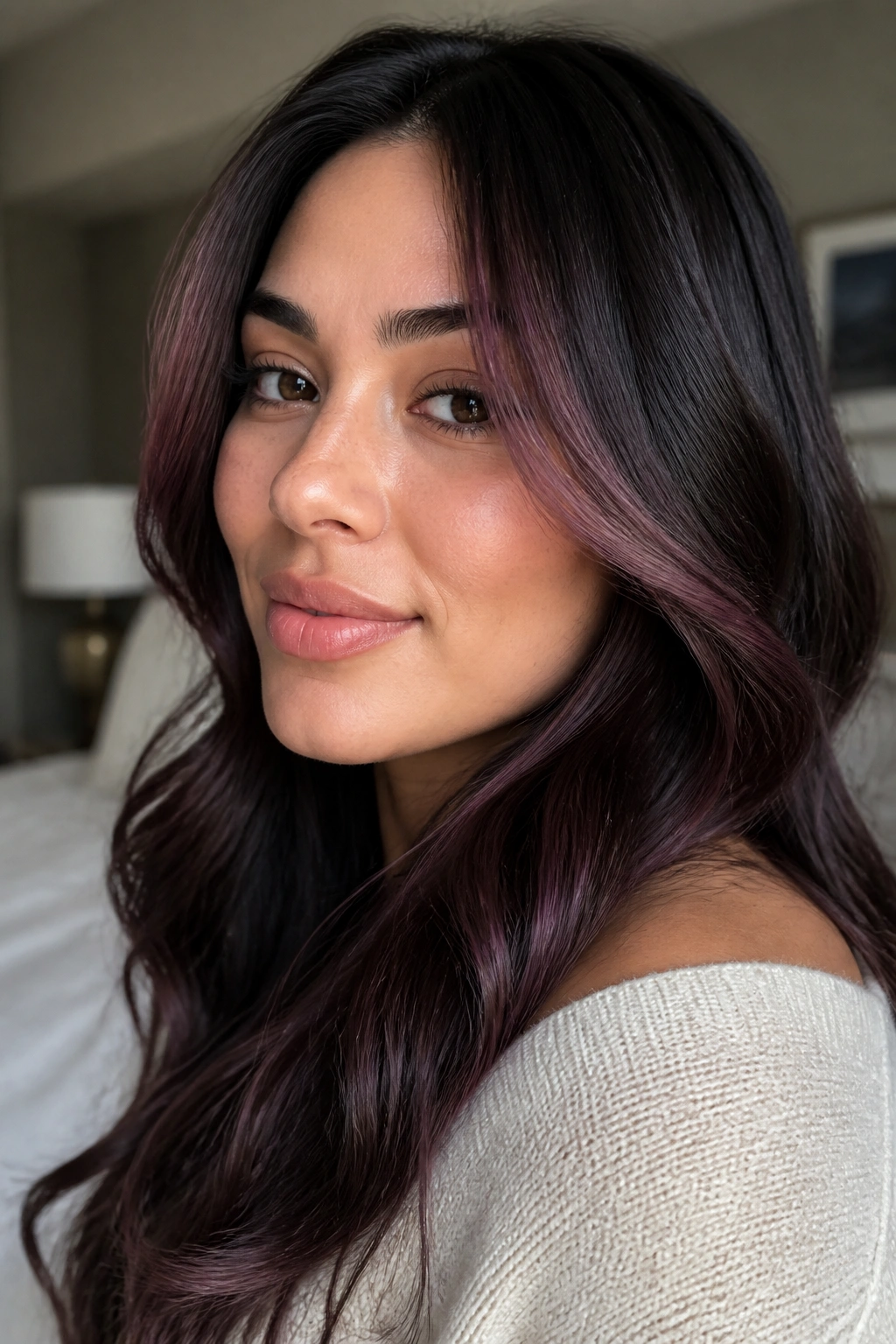
A money piece can be a cheat code on a round face, but only if the lightest strands start high enough. When the front sections begin around the cheekbone or just below it, the eye climbs up the face instead of sitting right at the widest point.
Why It Flatters
The brightest streak should behave like a frame, not a band. On a round face, a wide pale block near the temples can make the face look fuller, while a narrower violet-brown panel that lands just off the cheekbone reads longer and softer. Keep the root a shade or two deeper, then let the lightest brown-purple live through the front third of the hair.
What to Ask For
- 1/2- to 1-inch-wide front pieces on each side
- A soft plum-brown lift that starts near the cheekbone
- A root shadow that stays 1 to 2 levels darker than the front
- A gloss that leans mauve or blackberry, not neon violet
Best move: keep the brightest point about 1 inch away from the temple so the face doesn’t look wider where it already curves out.
2. Narrow Plum Balayage Through the Mid-Lengths
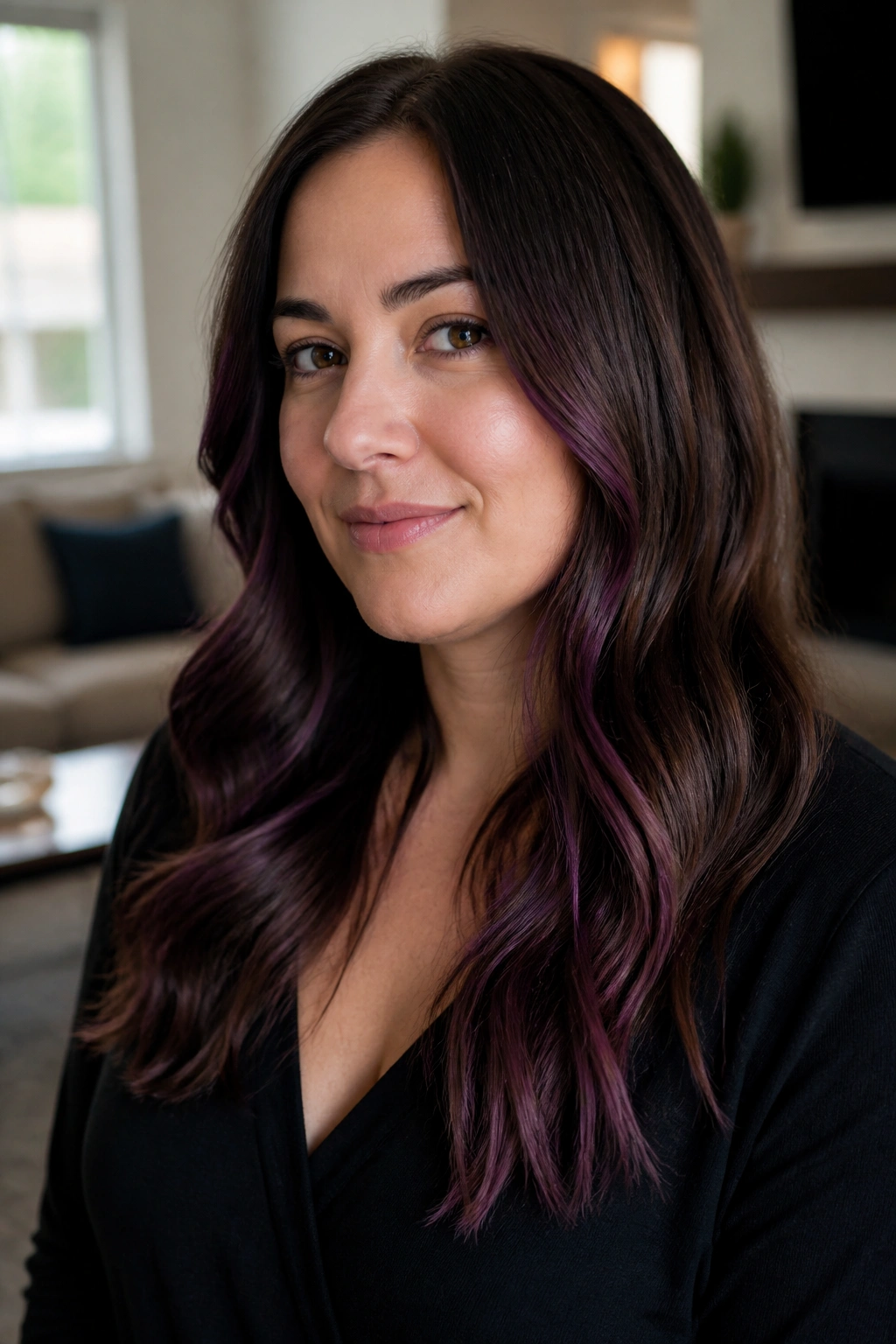
Balayage works here because it can stay narrow through the sides and heavier through the lower half of the hair. That matters on round faces. You want movement that falls downward, not a halo of color that spreads sideways at ear level.
The sweet spot is a base brown with plum-painted ribbons that begin below the cheekbone and get a little brighter from mid-length to ends. It gives a soft contour effect without looking stripy. On wavy hair, this placement is especially good because the bends break up the color and keep the face from looking boxy.
Ask for a painterly hand, not chunky patches. A colorist can leave the outer side sections deeper and place the lightest plum only where the hair flips forward or bends under. That keeps the face frame from puffing out. And yes, a few darker pieces near the temple are useful. They stop the front from turning into a solid pale curtain.
3. Feather-Fine Babylights for Fine Hair
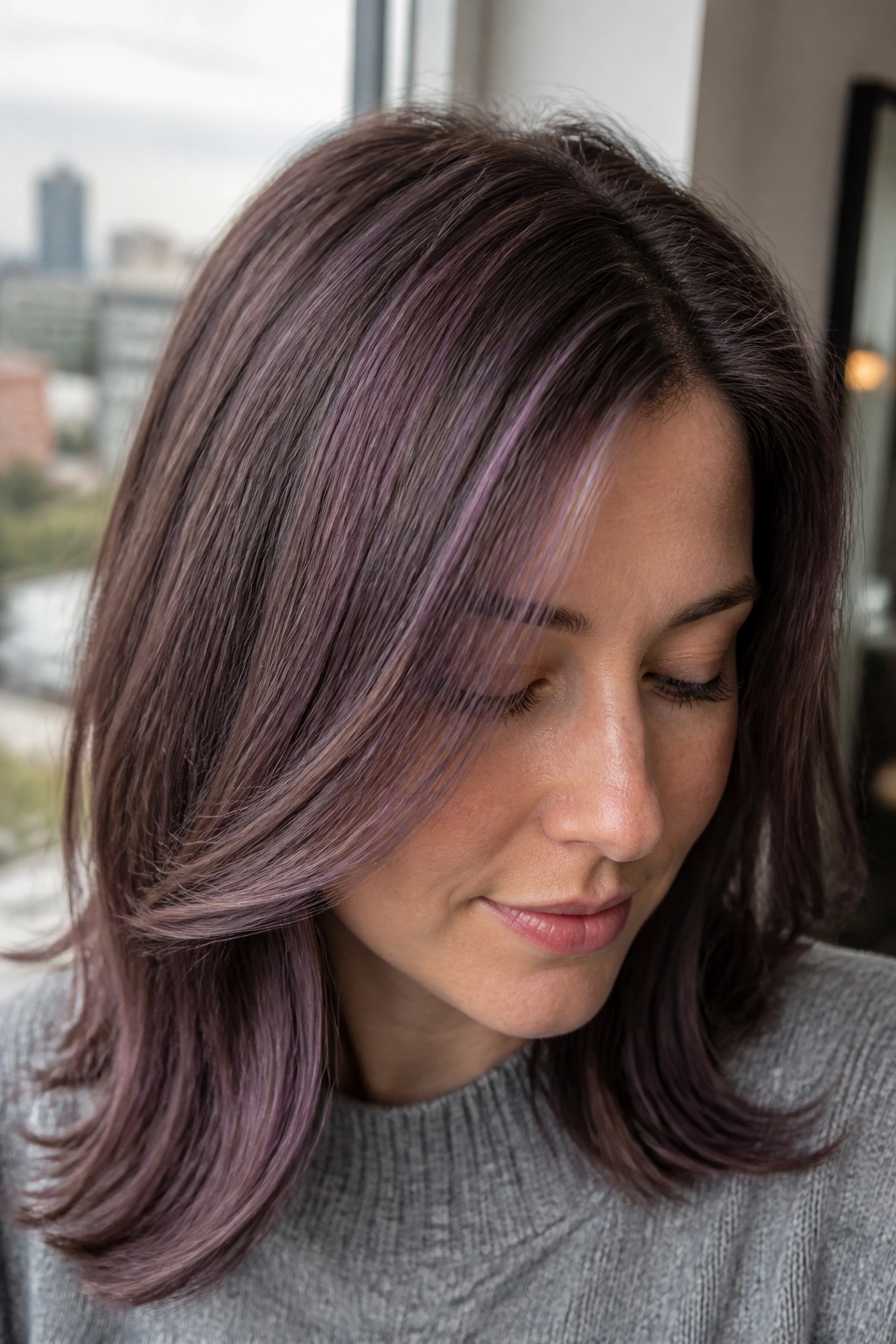
Can tiny highlights change the shape of a face? They can, if the foils are placed with some restraint. Babylights are ideal when you want purple brown highlights for round faces without obvious stripes or harsh edges.
What Makes Them Work
Feather-fine strands create a soft mist of color instead of a blocky frame. That softness matters when hair is fine, because thick ribbons can swallow the shape of the cut. A few ultra-thin plum-brown foils around the crown and front layers give the illusion of depth while keeping the perimeter light enough to move.
How to Place Them
- Use 1/16- to 1/8-inch slices
- Keep most light pieces above the cheek’s widest point
- Leave 2 to 3 deeper strands near the temple
- Finish with a cool brown-violet gloss so the color stays smooth
A little shine goes a long way here. Fine hair can look flat fast, and babylights help by catching light in small broken lines. Don’t overlighten the front. That’s the trap. Tiny pieces, close spacing, and a slightly deeper root make the whole cut look fuller and longer at the same time.
4. Violet Brown Ribbons on Wavy Hair
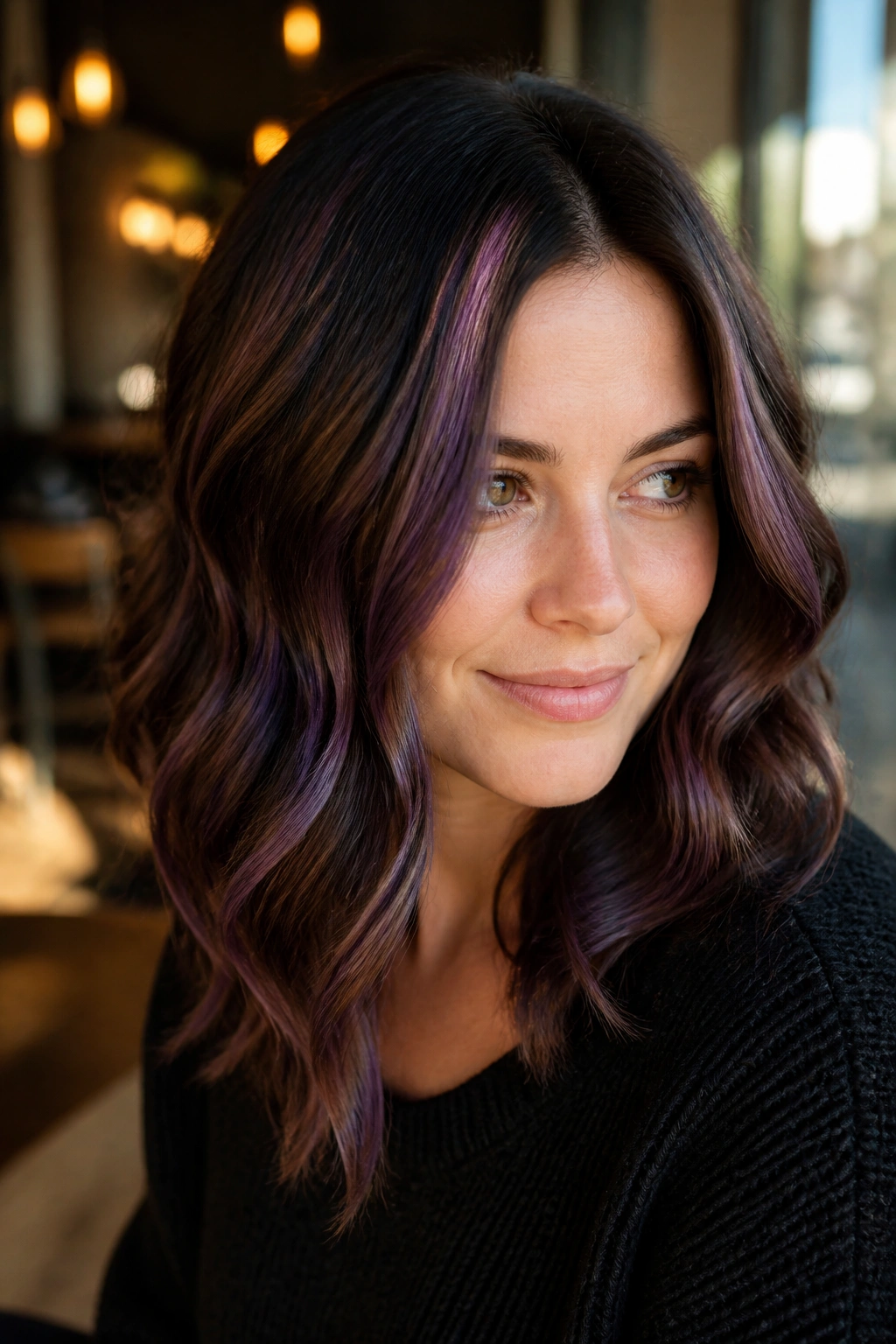
Picture shoulder-length waves with two or three thicker violet-brown ribbons falling through the front. That’s the sort of placement that gives round faces shape without trying too hard. Waves already bring movement, so the color only needs to follow the bend.
The trick is to keep the brightest ribbons vertical and a little uneven. Straight, even stripes can make the face look wider. But when the ribbons start just below the eyes and continue through the ends, they break the curve of the face in a better way. A level 6 brown with smoked violet through the mid-lengths usually gives enough contrast without turning dramatic in the wrong place.
Good Details to Request
- 2 to 4 thicker ribbons near the front layers
- A deeper violet brown at the roots
- Brighter pieces that stop before the jawline flares out
- Soft ends that are slightly lighter than the top
Round faces need length cues. These ribbons give them one.
5. Crown-Lift Foils That Build Height
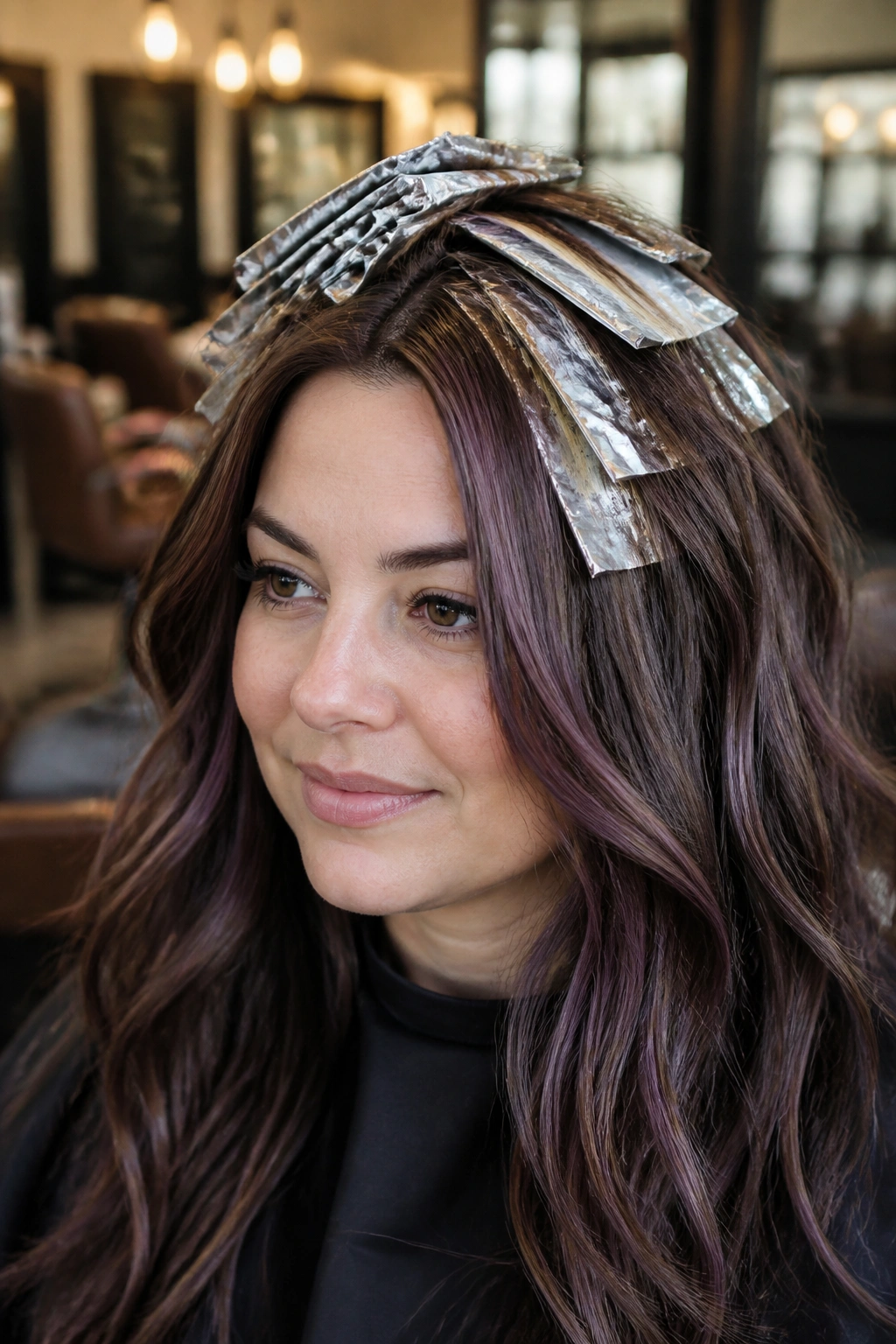
Height at the crown matters more than most people think. A round face often looks longer when the top has a little air and the sides stay quieter.
Foils placed in the crown area create that lift without shouting. The color can be a soft plum-brown or smoky aubergine, but the real point is the direction. Concentrate lightness at the top and slightly back from the hairline, then let the sides stay deeper. That draws the eye up instead of out.
What to Ask Your Colorist
- Place foils 1 to 2 inches behind the front hairline
- Keep the sides one step darker
- Use a violet-brown toner to blur the highlight lines
- Leave the underlayer rich and brown so the top can pop
This is a smart choice if your hair falls flat at the roots. A little extra lift makes the face feel less circular. It also grows out well, which is nice because crisp crown foils can get fussy if they’re too bright around the temples.
6. Peekaboo Purple Brown Panels Under the Top Layer
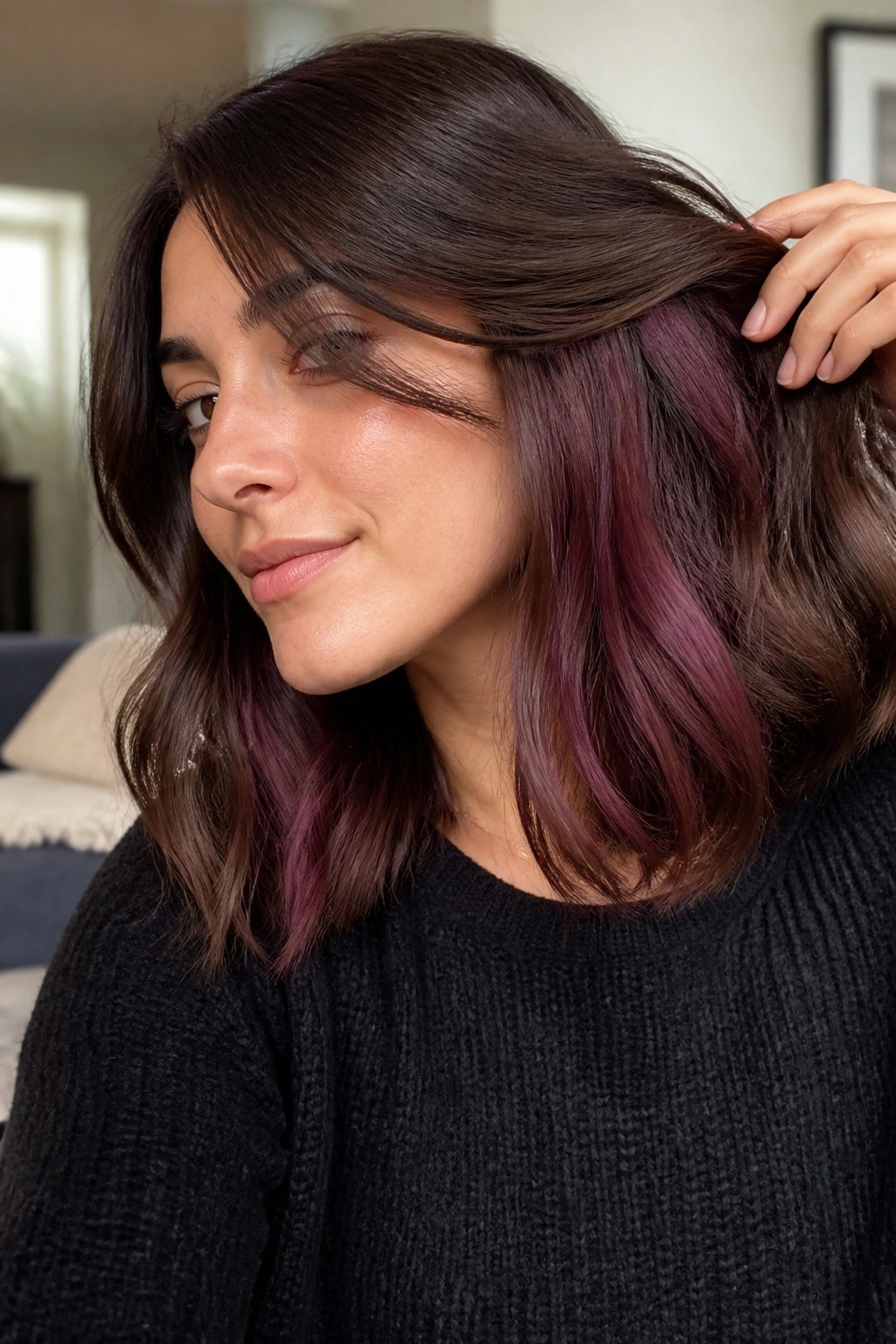
A hidden pop of color is useful when you want edge without a wide halo of brightness. Peekaboo panels sit under the top layer, so the face still keeps its depth while the movement underneath flashes purple brown when the hair shifts.
That works especially well on round faces with layered cuts. The top layer can stay deep mocha or espresso, which helps narrow the profile visually, while the lower sections carry plum or blackberry tones. You get dimension without making the outer edge of the hairline look wider.
The style also gives you more control. Tie your hair half up, and the color shows. Wear it down, and the shape stays smoother. If you dislike obvious face-framing streaks, this is the quieter route. It’s also a good fit for people who want fashion color but still need the hair to look office-friendly most of the time.
7. Purple Brown Shadow Root with Mauve Mid-Lengths
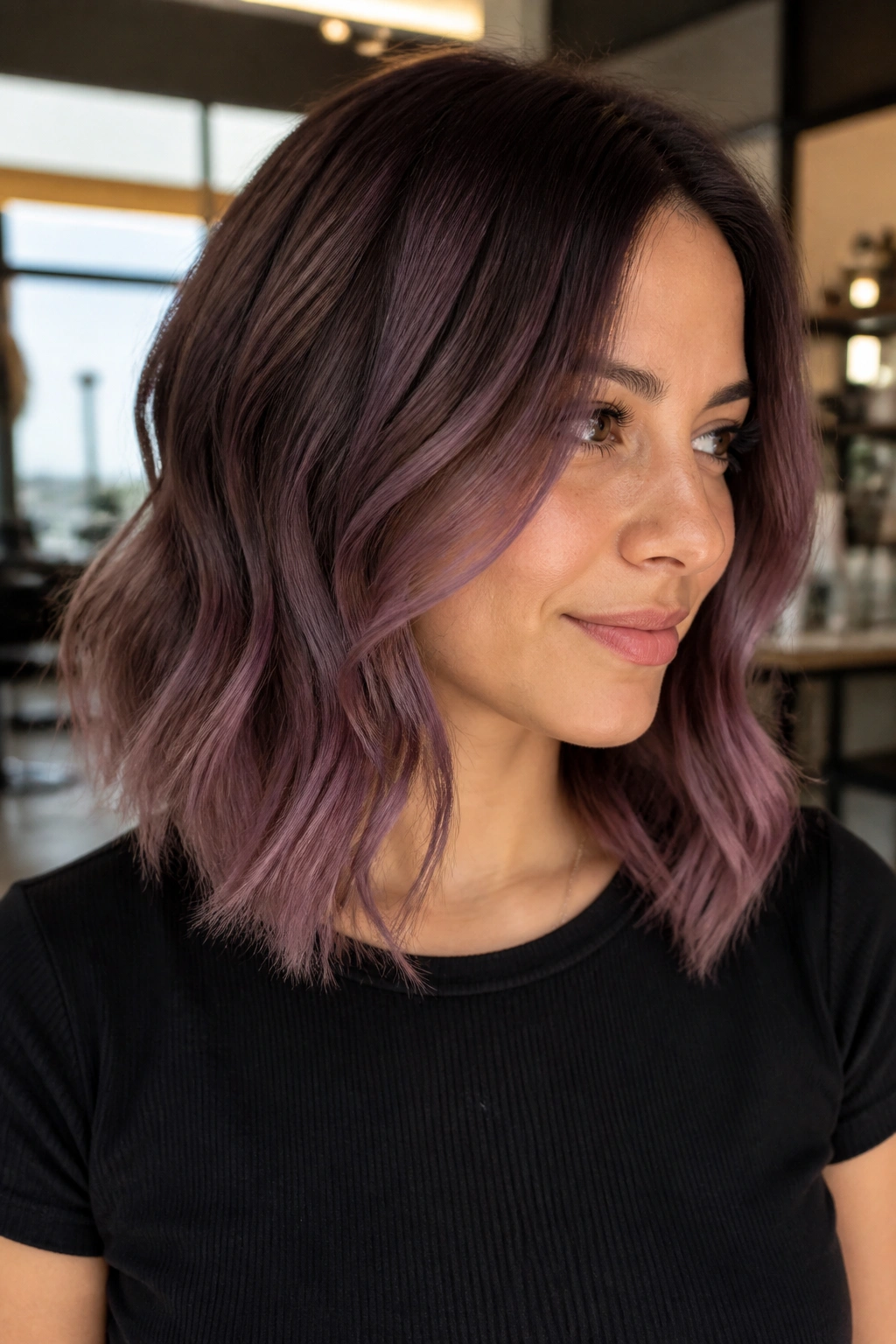
Why do some purple brown highlights feel softer on round faces? The answer is the shadow root. A deeper root keeps the top of the head compact, which makes the face read longer before the lighter color even starts.
Why the Shadow Root Helps
A strong root melt removes the hard stop that can happen when bright pieces begin too high. Instead of a line, you get a slow fade from espresso or dark chestnut into mauve-brown and then into brighter plum ends. That fade looks especially good on lobs and long bobs, where the shape already needs a little vertical pull.
What to Tell the Salon
- Ask for a root shadow 1 to 2 levels darker
- Keep the mauve mid-lengths below the cheekbone
- Let the lightest purple-brown live in the bottom third
- Finish with a gloss, not a heavy toner, so the blend stays soft
This is the kind of color that grows out gracefully instead of begging for a touch-up every few weeks. And it has one more advantage: it keeps the front from getting too wide and fluffy.
8. Mushroom Brown with Violet Lowlights
Highlights are not always the answer.
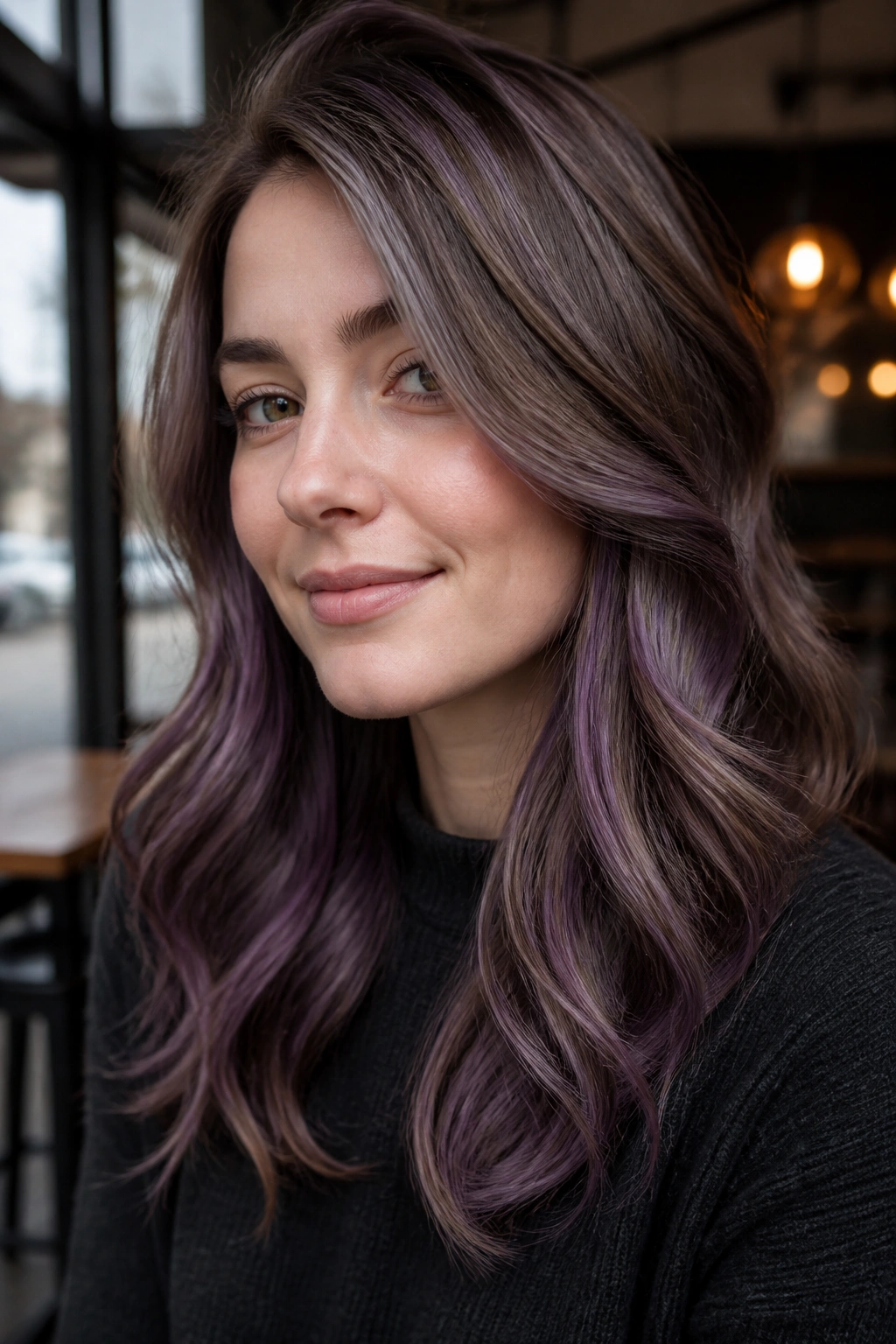
On a round face, too much lightness can spread the hairline outward. Violet lowlights fix that by building narrowness back into the shape. A mushroom brown base with cool plum or grape-toned lowlights creates a smoky finish that feels modern without being loud. It also makes brighter pieces look more intentional, because the depth around them gives the eye something to compare against.
This style works especially well if your hair is already light brown or dark blonde and you want the purple-brown family to feel subtle. Instead of painting in obvious front streaks, weave the darker violet tones through the mid-lengths and underlayers. Leave a few brighter ribbons on top, then let the darker pieces sit around the sides. That keeps the shape clean.
Dark pieces matter. They’re the quiet part of the haircut’s contour.
9. Blackberry Ends on Long Layers
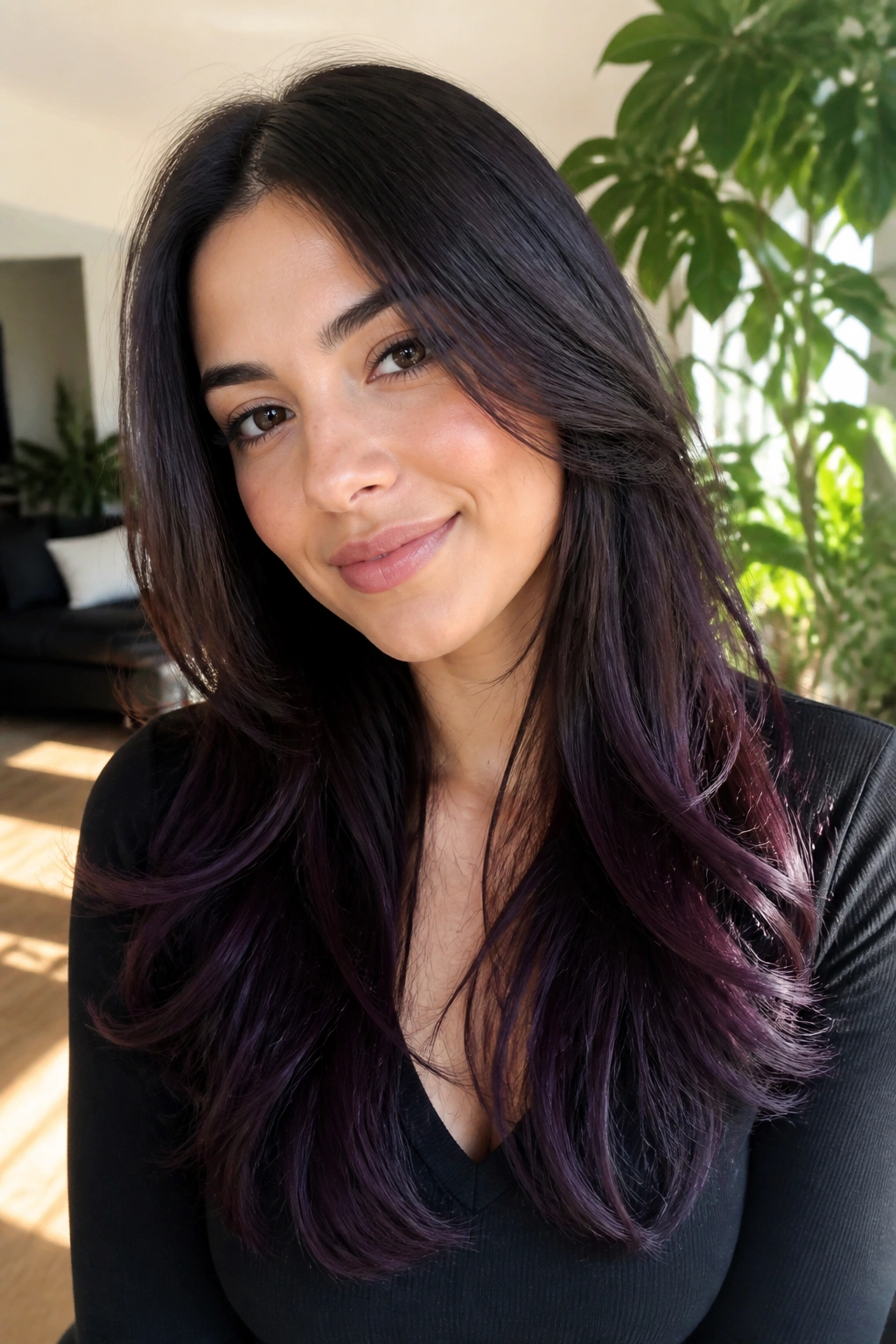
Long layers and blackberry ends are a good match because the color falls away from the cheeks. That matters. On a round face, anything that pulls the eye lower helps the face read longer.
The idea is simple: keep the roots and upper mids a rich brown, then let the ends drift into plum-blackberry territory. The color can be soft and glossy, not punky or harsh. It’s the placement that does the work. When the lightest shade is concentrated near the bottom of the hair, the eye follows the length of the cut instead of parking at the cheeks.
Why the Ends Should Do the Heavy Lifting
- They create vertical movement
- They keep the top half from looking wide
- They work well with U-shaped or layered cuts
- They look especially good when the hair curls under slightly
If your hair is long enough to reach the collarbone or lower, this is a strong option. It gives the face a slimmer outline without needing loud front pieces.
10. Temple Contour Highlights
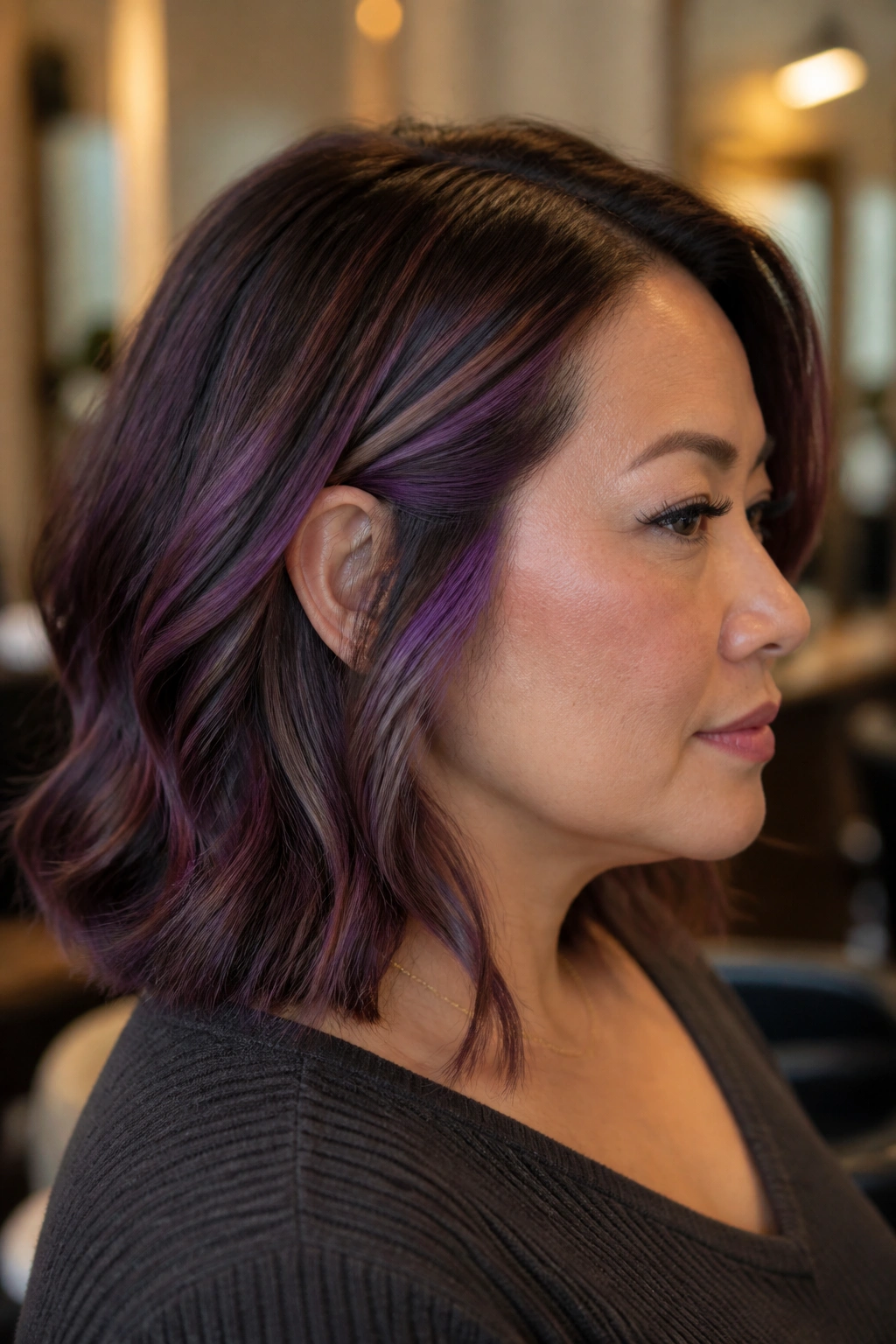
The temples are the spot most people miss. Lightening them too much can widen the face, but leaving them dead flat can make the front look heavy.
The smarter move is a contour highlight that starts just above or just behind the temple and bends downward in a slim purple brown ribbon. Think of it like a hairline shadow sketch. The light piece should be narrow, broken, and a touch darker at the root, then slightly brighter as it slips toward the cheekbone. That shape can soften the curve of a round face without turning the sides into a bright wall.
Use this if you wear your hair tucked behind one ear a lot. The highlight shows off the line of the cut, not just the color. And if you have a layered bob, the placement can make the front pieces look longer than they are. That little visual stretch matters more than people expect.
11. Curtain Bang Accent Lights
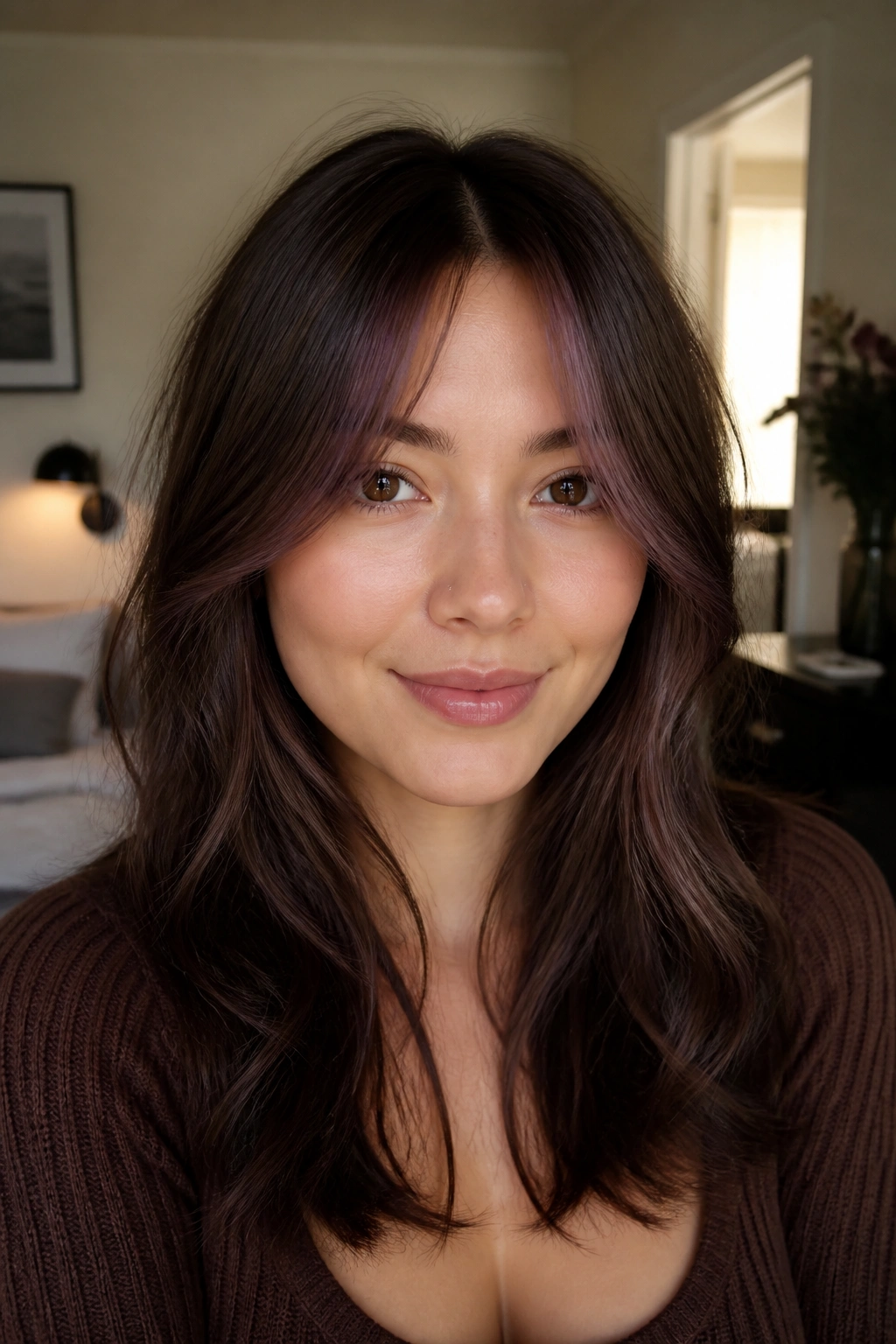
Curtain bangs can do more than hide the forehead. They can steer the eye down and out, which is helpful on a round face if the color is handled with care.
A slim purple brown accent in each curtain bang keeps the center of the face from feeling heavy. The highlight should be thin at the root, then a touch brighter through the bend of the bang, almost like a soft wash of lilac-brown. Too much light at the bang line will look chunky. Too little and the bangs disappear into the rest of the cut.
Pair the bangs with slightly deeper face-framing lengths. That contrast helps the bangs read as a diagonal line rather than a shelf. And that diagonal line is doing sneaky good work, because diagonals always feel longer than curves.
A small color shift here can be enough. You don’t need a full front panel.
12. Curly Halo Purple Brown Highlights
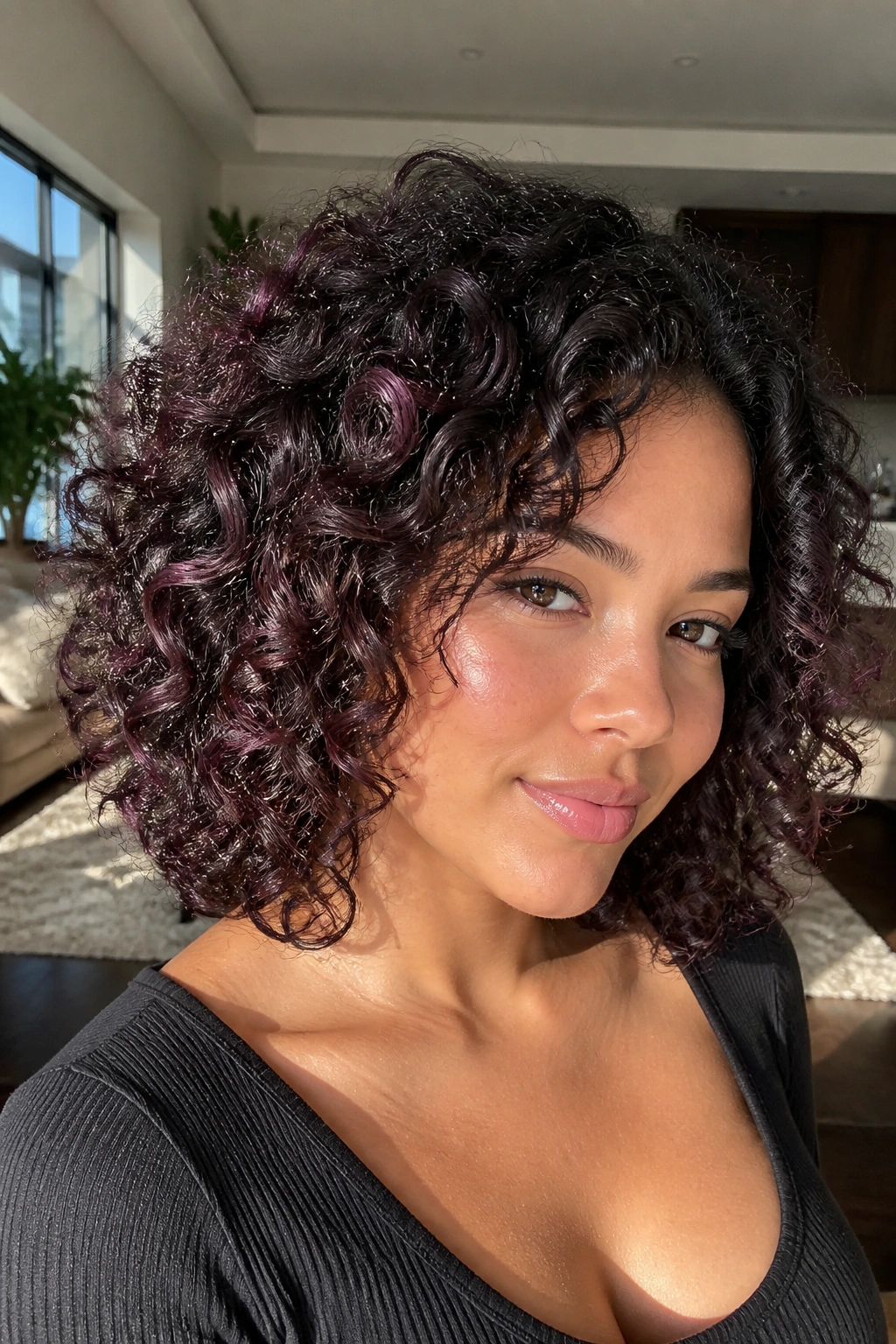
Curly hair changes the color game completely. The same purple brown highlight that looks bold on straight hair can look soft and floating in curls because the coil pattern breaks it up.
For round faces, the best move is a halo of highlights on the outer ring of curls, with the brightest pieces sitting above the cheek line and through the top layers. Leave the interior darker. That keeps the shape from ballooning out at the sides. A plum glaze on a level 4 or 5 brown base gives the whole shape depth, while the brighter curl caps catch the eye and create lift.
What Curly Hair Usually Needs
- Highlight the outer canopy, not the bulk inside the curl
- Keep the lighter pieces broken and staggered
- Leave some deep brown near the ears and jaw
- Use a moisture-rich toner or gloss so curls stay shiny
Curls already have volume. The color should refine that volume, not fight it. A halo approach does that nicely.
13. Vertical Foilage on a Lob
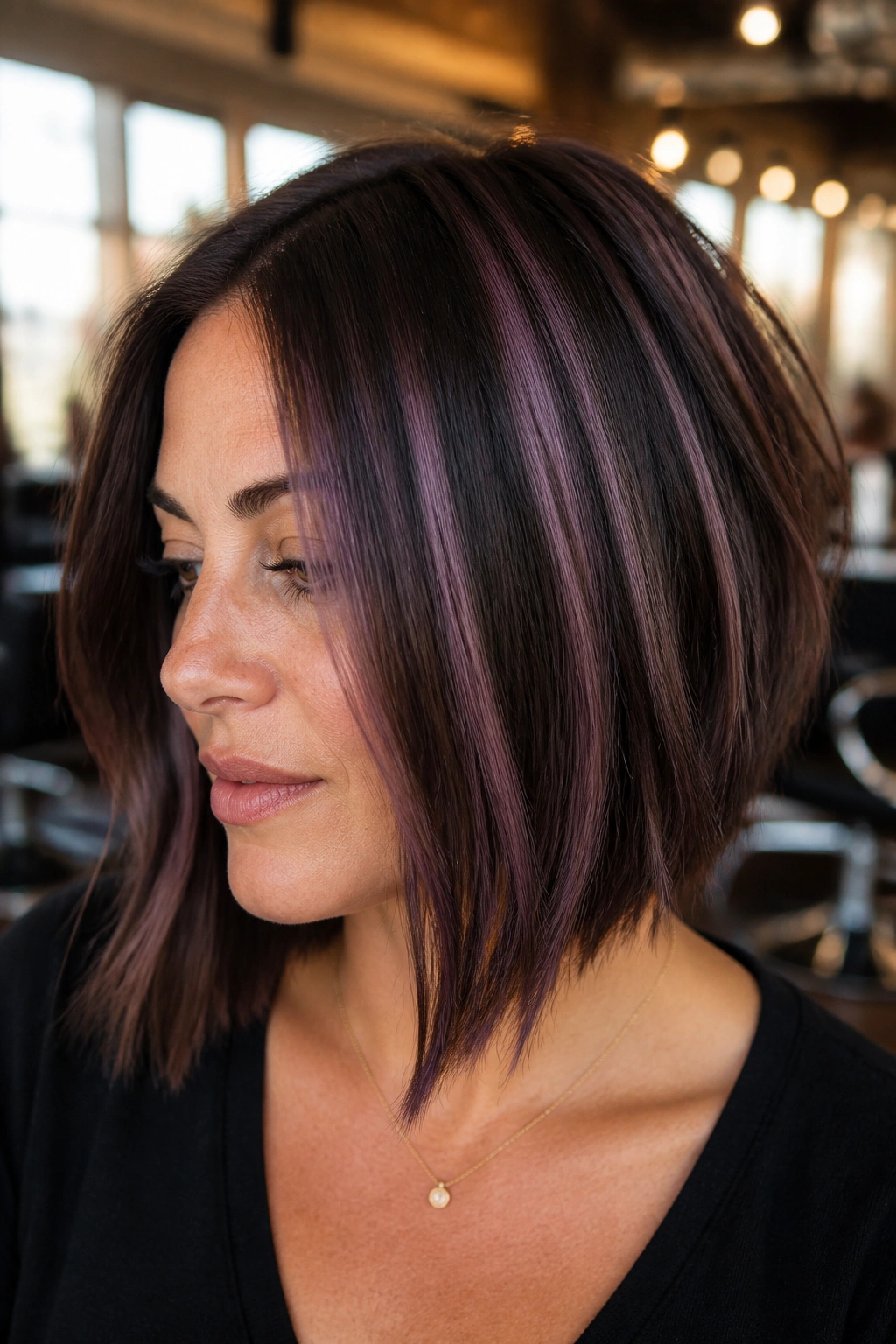
Vertical foilage is one of the cleanest ways to make a round face look longer. The direction is doing almost all the work.
Instead of placing the brighter purple brown pieces horizontally around the face, run the foils from root to ends in narrow columns. On a lob, that creates lines that travel down the hair rather than across it. The face gets the same benefit from those lines that it gets from a V-neck: the eye moves in a longer path.
This is a good choice if you want visible color but don’t want a chunky face frame. Ask for a deeper root, a soft plum-brown midsection, and a slightly brighter end. The pieces can be 1/4-inch wide or a little larger, depending on how bold you want the result. Keep them spaced far enough apart that the lob still shows some brown between the purple tones. That separation keeps the shape sleek.
Vertical placement. Simple. Effective.
14. Smoky Plum Streaks on a Short Bob
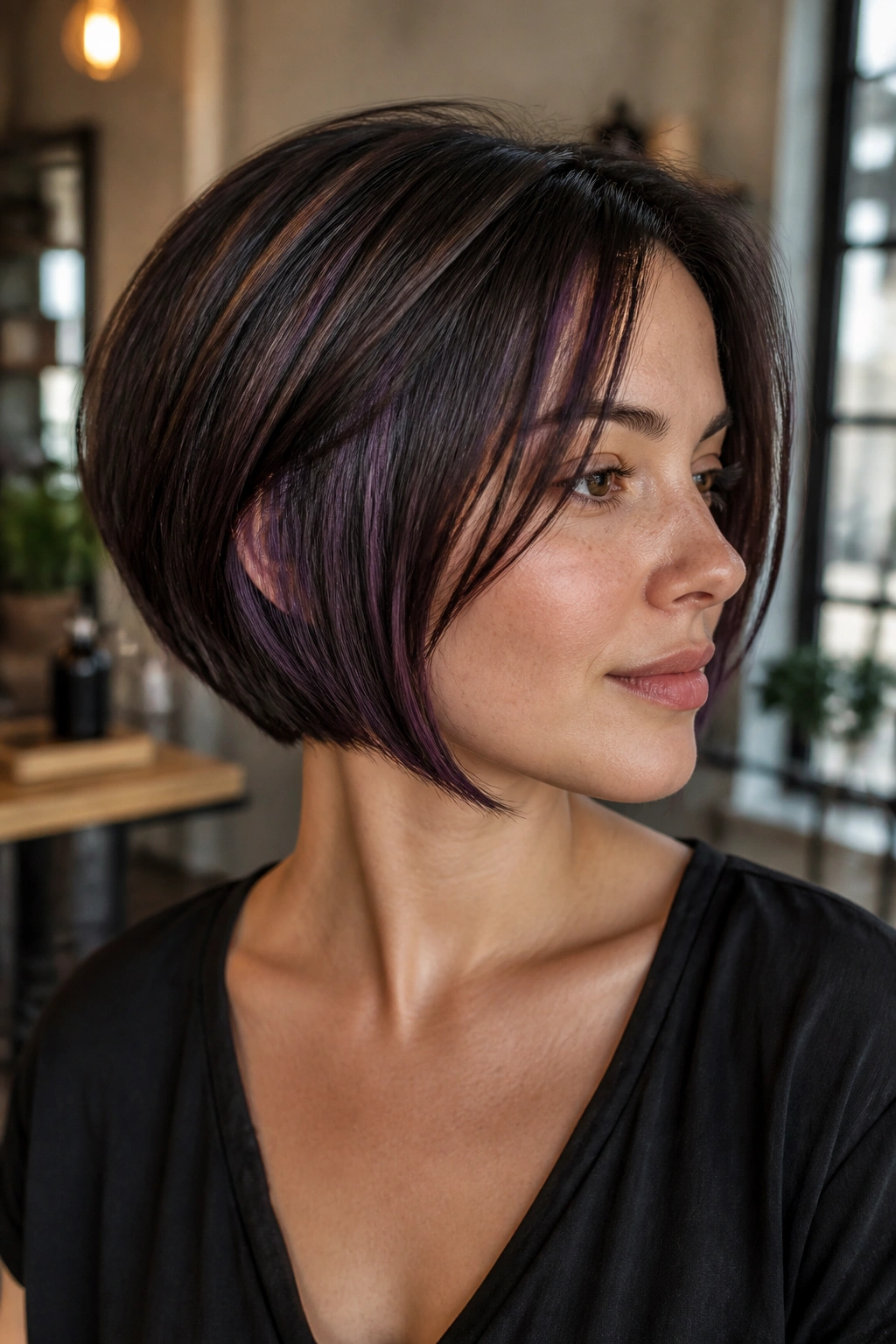
A short bob can look sharper than a long cut because the line is right at the jaw. That means color placement has to be careful. Smoky plum streaks are useful because they add texture without expanding the sides.
The best streaks on a round face sit a little below the cheekbone and angle slightly forward. They should not fan out at the widest part of the face. A bob already has strong shape, so the color only needs to add movement through the front corners and a bit of brightness through the top layer. Keep the nape rich and dark. That contrast makes the bob feel tidy, almost sculpted.
If you like a more editorial look, add one or two brighter violet-brown slices near the front edge. Not many. Just enough to break the line. Too much light around the jaw will round the cut out. A few smoky streaks are cleaner and far more flattering.
15. Espresso Base with Lavender Brown Ribbons
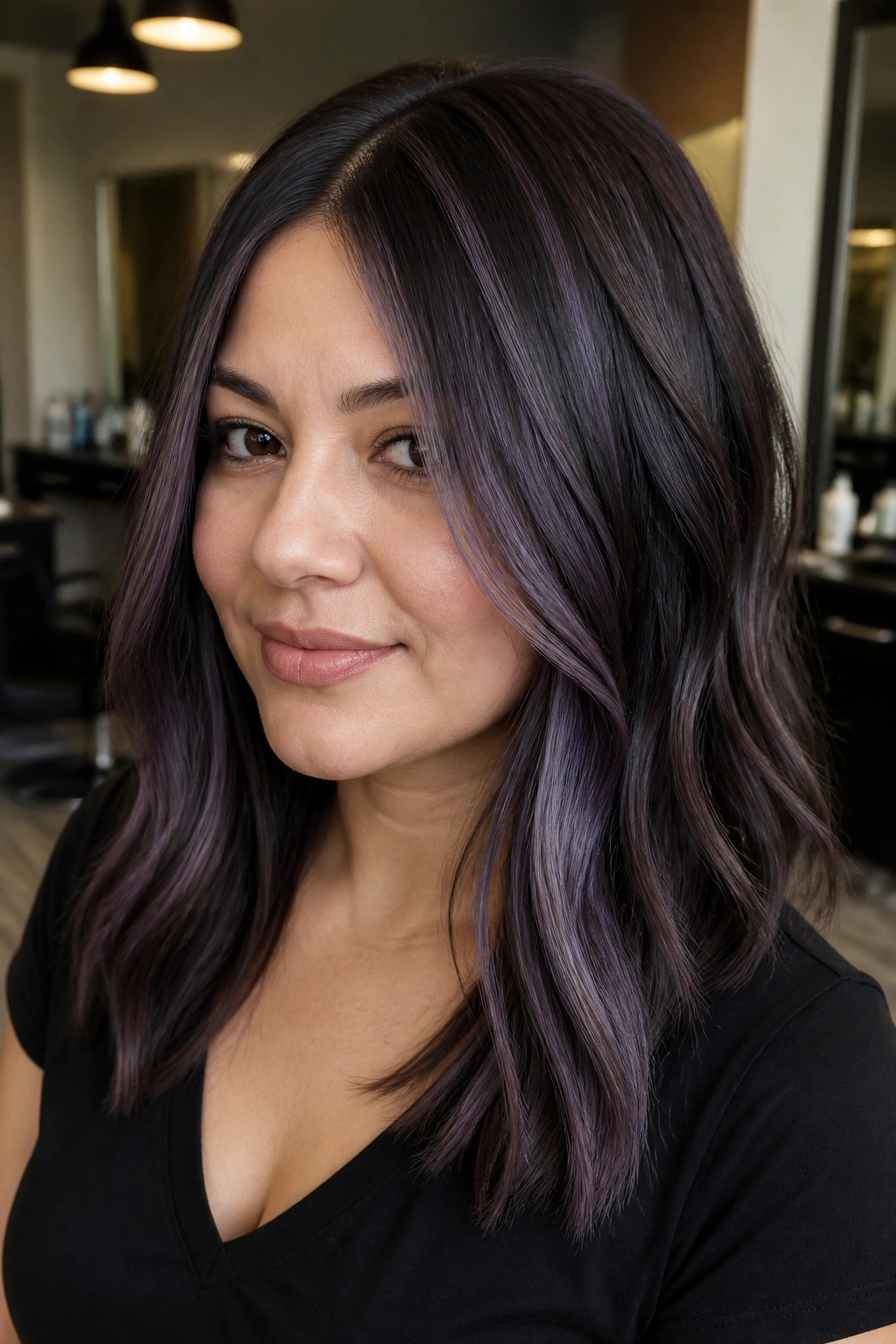
Can lavender brown feel grown-up? Absolutely, if the base stays dark enough.
An espresso base gives the face structure right away. Then the lavender-brown ribbons can show up as soft cooler streaks through the top and front sections. Because the base is deep, the ribbons never take over the whole head. They just sit there and shimmer a bit when the hair moves. On a round face, that contrast helps pull the eye vertically, especially if the ribbons are kept slim and slightly longer than chin length.
A Smart Placement Pattern
- Dark espresso at the roots and underlayer
- Lavender-brown ribbons through the top third
- Slightly brighter ends near the collarbone
- Minimal lightness around the widest cheek area
This look has a nice balance of polish and edge. It’s not loud. It does not need to be. The color shows enough personality on its own.
16. Chunky Highlights for Dense Hair
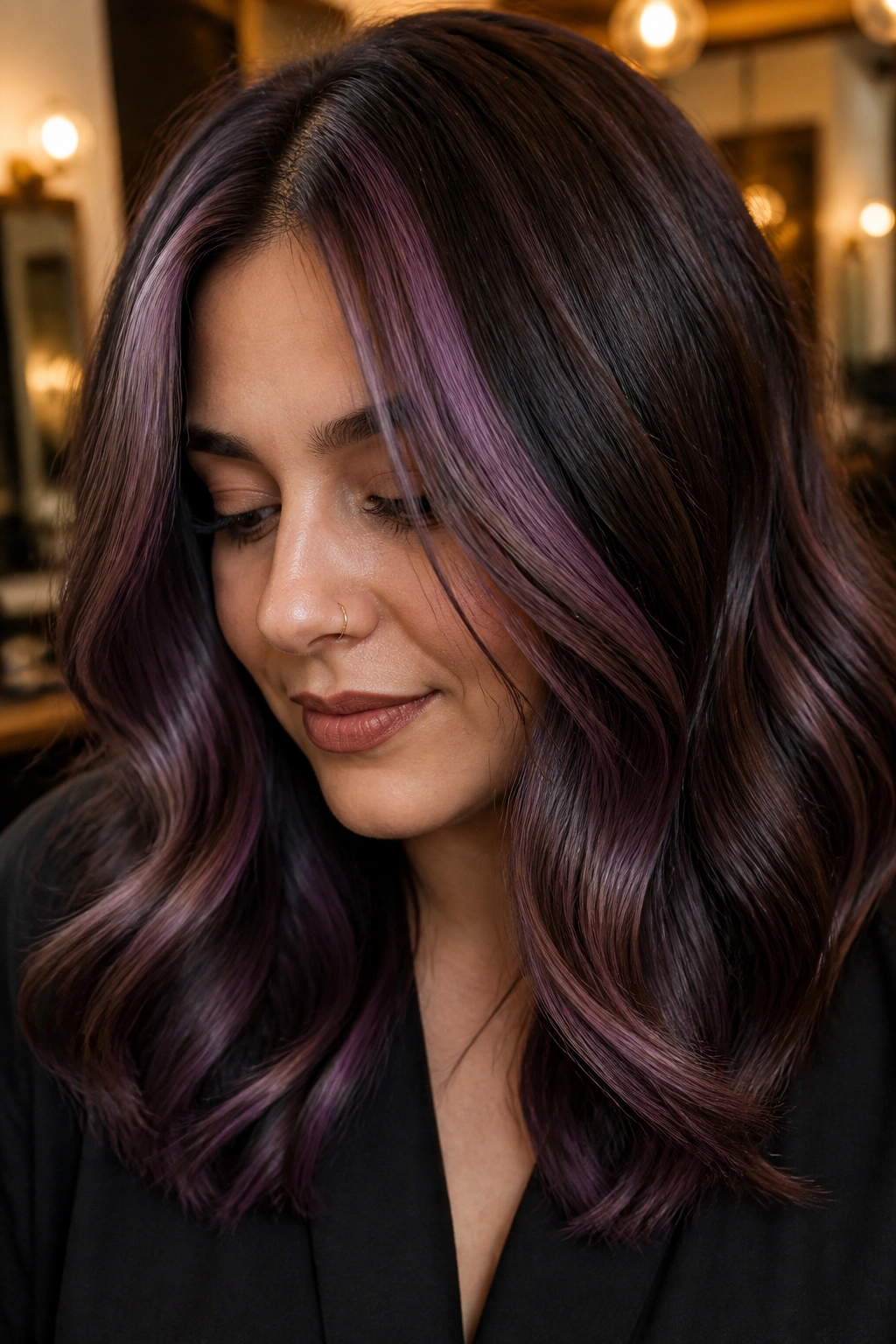
Dense hair needs a different plan than fine hair. Tiny babylights can disappear in all that texture, and the face ends up looking heavier because the color has no clear shape.
Chunky purple brown highlights solve that by making the pattern easier to see. On a round face, the chunks should still be placed with some restraint: a few bold ribbons through the front, more space through the sides, and deeper brown in between. That dark spacing keeps the hair from turning into a solid light blanket, which can happen fast with dense hair.
How to Keep It Flattering
- Use larger sections near the front, smaller ones farther back
- Keep the widest point of the face in deeper brown
- Break up the chunks with one or two darker lowlights
- Choose a smoky plum tone instead of a bright purple
Dense hair can carry contrast. It often looks better with it. The trick is to let the chunks travel downward, not spread outward. That’s where the face-shaping part comes in.
17. Mulberry Tips on Shoulder-Length Cuts
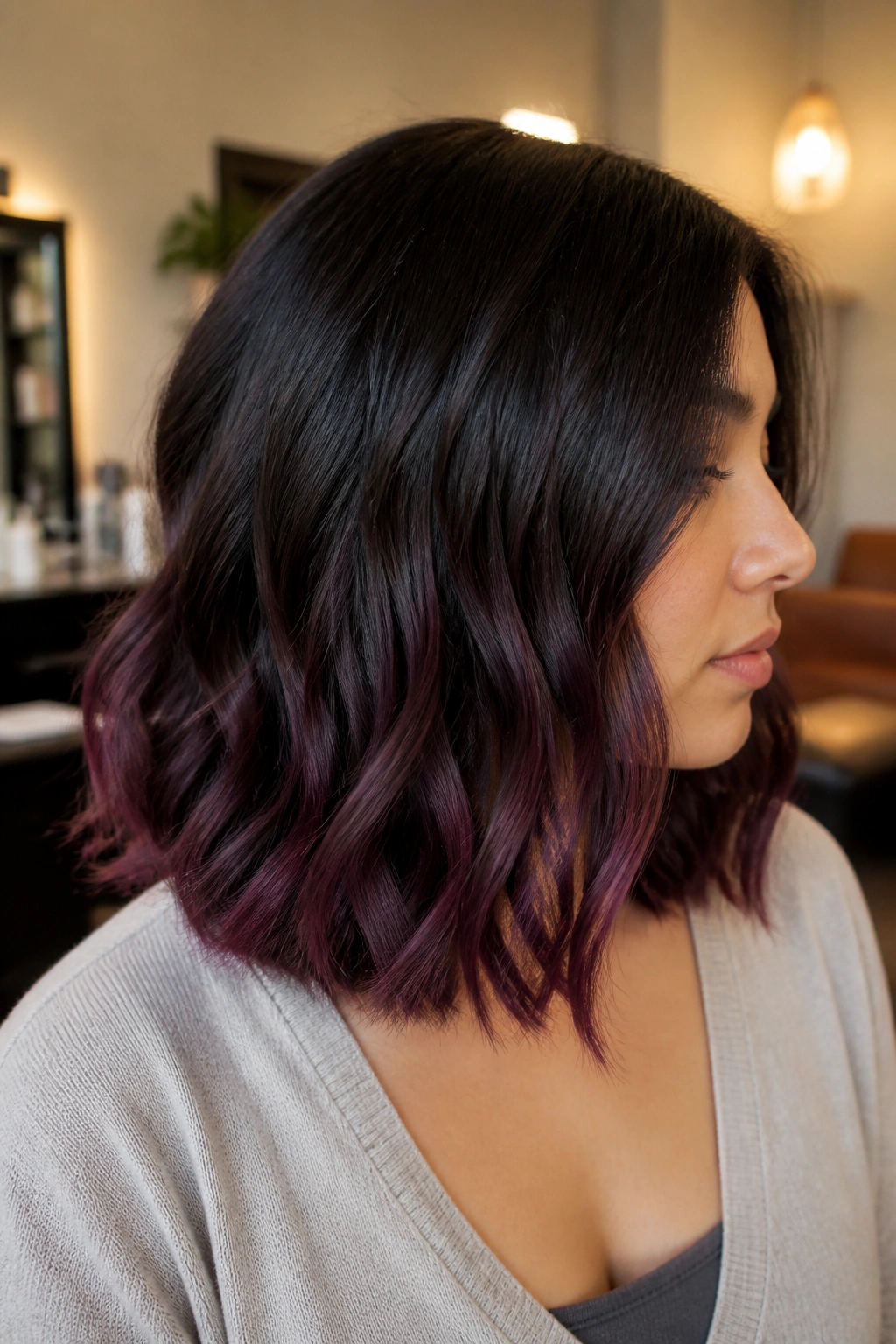
Unlike face-framing streaks, tip color works from the bottom up. That can be a smart shift for round faces, especially when the haircut sits at the shoulders and already has enough volume near the cheeks.
Mulberry tips keep the color concentrated where the eye naturally falls at the ends. The top stays a deeper brunette, which helps narrow the face visually, while the bottom edge gets a richer purple-brown finish. The effect is subtle at first glance and more noticeable when the hair moves. It’s a nice answer for people who want color that doesn’t fight their features every time they look in the mirror.
This placement also works well with bends and loose waves. The color clusters at the bottom curve, so the eye follows the length of the hair instead of stopping at the middle of the face. That little shift can make shoulder-length cuts feel longer and lighter.
If you want low maintenance, this is a solid place to be.
18. Ash Brown with Grape Lowlights
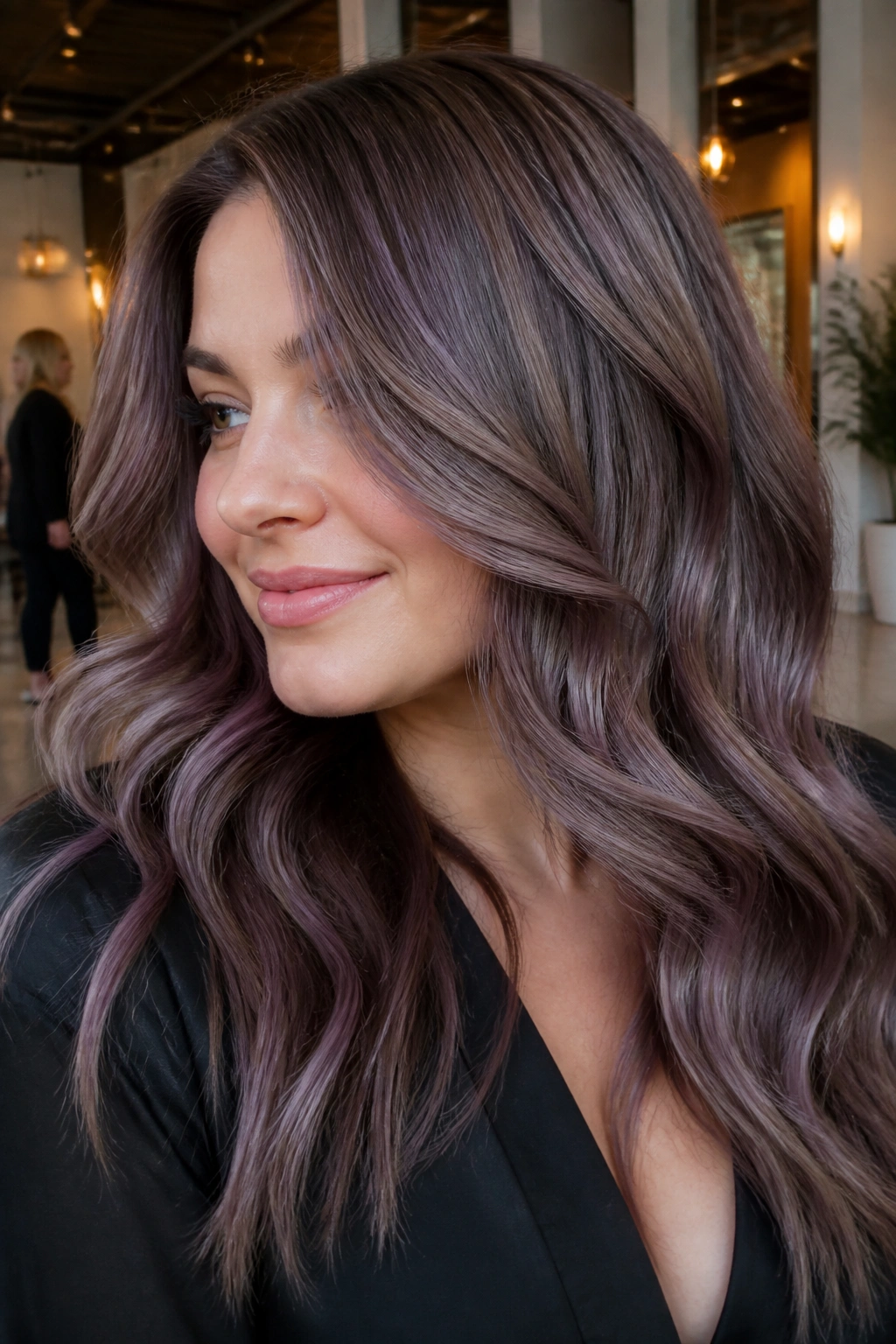
Ash brown can turn flat fast. Grape lowlights stop that from happening.
The cool mix of ash and purple-brown depth is useful on round faces because it keeps the sides from puffing out visually. Instead of brightening everything, you’re adding shadow in the places where the face already curves. That means the hair reads slimmer at the sides and fuller where it should be, especially through the crown and ends. The purple needs to stay dark and smoky here. Too much brightness would cancel the effect.
This is a good option if your natural hair sits around a level 6 or 7 and you don’t want a big color shift. Ask for grape lowlights woven through the top and sides, then leave the front a touch lighter only at the ends. That gives you dimension without dragging the whole look into a heavy, muddy zone. And no, muddy is not a good look. It’s the thing to avoid.
19. Jawline Slices That Stretch the Face
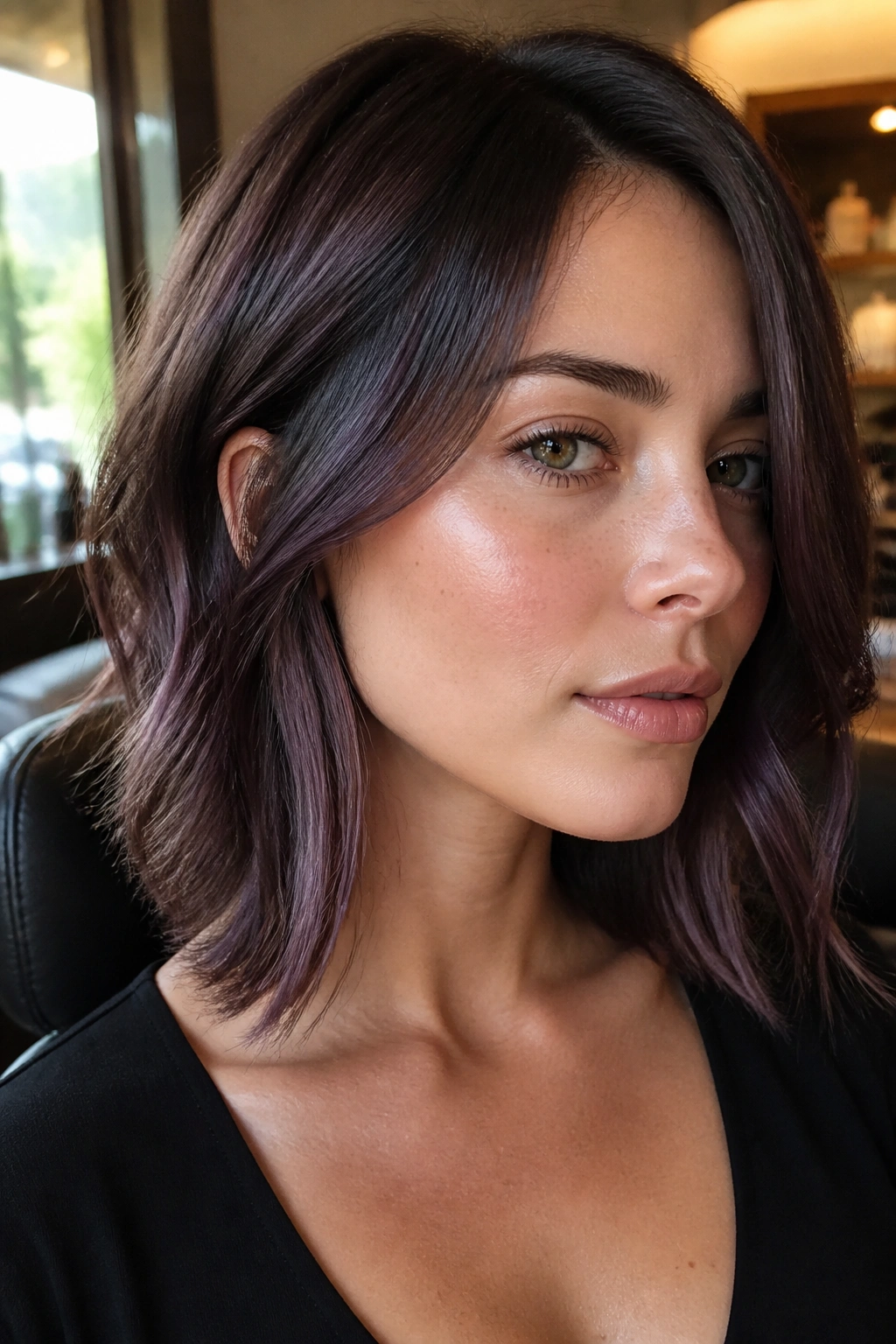
Jawline pieces can be risky, so placement matters a lot. The smartest ones don’t sit on the curve of the cheek. They start a little lower and travel downward in narrow purple brown slices that skim the jaw and move toward the collarbone.
That creates a longer line on the face, which is the whole point. A round face benefits from anything that gives the eye a sense of length. Broad light pieces at the jaw do the opposite. They make the face feel wider. Slim slices, especially when they’re a shade brighter than the base but still in the brown-purple family, draw a cleaner line.
I like this approach on layered lobs and mid-length cuts. The slices can peek through when the hair is tucked behind the ear, but they don’t dominate the front. If you like a softer contour effect, keep the slices a bit smoky and avoid high contrast. The result feels tailored rather than flashy.
20. Rooted Purple Brown Ombré
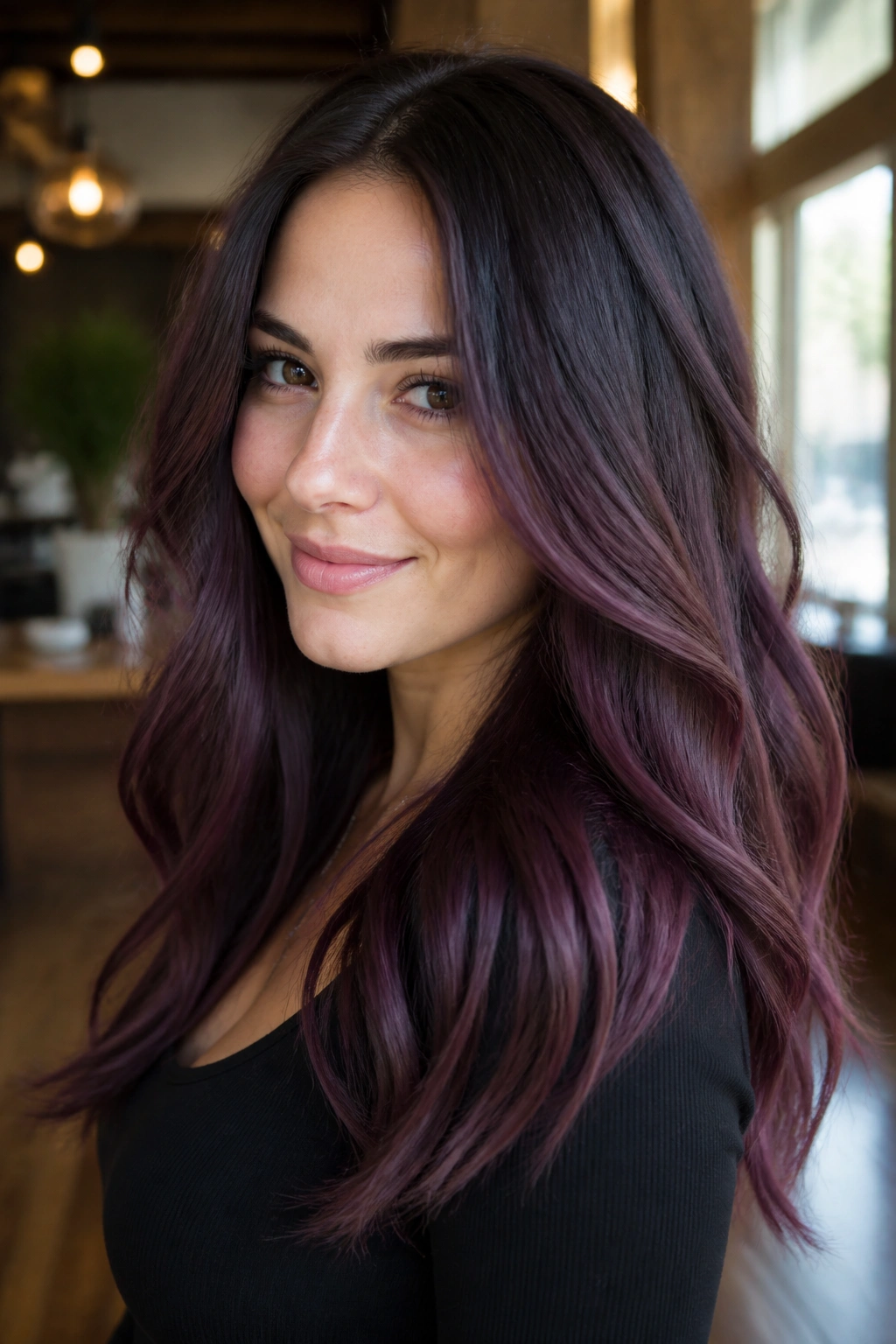
A rooted ombré gives the hair a natural top-heavy weight that works well on round faces. Dark roots keep the crown visually compact, while the purple brown through the lengths and ends pulls the eye down.
The best version stays rooted in espresso, chestnut, or dark mocha and slowly opens into plum-brown through the middle and lower sections. You want the fade to look gradual, not like two different colors slapped together. A good ombré should feel like the hair is getting lighter as it falls, which is exactly why it helps a round face. Gravity does part of the styling for you.
This style is also forgiving if you’re not in the mood for constant maintenance. The root can grow a little, and the look still holds. If you add loose waves, the color break becomes even more flattering because the bends create vertical movement. Keep the brightest part below the chin if you can. That detail keeps the front from ballooning out.
21. Purple Brown With Copper Undertones for Warm Skin
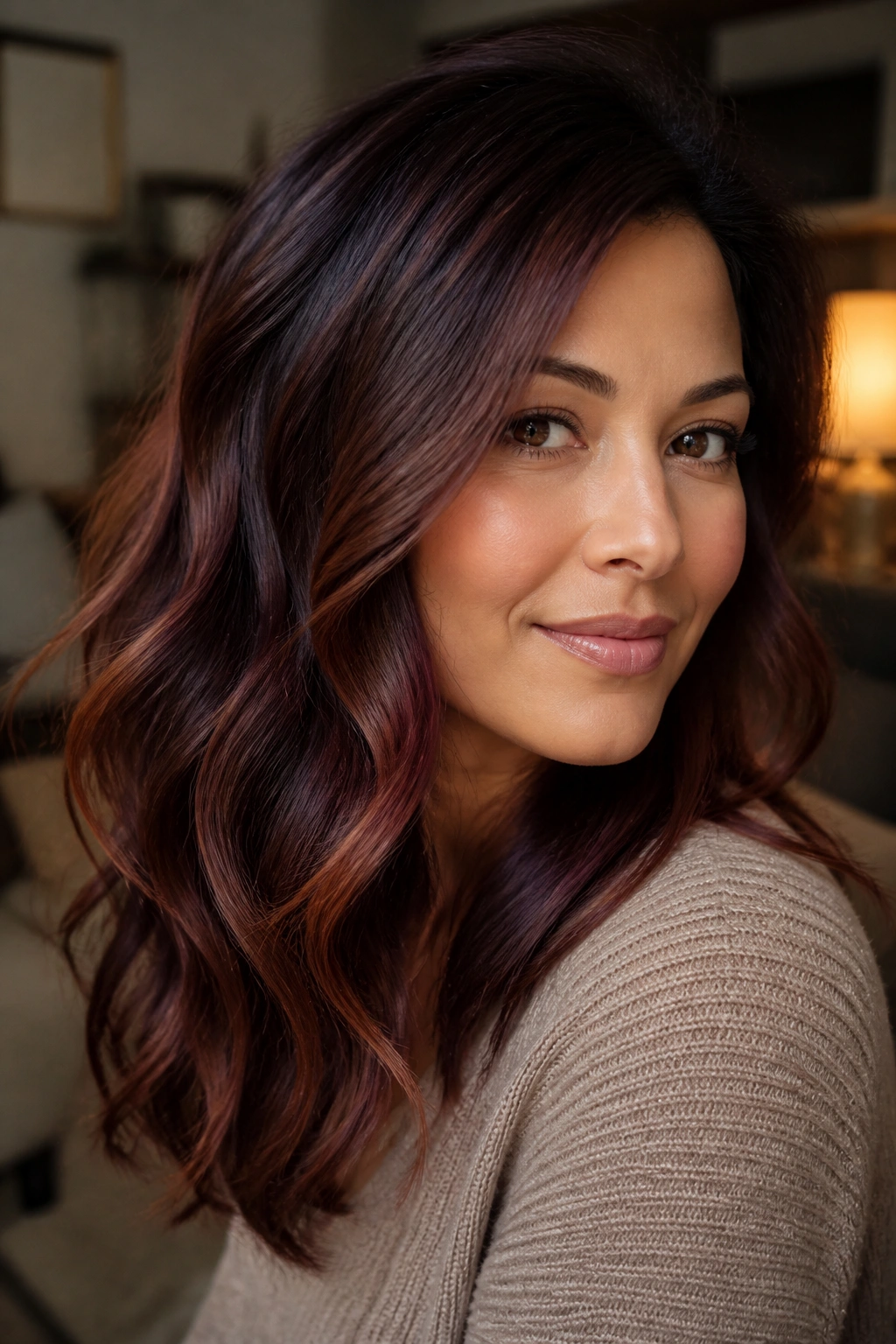
Skin tone changes how purple brown reads, and warm skin can make a plum-brown look flat if the shade leans too gray. A little copper in the mix fixes that. It keeps the color alive while still giving the round face the shape help it needs.
The trick is to use copper only as a whisper, not a shout. Think mahogany-brown with a violet cast and a warm glow at the ends or on a few front pieces. That touch of warmth keeps the hair from disappearing against peachy or golden skin. On a round face, I like this best when the warmer pieces stay lower on the hair, because bright warmth around the cheeks can widen the silhouette.
Ask for a gloss that sits between berry and chestnut. It gives depth without turning muddy. If your skin tans easily or leans golden, this family tends to look more natural than icy plum.
22. Purple Brown With Inkier Plum Notes for Cool Skin
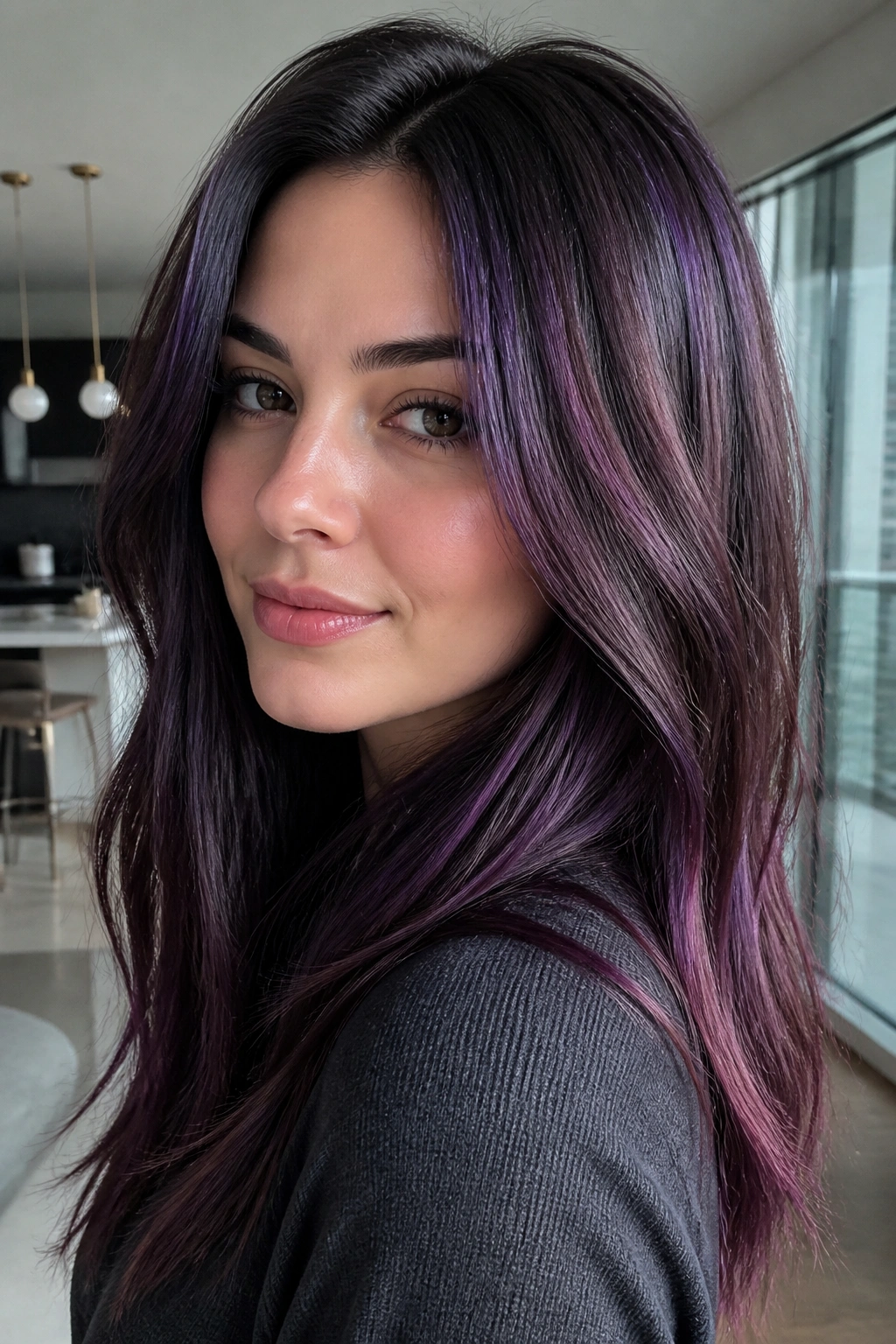
Cool or rosy skin usually likes a different kind of purple brown. Blue-plum, blackberry, and inkier mauve tones sit closer to the skin’s natural cast, so the color doesn’t fight it.
On a round face, a cooler tone can still be soft if the placement stays narrow. A few slim front pieces, a darker root, and a cool mid-length glaze are enough. The trick is not to let the cool tone spread too wide across the sides. That can make the face read fuller. Instead, use the cooler notes in a vertical way: top, front edge, and lower lengths. The shape stays long, and the color feels crisp.
This is also where a gloss matters. Cool tones can turn smoky in a nice way, but only when the finish is shiny. If the hair looks dull, the whole look loses its depth. A clear or violet-based gloss keeps the tone clean and keeps the face frame from looking heavy.
23. Coily Hair Violet Brown Highlights
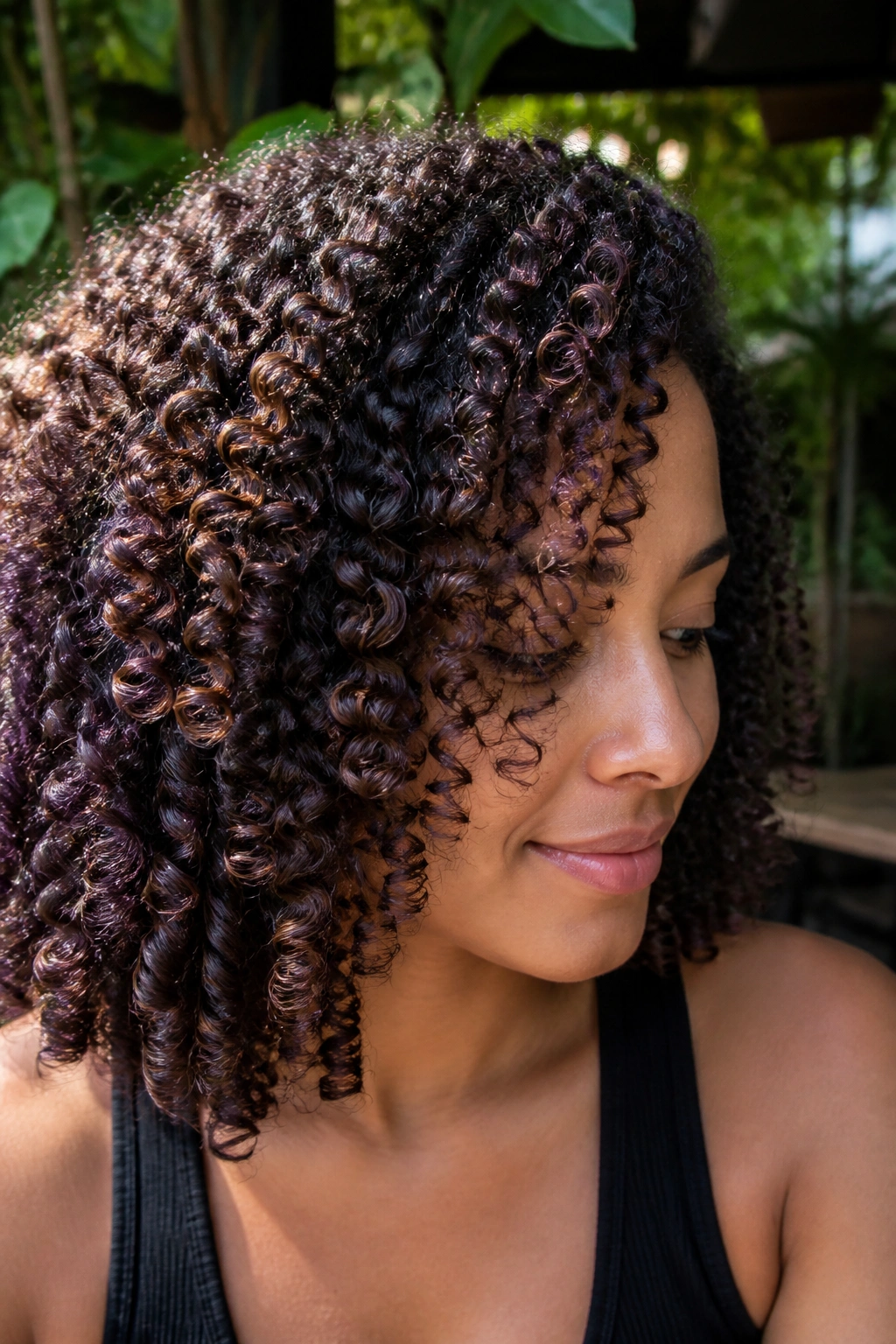
Coily hair needs color placed on the curl pattern, not just painted on top of it. That sounds obvious, but it gets missed all the time. The best violet brown highlights for round faces follow the curve of the coil and sit on the outer canopy, where light naturally lands.
What the Pattern Should Look Like
- Place brightness on the upper third of the coils
- Keep the innermost sections deeper and darker
- Use thin painted panels, not blanket lightening
- Blend with a gloss so the coils still look juicy, not dry
The reason this works is simple: curls expand color visually. A small amount of plum-brown goes farther here than on straight hair. That’s good news for a round face, because you can get shape from the highlight pattern without loading the sides with too much brightness. Keep the front pieces a touch longer and slightly more saturated, and the face reads longer.
24. Low-Contrast Waves That Keep the Cheeks Narrow
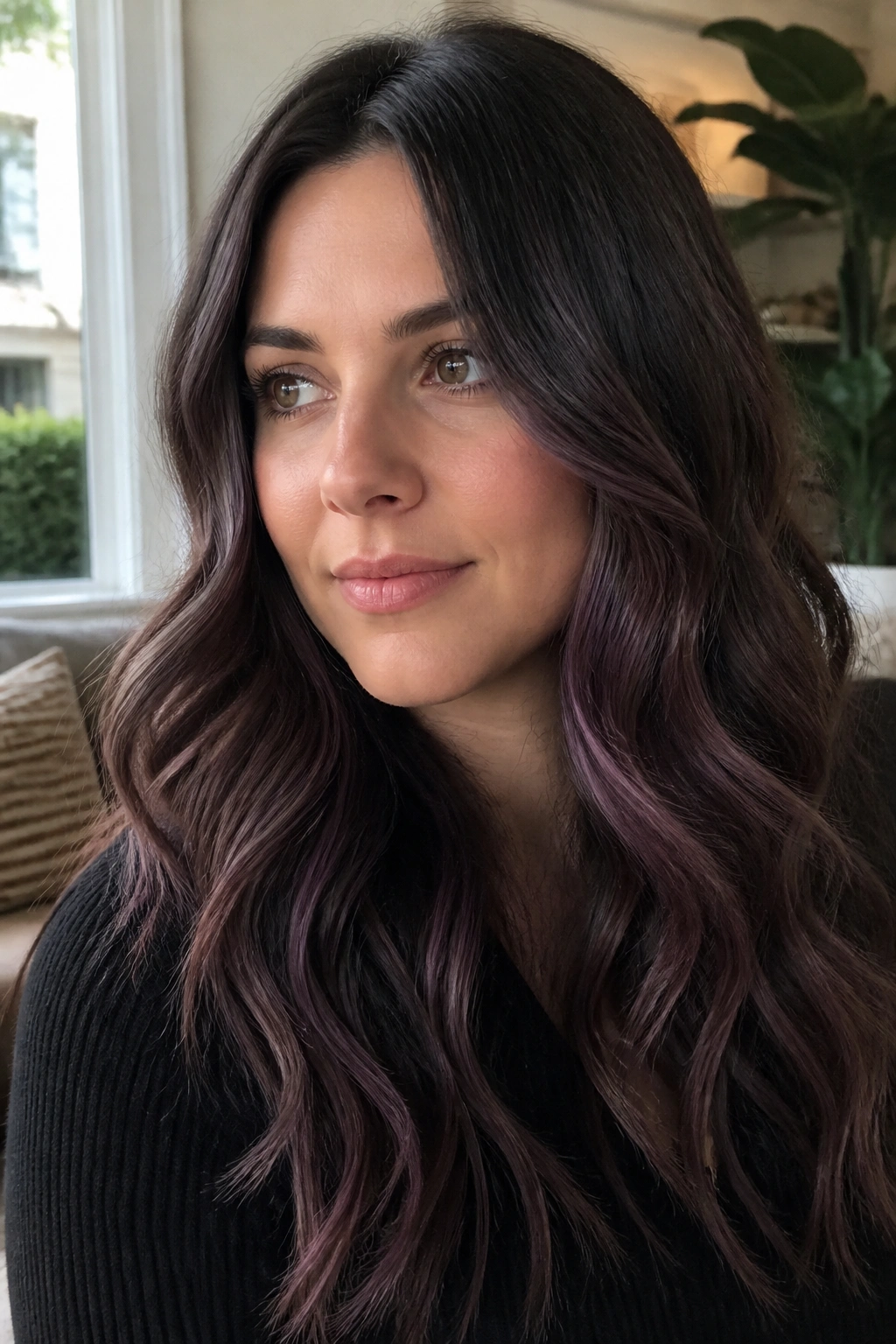
Big contrast isn’t always flattering. Sometimes the smartest move is a low-contrast purple brown blend that stays close to the natural base and only opens up at the ends.
That softer difference keeps the hair from spreading visually around the face. On a round face, the strongest color shifts can happen lower down, where the ends can carry the weight. The top stays in the brunette family, the mid-lengths get a whisper of plum, and the ends carry the brightest brown-purple. It looks calm, not busy. It also works well if you like loose waves, because the color rides along the bend instead of sitting in one obvious stripe.
This is a nice choice if you’ve tried bolder face-framing color and felt like it fought your features. Low contrast can be more flattering than drama. Not every good hair color needs to announce itself from across the room.
25. Deep Eggplant Brown Gloss Finish
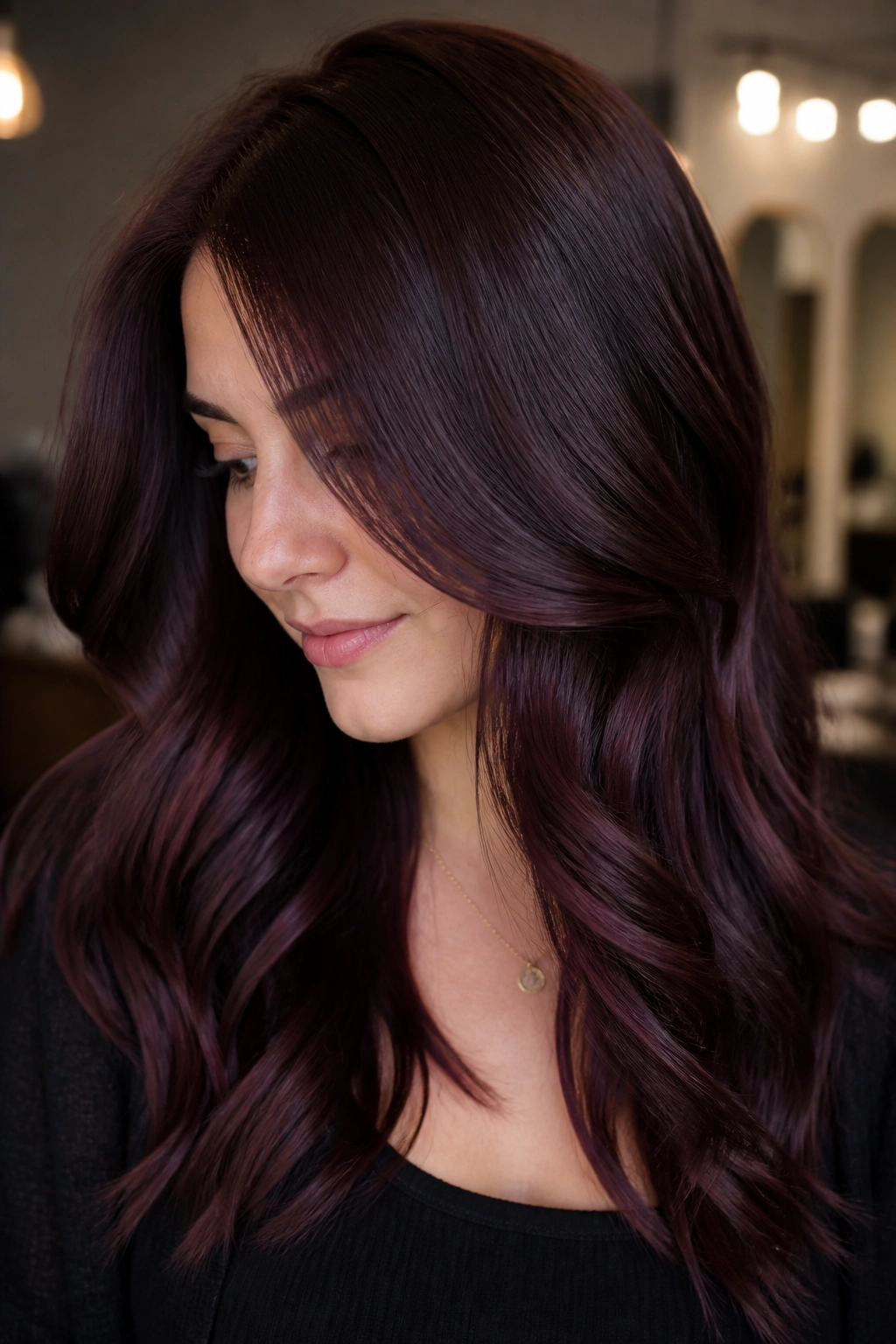
Not every round face needs obvious streaks. Sometimes the smartest move is a rich eggplant-brown gloss over a brunette base, plus a few hidden ribbons where they’ll show only when the hair moves.
That finish keeps the silhouette clean. The crown stays deep, the sides stay smooth, and the purple brown depth shows up as shine instead of stripes. If your face tends to look widest at the cheeks, this is a calming option because it avoids adding bright edges there. The color still has personality. It just speaks in a lower voice.
A gloss like this is also one of the easiest ways to refresh previously highlighted hair. It softens old light pieces, cools brass, and makes the hair look polished without a hard redo. If you want the face to read a little longer, keep the brightest movement below the chin and let the top remain dark and glossy. That single choice does a lot of work.
If you’re choosing between several purple brown looks, start with the one that respects your face shape first and your color cravings second. That order usually gets the better result.
