



Brown highlights for round faces work best when they behave like shadow and light, not stripes. That sounds obvious, but I see people miss it all the time: they ask for brighter pieces around the cheeks, then wonder why their face looks wider instead of softer.
The fix is usually placement, not drama. A caramel ribbon that starts at the temple and slides past the jaw does more for a round face than a chunky blonde streak sitting right on the cheekbone. Same goes for chestnut balayage, mocha money pieces, and those fine babylights that look subtle until you catch them in daylight.
Small change. Big difference.
The best part is that brown tones are forgiving. You can go warm, cool, deep, smoky, glossy, or dimensional without fighting your base color. And because brown has so many shades — caramel, toffee, cocoa, mushroom, walnut, bronze — you can shape the face while still keeping the look believable and easy to wear.
1. Caramel Temple Ribbons That Pull the Eye Downward
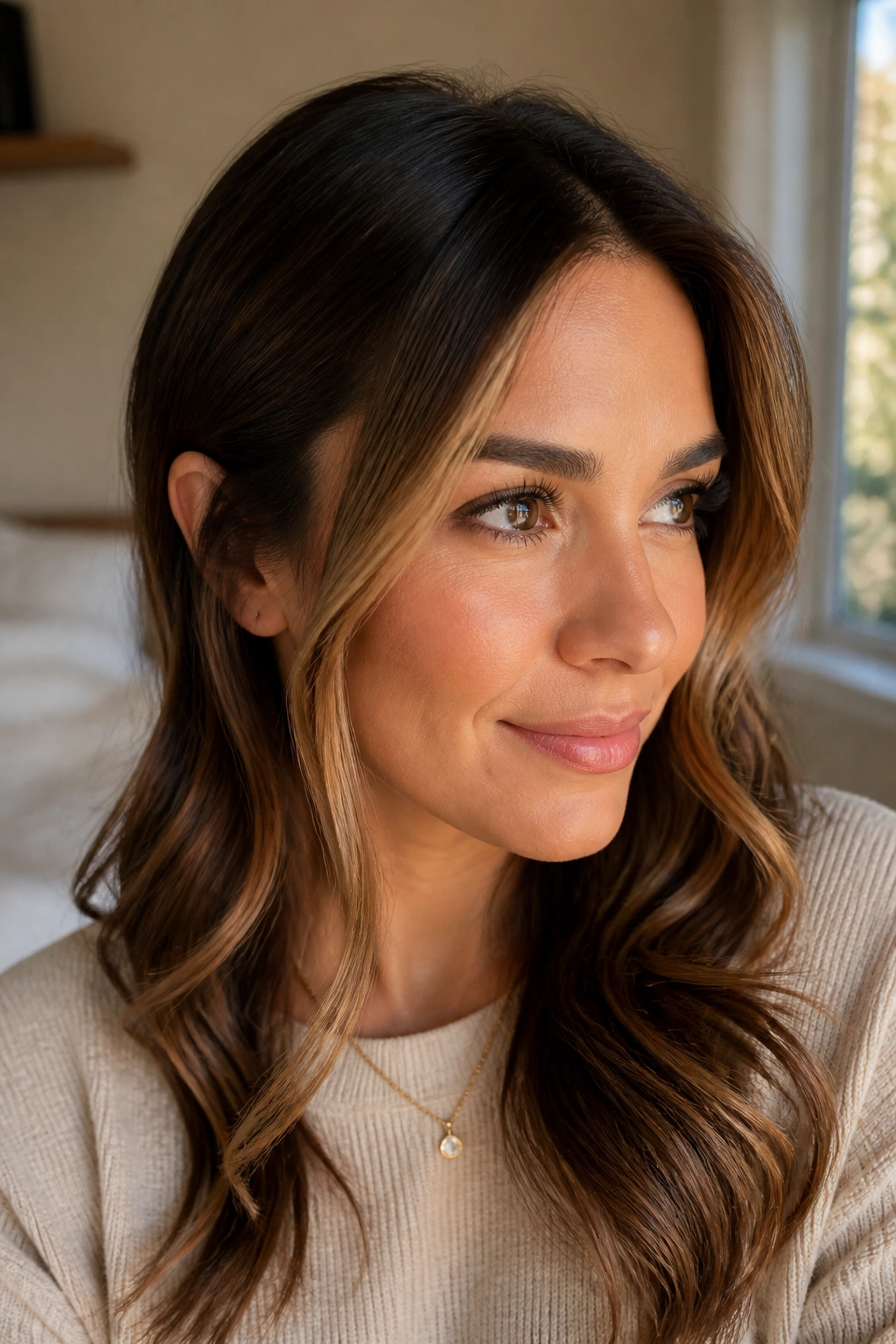
Caramel is one of those shades that almost never overcomplicates things. On a round face, it works best when the brightest pieces sit near the temples and then fall gently past the jaw, so the eye moves down instead of across.
Why This Placement Flatters a Round Face
The temple area gives you lift without crowding the cheeks. If you place the lightest ribbon too close to the widest point of the face, the highlight can read as width. Keep the ribbon narrow, about half an inch to 1 inch, and let it soften as it reaches the ends.
- Ask for soft weaving, not thick chunks.
- Keep the brightest caramel at level 7 or 8.
- Leave the root a shade deeper for a natural shadow.
- Style with a round brush or a bendy wave, not a tight curl.
Pro tip: tuck one side behind the ear after styling. It shows off the face frame without making both cheeks feel equally “open.”
2. Chestnut Balayage Below the Cheekbones
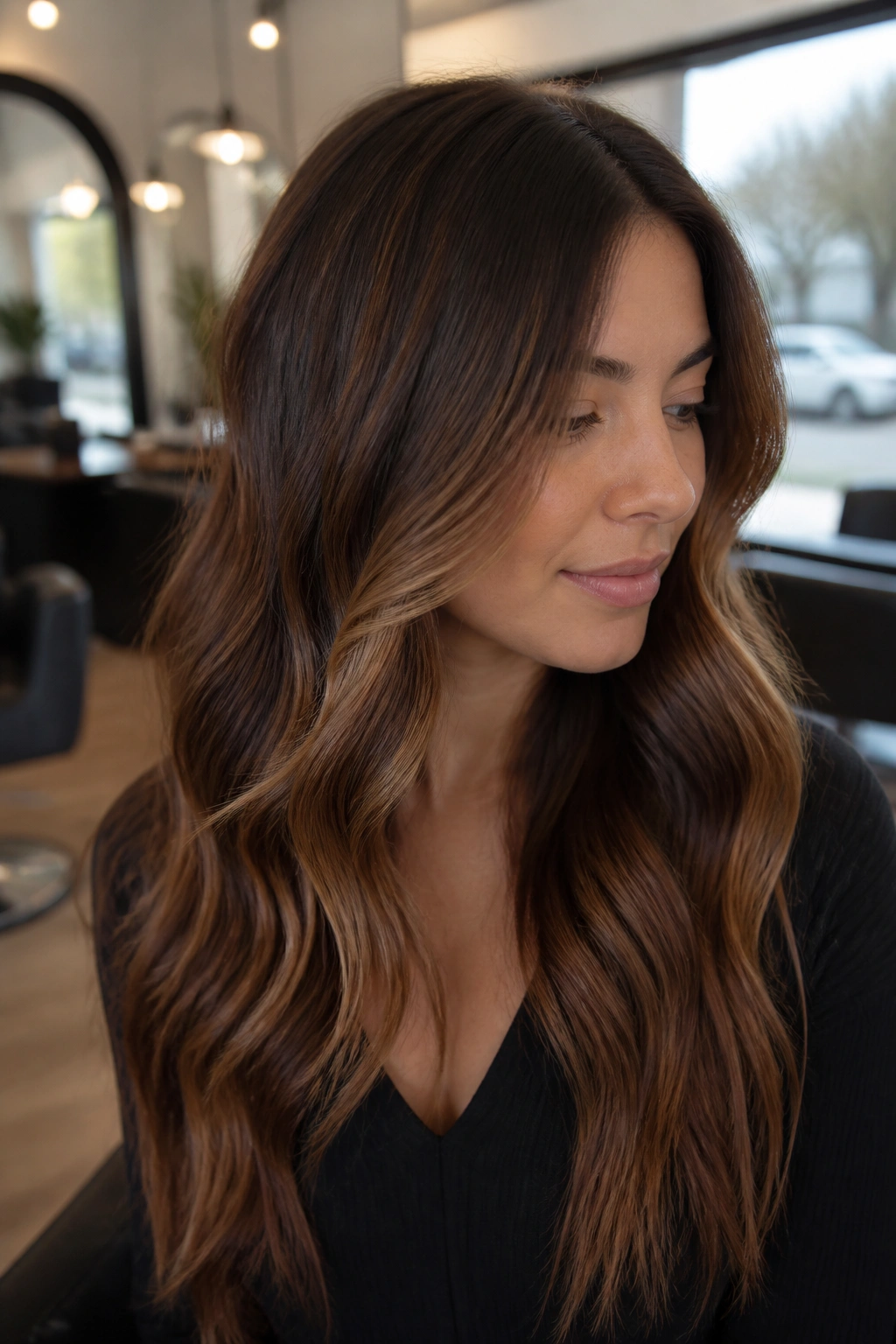
Chestnut balayage is quieter than caramel, and that’s why I like it on round faces. It doesn’t shout for attention; it slides in below the cheekbones and lets the haircut do some of the work.
The trick is starting the light pieces lower than people expect. If the balayage begins around the mouth or just under the cheekbone, the color draws the face downward instead of fanning out at the widest point. That little gap at the top is useful. It gives the cheek area a bit of shadow, which is exactly what round faces need when they want more shape.
This look is especially good on medium and long hair with movement. Straight hair can make chestnut balayage feel flat if the ribbons are too wide, so ask for soft, painted transitions and a gloss that keeps the brown rich rather than muddy.
And yes, it grows out gracefully. That matters. Nobody wants to live in the salon chair just to keep a flattering placement alive.
3. Mocha Money Piece for Round Faces
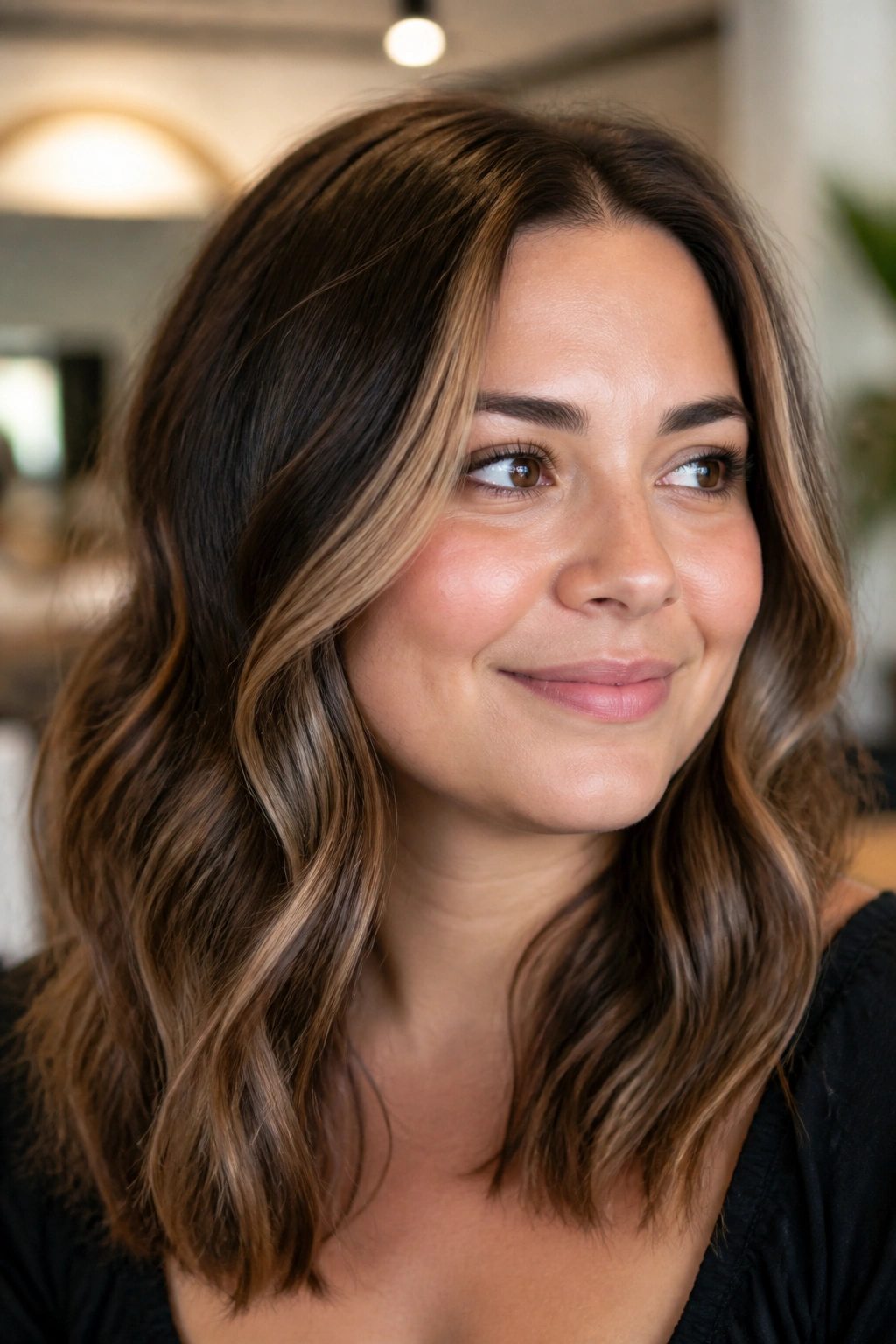
Can a money piece work on a round face? Absolutely — if it’s mocha, narrow, and placed with a little restraint.
What Makes It Work
A mocha money piece has enough contrast to brighten the front, but it doesn’t need to be pale to do its job. I’d rather see a level 6 or 7 mocha-beige face frame than a stark blonde stripe that competes with the cheeks. The best version starts just outside the part and falls in a slim line that stops below the cheekbone.
How to Wear It
- Pair it with a deep root shadow for softness.
- Keep the front pieces narrower than the width of two fingers.
- Ask for a gloss that leans beige-brown, not orange.
- If you wear your hair curly, have the face frame cut around the curl pattern, not against it.
The point is contrast with manners. A money piece should open the face, not shout over it.
4. Honey-Brown Babylights Through Long Layers
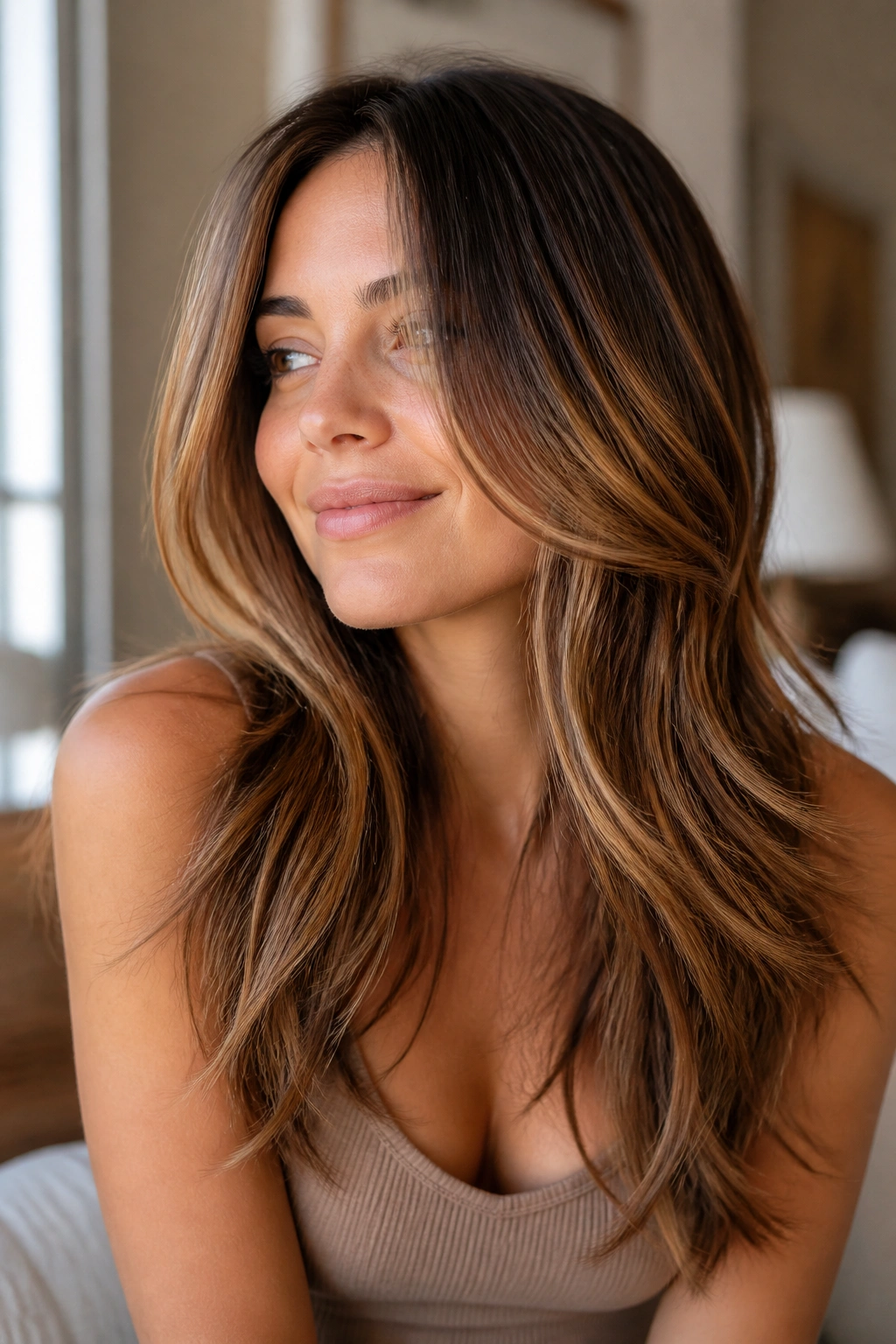
Honey-brown babylights are for the person who wants brightness, but doesn’t want the hair to look striped from across the room. They’re tiny, and that’s the whole charm of them.
I like them best on long layers because the movement keeps the small ribbons from disappearing into the hair. A round face benefits from the way babylights shimmer along the length, especially when the lighter pieces begin below the cheeks. You get brightness without a loud horizontal band, which is where a lot of highlight jobs go sideways.
The Small Details That Matter
- Use micro-weaving or very fine slicing.
- Keep most of the light around the mid-lengths and ends.
- Ask for a soft beige honey tone rather than gold-heavy blonde.
- Style with loose bends so the layers separate.
There’s a reason this looks expensive in person. The color changes as the hair moves. On still hair, it’s subtle. In motion, it comes alive.
5. Ash Brown Highlights for a Softer Outline
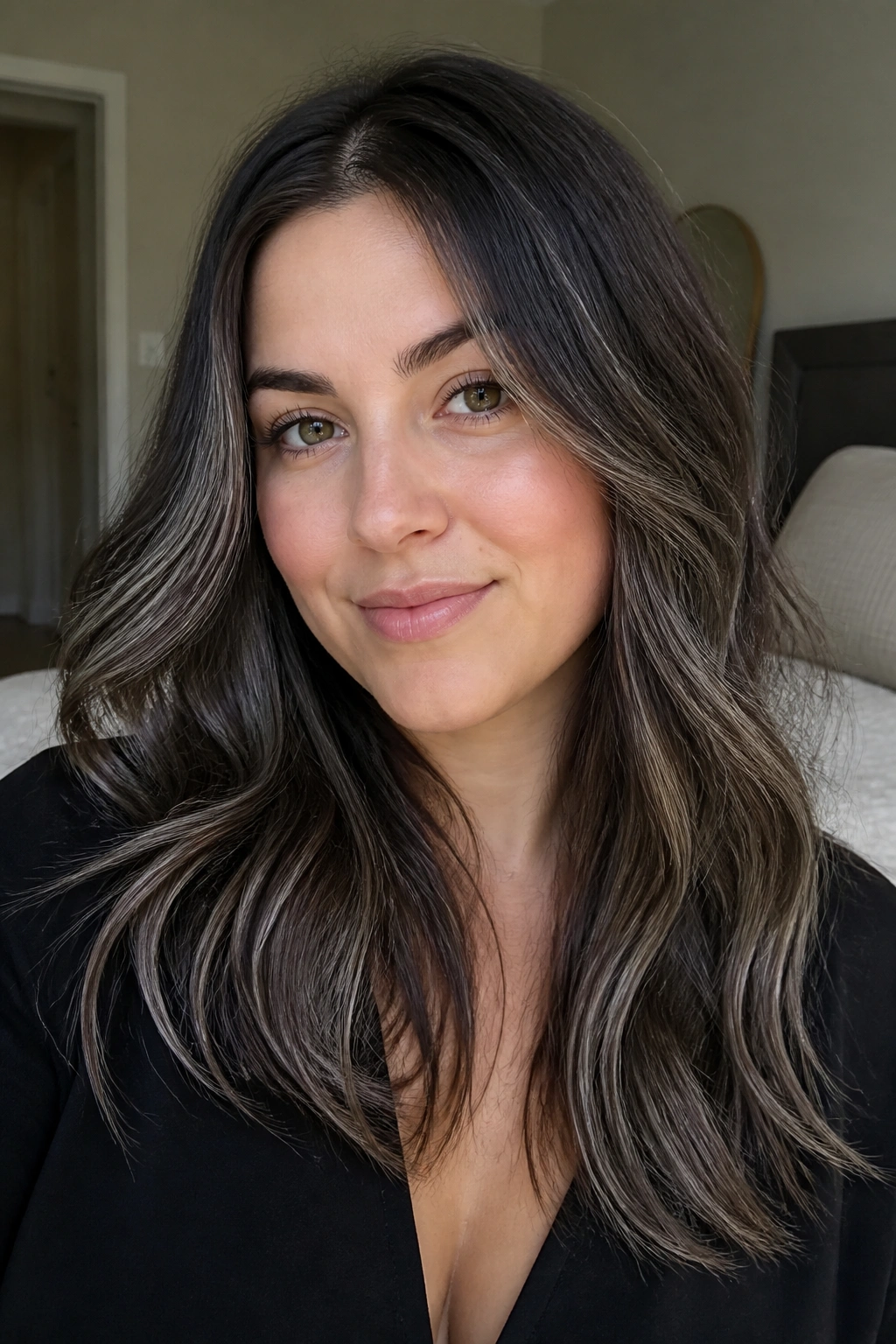
Ash brown is the shade people often misunderstand. Done well, it softens a round face by muting the contrast around the cheeks. Done badly, it can look flat, gray, or tired. So this one needs a steady hand.
What I like about ash brown highlights is the quiet edge they give to the face. They don’t flash warmth everywhere, which means they’re useful if you want shape without a sunny glow. A cool, smoky ribbon near the temples and through the lower layers can make the jaw line look cleaner, especially on medium brown bases.
The catch? Go too light and the color loses its depth. Go too cool and you can end up with hair that looks dull in low light. The sweet spot is usually only 1 to 2 levels lighter than your base, with a beige or mushroom gloss to keep it from turning flat.
If you’re tired of coppery tones fighting your skin tone, this is the brown family I’d reach for first.
6. Toffee Ends on a Jaw-Skimming Lob
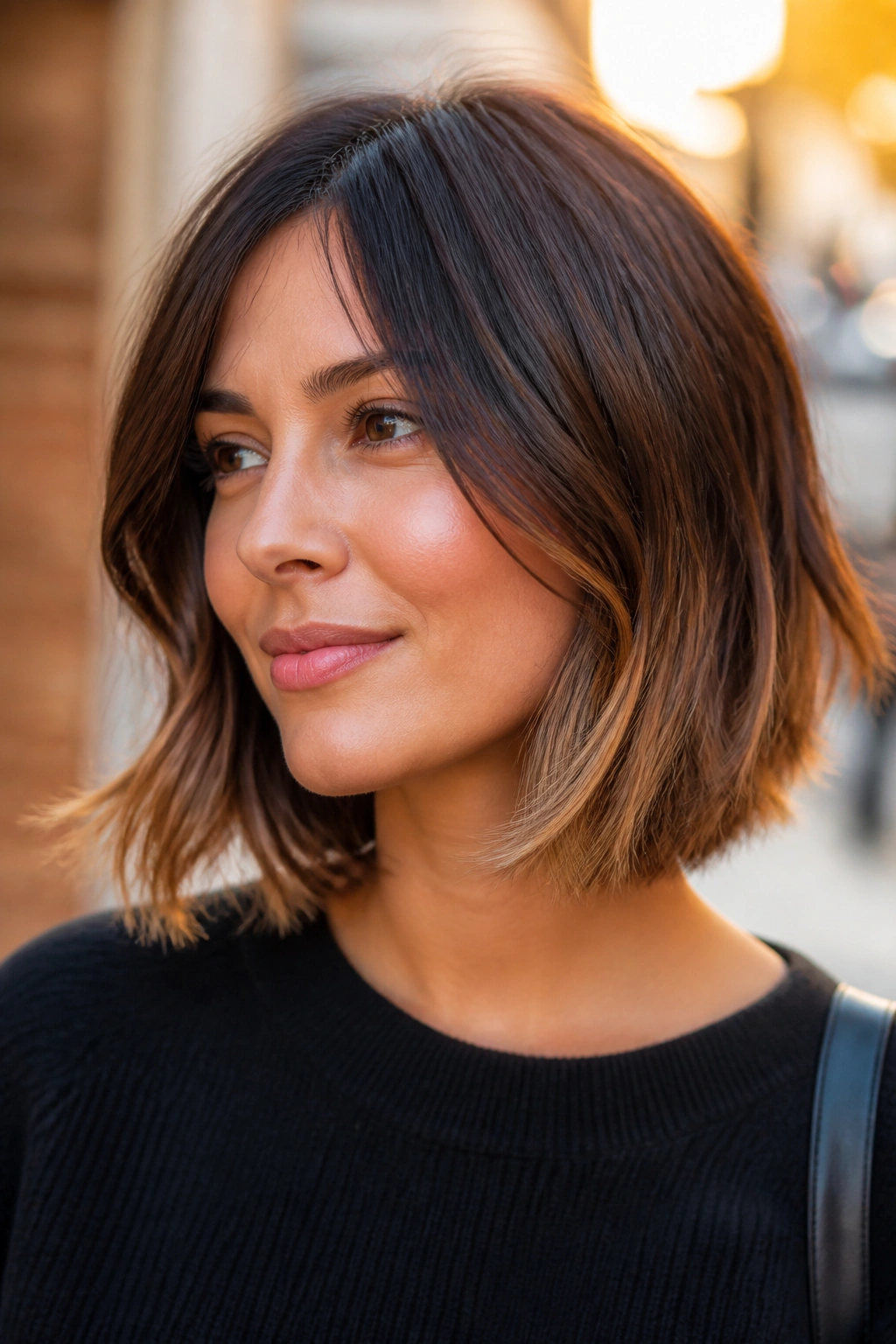
A lob can be a round face’s best friend, but only if the color respects the cut. Toffee ends do that well because they pull the eye toward the bottom of the shape instead of stopping at the cheeks.
This is a smarter choice than putting bright pieces all around the front of a short cut. On a lob, the ends already sit near the jaw, so lightening them gives you length in the visual sense. Keep the root and the area around the ears a little deeper, then let the toffee build from mid-length to the bottom inch or two.
It works especially well on hair that flips under at the ends. That curve gives the lighter color a polished edge. If the hair is straight and blunt, ask for softer graduation so the line doesn’t feel boxy.
Best for:
- Shoulder-grazing or jaw-skimming cuts
- Fine to medium hair
- People who want a lighter look without lots of upkeep
7. Sable Peekaboo Highlights Under the Top Layer
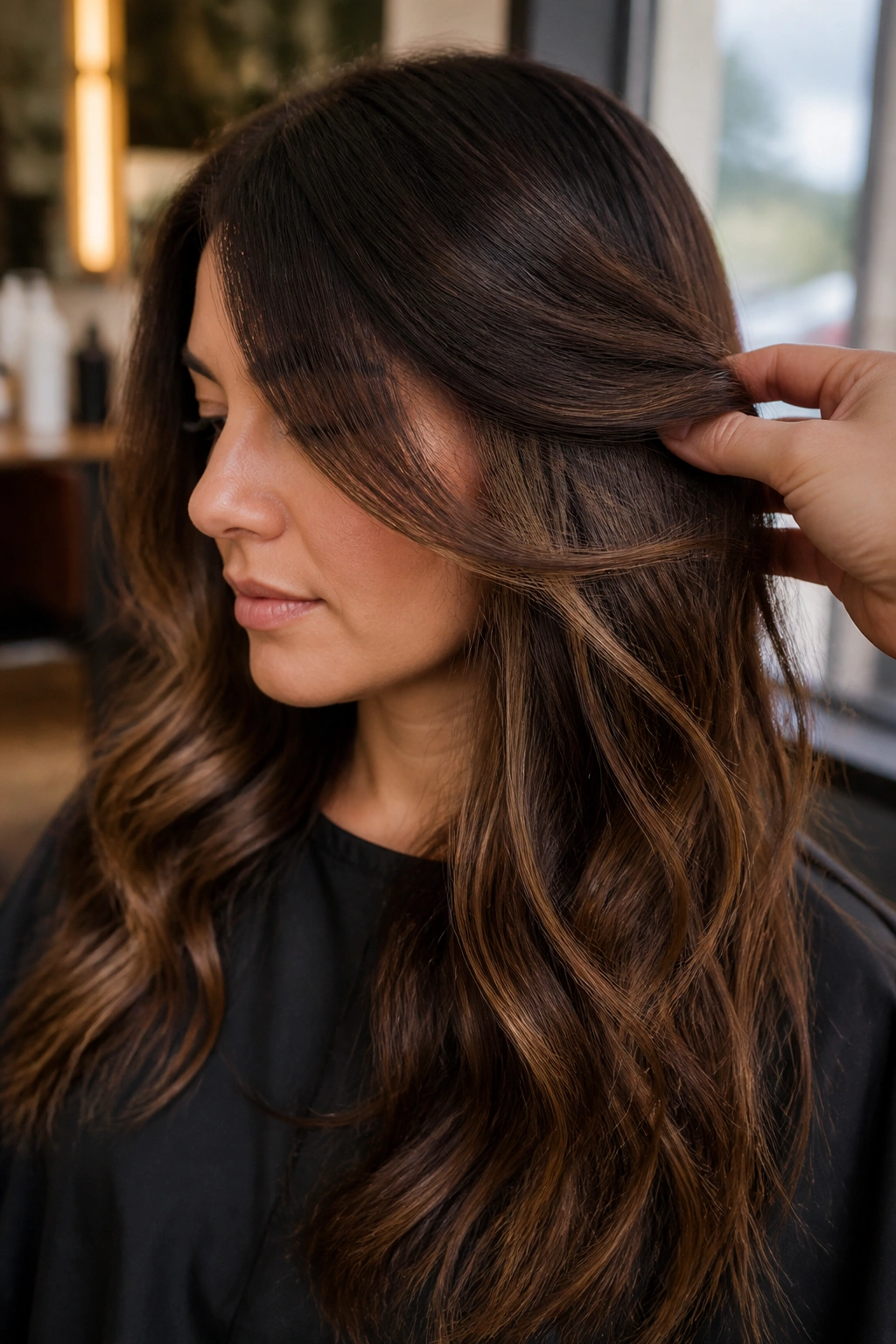
What if you want brown highlights for round faces, but you don’t want the color to show in a loud front frame? Peekaboo lights solve that neatly.
Sable peekaboo highlights live under the top layer, so they only show when the hair moves, flips, or gets tucked behind the ear. That hidden placement keeps the surface clean, which is useful on round faces because it avoids extra width at the cheeks. The color still adds depth, just in a more private way.
How to Ask for It
- Keep the top layer mostly solid.
- Place the lighter sable pieces underneath and around the crown.
- Choose a shade that reads as warm brown, not black-brown.
- Add soft waves if you want the color to peek through more often.
This is one of my favorite options for people who work in conservative settings or just don’t want obvious color maintenance. Quiet on purpose. That’s the appeal.
8. Cinnamon Brown Dimension on a Wavy Shag
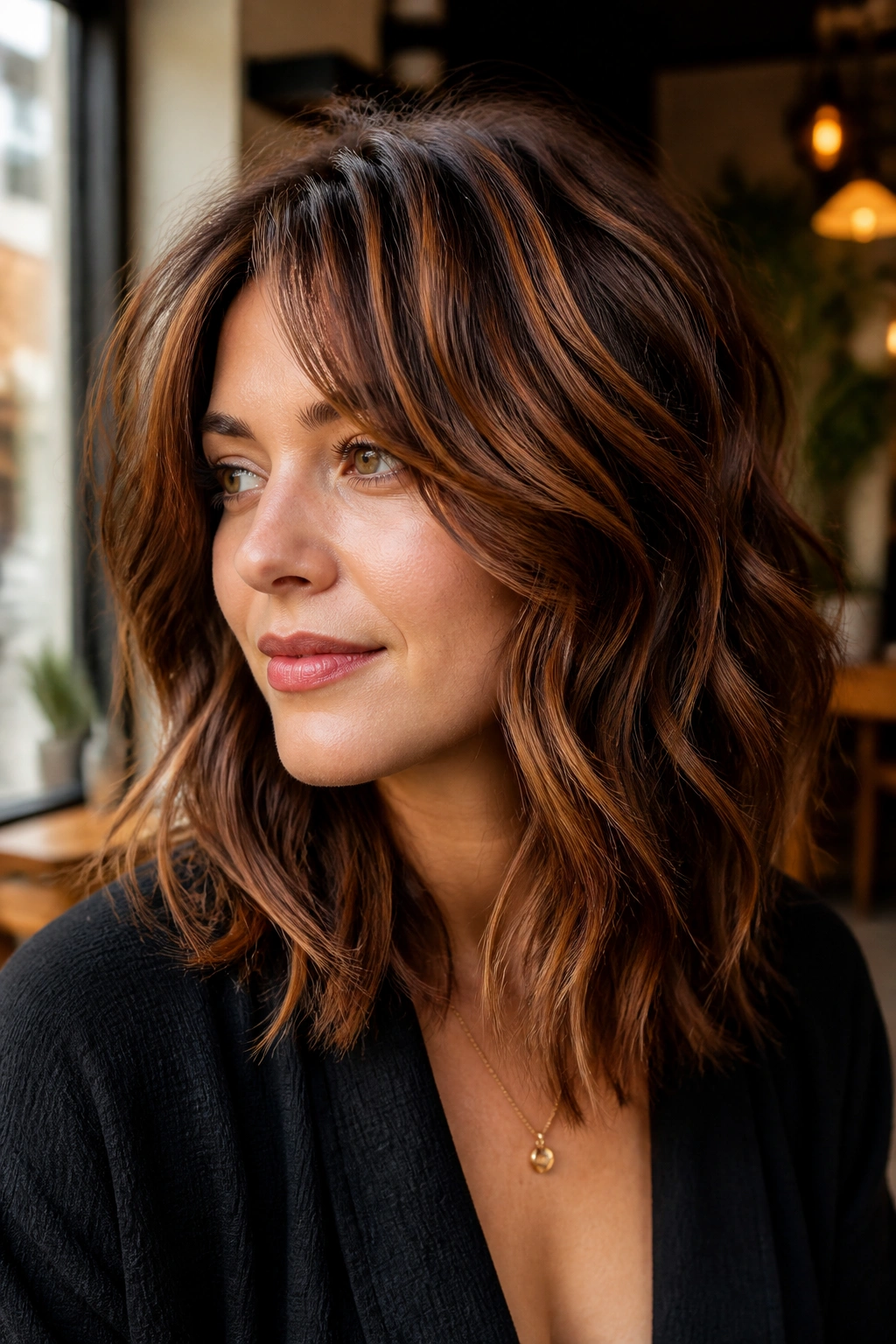
A shag and round face can be a gorgeous match if the color has enough broken-up texture. Cinnamon brown does that job because it brings warmth and movement without looking like one big block of color.
The waves are the real trick here. On a shag, the layers already interrupt the outline of the face, and cinnamon ribbons sliding through those layers make the whole cut feel lighter. Instead of brightening the widest point of the cheeks, the color lands in uneven little flashes that keep the shape loose.
What to Watch For
- Ask for alternating ribbon widths.
- Keep a few darker lowlights between the lighter pieces.
- Use a soft blow-dry or diffuser so the texture stays visible.
- Avoid an all-over cinnamon glaze if your base is already warm.
This is one of those looks that can feel edgy or soft depending on how you style it. Air-dry it, and it reads casual. Blow it out with movement, and the dimension jumps.
9. Milk Chocolate Ribbons on Curly Hair
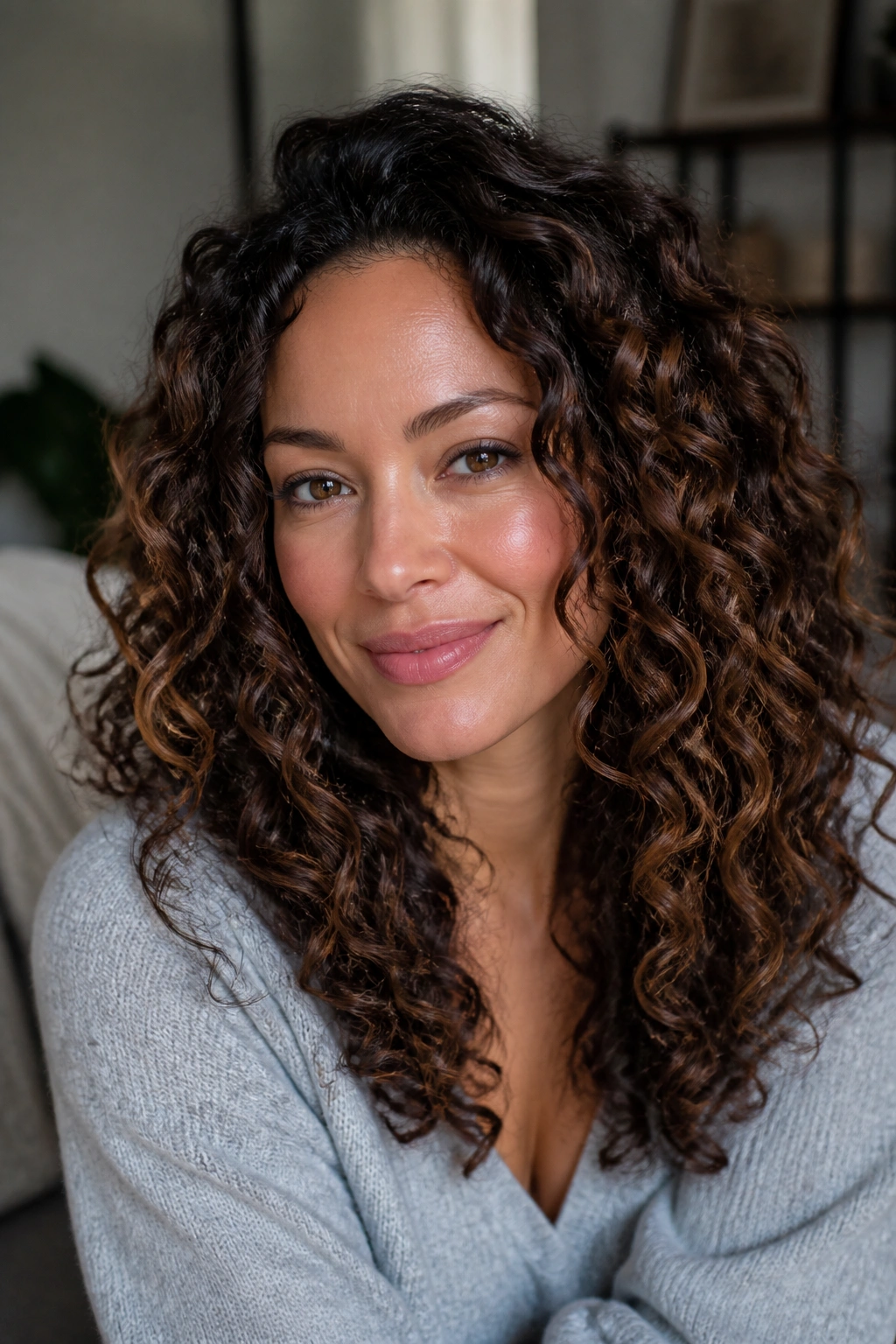
Curly hair changes the whole equation, and honestly, that’s part of why I like milk chocolate ribbons so much. Curls shrink, bend, and stack on top of each other, so the highlight placement has to follow the shape of the coil.
The smartest version keeps the lighter ribbons on the outer surface of the curls, not buried in the center of the ringlet. That way, the color shows when the hair moves instead of disappearing into the curl pattern. On a round face, the benefit is subtle length: the eye follows the curl clumps downward instead of getting stuck at one level.
Milk chocolate is also a lovely compromise if you want dimension but don’t want a huge contrast. It softens dark brunette hair without turning it orange or gold. Ask for thin painted pieces and a gloss that keeps the brown creamy.
And please, no harsh striping. Curly hair looks best when the color feels woven in, not stamped on.
10. Espresso Lowlights Mixed With Brown Highlights
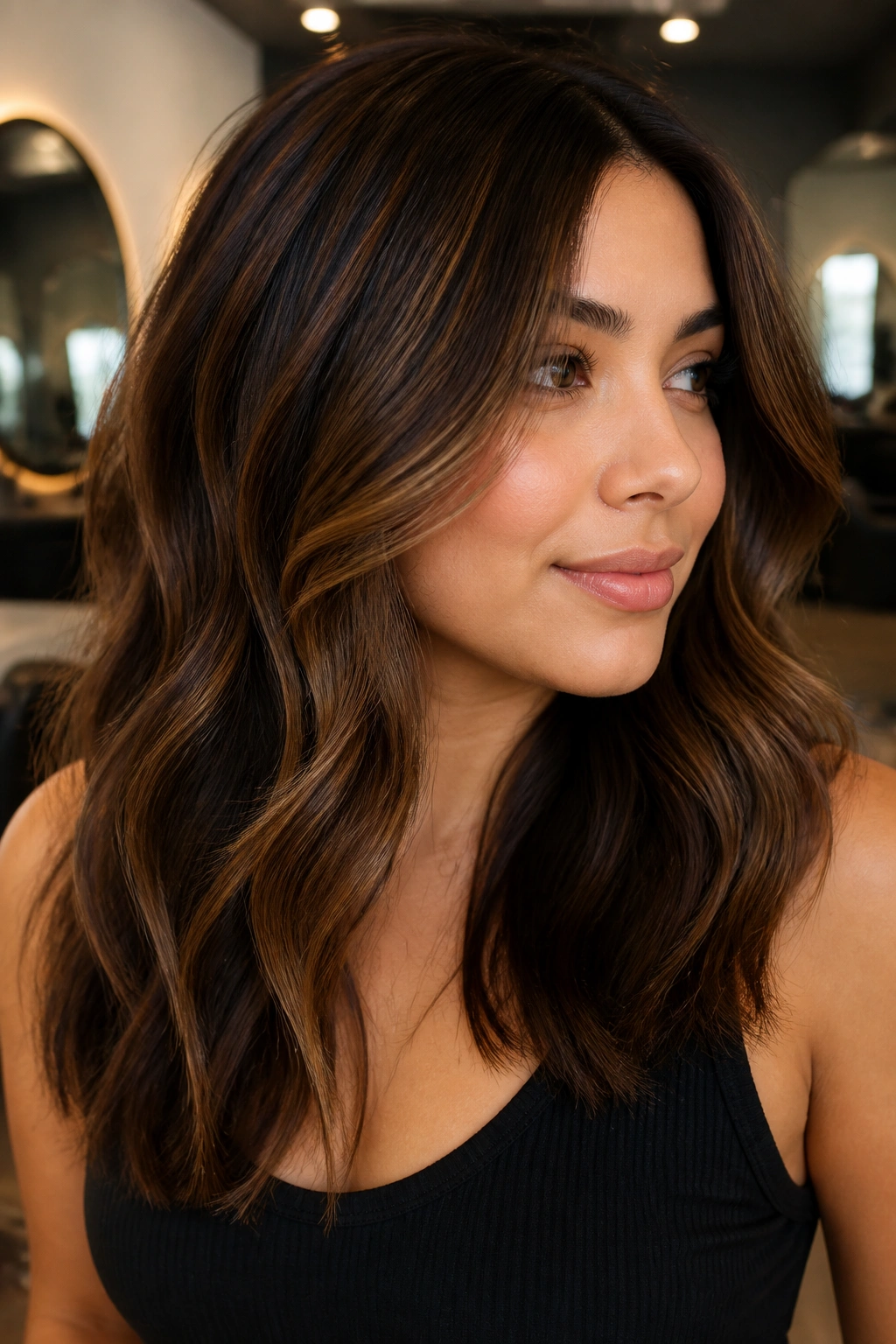
Why bother with lowlights in a highlight article? Because sometimes the real problem is that the hair is too uniformly light around the face.
Espresso lowlights give the lighter brown highlights something to sit against. On a round face, that contrast matters because it creates vertical variation instead of one broad bright zone. If the front pieces are all the same tone, the face can look wider. If some deeper espresso pieces run through the underside and around the outer layers, the shape looks cleaner.
What to Ask For
- A level 3 or 4 espresso lowlight mixed into a medium brown base.
- Brown highlights that are one shade lighter, not six.
- A root shadow near the part so the top doesn’t feel too open.
- Placement that avoids a bright band at the cheek line.
This is a smart move if your hair has started to look washed out or one-note. The darker strands sharpen the whole haircut. They also grow out nicely, which never hurts.
11. Bronde Blend for Short Round Faces
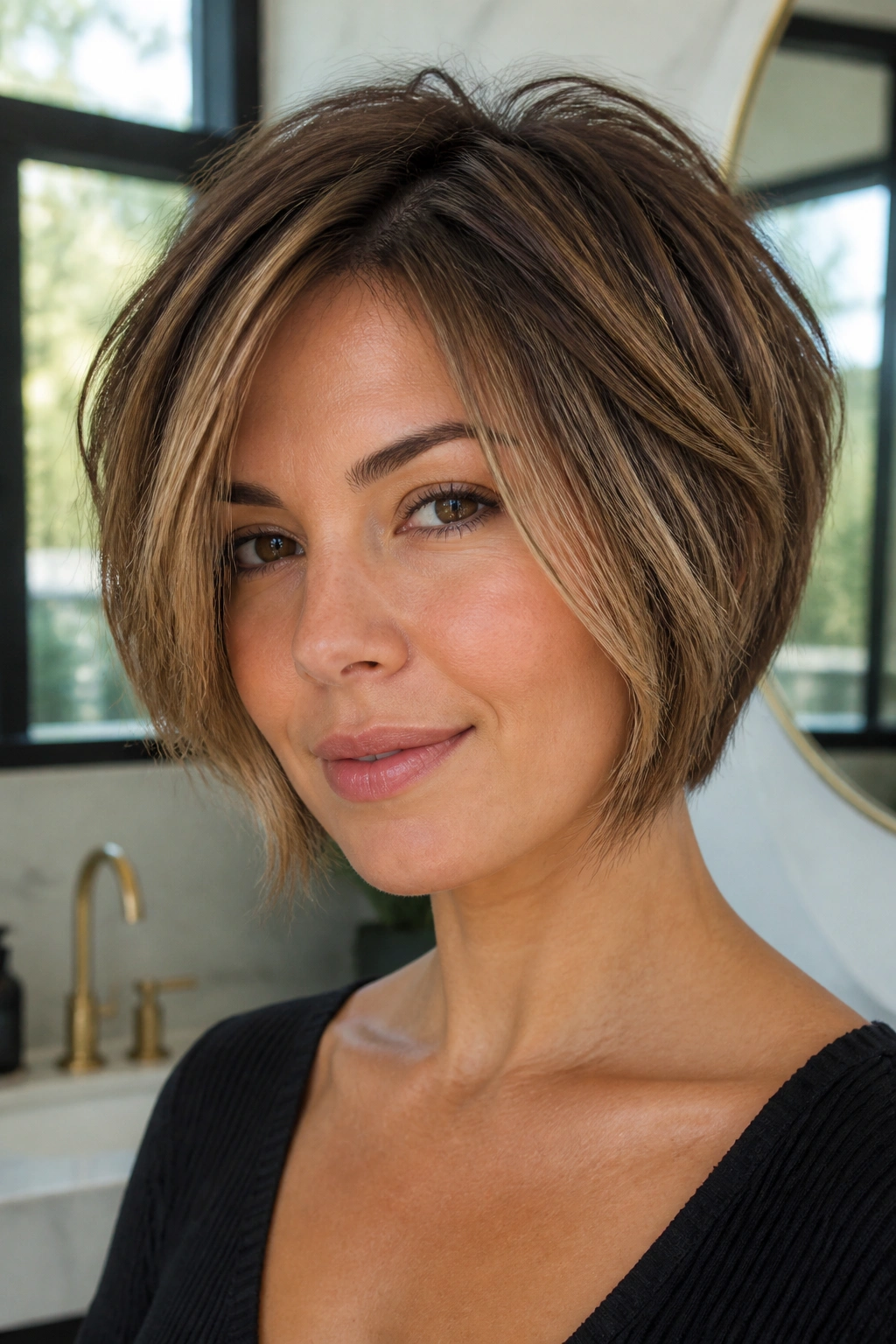
Short round faces can handle brightness, but they need it handled carefully. A bronde blend — that brown-and-blonde middle ground — gives you lightness without turning the head into a bright circle.
The best bronde for this face shape keeps the lightest pieces away from the widest part of the cheeks and uses the ends to stretch the silhouette. On a short cut, that usually means placing the brightest brown-blonde mix from the cheekbone down, not right at the nose level. It’s a small shift, yet it changes the whole reading of the face.
I also like bronde on shorter hair because it keeps the cut from feeling heavy. A solid dark brown bob can sometimes look dense around the jaw. Bronde breaks that up. If your skin has warmth, go for caramel bronde. If you run cooler, pick beige-brown bronde so the finish doesn’t fight your undertone.
The mistake is going too pale. That turns bronde into blonde, and then the soft face-shaping gets lost.
12. Maple-Brown Face Frame With Curtain Bangs
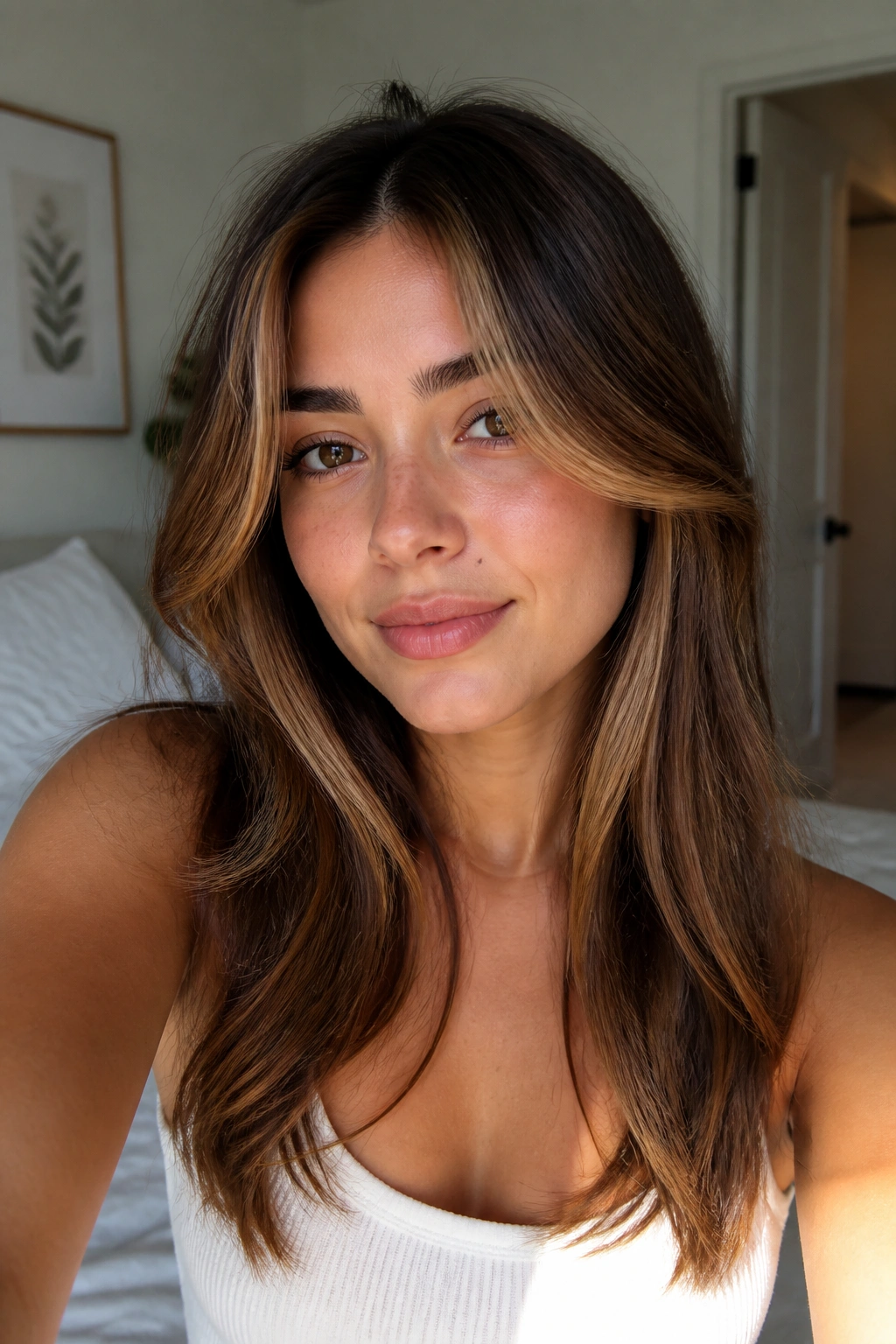
Curtain bangs can be terrific on a round face, but they need the right color around them or they start to widen the forehead area. Maple-brown face framing keeps the whole thing light and soft.
The difference between a good face frame and a clumsy one is where the light begins. Around curtain bangs, I like the brighter maple-brown to start just below the brow line and sweep past the cheekbone instead of sitting straight across it. That diagonal path makes the face feel longer. Straight-across brightness does the opposite.
This look is especially good if you wear your hair in loose waves or a round brush blowout. The bangs open the forehead, the face frame narrows down the side, and the maple tone keeps things warm enough to feel lived-in.
It’s a prettier, more relaxed version of the money piece. Less obvious. More flattering.
13. Mushroom Brown Highlights for Cool-Toned Skin
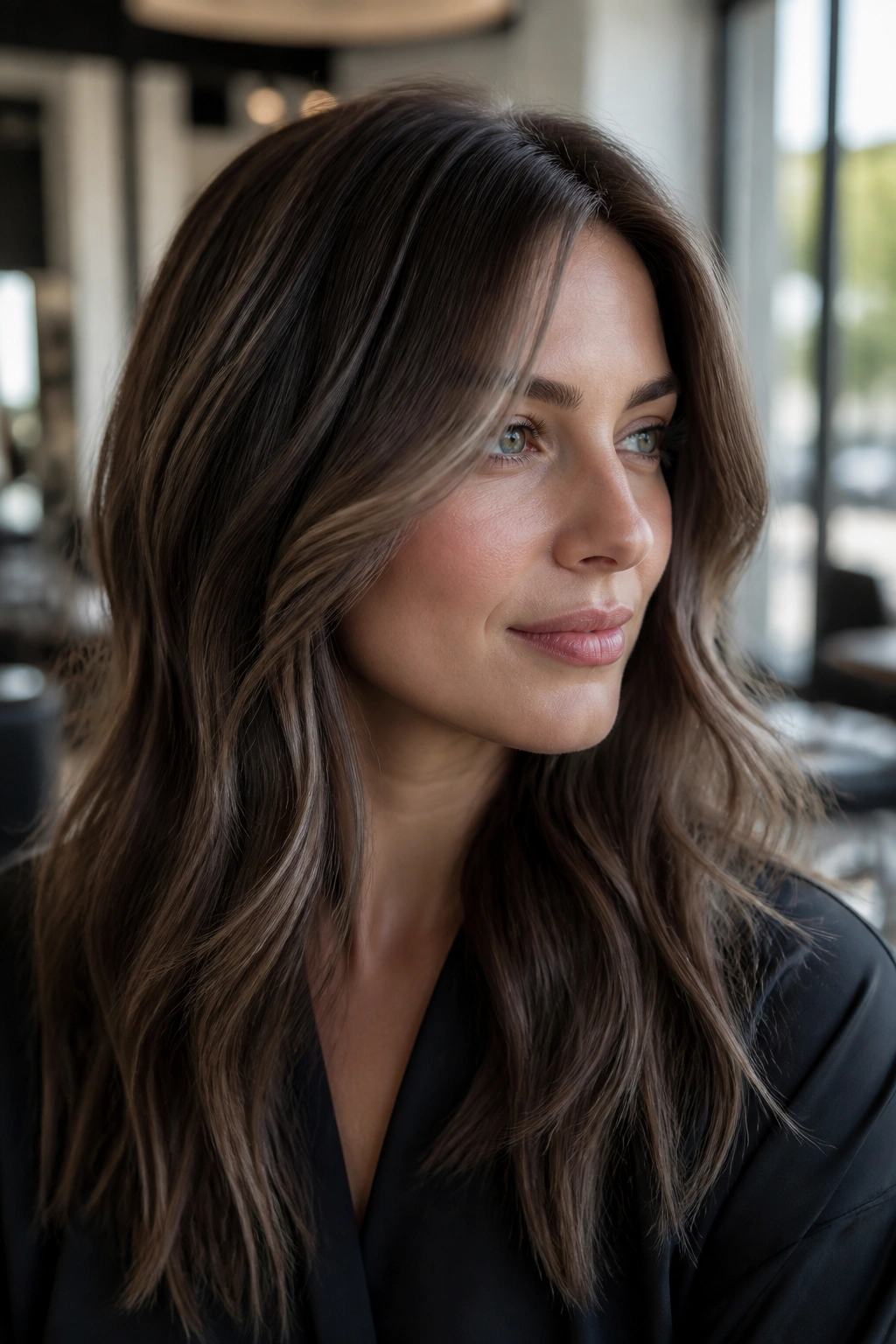
Mushroom brown is the shade people choose when they want depth, not shine. It sits in that smoky space between taupe and soft brown, and on a round face it can make the edges look calmer.
Why It Works
Cool-toned skin often gets overwhelmed by yellow or copper-heavy highlights. Mushroom brown avoids that by staying neutral and muted. The effect is gentle, almost matte, but not dull when the color is layered well. A round face benefits because the shade doesn’t reflect too much light at the cheeks.
Quick Notes
- Best on level 5 to 7 brown bases.
- Ask for a cool beige gloss, not a pearl blonde toner.
- Keep the brightest ribbons narrow and spaced out.
- Works especially well with straight styles and soft bends.
One warning: if your hair is already porous or over-lightened, mushroom brown can slip flat fast. The cure is usually a deeper root and a gloss that has enough warmth to keep the finish alive.
14. Golden Brown Balayage on Thick Hair
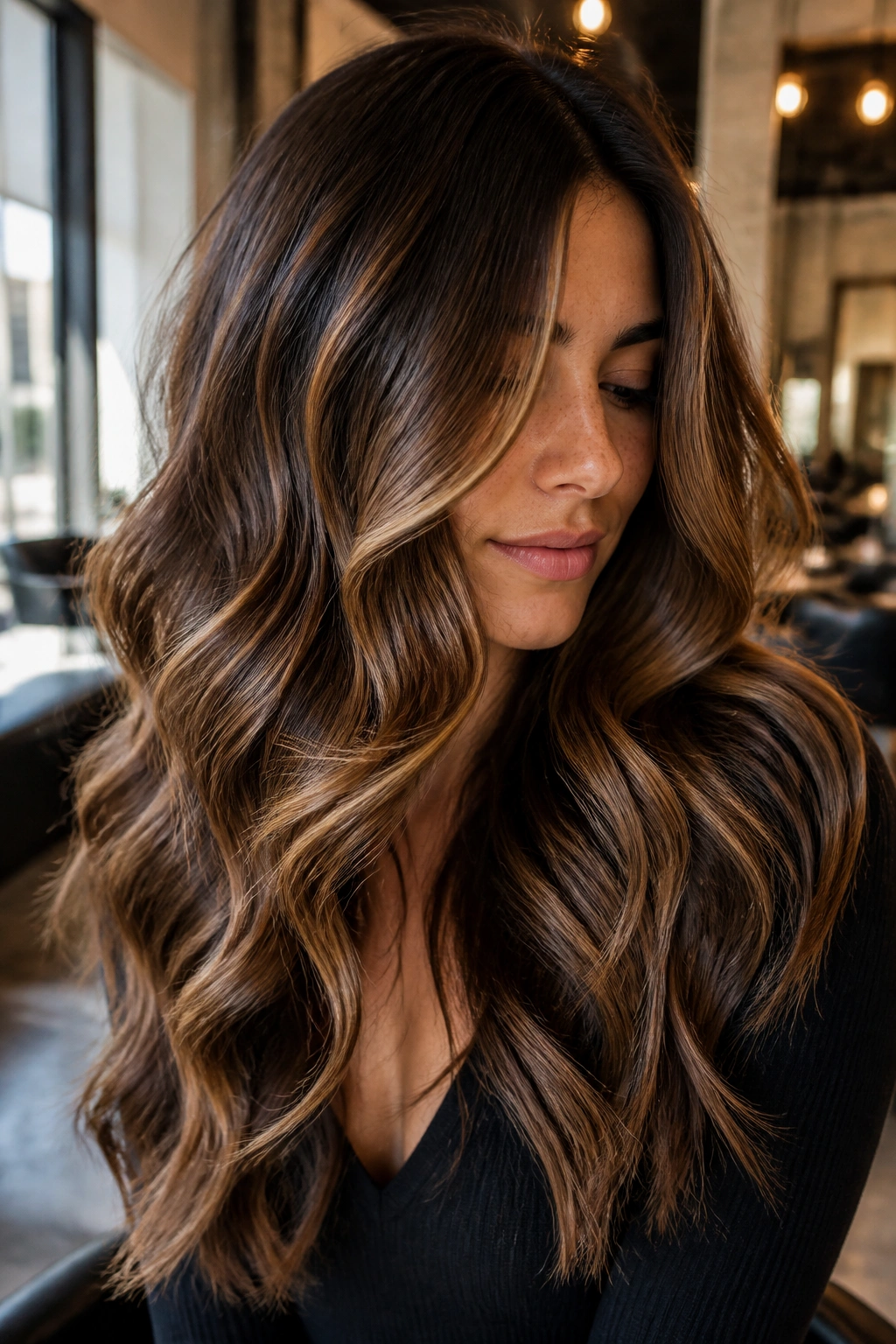
Thick hair can wear more contrast than fine hair, and that’s why golden brown balayage often looks so good on it. The fuller the hair, the more room there is for light and dark to play against each other.
The round-face advantage comes from the way thick hair can hold shape. You can place the golden ribbons lower, give them a little width, and still avoid that broad front panel that makes the face feel wide. The key is spacing. If every section is light, the color gets muddy. If the ribbons are separated by deeper brown strands, the cut looks controlled.
I’d avoid tiny, overblended highlights here. Thick hair needs a stronger visual pattern or the color vanishes inside the density. A painterly balayage with a warm golden-brown tone gives you shine without losing dimension.
This is one of the few looks where I’m happy to see a bit more brightness. Thick hair can take it.
15. Soft Auburn-Brown Ribbons Near the Jawline
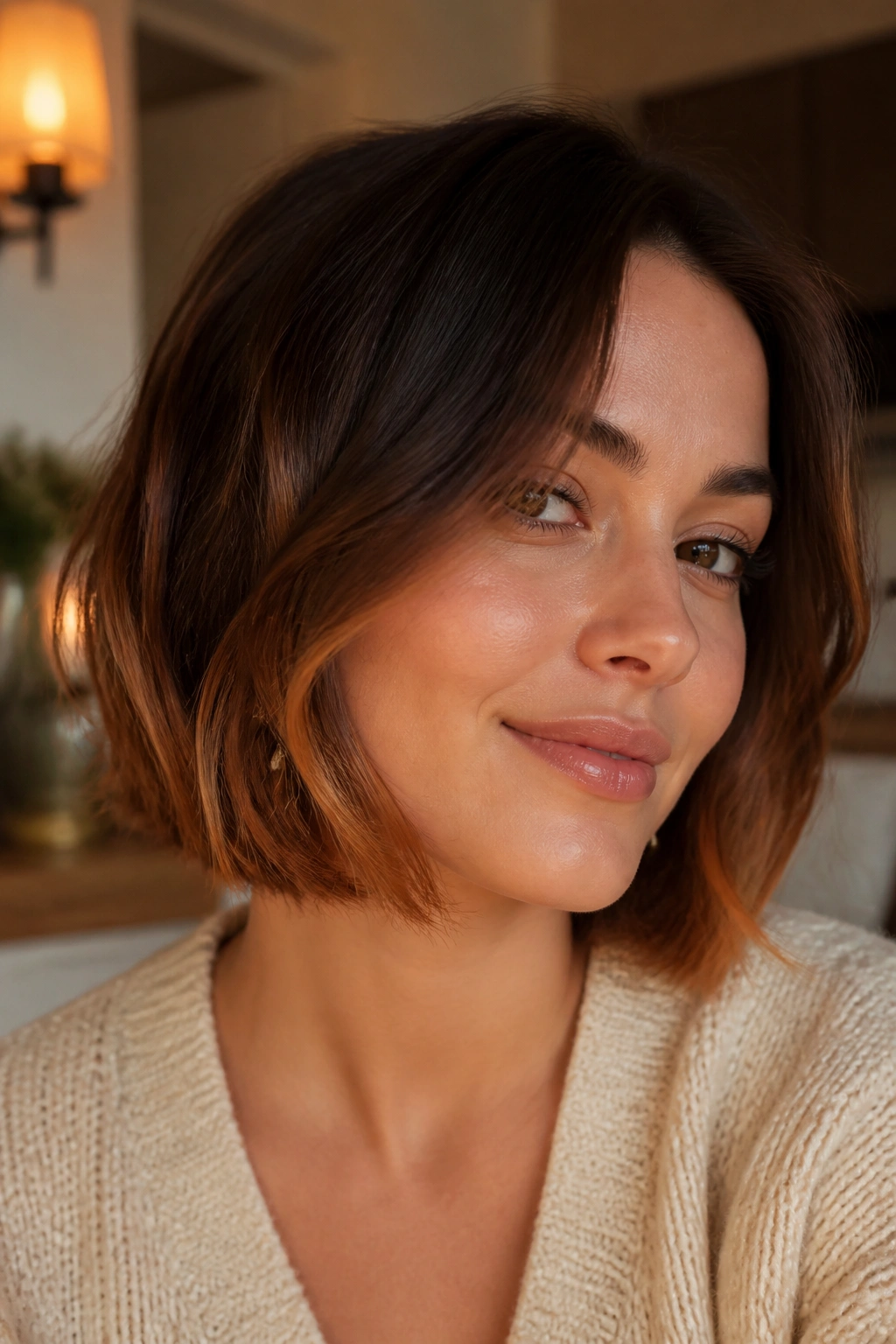
Can a warm brown shade flatter a round face? Yes, if it stays soft and lives near the jawline instead of blazing around the cheeks.
Auburn-brown has a red-brown cast that can look rich and expensive when it’s kept subtle. On a round face, the smartest placement is low and slightly forward, around the lower half of the hair. That pulls color into the bottom of the shape and gives the face a longer read. If the red tone jumps too high near the temples, it can feel wider and louder than intended.
How to Keep It Calm
- Ask for a deep auburn-brown glaze, not true copper.
- Keep the front pieces narrow.
- Leave some darker brown between the ribbons.
- Style with loose bends so the red-brown catches in pieces, not all at once.
This shade loves warmer complexions. It also works beautifully in autumn light, though I’m trying hard not to make this seasonal. The real point is simple: soft auburn brown gives warmth without turning the whole head into a red block.
16. Caramel Teasylights for Fine Hair
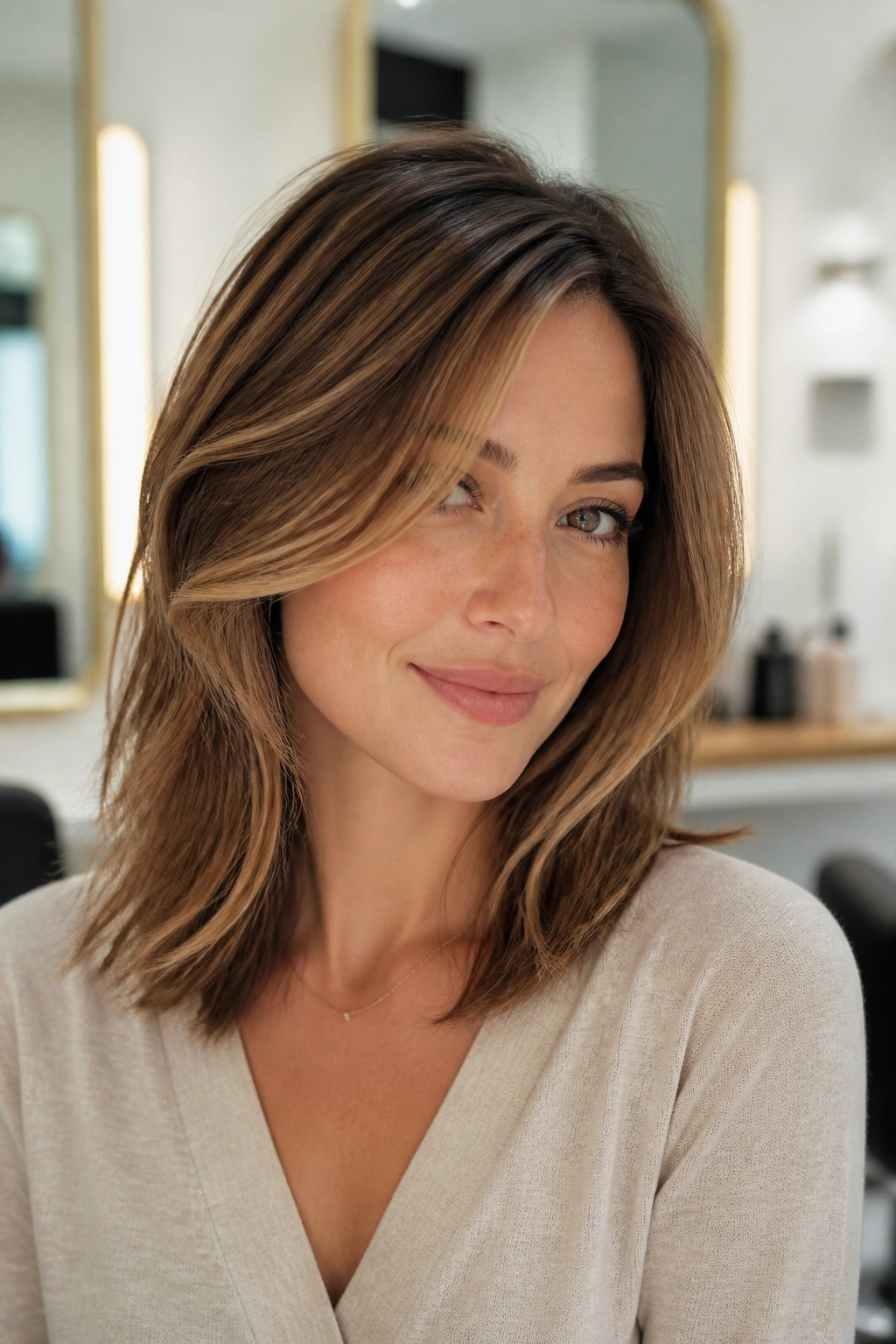
Fine hair needs a gentle hand. Teasylights — tiny highlights created with a bit of backcombing — are one of the smartest ways to add brown dimension without exposing a hard line.
The backcombing creates a soft blur at the root, which means the highlight doesn’t start as a clean stripe. On a round face, that matters because the color stays airy around the cheeks rather than drawing a sharp band across them. Caramel teasylights can live through the top and outer layers, then thin out toward the bottom, where they make the whole cut look fuller.
Key Details
- Use very fine sections and a soft tease at the root.
- Keep the caramel one to two shades lighter than the base.
- Pair with a layered cut if you want extra movement.
- Blow-dry with a brush to show the ribbon effect.
If you’ve ever felt like chunky highlights swallowed your hair, this is the antidote. It’s a whisper, not a billboard.
17. Cocoa Ombré on Shoulder-Length Cuts
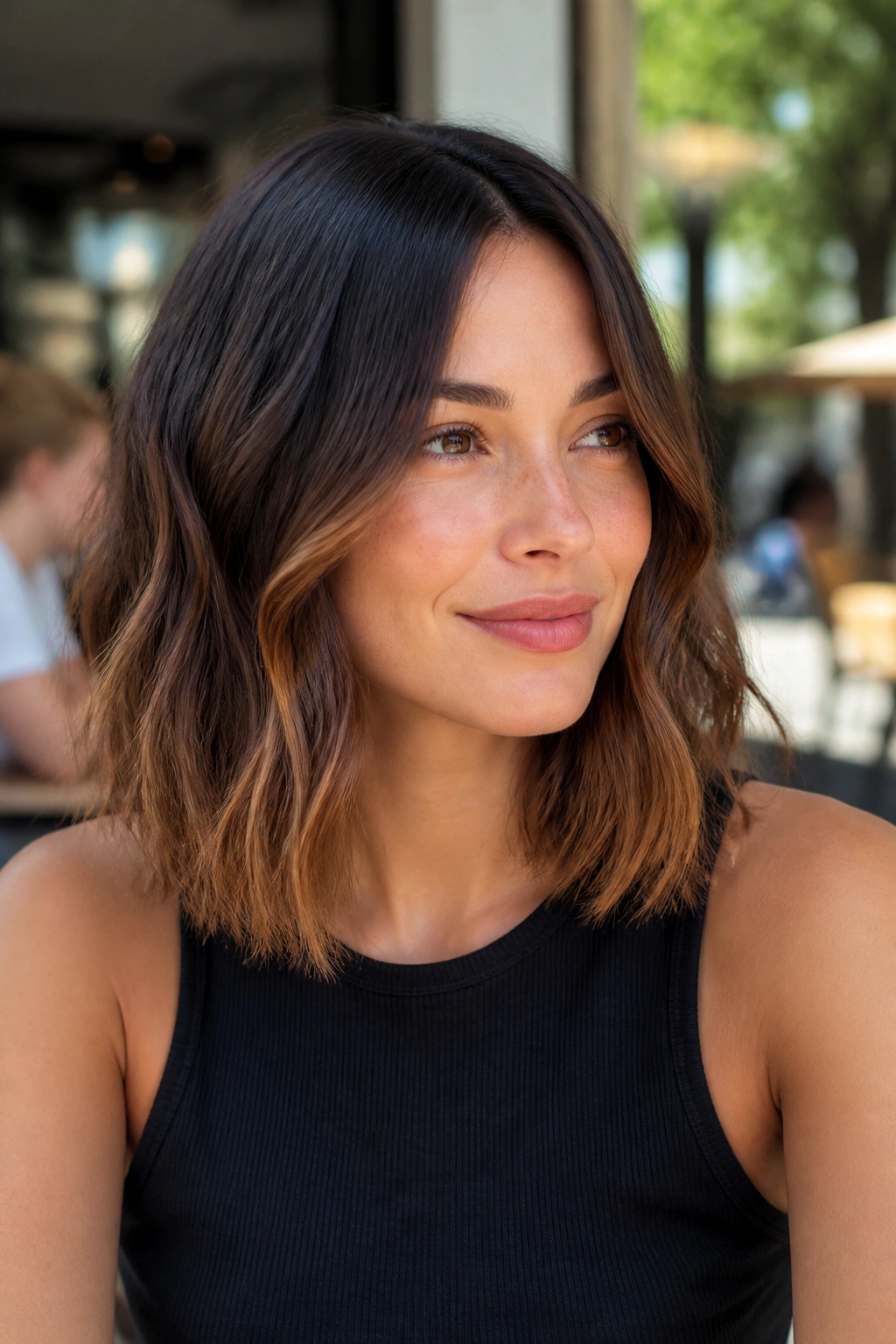
Shoulder-length hair can sometimes hit the face in a blunt, boxy way. Cocoa ombré softens that nicely because the brightness lives more toward the ends, where it helps stretch the outline downward.
The thing to watch is the transition. If the ombré starts too high — right around the cheekbone — the face can look wider, which defeats the point. Keep the shift gradual and let the cocoa base stay richer near the top and around the temples. Then allow the lighter brown to bloom through the lower half of the length.
I like this look on people who want movement but don’t want a lot of touch-ups. The grown-out effect is part of the appeal, and on shoulder-length hair it reads polished rather than forgotten. A loose wave helps the colors blend, but even straight hair can carry it if the transition is soft enough.
Some ombrés look too obvious. Cocoa ombré shouldn’t. It should feel like the hair got sun-kissed in a grown-up way, minus the fake shine.
18. Deep Side-Part Sweep With Brown Highlights
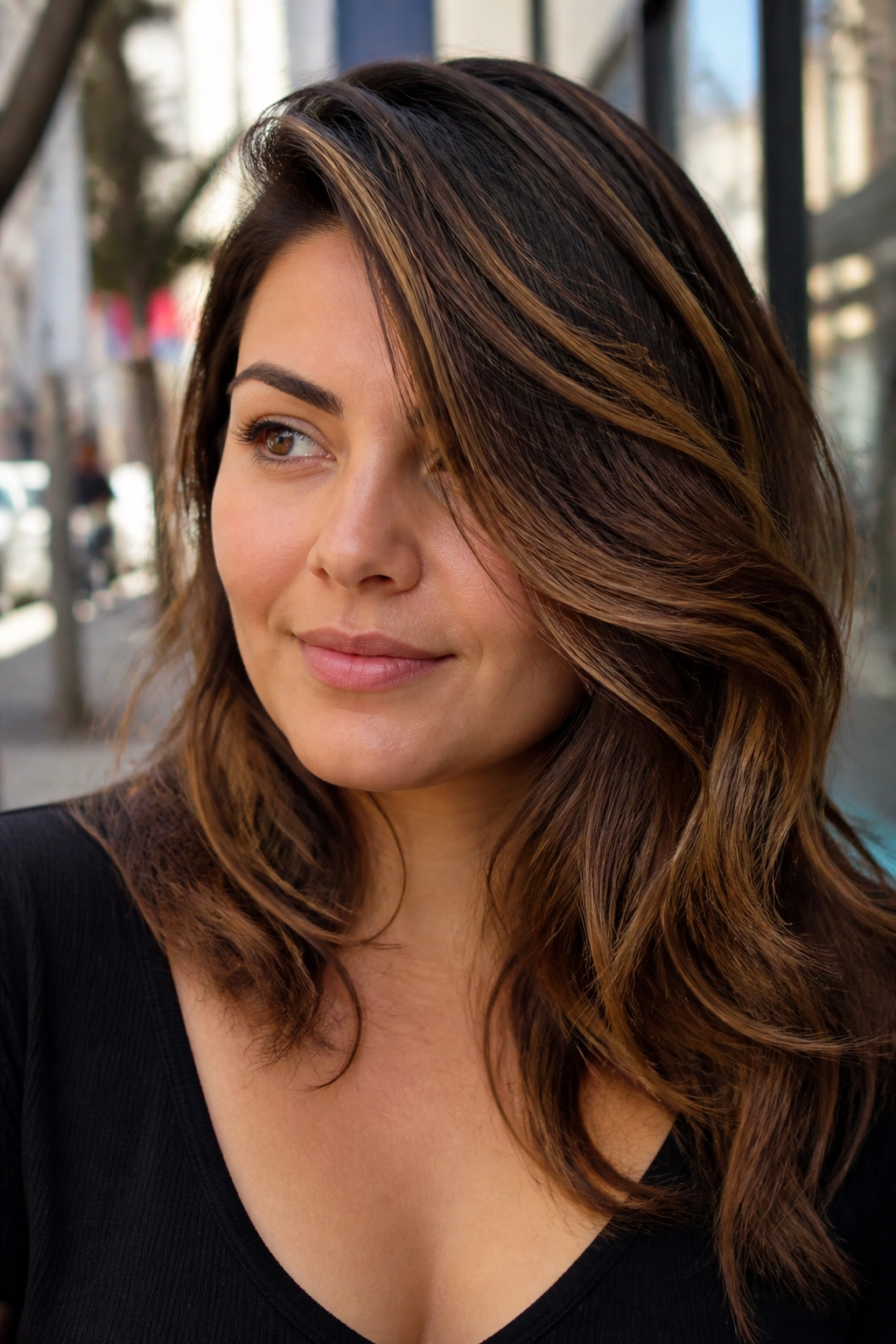
A side part can do more for a round face than people expect, especially when the highlights follow the sweep of the hair. It creates a diagonal line, and diagonals are your friend when you want to make a face feel longer.
Compared with a center part, a deep side part shifts volume off the middle of the face. That matters if your highlights are already warm or bright, because the asymmetry keeps the look from feeling too open around both cheeks. Brown ribbons through the longer side of the part make the face feel narrower without turning the color severe.
The best version uses a few brighter pieces near the front and softer pieces through the opposite side. Not mirror-image. That’s the point. The unevenness breaks the roundness.
If your hair naturally wants to fall to one side, lean into it. Fighting the part just to be “balanced” is a waste of energy.
19. Bronze Brown Highlights on Dark Brunette Hair
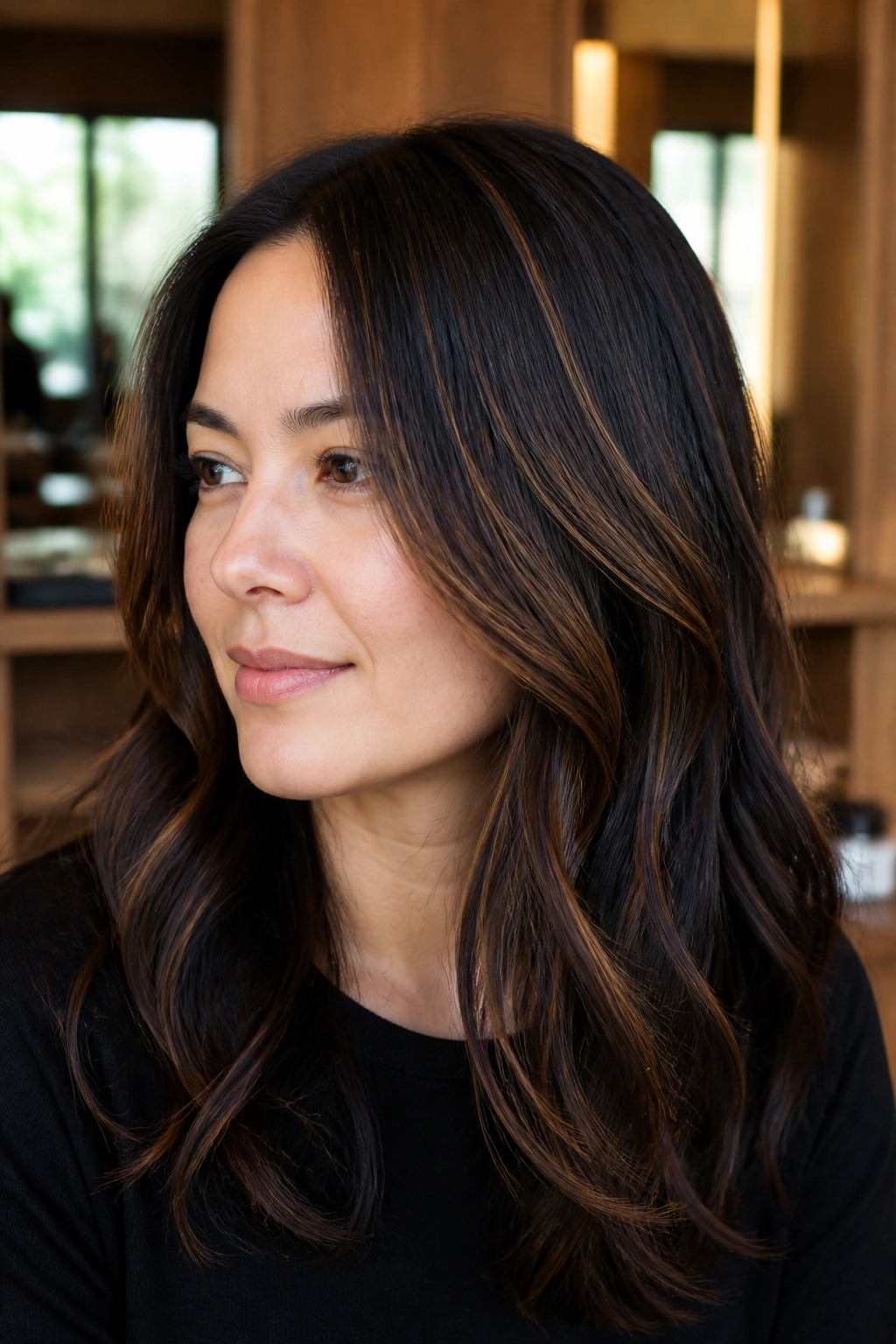
Bronze is one of the better shades for dark brunette hair because it brings light without losing that deep brown base that gives the face structure.
What Makes Bronze Different
Bronze sits between brown and warm metal, so it reflects light in a way that feels rich instead of yellow. On a round face, that glow works best when the bronze is placed in slim ribbons around the outer layers and ends. Too much around the cheeks, and the face gets broader. Used carefully, it adds shine where the eye should travel.
A Few Things to Ask For
- Keep the base deep brunette, not medium brown.
- Ask for bronze ribbons that are narrow and spaced apart.
- Add a gloss so the finish stays warm, not brassy.
- Avoid heavy face framing if your hair is already thick.
This is a good match for people who want warmth but don’t want caramel. Bronze has more depth. It looks especially nice on straight or softly waved hair, where the shine can move around.
20. Center-Part Dimension That Lengthens Round Faces
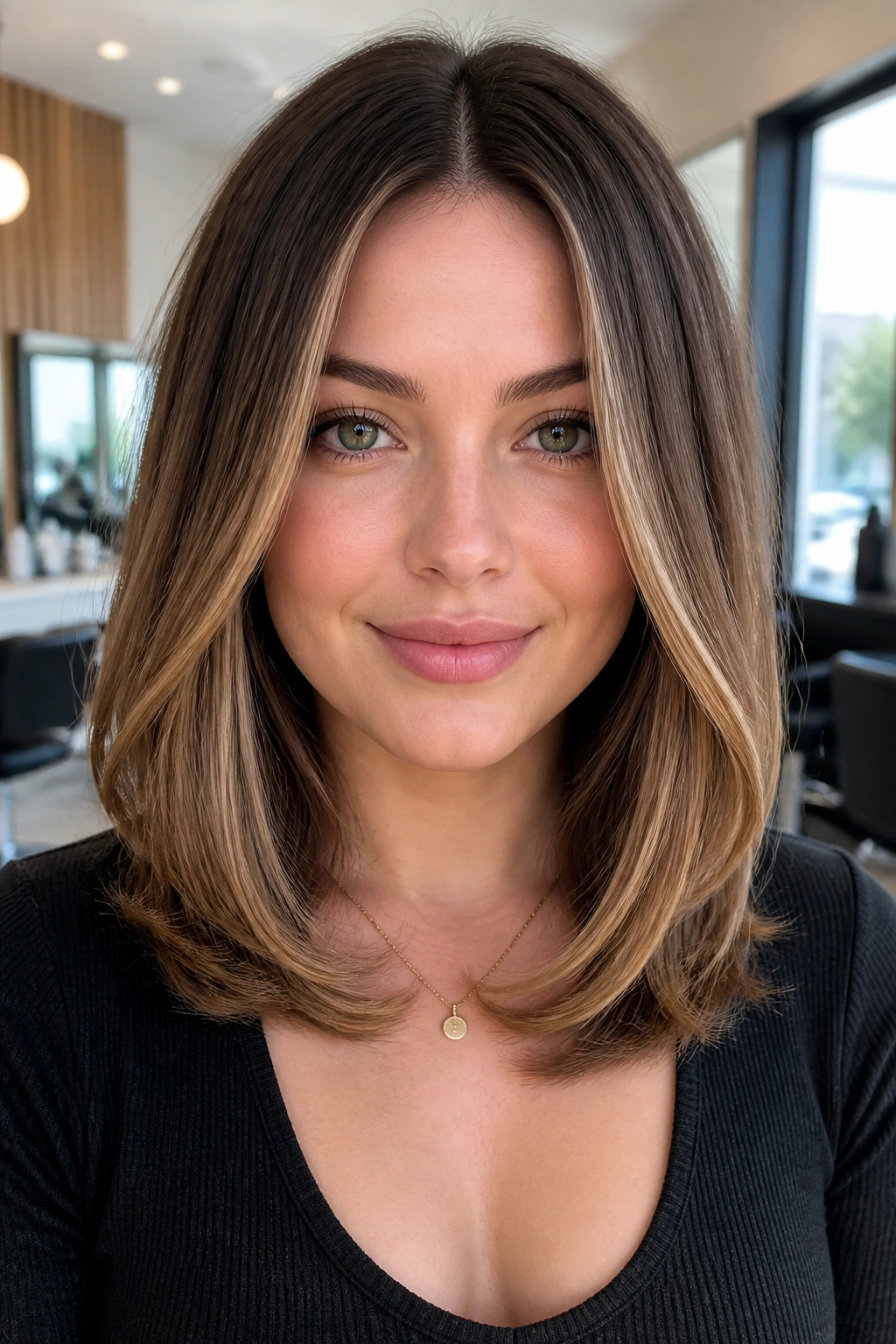
A center part can work on a round face. It just needs the right kind of brown highlight placement, or the whole thing can feel too symmetrical.
The goal is length, not perfect mirroring. So instead of placing the brightest pieces in a wide halo around the face, keep the center part clean and run the brown dimension in slim vertical paths down both sides. That gives the face a longer look without piling volume at the outer cheeks. If one side gets a little more brightness than the other, fine. That slight imbalance keeps the style from becoming rigid.
I’d reach for this when someone wants a polished look and doesn’t love side parts. It works best with straight styles, soft curls, or a brushed-out wave. A fluffy blowout can make it too wide, while a sleek finish keeps the line cleaner.
The part is not the enemy. Bad placement is.
21. Chestnut Peekaboo Lights for Low Maintenance
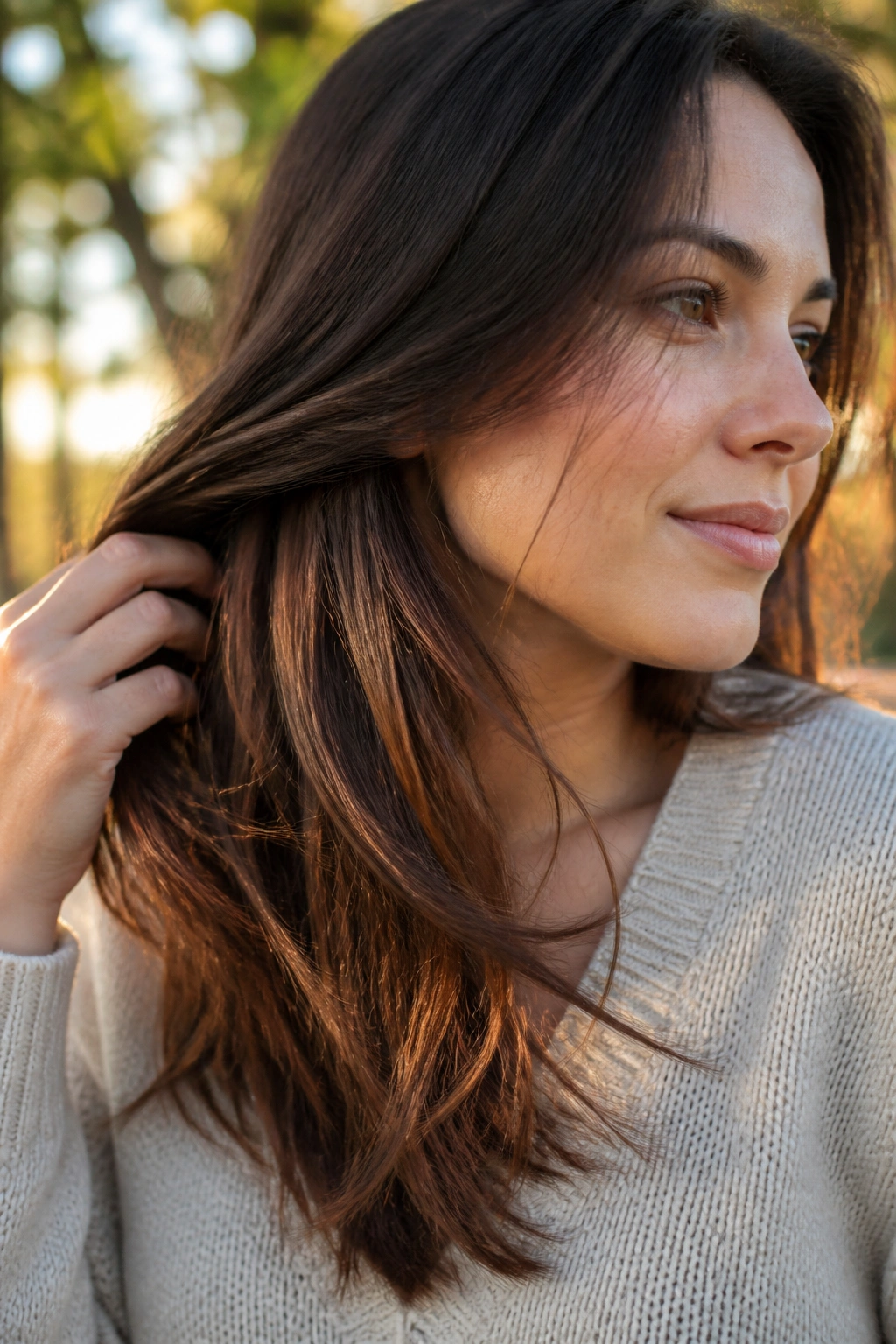
If you want color that shows up when it matters and hides when it doesn’t, chestnut peekaboo lights are a smart little trick.
They live under the top layer, usually around the nape and lower sides, so the surface stays calm. That keeps the face from feeling crowded. For round faces, it’s a useful move because the bright pieces stay away from the widest parts of the cheeks, but the hair still has movement and depth when it swings.
What I like here is the low maintenance. These lights don’t scream for a touch-up every time the root grows a quarter inch. They peek through during a ponytail, a tuck-behind-the-ear moment, or a windy afternoon. That’s enough for most people.
Best if you:
- Wear your hair up often
- Want subtle color at work
- Prefer darker brown bases
- Don’t want obvious root regrowth
Quiet color has a place. This is it.
22. Sandalwood Brown With Face-Framing Layers
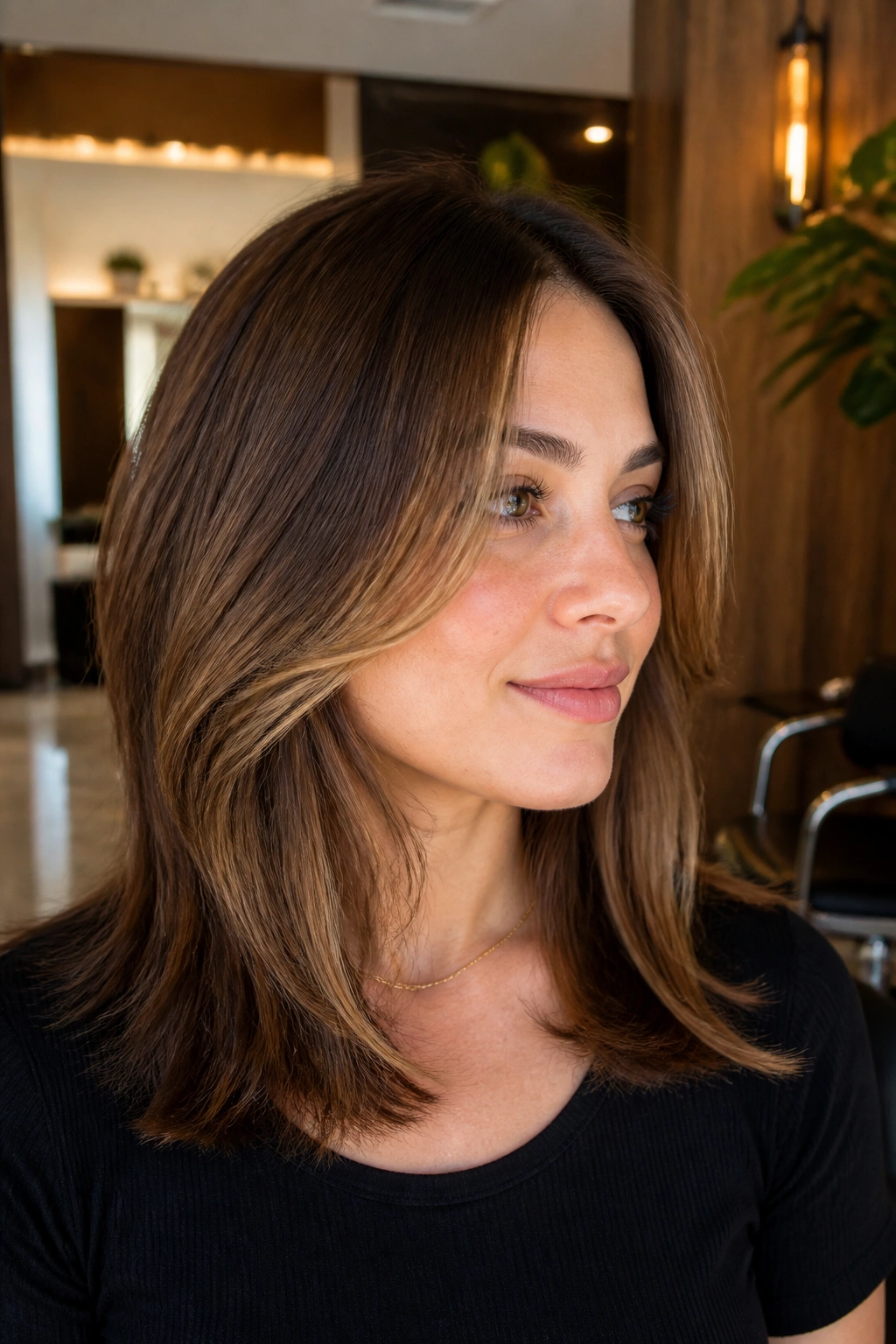
Sandalwood brown sits in a very wearable middle zone: not too warm, not too cool, not too bright. On a round face, that neutrality is useful because it softens the outline without adding bulk.
The face-framing layers should start below the temple and move downward in a gentle curve. If they begin too high, the color and the layer both widen the face. Start lower, and the whole shape looks longer. Sandalwood works well because it has enough softness to blend, but enough definition to show each layer.
I’ve always liked this look on hair that already has some movement. The color doesn’t need to do all the work; the cut helps. A shoulder-length cut with face-framing layers and sandalwood brown highlights can feel polished in a way that still looks easy.
Good pairing:
- Loose blowout
- Medium-density hair
- Subtle contouring at the front
- A gloss that keeps the brown beige, not yellow
23. Walnut Highlights on a Sleek Blowout
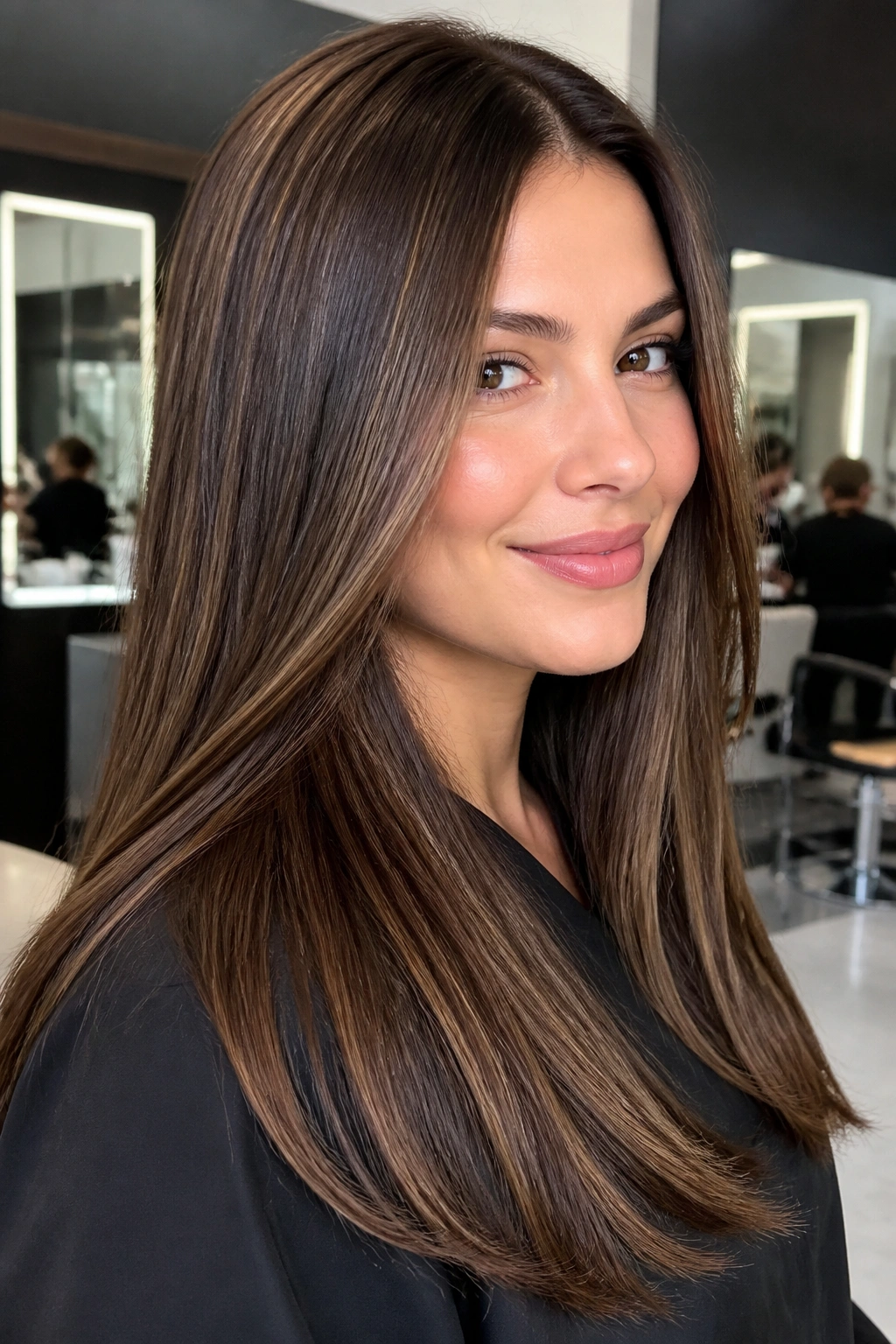
Walnut highlights are the elegant cousin in the brown family. They’re deep enough to stay believable, but light enough to catch on smooth, straight hair.
A sleek blowout changes how these highlights read. Instead of hiding in waves, the walnut ribbons line up with the shine and make the surface look expensive — yes, I said it. The real benefit for a round face is that the sleek finish creates long vertical lines. Pair that with narrow walnut highlights running from the cheek area downward, and the face gets a cleaner outline.
Keep the pieces slim. Walnut looks best when it’s layered into dark brunette hair, not sliced into giant panels. A smoothing cream, a boar-bristle brush, and a clean center or soft side part are usually enough to show it off.
This is a very controlled look. Not boring. Controlled. There’s a difference.
24. Reverse Balayage to Slim Fuller Cheeks
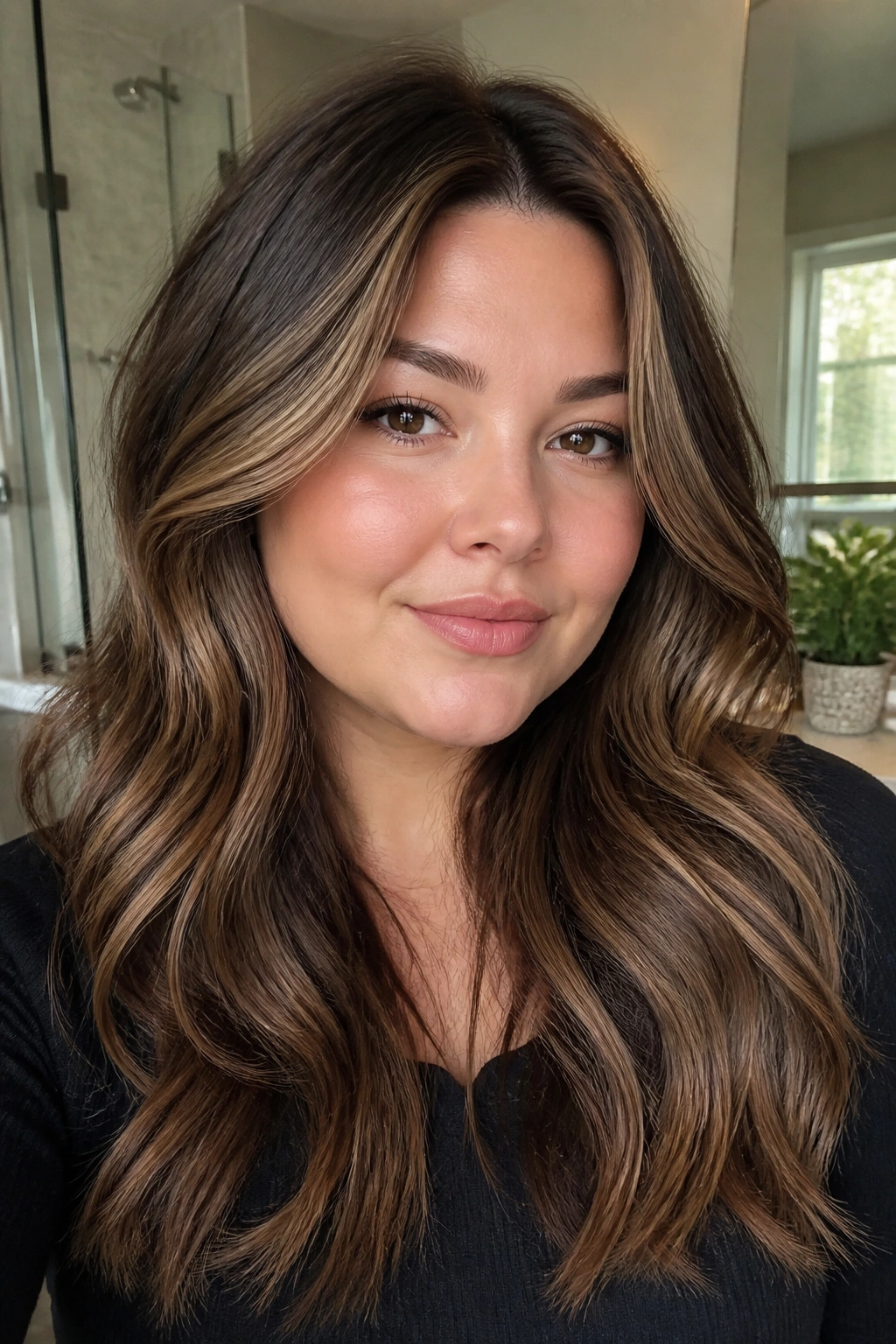
Reverse balayage is the answer when hair has gone too light around the face and you want to put some shape back in. Instead of adding brightness, you add depth.
That darker depth is especially helpful for round faces because it carves the outline back in. If the front pieces are too bright and too wide, the cheeks start to look wider than they are. Reverse balayage adds lowlights and a root melt, usually a couple of shades deeper than the current blonde or caramel, so the brightness stays where it helps most — lower and farther from the face.
When It Makes Sense
- Hair feels washed out around the cheeks
- Highlights are too flat or too broad
- You want a more grown-up, expensive-looking brown
- You like dimension but hate obvious stripes
Ask for a soft root smudge and a few darker ribbons around the outer face frame. That’s enough to narrow the visual width without making the hair look heavy.
25. Custom Brown Highlight Map for Round Faces
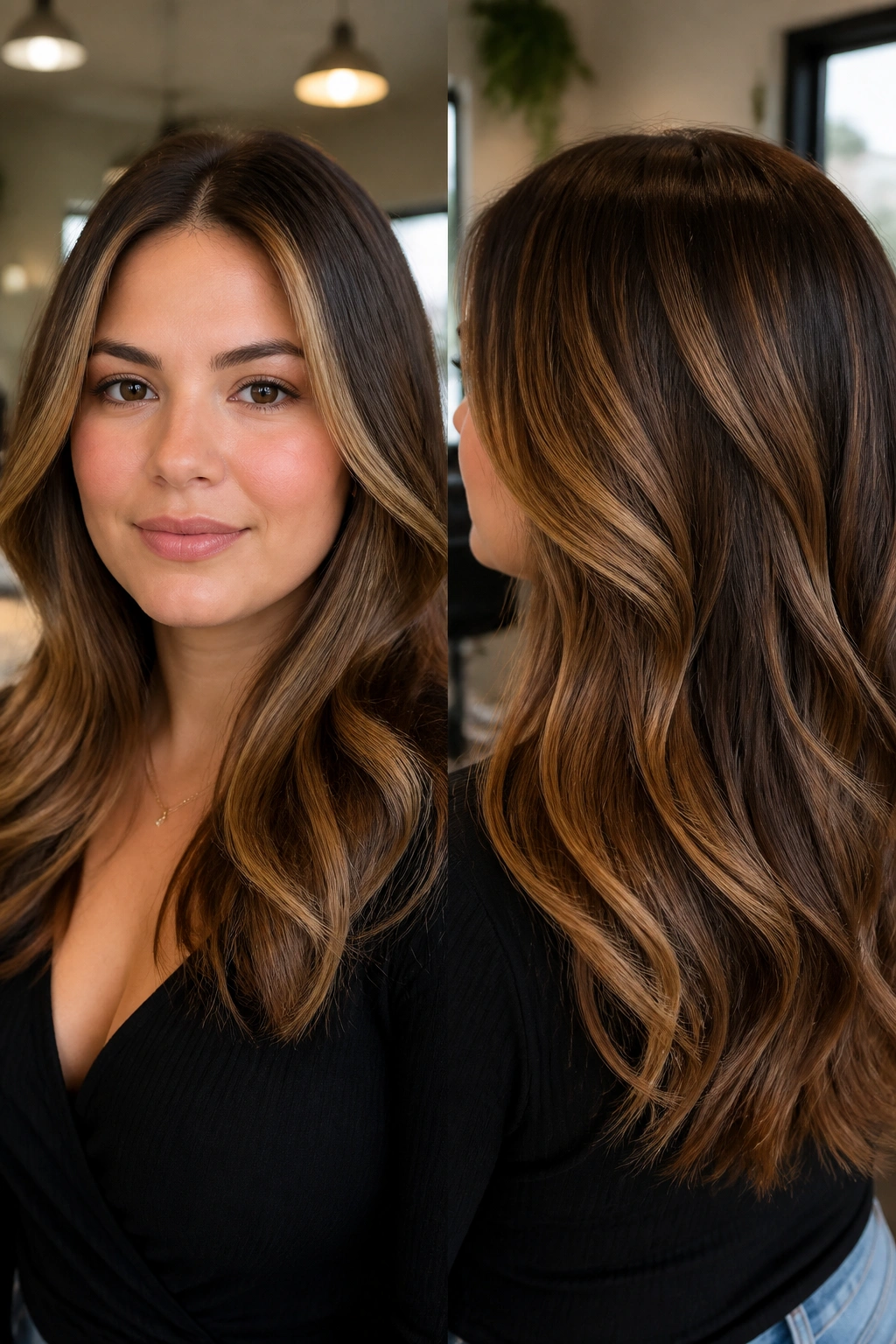
The best brown highlights for round faces are rarely copied straight from a photo. The placement has to match your haircut, your density, and where your face is widest.
That’s why a custom highlight map matters more than the exact shade. A colorist can use caramel, chestnut, mocha, walnut, or bronze and still make the result flattering if the brightest pieces sit in the right spots. Usually that means keeping the lightest bits near the temples or below the cheekbone, leaving some depth around the widest part of the face, and letting the ends carry more brightness than the top.
A simple salon script
- “I want brown highlights for round faces, not chunky stripes.”
- “Keep the brightness narrower around the cheeks.”
- “Bring some lighter pieces through the ends.”
- “Leave enough shadow near the root so the face doesn’t look wider.”
If you’re bringing a reference photo, bring two. One for the shade. One for the placement. Those are not the same thing, and hair color goes wrong when people assume they are.
Final Thoughts
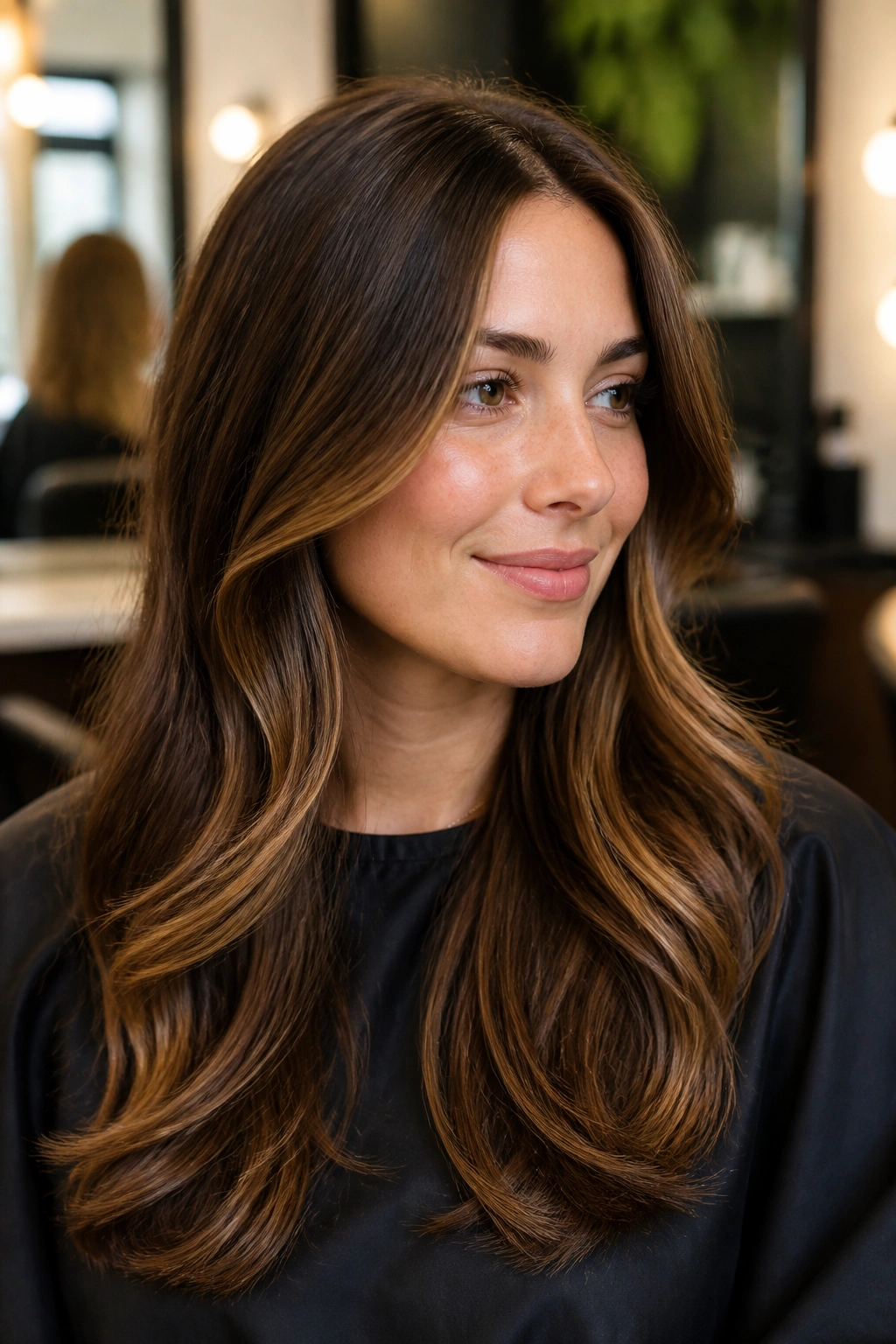
Round faces don’t need hiding. They need direction. The best brown highlights guide the eye vertically, soften the widest point, and keep the front from turning into one big bright frame.
If you want the safest request, ask for a medium brown base with caramel, chestnut, or mocha ribbons that start below the cheekbone and taper through the ends. That combination does a lot of quiet work.
Bring a little restraint to the salon chair. It pays off.
