



Round faces and short hair can get along just fine. The trick is to stop treating every short cut like a neat little helmet and start looking at where the shape actually sits. A short shag haircut for round faces works when it breaks up width, adds movement through the top, and keeps the cheek area from feeling boxed in.
Texture does the heavy lifting.
A blunt line at cheek level can make a round face look wider than it is. A shag changes the conversation. The ends are broken up, the layers move, and the eye gets pulled up and down instead of left to right. That’s why the right cut can feel lighter around the face even when it’s still short, even when it still has bite, even when you can shake it out and go.
The cuts below lean on different tricks: some use curtain fringe, some use crown lift, some use a side part or a tapered nape, and some go a little messy on purpose. Short shag haircuts for round faces are not one look. They’re a whole family of shapes, and the best one is the one that works with your hair density, your styling patience, and the parts of your face you actually want to show off.
1. Jaw-Length Feathered Shag for Round Faces

Jaw-length is the sweet spot when you want the face to look a little longer without going too severe. This cut keeps the perimeter just below the jaw while the layers are feathered enough to blur the widest part of the cheeks. It feels airy, not heavy. And that matters.
Why it flatters
The jawline gives the eye a lower stopping point, which helps a round face read more oval. If the shortest pieces hit right at the fullest part of the cheek, the cut can puff out in a way that fights the face instead of working with it. Here, the broken ends sit lower and the crown stays a touch taller.
Ask for point-cut layers that start around the cheekbone and fall to the jaw. That shape keeps the cut soft while still giving it some spine. A side part makes the line even better, especially if your hair tends to lie flat on top.
Best for: medium to thick straight or wavy hair.
Styling note: a 1-inch round brush or a quick bend with a flat iron is enough.
Watch for: layers that start too high and turn the top into a puff.
Pro tip: tell your stylist you want the ends to look broken up, not thinned out.
2. Pixie Shag with Long Side Fringe
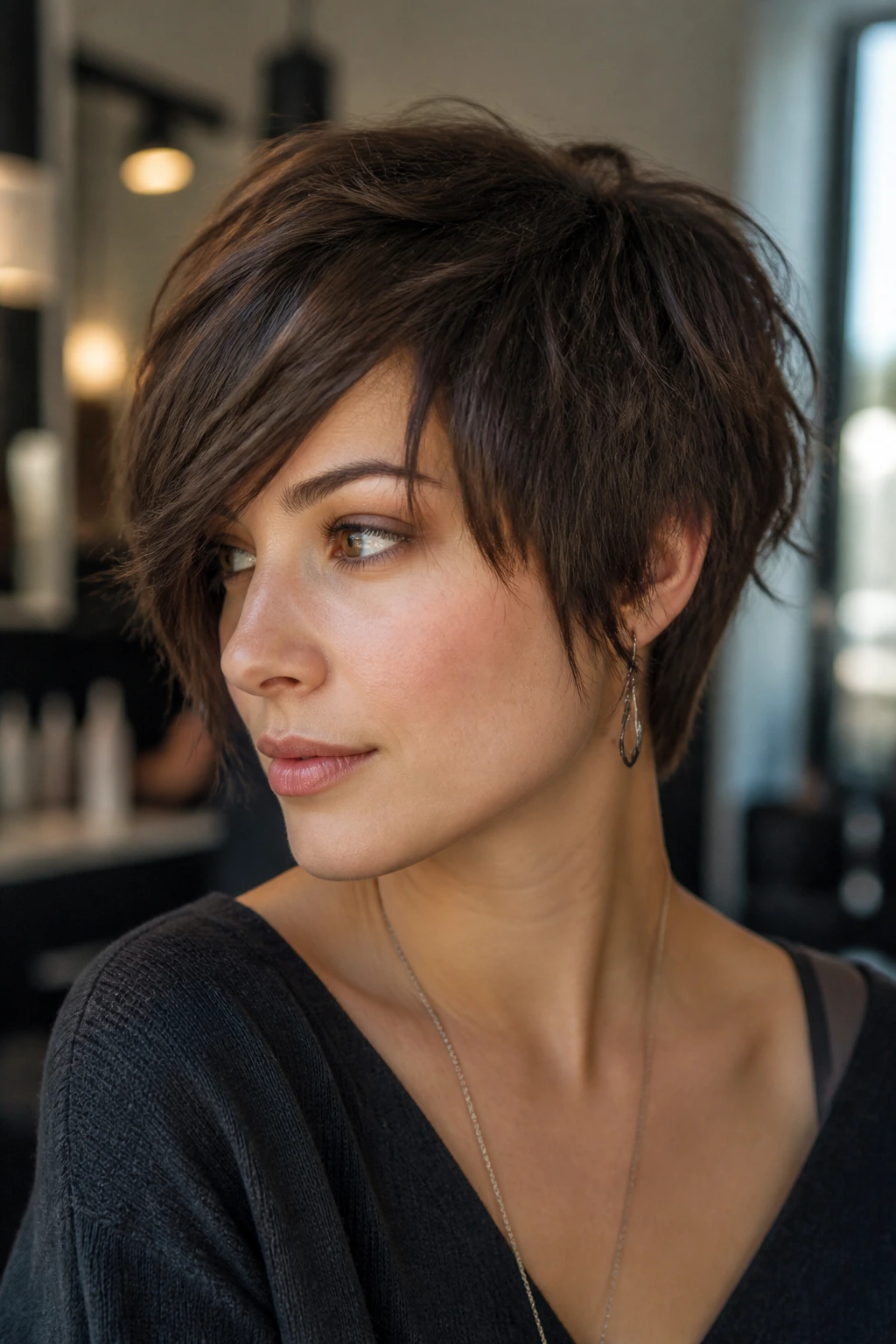
Can a pixie work on a round face? Yes, if the fringe stays long and the sides stay soft. A short pixie with shaggy texture can be a little cheeky in the best way, but only when the front is left long enough to carve a diagonal across the face.
The side fringe should skim somewhere between the brow and the top of the cheekbone. Shorter than that and it can feel abrupt. Longer than that and you get a nice sweep that pulls the eye away from the face’s widest point. Keep the ears lightly covered or softened with wispy side pieces so the cut doesn’t widen the middle of the face.
How to get the most from it
- Ask for 2 to 3 inches more length on top than at the sides.
- Keep the fringe movable, not stiff.
- Use a matte paste or light cream, not a heavy wax.
- Blow-dry the fringe in the opposite direction first, then sweep it over.
This one suits people who want short hair with some attitude. It is not a shy haircut. It looks best with a bit of bend, a bit of separation, and a little mess.
3. Chin-Length Choppy Shag Bob

If your hair flips out at the ends every time it gets cut blunt, a choppy shag bob can feel like a relief. The chin length keeps the outline clean, while the internal layers stop it from becoming a block. On a round face, that’s a smart trade.
The key is where the weight sits. A good shag bob still has shape, but it does not pile volume at the cheeks. The choppiness should happen through the mid-lengths and ends, not all at once near the jaw. That gives you movement without making the face look wider. Ask for the perimeter to sit right at or just below the chin, with the shortest face-framing pieces cut a little lower than the cheekbone.
A center part can work here if the fringe is soft. A slight off-center part often gives a better line, though. It makes the whole cut feel less round and a little more directional. If your hair is straight, point cutting is your friend. If it’s wavy, the shape will usually live nicely on its own.
4. Curly Short Shag

A curly shag is not about taming the curl. It’s about giving the curl a shape that does not balloon at the sides. That’s a useful difference, and a lot of people miss it. On a round face, curls can look gorgeous when the layers are placed to create height at the top and softness at the jaw.
The smartest version is usually cut dry, curl by curl, so the stylist can see where each coil actually lands. Wet curls lie. They always do. If your hair is wavy to curly, ask for longer layers around the crown and softer internal layering through the sides. You want lift, not a triangle.
Ask your stylist for
- A dry cut or a curl-by-curl shape.
- Layers that follow your curl pattern rather than fight it.
- No aggressive thinning near the temples.
- A slightly longer front section to keep the face open.
This cut shines with a diffuser and a leave-in cream. Let it set, then break the cast gently with your hands once it’s dry. The finished look should feel lively, not fluffy.
5. Wolf Cut Bob

The shape looks messy in the best way. A wolf cut bob brings that rougher, slightly wild edge, but the shorter length keeps it wearable. For round faces, the reason it works is simple: it builds motion where a blunt bob would add width.
The top is usually shorter and more lifted, while the lower layers taper out so the nape doesn’t feel bulky. That creates a longer vertical line through the head. It also gives the face room. If you like a haircut that looks even better after a day of being slept on, this is one to keep on your radar.
A wolf cut bob needs texture products that do not stiffen the hair. Think soft mousse, a light salt spray, or a dry texture spray used sparingly. Too much product and the cut gets stringy. Too little and the layers lose their point.
6. Razored Crop with Deep Side Part
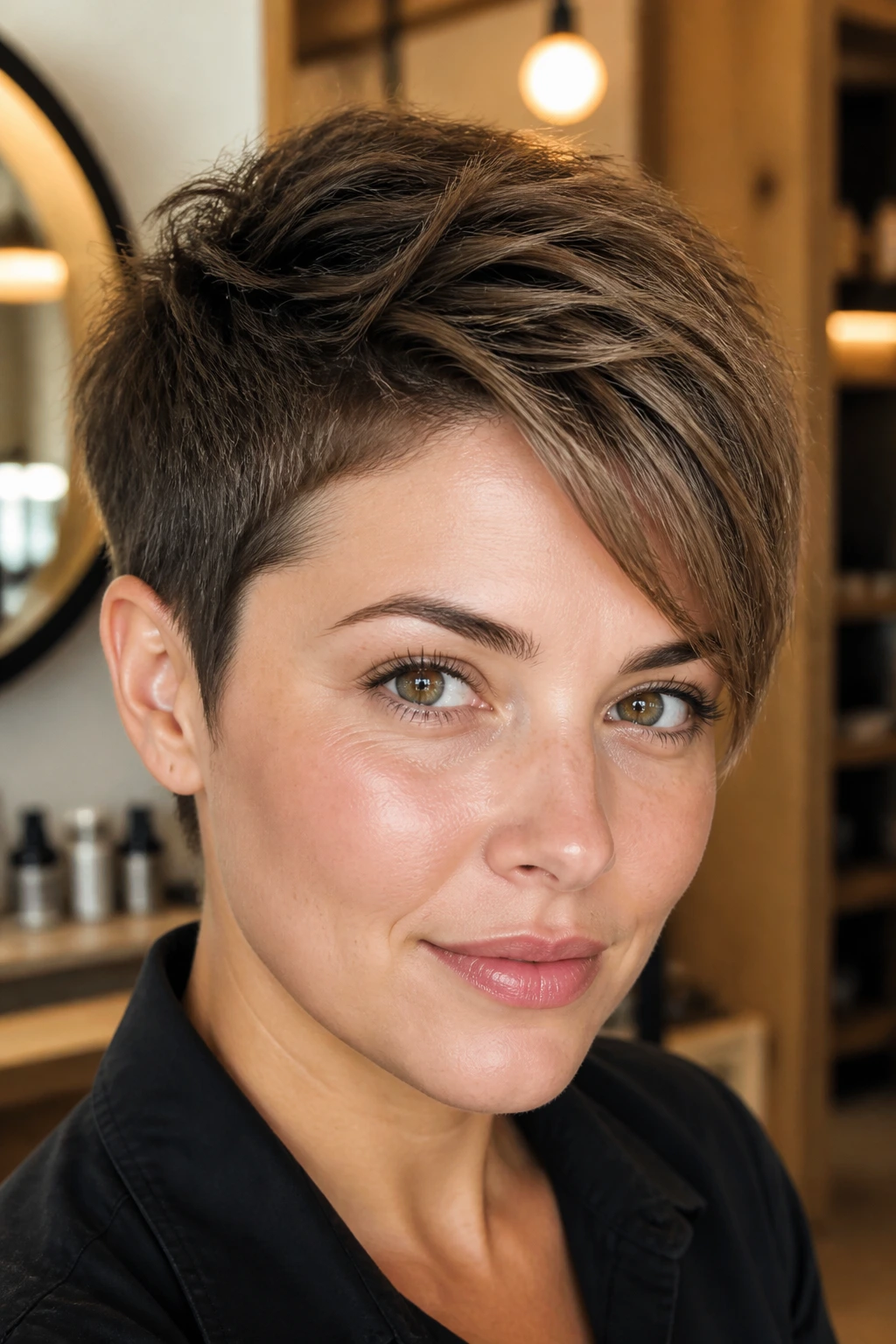
Straight hair can look boxy on a round face unless the cut breaks the line. A razored crop does that quickly. The razor gives the edges a softer finish, and the deep side part pushes a curtain of hair across one side of the forehead, which changes the whole balance.
This cut works especially well on dense hair that feels heavy when it’s cut with scissors alone. Razor work can remove some of that bulk and make the ends move instead of sit like a shelf. But here’s the catch: if your hair is fragile, frayed, or already prone to split ends, too much razor work can make it look rough. So this one needs a careful hand.
What to ask for
- A deep side part with one side falling across the cheek.
- Soft razored ends, not shredded pieces everywhere.
- Shorter sides and a little more height through the top.
- A finish that can be tucked behind one ear.
The real benefit here is the diagonal line. Round faces love diagonals.
7. Bixie Shag

Bixie or shag? You do not have to choose one mood and stick there. The bixie is that in-between cut—shorter than a bob, longer than a pixie—with shaggy movement added in. On a round face, it can be a strong choice because it gives you the lift of a pixie without exposing too much width at the cheeks.
The shape usually has shorter back sections, ear-grazing sides, and a longer crown. That crown length is the important part. It lets you build height without making the sides feel square. If your hair is fine, this cut can create the illusion of more density on top, which helps balance a softer face shape.
How it differs from a regular pixie
A pixie can hug the head too closely. A bixie leaves more room around the temples and crown, so the face looks less circular. It also grows out better. That matters more than people admit.
Recommendation: ask for a bixie with piecey top layers and sideburns left a little longer than usual. That small detail keeps the shape from looking too cropped.
8. Curtain Bang Shag for Round Faces

If your forehead is the part you always hide, curtain bangs can soften the front without flattening the whole cut. They part in the middle, bend away from the face, and usually land around the cheekbone. On a round face, that creates a nice opening in the center while still giving you coverage at the sides.
The trick is to keep the bangs long enough to sweep, not hover. Short curtain bangs can make the face feel wider because they stop too high. Longer ones, especially when blended into shag layers, create a vertical frame that pulls the eye downward. That little bit of length is doing more work than it looks like.
The rest of the cut should stay light around the jaw and fuller through the crown. If the bangs are soft but the sides are bulky, the effect gets muddy fast. A round brush helps, but so does a quick bend from a flat iron on the outer pieces. Keep the center a touch shorter and the sides a little longer. That’s the whole trick.
9. Soft Wavy Bob with Tapered Ends
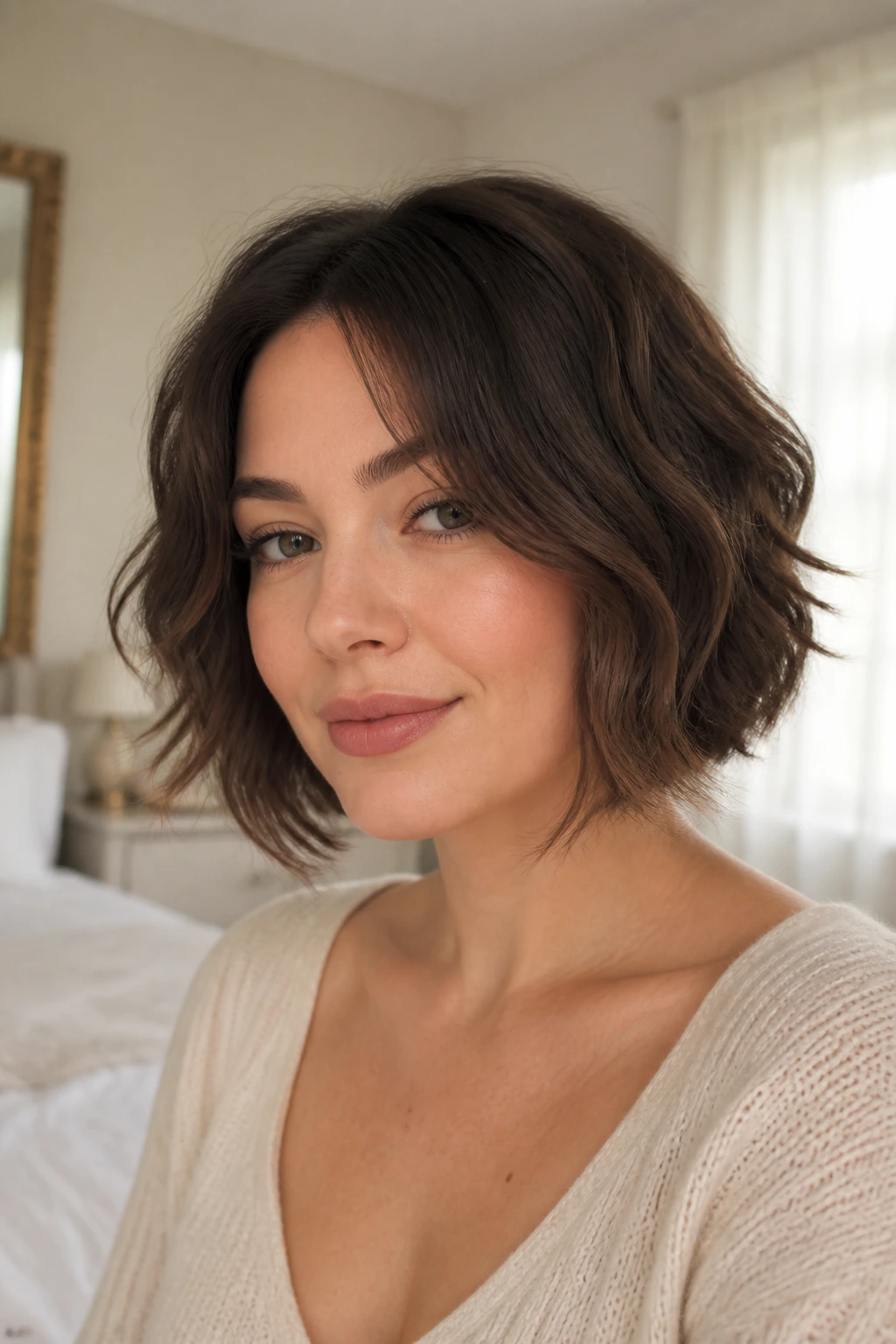
Not every round face needs a lot of choppiness. Some do better with a softer, quieter shag shape that keeps the outline smooth and lets the wave do the work. A soft wavy bob with tapered ends is one of those cuts. It’s less edgy than the wolf cut or the bixie, but it can be easier to wear every day.
The tapered ends stop the bob from looking heavy at the bottom. The layers are there, but they’re subtle. Think of them as a whisper instead of a shout. If your hair naturally bends or flips a bit, this cut keeps that movement without turning the whole head into a cloud. That matters for round faces, because too much side width is the enemy.
This is a good choice if you want to air-dry often and use a diffuser only when you feel like it. A little leave-in conditioner, a touch of mousse, and a rough dry with your fingers may be enough. Simple. Which is nice for once.
10. Mullet-Lite Shag

A full mullet is a lot. A mullet-lite shag keeps the attitude and trims the drama. The shape is shorter up top, a bit longer in the back, and softly connected through the sides. For round faces, that longer nape helps stretch the silhouette downward, which is one of the oldest tricks in the book.
What makes this version more flattering than a harsh mullet is the softness through the temples. You do not want the sides puffing out at the cheekbone. You want the eye to move past them. A few broken layers around the face and a light fringe, if you want one, keep it modern without turning it into a costume.
This cut comes alive with texture spray and finger styling. You can push the crown up a little, pinch the ends, and let the nape fall where it wants. It looks especially good on hair that has some natural bend. On pin-straight hair, you may need a flat iron to create a slight flip at the ends.
11. Bottleneck Bang Shag

Why do bottleneck bangs work so well here? Because they start narrow in the center and widen as they move toward the temples, which means they frame the face without drawing a hard line across it. That shape is kinder to a round face than a thick straight fringe.
The bangs should open at the bridge of the nose or just below it, then feather out toward the cheekbones. That gives you coverage without closing off the top of the face. Pair them with short shag layers and you get a cut that feels soft but deliberate. Not messy. Not stiff either.
Styling it fast
Use a small round brush or your fingers to direct the center pieces downward first, then flip the outer edges away from the face. A tiny bit of cream is enough. Too much product and the bangs stick together, which kills the whole effect.
This is a good cut if you want the front of your hair to do some of the shape work for you. You should not have to fight it every morning.
12. Asymmetrical Shag Bob
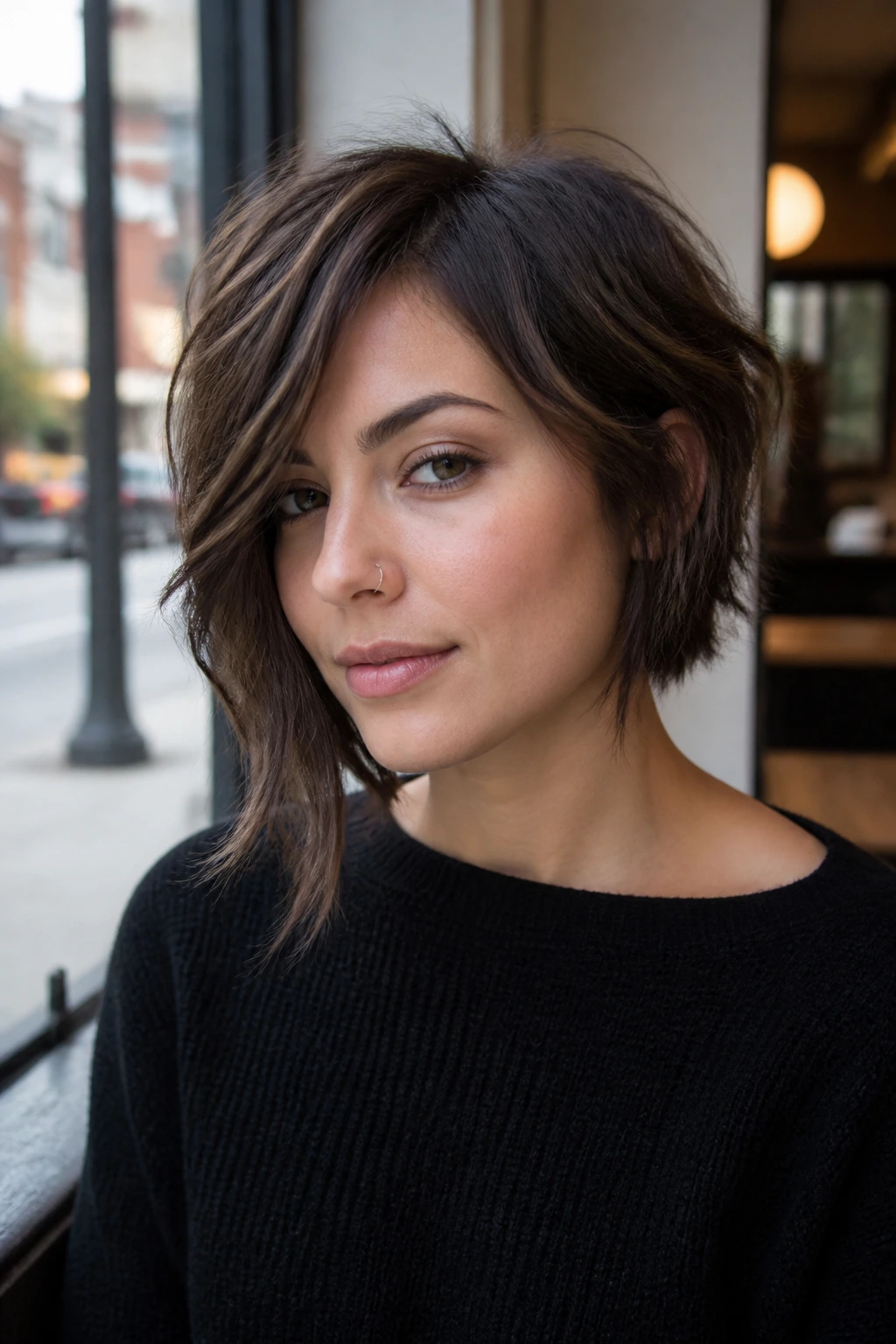
If symmetry makes your face look rounder, tilt the shape. An asymmetrical shag bob does exactly that by leaving one side a little longer than the other—usually by about half an inch to an inch and a half. That may sound tiny, but on the face it reads clearly.
The longer side creates a diagonal that cuts across the cheek area. The shorter side keeps the cut light. Together, they stop the head from looking too even, which is often what makes a round face feel wider in a straight-across cut. The layers inside the bob still matter, of course. You need movement, not just unevenness.
This style works best when the asymmetry is subtle. A dramatic one-sided chop can feel harsh unless the rest of the look is very polished. A soft wave, a slight bend at the ends, and a side part make it feel intentional. If you wear glasses, this cut can sit nicely around the frames too. That’s a small bonus, but a real one.
13. Crown-Heavy Disconnected Shag
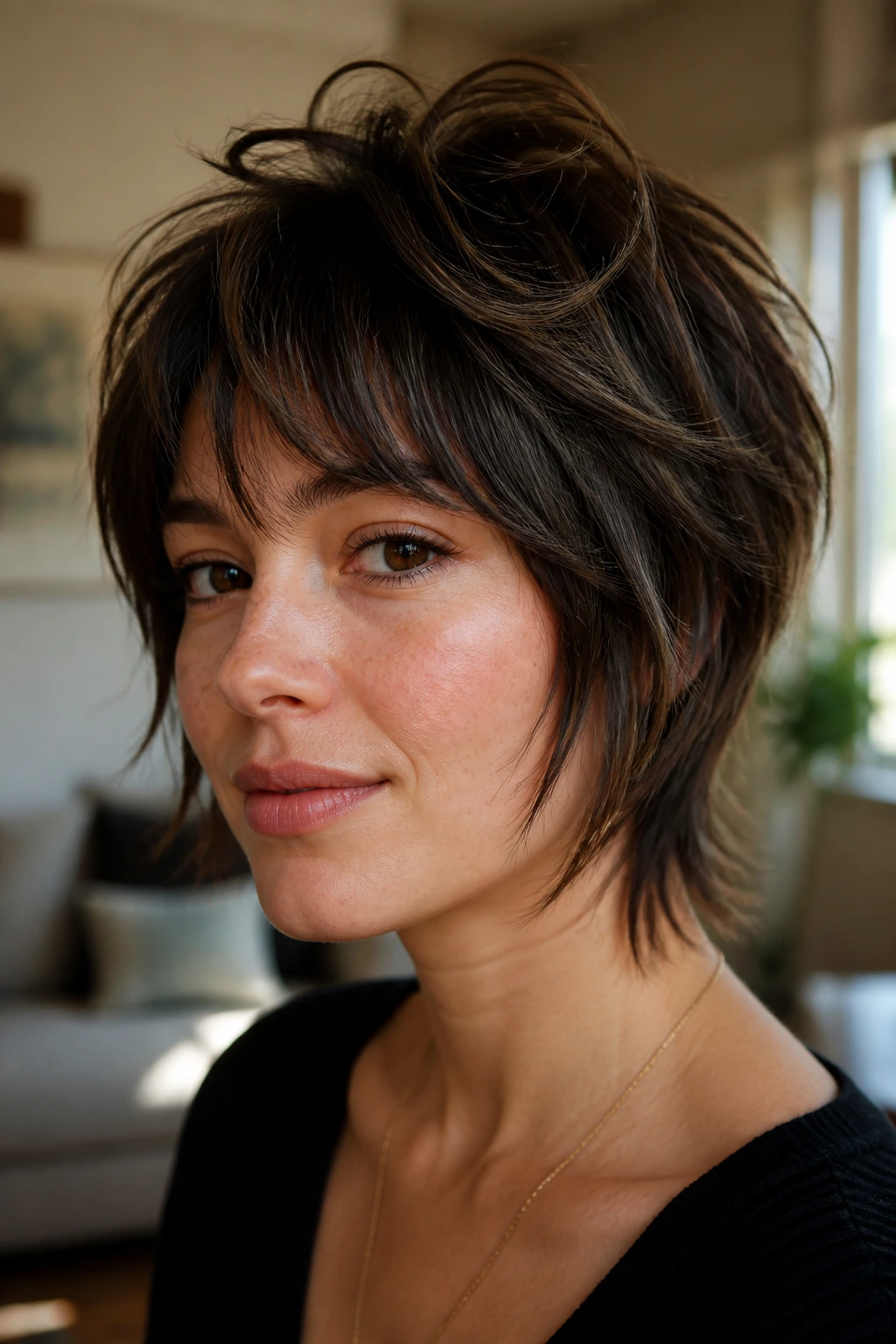
Volume belongs at the crown, not at the cheeks. That’s the whole reason a crown-heavy disconnected shag works so well on a round face. The layers are cut so the top has lift and the lower sections do not blend too neatly into the sides. You get vertical shape instead of a tidy little circle.
This cut has a stronger personality than a soft shag bob. It looks especially good when the top layers are a little shorter and the sides fall away more loosely. The separation keeps the shape from collapsing. If your hair is fine, that added lift can be useful. If it’s thick, the disconnect helps remove some bulk from the mid-section without making the ends skinny.
What to watch for
- Too much lift at the sides can widen the face.
- Too much blending can flatten the crown.
- A small amount of root mousse usually helps.
- A rough dry with a diffuser or vent brush keeps the shape alive.
This is one of those cuts that looks better with a little imperfect texture. Perfectly smooth hair can make it feel too tidy.
14. Feathered Side-Bang Shag
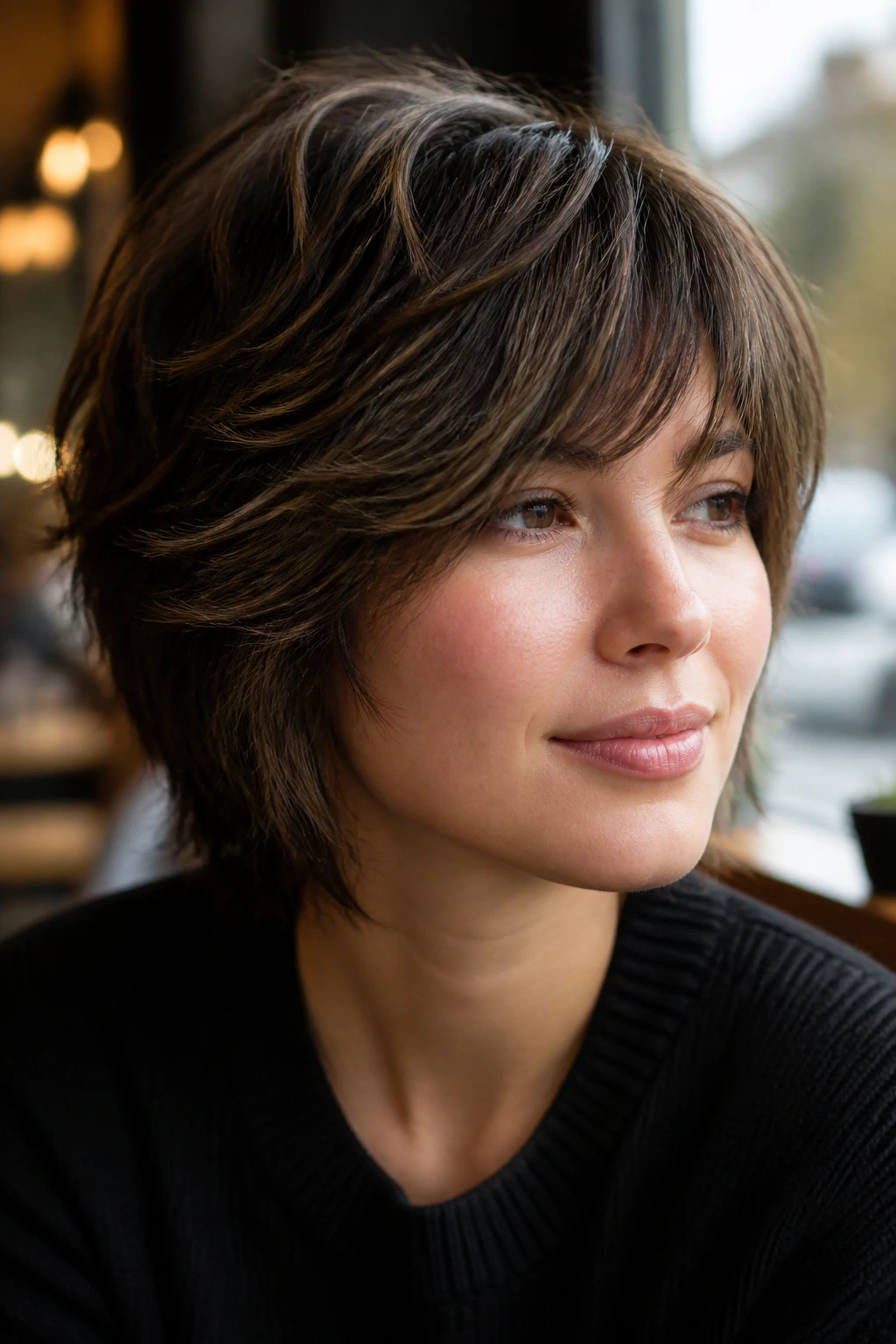
Soft pieces that graze the temple do a lot of quiet work. Feathered side bangs pull attention toward the eyes and away from the widest part of the face, which is exactly what you want with a round shape. They also age well as the haircut grows out. That’s not a small thing.
The feathering should start near the temple and blend into the front layers, not sit as a separate chunk. A heavy side bang can drag the face down. Feathering keeps it light. If the bangs land around eyebrow level and sweep down toward the cheekbone, the line feels long and clean.
This cut is easy to live with if you do not want a full fringe. It can be tucked, swept back, or left loose. It also behaves nicely on wavy hair because the side pieces can dry into a natural bend. If your hair is straight, a quick pass with a round brush at the roots helps. Nothing fussy. Just enough lift to keep the shape from lying flat.
15. Chin-Grazing Shag with Bluntish Perimeter
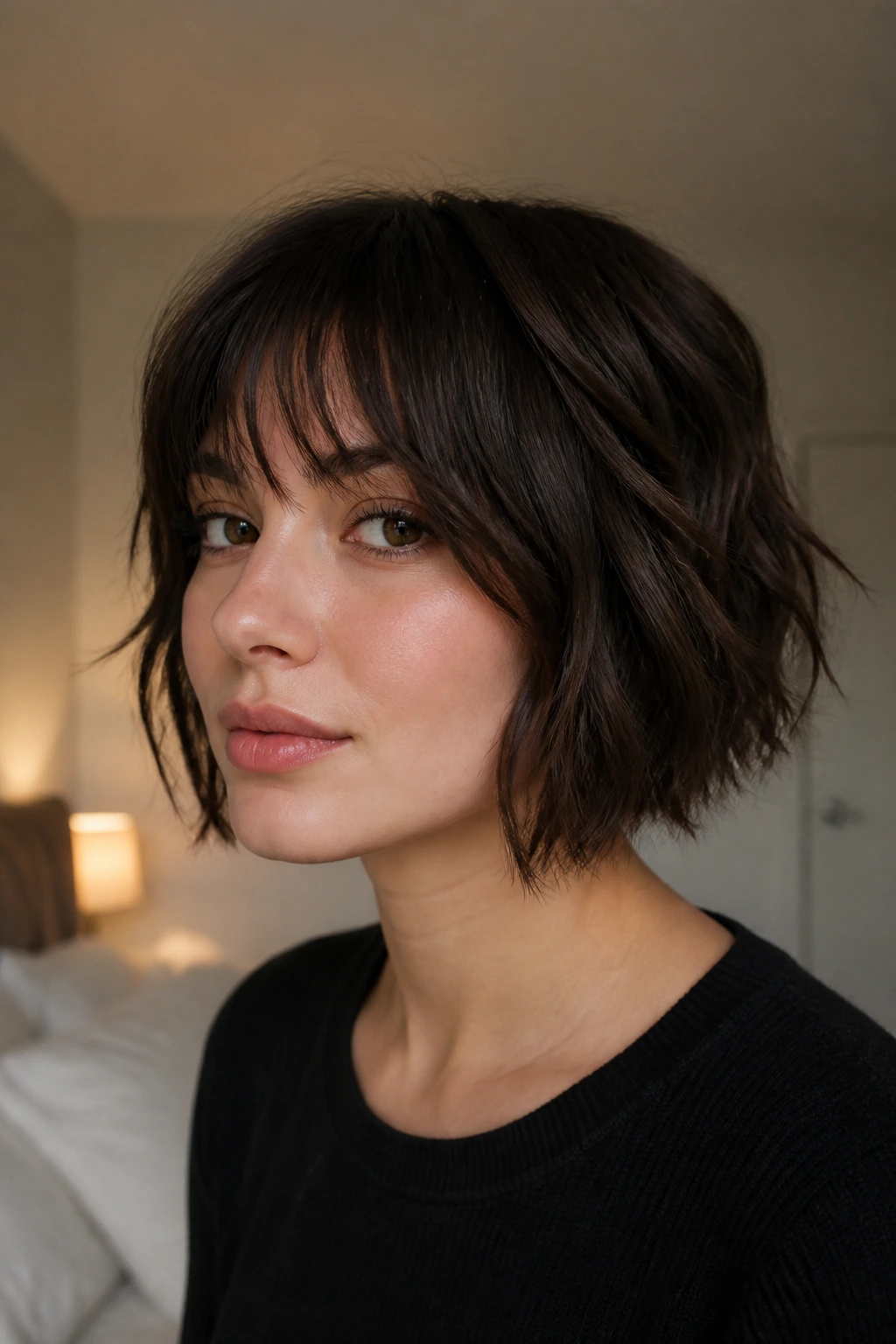
Unlike a fully shattered shag, this one keeps a cleaner edge. The chin-grazing perimeter gives the cut a little structure, while the layers inside break up the width and stop it from feeling too solid. That mix is useful on round faces because it gives you line and movement at the same time.
The shorter inner layers should not all sit at the same level. A staggered shape works better. You want some pieces to fall just below the cheekbone and others to drift nearer the jaw. That unevenness keeps the eye moving. If the ends are too choppy, the cut can start to look too fluffy. If they’re too blunt, the roundness comes back.
This is a smart option for fine hair that needs a stronger outline. A bluntish edge makes the hair look fuller at the bottom, while the shag layers keep it from feeling heavy. I like this one for people who want a haircut that still looks neat on day three. It has more staying power than a super-soft shag.
16. Wash-and-Go Airy Shag

How little styling can a short shag ask for? Less than most cuts, if the layers are placed right. A wash-and-go airy shag is built for hair that already has some natural bend and for people who are tired of wrestling with a round brush every morning.
The cut should have lightweight internal layers and a slightly longer front, so it dries with movement instead of lumping up at the sides. On a round face, that airy space matters. The hair never sits as one solid line across the cheeks. It falls in pieces, which is much kinder. Use a leave-in product that softens but does not weigh the hair down, then scrunch and leave it alone for a while.
Best for
- Wavy hair that air-dries with a bit of shape.
- Busy mornings.
- People who hate stiff styling products.
If your hair dries puffier than you want, the answer is usually less product, not more. A little goes a long way here.
17. Undercut Shag
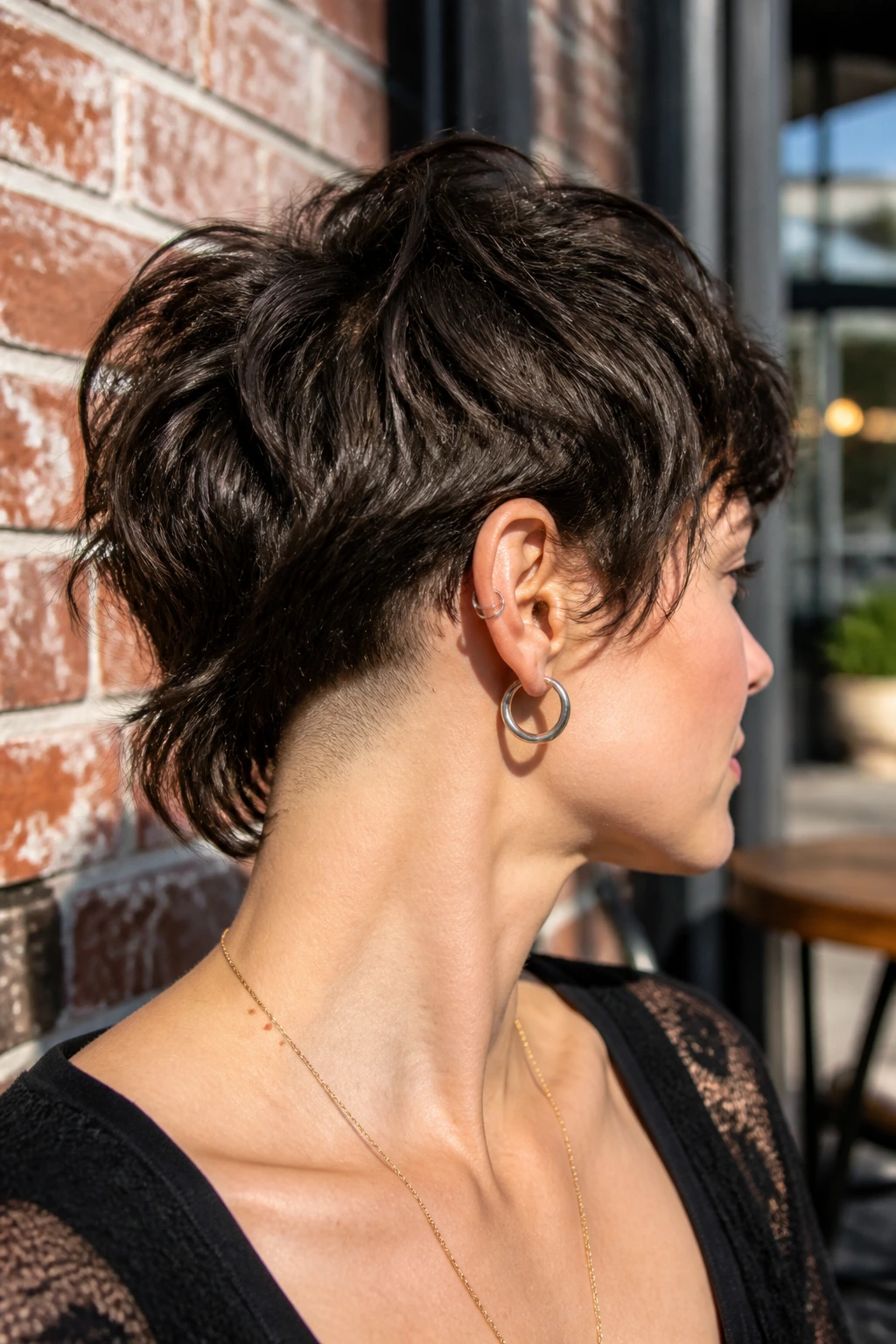
Dense hair can balloon out at the sides fast. An undercut shag solves that by removing bulk underneath, often at the nape or just behind the ears, while keeping the top and outer layers shaggy. For a round face, that hidden reduction can make a huge difference.
The visible shape stays soft, but the weight underneath is gone. That means the hair can fall closer to the head without sticking out at the widest point. It also means your styling time often drops, because you’re not forcing thick hair to sit flat where it does not want to sit. If your hair grows fast around the neck, though, plan on trims every 6 to 8 weeks. Short undercuts lose their clean line quickly.
This cut has a cooler, sharper feel than a feathered bob. It is not the best choice if you want something sweet or airy. It is the one to pick if you want the haircut to have some bite. Very practical. A little rebellious. And easier to wear than it sounds.
18. Coily Round-Face Shag
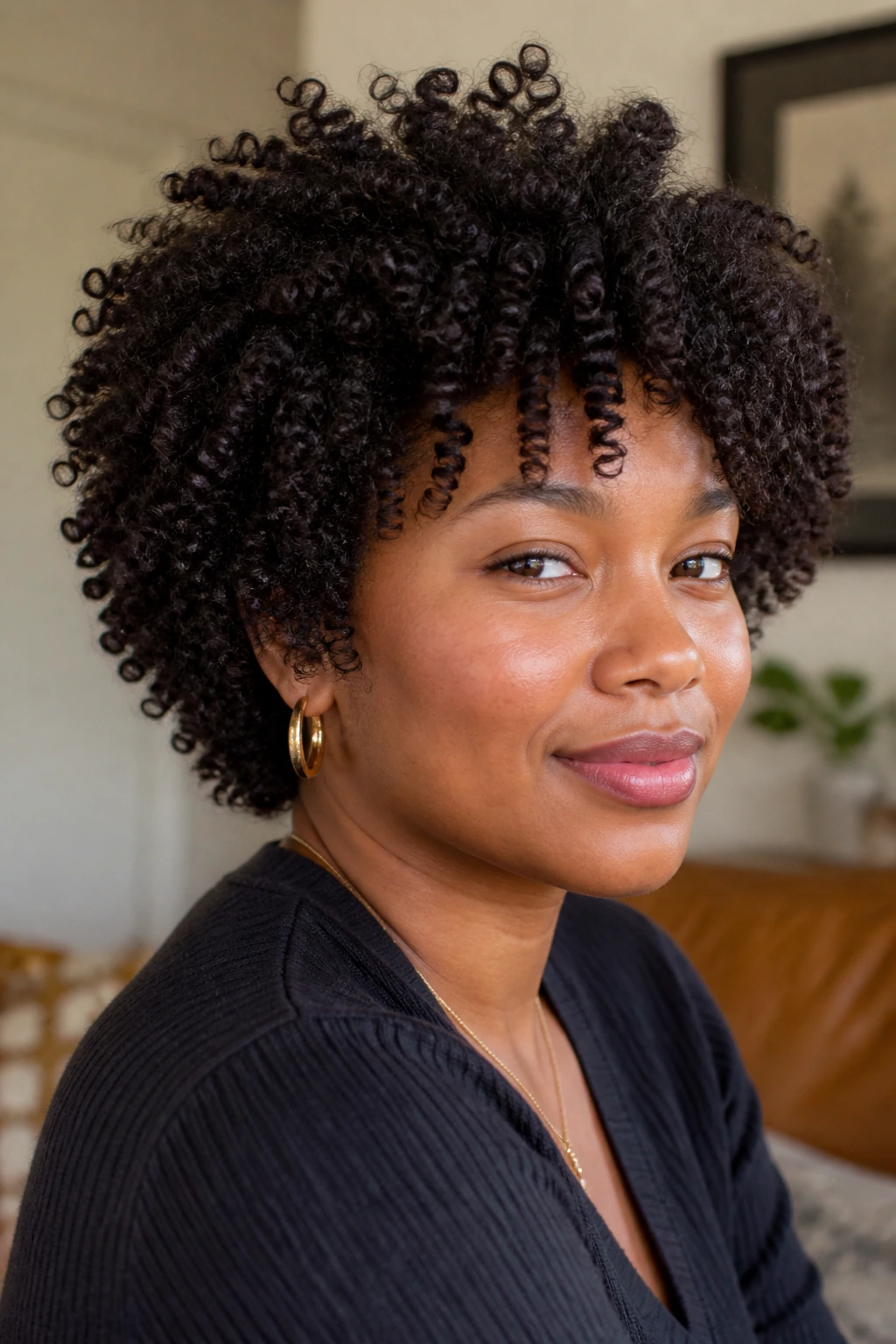
Curls and coils need shape, not thinning shears everywhere. That’s the part people get wrong. A short coily shag for a round face should be shaped around the curl pattern so the silhouette rises where it should and stays soft where it would otherwise spread out.
Dry cutting helps here because shrinkage changes everything. A coil that looks chin-length when wet may bounce to the mouth or higher once it dries. The stylist needs to see the real shape before taking off too much. Keep the sides a touch longer if your coils spring wide, and let the top hold some height. That vertical lift is the difference between a rounded halo and a balanced shag.
What to avoid
- Over-thinning the sides.
- Cutting too much length off the crown.
- Ignoring shrinkage.
- Forcing a curly fringe too short.
This is one of those cuts where the first hour after styling matters less than the next day. Once the curl settles, the shape usually gets better.
19. Sleek Piecey Shag with Micro Fringe
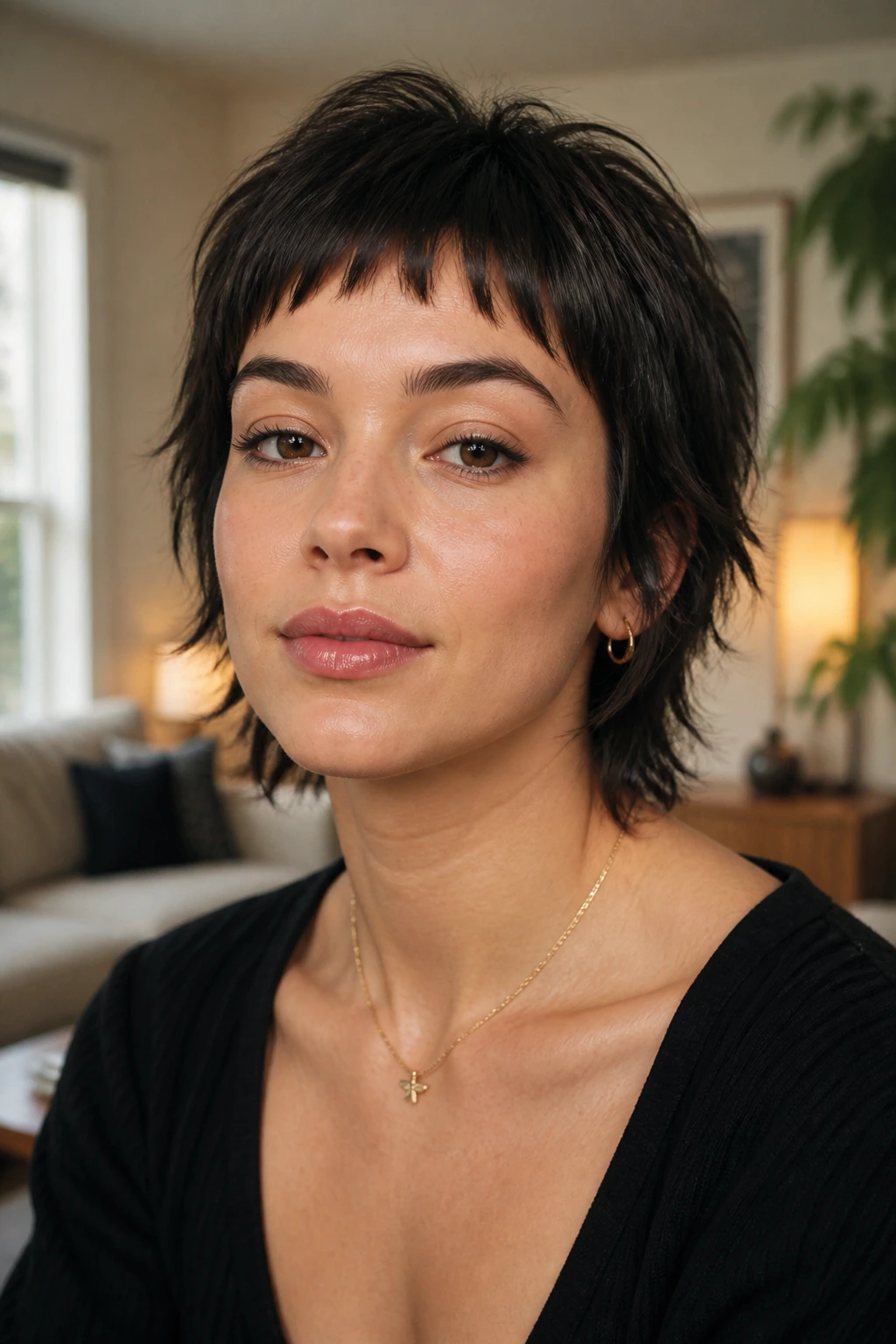
A shag does not have to be wild to work. A sleek piecey shag keeps the layers visible but controlled, with separated ends and a very short fringe only if the forehead can handle it. On a round face, the clean lines can look sharp, especially when the top keeps a little lift.
Micro fringe is a commitment. It draws attention fast, so it works best when the rest of the haircut has enough movement to stop the front from feeling severe. If your hair is dense and straight, this can be a smart combination. The fringe gives a high contrast point, and the piecey lengths around the cheeks stop the face from looking too circular.
Use a flat iron only where needed, and bend the ends just slightly inward or outward—nothing too tidy. The point is separation. Not polish. This style suits someone who wants a short shag haircut for round faces but does not want the usual soft fringe everyone suggests. A little edge helps.
20. Face-Framing Long-Layer Shag for Round Faces
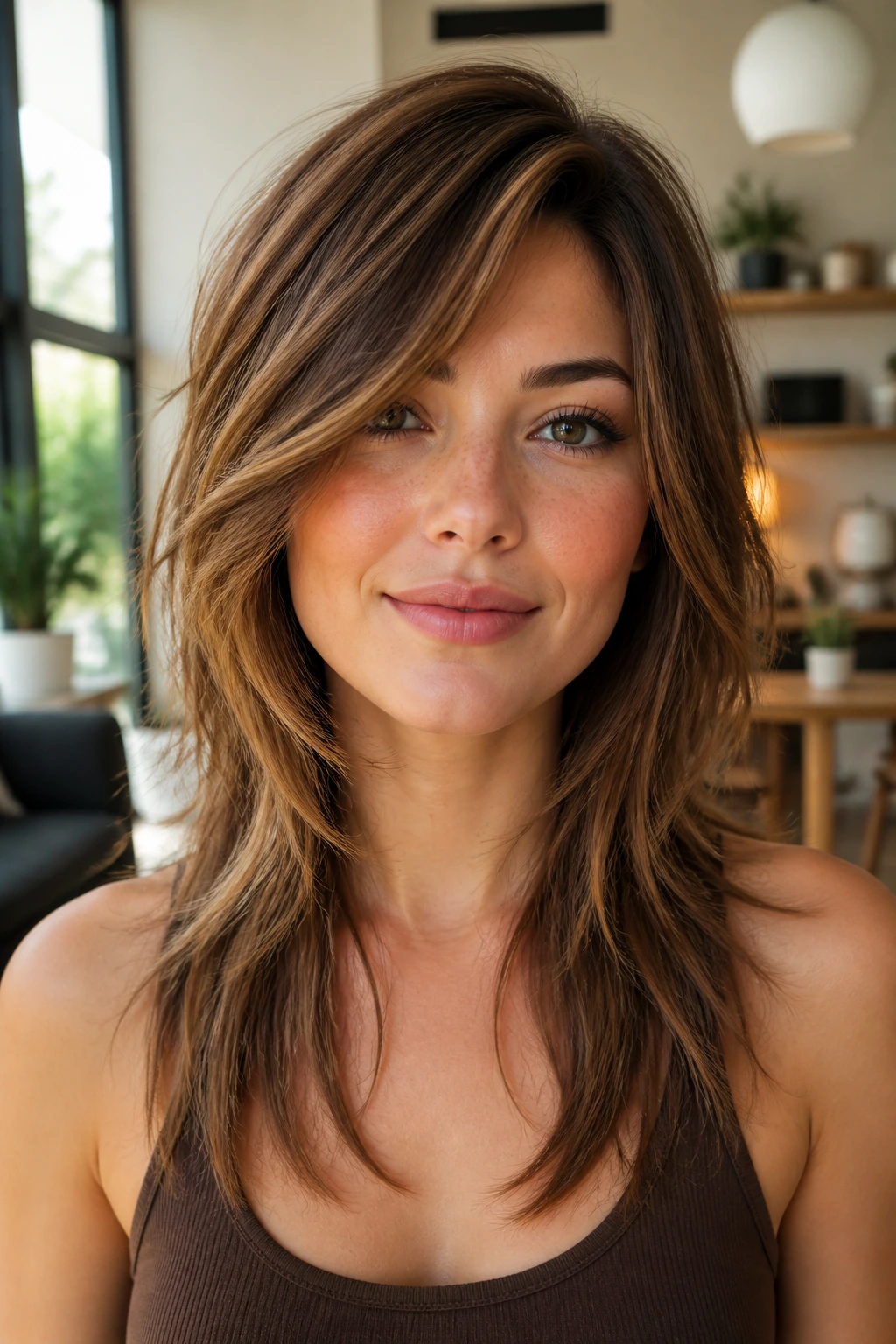
If you want the safest bet, start with long front pieces and short internal layers. That is the basic idea behind a face-framing long-layer shag, and it works because it gives round faces a visible vertical line without sacrificing the short length. The longest pieces should fall below the cheekbone, often closer to the top of the jaw.
This cut is the one I’d point to for someone who says, “I want short hair, but I do not want to regret it in two weeks.” Fair ask. The shape is forgiving. It grows out well. And it still gives you the shag movement that keeps the face from looking too wide or too flat. If your hair is fine, the layers can add body. If it’s thick, they can pull out some bulk.
The simplest way to wear it is with a soft side part and a little bend at the front. If you want a cleaner finish, tuck one side behind the ear and leave the other loose. That small imbalance keeps the cut from looking too round, which is really the whole game here.
