



Round faces can wear bangs. They can also wear the wrong bangs, and that is where the whole haircut goes sideways.
The best blonde bangs for round faces do one thing well: they stretch the face without making the forehead look bare or the cheeks look wider. Blonde changes the equation a little because lighter pieces show every bend, every break, every soft edge. A blunt line at cheek level can feel boxy; a broken, airy, or diagonal fringe usually moves better.
I keep coming back to one simple rule: round faces do not need hair that hides them. They need shape. A little lift at the crown, some length near the temples, and a fringe that lands in the right place can change the balance of a haircut fast.
The 20 ideas below take that shape in different directions. Some are soft and easy. Some are sharper, cooler, or a little more styled. All of them are built to flatter a round face instead of tracing it.
1. Long Curtain Bangs for Round Faces in Beige Blonde
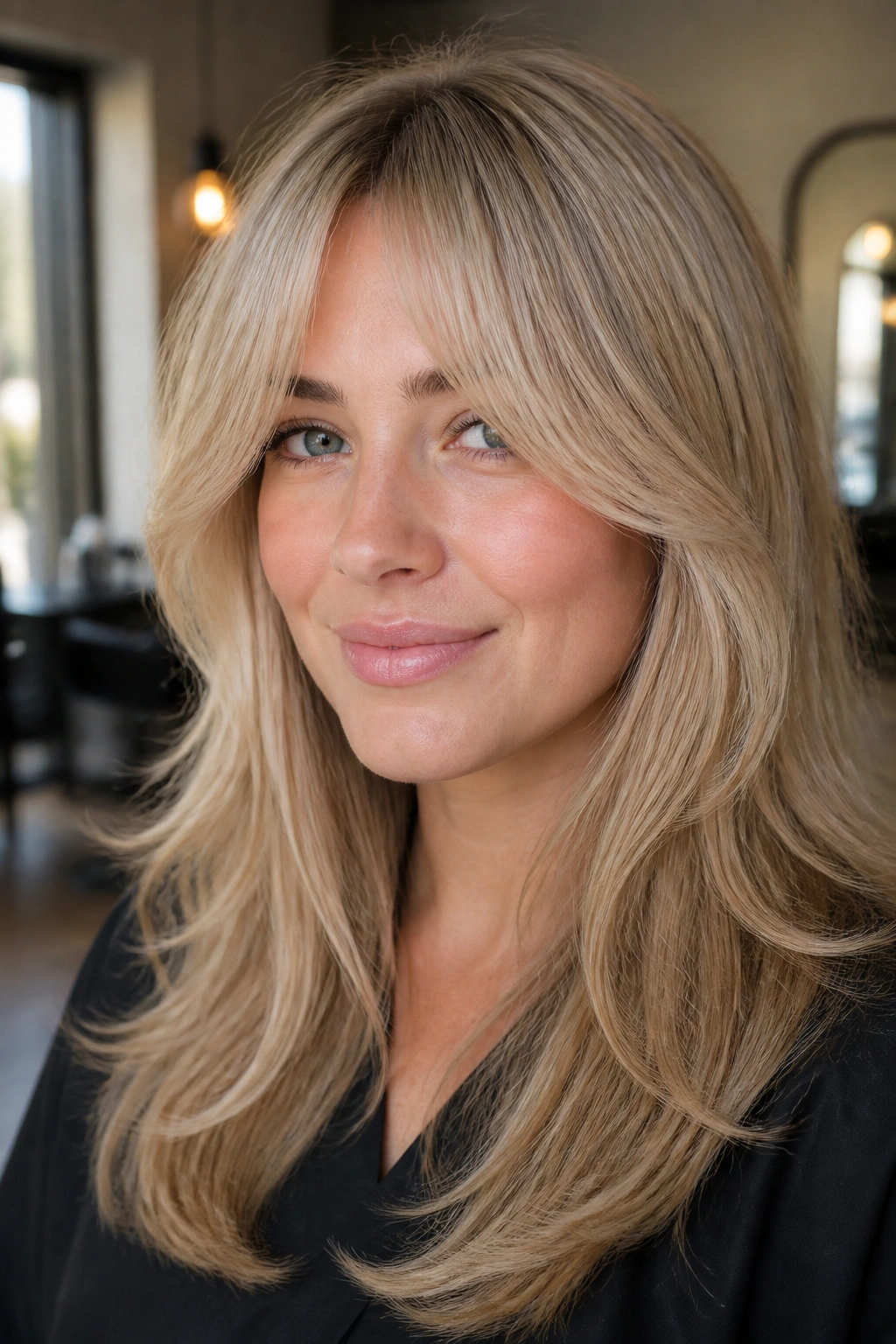
Long curtain bangs are still one of the smartest choices for a round face, and beige blonde keeps them from looking heavy. The length matters here. You want the shortest point to sit around the brow bone, then let the sides drift down toward the cheekbone or even the top of the lip.
Why this shape works
The center split opens the forehead, which stops the face from feeling enclosed. The longer edges travel downward instead of stopping at the widest part of the cheek, and that gives the eye a clear vertical line to follow. Beige blonde helps because it softens the contrast between fringe and skin, so the bangs feel light even when they have enough body to actually do their job.
A good salon note helps a lot. Ask for the curtain pieces to be soft enough to tuck behind the ears on days when you want them out of the way, but not so long that they disappear into the rest of the haircut. That tiny difference changes everything.
- Shortest point: just below the brows
- Longest point: cheekbone to lip level
- Finish: point-cut ends for movement
- Best styling tool: a 1.25-inch round brush
Pro tip: blow the bangs side to side while they cool. It keeps the center from sticking flat to the forehead.
2. Side-Swept Blonde Bangs for Round Faces with Honey Highlights
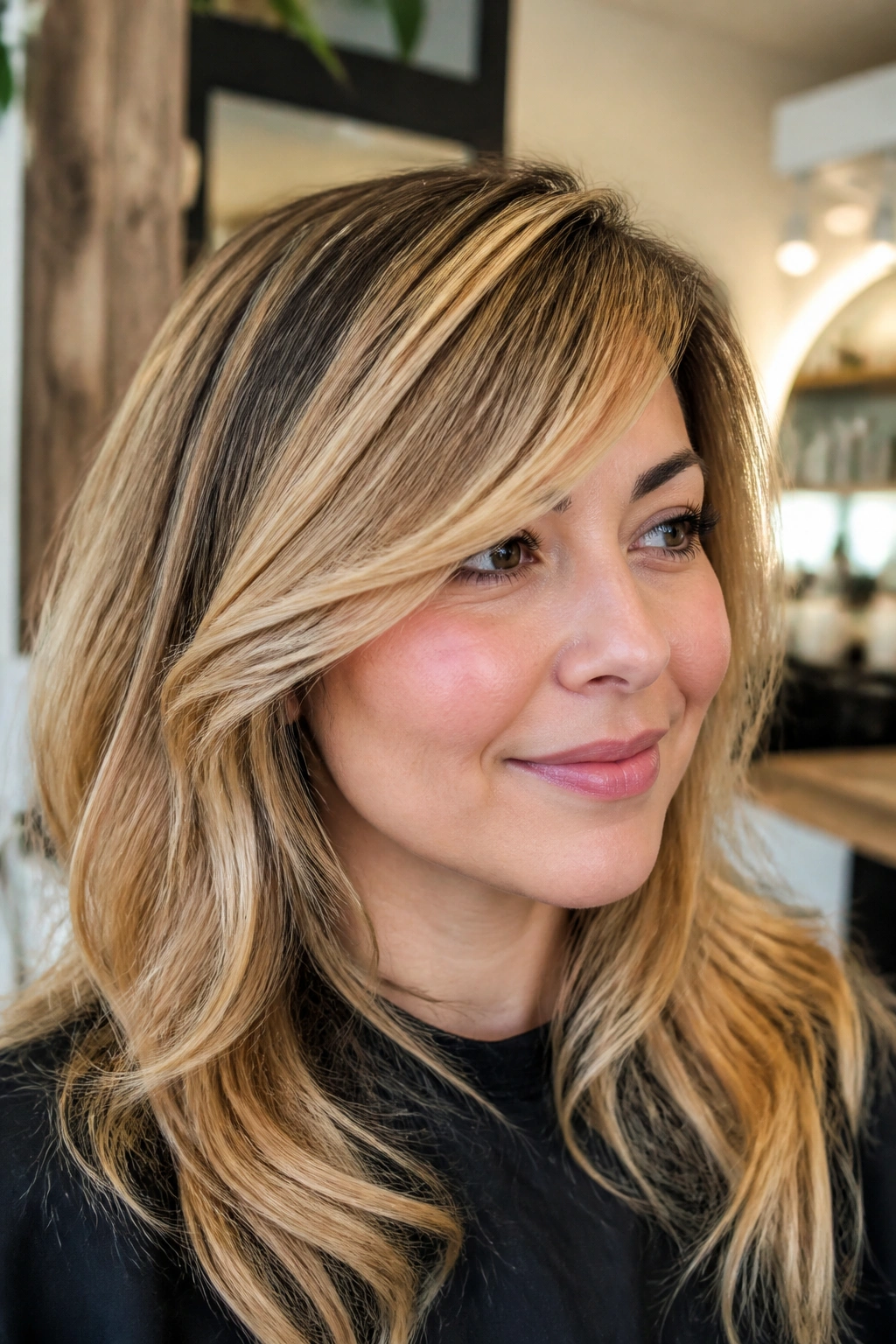
A side-swept fringe is one of the cleanest ways to sharpen a round face. The diagonal line does the work for you, and honey highlights make the sweep feel brighter right where the hair needs a little lift.
That diagonal matters. A deep side part creates a longer top line across the face, while the fringe itself cuts across the widest part instead of sitting right on it. If your hair grows out fast, this cut is forgiving too. The shape looks intentional even when it is slightly overgrown.
Honey blonde is a good match because it brings warmth near the temples and cheekbones. I like that better than one flat blonde shade, which can make the whole fringe read as one solid panel. If your hair is straight, keep the ends soft and a little feathered. If it is wavy, let the wave stay loose and don’t over-polish it.
That diagonal line matters.
A quick styling note: push the fringe away from the face with a medium round brush, then let it fall back without combing it too hard. You want movement, not a frozen swoop.
3. Bottleneck Bangs for Round Faces with Root Shadow Blonde
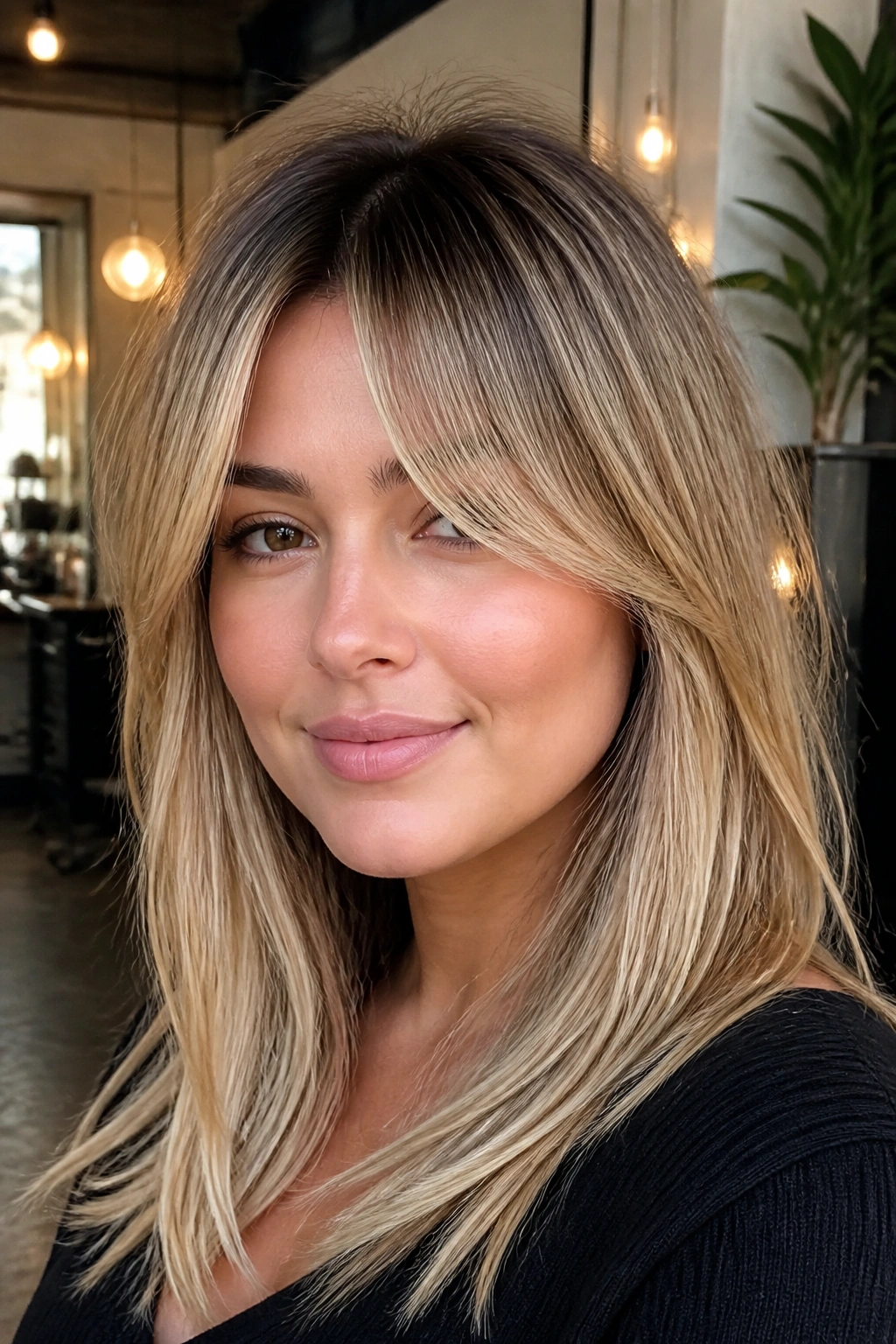
Why do bottleneck bangs flatter round faces so well? Because they do two jobs at once. The center sits shorter and lighter, then the sides expand outward and taper into the rest of the cut, which gives you lift without that hard curtain wall across the forehead.
The shape is a little more tailored than classic curtain bangs. It feels narrower at the top and wider as it reaches the temples, which breaks up the roundness of the face in a subtle way. A root shadow makes the blonde look fuller and less puffy at the root, and that matters more than people think. Too-bright roots can make bangs look like a helmet. A soft root melt keeps the fringe moving.
How to ask for it
- Shortest point: between the brow and upper lash line
- Side length: taper into cheekbone layers
- Root color: a soft shadow, not a harsh line
- Texture: light, broken ends rather than a blunt finish
If your forehead is on the smaller side, this is even better. The shape opens just enough space without swallowing your features. It also grows out in a decent way, which is a nice break from bangs that demand a trim every three weeks.
4. Wispy Eyebrow-Grazing Bangs in Champagne Blonde
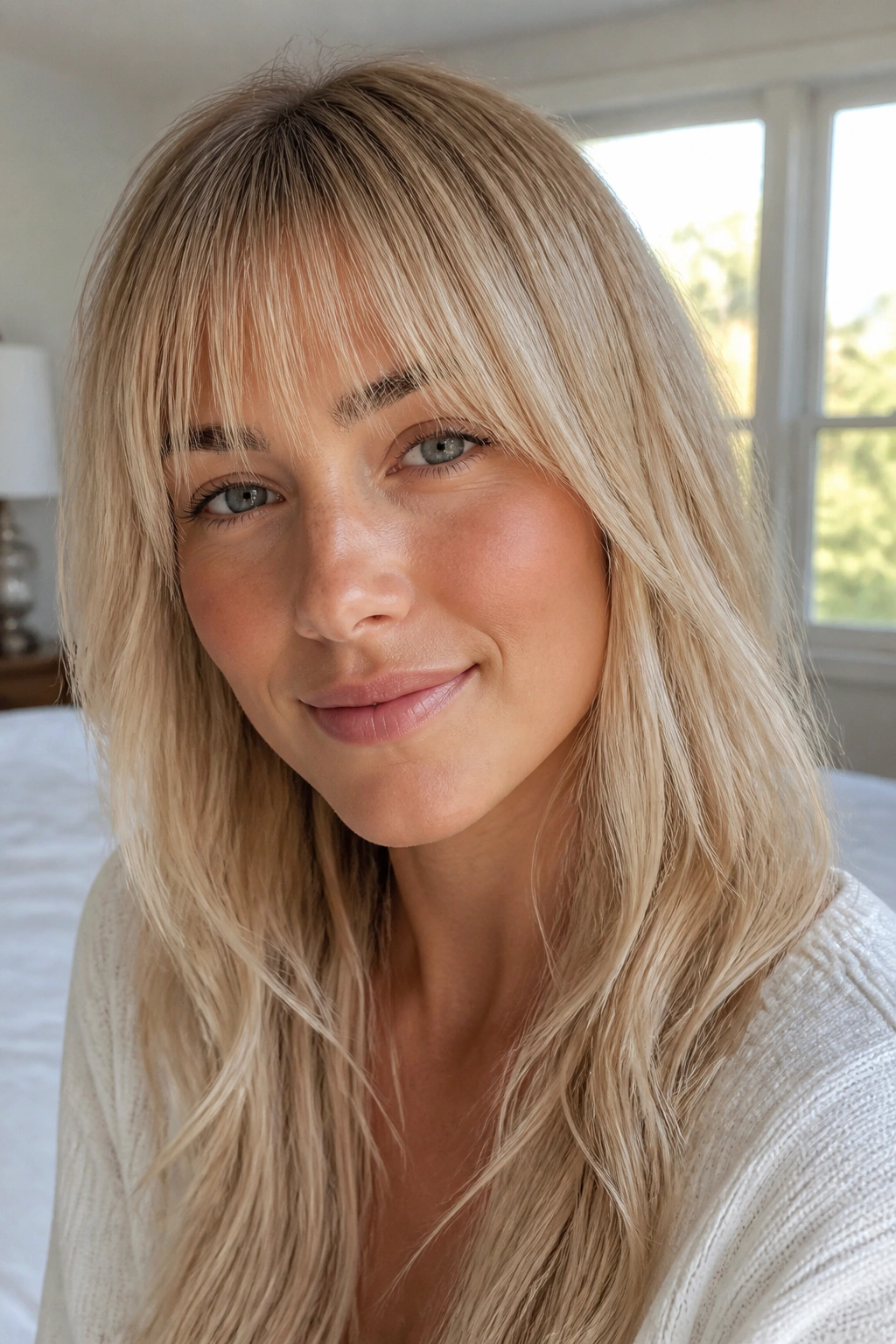
If you want bangs without that dense, heavy feel, this is the one I’d point to first. Wispy eyebrow-grazing bangs sit lightly on the face, so the forehead still shows through a little. That bit of air is useful on a round face because it stops the fringe from turning into one solid horizontal line.
Champagne blonde makes the softness even better. The color has enough brightness to read fresh, but not so much contrast that the bangs shout for attention. I like this shape on finer hair because the fringe can look fuller than it is if the pieces are kept narrow and feathery. On thicker hair, the trick is to thin the underside a little so the bangs do not sit like a shelf.
Short version: keep them light.
A round face usually benefits from bangs that feel a little unfinished around the edges. Not sloppy. Just broken up. A tiny bend with a flat iron, a mist of flexible spray, and a finger comb is usually enough. Skip the stiff hairspray. It kills the softness that makes this cut work.
5. Feathered Bangs in Layered Butter Blonde
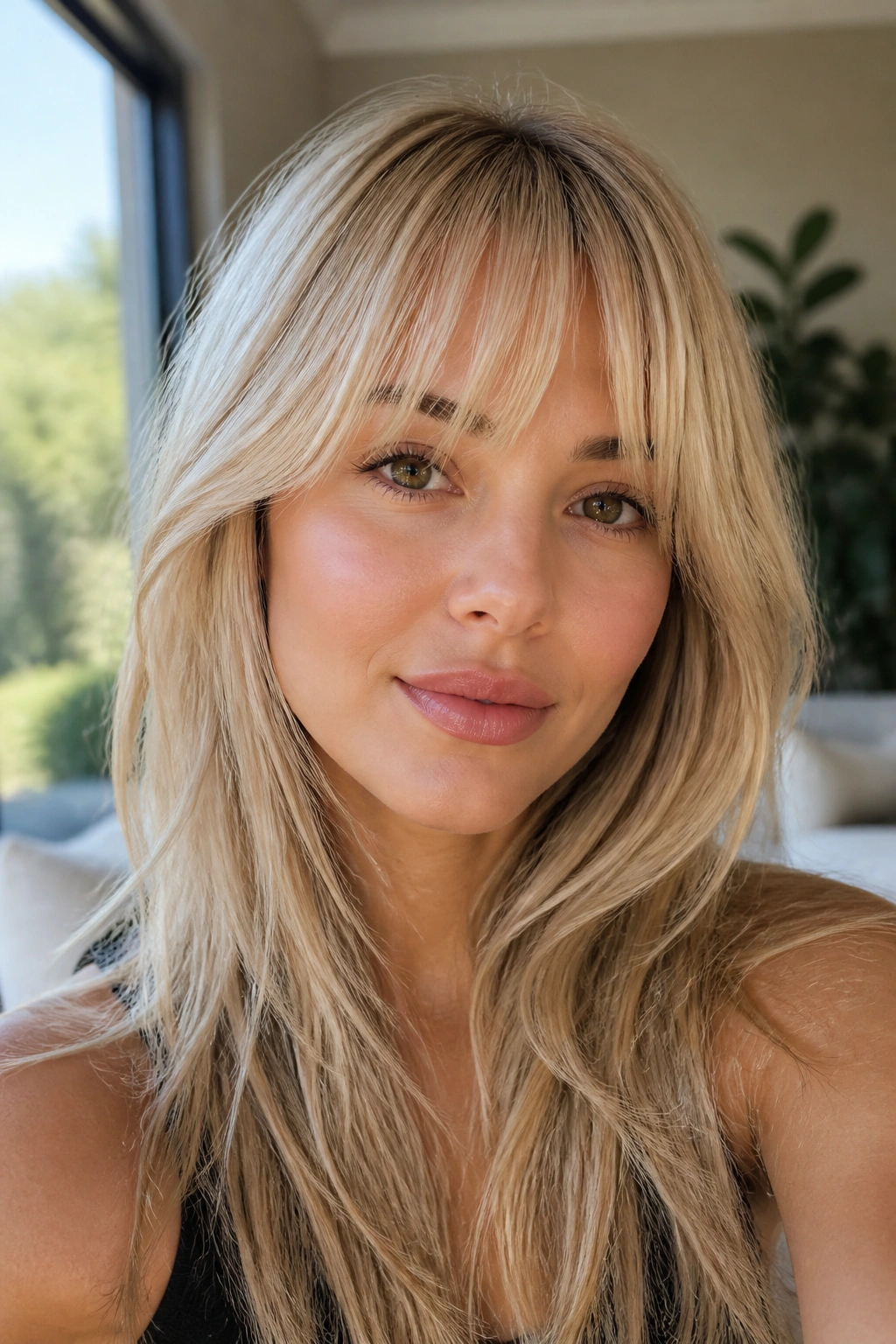
Feathered bangs have a nice, old-school blowout feel, but they work far better than people give them credit for. The key is the layering. Instead of one solid fringe sitting across the forehead, the hair breaks into soft strands that blend into the rest of the cut.
Butter blonde suits that movement. The color is warm enough to keep the fringe looking soft, and the layering keeps it from turning into a blunt block. On a round face, this is useful because the broken edges make the eye travel up and down instead of left to right. That little visual shift changes the whole balance.
I like this look on medium-density hair best. Fine hair can do it, but you need a little root lift mousse at the crown or the bangs can sit too flat. Thick hair does well if the stylist removes weight through the ends and keeps the shortest pieces around the brow, not much shorter.
The styling is old-fashioned in the best way. Blow-dry with a vent brush, wrap the fringe slightly away from the face, then let it cool before touching it. The result should feel soft and touchable, not sprayed into place.
6. Cheekbone-Skimming Fringe with Dimensional Balayage
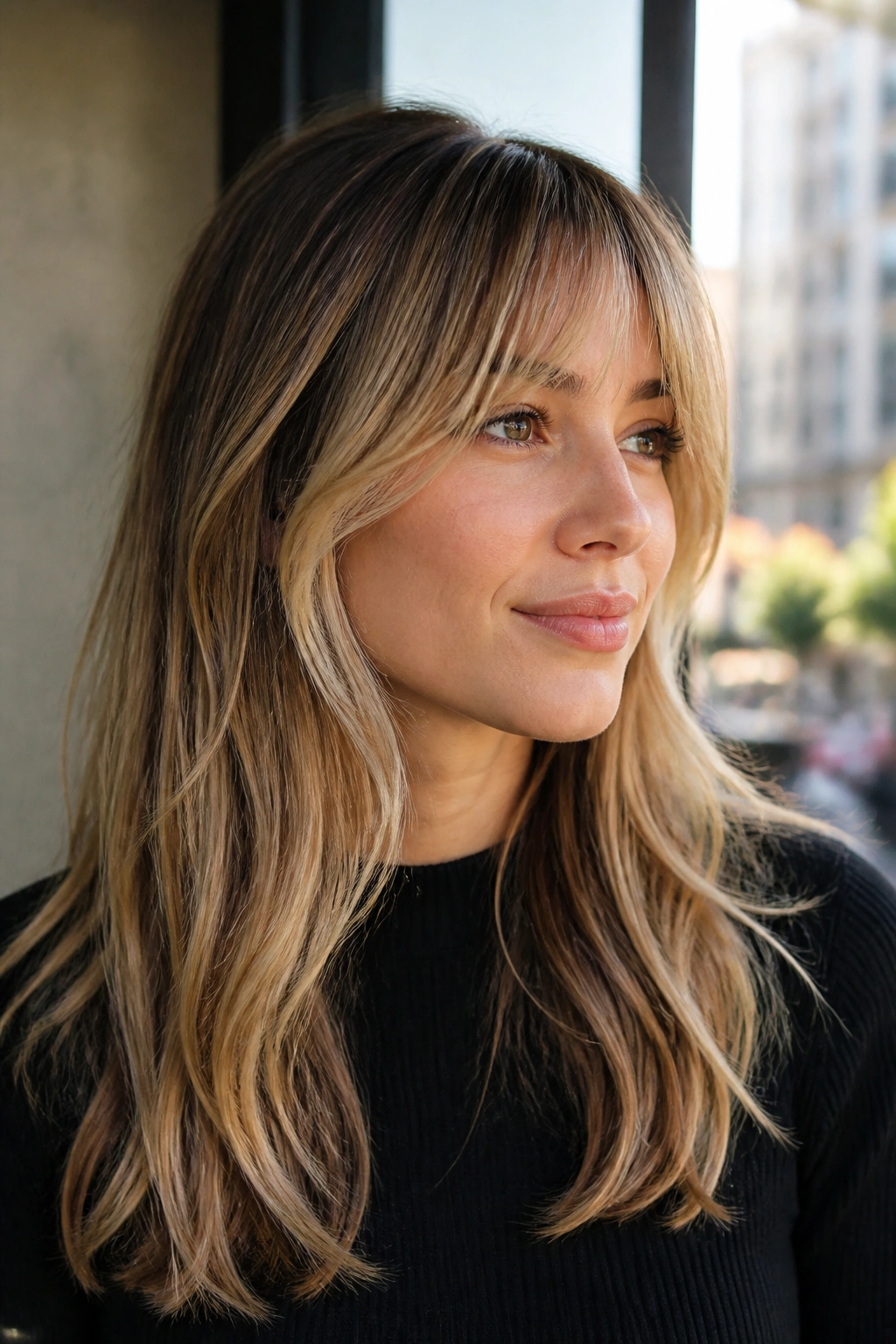
A straight fringe ends where a round face is often widest. A cheekbone-skimming fringe starts working before that point and keeps the eye moving downward, which is exactly why it looks so good. The shape lands near the cheekbone, then blends into layers that angle toward the jaw.
Dimensional balayage makes the effect stronger. Bright pieces around the temple and outer fringe catch the eye, while a slightly deeper base underneath keeps the style from looking flat. That mix is better than a single blonde shade when the cut has length, because the dimension gives the fringe structure.
I prefer this on medium to thick hair. Fine hair can wear it, but it needs enough density to hold the shape when the pieces are pushed to the side. If the hair is too thin, the cut can collapse and lose the face-framing effect.
The real trick is placement. Put the brightest blonde around the outer corners of the bangs and the front layers, not right in the center. That draws the eye outward and down, which is flattering on a round face without feeling obvious.
7. Choppy Piecey Bangs in Sandy Blonde
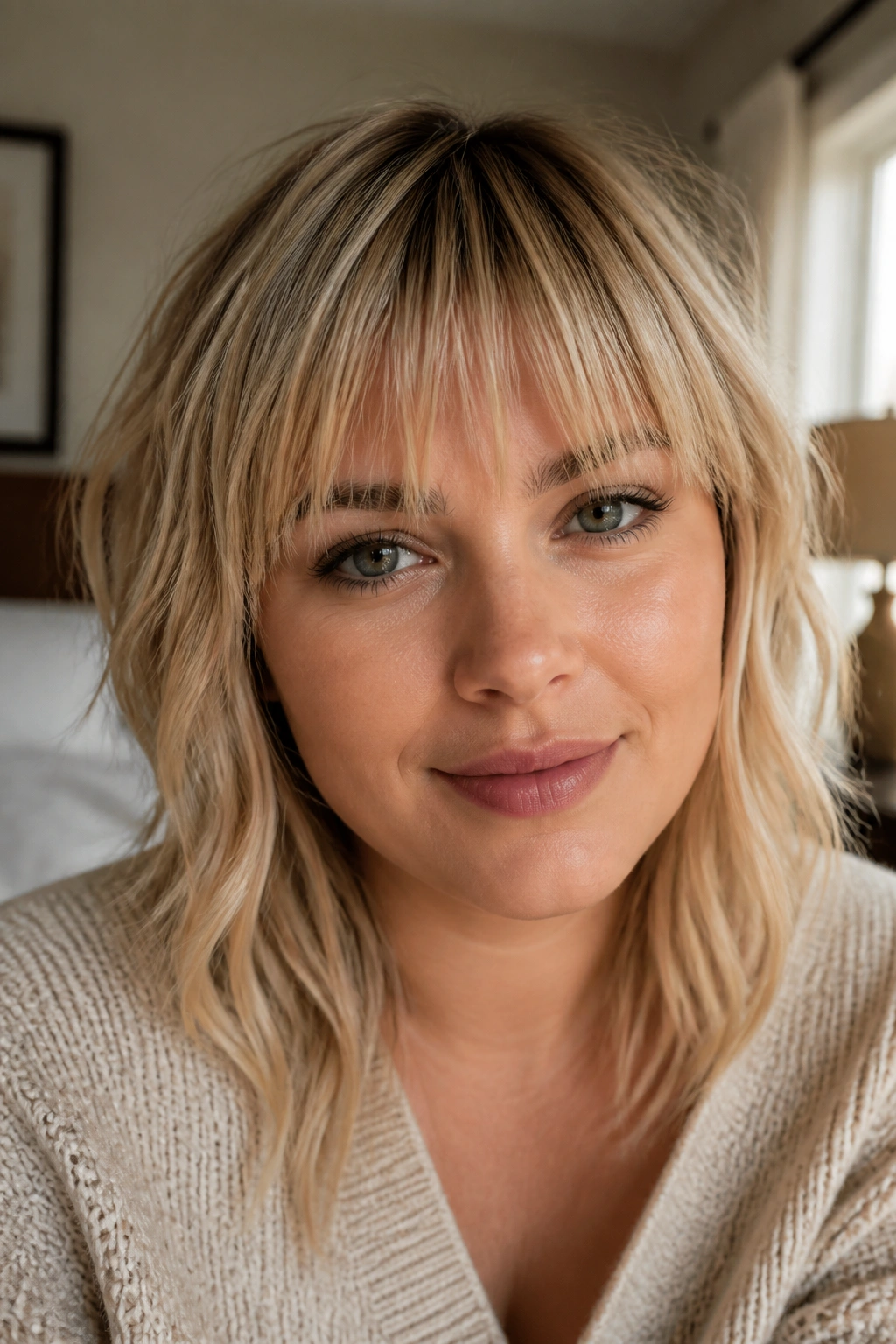
Piecey bangs can be friendlier than soft bangs if you need movement. The broken ends interrupt the curve of a round face, and sandy blonde keeps the whole thing from looking too sharp or too dark.
This style works best when the bangs are cut with a little irregularity. Not choppy in a rough way. Just enough separation that the fringe falls into small strands instead of a flat strip. That detail matters if you wear your hair down often, because the bang line needs to hold its shape even after a long day.
A good styling paste makes a difference here. Rub a tiny amount between your fingers, then twist two or three small sections of the fringe while it is dry. That gives you separation without making the hair sticky or stiff. You can also mist the roots with dry texture spray if the bangs collapse by midday.
Use less product than you think.
Too much will turn piecey into greasy. One or two small pinches is enough for most hair types, and if you need more, build slowly.
8. Face-Framing Sweep with Caramel Lowlights
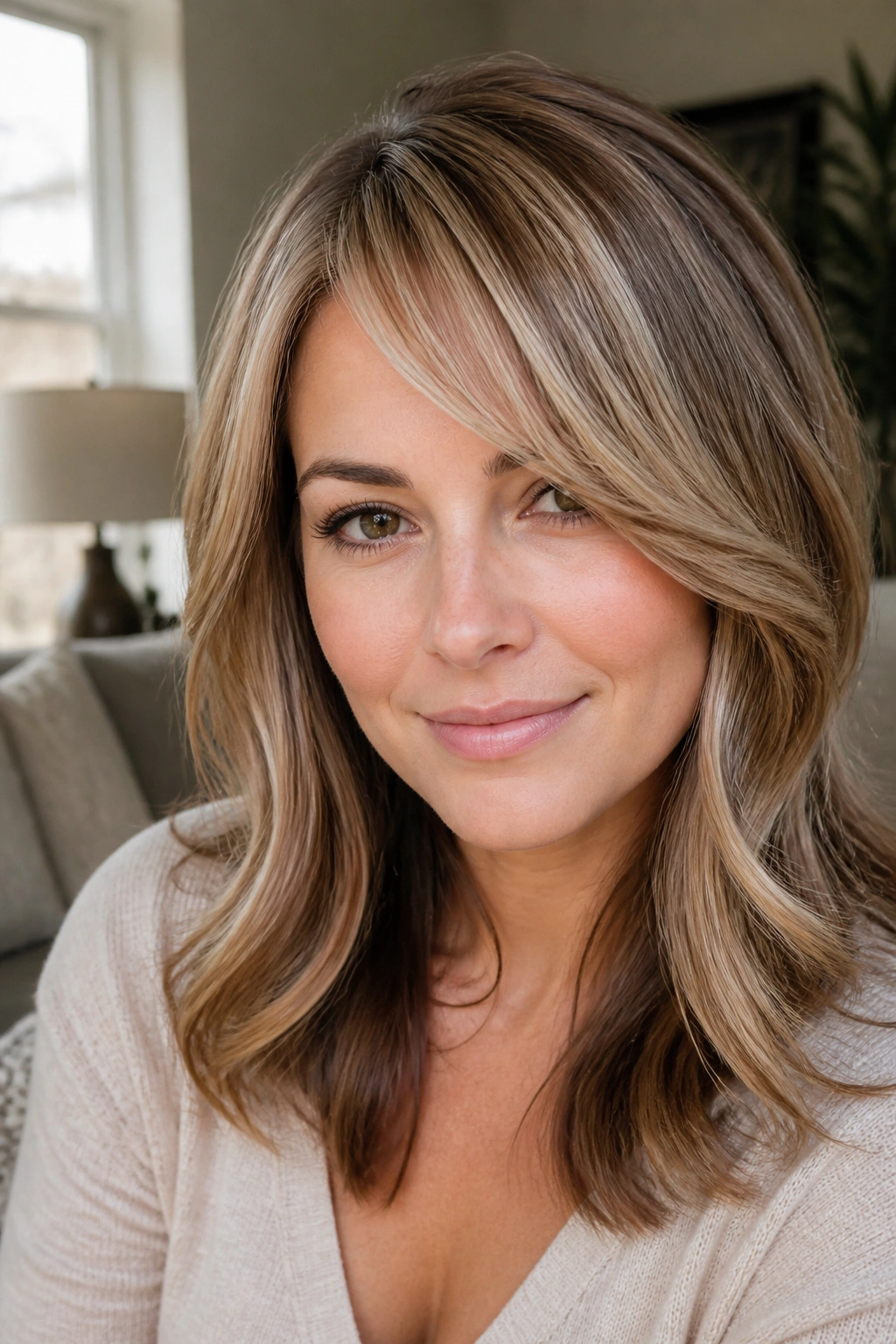
Can bangs be subtle and still change a round face? Absolutely. A face-framing sweep does the job quietly, which is nice if you do not want a hard fringe sitting on your forehead every single day.
The shape starts near the temple, crosses the forehead in a soft angle, and disappears into longer face-framing layers near the cheekbone. Caramel lowlights tucked under the blonde add depth and keep the style from looking too wide or puffy. That little shadow helps the eye read the face as longer.
What to ask for
- A sweep that begins off-center
- Length that grazes the cheekbone
- A soft taper into the jawline layers
- Caramel lowlights under the top blonde panel
This is one of my favorite low-drama options. It is polished enough for work, but it also looks good when you toss the hair behind one ear. If you want fringe without committing to a heavy bang line, this one gives you that middle ground.
It also grows out cleanly. That counts. A lot.
9. Airy French Bangs in Creamy Blonde
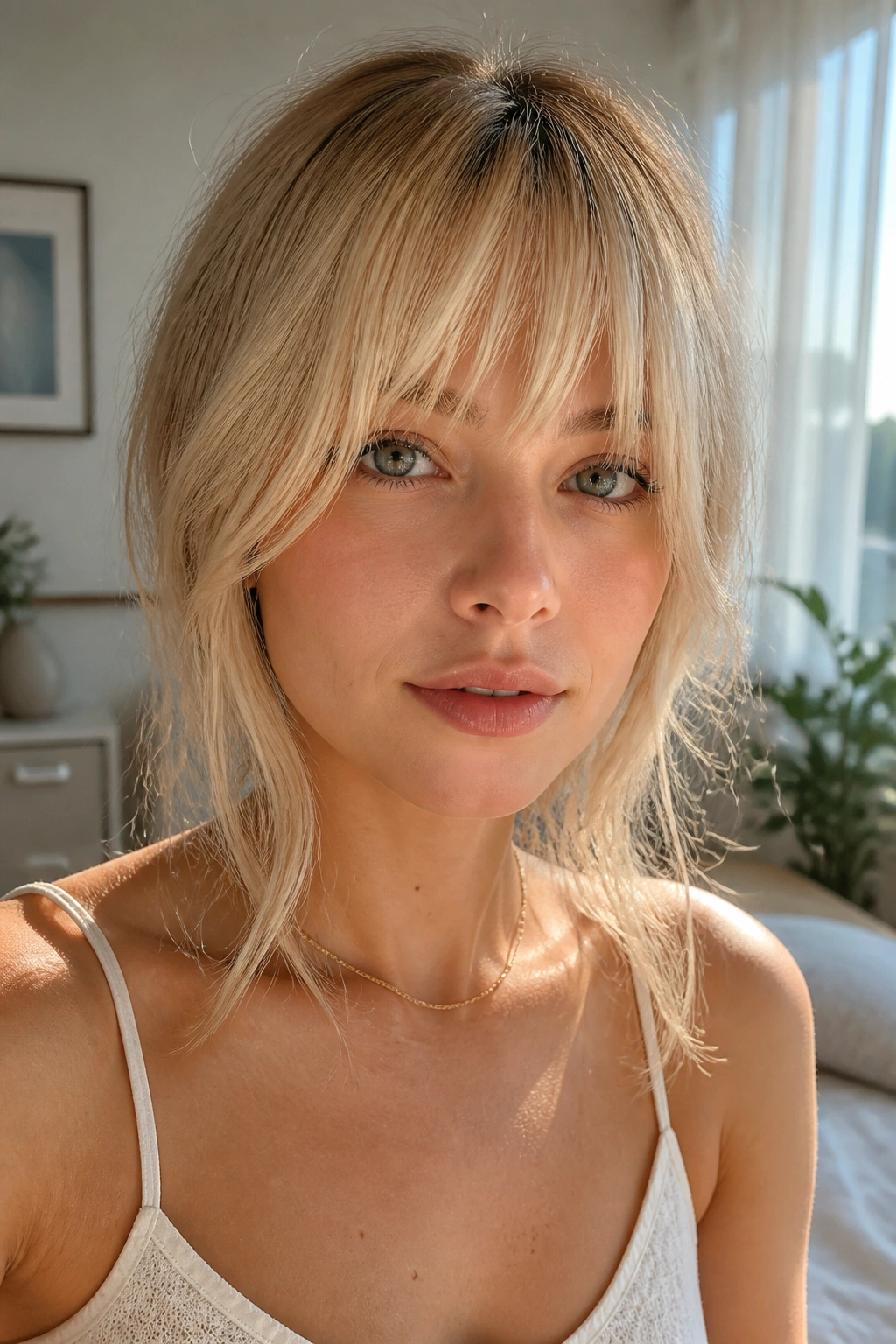
French bangs can go wrong fast on a round face if they are cut too full or too short. The right version is lighter: airy in the center, a little longer at the sides, and soft enough to separate with your fingers.
Creamy blonde helps because it keeps the fringe from feeling severe. A very pale, flat blonde can make French bangs look boxy if the cut is dense. Creamy tone, by contrast, lets the texture show. You want people to notice the shape first, not the line of the cut.
I like this look on straight or slightly wavy hair. Curly hair can wear it too, but the curl pattern has to be predictable or the fringe can bounce too high and make the face look shorter. That is the part people miss. A round face does not need more width across the middle, so the bangs should sit with some looseness rather than a hard curve.
Short is where this can go wrong. Keep the fringe near the brow, not way above it, unless you are after a sharper fashion look and you are willing to style it every morning.
10. Split Bangs with a Deep Side Part and Platinum Blonde
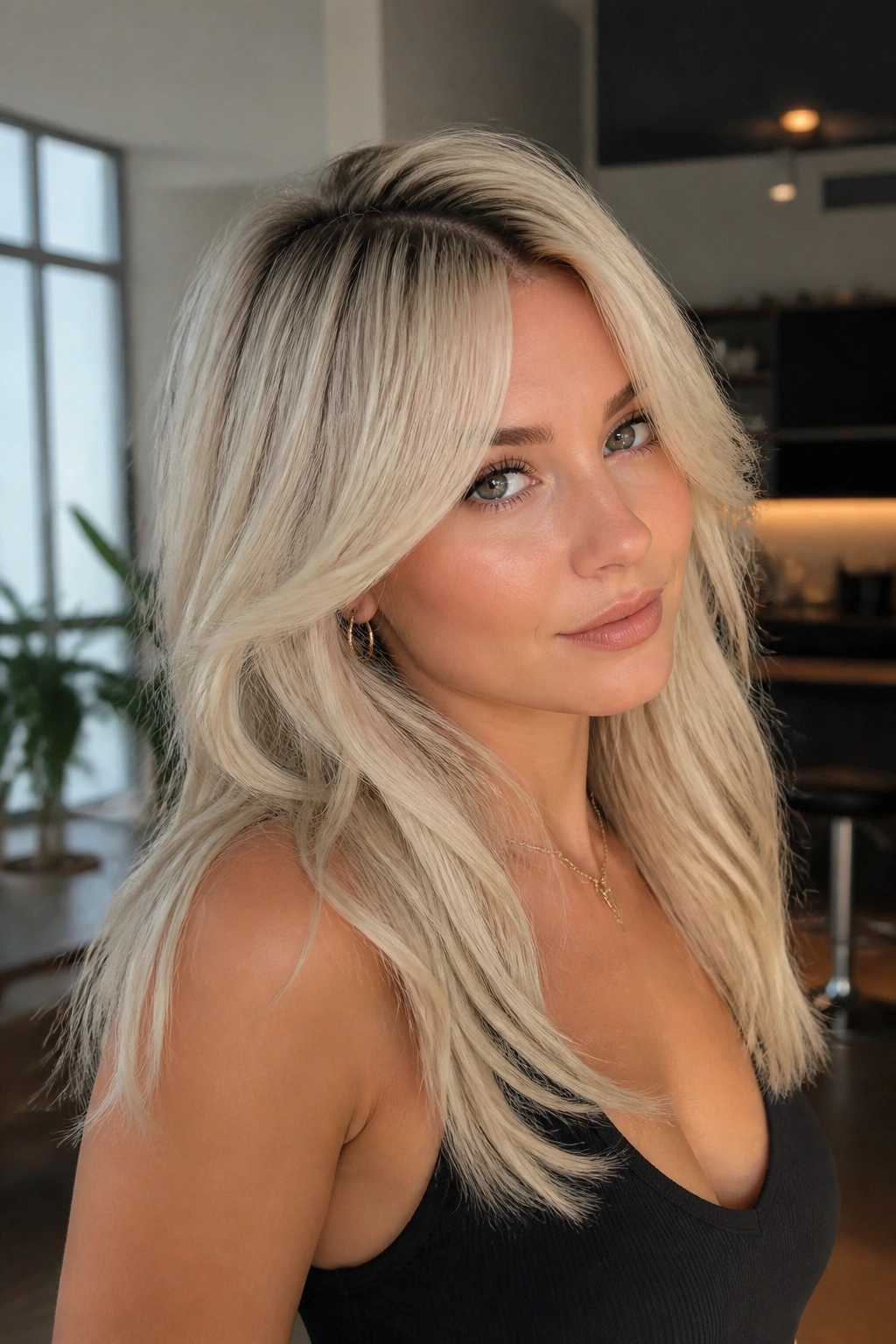
A split fringe gives a round face more open space through the center, and that alone can change the whole mood of the haircut. Add platinum blonde, and the look gets crisp, bright, and a little dramatic.
The split works because it breaks the forehead into two moving pieces instead of one horizontal block. That keeps the eye from settling across the widest part of the face. Platinum can be unforgiving, though, so I would never wear it as a flat, solid sheet in this shape. A small shadow at the roots, even if it is only a half-inch, gives the bangs dimension and stops them from looking pasted on.
This style suits straight hair best, or hair that can be blown sleek with a paddle brush. If your hair has a strong cowlick at the front, you may need a bit of root-lift spray and a blow-dryer nozzle to get the split to sit where you want it.
A good way to wear it: tuck one side behind the ear, let the other side fall forward, and keep the ends slightly broken. It looks deliberate without trying too hard.
11. Long Layered Bangs with a Bronde-to-Blonde Melt
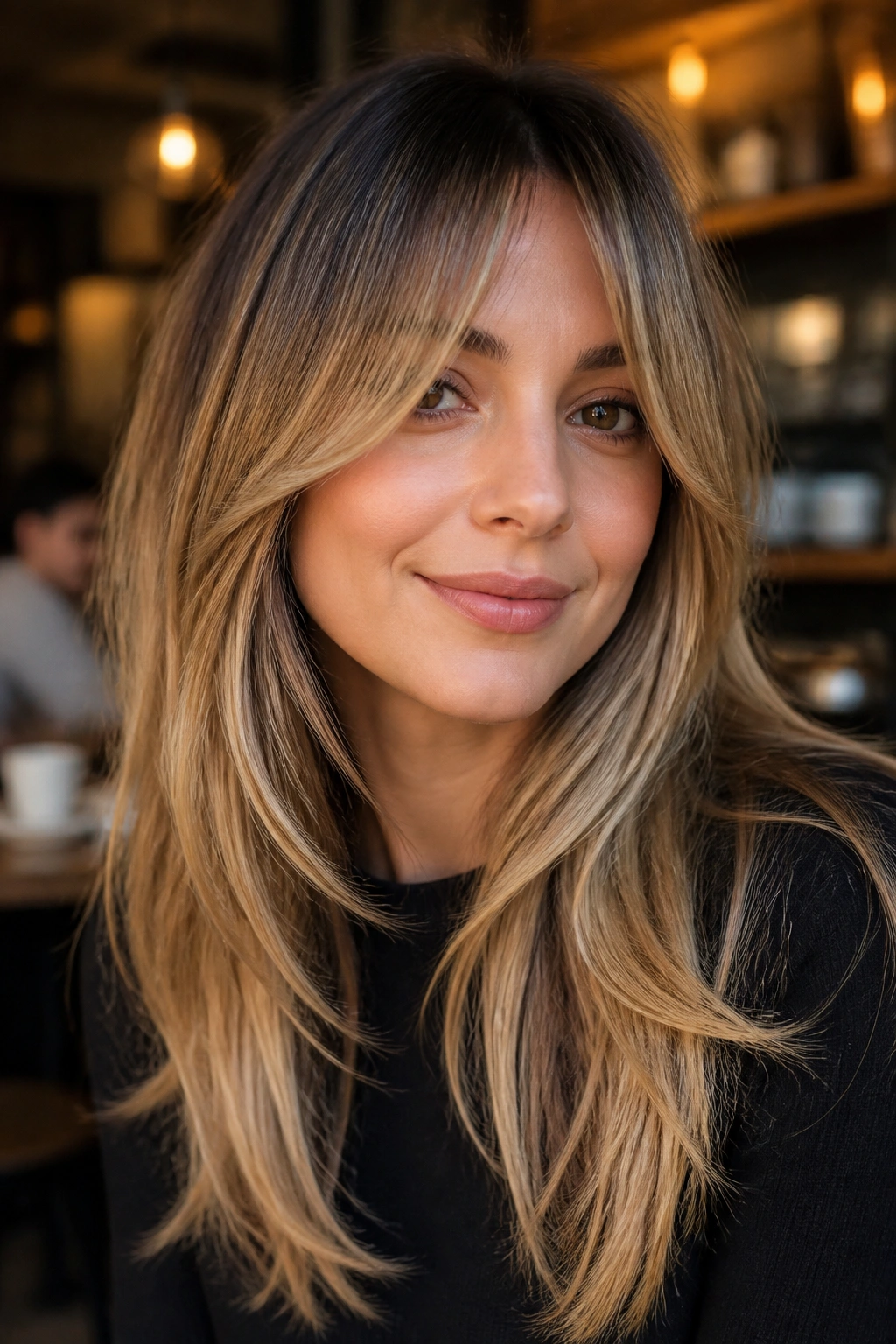
A single-tone blonde can make long bangs look heavy if the fringe is thick. A bronde-to-blonde melt fixes that by giving the eye more to follow. The darker base near the crown and the lighter ends near the face create a vertical path, which is useful on a round face.
This is a softer version of face-framing bangs. The fringe starts long, almost like a grown-out curtain, then drops into the front layers with barely a visible line. That works especially well if your hair is already layered through the ends. You get movement without a sharp break.
Compared with a bright, one-note blonde, this style feels more grounded. It is also easier to wear if your natural base is darker, because the grow-out does not look so obvious. The blonde can live where it matters most — around the face — while the deeper root gives the haircut some structure.
If you want something polished but not high-maintenance, this is a strong pick. It has that easy, lived-in feeling without looking random.
12. Textured Blunt Bangs Softened with Rooty Blonde
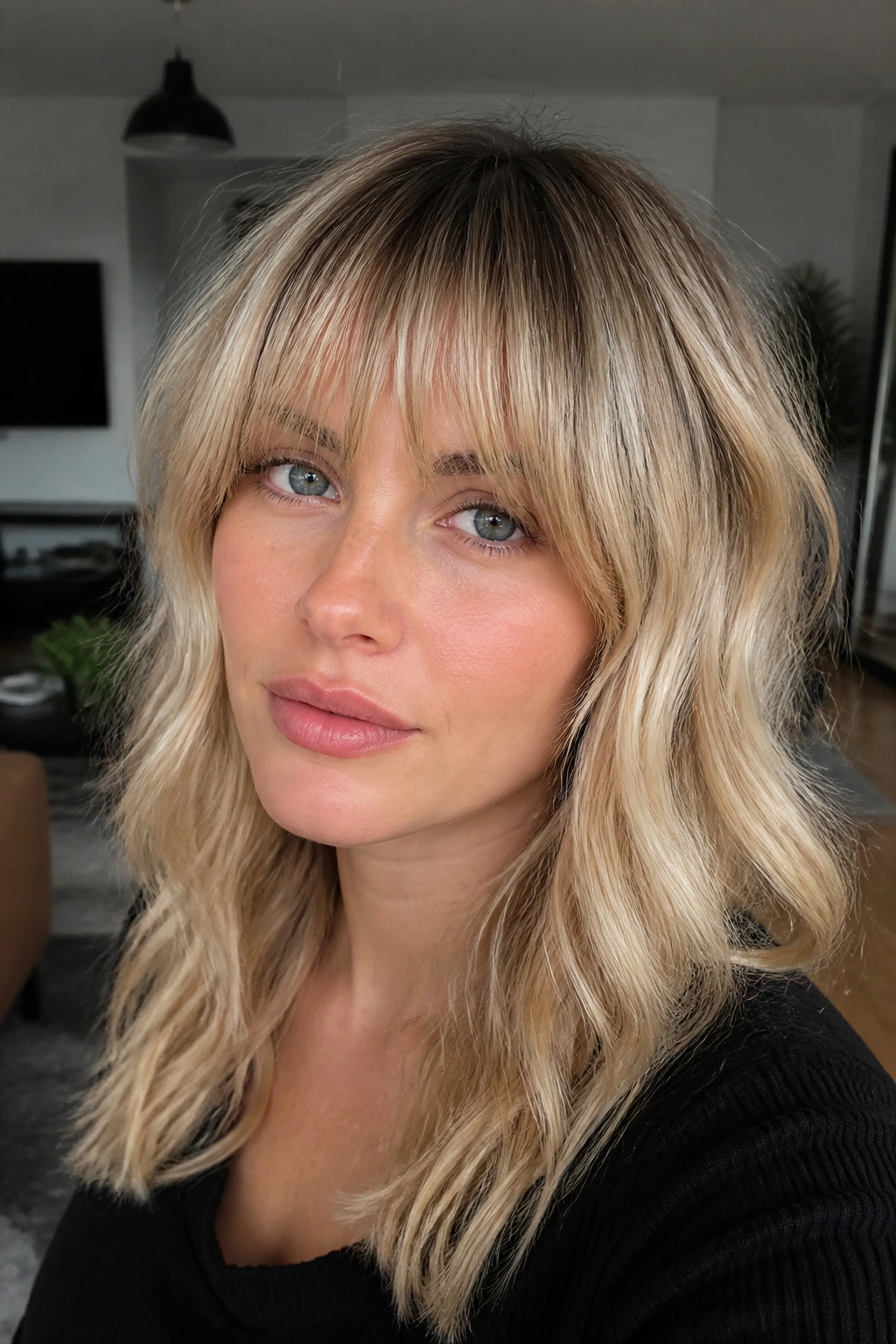
Blunt bangs can work on a round face. There, I said it.
The mistake is cutting them too dense, too boxy, and too short. If the line is softened with point-cut ends and the blonde has a rooty shadow underneath, the fringe reads more modern and less rigid. That matters because a round face can handle a strong bang line as long as the edges move a little.
I would ask for the length to hit around the lashes or just below, not high on the forehead. The fringe should have enough width to feel intentional, but not so much bulk that it cuts the face in half. A rooty blonde finish helps here because the darker base creates depth at the scalp and keeps the fringe from floating like one pale block.
This style needs density.
If your hair is fine and sparse at the front, a blunt bang can collapse fast and expose the problem. On thicker hair, though, it can look excellent with a blow-dry that bends the ends slightly under or off to the side. A round brush, low heat, and a little patience make this one work better than the casual version you see in photos.
13. Soft Arched Bangs in Pearl Blonde
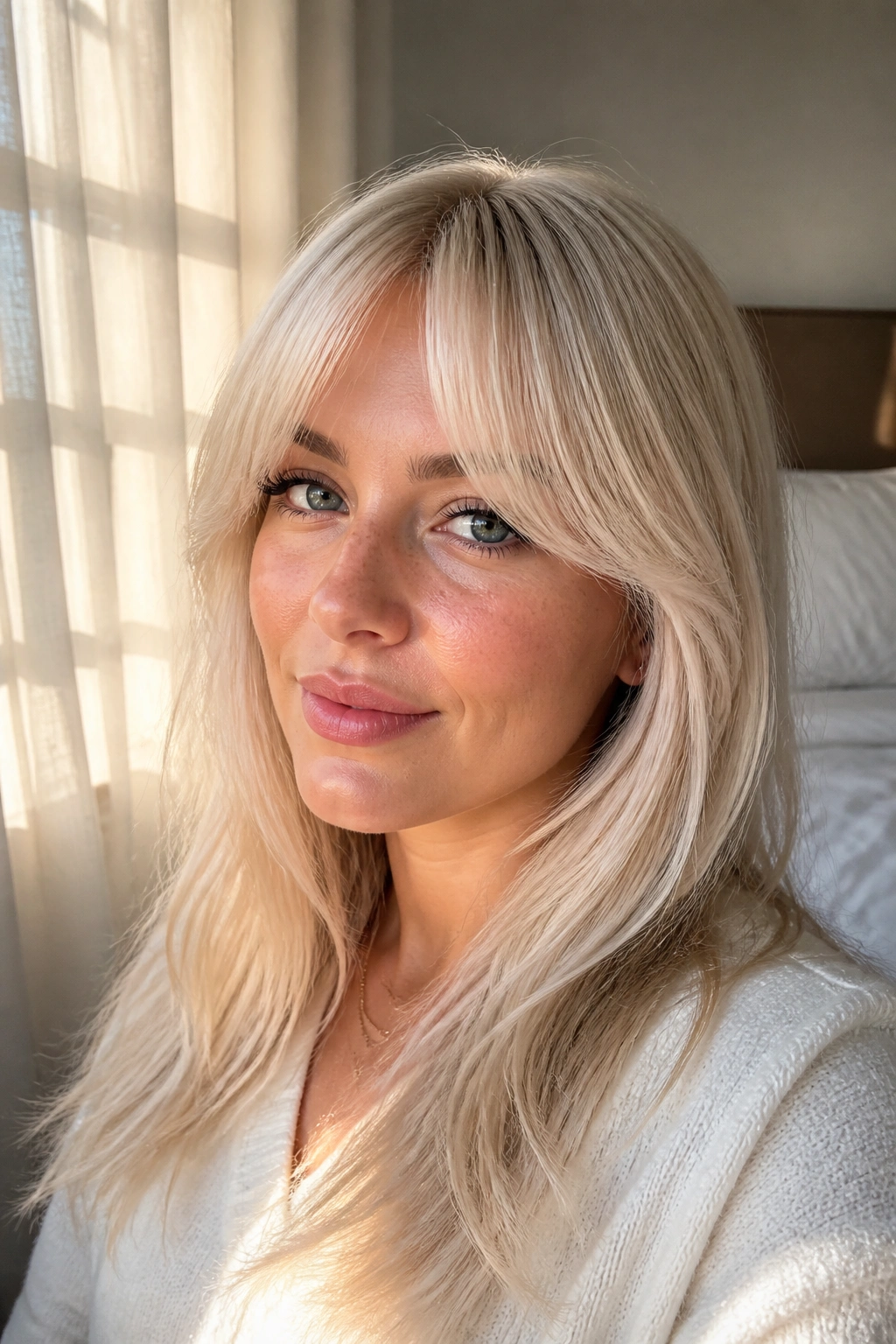
Can an arched fringe flatter a round face? Yes, if the arch is shallow and the ends are soft. A hard semicircle will echo the face shape too closely, which is not what you want. A gentle arch, though, adds a little lift in the middle and keeps the sides light.
Pearl blonde is a smart color for this because it reflects light in a soft way. It does not scream for attention. That lets the cut do the shaping. I like this version when the stylist keeps the center slightly higher and the outer edges longer, almost like a relaxed frame around the eyes.
How to keep the arch soft
- Keep the center just at or below the brow
- Let the sides taper toward the temples
- Ask for point-cutting at the ends
- Style with a small round brush, not a tight curl
The bigger point is balance. Arched bangs should feel intentional, not cute in a doll-like way. Pearl blonde helps because it keeps the line airy, which makes the whole shape easier to wear on fuller cheeks.
14. Shag Bangs with Lived-In Blonde
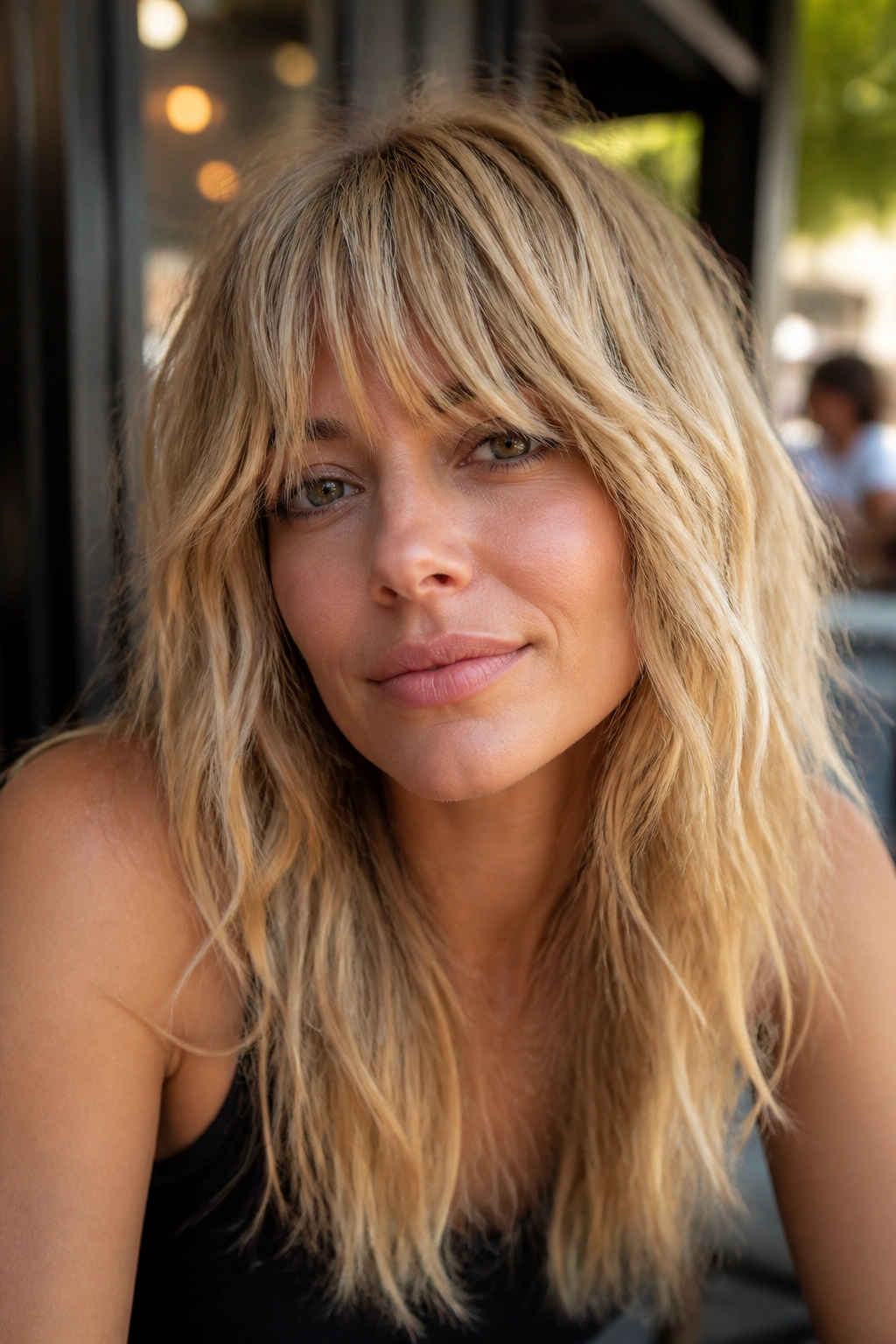
If your hair gets puffy, flat, or weirdly separated by lunchtime, a shag fringe may be your best friend. The layers cut through the width of a round face and add vertical movement, which changes the shape without forcing the hair into a stiff style.
Lived-in blonde works well here because the roots stay a touch darker and the ends have more lightness. That contrast gives the shag shape. Without it, the layers can blur together and lose the definition that makes the style interesting. On a round face, the fringe should stay broken up enough to show the forehead through the ends.
I like this on wavy hair most of all. Air-drying with a bit of mousse or a salt-free wave cream can be enough. If you want more polish, diffuse the fringe for a few minutes and then separate the pieces with your fingers. That gives you the soft, slightly undone feel the shag needs.
It is not the neatest option on the list. That is part of the appeal.
15. Grown-Out Baby Curtain Fringe in Buttery Blonde
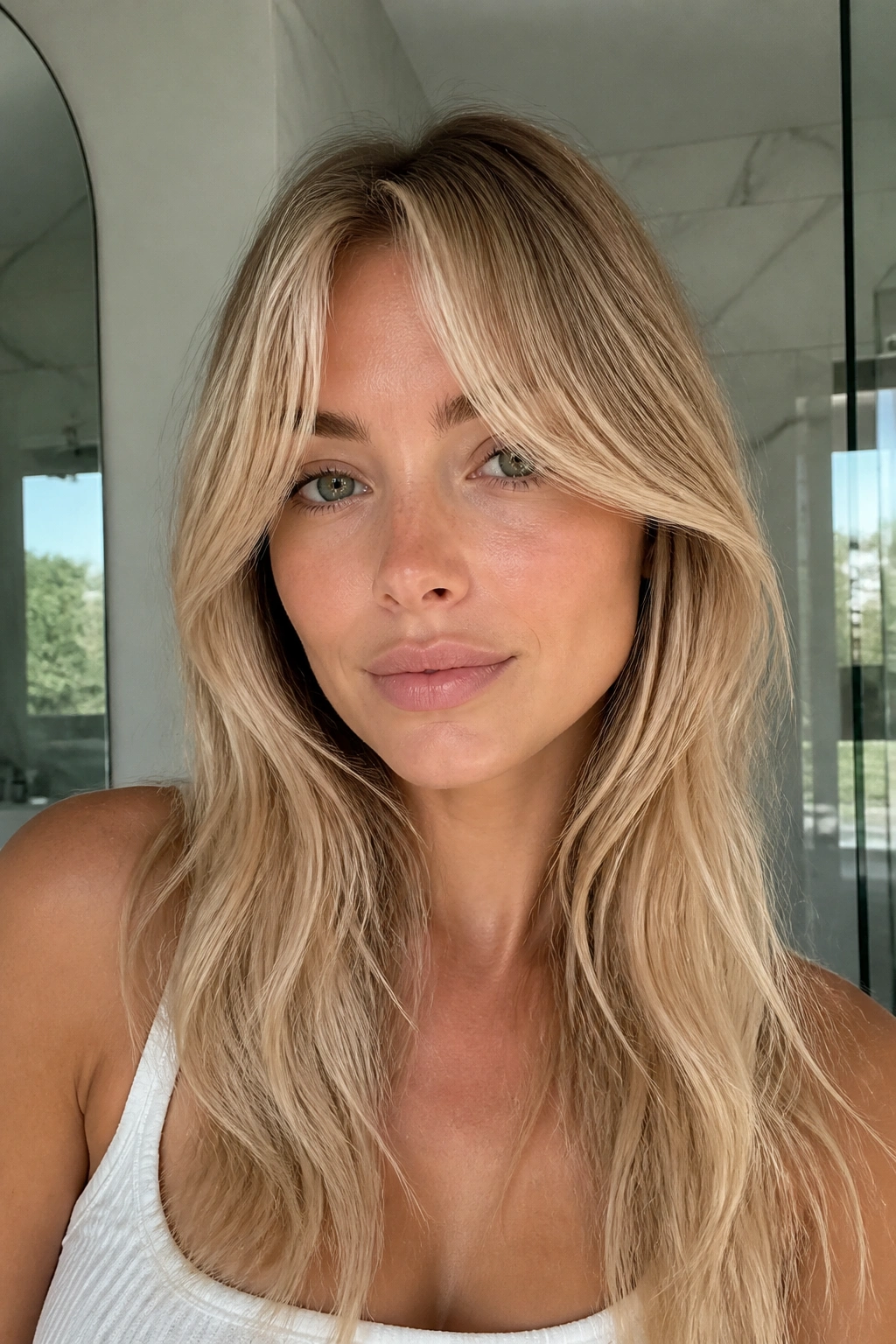
This is the low-maintenance version of curtain bangs, and I mean that in the nicest possible way. The center is shorter than a classic curtain fringe, but the sides stay long enough to bend away from the cheeks. For a round face, that gives you the opening at the center without the bulk.
Buttery blonde keeps the look warm and soft. The color helps the short center pieces blend instead of shouting for attention. I like this one for people who want bangs but also want to be able to pin them back, split them, or let them do their own thing on a lazy morning.
The real benefit is flexibility. You can wear the fringe with a center part, a soft off-center part, or even brushed back with a little root spray. It does not demand a single styling pattern every day. That freedom makes a difference if you are the kind of person who gets bored fast.
A trim every few weeks keeps the center from dropping into your eyes. After that, it behaves nicely.
16. Asymmetrical Bangs in Icy Blonde
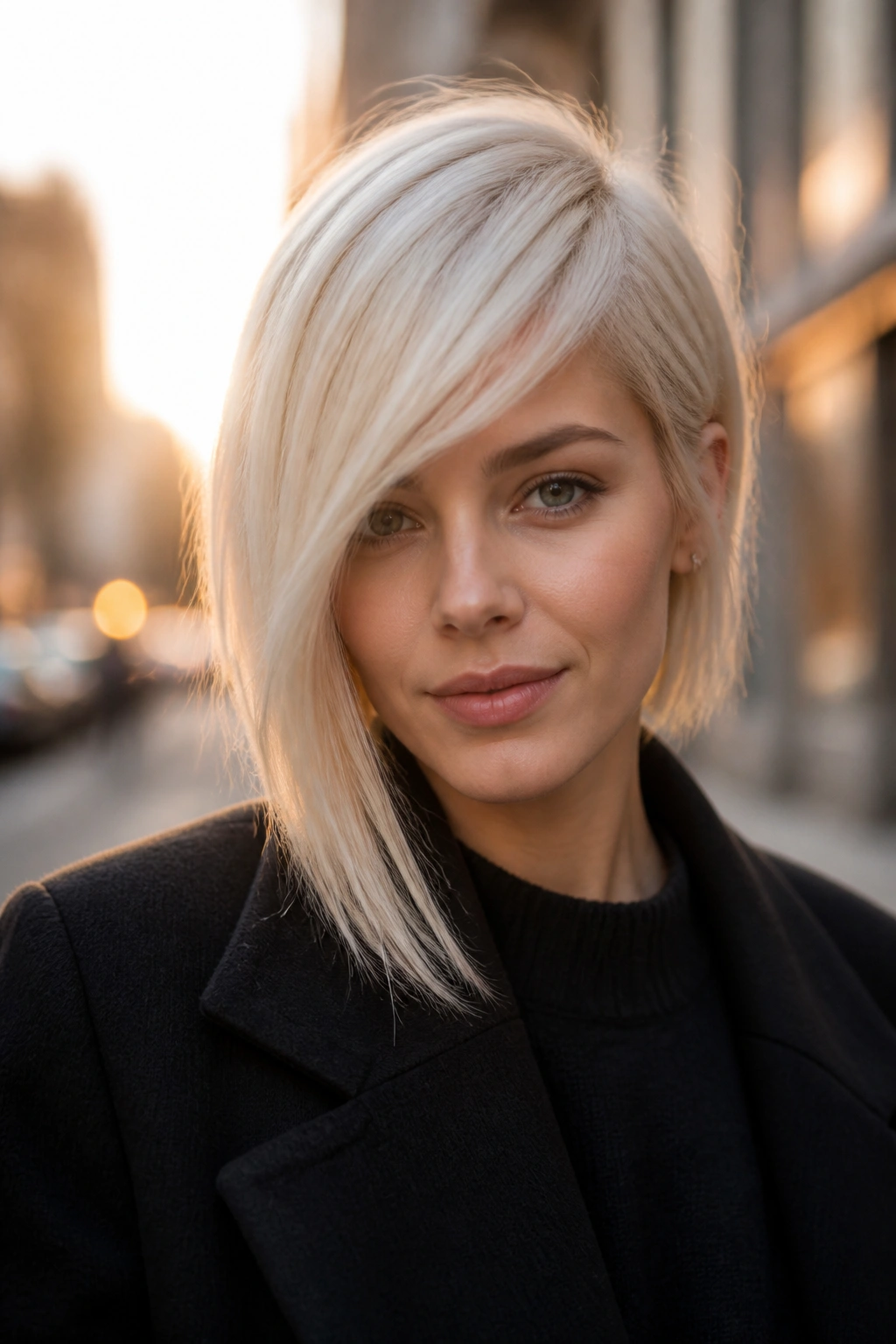
Asymmetry is underrated. A fringe that falls longer on one side creates an instant diagonal line, and diagonal lines are your friend if your face is round. They move the eye away from width and toward length.
Icy blonde adds a crisp finish to the look. It can feel sharp, so the cut should stay soft at the ends rather than razor-straight from root to tip. I like this on straight hair or hair with a slight bend, because too much wave can blur the asymmetry and turn it into a side-sweep.
If you wear one side tucked behind the ear, even better. That opens up one side of the face and makes the cut feel deliberate instead of accidental. It also gives you a little contrast near the jawline, which keeps the profile from feeling too circular.
This is not the most casual option on the list. But if you like a fringe with edge, it gives a round face a cleaner line fast.
17. Rounded Side Fringe in Golden Blonde
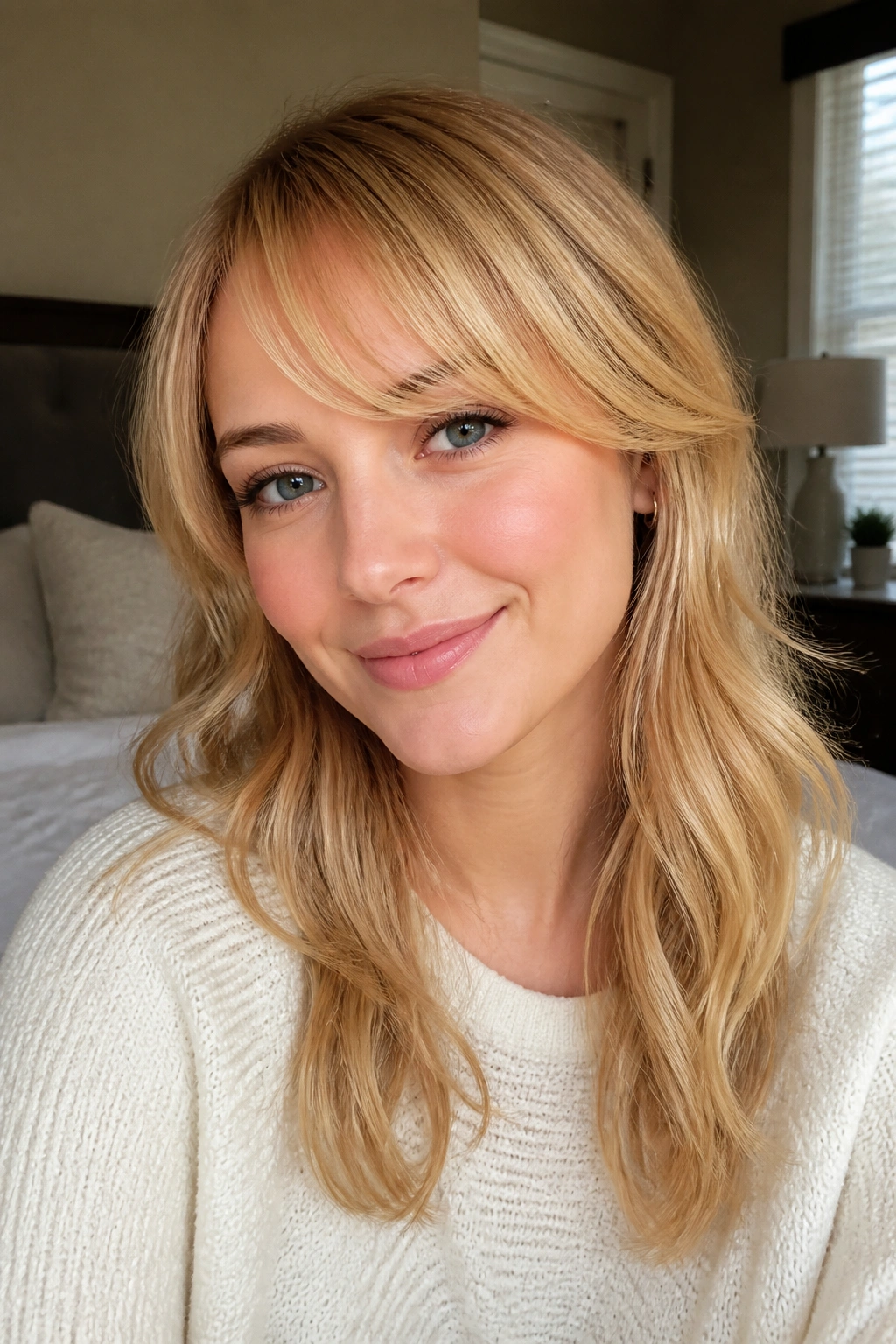
A rounded side fringe feels softer than a deep, sharp sweep. That difference matters. Instead of cutting a hard slash across the forehead, the hair follows a gentle curve that still points the eye in one direction.
Golden blonde works here because the warmth keeps the shape friendly. The fringe should sit long enough to skim the brow on the heavier side, then taper toward the temple. If it gets too thick at the base, it can widen the face, so ask for the stylist to remove weight underneath while keeping the top surface smooth.
This style suits people who like movement but do not want a full curtain bang. It also pairs well with soft waves, since the bend in the hair supports the curve of the fringe. A 1.5-inch round brush can help if you want a looser blowout, though a paddle brush and a small bend at the ends works too.
It is one of those cuts that looks calm, but still does the shaping work.
18. Micro Curtain Bangs with Face-Framing Length in Soft Blonde
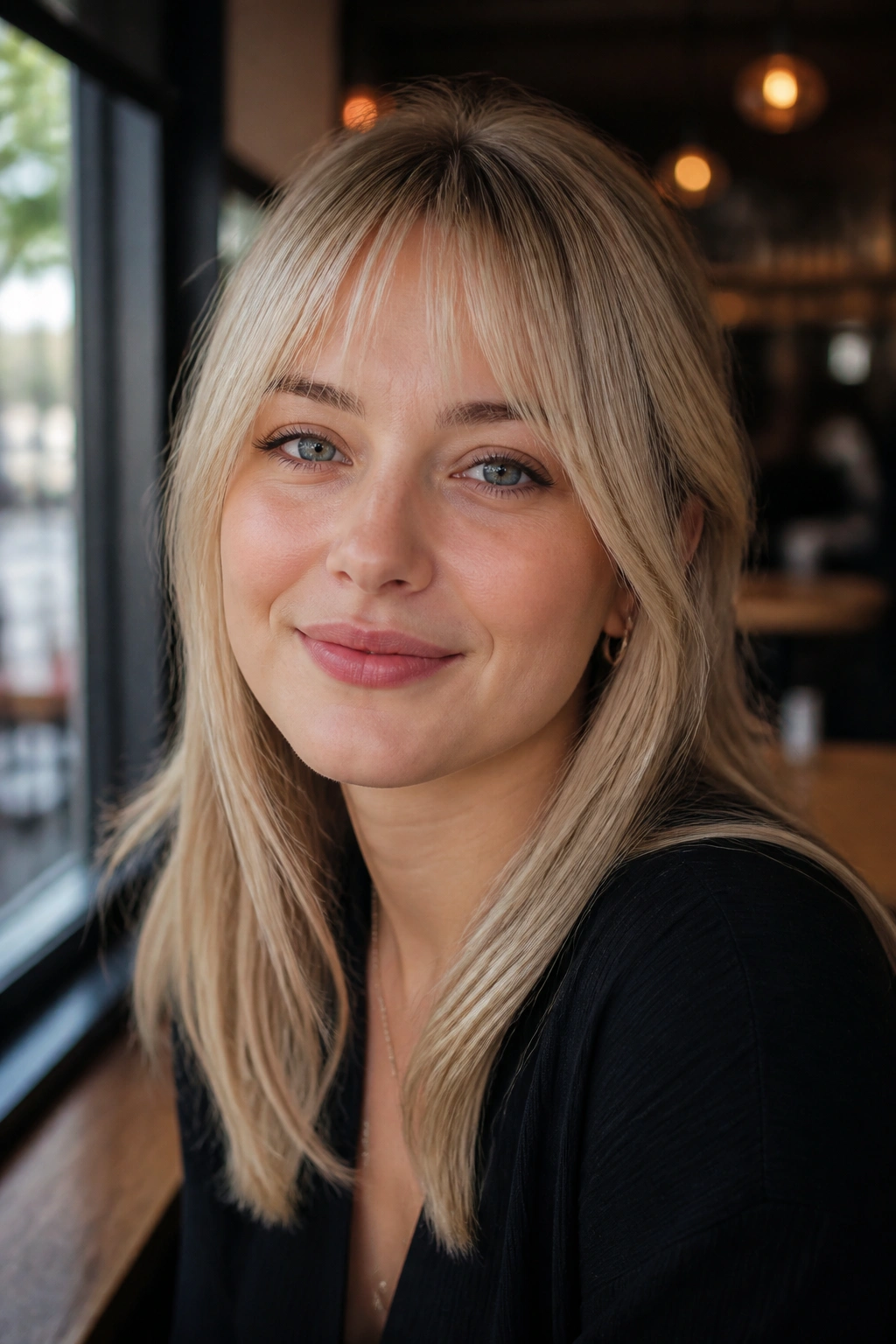
Can shorter bangs work on a round face? Yes, but only if the sides carry the weight. Micro curtain bangs are a little fashion-forward, and they need the longer pieces at the temples to keep the face from feeling too wide.
The center sits higher, which opens the forehead and gives the style some bite. The outer pieces should drop well past the cheekbone so the cut has length where the face needs it most. Soft blonde makes the look easier to wear because the fringe line does not feel so stark.
What keeps it from feeling too short
- Keep the outer edges long
- Leave some softness at the center part
- Style with a light bend, not a tight curl
- Avoid a heavy blunt line under the brows
I would not call this low-maintenance. It needs a bit of styling every time, especially if your hair has a stubborn cowlick. But if you want something a little cooler than classic curtain bangs, this version gives you that shape without turning the face boxy.
19. Razor-Cut Fringe with Beige-Gold Brightness
Razor-cut bangs have a different feel from scissor-cut bangs. The ends look lighter, the fringe moves more, and the whole shape tends to sit a little closer to the face without that thick shelf effect. On a round face, that lighter edge can be useful.
Beige-gold blonde suits it because the color has enough warmth to keep the style soft. If the blonde is too icy and the fringe is too sharp, the cut can feel severe fast. A beige-gold tone lets the texture shine through and keeps the bangs from looking overdone.
This style is especially good if your hair is thick at the front. A razor cut can remove some of that heavy weight and let the bangs fall into separated pieces. If your hair is very fine, though, I would be cautious. Over-razoring can make the ends look thin and frayed, which is not the same thing as airy.
A good stylist will leave the outline broken, not ragged. That difference matters more than people think.
20. S-Curved Fringe with Sunlit Blonde Ribbons
An S-curved fringe is a little more sculpted than a side-swept bang, and that is why it can be so flattering on a round face. The hair bends in one direction, then eases back the other way, creating a long line that feels soft instead of rigid.
Sunlit blonde ribbons make the curve stand out. The lighter strands catch the bend, while a slightly deeper base underneath keeps the shape from reading flat. That mix is especially nice if you want a fringe that looks polished without looking too neat. The curve gives the face length, and the blonde dimension gives the hair movement.
I like this best when the bangs are cut longer through the temple area and styled with a round brush first, then a tiny flat-iron bend if needed. You do not want a curl. You want a soft turn in the hair. That is the whole game.
If you are choosing one look for a round face and you want something a little more interesting than the usual curtain bang, this is the one I would put high on the list. It has shape, but it still feels easy to wear.
Final Thoughts
If you want the safest place to start, long curtain bangs and a side-swept fringe are the easiest wins. They give you movement, they soften the cheeks, and they usually grow out in a way that does not make you regret the cut two weeks later.
If you want more attitude, go sharper. Textured blunt bangs, asymmetrical fringe, and razor-cut pieces can all work on round faces when the blonde has enough depth at the root and the ends stay light. The shape matters more than the label.
The detail I would not skip: ask where the shortest point lands. Keep it away from the widest part of the cheek, and the whole haircut tends to make more sense. That one placement choice saves a lot of bad bangs.
