



Gray hair can look flat in the wrong light, but the right silver highlights turn it crisp, airy, and deliberate instead of washed out. That is why silver highlights for gray hair older women keep earning a place in salons: they don’t fight the gray, they echo it, sharpen it, and make it feel like part of the style rather than a problem to hide.
The trick is choosing the kind of silver that works with the hair you already have. Some women need whisper-fine babylights that melt into scattered gray strands. Others need brighter money pieces, a root shadow, or a soft balayage that keeps the grow-out calm. Same silver family. Very different effect.
And yes, placement matters more than people think. A silver tone dropped too high on porous hair can go icy in a bad way. Put it in the right places, though, and it adds movement, brightness near the face, and a cleaner look around the hairline and part without making the whole head feel striped.
1. Ultra-Fine Silver Babylights for Gray Hair Older Women
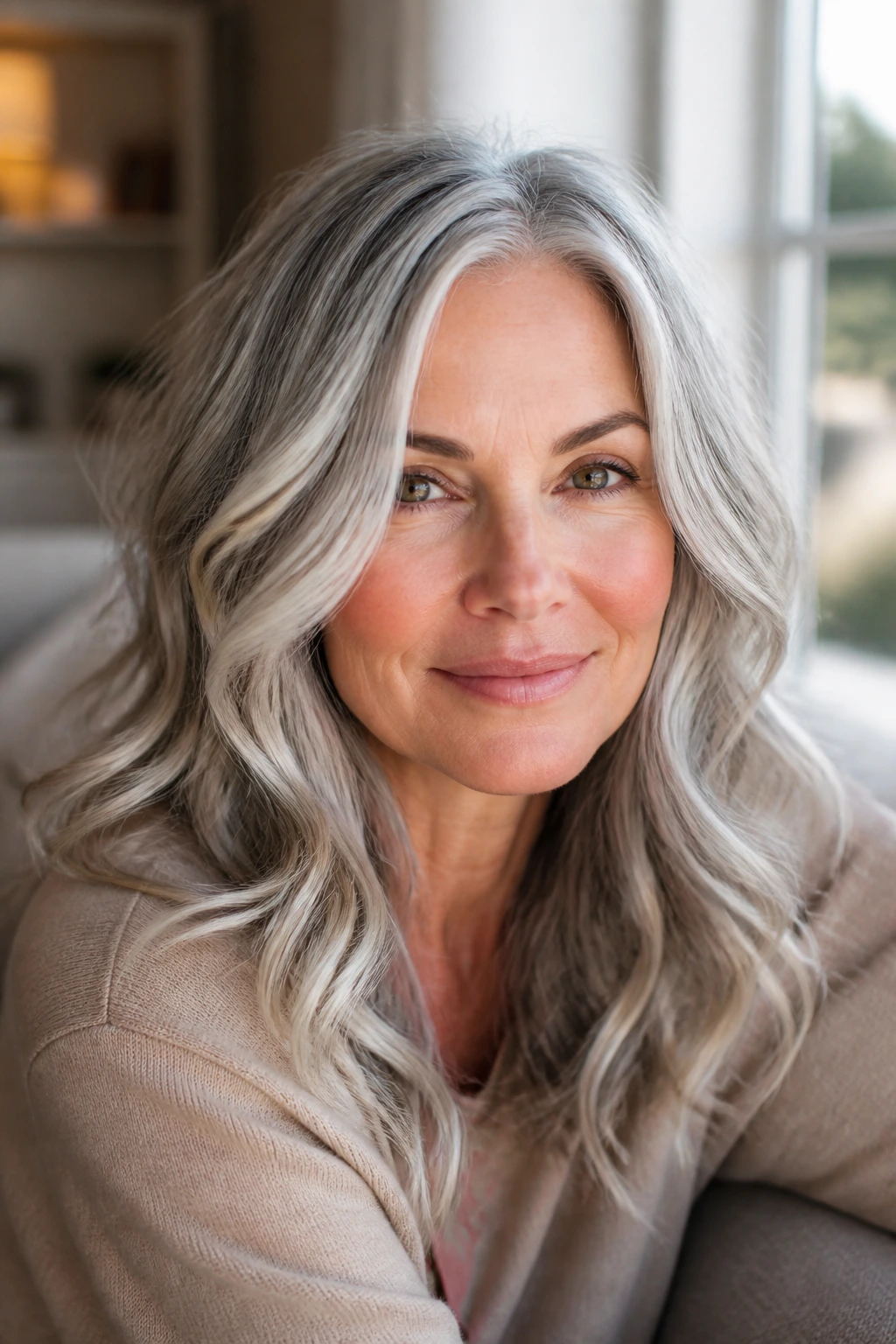
Ultra-fine babylights are the quietest way to bring silver into gray hair, and I mean that in the best possible sense. They’re tiny, soft, and threaded through the top layers so they look like natural silver strands that were always meant to be there.
Why this works so well
Babylights are a smart match for women whose gray is coming in all over, not in one neat pattern. The narrow weave keeps the hair from looking streaky, and the silver tone helps blend darker peppery pieces with brighter white ones. You get softness first, contrast second.
The best part is how little the grow-out shouts at you. Because the highlights are so fine, they blur into the existing gray instead of drawing hard lines every few weeks. If you wear your hair in a loose wave or a round-brush blowout, the movement makes the strands look even more natural.
Salon notes that matter
- Ask for foils no wider than 1/8 to 1/4 inch.
- Keep the silver at a cool pearl or ash level 9–10 if your hair pulls yellow.
- Leave some of your natural depth underneath so the hair does not turn flat.
- Ask for a soft toner, not a harsh icy finish, if your hair is porous.
Pro tip: The first 1 to 2 inches around the hairline should be the lightest part. That little lift makes tired hair look fresher fast.
2. Face-Framing Silver Money Pieces
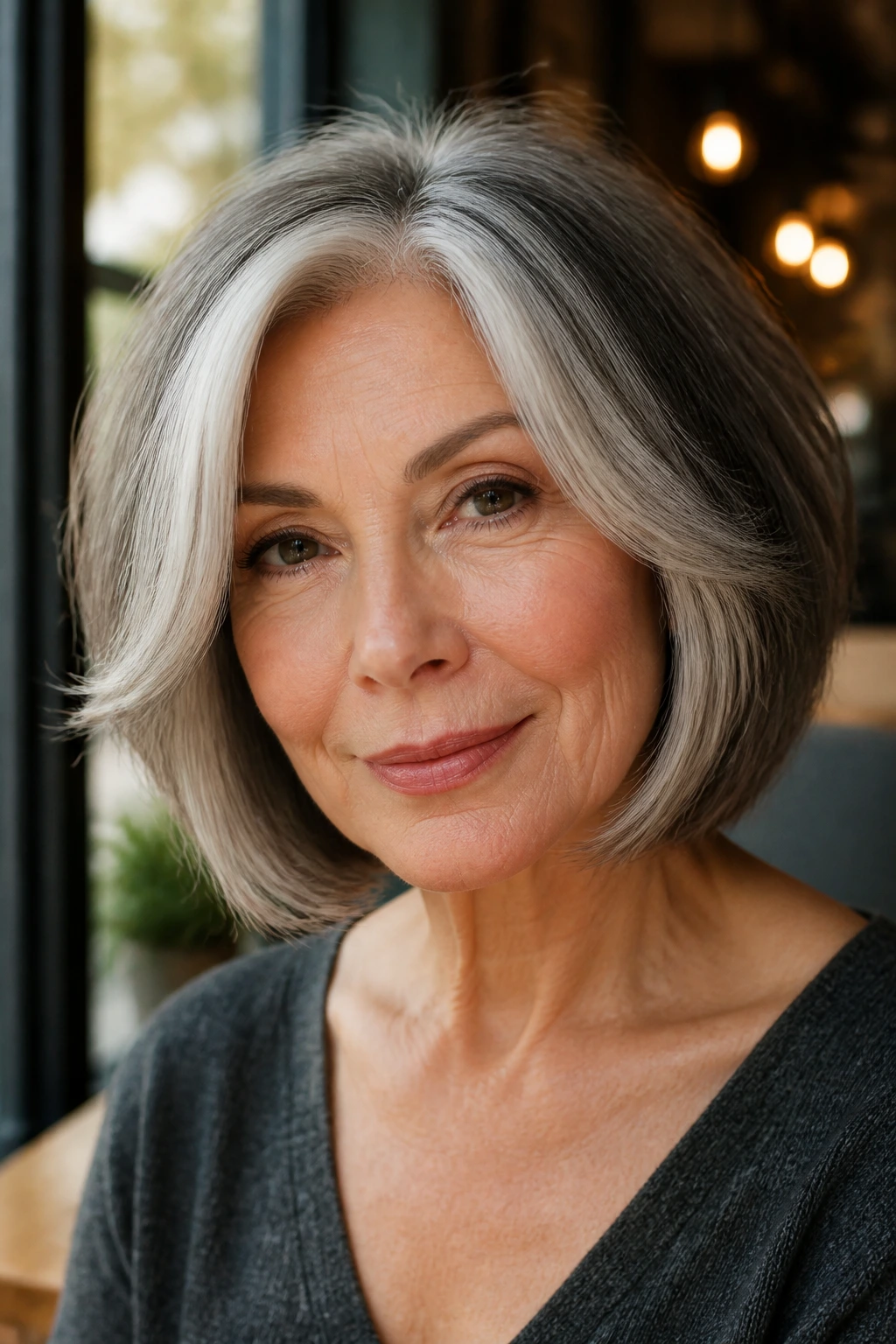
A pair of bright silver money pieces can do more for the face than a full head of highlights ever will. They sit right where the eye lands first, which means you get brightness around the cheeks, temples, and eyes without changing the rest of the head too much.
That makes this look especially good if your natural gray is uneven or if the bottom lengths are still deeper than the front. The contrast is clean, but not loud. It’s a neat trick on bobs, long bobs, and layered cuts that need a little lift near the face.
I like this one for women who wear glasses too. The silver catches the area around the frames and stops the whole face from disappearing behind darker hair. If the placement is too wide, it can look chunky. Keep it narrow, keep it soft, and let the rest of the hair stay calm.
One more thing: money pieces need a little styling to behave. A quick bend with a round brush or a flat iron curve at the ends gives them shape, which stops the front from looking like two random streaks dropped on either side.
3. Smoky Silver Balayage on a Brunette Base
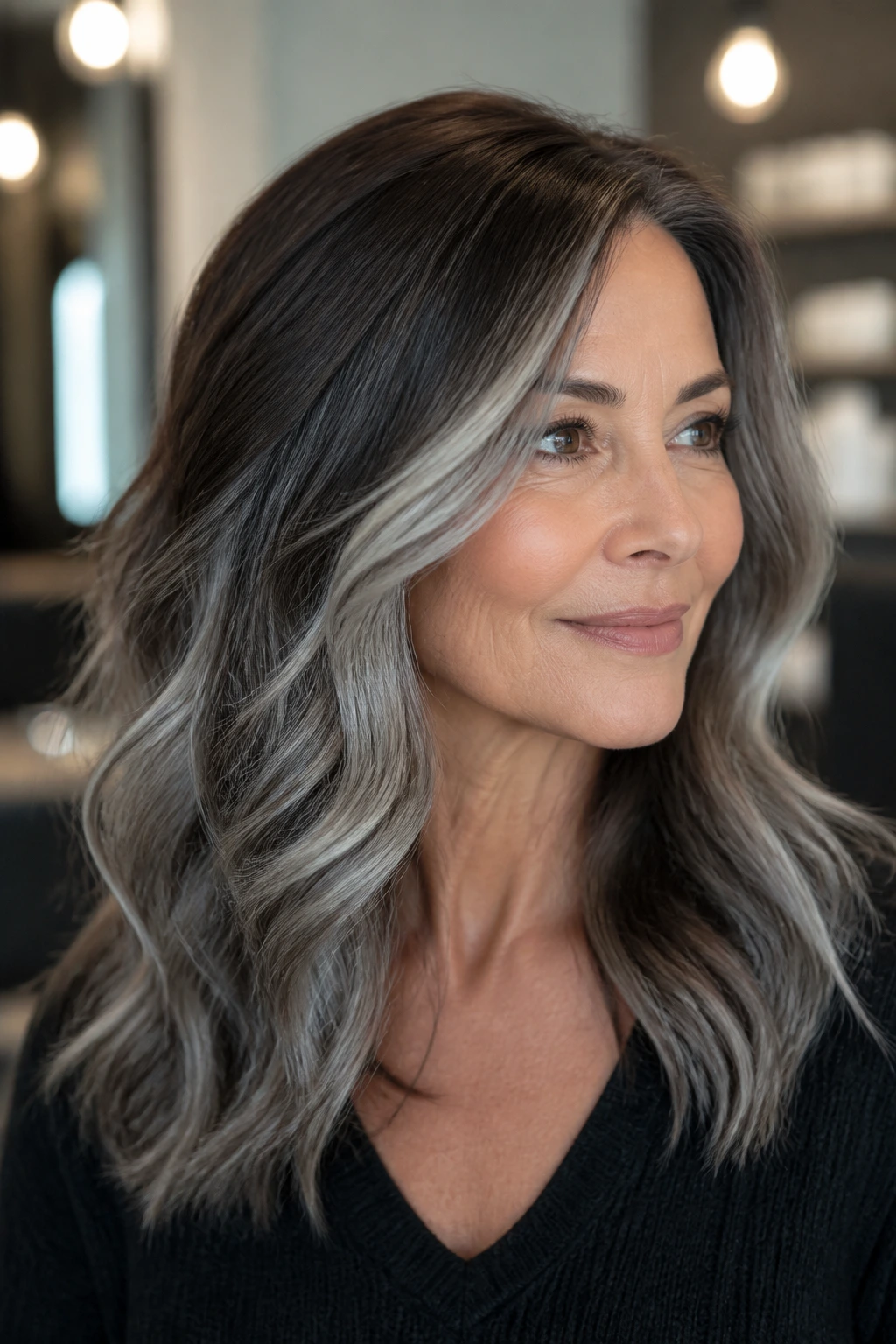
Why does smoky silver balayage flatter darker gray hair so much? Because it respects the depth that is already there. Instead of trying to pull everything light at once, it paints silver through the mid-lengths and ends in loose ribbons, then leaves the root area darker for balance.
That darker base matters. It keeps the silver from turning washed out, and it gives the eye something to rest on. On brunette hair with gray coming in at the temples or crown, smoky silver balayage makes the natural mix look intentional instead of patchy. The result is cooler and softer than a full blonde shift.
How to wear it without overdoing it
- Keep the brightest silver in the middle and lower third of the hair.
- Blend with a neutral brown or mushroom root melt.
- Use a gloss every 6 to 8 weeks if your hair turns warm fast.
- Style with loose bends, not tight curls, so the silver ribbons stay visible.
This one works best when the colorist leaves a little shadow. No harsh lines. No bright strip near the scalp. Just soft, smoky movement that makes gray hair look expensive without trying too hard.
4. Pearl-Silver Ribbons Through Layered Cuts
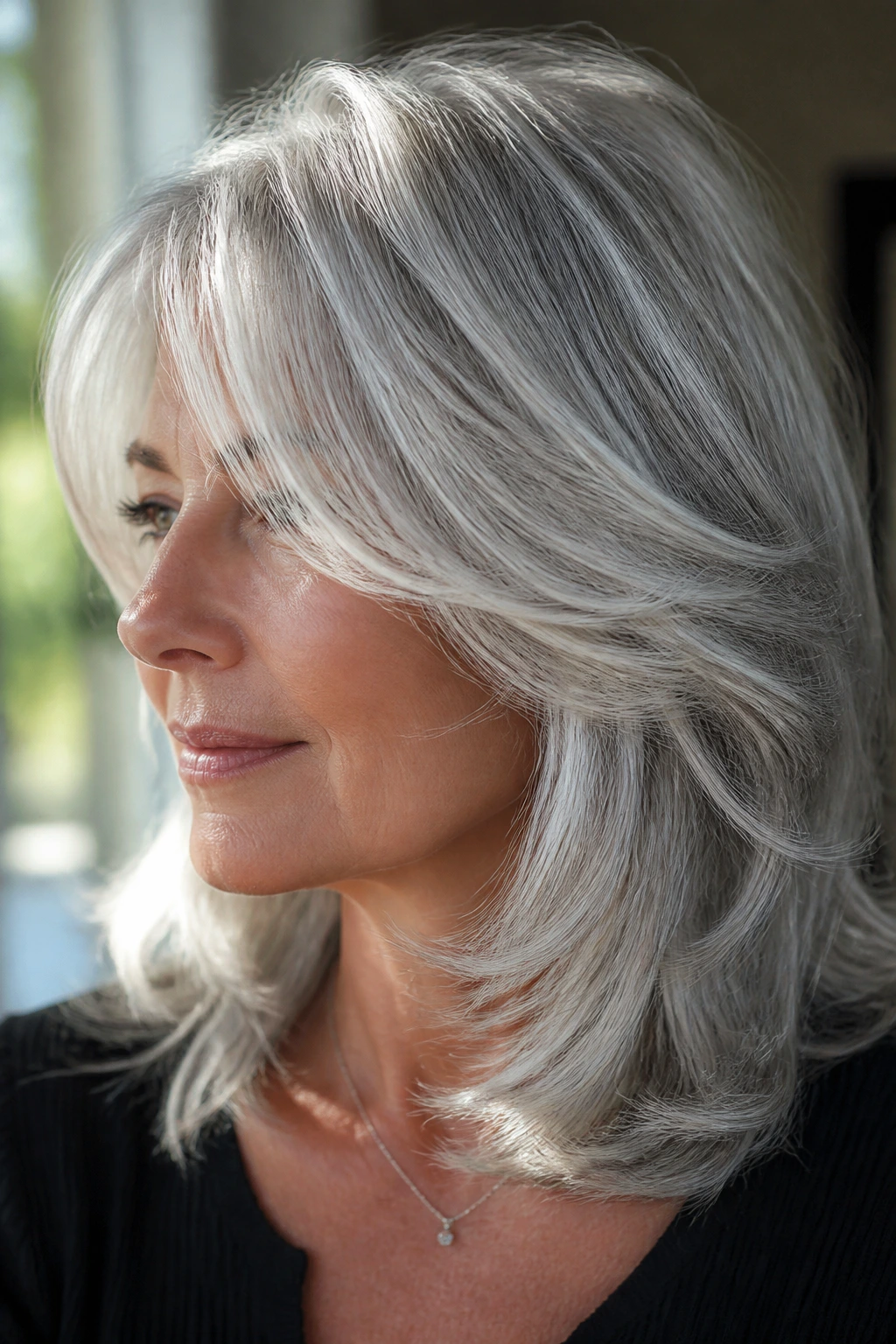
Pearl-silver ribbons are the prettiest choice for layered cuts because the layers do half the styling work for you. Each bend in the hair catches the light in a slightly different way, so the silver never sits in one flat plane. It moves.
That movement is the whole point. On shoulder-length hair with choppy layers, pearl silver can make the cut look softer and lighter without removing depth from the bottom. The tone sits between white and soft beige, which helps if you want shine but don’t want your hair to look like frosted glass.
What makes it different
Pearl silver is less stark than pure silver, and that makes it easier to wear on mature hair with mixed texture. The sheen is soft. The edges are softer still. If your hair has a few coarse strands, this tone doesn’t call attention to every one of them the way a white-blonde highlight can.
Best on:
- Layered lobs
- Mid-length cuts with movement
- Hair that air-dries with a bend
- Natural gray mixed with brunette or dark blonde
Avoid if: your hair is already very porous and grabs toner too fast. Pearl tones can go muddy if the base isn’t lifted evenly.
5. Frosted Silver Ends on a Long Bob
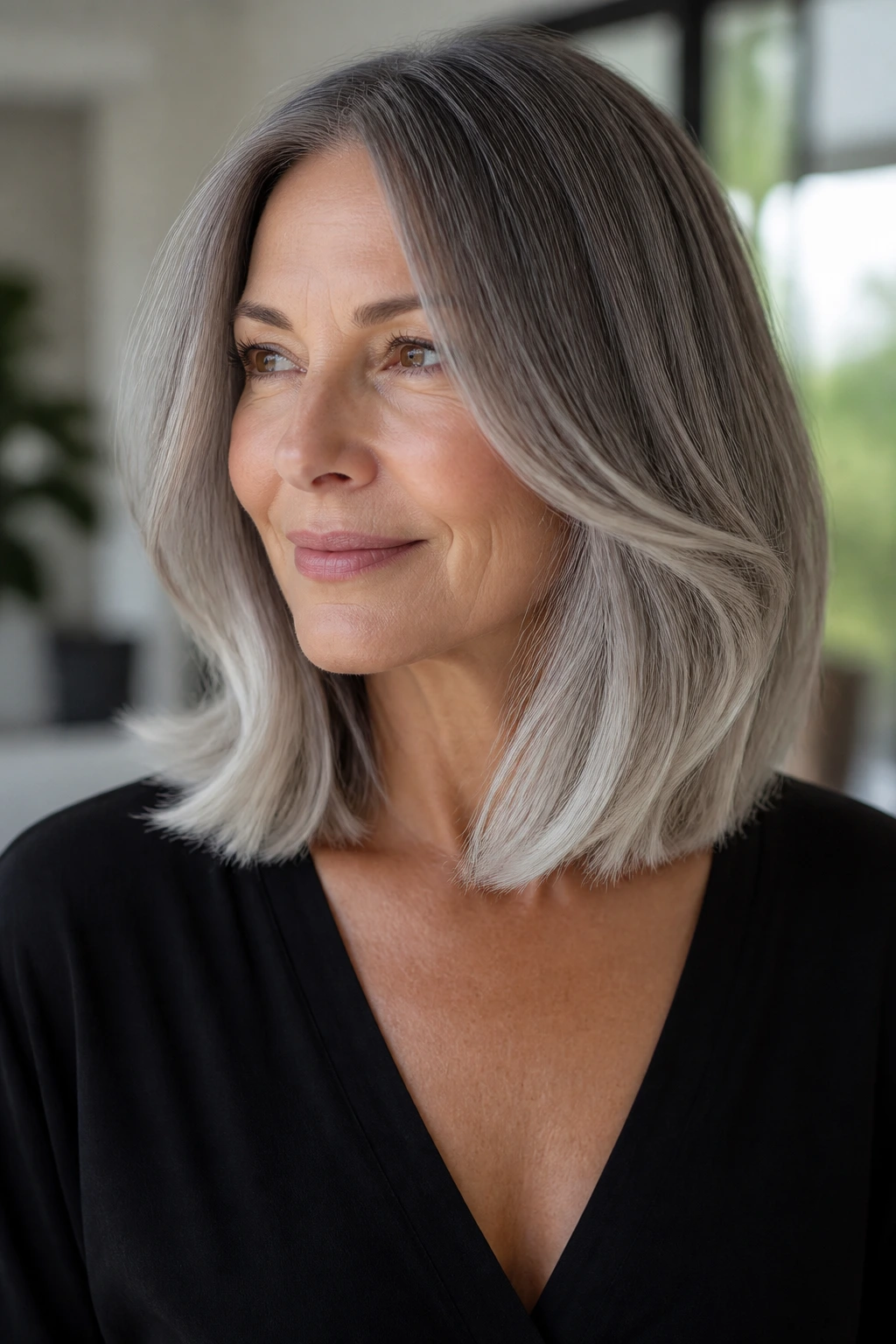
A frosted long bob has a nice, clean edge to it. The silver lives mostly at the ends and lower lengths, so the cut keeps its shape while the color adds a cool finish.
This is one of my favorite silver highlights for gray hair older women who do not want heavy upkeep. The root area stays calmer, and the brightness sits where hair usually needs the most help anyway — on the parts that can look a little dry or faded. A well-placed frost at the ends makes the entire bob look sharper.
The key is not to push the silver too far up the head. That’s where people get into trouble. If the top is too light and the ends are too bright, the cut can lose its outline. Keep the crown deeper. Let the bottom two or three inches do the talking.
It’s a nice choice for straight hair, but it’s even better on a soft wave. The bend keeps the ends from looking like a block of color. Instead, you get a clean drift of light that feels polished without being stiff.
6. Root Shadow With Silver Lengths
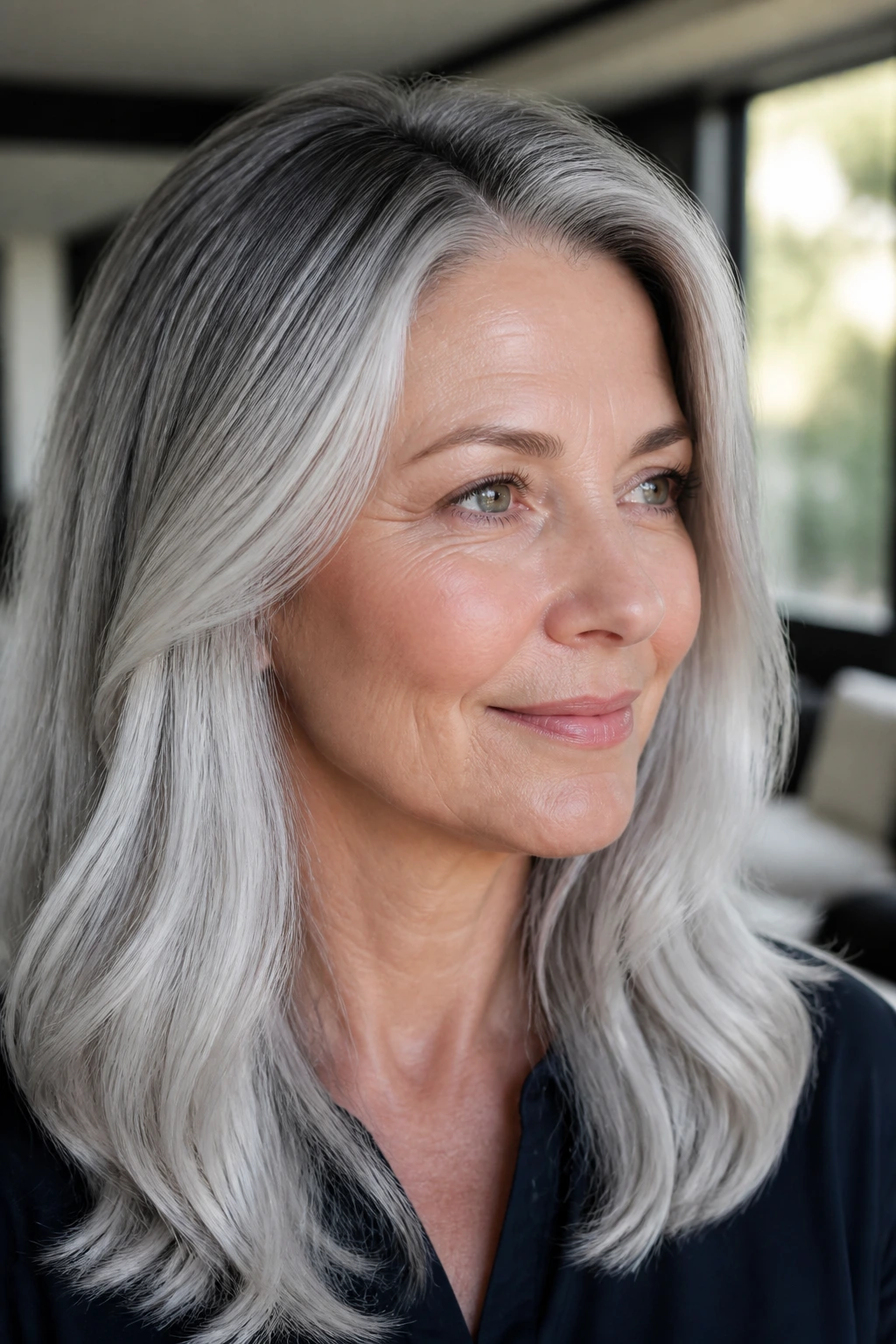
A root shadow is the practical person’s silver highlight. It gives you brightness where you want it and a softer grow-out where you need it. No drama. No hard line at the scalp. Just a darker base melting into silver lengths.
Why this one stays popular
Because it solves the exact problem many women dislike: roots that show too fast. A root shadow in a level 6 to 7 neutral brown or soft ash shade can anchor the silver, especially if the ends are lifted to a level 9 or 10. The difference gives the hair shape and keeps the color from looking chalky.
It also makes fine hair look fuller. That small band of depth at the root gives the illusion of density, which is a gift when the hairline has become a little more delicate over time. The silver below still shines, but it does not float away from the scalp.
The practical part
- Ask for a soft melt, not a blocky root.
- Keep the first inch near the scalp a shade or two deeper.
- Use a purple shampoo sparingly, about once a week, if brass creeps in.
- Finish with a gloss so the silver lengths stay shiny instead of dull.
If you hate constant salon visits, this is the one to bookmark.
7. Ashy Silver Streaks Around the Crown
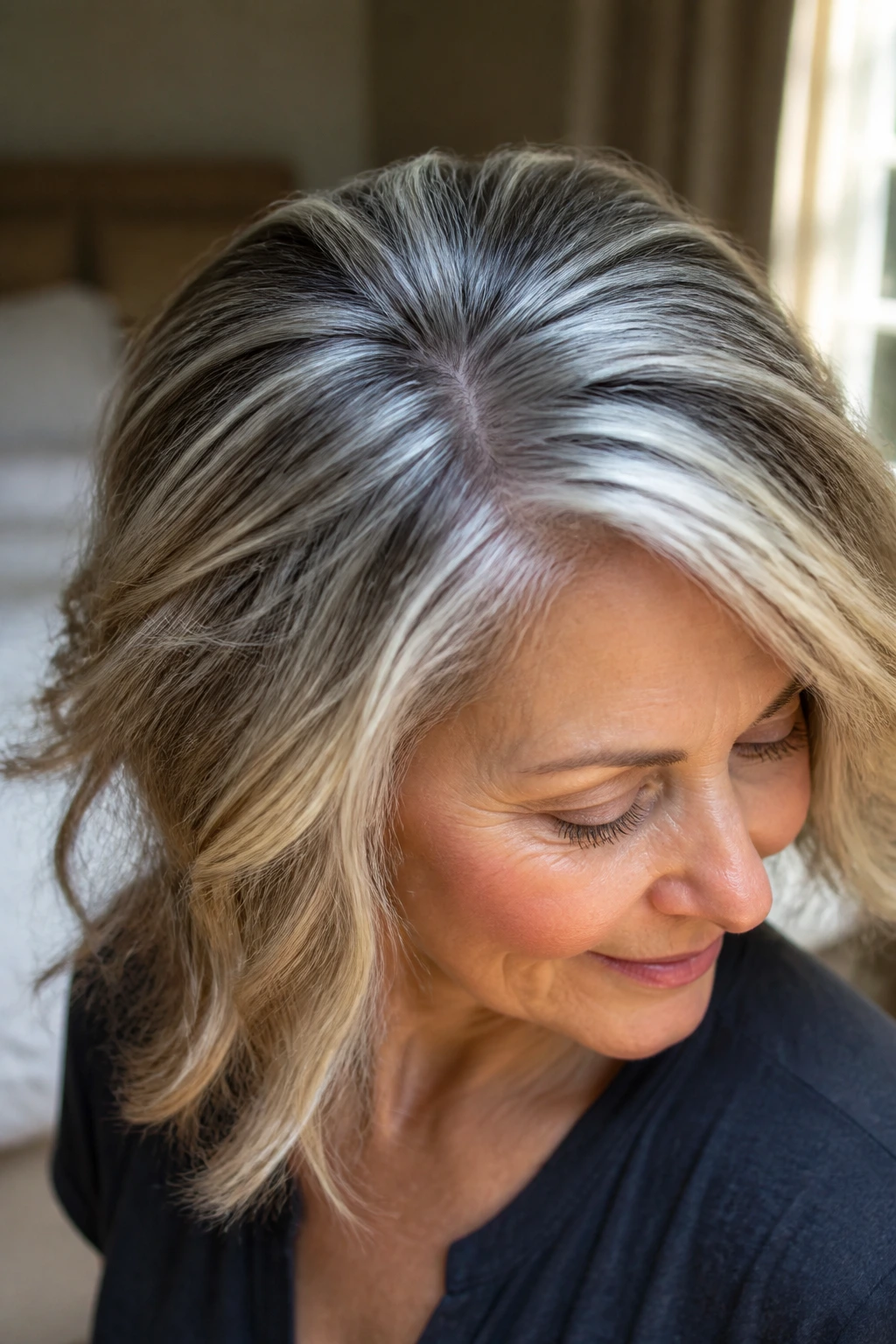
Crown placement is underrated. People focus on the face, then wonder why the top of the head still looks tired. Silver streaks around the crown fix that by brightening the area where light naturally falls first.
The effect can be subtle or more visible, depending on how many strands you want lifted. On thinning areas, those streaks can also make the hair appear a little fuller because the contrast breaks up the scalp line. That is not magic. It is just smart placement.
What to ask for
- Fine streaks around the part and crown
- A cooler ash tone, not a yellow-silver blonde
- Slightly deeper pieces between the light ones for dimension
- A finish that follows the hair’s natural swirl
One thing worth saying: crown highlights need careful placement if your hair is short or strongly layered. Too many light pieces in the wrong spot can expose scalp instead of disguising it. A good colorist will weave them where the hair naturally falls, not where a chart says it should go.
The payoff is a brighter top that looks awake in daylight. No helmet effect. No stripe. Just lift where it counts.
8. Chunky Silver Panels for a Bolder Look
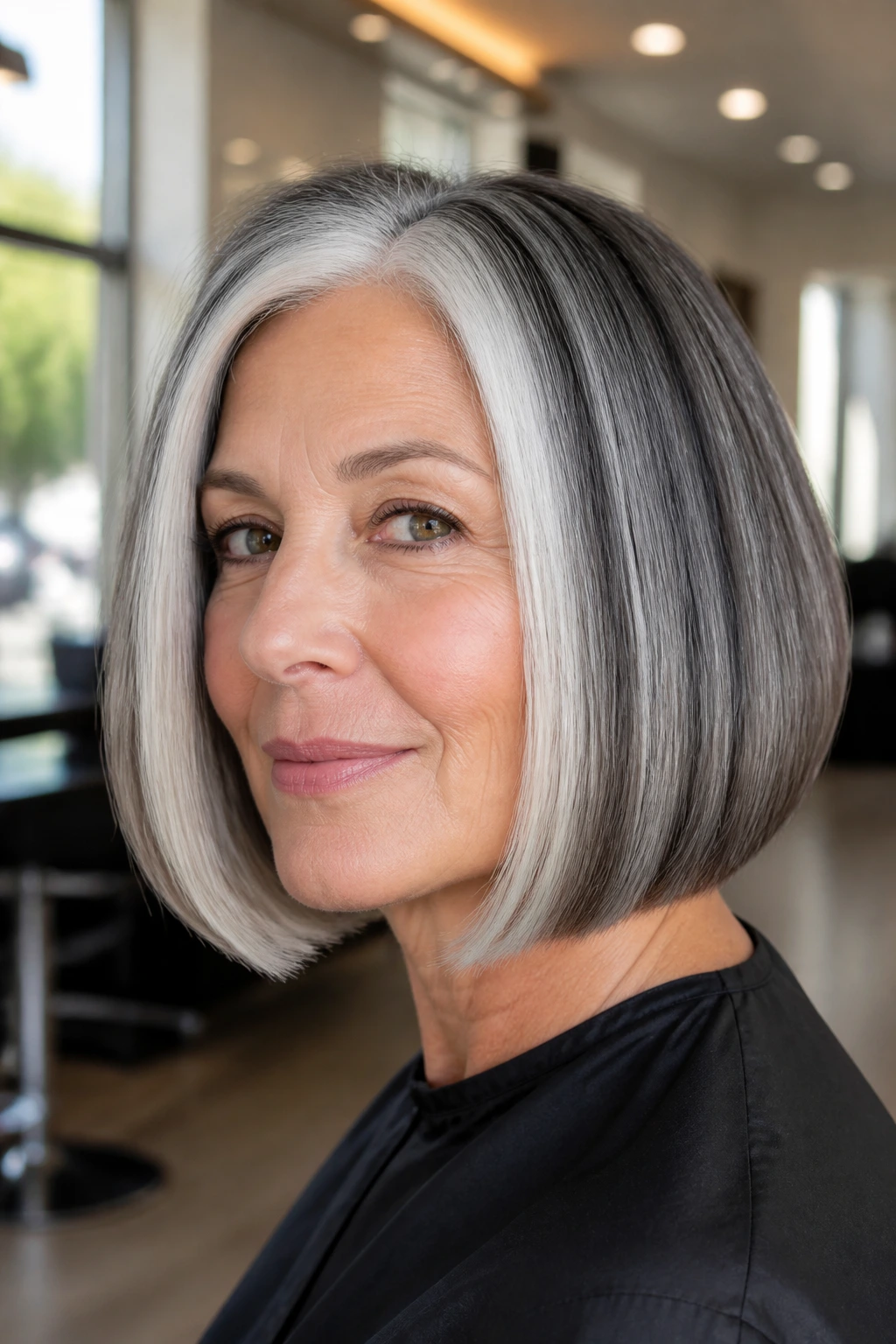
Chunky silver panels are for women who don’t want their gray to whisper. They want it to show up and make a statement. And honestly, on the right cut, that can look sharp.
This is not the softest option on the list. It’s the most graphic. Thick panels of silver against a deeper base create contrast that reads modern and confident, especially on blunt bobs, shoulder-length cuts, and hair with a bit of natural volume. If your style is simple and your clothes lean clean and tailored, the color does half the dressing for you.
The catch? You need enough density for it to work. Fine hair can look stringy if the panels are too broad. Thick hair handles it better because the color has room to sit in bands without splitting the shape apart.
Good match for:
- Strong jawline bobs
- Straight or slightly wavy textures
- Women who like visible contrast
- Hair that holds tone well
Not great for: anyone who wants the grow-out to disappear. You will see these panels sooner. That is part of the look.
9. White-Silver Halo Highlights
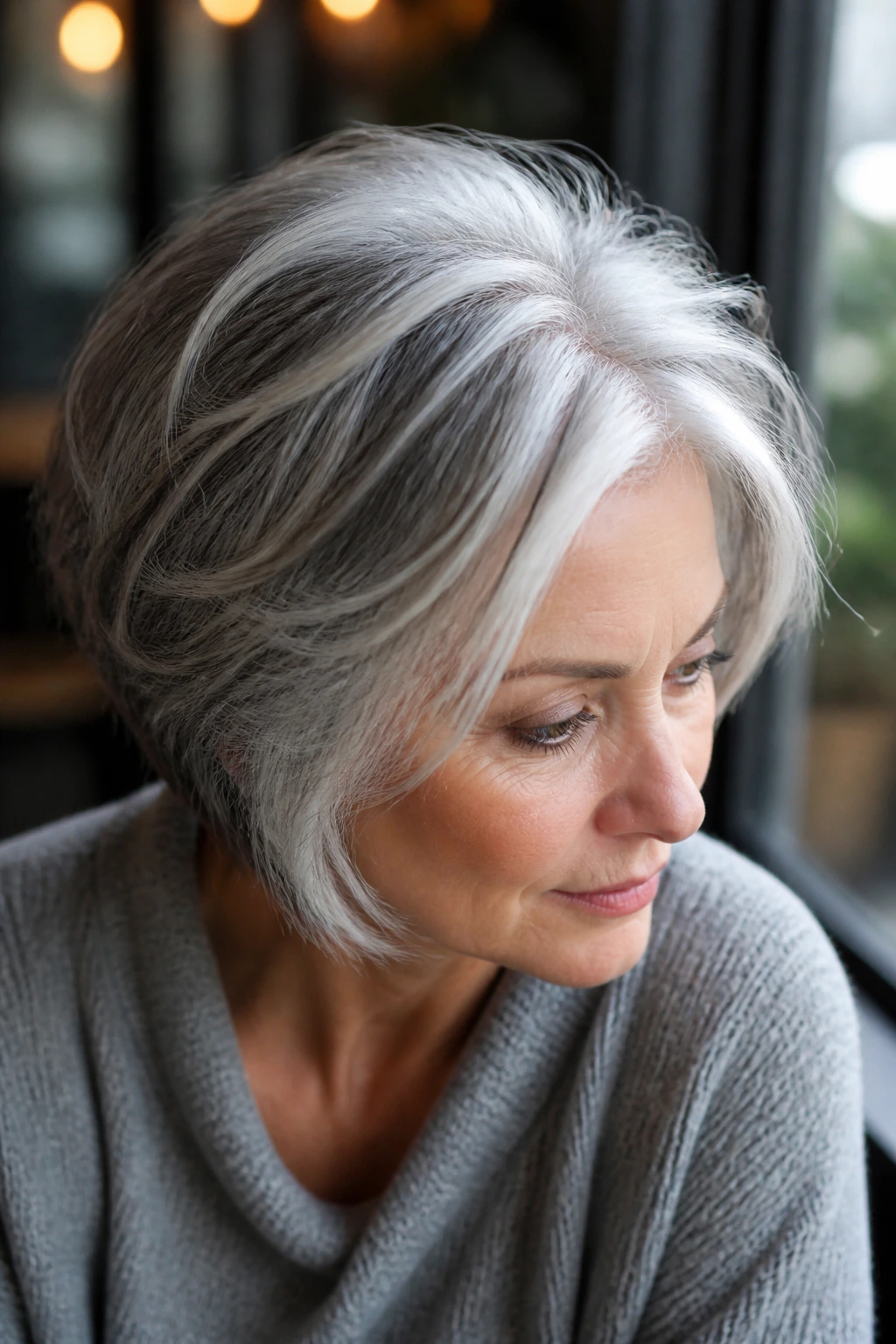
Would a halo of white-silver pieces make hair look thinner or fuller? If the placement is right, fuller. Much fuller. The halo effect puts the brightest strands around the upper perimeter of the head, which makes the cut look lifted and airy.
This look works especially well on short-to-medium hair that needs some visual height. By concentrating the lightest silver on the outer surface layers, the style gets a soft frame that catches light from above and from the sides. The inside stays deeper, so the hair still has structure.
The danger is over-lightening the whole top. Don’t do that. A halo should feel like a ring of brightness, not a bleach cap. Leave pockets of depth between the light pieces so the hair still has shape when it moves.
It’s a smart choice if your natural gray is already strong and you only want to sharpen the top. The halo does not fight the gray. It gives it a cleaner edge.
Best styling move
A round brush at the crown and a loose bend through the ends. That small bit of lift keeps the halo visible instead of letting it sit flat against the head.
10. Mushroom Brown With Silver Gloss
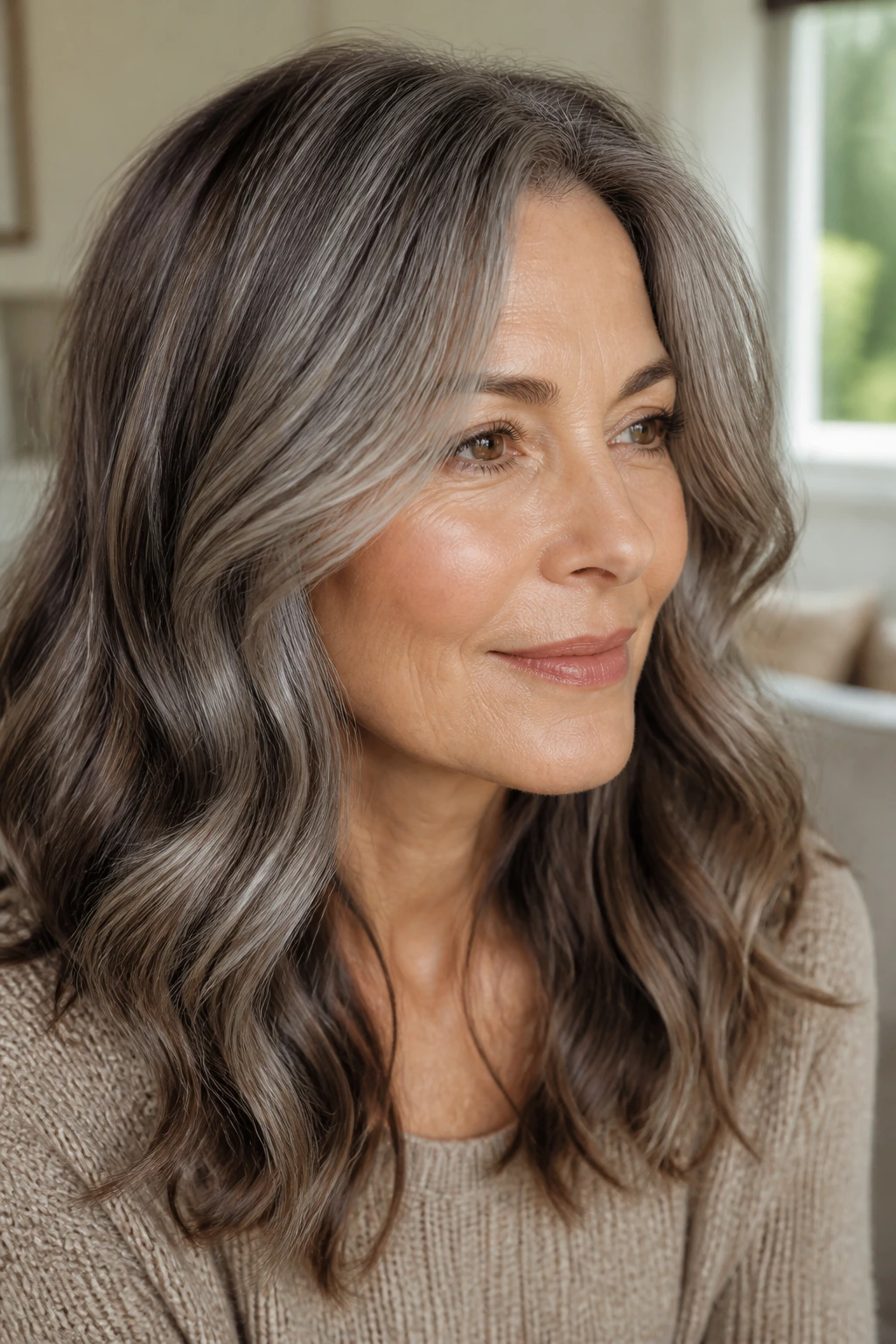
Mushroom brown with silver gloss is the middle ground I wish more people would try. It keeps the cool tone of silver, but the base stays earthy and soft rather than bright and icy. That’s a mercy for women who want something refined without sliding into pale blonde territory.
Unlike full silver highlights, this look leans on depth. The brown base is muted and smoky, and the silver gloss sits over the lighter pieces to give them sheen rather than a hard metallic edge. The result is quiet, but not boring. There’s movement when you turn your head, and the grow-out is easier because the shadow stays part of the design.
I like it for warmer skin because it doesn’t fight the face the way a very blue-toned silver can. It also looks good on thicker hair, where too much pale highlight can sometimes feel busy. Mushroom brown gives the silver somewhere to land.
If your gray is coming in around the temples and part, this is a nice way to blend it without going fully blond. It’s one of those shades that looks better in real life than in a photo. Smooth. Cool. A little smoky.
11. Peekaboo Silver Highlights Under the Top Layers
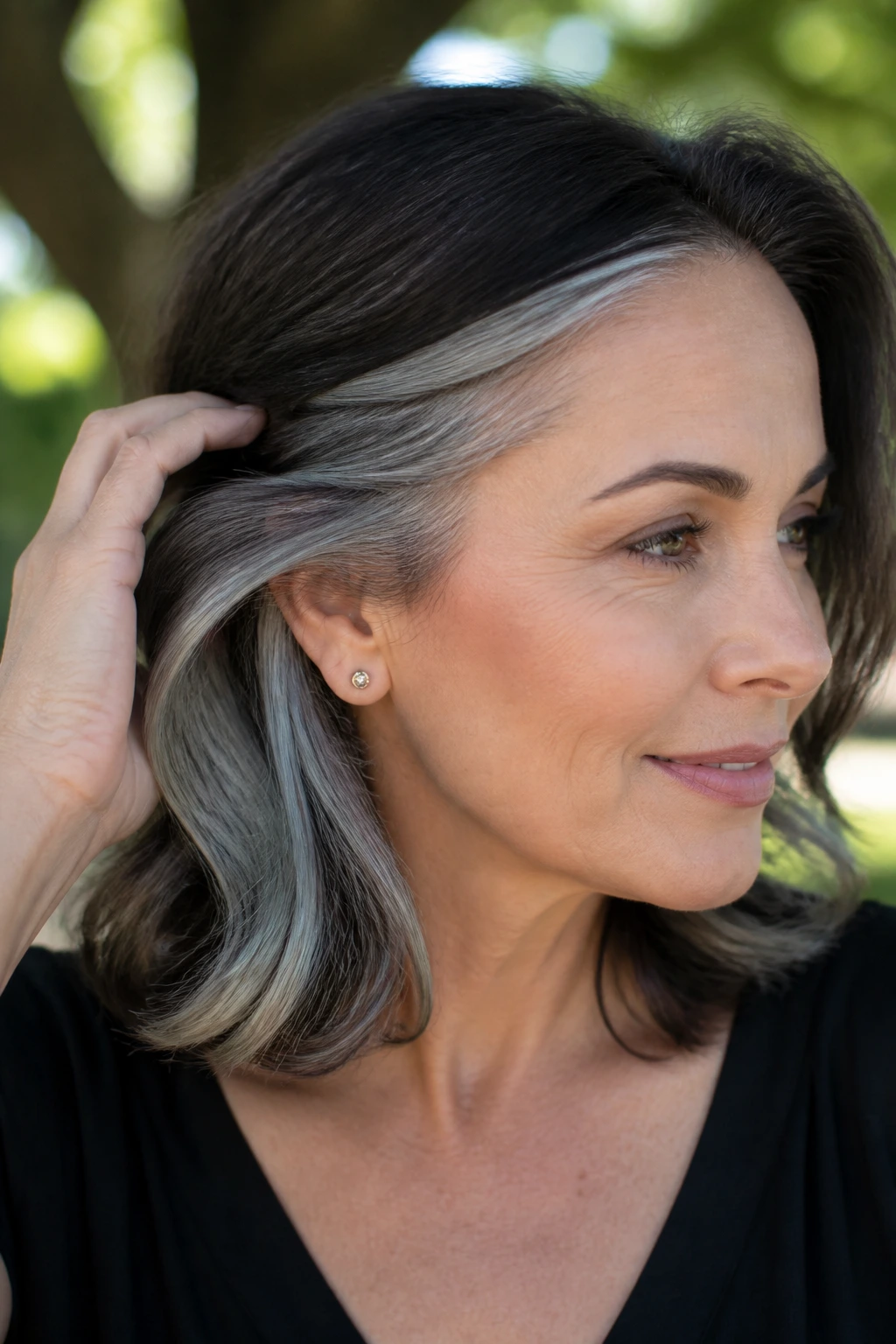
Peekaboo silver highlights are for women who want a private little surprise in their hair. From the top, the style stays calm. Lift the outer layer, tuck it behind the ear, or pull the hair into a half-up twist, and the silver flashes through underneath.
That makes it a smart option if you want color without a big commitment to brightness. The top layer can stay more natural, which protects you from that over-lightened look some silver jobs get when every section is pushed to the same level. The hidden layer does the fun part.
Why I like this placement
- It keeps the hair looking polished in conservative settings.
- It lets you control how much silver shows.
- It works well with ponytails, clips, and loose buns.
- It gives fine hair more depth than a full surface highlight might.
The best peekaboo silver sits a little lower than the crown and a little deeper than the part, so it reveals itself only when the hair moves. That movement is the payoff. You get dimension without staring at it all day.
It’s also a good choice if your ends are lighter than your roots already. The hidden silver can stitch the whole head together without a dramatic top-to-bottom change.
12. Champagne Silver Blend for Warmer Skin
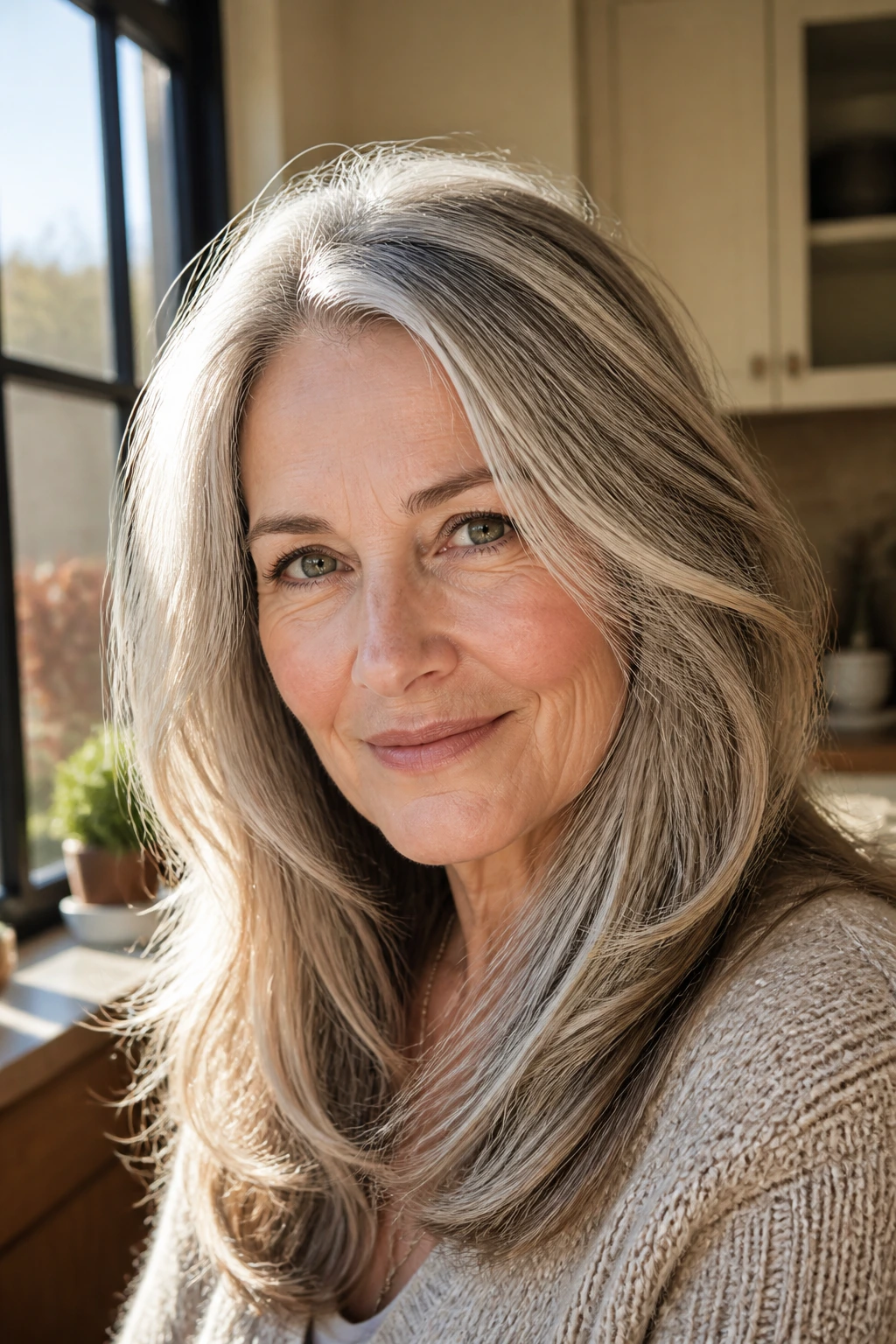
Champagne silver is proof that silver does not have to be icy to work. A softer champagne tone adds a pale beige note to the silver, which keeps the color flattering on warmer skin and avoids that stark, bluish cast some women dislike.
This shade is especially useful when gray hair starts to lose shine and pick up dull yellow tones. The champagne tint warms the silver just enough to make it look polished instead of cold. That matters. A lot. Cool colors can be harsh near the face if your skin already has golden or peach undertones.
How to wear it well
A champagne silver blend usually looks best when the lightest strands stay in the top layer and around the face, while the lower sections keep more beige or soft taupe depth. That balance keeps the style from turning chalky. It also makes regrowth less obvious, because the transition between gray, silver, and natural root is gentler.
If you wear lipstick, this shade plays well with coral, rose, and soft berry tones. It gives the face a little glow without competing with makeup.
This is not the coldest silver on the menu. Good. That’s the point.
13. Cool Silver Ombré for Long Hair
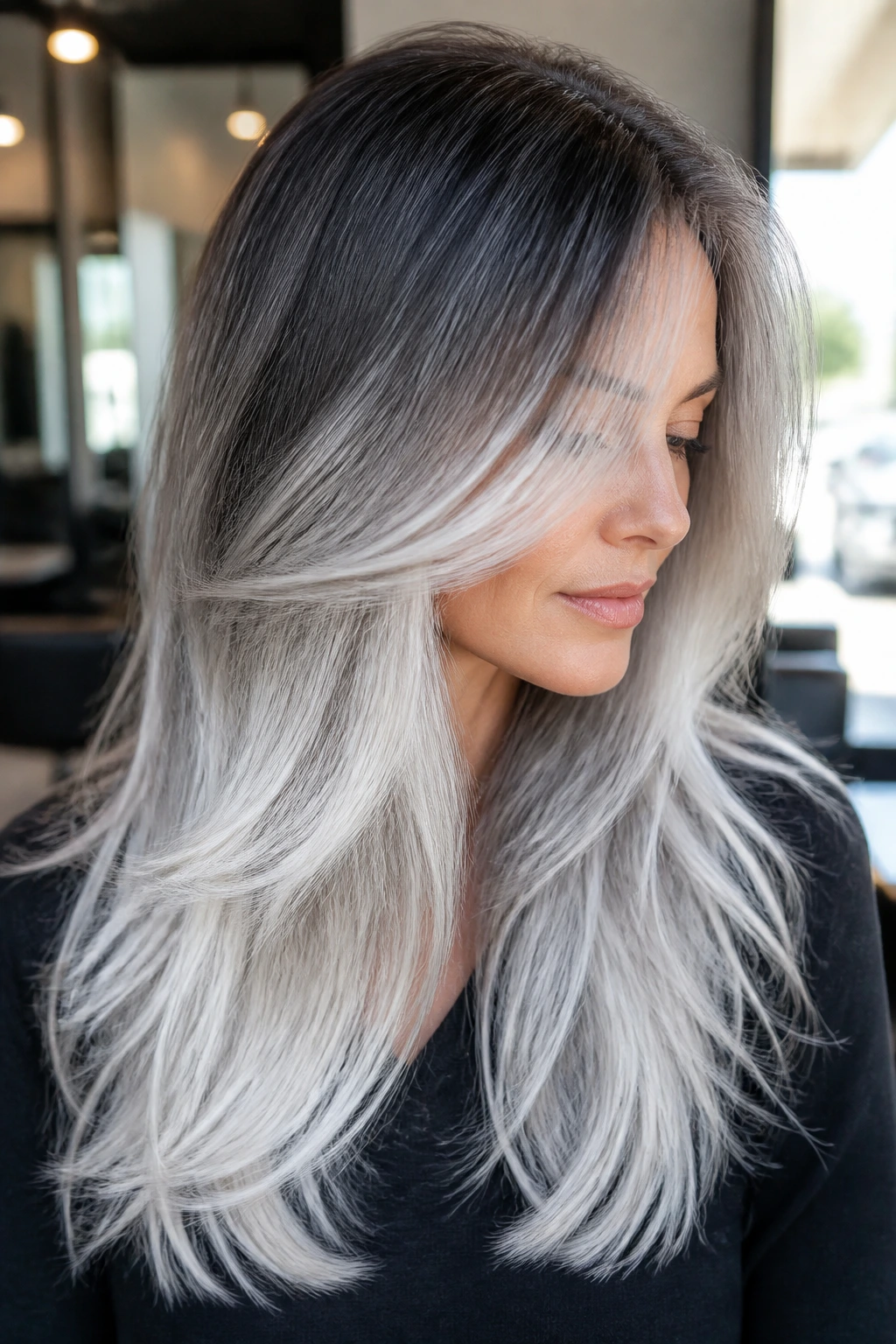
Why does silver ombré work so well on long hair? Because it gives the color room to breathe. The dark or soft-neutral root stays in charge near the scalp, then the silver opens up through the mid-lengths and becomes brightest at the ends.
Long hair needs that progression. If the silver starts too high, it can look heavy and expensive to maintain. If it starts lower, the hair keeps its shape and the color feels gradual instead of abrupt. On women with longer gray hair, ombré can make the ends feel brighter without forcing the entire head into a pale tone.
The style also handles grow-out nicely. Since the root stays deeper, you do not get the hard stripe that can happen with all-over silver. The shift is gentle enough that a few inches of regrowth do not ruin the look.
I’d choose this one if your hair is past the shoulders and you like wearing it loose or in a low ponytail. The color shows even when the hair is tied back, which is useful. Some silver looks disappear the minute you gather the hair. This one doesn’t.
14. Salt-and-Pepper Enhancement With Lowlights
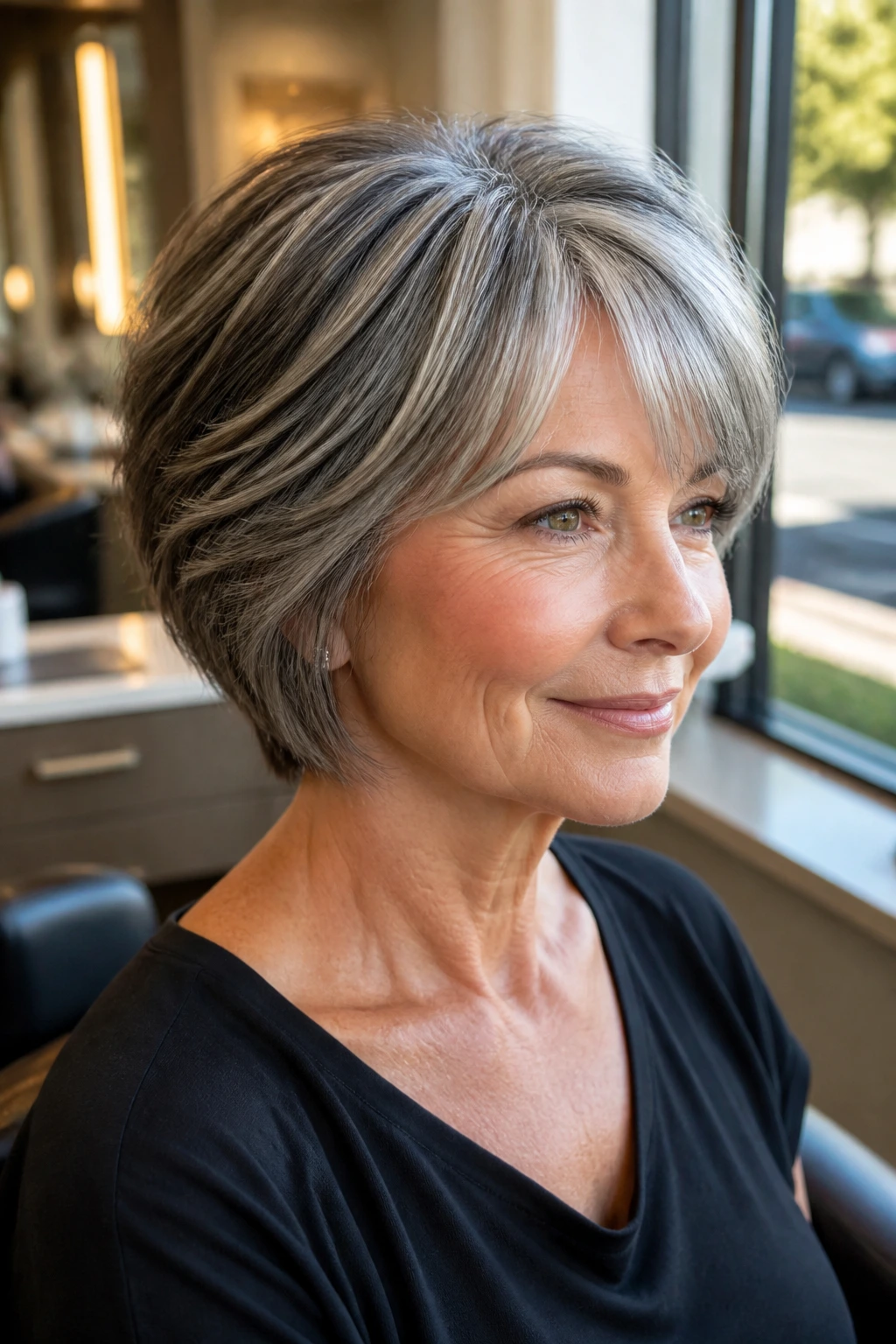
Salt-and-pepper hair already has good bones. The trick is not to cover it up, but to sharpen the contrast so the silver pieces look intentional. That is where lowlights come in.
Instead of adding more brightness everywhere, lowlights deepen selected sections, which makes the gray and silver threads stand out. The result is richer, not louder. Hair that was starting to look washed out gets back some shape, especially if the gray is very white around the temples but darker through the back.
What lowlights do here
They add:
- Depth around the nape and under layers
- A better shape for wavy or curly hair
- Less blur between white strands and the scalp
- A more natural transition if the hair is growing out from dye
This is a strong move for women who are mostly gray already. A few deeper pieces keep the color from flattening into one pale sheet. The silver then reads as texture, not just color.
And yes, lowlights can be too dark. If the contrast is too sharp, the hair starts to look striped. Stay in the same family as your natural depth. The goal is support, not a reinvention.
15. Silvery Face-Framing Layers on Curls
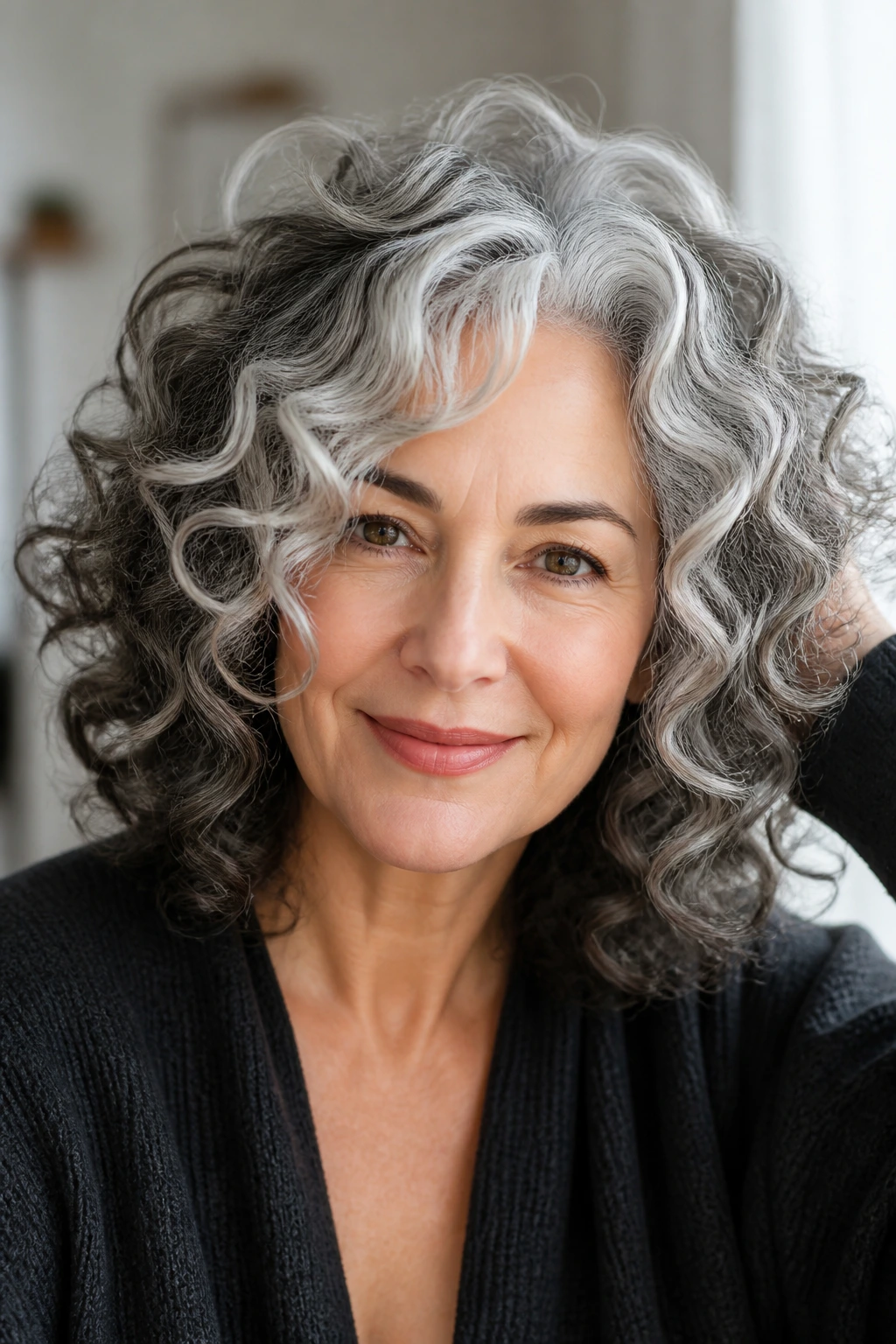
Curly hair needs a different approach because curls don’t lie flat. They spring, stack, and fold over themselves, which means silver placement has to follow the curl pattern rather than fight it.
Silvery face-framing layers work because they brighten the outer curve of the curl where the eye lands first. That brings shape to the face and makes the curls look more defined. If the silver is painted in clumps that match the curl groupings, the result feels natural. If it’s scattered randomly, it can look busy fast.
The best versions keep the inner curl deeper and the outer curl lighter. That gives the spirals a nice edge. It also helps the style hold up between washes, because the silver still shows even when the curls lose a little bounce.
How to think about it
Ask for silver on the curls that frame the face, the top ridge, and a few outer panels at the sides. Leave some darker pieces between them. Curly hair needs space to move, and too much silver can break up the pattern in a bad way.
One small detail matters a lot: use a toner that won’t go flat after one wash. Curly hair can swallow shine. A glossy finish keeps the silver from disappearing.
16. Metallic Silver on Short Pixie Cuts
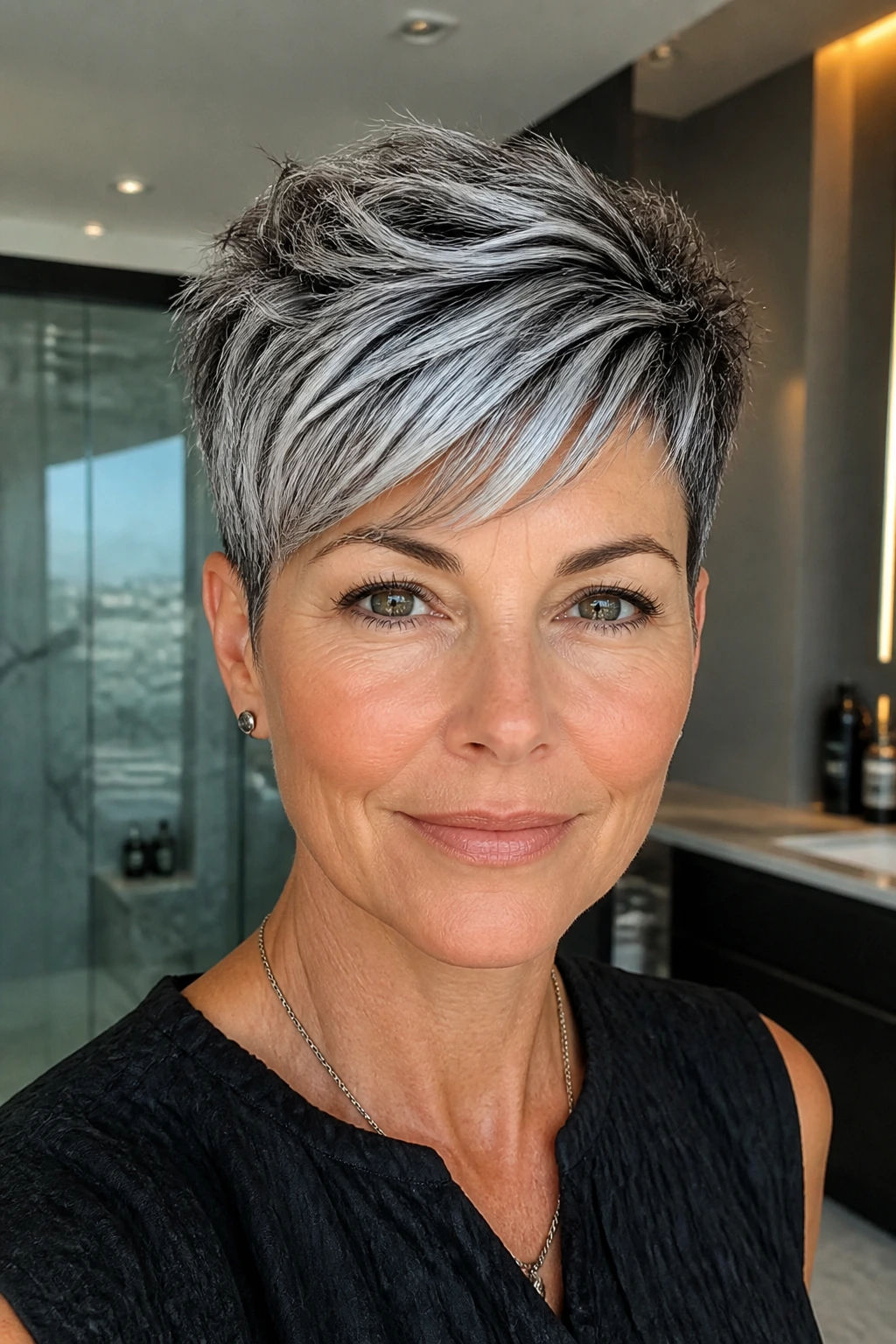
A pixie cut can carry metallic silver better than a lot of longer styles. That may sound backwards, but short hair gives silver room to read as texture instead of simply color. Every little ridge, piecey edge, and side sweep picks up light in a different spot.
The beauty of this cut is how clean it looks with relatively little effort. The silver can sit on the top, crown, and fringe, while the sides stay a touch deeper for shape. That contrast keeps the pixie from looking washed out. It also makes the cut feel modern without needing a lot of styling time in the morning.
What to ask your stylist for
- Bright silver on the top ridge
- Softer, slightly deeper sides
- A cool toner that won’t go purple
- Piecey texture through the fringe
This is a good choice if you are already wearing short hair and want it to feel sharper. It’s also practical. Short cuts show damage faster, so a silver pixie often looks best when the hair is healthy, trimmed every 4 to 6 weeks, and styled with a light cream instead of a heavy wax.
The only catch is upkeep around the ears and neckline. Short hair grows fast in the wrong places. But if you like crisp lines, that tradeoff is worth it.
17. Silver Balayage With Curtain Bangs
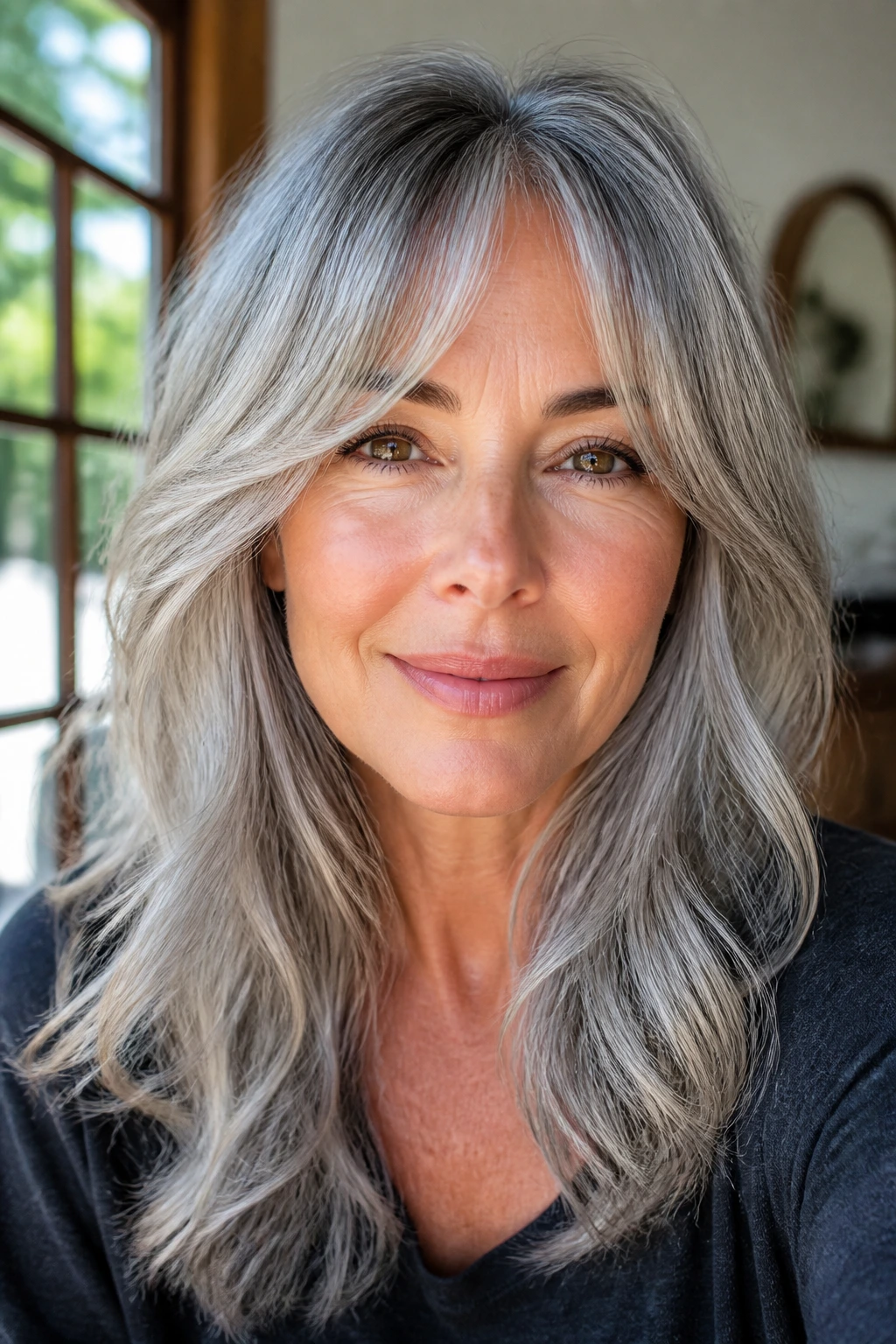
Curtain bangs change the whole mood of silver balayage. They drop the brightness right around the eyes and cheekbones, then let the rest of the hair flow away in softer silver waves. The result is friendly, not severe.
This style works because curtain bangs already have movement. When silver balayage follows that movement, the front of the hair looks lifted and open. It also helps balance broader foreheads, strong features, or a cut that needs a little softness near the front. The silver frames the face without sitting in one hard block.
The rest of the balayage can stay looser and more blended through the sides and ends. That makes the bangs the focal point. If the silver gets too bright all the way through the fringe, it can look harsh. Keep the lightest pieces feathered, not solid.
I like this choice on shoulder-length hair with a bit of bend. It feels lived-in. The bangs are the only part that needs a little daily attention, and even that is easy once you know your brush and blow-dry angle.
18. Soft Silver Veil Highlights for Gray Hair Older Women
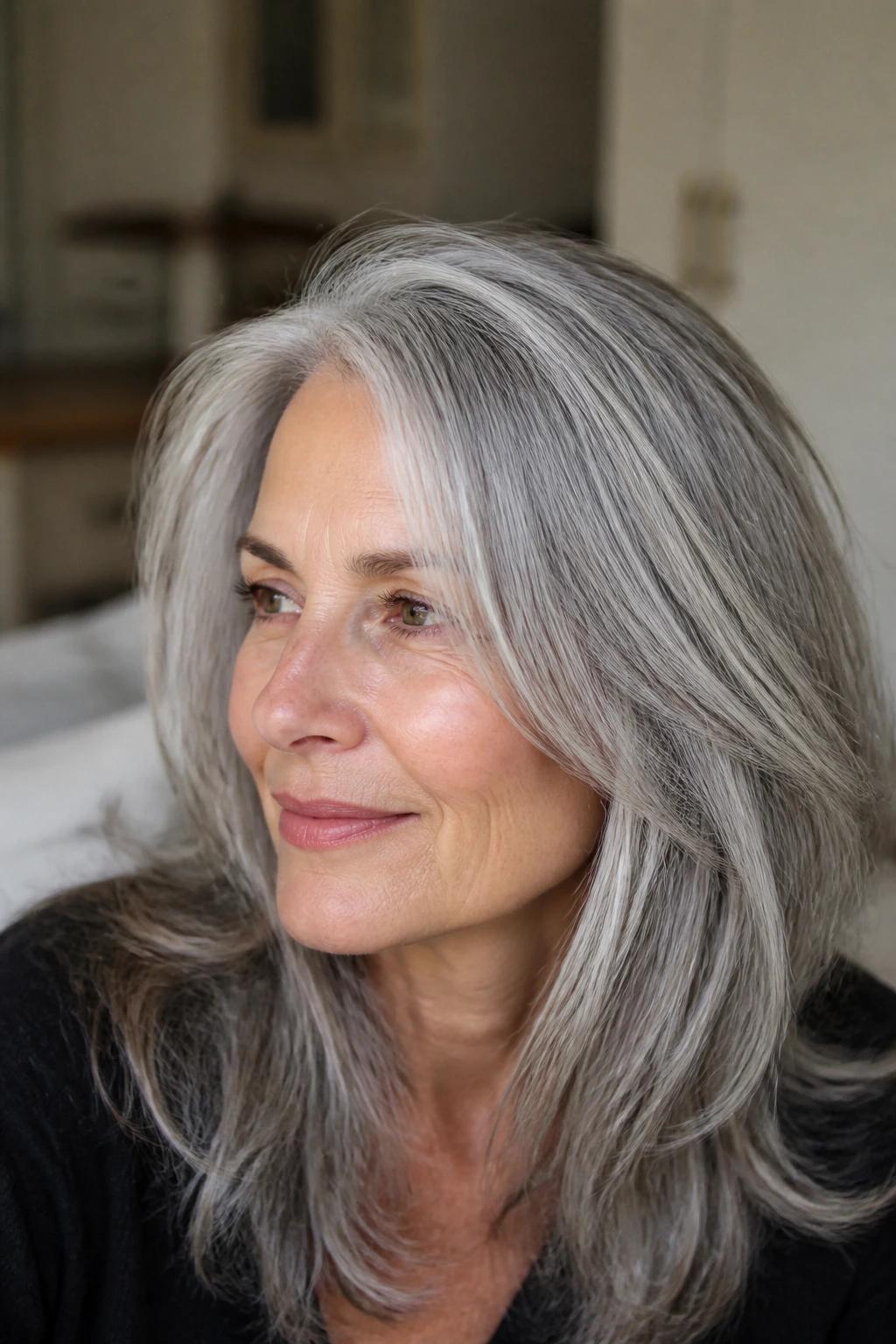
Soft silver veil highlights are for women who want the lightest possible touch. The color sits like a thin veil over the surface layers, barely more than a shimmer in some spots, but enough to clean up dullness and sharpen the gray.
This is one of the most forgiving silver highlights for gray hair older women because it works with the hair’s natural mix instead of announcing itself. You still see the gray. You still see the white. The silver just smooths the whole picture. On thick hair, it keeps things airy. On fine hair, it stops the color from feeling overworked.
Best for women who want low drama
- Hair that is already mostly gray
- Fine or medium textures
- Straight, wavy, or softly curled styles
- A grow-out that needs to stay easy
The veil effect is subtle, but not boring. That distinction matters. Too many silver jobs go straight to bright and miss the softer middle ground. Veil highlights are the answer when you want shine near the top and a calm transition everywhere else.
If you pair them with a light gloss every few weeks, the hair keeps that clean, silvery finish without looking frosted. The whole point is restraint. Not invisibility. Restraint.
Final Thoughts
The best silver choice is the one that matches your cut, your texture, and how often you want to sit in a salon chair. Some women need fine babylights. Others need a root shadow, a halo, or a bolder panel of contrast. There isn’t one right silver. There are several good ones, and they do different jobs.
If your gray hair is already strong, focus on tone and shine. If it’s still coming in unevenly, focus on blend and placement. If your hair is fine, keep the highlight width tiny. If it’s thick, you can handle more contrast. Those are the real levers.
Bring photos, yes, but also bring a little honesty about upkeep. A silver look can be soft and easy, or crisp and high-maintenance. The difference usually lives in the placement, the toner, and how much depth you leave behind.
