



Purple black highlights can do a lot more for a round face than people give them credit for. The right mix of inky black depth and violet, plum, or blackberry tones pulls the eye up and down instead of letting it sit across the widest part of the face.
That vertical movement matters. A round face usually has soft width through the cheeks, so color placement becomes a shape trick as much as a style choice. When the brighter pieces sit too high or too wide, they can make the face feel fuller. When they start lower, skim the temples, or travel in narrow ribbons through the lengths, the whole look stretches out.
Black hair gives purple a richer, more expensive-looking base, too. On dark strands, purple can read as smoky eggplant in low light and more jewel-toned near a window, which is part of the appeal. The shade can stay subtle or go loud, but the placement is what decides whether it flatters a round face or fights it.
Some versions are soft and airy. Some are bold enough to make a haircut feel brand new. The good ones do the same thing under all that color: they sharpen the face just enough, without making it look boxed in.
1. Long Plum Ribbons Starting at the Temple
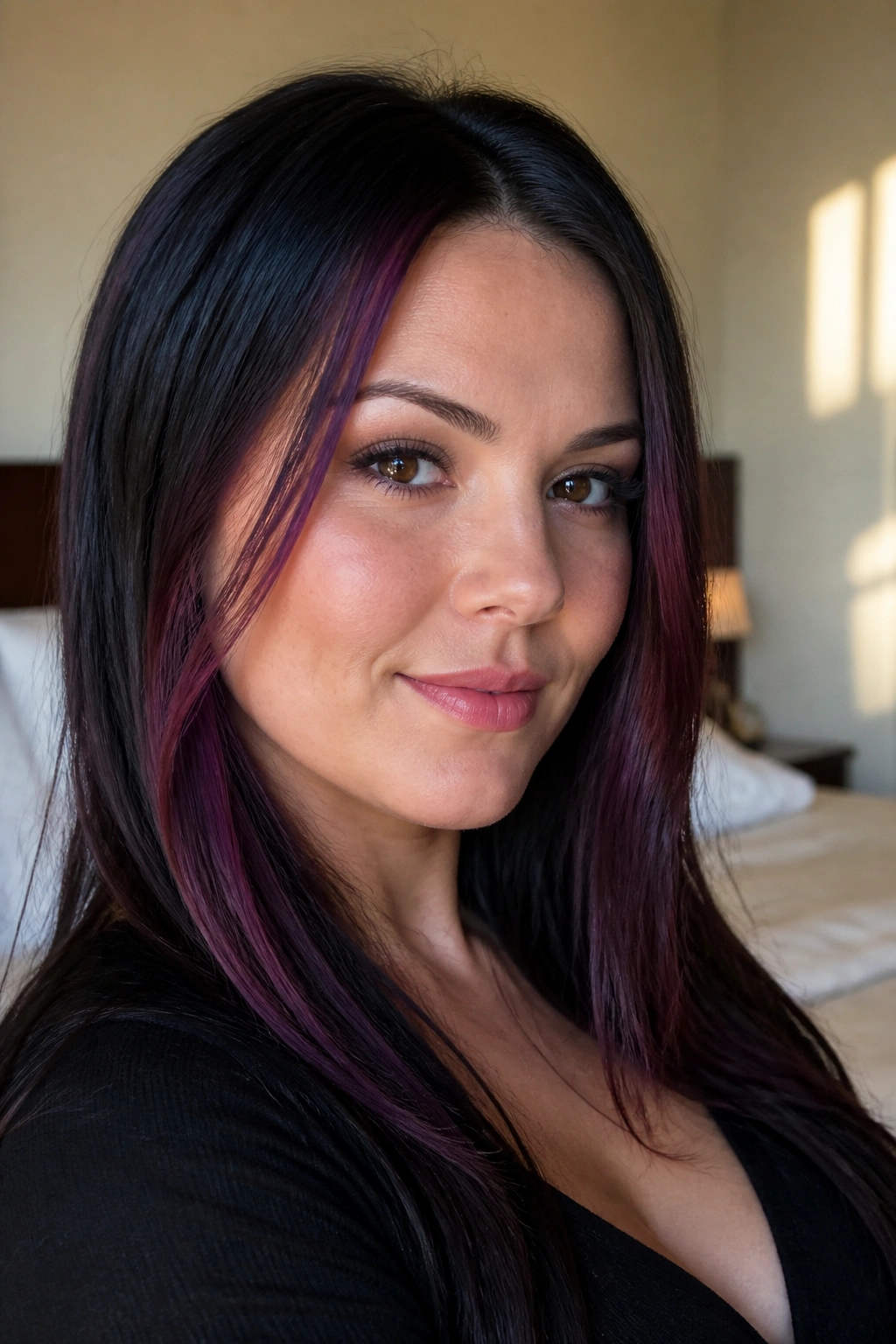
This is the easiest purple-black look to recommend for a round face. Long plum ribbons placed just outside the temple line give you that slim, vertical frame without drawing a hard border around the cheeks.
Why It Works
The magic here is in the spacing. Ask for thin ribbons, not chunky stripes, and ask that they begin a little above the cheekbone and fall past the jaw. That keeps the eye moving downward, which is exactly what you want when the face shape is soft and full.
A deep black base makes the plum show up without looking flat. If the purple pieces are lifted to a medium brown first, they can read as wine, mauve, or berry depending on the light. That little shift gives the hair movement even when it’s worn straight.
- Best on collarbone-length hair or longer
- Ask for 4 to 6 front ribbons on each side
- Keep the brightest pieces 1 to 2 inches below the cheekbone
- Works well with a middle part or a slight off-center part
Pro tip: Tell your colorist you want the front to look slimmer, not wider. That one sentence saves a lot of regret.
2. Deep Violet Money Piece With Black Roots
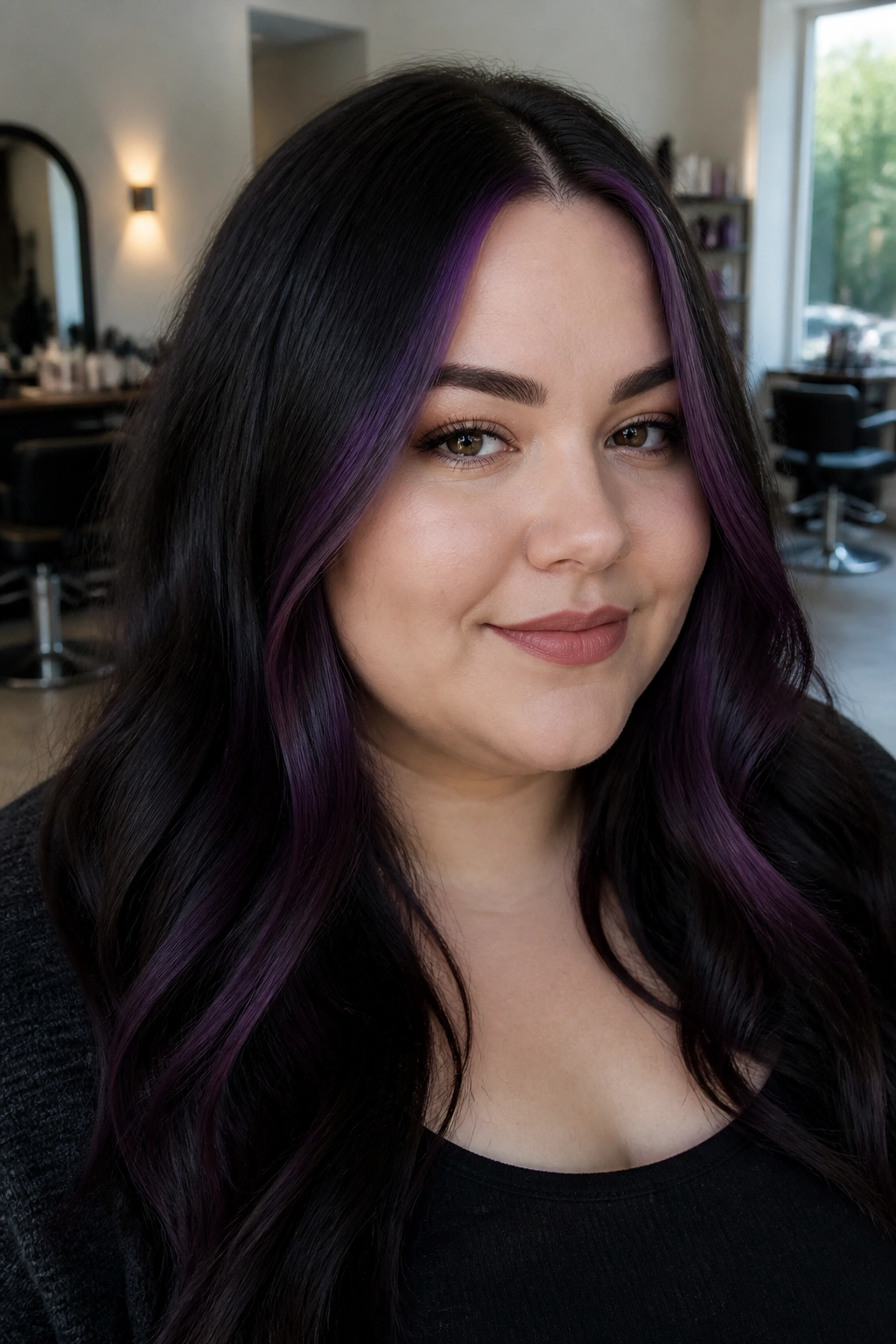
A money piece can flatter a round face, but only when it stays narrow and deliberate. A deep violet frame against black roots gives you contrast without that stripey, over-wide front section that can spread the face sideways.
The trick is to keep the money piece slim through the root area and then let it widen a bit lower down. That way, the brightest area sits near the eyes and collarbone instead of sitting like a neon bar across the cheeks. It feels sharper. Cleaner, too.
This version is for someone who likes a stronger look and doesn’t mind some upkeep. The front will need refreshes sooner than the rest of the hair, especially if the violet is vivid rather than smoky. Still, the payoff is good. The color looks expensive when the black root is glossy and the purple is a shade darker than candy.
Wear it with soft waves if you want the front pieces to bend around the face. Keep it sleek if you want the contrast to look precise.
3. Smoky Eggplant Balayage on Long Layers
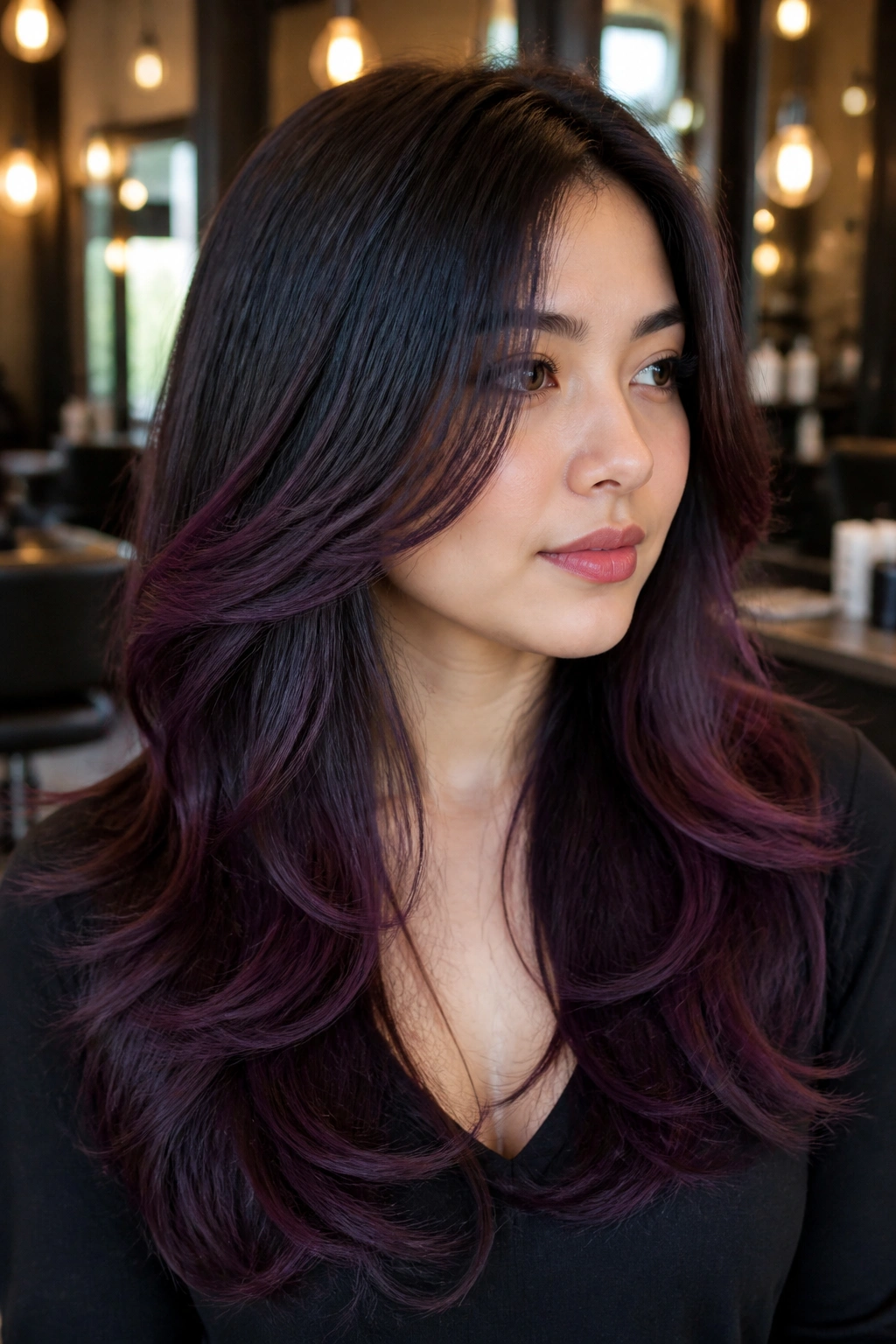
Why does smoky eggplant work so well on a round face? Because it behaves like shadow first and color second.
Balayage in this tone tends to melt into the black base instead of sitting on top of it. That makes the highlights feel long and fluid, which is exactly the shape round faces like. The best version starts below the widest point of the cheek and keeps the brightest purple through the mid-lengths and ends.
How to Ask for It
Ask for soft hand-painted placement, not foils packed near the top. You want the color to live in the movement of the haircut. Long layers help a lot here because they create visible vertical lines even before the color does its job.
If your hair is thick, this can be one of the prettiest ways to break up the bulk without going too light. If your hair is fine, keep the purple smoky and slightly muted so the hair doesn’t look stringy at the ends. The shade should look plush, not thin.
A middle part can work here, but I like this look more with a slightly off-center part. It lets the front layers fall a little unevenly, which keeps the face from feeling too symmetrical.
4. Peekaboo Purple Underlayers on a Lob
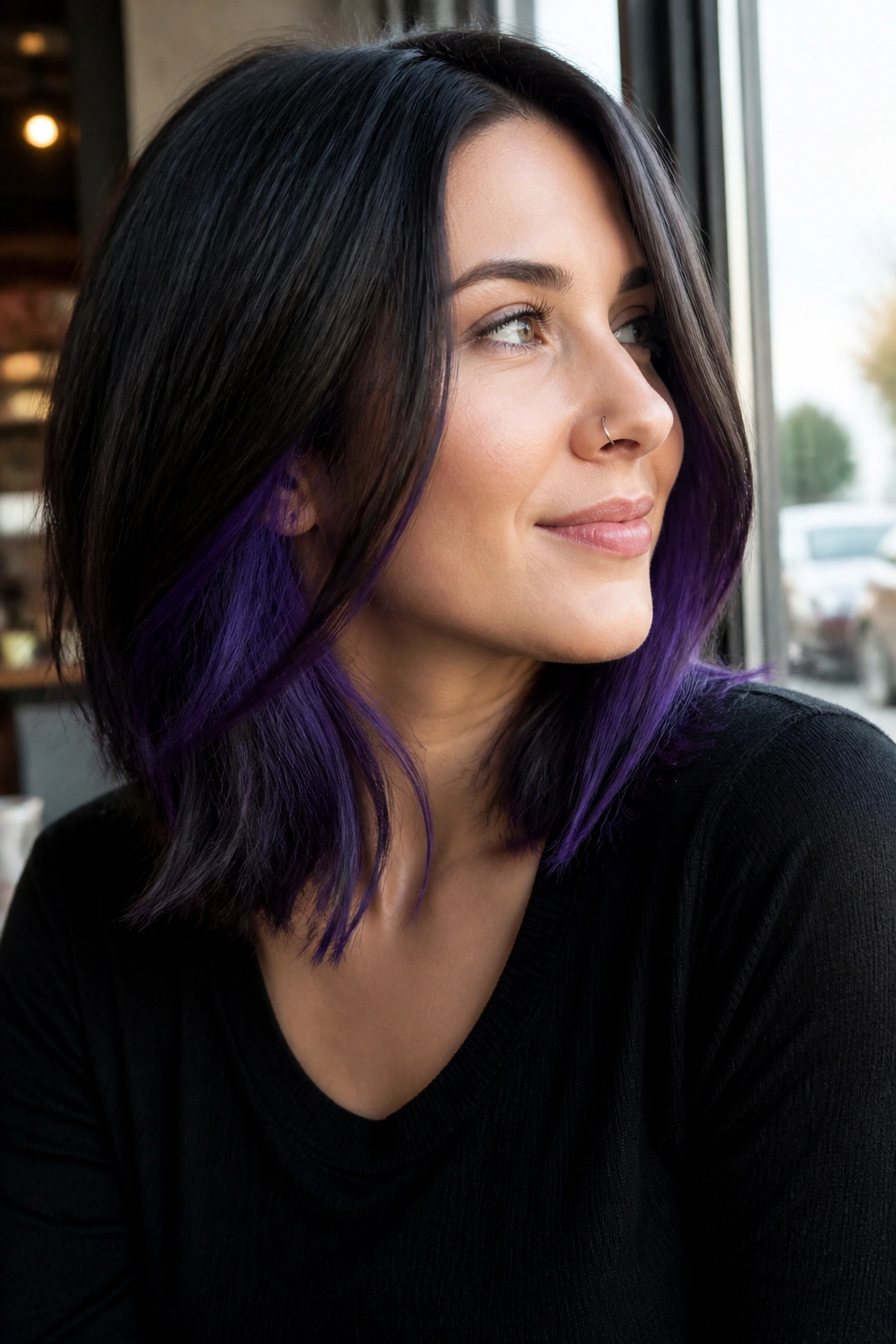
I’ve always liked peekaboo color for round faces because it gives you drama that doesn’t shout from every angle. Purple hidden underlayers on a lob let the black top layer do the slimming while the violet flashes when the hair moves or tucks behind the ear.
That little flash matters. It keeps the face open at the front and puts the color lower, closer to the jaw and neck. Round faces benefit from that break in the lower half of the shape, especially if the lob sits right at the chin.
This is a smart choice if you want purple black highlights but don’t want to live with bright front pieces all the time. The color can be bold in motion and quiet when the hair is still. Good thing, too. Some looks are fun only for one photo; this one keeps working in daily life.
If your lob has blunt ends, add a few soft bends with a flat iron so the purple underlayer peeks out in strips, not a solid block.
5. Amethyst Babylights Around the Crown
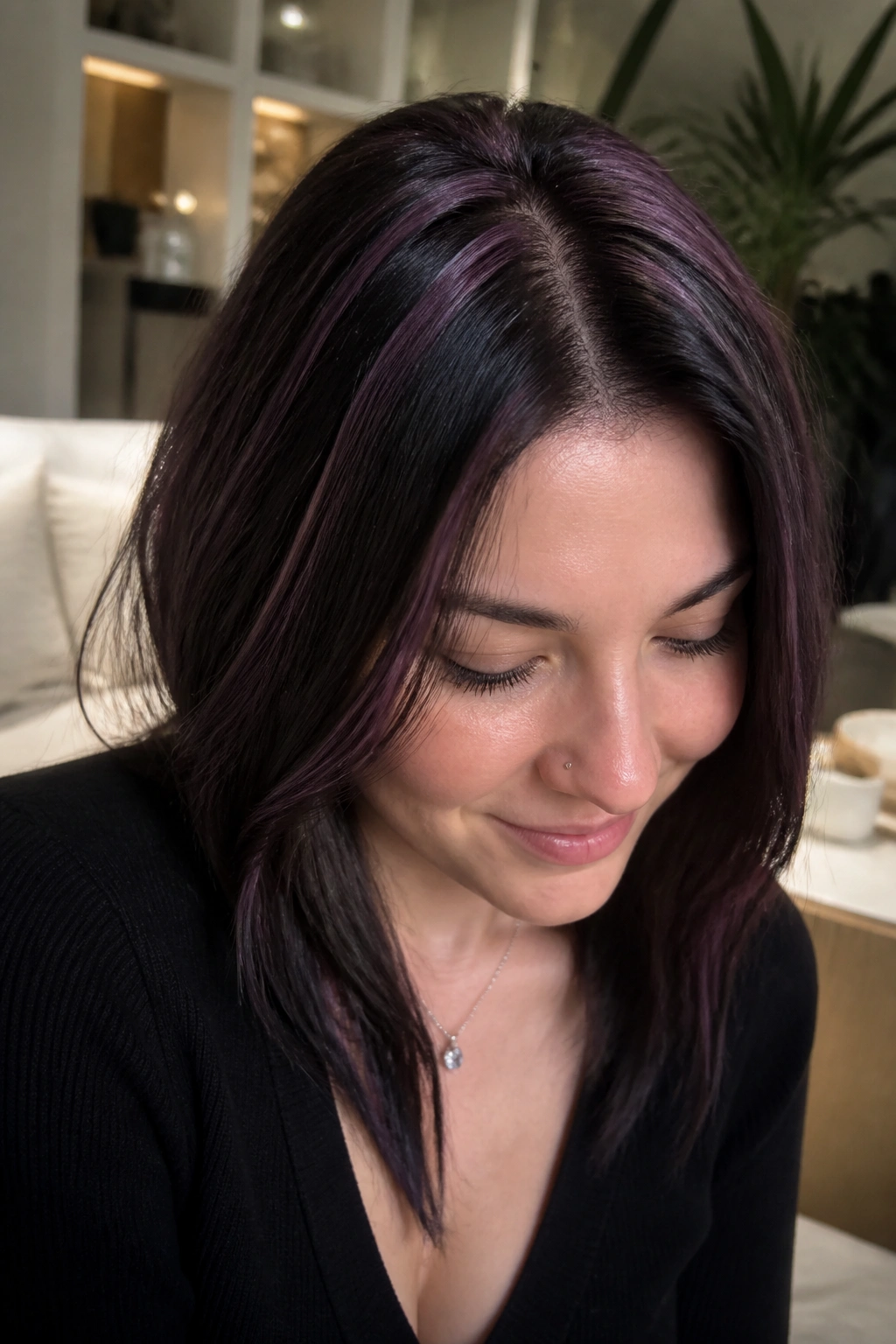
Babylights are the subtle person’s answer to purple-black hair. Around the crown, they give lift without widening the face, which is a nice trade for anyone who wants color that feels soft from the front.
The key is to keep the highlights extremely fine. Think thread-thin pieces, not obvious streaks. On black hair, amethyst babylights can look almost like a soft sheen at first glance, then read more purple when light hits the top of the head. That tiny shift adds movement without cluttering the cheeks.
This placement works especially well if you wear volume at the crown. A little lift at the roots pulls the eye upward, which helps round faces feel a touch longer. Keep the heavier saturation away from the temples and focus on the top half of the head.
A gloss every so often keeps the amethyst from turning muddy. If the tone goes dull, the whole look loses the airy effect.
6. Chunky Grape Panels on a Shag
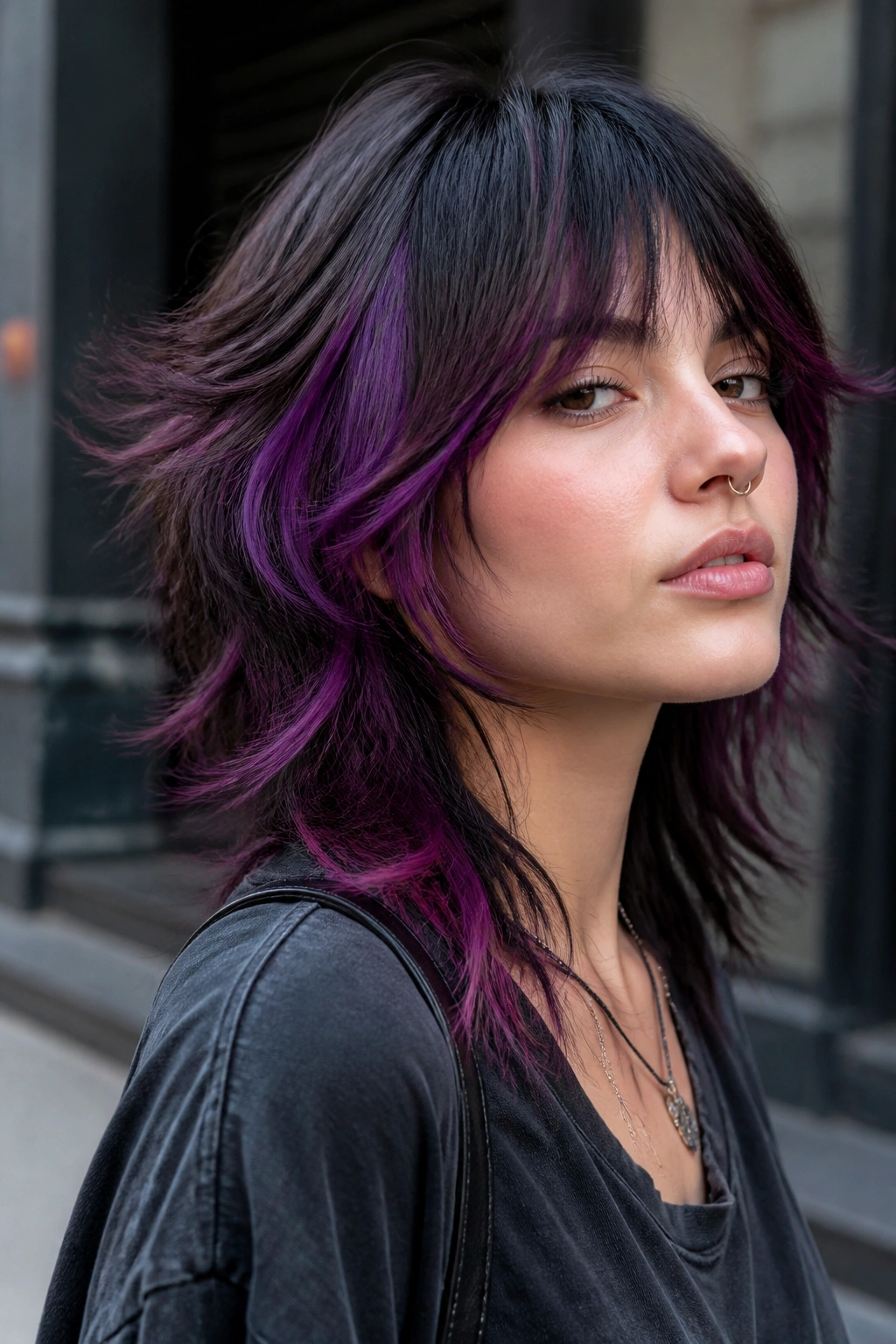
Unlike thin highlights, chunky grape panels need texture to make sense. On a shag, they look intentional because the haircut already has broken-up layers and movement. On a round face, that movement can carve out angles that the bone structure doesn’t naturally show.
This is not the look for someone who wants subtle. It’s for someone who likes a little edge and wants the haircut to do half the work. The panels should be placed through the outer layers, not packed into the widest part of the cheeks. That keeps the color from making the face look broader.
The shag’s choppy ends help the purple read as shape, not as one solid block. You’ll notice the difference most when the hair is feathered back from the face or pushed over one eye. A heavy, blunt shag can fight the color, though, so the cut needs some softness.
Best on medium-density hair with a bit of grit. Fine hair can wear it too, but the panels should be slightly thinner so they don’t swallow the cut.
7. Black Cherry Lowlights Through Curls
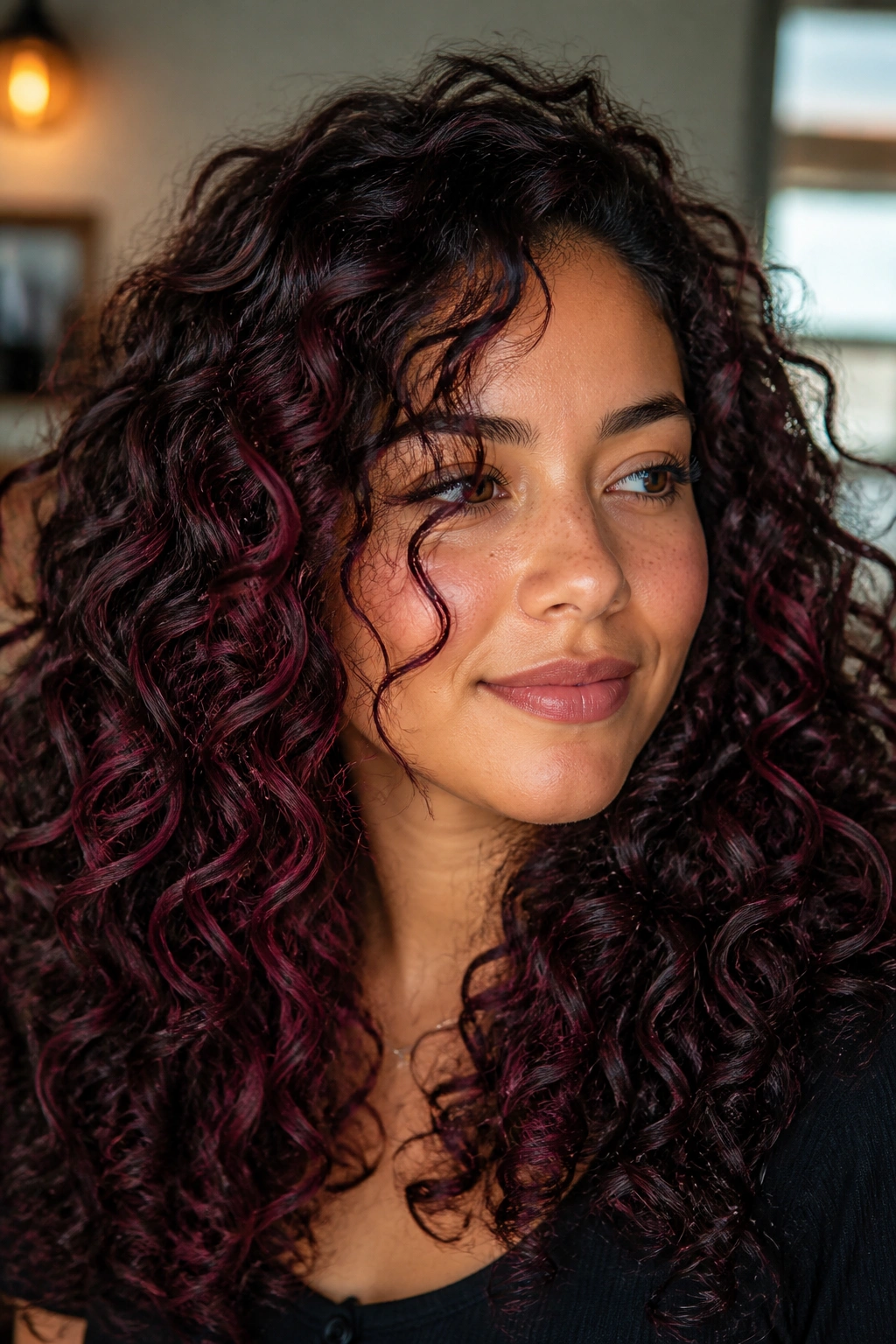
Lowlights are underrated for round faces. Black cherry tones tucked into curls create depth inside the shape of the hair, which keeps the style from puffing out too wide around the face.
Curly hair already has volume, so adding purple-black highlights on top can sometimes get noisy. Lowlights solve that by darkening some sections and making the purple stand out only where you want it to. The result feels richer, not busier.
If your curls sit around the jaw, ask for the darker cherry pieces to land slightly underneath the outermost layer. That keeps the silhouette from ballooning. A few brighter violet threads near the front can still frame the face, but they should be narrow and broken, not broad.
Quick Salon Notes
- Use lowlights 1 to 2 shades deeper than your base
- Keep brighter purple pieces near the eyes, not the cheeks
- Ask for painted placement that follows the curl pattern
- Diffuse dry on low heat so the color stays visible in the bends
The best part is how the shade moves. Curls make cherry and plum look layered instead of flat.
8. Indigo-Purple Ends on a Pixie
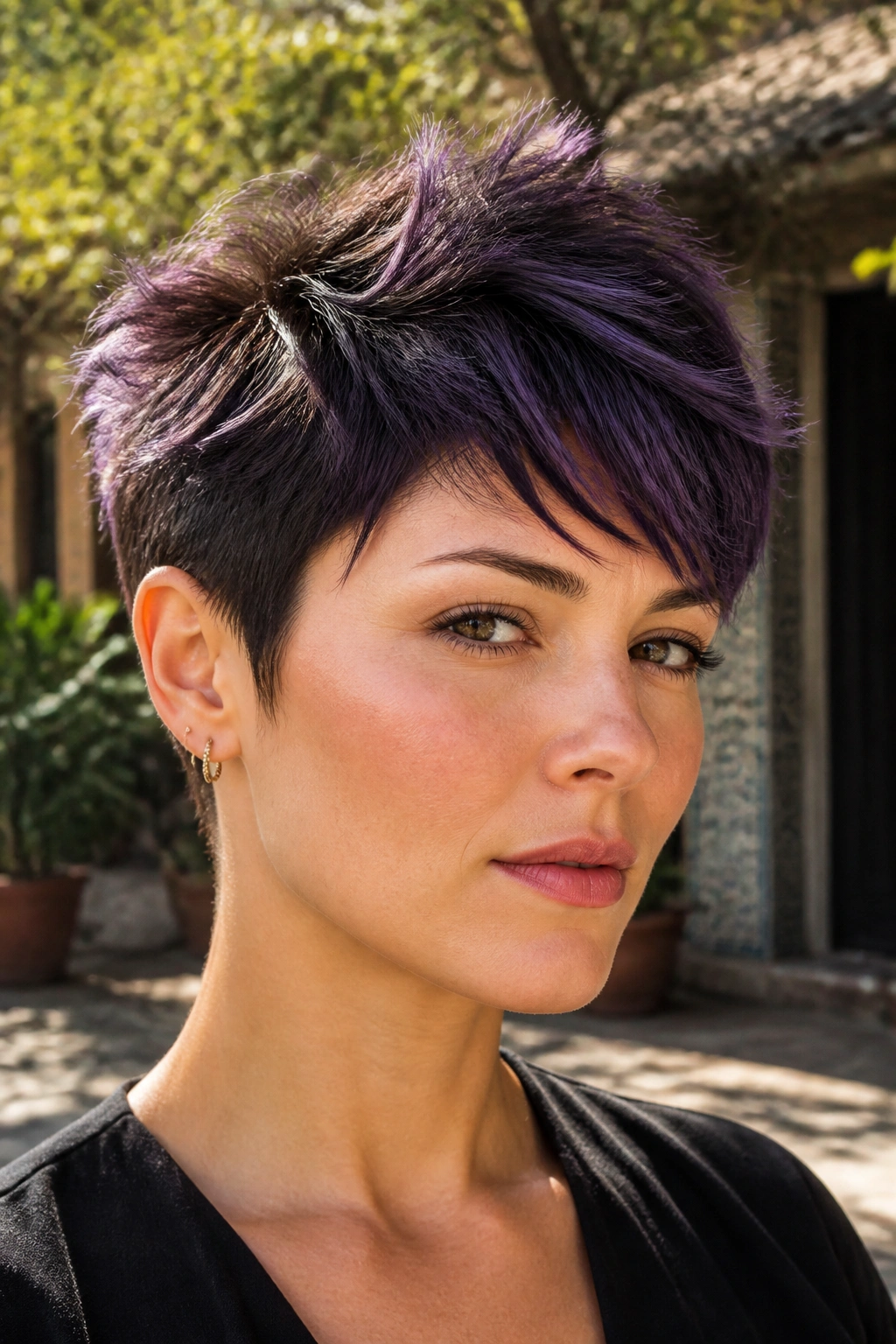
A pixie can flatter a round face if the color helps it look taller at the top and tighter at the sides. Indigo-purple ends do exactly that. They pull attention upward and away from the width of the cheeks.
The short length keeps the shape clean, which is useful when the face is already soft. If the sides are tapered and the top has a little lift, the purple ends can look sharp without being loud. I’d keep the color concentrated on the top layers and fringe, then fade it lower through the crown rather than across the full side sections.
This is one of those looks that reads stronger in person than in a flat photo. The dark base can almost vanish in shadow, while the indigo lights up near the edges. It’s neat. A little moody, too.
If your hair grows fast or you hate frequent touch-ups, keep the purple closer to a glaze than a full saturated block. Short hair shows regrowth fast, and the grow-out is easier when the purple is soft.
9. Ribbon Highlights Through Curtain Bangs
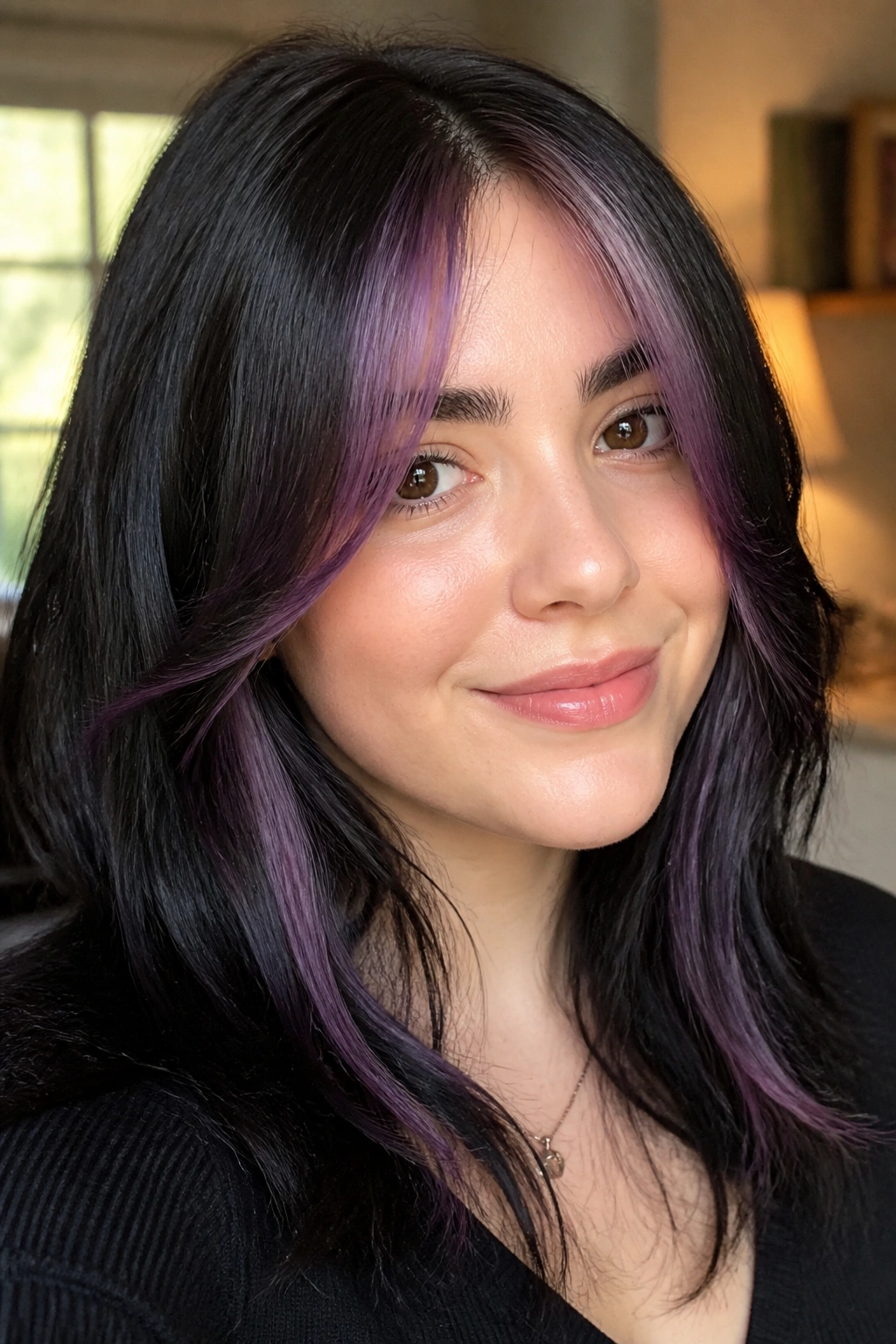
Can curtain bangs work with purple-black highlights on a round face? Absolutely, if the color follows the bang shape instead of fighting it.
Curtain bangs already create a vertical frame because they open in the middle and sweep down along the sides. Add slim violet ribbons, and the whole front starts to behave like a soft curtain around the face rather than a wide mask. That makes the cheeks feel less dominant.
What to Ask For
Tell your colorist you want the brightest pieces to begin at the bend of the bang, not at the root. That small difference keeps the center of the forehead clean and stops the color from spreading too far across the face. If you want extra lift, ask for the ribbons to continue into the first layer below the chin.
This works especially well on medium to thick hair, where the bangs have enough weight to curve instead of flop. A round face gets a nice line from brow to jaw without any harshness. And yes, this can be subtle or bold depending on how much violet is used.
A blowout with a round brush helps the color sit in that sweeping shape. Air-dried bangs usually hide too much of the placement.
10. Blackberry Veil on Straight Mid-Length Hair
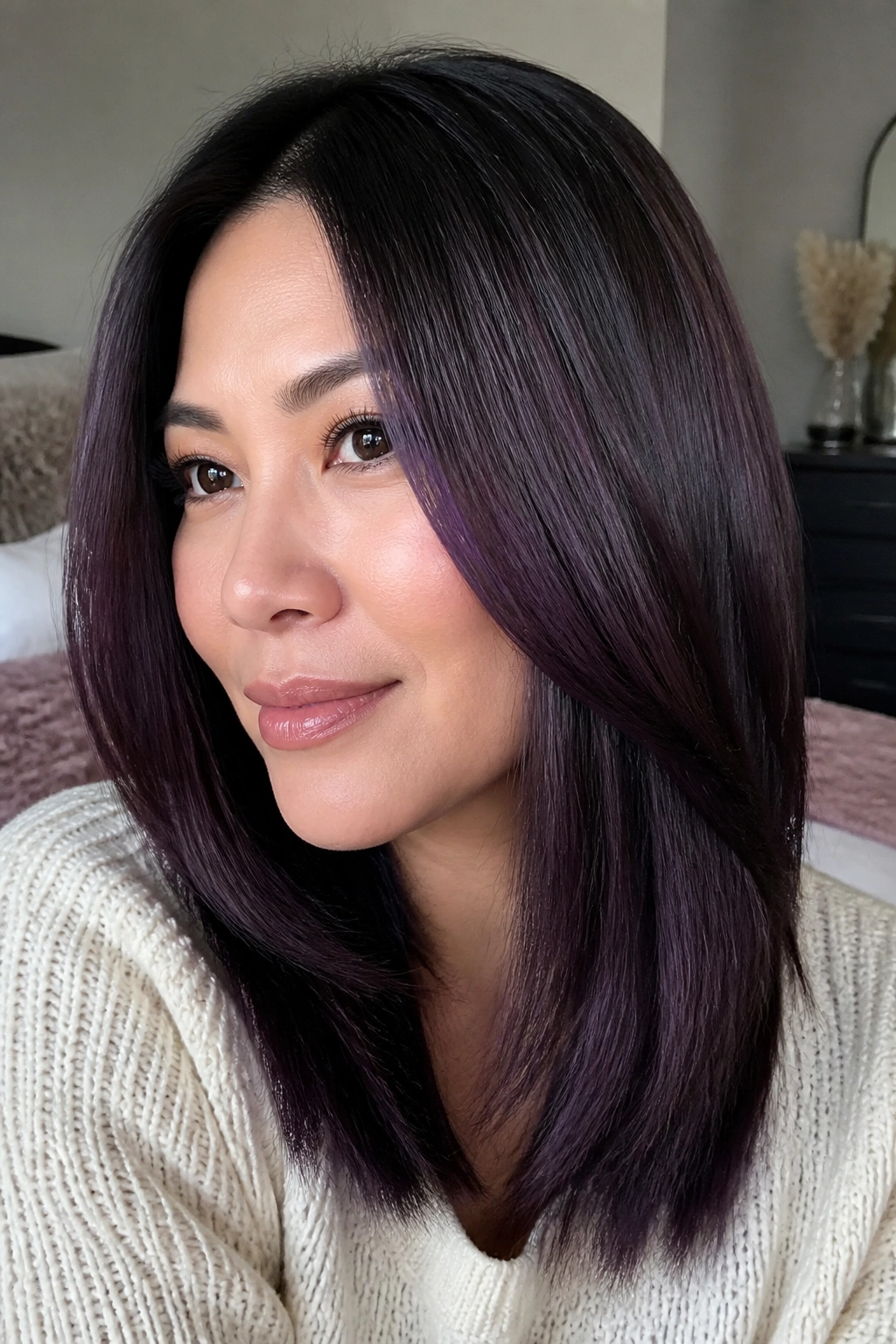
Straight hair can make purple-black highlights look sharper than curls ever will. A blackberry veil on mid-length hair keeps that sharpness soft by diffusing the purple across thin, overlapping layers.
Picture the hair almost like sheer fabric. The black base shows through, and the blackberry tones sit on top in a transparent way. That’s useful on a round face because it avoids the wide, blocky effect that solid color sometimes creates around the cheeks.
The best placement is from the cheekbone down to the collarbone, with a little more saturation around the front than the back. That keeps the eye moving vertically. If the ends are blunt, you may want a few interior layers so the color doesn’t stop too abruptly at one line.
This one is nice for someone who wears hair straight most days. It looks controlled without feeling stiff, and the purple reads as a deep sheen rather than a loud streak.
11. Violet Foilayage Starting Below the Cheekbone
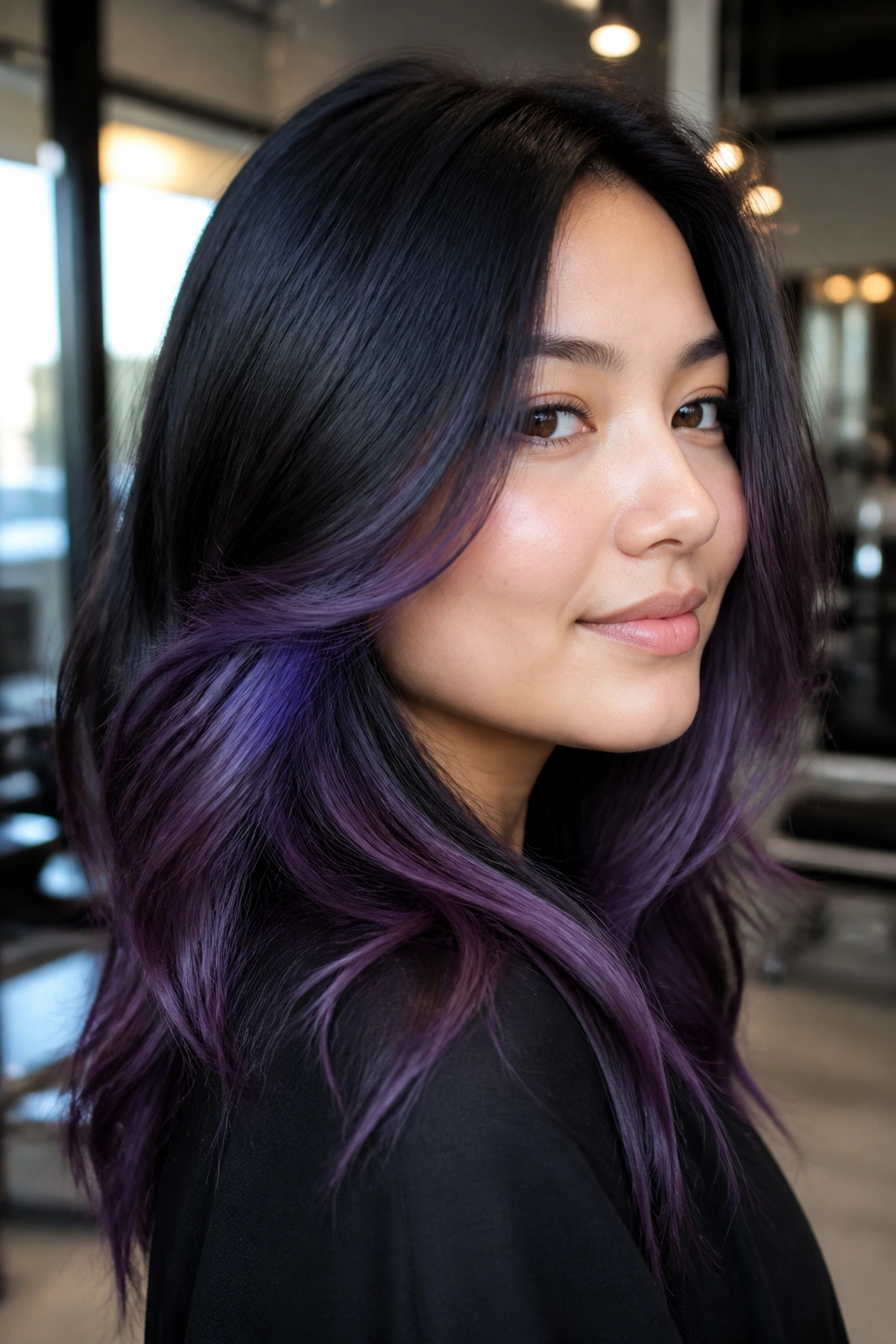
Foilayage gives you the brightness of foils with the softer fade of balayage. On a round face, that matters because the color can be placed where the face needs length, not just where it’s easiest to paint.
Starting below the cheekbone is the move here. If the violet begins too high, it can widen the top half of the face. If it begins lower and then threads through the lengths, the color acts like a vertical guide for the eye. That’s the whole game with round faces.
This technique works especially well on layered cuts because the lifted pieces catch the light in different places. The purple can read almost silver-violet in bright light and deeper eggplant indoors. That shift keeps the hair from looking flat.
If your hair is very dark, ask for a cool violet rather than a red-purple. The cool tone tends to look cleaner against black and makes the whole style feel more modern and less muddy.
12. Merlot-Purple Ombré With a Center Part
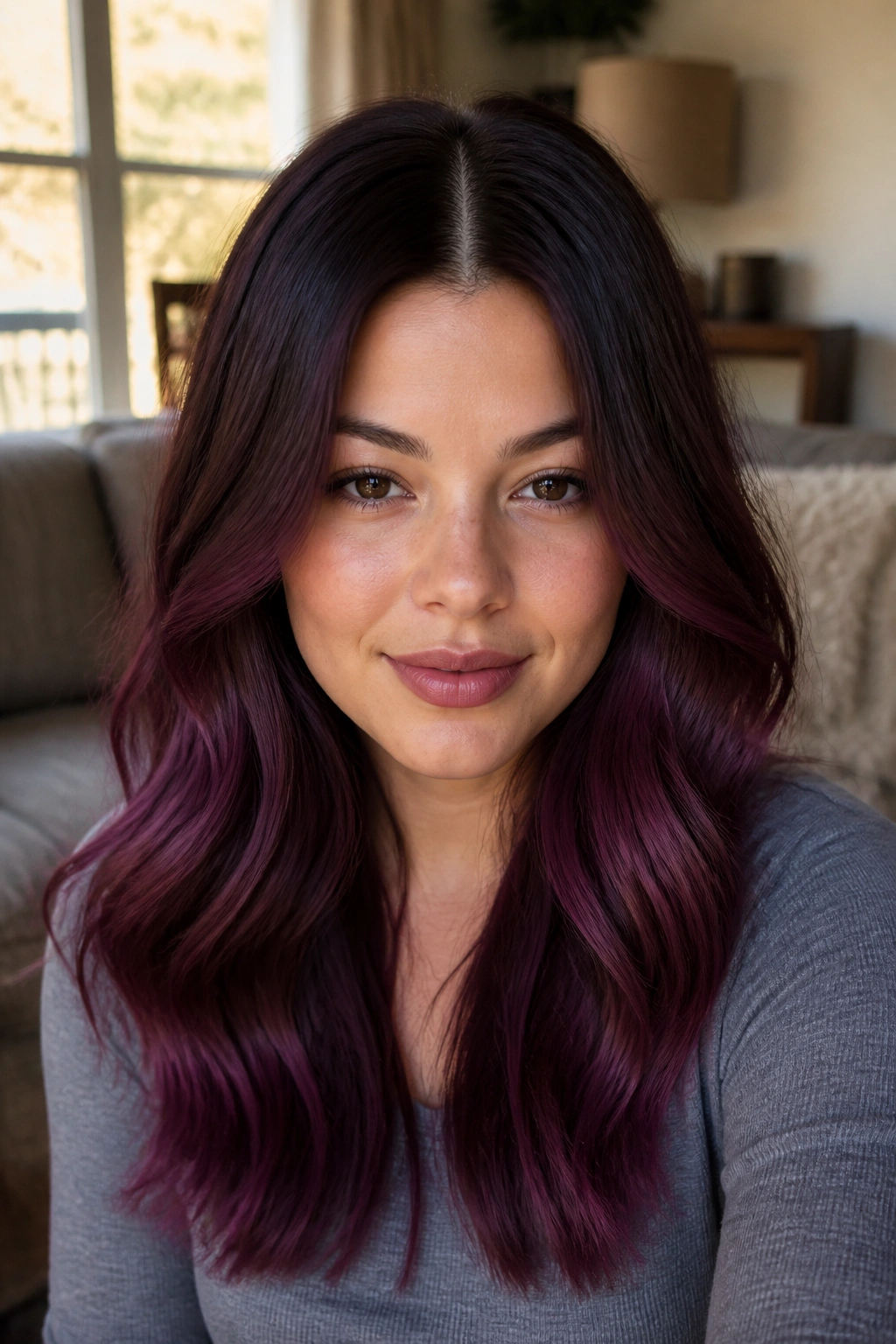
A center part can flatter a round face when the color starts low enough. Merlot-purple ombré does that nicely because the darker root stays close to black while the richer purple builds toward the ends.
The danger with center parts is width at the cheeks. Here, the ombré helps by keeping the top clean and moving the visual weight downward. The eye lands near the collarbone and below, which lengthens the face without any effort from you.
Unlike a blunt band of highlights near the front, this look feels gradual. The merlot tone is deeper than bright purple, so it doesn’t shout from every angle. It’s a good fit if you want something moody and polished rather than playful.
Wear it with soft bends or a loose wave to break up the length. On very straight hair, the fade can look too neat, almost severe. A little texture fixes that fast.
13. Orchid Babylights in a Blunt Bob
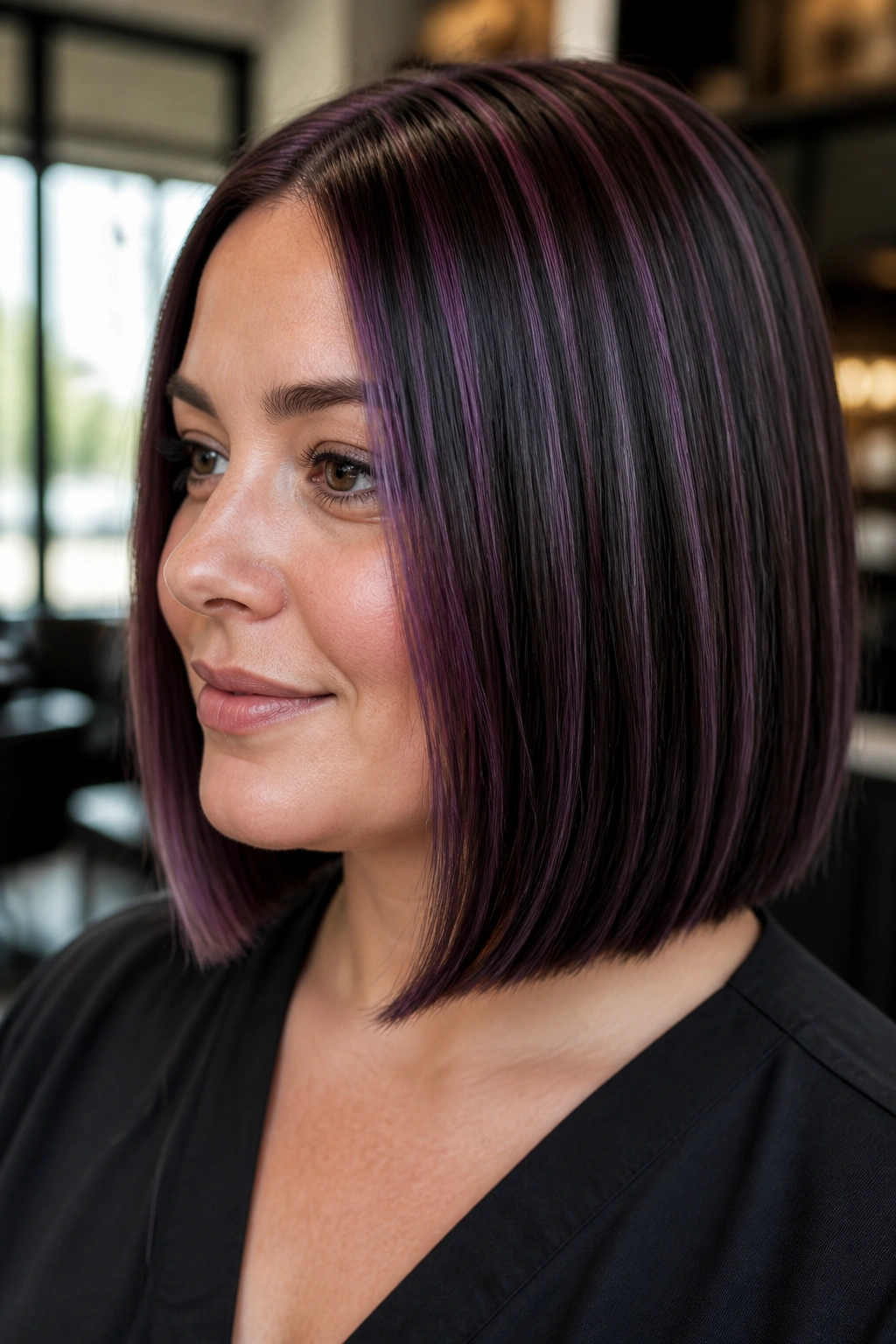
A blunt bob can absolutely work on a round face, but the color has to do some of the shaping. Orchid babylights help by adding fine vertical movement inside a clean, sharp cut.
The point here is restraint. You do not want thick streaks marching across the width of the bob. Fine orchid lights, scattered through the top layers and just under the surface, keep the cut from looking like one solid block. That’s what gives the face a little air around it.
Good Placement Cues
- Keep the brightest pieces near the front corners
- Leave the lower back section darker for weight
- Use ultra-fine foils, not wide sections
- Keep the orchid tone cool so it doesn’t go pink too fast
The blunt line still gives structure. The babylights soften the shape without dulling the edge. That contrast is what makes this cut feel balanced on a round face.
14. Split-Dyed Black and Purple Asymmetrical Bob
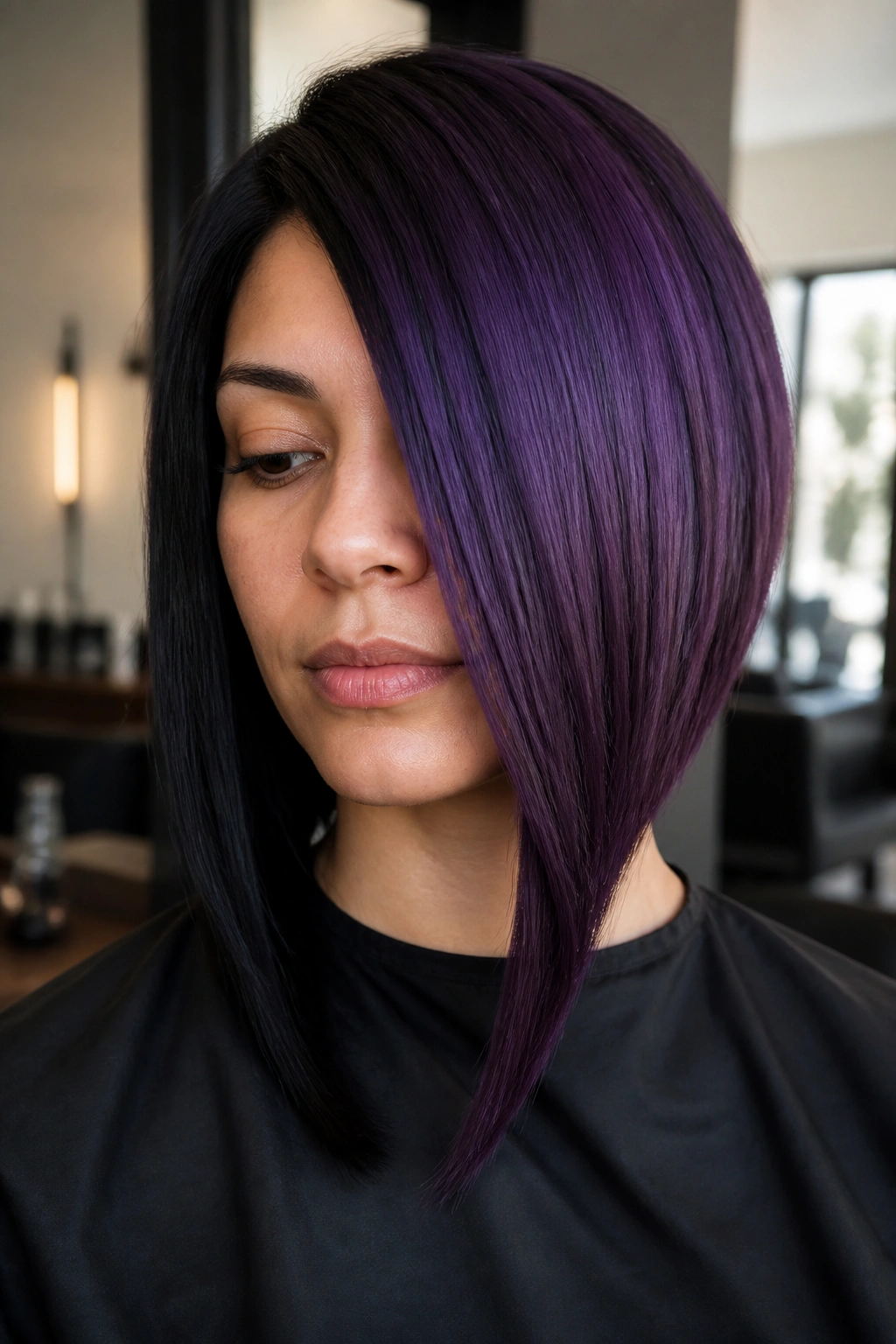
This look is not shy, and that’s the point. An asymmetrical bob already creates a diagonal line across the face, which is one of the easiest ways to flatter round features. Add black on one side and purple on the other, and the shape gets even more directional.
The asymmetry matters more than the split dye itself. A longer side that falls below the jaw pulls the face down visually. The shorter side keeps the whole cut from feeling heavy. Purple on the longer side can be especially nice because it draws the eye along that line.
This is best when the cut is precise. If the bob is too puffed up or too round at the ends, the color can start to look busy. A smoother finish, with the ends beveled slightly inward, keeps the silhouette tidy.
For maintenance, expect more upkeep than a blended balayage. Still, if you like a graphic look, it’s hard to beat the impact.
15. Plum Face Sweep With Side-Swept Bangs
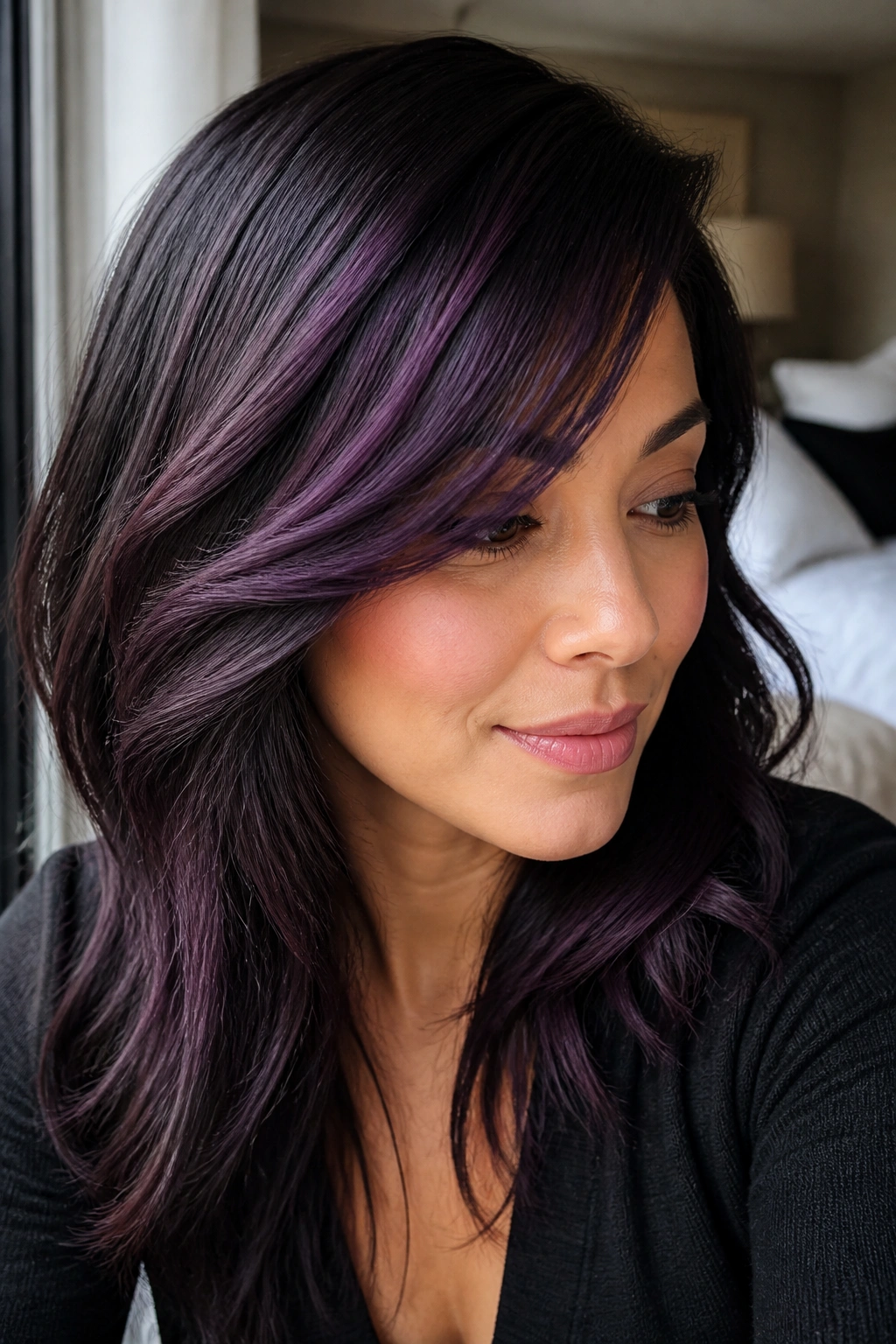
Can side-swept bangs do something useful on a round face? Yes — when the color helps them stay long and slanted.
Plum face sweep highlights follow the bang line instead of sitting in a straight strip. That diagonal movement cuts across the width of the face and gives you a more angled frame. It’s a small detail, but small details are where round-face flattering color usually lives.
How to Get the Most From It
Ask for the plum to start closer to the highest point of the sweep and fade out before it reaches the outer cheek area. That keeps the bangs light at the front and prevents them from looking like a colored curtain. If your bangs are thick, the plum can be broken into two or three slimmer bands for a softer finish.
This works well with medium-length cuts and layered ends. The side sweep adds motion, and the color makes the motion visible. Without that, the bangs can just look heavy.
16. Smoky Lilac Glaze Over Black Hair
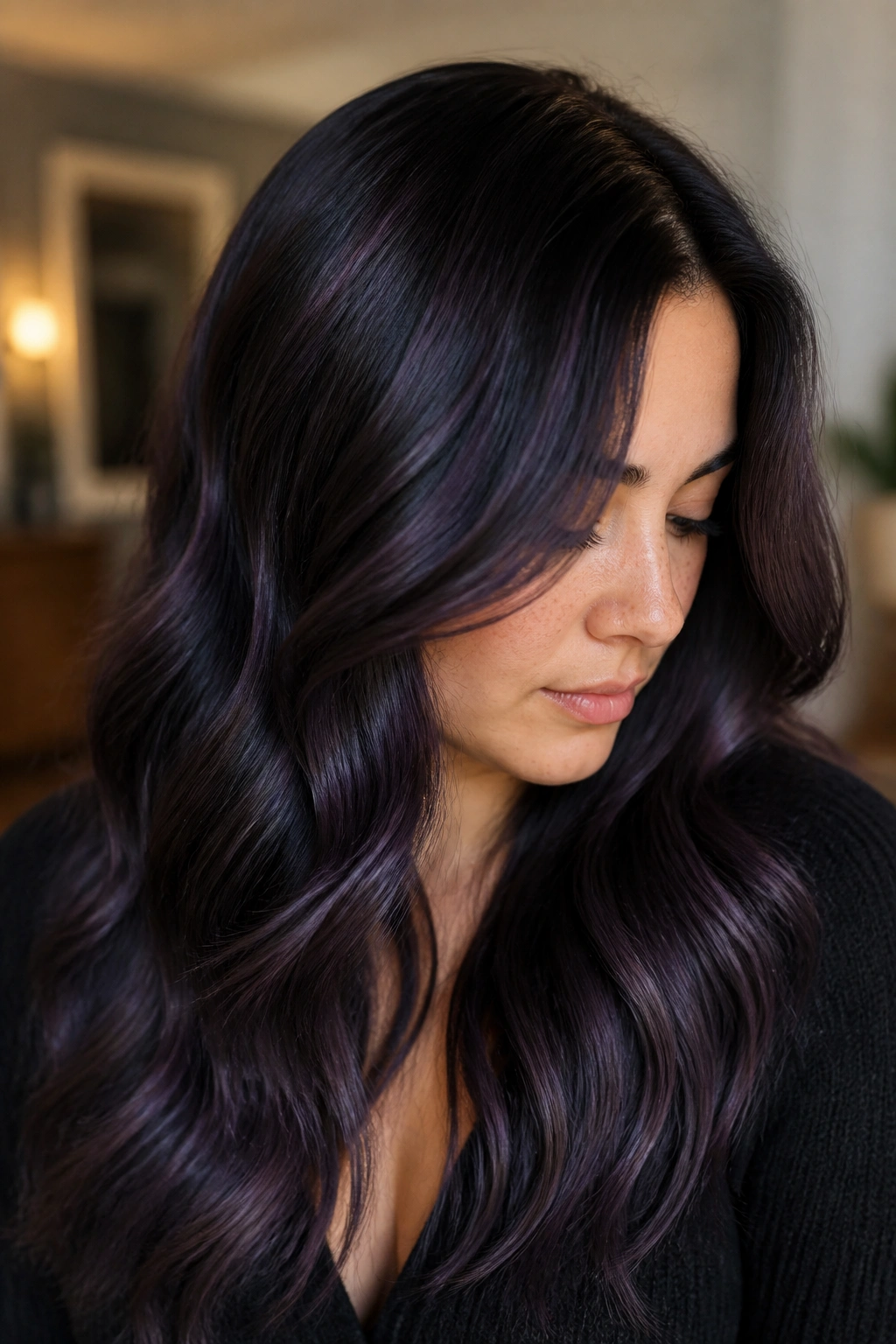
A glaze is for someone who wants mood, not streaks. Smoky lilac over black hair gives the surface a cool tint without committing to obvious highlight lines, which can be nice on a round face if you want softness more than contrast.
The shine is the point here. The hair catches light in a faint violet way, but the shape stays dark and sleek. That helps keep the face narrow and the style polished. It’s a strong choice for straight or softly waved hair, where the glaze can read as one continuous layer.
What It Looks Like in Real Life
- Indoors, it can appear mostly black with a cool cast
- Near daylight, the lilac shows up at the mid-lengths and ends
- On porous hair, the tone may grab darker and fade faster
- A clear gloss on top can keep the finish reflective
This is a good option if you want purple-black highlights without a lot of visual noise. It’s quiet, but not boring. There’s a difference.
17. Midnight Violet Balayage on Long Waves
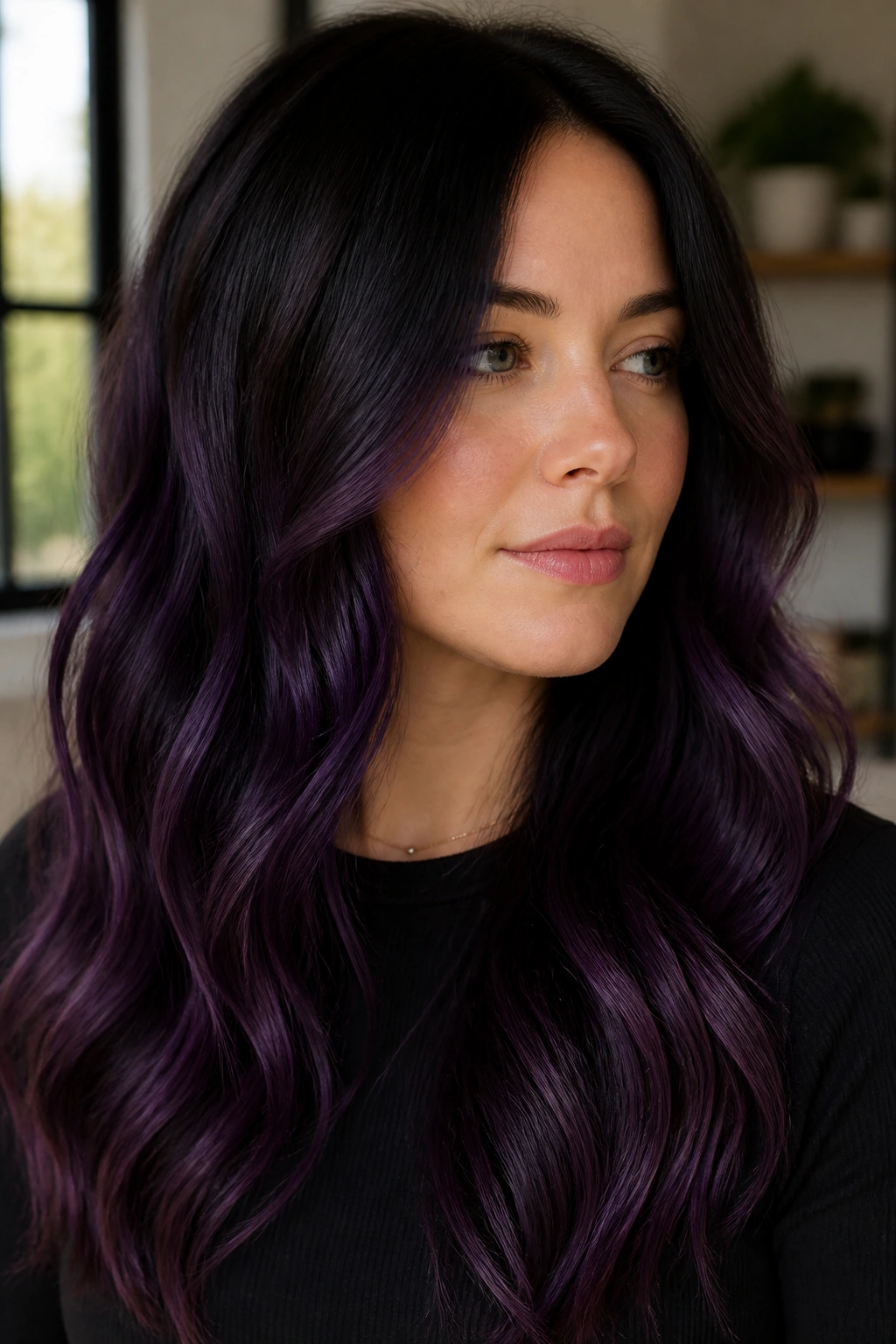
Long waves and midnight violet are a strong pair because the curve of the wave and the vertical spread of the color balance each other out. On a round face, that balance matters. You get softness without extra width.
The balayage should start below the cheekbone and get a little denser toward the lower half of the hair. That keeps the face open and lets the eye travel downward. If the purple is too concentrated near the root, the style can start to feel crowded. Better to let the top stay darker and let the color bloom later.
This is one of the easier purple-black looks to wear if you like low drama during the week and more visible color when you style it. The wave pattern shows the color in strips, which helps the face read longer.
For the finish, use a large barrel iron or overnight braids rather than tight curls. Tight curls can make the color look busier than you want.
18. Purple-Black Peekaboo Layers on Thick Hair
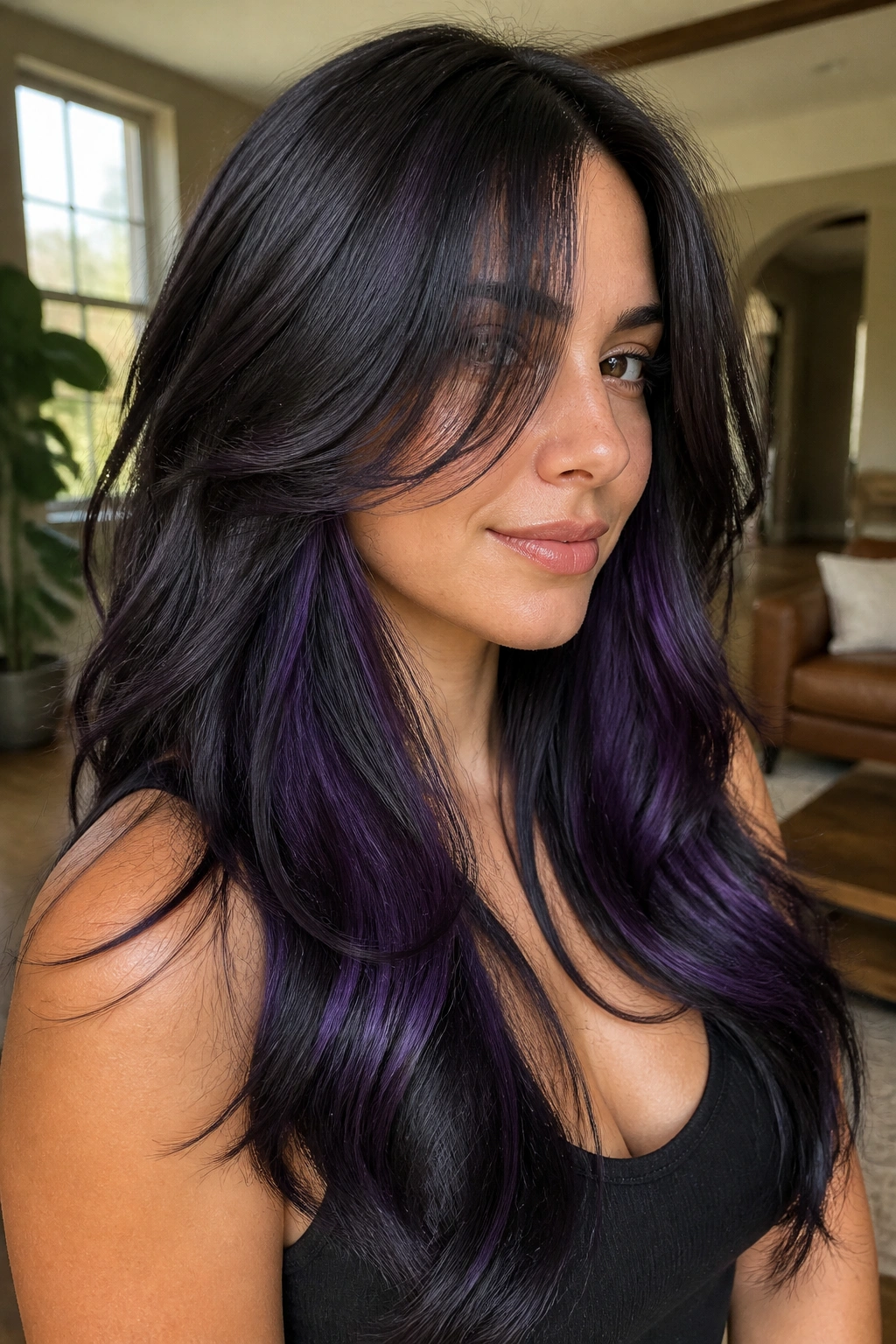
Thick hair needs color that breaks it up, not color that adds more bulk. Purple-black peekaboo layers do that by hiding the violet under the top sections and letting the black top layer keep the silhouette under control.
Unlike surface highlights, peekaboo layers keep the color moving underneath the cut. That means the face stays cleaner at the top while the movement happens lower. For a round face, that’s a gift. It keeps attention away from the widest point and lets the hair feel lighter around the jaw.
This look works especially well when the haircut has long internal layers. A blunt thick cut can swallow the color, but layered sections reveal it in flashes. Think of the style as controlled surprise rather than full exposure.
If your hair is very dense, ask for wider painted sections under the top layer so the purple doesn’t disappear. Thin hidden highlights can get lost fast in heavy hair.
19. Grape-Toned Money Pieces With a Deep Side Part
A deep side part changes everything. Add grape-toned money pieces, and the face gets a diagonal line that helps break up roundness fast.
The part itself creates lift on one side and a little closure on the other. The grape pieces should sit on the side with the most visible forehead space, then fall down past the cheekbone. That keeps the brightness from stopping right at the face’s widest zone.
This version is for someone who wants a flattering style without losing the drama of a face-framing highlight. The grape tone is rich enough to stand out against black hair, but it doesn’t have the hard neon look some purples do. It also grows out well because the side part makes regrowth less obvious.
Keep the rest of the hair smooth or softly waved. If the crown gets too puffy, the side part can lose the slimming effect.
20. Charcoal Black Hair With Soft Violet Lowlights
Soft violet lowlights are a quiet fix for hair that feels flat. On charcoal black hair, they add shadow inside the shape, which helps a round face feel a little longer and less wide.
The lowlights should be placed where the hair would naturally bend: behind the ears, under the crown, and through the lower sides. That keeps the outer edge dark and sleek while the violet peeks through when the hair moves. It’s subtle, but it changes the shape more than you’d think.
This look is useful if you want dimension without obvious streaks. It also works well for people who live in black clothing and want their hair to stay moody rather than bright. The violet can lean plum in some light and cool berry in others, which keeps it from feeling flat.
A satin finish or a light serum helps the dark base shine. Dull black hair swallows lowlights fast.
21. Electric Plum Streaks on a Cropped Cut
Can a short cut carry bold plum streaks on a round face? Yes, if the streaks are vertical and the sides stay tight.
A cropped cut needs height or angle to avoid looking too wide. Electric plum streaks help by pulling the eye up through the top layers instead of across the temples. That makes the head shape feel more elongated, which is exactly the trick.
How to Ask for It
Tell your stylist you want the plum to follow the direction of the cut, not wrap around the head. A few sharper streaks near the front and crown are enough. Too many can turn the crop into a color block, and that usually makes round faces look fuller.
This style is best for people who want edge. It’s graphic, a little punk, and much more interesting than a plain dark crop. If you want softer results, mute the plum with a smoky toner so it doesn’t read neon.
22. Blue-Violet Ribbons for Cool Skin Tones
Blue-violet can be the sweet spot between purple and black. It looks crisp against dark hair and tends to flatter cool skin tones without making the face look washed out.
The placement should be narrow through the front and more scattered through the lengths. That keeps the ribbons from widening the face. Because the tone is cooler, it also has a sleek feel that works well with round features. Think of it as a color that sharpens the outline of the haircut.
This is a nice choice if you already wear silver jewelry, cool makeup, or ash-toned clothes. The hair and skin start to feel connected instead of fighting each other. A black base with blue-violet ribbons can look almost liquid when the light hits it right.
If you want the shade to stay crisp, avoid too much heat styling and use a color-safe wash schedule. Cool tones fade muddy faster than people expect.
23. Wine-Purple Highlights on Warm Undertones
Warm undertones can wear purple-black highlights too, and wine-purple is often the easiest entry point. It’s richer, deeper, and less icy than blue-violet, so it sits more naturally next to golden or olive skin.
For a round face, the placement matters more than the warmth of the tone. Keep the wine-purple concentrated in vertical ribbons that start below the temples and travel through the ends. That gives you the face-slimming effect without a bright band around the cheeks.
This is one of those shades that looks expensive on wavy hair because the bend of the wave catches the red-purple tone in different ways. On straight hair, it reads more polished and serious. Both work.
A soft red-violet toner can keep the color rich, but don’t let it drift too bright. If the purple gets too red, the whole style can look less sharp and more scattered.
24. Stacked Bob With Hidden Violet Underlights
A stacked bob already has built-in shape, which is why hidden violet underlights can be so good here. The cut lifts at the back and narrows toward the front, and the underlights add color where the movement is strongest.
This is a smart option for round faces because the face-framing line stays clean. The violet lives beneath the outer layer, so the front doesn’t get too busy. When the head turns, the color flashes under the top section, giving the bob depth without widening the upper face.
Unlike surface streaks, underlights make the haircut feel more dimensional from the side and back than from the front. That’s useful if you want a style that rewards movement. It also means the grow-out stays softer, since the brighter color is partly hidden.
Keep the violet slightly darker than you think you want. Underlights look brighter when they catch motion, and a shade that’s too pale can get loud fast.
25. Soft Mauve Babylights for Subtle Movement
Sometimes the best choice is the quietest one. Soft mauve babylights add a fine shimmer to black hair, and on a round face they create movement without stealing width from the cheeks.
The pieces should be so fine that they break up the surface rather than announce themselves. That’s what makes the style feel light. Mauve is a good middle ground if you want purple-black highlights but don’t want the color to look too blue, too red, or too saturated.
This placement is especially flattering on shoulder-length cuts with a little layering around the face. The babylights can follow those layers and give the shape a soft diagonal feel. It’s subtle, but it keeps the hair from sitting like one dark sheet.
If your hair is fine, this may be the nicest version in the whole list. The tone adds dimension without making the ends look wispy.
26. Midnight Plum Curls With Diffused Highlights
Curls love color that melts instead of stripes. Midnight plum diffused through curls keeps the shape round in a good way — full, but not puffy.
The highlights should be painted in broad, soft sections that follow the curl clumps. That way the purple appears inside the texture instead of sitting on top like paint. On a round face, this matters because the eye sees motion downward through the curls instead of one wide halo around the cheeks.
This look works best when the cut has layers that remove weight below the chin. If the curls are all one length, the color can get too dense at the sides. A few lighter plum pieces near the front open things up just enough.
Air-drying with curl cream can make the diffused purple look richer. Diffusers are fine, but high heat can flatten the color faster than people expect.
27. Angular Purple Panels on a Layered Wolf Cut
A wolf cut already gives you angles, and purple panels can push that shape further. On a round face, those broken layers help the color fall in slanted pieces rather than wide bands.
The best purple panels in a wolf cut usually sit around the outer crown, the cheek-to-jaw fall, and the longer face-framing sections. That keeps the color moving in a zigzag pattern instead of a circle. You want the eye to travel down the layers, not around the face.
What Makes It Work
- The top stays dark, which keeps the head shape from widening
- The purple shows in the messy mid-layers
- Longer front pieces can be brighter than the rest
- Texture spray helps the panels separate cleanly
This is a strong choice if you like hair that looks lived-in and a little wild. The cut does most of the shaping; the color adds edge.
28. Glossy Black Hair With Violet Glaze and a Few Ribbons
Not every purple-black look needs a lot of color to make a point. A glossy violet glaze with just a few ribbons can look cleaner than a full highlight job, especially on a round face that benefits from a narrow, polished outline.
The gloss gives the black base a cool cast, almost like oil on water. Then a small number of violet ribbons — maybe two near the front and a few through the lengths — keep the hair from looking flat. That’s enough. Seriously.
This version is ideal if your hair is already healthy and you want the shine to do most of the work. The shape stays sleek, and the violet only shows when the light moves. It’s a low-fuss option for people who like a finished look without obvious stripes.
A flat iron or blowout brush helps the glaze read properly. On rough-dried hair, the subtle color can disappear into the base.
29. Deep Berry Highlights for Dense Hair
Dense hair can swallow delicate color, so deep berry highlights make more sense than pale purple. The richer tone stays visible between the layers and gives the hair enough contrast to change the face shape.
Placement should stay vertical and a little broken up. Dense hair tends to puff at the sides, so the highlights should run from above the ear down into the lengths rather than sitting in a horizontal block. That keeps the face from looking wider than it is.
This look is especially useful if your hair has natural wave or a lot of volume at the back. The berry pieces help separate the bulk into visible sections. The result feels controlled, not heavy.
If you heat-style often, a berry tone usually survives a bit better than a pale lavender. It fades, sure, but it fades into a rich plum instead of a washed-out pastel, and that matters on dark hair.
30. Soft Black-to-Purple Melt With Extended Face-Framing Pieces
If you want one look that feels balanced, this is the one I’d point to first. A black-to-purple melt with long face-framing pieces gives a round face the cleanest vertical line in the whole set.
The transition should be slow. Black at the root, smoky plum through the mid-lengths, and richer purple near the ends create a long visual sweep that narrows the face without looking harsh. The face-framing pieces should start around the temple and keep going past the jaw, almost like colored curtains that narrow as they drop.
This works whether your hair is straight, wavy, or softly curled. That’s part of the appeal. The melt gives you movement without needing a dramatic cut, and the long front pieces do the shaping job on their own. If you’re stuck between subtle and bold, this is the safest place to land.
A middle part gives it a sleek feel. A soft side part makes it a touch more forgiving. Either way, the goal is the same: keep the purple moving downward, not outward.
