



A round face can wear red and black hair with more edge than people expect — but only if the red is placed like a line, not a splash. Put a wide stripe right at the cheeks and the face reads wider. Push the color up toward the temples or down below the jaw, and the whole shape feels longer.
That is why red black hair color ideas for round faces are about placement first and shade second. A cherry red money piece, a burgundy underlayer, or a black cherry melt can all flatter the same face shape, while a chunky mid-cheek stripe can fight it. The difference is small on paper and obvious in a mirror.
I keep coming back to one rule: vertical beats horizontal. Dark roots, narrow face-framing pieces, and color that drops below the chin all help draw the eye up and down. Red also fades faster than black, so the smartest looks are the ones that still make sense when the red softens a little.
The best part is that you do not need one exact formula. Some of these ideas are loud, some stay subtle in indoor light and wake up in the sun, and a few are basically black hair with a sneaky red undertone. The trick is matching the placement to the shape of your face, then letting the shade do the flirting.
1. Midnight Black Base With Cherry Red Face-Framing Panels
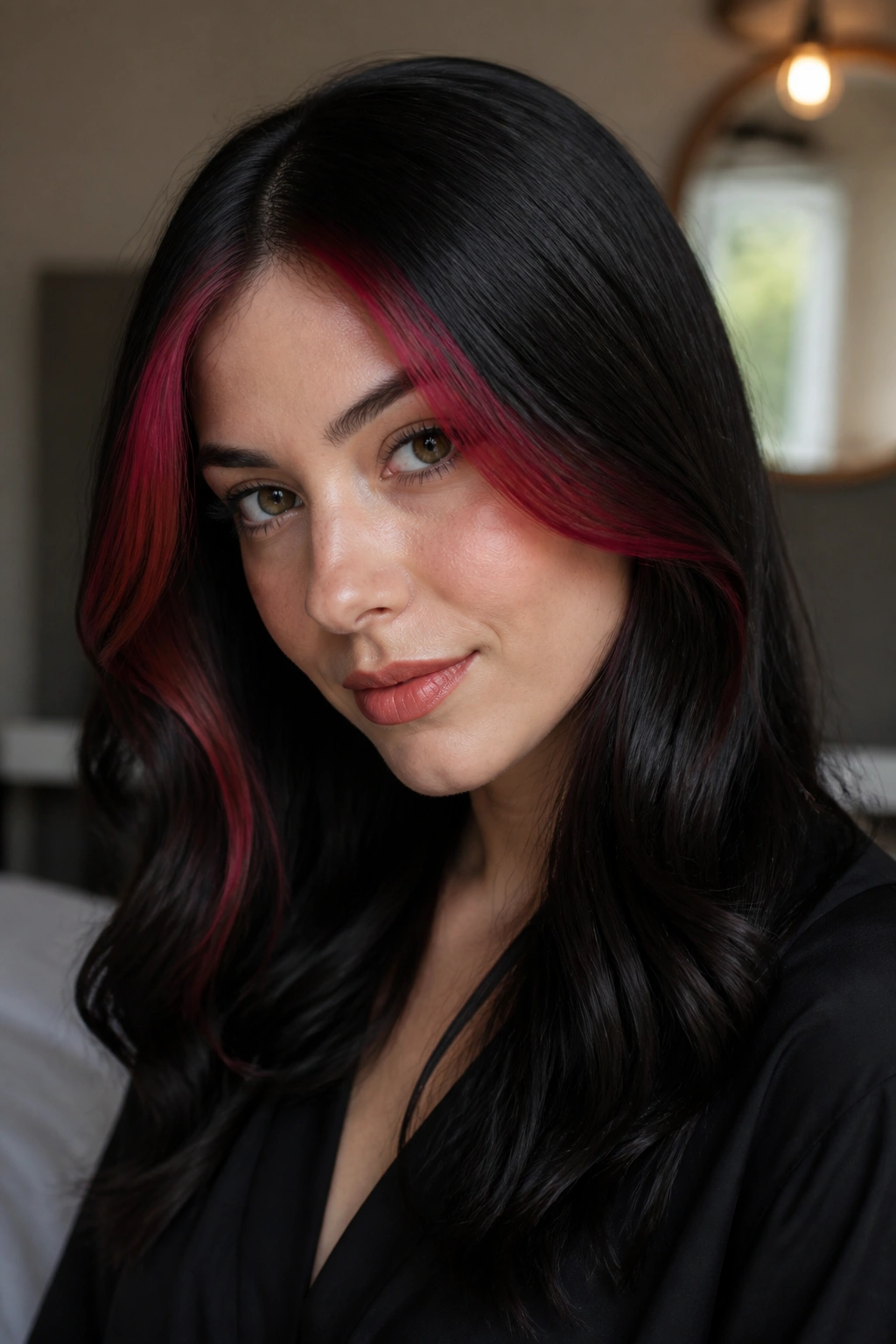
This is the fastest way to make a round face look a little longer without touching the haircut. The black base keeps the shape tight, while the cherry red panels act like vertical lines beside the face. That contrast pulls the eye downward instead of outward.
Why it flatters a round face
The panels should start near the temple and taper past the cheekbones, not stop right at the fullest part of the face. If the red sits too high and too wide, it can make the face feel broader. Keep the red narrow — about ½ inch to 1 inch wide at the front — and let it soften as it moves toward the jaw.
A side part helps here. So does a little bend in the hair, because pin-straight face-framing pieces can look harsh against black lengths. Cherry red on top of black reads sharp, almost lacquered, and that sharpness is what gives the look its edge.
Ask for this at the salon
- A level 2 or level 3 black base with cherry red front panels
- Color that starts at the temple, not the cheek
- Softer blending below the jawline
- A gloss finish, not a flat matte red
Pro tip: If your hair is very dark and resistant, ask whether the red panels need a small pre-lightening step. Bright cherry usually needs a cleaner canvas than burgundy does.
2. Black Cherry Balayage on Long Layers
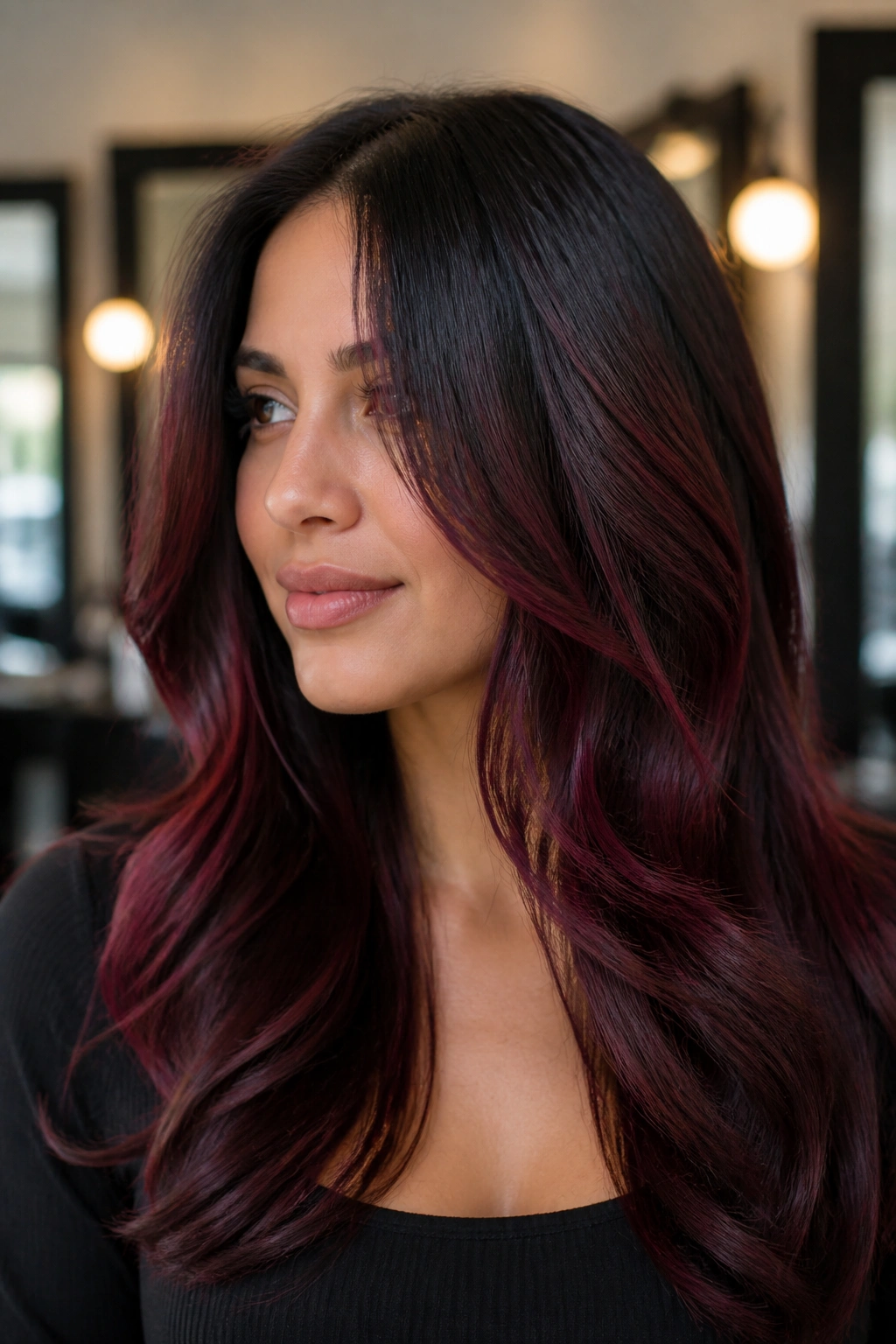
Why does black cherry feel richer than a bright red stripe? Because it moves with the hair instead of sitting on top of it. On long layers, the color can be painted lower and thinner, which keeps the width away from the cheeks.
The best version starts with black at the roots, then threads black cherry through the mid-lengths and ends in soft ribbons. Think of it as a stain, not a stripe. The finish should look like wine-dark sheen in indoor light and deeper red when you step near a window.
Long layers matter more than people think. They break up the bulk around the face and give the balayage room to fall vertically. If the layers are too short and flip outward at cheek level, the color can puff the face out a little. Nobody wants that.
What to tell your colorist
- Keep the brightest red below the chin
- Use thin balayage pieces, not chunky blocks
- Blend the transition with a demi-permanent gloss
- Add the richest cherry tone through the ends for movement
A wavy blowout makes this look especially good. The waves interrupt the line just enough, so the color feels soft instead of striped.
3. Deep Burgundy Peekaboo Under a Jet Black Top Layer
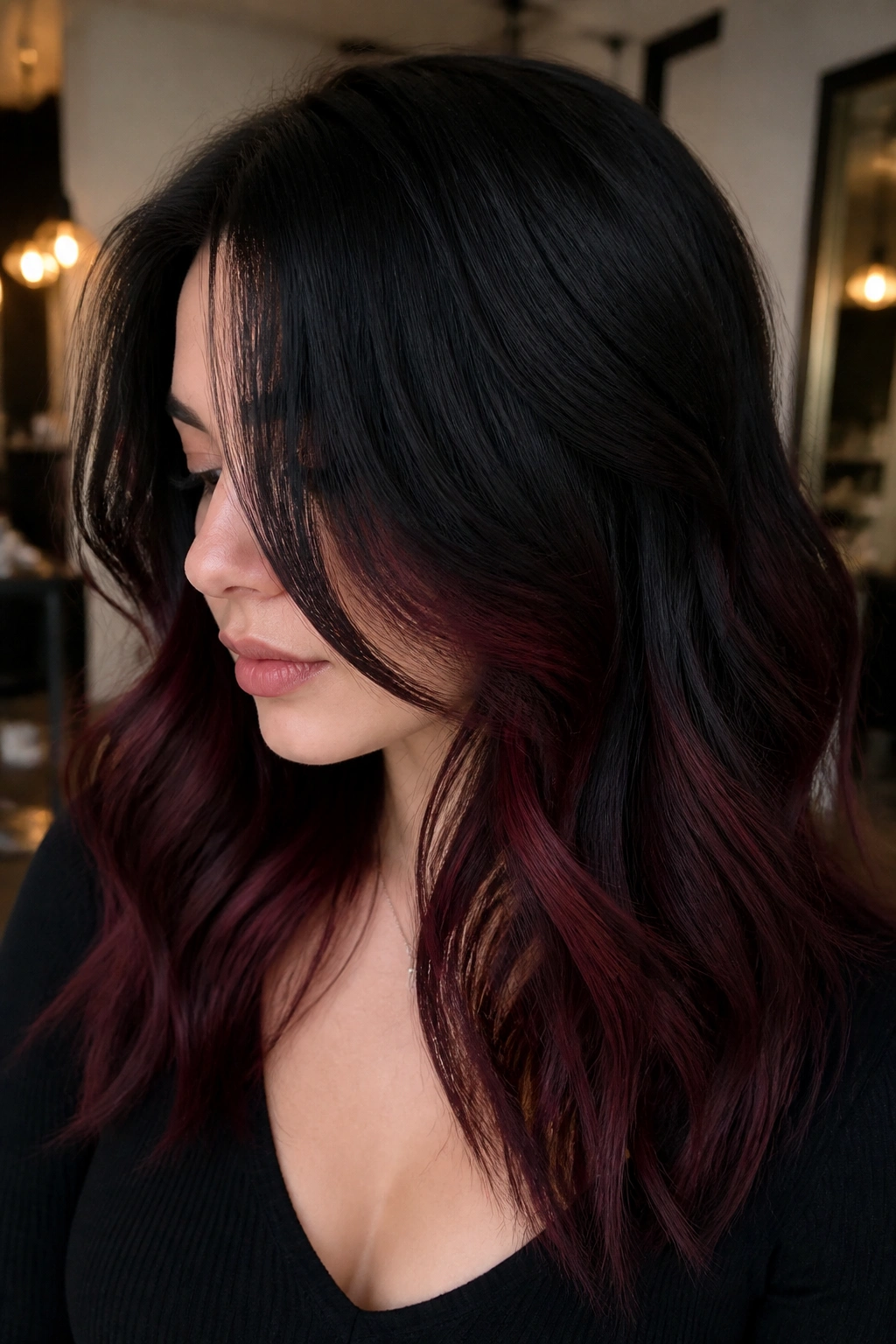
Hidden color is underrated. A peekaboo burgundy layer gives you red-black contrast without putting the red across the widest part of the face. The top layer stays black, which keeps the silhouette slim and the color story a little more mysterious.
This is one of my favorite choices for a round face because the red only shows when the hair moves. You get flashes at the shoulders, under curls, or in a half-up style, but the face itself stays framed by dark lengths. That means the visual weight sits lower, where it helps.
It also ages well between appointments. As the burgundy softens, it usually turns into a plum-brown tone instead of looking harsh. That matters. A lot of vivid red shades go loud, then fade into something patchy and tired. Burgundy tends to wear better.
Best if you like this kind of styling
- Half-up styles
- Loose braids
- Shoulder-length hair that swings
- Straight hair with a tuck-behind-the-ear habit
If you wear your hair up often, this is one of the smarter red-black ideas to try. The color appears exactly when you want a little surprise.
4. Red Velvet Money Piece With Dark Lengths
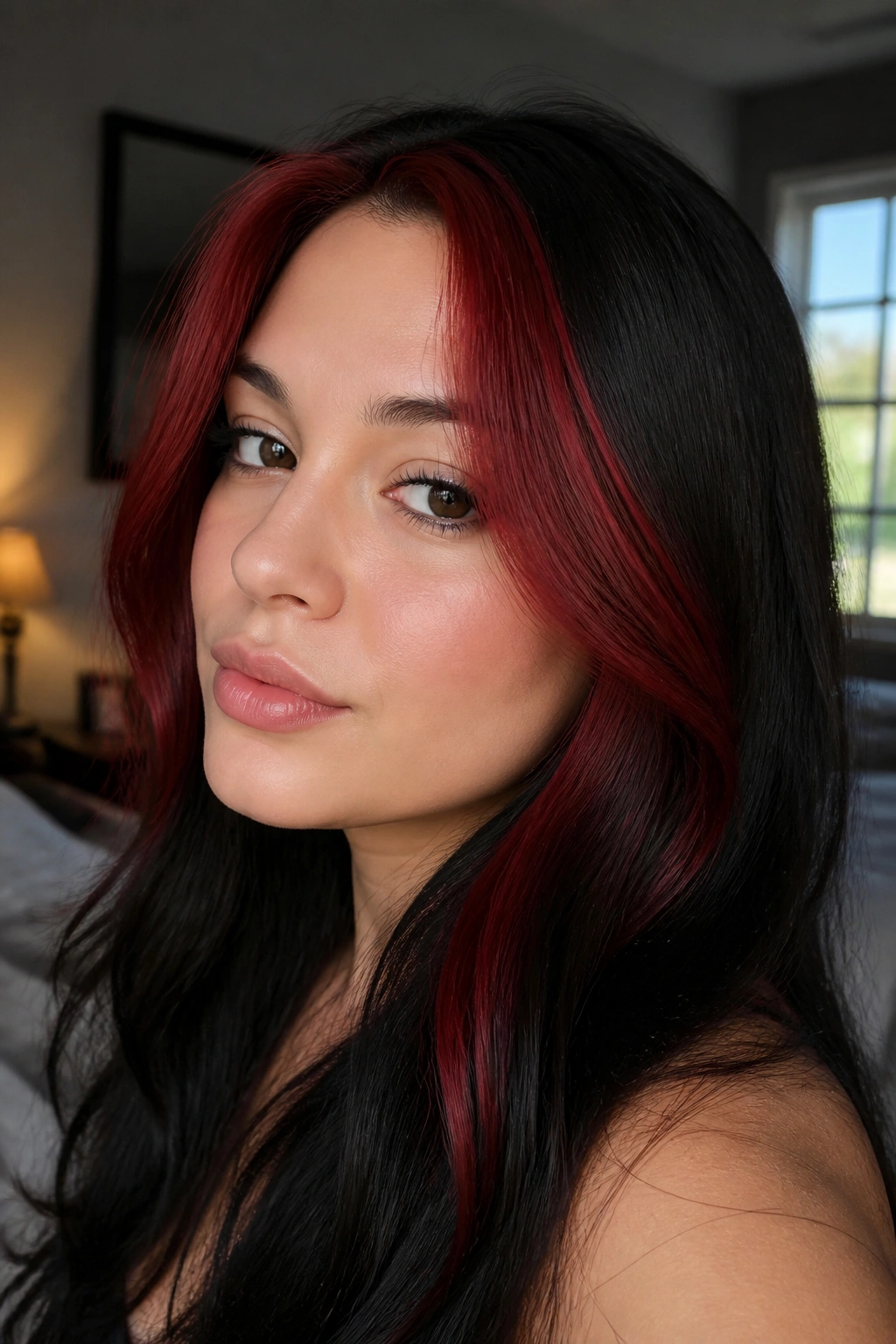
A money piece can flatter a round face, but only if it behaves. A thick, wide front panel that starts at the brow and ends at the cheek will make the face read wider. A slimmer red velvet piece, placed just outside the face and softened at the ends, does the opposite.
This look works best when the red is intense but controlled. Red velvet is richer than cherry and less orange than copper, which keeps it from shouting. On black hair, it creates a strong frame around the eyes without turning the whole front of the head into a bright block.
I like this on layered medium-length cuts because the face-framing pieces can taper as they drop. If your hair is straight, ask for a soft bevel at the front so the red doesn’t hang like two stiff curtains. If it’s wavy, even better. The bend breaks the line and gives the color more depth.
One thing people miss: the red should not be the widest thing near your face. The widest thing should still be your hair volume farther down.
5. Black-to-Crimson Ombré That Starts Below the Chin
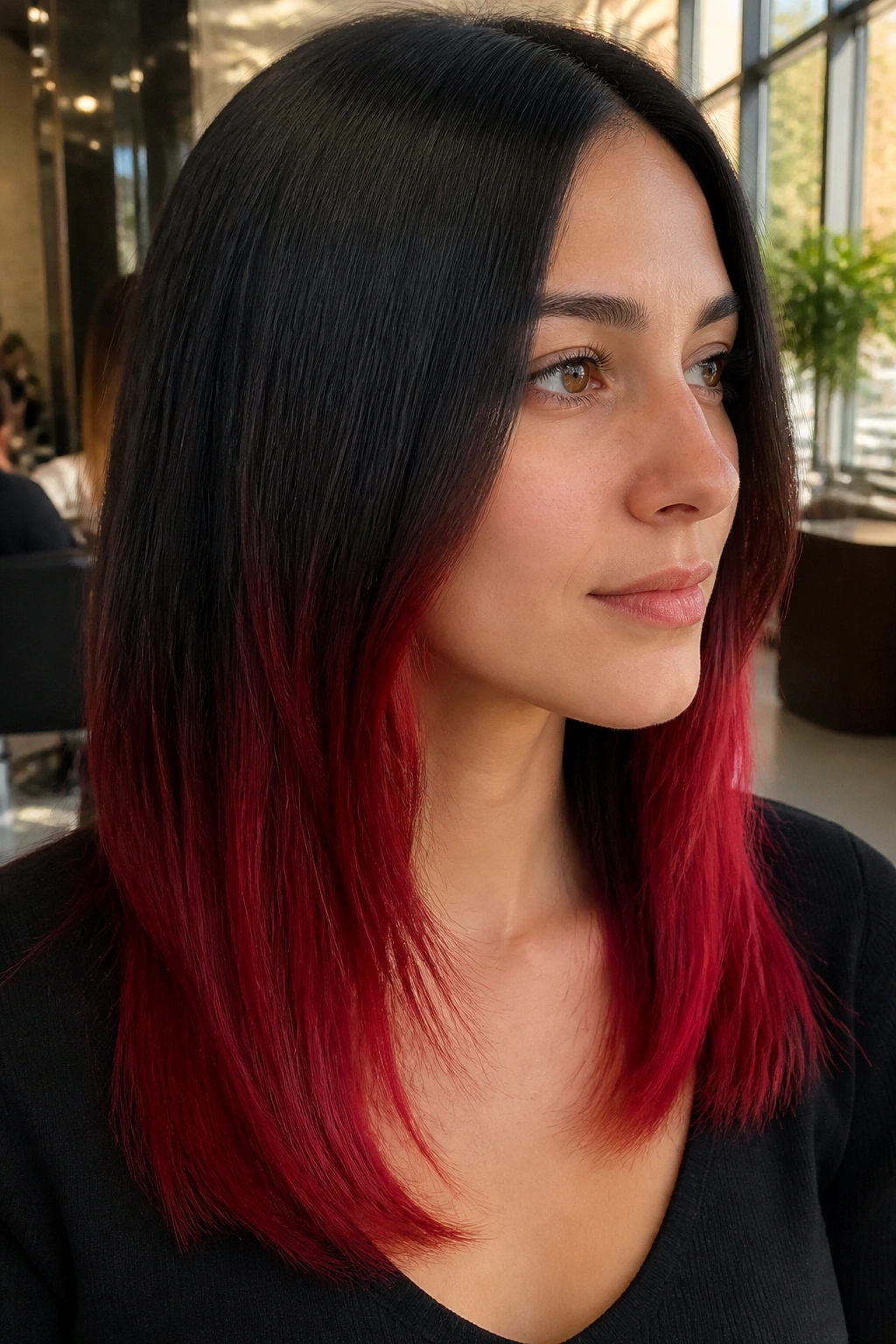
This is the quietest way to wear a bold shade. The roots stay black, the color begins to soften around the chin, and the ends drift into crimson. That lower placement matters because it keeps the eye moving down the hair, not out across the cheeks.
Below the chin is the magic point. Start the red transition too high and the color sits right beside the roundest part of the face. Start it lower and you get the lengthening effect for free. A good ombré should feel like a slope, not a line.
Keep the crimson glossy. Matte red on dark hair can look dry fast, especially if the ends are layered or lightly porous. A clear glaze over the red every so often helps the ends look saturated instead of dusty.
The style pairs well with straight hair, soft bends, and long bobs. It is not the best choice if your ends are already very damaged, because red pigment has a way of exposing rough texture. Clean ends make a huge difference here.
6. Mahogany Ends on a Black Lob
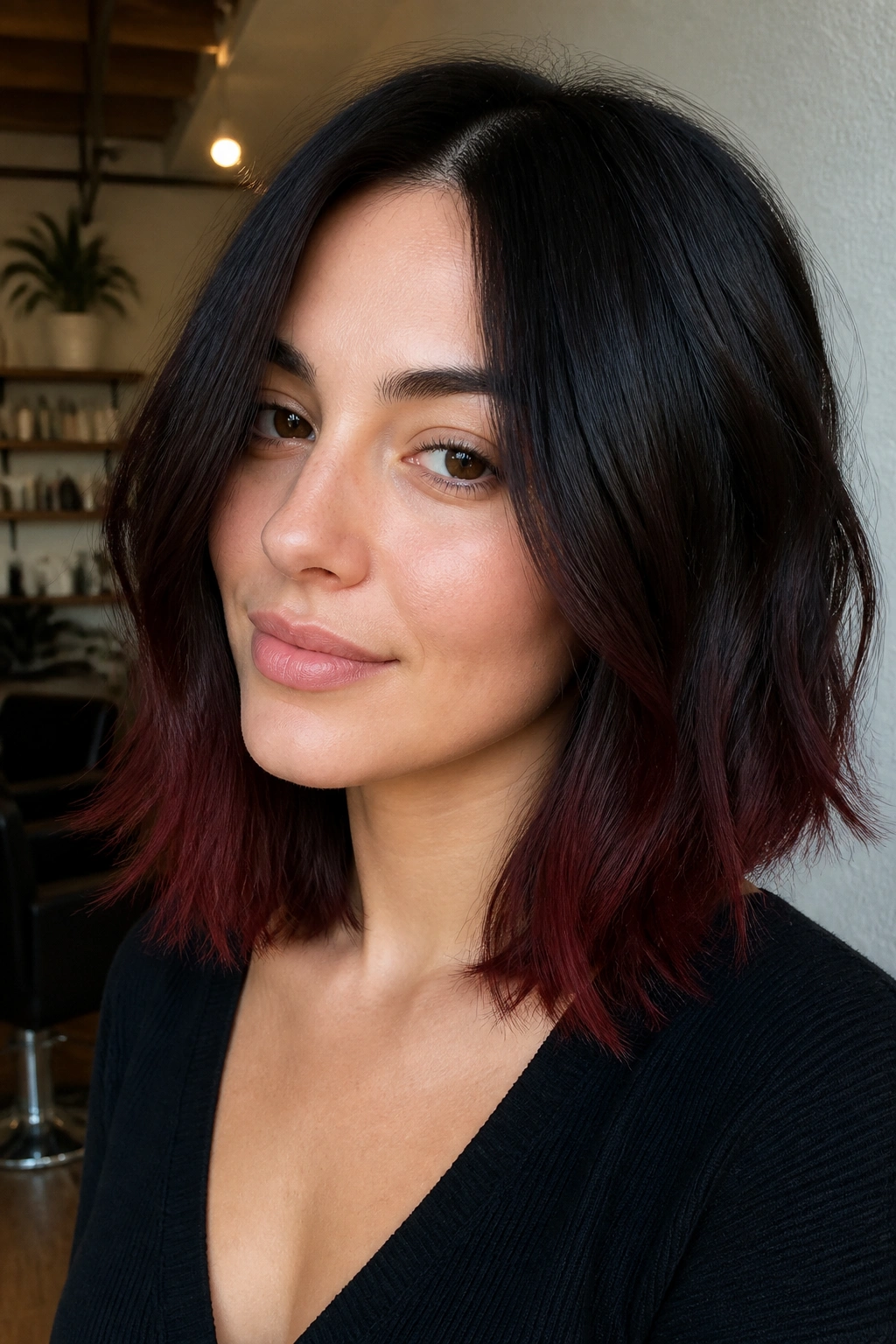
Not every red-black look needs a loud contrast. Mahogany ends on a black lob are calmer, richer, and easier to wear on a round face because the color sits low and lengthens the line of the cut.
A lob already helps a round face by creating a longer shape around the jaw. Add mahogany at the ends and you get a little warmth without puffing out the sides. The trick is keeping the top and sides dark while the red shows mainly at the bottom edge of the hair. That gives the eye somewhere to travel.
This is the sort of color that looks expensive in a real room, not just in a photo. The red is there, but it doesn’t scream for attention. It feels polished when the hair swings and deeper when it settles.
Why this one holds up well
- The red is concentrated at the ends
- Black roots keep the face framed tightly
- The lob length lands below the cheekbones
- Regrowth looks soft, not obvious
If you want red but need something office-friendly, this is a solid place to start. Quiet does not mean boring.
7. Auburn Ribbon Highlights Over Soft Black
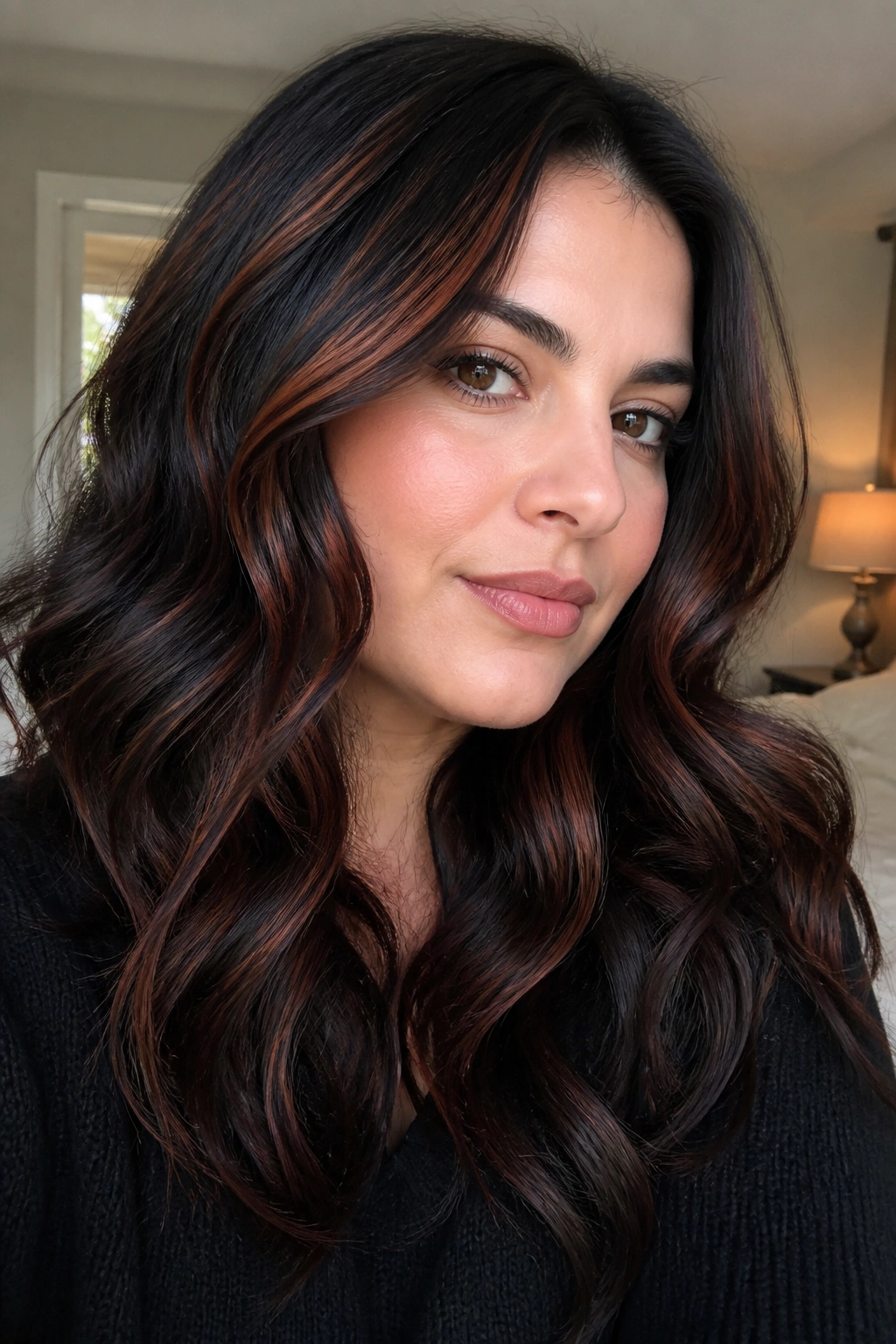
Why ribbons instead of chunky streaks? Because thin auburn ribbons create movement without putting weight in one spot. On a round face, that matters. The eye reads the hair as longer, lighter, and more vertical.
This idea works especially well if your black base is not inky black but a softer espresso black. Auburn sits in that warm red-brown zone, so the contrast is gentler. The result is less “striped hair” and more “dark hair with warm threads.”
How to place the ribbons
- Keep them thin and scattered
- Concentrate them around the crown and outer lengths
- Avoid placing too many pieces at cheek level
- Ask for a soft gloss so the auburn reflects, not flattens
The best version has enough contrast to show from a few feet away, but not so much that the pieces look pasted on. If your hair is wavy, the ribbons will appear and disappear as the hair moves, which is exactly what you want. A round face does well with that kind of motion.
And if you usually wear a side part, even better. The extra height near the part line adds a little lift up top.
8. Smoky Black and Merlot Melt on Wavy Hair
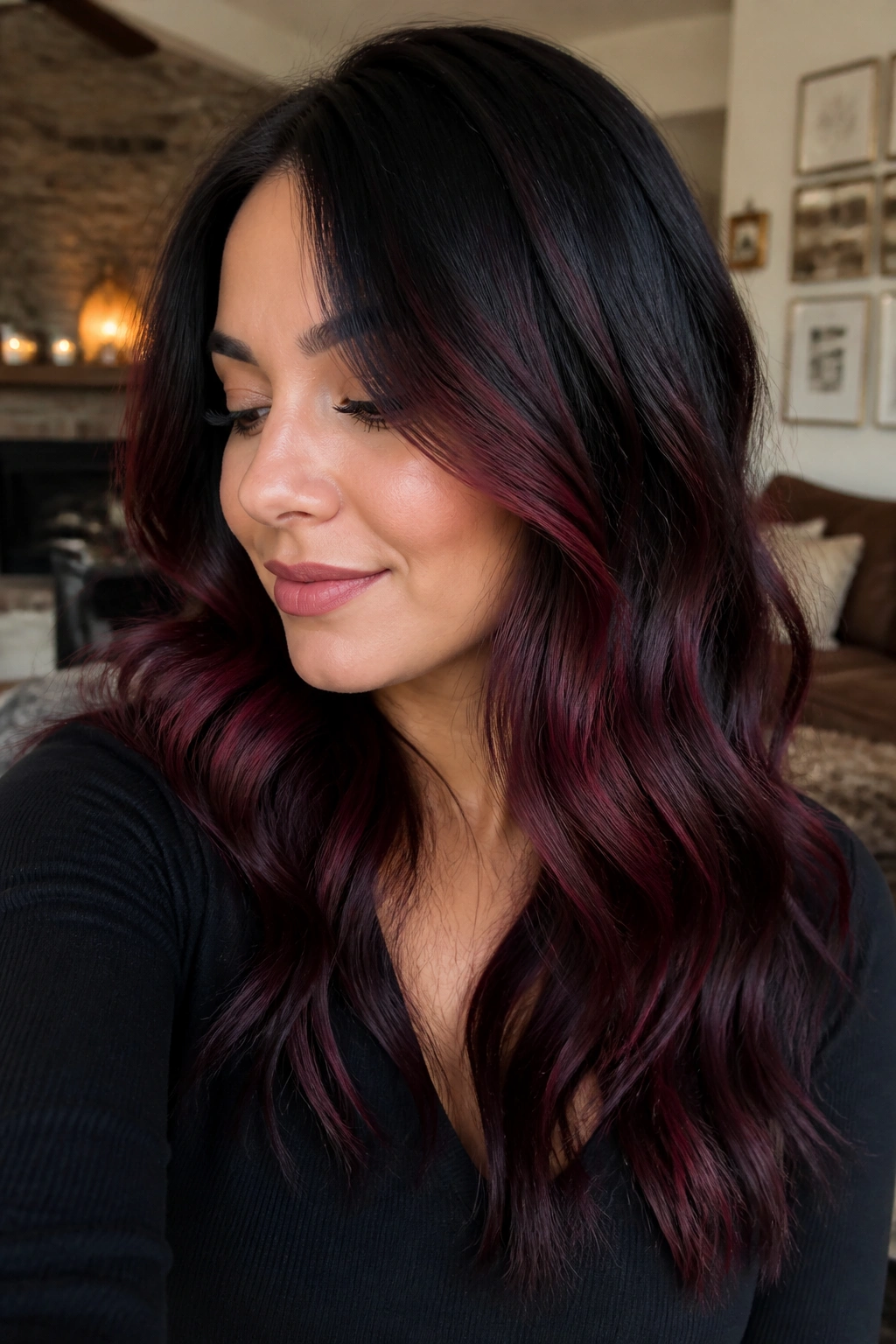
Wavy hair loves a color melt. The texture blurs the transition, so smoky black and merlot can slide into each other without creating hard edges beside the cheeks. That softness helps a round face look more drawn out.
The color should feel moody, not bright. Merlot has enough red in it to read clearly, but it stays deep enough to avoid shouting from every angle. On waves, the color catches in the bends and gives you a layered look without needing extra foils.
Here’s the part I care about most: keep the merlot lower on the wave pattern. If you pack the red into the widest section of the face, the shape opens up. If you let it live on the lower half of the wave, the whole silhouette feels longer.
The finish matters too. A little shine serum on the mids and ends makes the black look richer and the merlot look smoother. Dry merlot can turn flat in a hurry.
9. Black Hair With Cinnamon-Copper Underlights
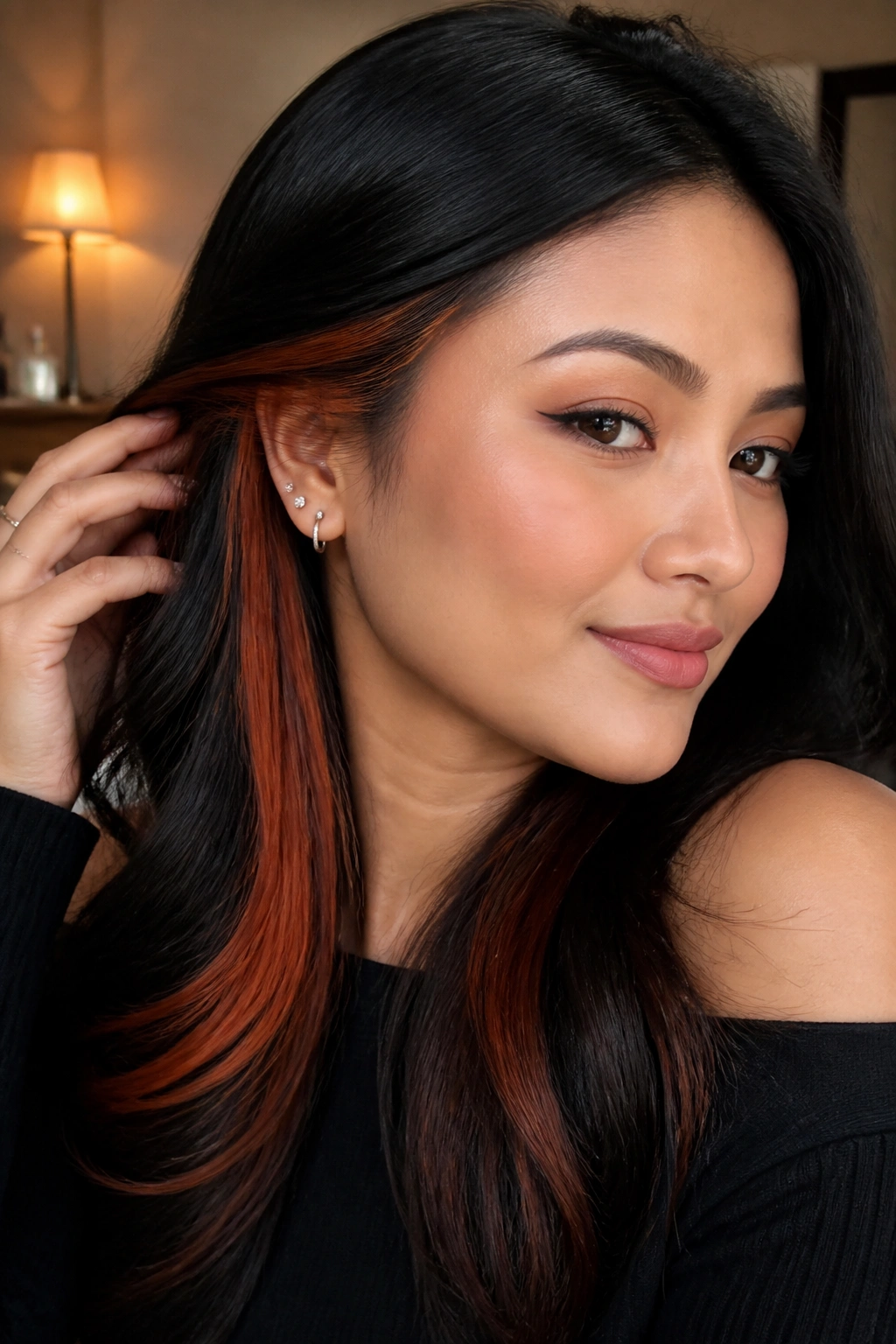
This one is sneaky in the best way. Cinnamon-copper underlights stay mostly hidden under a black top layer, then flash out when you tuck the hair behind the ears or flip it forward. For a round face, that hidden placement is a gift.
The front stays dark. The sides stay slim. The warmth appears lower, usually around the mid-lengths and ends, where it doesn’t add width near the cheeks. Cinnamon-copper also has a softer feel than bright orange copper, so it reads as rich rather than loud.
I like this for thick hair in particular. Thick hair can hold those hidden panels without exposing too much scalp, and the underlights show in a more controlled way. On finer hair, the contrast can look patchy if the sections are too wide.
A few practical details help:
- Ask for the copper to sit under the top layer only
- Keep the front hairline dark
- Use a gloss that leans warm, not orange
- Style with tucks, braids, or loose waves to reveal the color
This is a good choice if you want surprise color, not constant color.
10. Cherry Cola Curls With Dark Roots
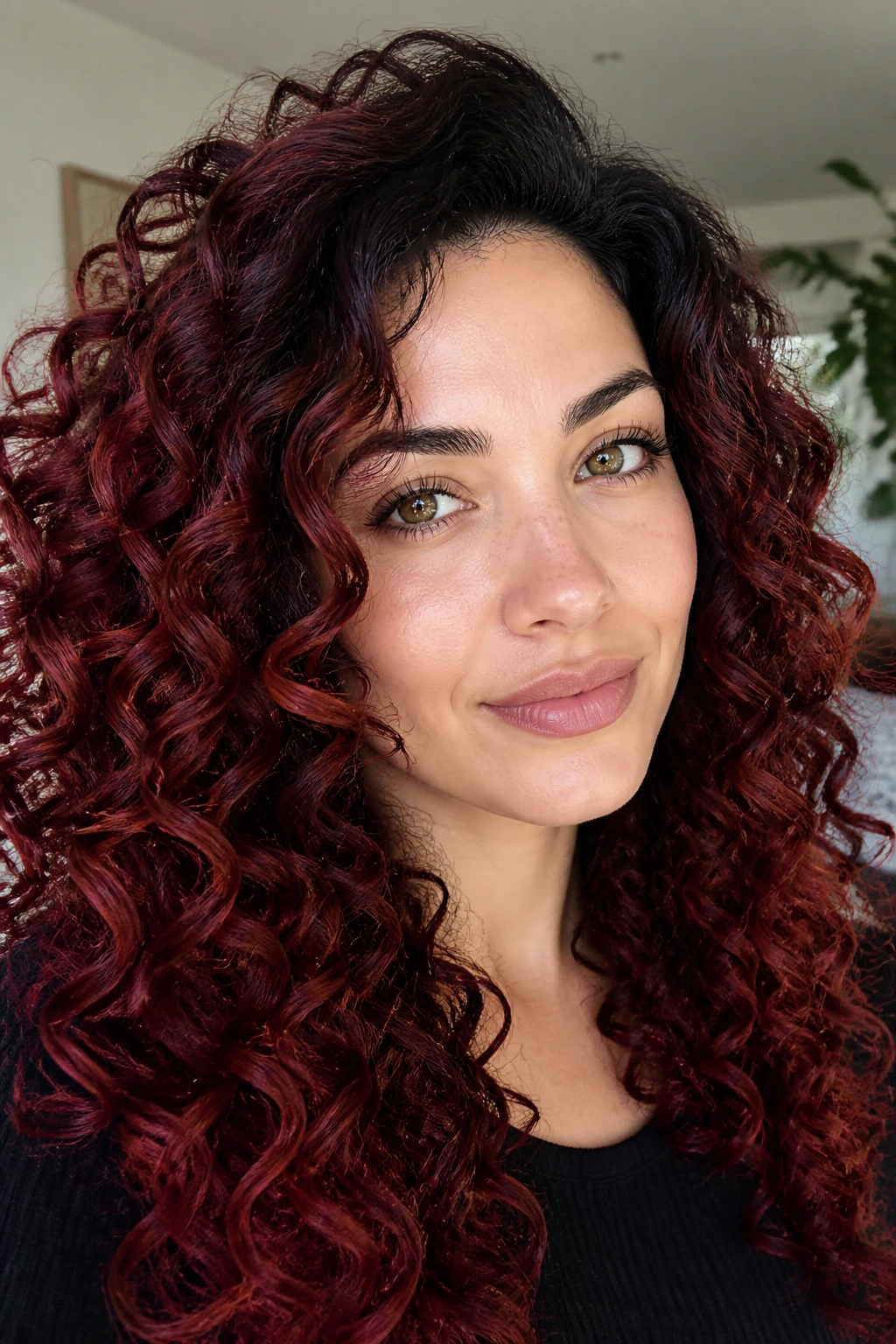
Cherry cola curls are a smart answer for round faces because curls already carry volume, and you do not want to pile brightness on the fullest part of the head. The darker roots keep the shape anchored, while the red sits on the outer surface of the curl where it can move.
The texture does most of the work. On curls, red and black are not just colors; they are layers of depth. Cherry cola usually reads as deep red-brown in shade and brighter red when the light hits the outside ring of each curl. That makes the whole style feel alive without needing big streaks.
Do not paint the inside of the curl pattern too heavily. That is where color can get muddy and where the face can start to look wider if the red blooms around the cheeks. Place the brightness lower, at the ends and outer halo, and let the root stay dark.
It helps to diffuse on low heat and keep the curl clumps defined. Loose, shapeless curls spread color out too much. Defined curls keep the red looking intentional.
11. Scarlet Dip-Dye on a Blunt Cut
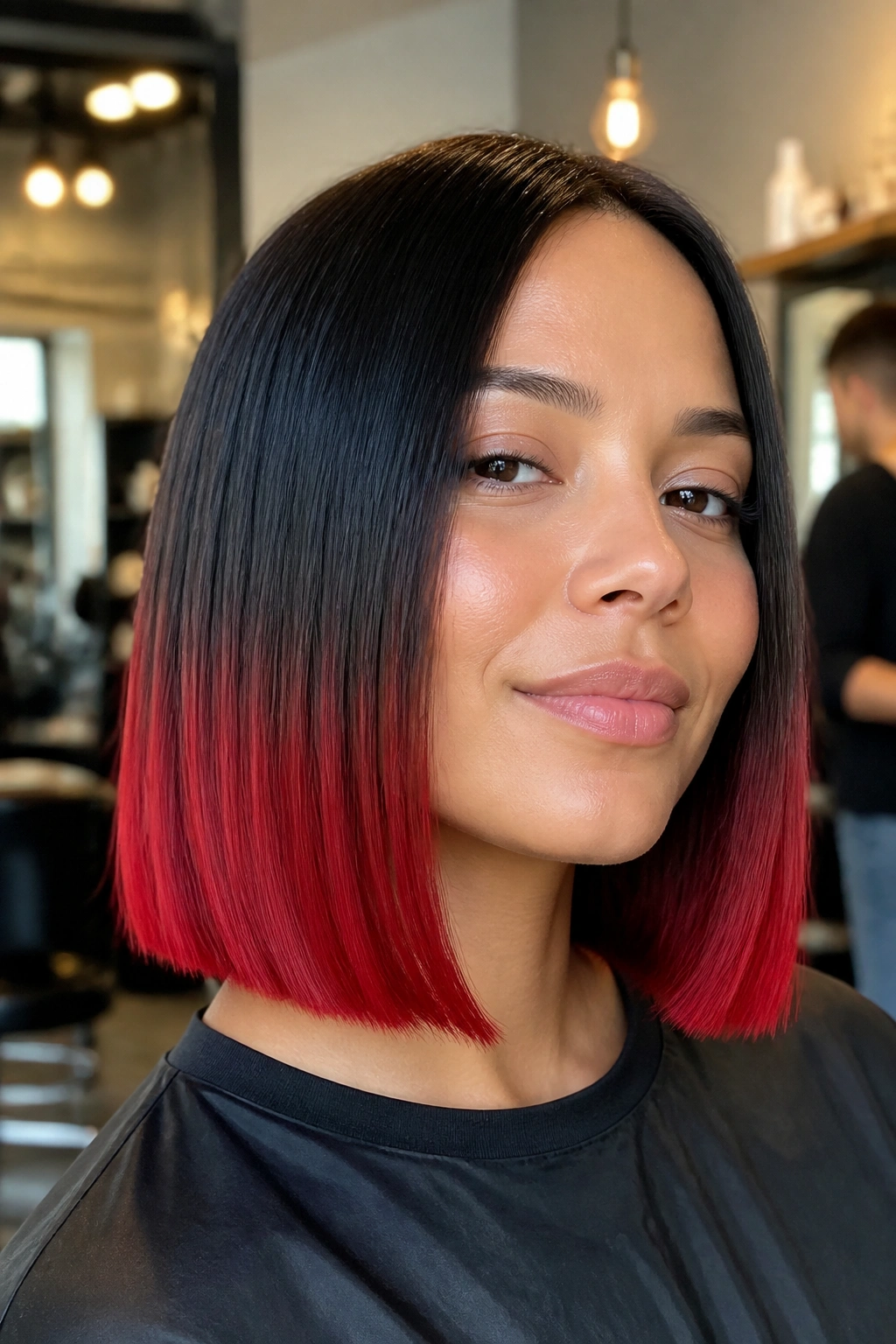
Unlike balayage, dip-dye gives you a hard finish. That sounds severe, and sometimes it is — but on the right blunt cut, it can be exactly the sharp edge a round face needs.
A shoulder-length blunt cut already creates a cleaner outline than lots of soft layers. Add scarlet dip-dye to the bottom 3 to 5 inches, and the color lands below the chin, which helps stretch the face visually. The line is bold, but the placement is smart.
This idea works best when the red is truly saturated. Faded scarlet can look brassy against black. A fresh, glossy red at the ends gives the style a crisp finish that holds its shape better in straight hair or polished waves.
Choose this if you want:
- A strong color break
- A cleaner haircut shape
- Lower maintenance at the roots
- A style that looks sharp in ponytails
Skip it if your ends are wispy or very damaged. A blunt line makes everything visible, including bad ends. That’s the tradeoff.
12. Black Base With Vivid Red Panels at the Back
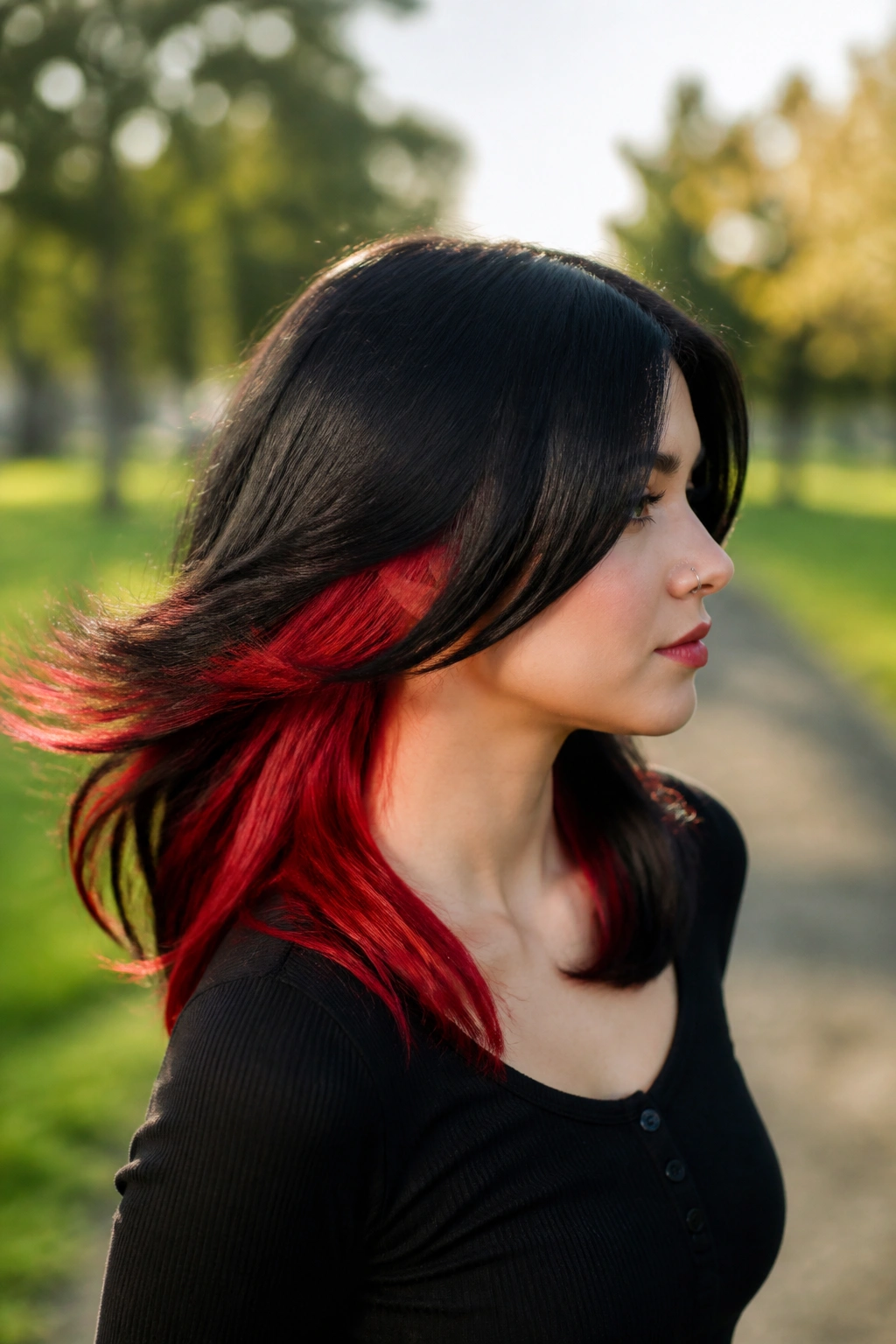
Why hide the brightest color in the back? Because it gives you drama without expanding the face. The front stays dark and slim, while the back panels show up in movement, braids, ponytails, and half-up styles.
This is a good call if you like surprise color more than constant color. From the front, the look can stay sleek and almost severe. From the side and back, the red comes alive. That contrast works well on round faces because the eye is not pulled outward at the cheeks. It goes up and down, and sometimes backward, which is fine.
I especially like this on straight hair with a clean center or side part. The front shape stays controlled. The back panels can be as vivid as you want, from cherry to ruby to deep fire red. If your hair is layered, make sure the red panels are placed on the lower interior so they do not spread too far across the sides.
When this one shines
- Ponytails
- Braids
- Half-up buns
- Slicked-back looks
It is a little dramatic. That is the point.
13. Ink Black With Raspberry Lowlights
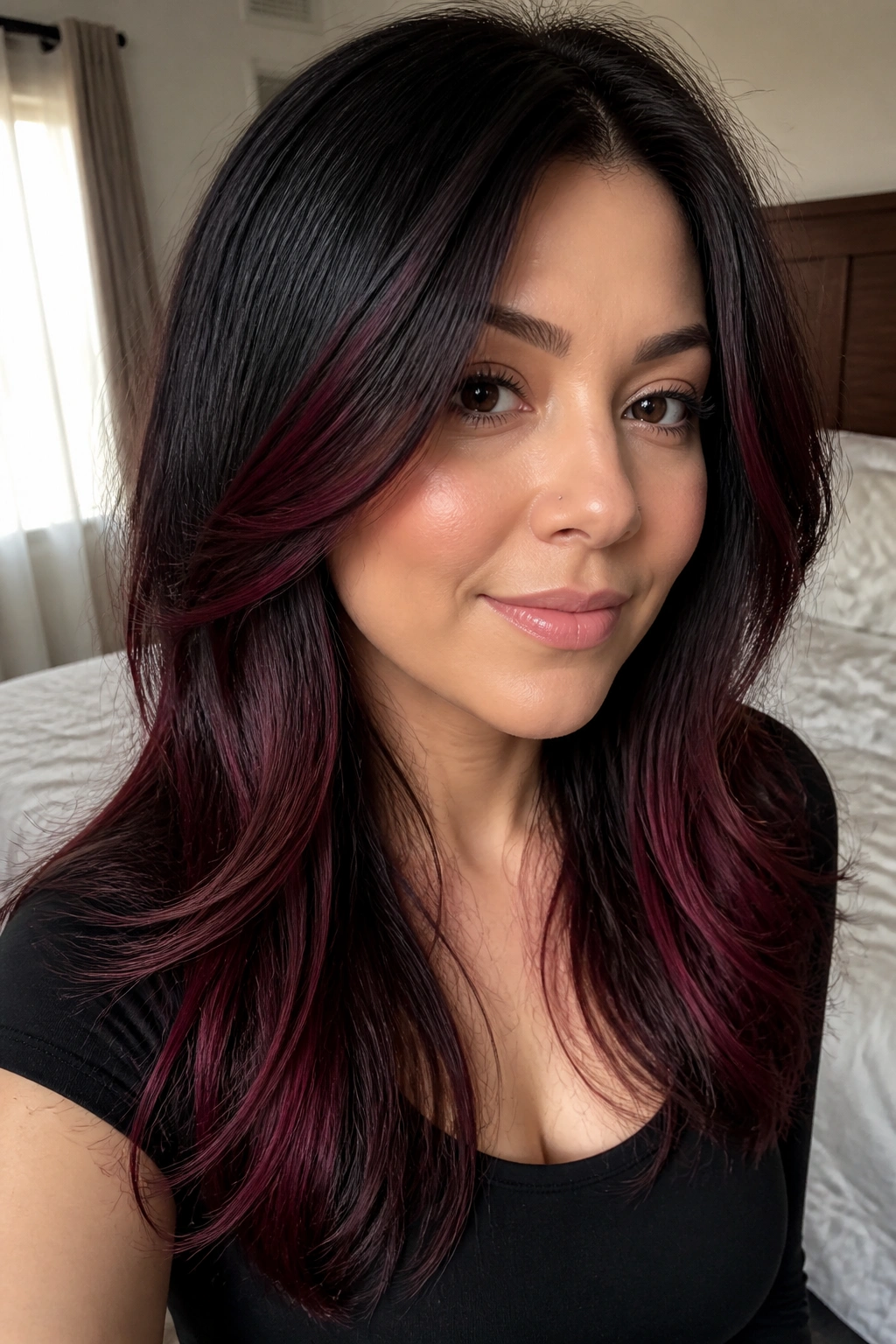
Lowlights do more than highlights on black hair. Raspberry lowlights break up the flatness without turning the whole head bright, and that makes them surprisingly flattering on a round face.
The raspberry should sit one or two shades lighter than the black base, not ten shades lighter. You want depth, not stripes. A few placed through the mid-lengths and lower layers create movement and shadow, which makes the hair look fuller in a controlled way. On round faces, that shadow helps slim the outer edge.
This is a good choice if you wear your hair straight, because straight hair can go flat very quickly. The lowlights keep the shape from looking like one solid block. On wavy hair, the effect is even better because the darker and lighter pieces fold into each other.
A blunt cut can handle this. So can a long layered cut. What matters is that the raspberry never takes over the front width of the style.
Low-key, rich, and practical. That’s the appeal.
14. Black and Copper Peekaboo for Layered Hair
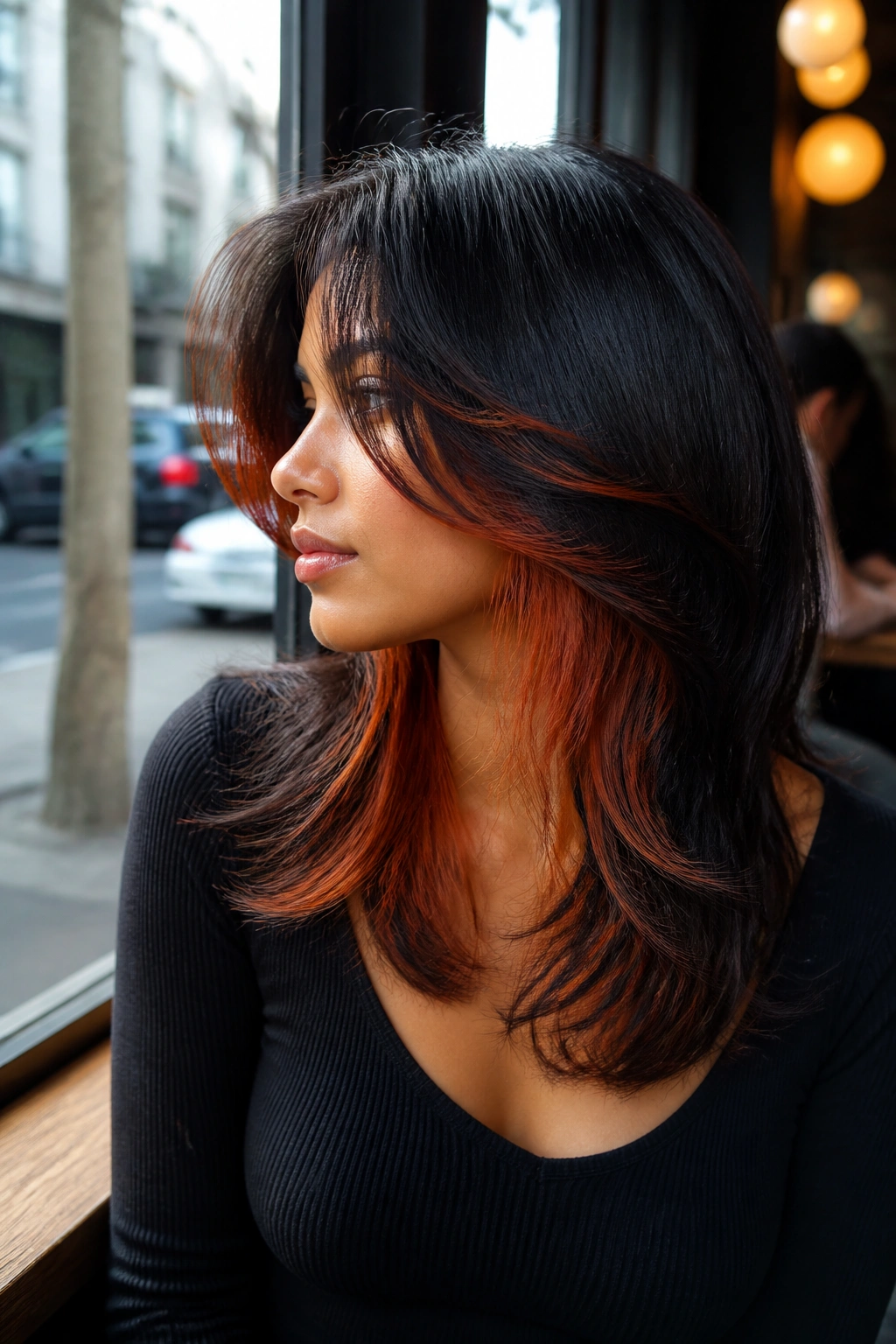
I love peekaboo color on layered hair because the layers give the copper somewhere to hide and then pop back out. Black and copper can look busy on a round face if the copper is plastered across the cheeks. Under layers solve that problem.
The copper should live underneath the top sections, mostly through the bottom half of the head. When the layers move, the color flashes out like a quick spark. When the hair is still, the black remains dominant and keeps the face frame narrow.
This is one of those styles that looks better in motion than in a still photo. You tuck the hair, shake it out, and the copper peeks through. That small reveal keeps the style from feeling heavy. It also means the color can be quite vivid without taking over the whole look.
Good ways to wear it
- Loose waves
- Half-up clips
- Soft braids
- Layered blowouts with movement at the ends
If you have a round face and like warm tones, this is an easy one to love. The warmth is there. It just knows where to sit.
15. Mulled Wine Balayage Around the Crown
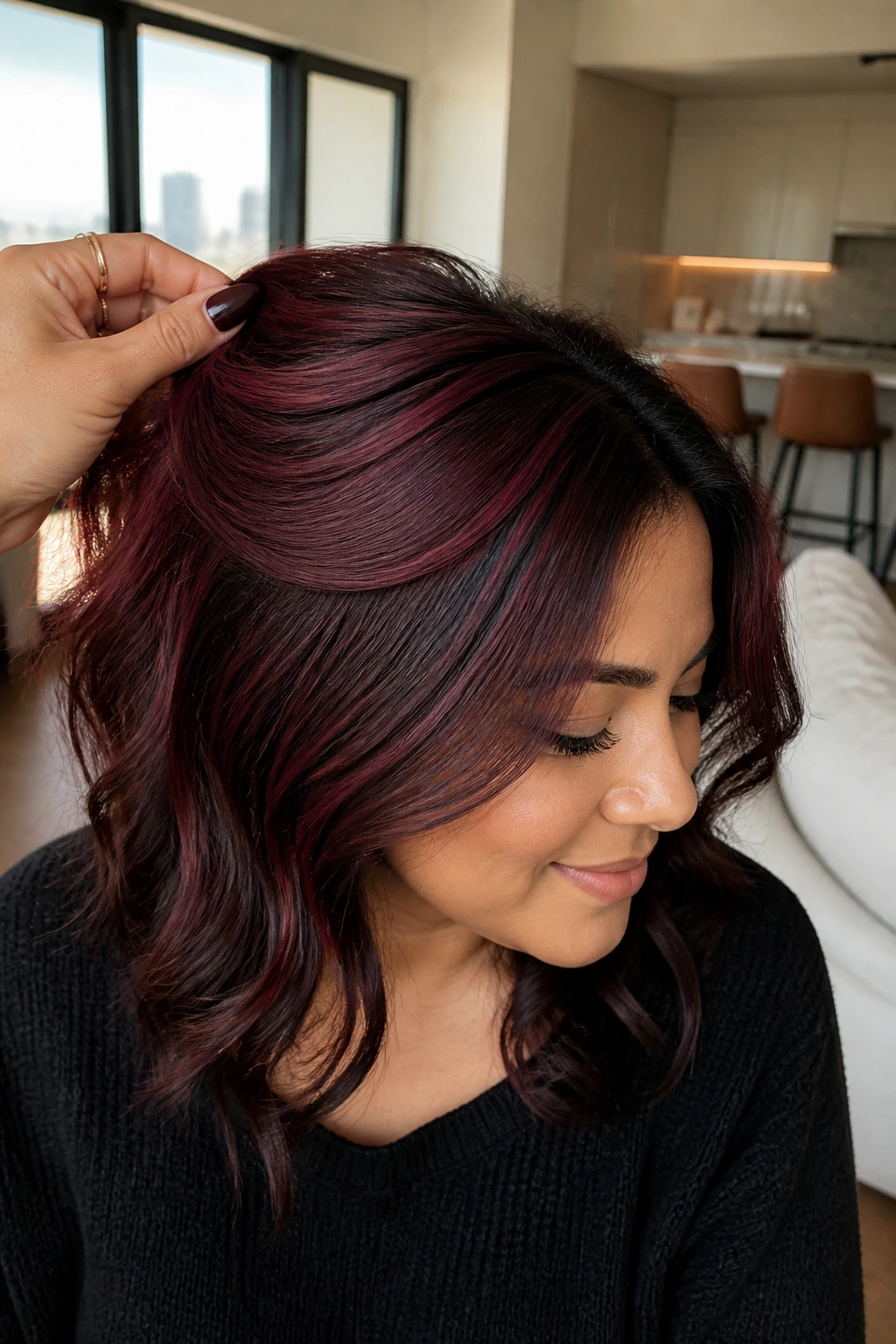
Crown placement changes everything. If the red starts up high around the crown and upper lengths, it lifts the eye upward, which is exactly what a round face needs. The color should not gather around the cheeks like a ring.
Mulled wine is a deep, spiced red with brown in it, so it stays rich rather than candy-bright. That makes it easier to wear across a full head of hair. A few balayage pieces at the crown, then tapering down through the outer lengths, add height and movement without adding width.
What not to do
- Do not cluster the red around the cheekbones
- Do not use too many wide front pieces
- Do not stop the color too high on the face
The best version has a soft root shadow, then the red appears in broken ribbons as the hair drops. If you wear volume at the crown, even better. That lift pairs naturally with the color placement and gives the whole look a little more structure.
It is a good salon choice if you want red that feels grown-up, not costume-y.
16. Ink-Black Pixie With Ruby Micro-Highlights
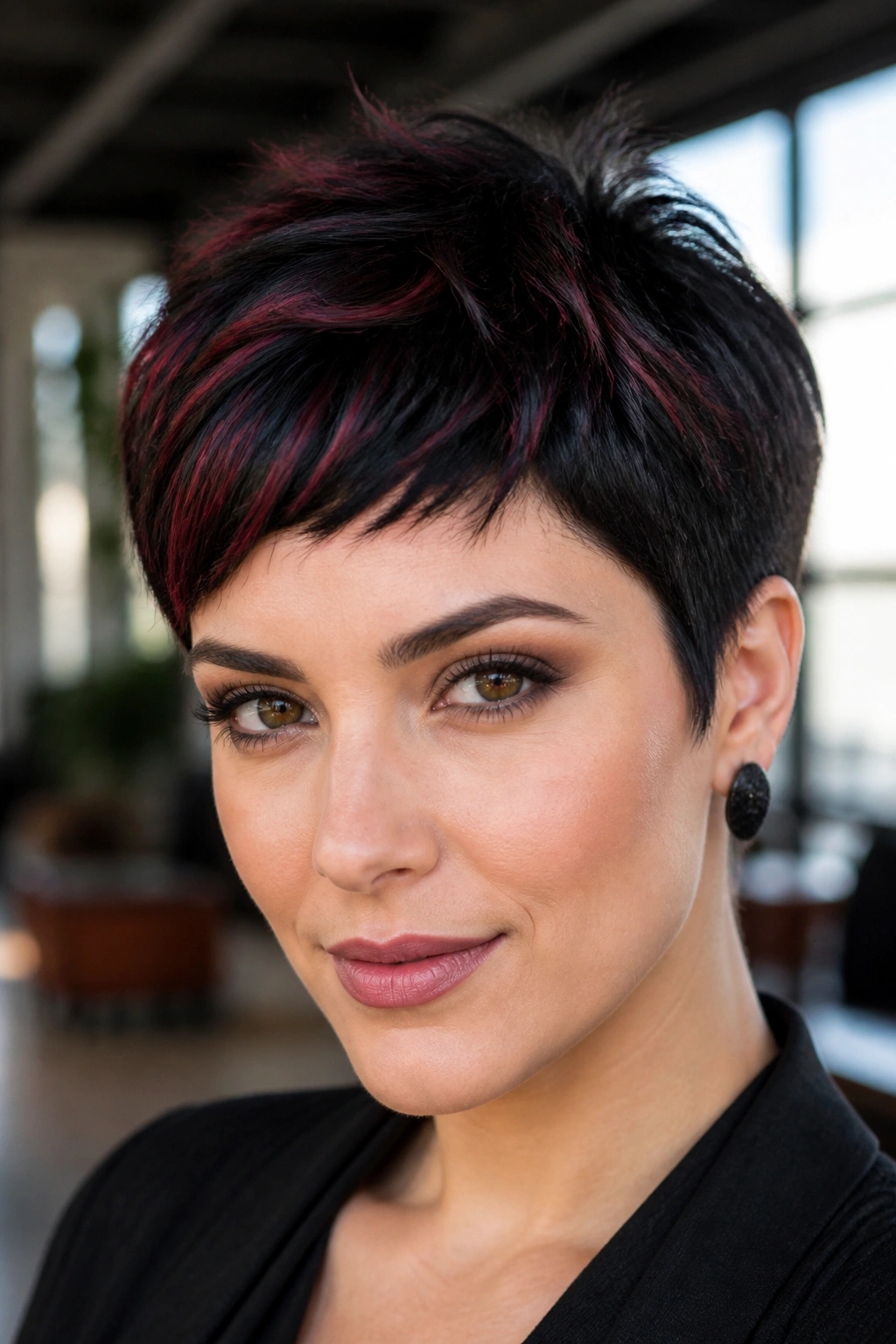
Short hair on a round face needs a little height on top, and that’s where ruby micro-highlights can help. They add texture without turning the whole cut into a bright cap of color.
The highlights should be tiny. Micro, really. Think little slices through the crown, fringe, and top layers — enough to catch light, not enough to widen the head. Keep the sides and nape dark and close so the shape stays tight. That contrast does the slimming work.
This is one of the few red-black ideas that can look sharper the more controlled it is. A pixie with too much red can start to feel busy. A few ruby touches through piecey top sections look deliberate and modern. The red shows most when you separate the hair with a matte paste or light cream.
Keep the sides dark. That single choice matters more than the shade itself.
If you want a short cut that still has bite, this is a strong option.
17. Black Lob With Auburn Face Frames and Dark Root Smudge
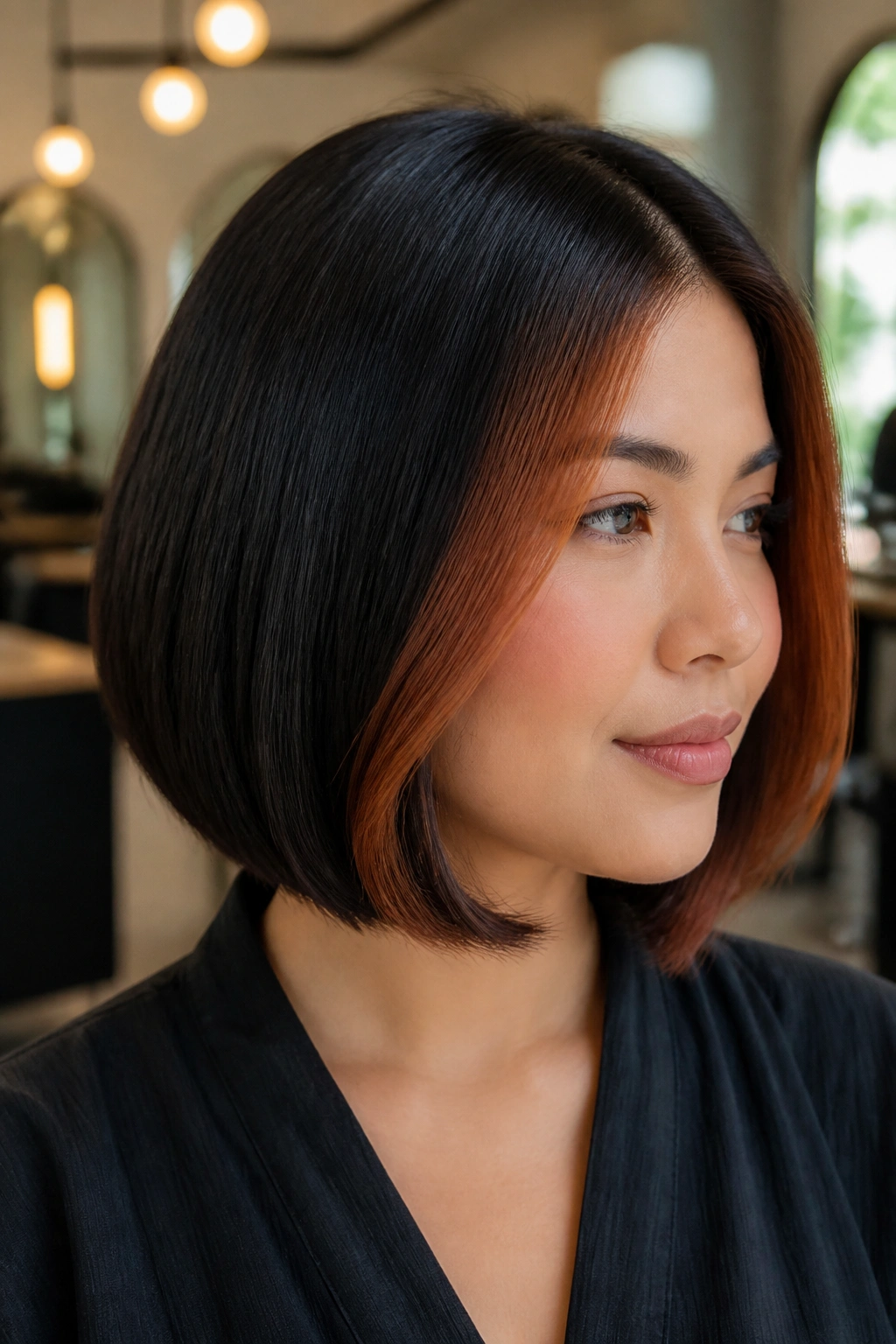
Unlike a full money piece, auburn face frames are softer and easier to live with. The root smudge keeps the transition from black to auburn blurred, which makes the color feel like part of the cut instead of an added stripe.
A lob that ends below the jawline already helps a round face. Add auburn frames that begin near the temples and taper downward, and you get a gentle lengthening effect. The key is that the frames should not stop at the widest part of the cheek. They need to fall past it.
This is a very wearable look if you like your hair polished and smooth. It works with straight blowouts, soft bends, and tucked-behind-ear styling. The auburn should feel warm, not orange. A softer auburn holds up well against black without looking harsh.
Salon notes
- Ask for a dark root smudge
- Keep the auburn pieces narrow near the face
- Let the color deepen toward the ends
- Use a gloss between appointments
It is the kind of style that looks calm from a distance and more detailed up close. That balance is hard to beat.
18. Velvet Black and Fire Red Streaks on Thick Hair
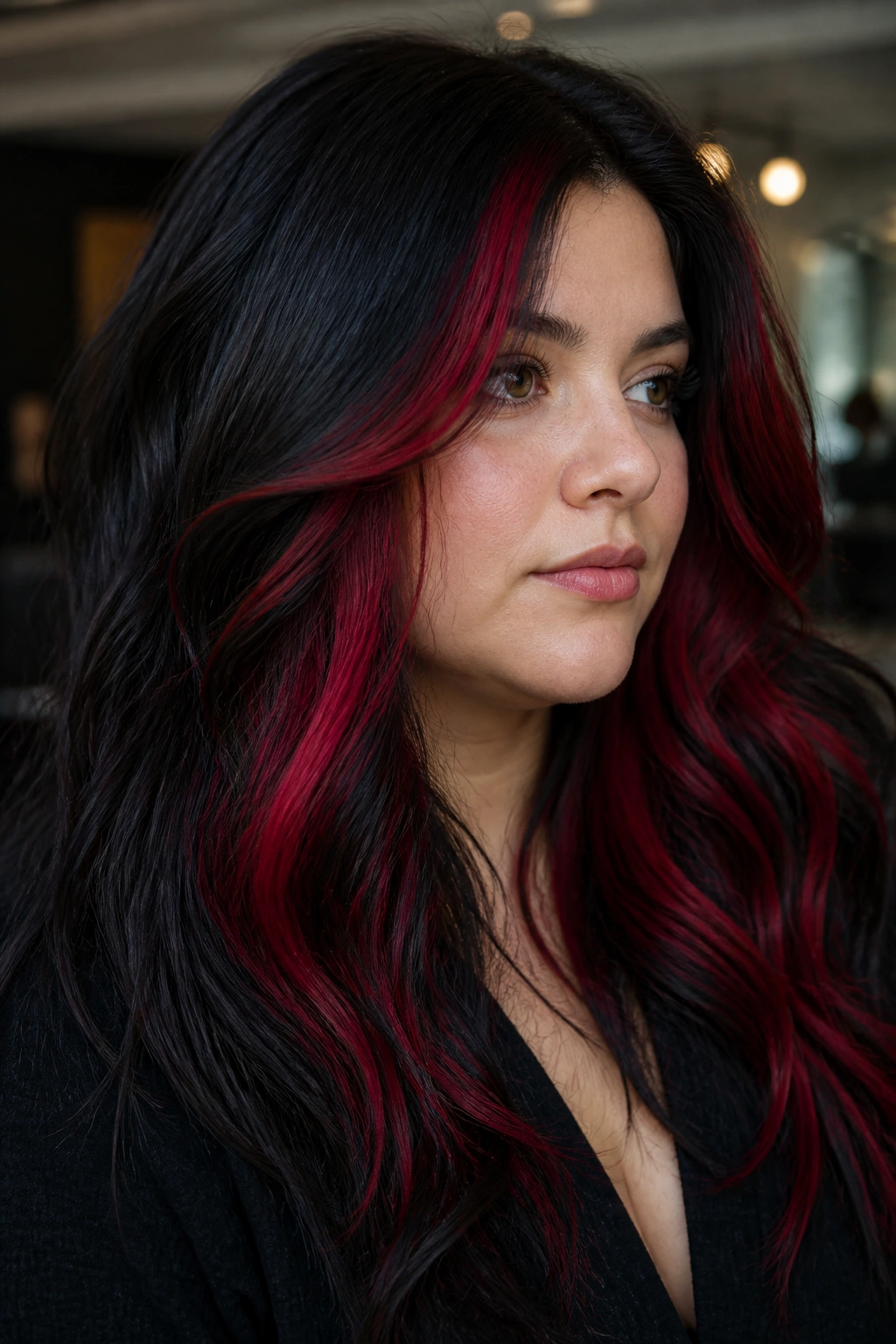
Thick hair can take bold streaks better than fine hair can. There is more room for separation, more room for contrast, and more room for the fire red to show without swallowing the whole style.
The trick is vertical slicing. Not wide horizontal bands. Vertical streaks travel with the length of the hair and help a round face look more elongated. If the red is placed in thick chunks right at the sides, the head can start to look boxy. Keep the slices narrow, place them through the interior and lower lengths, and let the black remain dominant.
This is a high-drama option. It has to be handled with some discipline. A good cut — usually layered enough to keep the weight moving — helps the streaks sit where they should. The red should look like it is cutting through the black, not floating on top of it.
How to avoid the helmet effect
- Use thin vertical streaks
- Keep the widest streaks below the cheekbones
- Leave the top layer darker
- Add movement with waves or a round brush blowout
If you want loud hair that still flatters a round face, this is one of the stronger choices. It just needs restraint in the placement.
19. Glossy Black With Cherry Glaze Ends
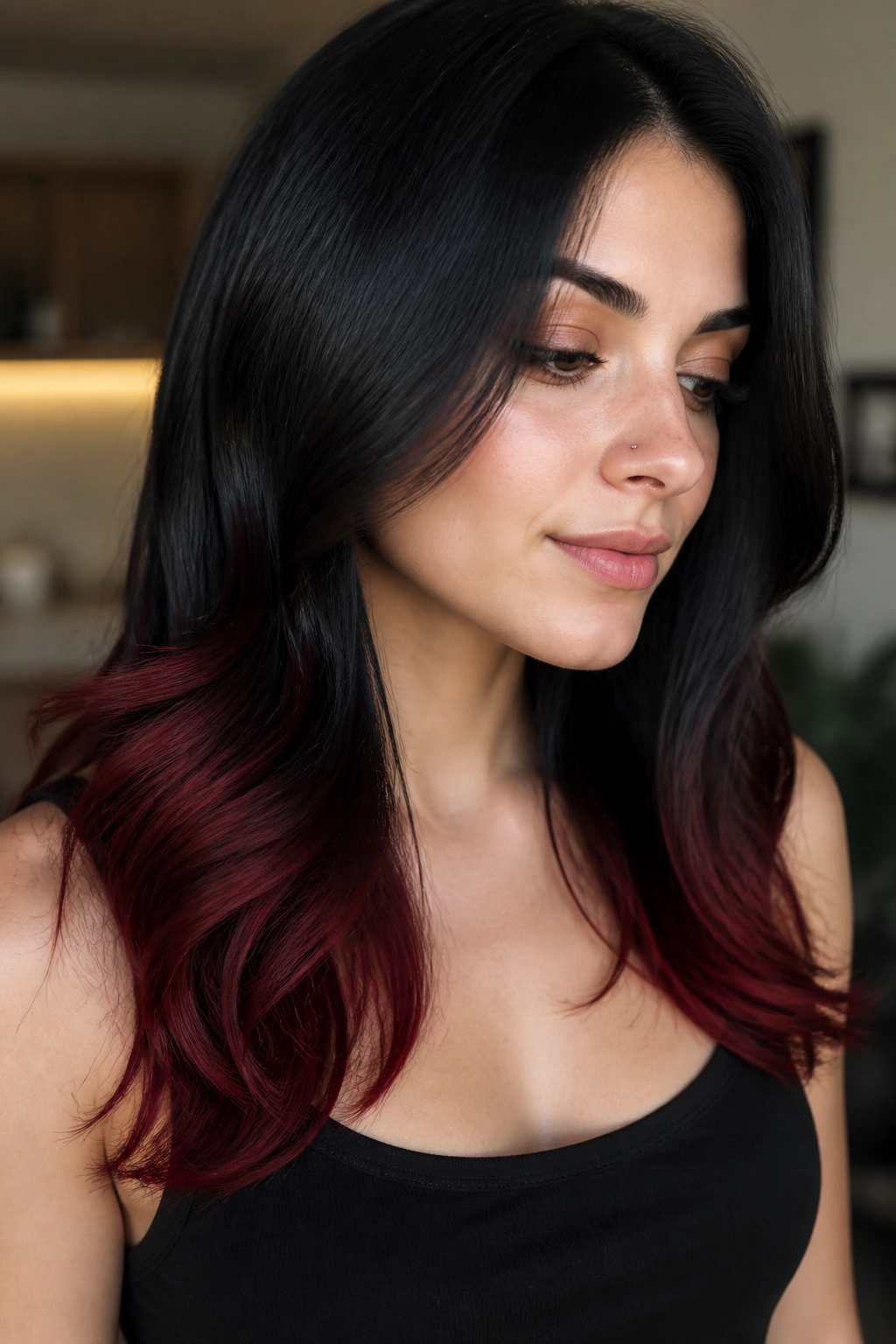
If you want red-black hair that feels sleek instead of striped, a cherry glaze on the ends is a smart move. The red stays translucent, almost like a wash of color over the black, and the face stays framed by darkness.
This works especially well when the ends are already healthy and blunt. The glaze catches the light and gives the bottom of the hair a cherry reflection, but it does not shove color into the cheeks. On a round face, that lower placement helps the eye move down, which is what you want.
I like this when someone wants change without a huge commitment. A glaze can be refreshed more easily than a fully saturated red panel, and it fades in a softer way. As it lightens, it still looks intentional.
A few things help it stay sharp:
- Keep the roots black
- Ask for a glossy finish
- Cut dry or frayed ends before coloring
- Style with a smooth bend so the glaze shows
This one is subtle. Subtle is useful.
20. Red Velvet Ombré for Curly Round Faces
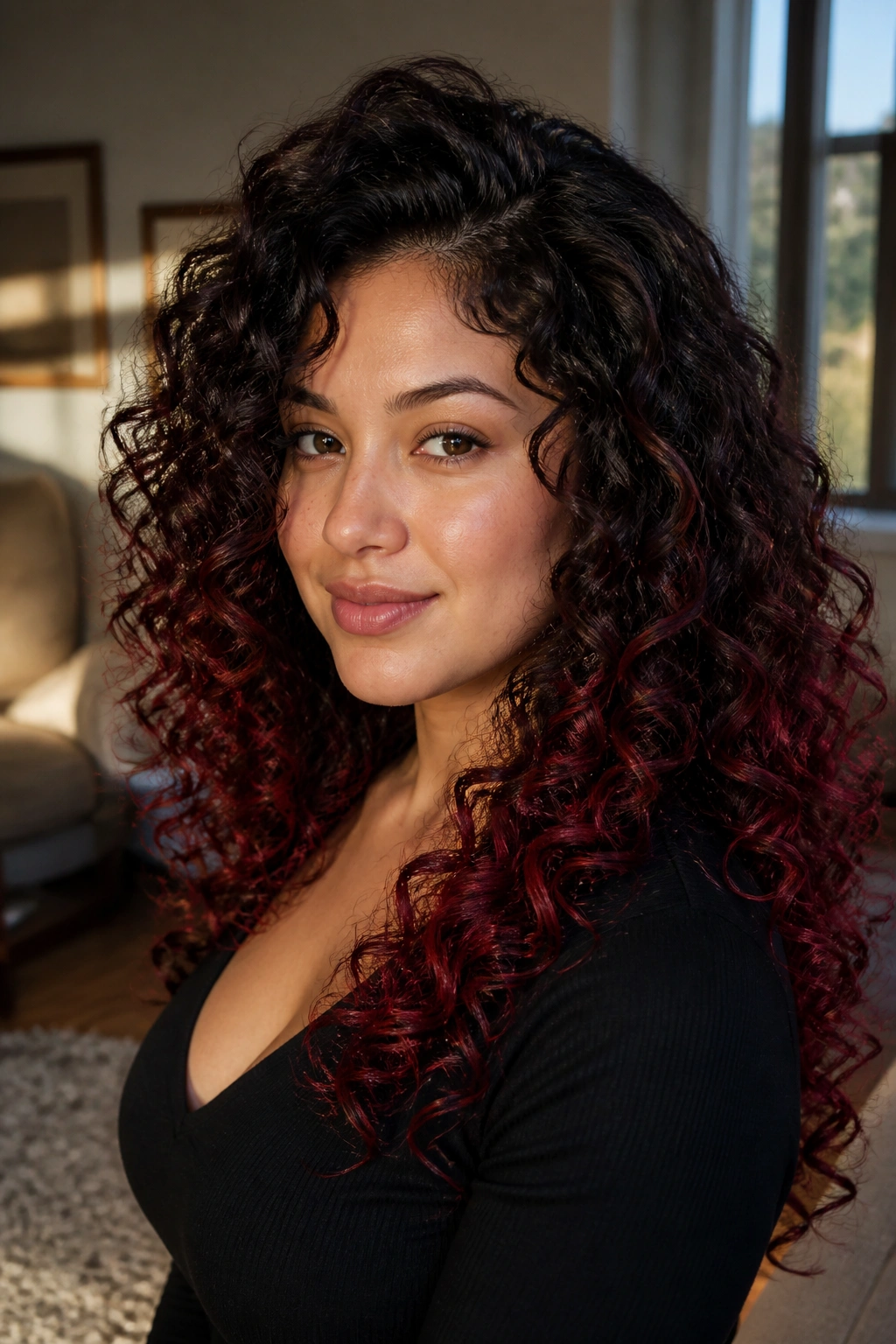
How do curls change the placement rules? A lot. Curls spread color outward, so the safest move is to keep the roots dark and put the red on the lower third of the curl pattern. That way the color lengthens the silhouette instead of widening the cheeks.
Red velvet is a good call because it sits between bold red and deep wine. On curly hair, that in-between shade gives depth without turning each curl into a bright dot. The red should appear on the outer halo of the curls, not packed into the inside near the face.
The ombré should feel gradual. A hard color block on curls can look choppy unless that is the exact look you want. For a round face, a smoother fade is kinder. The dark roots keep the face anchored; the red ends carry the drama downward.
What curls need here
- Dark root area
- Red placed lower on the hair
- Defined curl clumps
- Moisture, because dry red ends are obvious
If your curls are very tight, ask your colorist how the red will sit in shrinkage. That question saves regret later.
21. Dark Mahogany Gloss Over Black Hair
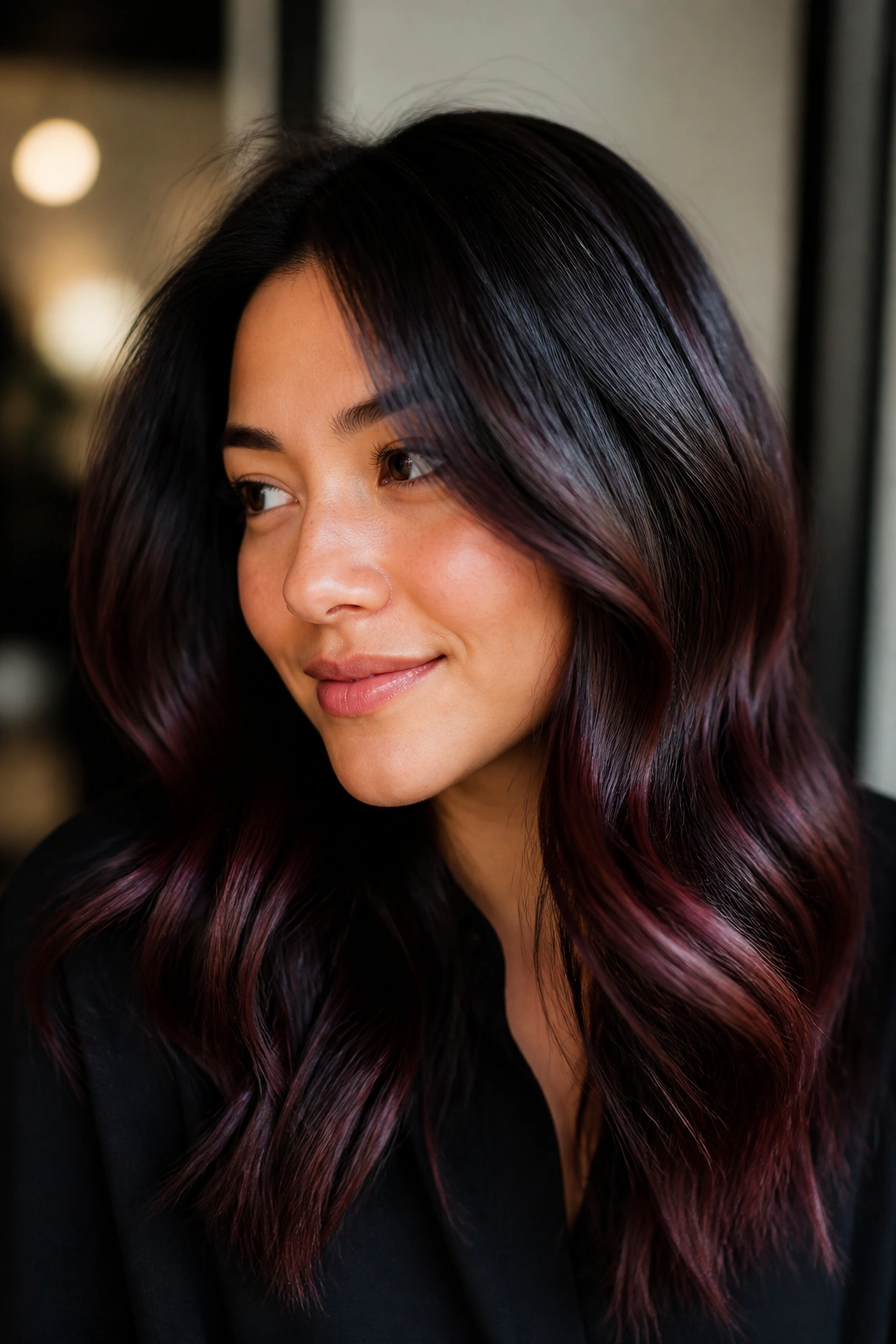
Sometimes the smartest red-black idea is the one that barely announces itself. A dark mahogany gloss over black hair warms the base without creating obvious panels, and that can be excellent for round faces.
The reason is simple: gloss adds depth, not width. It deepens the black, gives the hair a red-brown sheen in the light, and keeps the overall shape clean. There is no stripe to fight with, no heavy face-framing section to manage, and no bright edge at the cheeks.
Low drama, high payoff. That is the whole pitch.
This is especially good if you like your hair shiny and smooth. The gloss makes black hair look richer and the red undertone feel more deliberate. It also grows out with almost no visual drama, which is useful if you do not want a strict maintenance schedule.
If you have naturally warm skin, mahogany can tie the whole look together. If your skin runs cooler, the red-brown note still works as long as the black stays dominant. It is the quietest option here, but not the dullest.
22. Black Cherry Curtain Fringe With Soft Red Ends
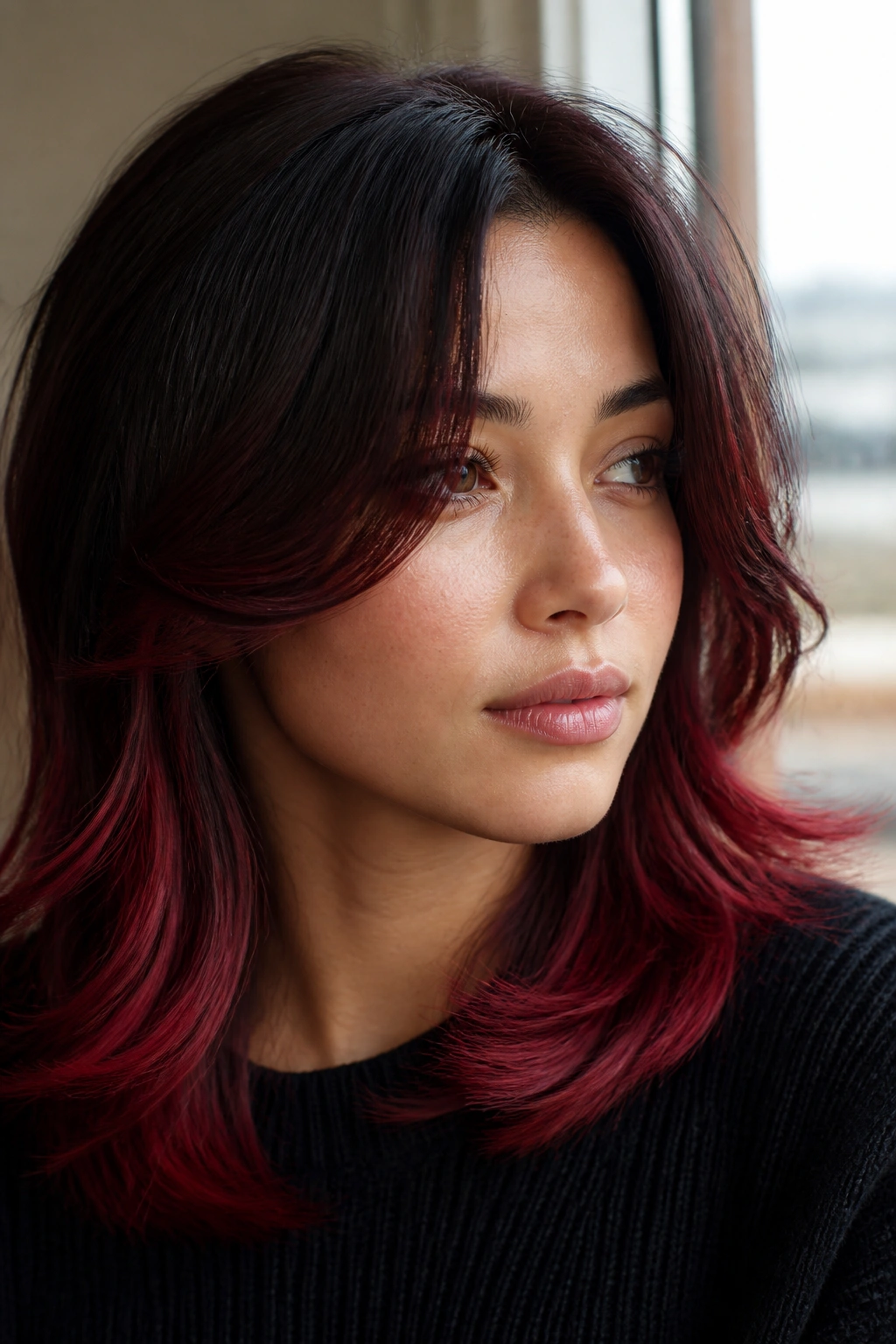
A curtain fringe can work on a round face if the color is handled carefully. The fringe opens the center of the face, while the soft red ends pull the eye downward. That combination gives you shape without a blunt block across the forehead.
The fringe itself should split in the middle and skim the cheekbones, not sit heavy and straight across the face. Keep the roots dark near the fringe, then let the red show farther down through the ends and lower lengths. That keeps the width out of the most sensitive area.
Soft red ends make the cut feel connected. They also stop the fringe from looking disconnected from the rest of the style. On wavy or loosely curled hair, this can be gorgeous, because the fringe stays light while the lower color moves.
Best details to ask for
- A curtain fringe, not a blunt bang
- Darker roots through the front
- Red that begins below the cheekbone
- A soft bevel on the ends
It is a good final note because it proves the main point: red-black hair for a round face works when the color has direction.
Final Thoughts
Round faces do not need to hide behind dark color. They need shape. Red and black can give you that shape if the red moves vertically, stays lower, or frames the face in a narrow way instead of a wide one.
The styles that work best are usually the ones that respect the cheeks. Cherry pieces at the temples, burgundy tucked underneath, or red ends that sit below the chin tend to flatter more than bright side stripes. That is the real pattern here.
If you are choosing between two shades, choose the one that lets the black stay dominant. The red can still be bold. It just needs a smarter seat at the table.
