



A short inverted bob can be a cheat code for a round face—if the angle lands in the right place. Cut it too blunt and it can widen the cheeks. Cut it with enough lift at the back and a clean drop toward the front, and the whole face looks longer, sharper, and a little more awake.
The phrase short inverted bob haircuts for round faces gets searched for a reason. Most people are not chasing a drastic chop. They want shape. They want cheekbones to show up a little more, a jawline to look cleaner, and a haircut that does something useful without demanding a 45-minute styling session before breakfast.
Tiny adjustment. Big difference.
The mistake I see most often is a bob that sits right at the widest part of the face and then stops there, like it forgot to finish the job. A better inverted bob gives the eye a diagonal line to follow. Side parts help. Front pieces that fall below the cheekbone help more. So do soft layers in the crown when the hair wants to lie flat and sulk.
1. Softly Stacked Inverted Bob for Round Faces
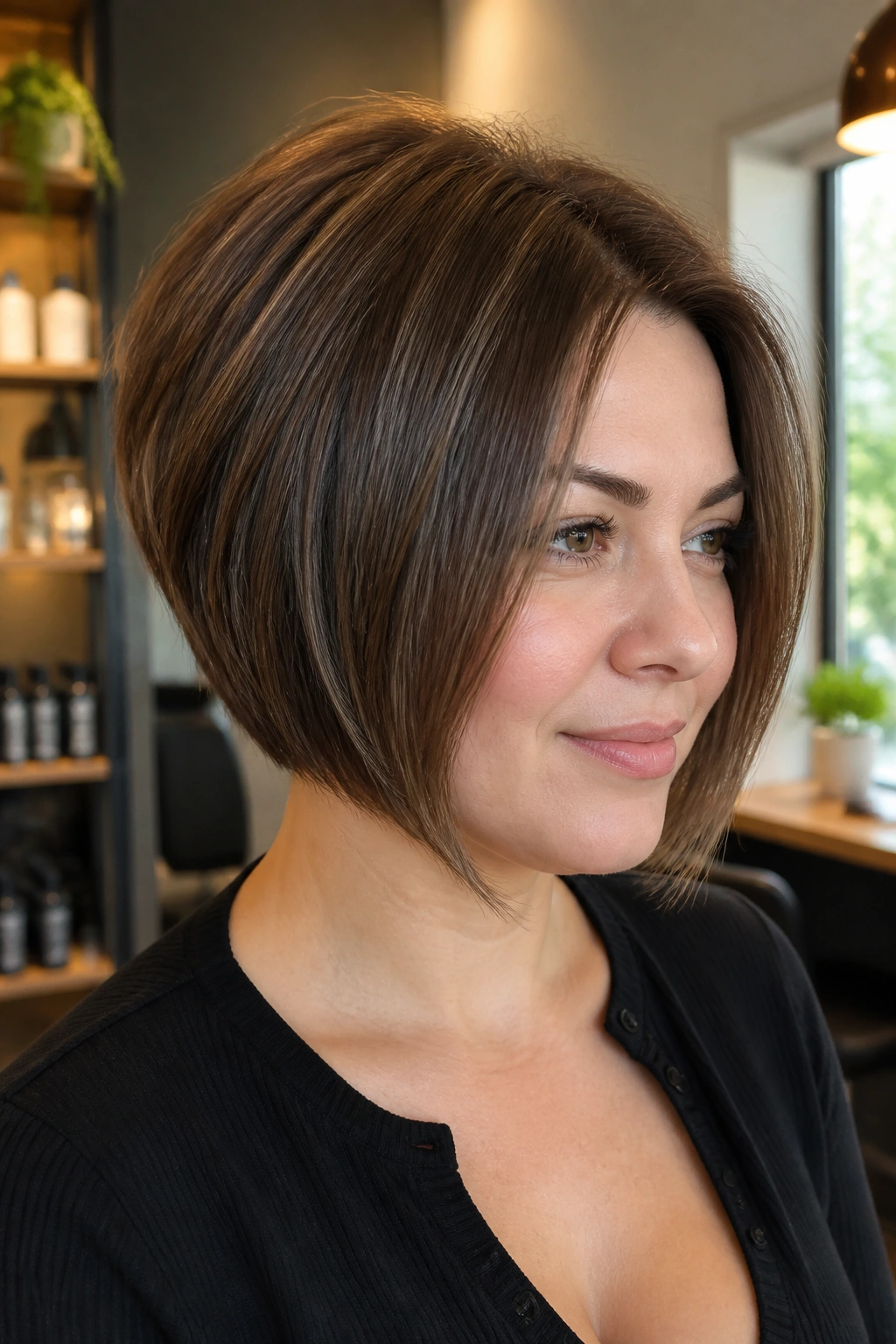
This is the safest place to start if you want the roundness softened without looking like you’re trying too hard. The back is neatly stacked, but not aggressively short, and the front pieces drift down past the jaw instead of ending at it.
Why It Works on a Round Face
A softly stacked shape adds lift where round faces usually need it most: at the crown and upper back of the head. That little bit of height changes the balance of the whole haircut. The face stops reading as wide first and starts reading as longer.
The front should stay gentle. Ask for pieces that skim just below the jawline instead of stopping right at the chin. That small drop keeps the eye moving downward. It’s subtle, which is exactly why it works.
- Keep the shortest layers at the nape, not high in the back.
- Ask for a 45-degree stacked graduation, not a severe wedge.
- Style with a light root mousse and a 1.25-inch round brush.
- Skip heavy oils near the roots. They flatten the lift fast.
Best tip: if your hair is fine, this is one of the few short inverted bob haircuts for round faces that can look full without getting puffy.
2. Deep Side-Part Angled Bob for Round Faces
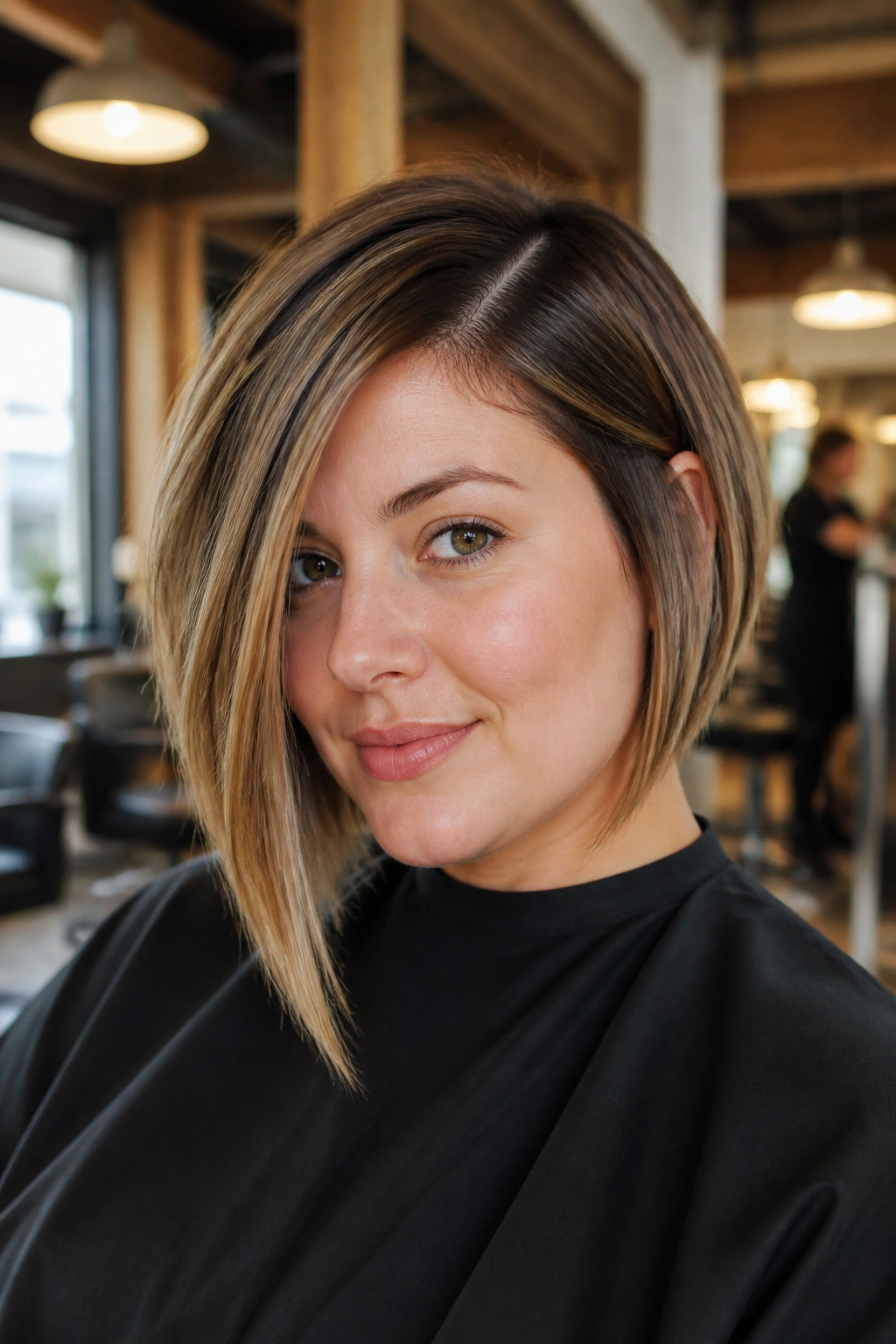
A side part does more slimming than another half inch of length. That sounds almost too simple, but it’s true. A deep side part shifts the visual weight off the middle of the face and gives the haircut a cleaner diagonal line.
The best version of this cut keeps one side slightly longer so the front can fall toward the collarbone while the shorter side hugs the jaw. That slant breaks up the curve of a round face in a way that feels polished, not sharp. It also works well if one side of your hair naturally resists volume, because the part gives it a job to do.
Ask your stylist to place the part about 2 inches off center and keep the angle visible in profile. If both sides land at the same place, the haircut loses its edge. You want the line to show when you turn your head.
A deep side-part angled bob is especially good for thick hair that wants to balloon at the cheeks. The part pulls some of that fullness upward. Cleaner. Leaner. Better behaved.
3. Curtain Bang Inverted Bob for Round Faces
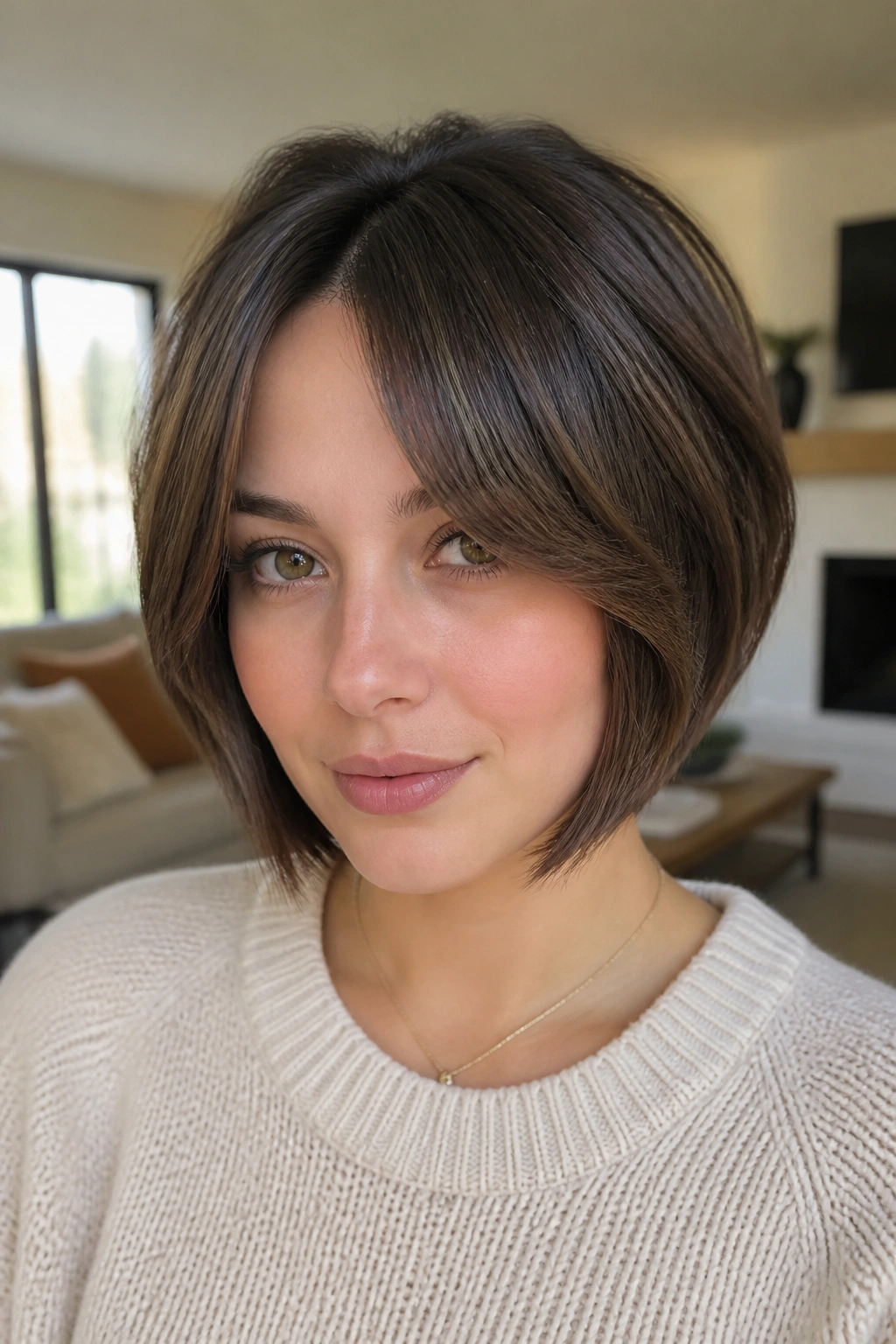
Why do curtain bangs keep showing up on round faces? Because they split the forehead visually and then open outward toward the cheekbones, which gives the face a longer shape without hiding it behind a wall of hair.
The key is placement. Curtain bangs should start narrow in the center and get a little longer as they move outward, usually grazing somewhere between the brow and the outer corner of the eye. If they’re cut too short and too full, they can make the face look boxier. That’s the wrong move here.
The bob itself should stay inverted and lightly stacked, with the front pieces falling below the chin. The bangs do the softening, while the angled body of the cut does the lengthening. That pairing is what keeps the haircut from feeling heavy.
How to Style It
Blow-dry the bangs away from the face with a 1.5-inch round brush. Aim the airflow downward first, then flip the brush slightly outward at the ends. A cool shot at the end keeps the bend from collapsing by lunchtime.
A tiny bit of smoothing cream on the fringe is enough. More than that and the bangs separate in a greasy way that no one asked for.
4. Feathered Ends Inverted Bob
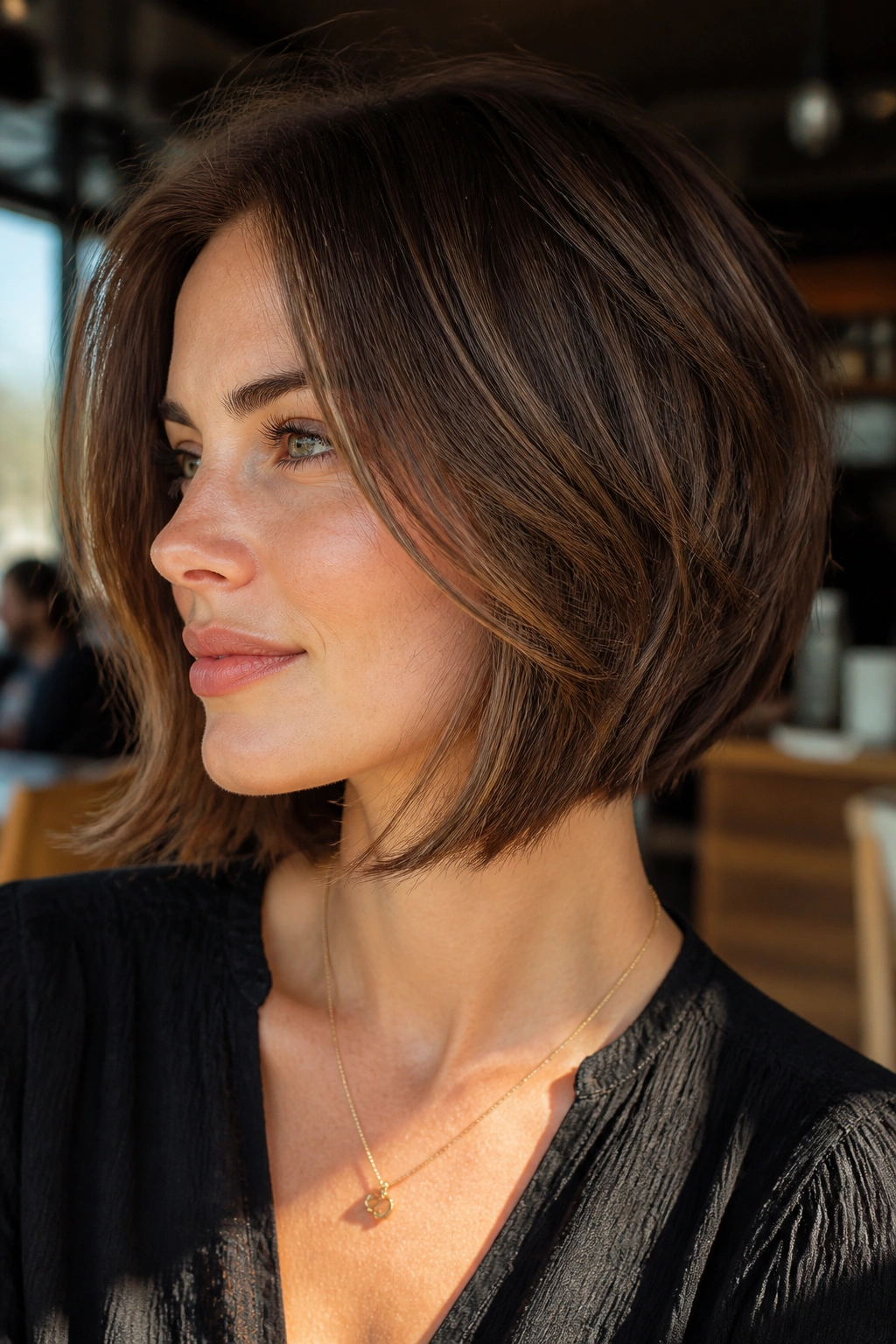
A feathered bob has a lighter feel at the edges, and that matters more than people think. Round faces can get swallowed by a haircut that ends in one thick, blunt block. Feathered ends break that block apart.
Picture a bob with movement at the bottom instead of a hard shelf. The back still gives you structure, but the ends flick a little, so the line around the jaw doesn’t feel boxed in. That softness keeps the face from looking wider than it is.
This cut is especially good if your hair has a bit of natural wave or if your ends tend to curl under on their own. The feathering works with that movement instead of fighting it. If your hair is very thick, ask for internal removal of weight so the feathering doesn’t turn into a fluffy triangle. Nobody wants the triangle.
- Best with a razor-light point cut at the perimeter.
- Works well at chin length or slightly below.
- Style with a paddle brush for air-dried texture or a round brush for polish.
- Avoid blunt, heavy finishing on the very ends.
The nicest thing about feathering is that it grows out well. That’s worth something.
5. Sharp Glassy Inverted Bob with a Tapered Nape
This is the crisp one. The haircut has clean edges, a shiny surface, and a taper at the nape that keeps the back snug against the head. On a round face, that neatness does real work. It gives definition where the face already has softness.
A glassy bob depends on line. The front pieces should stay long enough to create a visible angle from cheek to neck. If the angle is too shallow, the cut just looks like a regular bob with a nice blowout. If it’s too steep, it can look severe. The sweet spot is a line you notice when the head turns, not a wedge that shouts from across the room.
This version loves straight hair, but it can also look good on naturally wavy hair if you’re willing to flat iron the top layer and smooth the ends. Use a 1-inch iron and pass it once or twice only. Too much heat and the shape gets brittle. Too little and the shine never shows.
A small drop of serum through the mid-lengths is enough. Keep it off the roots. That’s where clean bobs go to die.
6. Tousled French Bob with a Slight Angle

Unlike a blunt French bob, this version keeps a little more length in front and a little less bulk in back. That tilt matters. A round face usually looks better with a bob that points somewhere instead of one that ends in a flat line.
The messy finish helps too. Soft texture keeps the haircut from feeling stuck on the face. A few bendy pieces around the cheekbones make the whole cut feel lighter. That’s especially useful if your features are delicate and you don’t want the haircut to do all the talking.
This is one of the easier short inverted bob haircuts for round faces if you live in air-dry territory. A salt spray, a small dab of styling cream, and a rough-dry with your fingers can be enough. Don’t overcomb it. You’ll only flatten the movement you wanted in the first place.
Best on fine to medium hair. Very thick hair can wear this cut, but it needs enough internal removal so the back doesn’t puff out. Keep the angle visible, even when the styling is undone. That’s the whole trick.
7. Asymmetrical Bob with Long Front Pieces for Round Faces
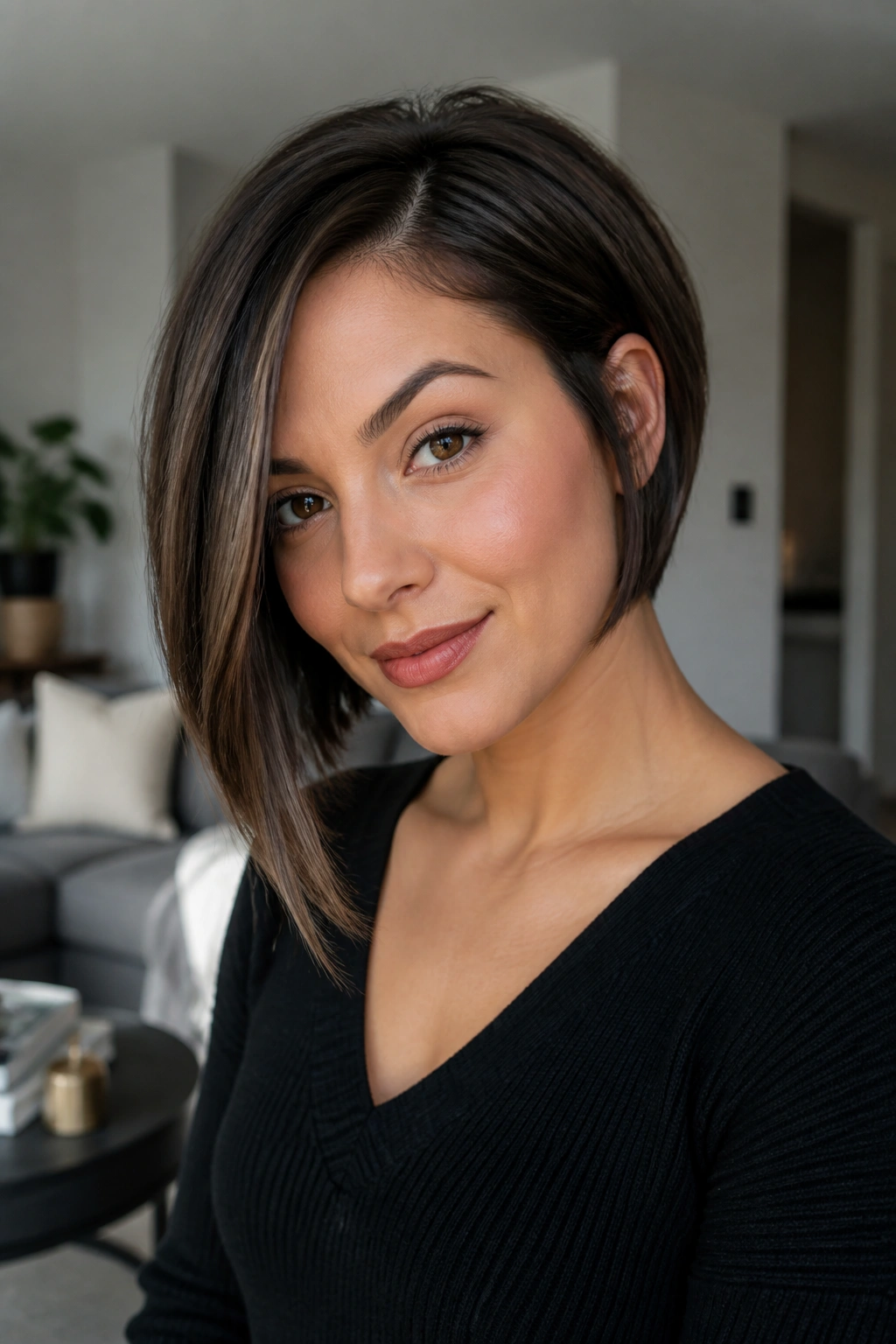
One side can be a full inch longer and still look balanced. That’s the part people often miss. Asymmetry gives the eye a line to follow, and the face stops reading as a circle.
The longer front section should fall past the chin, sometimes even brushing the top of the shoulder depending on how short the back is. The shorter side can sit right around the jaw. That contrast creates direction, which is what round faces need more than extra volume. A little drama doesn’t hurt either.
Keep the back compact. If the back gets too heavy, the whole cut slumps. The point is to make the front look intentional, not accidental. Ask for the angle to be strongest when the hair is parted on the shorter side, because that’s where the effect usually looks cleanest.
This cut suits straight hair, but it’s especially nice on hair with a bend. The uneven line becomes softer when the hair moves. That keeps the style from looking stiff or overbuilt.
8. Chin-Grazing Tucked Bob
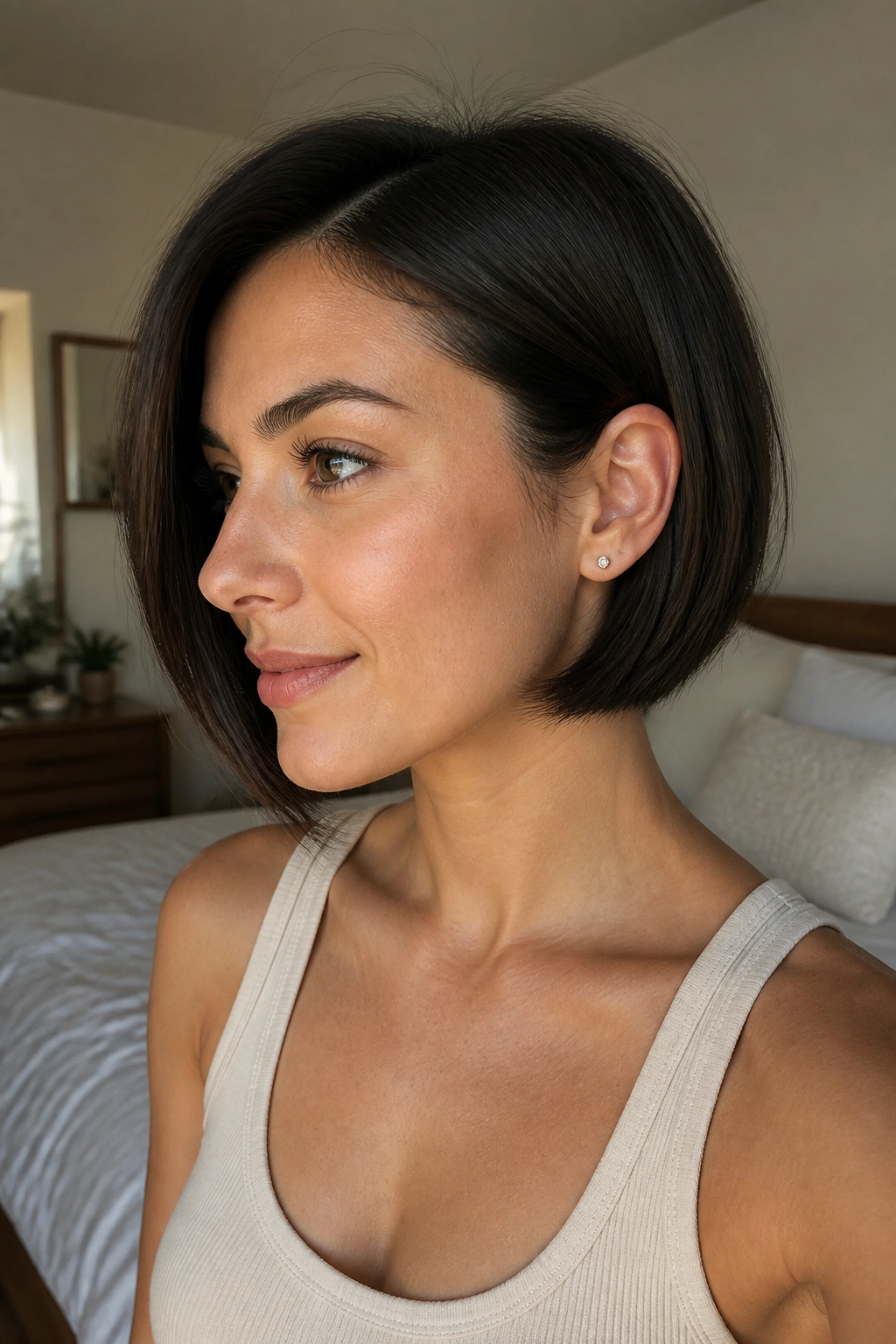
Can a bob that sits right at the chin work on a round face? Yes, but only if the ends are light and the sides stay narrow. Otherwise you get width right where you don’t want it.
The tucked version solves that problem. One or both sides can be tucked behind the ears, which opens the face and lets the jawline show through. That little reveal changes everything. A fully loose chin bob can feel heavy. A tucked one feels cleaner and more deliberate.
Why the Tuck Matters
Tucking keeps the hair from landing as one solid band around the cheeks. It creates a break in the line, and that break is what helps the face look less broad. The bob still does its job, but it does it quietly.
Ask for soft internal layering so the tucked side doesn’t pop out with too much bulk. If your hair is thick, that matters even more.
- Best with a side part or an off-center part.
- Use a flat iron only on the front half if the ends flip too much.
- A light wax on the tucked side keeps flyaways down.
- The cut looks best when one ear is left visible. Small detail. Big payoff.
9. Crown-Lifted Layered Bob
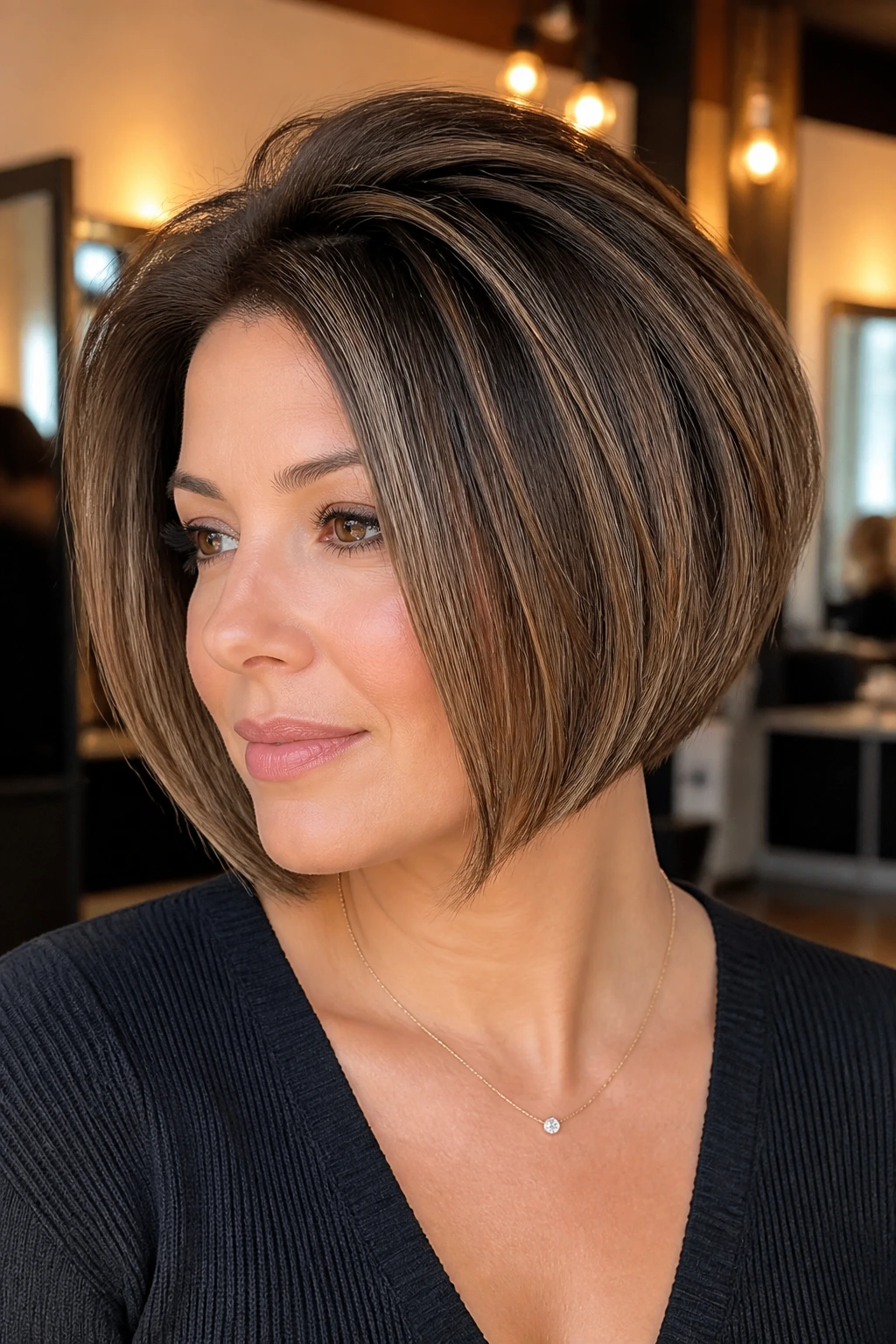
Flat hair and round faces can be a rough pairing. When the top goes limp, the widest part of the face starts to dominate. A crown-lifted bob fixes that by putting height where the face needs it most.
The lift should live high on the head, not out at the sides. That distinction matters. Volume near the temples can widen the face. Volume at the crown lengthens it. Stylists who know this usually cut a few internal layers through the top, then leave the outer perimeter clean so the shape still looks like a bob and not a shag that got lost.
A root spray and a round brush are the whole game here. Blow-dry the top section up and slightly back, then direct the front pieces forward and down so they frame the face. The contrast creates a nice vertical line.
This cut is one of the better choices for finer hair that collapses by noon. A good crown-lifted bob keeps its shape longer because the hair has somewhere to sit besides flat against the scalp. It’s practical. Also flattering. Nice when both happen.
10. Wavy Inverted Bob with Side Sweep
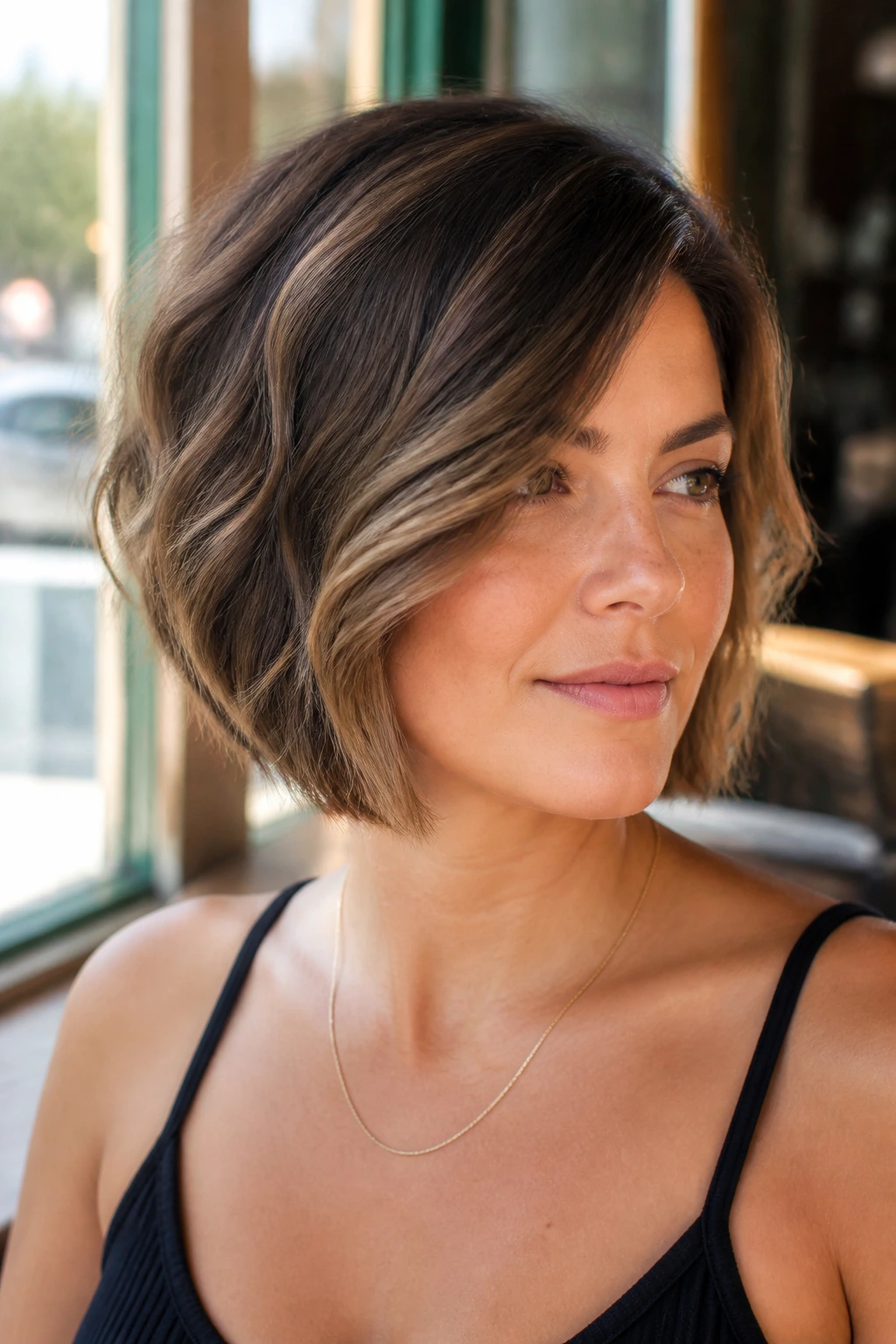
A wave changes the whole personality of an inverted bob. Instead of a hard line, you get movement. That movement helps round faces because it breaks the symmetry and keeps the haircut from sitting like a frame around the cheeks.
The side sweep is the part I like most. A loose sweep from one temple toward the opposite cheekbone creates a diagonal across the face, and diagonal lines are your friend here. They draw the eye down and out rather than straight across. That sounds small, but haircuts are often won by small things.
If your wave pattern is loose, let it stay soft. If it’s tight, stretch it a little with a diffuser and a wide-tooth comb before it dries all the way. Then scrunch the ends only. No one needs perfect curls here. They would fight the shape.
This version looks especially good when the back is tapered and the front pieces are long enough to hit below the cheek. Too short, and the wave puffs outward. Too long, and it stops feeling like a bob. There’s a narrow lane here, but it’s a good one.
11. Sleek Straight Angled Bob with a Clean Part
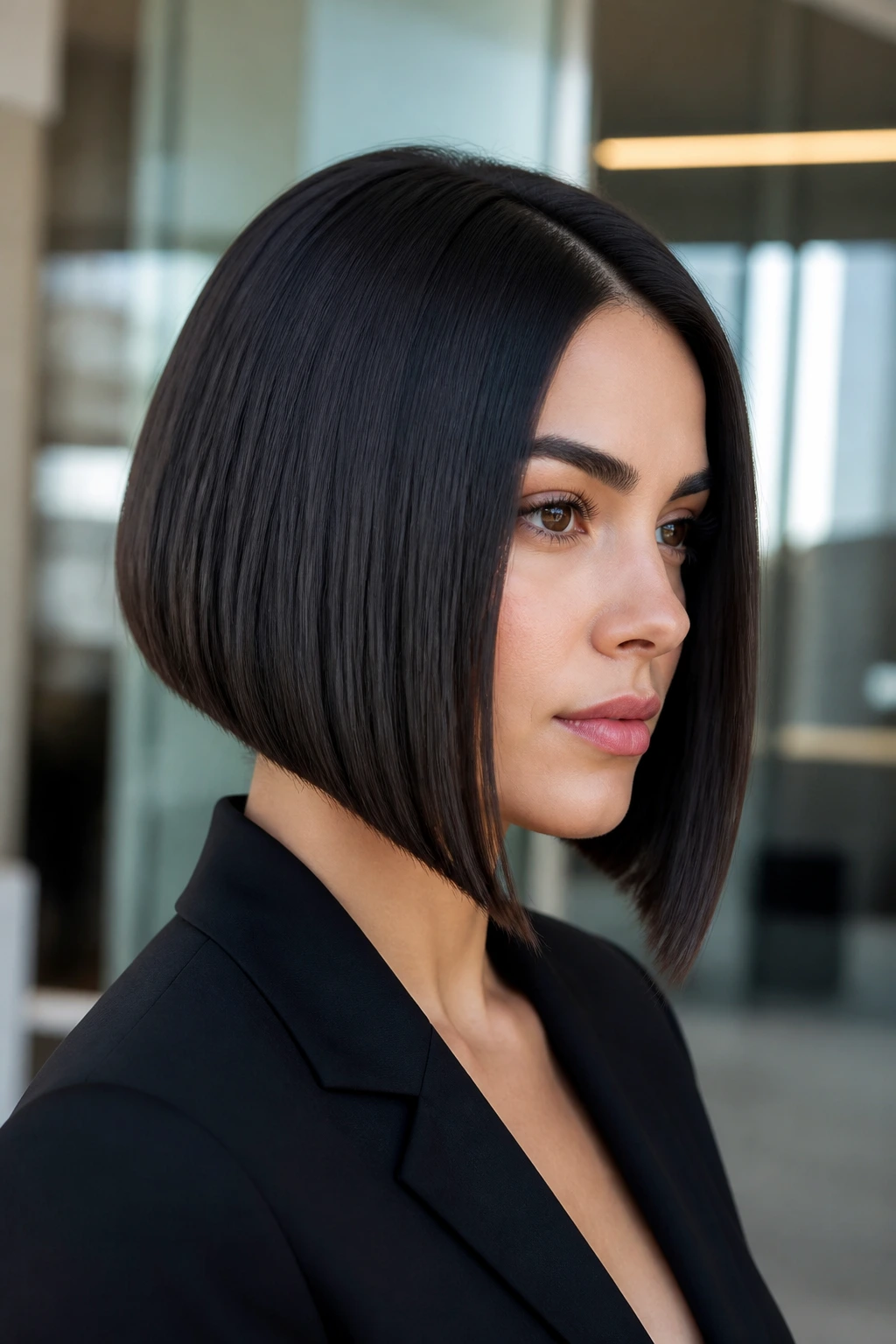
The sleek version works because it’s precise. Straight hair exposes every line, which sounds unforgiving, but on a round face that honesty can be useful. The angle becomes obvious, and the face gets a clear vertical drop through the front.
Unlike a wavy bob, this one leans on structure instead of movement. The part should be clean, the perimeter should be even, and the front should angle down in a visible sweep. If the cut is too soft, it loses the sharpness that makes it flattering.
This shape loves thick hair because thick hair holds a crisp edge. It also works for fine hair if the stylist keeps enough density in the ends so the line doesn’t look wispy. A blunt front would be too heavy here, so the weight should be tucked into the back and released gradually toward the front.
Ask for a blowout that bends the ends inward just slightly. A flat, poker-straight finish can look severe. A tiny curve at the bottom is more flattering and less brittle-looking. That little bend matters more than people admit.
12. Piecey Bob with Micro Layers
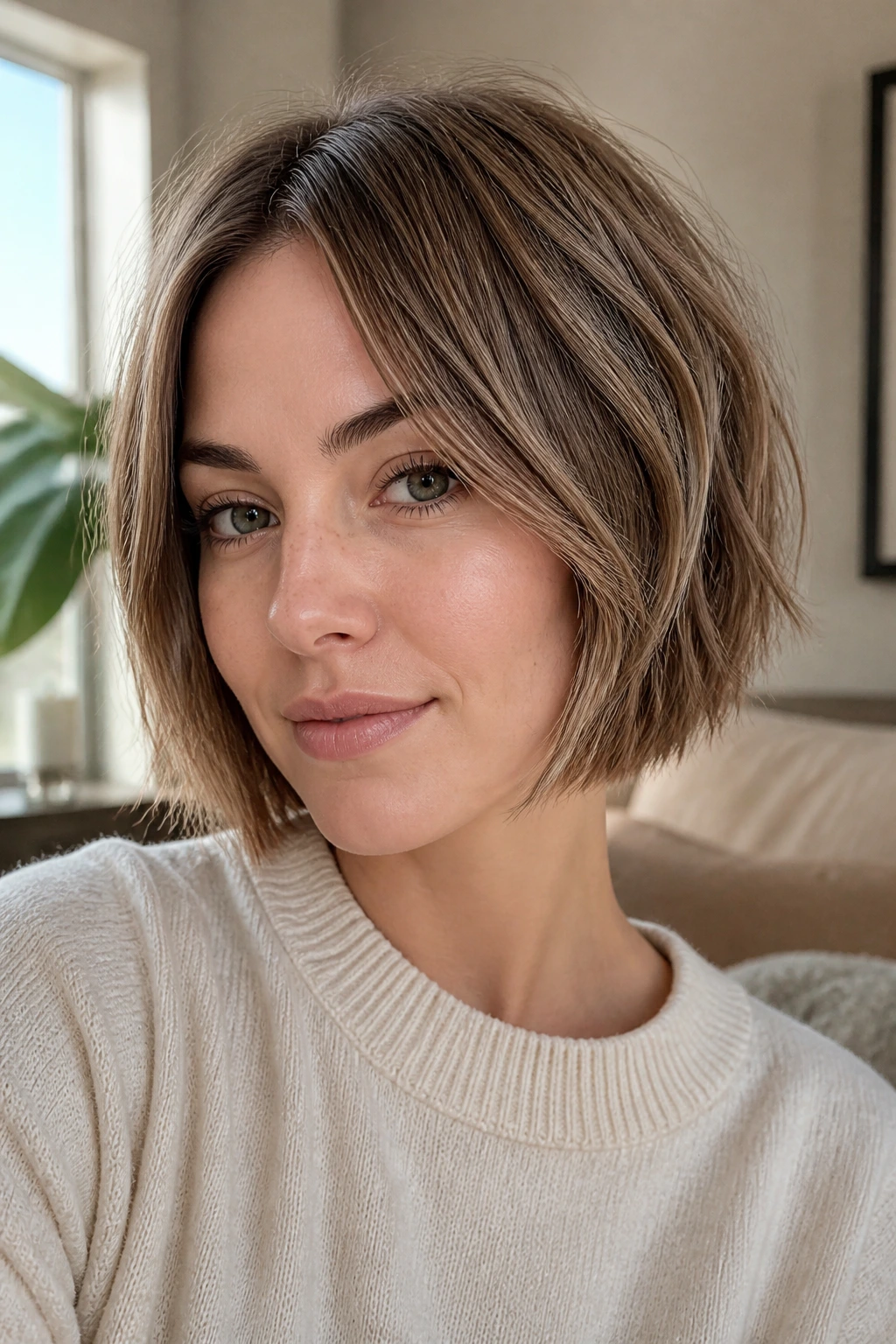
Why does piecey texture help? Because it breaks the haircut into smaller visual sections, and that keeps the face from looking boxed in by one solid shape.
Micro layers are a quiet fix. They’re not dramatic. They’re just enough to stop the ends from landing as one thick line around the cheeks. If your hair is dense, this matters a lot. If your hair is fine, the layers need to stay subtle so you don’t lose body.
How to Get the Piecey Finish
Use a small amount of matte paste on dry hair. Warm a pea-sized amount between your palms, then pinch it through the ends in 2-inch sections. That’s enough to define the pieces without making the bob look sticky.
A few more details help:
- Keep the shortest layers below the cheekbone.
- Twist random sections while they’re still damp.
- Dry the top with fingers, not a brush, if you want separation.
- Leave the ends a touch undone. Too polished kills the effect.
The nicest thing about this cut is that it looks intentional even when it’s slightly messy. That’s rare. And useful.
13. Bottleneck Bang Bob
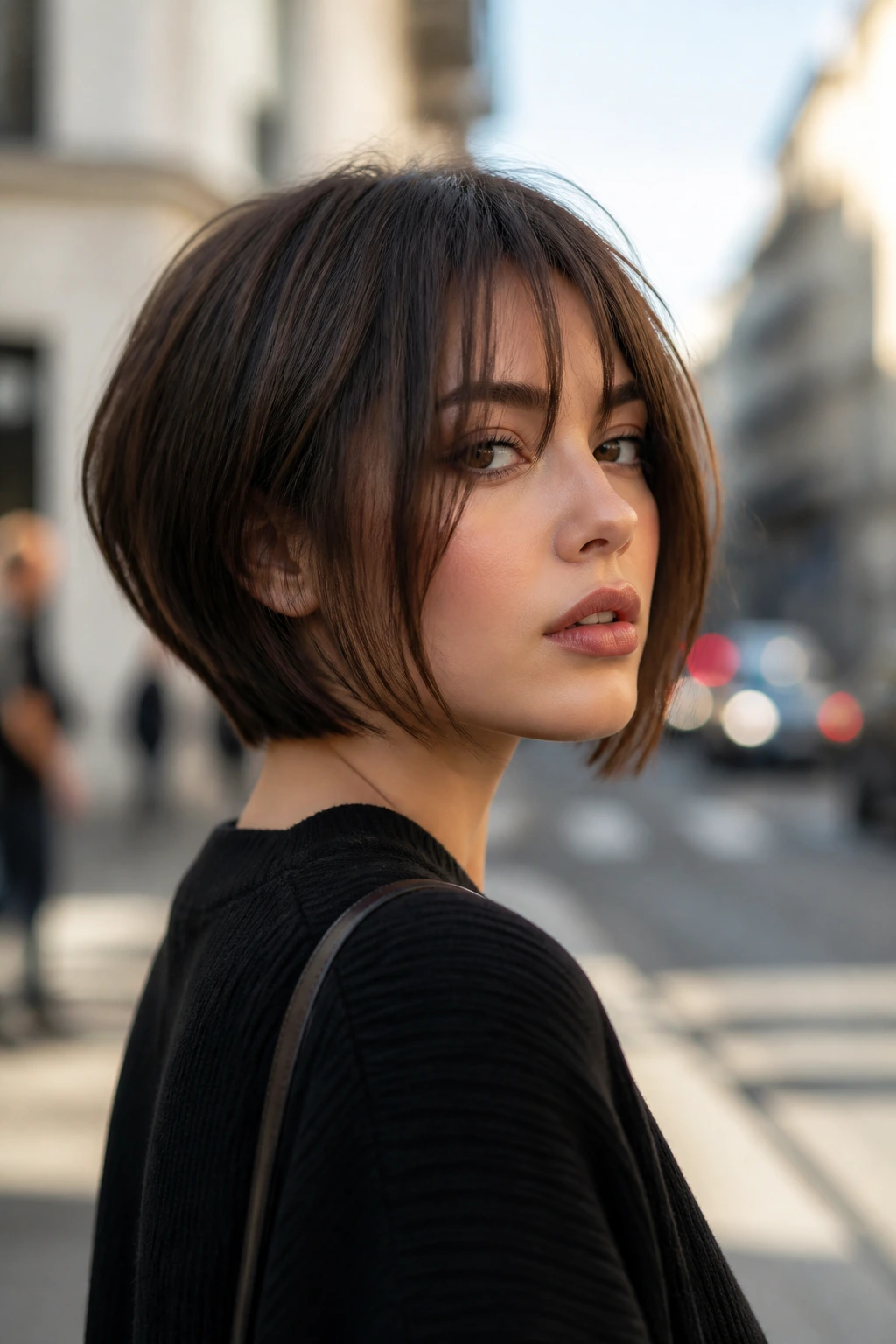
A bottleneck bang can be a smart move for round faces because it starts narrow in the center and then opens out around the eyes and cheekbones. That shape changes the upper half of the face before the bob even gets a chance to work.
The trick is not making the bangs too heavy. Full bangs can flatten the face if they hang straight across the forehead. Bottleneck bangs avoid that by creating a soft middle point and then a wider curtain-like shape near the temples. It’s a gentler version of fringe, and gentler is usually better here.
The bob underneath should stay angled and short enough at the back to keep some lift. If the rest of the haircut is too flat, the bangs can feel disconnected. Ask for the front pieces to blend into the fringe line so everything moves together.
This style is good when you want a little face-framing without committing to full curtain bangs. It also photographs well in motion, which is a fancy way of saying it looks better when you’re not staring at it in a bathroom mirror under harsh light.
14. Nape-Short Undercut Bob
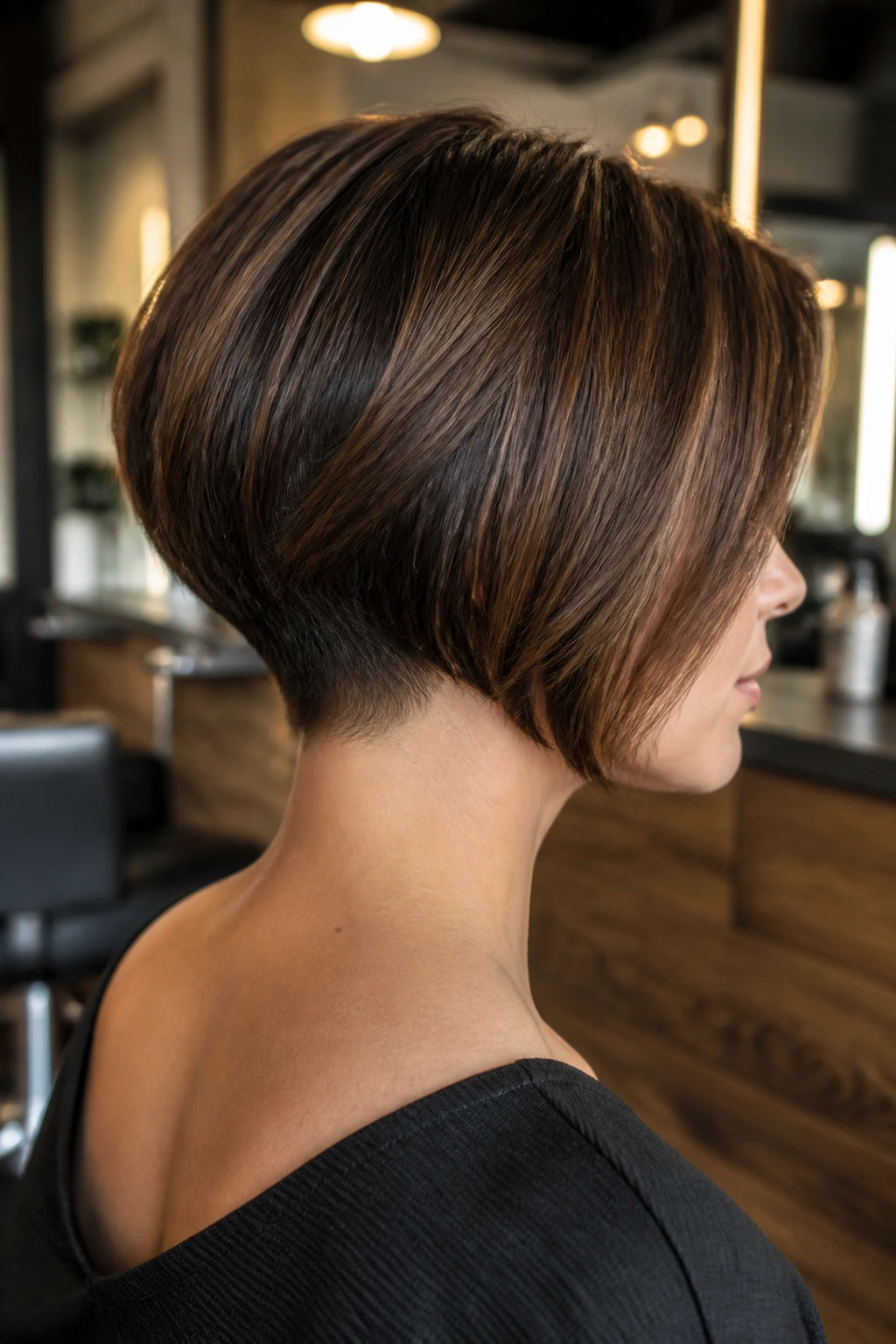
This is the edgy one, and it is not for everyone. But if your hair is thick, coarse, or stubbornly bulky at the back of the head, a hidden nape undercut can save the cut from ballooning out.
The point is control. The undercut removes weight from the lower back section so the top layers can sit close to the head. That keeps the silhouette sleek and lets the front angle do its work. On a round face, that matters because extra bulk at the nape can make the neck area look shorter and the face look wider by comparison.
Ask for the undercut to stay concealed, usually about half an inch to 1 inch high, depending on density. If it shows too much, the cut starts feeling more severe than short inverted bob. If it stays hidden, you get the benefits without the drama.
A caution here: very fine hair usually does not need this. Take away too much weight and the bob can look flat and sparse. Thick hair, though? Different story. Different rules.
15. Collarbone-Skimming Short Inverted Bob
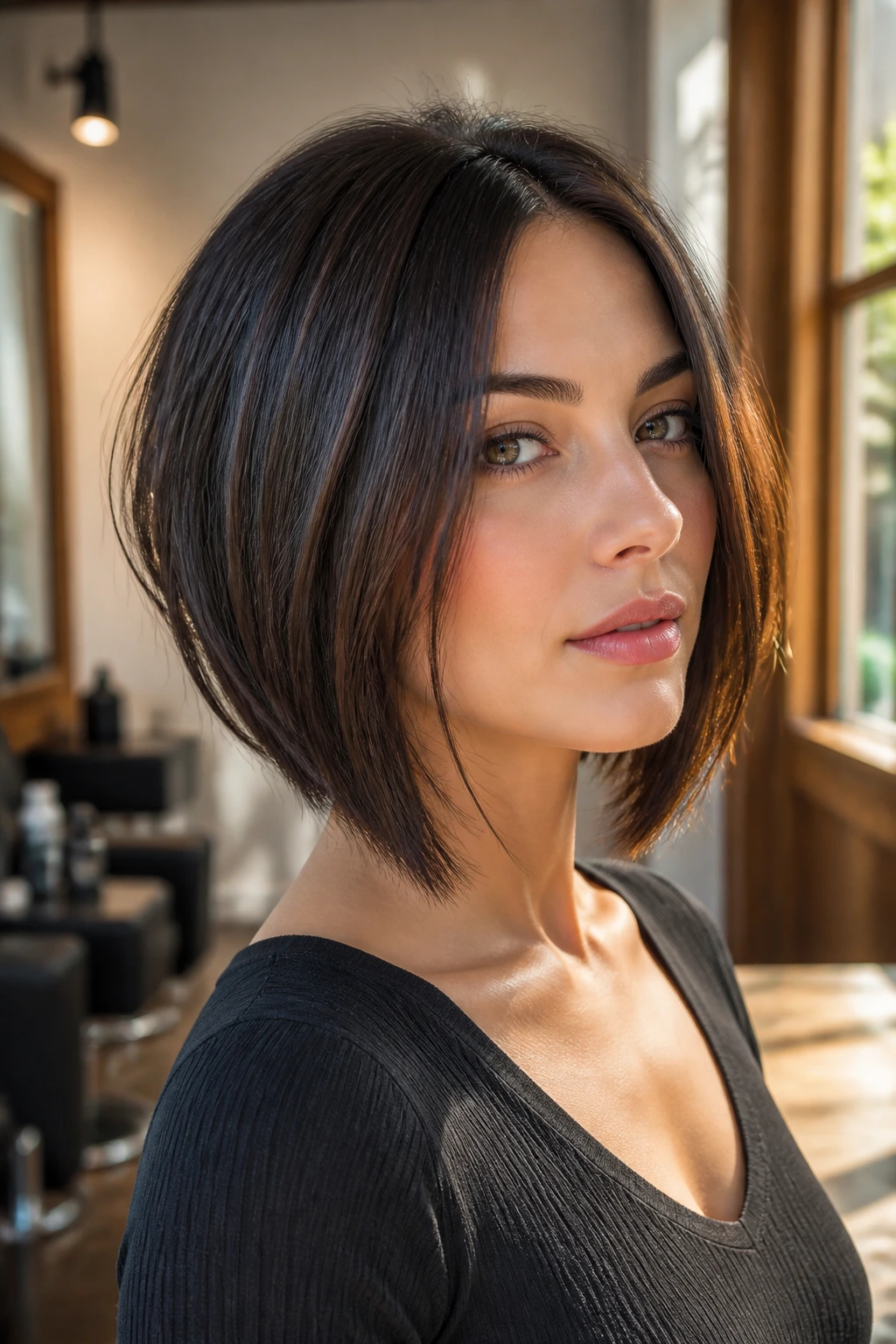
This version is for the person who wants the slimming effect of an inverted shape but doesn’t want to live at the salon every five weeks. The front lands lower—sometimes brushing the collarbone—while the back still keeps a short, lifted line.
That extra length makes the face look longer in a calm, easy way. It also gives you a little more styling freedom. You can tuck it, wave it, straighten it, or leave it with a bend and still keep the angle intact. Shorter bobs can be fussy. This one is less fussy.
A collarbone-skimming front works especially well if your cheeks are the widest point of your face. The ends drop below that area, which softens the width without hiding the face entirely. There’s a nice balance in that. Enough shape to matter, enough length to feel relaxed.
This cut grows out well, too. That’s not glamorous, but it matters. A haircut that still looks deliberate three weeks later is worth more than one that only behaves on day one.
16. Curved Inverted Bob with Rounded Ends
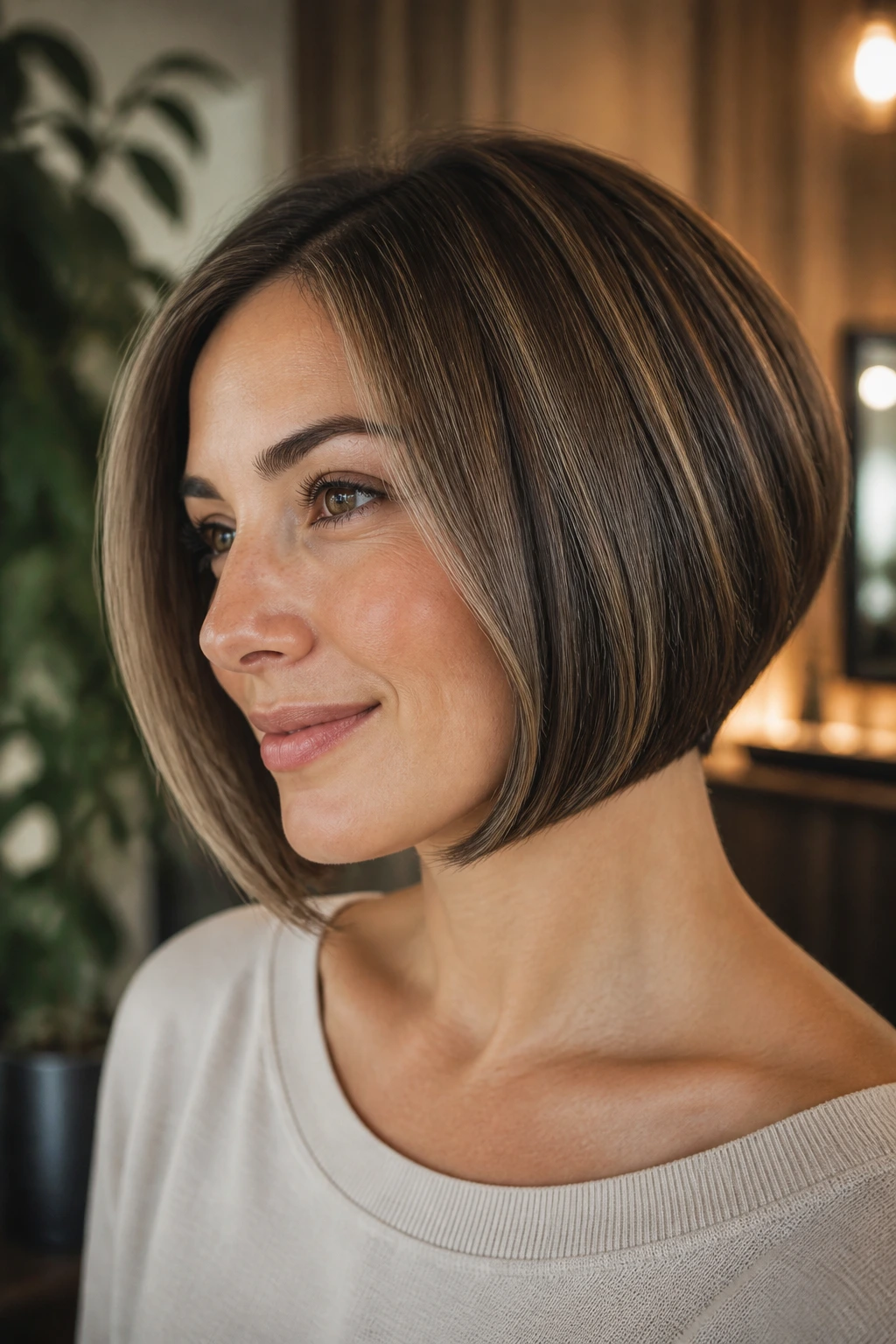
A curved inverted bob is softer than a sharp angled one. The line bends inward toward the jaw instead of slicing straight down, and that inward curve can be kind to a round face when you want polish without edge.
The curve is especially helpful if your hair naturally rounds under on its own. Instead of fighting that bend, the cut uses it. The stylist keeps the back lifted and the front slightly longer, then shapes the ends so they turn in gently. No hard corners. No shelf-like perimeter.
What Makes the Curve Work
The curve creates a visual oval around the face instead of a circle around the cheeks. That’s the whole idea. It gives structure, but it doesn’t feel severe.
Styling is simple if your hair cooperates:
- Use a large round brush on the front sections.
- Aim the ends under, not out.
- Keep the root area lifted with mousse or spray.
- Avoid over-thinning the perimeter, or the curve turns wispy.
A curved bob is a good middle road. Not too strict. Not too soft. Just enough shape to matter.
17. Razor-Cut Airy Bob
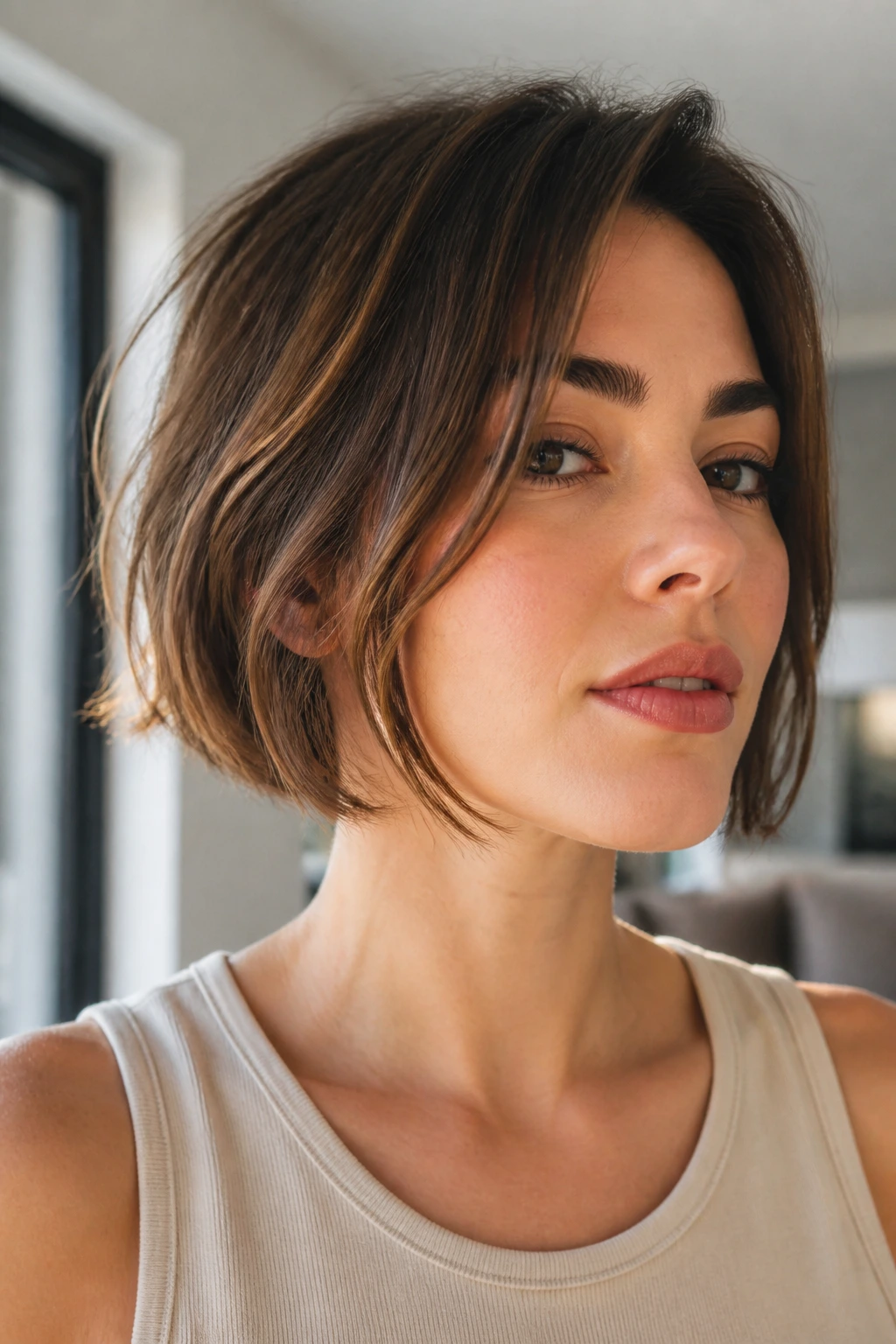
Can a razor cut work on a round face? Absolutely, if the stylist has a steady hand and the hair texture can handle it. The point of the razor is to remove weight and create air around the ends, which keeps the bob from feeling dense at the cheeks.
This cut is a nice fit for medium hair and some fine textures, but I’d be cautious with very frizzy or highly porous hair. A razor can make those ends split apart in a way that looks fuzzy instead of airy. Scissor cutting is safer there. That’s the honest version.
How to Keep It from Frizzing
Use a smoothing cream on damp hair, then rough-dry the roots and finish the mid-lengths with a round brush or diffuser. The goal is movement, not chaos. If you overwork the ends with a brush, the airy texture can disappear.
A razor-cut bob looks best when the front pieces stay a little longer than the chin. That extra length offsets the softness and keeps the face from feeling too open. If the ends are too short, the cut can puff at the widest part of the face. No thanks.
18. Side-Parted Face-Framing Bob
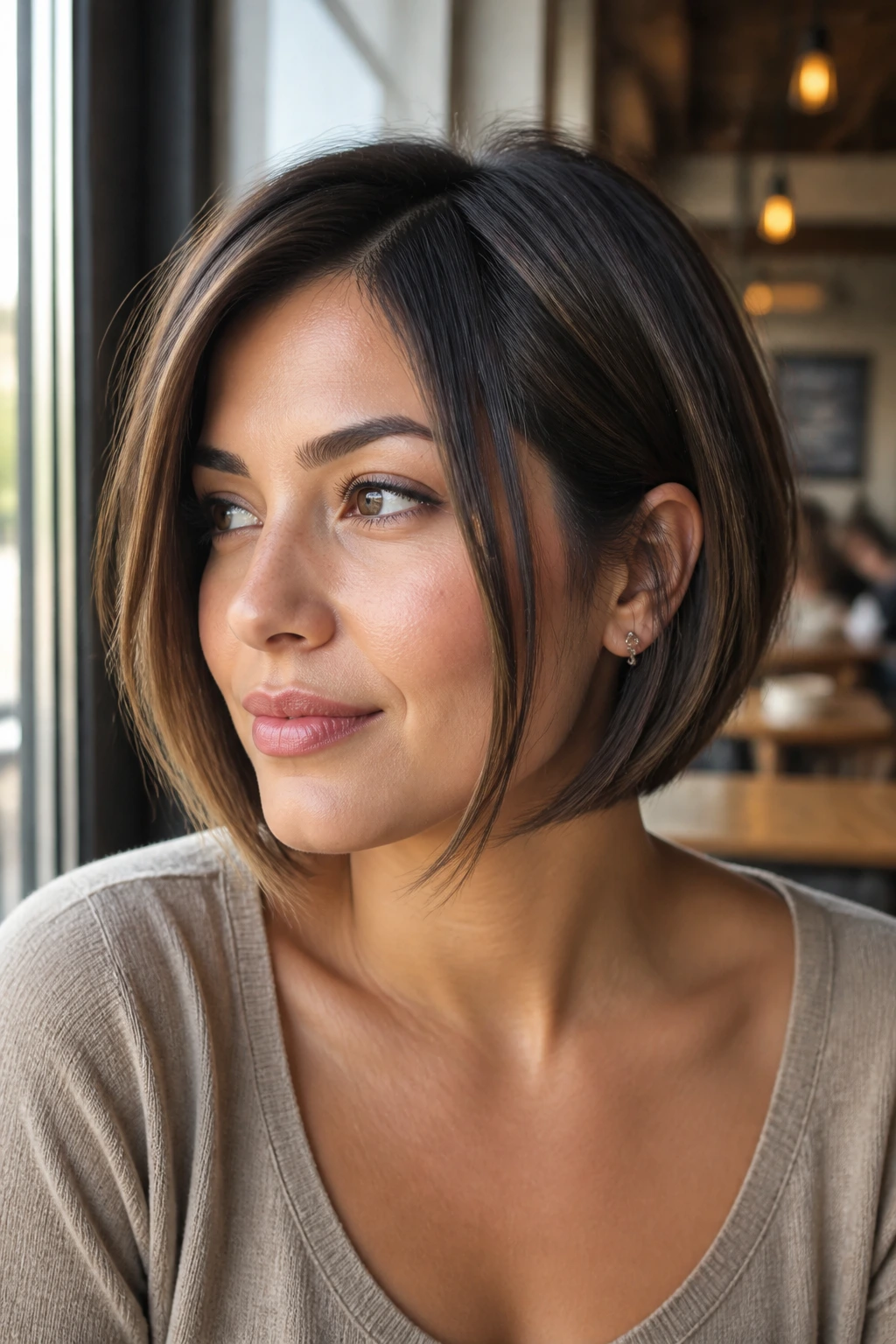
A face-framing bob is one of the easiest ways to flatter a round face because it gives the haircut a clear job: soften the cheeks and guide the eye downward. The side part adds another diagonal line, which helps even more.
The front pieces should start around the cheekbone and taper down toward the jaw or neck. That length matters. If the framing starts too high, you can accidentally emphasize the roundest part of the face. If it starts too low, it loses the shaping effect. There’s a sweet spot, and it sits right in that cheek-to-jaw zone.
This is a good cut if you like quick styling. A blow-dry with a paddle brush can be enough. If you want more shape, bend just the front pieces with a curling iron and leave the rest straight. That contrast makes the face-framing stand out without turning the whole head into a production.
A little volume at the crown helps too. Not a lot. Just enough to keep the top from lying flat against the scalp.
19. Blunt-Edge Bob with Soft Interior Layers
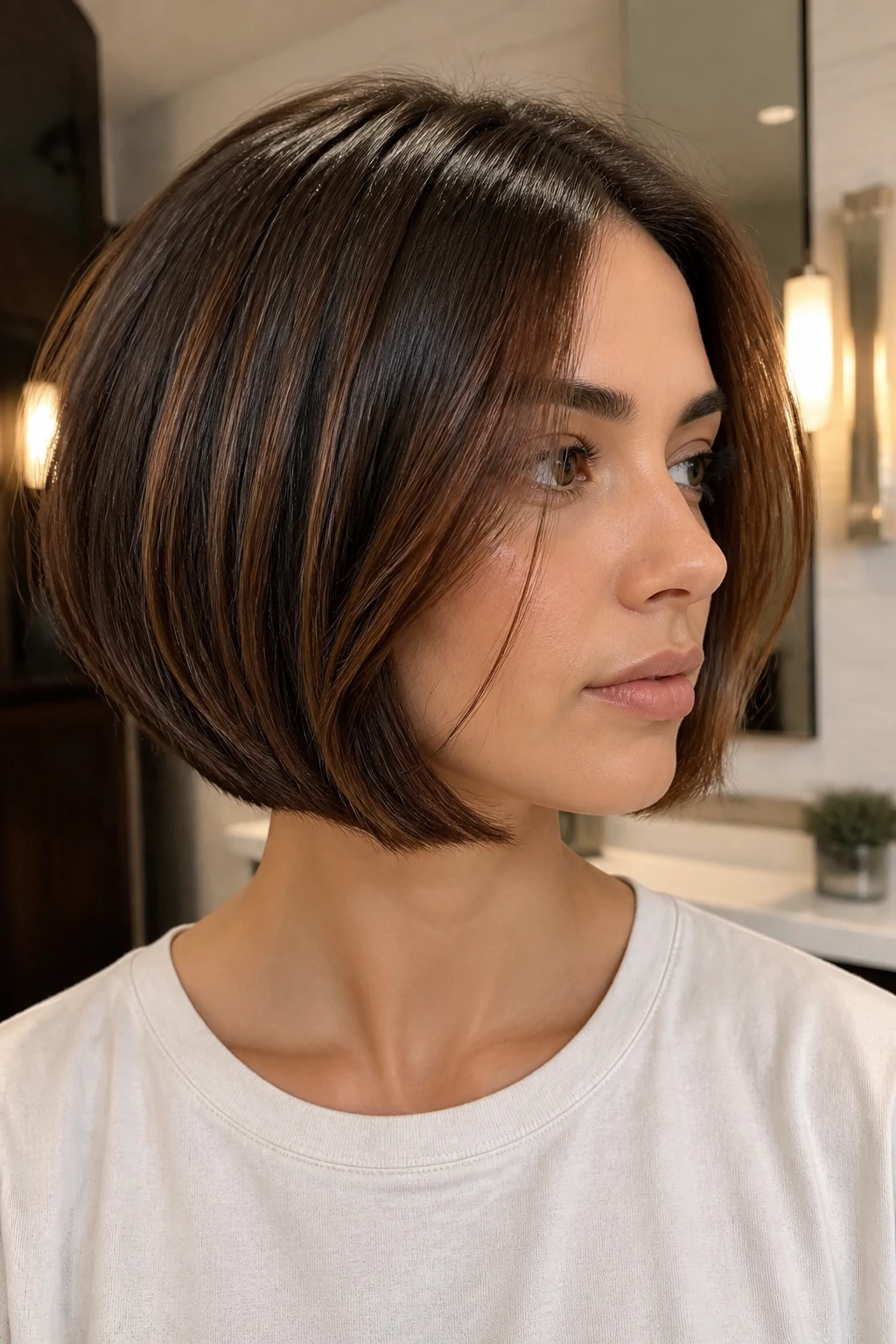
Blunt does not have to mean boxy. That’s the trick with this cut. The outside edge stays clean and dense, but soft internal layers remove bulk inside the shape so the bob still feels light on a round face.
This works because the perimeter gives the haircut structure while the hidden layers stop it from spreading outward. If all the weight sits at the cheeks, the face can look wider. If the interior is too thin, the bob starts to fray. The balance is in the middle, which is where a good stylist earns the money.
Fine hair likes this cut because the blunt edge makes the ends look fuller. Thick hair can wear it too, but the internal layering has to be thoughtful. Too much and the shape collapses. Too little and the bob looks heavy enough to sit on your shoulders like a helmet.
Keep the front just past the jaw, not right at the cheek. That keeps the line flattering. A blunt edge near the cheekbone is a bad idea here. It’s one of those mistakes that seems small until you see it in the mirror.
20. Low-Maintenance Tousled Inverted Bob
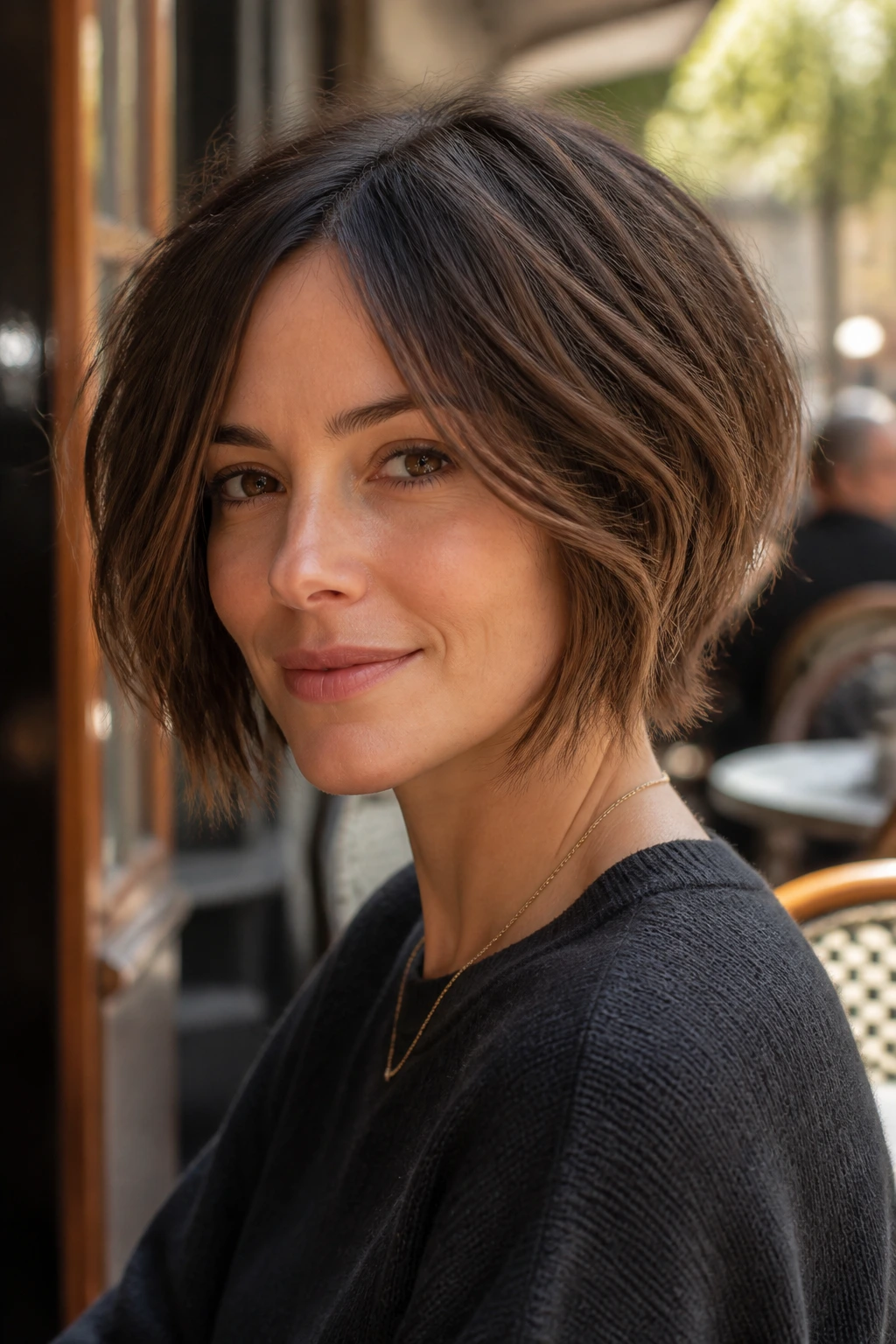
If you want a haircut that looks lived-in without looking lazy, this is the one. The angle is still there, but the finish is soft, broken up, and a little undone. On a round face, that kind of movement matters because it keeps the style from reading as too neat or too wide.
The best low-maintenance version keeps the back slightly stacked and the front long enough to skim below the cheekbone. Then the texture does the rest. Air-dry cream, a small amount of sea-salt spray, and finger-drying are often enough. I’d rather see this cut a little messy than overstyled. Overstyling kills the charm.
This is also the easiest one to live with if you hate daily heat tools. Rough-dry the roots, scrunch the ends, and leave a few pieces loose around the face. That softness helps the face look longer without making the haircut feel stiff.
For a round face, the win here is not drama. It’s ease. A good tousled inverted bob makes it look like you know exactly what your hair does and you’ve stopped arguing with it. Which, frankly, is a nice place to be.
Final Thoughts
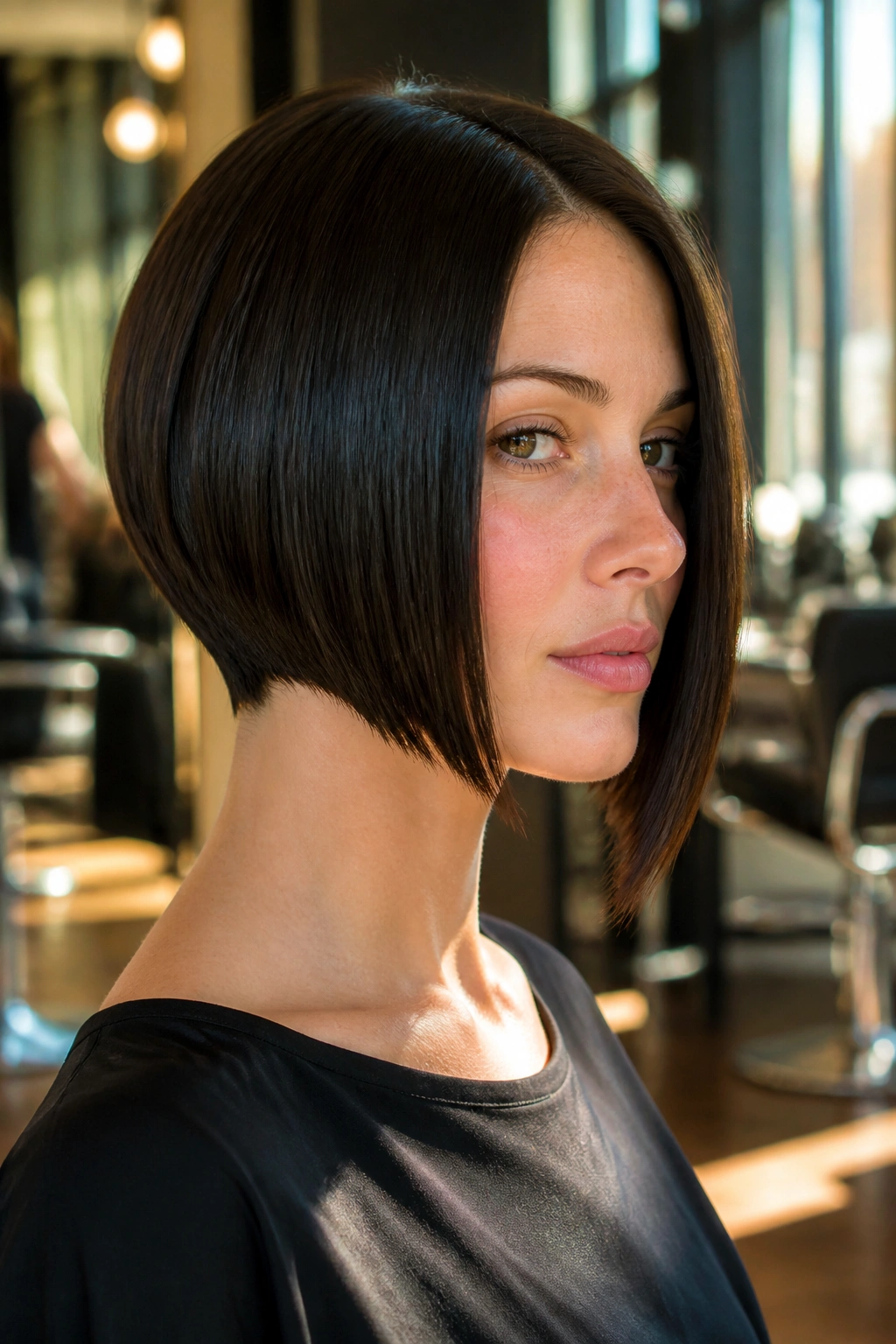
A round face does not need to be hidden. It needs lines that work with it. The right short inverted bob gives you that by moving the eye downward, lifting the crown a little, and keeping the front pieces out of the widest part of the cheeks.
The safest choice is usually the one with the cleanest angle and the softest front. The boldest choice is not always the smartest one. If your hair is fine, keep the back light but not sparse. If it’s thick, keep the weight under control before it swells out around the jaw.
Bring a photo to the stylist, but also be ready to talk about where your hair naturally falls. That part matters more than people think. A good inverted bob is not only about the shape on paper. It’s about where your hair wants to sit on your head when you’re not trying to bully it into place.
