



Round faces can wear blonde blue ombre hair better than most people expect—if the color starts and ends in the right places.
The mistake people make is easy to spot. They put the brightest blue right around the cheeks, or they stop the blonde too high, and the whole style gets wider instead of longer. That is not a blue problem. It is a placement problem.
The good versions work because they change where the eye goes. Blonde near the crown and around the top half of the face keeps things light. Blue lower down, especially past the jawline, drags the eye vertically and gives the face a little more length. A side part, a few face-framing layers, and some bend through the mid-lengths help too. Not magic. Just smart styling.
Some of the nicest versions are soft and misty, like denim or powder blue. Others are sharper, with cobalt or navy ends that make the blonde look brighter by contrast. The cut matters just as much as the color. A blunt line at the chin is a different story from loose layers that skim past it.
1. Champagne Blonde to Icy Blue Tips
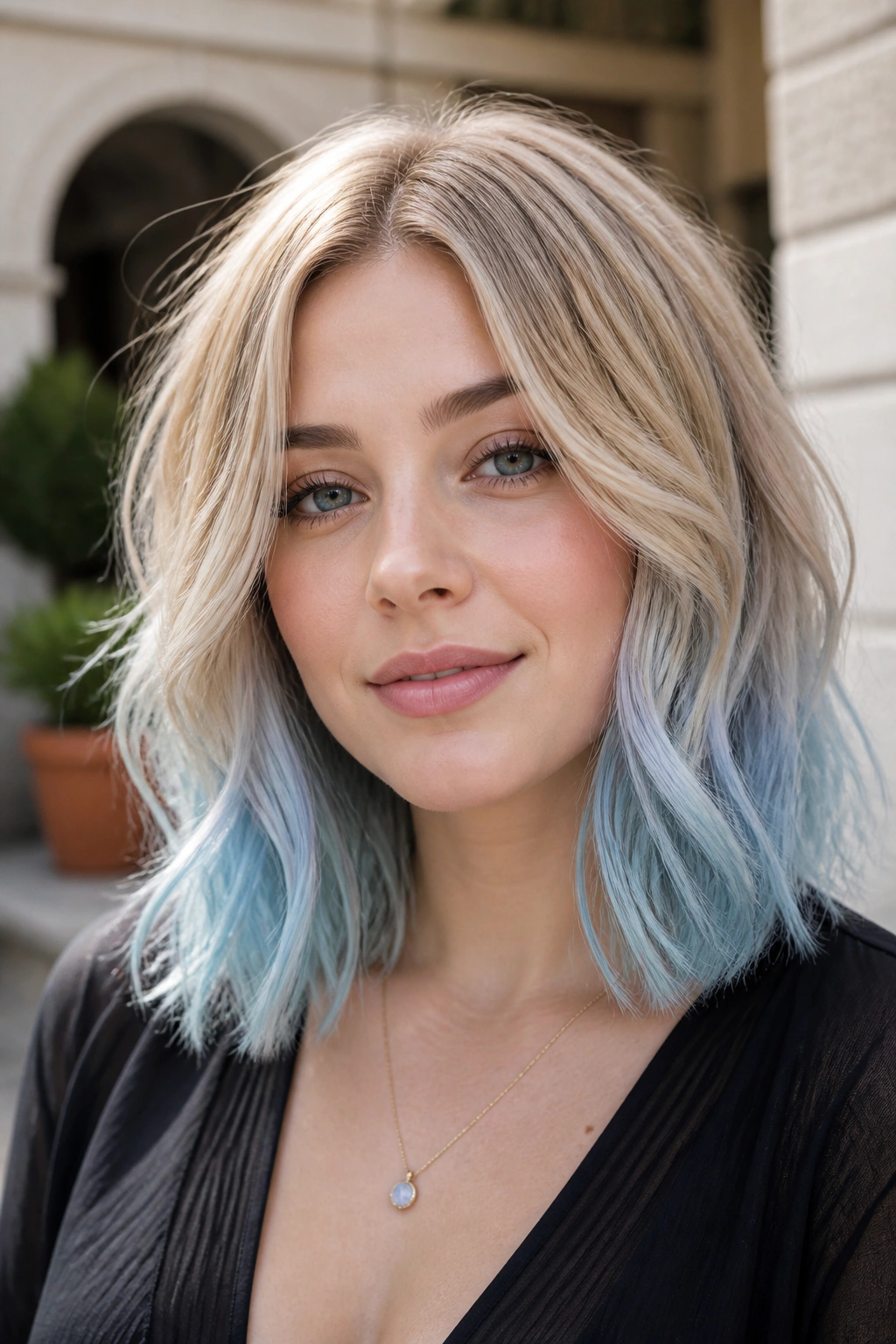
Champagne blonde at the roots and through the mids keeps this look airy, while the icy blue tips do the heavy lifting at the bottom. On a round face, that lower color placement matters. It pulls the eye below the widest part of the face, which is exactly where you want it.
Why It Flatters Round Faces
The blonde should live around the cheekbones and above, not sit in a hard stripe at the widest point. That gives the face brightness without adding width. The blue stays at the tips, where it reads long and clean.
This version looks especially good on hair that already has a few layers. Straight ends can feel boxy. Soft waves break that up and let the gradient move.
- Best on shoulder-length hair or longer
- Blue starts about 3 to 4 inches below the chin
- Works well with a center part or a slight off-center part
- Looks sharper if the tips are lightly textured, not blunt
Pro tip: keep the blue a little cooler than the blonde. If both shades are too soft, the whole thing can blur into one pale block.
2. Beige Blonde with Denim Blue Ends
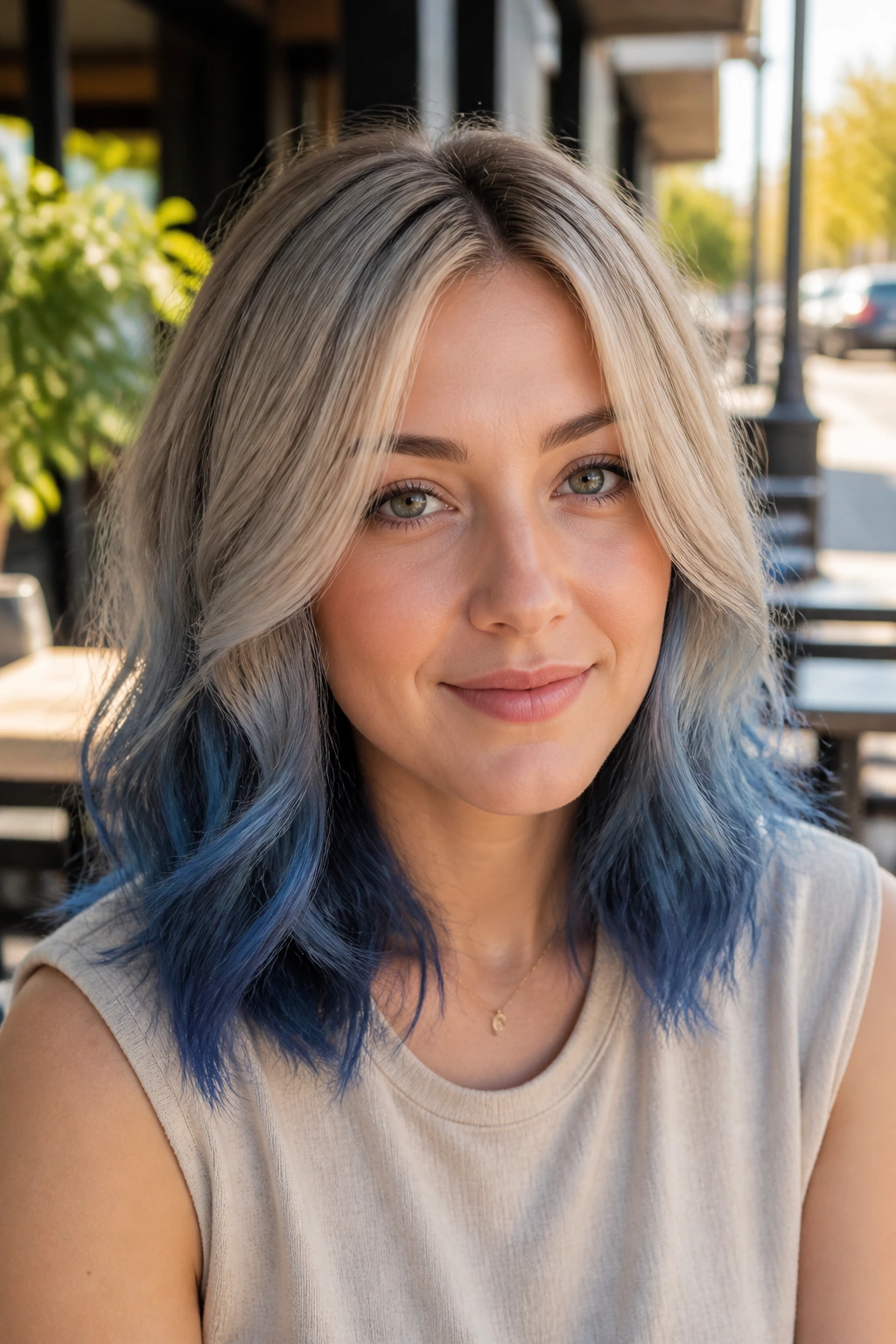
Denim blue is one of the easiest blue shades to wear on a round face. It has enough depth to shape the silhouette, but it does not shout over the haircut. That makes it a smart pick if you want color that looks cool without turning the whole style into a costume.
The beige blonde on top keeps the face bright and open. Denim blue at the bottom gives weight where you want it, especially if the ends hit somewhere between the collarbone and the upper chest. That little bit of vertical length makes a difference.
I like this look on a lob with soft internal layers. A round face needs movement, not a hard horizontal line. Blow-dry the crown with a touch of lift, then leave the ends slightly bent under or out. Flat, poker-straight hair can make the color feel heavier than it is.
If you want a blue ombre that still feels wearable in daylight, this is a strong choice. Denim tends to age well between salon visits, too, because it fades into a softer steel tone rather than turning brassy or neon.
3. Platinum Bob with a Baby Blue Underlayer
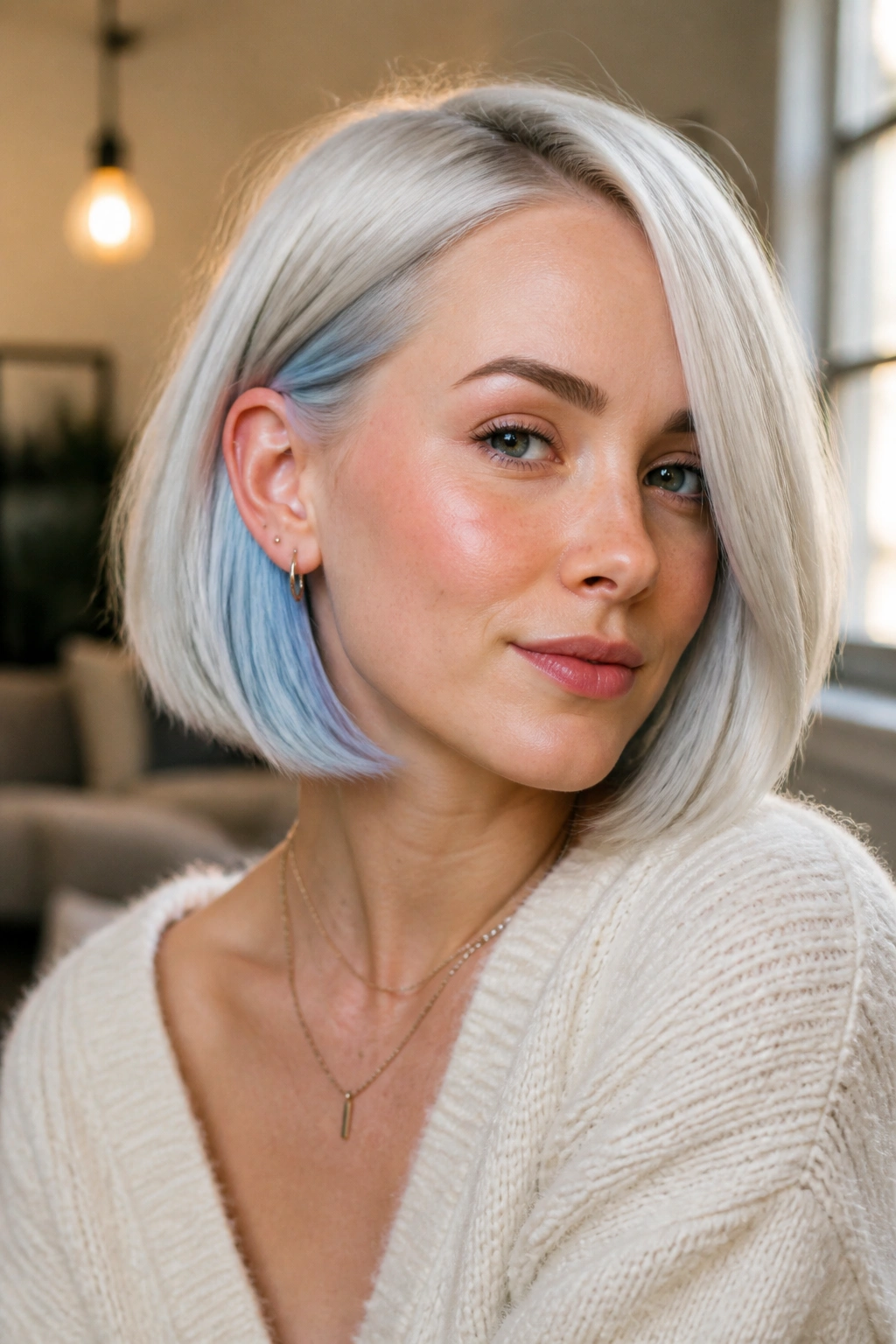
Why hide the blue under the top layer? Because on a round face, surprise color can do more than obvious color. A baby blue underlayer keeps the bob looking crisp from the front, then gives you a flash of color when the hair moves.
That movement matters. A bob that ends just below the jawline can be tricky on a round face, so the blue underlayer helps pull attention down and away from the cheeks. It also keeps the cut from feeling too solid. Solid can be a problem.
How to Style It
Tuck one side behind the ear. Let the other side fall forward. That slight asymmetry helps the face look less wide, and it gives the blue places to peek through without needing big curls.
A side part works well here, especially if you want a little more length through the front. Use a flat iron to add a soft bend at the ends, not a stiff flick. Baby blue looks better when the bob moves.
This is also a good option if you want blue without constant upkeep on the whole head. The top stays platinum, the underlayer carries the color, and the grow-out looks less harsh than a full saturated panel.
4. Honey Blonde with Cobalt Money Piece
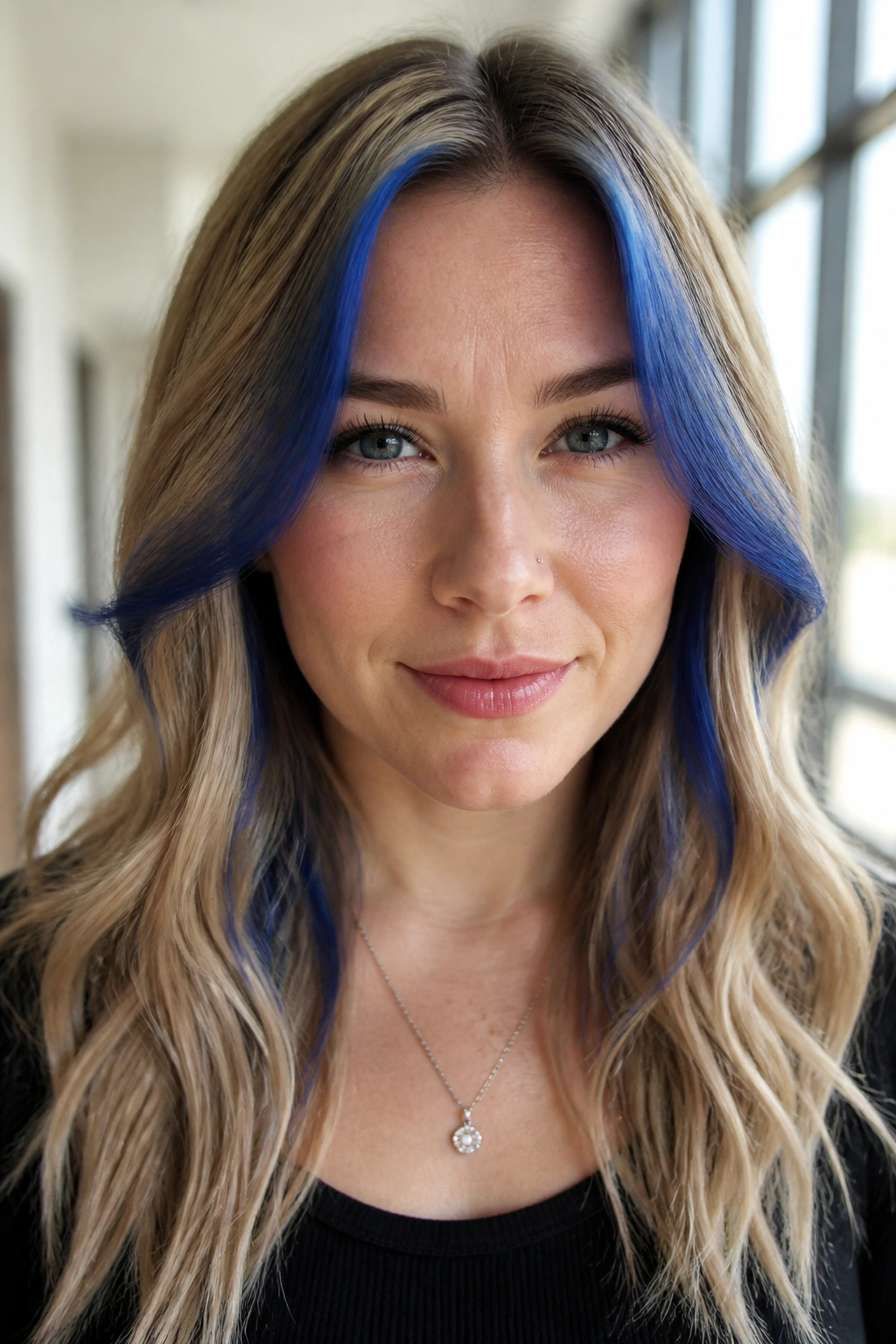
A bright cobalt money piece against honey blonde can be unfairly good on round faces. The reason is simple: those face-framing streaks create two vertical lines on either side of the face, and vertical lines are your friend here.
Picture a soft wave that starts with warm blonde around the crown, then drops into a bold blue frame right beside the cheeks. The contrast does the shaping for you. It makes the center of the face feel longer, not broader.
Quick Notes
- Keep the cobalt around 1 to 1.5 inches wide on each side
- Start the blue below the cheekbone if you want a slimmer look
- Pair it with curtain bangs that open in the middle
- Best on medium to long hair with loose bends
This look is a little louder than the denim and powder-blue versions, and that is the point. If you wear your hair in a ponytail or half-up style a lot, the blue money piece keeps the color visible even when the rest of the hair is pulled back.
Don’t place the blue too high. That is where the trouble starts. Near the temples, it can widen the face. Lower, it sharpens everything.
5. Ash Blonde Balayage with Periwinkle Melt
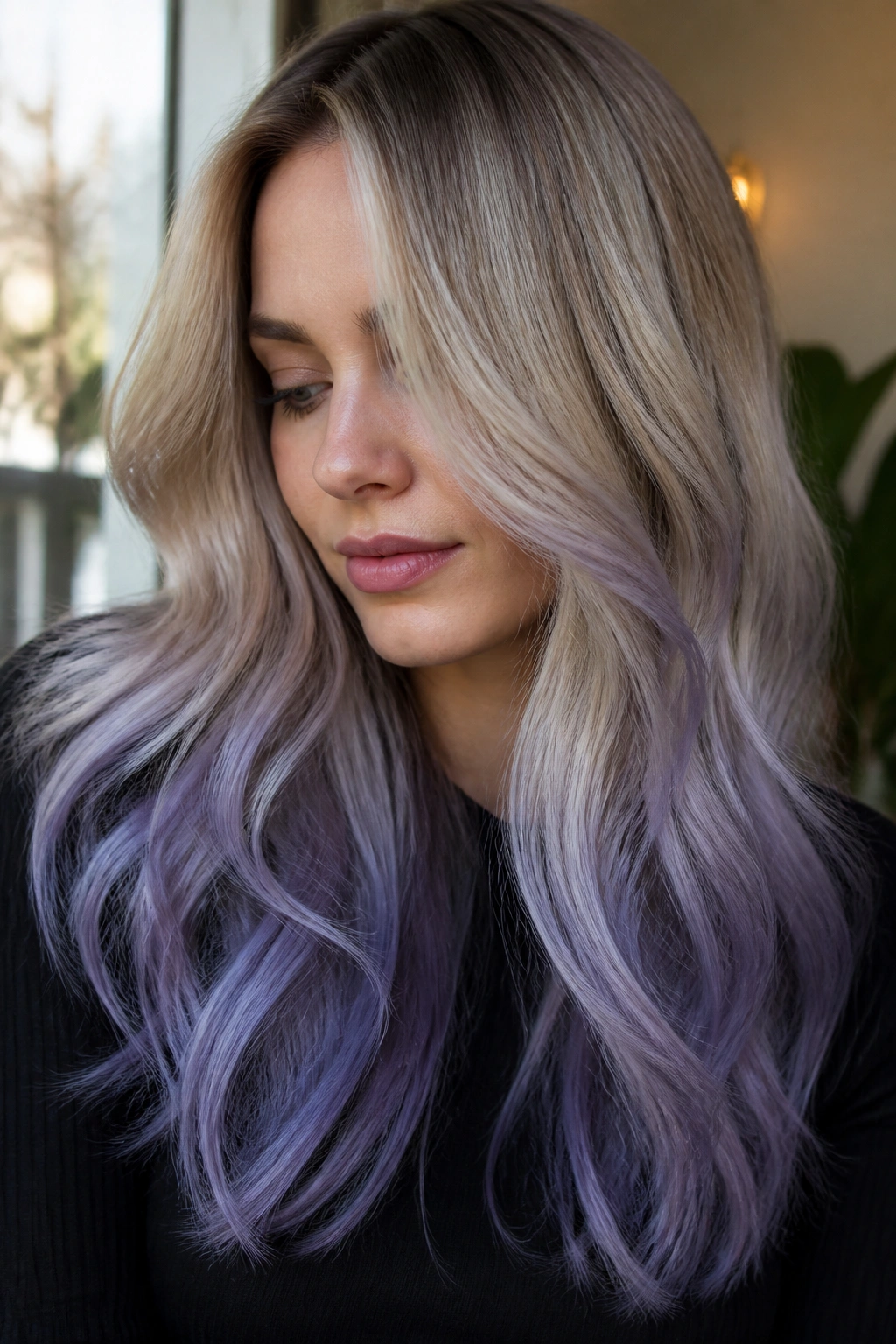
Ash blonde and periwinkle are a calm pair, and calm is underrated. The look feels softer than cobalt or navy, but it still gives enough contrast to shape a round face. The periwinkle melt works best when the transition is slow and blurred, not stripey.
I like this on long layers with a little bend through the ends. The ash blonde keeps the top half cool and light, while the periwinkle deepens gradually from mid-length to tips. That change in depth is what makes the face look longer. Harsh lines around the cheeks would spoil it.
A lot of people assume pastel colors are only for thick hair. Not true. On finer hair, periwinkle can make the length look fuller because the color shift creates the illusion of density. You do want a good toner, though. Ash blonde that turns muddy is a mess nobody needs.
This version also grows out with less drama than bright blue. The fade from blonde to soft blue-gray can last longer between appointments because the in-between stage still looks intentional.
6. Butter Blonde with Midnight Blue Shadow Root
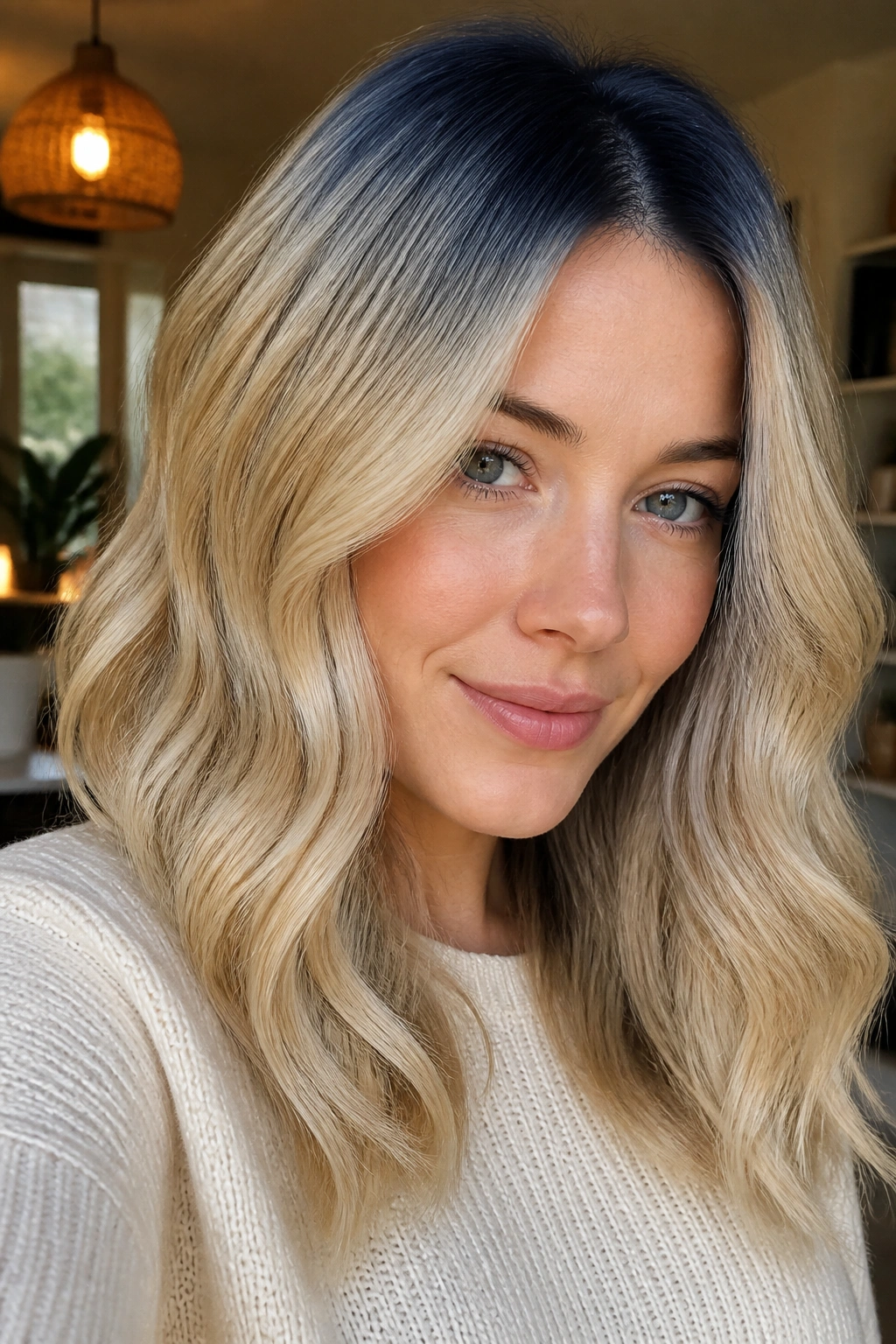
Unlike a full pastel melt, a midnight blue shadow root gives you a darker top and a lighter body. That is a useful trick on round faces because darker roots add visual depth at the crown, which can make the face seem a bit longer from hairline to chin.
The butter blonde mid-lengths stop the look from feeling heavy. They keep the style bright enough to wear in daylight, while the midnight blue adds a clean anchor at the top. It is a stronger look than people expect, but not in a loud way.
This one really suits hair with some thickness. A shadow root needs enough density to show the color shift. On thin hair, it can look flat if the root area is too wide. Keep the dark zone narrow, usually about an inch and a half or so, and let the blue fade into blonde through the upper third.
If you wear your hair in soft waves, the color reads like motion. If you wear it straight, it reads more graphic. Both can work. I prefer the waves. They soften the face and keep the dark root from feeling severe.
7. Strawberry Blonde with Sky Blue Ends
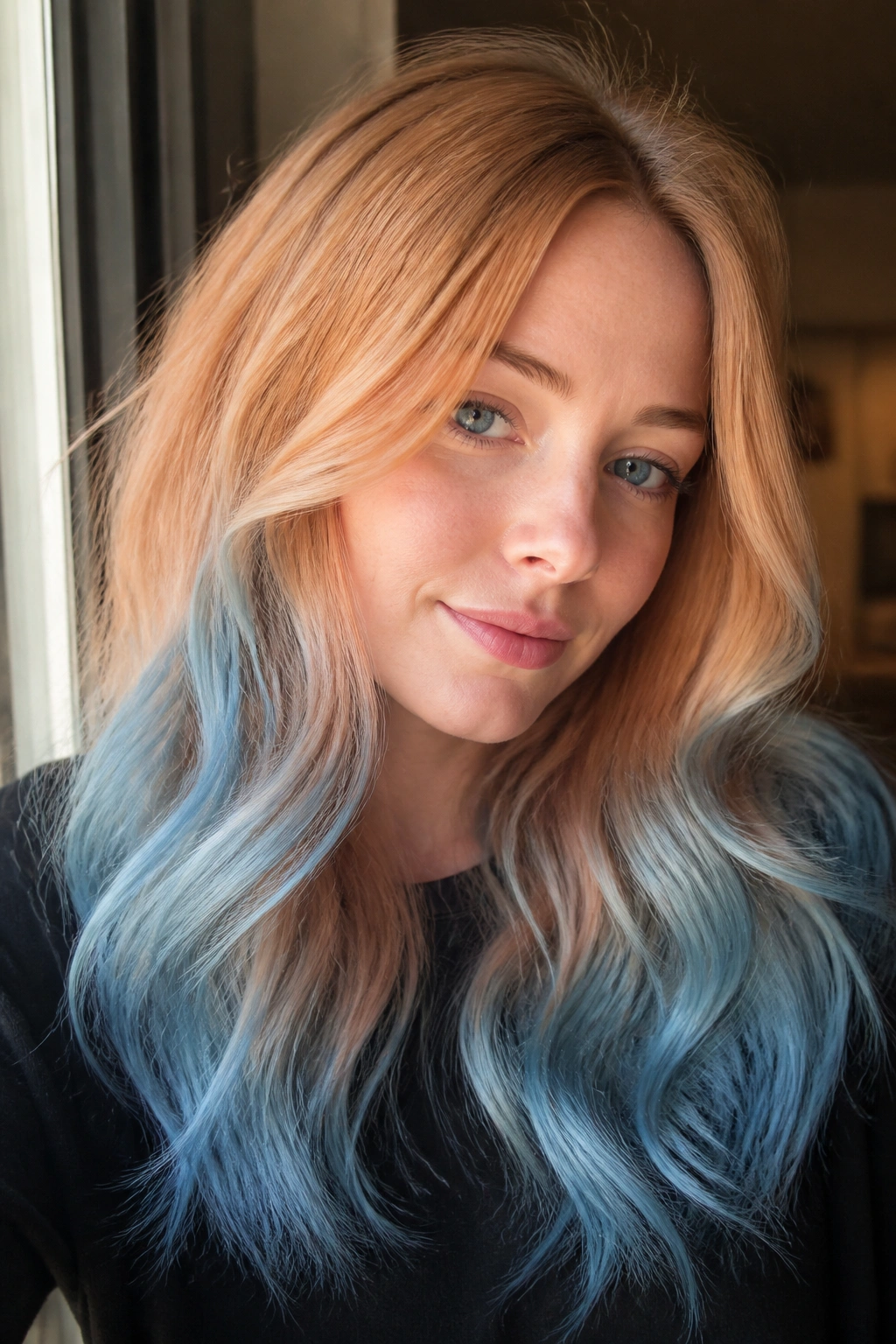
The warm-cool mix here is the whole story. Strawberry blonde near the top keeps the face soft and bright, while sky blue at the ends cools everything down and draws the eye lower. On a round face, that lower movement matters a lot.
This version works because it does not rely on harsh contrast. The strawberry shade eases the transition into blue, so the ombre feels painterly rather than striped. That is a much better match for soft facial curves than a sharp line would be.
What Makes It Work
- Best on waves or loose curls
- Blue should stay below the widest part of the cheeks
- Strawberry blonde should be kept warm, not orange
- Medium-length hair shows the fade best
A center part can work if the cut is layered. A soft side part works if you want a little more narrowing through the front. Either way, keep the top flat enough to avoid extra width at the cheeks.
This one is for someone who wants color with a little sweetness. It looks gentle in sunlight and cooler indoors, which makes it more interesting than it sounds on paper.
8. Mushroom Blonde Shag with Ocean Blue Ribbons
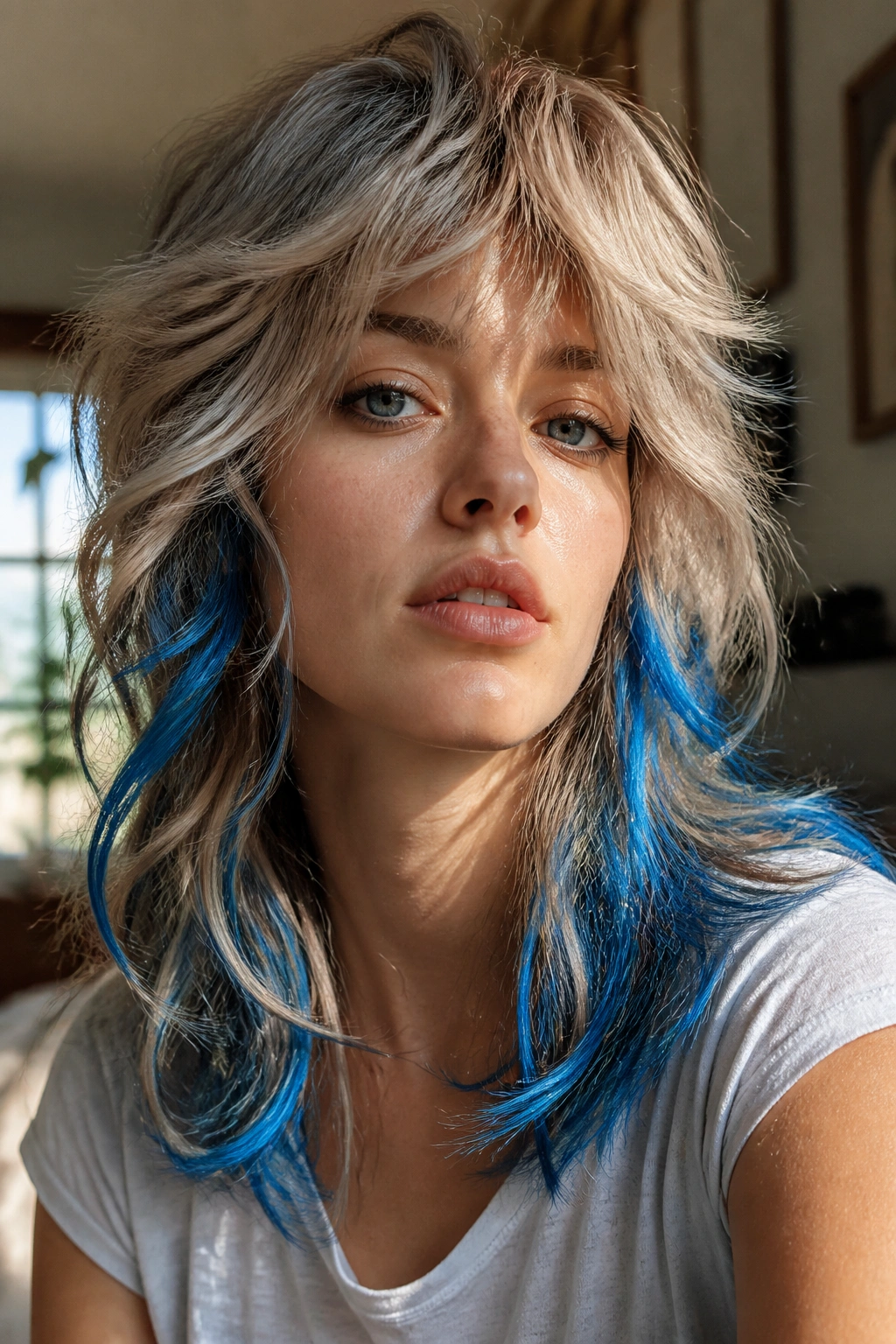
Shags are one of the easiest cuts for round faces. They break up the width, add vertical texture, and stop the hair from sitting like one round shape around the head. Add ocean blue ribbons through a mushroom blonde base, and the result gets even better.
The blue should not be painted evenly. That would kill the point. Instead, weave it through the longer layers and around the perimeter, where the pieces move when you walk. Those ribbons create a little visual length because they fall in thin lines instead of a thick block.
A shag also gives you natural face framing without needing a lot of styling. The layers around the cheekbones do the narrowing work. The longer pieces at the bottom carry the blue and keep the whole look from puffing out at the sides. That is the trick with round faces: keep the shape loose on the sides, fuller at the top, and a bit longer at the bottom.
If you like hair that looks cooler when it is messy, this is a strong pick. A shag that is too polished loses some of its edge.
9. Vanilla Blonde with Steel Blue Money Pieces
Why does this combination work so well? Because steel blue is soft enough to wear every day, but dark enough to carve out the face. On a round face, that shape matters more than pure brightness. You want definition.
Vanilla blonde keeps the middle and back of the hair light, so the style does not feel heavy. The steel blue money pieces frame the face without screaming for attention. They should sit just outside the cheekbone line and curve past the jaw, not end right at the cheeks.
This look is especially nice if you wear glasses. The blue lines can balance the frames without competing with them. It also works on straight hair, which is useful if you do not want to spend 20 minutes curling every morning. The color placement carries enough of the visual load on its own.
How to Wear It
Pull the front pieces slightly forward when the hair is down. Let them skim the sides of the face. When the hair goes up, leave the money pieces out. That keeps the shape soft and keeps the blue visible.
10. Curly Blonde Lob with Turquoise Ombre
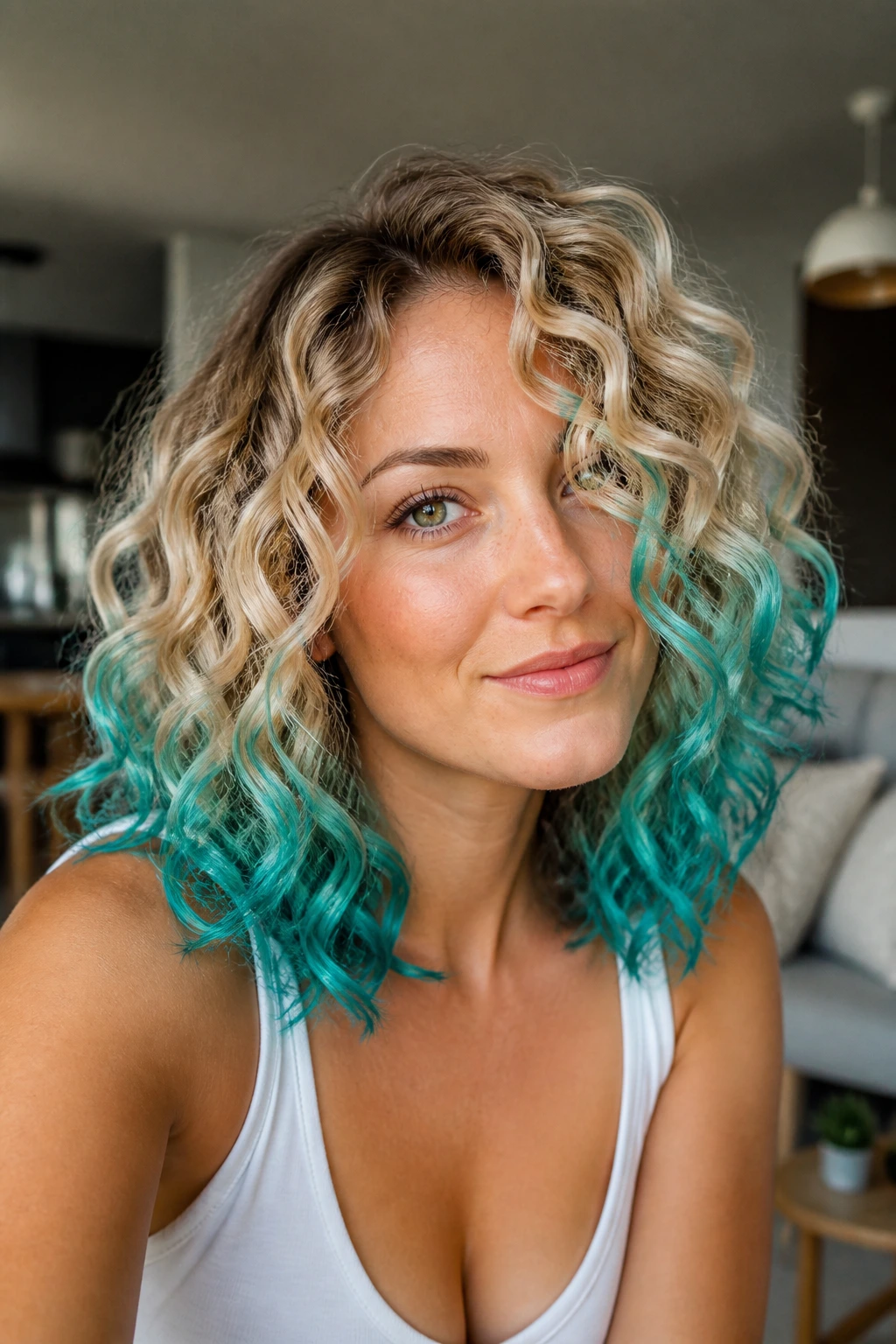
Curls change the rules a little. A curly lob can make a round face look longer if the curl pattern is allowed to spring downward instead of out to the sides, and turquoise ombre helps by leading the eye through the length of the curl.
This is a good place for a softer blonde at the top and a richer turquoise through the lower half. Turquoise has enough depth to be seen inside a curl, which is important. Thin pastel shades can disappear once the hair dries. A slightly stronger tone holds its own.
Curl-Friendly Details
- Start the color melt below the cheekbone line
- Keep the shortest face-framing curl just below the chin
- Use a curl cream that defines without crunch
- Diffuse on low heat to keep the shape from puffing out
A lob length is easier to manage than longer curls, especially if your hair has a bit of shrinkage. The cut should be longer in the front by a small margin, maybe half an inch to an inch, so the face gets that extra vertical line.
The best part is how the turquoise shows in motion. Every curl catches a slightly different shade. Messy is good here. Too much uniformity flattens the whole effect.
11. Pearl Blonde with Powder Blue Face Frame
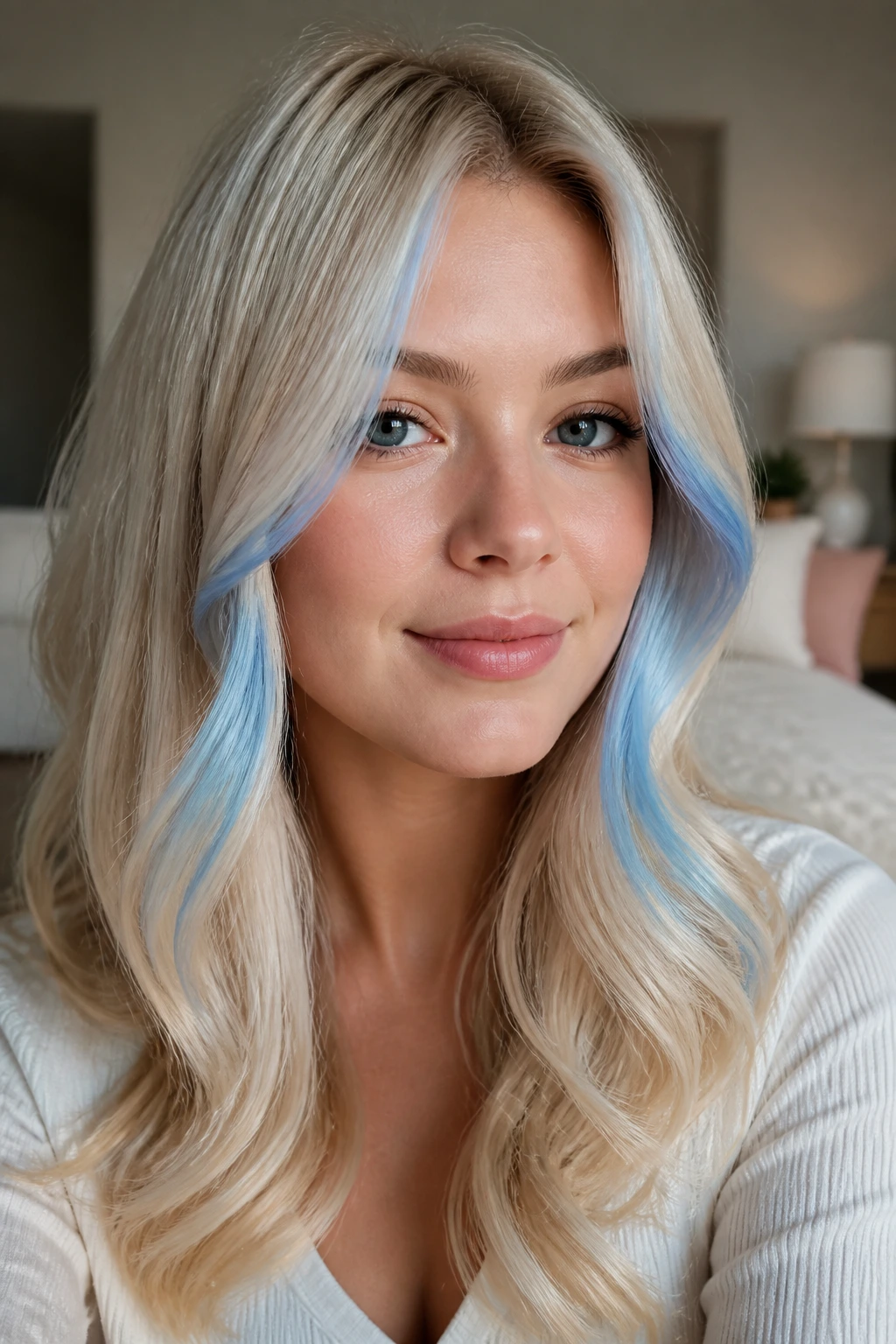
Pearl blonde has a soft shine that makes powder blue feel delicate instead of washed out. On a round face, the face-frame placement does the hard work. Keep the blue narrow, cool, and a little lower than you think. That keeps the cheeks from looking wider.
The pearl blonde through the rest of the hair creates a pale, reflective base. It brightens the whole look without needing a lot of contrast. Powder blue along the front gives you shape without harsh edges. I like this on long curtain bangs because the bangs open the face and let the color move around it instead of across it.
This style needs good toning. Pearl blonde can turn dull if the hair is not lifted cleanly enough, and powder blue can go green if the base is too yellow. That means pre-lightening has to be even. Patchy lifting shows fast in a pale look like this.
It is a quiet style, but not boring. The softness is the point. If you want the face to look a touch longer without obvious contouring from hair color, this is one of the cleaner ways to do it.
12. Rooted Ice Blonde with Navy Blue Ends
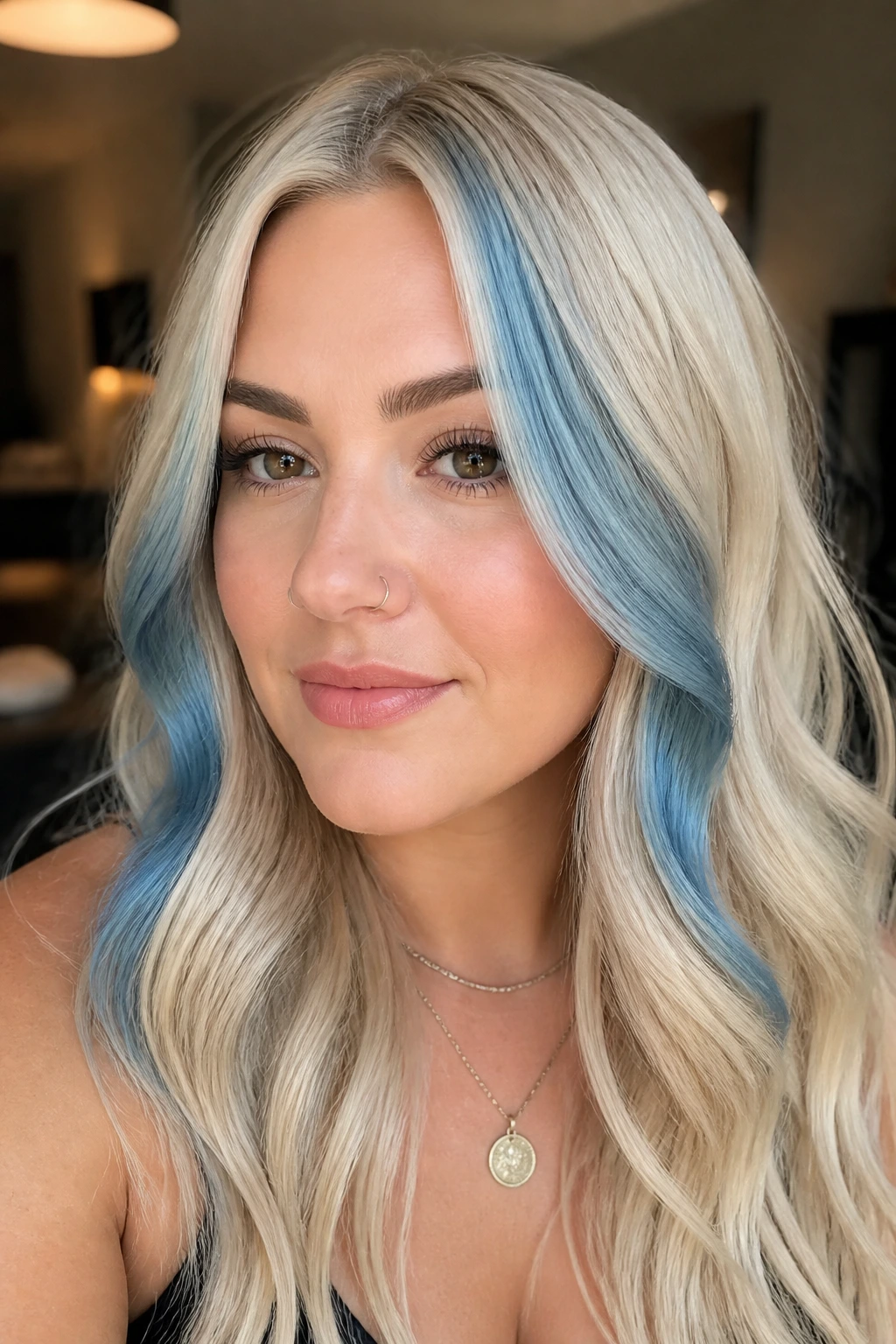
Unlike pale baby blue, navy has weight. That weight helps round faces because it pulls the visual line down and keeps the bottom of the hair from floating away. A rooted ice blonde top makes the crown look lifted, while the navy ends give the whole shape a longer finish.
This style feels sharper than pastel ombre. It is also easier to read from a distance, which matters if you have a lot of layers or a thick cut. Navy survives movement better. When the hair swings, the darker ends still show up.
A middle part can work here if the front pieces are long and soft. A deep side part can be even better if you want more narrowing through one side of the face. The cut should not be blunt at the chin. That would fight the whole idea.
This is a good option for someone who likes cool tones but wants something a little moodier than turquoise or periwinkle. Navy blue at the ends looks polished, but it still has edge. And yes, it fades more slowly than the lighter shades. That is a nice bonus.
13. Sandy Blonde Pixie with Blue Fringe
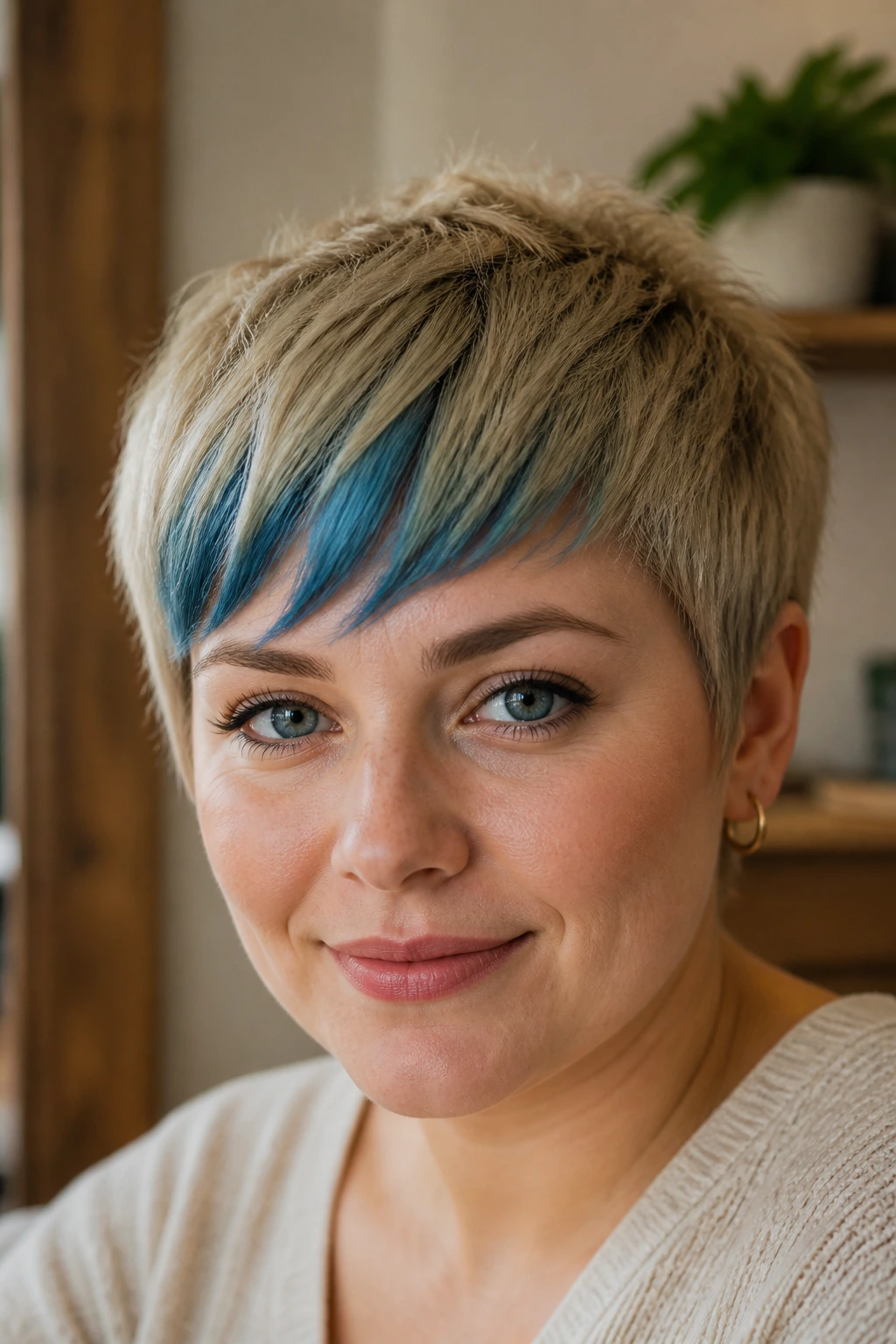
A pixie on a round face lives or dies on height at the top. Keep the sides close, give the crown some lift, and the face opens up fast. Add a blue fringe or a blue-tipped front section, and the style gets a little unexpected without losing structure.
The sandy blonde base keeps things soft, which matters with a short cut. Too much contrast on a pixie can make the head look wider, not longer. Blue near the fringe works best when it is narrow and textured, almost feathered into the hair rather than stamped on.
Good Pixie Placement
- Keep the blue off the temples
- Add volume at the crown, not the sides
- Use paste or light wax to piece out the top
- Let the fringe angle slightly forward
A pixie is one of the boldest ways to wear blonde blue ombre hair on a round face, but it can also be one of the smartest. Short hair removes bulk from the cheeks, and a bit of blue up front gives the cut personality. Not too much. Enough.
The mistake is going too broad with the color. Short cuts need precision. Thin, irregular pieces look better than a heavy block.
14. Bronde Waves with Teal-Blue Dip
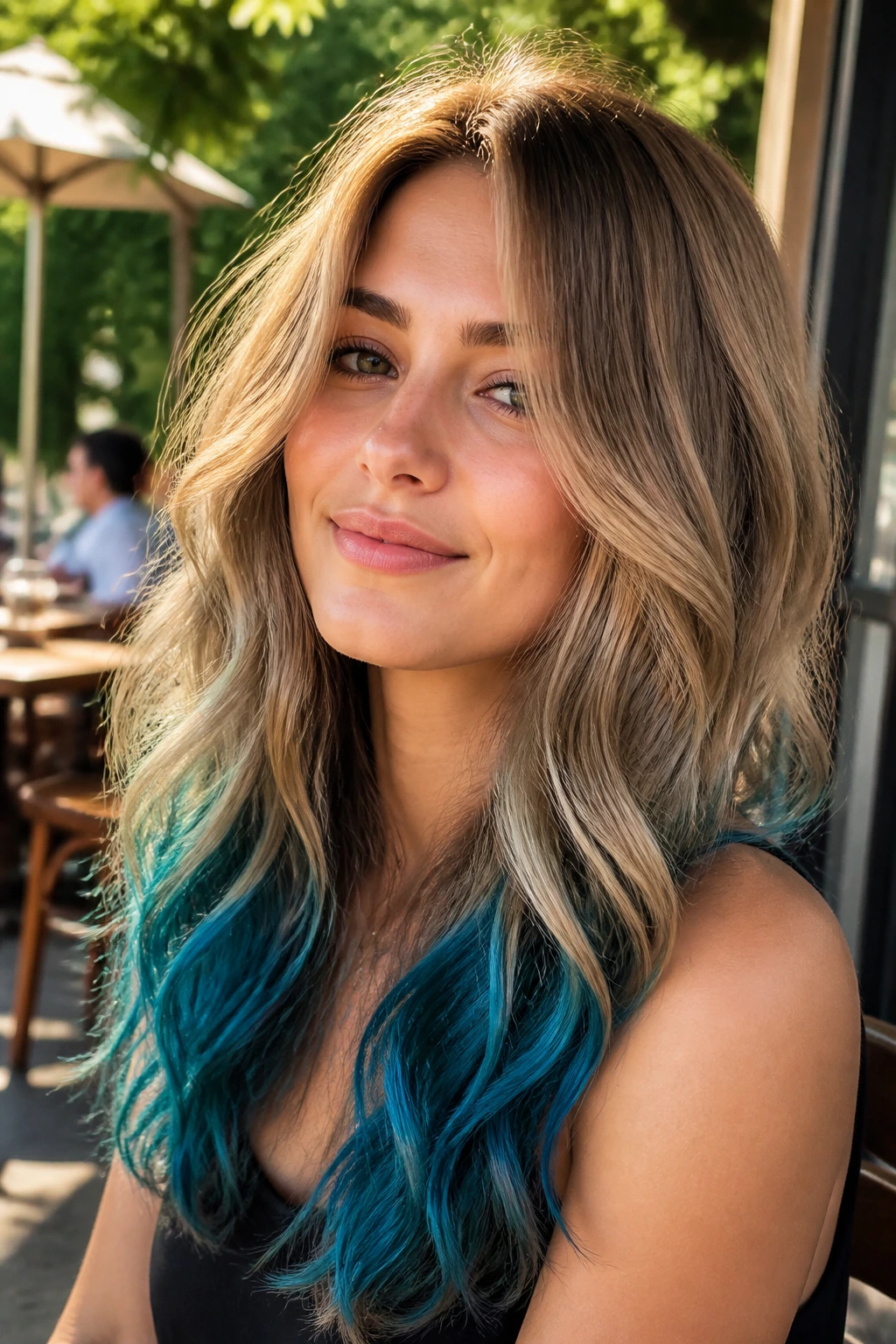
This is the low-commitment option, and I mean that in the best way. Bronde already sits in the safe middle between blonde and brown, so adding a teal-blue dip gives you color without forcing the whole head into a cool palette.
For round faces, the bronde base is useful because it keeps the sides from looking too bright. The teal lives at the ends, where it adds length and movement. That is why a dip dye can work so well here: the bottom gets the weight, the top stays soft, and the face feels more open.
Loose waves suit this look best. They keep the bronde from feeling flat and help the teal peek through in small sections instead of one solid band. If you wear your hair curled, the blue shows in flashes. If you wear it straight, it reads cleaner and more graphic.
This is also one of the easiest blue ombre ideas to grow out. The bronde root does a lot of the blending for you, which means fewer visible lines when the color starts to fade. That alone makes it practical.
15. Cool Beige Blonde with Smoky Blue Layers
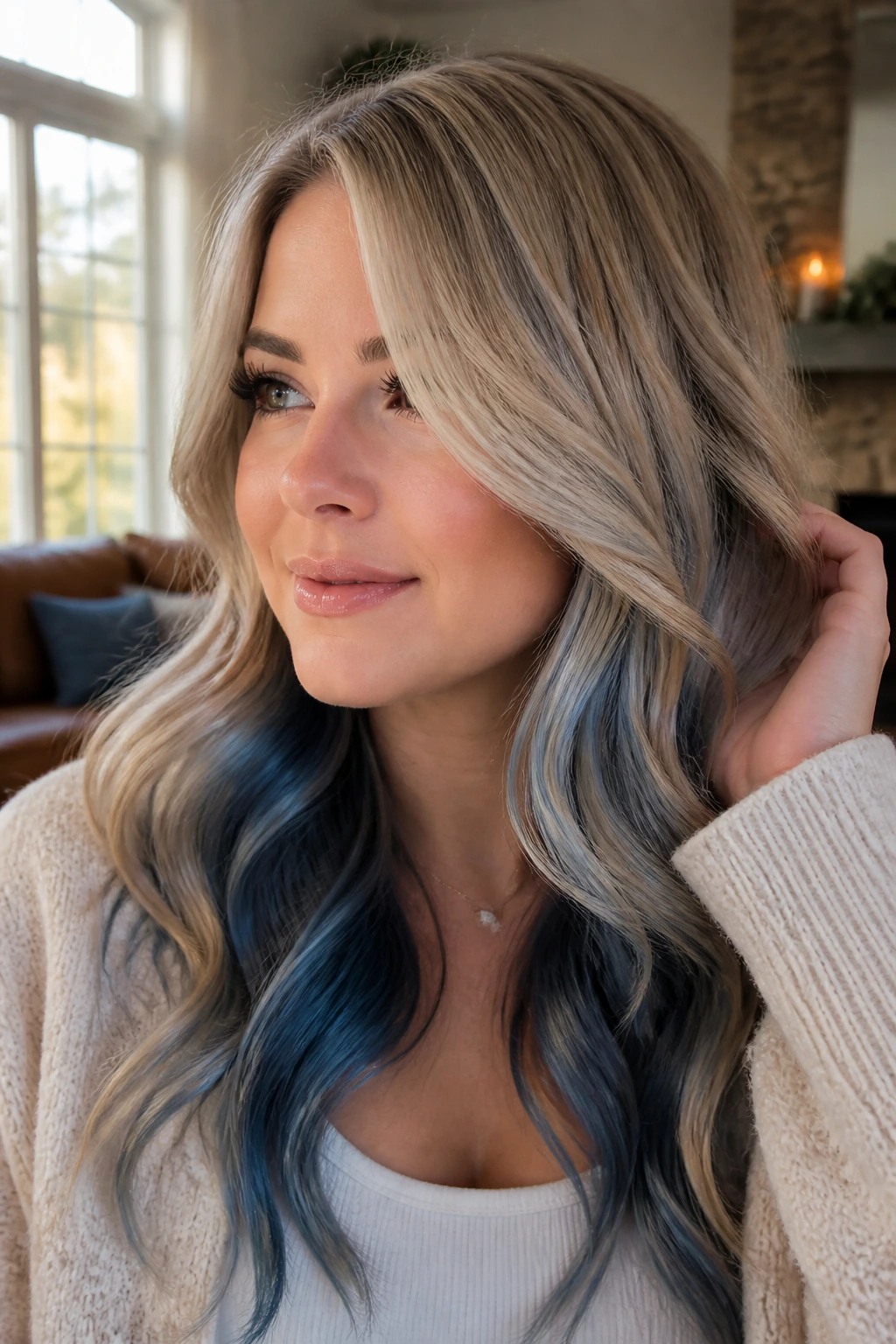
Can a blue ombre look subtle on a round face? Absolutely, if the blue is smoky enough. Cool beige blonde with smoky blue layers gives you that quieter effect, and it works because the color shift is about depth, not brightness.
The smoky blue should live in the lower layers and around the interior of the hair, not just on the outside. That makes the style move. It also keeps the top half light, which helps the face look taller. A soft side part is a nice touch here, especially if the cheek area feels full.
This is one of those looks that becomes prettier the more the hair moves. The interior blue catches when the layers separate, and the beige blonde keeps the whole thing soft at rest. A little bend in the mids helps a lot. You do not need big waves, just a bit of texture so the layers do not collapse into one shape.
If you want something that feels refined instead of flashy, this is a strong pick. It has enough personality to be interesting, but it does not fight your features.
16. Silver Blonde with Electric Blue Inner Layer
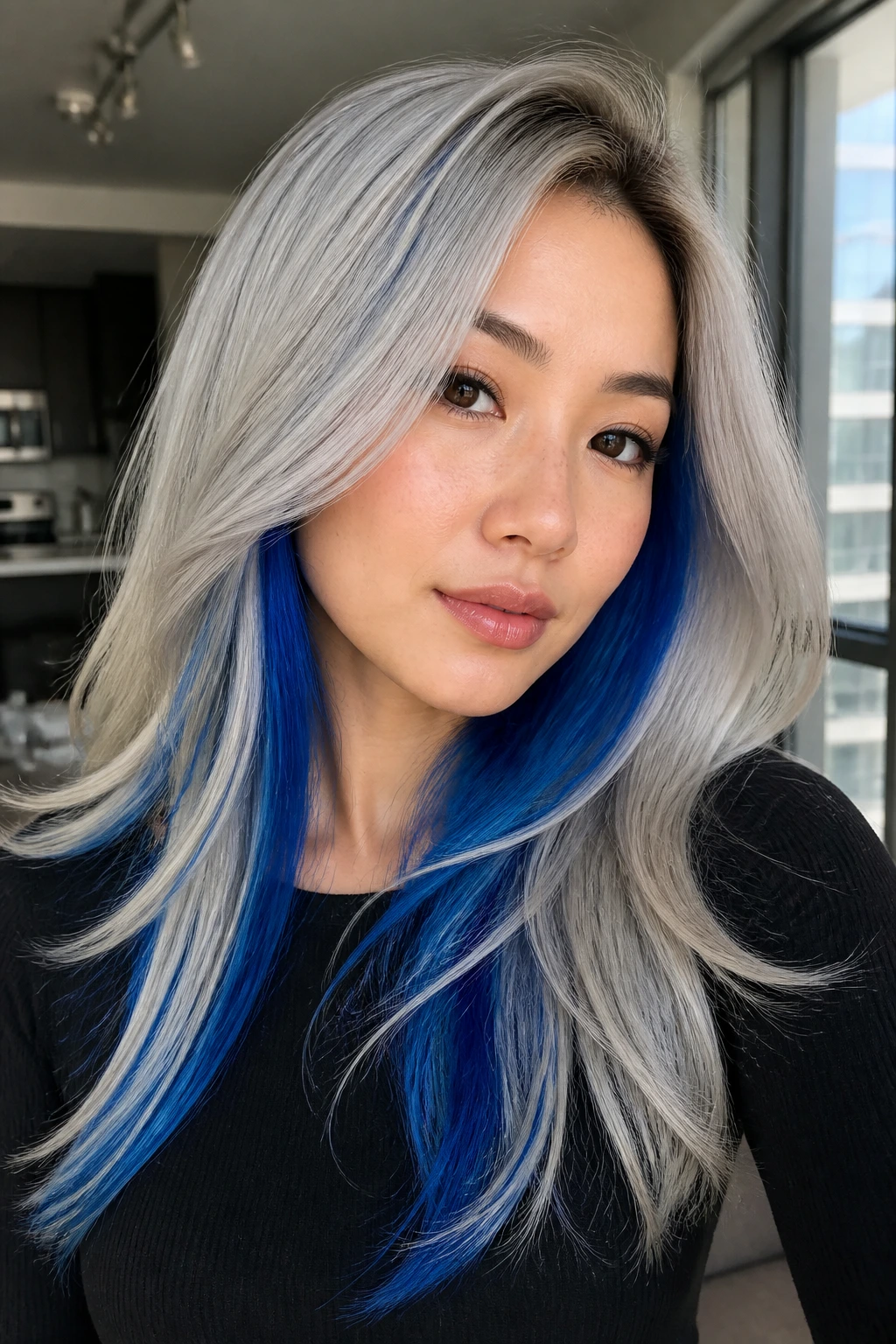
A hidden electric blue inner layer gives you a clean front view and a surprise hit of color underneath. That is a smart move for round faces because the visible shape stays sleek, while the color still adds interest when the hair moves.
Silver blonde on top makes the style feel bright and icy. Electric blue underneath gives the lower half a harder line, which can make the face appear a little longer. The contrast is stronger than it sounds, especially if the blue peeks out from under a smooth blowout or a tucked-behind-the-ear style.
I like this on medium-length hair with a blunt but not boxy finish. Keep the outer silver layer slightly longer than the inner blue section so the color has a place to hide and reveal itself. If the blue sits too high, the whole effect gets busy.
This is a good choice for anyone who wants something a little more playful without giving up polish. The hair looks clean from the front, but it is not plain. That balance is hard to beat.
17. Soft Caramel Blonde with Robin’s Egg Blue Ends
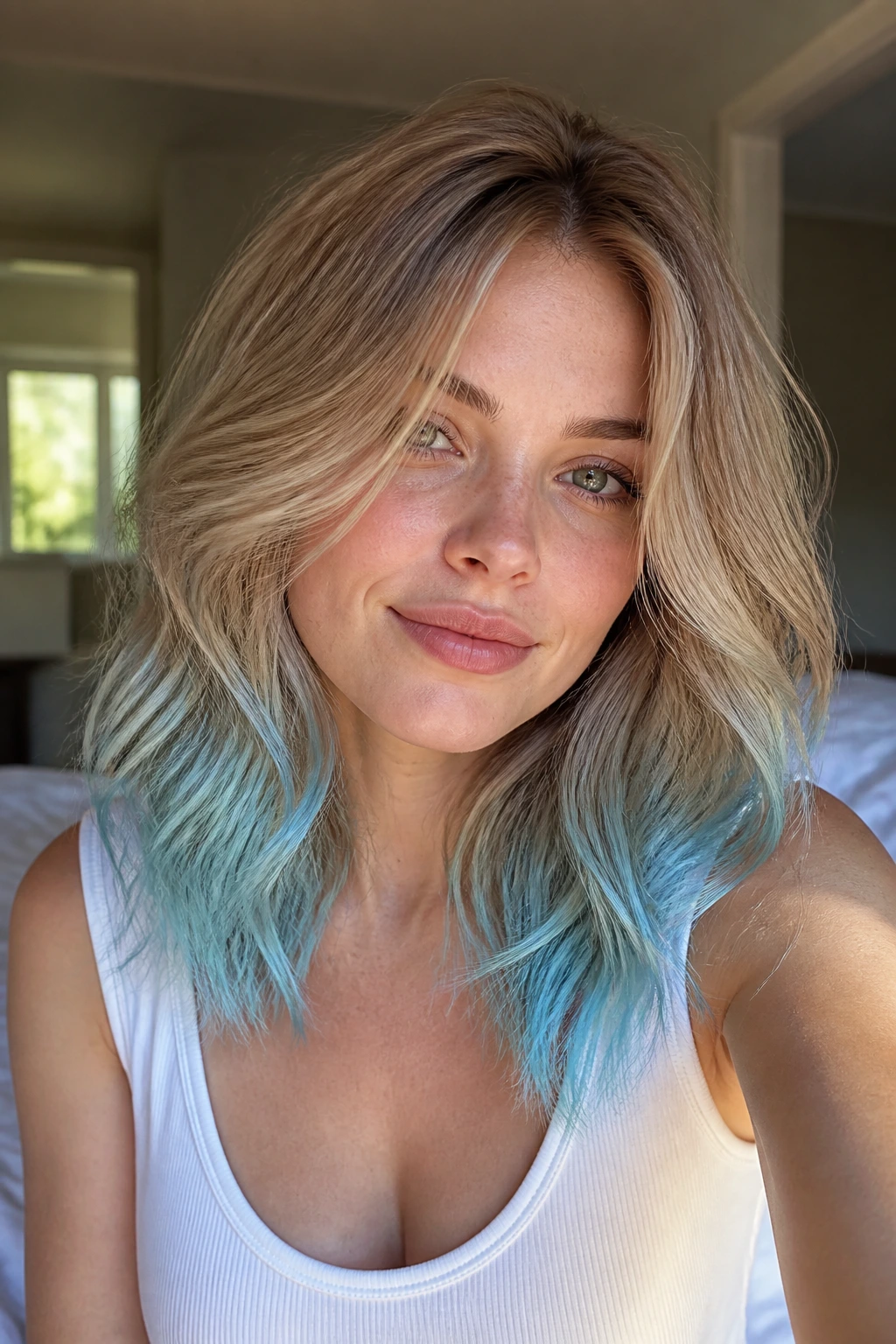
Soft caramel blonde gives the face warmth, and robin’s egg blue cools it down at the ends without making the style feel severe. On a round face, that warmth on top is useful. It keeps the cheek area friendly and open while the blue below adds the length you want.
The important part here is the edge of the blue. Keep it wispy. Rounded ends with a hard line can make the hair feel heavy, but a soft, feathered finish lets the color melt and keeps the shape light. This is especially good on layered hair that hits just below the shoulders.
A lot of people think pastel blue only works with very pale blonde. Not true. Caramel blonde gives the ombre more contrast and makes the blue look fresh rather than washed out. It also flatters deeper skin tones in a way that icy shades sometimes do not.
If you like warm roots and cool ends, this is one of the nicest combinations. It feels easy to wear, which is more useful than sounding dramatic.
18. Ashy Cream Blonde with Cobalt V-Cut
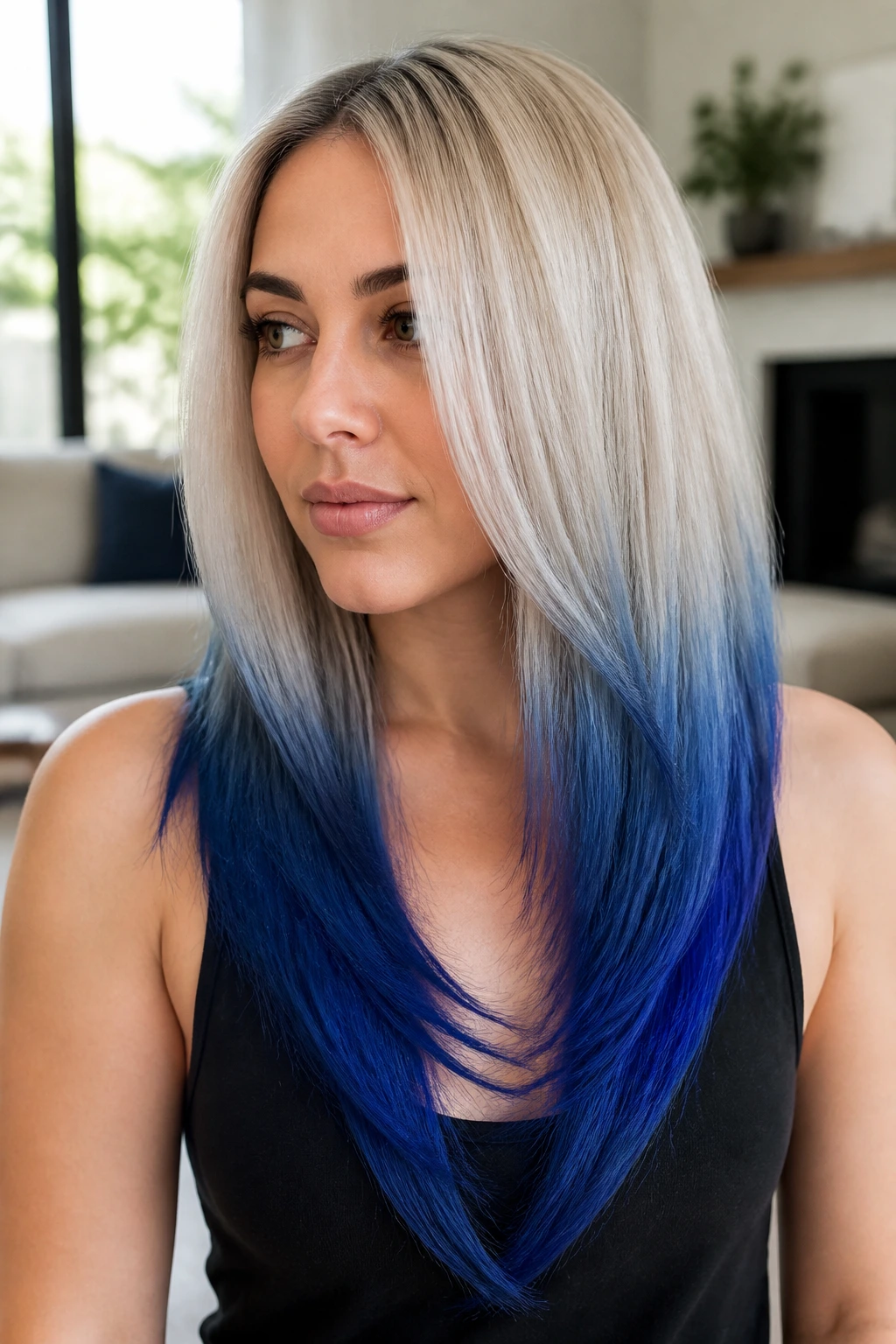
The V-cut is the real hero here. It gives the ends a pointed shape, and that point matters on a round face because it creates a downward line instead of a wide, flat hem. Add cobalt blue to the lower lengths, and the whole silhouette gets leaner.
Ashy cream blonde through the top half keeps things soft and cool. The cobalt gets concentrated lower down, usually from the mid-lengths to the last few inches. That placement keeps the face clear and stops the color from sitting in the widest part of the head.
Unlike a straight-across finish, a V-cut avoids the blocky look that can make round faces seem broader. It works best when the layers are long enough to show the angle. If your hair is too short, the point disappears. If it is too long and heavy, the point gets swallowed. Somewhere between the shoulders and mid-back tends to hit the sweet spot.
This is one of the more structured looks in the bunch. It still feels soft, but it has shape. And shape is the whole game here.
19. Pale Wheat Blonde with Blue-Gray Ombre
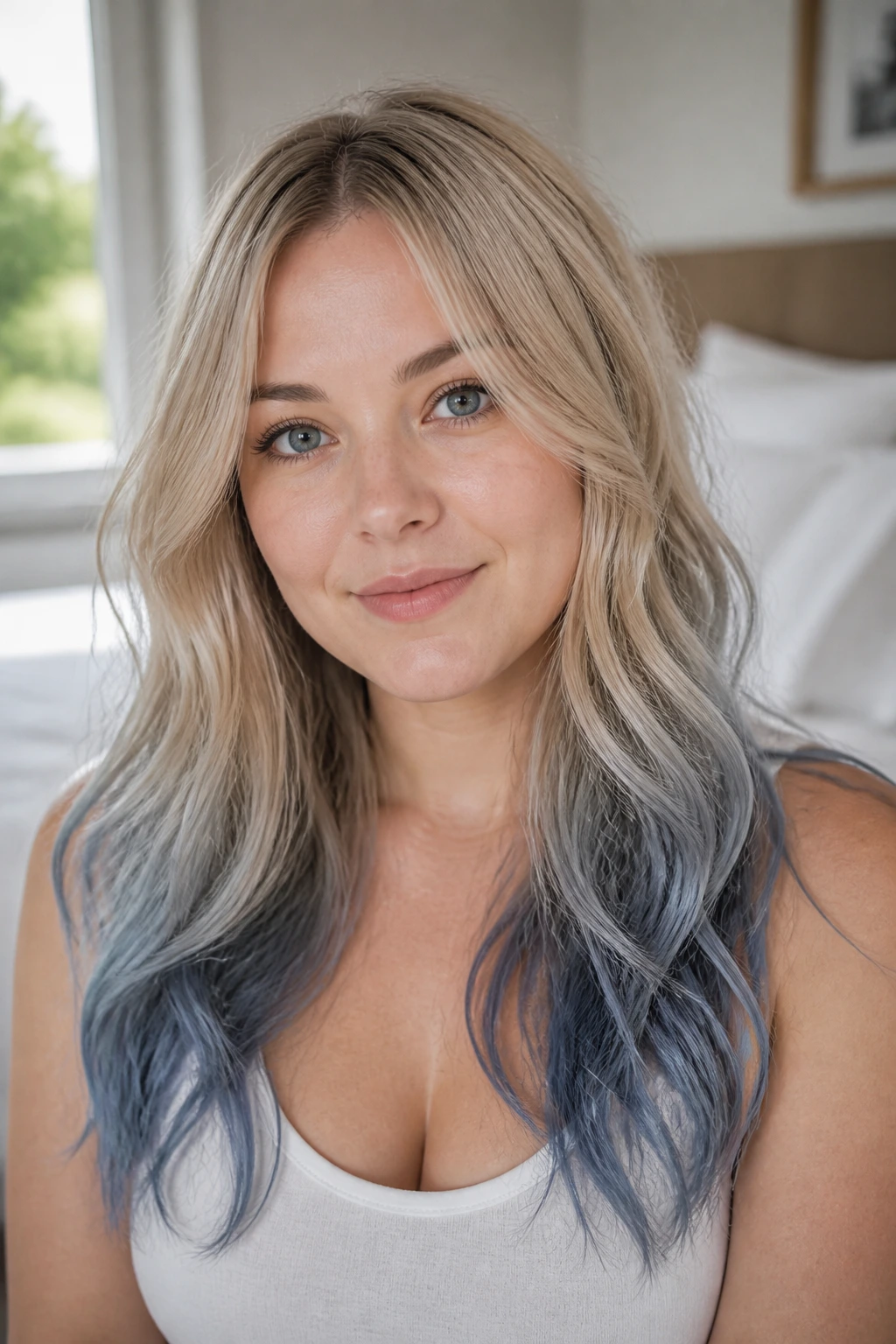
Pale wheat blonde is one of the nicest bases for finer hair because it gives warmth without bulk. Pair it with blue-gray ombre, and you get a look that feels airy rather than heavy. On a round face, airy is useful.
The blue-gray should start low, around the lower third of the hair, so the face stays bright. That lower fade makes the style feel longer. If the blue starts too high, the color can compete with the cheeks and jaw. Nobody wants that.
What to Keep in Mind
- Best on straight to wavy textures
- Works well with light layering around the face
- Blue-gray should stay muted, not smoky black
- A center part can work if the front pieces are long enough
This version has a clean, quiet finish. It is not trying to be loud. That is what makes it good. The color shift is obvious enough to matter, but soft enough that it does not feel like it is wearing you.
For people who get nervous about blue hair looking too bold, this is one of the gentlest entries. It still counts. It still shapes the face. It just does it without shouting.
20. Sandy Platinum with Dusty Blue Veil
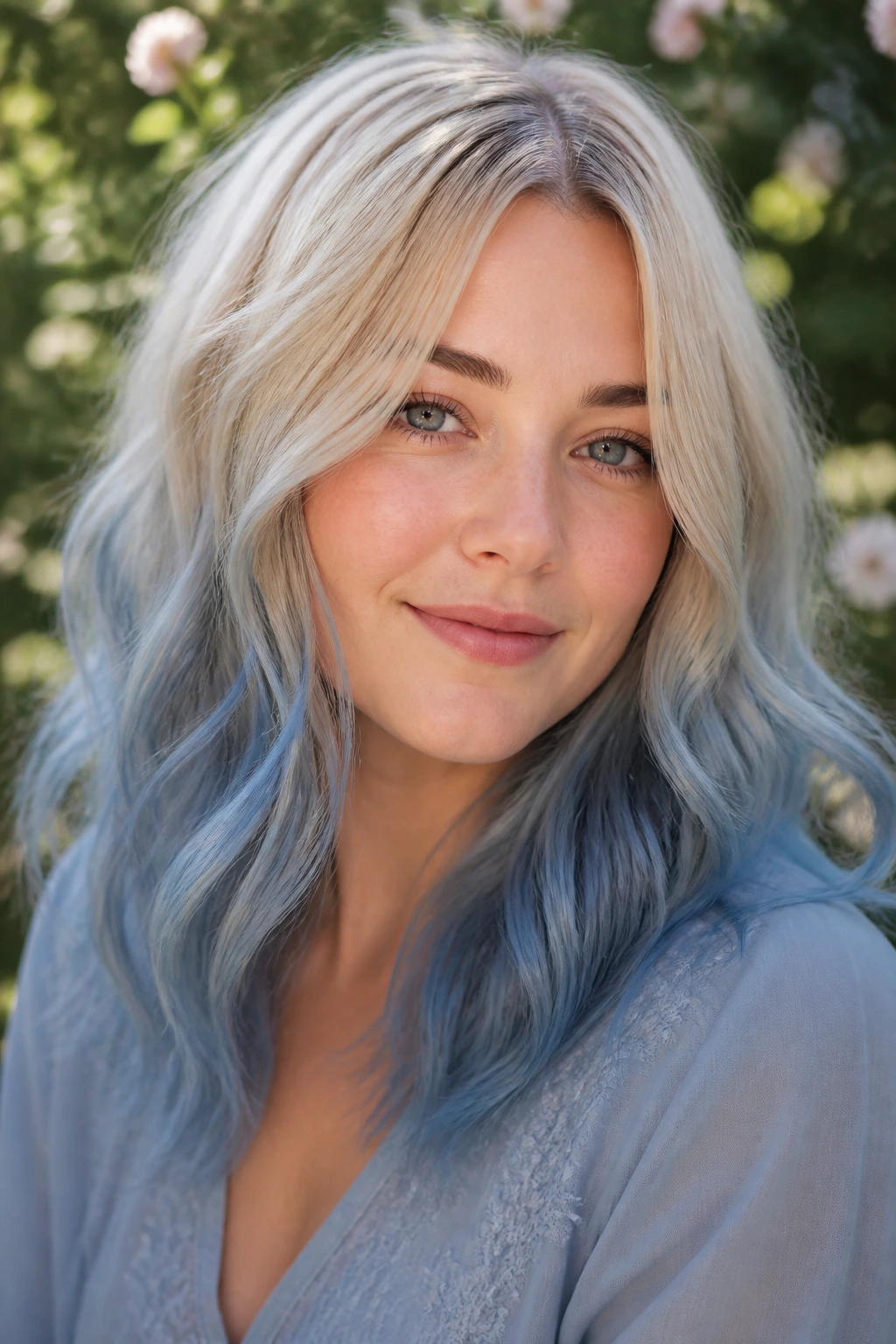
Sandy platinum with a dusty blue veil is the kind of blonde blue ombre hair that looks soft from a distance and more interesting the closer you get. On a round face, that is a strong finish because the eye moves through the length instead of stopping at one bright point.
The sandy platinum keeps the top very light and open. The dusty blue sits in a thin veil through the lower half, almost like a wash of color rather than a heavy block. That helps the face look longer, especially if the hair is worn with a slight side part and a few loose bends around the front.
This one suits people who want the blue to feel almost hazy. It is less graphic than navy, less sweet than baby blue, and easier to wear than cobalt if you prefer something muted. The veil effect is especially nice on longer hair, where the gradient has room to breathe.
If you want one style that gives a round face shape more length without turning the whole look harsh, this is the one I would point to first. Soft top, cooler bottom, a little movement around the cheeks. That combination does a lot of work without looking like it is trying too hard.
