



Round faces don’t need hiding. They need shape.
That’s the part people get wrong with blonde and black highlights. Put the lightest pieces in the wrong spot and the face looks wider, flatter, and a little too circular. Put them where they create a vertical line — near the part, around the jaw, and through the lengths — and suddenly the whole haircut feels sharper, longer, and more deliberate.
The best results usually come from contrast with a plan. A black base can be gorgeous on a round face, but the blonde pieces have to earn their place: thin babylights for softness, chunkier ribbons for drama, or face-framing money pieces that start higher than the cheekbone and taper down past the chin. That little shift makes a bigger difference than people expect. It’s the difference between “nice color” and “my face looks more sculpted.”
Straight hair, waves, curls, lobs, long layers — they all take the contrast differently. So do soft blondes, beige blondes, ash blondes, and warmer honey shades. Some placements widen the face if they sit too low. Some need a deeper side part. Some look best with a root shadow so the blonde doesn’t sit like a hard stripe. The details matter. A lot.
1. Face-Framing Blonde Ribbons on a Black Lob
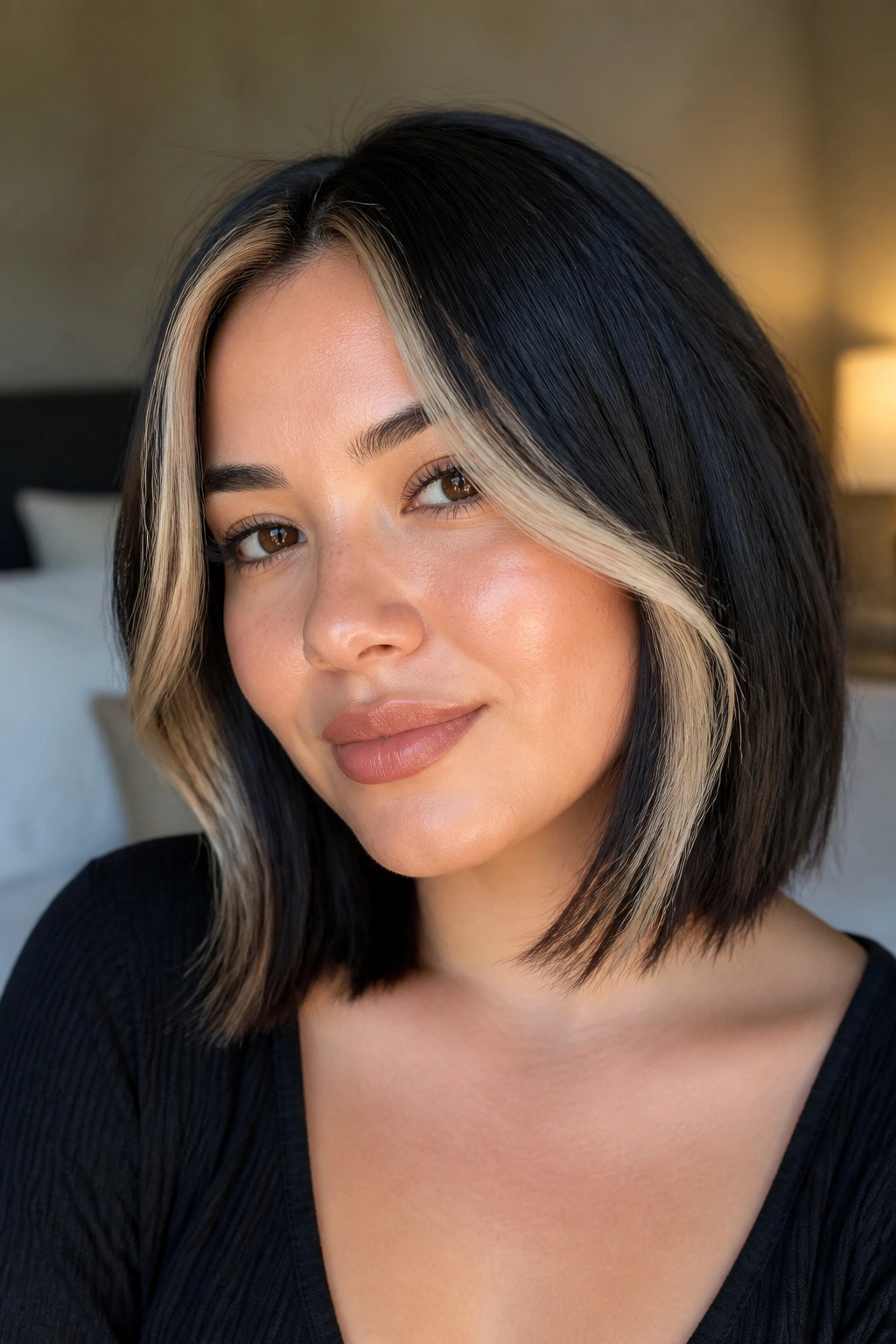
A black lob with blonde face-framing ribbons is one of the easiest ways to flatter a round face without making the color feel fussy. The length already helps, because a lob that hits just below the chin or collarbone adds a vertical line right where round faces need it most.
Why It Works
The blonde pieces should start near the cheekbone, then slide down past the jaw. That line pulls the eye downward instead of straight across the widest part of the face. Keep the ribbons medium-width, not chunky enough to feel stripey, and ask for a soft blend at the root so the contrast looks expensive, not harsh.
A center part can work here, but a slight off-center part usually gives the face more lift. If your hair has a little bend in it, even better. The movement keeps the highlights from looking stiff.
Best for: medium-density hair, soft waves, and anyone who wants visible brightness without a full blonde commitment.
Pro tip: Ask your colorist to leave the brightest blonde a half inch below the root at the front. That tiny gap keeps the grow-out softer and stops the face from looking wider at the cheeks.
2. Ash Blonde Babylights Over a Glossy Black Base
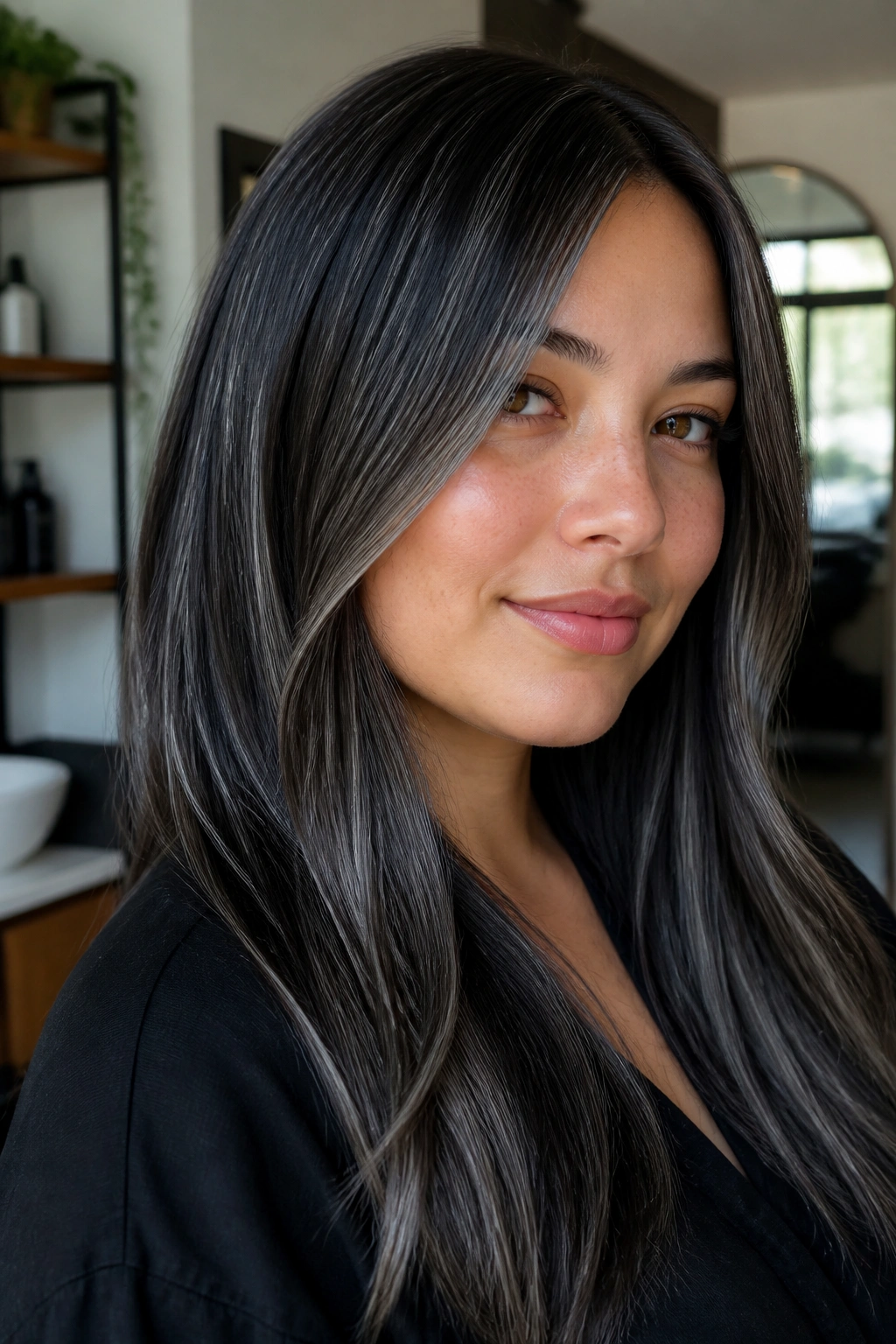
This is the quiet version of contrast, and I like it more than the louder one. Ash blonde babylights on black hair give round faces shape without shouting for attention. The effect is fine, thin, and slightly smoky, which is exactly why it works on softer face shapes.
Babylights are tiny. That’s the whole point. On a round face, they create the sense of movement without dropping a heavy blonde block across the cheeks. The ash tone also cools down the black base, so the color reads sleek instead of warm and muddy.
Keep most of the brightness through the top layers and the lengths, not packed into the sides. You want the color to feel like light moving through hair, not a stripe wrapping the face. On straight hair, this looks sharp. On wavy hair, it looks even better because the little strands catch and break up the shape.
Use this if you like low drama and high polish. It’s also one of the easier options to maintain, which matters if you don’t want root appointments every few weeks.
3. Chunky Blonde Ribbons Through Long Layers
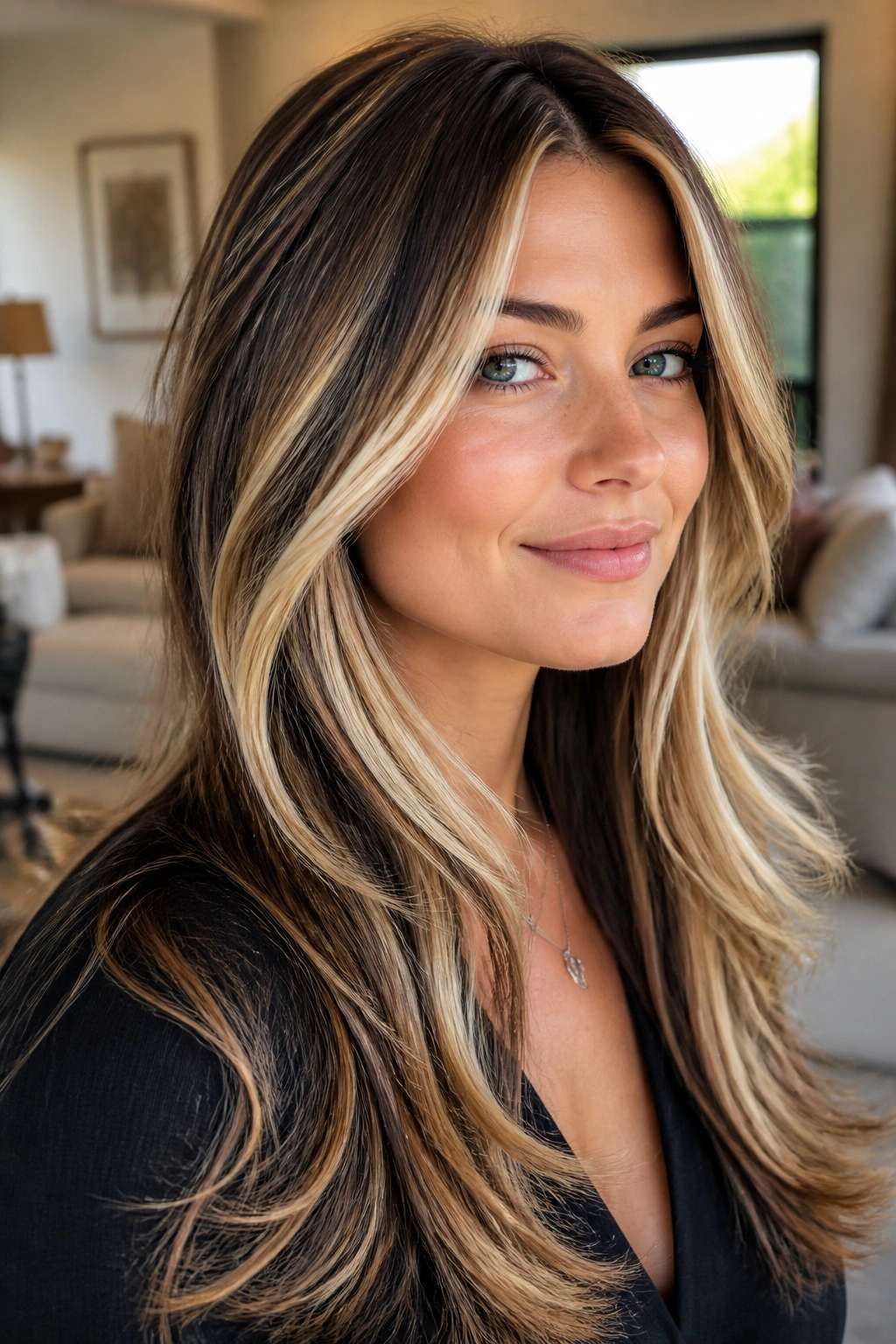
Why do chunky highlights still work? Because they do one thing extremely well: they make long layers visible. On a black base, blonde ribbons placed through the length of the hair create a strong vertical path that flatters a round face far more than a wide band of color ever could.
The trick is placement. Keep the thickest blonde pieces below the cheekbone and let them fall through the ends. That stops the color from spreading too much across the face. You want the eye to travel downward, past the jaw, not hover around the middle of the cheeks.
What to Ask For
- Blonde ribbons that begin below the cheekbone
- A soft root shadow for a less blocky grow-out
- Layered ends that move when the hair swings
- A few finer pieces near the crown for lift
This look is bold. No pretending otherwise. But bold doesn’t mean sloppy. If the ribbons are placed well, the roundness of the face gets balanced by the length and motion in the hair.
Best for: thick hair, long layers, and people who don’t mind contrast that people can notice from across the room.
4. Peekaboo Blonde Panels Hidden Under Black Top Layers
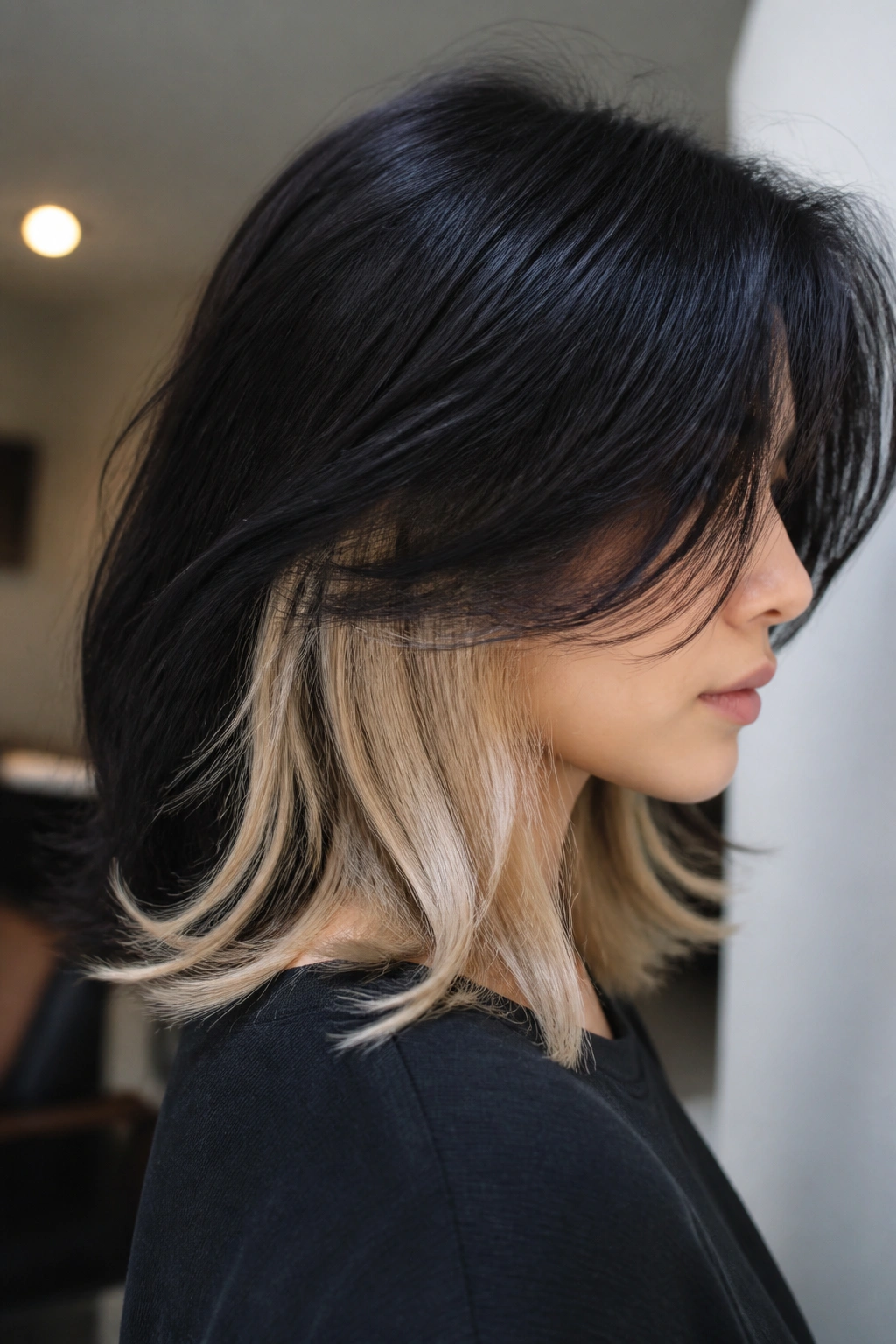
A peekaboo highlight is a smart move when you want contrast without turning the whole head into a light-and-dark checkerboard. Blonde panels hidden under black top layers give round faces a slimmed outline from the side and a nice flash of brightness when the hair moves.
The reason this flatters a round face is simple: the blonde sits underneath, so it doesn’t widen the outer edge of the hair around the cheeks. Instead, the light peeks out near the ends or at the nape. That little flash pulls the shape downward.
This works especially well on shoulder-length cuts and longer bobs. If you wear your hair tucked behind one ear, you get a nice hit of contrast near the jaw without putting a bright band across the whole face. It’s a good choice for people who want something playful but not loud all the time.
Ask for blonde panels that are hidden in the interior layers, not just a stripe near the surface. That gives the color movement when you curl, wave, or braid the hair. And yes, it still looks good when it’s straight. Just quieter.
5. Curtain Bangs with Blonde and Black Dimension
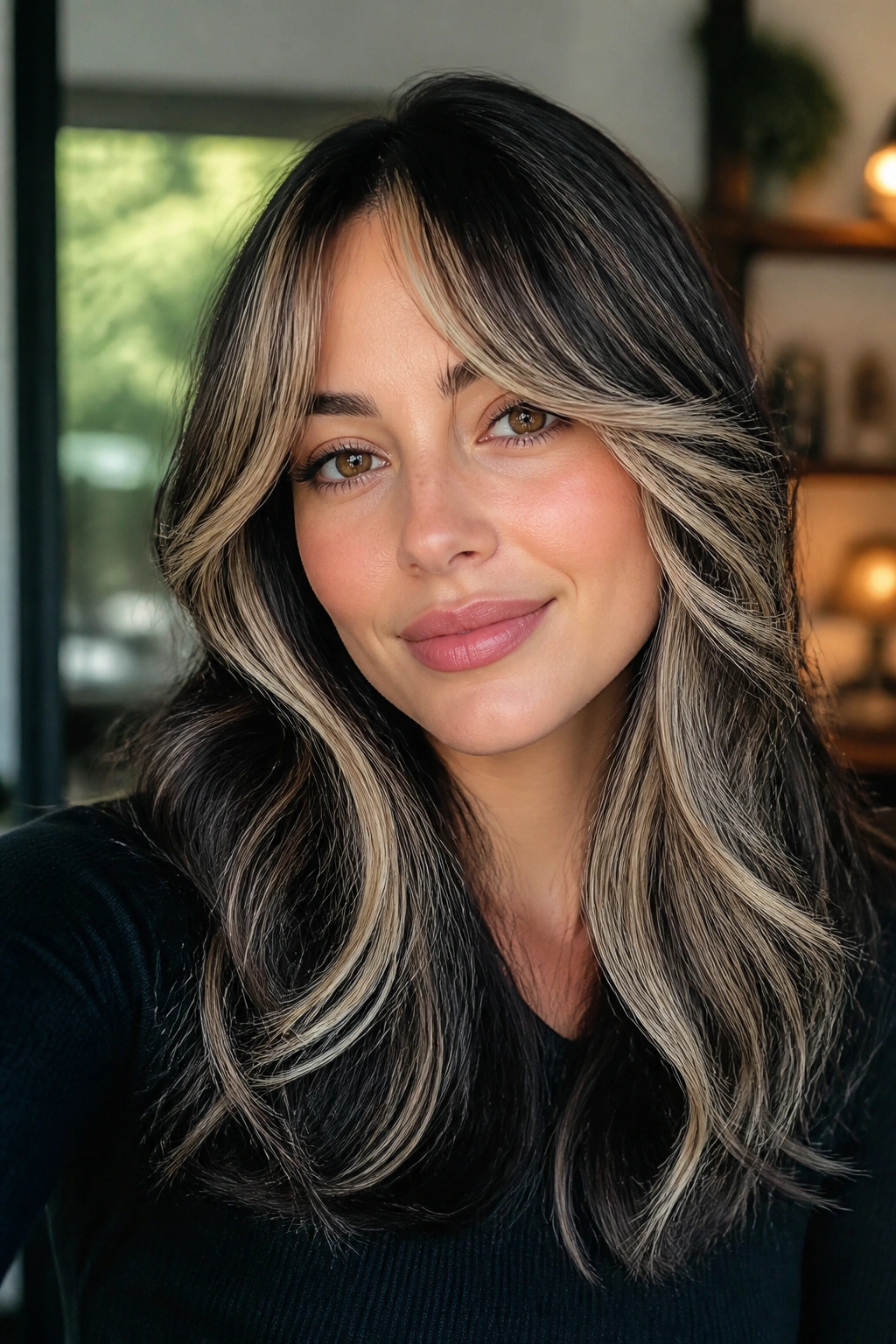
Curtain bangs can rescue a round face when the color follows the same soft bend. Add blonde and black dimension through the front sections, and you get a shape that opens the face without making it look wider.
The key is keeping the brightest pieces longer than the bangs themselves. You want the blonde to skim the cheekbones and drift into the lengths, not sit as a hard, horizontal block right at the widest part of the face. That’s the mistake I see most often.
Curtain bangs already break up roundness because they create an open center and a tapered side sweep. Once you layer in soft blonde babylights or fine money pieces, the cut gets more visible and the face looks a touch longer. On wavy hair, this combo is almost unfair. It’s that good.
Keep the contrast soft if your bangs are heavy. If the fringe is airy, you can push the brightness a little more. Either way, avoid placing the lightest blonde too high at the temples. That can make the top of the face feel broader than it needs to.
6. Balayage That Starts Below the Cheekbones
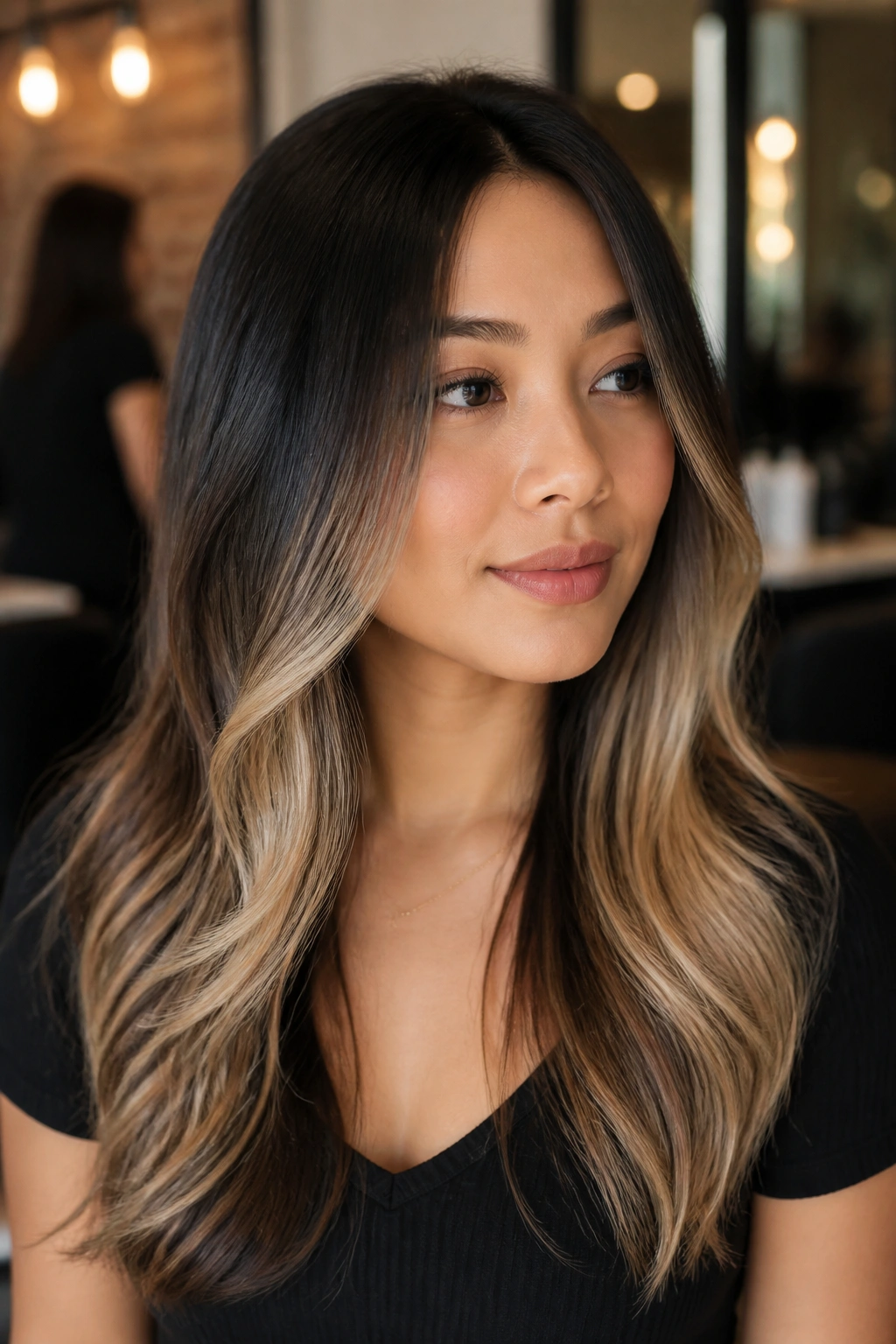
Would this look work if the blonde started at the roots? Not nearly as well. For round faces, a black base with blonde balayage that begins below the cheekbones is a safer, smarter choice because it avoids widening the upper half of the face.
Balayage is painted by hand, so the placement can be more controlled than traditional foils. That matters here. Ask for the lighter pieces to begin lower at the sides, then sweep down through the lengths and ends. The face keeps its shape, and the color still feels soft.
This is one of those styles that gets better with movement. When the hair bends, the lighter strands show in slim vertical lines. When the hair is straight, the effect is more subtle and sleek. Either way, the black and blonde contrast doesn’t sit directly across the cheeks, which is the part that matters most.
A rooty balayage also gives you a better grow-out. Fewer harsh lines. Less maintenance. More room for the cut to do the shaping.
7. Platinum Money Pieces with a Deep Side Part
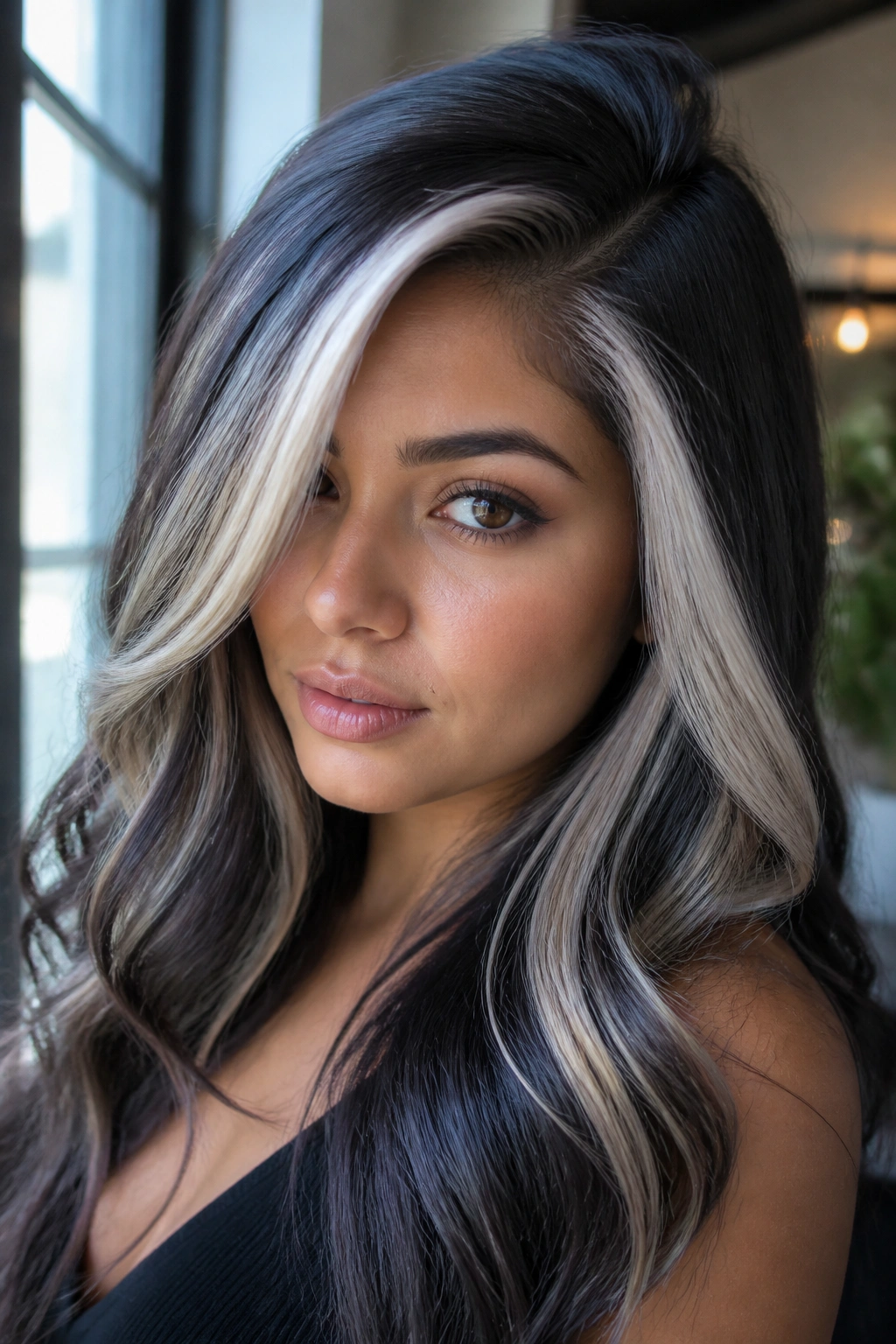
A deep side part does a lot of heavy lifting on a round face. Add platinum money pieces to one side, and the whole style gets a sharper line. I like this look on black hair because the contrast is immediate, but the side part keeps it from feeling too centered and too wide.
The platinum pieces should be placed just in front of the part and angled down toward the jaw. That angle matters. Straight-across brightness tends to make the face read fuller. A diagonal line feels leaner.
How It Changes the Shape
- Creates lift at the crown
- Breaks up the symmetry of a round face
- Draws attention upward before leading it down
- Adds drama without requiring a full head of light blonde
This is not a shy look. It’s clean, bright, and a little bit sharp. If you like strong makeup, polished waves, or a straight blowout with smooth ends, it looks especially good.
One warning: platinum near the front can be high maintenance if your natural base is very dark. Keep the front pieces narrow so they don’t turn into a grow-out project you hate by week three.
8. Warm Honey Blends on a Black Wavy Bob
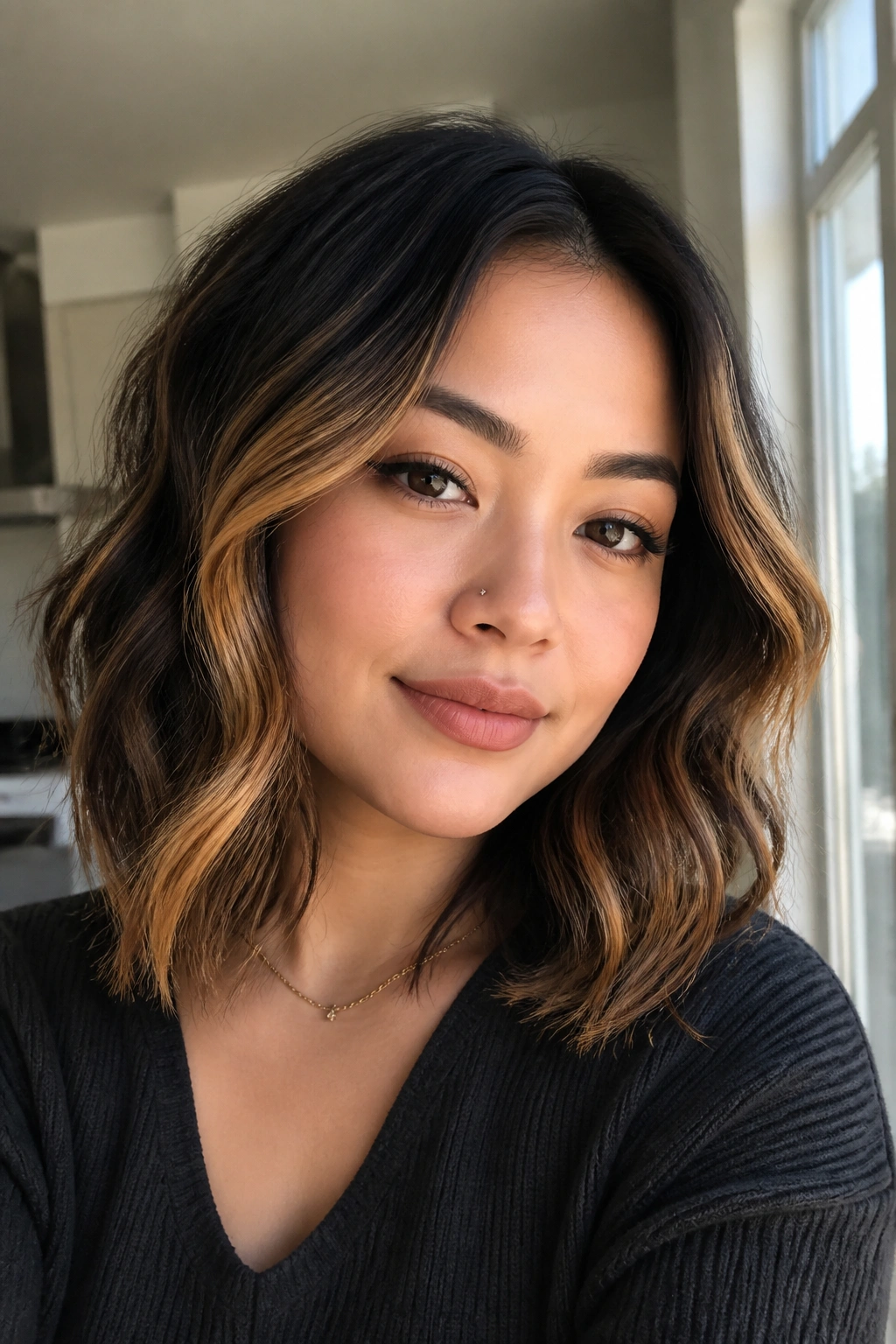
Black hair with honey-blonde highlights can soften a round face in a way ash tones sometimes don’t. The warmth keeps the color from looking too severe, and the wavy bob gives the face the vertical movement it needs.
What makes this placement work is the bend in the hair. On a bob that falls around the jaw or just below it, honey pieces should be painted through the mid-lengths and ends, not stacked at the cheeks. That keeps the widest part of the face visually clear. The color still pops when the hair flips or curls inward a little.
This is a good choice if you want contrast but don’t want the blonde to feel icy. Honey tones also tend to play nicely with olive or golden skin, though they’re not limited to that. They just feel softer in motion. Less “striped.” More lived-in.
If your bob is blunt, ask for some very fine lowlights as well. A touch of depth near the underside keeps the silhouette from puffing out around the face. Small detail. Big payoff.
9. Smoked Blonde Lowlights for a Soft, Narrower Look
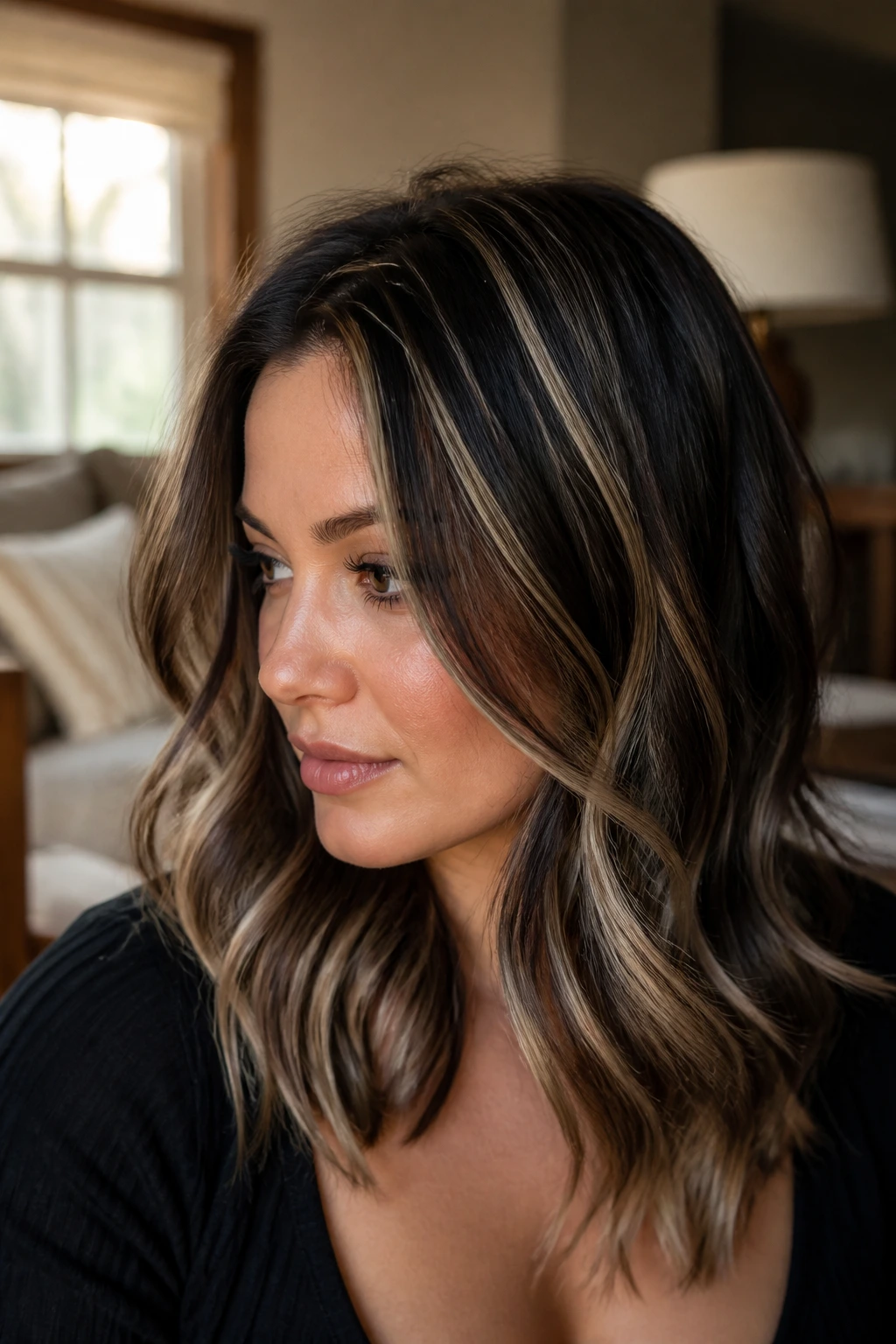
People forget lowlights matter just as much as highlights. On a black base, smoked blonde lowlights can be a smart choice for round faces because they create depth first and brightness second. That depth narrows the visual width of the hair.
This style is especially useful if your hair is very thick or naturally puff-prone. Instead of adding more blonde at the sides, you’re breaking up the overall mass with muted blonde sections that sit between the black pieces. The result is smoother and less helmet-like.
A lot of stylists call this “dimension,” which is fine, but the real value is simple: the hair stops looking like one big shape. It becomes a series of vertical layers, and round faces usually look better when the eye can move through the hair instead of stopping at one blunt edge.
Best Placement
- Under the top layer
- Through the mid-lengths
- Near the nape
- Around the back of the head, not just the front
That last part matters. If all the contrast lives around the face, the roundness can come back fast. Spread the depth around the whole head.
10. Blonde and Black Curtain Highlights on Long Hair
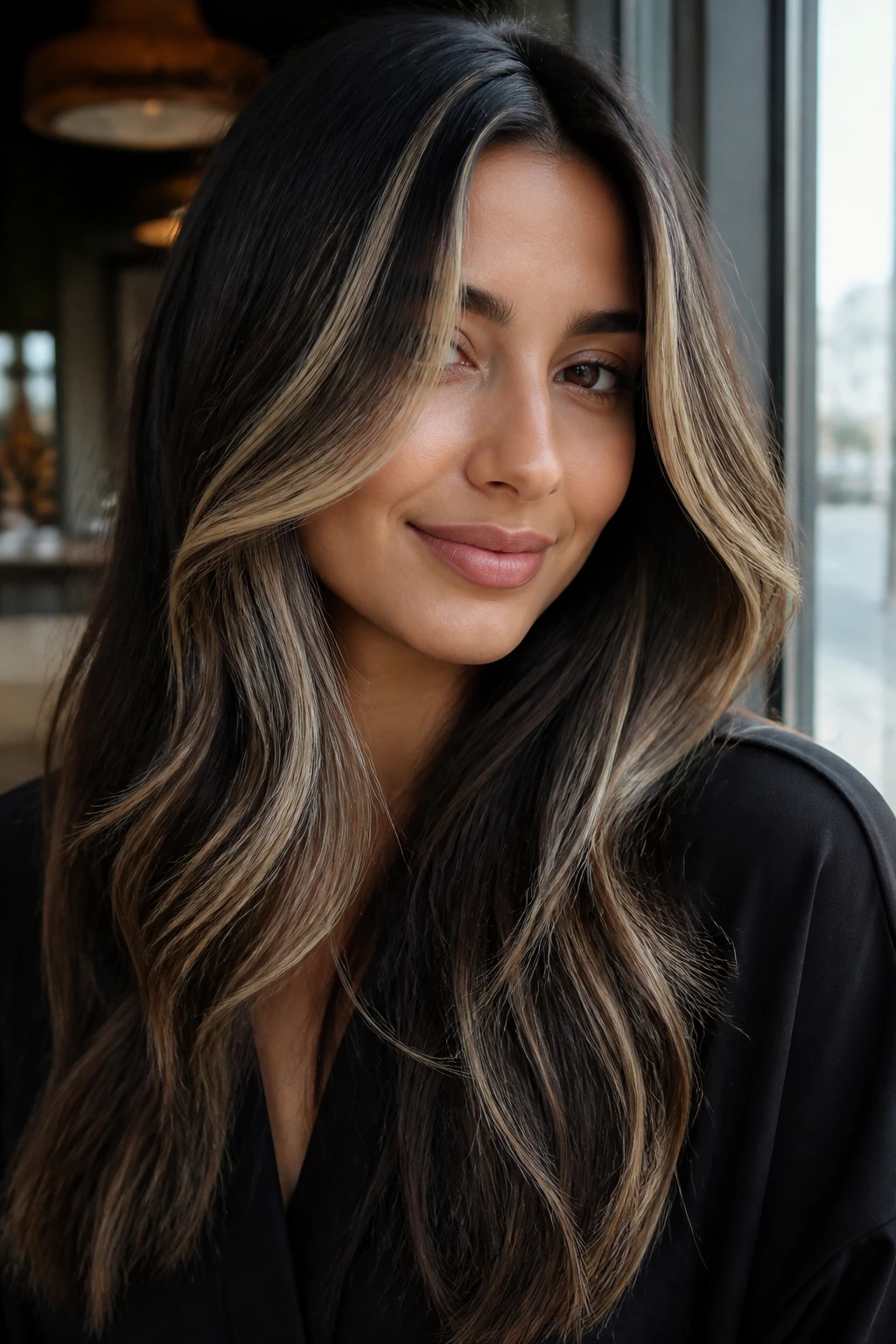
Long hair gives curtain-style highlights room to breathe. On a round face, that’s a gift. The blonde and black pieces can fall from the part, skim the cheekbones, and then taper into the lengths without building width at the jaw.
This look is best when the front sections are feathered, not chunky. Think narrow strips that open the face, not heavy face panels that sit like curtains in the wrong place. The rest of the highlights can stay softer and more diffused through the lower half of the hair.
The thing I like here is the movement. When long hair swings, the color follows it. That motion keeps the face from feeling boxed in. If your hair is straight, add loose bends with a 1.25-inch curling iron and brush them out. If it’s wavy already, even better. Let the texture do the work.
Ask for the blonde to be a shade or two lighter than you think you want. On black hair, a middle-of-the-road blonde can disappear. You want enough brightness to carve shape, not just whisper at it.
11. Babylights Around the Crown and Front
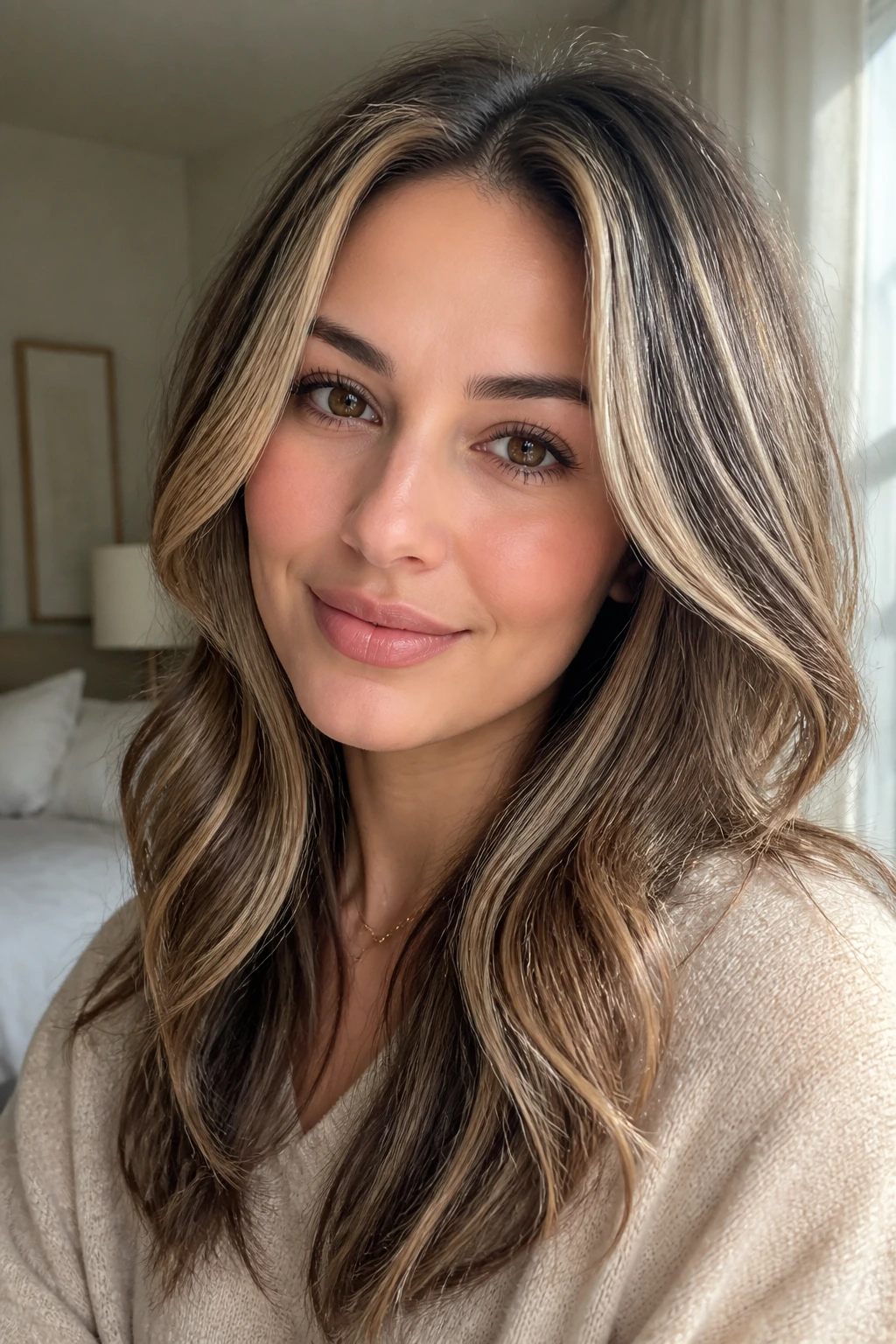
Crown lift changes everything on a round face. Thin blonde babylights placed around the crown and front sections create a little height where you need it most, which helps the face read longer and less wide.
The goal here is softness, not contrast that shouts. Babylights are so fine that they blend into the black base and create a shimmer rather than stripes. Around the crown, they add lift without making the face appear broader at the sides. Around the front, they create a narrow bright line that guides the eye up and down.
This is one of the smartest choices for fine hair too. Because the color is delicate, it doesn’t overwhelm the hair density. Instead, it gives the cut a more lifted, airy feel.
If you wear your hair in a blowout, this style is especially good. The root area looks fuller, the lengths catch light, and the roundness of the face gets balanced by the added vertical height. It’s subtle, but subtle can be powerful when it’s placed well.
12. Beige Blonde Ends on a Black Shag
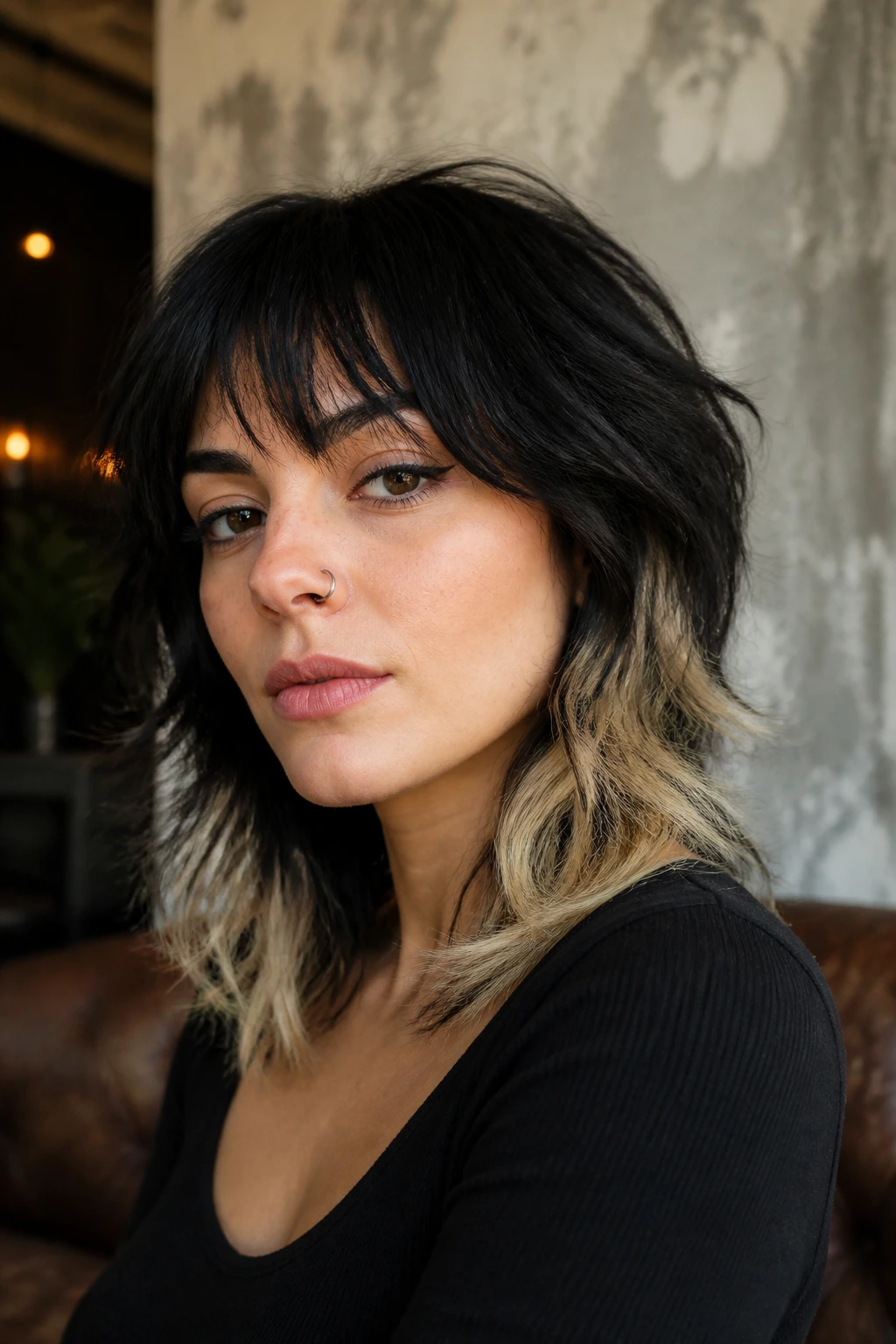
A shag gives round faces built-in edge. Add beige blonde ends to a black shag, and the haircut gets even better because the lighter ends keep the lower half of the face from feeling heavy.
The shag works here because the layers are already broken up. That means the blonde can sit at the ends without turning into one large bright block. Beige tones are a nice middle ground — less brassy than honey, less icy than ash. They soften the cut without stealing all the attention.
This look suits people who like texture. A shag without movement can look flat. A shag with the right color placement looks deliberate and a little bit cool, which is rare and useful. The blonde ends also help make the layers visible, especially if your black base tends to swallow shape.
Keep the brightest pieces away from the cheek line. Let them fall lower, around the neck and collarbone. That gives the round face room to breathe.
13. High-Contrast Blonde Skunk Stripes
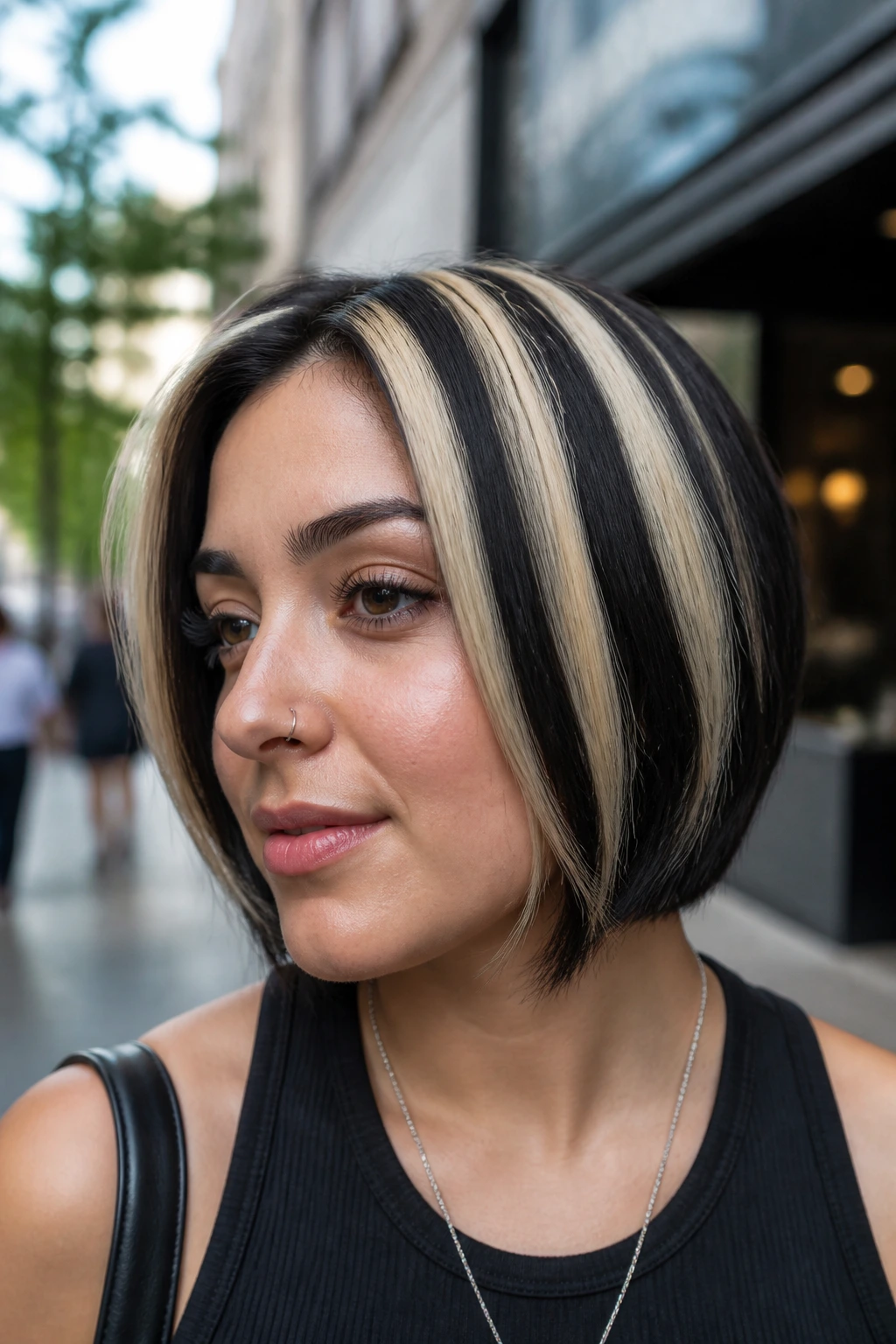
High-contrast skunk stripes are not for the faint of heart. But on the right round face, they can be surprisingly flattering if the stripes run vertically and sit away from the widest part of the cheeks.
The old mistake with this kind of color is putting the stripe too high and too wide. That makes the face look broader. Better version: place the blonde in narrow, deliberate lines that fall from the top section of the hair toward the jaw and below. Keep the rest of the hair black and glossy so the contrast feels designed.
Good Uses for This Look
- Short, angular cuts
- Strong side parts
- Sleek blowouts
- Bold makeup days
The reason it can work is simple. A round face often benefits from shape, and this style gives it shape in a loud way. Not everyone wants quiet. Some people want the hair to enter the room first.
If you’re trying this, keep the blonde clean and the black rich. Dull contrast looks cheap. Sharp contrast looks intentional. There’s a big difference.
14. Soft Face-Framing Blonde on a Layered Pixie-Bob
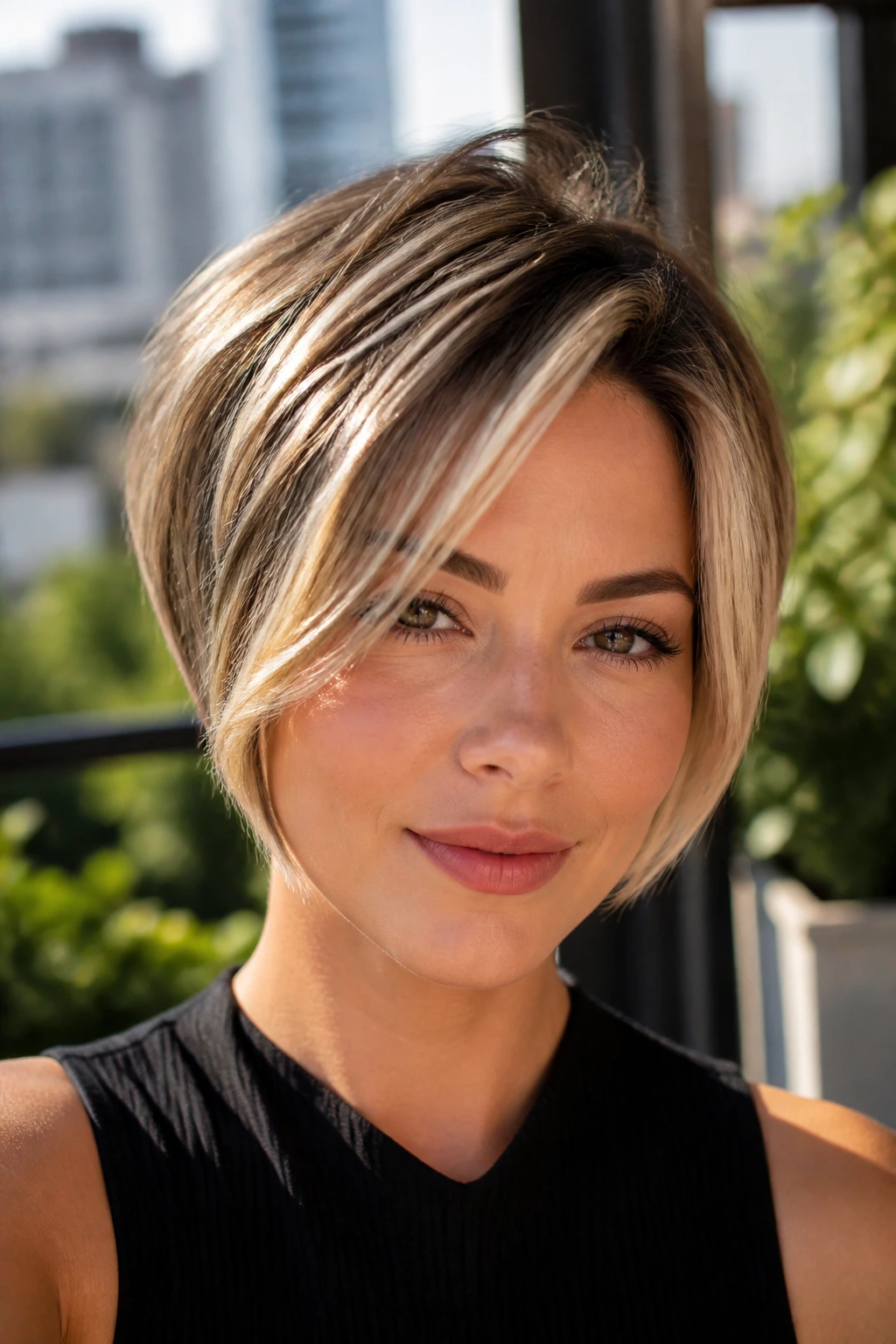
A layered pixie-bob can be a brilliant cut for a round face because it lifts the crown and leaves the neck open. Add soft blonde face-framing pieces over a black base, and the shape gets even cleaner.
This is one of those styles where placement has to be precise. The lightest pieces should sit at the front edge and top layers, then fade quickly into darker underlayers. That keeps the face from looking boxed in. Short hair exposes every line, so the contrast has to be earned.
The blonde should not sit in a solid chunk at the cheeks. That’s the trap. Instead, use broken bits of brightness to create movement around the temples and the front corners of the haircut. It’s a smaller style, so every inch counts.
A pixie-bob with this color works well if you like fast styling. A quick bend with a flat iron, a little root lift, and you’re done. Low effort. Strong outline. Good combination.
15. Scattered Blonde Pieces Through Loose Waves
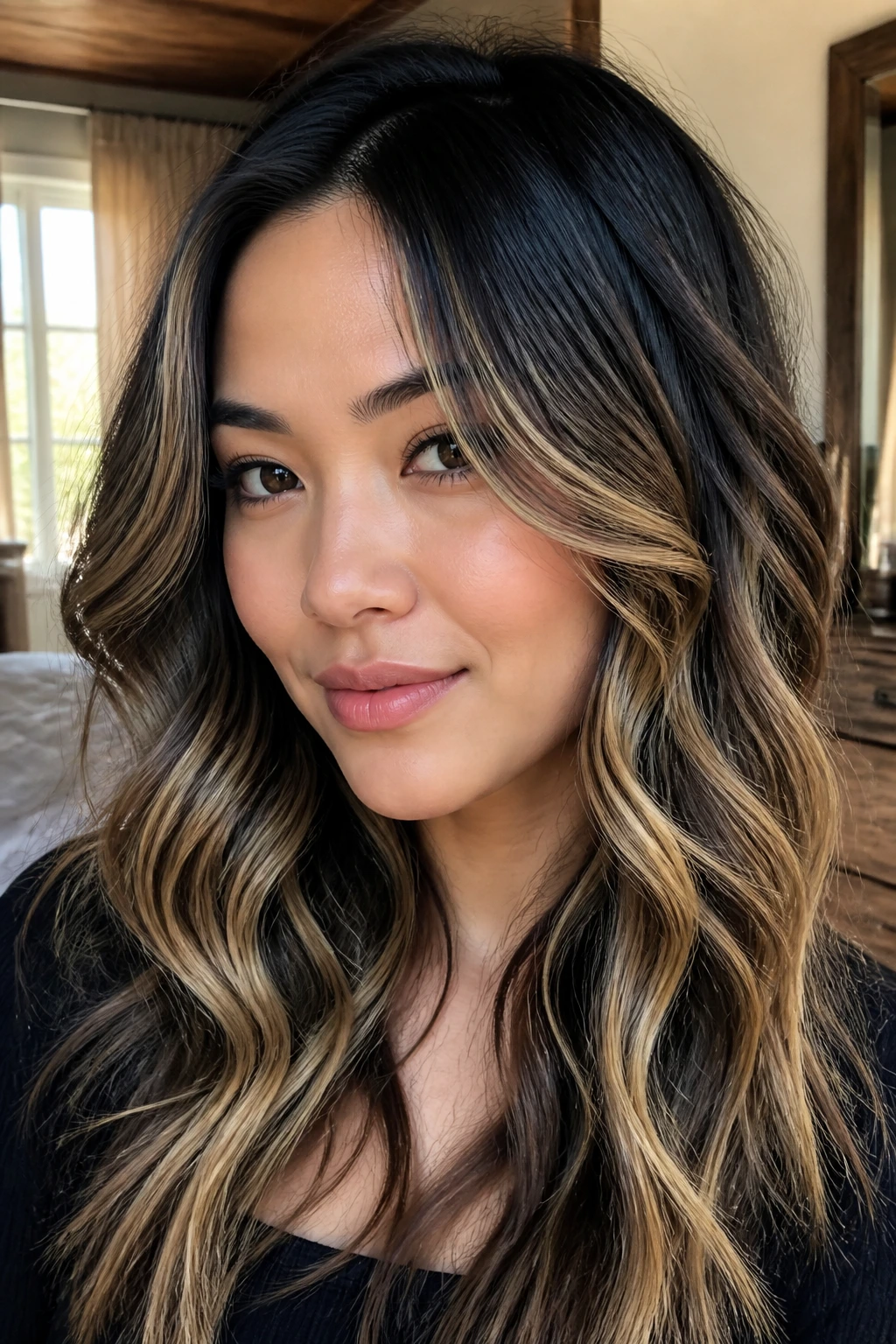
Loose waves are forgiving, but they still need smart placement on a round face. Scattered blonde pieces on black hair can look airy and soft if the bright strands are placed unevenly through the lengths, not in a ring around the cheeks.
That unevenness matters. A perfectly balanced highlight map can make the head feel too symmetrical. Round faces often look better with a bit of asymmetry, especially when the hair falls in gentle waves. A few brighter strands near one side of the part and a few lower toward the ends keep the eye moving.
If the waves are big and polished, keep the blonde pieces narrower. If the waves are more broken and beachy, the blonde can be a touch chunkier. The texture changes the way the color reads. It always does.
This is a nice everyday choice if you want dimension without a big color commitment. It grows out gracefully, and it doesn’t need constant styling to make sense.
16. Collarbone-Length Layers with Bright Front Strands
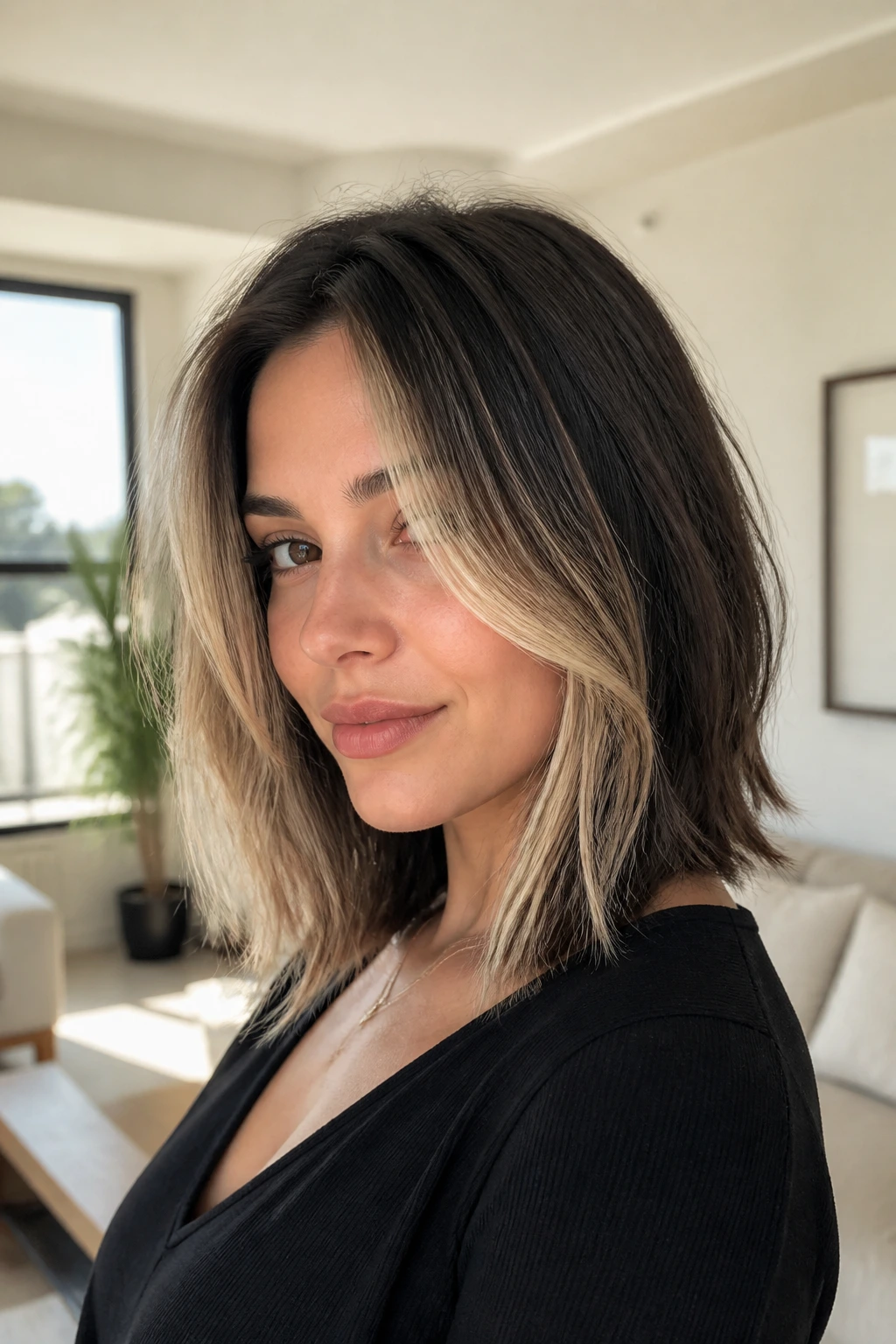
Collarbone-length hair flatters round faces for a reason: it gives the face a longer frame without dragging the style down. Add bright front strands, and the cut starts doing some of the contour work for you.
The front pieces should begin around the nose or cheekbone, then taper as they fall. That route pulls attention downward and keeps the light from hovering too high across the face. Ask for layers that move away from the cheeks instead of curling under them.
This is a better choice than a blunt one-length cut if you want the blonde to feel lighter. The layers stop the shape from getting boxy. And if you have a naturally full face, boxy is the last thing you want.
A small side part can give this look a little extra angle. Not dramatic. Just enough to break the symmetry. That tiny shift can make the front pieces look more intentional and less like they were dropped in by accident.
17. Smoke Blonde Babylights on Curly Hair
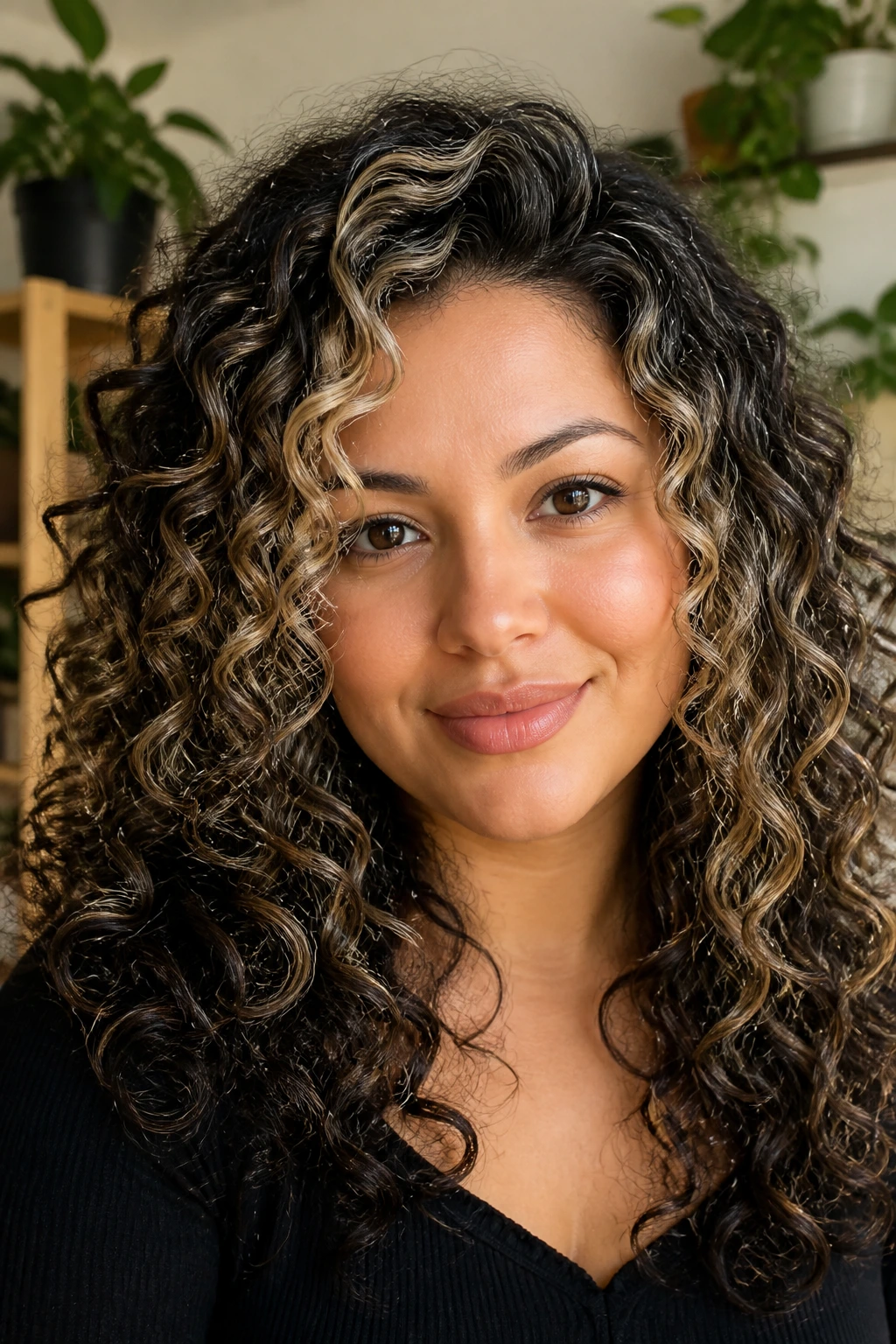
Curly hair and round faces can be a lovely match, but the color placement has to respect the curl pattern. Smoke blonde babylights on black curls add definition without turning the silhouette into one wide halo.
The reason babylights work so well here is that they follow the curl in tiny threads. Instead of creating one broad blonde patch, the color moves through individual curls and gives the hair more shape. Smoke blonde is a good tone because it stays soft and doesn’t fight the depth of the black base.
Put the brightest pieces around the front curls and a few through the top layer. Leave the side volume slightly darker if your curls already spread wide at the cheeks. That’s how you keep the face looking balanced.
Curls hide grow-out better than straight hair, which is a nice bonus. You can wear this longer between appointments without the whole thing looking messy. That matters more than people admit.
18. Blonde Ends with Dark Root Melt
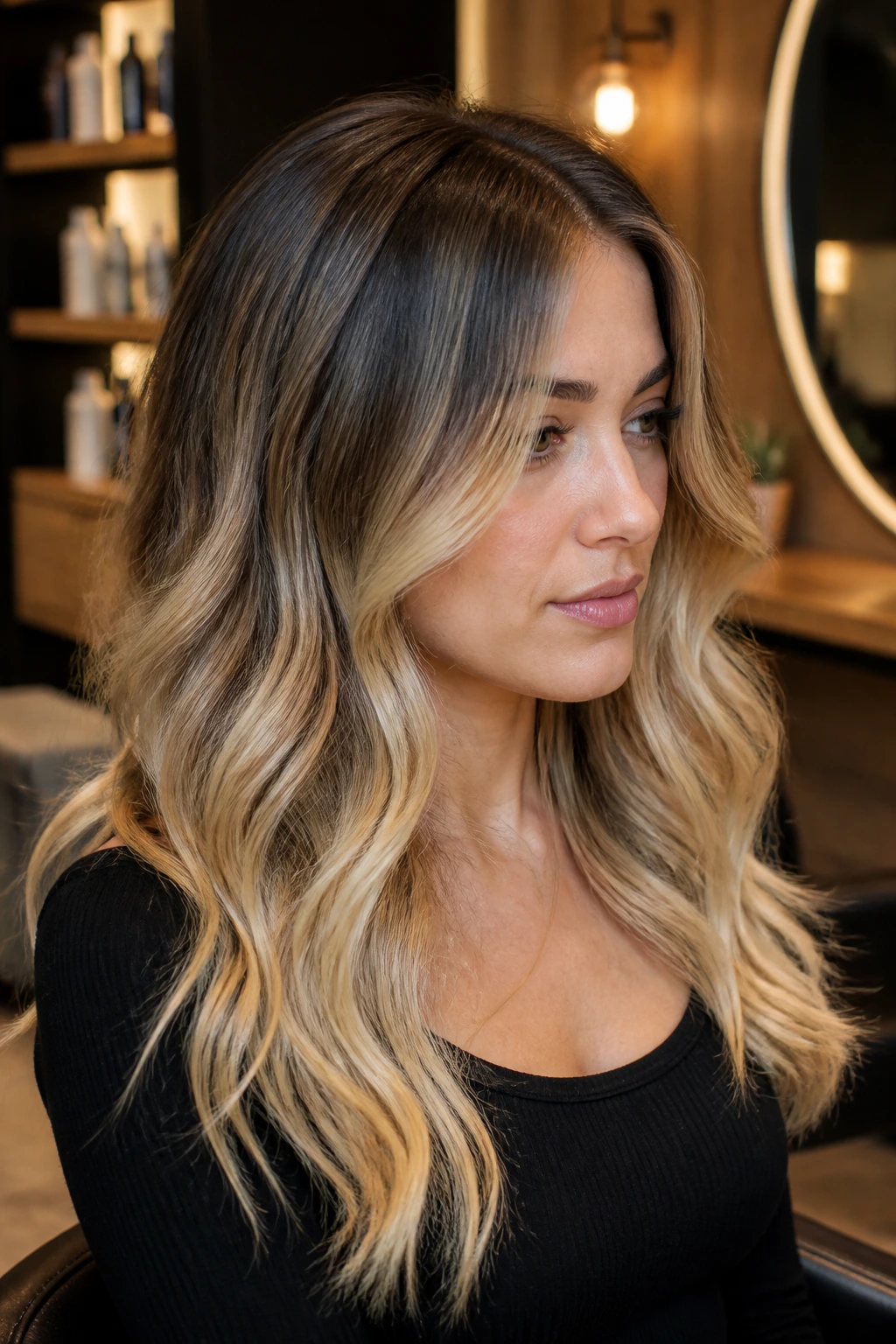
A dark root melt is practical, but it also helps round faces by avoiding a hard line where the color changes. On black hair, blonde ends with a smooth root melt keep the top of the head darker and the lighter weight pushed lower, which visually lengthens the face.
That lower brightness is the key. It draws the eye down past the jaw and neck. If the blonde started too high, the face would read wider. Since it starts at the mid-lengths or lower, the shape stays sleek.
This works best on layered cuts or softly waved hair. The darker root keeps the style grounded, and the blonde ends create movement. If the ends are blunt, the look can feel heavy. If they’re feathered, it feels clean.
Ask for a melt, not a harsh line. You want the black to fade into brownish depth, then into blonde. That gradual shift makes the whole style easier to wear and easier to grow out.
19. Side-Swept Fringe with Blonde Threads
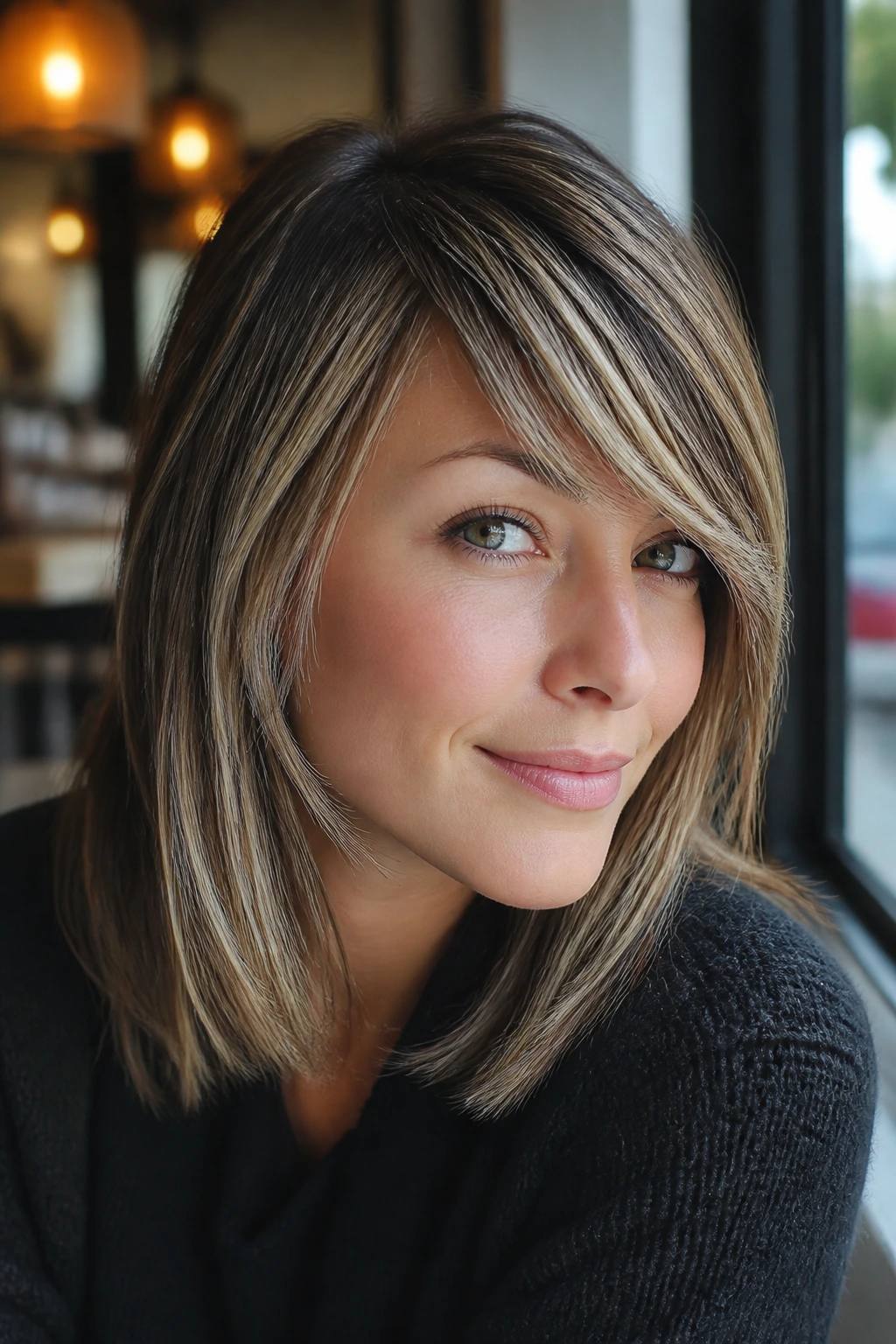
A side-swept fringe is one of the easiest ways to break up the symmetry of a round face. Add blonde threads through the fringe and the front lengths, and the shape gets a little leaner almost instantly.
The fringe should sweep diagonally, not stop at the brow in a straight line. Straight lines across the forehead can make round faces feel shorter. Diagonal lines do the opposite. They stretch the face visually and give the hair a more lifted look.
The blonde threads should stay fine. Too much brightness in the fringe can make it look chunky and draw too much attention to one spot. Fine strands keep the movement soft. On a black base, even a little blonde shows up clearly, so restraint works better here.
This is a nice option if you already wear bangs or want to try them without going full curtain fringe. It’s flattering, easy to style, and less commitment than a heavy fringe that needs trimming every two weeks.
20. Blonde and Black Babylights with a Crown Lift
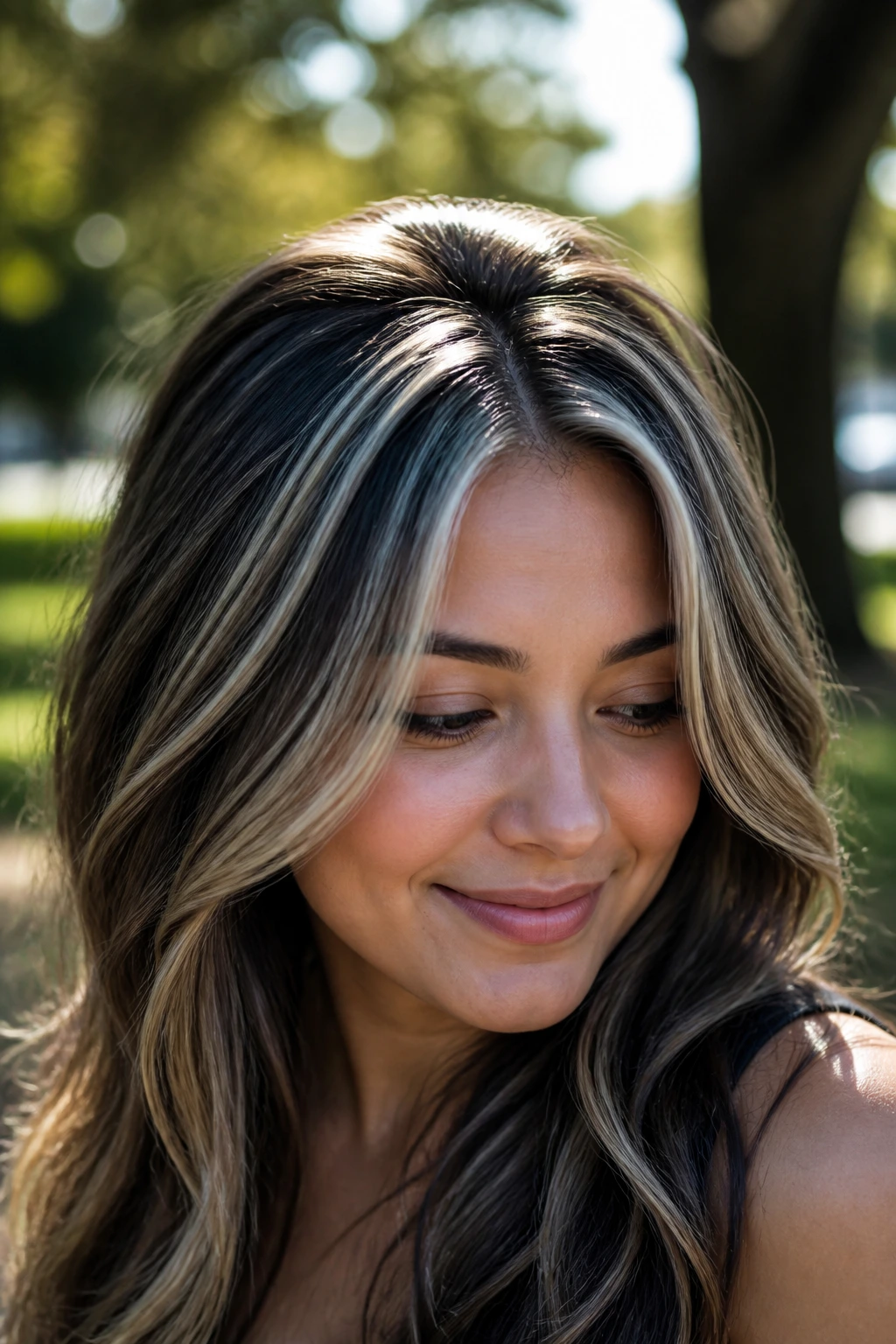
If you want the face to look longer, start at the top. Blonde and black babylights concentrated around the crown create lift, and round faces usually need that upward movement more than extra width at the sides.
The color should be fine enough that it reads as shimmer, not pattern. Babylights are ideal because they blend into the black and give the hair a lighter top without a blocky stripe. Around the crown, they make blowouts look fuller. Around the part, they keep the face from feeling flat.
This style is especially good for medium to long hair that tends to lie close to the head. A little crown brightness makes the whole silhouette seem taller. If you’re someone who feels like your hair “drops” around your face, this is worth trying.
Use a volumizing mousse at the roots and a round brush when drying. The color does one job, the styling does the other. Together, they shape the face better than either one can alone.
21. Warm Blonde Lowlights on a Black Bob
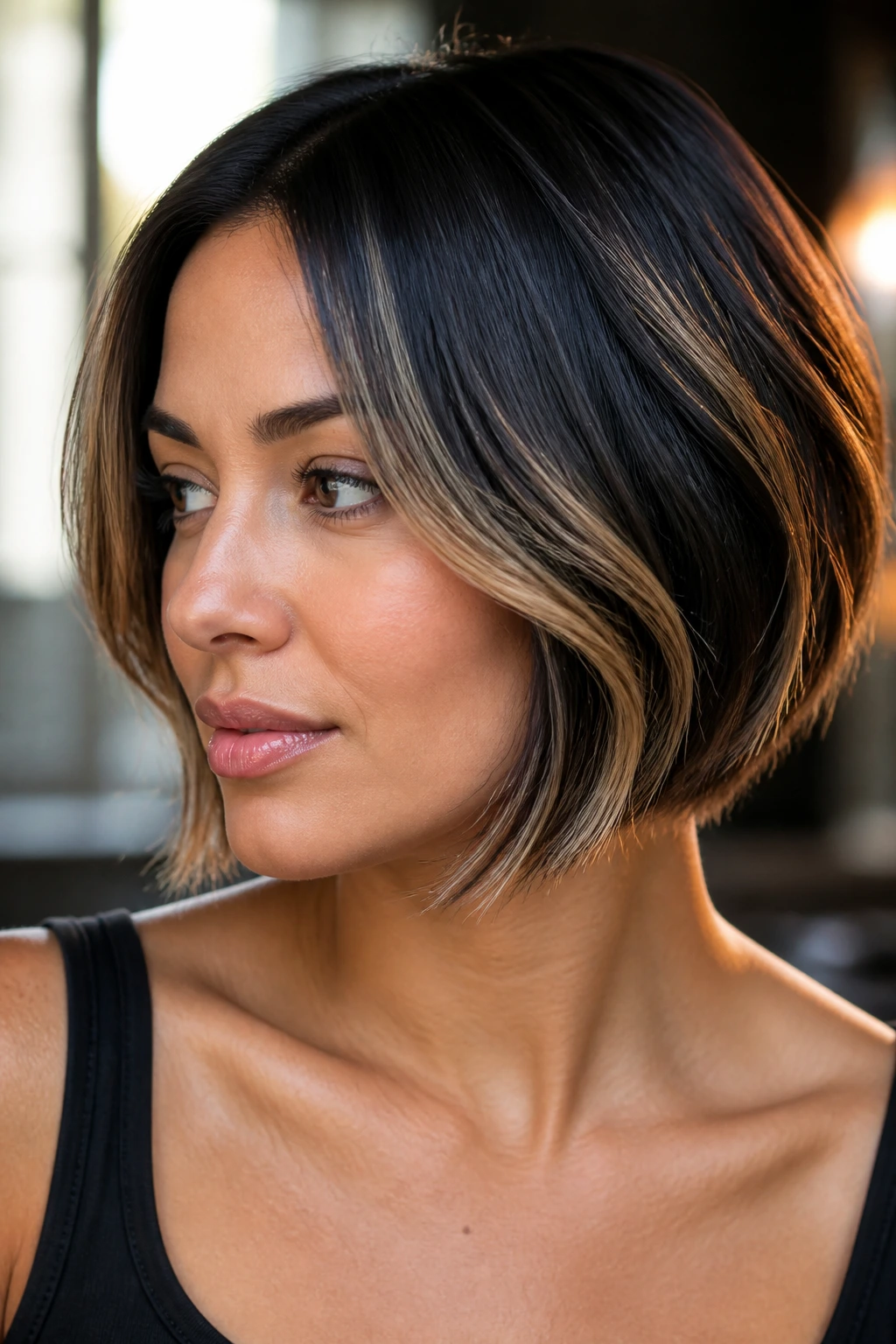
A black bob with warm blonde lowlights sounds backward at first, but it can be one of the prettiest options for a round face. The darker pieces are already doing most of the contouring, and the warm blonde lowlights bring in movement without expanding the silhouette.
This look is especially useful if your bob is rounded at the ends. Lowlights cut through that roundness and give the hair some visual break points. The warm tone keeps the style from feeling too stark or too flat. It also adds softness around the jaw, which is helpful if the cut sits right at the face line.
You won’t get the same bright flash you’d get from highlights, and that’s the point. This is a quieter look. More depth than drama. More shadow than sparkle.
Ask for a few fine lowlights under the top layer and through the back. That keeps the color from looking one-dimensional when the hair moves. A bob needs structure. These pieces give it that.
22. Diagonal Blonde Streaks Through a Shoulder-Length Cut
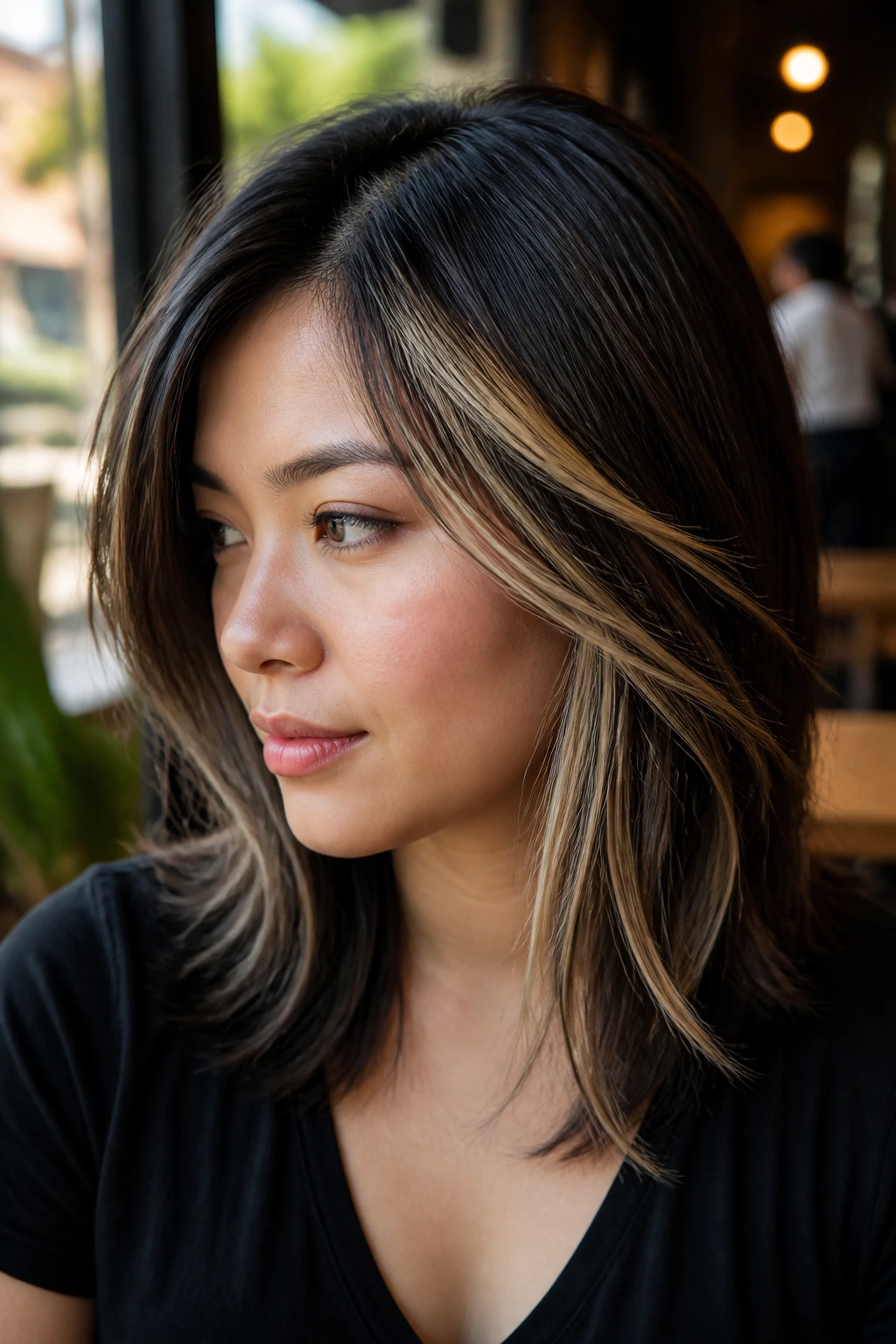
Shoulder-length hair gives you room to place color diagonally, which is a gift for round faces. Diagonal blonde streaks on black hair create a visual slant that cuts across softness and makes the whole style feel less circular.
The streaks should not sit level with the cheeks. They should angle from the upper front down toward the lower lengths. That direction matters because the eye follows lines faster than it follows shapes. A diagonal line pulls attention away from width.
This look works well if you wear your hair tucked behind one ear or if you like one side to fall a bit longer than the other. The asymmetry makes the color feel more natural and less painted-on. It’s also a nice choice if you want something that looks modern without being trendy in a way that ages fast.
Keep the blonde pieces spaced out. Too many diagonal streaks and the whole thing turns busy. A few good lines are enough.
23. Dimensional Blonde Ends on a Black Wolf Cut
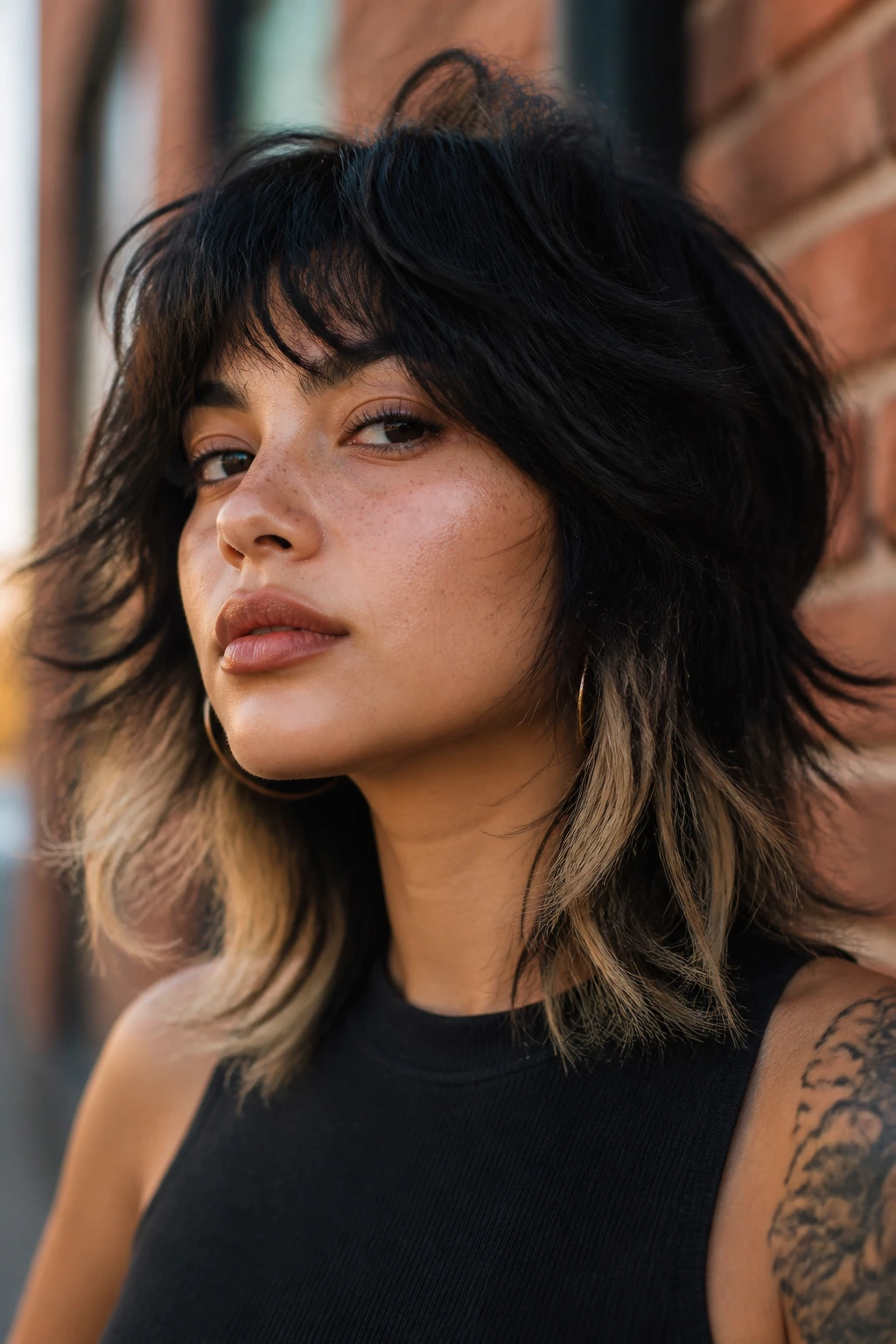
A wolf cut already has attitude. Add dimensional blonde ends on a black base, and the haircut gets the edge it needs without making a round face look wider.
The reason this works is the layer pattern. Wolf cuts are lighter around the crown and broken through the middle, so the eye is already moving around. Blonde ends emphasize that movement. They also keep the bottom from feeling too heavy, which helps the face stay open.
This is a good choice if you like texture and don’t mind a cut that looks a little wild. The color should stay concentrated through the tips and the shaggier outer layers. If the blonde climbs too high on the sides, the shape can spread. Keep it lower and the face stays balanced.
A matte styling cream or light texture spray helps here. Too much shine can make the layers clump. You want separation. Little flicks. Not a helmet.
24. Bright Money Pieces with Soft Black Depth
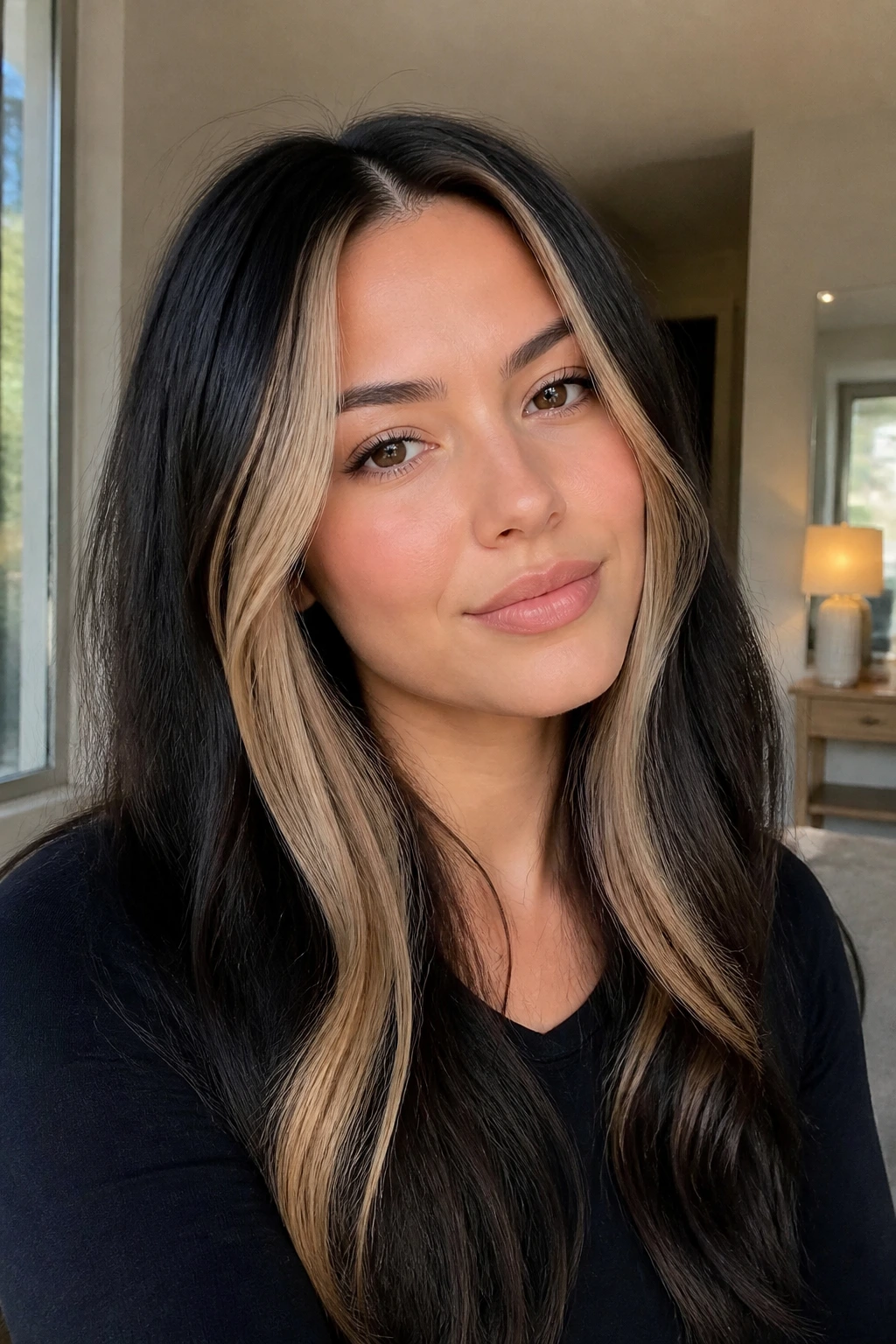
Bright money pieces can work on round faces if the rest of the hair stays deep enough to hold the shape. That contrast is what keeps the style from going flat. Black depth around the sides, bright blonde at the front, and the face gets framed instead of boxed in.
The money pieces should be long enough to pass the jaw. Short front lights can sit right where a round face is widest, which is not the goal. Length gives the contrast room to do its job. If your hair is wavy, let the pieces bend naturally. If it’s straight, keep the ends softly beveled.
I like this look for people who want a strong front view in photos. It reads clean and polished. The black around it makes the blonde look brighter, too, so you don’t need as much lift to get the effect.
Use this when you want the front of the hair to lead and the rest to support. That’s the right order for this style.
25. Feathered Blonde Layers on a Black Midlength Cut
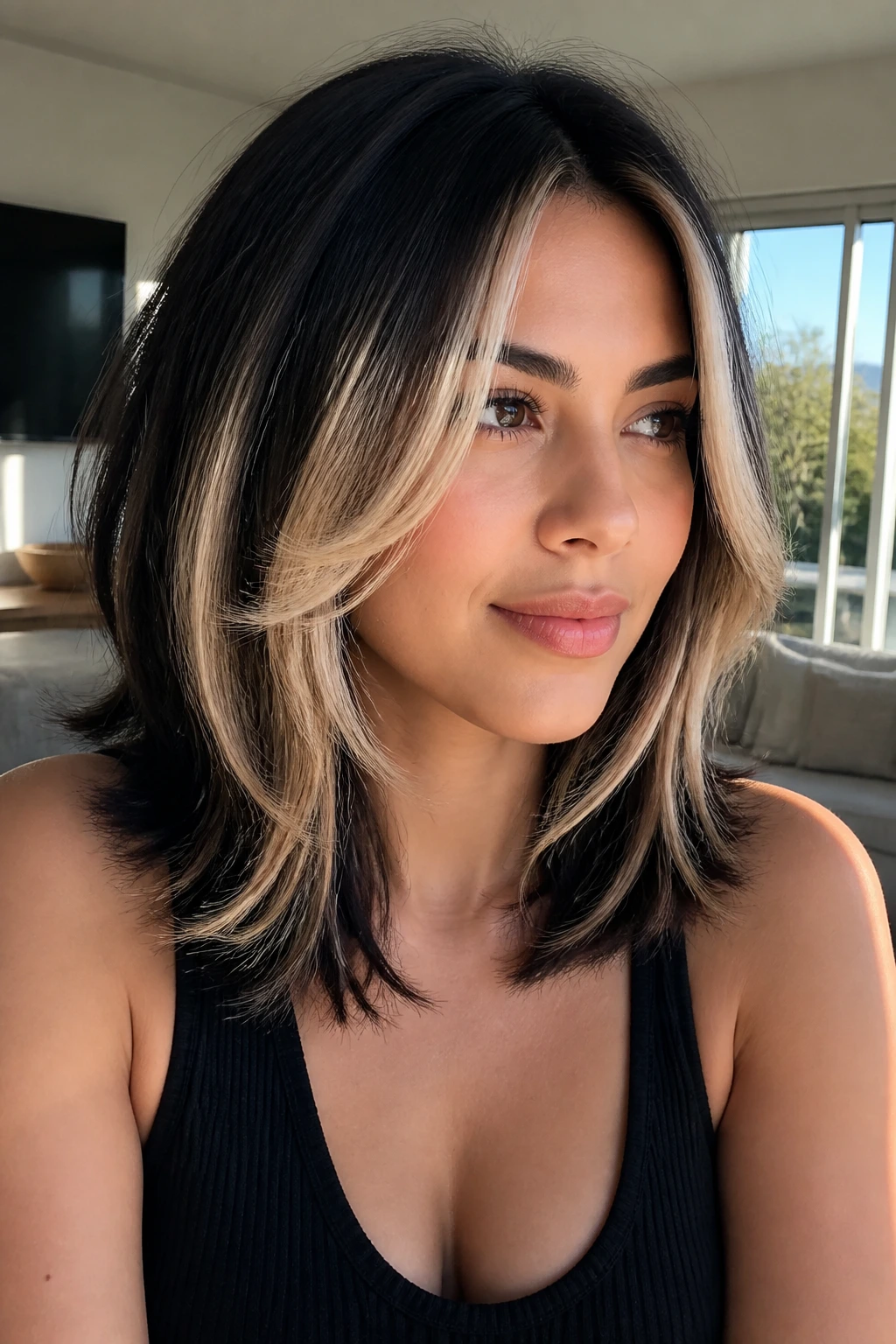
Feathered layers give round faces an easy exit route. Instead of sitting heavy around the cheeks, the hair falls away from the face in soft lines. Add blonde to the feathered pieces, and the shape feels lighter without losing contrast.
A midlength cut is a sweet spot here because it’s long enough to slim the face but short enough to keep movement. The blonde should live mostly on the outer feathered sections, not buried deep in the bulk of the hair. That way the color shows when you move, not just when you stare at it in a mirror.
This style is good if you like hair that behaves. It doesn’t need a huge amount of styling to look decent. A blow-dry with a round brush and a little smoothing cream is often enough. The color does some of the work because the feathered layers separate it naturally.
Keep the ends soft. Hard ends can make the haircut feel boxy, and boxy is not your friend on a round face.
26. Blonde and Black Invisible Highlights
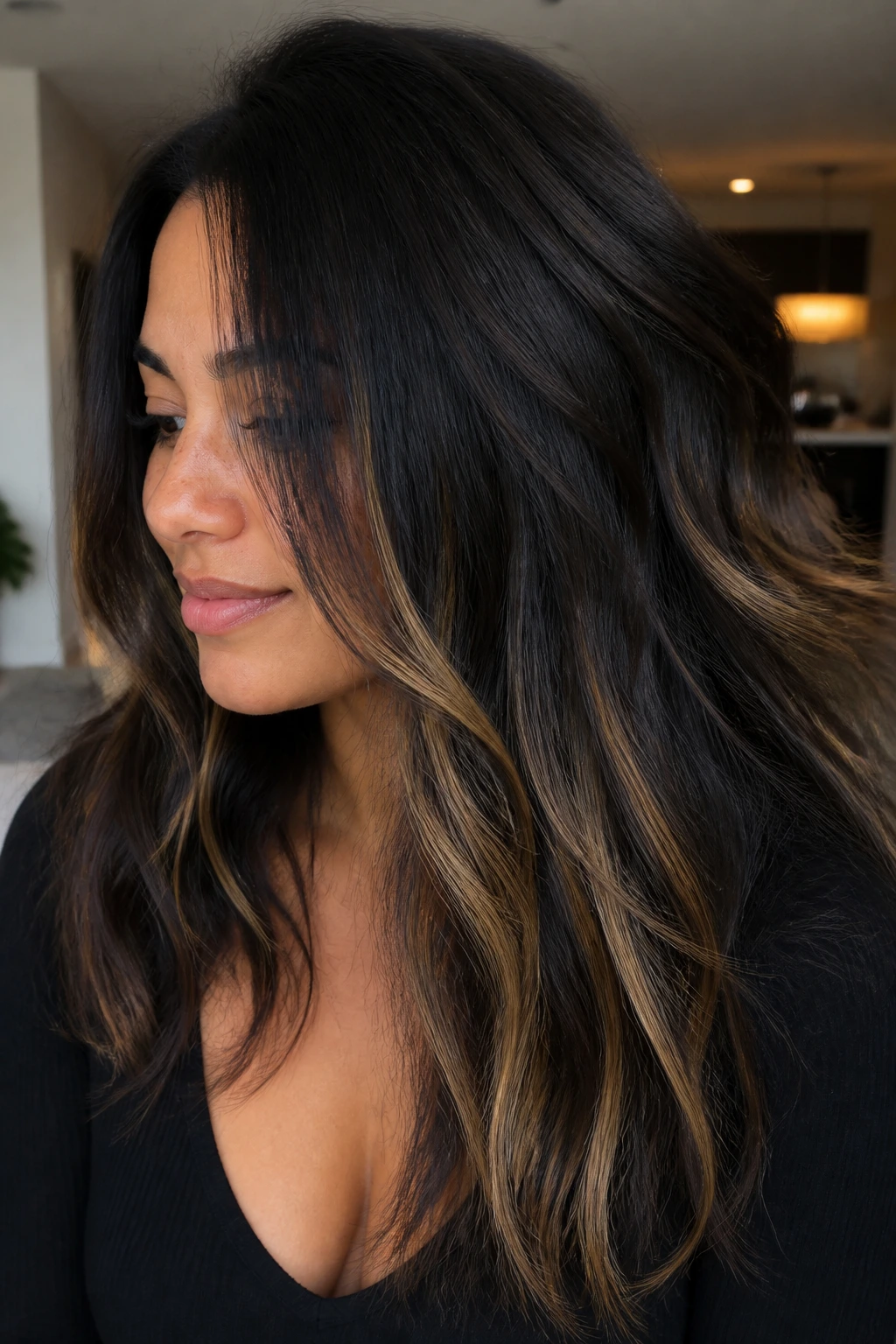
Invisible highlights are one of those things people don’t notice right away, which is exactly why they’re useful. On round faces, blonde and black invisible highlights add movement without making the hair look striped or wide.
The color sits under the top layer and only appears when the hair shifts. That means the front outline stays dark and lean, while the hidden pieces give depth. If your face shape is soft and you don’t want a loud blonde moment, this is a smart route.
It also works beautifully on hair that you wear up often. A ponytail or claw clip will reveal the lighter pieces underneath, which keeps the style interesting even when the hair is pulled back. That part matters more than people think. A lot of “hidden” color dies once the hair goes up. This one doesn’t.
Ask for a soft blend through the interior, not bright panels. The goal is motion, not a block of blonde peeking out from the back.
27. Reverse Balayage with Blonde Ends and Dark Depth
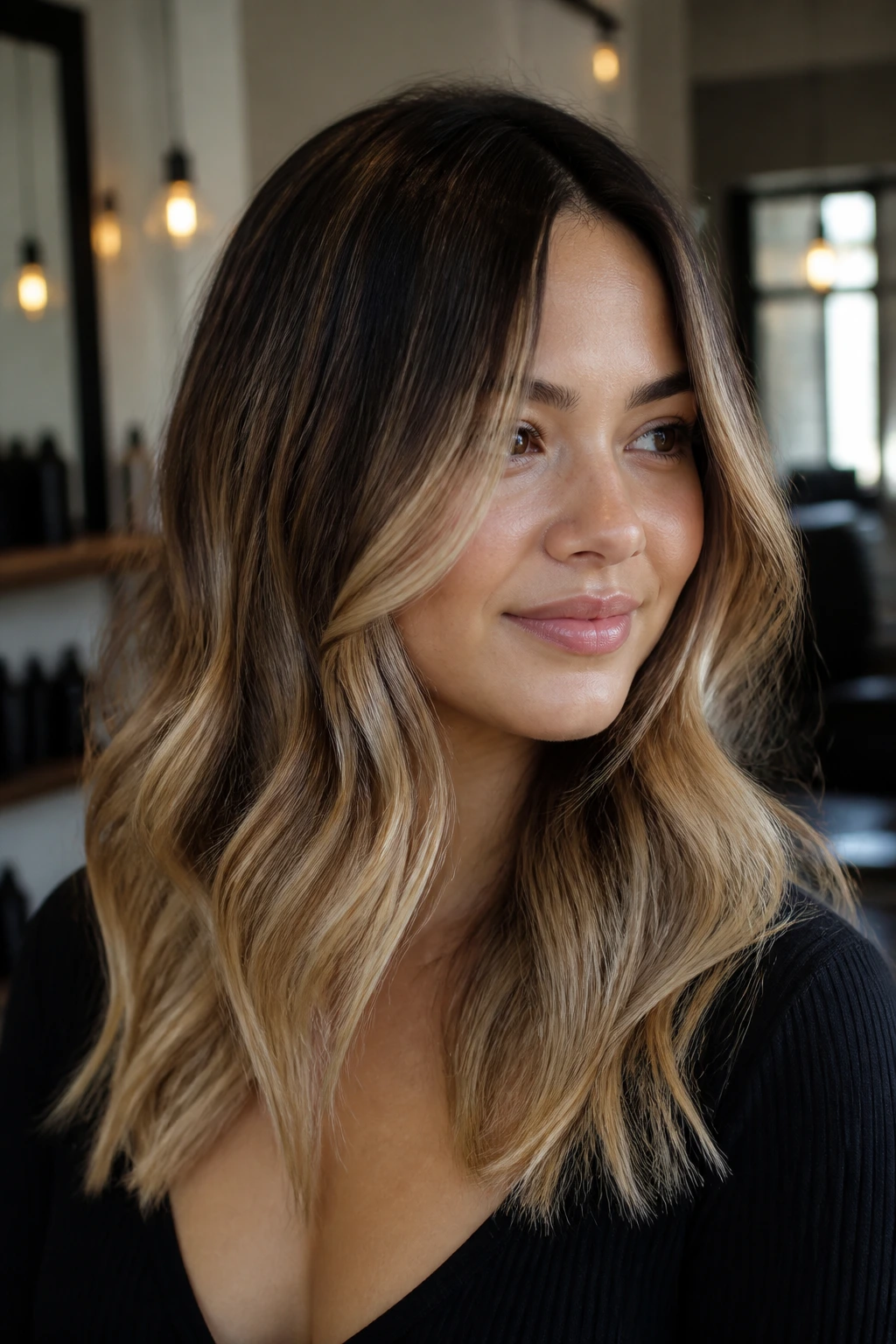
Reverse balayage is for people who want blonde but also want the black base to keep control of the shape. On a round face, that depth is useful. It gives the hair a darker frame near the top and sides, then lets the blonde live lower where it can lengthen the look.
The technique is especially good if you’ve gone too light in the past and the hair needs a reset. The darker pieces reintroduce contour. The blonde ends still keep the style fresh. That balance is what makes it work.
This is also a softer grow-out option. Because the shadow sits closer to the scalp and through the upper sections, the roots don’t scream for attention. The face keeps its outline, and the hair doesn’t lose dimension after two washes.
If your face is round and your hair is thick, this is one of the smartest color patterns you can choose. It does less in the wrong places and more in the right ones. That’s the whole game.
28. Blunt Cut with Internal Blonde Dimension
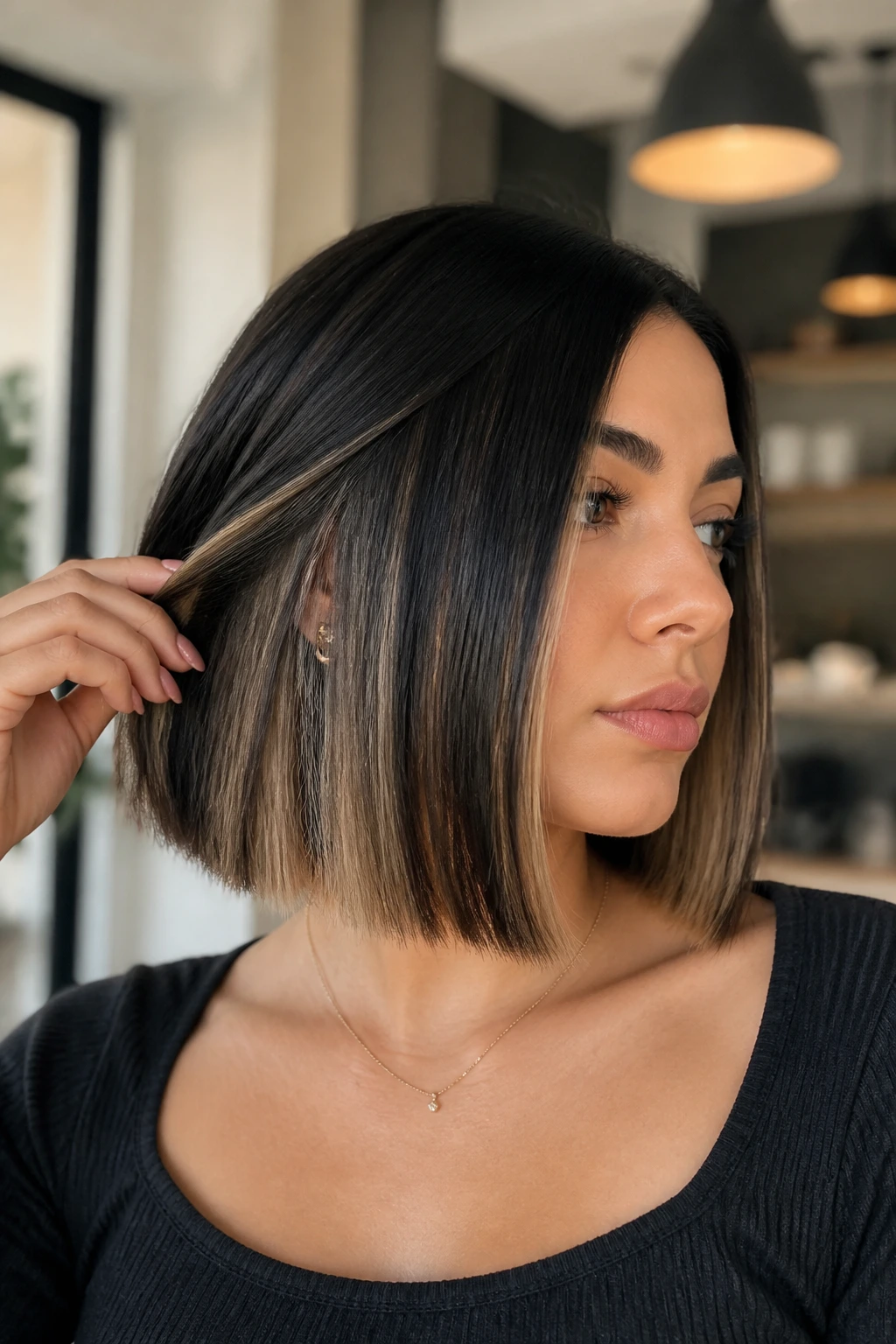
A blunt cut on a round face can sound risky, but it works when the color gives the shape some inner movement. Black hair with internal blonde dimension keeps the edges clean while breaking up the inside of the cut.
That internal dimension is the trick. You don’t want the blonde sitting on the outer rim of the haircut, where it can make the face feel wider. You want it hidden inside the shape so the cut stays crisp from the outside and alive from within.
This is a good choice if you like sleek hair and straight finishes. A blunt outline can be elegant, but only if the interior has enough depth to avoid looking like one solid curtain. Blonde tucked between black sections gives it that lift.
Use a smoothing serum sparingly. Too much product can make the interior pieces stick together and flatten out the whole point. A little goes farther than you’d expect.
29. Long V-Cut with Blonde Slices at the Ends
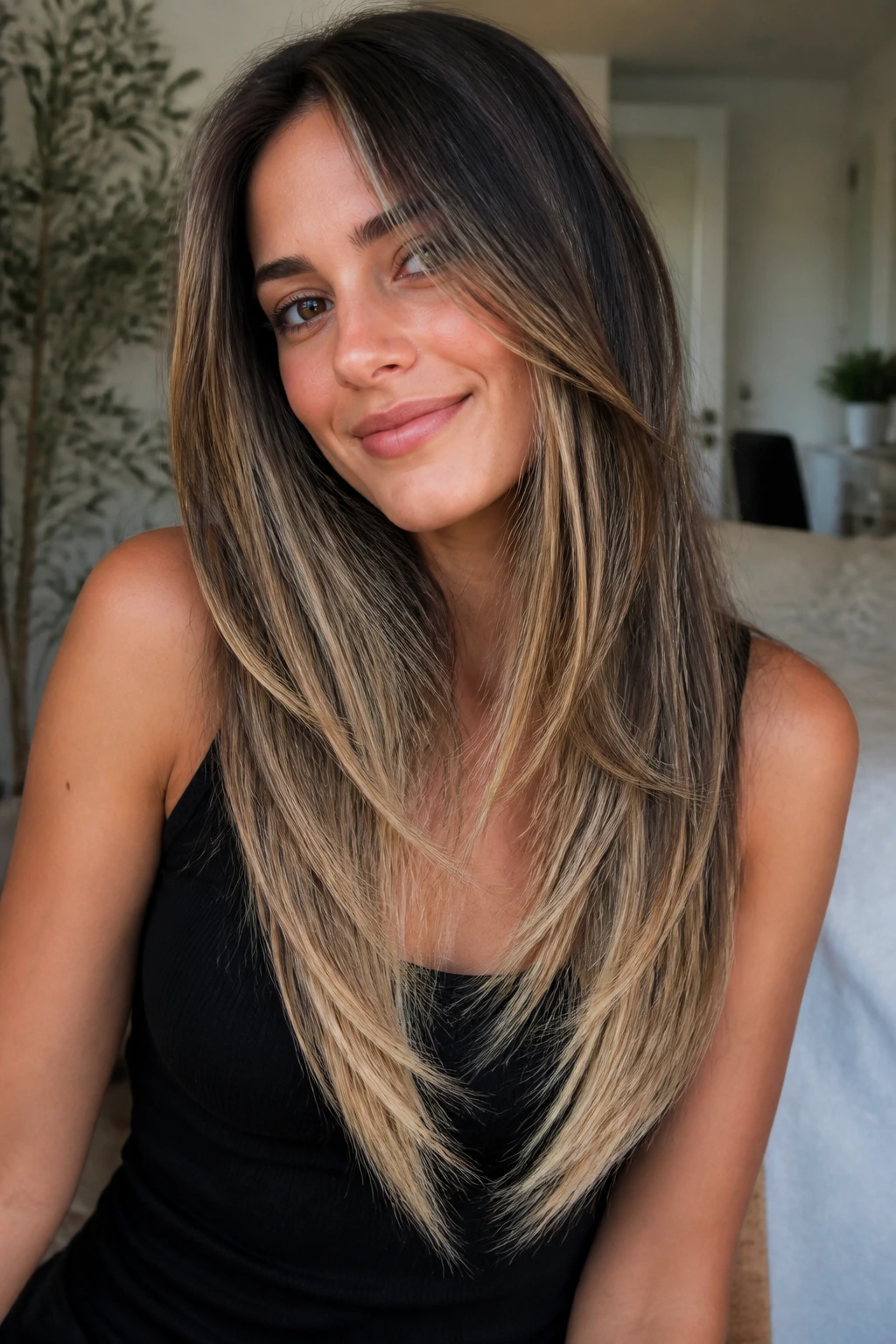
A long V-cut gives round faces a built-in vertical point, which is exactly what you want. Add blonde slices at the ends, and the shape becomes even longer and more directional.
The V shape helps because it draws the eye to the center line of the hair instead of spreading it out sideways. Blonde slices at the ends then emphasize the point of the V, which keeps everything moving downward. That is the cleanest kind of visual balance for a round face.
This style works especially well if your hair is thick or if you like wearing it in loose curls. The V shape stops the ends from looking blunt, and the blonde slices make the finish look lighter. If your hair is pin-straight, the line reads even sharper.
Avoid placing too much blonde near the outer sides. Keep the brightest slices toward the center back and lower lengths. That’s where the shape stays long instead of wide.
30. Blonde and Black Money Pieces with Long Waves
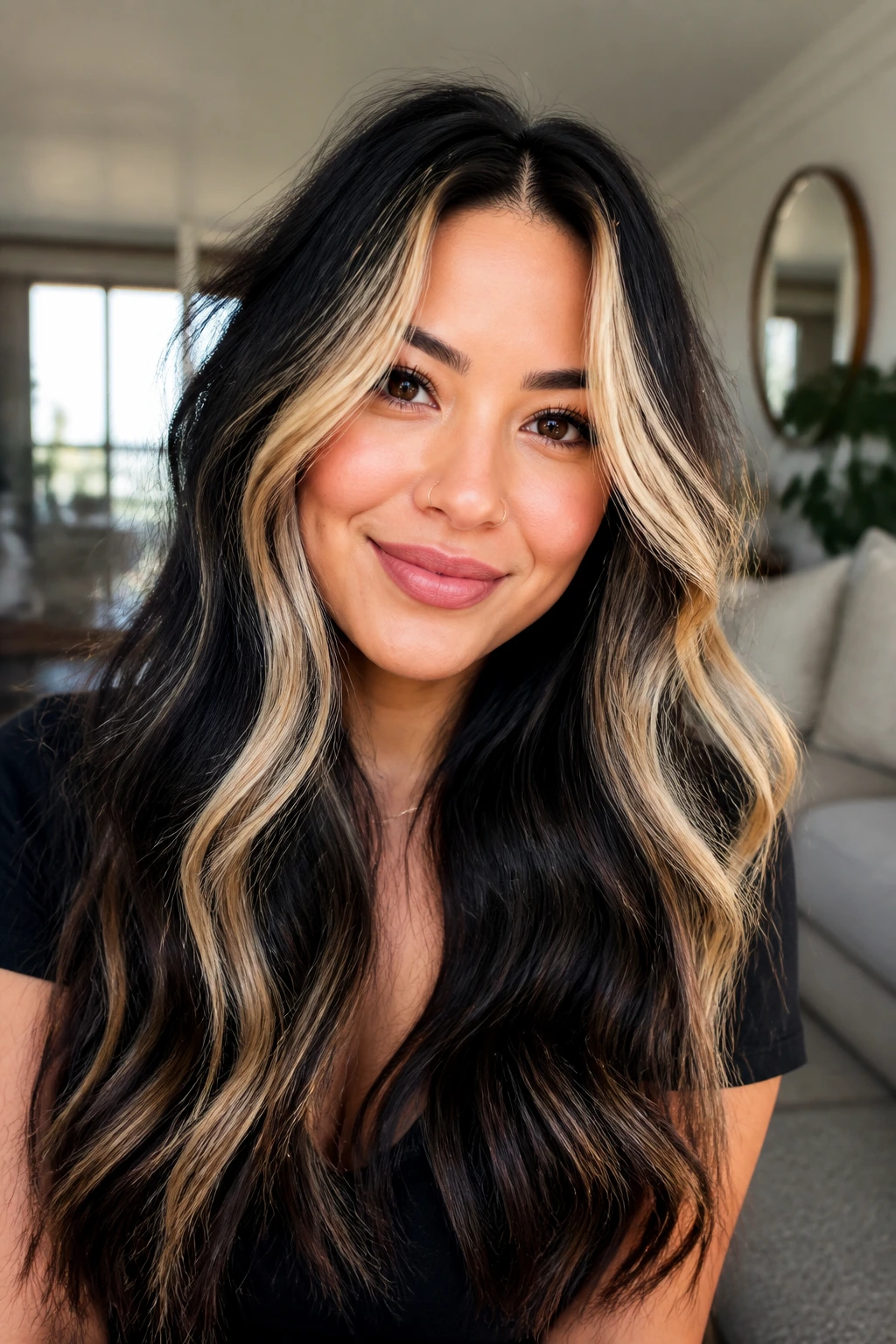
Long waves are forgiving, but they still need structure, and blonde and black money pieces give that structure fast. On a round face, long waves plus well-placed front brightness can lengthen the shape in a way that feels easy, not forced.
The money pieces should start high enough to lift the eyes but long enough to pass the cheekbone and fall into the wave pattern. That combination keeps the face open and lets the hair move. If the pieces are too short, they sit in the widest zone of the face. Too long, and they lose their framing job. The middle ground is where the good stuff happens.
Long waves also make contrast softer. A blonde streak on straight hair can look severe. The same streak in a wave bends and breaks into a more flattering line. That’s why this style reads so well in real life. It has shape, but it doesn’t feel stiff.
If you want one style that lands between dramatic and wearable, this is probably it. Strong front pieces. Deep black lengths. Soft movement. Hard to argue with that combination.
Final Thoughts
Round faces don’t need every blonde piece to work overtime. They need the right ones in the right places. Keep brightness moving vertically, let the darker base hold the sides in check, and avoid putting too much light directly across the cheeks.
The most flattering versions in this group all share the same habit: they guide the eye up, then down. That’s why babylights at the crown, money pieces that pass the jaw, and balayage that starts lower tend to work so well.
If you’re torn between styles, start with the one that matches your cut and your styling habits. Hair that moves easily can handle more contrast. Hair that sits flat usually needs finer lights and a little root shadow. The color doesn’t have to do everything at once. It just has to do the right thing.
