



Round faces can wear red highlights on black hair without looking bulky — but the color has to do one job: pull the eye up and down, not side to side.
That sounds picky. It is.
If the red sits in a thick band across the cheek area, the face can read wider. If the red is placed higher at the temples, lower at the ends, or broken into thin ribbons, the whole shape looks longer and cleaner. Black gives you the dark anchor. Red gives you the movement. The trick is deciding where that movement should live.
I’ve always liked black and red together because they can go from soft to loud without changing the base color at all. Cherry, burgundy, merlot, ruby, copper-red — they all read differently once they hit black hair, and they all behave differently around a round face. Some make the jaw look sharper. Some make curls look fuller. Some are there for drama, plain and simple.
Placement matters more than brightness. That’s the whole game.
1. Cherry Money Piece for Round Faces
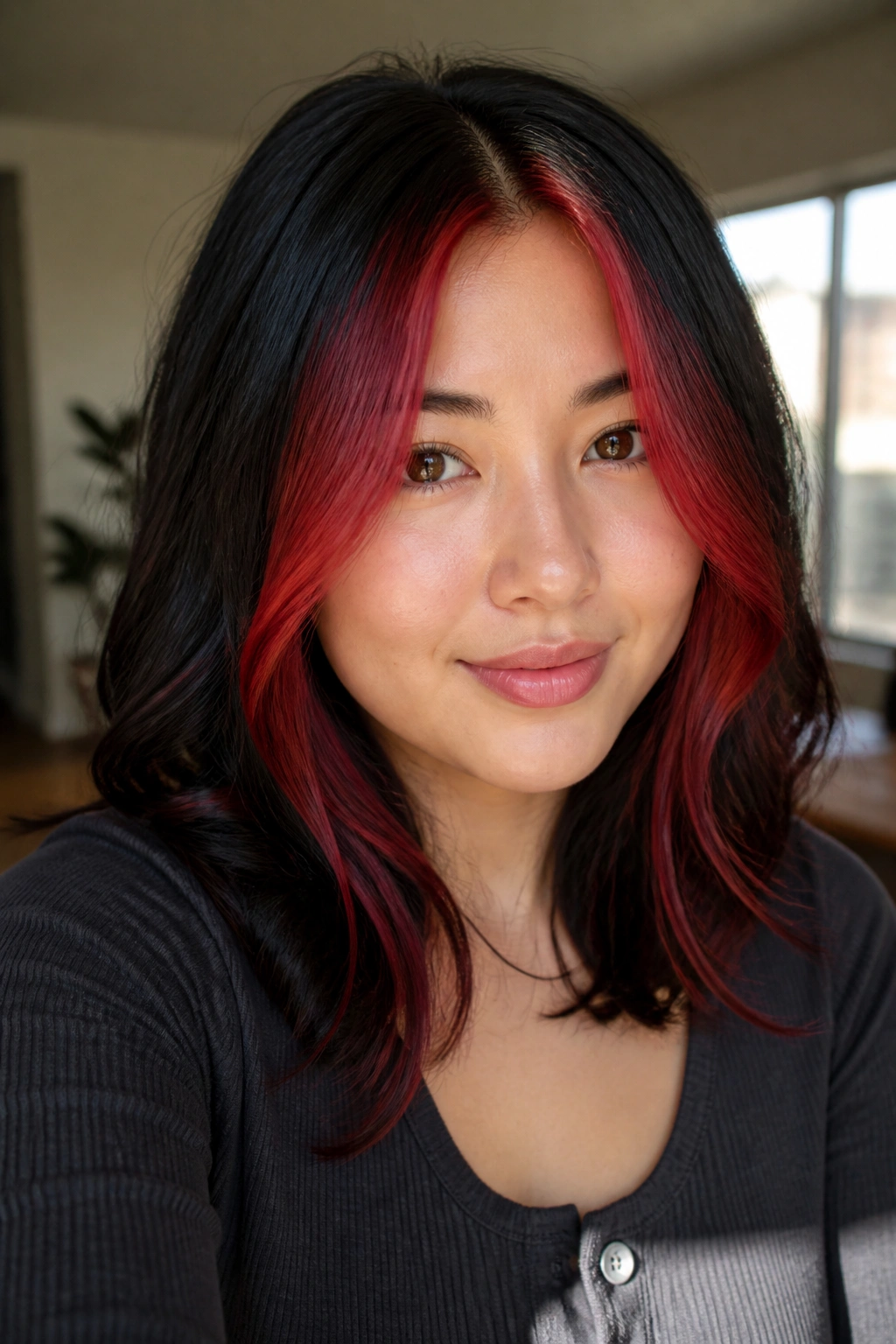
The easiest place to start is the front. A cherry money piece gives the face a bright strip where the eye naturally lands first, and that helps a round face look a little longer if the light pieces start above the brow and slide down past the cheek.
Why It Works
The money piece should not stop right at the widest part of the face. That’s the mistake I see most often. Let it drop lower, around the jawline or even the collarbone if your hair is long enough, and the whole shape feels more vertical.
- Keep the brightest red at the front, not all over.
- Ask for thin-to-medium face-framing pieces, not a heavy block.
- Let the red soften as it moves toward the ends.
- Side parts make this look even better than a flat middle part.
Best for: straight hair, loose waves, and shoulder-length cuts that need a stronger frame.
2. Burgundy Balayage Starting Below the Cheekbone
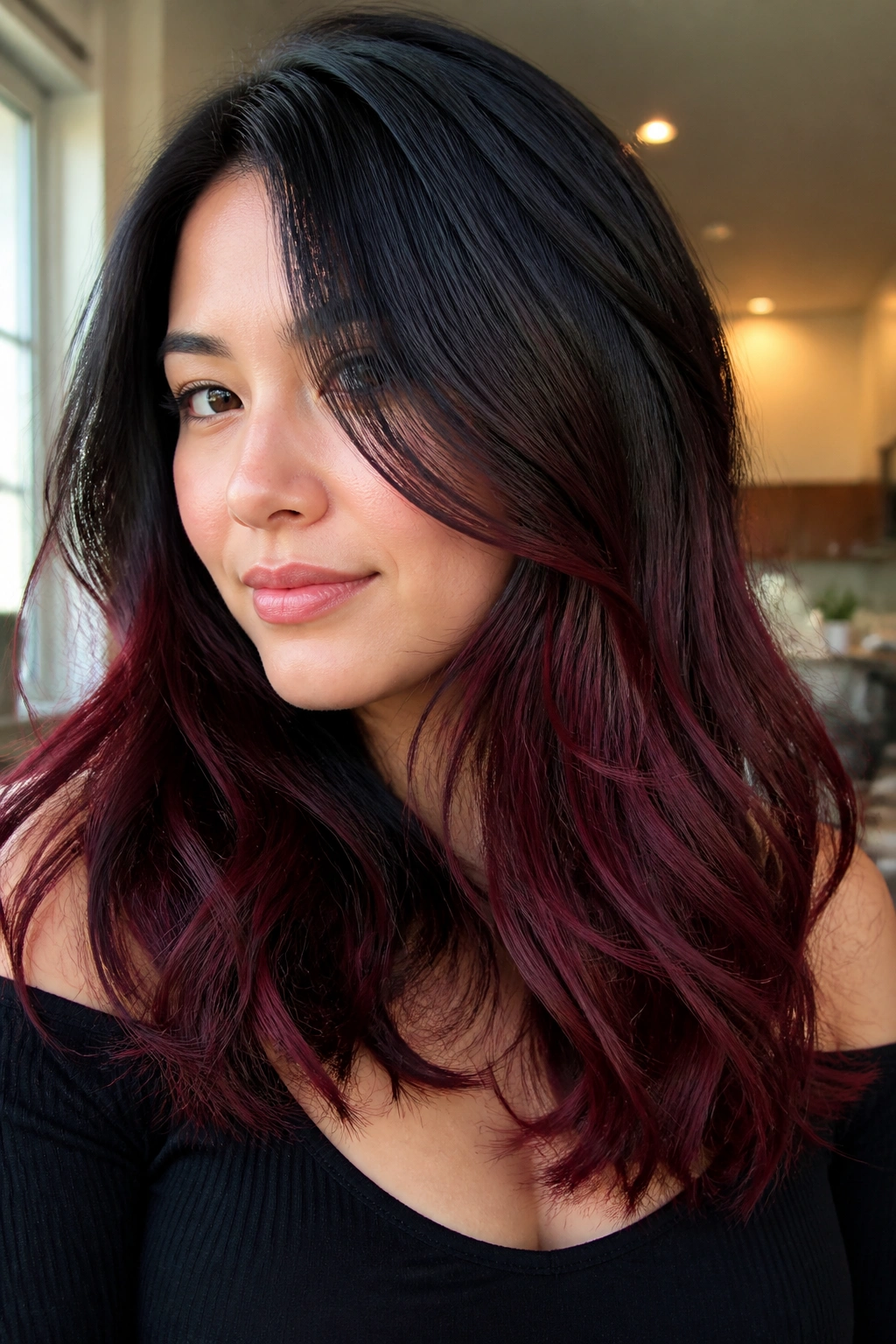
A round face can handle a darker red better than people think. Burgundy balayage looks rich on black hair, and because the red sits lower through the mid-lengths, it avoids crowding the cheeks.
The part I like here is the softness. Balayage does not draw a hard line across the face, so the color falls in a gentle diagonal instead of a wide horizontal stripe. That diagonal matters. It gives the eye somewhere to travel.
This is one of the better choices if you want red to show in sunlight but still look serious indoors. Burgundy is deeper than cherry, so it blends into black hair instead of shouting over it. That makes the face look narrower, especially when the color starts closer to the ear and opens up toward the ends.
3. Peekaboo Crimson Panels Under a Dark Bob
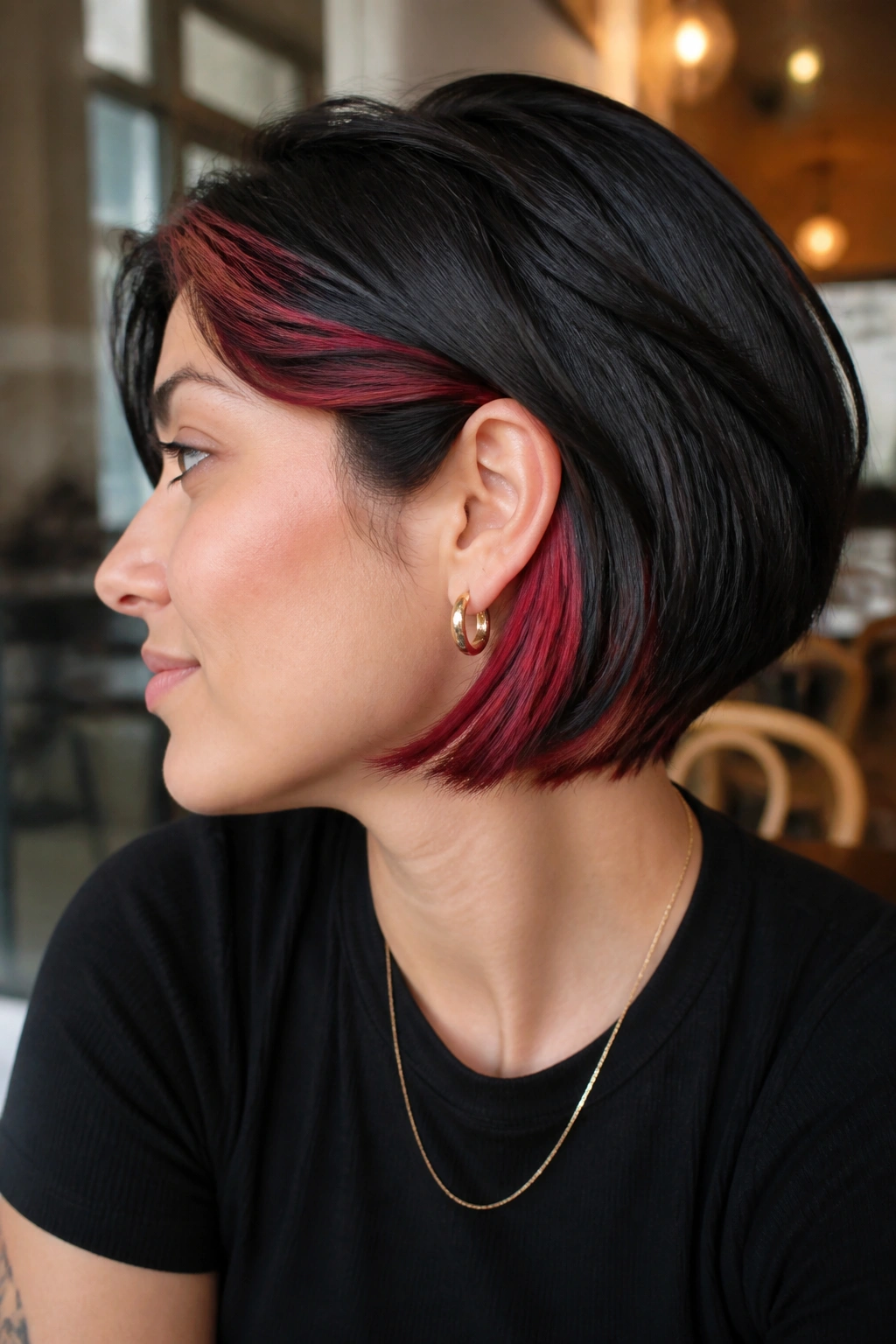
Can a bold red still look subtle? Yes — if you hide it under the top layer.
A peekaboo crimson panel gives a dark bob a little flash when the hair moves, but it does not add width at the cheeks the way surface highlights can. That makes it a smart pick for round faces that want contrast without a lot of visual bulk.
Where to Place the Crimson
Keep the red underneath the top surface and closer to the back half of the bob. When the top layer falls over it, the face stays framed by black, which is usually the cleaner shape. The red appears when you tuck the hair, flip the ends, or walk into light.
- Put the crimson under the crown or near the nape.
- Leave the outer hairline darker.
- Keep the ends a little lighter than the roots.
- A chin-length bob can use thinner panels than a longer lob.
Pro tip: If you wear glasses, this placement is especially good. The color shows without fighting with the frame.
4. Wine-Red Curtain Highlights Around the Face
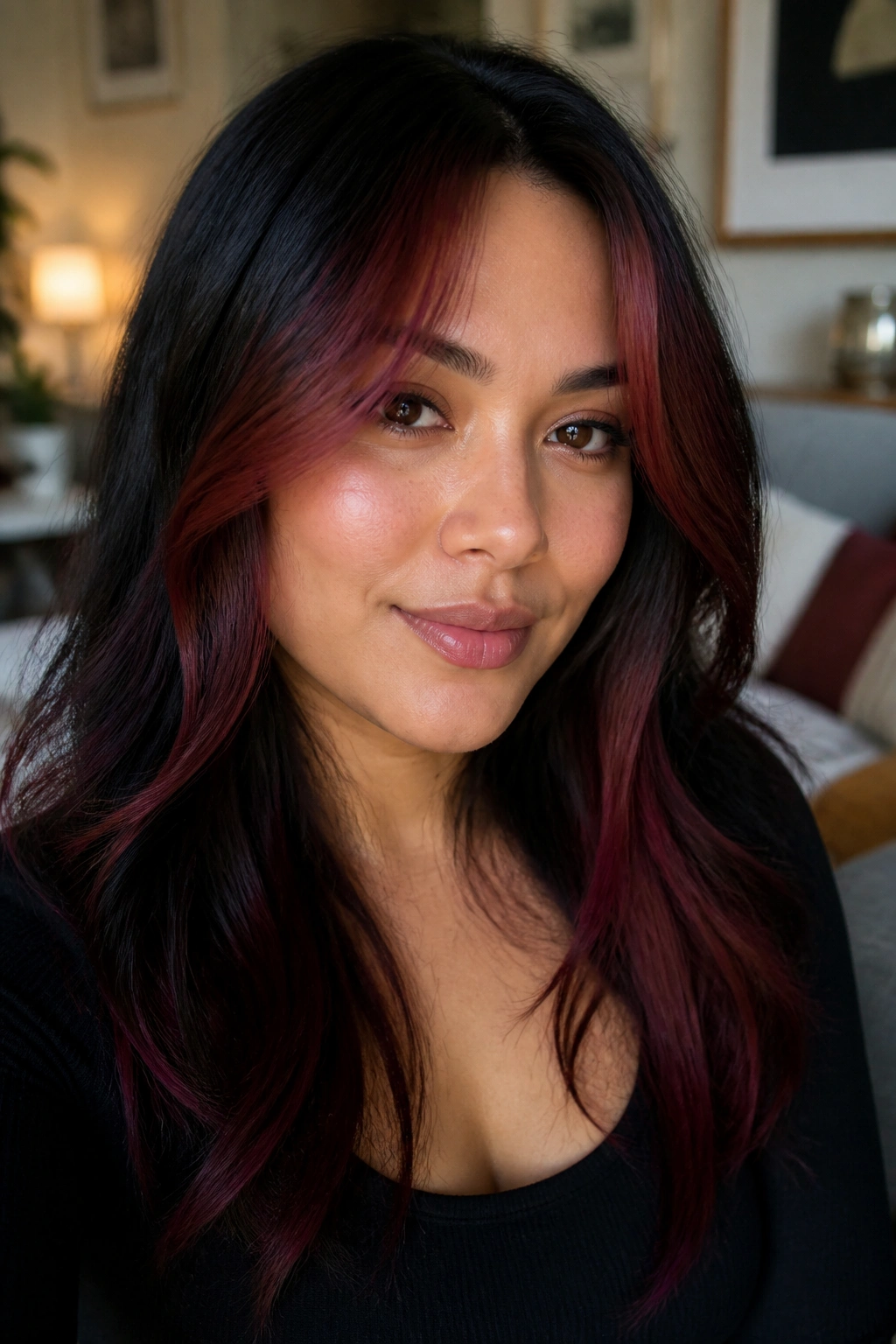
Picture soft curtain pieces, but deeper. Wine-red highlights melt into black hair in a way that feels smooth rather than striped, and that matters on a round face because hard contrast at the cheeks can widen the look.
This style works best when the red begins near the temples and drifts down on both sides of the face. It should feel like two long drapes, not a stiff frame. If the hair is layered, even better. The layers help the red break up into thinner pieces, which keeps the face from looking boxed in.
What I like here is the balance. The face gets attention, but the color does not stop at the widest point. It keeps moving. That sense of movement is what changes the shape.
5. Mahogany Lowlights for Soft Shadow
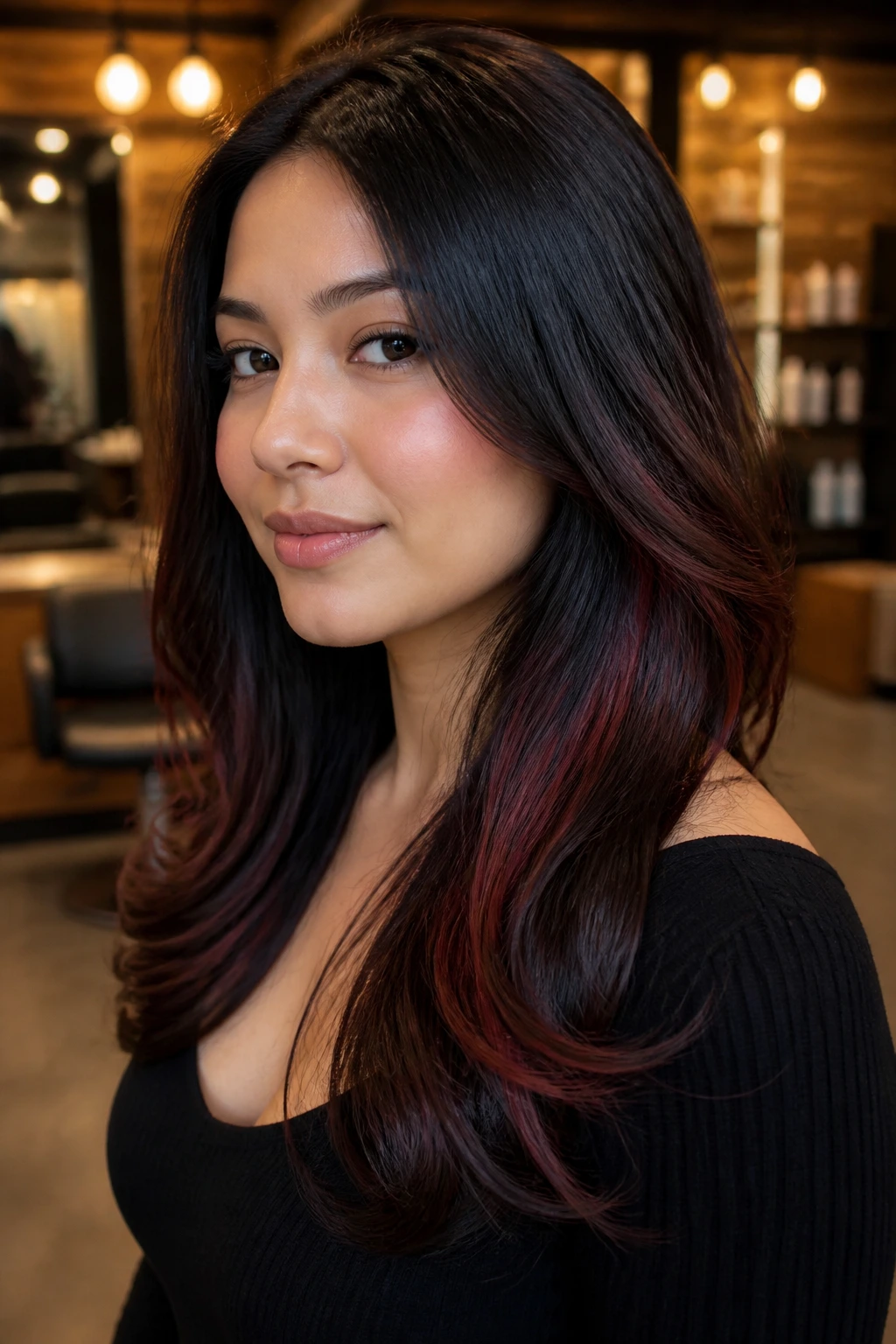
Sometimes the answer is not more red. Sometimes it is less brightness and more shadow.
Mahogany lowlights add a red-brown depth inside black hair, and on a round face that extra shadow can sharpen the outline without making the color loud. It is a quieter look, but it has good structure. The darker red pieces sit beneath the surface and create depth through the sides and ends.
This is the one I’d choose for someone who wants red hair ideas for round faces but hates obvious streaks. Lowlights work especially well if your hair is thick, because thick hair can eat up color fast and look flat without contrast.
A round face with lowlights needs a little lift at the crown or a side part. You do not need a lot. Just enough to keep the color from sitting like one dark sheet.
6. Auburn Ribbon Highlights on Long Layers
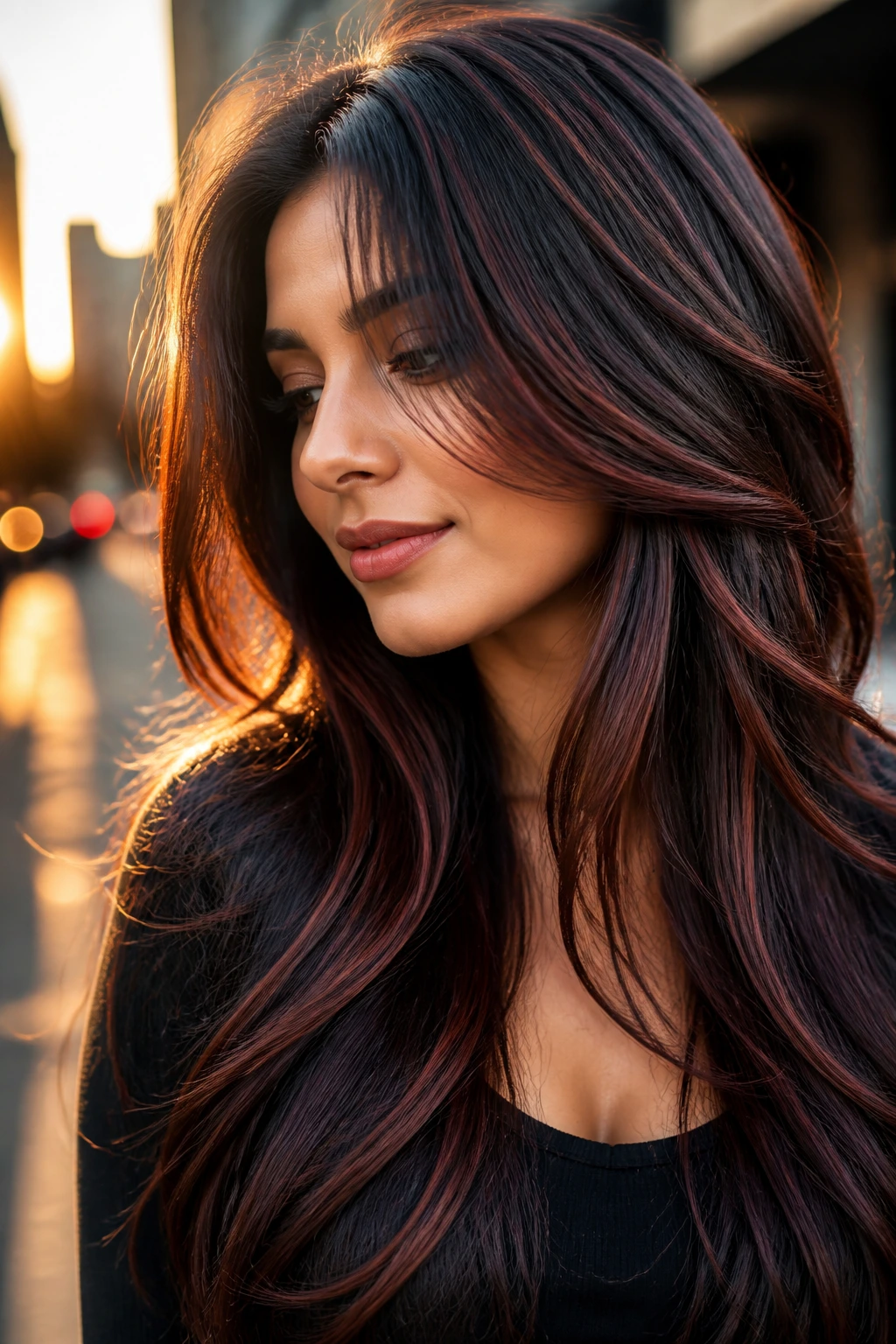
Auburn ribbons are a good middle ground. They are warm enough to show up on black hair, but they are not as bright as copper or scarlet, so the result stays wearable.
Unlike chunky stripes, ribbon highlights follow the movement of the cut. On long layers, that means the red appears in slim arcs that start higher on the head and trail downward. That long line helps a round face look a little leaner, especially if the layers begin below the cheekbone.
This is one of those looks that gets better when the hair moves. Still photos are fine. In motion, it looks richer. If you have a lot of hair, ask for ribbons that are thinner near the face and a touch thicker toward the back. That keeps the front soft and the silhouette more balanced.
7. Scarlet Ends on a Sleek Lob
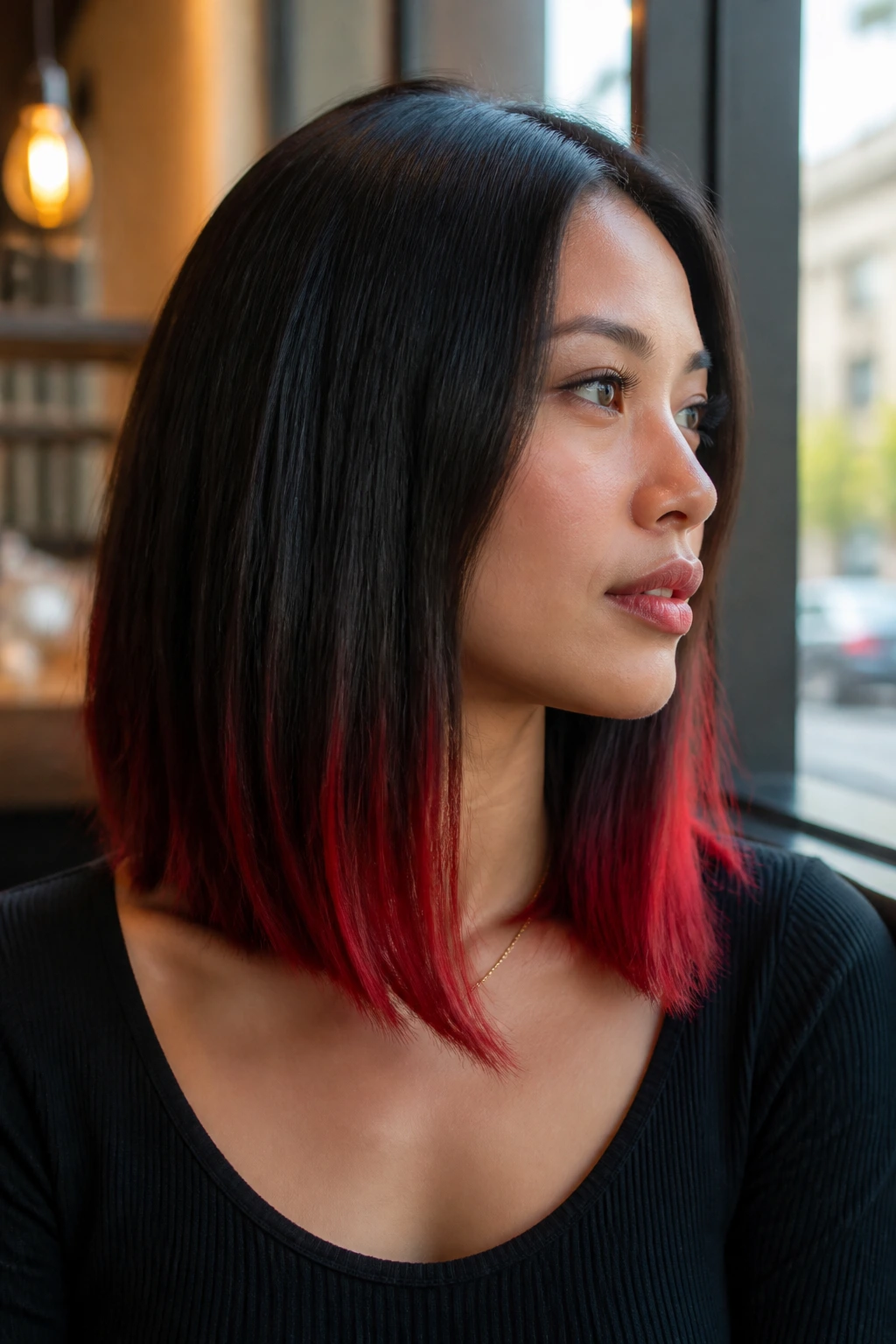
A sleek lob can handle a blunt hit of color, but not too high up. Scarlet ends work because the eye follows the color downward, away from the cheeks and toward the collarbone.
That sounds small. It changes everything.
When the red lives only on the bottom third of the hair, the roundness of the face feels less obvious. The top stays dark and neat, and the bright ends create a long line below the chin. It is a clean, simple shape, which is exactly why it works.
This look is especially good if you wear your lob straight most of the time. The ends show when they swing, and the black-to-red shift reads sharp without making the hair look busy. If the cut is blunt, keep the scarlet very even. If the lob is softly layered, let the red sit a little higher in the front pieces and lower in the back.
8. Babylights at the Crown for Lift
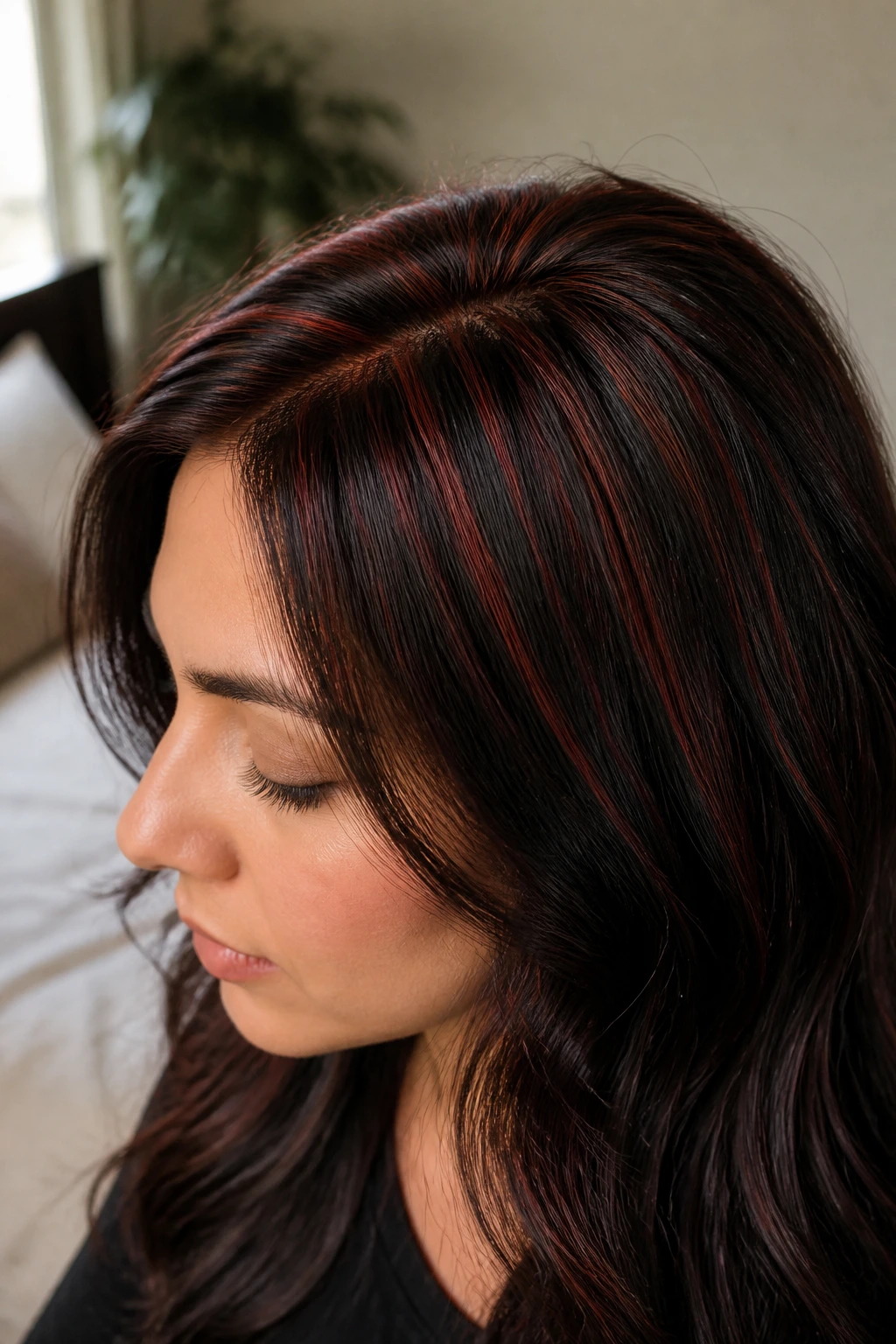
A round face often benefits from visual height, and babylights at the crown do that better than heavy face-framing color. The red is fine, thin, and soft enough to blend into black hair instead of sitting on top of it like stripes.
Crown Lift Without Cheek Width
The idea is simple: bring attention upward. Tiny red threads at the top of the head create brightness where the eye should travel first. That can make the face feel longer, especially if the rest of the color stays darker near the jaw.
- Use very fine sections, almost threadlike.
- Keep the red concentrated at the crown and upper sides.
- Avoid wide panels at cheek level.
- A soft side part helps the lift show more.
The beauty of this look is that it does not scream for attention. It just changes the balance. For a round face, that balance is usually the whole story.
9. Copper-Red Face Framing for Curly Hair
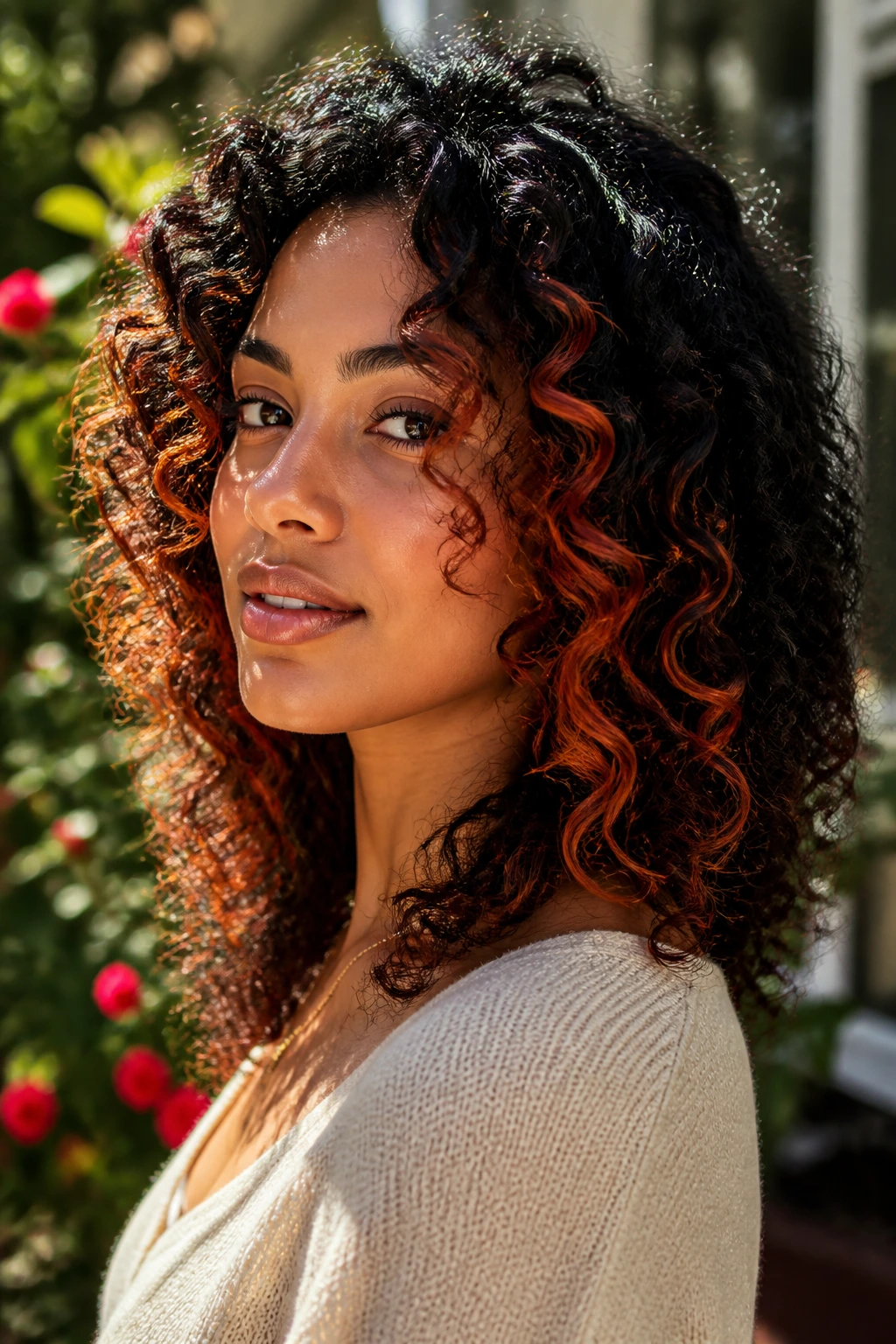
Curly hair does something straight hair does not: it moves the color all over the place. That means copper-red face framing can look lively and soft instead of sharp, which is good news for a round face.
The key is placement on the curl pattern, not just the cut. You want the copper pieces to land on the outer curve of the curls near the temples and then fall a little lower around the jaw. If the brightest color sits right on the widest part of the cheeks, the curls can puff out that zone. Keep the strongest copper higher or lower, and the face reads longer.
This is a great choice if you want warmth. Copper wakes up black hair fast. It also shows texture in a way deeper reds sometimes miss. On dense curls, thin face-framing pieces usually look better than a wide section, because they let each coil keep its shape.
10. Red Underlights Beneath Black Waves
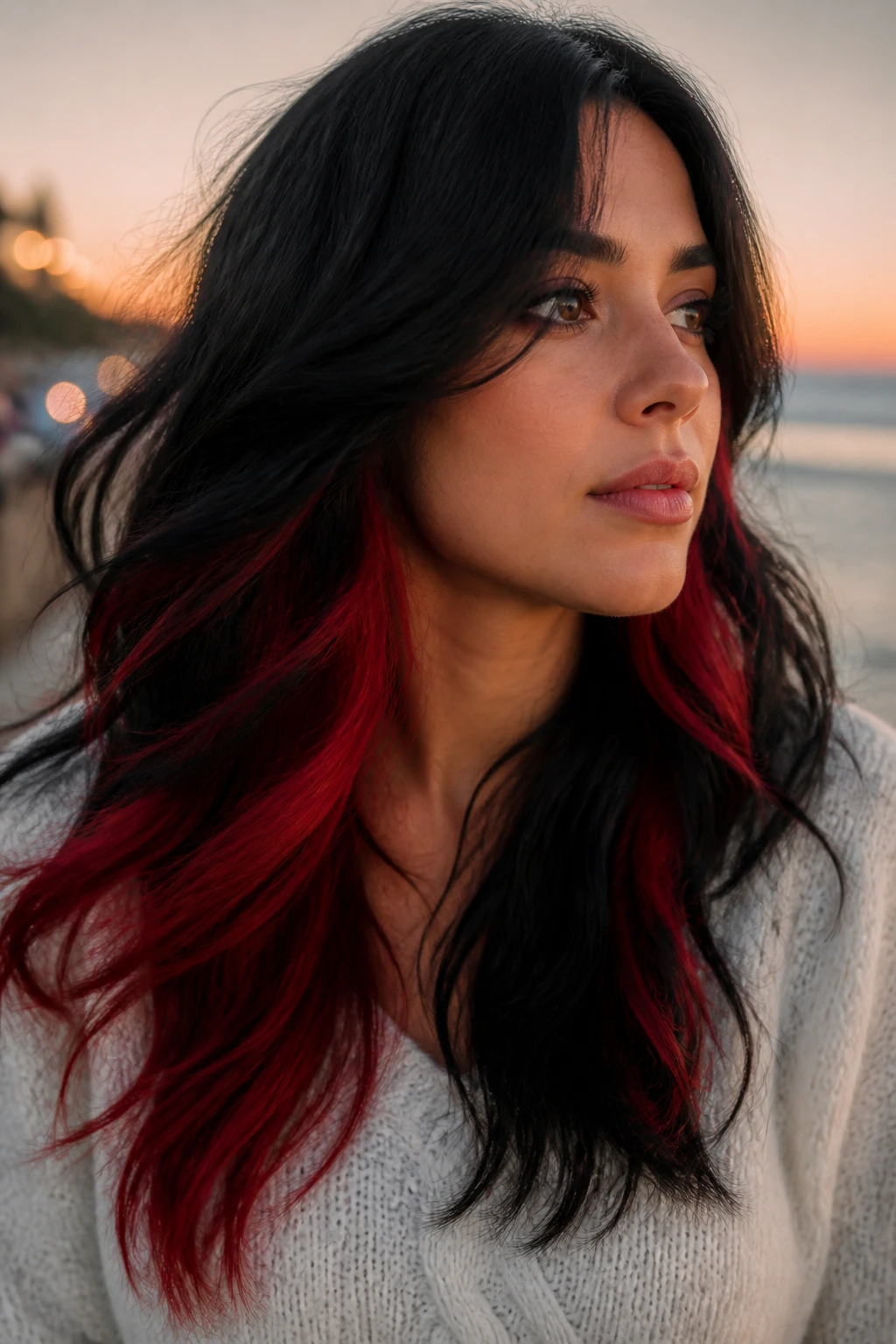
Here’s a smart move for anyone who wants drama without a lot of upkeep: red underlights.
The top layer stays black. The red lives underneath, usually through the mid-lengths and ends, so it flashes when waves separate. On a round face, that means the darker outer layer keeps the sides clean while the red adds depth where the hair moves.
This is one of my favorite choices for people who tuck their hair behind one ear or wear soft waves. The color appears in pieces instead of one block, which keeps the face from looking wide. It also grows out with less fuss because the red is hidden under the top sections.
If you like contrast but hate the feeling of color staring you in the face every time you look in the mirror, this is the one.
11. Cherry Cola Color Melt from Roots to Ends
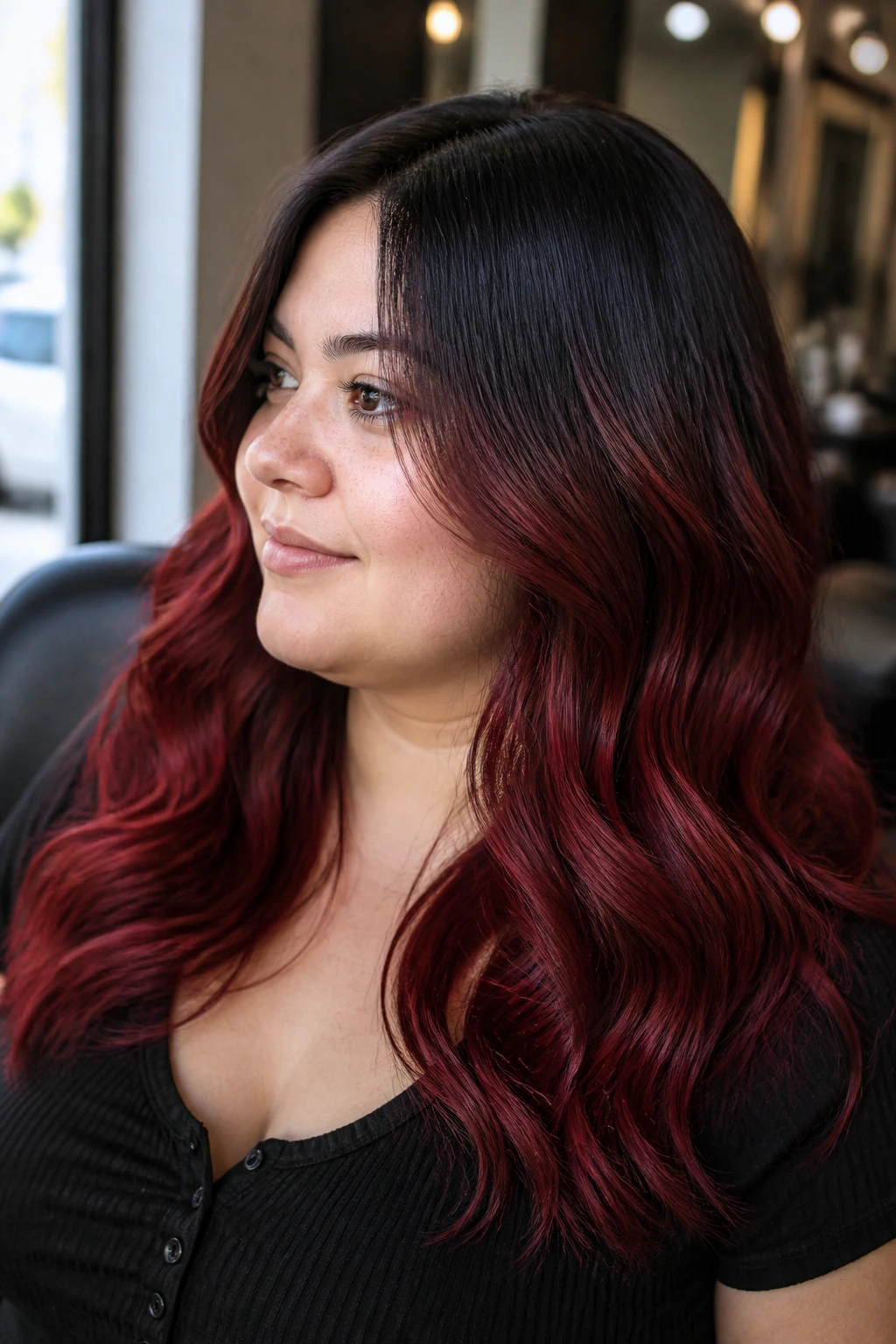
A cherry cola color melt is one of the smoother ways to wear black and red together. The black stays deepest at the roots, then the red appears gradually through the mid-lengths and ends instead of starting in one hard line.
That gradual shift matters on round faces because hard lines can cut the face in half. A melt does the opposite. It stretches the color downward and keeps the silhouette soft. The result looks polished, but not stiff.
This style is especially useful if you do not want to fuss over regrowth every few weeks. The darker roots blend into the black base so the grow-out stays easy to live with. I also like it on layered cuts, since the layers help the red catch on different levels instead of sitting flat.
12. Diagonal Slice Highlights from Temple to Jaw
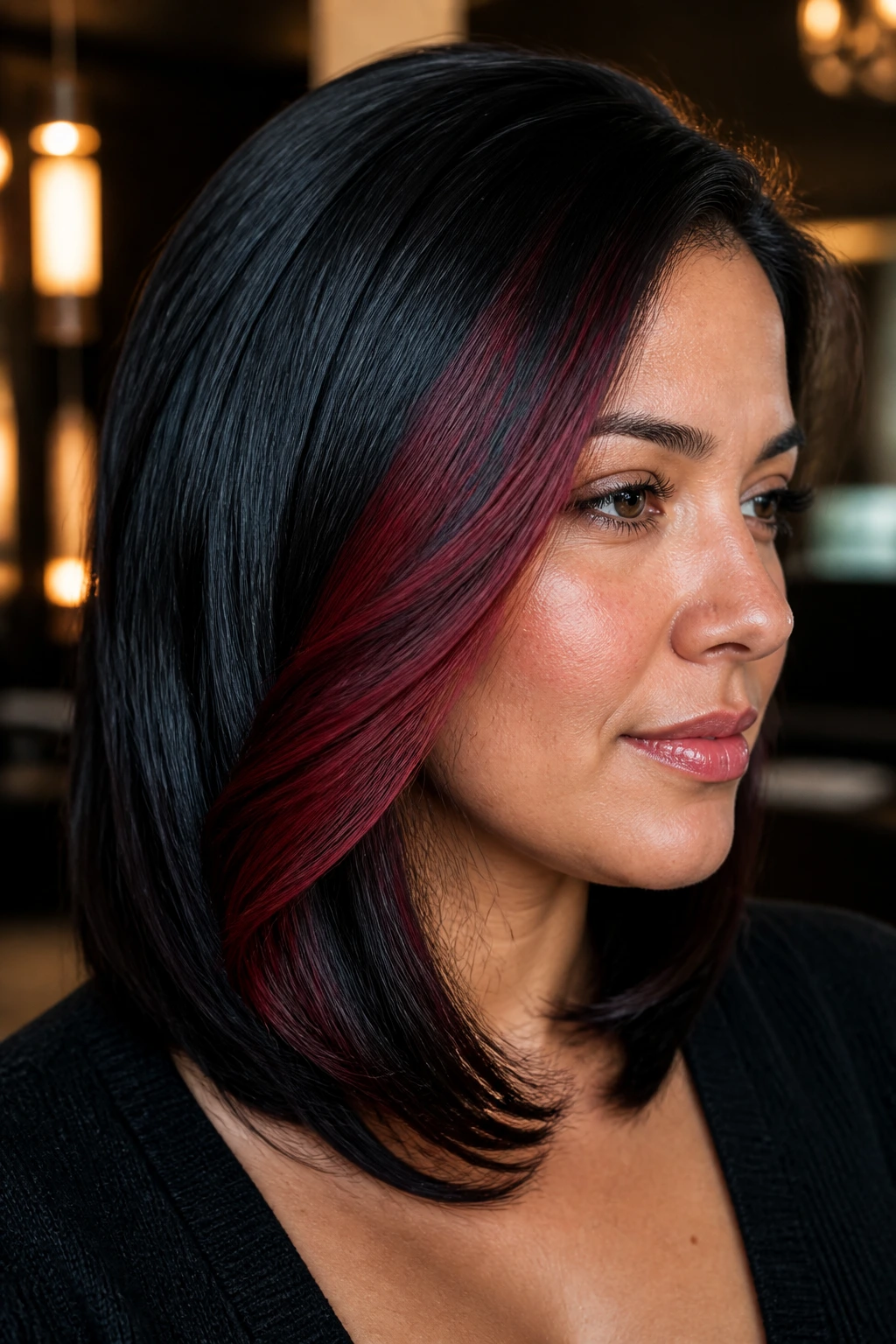
Most people think about highlights as vertical, but a diagonal slice can be more flattering on a round face if it is placed correctly.
The line should start near the temple, then angle down toward the jaw or just below it. That keeps the eye moving in a slant instead of a flat band across the cheeks. A diagonal shape breaks up roundness better than a straight horizontal streak, which is why this look feels sharper.
What makes this version different is the geometry. The red is not trying to be everywhere. It is cutting across the hair in a way that mimics contour. On black hair, even a narrow red slice can read clearly, especially under side light. If you want the face to look a touch longer, keep the slice thin near the top and a little fuller at the ends.
13. Merlot Highlights on a Pixie Cut
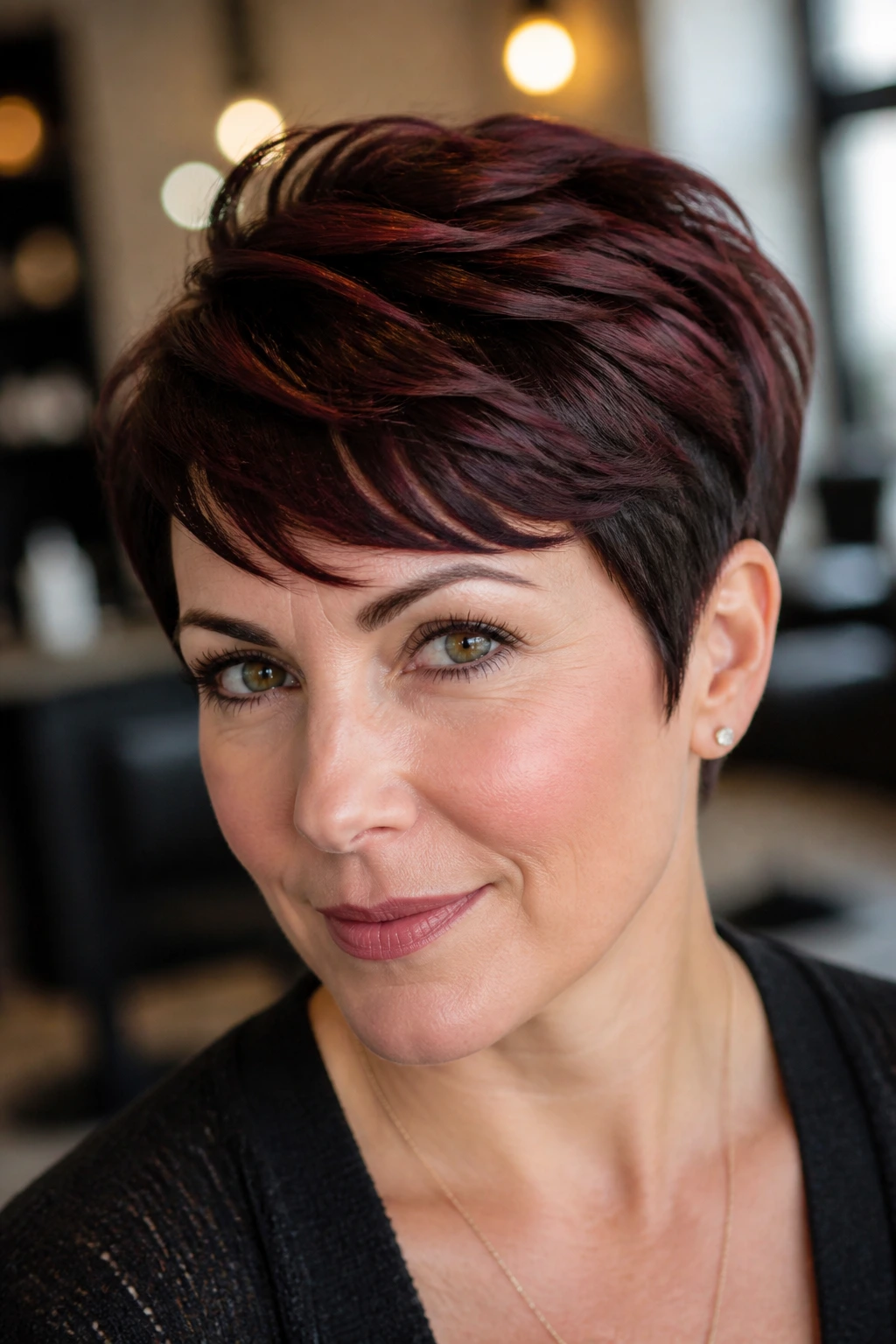
A pixie cut gives you less space, so the color has to work harder. Merlot highlights are a nice fit because they bring depth without turning the short cut into a loud block of red.
On a round face, a pixie usually needs lift through the top and softness around the sides. Merlot helps both. Put a few brighter pieces near the upper layers, then keep the sides darker so the head shape does not widen at the temples. The tiny shift in color creates height, which is the thing you want most with a short cut.
I like this on textured pixies especially. The red catches on the ridges of the cut and gives it shape. If the pixie is smooth and sleek, ask for thinner pieces. If it is choppy, a few thicker merlot strands can look better because they echo the movement of the cut.
14. Rust-Red Pieces on a Choppy Shag
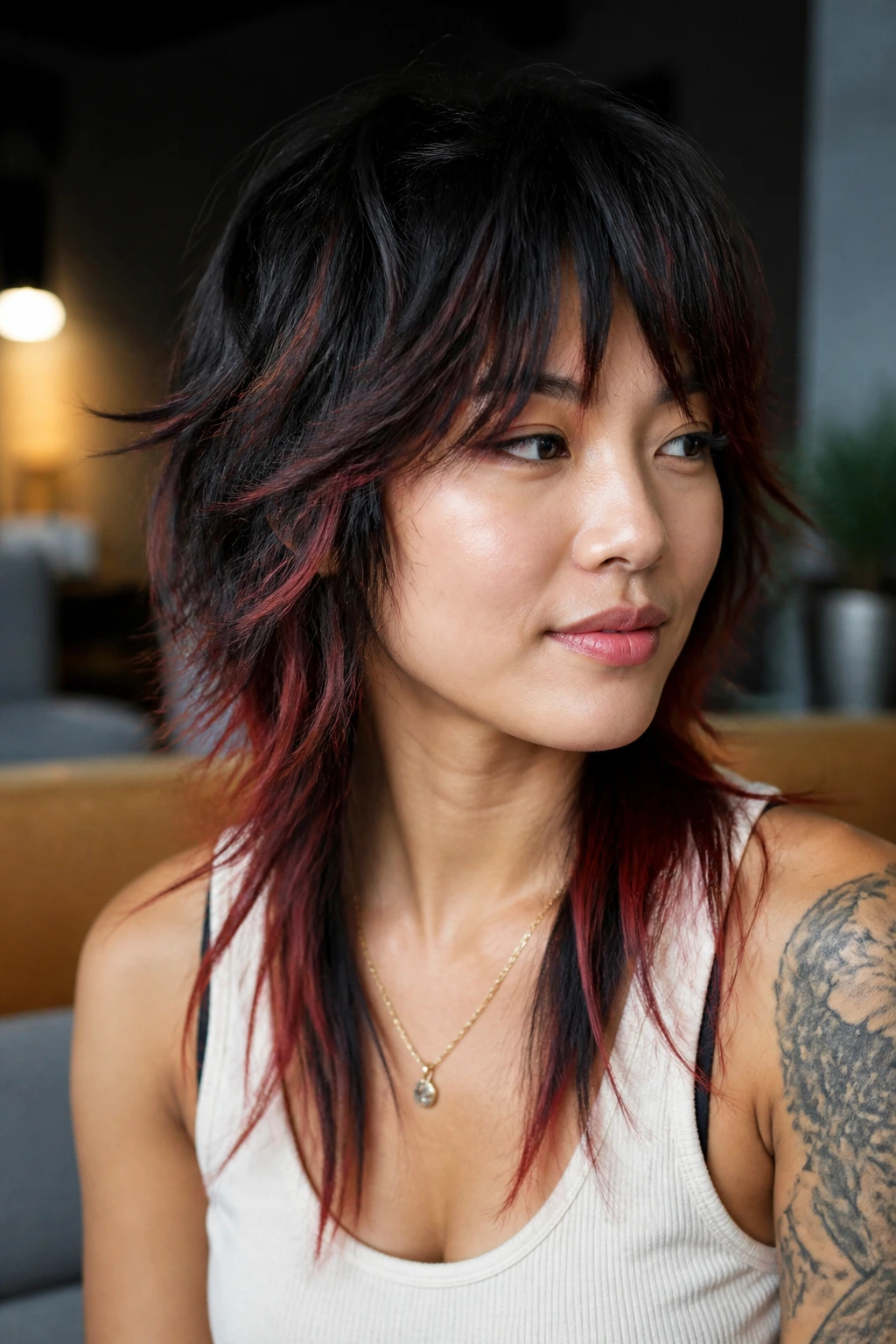
A shag already has motion built in. Add rust-red pieces and the whole cut starts to look more broken up, which helps a round face because it stops the hair from reading as one wide mass.
The trick is to keep the brightest rust away from the cheeks and let it hit the ends, fringe, and upper layers instead. That way the red follows the shag’s natural texture rather than sitting in one heavy stripe. A choppy finish is a good thing here. The uneven ends keep the color from looking flat.
This look has a little grit to it, which I like. It does not try to be neat. It just moves. If you want something that feels lived-in and still flattering, a rusty shag is a strong pick. On black hair, the contrast is enough to show the cut without needing thick highlights.
15. Ruby Halo Highlights Around the Hairline
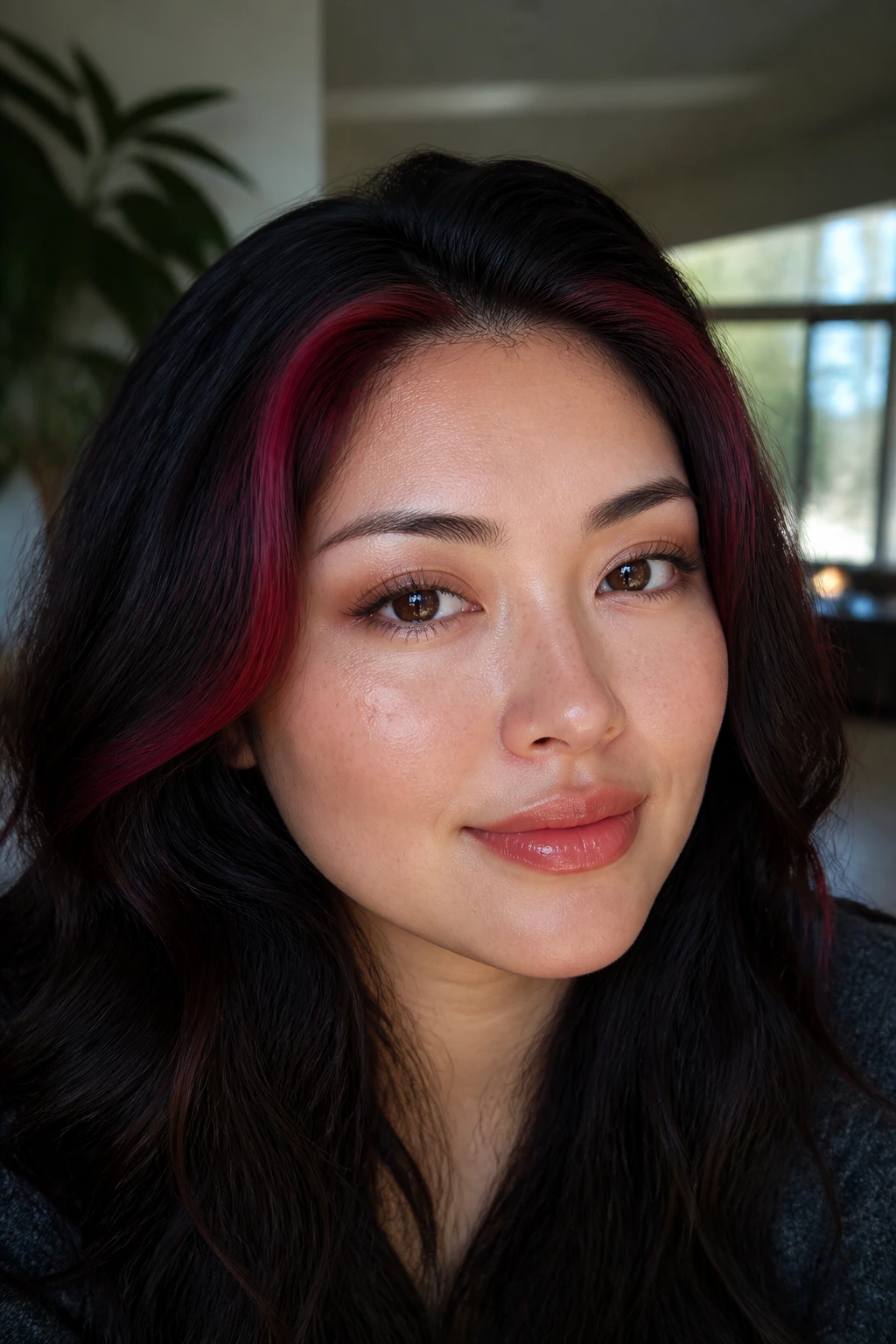
A ruby halo is a bolder version of face-framing color, but it works if the red stays thin and arcs around the outer hairline rather than sitting in the middle of the cheeks.
Why the Hairline Matters
The hairline is where a round face can use a little lift. Brightness at the temple and forehead area pulls the eye upward before it ever reaches the cheeks. That creates a longer look without needing a lot of color everywhere.
- Keep the halo narrow, not chunky.
- Let the ruby sit just inside the hairline.
- Feather the ends so the red does not stop bluntly.
- Side-swept bangs make this look even softer.
A halo can sound dramatic, and it can be, but the best version is controlled. You want a glow, not a band. On black hair, ruby gives enough contrast to show the shape without turning the front into a hard frame.
16. Garnet Balayage on Center-Parted Hair
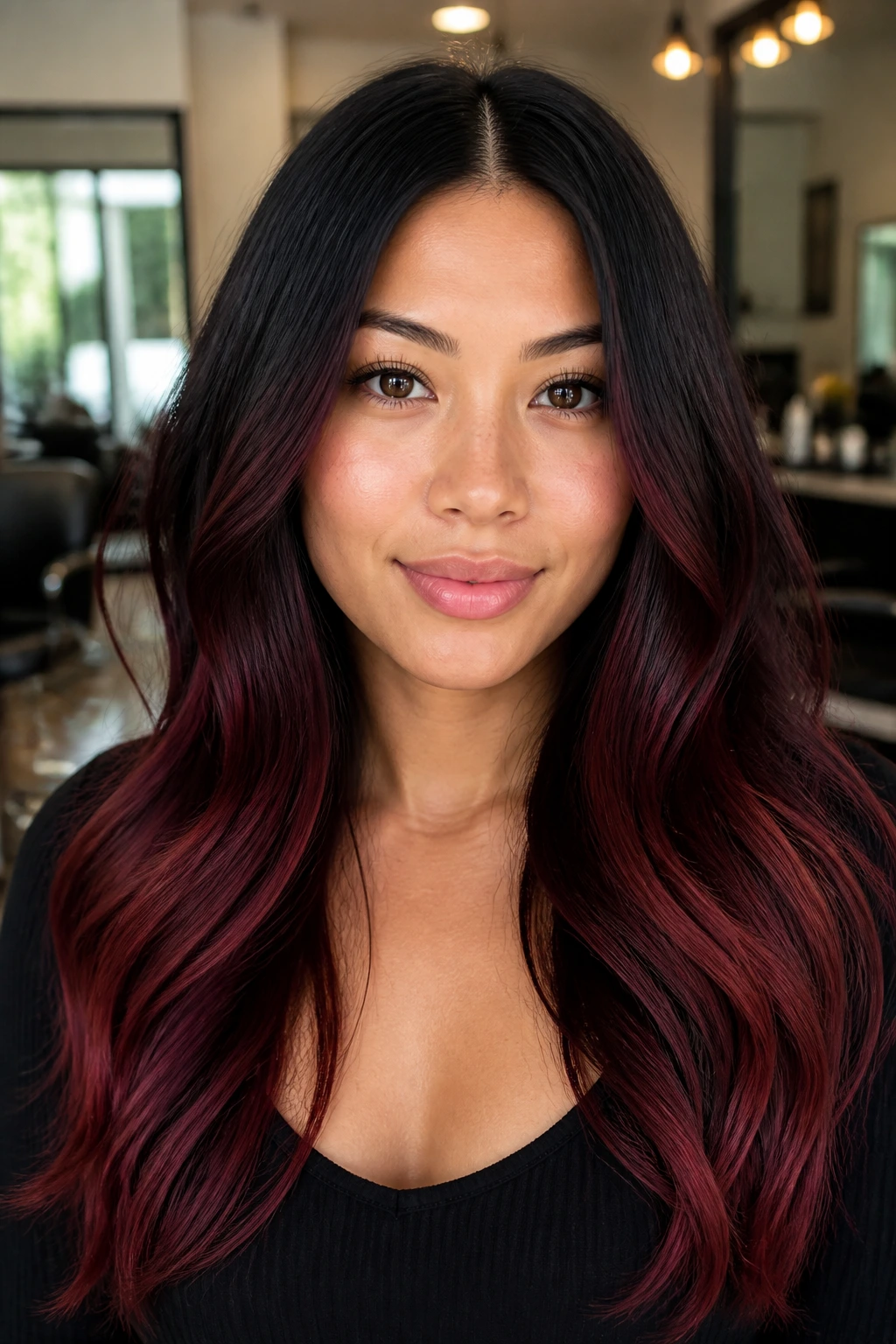
A center part can be tricky on a round face, because it can split the face in two and make the cheeks more obvious if the color sits too high. Garnet balayage solves that by keeping the red lower and softer through the sides.
The thing to watch is width. A center part with wide red chunks near the cheekbone can make the face feel boxy. Garnet is better when it starts below the widest point of the face and spreads out through the lower mid-lengths. That gives the hair a long, falling line on both sides.
This look suits people who want symmetry but not harshness. The red should feel like a gradient, not a stripe. If the hair is medium to long, ask the colorist to keep the brightest garnet near the ends and the front pieces a touch softer. That keeps the face from looking too round in the middle.
17. Crimson Tips on Braided Styles
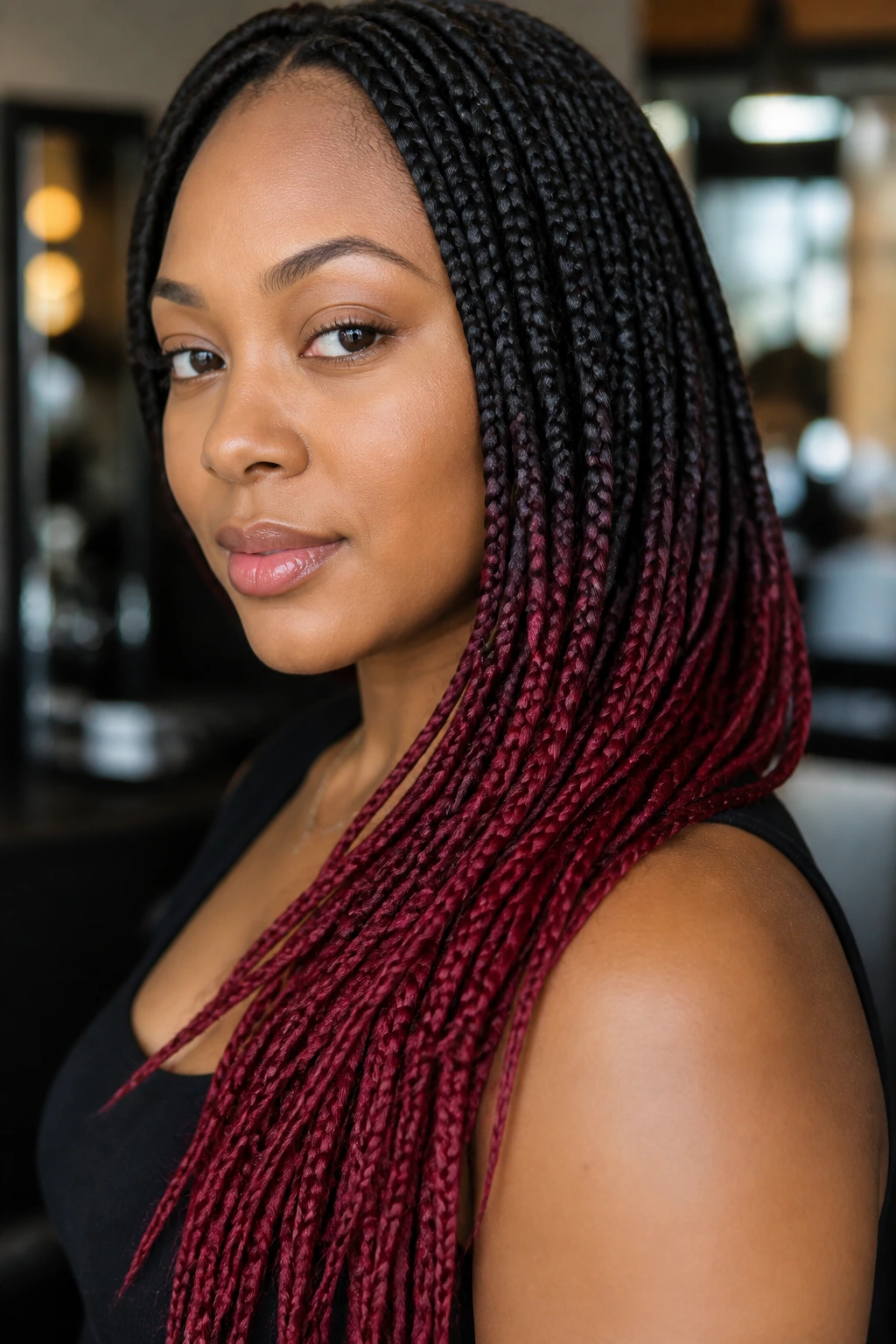
Braids change the whole color story because they break the hair into sections. That makes crimson tips a smart choice for round faces: the red appears in motion, not in one wide visual block.
The color at the ends of braids helps draw the eye downward. That is the useful part. A round face benefits from anything that lengthens the line below the jaw, and bright tips do that cleanly. If the roots and mid-lengths stay black, the braid still looks sleek. The color only shows when the braid moves or is styled over the shoulder.
This works on box braids, twists, and feed-in braids. The more defined the braid pattern, the more the red tips look intentional. I’d keep the crimson concentrated on the last few inches rather than halfway up the braid. Too much red too high can widen the face again.
18. Dark Cherry Panels Behind the Ear
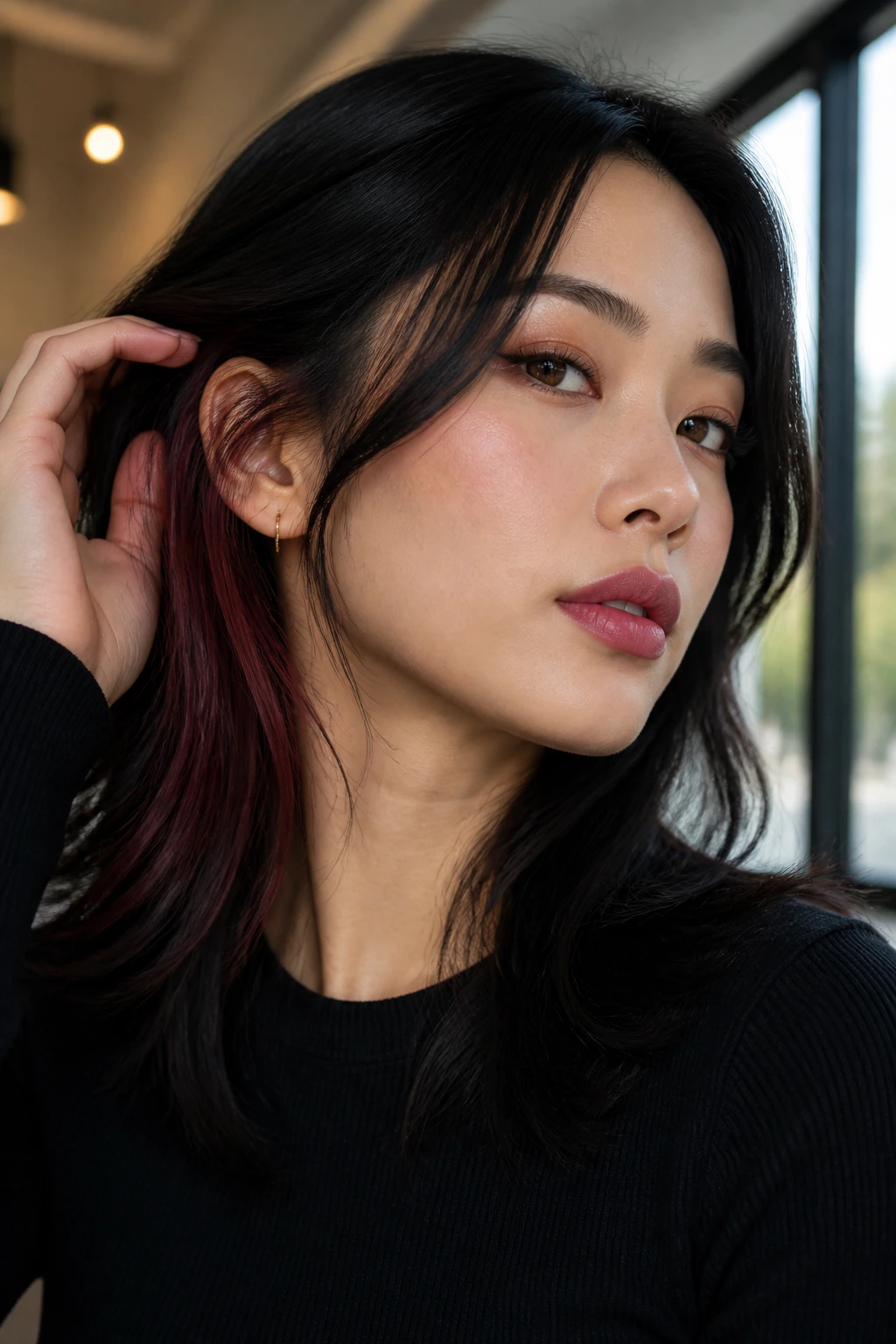
There’s something nice about a color that reveals itself late. Dark cherry panels behind the ear do exactly that.
You get the red only when the hair shifts, tucks, or swings forward. That keeps the outer frame dark, which is flattering on a round face because it preserves a slimmer outline around the cheeks. It also makes the color feel richer, since you notice it in pieces instead of all at once.
I like this approach on medium-length cuts and long bobs. It gives the hair a hidden layer of color that shows up in side views and half-up styles. If you wear one side behind the ear often, place the panel there. The asymmetry adds shape. The dark cherry stays tucked until it gets a little sunlight, and then it pops.
19. Rosewood Highlights on Thick Hair
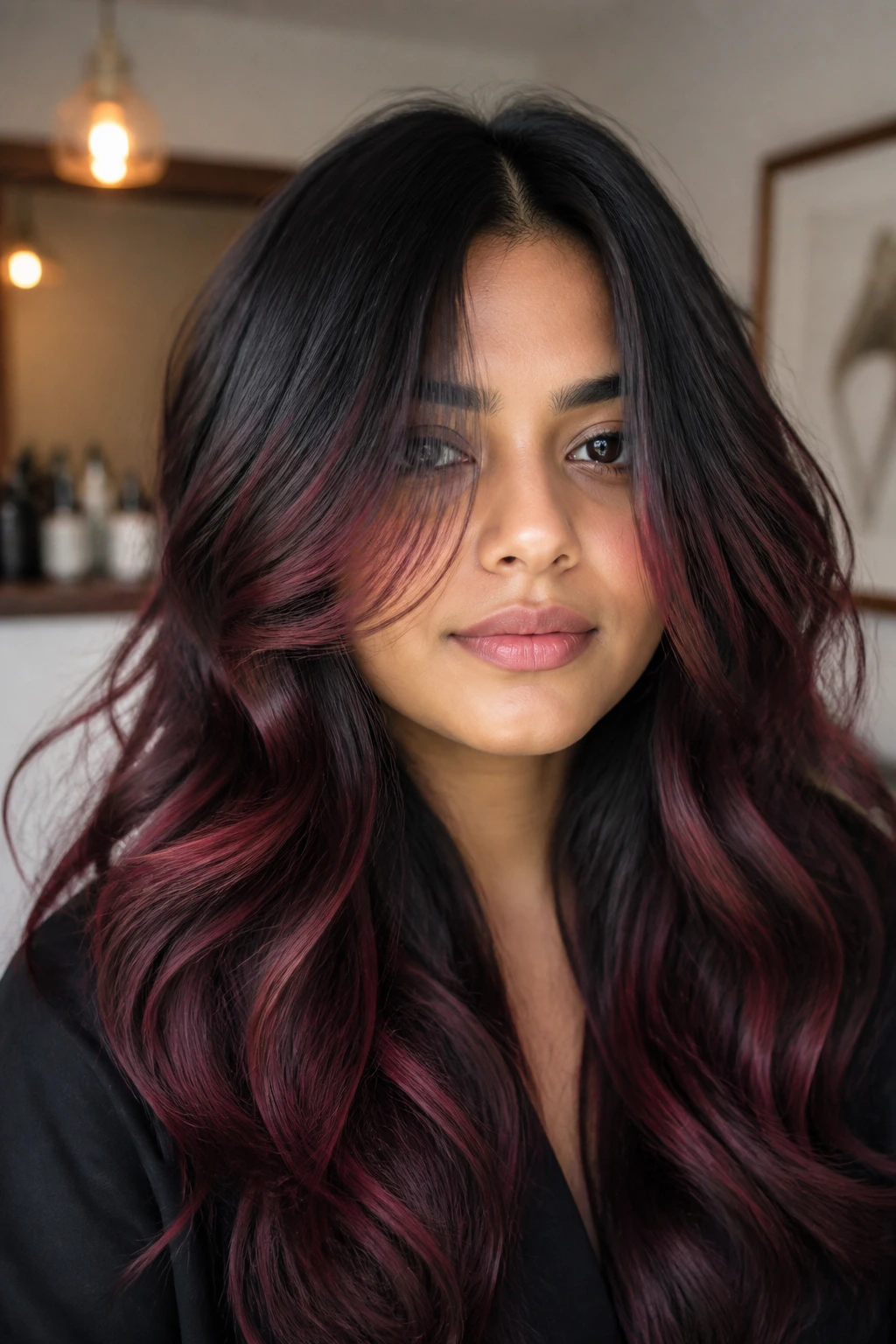
Thick hair can swallow color if the pieces are too narrow. Rosewood highlights are a good answer because they have enough depth to show through black hair without needing a lot of brightness.
What helps most on a round face is spacing. Thick hair can turn rounder when the color is packed too densely across the sides. Instead, keep the rosewood in softer ribbons through the lower half and around the ends. That lets the hair keep its weight while the face stays framed by darker sections.
This is one of the better options if you want color that reads elegant rather than obvious. Rosewood sits between red and brown, so it blends nicely and grows out with less drama. On a dense mane, a few well-placed panels can do more than a full head of brighter red.
20. Flame-Red Flicks on a Layered Bob
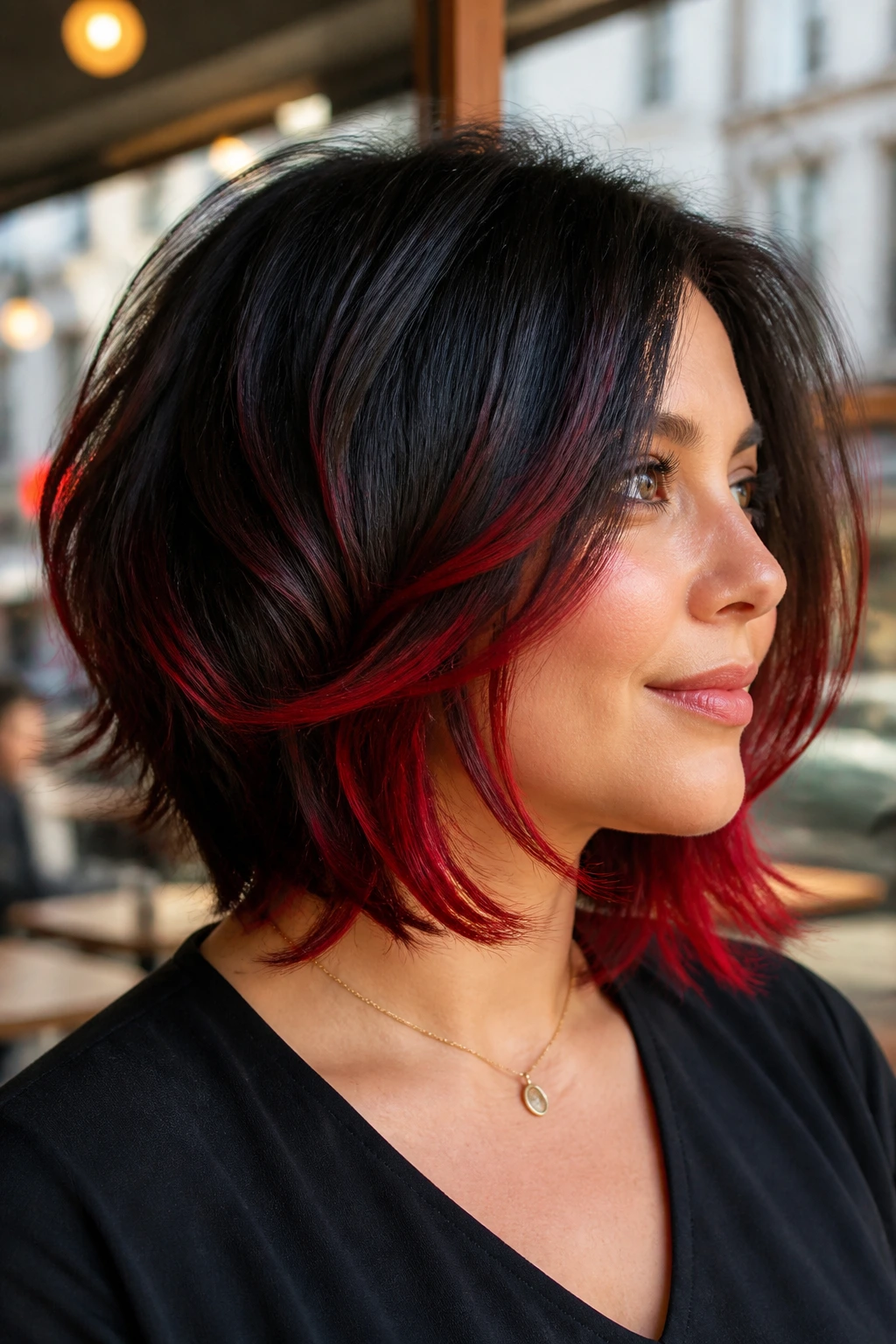
A layered bob is built for movement, so flame-red flicks can look sharp without making the face look wider. The layers lift the color off the cheeks and let each red piece sit at a slightly different height.
Ask for the brightest flicks around the lower layers and the ends, not across the widest part of the face. That keeps the shape narrow through the middle and gives the bob a bit of edge at the bottom. If the front is longer than the back, the red can trail a little more in front to stretch the silhouette.
What to Ask the Colorist
Keep the red pieces fine near the face and a touch bolder through the ends. A bob can get heavy fast if the color sits too high.
- Use a layered cut, not one blunt sheet.
- Put the brightest red below the cheekbone.
- Leave some black between each flame-red piece.
- Soften the front with a side part or off-center part.
The result feels lively, but not fussy.
21. Black Cherry Gloss with Sparse Red Ribbons
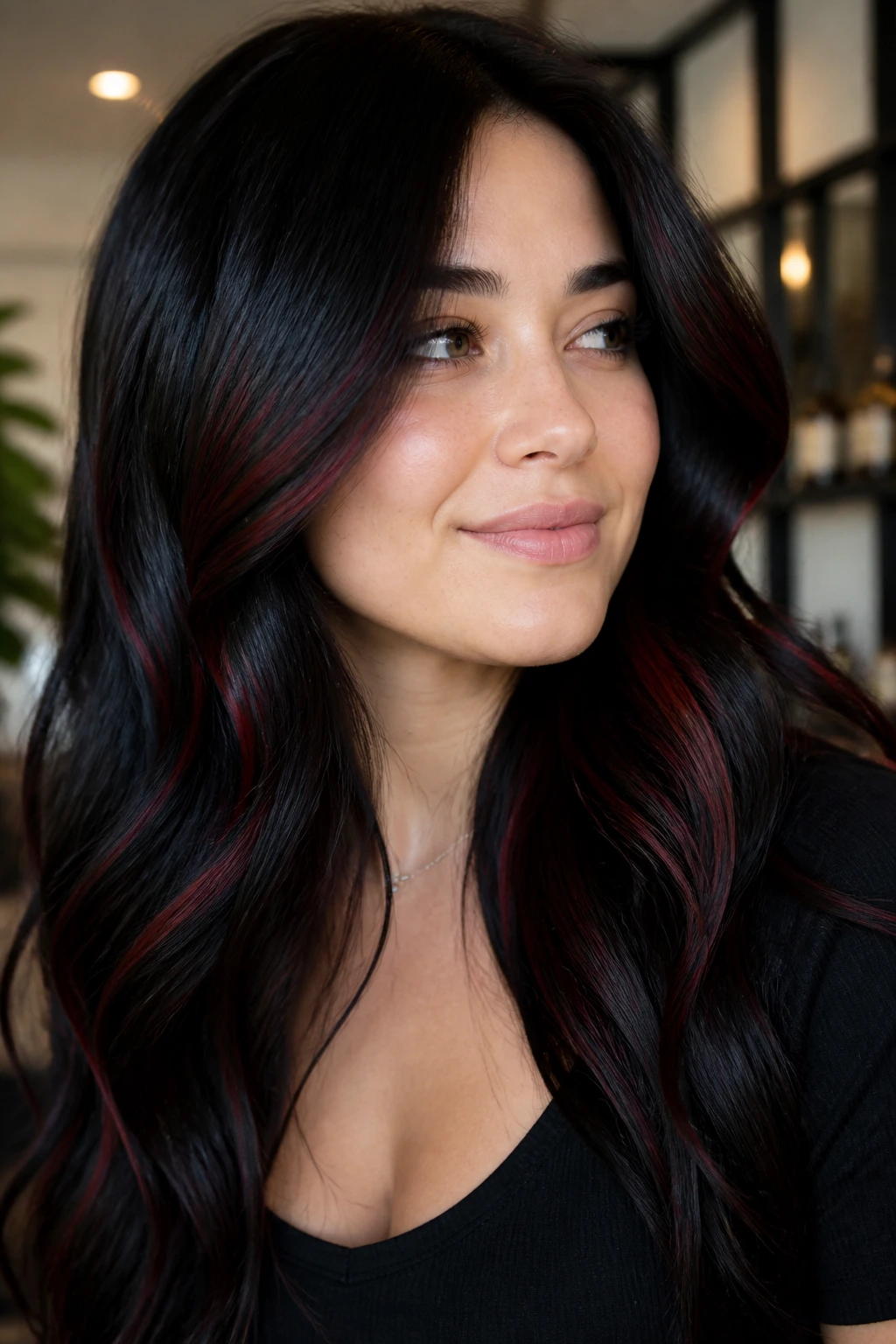
A gloss can change the mood of black hair fast, and black cherry gloss is one of the easiest ways to try red without committing to heavy streaks.
The idea here is restraint. Keep the ribbons sparse and let the gloss do most of the work. On a round face, that matters because too much red close together can make the sides feel full. Sparse ribbons leave enough dark space to keep the shape clean.
This style is also friendlier to people who like low maintenance. The red reads more like shine than stripe, especially indoors. Under light, the cherry cast shows up at the bends and ends of the hair. That softness is the whole point. If you want a red-black look that feels smooth and grown-up rather than loud, this is a strong choice.
22. Cinnamon-Red Streaks for Warm Undertones
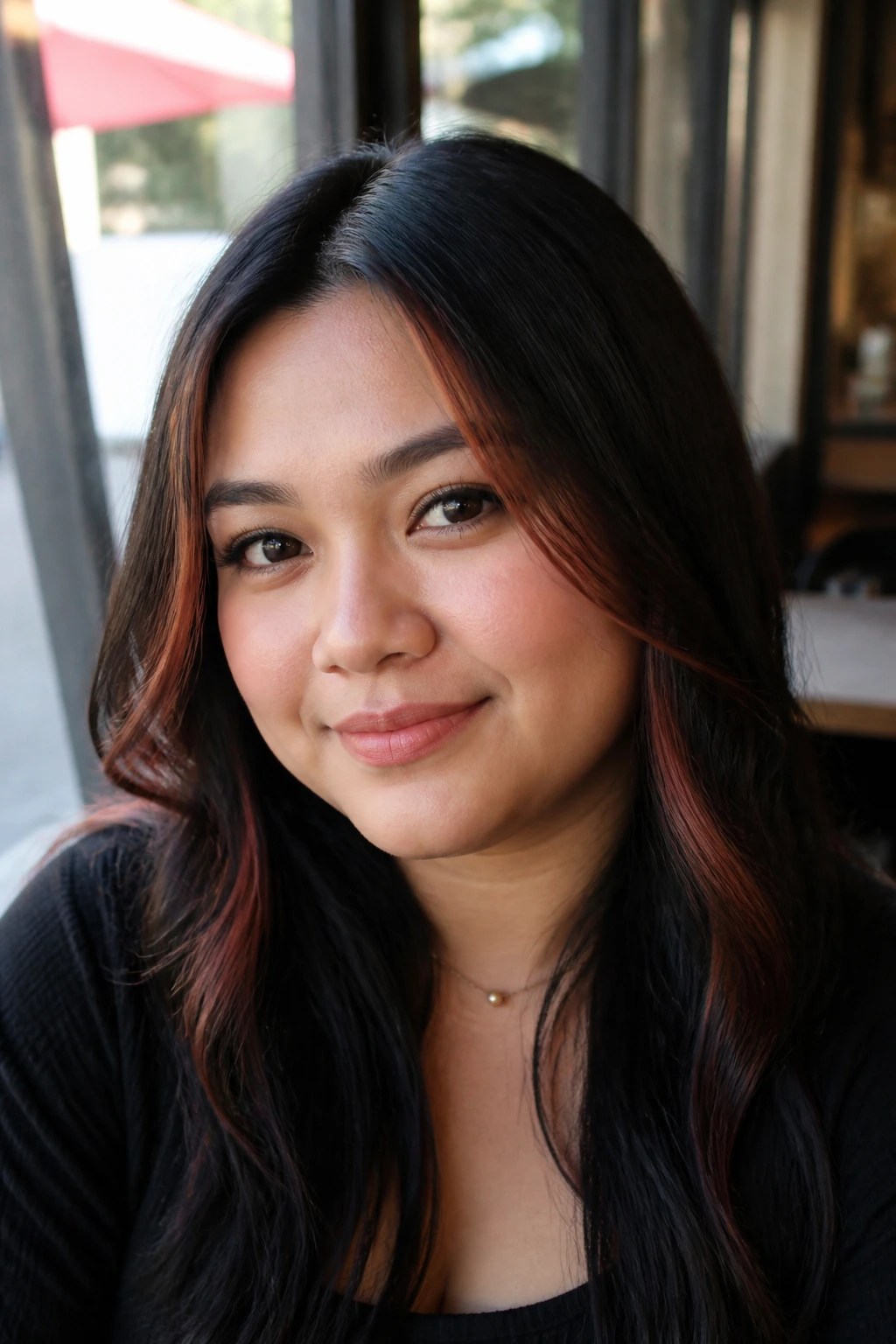
Warm undertones and cinnamon-red hair get along without much effort. The shade has enough orange-brown warmth to sit naturally beside black hair, and that can be useful on a round face because the color does not need to shout to be seen.
I like cinnamon-red streaks when the goal is softness. They brighten the face without giving you the harsh contrast of pure scarlet. Put them near the front pieces, but keep them thin and a little lower than the cheekbone. That keeps the face framed, not widened.
If your skin pulls golden or peachy, this tone is easy to wear. It also works nicely in daylight, where the warmer undertone shows up more clearly. You do not need a lot of it. A few well-placed cinnamon streaks can do more than a dense set of highlights.
23. Plum-Red Highlights for Cooler Skin Tones
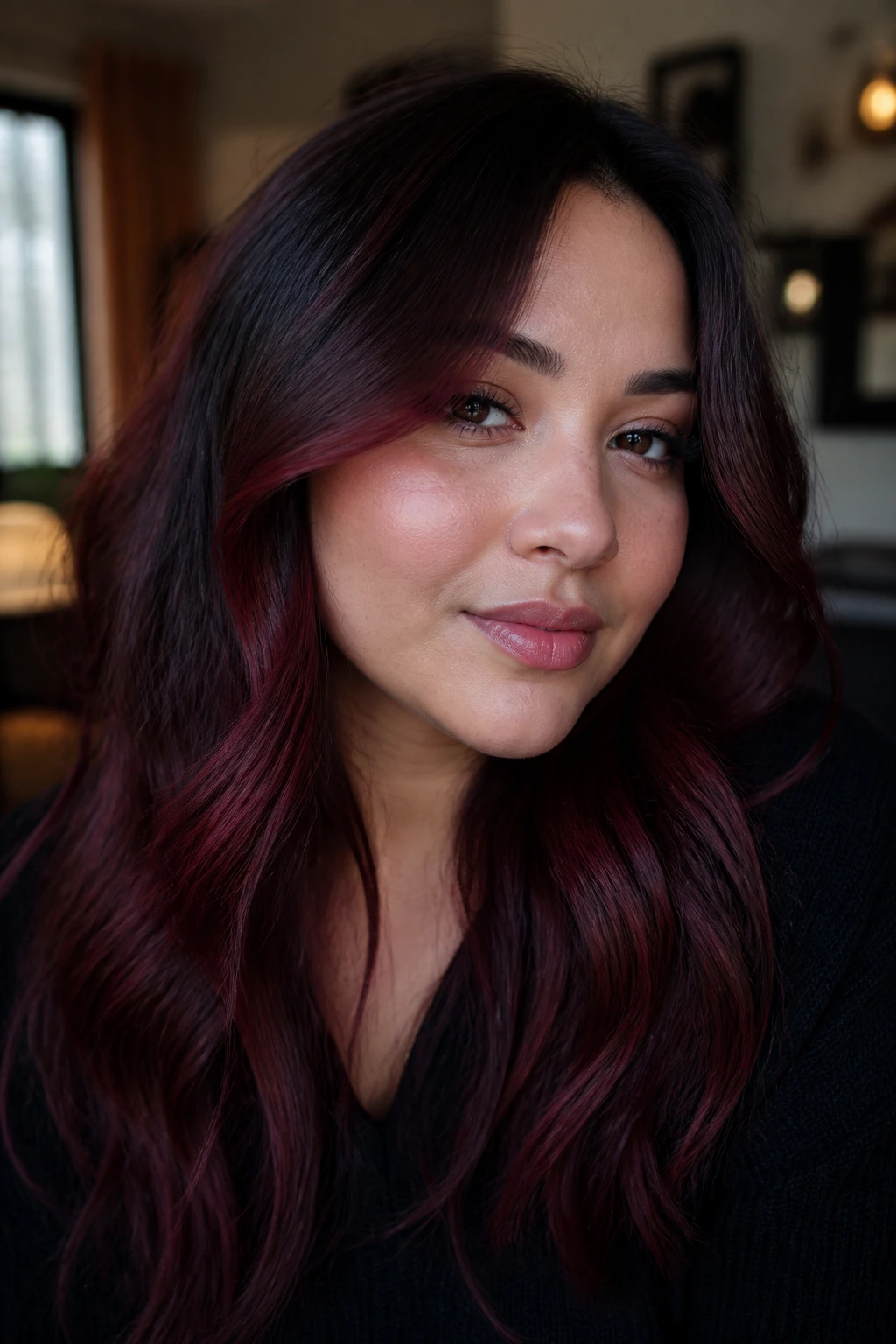
Plum-red is the red people overlook, and that’s a shame. It has a cooler edge that can sit beautifully against black hair, especially if your skin has pink, blue, or neutral undertones.
For a round face, the best part is the depth. Plum-red highlights can be placed a bit lower through the mid-lengths and ends, which keeps the face looking longer. The color is rich enough to be visible, but it does not throw a lot of warm glare across the cheeks.
This is a cleaner, quieter kind of red. If bright copper feels too warm or too loud, plum gives you contrast without the heat. It can also make curls and waves look denser, because the cooler red sinks into the dark base instead of sitting on top like a stripe.
24. Dimensional Lowlights for Fine Hair
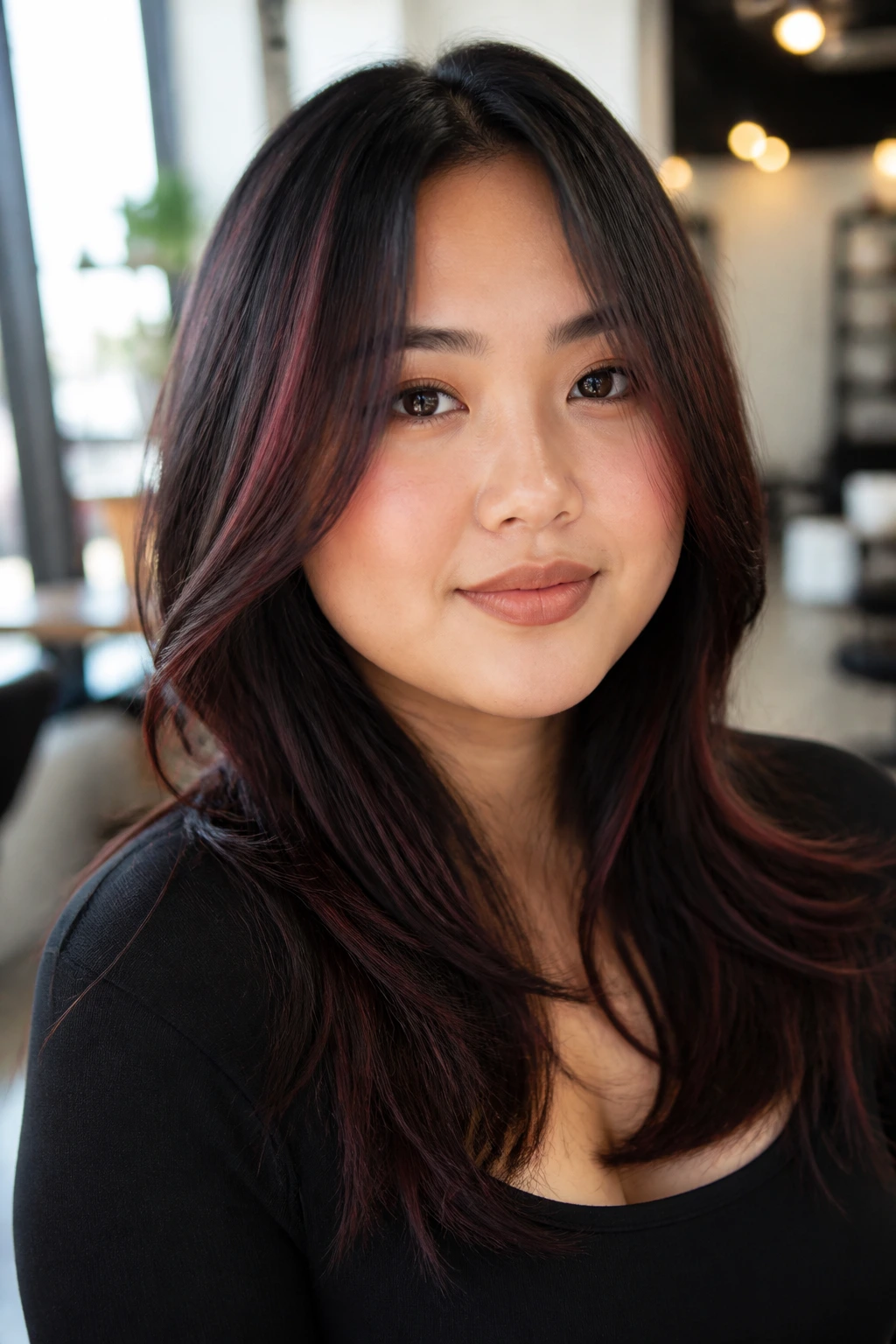
Fine hair is a different animal. Too many bright pieces can make it look stringy, and that is where dimensional lowlights earn their keep.
Instead of chasing lightness, add red-brown shadow inside the black base. The lowlights create depth, which makes the hair appear fuller. On a round face, that extra fullness should stay lower through the ends, not puff out at the cheeks. Keep the top a little darker and the sides broken up, and the face shape stays cleaner.
This look is for people who want movement more than brightness. The red is there, but it is tucked into the hair rather than sitting on the surface. Fine hair often benefits from that kind of quiet color, because the strands keep their shape better when they are not overloaded with lightening. It is a small adjustment. It changes the whole impression.
25. Red Peekaboo Ends on Twists and Braids
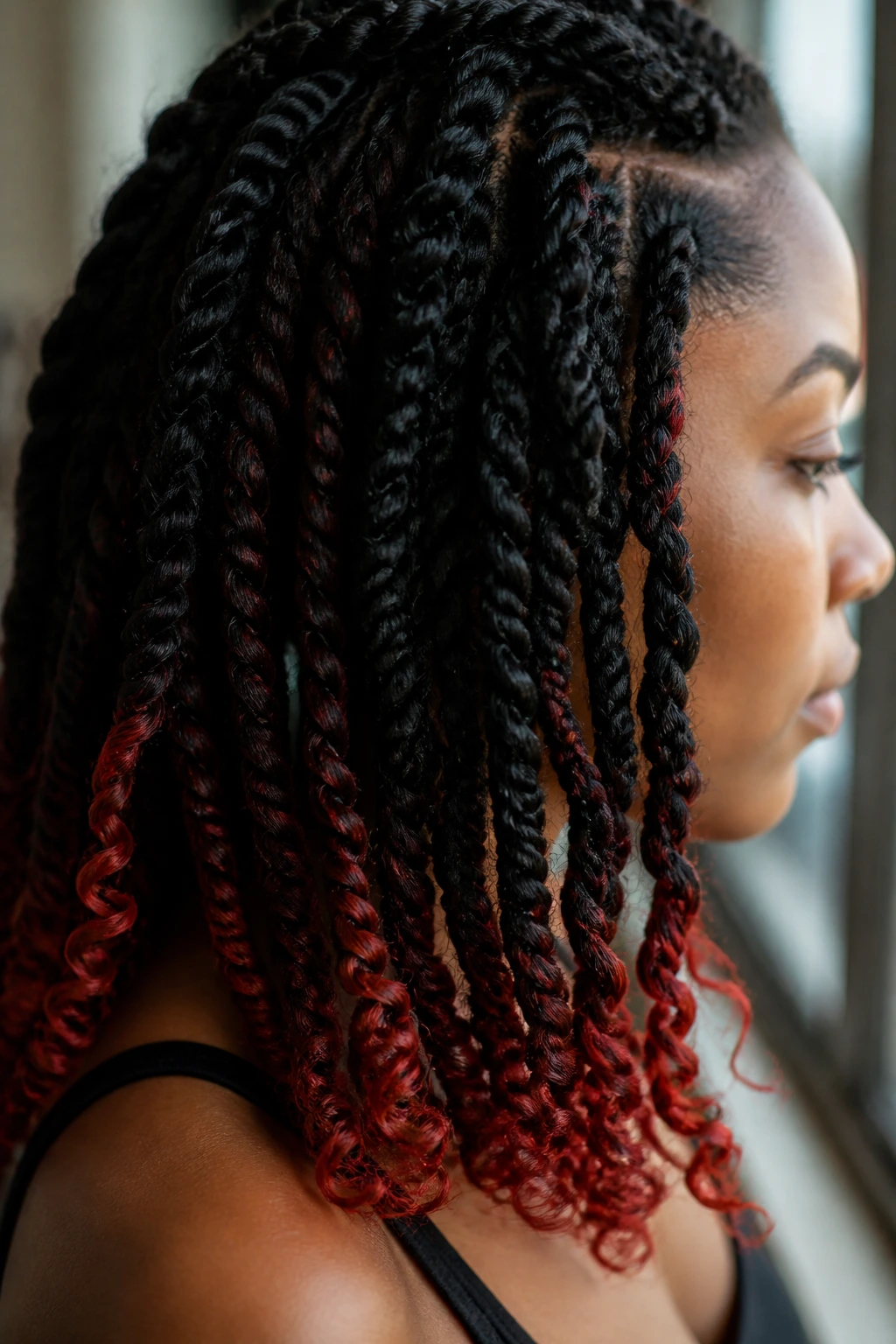
Twists and braids have a built-in pattern, so the color should work with that pattern, not fight it. Red peekaboo ends do that neatly.
The black base keeps the roots calm, and the red shows only at the tips or in the last few inches of each twist. On a round face, that pulls the eye downward and keeps the focus away from the cheeks. It also makes the style feel lighter, which helps if the hair is thick or long.
This is one of the better options if you like protective styles but still want a little edge. The color moves when the braids move. That movement keeps the face from feeling boxed in. If you want more drama, use a brighter red at the very ends and keep the upper braid darker. That contrast looks clean from every angle.
26. Two-Tone Face Frame with Black and Burgundy
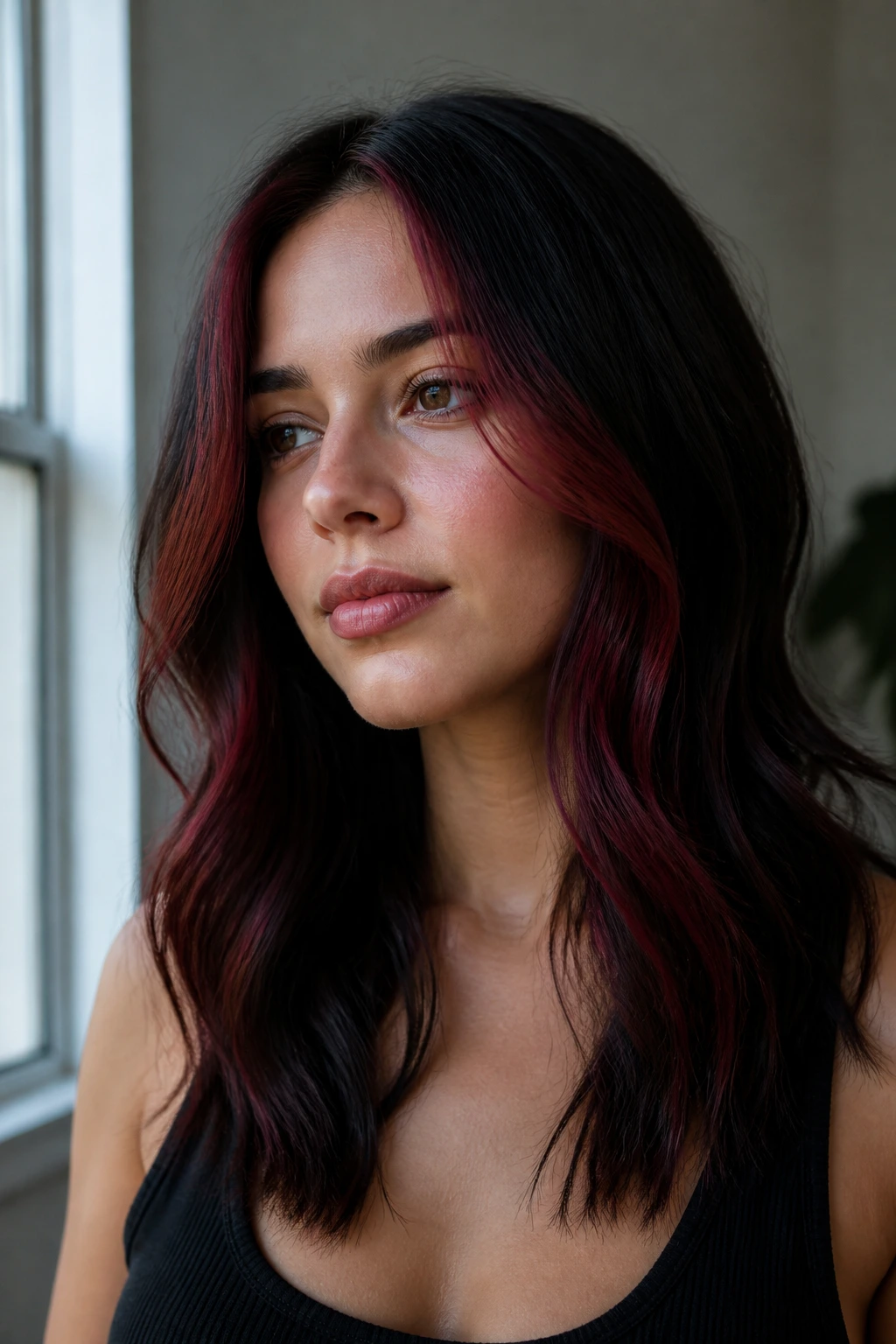
A two-tone face frame can look expensive when it is done with restraint, and round faces do well with it because the two shades create depth along the sides.
Here’s the part that matters: the burgundy should not sit in one thick strip. It should be broken into a lighter inner ribbon and a deeper outer edge, almost like a soft outline. That keeps the front from reading like one solid band. The black remains the anchor, while the burgundy bends the shape of the face a little more vertically.
This is a strong pick if you want color that looks deliberate. It feels tailored without being stiff. If the haircut has curtain pieces, this placement becomes even better, because the lighter burgundy can live on the inner curve while the black stays along the outside. That gives the face a slimmer frame without wiping out the dark base.
27. Feathered Babylights on a Medium Cut
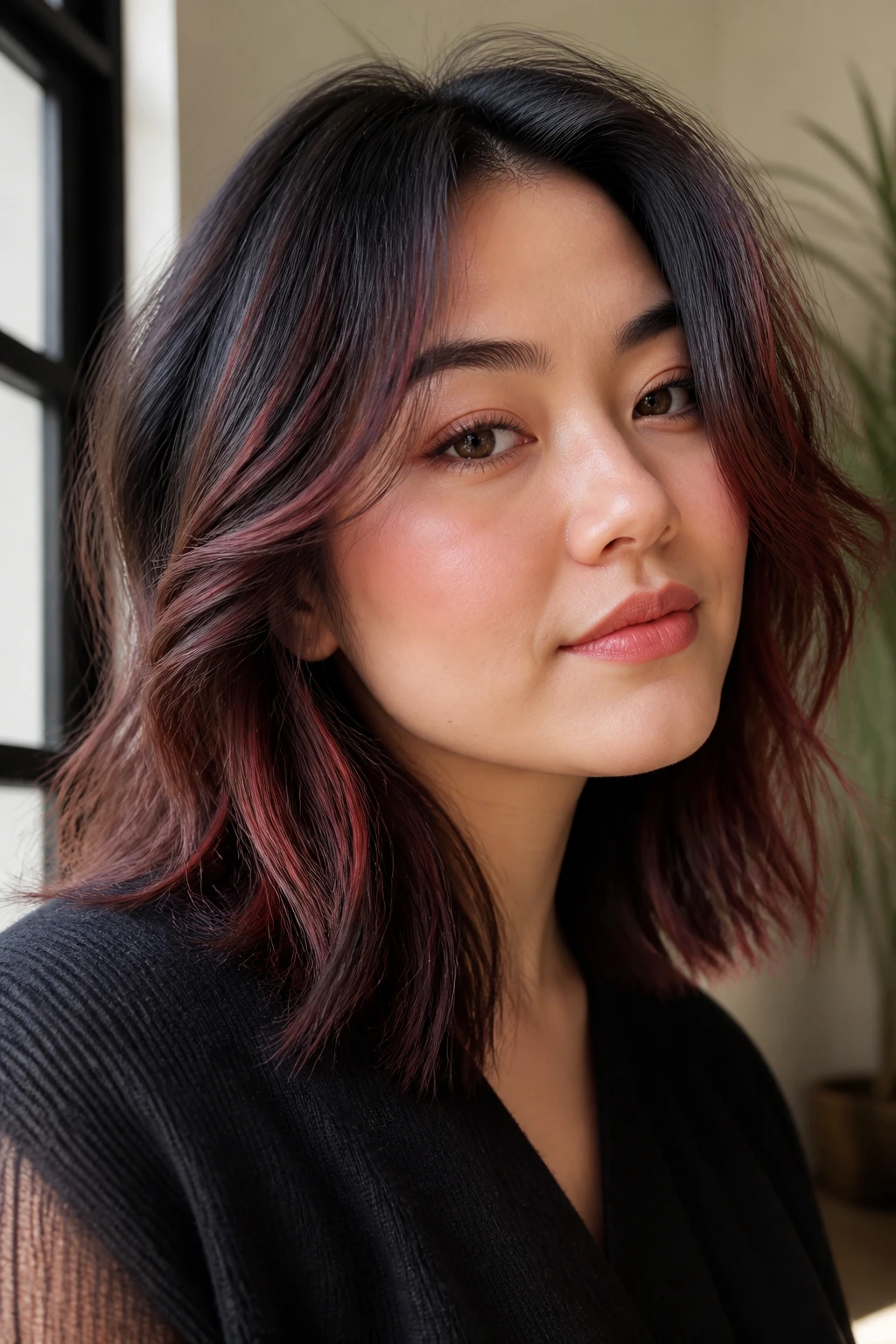
A medium cut gives you room to play with fine color, and feathered babylights are one of the best ways to keep red soft on black hair around a round face.
Babylight Placement
The red should be barely there at first glance. Thin baby strands through the upper sides and ends give the cut lift without thickening the cheeks. The feathered finish means the pieces blend into the black instead of stopping abruptly.
- Keep the highlights thread-fine.
- Place them above and below the cheekbone, not across it.
- Let the ends hold a touch more red than the roots.
- A soft wave makes the color look fuller.
This is one of those looks that rewards patience. It does not scream from across the room. It shows up when the light moves. On a round face, that subtlety is a gift, because the eye notices shape before it notices streaks.
28. Soft Black Cherry Shadow Lights for Everyday Wear
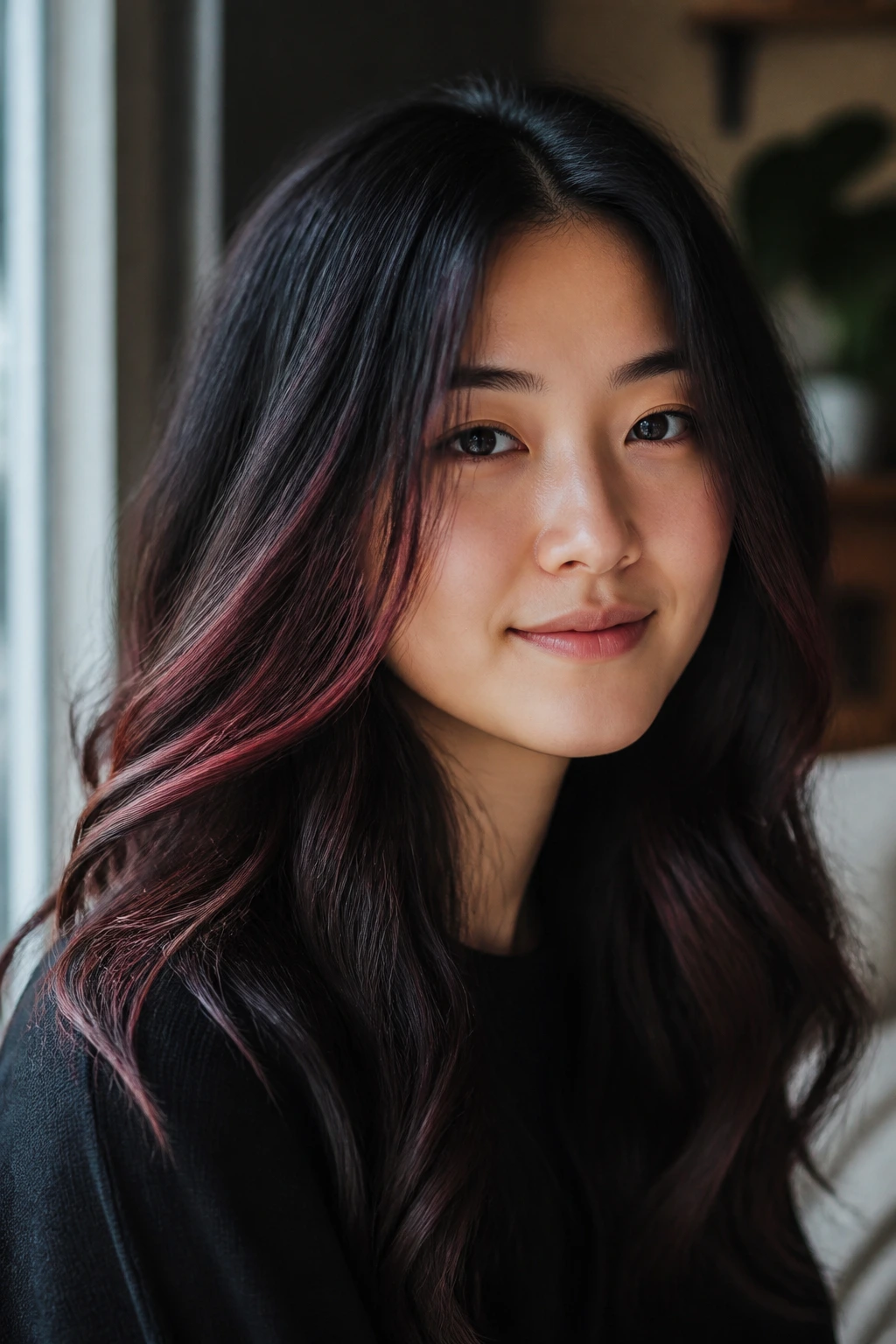
Not everyone wants a bright red moment. Some people want black hair with a red cast that feels easy to live with, and soft black cherry shadow lights are exactly that.
The color sits in the shadows of the hair instead of on the surface, so the face keeps its dark frame. That is especially useful for round faces, where a strong front highlight can widen things if it lands in the wrong spot. Here, the red lives deeper through the mid-lengths and lower layers, which creates movement without crowding the face.
I like this finish for daily wear because it looks good in low light and even better in daylight. It is the least fussy option in the whole group, but not the least interesting. If you want a black-red look that doesn’t scream for attention and still gives the hair shape, this is the one I’d steer you toward. Keep the brightest red below the cheekbone, and let the rest stay dark. That’s the cleanest line of all.
