



There is an old, persistent myth floating around hair salons that bangs and curly hair are enemies. It is a tired narrative that ignores the sheer architecture of a good curl. When cut correctly—dry, with patience, and an understanding of how a coil springs back—bangs become one of the most transformative elements you can add to a curly hairstyle. They do not fight your texture; they celebrate it by framing the face and adding a deliberate shape to the wild, beautiful volume of your natural hair.
You might have spent years pinning your curls back or hiding behind long layers because you were afraid of a “poodle” situation. That fear is understandable, but it is entirely misplaced. The secret is not in the bangs themselves but in the method. You need a stylist who understands that a curl cut wet will result in a surprise when it dries, often shrinking by several inches. We are talking about precision, movement, and working with your specific curl pattern rather than forcing it into a straight line.
The variety available to us is incredible, ranging from soft, wispy pieces that barely graze the eyebrows to dramatic, full-bodied shapes that command attention. Whether you have loose waves that behave like silk or tight, dense coils that defy gravity, there is a fringe out there designed to complement your unique look.
1. Bottleneck Bangs
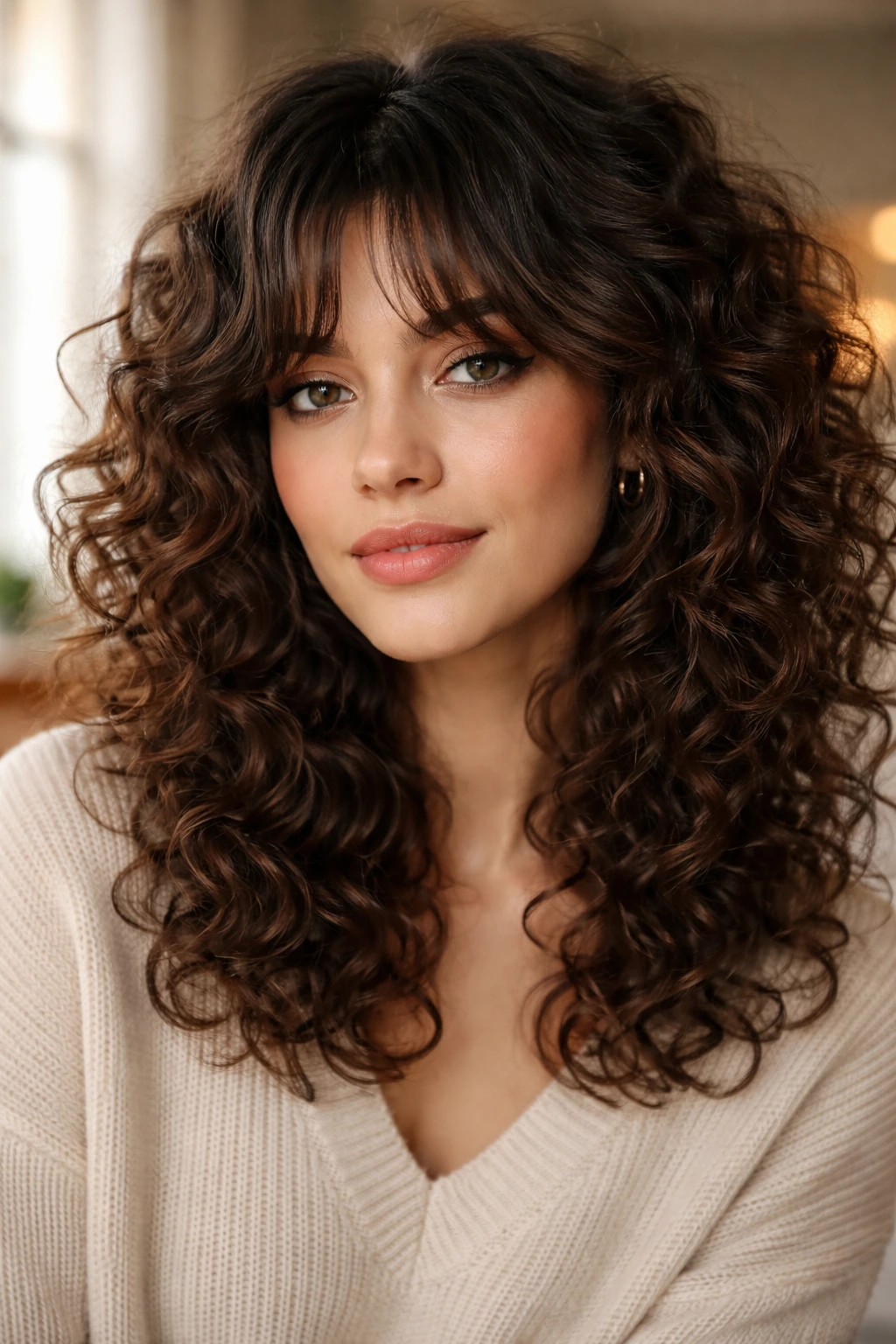
Bottleneck bangs are essentially the evolved version of curtain bangs. They are shorter in the middle and get longer as they move toward the temples, creating a shape that mimics the neck of a bottle. For curly hair, this is brilliant because it allows the bangs to blend into the rest of your hair rather than standing out as a harsh, separate block.
Why They Work for Texture
The key here is the graduation of length. Because they transition from short to long, they don’t get trapped in that awkward stage where your bangs are too short to tuck behind your ears but too long to see through. You can sweep them to the side or let them fall forward, and they will look natural with your curl pattern.
- Best for: People with oval or heart-shaped faces.
- Styling tip: Use a light hold gel while the hair is damp. Scrunch upward toward your scalp to encourage the curl to set in that curved bottleneck shape. If you have looser waves, a tiny bit of salt spray helps the fringe hold its structure without becoming flat.
2. Wispy Curly Fringe
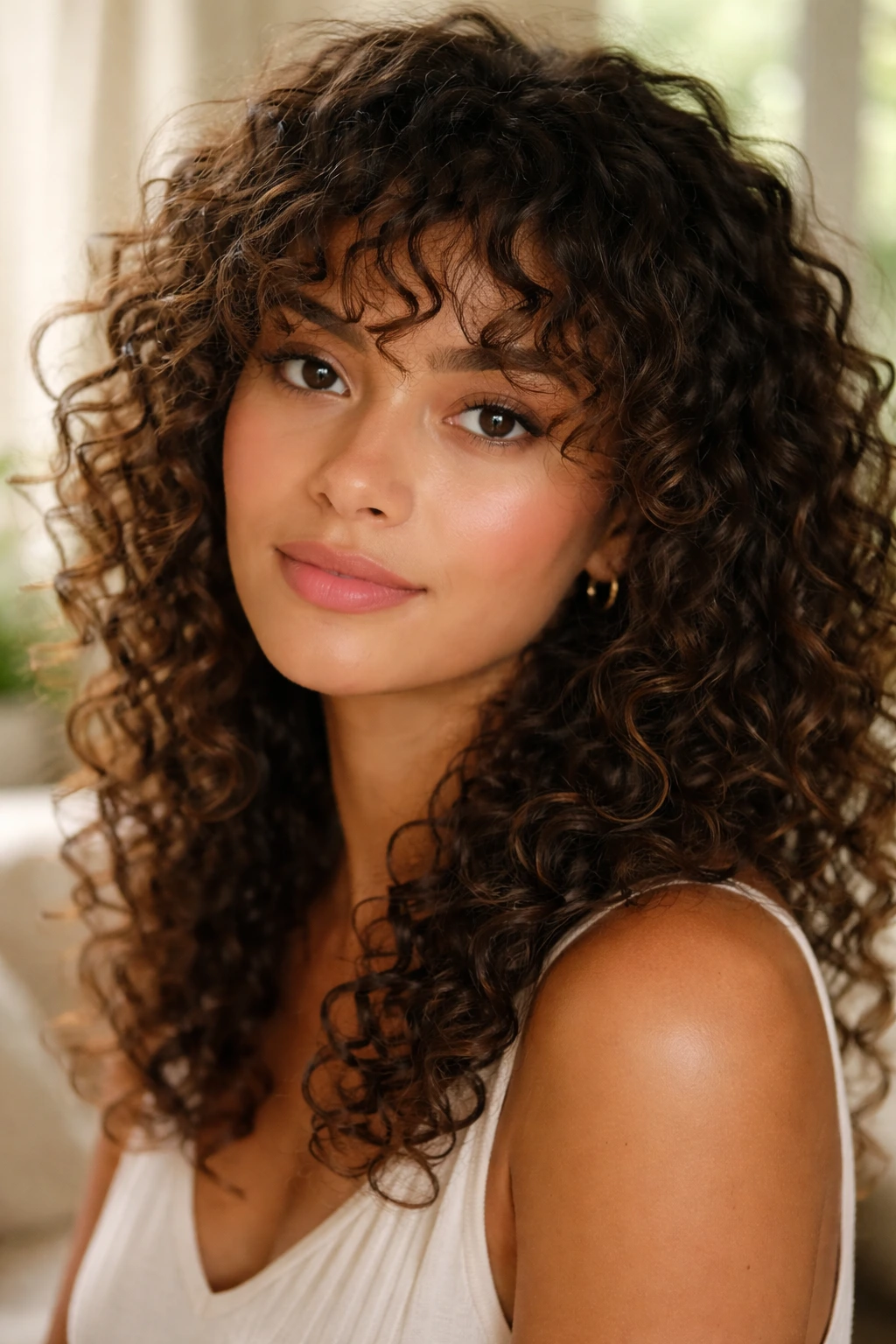
If you are hesitant to commit to a thick, heavy set of bangs, the wispy fringe is your best entry point. This style uses only a small amount of hair at the front, leaving your forehead visible through the gaps in your curls. It is incredibly soft and does not feel heavy or suffocating, which is a major bonus if you live in humid climates.
The beauty of a wispy fringe lies in its fragility. It’s not about perfection; it’s about having a few loose, bouncy ringlets dancing across your brow. You can achieve this by asking your stylist to point-cut the ends, which breaks up the bluntness and keeps the fringe light.
Pro tip: When styling, avoid heavy creams near your hairline. The weight of heavy products will stretch your curls out, causing your wispy bangs to look limp. Stick to a lightweight mousse or a sheer curl refresher spray to keep them bouncy and airy throughout the day.
3. Curly Curtain Bangs
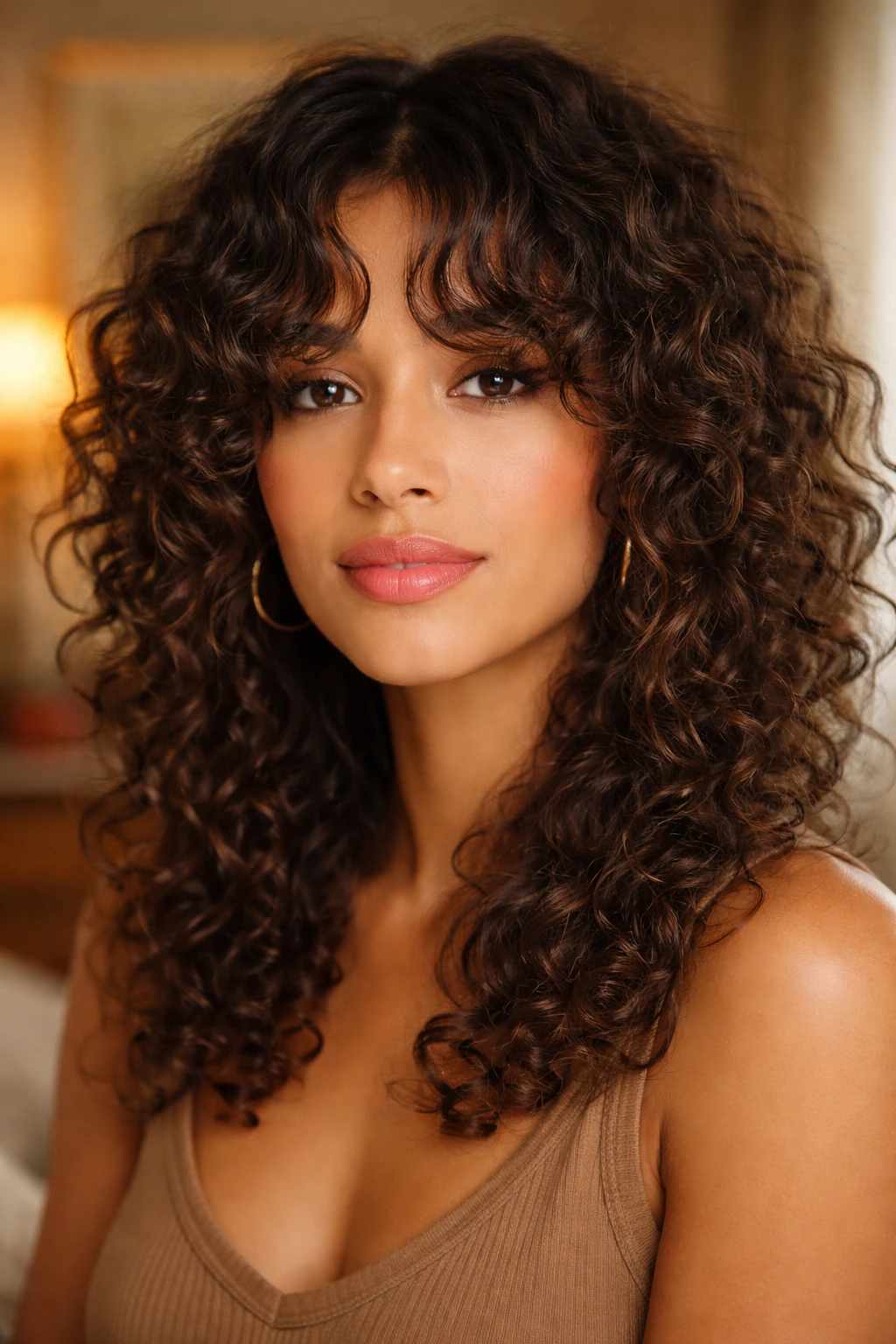
Curtain bangs have been a popular choice for years, but they are often shown on straight hair. On curly hair, they take on a romantic, vintage quality that feels like a throwback to the seventies. They part in the middle and frame the face, creating a soft, cascading effect that blends seamlessly into the rest of your layers.
How to Achieve the Look
The length is crucial here. They should hit around the cheekbone or the jawline. If you go too short, they might spring up and look more like an awkward layer than a intentional curtain.
- The benefit: They are incredibly low-maintenance. Because they are longer, you do not have to trim them every three weeks. If they grow out, they just turn into face-framing layers.
- Who should skip this: If you have extremely tight coils that shrink significantly, curtain bangs might look like a halo of frizz around your forehead. They are best suited for waves or loose to medium curls.
4. Full-Volume Curly Bangs
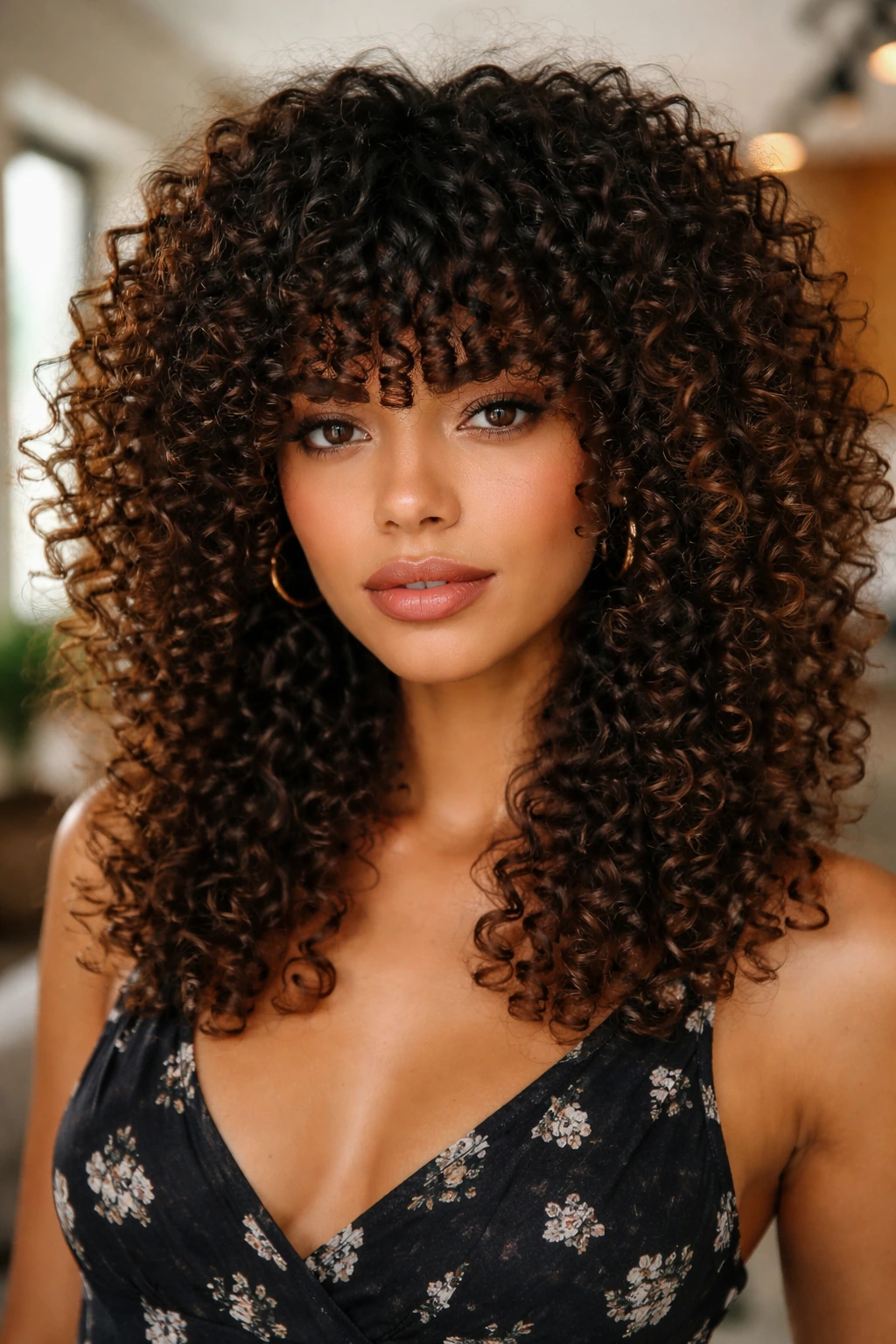
Some of us want to make a statement, and there is no better way to do that than with a full, thick fringe. This is not for the faint of heart. It requires cutting a larger section of your hair from further back on the crown, bringing that volume right to the front.
I remember watching a woman with dense, 4C coils walk into a room with a full fringe like this, and it was architectural art. The bangs had their own shape, sitting beautifully above her eyes, while the rest of her hair formed a perfect crown. It is a high-fashion look that requires confidence.
You have to be prepared for the maintenance. A full-volume fringe means more hair to style, and since it is sitting on your forehead, it will inevitably get oily from your skin faster than the rest of your head. Keep a dry shampoo on hand, but make sure it is a clear formula so you do not get that dusty white residue in your bangs.
5. Curly Shag Fringe
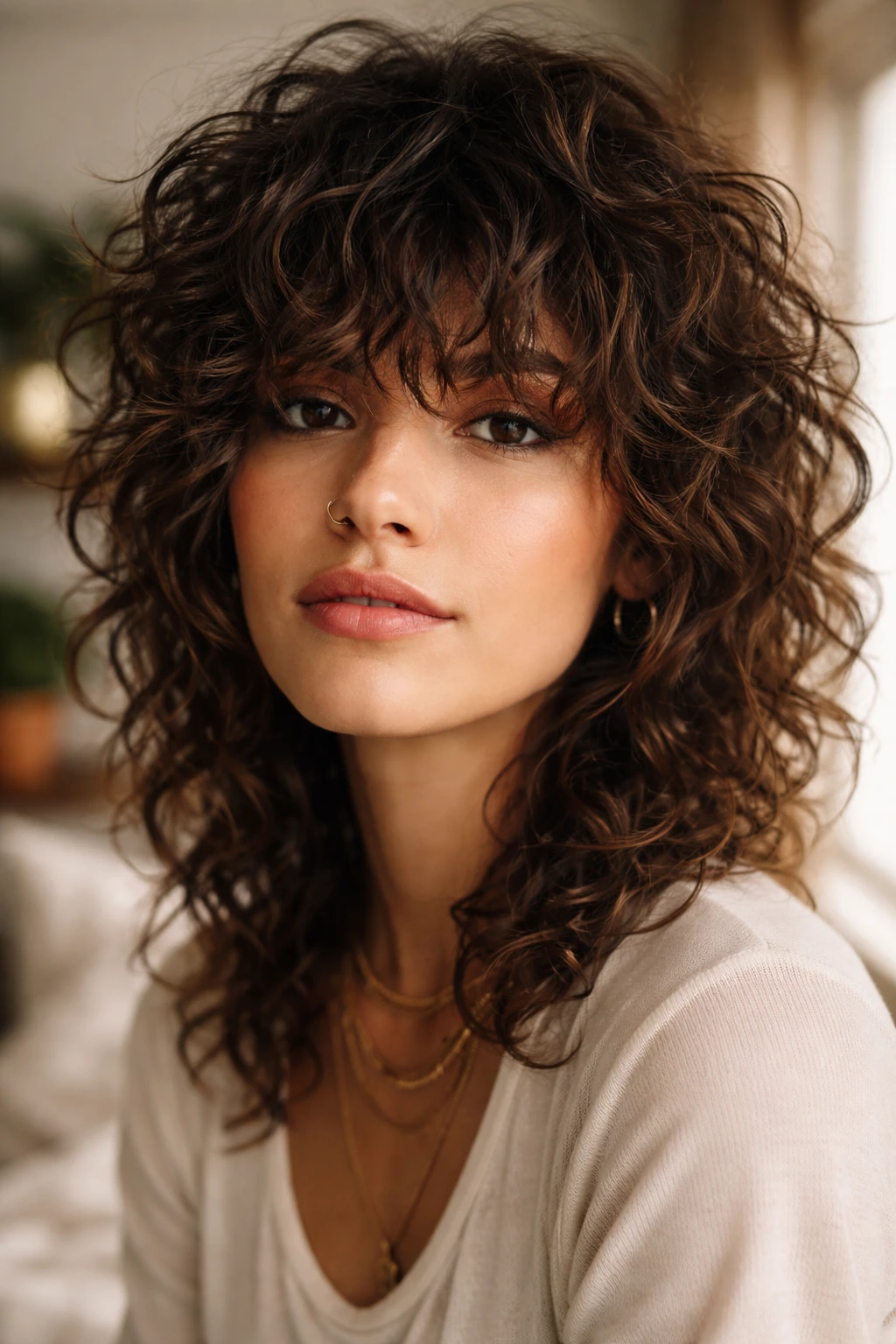
The shag is arguably the best haircut for curly hair, and the fringe is the cherry on top. This look is intentionally messy, choppy, and layered. It leans into the natural texture rather than trying to tame it. The fringe in a shag cut is usually short and textured, designed to look like you just rolled out of bed with effortless style.
Why It’s Effective
This style works because it embraces the “imperfections.” If your bangs are a little uneven, it just adds to the vibe. The shag is all about movement and disconnected layers, so a fringe that looks a bit wild is actually the goal.
Styling Essentials
- Texture spray: You need something to give the hair grit.
- Diffuser: Use a diffuser attachment on your blow dryer to encourage volume without blowing the curls apart.
- Avoid brushes: Never brush your hair when it is dry. Use your fingers to fluff the fringe until you get that lived-in, rock-and-roll shape.
6. Side-Swept Curly Fringe
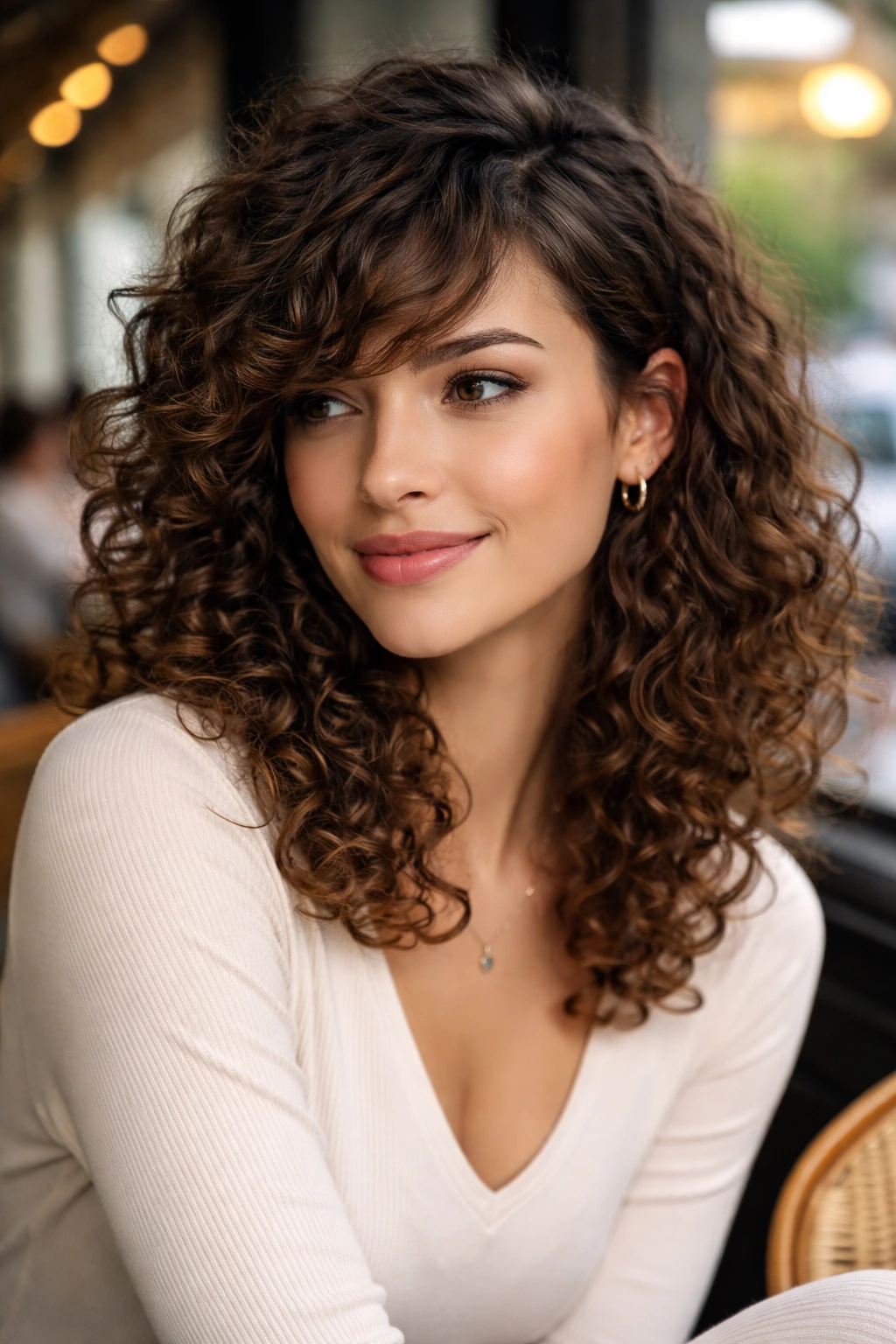
If you are worried about bangs feeling too restricting, the side-swept fringe is a great alternative. It allows you to keep some length while still getting the benefits of a fringe. It is essentially a long, tapered section of hair that is trained to fall across the forehead at an angle.
Why This Style Works
It acts as a gateway to shorter bangs. If you find yourself hating the side-swept look after a few weeks, you can easily grow it out or blend it back into your main layers. It is much less of a commitment than a blunt, straight-across cut.
To keep the shape, you might need to use a single bobby pin or a tiny bit of pomade to encourage the curls to lay in that direction. Don’t try to force them flat against your forehead; let them sit as a side-swept wave. The asymmetry helps draw attention to the eyes and cheekbones, making it a very flattering choice for almost anyone.
7. Micro-Bangs
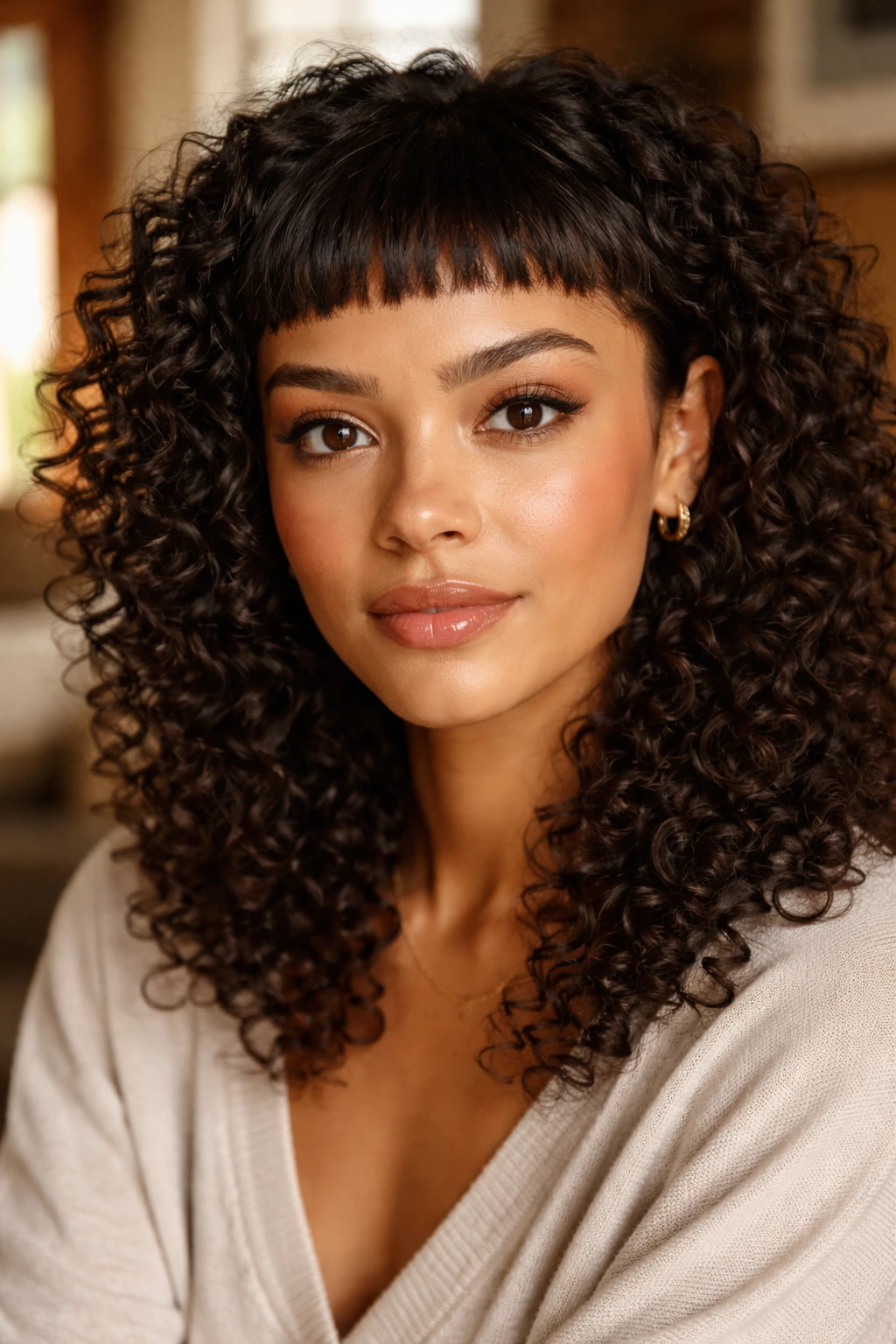
Micro-bangs, or “baby bangs,” are incredibly short, hitting mid-forehead or even higher. On curly hair, this is a bold, artistic choice that highlights your brow bone and your eyes. It is edgy, modern, and undeniably cool.
A Note on Precision
You cannot cut these haphazardly. If you have tight curls, you must cut them on dry, stretched hair, or perhaps on your natural curl pattern, depending on the look you want. If you cut them wet and they shrink by two inches, you might end up with a hairline-bang hybrid that you did not ask for.
When styled right, micro-bangs look intentional and high-fashion. Pair them with a shorter bob or a long, flowing cut to contrast the sharpness of the bangs. They are definitely high-maintenance because any growth will make them lose that “micro” edge, so be ready for frequent trims.
8. Disconnected Curly Fringe
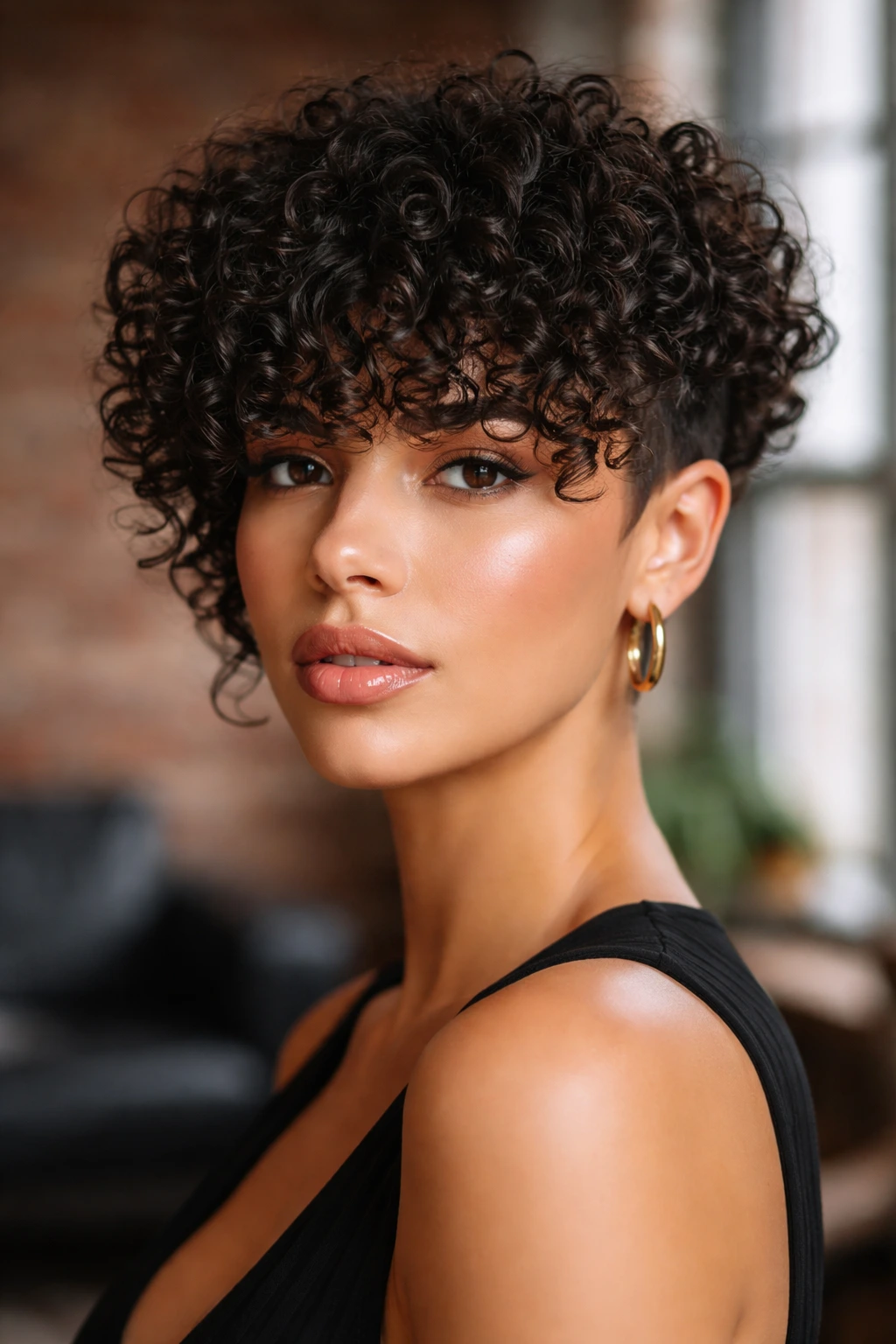
A disconnected fringe means there is a clear, visible gap between your bangs and the rest of your hair. This is often done by keeping the sides shorter or shaved, or by cutting the fringe as a distinct piece of hair that doesn’t blend into the side layers.
It is a style often seen in more alternative, punk, or creative circles. It allows you to showcase the fringe as a design element rather than just a hair feature. Because the fringe is separated, you can style it differently than the back of your hair. Perhaps you wear the back in a messy bun, while the fringe is kept smooth and defined with a curl-defining cream.
This look is about breaking the rules. Do not worry about “blending” or “softening.” The contrast is the point. If you like bold, graphic shapes, this is the direction you should take.
9. Curly Face-Framing Tendrils
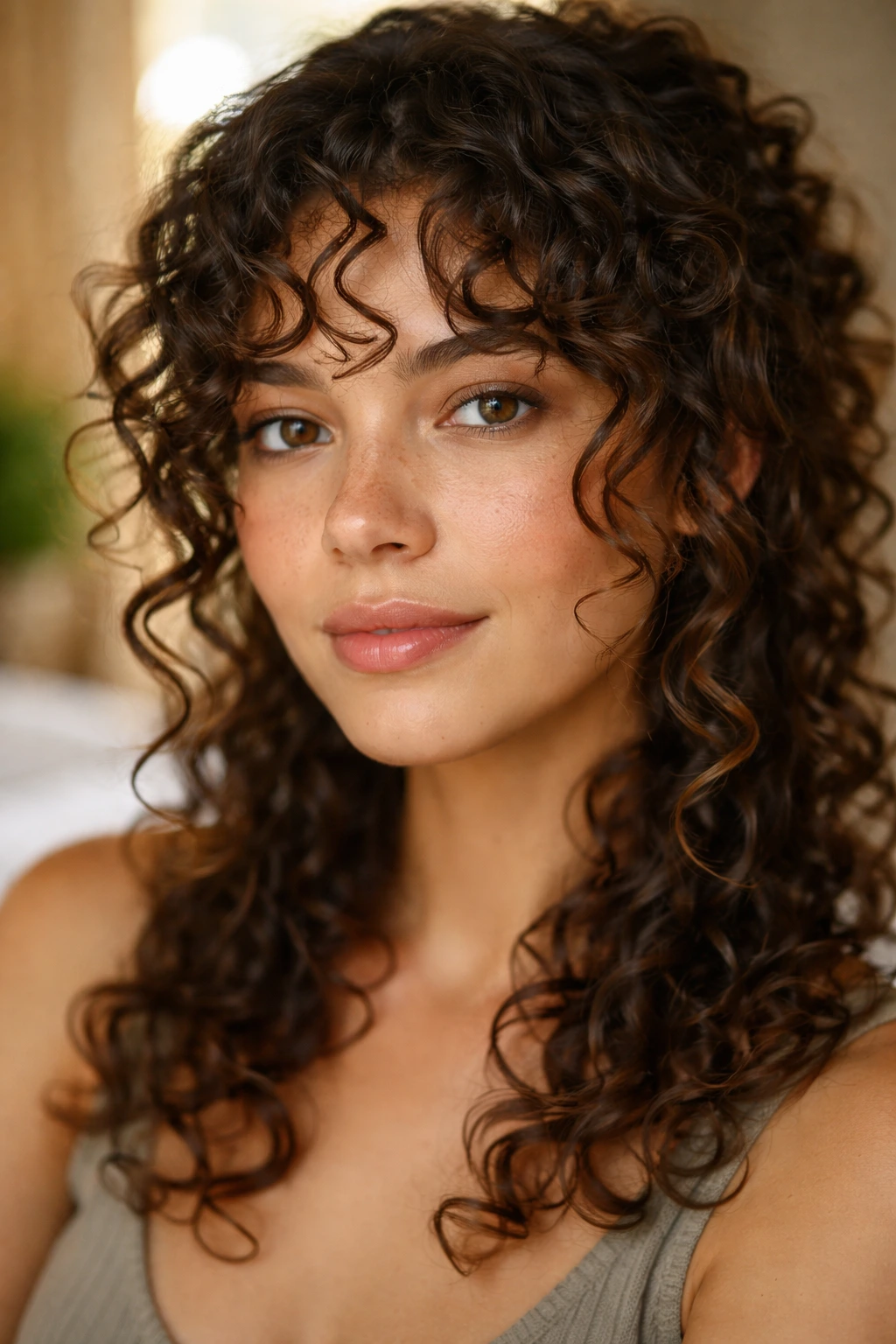
Technically, this is the “lazy” version of bangs, but it is just as effective. Instead of a full-on fringe, you ask your stylist to cut a few shorter pieces around your face that act as an accent. These are often called “money pieces” or “face-framing layers,” but when you keep them short enough, they function as a soft, ethereal fringe.
Why Use Tendrils
- Low effort: They require almost no styling.
- Versatile: If you pull your hair up, they fall out naturally to frame your face.
- Softens features: They take the harsh edge off a tight ponytail or bun.
You can create this look at home, but be careful. Start by sectioning off a small piece at the front hairline. Twist the hair, and cut it at an angle, starting around the cheekbone. Let it fall, and see where it lands. You can always take more off, but you cannot put it back.
10. Deep Side-Part Curly Bangs
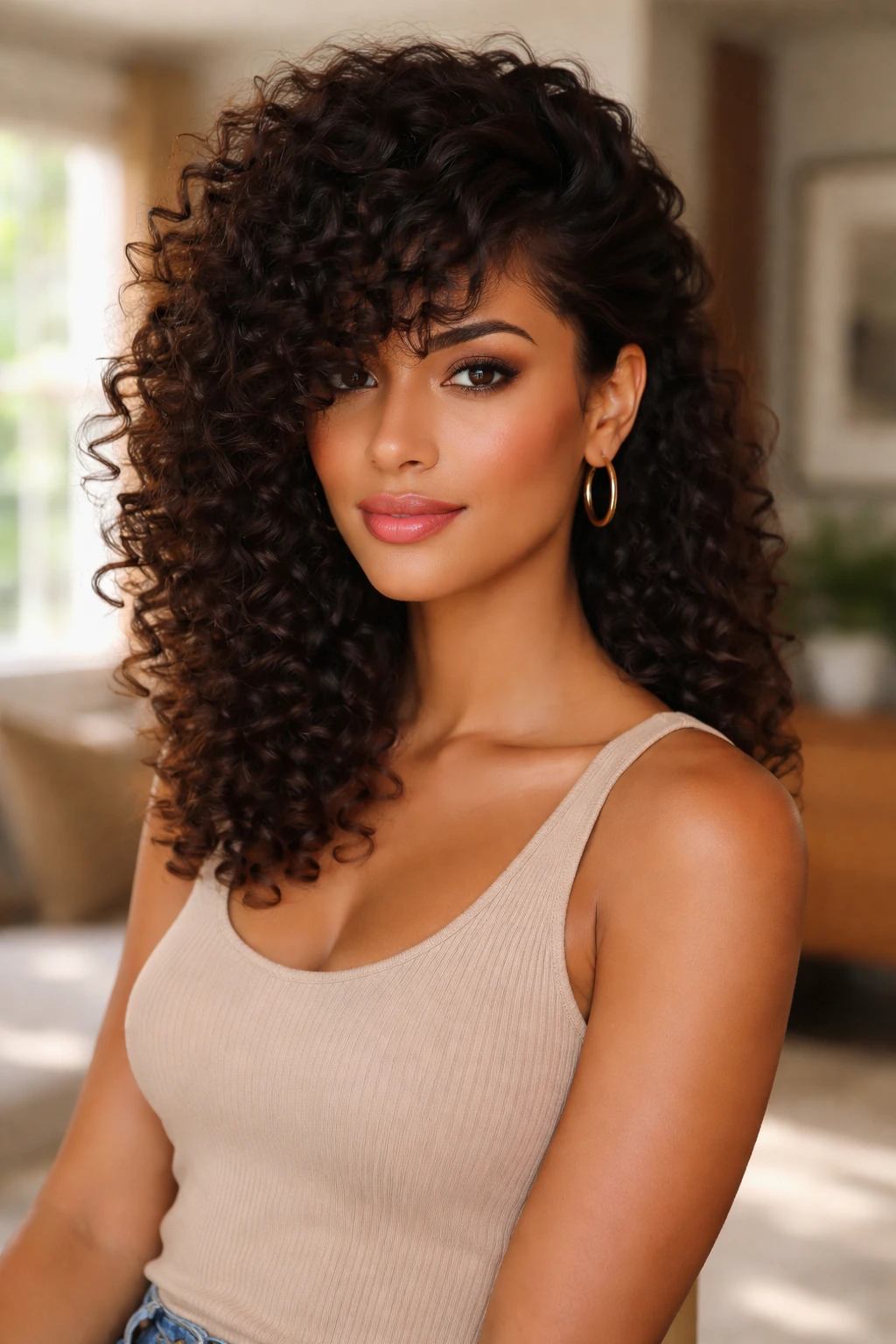
This style is all about volume and sweep. You part your hair deep on one side, allowing a large section of hair to cascade over the forehead like a wave. For curly hair, this creates a dramatic, vintage Hollywood silhouette that feels sophisticated and grown-up.
Making It Stay
The challenge with deep side parts is keeping the hair from falling back into the center. You will need a strong-hold product at the roots. A volumizing root spray or a little bit of texturizing powder at the part line helps prop the hair up so it stays to the side.
This is a great look for those who feel like bangs make them look too “young.” The deep side part feels more mature and adds height to the face, which can be very slimming. It is an elegant way to incorporate a fringe without actually having to commit to the short, straight-across cut.
11. Curly Fringe with Integrated Layers
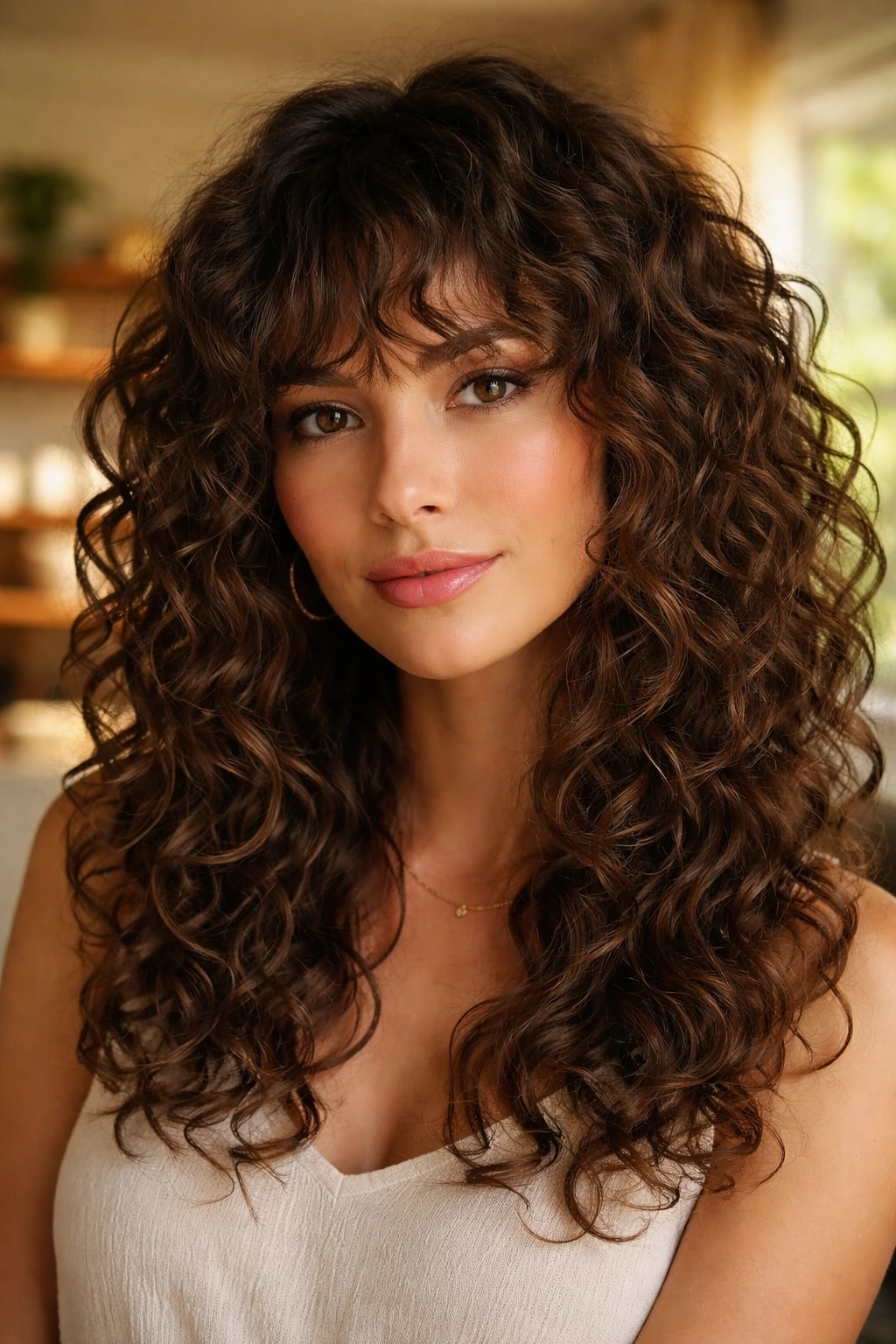
Sometimes the best bangs are the ones you don’t even realize are bangs. By integrating long, face-framing layers that start high up near the eyebrow, you get all the movement of a fringe without the bluntness. This is perfect for those who want the style but are terrified of the “bang” label.
The goal is a seamless gradient. Your stylist should cut the hair in a way that feels like it’s peeling away from your face. When your hair is dry and styled, these layers will curl up and rest around your forehead, giving you that fringe-like effect.
This style is forgiving. If you have a bad hair day, you can just blend these layers back into the rest of your hair. It provides structure to your face without being a permanent modification that requires daily attention.
12. Blunt-Cut Curly Fringe
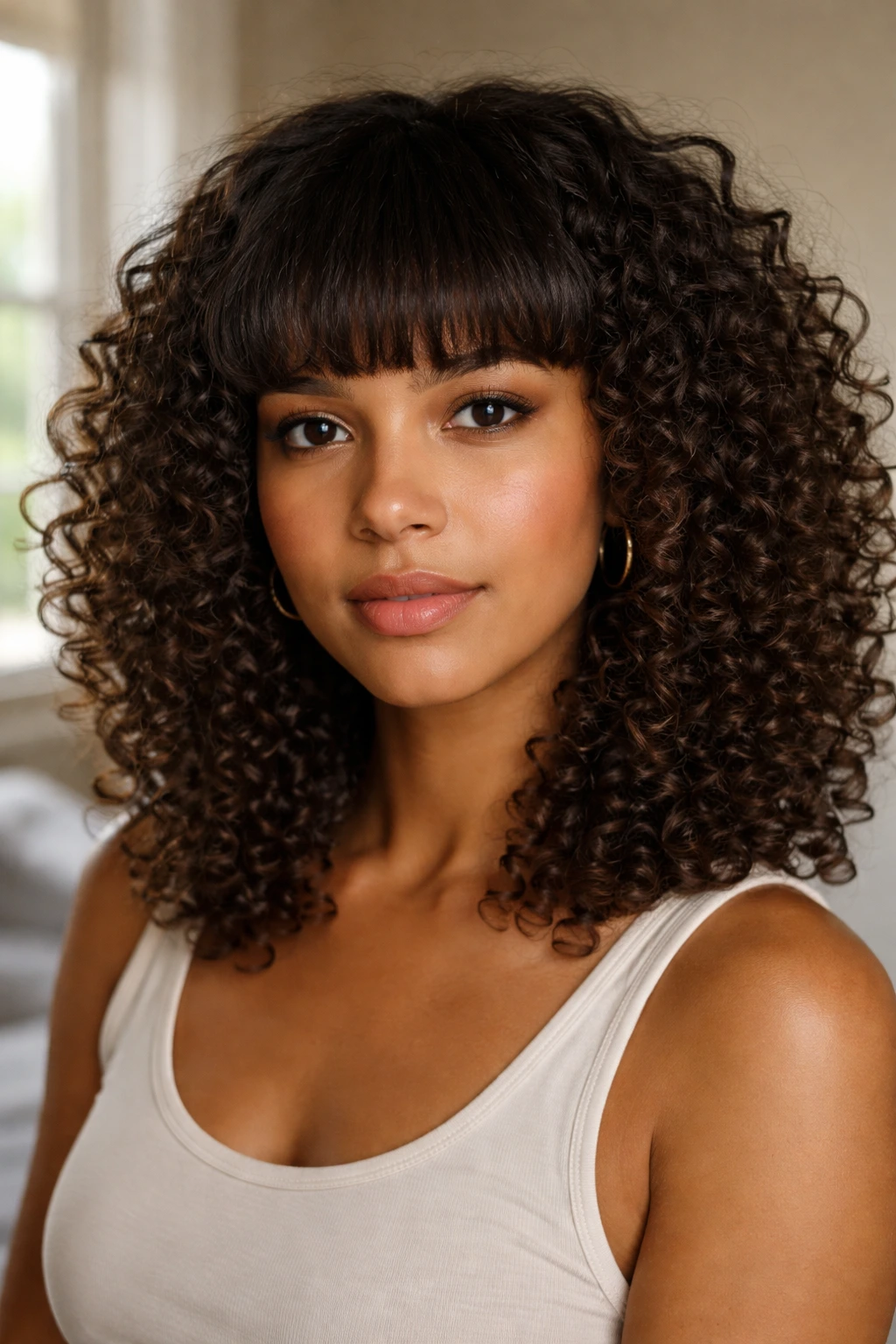
A blunt fringe is defined by a straight, uniform line. On curly hair, this is a beautiful, striking contrast. You have the soft, erratic nature of the curls meeting the hard, geometric line of the haircut.
The Maintenance Factor
This is not a “wake up and go” style. Because you want that blunt edge, you have to be vigilant about keeping the ends trimmed. As your curls grow, the line will get soft and fuzzy. If you want that sharp look, you need a trim every few weeks.
Stylist Tip
Ask for the hair to be cut specifically while dry. If your stylist tries to pull the hair taut to cut a straight line, they are ignoring the fact that your hair will spring back unevenly. A truly skilled curly hair stylist will cut each curl individually to ensure that when it rests, it forms a cohesive line.
13. Curly Bardot Fringe
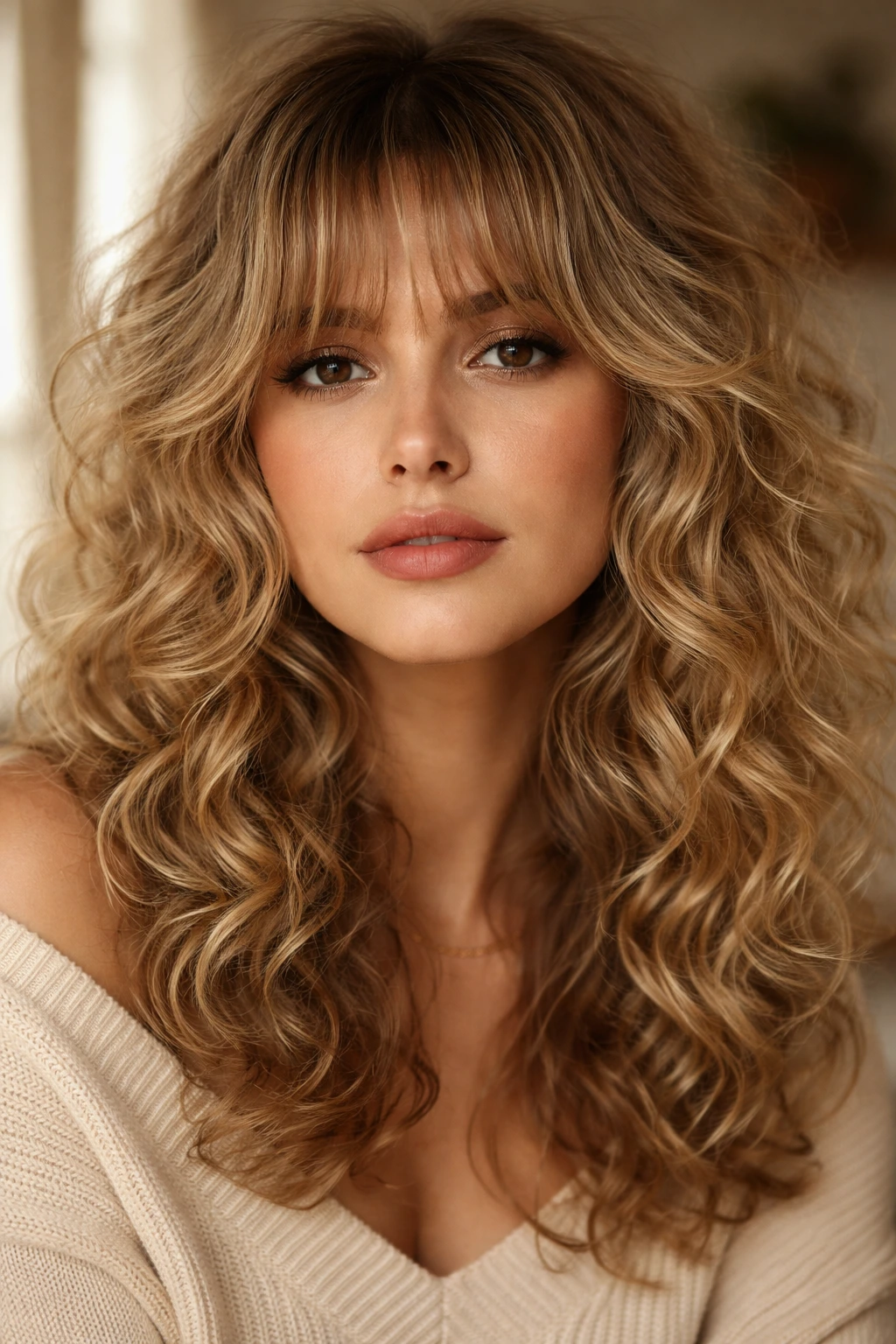
Think Brigitte Bardot, but with curls. This is a soft, mid-length fringe that is parted in the middle and wispy at the edges. It’s softer than curtain bangs and less intense than a blunt fringe. It feels like you’ve lived in this haircut for years.
It hits just below the eyebrows, so you don’t have to worry about them getting in your eyes constantly. Because it’s a middle part, it draws attention to the center of the face, emphasizing your nose and mouth. It’s an incredibly balanced, classic look that works well for almost every curl type, from soft waves to tight spirals.
14. Asymmetrical Curly Fringe
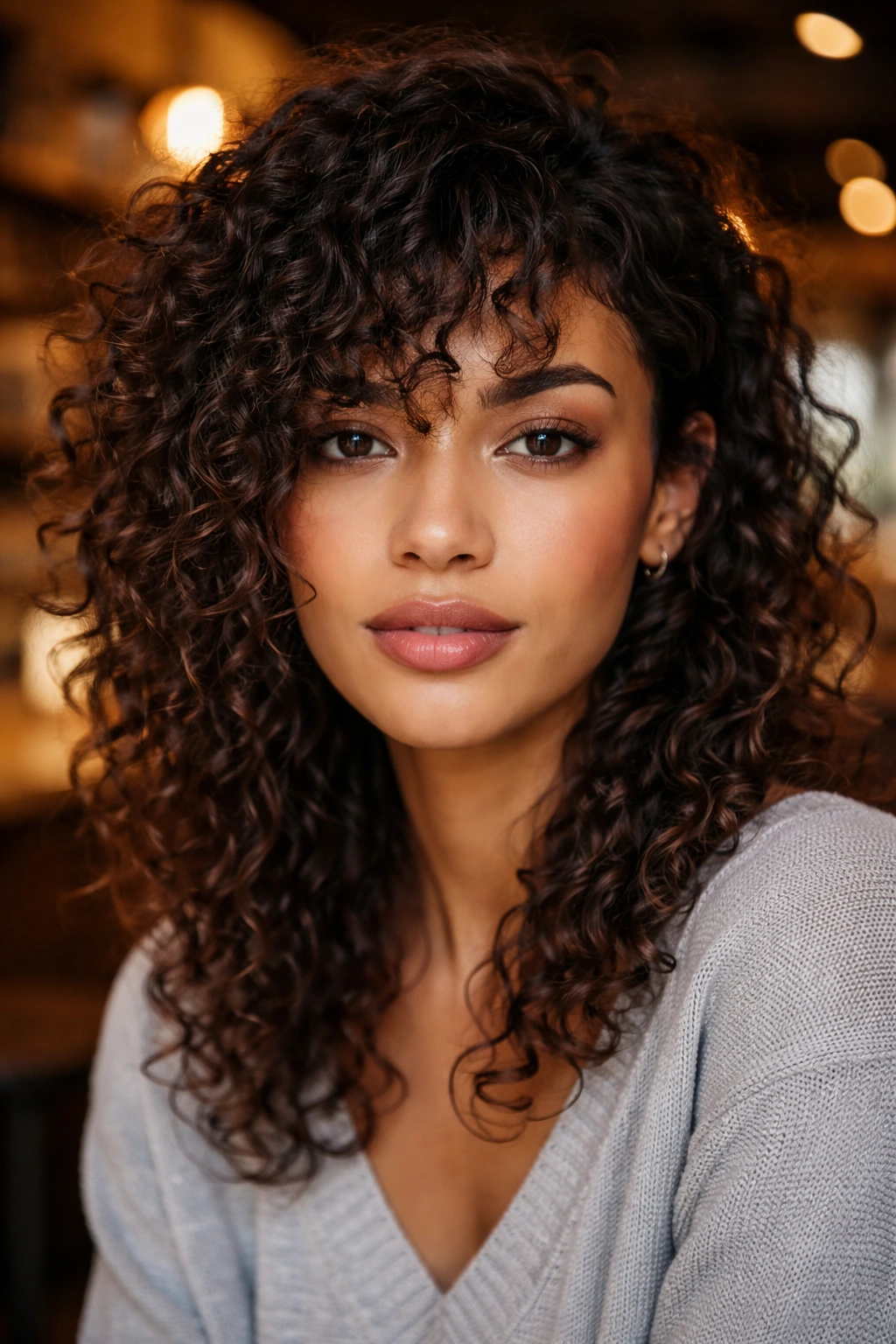
Asymmetry is a great way to add personality to your hair. With this style, one side of the fringe is shorter than the other, or the angle is jagged and uneven. It is a deliberate choice that makes the hair look artistic and intentional.
This works particularly well for people with round faces, as the angle helps break up the symmetry of the face. It is also great for people who have cowlicks or natural growth patterns that make a traditional fringe difficult. Instead of fighting your hair’s natural direction, you lean into it by cutting the bangs at an angle that works with that direction.
15. Curly Fringe for Tighter Coils
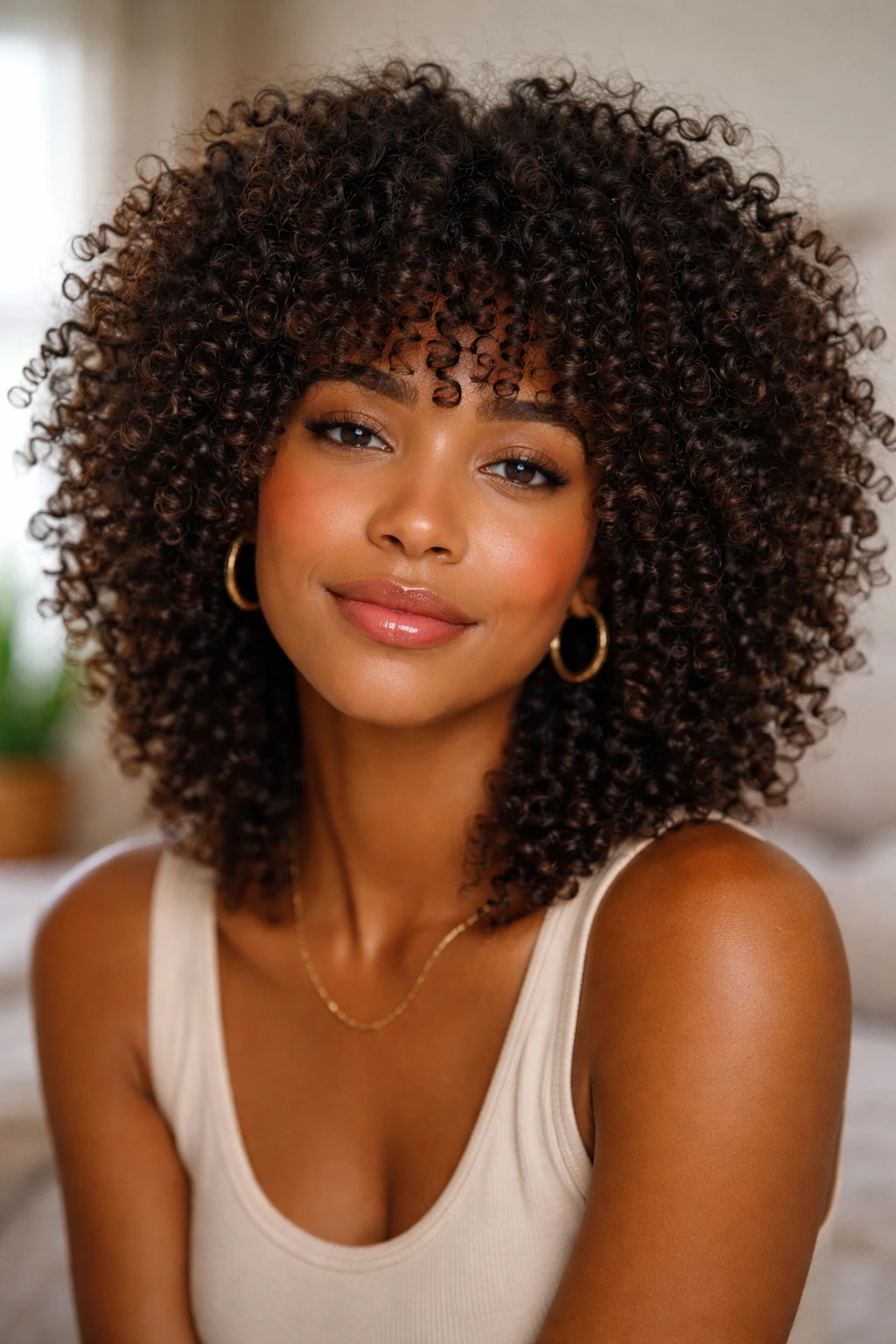
If you have 4C or very tight, dense coils, a fringe can be tricky, but it is not impossible. The key is to embrace the vertical volume. Instead of trying to make the bangs lie flat across your forehead, you want them to sit on top of your forehead, creating a beautiful, rounded shape.
The “Halo” Technique
This creates a halo effect. The bangs shouldn’t be too long; they should be just long enough to create a soft, rounded shape that sits at the hairline. This is a very regal, classic look.
Do not use heavy oils or waxes here. You want the curls to be light and fluffy so they hold their shape. A leave-in conditioner and a light-hold gel are usually sufficient to define the curls without weighing them down.
16. Curly Fringe for Loose Waves
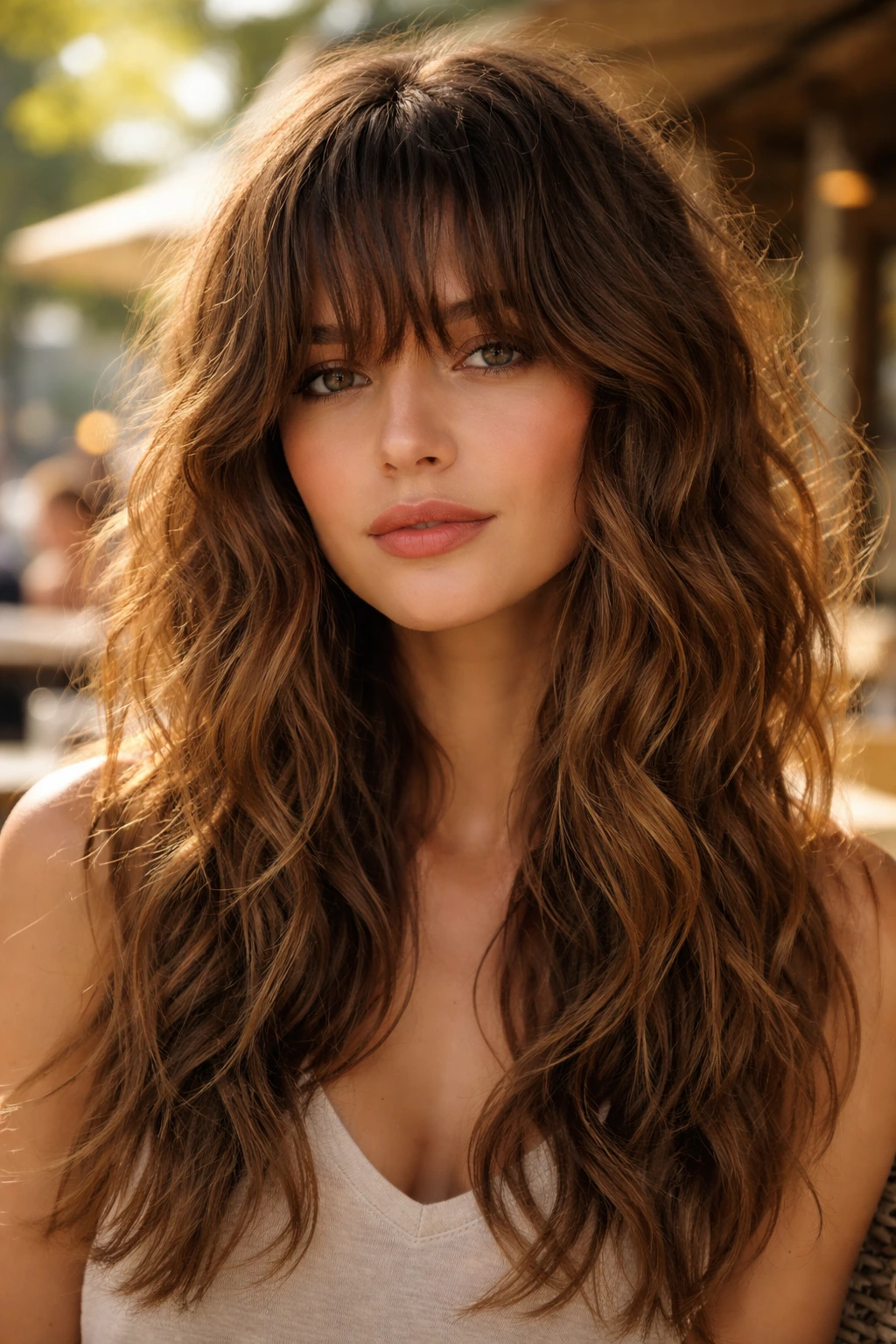
Loose waves are often the easiest to style with a fringe because they don’t have as much shrinkage. You can go for a longer fringe—maybe one that hits the bridge of the nose—and it will look perfectly intentional.
The loose wave fringe is all about texture and flow. You want it to look effortless, so don’t try to define every single curl. Use a little bit of sea salt spray or texturizing cream to get that piecey, beachy look. It should be a little tousled, a little messy, and very relaxed.
17. Curly Fringe with an Undercut
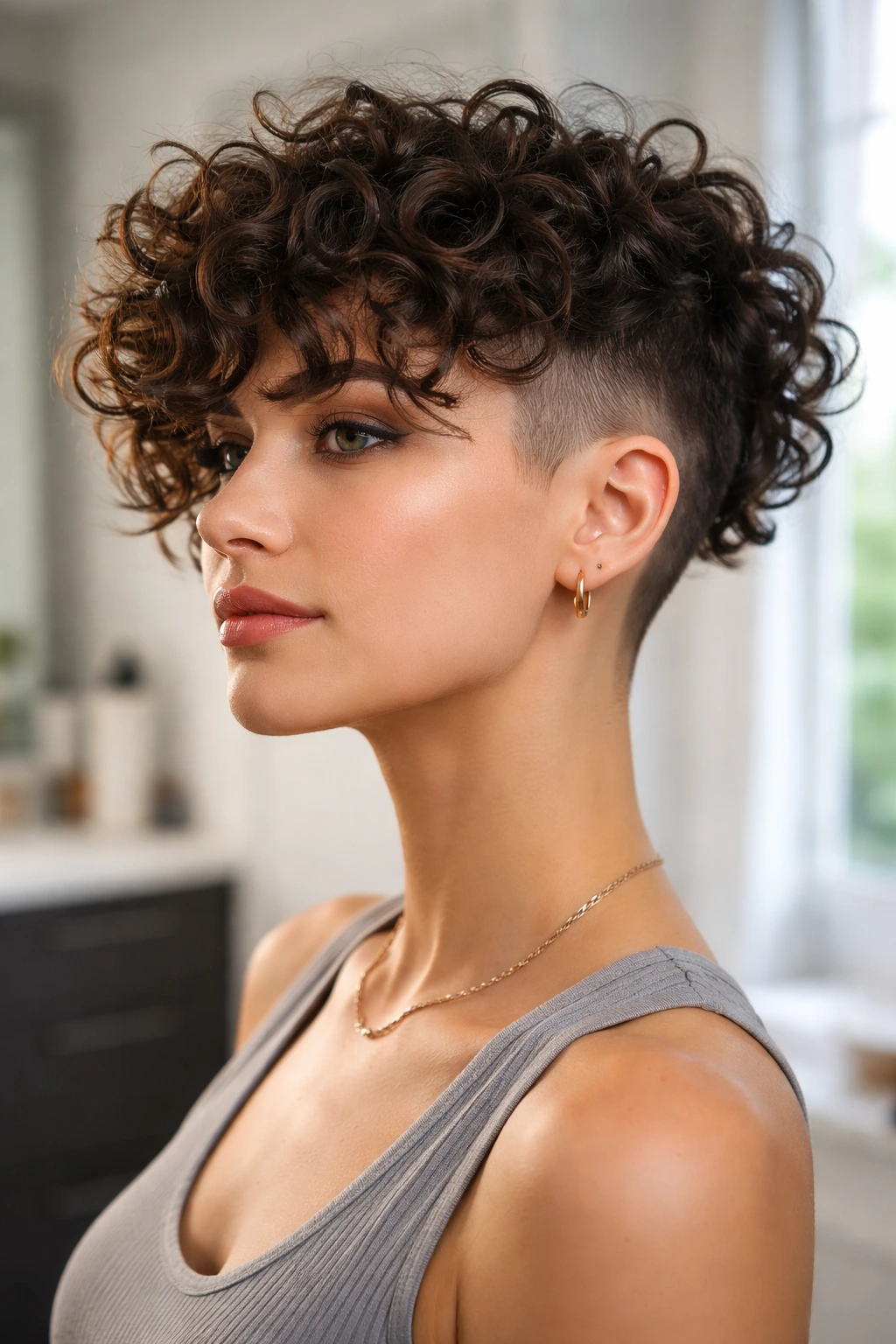
If you want to go bold, pair your curly fringe with a nape or side undercut. The contrast between the soft, feminine curls of the fringe and the harsh, clean lines of a shaved undercut is stunning.
This works because it removes the “bulk” from the rest of your head, allowing your curls to sit higher and with more volume. The fringe becomes the focal point. It’s a very modern, high-contrast look that screams confidence. It is also practical if you have thick, heavy hair that gets too hot in the summer—you get the style of a full head of hair with the comfort of an undercut.
18. Curly Fringe with Space Buns
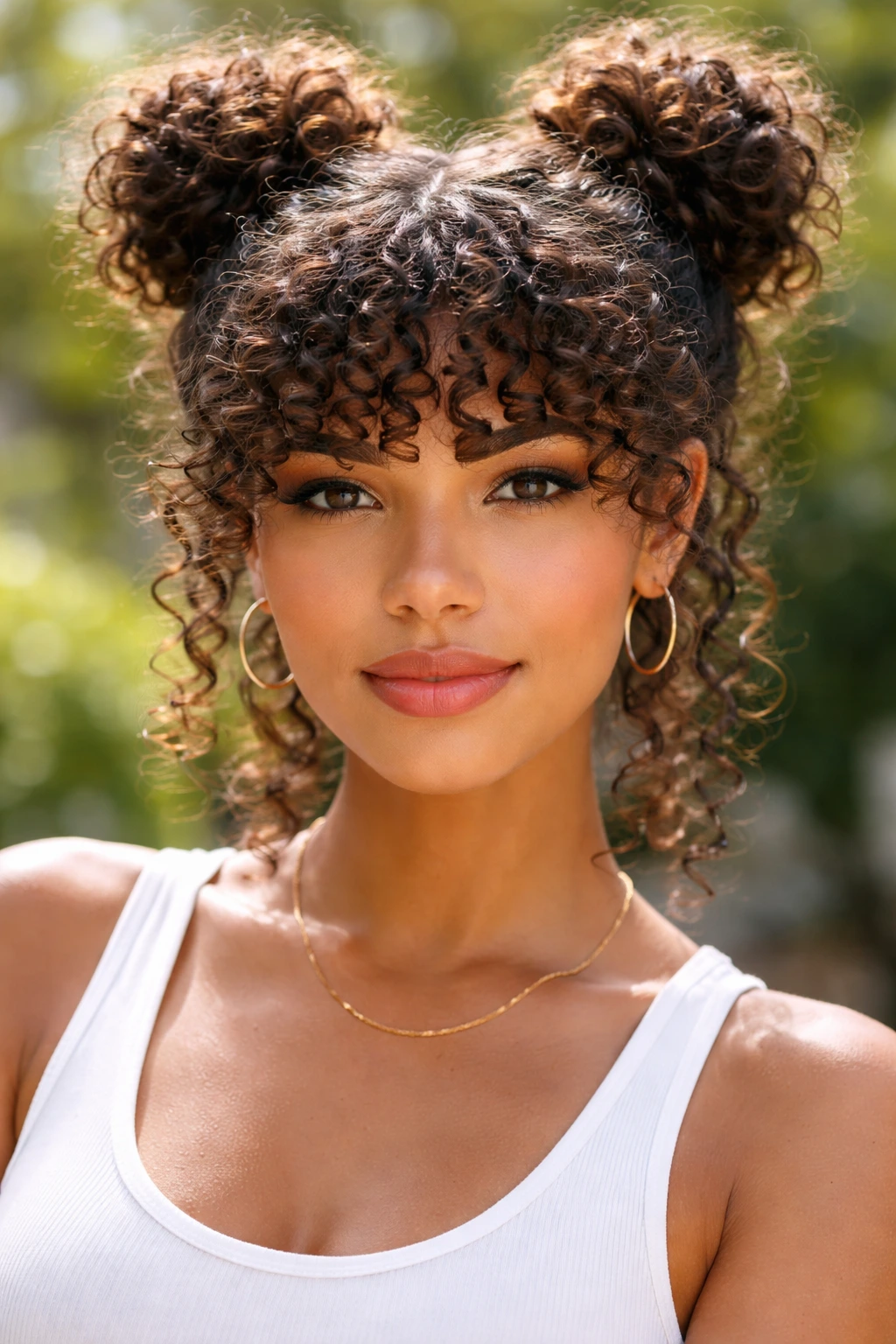
Space buns and curly bangs are a match made in heaven. The bangs soften the look, and the buns add a playful, youthful energy. This is a great protective style, too. You can keep your hair pulled up in buns, reducing the amount of friction your ends face, while letting the fringe fly free.
Styling the Fringe
For this look, you want the fringe to be defined and bouncy. Use a curl-defining cream on the bangs, and twist them around your finger to encourage a clean, spiral shape. Keep the buns sleek or messy, depending on your mood—the contrast between the sleek buns and the wild, curly fringe is part of the appeal.
19. Curly Fringe with a Pixie Cut
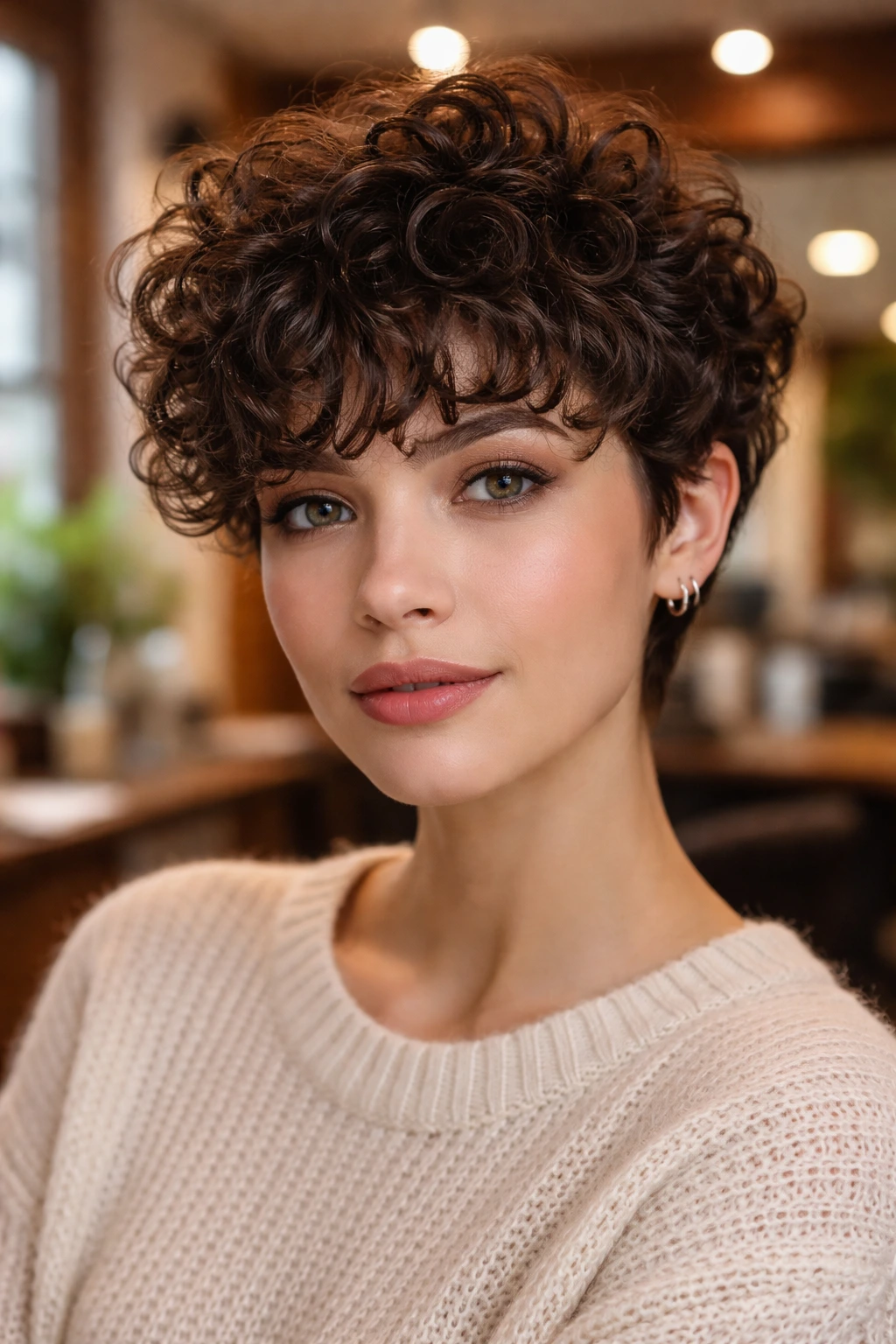
A curly pixie with a fringe is an incredibly chic, low-maintenance look. It is short, manageable, and frames the face perfectly. The fringe in a pixie cut can be styled in a dozen different ways—messy, swept to the side, or curled tight on the forehead.
The Shape
The key is to keep the sides and back tight. The fringe is the place to show off your curl pattern. If you have tighter coils, a short, cropped fringe looks sharp and clean. If you have looser waves, a slightly longer, piecey fringe adds texture.
This is a great cut for someone who wants to highlight their facial features. Because there is nowhere for the hair to hide, your eyes, cheekbones, and jawline become the stars of the show.
20. Curly Fringe for Shoulder-Length Hair
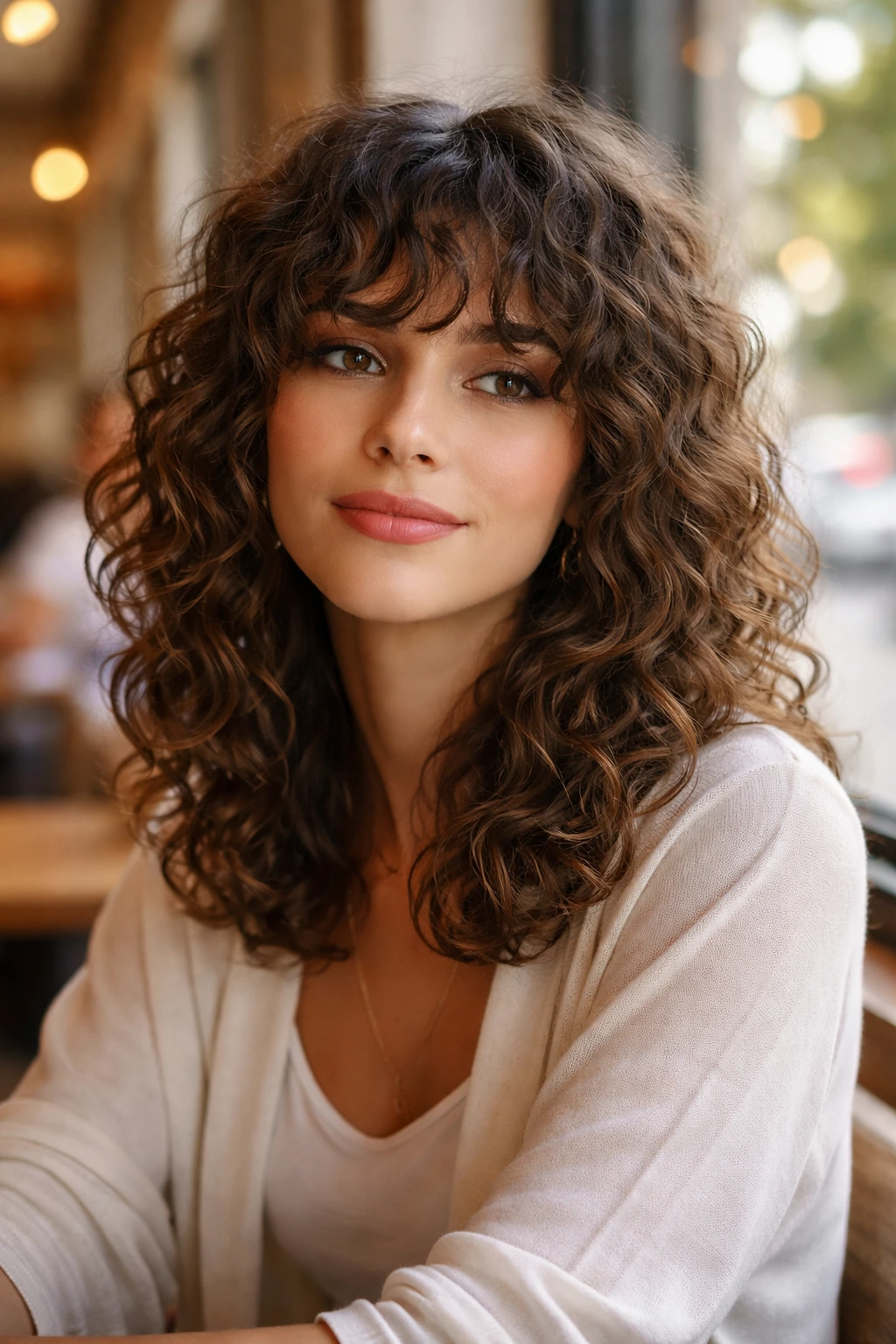
Shoulder-length hair with a curly fringe is the quintessential “cool girl” cut. It’s long enough to put into a ponytail but short enough to be manageable and healthy. The fringe adds that extra touch of style that makes the cut look intentional rather than “I haven’t been to the salon in a year.”
It works because the length provides enough weight to balance out the fringe. If your hair is too short, the fringe can sometimes look disconnected. But at shoulder length, the bangs and the layers of the main cut flow into each other naturally.
21. Curly Fringe for Long, Weighted Hair
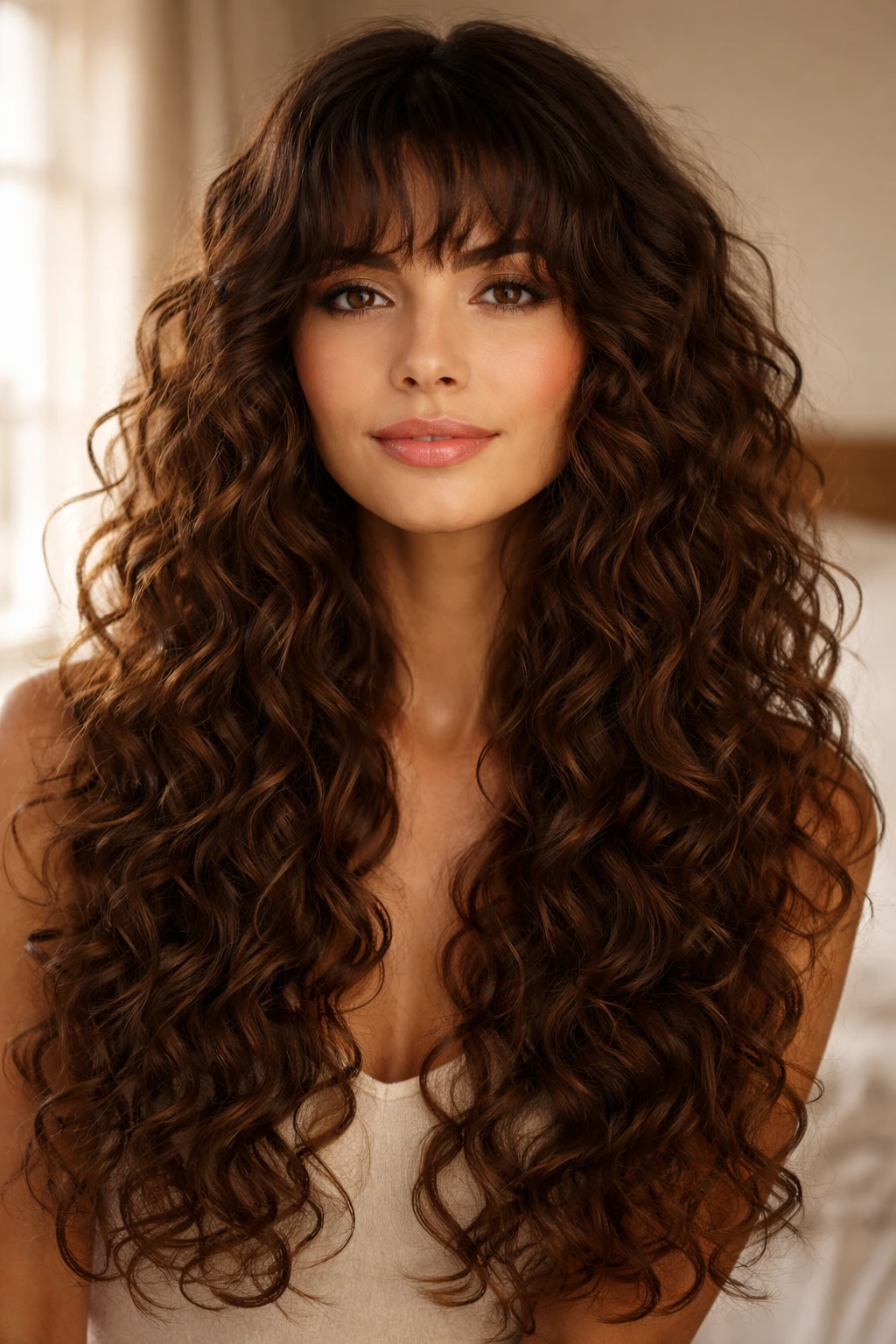
If you have very long, thick hair, the weight of the hair can actually help pull the curls down and make them more manageable. A fringe on long, heavy hair creates a lovely contrast. The heaviness of the long hair grounds the look, while the fringe adds lightness and movement to the face.
Managing the Weight
You have to be careful that the fringe doesn’t disappear into the volume of your long hair. Keep the fringe sections distinct and make sure your stylist doesn’t over-thin the rest of your hair, or you will lose the balance. You want that “big hair” energy, and the bangs help frame it.
22. Curly Fringe for Fine Hair
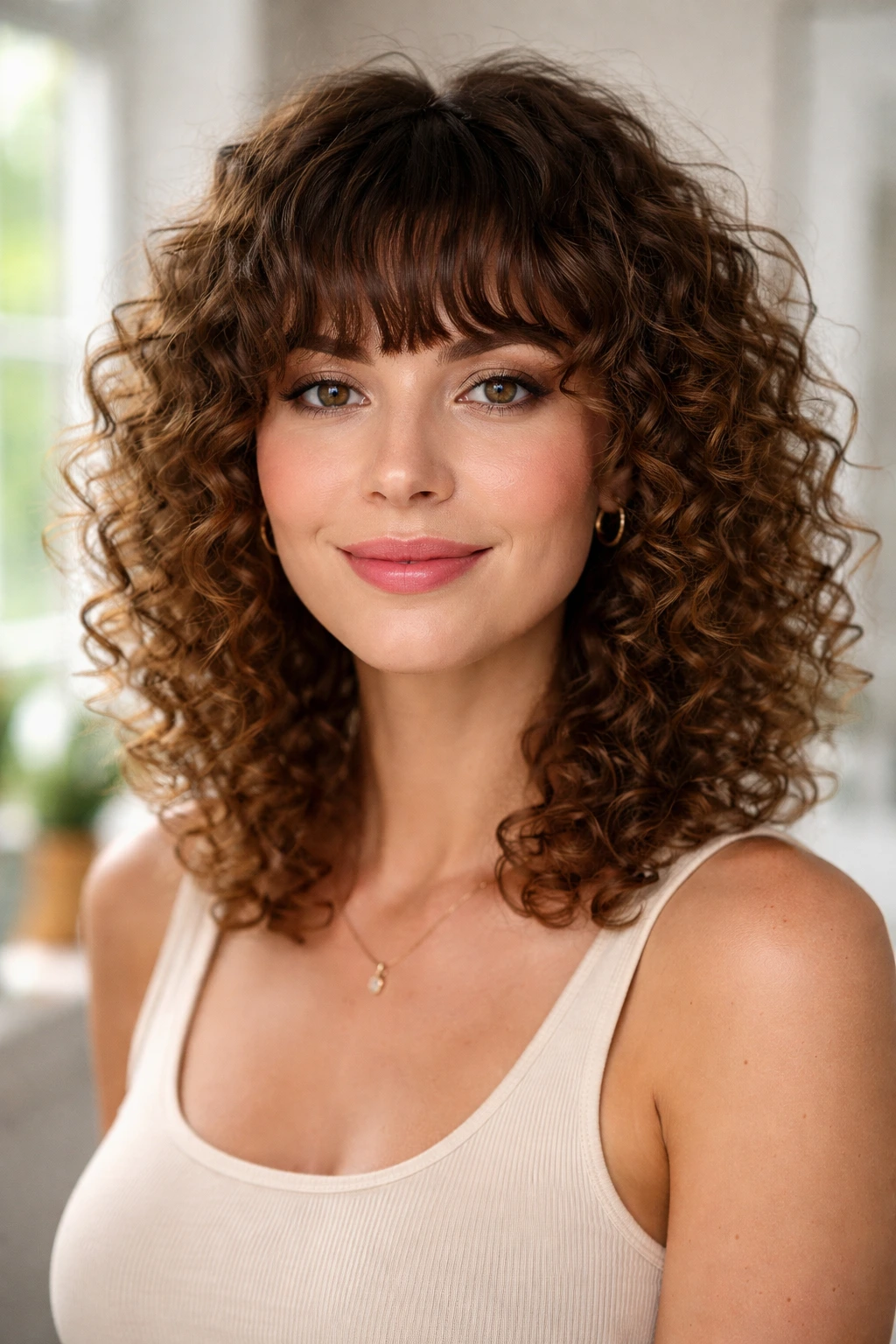
Fine curly hair needs help in the volume department. A fringe is actually a great strategy because it forces you to use the hair at the front of your head for a specific purpose, which can make your hair look fuller overall.
The Strategy
- Don’t over-layer: If you have fine hair, too many layers can make it look stringy. Keep the bangs relatively blunt and dense.
- Avoid heavy products: Fine hair will get weighed down in minutes. Use foams or mists instead of thick, oil-based creams.
- Diffuser is key: Always diffuse fine, curly hair to build up that volume from the root.
23. Curly Fringe for Thick Hair
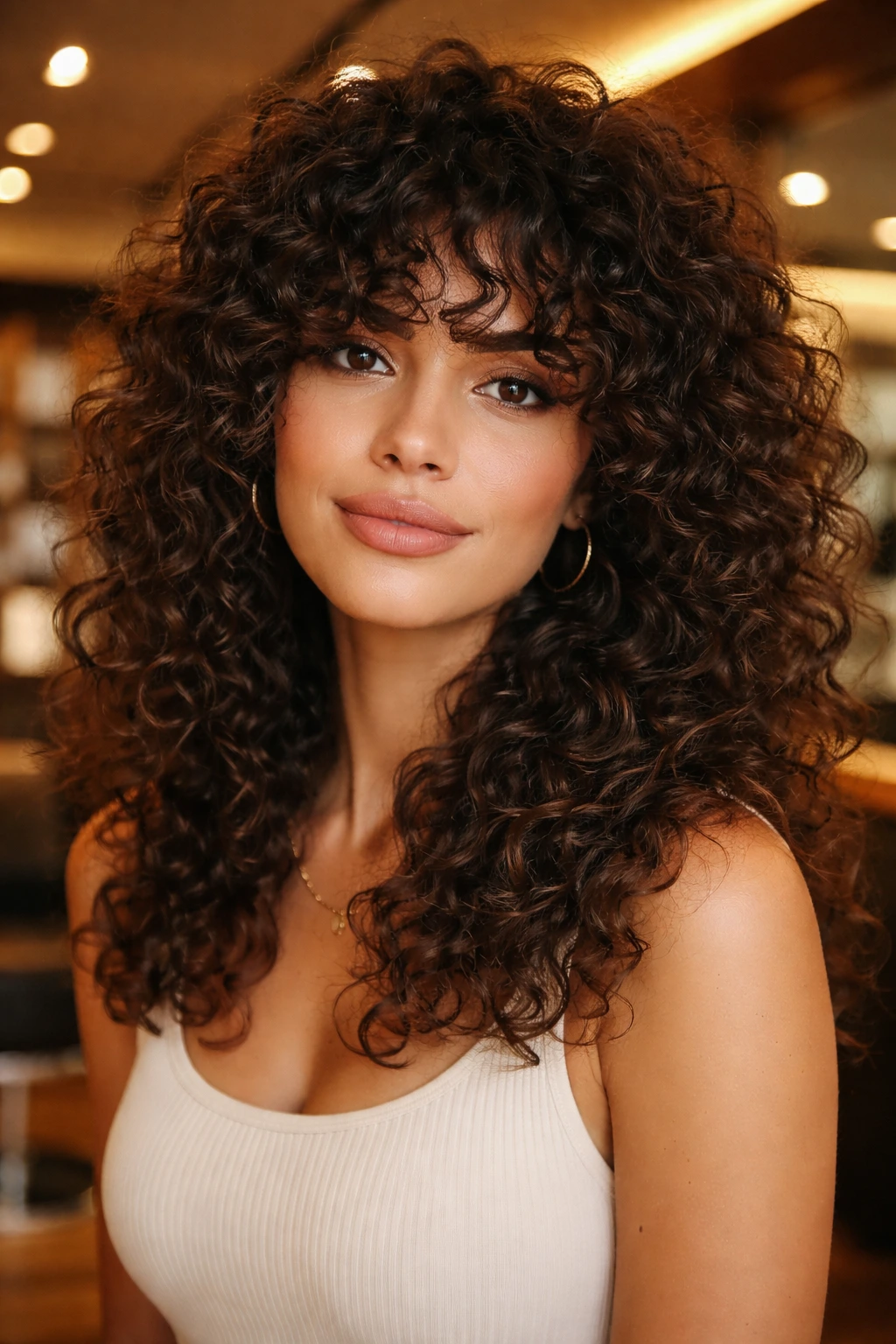
Thick curly hair is a blessing, but it can be unruly. The goal with a fringe on thick hair is to prevent it from turning into a giant, unmanageable mass on your forehead.
You need to ask for internal layering within the fringe. This removes the bulk without making the bangs look thin or scraggly. It allows the bangs to have that soft, airy movement rather than sitting like a solid brick of hair.
24. Colored Curly Fringe
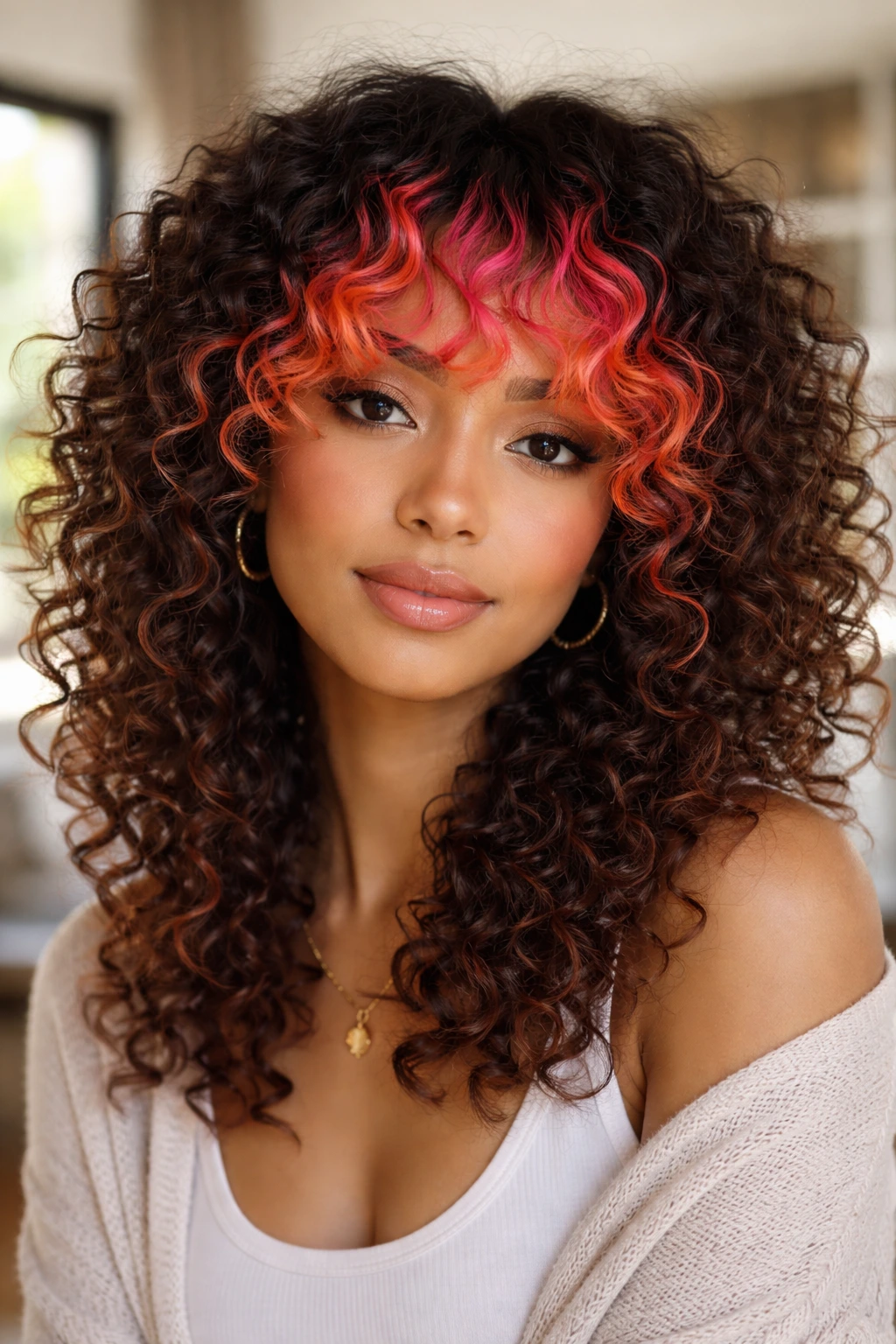
Why not add some color to the mix? A colored fringe—whether it’s a subtle highlight or a bold, neon shade—is a fantastic way to frame your face and show off your personal style.
Because the fringe is right at the front, it’s the perfect place to experiment with color. You can go wild with a bright blue or a deep purple, and if you get tired of it, it’s only a small section of hair to grow out or color over. It adds visual interest and really makes the curl pattern pop.
25. Curly Fringe with Braids
If you are wearing your hair in box braids, twists, or cornrows, you can still have a fringe. Leaving a small section of your natural hair out at the front to be styled into curly bangs is a great way to soften the look of braids.
It gives you the best of both worlds: the protective, long-lasting nature of braids with the face-framing, soft energy of a curly fringe. Just make sure to keep the curly fringe moisturized. Since it is out, it is exposed to the elements, and it needs as much care as the hair in the braids.
The Bottom Line
Choosing the right bangs for your curly hair comes down to two things: understanding your curl pattern and finding a stylist who respects it. There is no one-size-fits-all solution, but there is definitely a version of a fringe that will work for you.
Stop letting the fear of the “poodle” keep you from trying something new. If you find a stylist who cuts your hair dry and understands the physics of your curls, you will likely find that a fringe doesn’t make your hair harder to manage—it makes it more interesting. Start small, maybe with a wispy, face-framing style, and see how it goes. Your hair is supposed to be fun, after all.
