



Type 4C hair does not need to be “tamed” into something else. It needs a shape that works with shrinkage, density, and coil pattern, not against them. Once you stop fighting that, the whole game changes. Styles start lasting longer. Detangling gets less dramatic. And your hair stops looking like it had a rough morning by noon.
The best hairstyles for type 4C hair usually do one of two things: they either let the texture breathe in a soft, full shape, or they tuck the ends away so the hair can rest. The sweet spot is different for everyone, but the same rules keep showing up. Clean parts matter. Moisture matters. Too much tension is a bad trade, no matter how polished the style looks for the first hour.
I’ve always thought 4C hair is at its best when it’s given a clear plan. A style with a real base, a sensible amount of hold, and a shape that makes sense from more than one angle. That might mean a puff, a twist-out, braids, knots, or an updo that looks simple but was actually built with a bit of patience. None of that is boring. It’s practical beauty, and there’s a difference.
So here are 20 hairstyles that make sense on type 4C hair for real life, not just for a photo. Some are fast. Some take a little more work. All of them can look sharp, soft, or both, depending on how you wear them.
1. Rounded Afro for Type 4C Hair
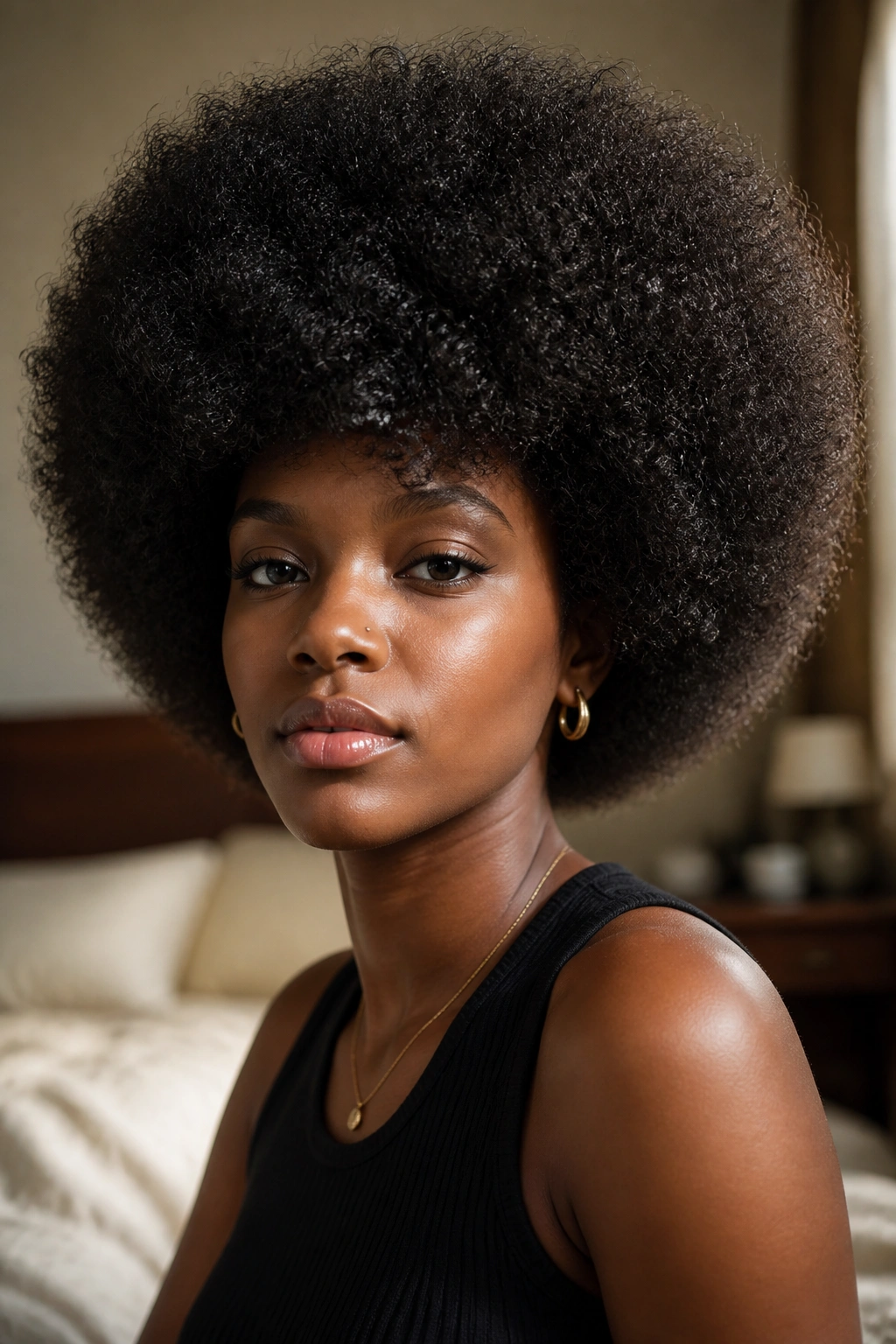
A rounded afro is one of the few styles that can look finished without trying too hard. That’s the charm of it. The hair keeps its own shape, but you guide the outline with a pick, a little stretch, and some careful fluffing at the crown and sides.
Why It Works So Well
Type 4C hair loves volume. When you shape it into a round silhouette, the texture does most of the work for you. You do not need a ton of manipulation, and that matters because overhandling can make the ends frizzy and the roots tired. A rounded afro also sits nicely with shrinkage; in fact, shrinkage is part of the appeal.
A light leave-in conditioner, a little oil on the fingertips, and a wide-tooth pick are usually enough. If the hair was stretched first, the shape looks even fuller. If it was styled from a wash-and-go base, the result is softer and denser. Both work.
Quick Shape Notes
- Best on moisturized hair that has been fully detangled.
- Use a pick only at the roots to keep the ends from losing definition.
- Fluff from the back and sides first, then shape the top.
- A satin scarf at night helps the outline stay round.
Pro tip: Don’t chase “perfect symmetry.” A rounded afro looks best when it has a little personality on one side.
2. High Puff for Type 4C Hair
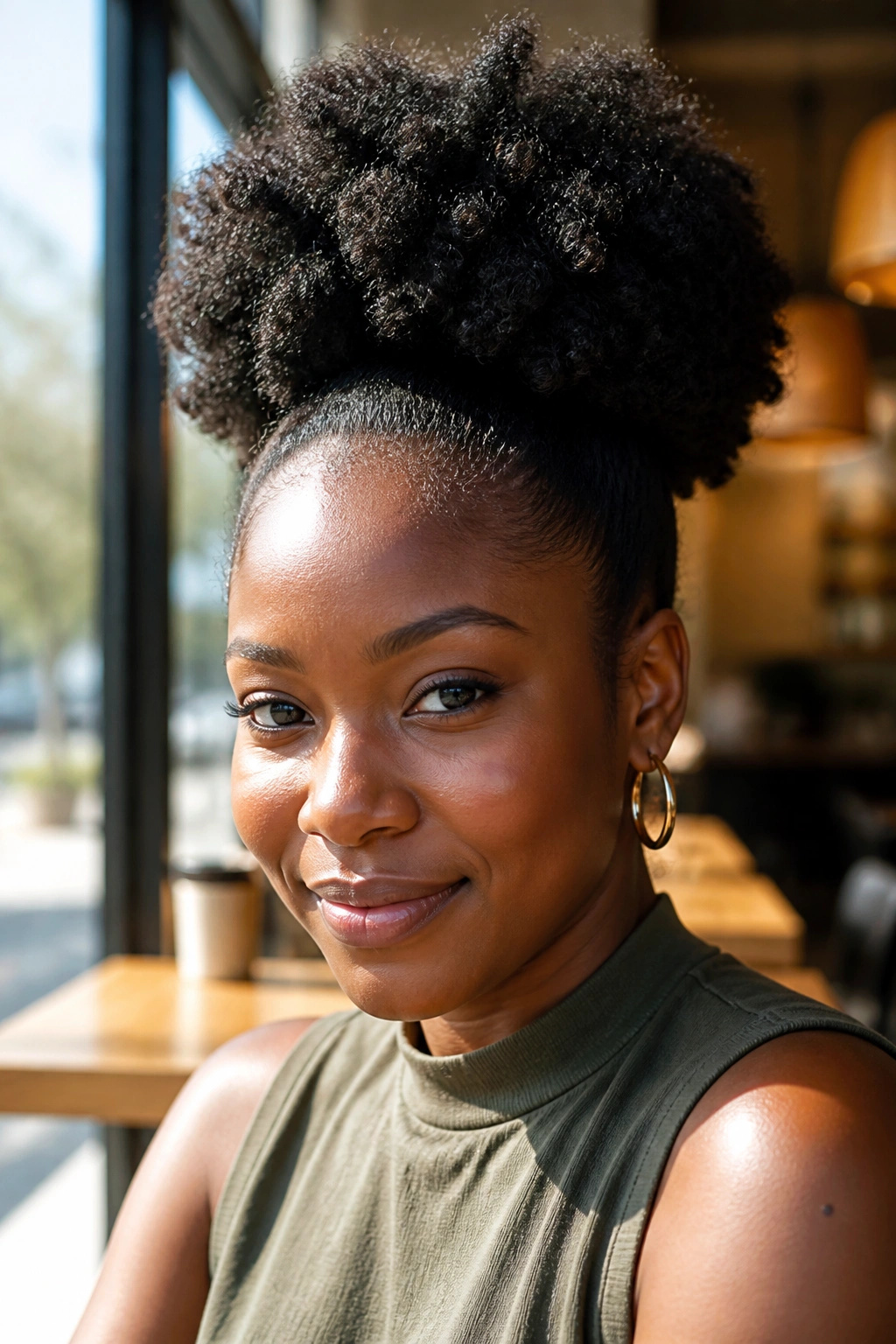
A high puff is the style I reach for when I want something fast that still looks intentional. It can be neat enough for errands, work, or a last-minute event, and it’s forgiving in a way a sleeker style often isn’t.
The magic is in the base. If the perimeter is brushed up smoothly but not dragged tight, the puff sits higher and looks fuller. A puff cuff makes the whole thing easier, though a stretchy band works too. I’d avoid loading the edges with too much gel. One clean pass is enough. More than that, and the front can start to look stiff while the rest of the hair stays soft.
For type 4C hair, a high puff works especially well on hair that has been stretched a little first. Banding overnight or doing a twist-out beforehand gives you more height and more length in the pony base. If your hair is short, the style still works; the puff just sits closer to the crown.
And yes, it looks good from the back too. That matters.
3. Defined Twist-Out for Type 4C Hair
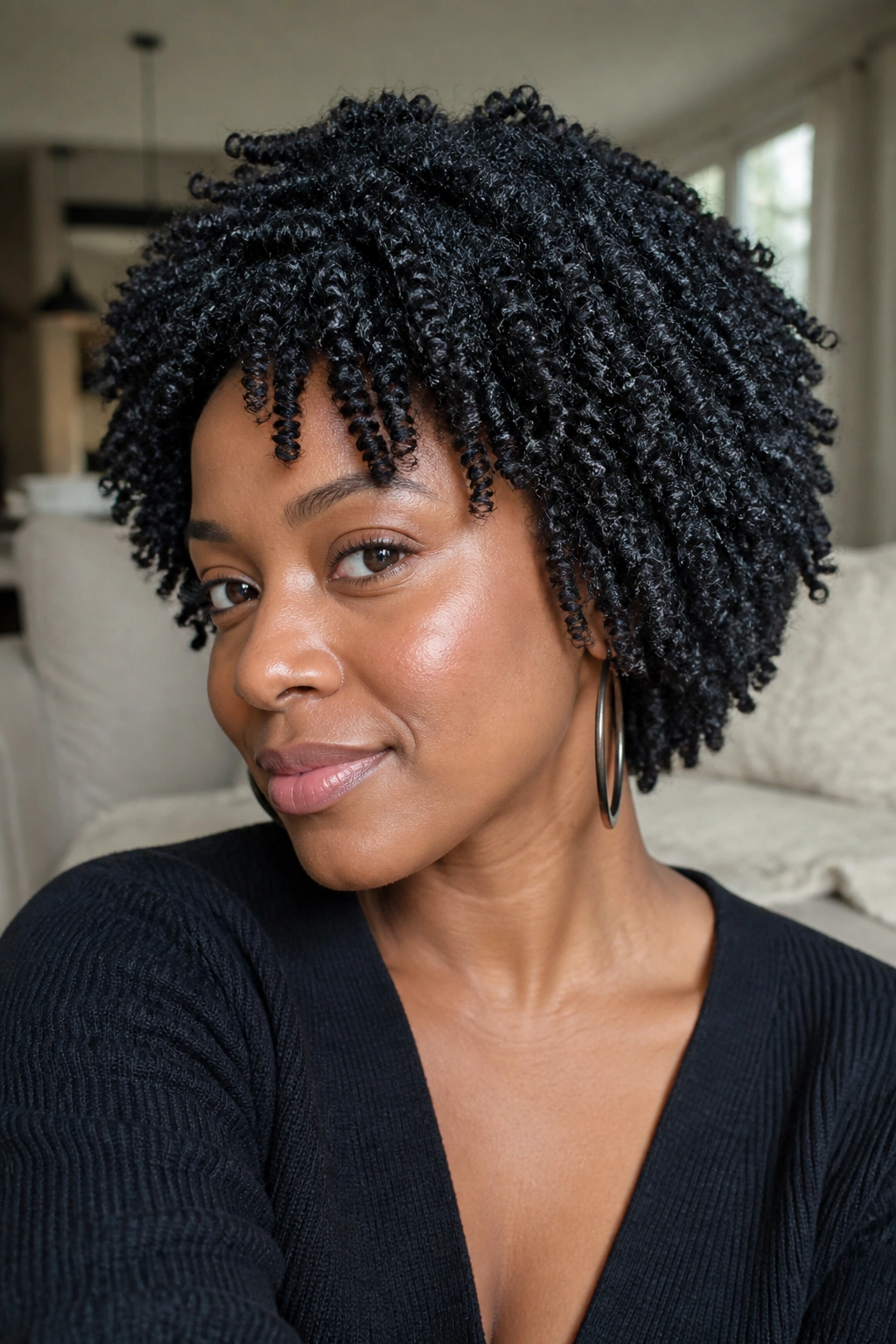
Why does a twist-out keep coming back as a favorite? Because it gives type 4C hair shape without erasing the texture. You still see the coils, but they’re encouraged into a softer, more stretched pattern.
The starting point matters more than people admit. Damp hair, not soaking wet hair, usually gives better results. Add a leave-in with slip, then a cream or setting styler that gives hold without turning sticky. Two-strand twists are the classic route, and they’re still the most reliable one if you want predictable definition. Let them dry all the way. That part is boring, but skipping it is how twist-outs turn fuzzy before breakfast.
How to Wear It Longer
Take the twists down only when they feel dry and cool to the touch. Use a tiny bit of oil on your fingers while separating. That keeps the hair from snagging and helps each twist open cleanly. After you separate, stop touching it. Seriously. Every extra pass makes the style puff up faster.
A twist-out can last a few days if you pineapple it at night and keep your hands out of it during the day.
4. Chunky Two-Strand Twists
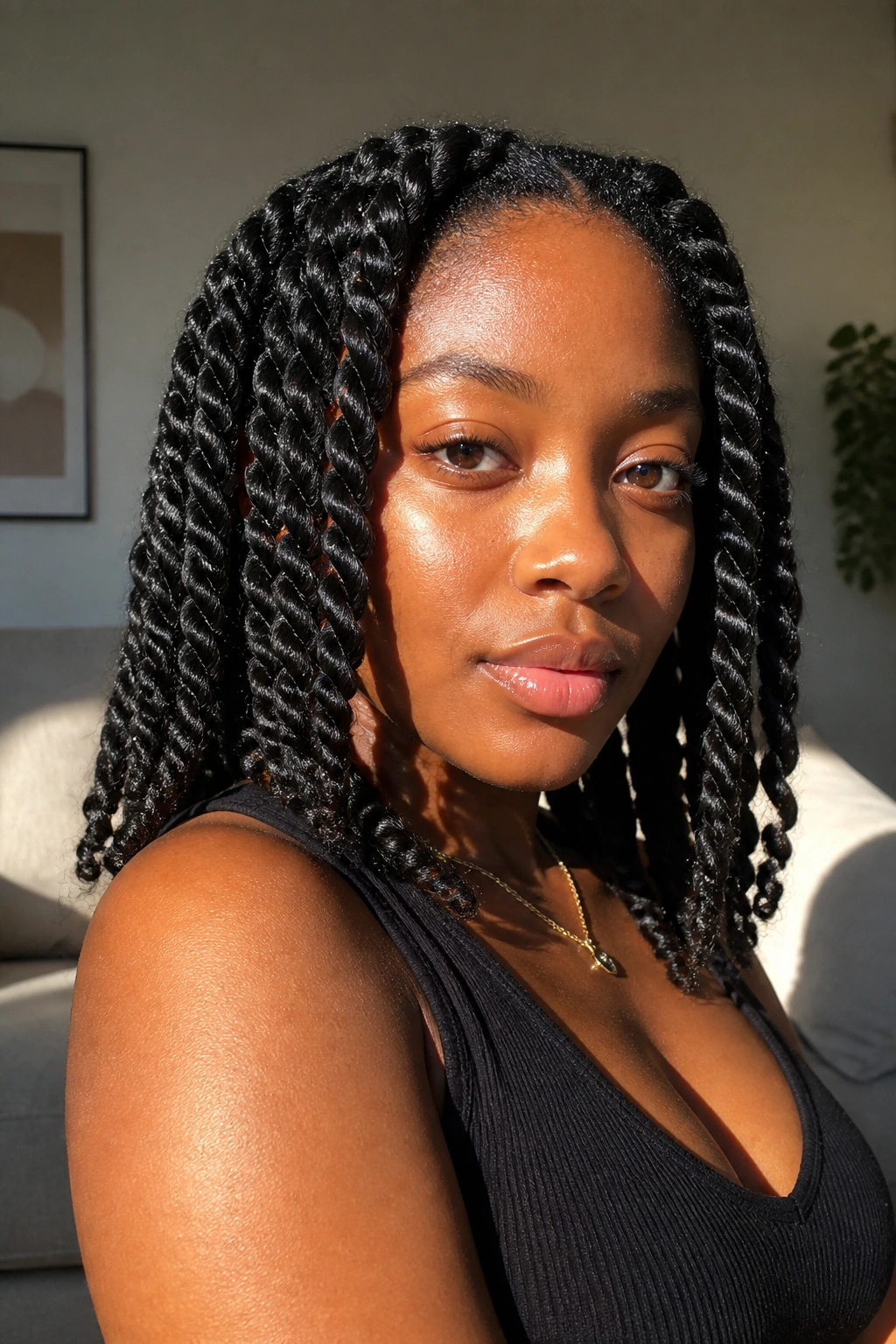
There’s something nice about a style that looks styled and also lets you move on with your life. Chunky two-strand twists do exactly that. They’re quicker than mini twists, easier to take down, and they give type 4C hair a soft, rope-like look that feels neat without being fussy.
The bigger sections make a difference. A half-inch to one-inch part gives the twist more body, which means less time installing and less stress on the scalp. I like chunky twists best when the hair has enough moisture to stay supple but not so much product that the twist starts sliding apart. A creamy leave-in plus a medium-hold styler is usually enough.
They also sit well under scarves, hats, and bonnets. That sounds small, but it’s not. A style that survives sleep without turning into a knotty mess saves you time the next morning.
- Faster to install than small twists.
- Good for stretching the hair without heat.
- Easy to wear loose, tied back, or pinned up.
- Easy to unravel later for a fuller twist-out.
The clean parting is what makes chunky twists look polished. Don’t rush that part.
5. Flat Twists from Hairline to Nape
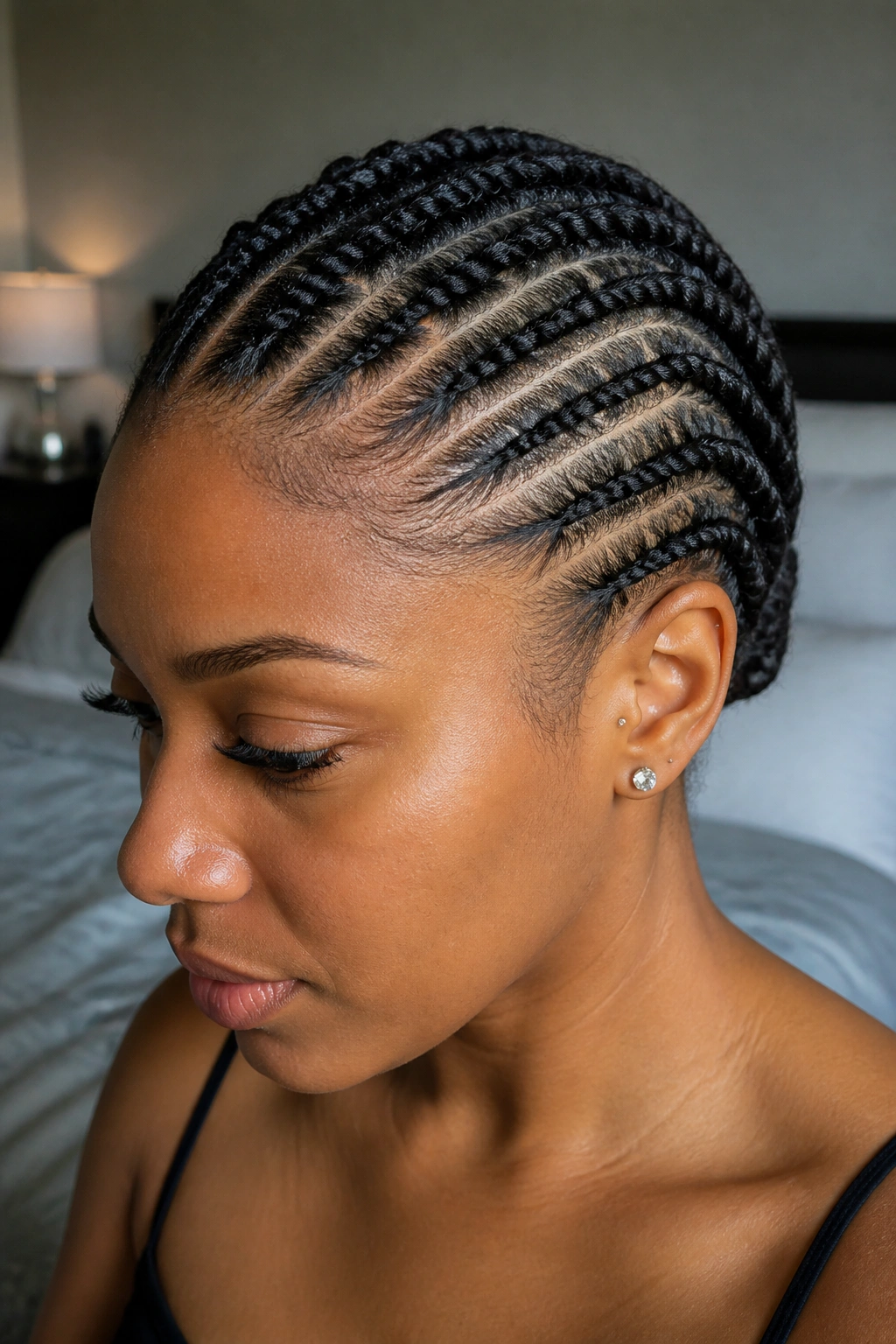
Flat twists are one of those styles that quietly do a lot. They can look simple from the front and still carry enough pattern to feel special. On type 4C hair, they’re especially useful because they keep the hair close to the head without needing the tight tension that some braid styles rely on.
The parting needs patience. A rat-tail comb helps, but only if the hair is already detangled and dampened with a bit of leave-in. Start near the hairline and keep the sections even all the way down. The twist should lie flat against the scalp, not sit up like a loose rope. That’s the detail that makes the difference between tidy and messy.
Flat twists are also easy to style into something else. You can tuck the ends into a bun, pin them into a crown, or leave them hanging at the back for a softer finish. That flexibility is part of why they stay on rotation.
A little edge gel can help the front look neat, but use it sparingly. Too much and the style goes from clean to crunchy fast.
6. Mini Twists for Low-Manipulation Wear
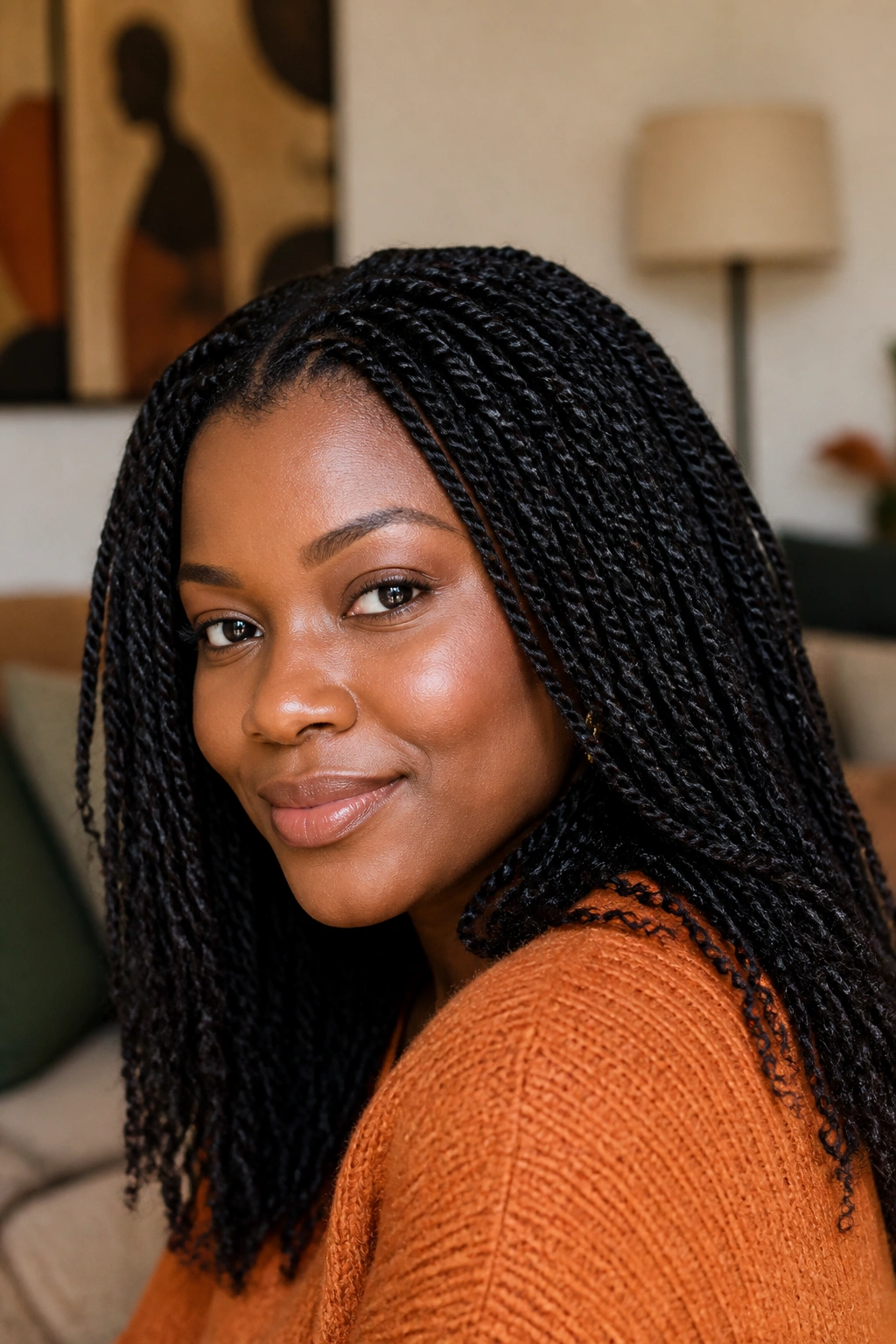
Mini twists are the marathon option. They take more time to install, and I won’t pretend otherwise, but the payoff is real if you want a style that can stay in place and still let your hair breathe.
Unlike chunky twists, mini twists create a finer, denser finish. That makes them a better fit when your hair tangles quickly or when you want a style that holds moisture for longer stretches between washes. They also shrink less dramatically than loose hair, which can make day-to-day styling feel easier. The tradeoff is time. Lots of it.
Who They’re Best For
- People who want a low-manipulation style.
- Anyone who likes wearing hair down without much daily shaping.
- Type 4C hair that frizzes fast in twist-outs.
- Medium to long hair that needs more control.
The twist size matters here. Go too small and the install becomes a chore. Go too large and you lose the sleek, uniform look that makes mini twists useful. I’d call the sweet spot around pencil-width sections, give or take. Keep the roots neat, but don’t pull them tight just to make the part look sharp. That’s a bad bargain.
Mini twists are best if you like a style that settles in over time.
7. Bantu Knots with a Glossy Finish
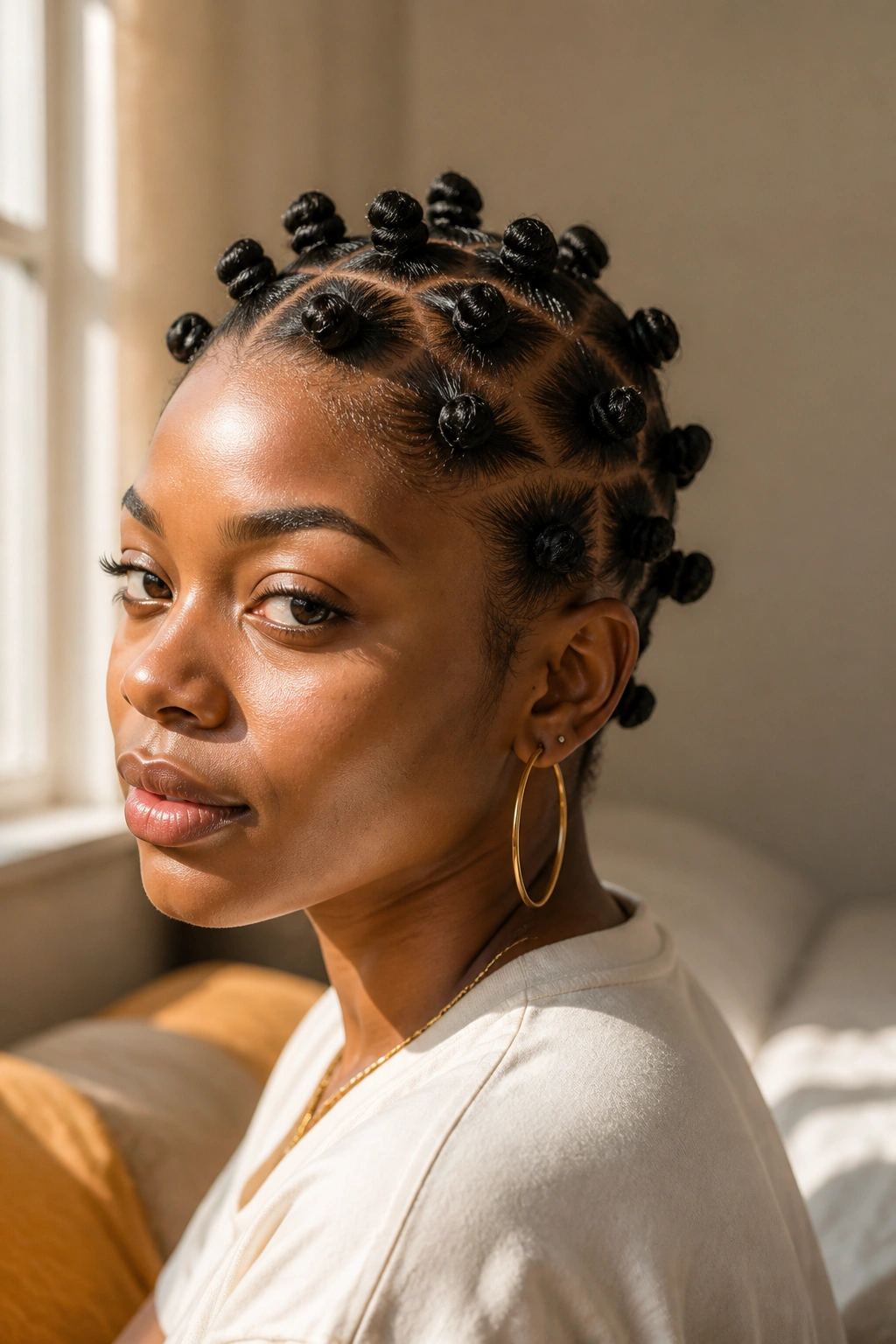
Bantu knots are not subtle. Good. They shouldn’t be. On type 4C hair, they look sculpted, clean, and a little playful, which is a nice change from styles that always aim for sleekness.
The trick is to create the knots on hair that has enough slip to wrap smoothly. If the hair is dry and rough, the sections fight back. A creamy styler and a small amount of gel on each part usually solve that. The knots can be tiny and uniform, or bigger and chunkier if you want more visual weight. Either way, the parts need to be clean if you want the style to look deliberate.
Bantu knots also do double duty. You can wear them as a style, then unravel them later for a curl pattern that looks like a knot-out. That second look is a different mood entirely. Softer, springier, and a little more dramatic.
A dry set is worth waiting for here. If the centers are still damp when you unwrap, the shape will collapse faster than you’d like. Patience pays off.
8. Frohawk with Pinned Sides
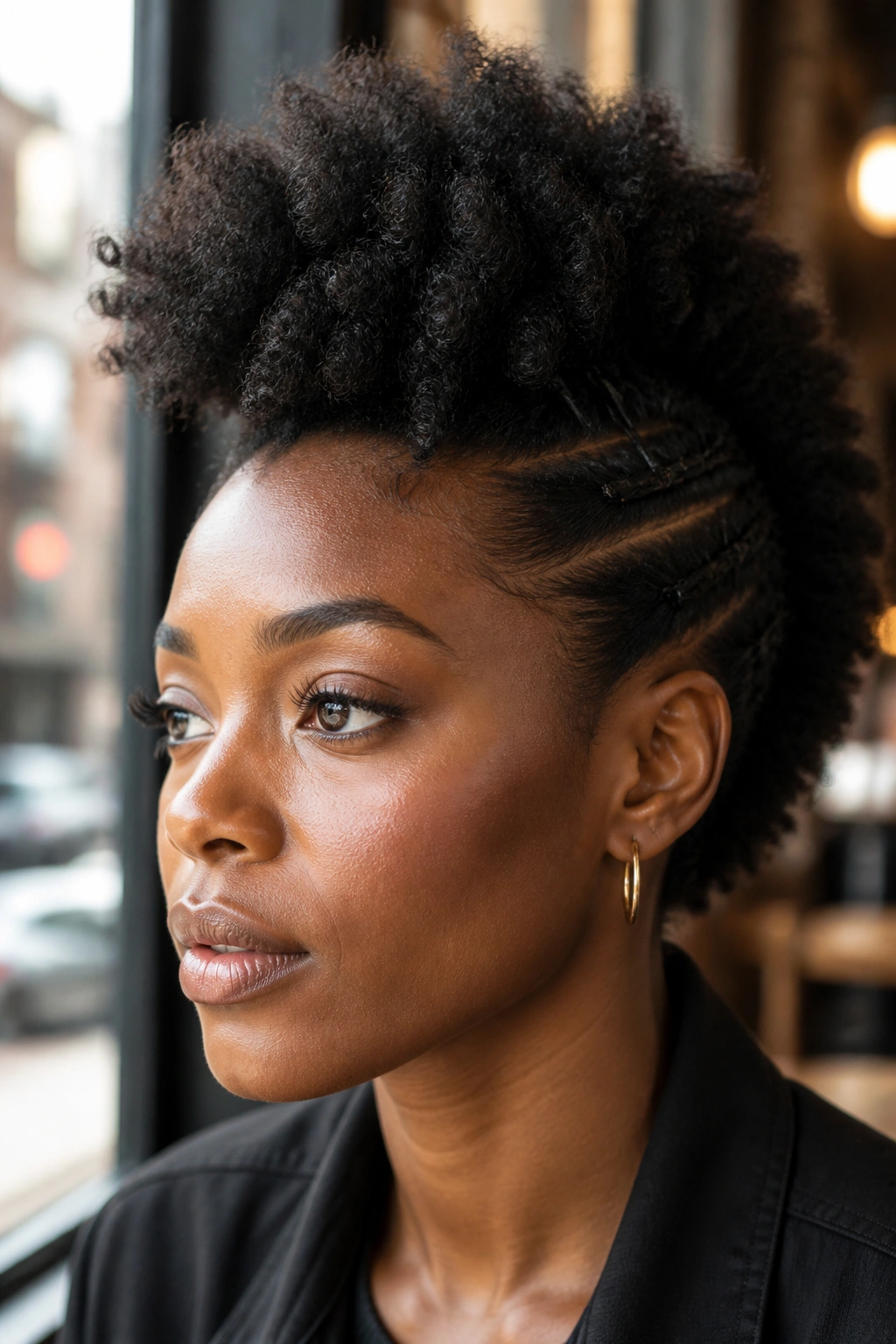
A frohawk is what I suggest when someone wants a little edge without committing to a full cut. It’s bold, but not difficult once you break it into parts. The sides get slicked, twisted, or braided back, and the middle stays out to build height and movement.
This style works especially well on type 4C hair because the texture gives the center section real body. You do not need to force height. It’s already there. The important part is controlling the sides cleanly so the contrast looks sharp instead of chaotic. A few crossed bobby pins usually hold better than one big pin, and they sit flatter too.
Key Details That Help
- Use flat twists or cornrows on the sides if you want the style to last longer.
- Keep the center section moisturized so it can be shaped without snapping.
- Pin from the back forward if the sides keep slipping.
- A light mist of holding spray helps the front stay put.
The frohawk can look casual or dressed up depending on how much volume you leave in the center. That flexibility is why it’s still a favorite.
9. Low Puff with a Center Part
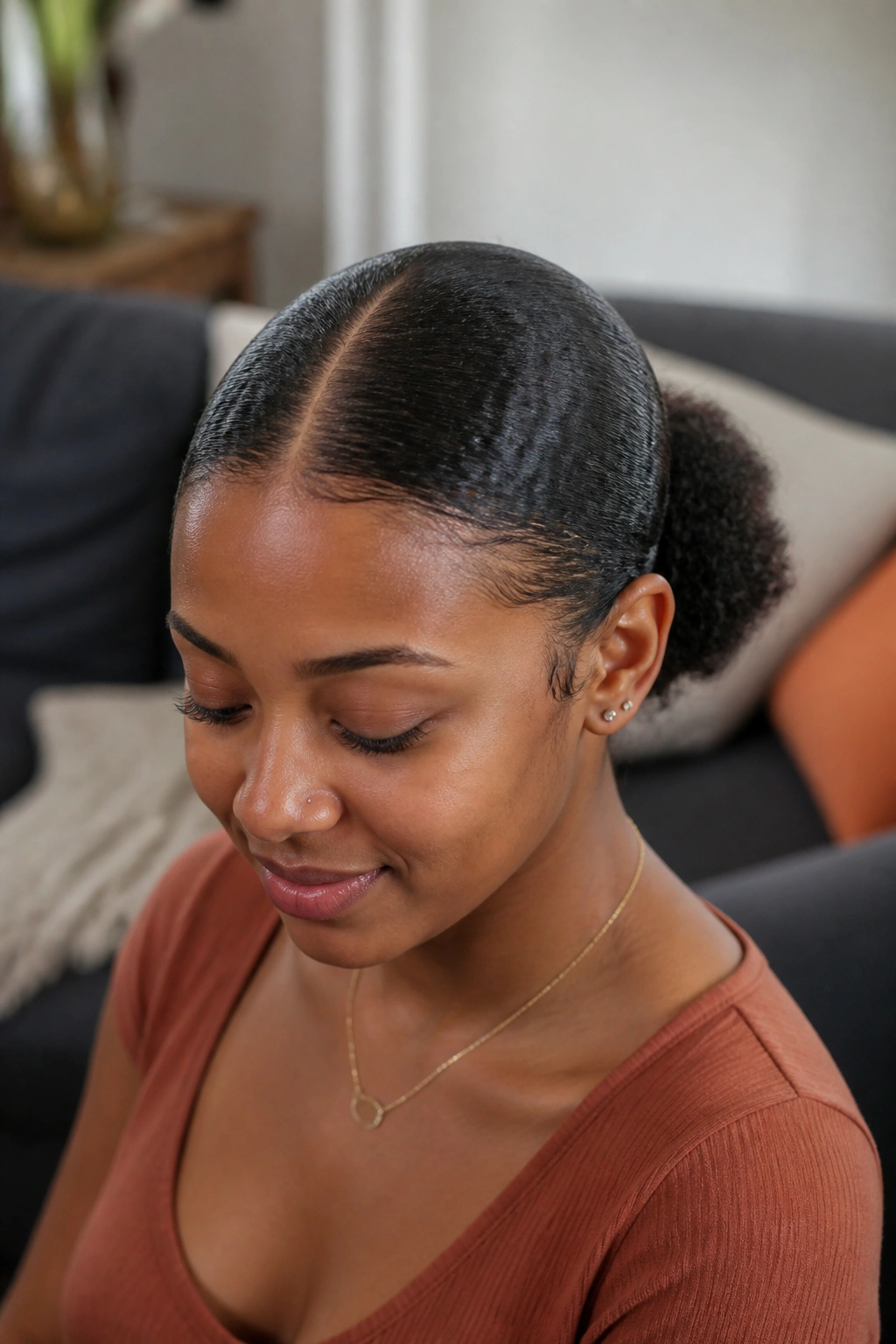
A low puff has a calmer feel than a high puff, and I like that. It does not shout for attention. It just sits neatly at the nape or lower crown and lets the hair texture do its job.
The center part gives the style balance. On type 4C hair, it also creates a clean line that makes the puff look intentional, even when the rest of the hair is soft and fluffy. I’d use a toothbrush or edge brush only on the part and the front perimeter. Don’t drag product all the way through the hair unless you want a stiff base and a limp puff. That look is never as neat as people hope.
A low puff works well on stretched hair, but it also looks good on hair with some shrinkage left in it. The difference is mostly in the silhouette. Stretched hair gives you a longer, sleeker puff. Unstretched hair gives you a rounder one.
If your hair is dense at the crown, keep the elastic loose enough that it doesn’t flatten the top. You want lift, not a dent.
10. Side-Swept Tuck and Pin
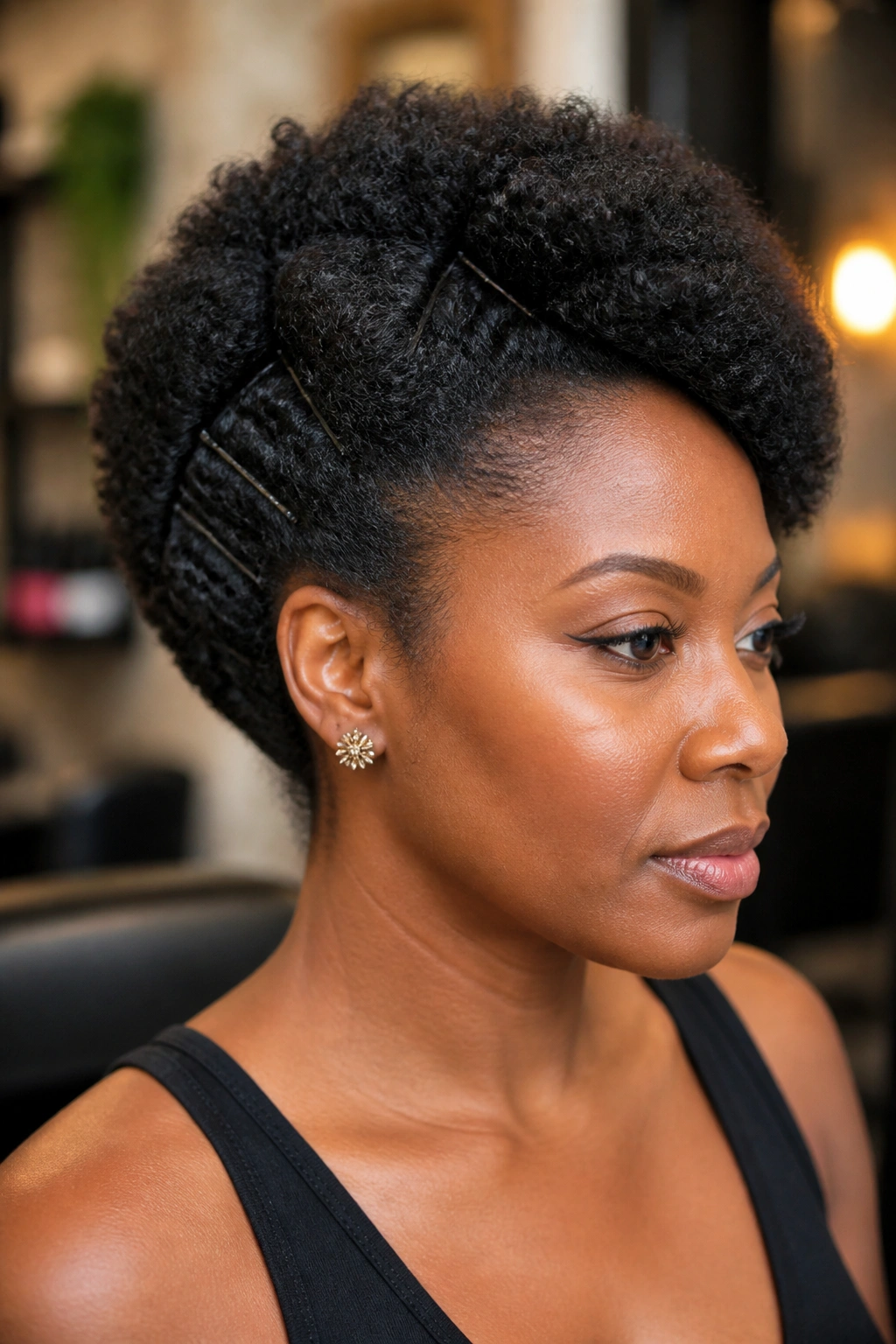
A side-swept tuck and pin is one of those styles that looks more complicated than it is. That is part of the appeal. It gives type 4C hair a soft, elegant curve without asking the hair to behave like it’s straight.
The style works best when the hair has a little stretch or at least a defined base, like a twist-out or braid-out. Sweep the hair to one side, tuck sections behind the ear or toward the nape, and pin them in a loose line that follows the head shape. Four to six bobby pins usually do the job, depending on density. More if the hair is thick. Less if the sections cooperate.
Unlike a full updo, this one keeps some movement in the front and crown. That makes it useful for medium-length hair that’s too short for a smooth bun but long enough to fold and pin. It also frames the face nicely, which is helpful if you want the style to feel softer.
I’d call this a low-drama style with a lot of mileage. Easy to wear. Easy to adjust. Hard to mess up badly.
11. Crown Braid Around the Hairline
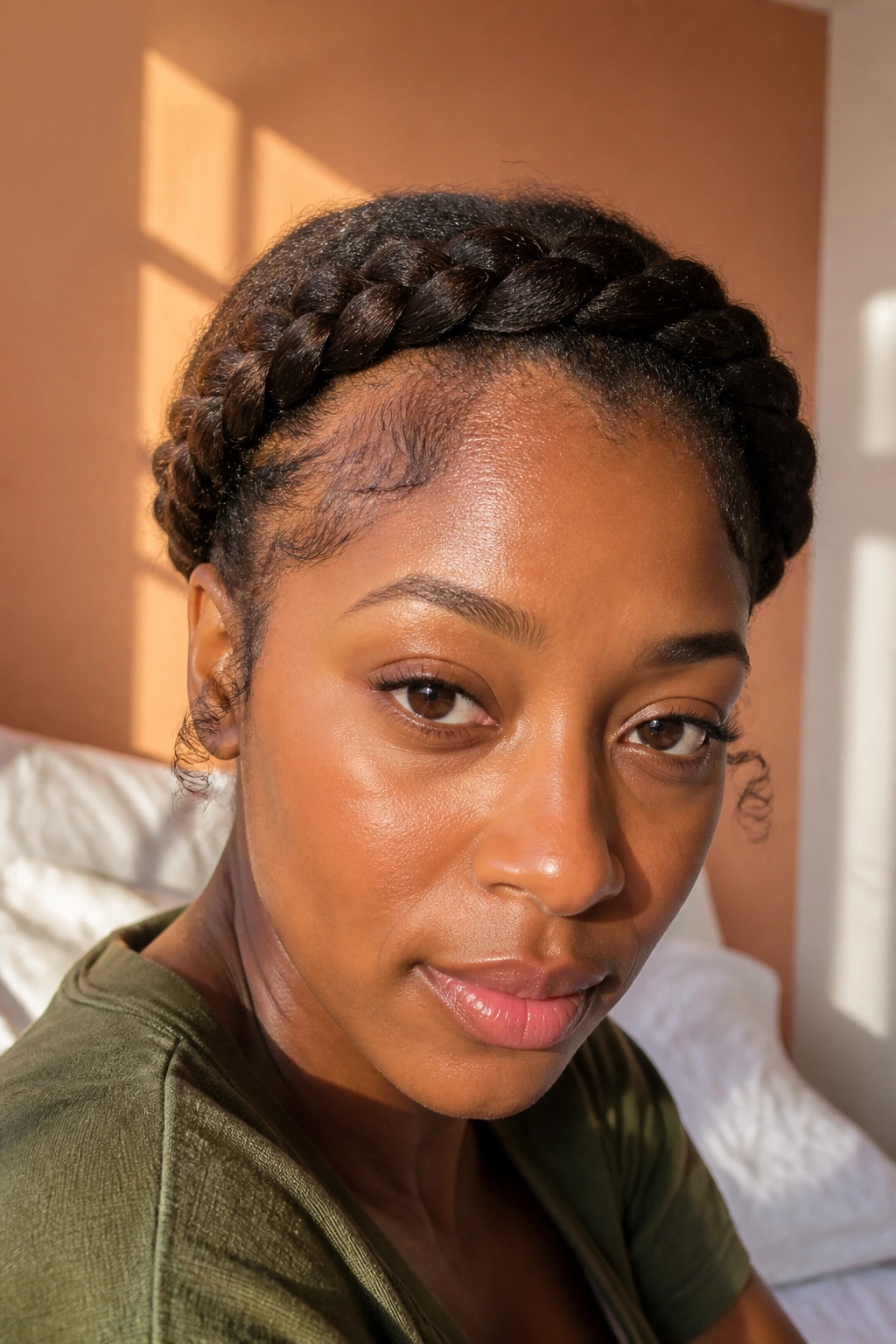
A crown braid can make type 4C hair look polished in a way that still feels soft. The braid sits like a frame around the face, and everything about that line creates structure without making the hair look stiff.
The trick is to braid close to the hairline without pulling at it. That distinction matters. Too much tension around the temples or nape can leave you with a headache and a style that lifts in odd places by the end of the day. A small amount of pomade on the parts helps the sections stay clean, but don’t overload the braid itself. You want grip, not grease.
I also like this style because it can work with different finishes. Leave the center curly, tuck it into a low bun, or keep the middle loose for more shape. All three read differently.
If your hair is very dense, part the braid in small sections around the perimeter. If it’s shorter, a thicker halo braid or two side braids pinned together can get you the same general shape without fighting the length.
12. Space Buns on Stretched Hair
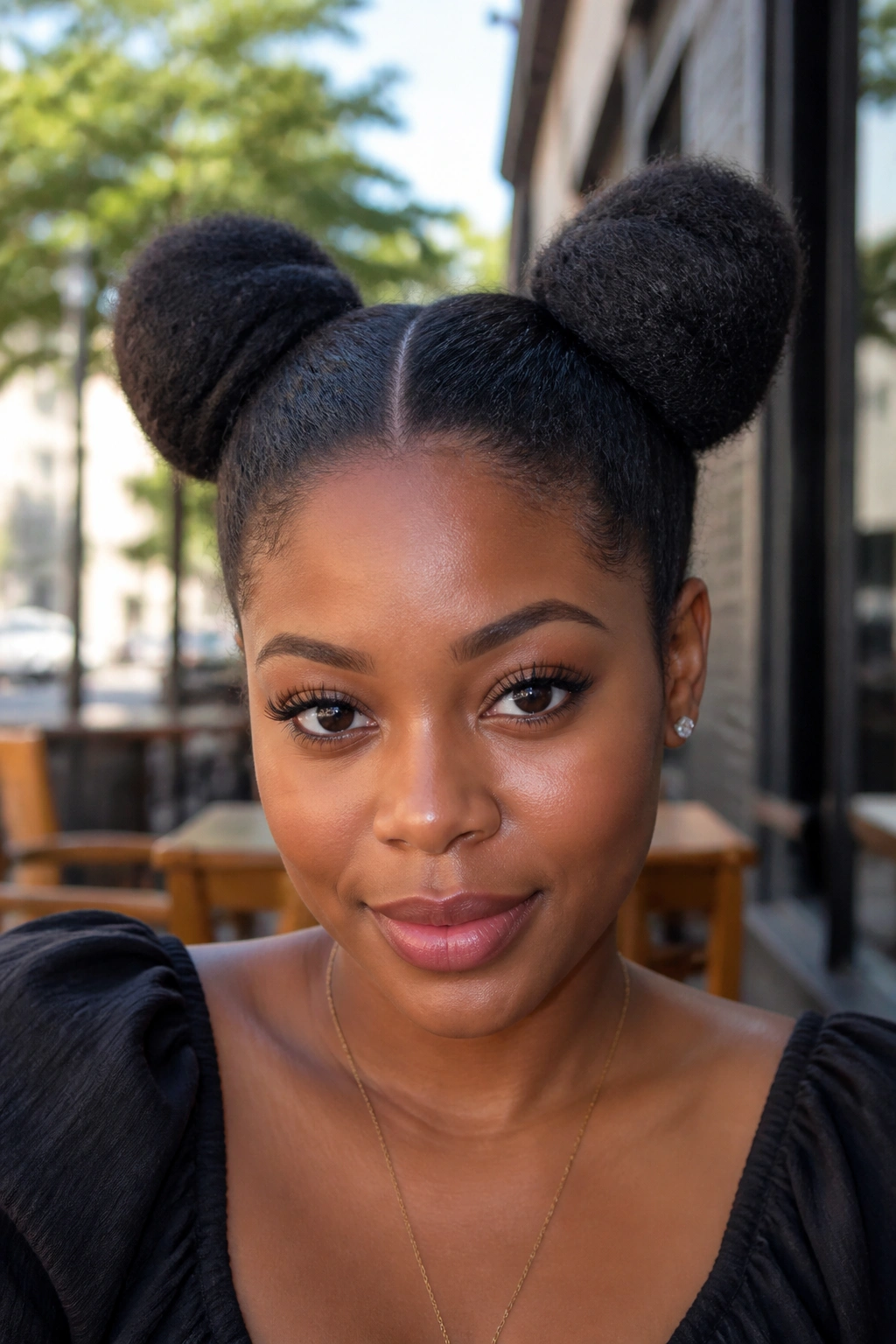
Space buns can look playful or sleek depending on how clean the base is and where you place the parts. On type 4C hair, stretching first makes a huge difference because it gives the buns enough length to sit up instead of collapsing into tiny knots.
A center part is the usual move, though a slight off-center version can feel less expected. From there, gather each side into a puff or ponytail, twist or wrap the lengths, and pin the buns into place. If the hair is dense, keep the bun base small and let the fullness come from the ends. That gives a better shape than trying to pack every strand into the base.
How to Keep Them Balanced
- Match the part height on both sides before you gather the hair.
- Use a mirror on the back of your head if the buns are meant to sit level.
- Stretch overnight with banding if you want more visible length.
- Add a satin scarf over the base while the hair dries for a smoother finish.
Space buns are best when you want a style that feels a little fun but still neat enough to wear anywhere.
13. Cornrows into a Bun
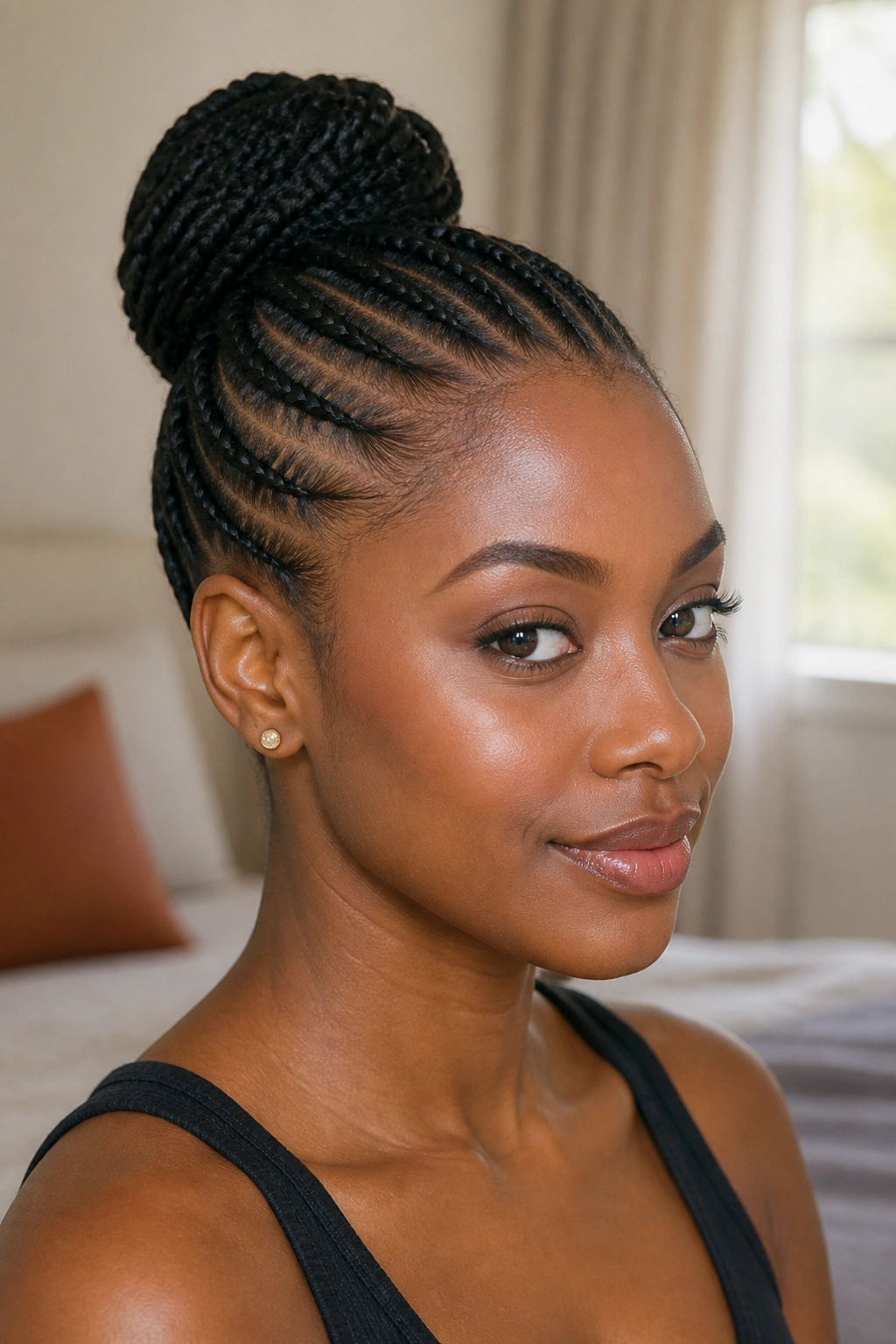
Cornrows into a bun are a workhorse style. Not glamorous in the flashy sense, maybe, but incredibly useful. The hair gets braided close to the scalp in rows that feed into a bun at the crown or nape, and the result is tidy, secure, and easy to live in.
This is a good option when you want your ends tucked away and your mornings simplified. It also helps if your hair tangles fast or if you need a style that can survive a few days without constant restyling. The bun part can be braided, twisted, or just wrapped, depending on how much length you have left after the cornrows.
- Keep the parts straight if you want a crisp finish.
- Braid in a direction that follows the shape of your head.
- Use a soft band, not a thin elastic that cuts in.
- Sleep with a satin bonnet so the bun stays neat.
The style can be dressed up with accessories, too. A few gold cuffs or a simple scarf can change the whole mood. Quiet style. Useful style. That’s why it works.
14. Twist-and-Braid Updo
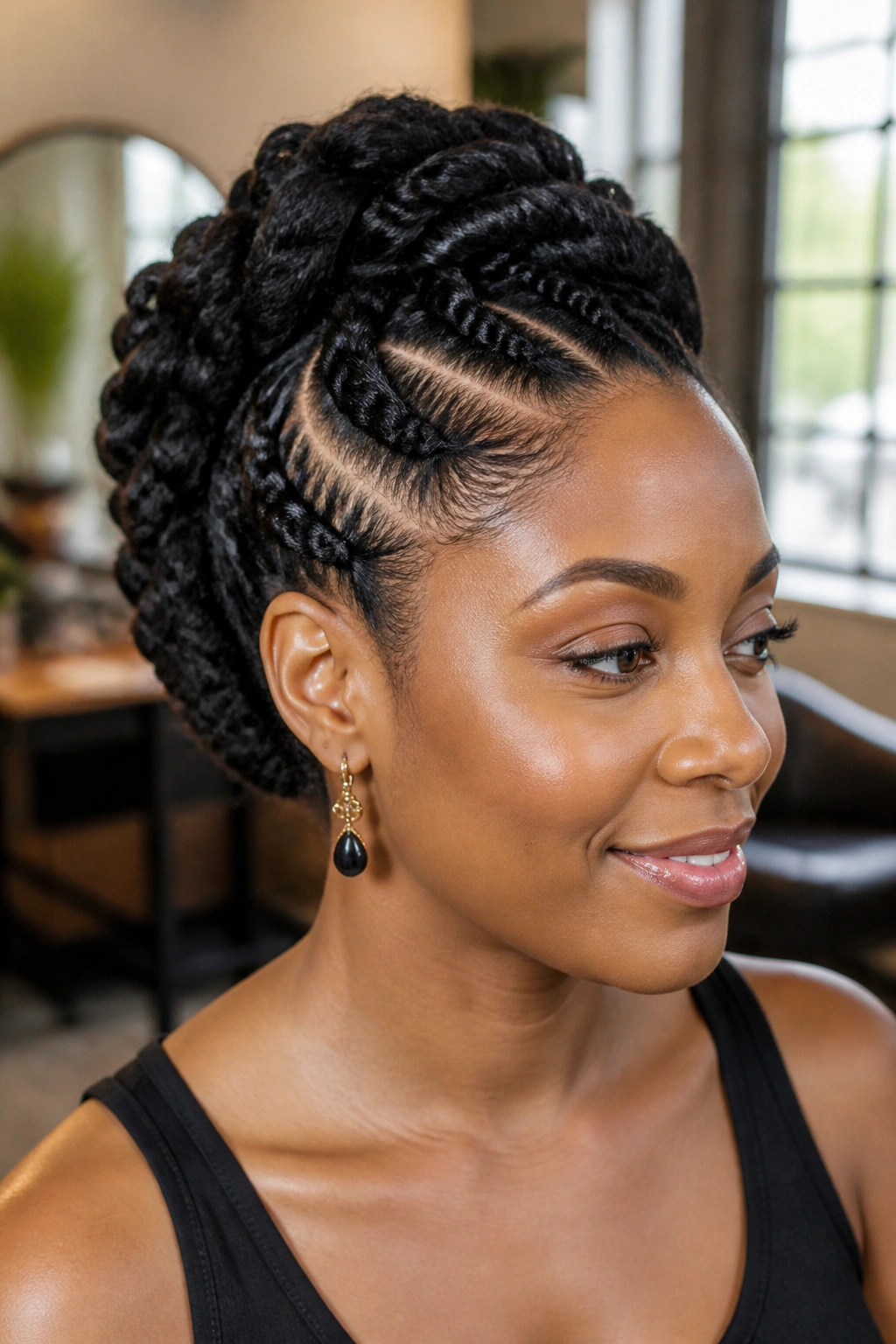
A twist-and-braid updo is the kind of style that makes medium-length type 4C hair look more elaborate than it really is. You twist one section, braid another, then tuck the ends into a pinned shape at the back or side. The mix of textures does the heavy lifting.
What I like about this one is that it gives structure without needing a perfect, ultra-sleek base. In fact, a little texture helps. The twists keep the style soft, while the braided sections give it enough grip to hold shape. If your hair is layered or uneven in length, this style hides that better than a smooth bun would.
A medium-hold gel along the parts can keep the scalp neat. After that, it’s mostly about placing the pins where they won’t show. Cross two pins if a section feels loose. It holds better than people expect.
The finished look works for formal events, but it doesn’t have to feel stiff. Leave a few soft edges or a side curl if you want it to breathe a little.
15. Finger Coils on Short 4C Hair
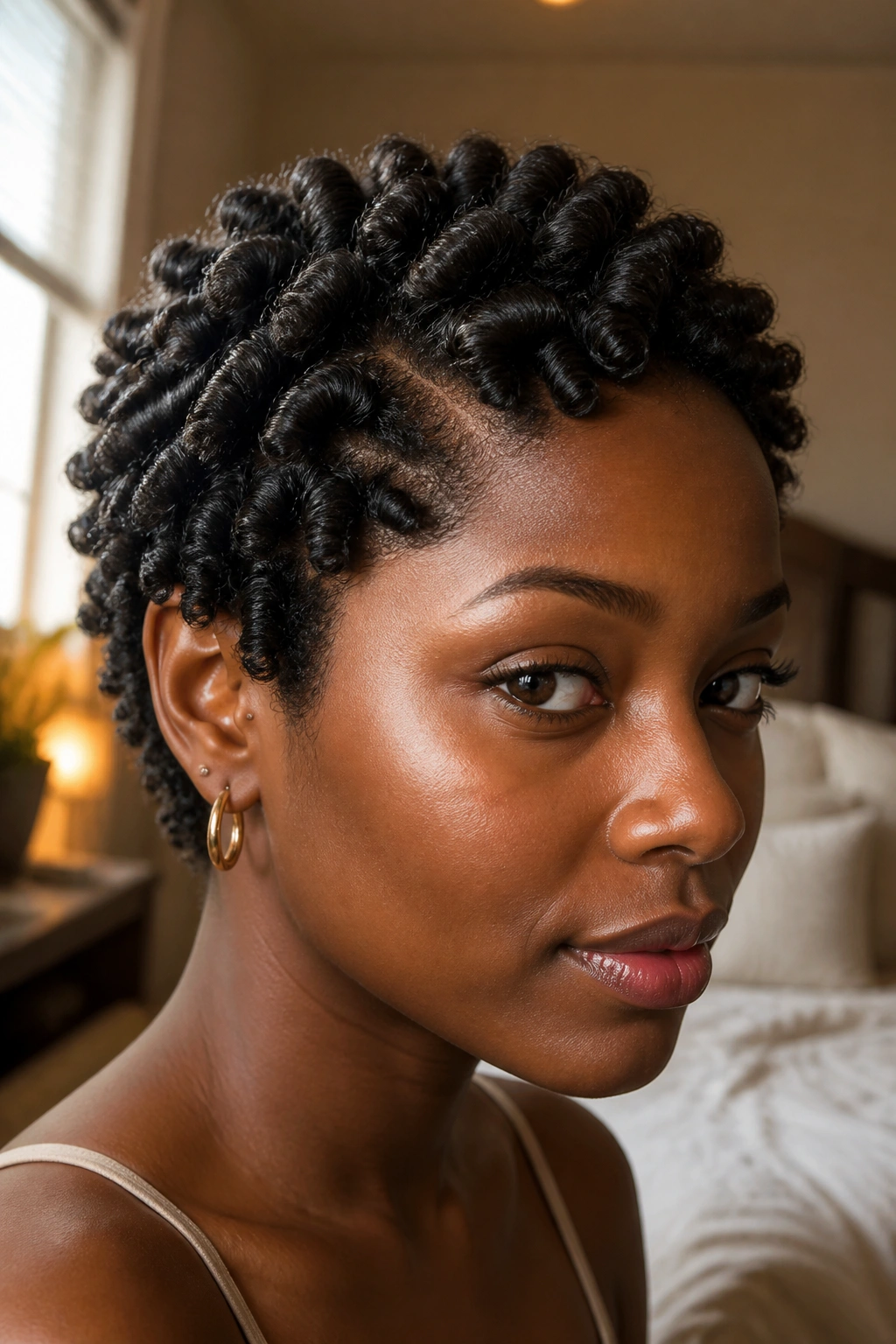
Finger coils are one of the cleanest options for short type 4C hair, especially if you’re wearing a TWA or a tapered cut. The style turns each tiny section into its own defined coil, which gives the whole head a crisp, almost dotted texture.
Unlike twist-outs, finger coils are built section by section on the head. That takes time, yes, but the payoff is control. Each coil can be shaped exactly where you want it, and the pattern is easy to see once the hair dries. I like them best on hair that has enough length to wrap around a finger at least one and a half to two times. Less than that, and the coil may not hold as cleanly.
What Makes Them Different
Finger coils are tighter and more defined than a loose wash-and-go. They also hold their shape better on short hair because each section is trained individually. That makes them a smart choice when you want definition without relying on heat or a lot of manipulation.
Use a curl cream or leave-in with slip, then twirl each section in the same direction. If the sections vary too much in size, the finished look can get patchy. A little unevenness is fine. Wildly uneven is not.
16. Flat-Twist Updo with a Tucked Nape
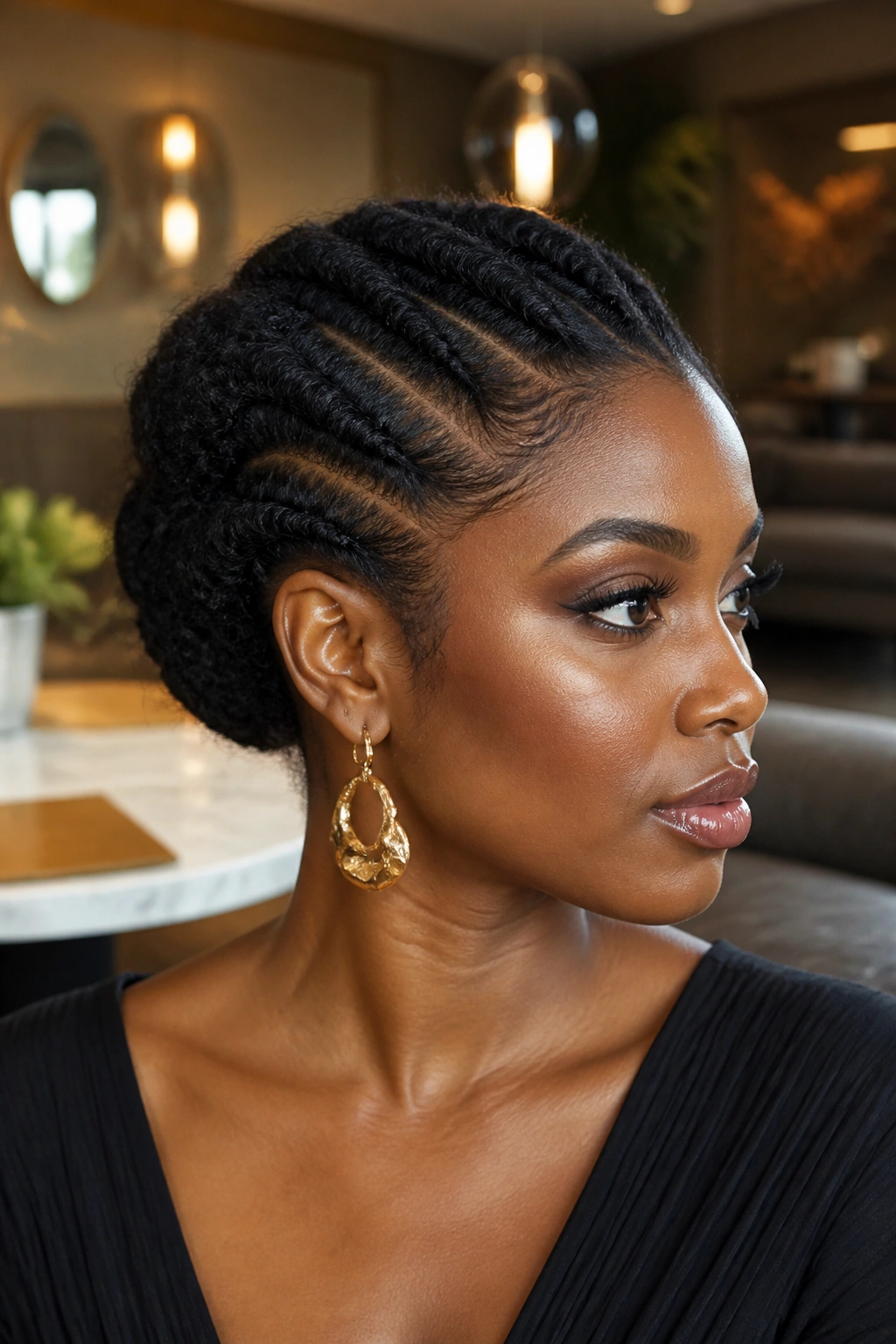
If you want one style that can go from neat to dressed up without adding hair, this is a strong pick. A flat-twist updo with a tucked nape keeps the sides smooth, builds shape at the crown, and hides the ends low at the back where they won’t get in the way.
The best part is how forgiving it is with length. Shorter hair can be tucked into a small roll. Longer hair can be wrapped into a fuller shape. Either way, the flat twists make the structure look intentional. That is really the whole point.
A good gel on the parts helps the design show up cleanly, but the style does not need to be wet-looking. I’d actually avoid that. Dry, neat, and slightly soft usually looks better on 4C hair than slicked-down and crunchy. A decorative clip, comb, or pin can add a little shine if you want the style to feel more formal.
It’s a quiet kind of polished. The kind that stays put.
17. Braided Ponytail with Leave-Out
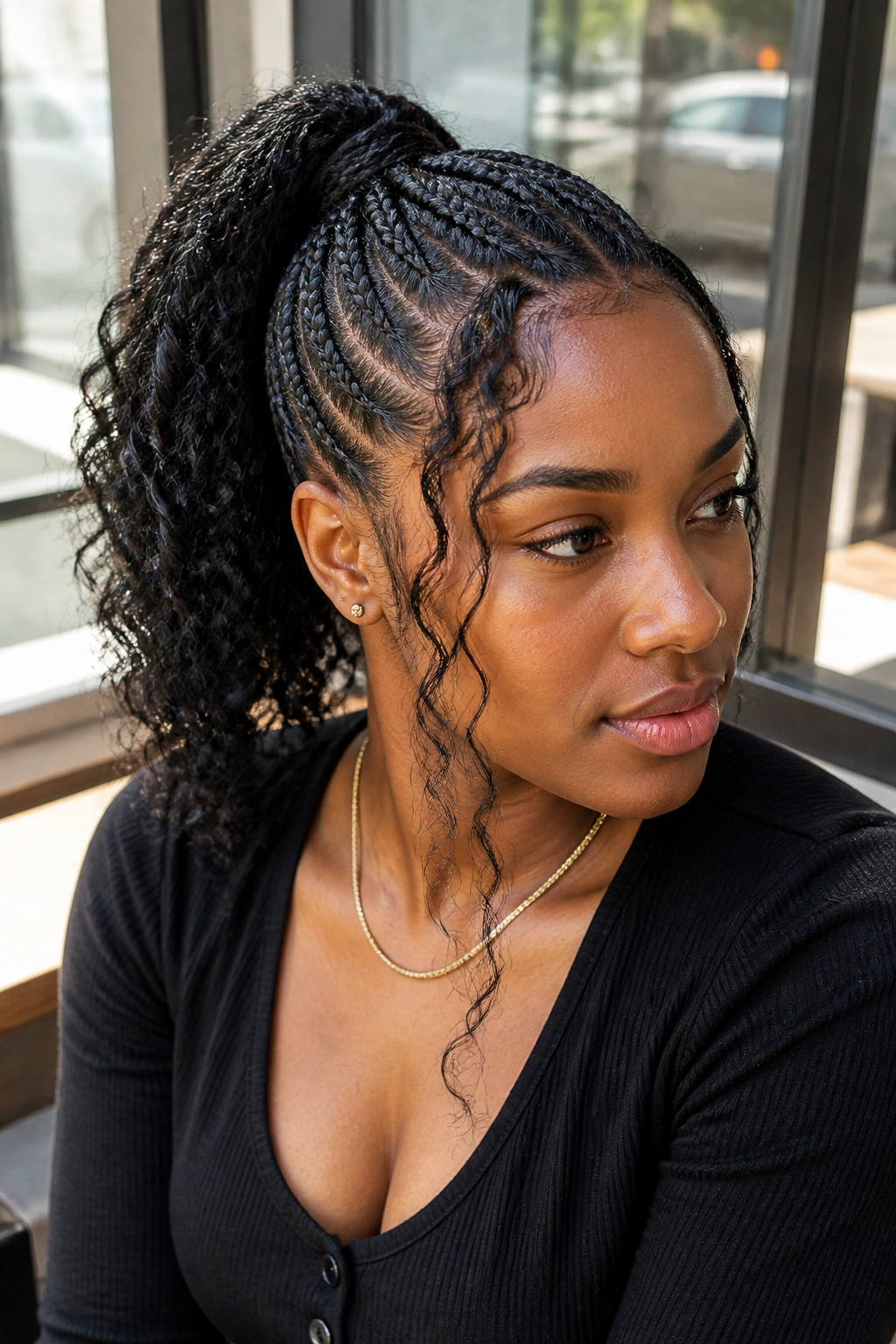
Can a braided ponytail work on type 4C hair without feeling too tight? Yes, if the base is handled with care and the leave-out isn’t forced to do too much. The style can be as simple as a smooth ponytail that’s braided down the back, or a wrapped base with a few soft front pieces left free.
The leave-out matters because it softens the look. A little fringe, a curled front section, or a tiny twist near the temple can stop the ponytail from looking severe. For 4C hair, I think that contrast is the thing that makes it interesting. Sleek near the base. Texture at the ends. Enough movement to keep it from feeling flat.
If you use extensions, match the braid thickness to the natural density at the base so the ponytail doesn’t look heavy. If it’s all your own hair, keep the ponytail low enough that the tension stays manageable. That part matters more than people admit.
A braid ponytail can lean casual or sharp. It depends on the finish, not the idea.
18. Rolled Updo with Soft Ends
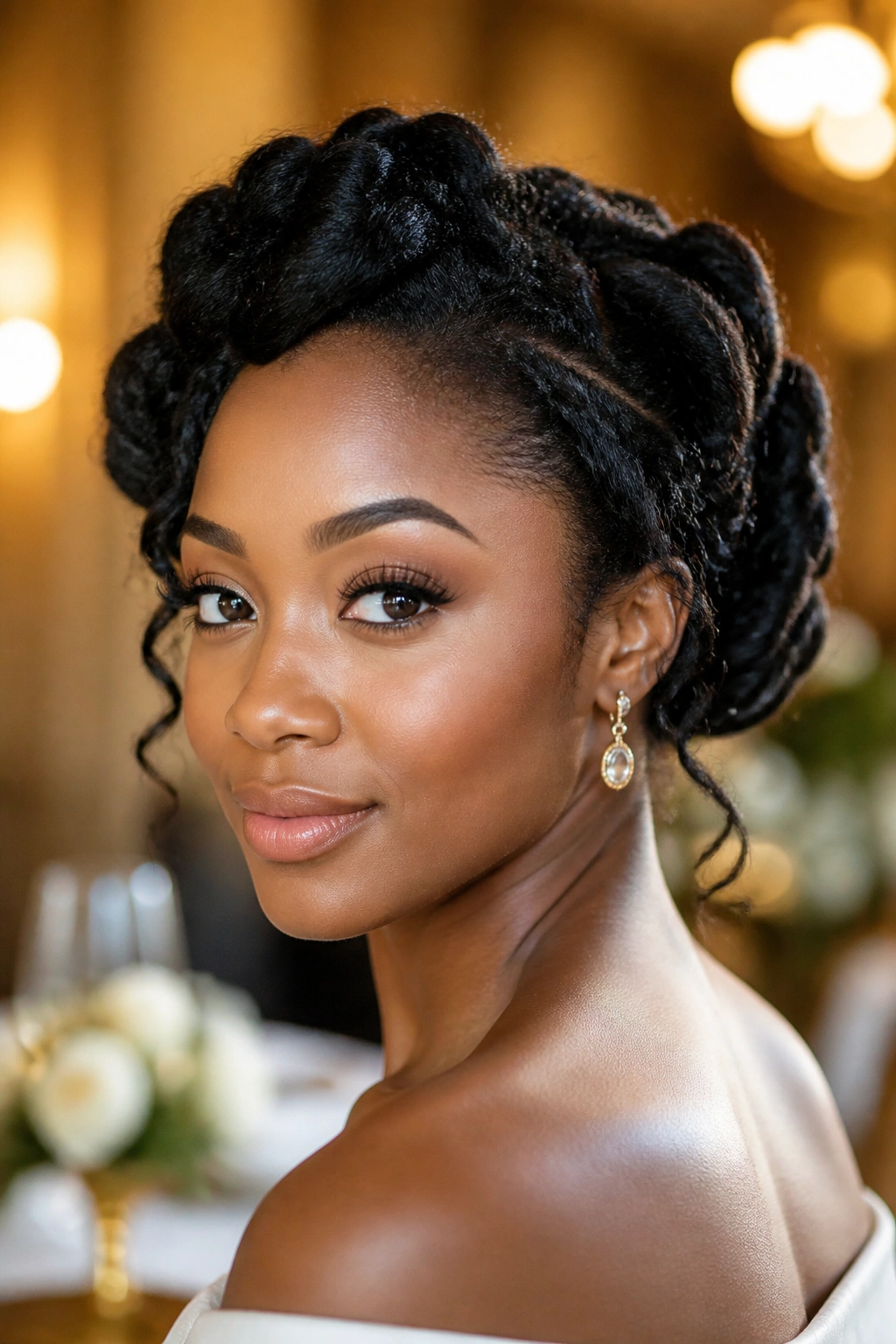
A rolled updo with soft ends gives type 4C hair a vintage feel without turning it into a costume. The sections are rolled inward or upward, pinned close to the head, and left with a little softness around the edges so the style doesn’t feel sealed off.
The best versions of this style use four to six sections, sometimes more if the hair is dense. Each section gets rolled toward the center or side, then pinned flat enough to stay secure but not so flat that the shape disappears. The soft ends can peek out a little. That touch keeps the style from feeling too rigid.
A Few Things That Help
- Use 4 to 6 bobby pins, crossed in an X when a section feels loose.
- Keep the hair slightly dampened with leave-in for better handling.
- Roll in the direction that follows the head’s natural curve.
- Avoid overpacking the back; the shape gets bulky fast.
This one suits weddings, dinners, church, or any day when you want the hair off your shoulders but still want a little texture on display.
19. Headband Faux-Halo Style
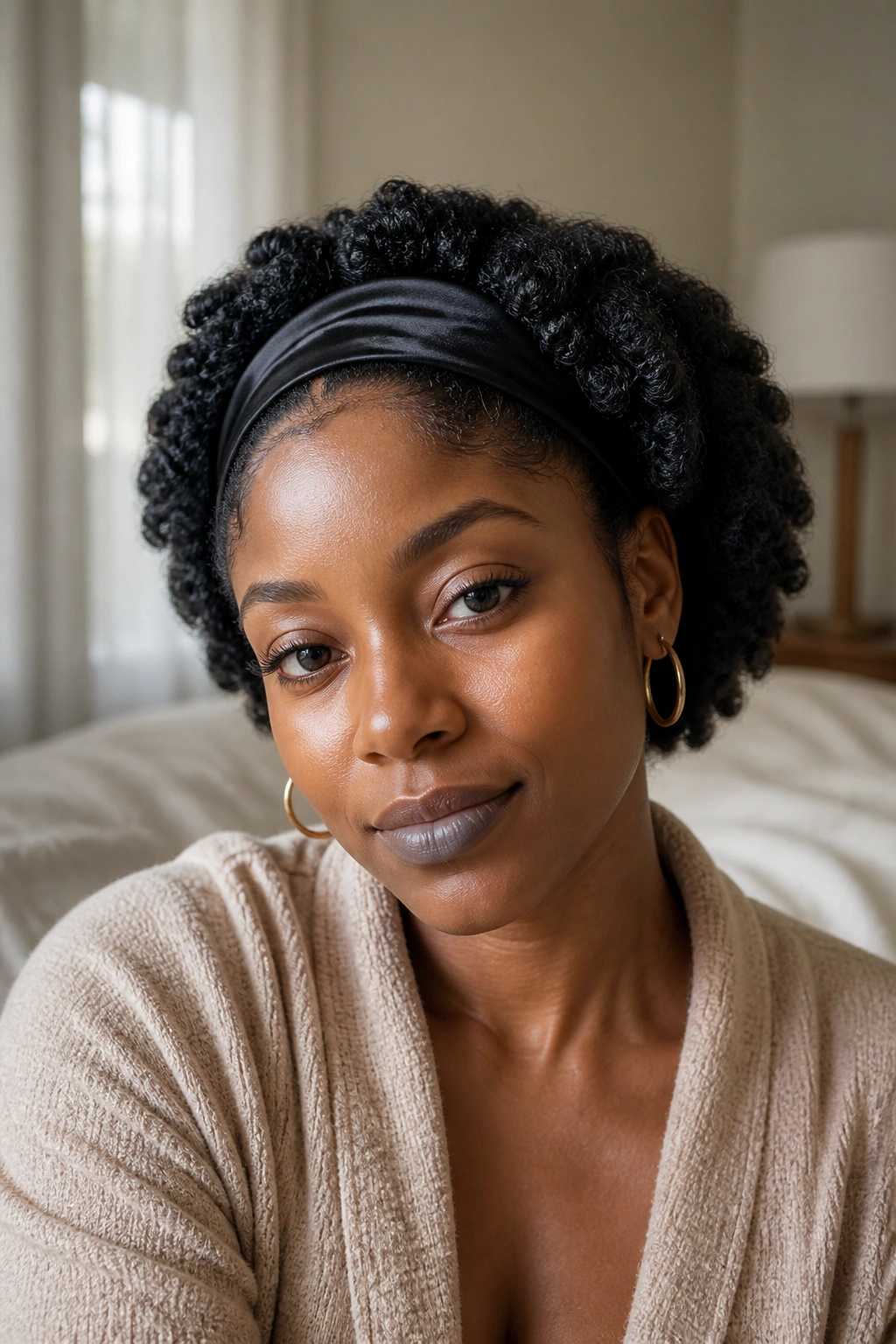
A headband faux-halo style is the lazy-day style that still looks thoughtful. That may sound like faint praise. It isn’t. On type 4C hair, anything that can look neat in under ten minutes deserves respect.
The setup is simple. Place a stretchy headband or scarf across the crown, then tuck or roll sections of hair into the band until the front and sides form a soft halo-like frame. The back can stay fuller and loose, or you can pin it in place if you want more control. It works especially well when the hair already has some stretch from a twist-out or banding.
The best version keeps the headband snug enough to hold, but not so tight that it dents the hairline. Satin-lined bands are a nice touch because they reduce friction. If the front pieces keep slipping, a few hidden bobby pins take care of it.
I like this style because it has range. It can feel casual with a wide fabric band or a bit more dressed up with a narrow one. Same basic shape. Different mood.
20. Stretched Afro Puff
A stretched afro puff gives you the volume of a puff with a little more visible length, which changes the whole feel of the style. Instead of sitting as a tight ball of shrinkage, the hair shows some of its length and movement. That small shift makes a big visual difference.
This works especially well when the hair has been banded overnight or stretched with twists, braids, or threading. You still get the fullness that makes a puff look good on type 4C hair, but the silhouette becomes longer and softer. The base can be high or low. I prefer medium height because it keeps the top lively without turning the style top-heavy.
The hold matters more here than on a loose puff. You want enough support at the base so the stretched lengths don’t pull the style down as the day goes on. A satin scrunchie, puff cuff, or wrapped elastic usually works better than a thin band.
If you need one style that sits somewhere between casual and polished, this is a strong bet. It looks like your hair, only a little more intentional. That’s often the best place to be.
