



Round faces and curly cropped cuts get along better than most salon charts suggest. The trick isn’t to hide width; it’s to redirect the eye with height, diagonal lines, and broken texture in the right places.
Curly hair makes that job both trickier and more interesting. Shrinkage can turn a tidy cut into something much shorter after it dries. A fringe that looks harmless when wet can land right at the lashes, and a shape that seems neat in the mirror can puff out once it meets humidity and daylight. That’s not a flaw. It’s the whole game.
The cuts that flatter a round face usually do one or more of four things: keep bulk away from the widest part of the cheeks, add lift at the crown, leave a little length near the temples or jaw, or break the outline so the eye doesn’t get stuck on one soft circle. Straight hair can fake angles with a hard edge. Curls need smarter placement.
So the list below leans practical, not fussy. Some cuts are clean and sculpted. Some are softer and messier. A few flirt with bowl shapes, which sounds risky until you see how much better they behave when the fringe is light and the perimeter is broken. The common thread is simple: shape matters more than length.
1. Tapered Curly Pixie with Crown Lift
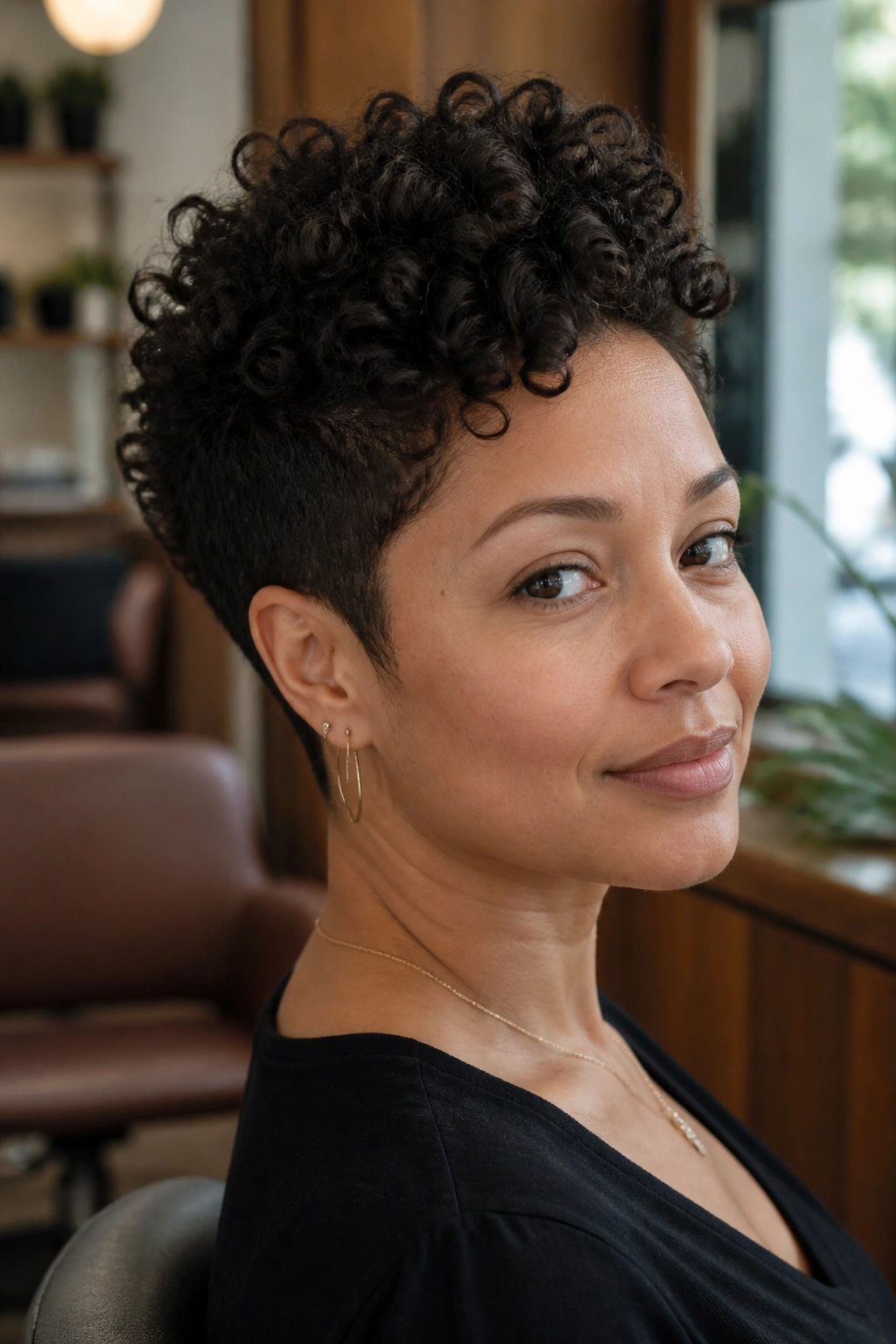
Short. Sharp. A little cheeky. The tapered curly pixie is one of the easiest ways to make a round face look more lifted without piling on styling work.
The sides and nape stay close to the head, which pulls attention upward. That matters. If the widest part of the haircut sits right at the cheeks, the whole look can feel wide and heavy. Push the volume to the crown instead, and the face starts to read cleaner.
Why the tapered sides help
Ask for 2 to 4 inches on top and a soft taper around the ears and neckline. If your curls are tight, the top can be a touch longer so shrinkage does not steal all the height. A dry cut is useful here because it shows you where the curl actually lands, not where it pretends to land when wet.
- Best for 3B to 4C curls
- Keep the sides at half an inch to 1 inch if you want a neat outline
- Leave enough length on top for the curls to form a small mound, not a helmet
- Use a light mousse at the roots and a cream only on the ends
Pro tip: ask for point-cutting on the top curls. That softens the edge and keeps the crown from looking blocky.
2. Side-Swept Bixie with Soft Temple Length
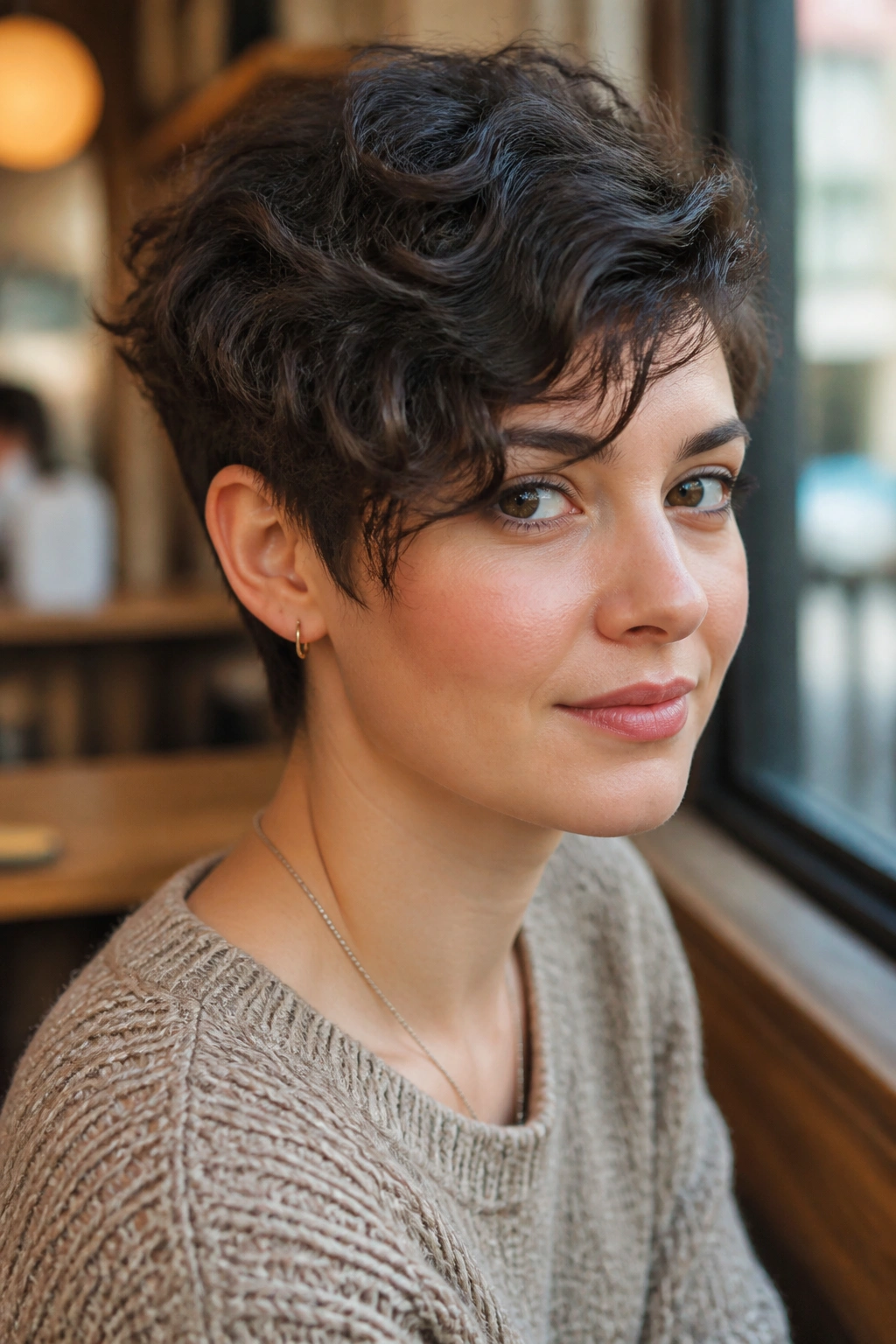
A bixie is the easiest way to keep a crop from feeling too severe. It sits between a bob and a pixie, which gives you that sweet middle ground: short enough to feel fresh, long enough to keep some movement around the face.
On a round face, the temple length does a lot of quiet work. It stops the cut from boxing in the cheeks. A side-swept front section also breaks the symmetry that can make a face look even rounder than it is. One side can skim the brow, the other can tuck a little behind the ear.
This shape is especially good if your curls are loose to medium-tight and you like a cut that grows out gracefully. The back can sit close to the neck while the front lands near the cheekbone or just below it. That little difference in length gives the whole style some air.
Wear it with a deep side part and let the longer side fall in one clean curve. No need to fuss. The cut should do most of the talking on its own.
3. Asymmetrical Crop with a Long Curl Line
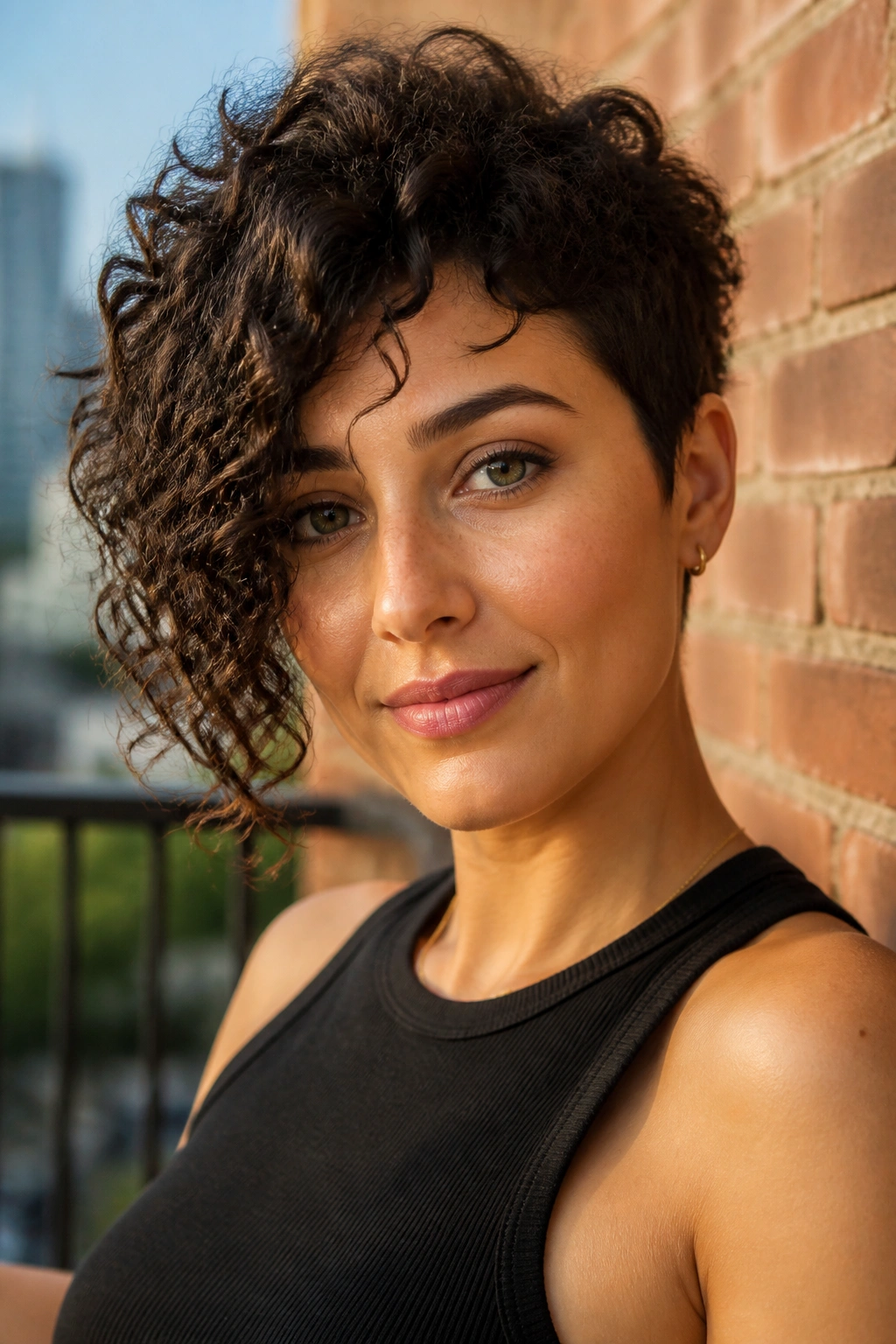
Why does a slightly uneven crop flatter a round face so well? Because the eye follows the longer side before it clocks the width of the cheeks. That’s the whole trick.
A true asymmetrical crop does not need a dramatic one-side-shaved statement unless that is your thing. Even a modest difference—say, one side grazing the cheekbone while the other sits closer to the ear—creates a diagonal line that changes the whole read of the face. Curls make this look softer than straight hair, which helps a lot.
How to style it
Keep the longer side clean and intentional. If it frizzes out, the asymmetry gets lost. A little gel cast or styling cream can keep the curl clumps defined enough to show the shape. The shorter side should stay neat around the temple and nape so the longer side has room to stand out.
- Ask for a 1 to 2 inch difference between sides
- Keep the longest front piece near the jawline or cheekbone
- Use a side part that sits off-center, not directly over the arch of the brow
- Diffuse from the longer side first so it does not shrink too far
This is a good one if you want a crop that feels modern without screaming for attention.
4. French Crop with Broken Fringe and Tidy Nape
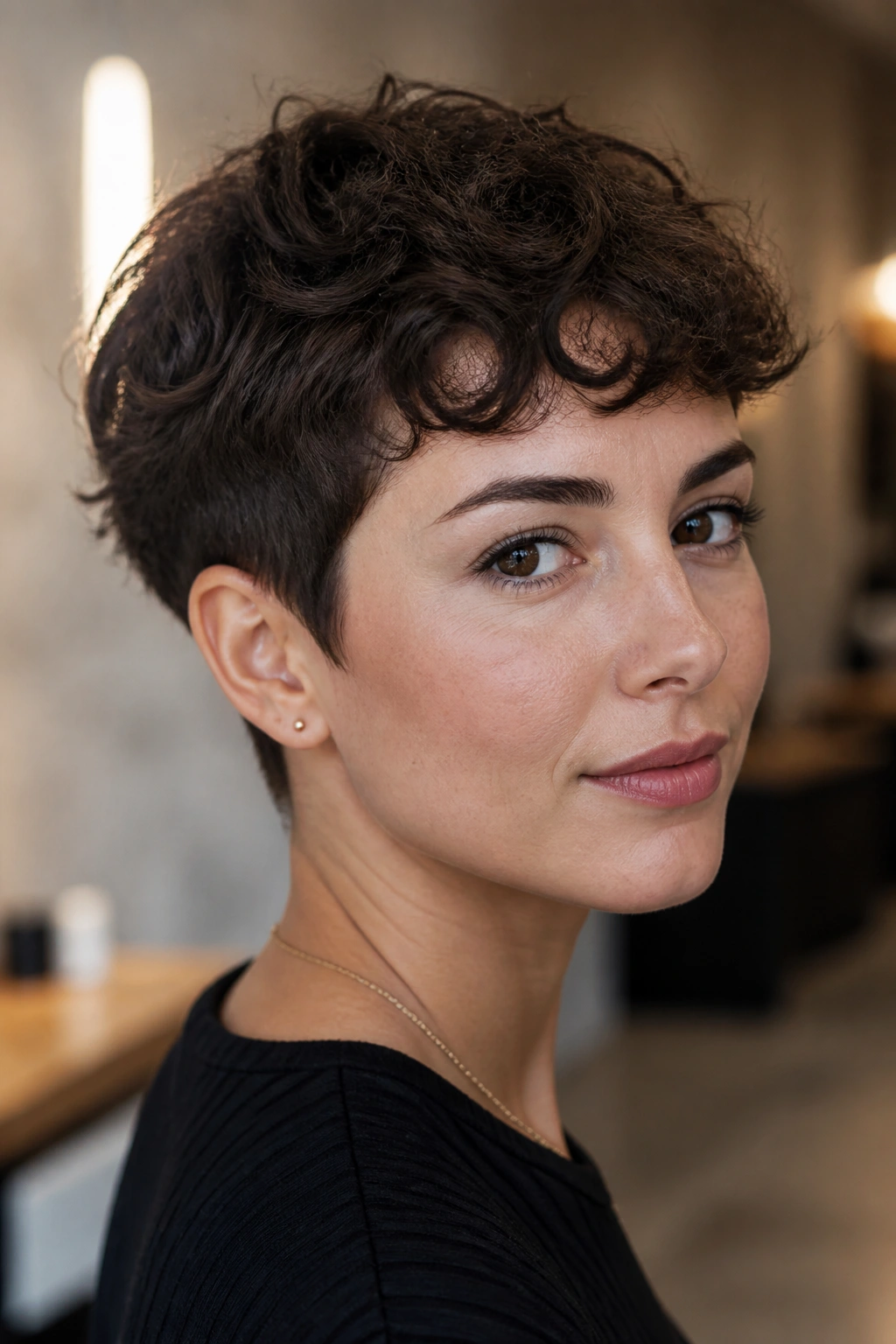
Walk into a salon asking for a French crop on curly hair and you may get something much better than you expected. The cut is compact, but it does not need to feel severe.
The magic is in the fringe. A broken fringe—soft, separated, not drawn into one blunt line—can sit right on the forehead without making the face look boxed in. The nape stays tidy and the sides stay close, which keeps the silhouette narrow where round faces usually need a little restraint.
This cut works especially well on tighter curls and coils because the fringe has natural bounce. If the curls are looser, the front should still be cut with enough irregularity to stop it from collapsing into one heavy curtain. A straight-across bang is the wrong mood here. It’s too tidy, too closed.
I like this cut for anyone who wants a low-maintenance shape that still looks considered. It takes well to a bit of matte cream or light gel, then a quick finger-shake once it’s dry. That’s it.
5. Jaw-Grazing Curly Bob with Face-Framing Layers
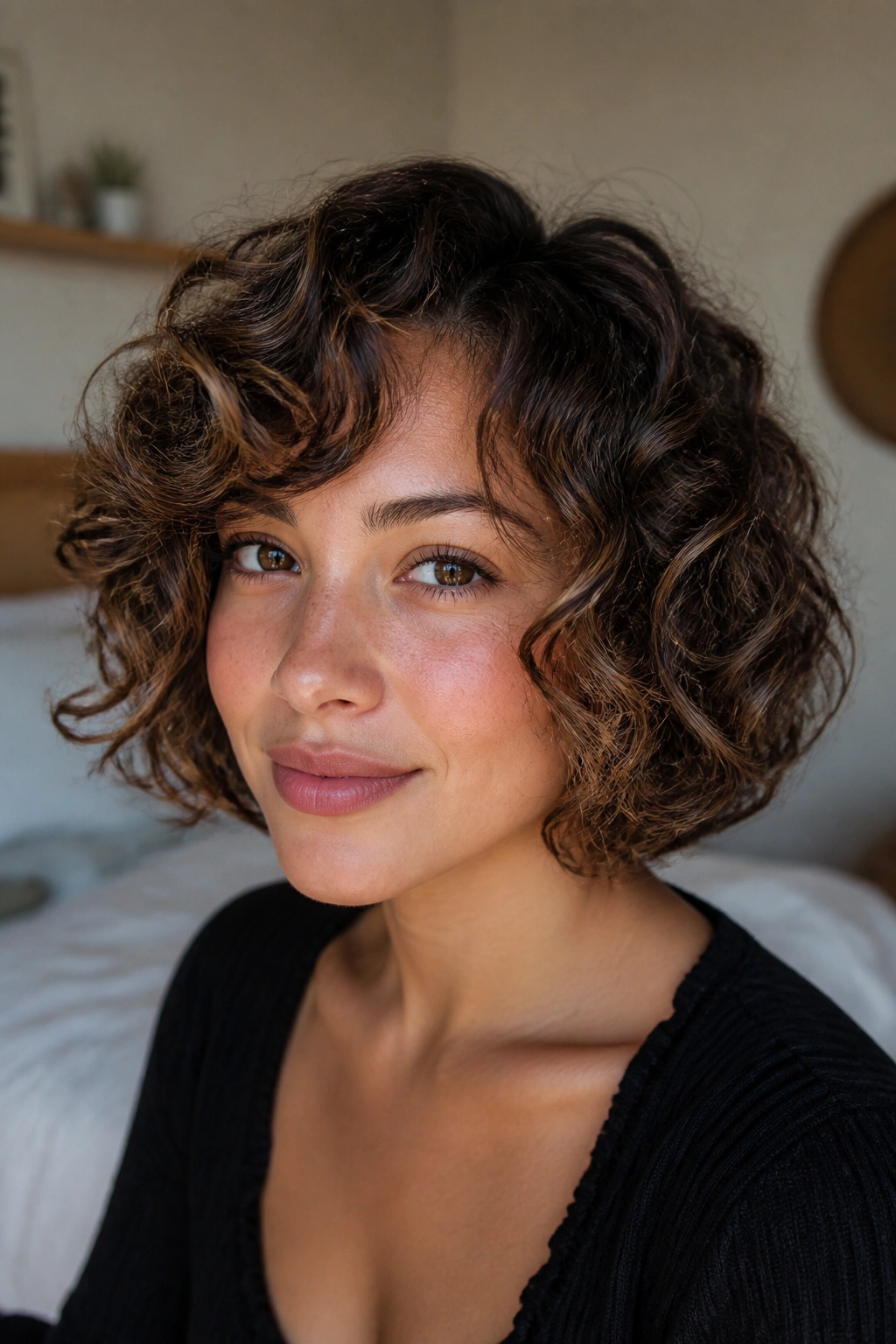
A jaw-grazing curly bob can be gorgeous on a round face, but only when the shape is cut with enough thought to keep it from blooming into a ball. Length matters here. So does spacing.
If the bob ends exactly at the fullest part of the cheeks, it can make the face feel wider. Push the line just below the jaw, and the cut starts to work with the face instead of against it. Face-framing layers should begin near the cheekbone or slightly lower so they soften the outline without swallowing it.
Density is the enemy here.
The best version of this cut has movement between the curl clumps. Not gaps, not thin spots—just enough air that the hair does not sit like one solid block. Ask for internal layering, not heavy shredding on the surface. That keeps the outside line neat while reducing puff underneath.
This is one of those curly cropped cuts for round faces that looks polished on a workday and relaxed on a weekend. A side part can sharpen it. A center part can make it feel softer. Both work, but the side part usually gives the face a little more length.
6. Stacked Crop with Lift in the Back
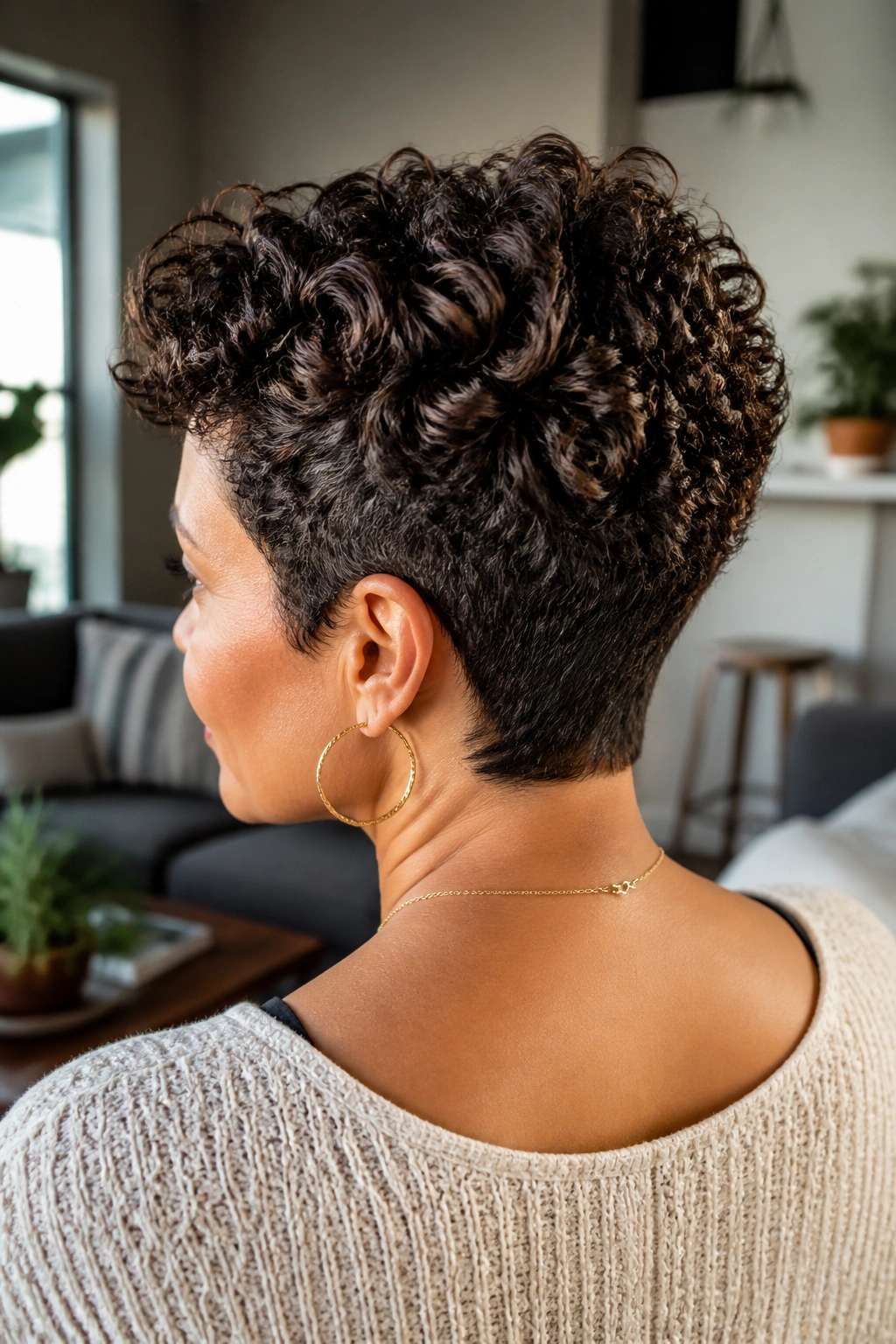
A stacked crop solves a simple problem: flat backs. Curly hair that lies low at the nape can drag the whole silhouette down, especially on a round face where you want the eye to move upward.
Unlike a one-length bob, a stacked crop removes weight at the back and builds a small shelf of volume through the crown. The result is shape, not bulk. That distinction matters. Bulk widens. Shape lifts.
Ask for graduated layers through the back that get shorter as they move toward the nape, while the front stays a bit longer. On many curl patterns, the stacking looks best when it’s subtle, not choppy. You want the back to rise, not spike.
This cut is especially useful for finer curls that collapse after a few hours. It gives the illusion of thickness without forcing every curl to do the same job. A diffuser helps, but so does a simple root clip at the crown while the hair cools. Small thing. Big payoff.
7. Curly Undercut with a Longer Top Section
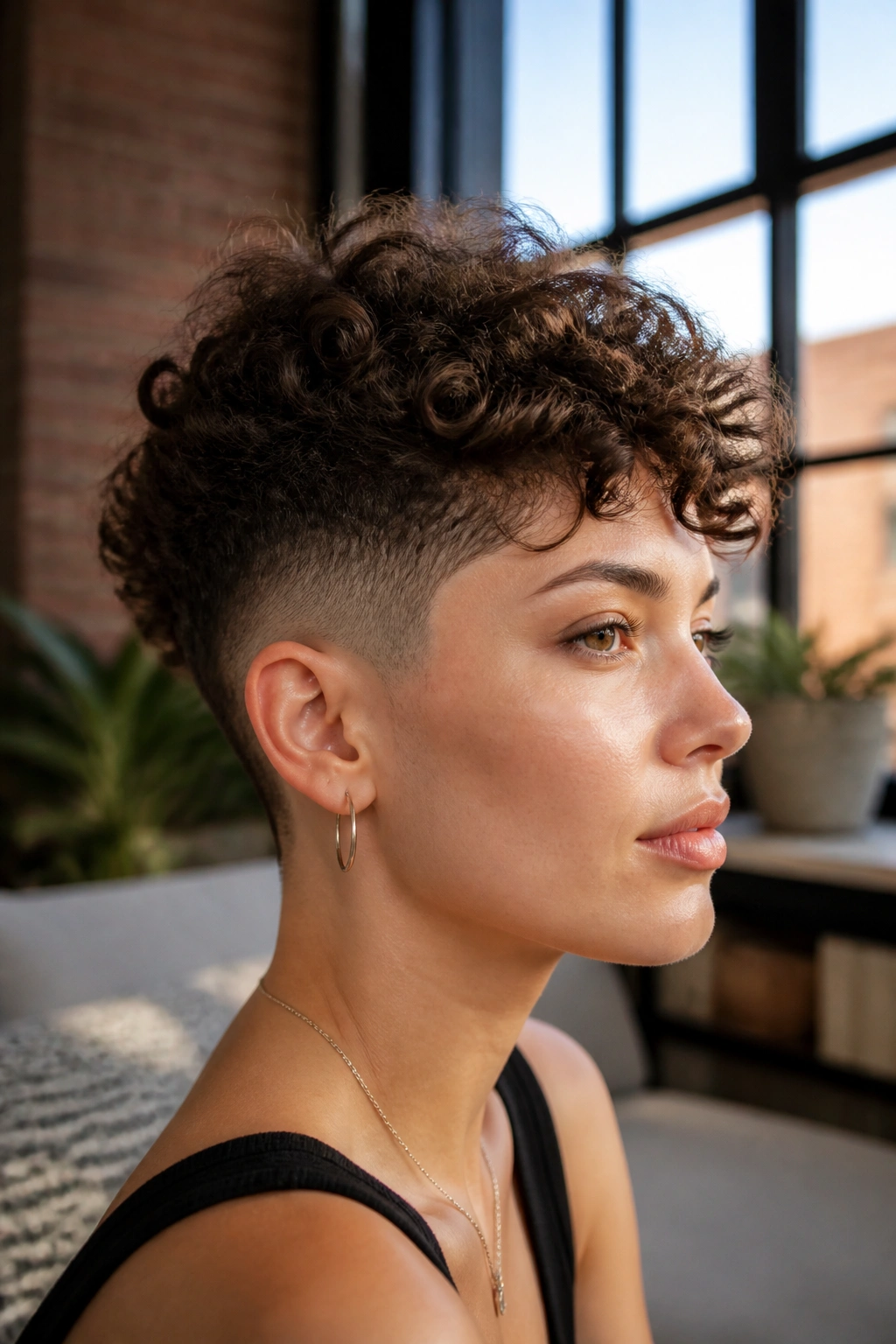
A curly undercut is not just edgy for the sake of being edgy. On a round face, it can be a smart move for thick hair that wants to expand in every direction at once.
The undercut removes bulk from the sides and lower back, which leaves the top free to rise and fall in a cleaner shape. That keeps the face open. It also makes styling easier, because you’re not fighting so much hair every morning. If your curls are dense, that alone can feel like a gift.
What makes it different
- The sides are cut very close, often with clippers or a tight scissor taper
- The top stays long enough to form a visible curl ridge, usually 4 to 6 inches
- The transition should be soft, not a hard ledge unless you want that look
- The top can be pushed forward, lifted back, or swept sideways depending on the day
Best for thick 3C to 4C curls, this shape does need upkeep. The grow-out is not subtle. But if you like clean sides and a bigger top, it’s hard to beat.
8. Broken Bowl Crop with Piecey Ends

If the word bowl makes you think of an old school photo, relax. This is not that. A broken bowl crop uses the same rounded outline, but it cuts the edge into pieces so the shape feels lighter and more alive.
The reason it can work on a round face is simple: the eye expects one solid circle, then doesn’t get one. Instead, it gets interrupted curl clumps, a soft fringe, and a perimeter that flickers in and out near the temples. That interruption matters more than people think.
I’ve always liked this shape for curls with good spring and enough texture to hold a line. The fringe should sit lightly across the forehead, not form a wall. The sides can graze the cheekbones, but the interior should be thinned enough that the cut does not balloon outward.
A broken bowl crop needs confidence from the person wearing it and restraint from the stylist. Too much roundness and it turns childish. Too much layering and it loses the point. The sweet spot sits right in the middle.
9. Ear-Length Halo Crop for Loose Curls

What if you want softness at the sides instead of a tight crop? The ear-length halo crop answers that pretty neatly.
This cut wraps around the head in a gentle circle, but it stays narrow enough through the lower half that it does not widen the face. The curls sit just off the ears and build a soft halo around the head rather than a heavy box. On a round face, that kind of airy outline is a welcome thing.
How to wear it well
Part the hair a little off-center so the front pieces don’t mirror each other too neatly. That breaks the symmetry. Diffuse with your head tilted side to side, then finish upright so the top doesn’t collapse. A tiny bit of root lift at the crown makes the whole cut feel more open.
- Works best on loose curls and strong waves
- Keep the front at ear to cheekbone length
- Ask for interior debulking if the hair wants to puff
- Use a lightweight cream rather than a heavy butter
This one is good when you want short hair that still feels soft, not severe.
10. Choppy Curly Shag Crop with Cheekbone Layers
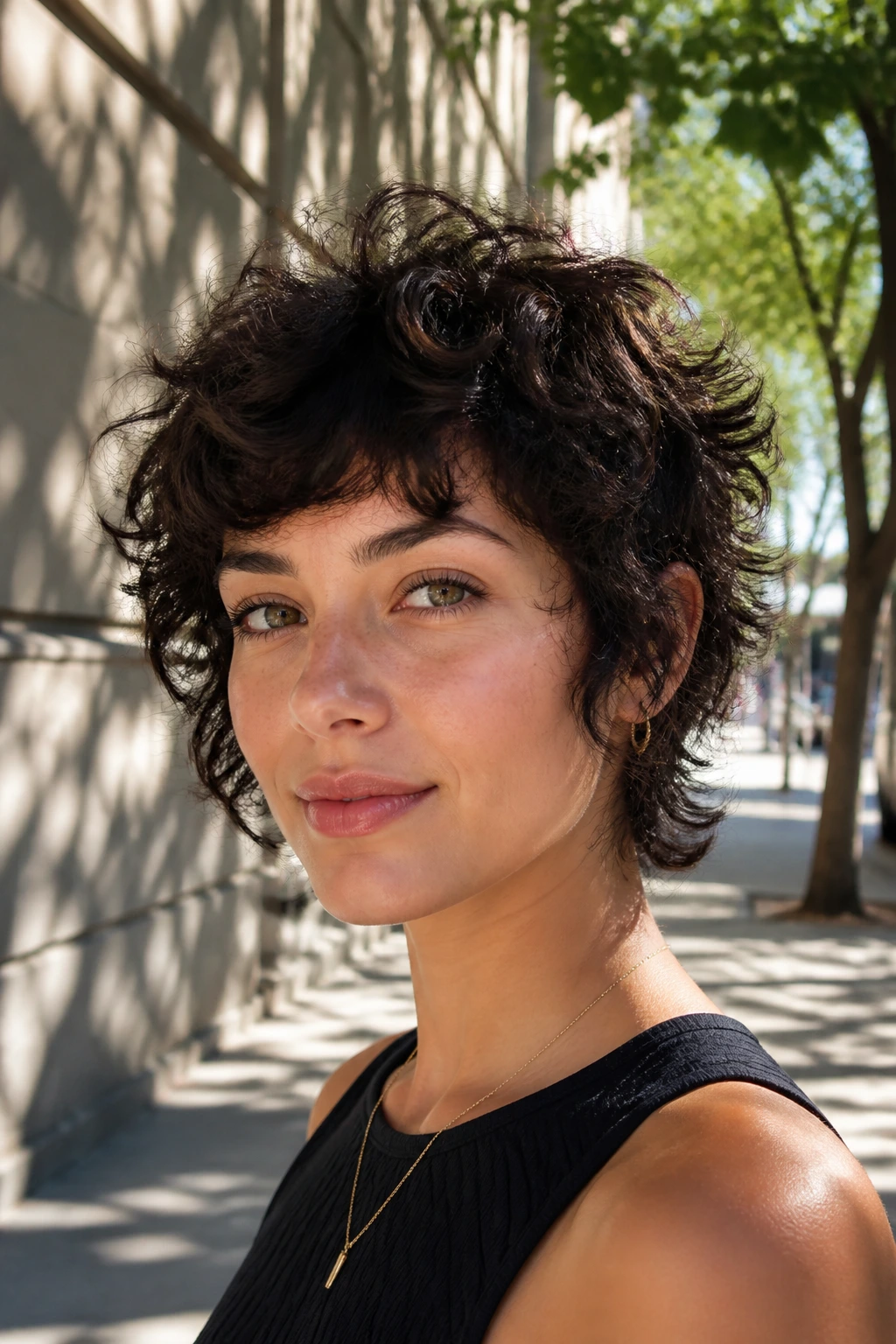
A curly shag at short length can look wild in the best way, provided the layers are placed with some discipline. Cheekbone layers do the heavy lifting here.
Instead of building one round shape, the shag breaks the hair into sections that sit at different lengths. That means the curl pattern keeps moving. On a round face, the best version avoids adding width at the sides and instead pushes energy upward and forward in little pieces.
This cut shines on medium to thick curls that like freedom. It’s less successful on hair that already balloons at the root, unless the stylist removes enough weight from the interior. Ask for a shorter crown, pieces that fall near the cheekbone, and ends that stay irregular. A uniform edge kills the shape fast.
A choppy curly shag crop can look a little rough while wet and completely right once dry. That’s normal. Curls do not always behave in the sink. They usually get smarter on their own later.
11. Mushroom Crop with Softly Separated Ringlets
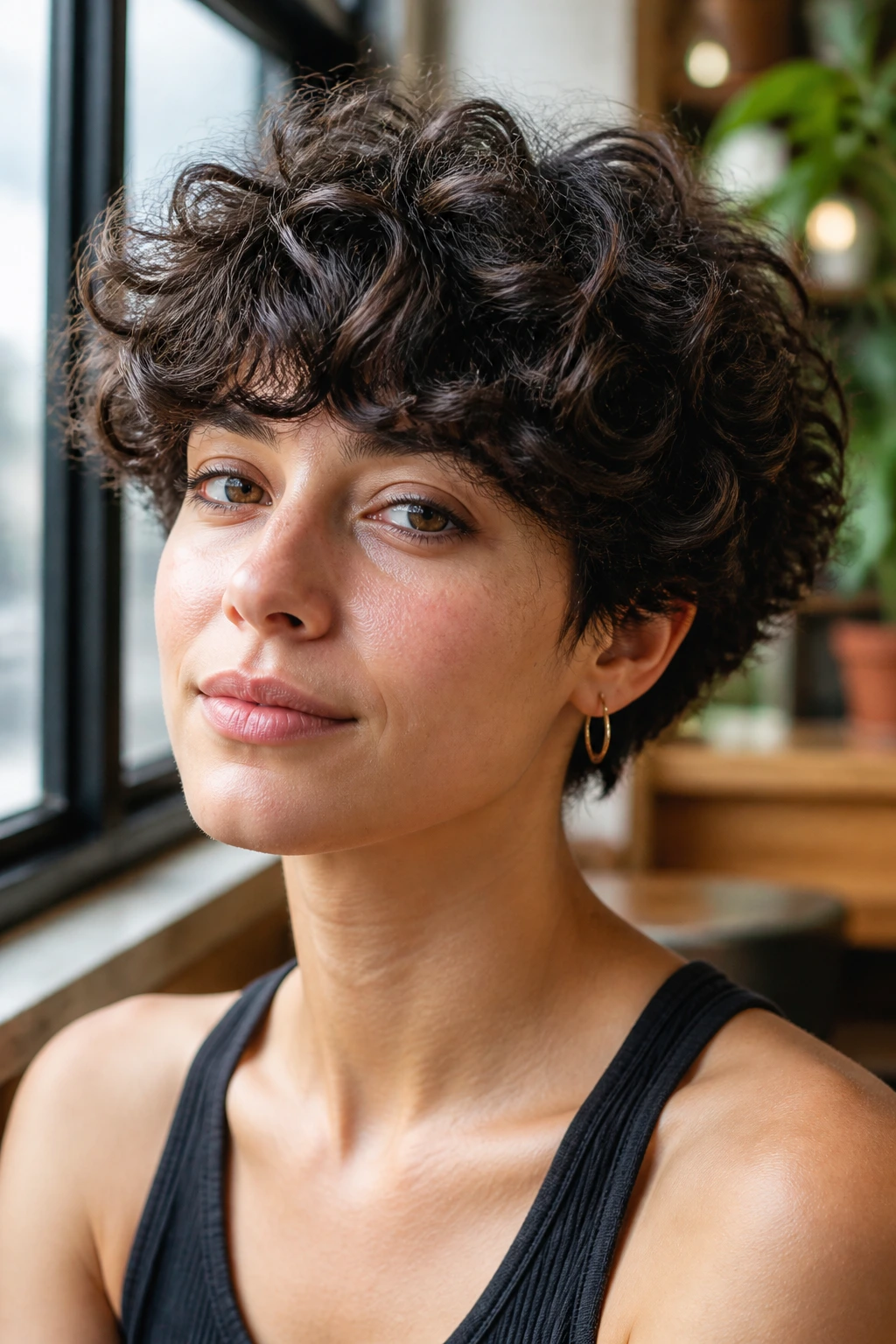
A mushroom crop gets a bad reputation because people picture a hard, helmet-like circle. Fair enough. A bad one does look like that.
A good one is different. The top sits gently rounded, the sides stay tucked in enough to keep the width under control, and the ringlets are separated so the outline never becomes one solid dome. On a round face, that separation is the whole point. Without it, the face and the haircut start echoing each other too much.
This cut works best when the curls have a little spring and can hold their own shape. A soft mushroom crop also benefits from a dry cut, because the stylist can see where the curls stack and where they need to be released. A heavy perimeter is the thing to avoid. It makes the cut sit down instead of floating.
I like this one for people who want something a little unusual but still wearable. It has personality. It also needs a hand with styling—usually a diffuser, a touch of cream, and a quick finger-shake at the end to separate the clumps before they dry together.
12. Deep Side-Part Bob with a Sweeping Fringe

A deep side part can change the whole mood of a curly bob. It gives the face a diagonal line, and diagonal lines are useful when a face is softly rounded.
Unlike a center part, which often reinforces symmetry, a deep side part breaks the front of the haircut into two different planes. One side can sweep across the forehead in a fringe-like curve. The other can sit tucked back or rest near the jaw. That movement makes the face look longer without turning the cut into a long haircut.
This is a strong choice if you want to keep some bob length but avoid a closed, helmety outline. Keep the fringe long enough to graze the cheekbone or eyebrow, depending on shrinkage. The key is that it should move, not stick.
The shape also gives you options on styling days when one side misbehaves. Push the bigger curl cluster forward, tuck the other side behind the ear, and let the part do the work. Simple. Effective.
13. Tapered Coil Crop with Clean Sides
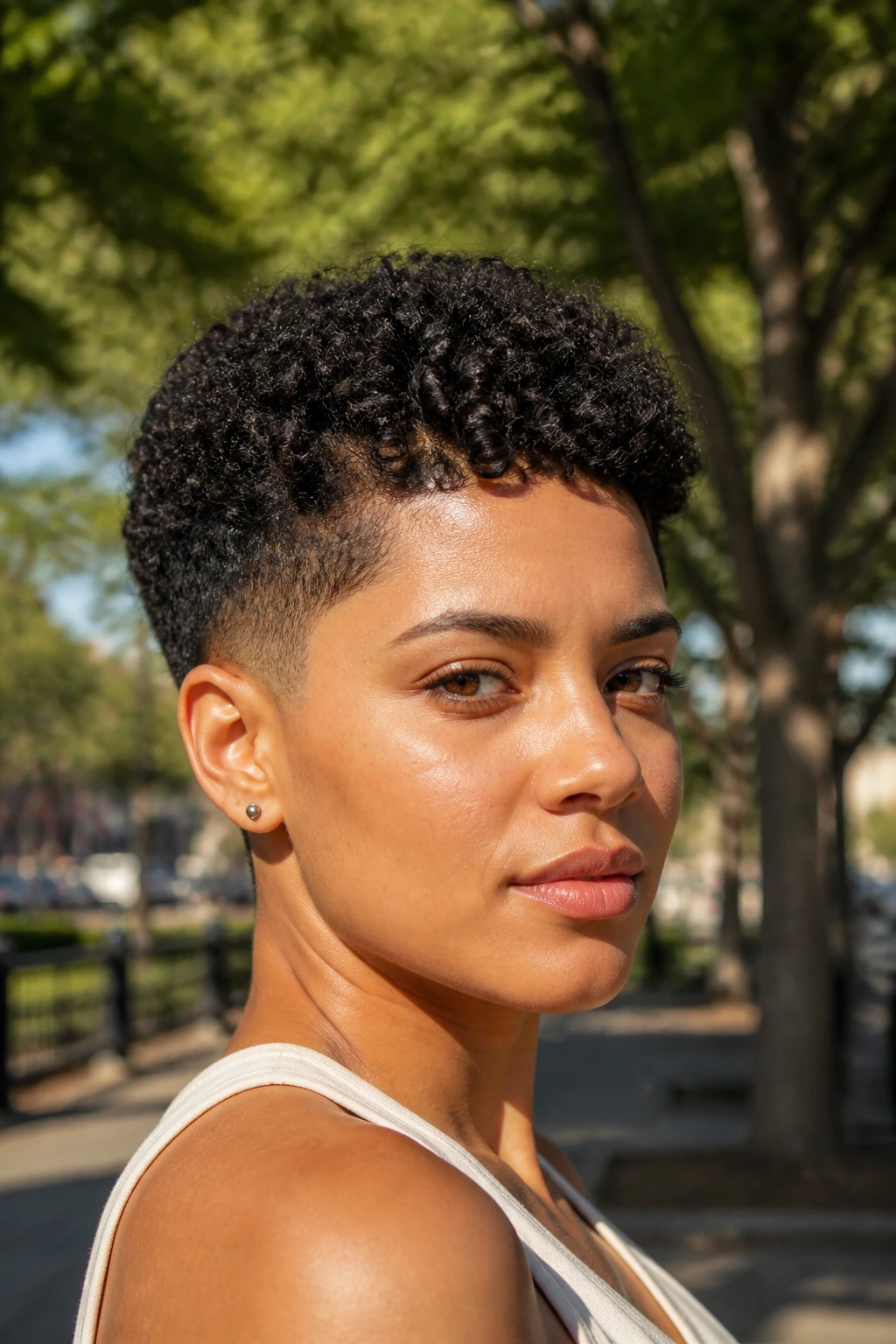
Coils need breathing room. When the sides are too bulky, the whole head can start to look rounder than it needs to be.
A tapered coil crop keeps the sides close and clean while letting the top and front carry the shape. On a round face, that clean side line becomes a quiet frame. It makes the cheek area look more open and gives the eye a clear path upward.
Why coils do well here
The structure of the cut matters more than a long styling routine. Leave enough length on top for the coils to curl upward, then taper down around the ears and neckline. A line-up can be neat, but it should not be so sharp that it feels stiff. Soft edges look better on most curl patterns.
- Ideal for 4A to 4C coils
- Top length: 3 to 5 inches depending on shrinkage
- Side taper: close enough to slim the silhouette, not shaved to the skin unless that’s the goal
- Styling: cream first, then a touch of gel for definition
This is one of the more honest cuts on the list. It does not pretend to be long. It just shapes what you already have.
14. Pixie Bob with a Long Front Corner
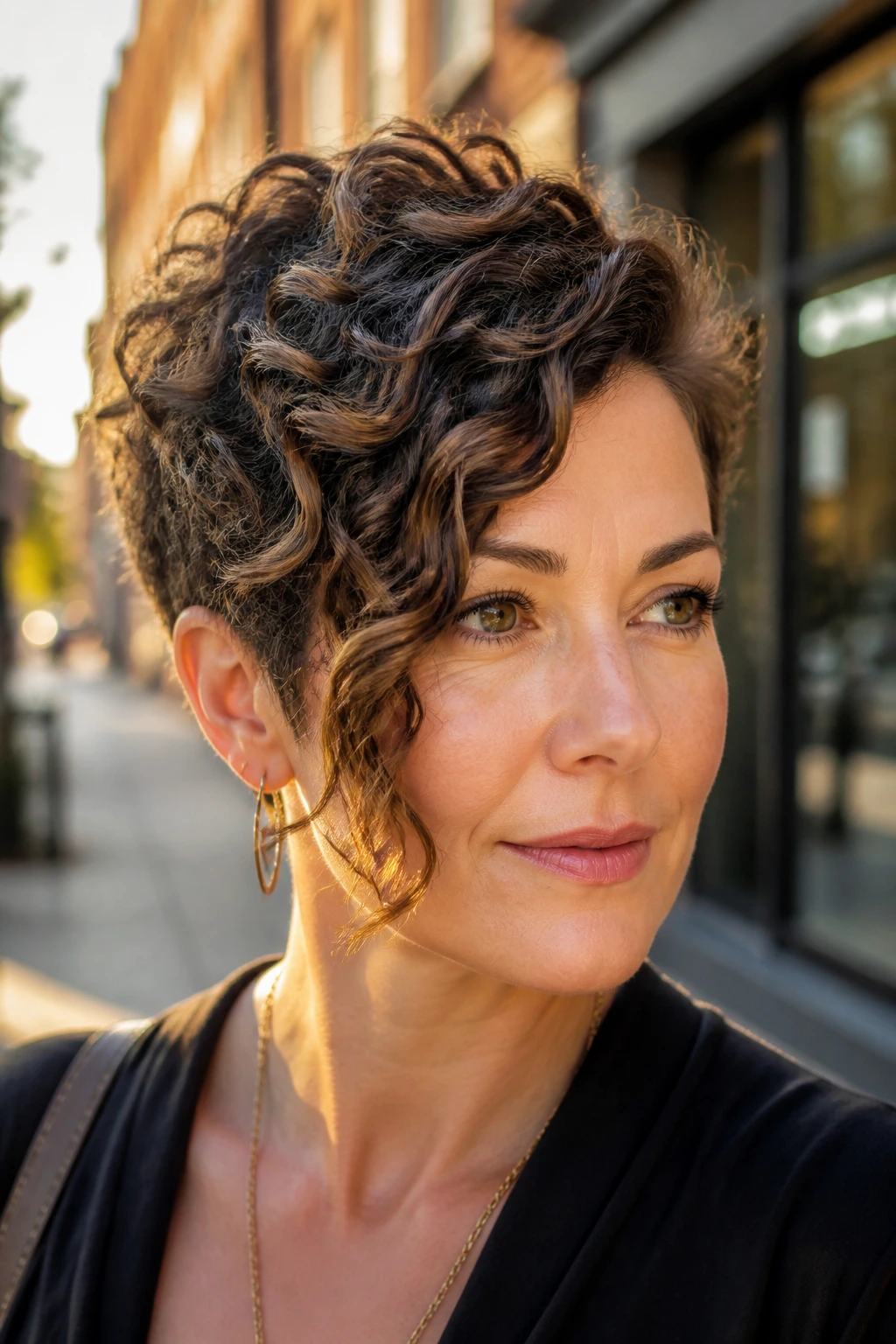
The pixie bob is the sweet spot for someone who wants short hair without losing a front piece to play with. The long front corner is the part that changes everything.
That longer section can hit the jaw, lip, or cheekbone, depending on your curl pattern and how much shrinkage you have. The back stays shorter and the sides stay tidy, which keeps the bulk from spreading too far across the face. On a round face, that front corner acts like a visual anchor. It pulls the shape down in one place and lets the rest stay compact.
This cut usually works best with a side part or a slightly off-center part. If the front corner is too symmetrical, the effect gets lost. Curls also need enough weight at the front to prevent that section from bouncing upward and disappearing.
I like this cut for people who want a neat outline but not a severe one. It has more softness than a pixie and less fuss than a bob. That middle ground is often where the good stuff lives.
15. Wedge Crop with Curl Clumps and a Narrow Nape
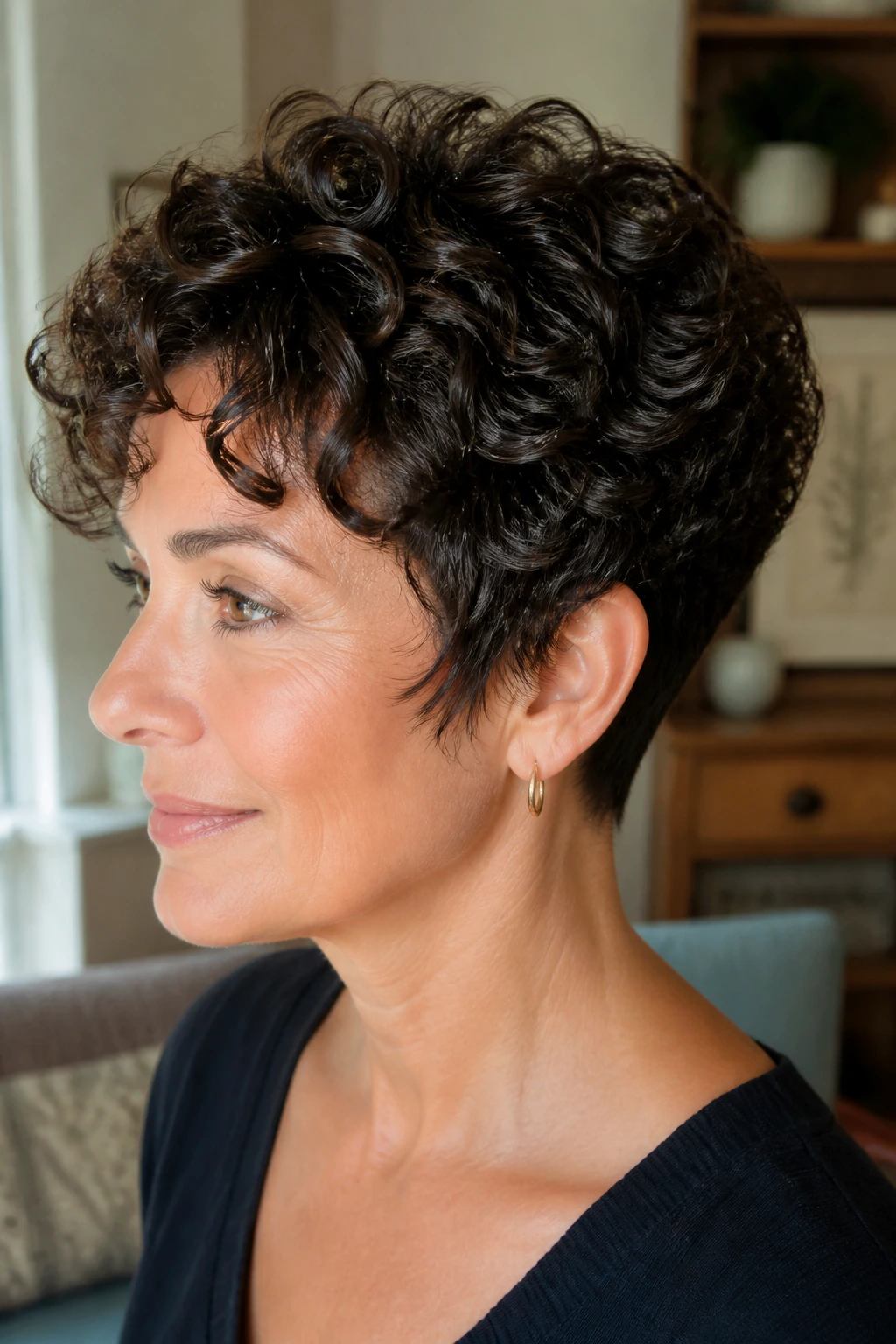
What makes a wedge crop so useful on a round face? The angle. The shape rises from a narrow nape into more fullness toward the crown, which gives the head a more lifted profile.
With curls, the wedge should not feel stiff. The curl clumps need space to sit in layers, or the whole thing can turn puffy in the wrong place. A narrow nape keeps the cut clean at the back, while the upper section carries the movement. That balance matters a lot.
Ask for the shortest point to land close to the neckline and the longest front pieces to stop near the chin or just above it. If your curls are loose, the wedge can be more obvious. If they are tighter, the graduation may need to be softer so the shape doesn’t jump too sharply.
This cut is a smart choice when you want a short style with structure. Not flat. Not fluffy. Structured.
16. Curtain-Fringe Crop with Flipped-Out Ends

A curtain fringe is one of those small details that can save a short curly cut from feeling too closed in. Split down the middle and allowed to fall softly to each side, it opens the forehead and breaks up the roundness of the face.
On curls, the fringe usually works best when it’s cut a little longer than you think you need. Shrinkage is rude about bangs. Leave room. The ends can flip outward or curl under depending on your pattern, and either direction can work as long as the shape stays light. A heavy curtain fringe is a bad idea here. It swallows the face.
The rest of the cut can sit at bob or crop length, but the fringe is what shifts the mood from strict to easy. I like this look when the curls have enough definition to separate into two soft panels around the forehead. It feels relaxed without falling apart.
A quick finger-coil on the front pieces can help if your curl pattern is less cooperative. Just don’t overdo it. The whole point is movement, not perfect symmetry.
17. Rounded Micro Bob with Light Internal Layers
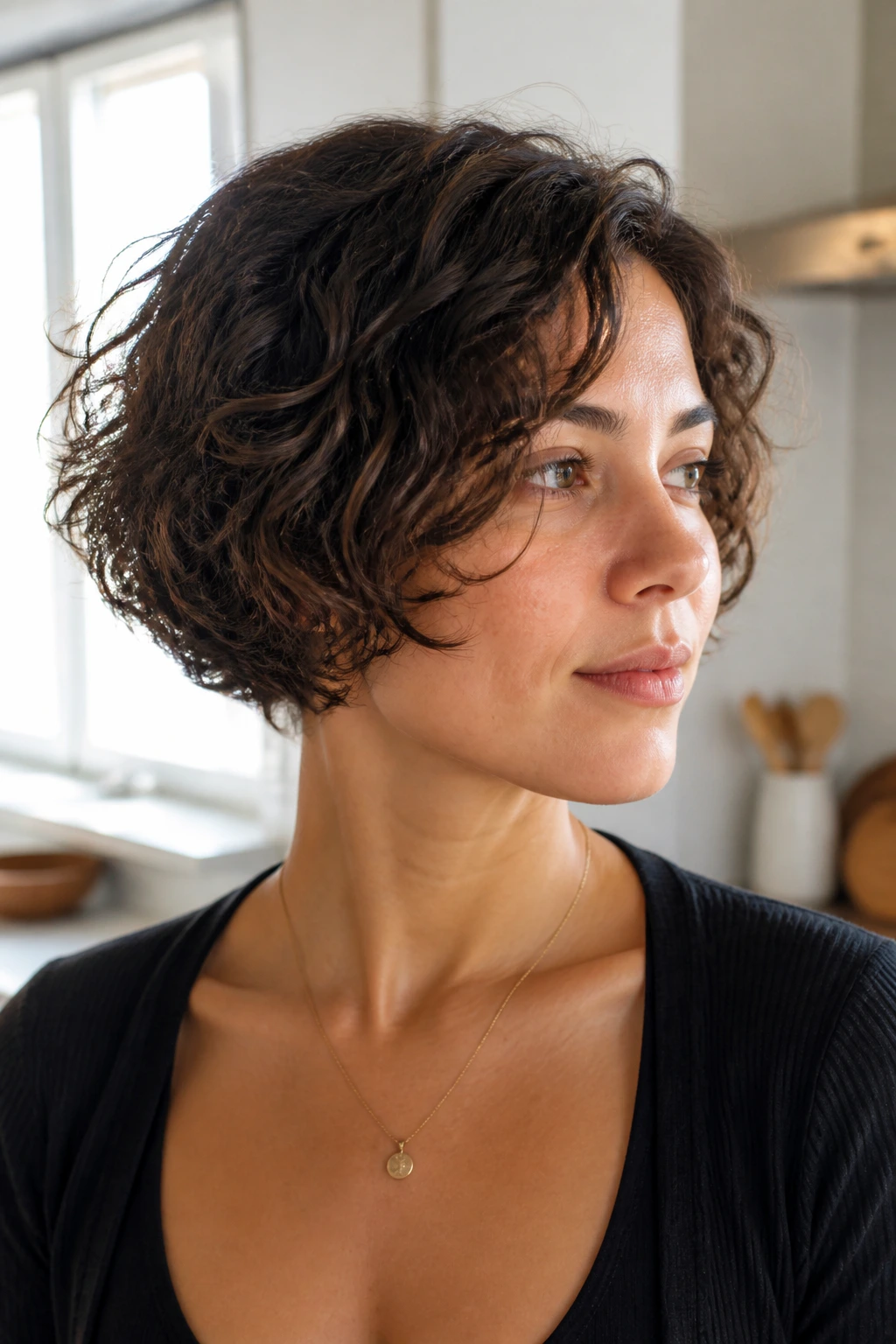
A rounded micro bob can look surprisingly good on a round face when the interior is cut with restraint. The line is short—often lip to cheekbone length when dry—but the shape should not be dense.
The interior has to breathe.
If the cut is left too full, it will sit like one hard shape around the face and that’s where people get nervous. Light internal layers fix that. They remove enough weight to keep the curls from forming a single thick rim, while the outer line stays soft and controlled.
This is a strong option for curls that behave well and do not require too much daily rebuilding. A mist of water, a small amount of cream, and a diffuser are usually enough. The trick is to keep the root area lifted and the perimeter separated. Once it dries into one solid ring, the face can look smaller than it is.
The micro bob suits people who like a cropped shape but want a little more body than a pixie. It has presence. It also needs a stylist who understands that short curly hair is not just long hair cut off. It has its own rules.
18. Soft Crop with a Tucked-Behind-Ear Shape

Tucking one side behind the ear sounds small, but it changes the face shape fast. That’s why a soft crop with built-in tuck room is such a useful choice.
The cut should be slightly longer on the side you want to tuck, with enough length near the temple to hold its place without looking forced. The other side can stay looser and a touch fuller. That imbalance keeps the face from reading as a perfect circle. It also gives you an easy styling trick on days when you have no patience.
This cut works well for people who wear glasses, because the temple area stays light and the frames don’t have to fight the hair. It also helps if you want a polished look without using heat. A simple side tuck can make the whole cut feel intentional.
Keep the ends soft and a little irregular. Too much precision makes the crop feel formal. Curly hair usually looks better when it moves a bit, even in a short shape. That extra bit of looseness is what keeps it from getting fussy.
19. Short Curly Cut with Temple Length
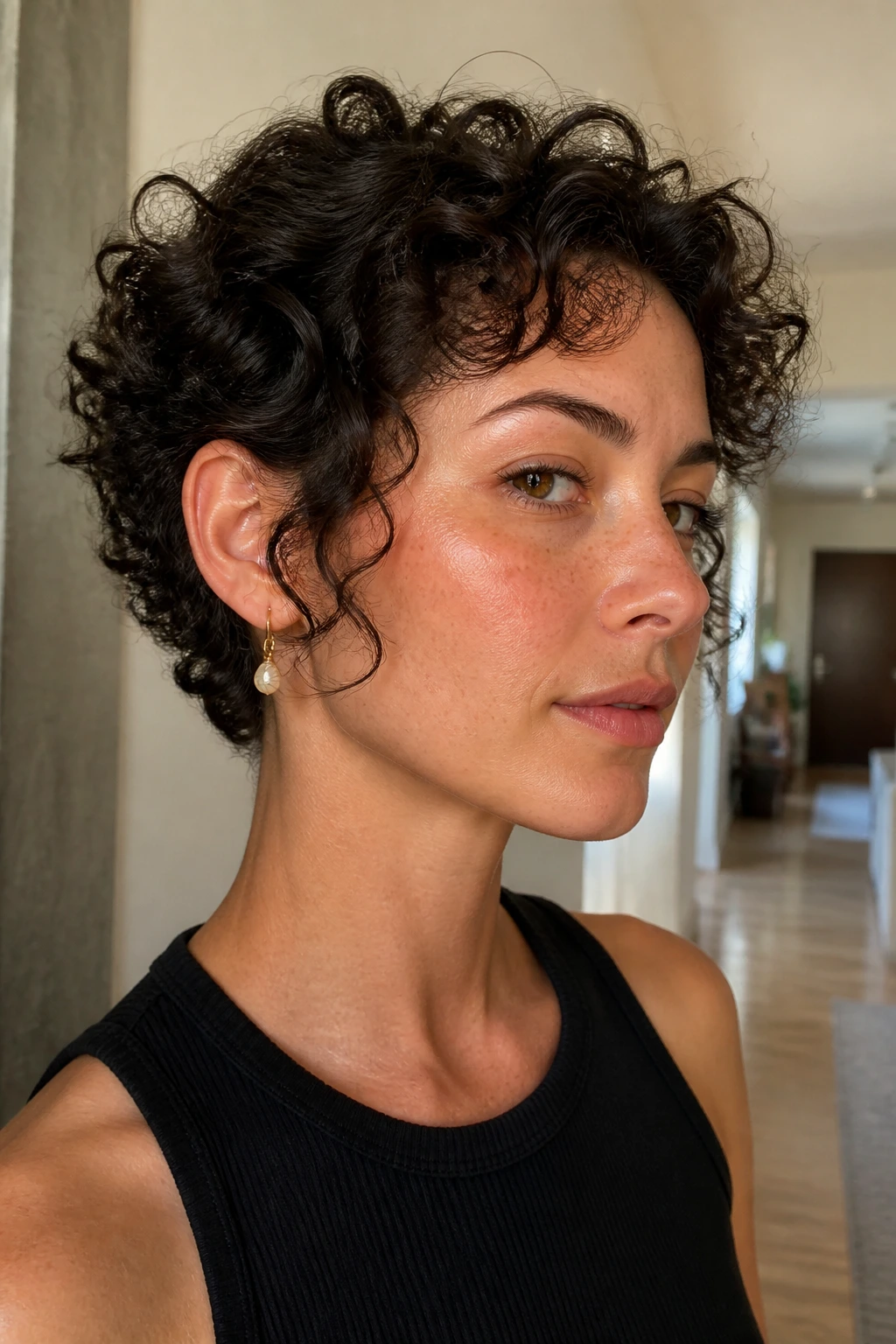
Temple length is one of the most underrated tools in short curly hair. It gives you a little vertical line beside the face without dragging the whole cut into bob territory.
On a round face, that matters because the temples are where a lot of cuts go wrong. Too much bulk there, and the face starts to widen. Keep the hair a touch longer at the temples, and the shape opens up. You get a frame instead of a wall.
- Good for wash-and-go styling
- Works on loose curls, ringlets, and softer coils
- Temple pieces should sit near cheekbone level when dry
- The back can stay shorter to preserve lift
This style is a sleeper hit because it grows out well. The silhouette changes slowly, not all at once. That means fewer awkward weeks between salon visits. For people who don’t want a high-maintenance crop, that alone makes it worth a serious look.
20. Textured Bowl Bob with a Floating Fringe

Yes, a bowl shape can flatter a round face. The catch is that it must be textured, not blunt, and the fringe has to float instead of forming a hard shelf.
The reason this version works is that the perimeter is broken into pieces. The fringe can sit lightly across the forehead in separated arcs. The sides should curve around the head without puffing at the widest point of the cheek. The bob length can hover around the jaw or just above it, depending on your curl pattern, but the edge needs movement.
If the old-school bowl cut is a solid circle, this is a scattered one. Much better. The texture keeps it from looking heavy, and the floating fringe softens the forehead without closing the face off. On the right curls, it looks cool and deliberate. On the wrong cut, it looks like a helmet. So the details matter.
Bring this one to a stylist who understands how curls shrink and where they want to spring. A blunt perimeter is the fastest way to ruin it. A little internal layering and a lot of restraint keep it sharp.
The Bottom Line
Round faces do not need to be hidden. They need shape. That can mean height at the crown, a longer front corner, a broken fringe, or a clean taper that stops the sides from taking over.
The smartest short curly styles usually leave one part of the cut a little longer than the rest. That diagonal or vertical movement is what keeps the face from feeling boxed in. If you remember only one thing, make it this: the outline matters more than the length.
Bring two photos to the salon if you can. One should show the overall silhouette you want, and the other should show the fringe or front detail. That tiny bit of extra clarity saves a lot of awkward grow-out later, which is worth caring about.
