



Short hair doesn’t need to stay flat around the jaw.
A round face usually reads widest through the cheeks, so the smartest updos work like little bits of visual architecture: a touch of height at the crown, a line that moves diagonally instead of straight across, or a slim strand that softens the cheekbone without adding bulk where you don’t want it. That’s the whole game. Not length. Shape.
And short hair can do more than people give it credit for. In fact, shorter lengths often hold pins better than long hair because there’s less weight dragging everything down. A little mousse at the roots, a few strong bobby pins, and a flexible hairspray can turn a chin-length cut or shoulder-grazing lob into something polished enough for a dinner, a wedding, or a day when you just want your hair off your neck.
The key is choosing styles that work with the face, not against it. A bun that sits too wide at the sides can make a round face feel fuller; a style that narrows at the temples, lifts at the top, or sweeps to one side usually feels lighter and more balanced. Tiny detail. Big difference.
1. Side-Swept Low Chignon for Round Faces
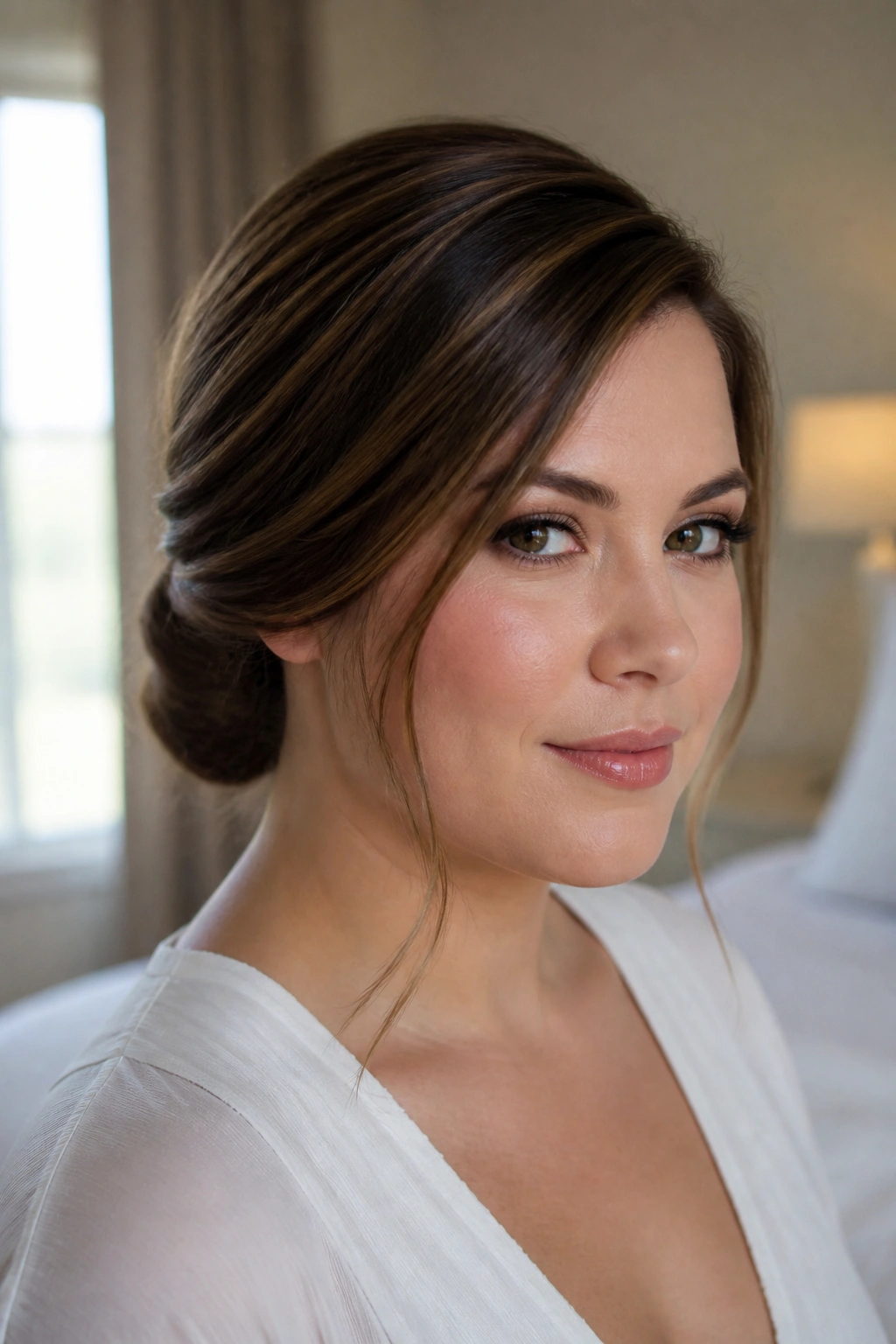
A low chignon can flatter a round face faster than a fussy braid pile-up. The reason is simple: it keeps the visual weight low and narrow while the side part creates a long line that cuts across the face instead of framing it in a perfect circle.
The Shape Trick
Sweep most of the front section to one side, then tuck the bun just below the occipital bone, not out near the ears. That placement matters more than people think. If the chignon sits too high or too wide, it starts to fight the face shape; if it sits low and slightly off-center, it feels cleaner and slimmer.
A few loose face pieces help, but keep them thin. You want strands that kiss the cheekbone, not a heavy curtain that lands right on the widest part of the face. That single choice changes the whole look.
- Use a deep side part if your hair falls flat at the roots.
- Keep the bun no wider than the back of your hand.
- Pin from underneath so the twist looks smooth from the front.
- Leave one slim section near the temple for softness.
Pro tip: Tease the crown only a little. One soft inch of lift is enough; a towering pouf can make the style feel top-heavy fast.
2. Twisted Crown Updo With Loose Cheek Pieces
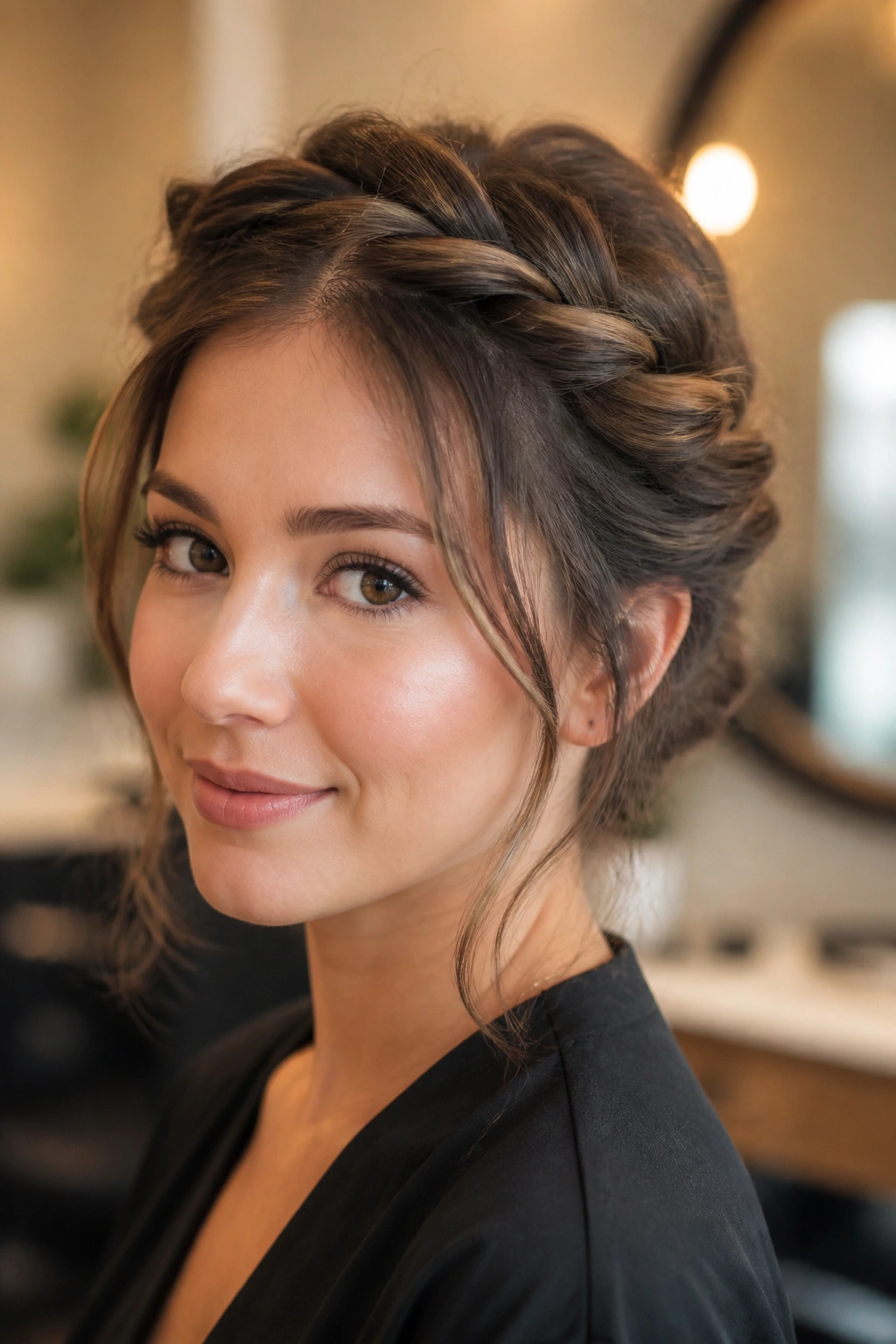
A twisted crown updo gives you height without turning the top into a puffball. That’s why it works so well on round faces. The twists sit along the hairline, then travel back toward the nape, which keeps the eye moving upward and back instead of straight outward.
The face pieces matter here. Leave a pair of slim, curved strands near the cheeks and stop them around the top of the jaw or just below the cheekbone. Too long, and they can drag the face down. Too short, and the front starts to look abrupt. There’s a sweet spot, and it’s usually smaller than people expect.
This style is especially kind to layered bobs and lobs because the shorter top layers help the twist hold its shape. Spray a little texture spray through the front sections before you twist them. Clean, slippery hair slips. Always.
Keep the crown airy, not puffy. That’s the part that gives the style lift without adding extra width where your face is already fullest.
3. Mini French Twist That Fakes Extra Length
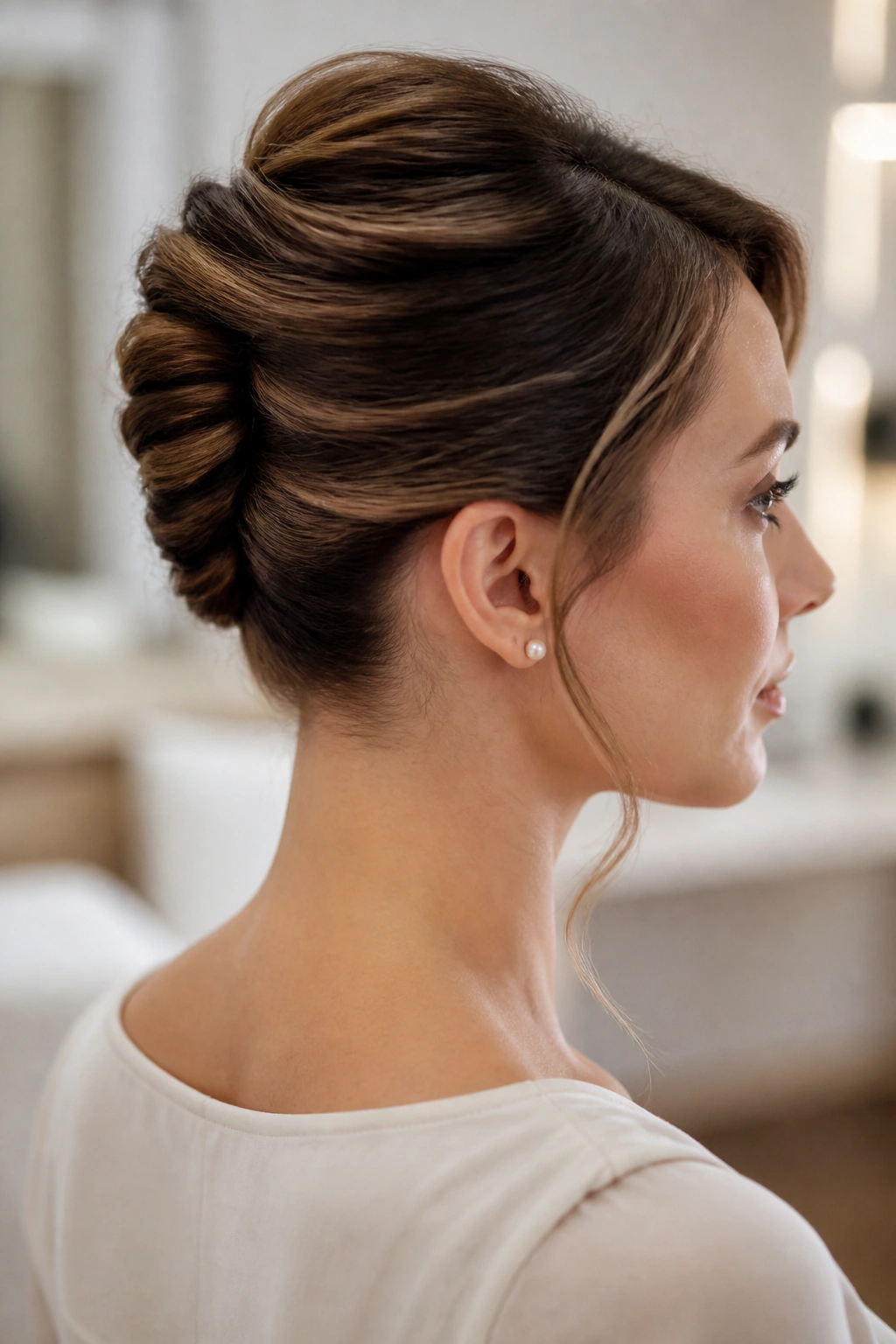
Can a French twist work on short hair? Absolutely—if you shrink the scale.
A classic, tall French twist can overwhelm a bob, but a mini version tucked low at the back does something smarter. It lengthens the neck, creates a neat vertical line, and leaves the face open so the cheeks don’t feel boxed in. The trick is to stop thinking of it as a formal shell and start thinking of it as a compact roll.
How to Build It
Take the back section and gather it as if you’re making a tiny ponytail, then fold the lengths upward and inward. Pin along the seam with two or three long bobby pins, crossing them if the hair is fine. The roll should look smooth but not bulky.
A side part works better than a dead-center part here if your face is very round. A center part can still work, but the twist needs a little asymmetry somewhere else—usually in the front sweep or in the angle of the roll itself.
Do not overfill the twist. If you force all the hair into one thick column, the style stops looking crisp and starts looking stuffed.
4. Braided Halo With Soft Height at the Crown
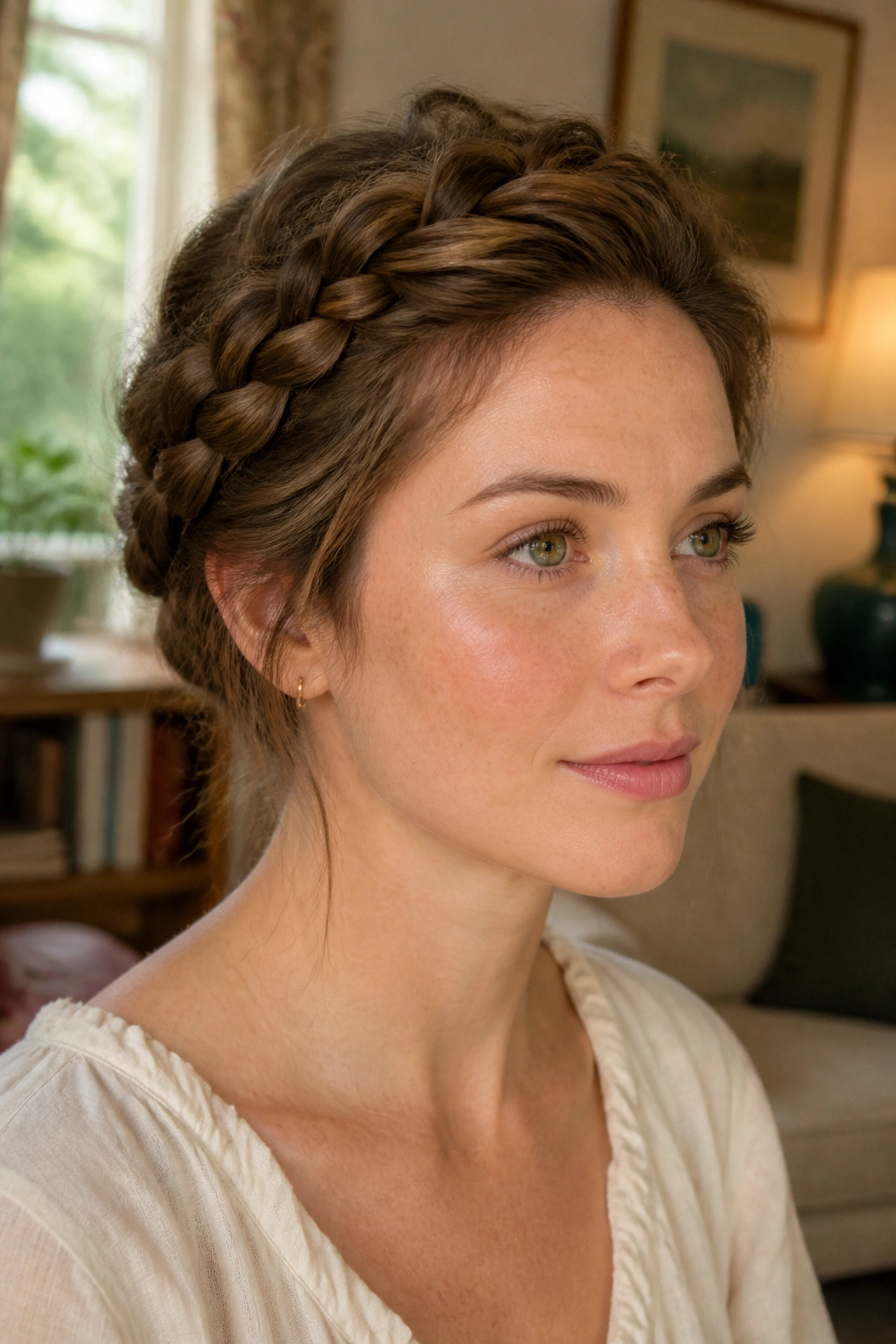
If your hair falls just below the chin, a braided halo is the style that makes people pause for a second and look twice. The braid sits around the head like a narrow frame, which keeps the widest part of the style away from the cheeks and gives the face a little vertical lift.
I like this one for hair that has some bend to it already. The texture helps the braid grip, and the finished halo feels less stiff. A smooth braid can work too, but it needs a touch of pull-apart volume at the crown so the top doesn’t collapse into a flat line.
What to Pin and What to Leave
- Start the braid low behind one ear and carry it across the back.
- Keep the braid close to the head so it doesn’t balloon outward.
- Pin the ends under the opposite side, hidden beneath the braid path.
- Pull a few crown sections gently once the braid is secure.
The result is soft, not childish, and that matters. A halo that sits too high can widen the face; one that stays close to the head and leaves a bit of height up top feels much more flattering. That small difference is the whole style.
5. Pinned-Back Faux Bob With a Clean Nape
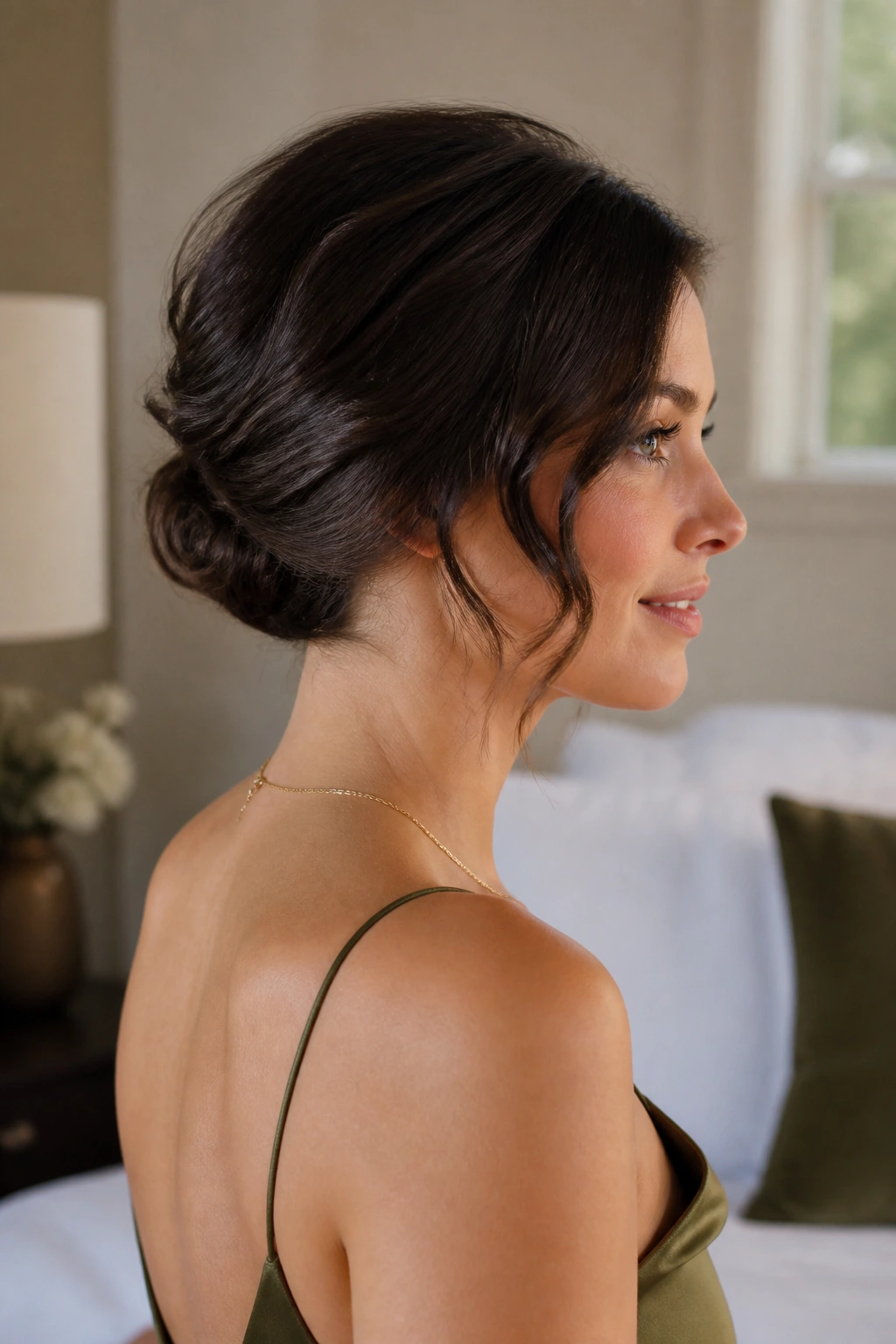
A faux bob is sneaky in the best way. You tuck the ends under, pin them near the nape, and suddenly a shoulder-length cut reads like a shorter, more sculpted shape that opens the neck and narrows the lower face.
The cleanest version starts with loose waves or soft bends, not pin-straight hair. Straight hair can work, but a little texture makes the tucked ends hold better and keeps the look from sliding into a harsh, flat line. A round face tends to look longer when the neck is visible, so this style earns its place.
The front can stay smooth or slightly side-swept. I prefer a mild side sweep because it breaks up the width at the temples without stealing attention from the tucked shape at the back.
It’s one of those styles that looks elaborate from the front and takes less effort than people assume. Good pins, a bit of hidden padding if the hair is thin, and patience while you tuck the ends. That’s it.
6. Center-Part Low Knot With Slim Side Strands
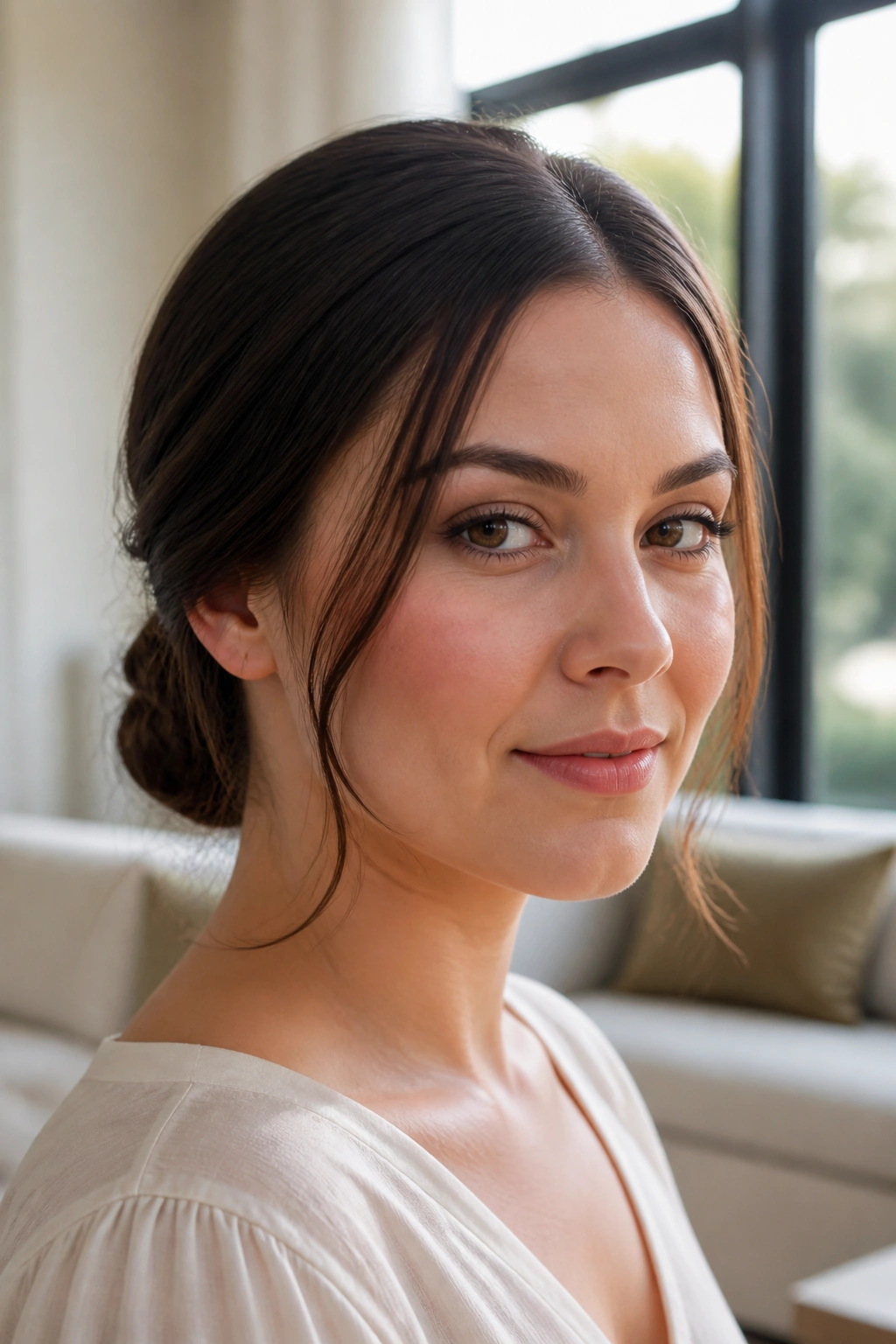
Compared with a tight ballet bun, a center-part low knot feels softer and far less boxy. The center part draws a clean vertical line, while the tiny knot at the nape keeps the shape compact enough that it doesn’t spread across the sides of the face.
This is a smart option for round faces because it balances symmetry with restraint. A full, wide bun can make the face feel broader. A small knot, tucked low and held close to the head, does the opposite. Small in the back. Calm in the front.
The side strands need discipline. Leave them thin and let them fall just to the curve of the cheek, not into the jawline. If your hair is thick, split the ponytail in two before you coil it so the knot stays flat instead of bulging out.
Best for: straight or lightly wavy hair, medium-short lengths, and days when you want a clean line without looking severe.
7. Messy Gibson Tuck That Hugs the Neck
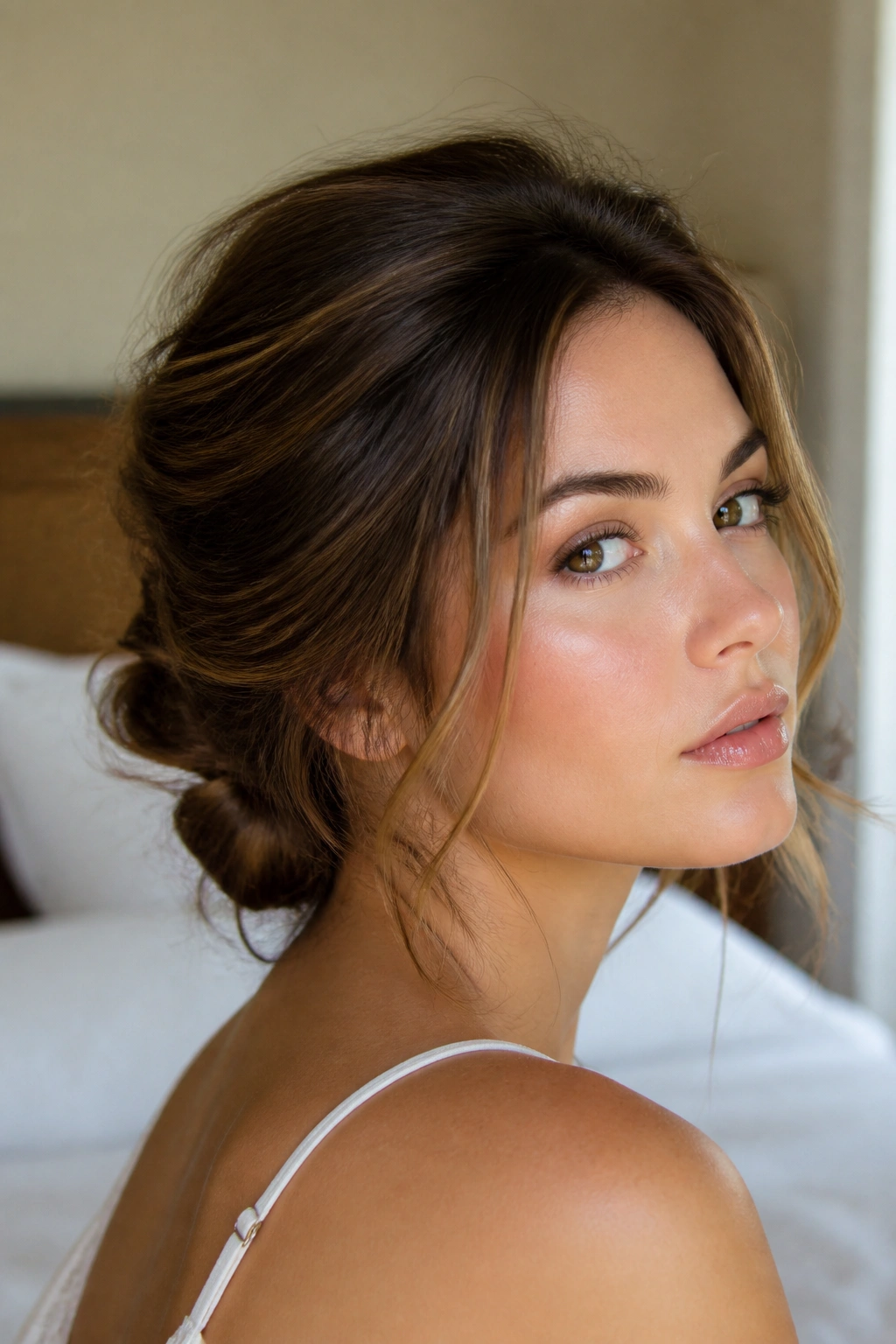
Some styles need more hold than others. The Gibson tuck is one of the easier short updos to fake because it works with a loose roll at the nape instead of asking every strand to behave like it’s in a formal bun.
Why It Flatters Round Faces
The tuck sits low and long. That alone helps. It also keeps the volume near the neck instead of at the cheeks, which matters when your face already has soft width through the middle. The shape reads almost like a graceful fold rather than a round knot.
What to Pin First
- Start by clipping the top section out of the way.
- Gather the lower half loosely and roll it inward.
- Secure the fold with pins placed horizontally, not just from the sides.
- Release the top section and tuck it over the roll.
A little mess is good here. Too much neatness makes the style stiff, and stiff usually means wider-looking. Let a few ends escape on purpose. A soft tuck beats a perfect tuck every time.
8. Rope-Braid Bun Set Off to One Side
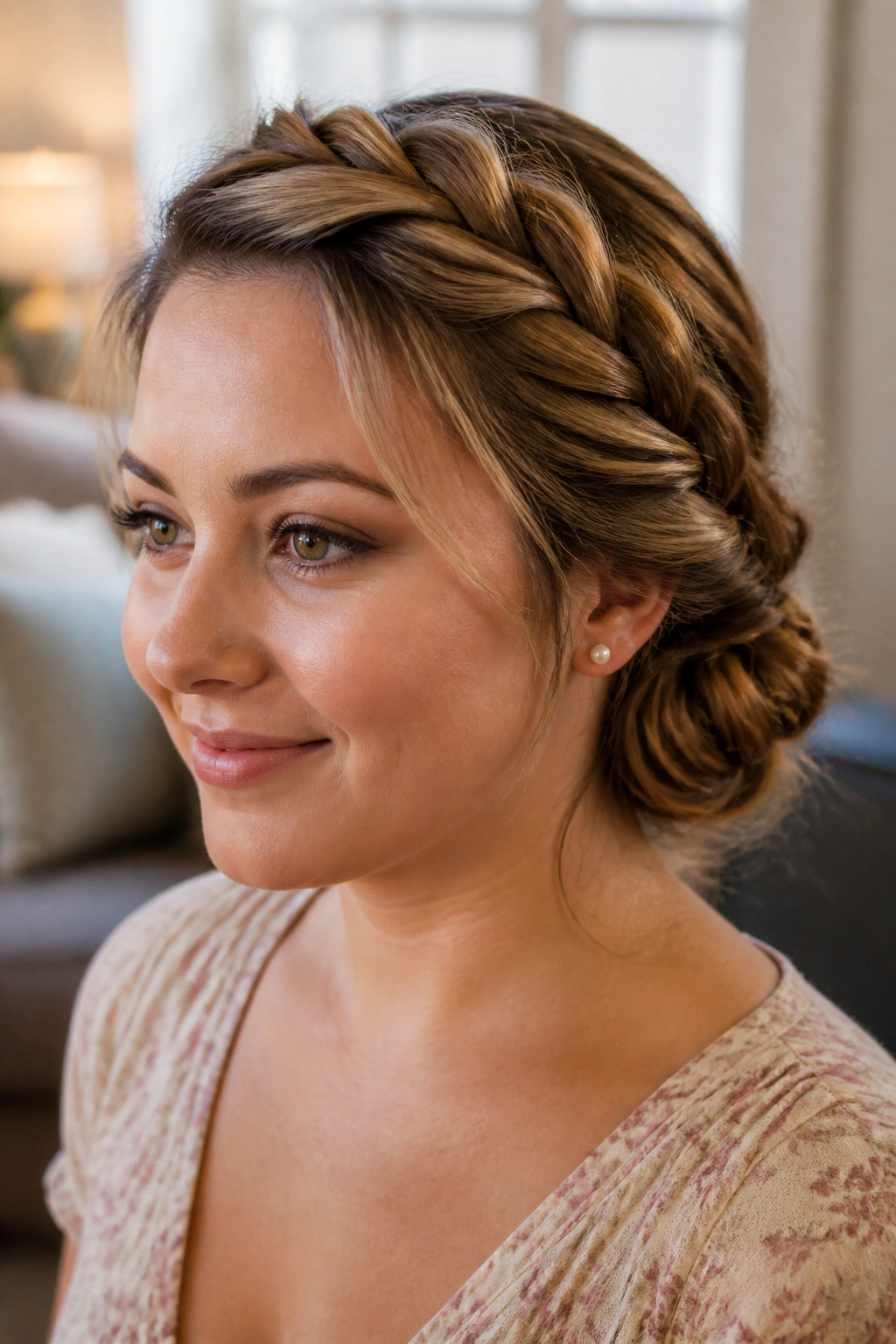
A rope braid changes direction faster than a three-strand braid. That sounds small, but on a round face it matters because the diagonal flow keeps the eye moving instead of sitting in one broad circle around the head.
This style begins with two twisted sections pulled from one side of the head and wrapped toward the other side, then folded into a low bun. It’s especially good when your hair is too short for a full braided crown but still long enough to twist and pin. The bun itself stays compact. The movement comes from the braid line.
You can keep the finish polished or a little undone. Polished gives you a sharper outline, which works well if your face is soft and you want more structure. A looser version feels easier and less formal.
A little grip helps a lot. If your hair is slippery, mist the mids with dry shampoo or texture spray before you twist. Clean hair and rope braids do not always get along.
9. Rolled Under Bob-Length Updo
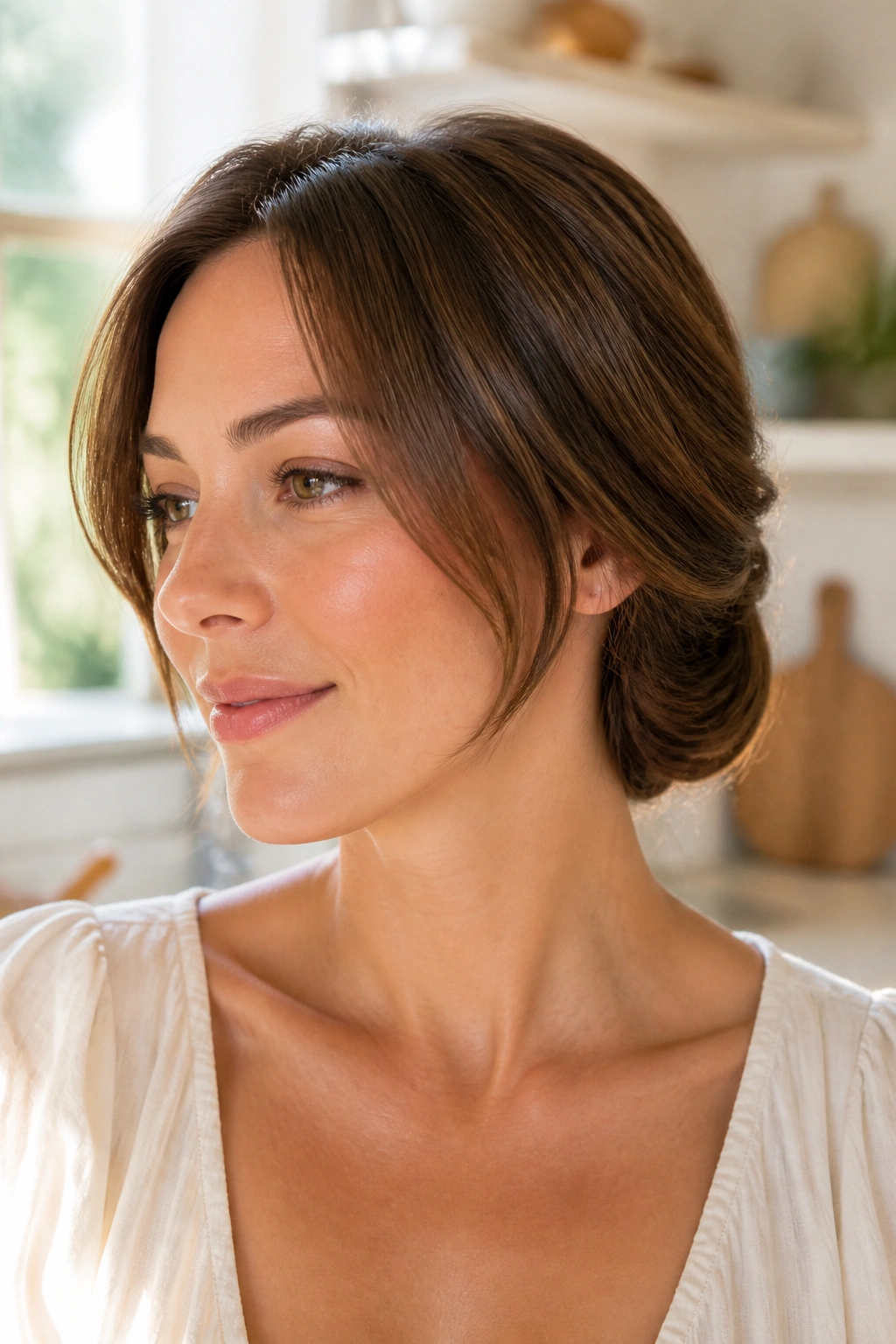
Bob-length hair loves a roll under. It gives you structure without pretending the hair is longer than it is, and that honesty is part of why it works on round faces.
The roll starts at the bottom edge of the hair, right near the nape, and folds upward so the ends disappear underneath. That inward curve narrows the silhouette. A wide, loose loop at the sides would do the opposite, so keep the roll snug and close to the neck.
Small Details That Matter
- Curl the ends lightly first if they stick out.
- Use long pins at the center seam.
- Smooth the top with a brush, but keep the sides flat.
- Finish with spray only after the roll feels locked in place.
This style reads neat, but not harsh. That’s a good thing. A round face benefits from a clean line, yet it still needs a little softness to keep the look from feeling severe. The rolled-under shape gives you both.
10. Curly Puff Pin-Up With Lift at the Roots
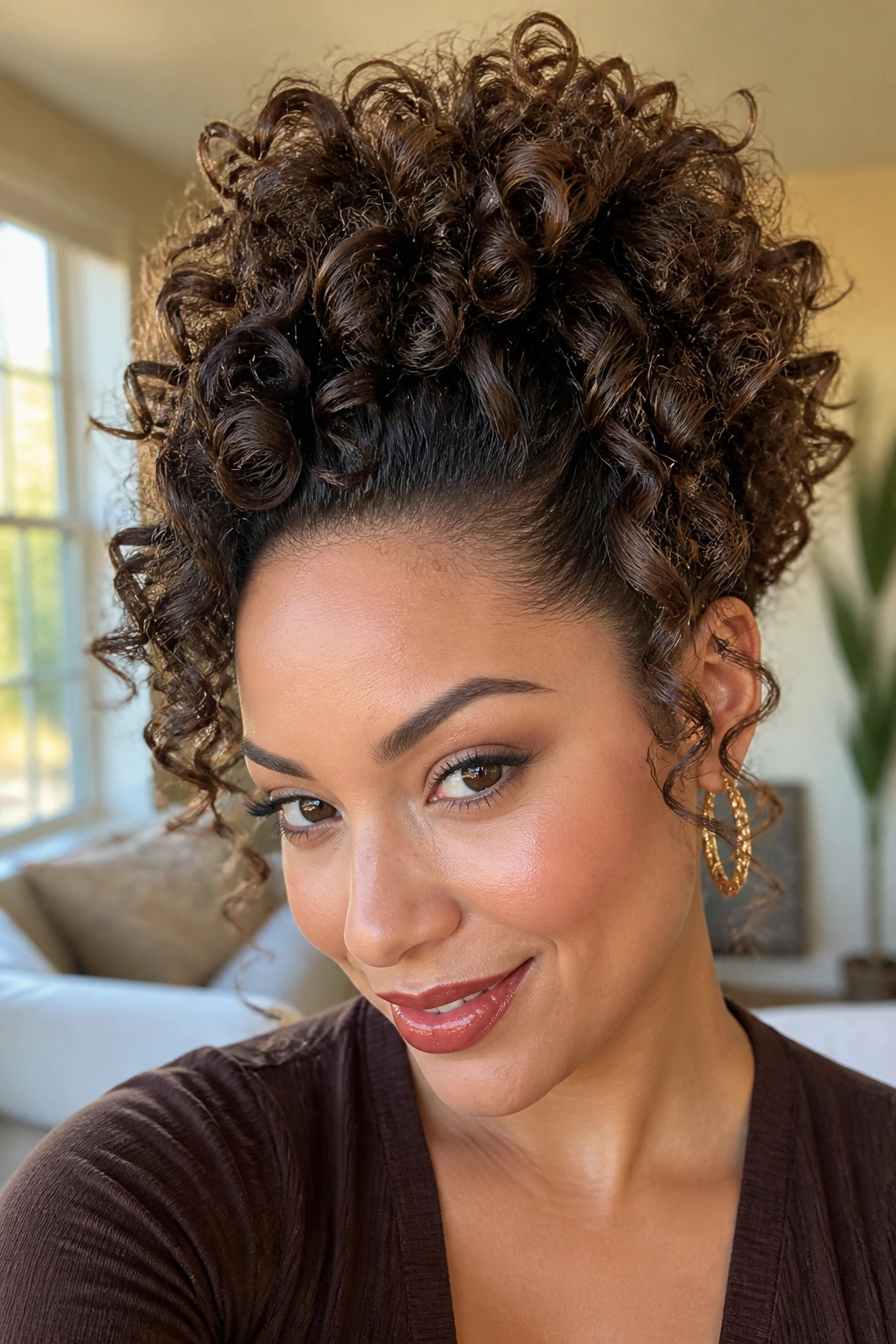
Why does a little lift at the roots change everything for curls? Because curls already bring width and texture, so the goal is to build height first and let the sides stay controlled. That gives the face a longer, lighter outline.
If your hair is curly or coily, this style is easier than it looks. Gather the top and middle sections upward, pin them in a soft puff, and let the lower curls rest against the head or disappear into the base. The shape should feel buoyant, not piled up.
How to Get the Lift
Work mousse through damp hair, then diffuse until the roots are about 90 percent dry. Clip the crown up while it cools. That little bit of setting time helps the lift stay in place without a stiff helmet finish.
Don’t flatten the sides with a brush once the hair is dry. Use your fingers. Fingers preserve the curl pattern and keep the style from spreading too wide. Height is your friend here. Width is not.
11. Knotted Half-Up Chignon for Shorter Layers
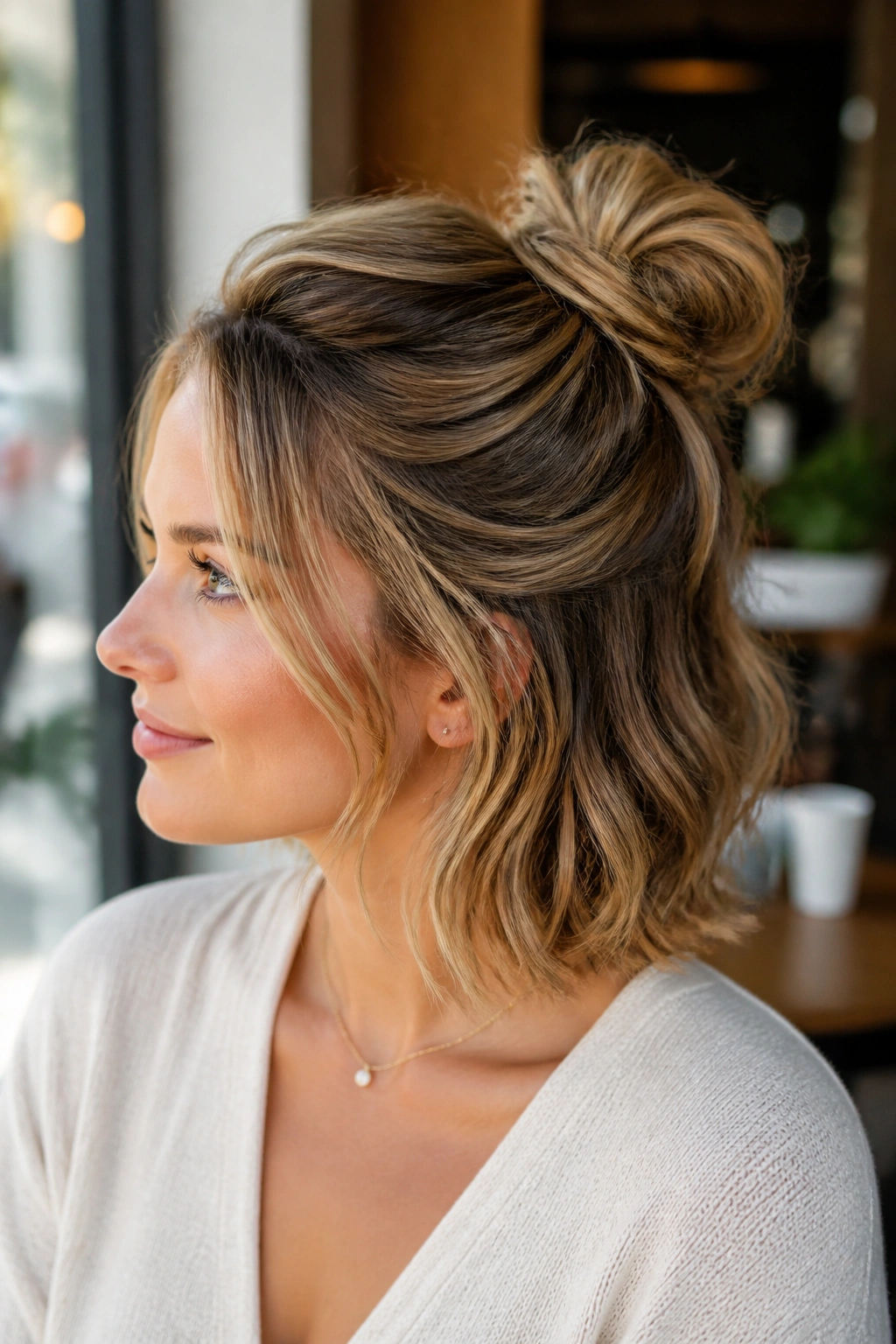
Half-up styles are safer than full buns when your layers keep slipping. That’s why this knotted chignon is such a good fallback for short hair on a round face. It gives you the shape of an updo without asking the bottom half of the hair to do more than it can.
The knot sits at the back of the crown or just below it, and the rest of the hair stays down, which creates a long line through the neck and shoulders. The result feels open. The face doesn’t get boxed in by hair on both sides, and the crown gets a little lift for free.
This is a nice choice when your ends are too short for a full twist. Tie the top section into a loose knot, tuck the ends inside, and pin the knot flat so it doesn’t puff out. If the lower layers are wavy, even better. Straight lengths work too, but they need a touch more texture spray.
Easy. Clean. Reliable. Sometimes that’s enough.
12. Sleek Low Bun With a Long Side Sweep
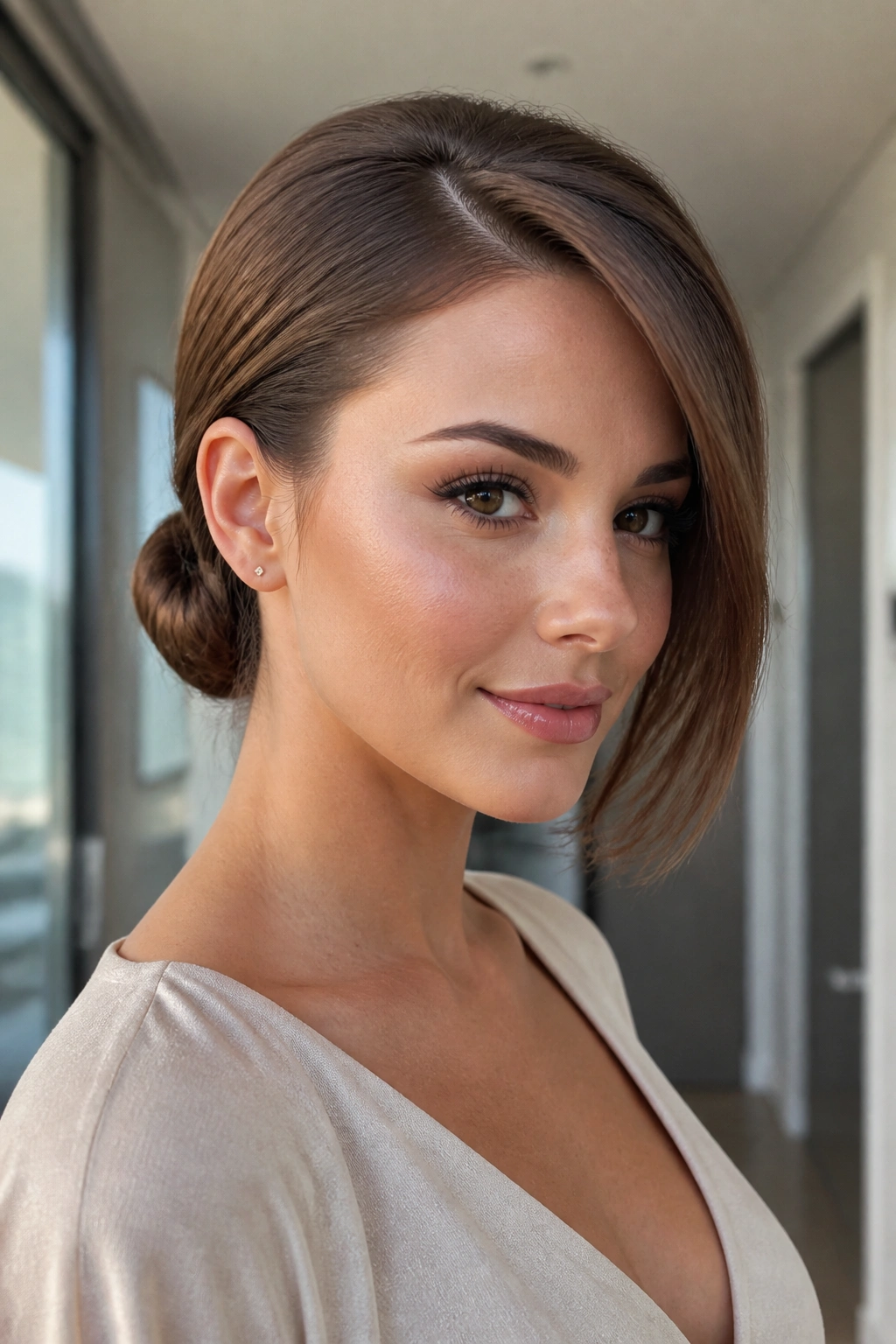
Sleek buns are not the enemy of a round face. The bad version is a tight, centered bun with no movement at all. The good version keeps the bun low, narrow, and slightly offset, then uses one long side sweep to break the symmetry.
That side sweep is doing a lot of work. It cuts across the face at an angle, which pulls the eye away from the fullest part of the cheeks. A soft sweep is better than a rigid one. You want it to glide, not sit like a hard stripe across the forehead.
I’d use a tiny bit of shine cream on the front and a fine-tooth comb to smooth the hair back. Then pin the bun close to the nape so the profile stays slim. If the bun starts to widen, remake it smaller. A round face usually looks better with a compact shape than with extra fullness at the sides.
This one has a dressier feel, and that’s not a bad thing. It’s just cleaner.
13. Double Twist Nape Bun With Hidden Pins
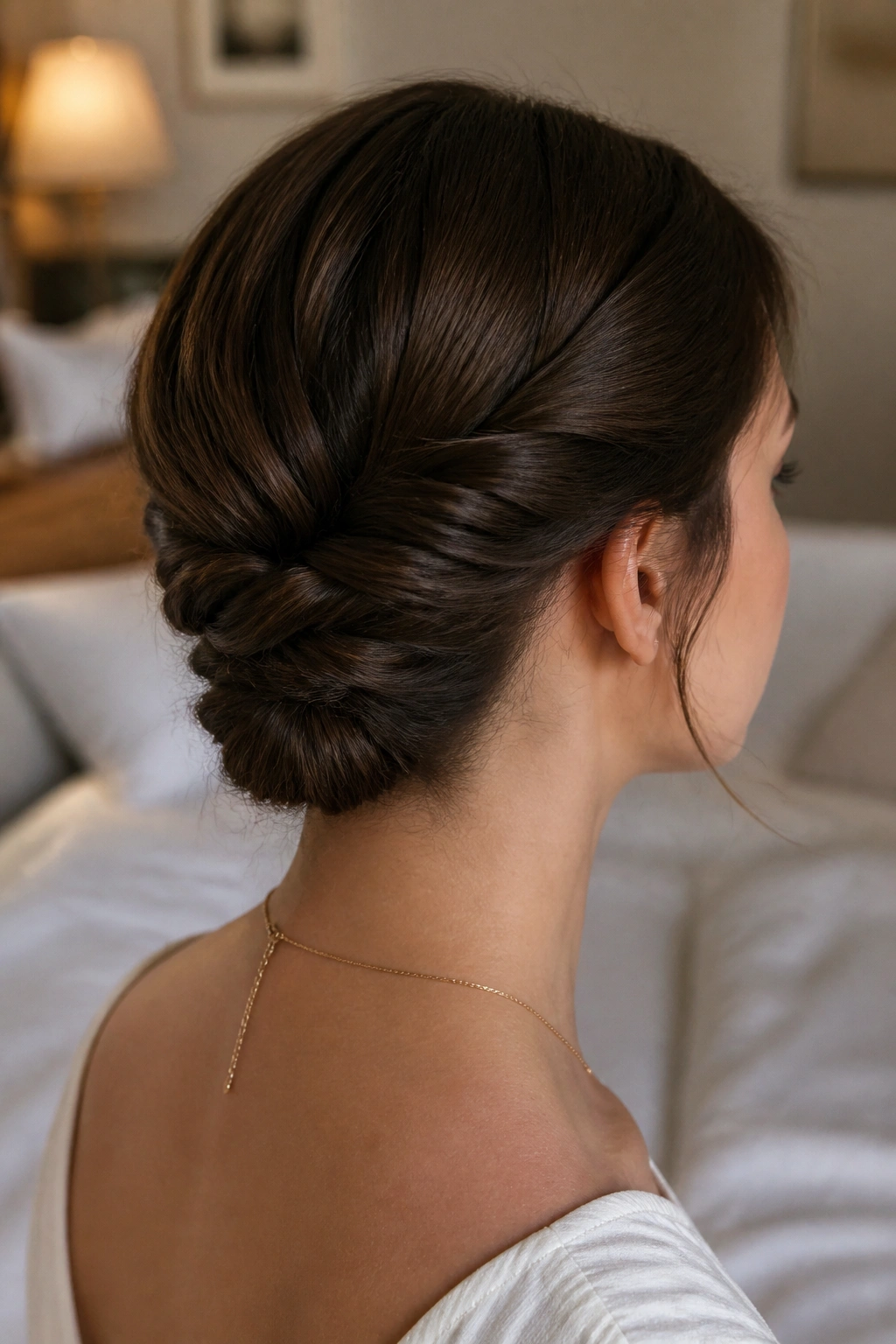
Two twists can do more than one.
Instead of gathering the whole head into a single knot, divide the hair into two side sections, twist each one back, and cross them into a bun at the nape. The crossed lines create a narrow X-shaped pattern that flatters a round face better than one broad, circular mass of hair.
Quick Styling Notes
- Twist each side section tightly enough to hold, but not so tight that it looks ropey.
- Pin the first twist near the center back, then fold the second over it.
- Hide the ends underneath instead of letting them flare out.
- Use pins in the same shade as your hair if possible; they disappear faster.
The best thing about this style is that it looks more complicated than it is. It also works on hair that’s too short for one full bun because the sections can stay small. Small sections are easier to control. That’s the part most people miss.
14. Waterfall Braid Tucked Into a Low Bun
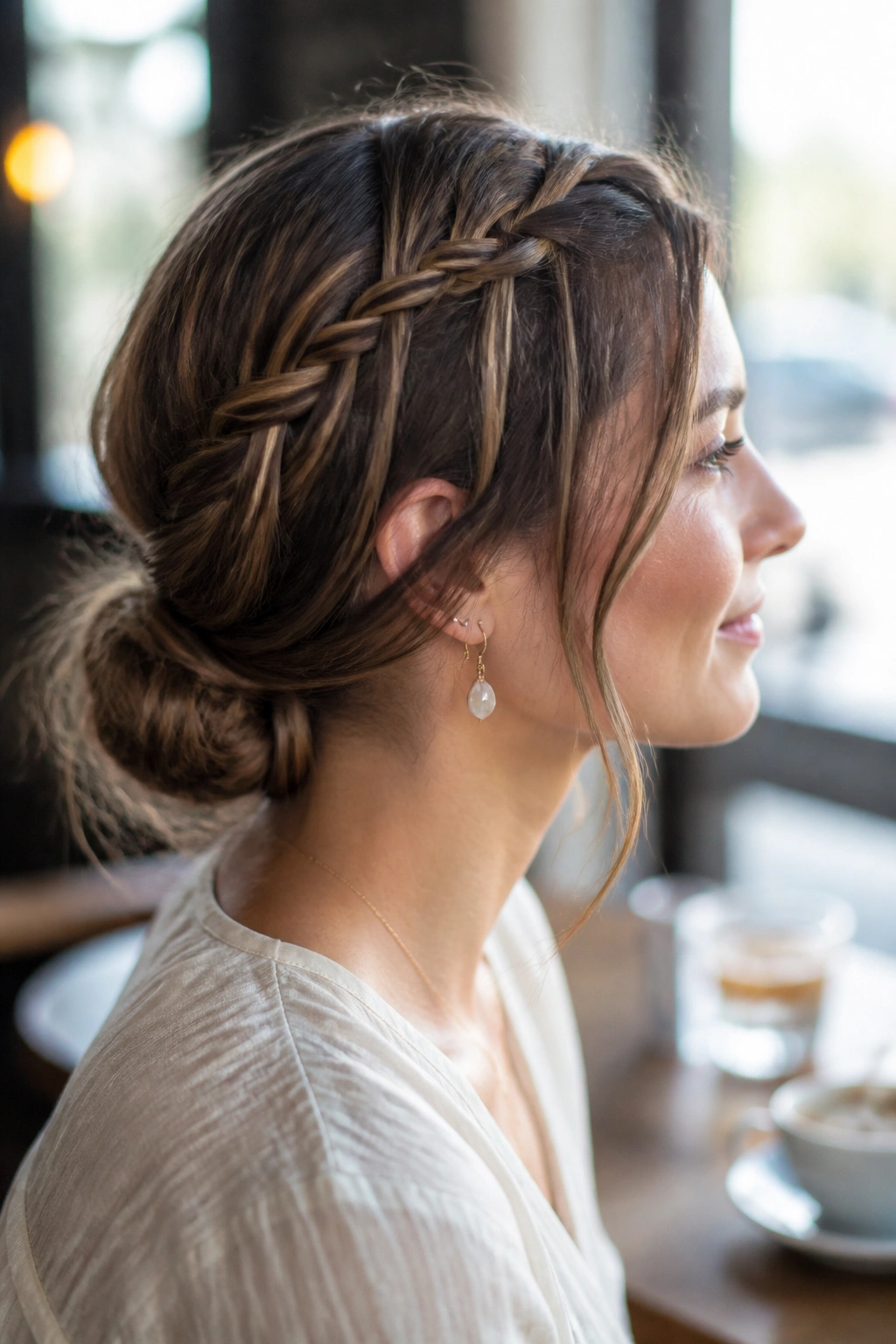
A waterfall braid gives short hair movement even when the bun stays tiny. That’s why it’s such a nice pick for round faces: the braid creates open spaces and a soft diagonal line, while the low bun keeps the shape from spreading wide.
The braid should begin near the front hairline and travel toward the back, dropping a few strands along the way so the pattern looks airy. Those dropped sections keep the style from feeling heavy. Then the remaining hair can tuck into a low bun or roll at the nape.
This one asks for a little patience. The braid needs neat finger work, and short layers can slip if you rush. Still, the payoff is worth it. The face stays open, the top gains subtle lift, and the braid itself acts like a slim frame instead of a thick border.
If your hair is fine, curl the loose pieces first. That helps the braid hold. If your hair is thick, keep the braid small so it doesn’t sit too far away from the head.
15. Clipped-Back Wave Sweep for Chin-Length Hair
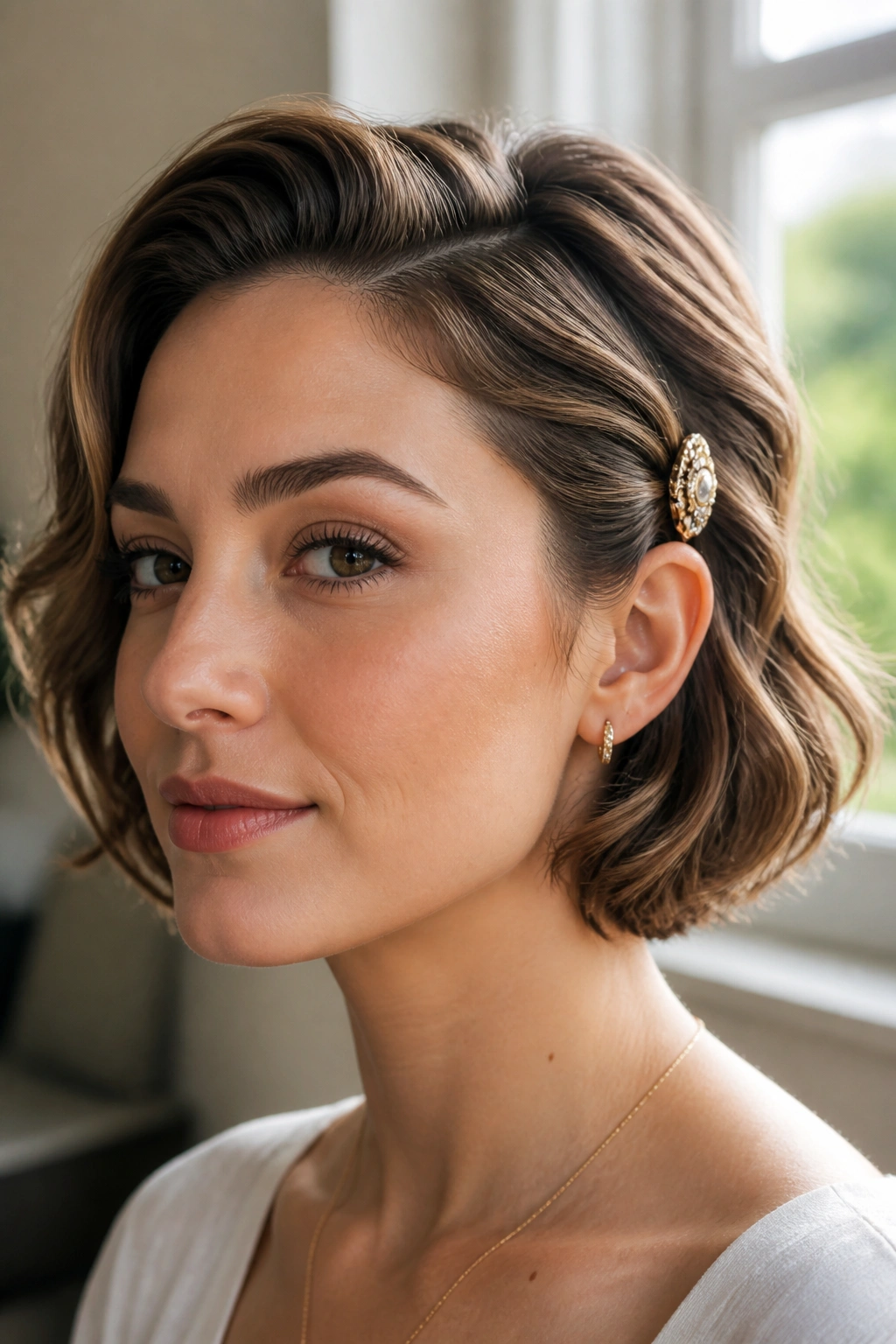
Can a chin-length bob count as an updo? It can, if you cheat with waves and pins.
This is the style that saves people with shorter cuts when they need hair off the face but don’t have enough length for a true bun. Wave the hair first, then sweep one side back and clip it securely behind the ear or just below it. The back sections can be tucked and pinned so the overall shape reads as an intentional pin-up rather than loose hair.
What to Watch For
Keep the wave pattern soft, not tight. Tight curls around the cheeks can add width, and that’s the last thing a round face needs. A broader, softer wave bends around the face without hugging it too closely.
A strong decorative clip helps here, but place it carefully. Too far forward and it pulls the eye to the widest part of the face. Too far back and it disappears. The sweet spot is just behind the cheekbone line.
This style works best when the front has some bend and the back has enough grip to stay pinned. It’s casual, but not sloppy. That’s the sweet spot.
16. Mini Topknot With Loose Ends at the Nape
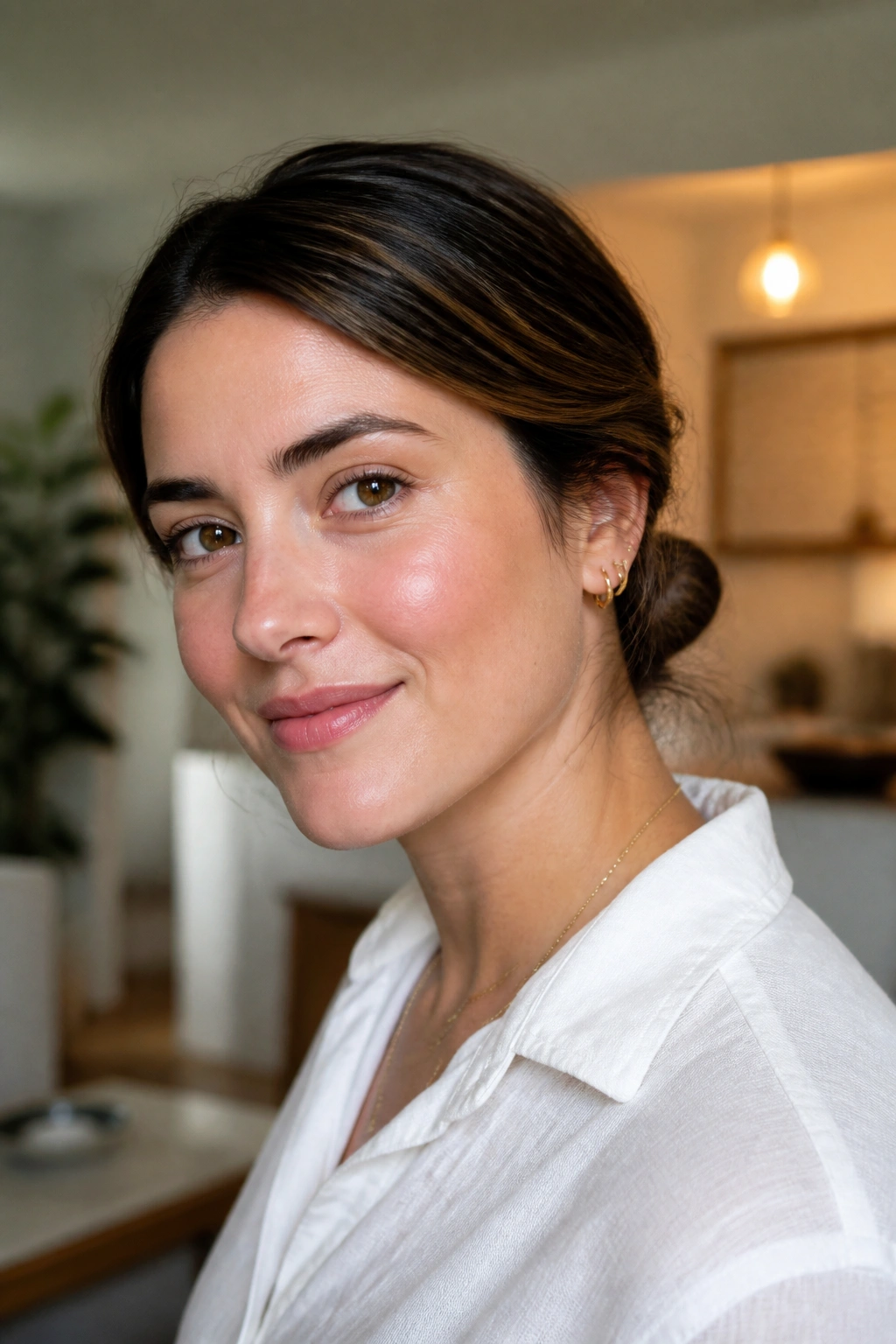
Unlike a sky-high topknot, this one sits just above the nape and stays small. That lower placement matters on a round face because a tall knot can make the head look wider from the side, while a tiny one keeps the silhouette narrow.
The loose ends aren’t a mistake. They’re the point. Let a few short pieces at the nape soften the base of the knot so it doesn’t look too abrupt. If your hair is too short for a true knot, fold it into a tiny loop and pin the ends underneath. Nobody needs to know the difference.
This is the most casual style in the group, which makes it useful for errands, travel, or any day you want your hair out of your face without looking overdone. A bit of dry texture spray keeps the knot from slipping, especially if your hair was washed that morning.
Keep the knot compact. If it starts getting bigger than a plum, it loses the clean line that helps a round face most.
17. Rolled Side Chignon With a Soft Diagonal Line
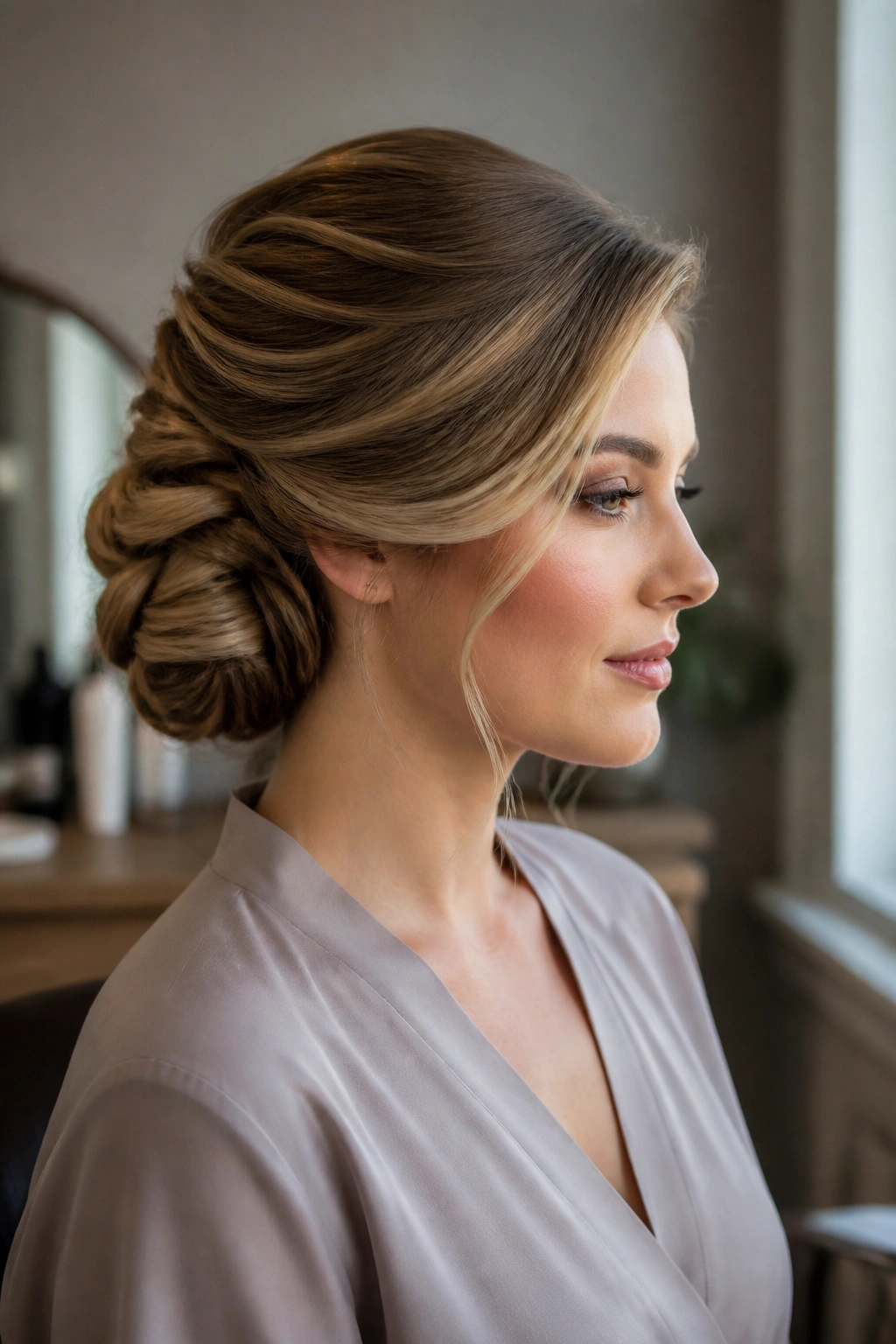
Side chignons look best when the line is crooked on purpose. That diagonal shape is what makes this version work on a round face, because it breaks the face’s natural curve and pulls the eye down and across.
I prefer this style with a deep side part and a roll that starts at the heavier side of the hair. The roll moves toward one shoulder, then tucks into a low chignon just off-center. It feels graceful without being rigid. A perfectly centered bun can look a little too tidy here; a side roll gives the face more room to breathe.
The texture can be smooth or softly waved. Smooth gives the style a sharper finish, which is nice if you want a cleaner silhouette. Wavy hair adds softness and keeps the roll from feeling flat. Either way, the chignon itself should stay narrow.
The whole point is the direction. Once the hair starts moving diagonally, the face seems longer and the cheeks feel less prominent. That’s the magic here, and it works every time.
18. Asymmetrical Pin-Curl Updo With a Narrow Silhouette
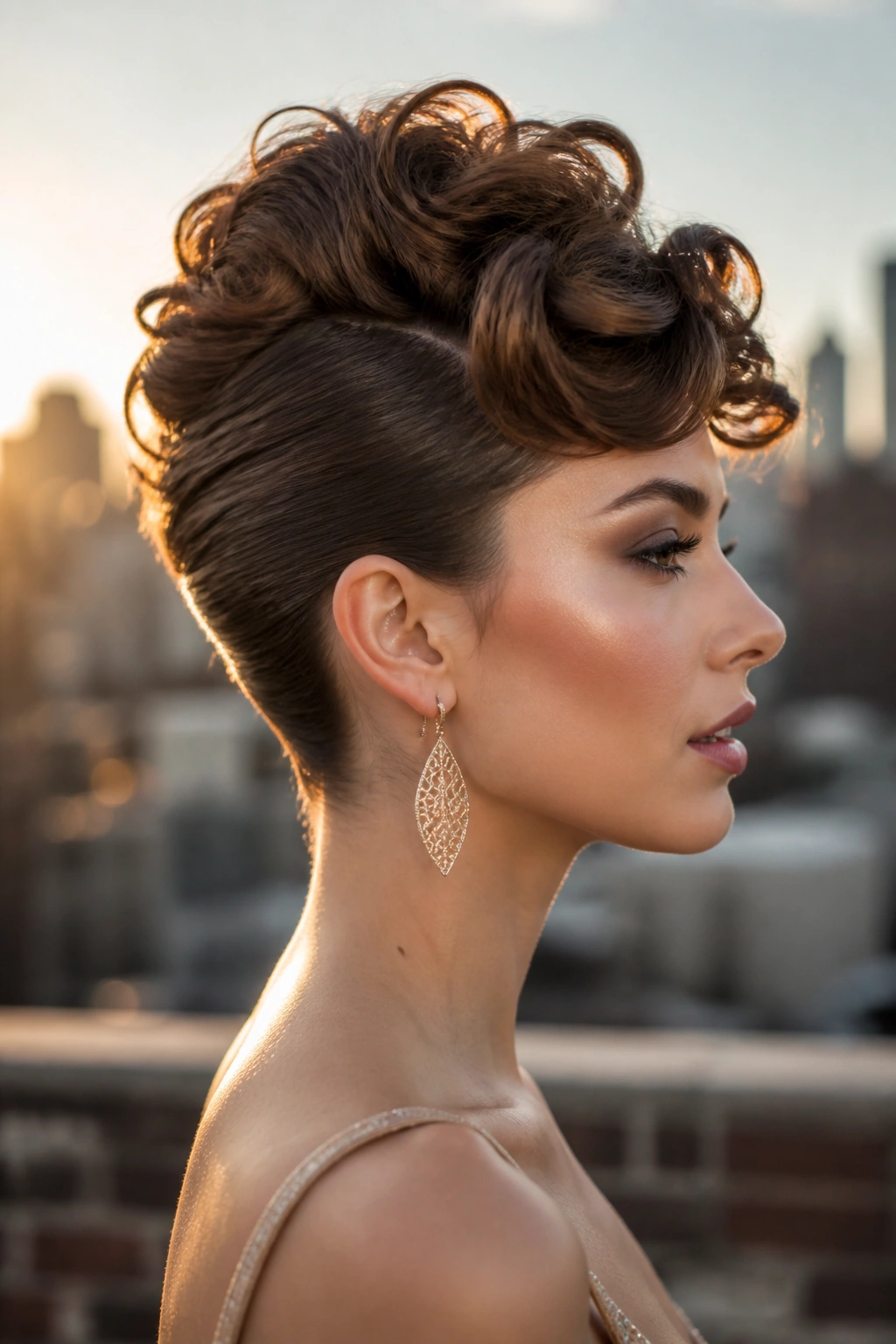
Pin curls are old-school for a reason. They let you sculpt short hair into a shaped updo without forcing it into one giant lump at the back.
This version leans into asymmetry. One side stays tighter and closer to the head, while the other side holds a little more curve or lift. That uneven balance keeps the style interesting and stops the silhouette from reading as round. On a round face, that matters more than people think.
The Line to Aim For
- Keep the fullest point of the style above or beside the cheekbone, not directly over it.
- Use small pin curls instead of one broad roll.
- Cross-pin each curl so it holds its shape.
- Leave one side cleaner if you want a sharper finish.
A pin-curl updo can feel formal, but it doesn’t have to be stiff. Let a few bends stay visible. Let the shape breathe a little. The hair should look placed, not frozen.
If you only remember one thing, make it this: shape the hair upward or diagonally, not straight across the widest part of the face. That simple choice is what makes short updos work on round faces, and it’s why the styles above hold up so well when the hair is cropped, layered, or just too short for a standard bun.
