



Long blonde hair can flatter a round face in a way that feels almost unfair, but only when the shape is doing the right work. If the volume sits too high at the cheeks, the face looks wider. If the movement drops lower—past the jaw, past the widest part of the cheeks—the whole look stretches out and softens.
That’s why the most useful long blonde hairstyles for round faces are rarely about length alone. They’re about placement. A middle part can sharpen the line. A side sweep can break up symmetry. Face-framing layers, curtain bangs, soft waves, and even a simple low ponytail can all pull the eye in the right direction if they’re cut and styled with a little care.
Blonde hair adds another layer of trickiness, which I actually think is part of the fun. Light catches on every bend, every highlight, every blunt edge. A flat one-tone blonde can look heavy fast, while a mix of root shadow, babylights, and lowlights gives hair movement without making it feel busy. Small detail. Big difference.
The styles that follow all do the same basic job in different ways: they keep fullness where it helps and keep the sides from bulking out. Some are polished. Some are easygoing. A few are more done-up than others. The first one starts with the easiest kind of softness.
1. Beach Waves With Face-Framing Layers for Round Faces
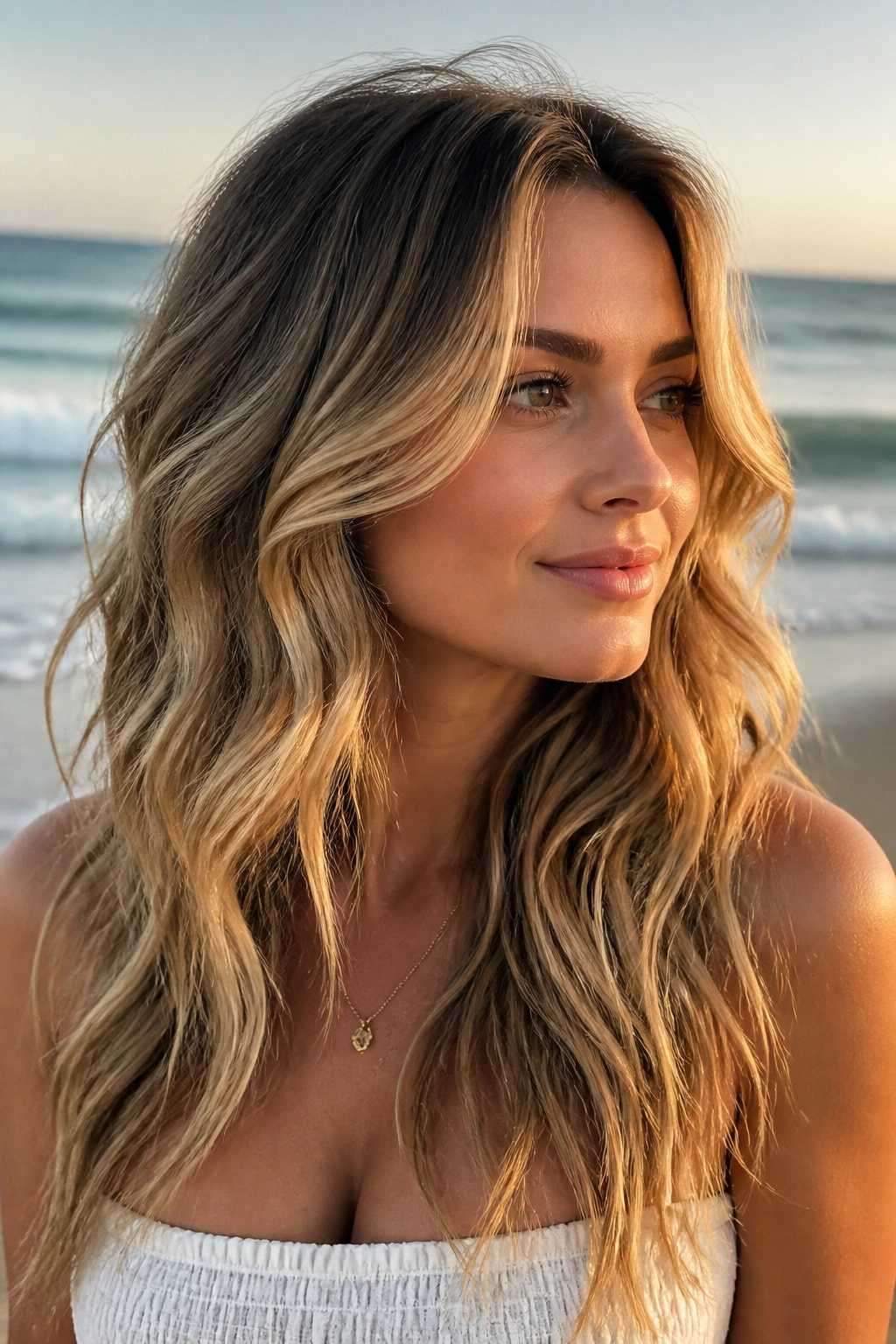
Beach waves are one of those styles people say they want, then accidentally make too wide at the sides. The version that works on a round face keeps the wave low and the top section smooth. That little shift matters more than most people think.
Why It Flatters
The wave should begin around the ear or lower, not right at the cheekbone. That keeps the eye moving down instead of out. Long face-framing layers give the front pieces a chance to skim the jaw and collarbone instead of stopping at the widest part of the face.
Blonde balayage makes this shape even clearer because the lighter pieces catch the bend in the hair. The result looks softer and longer, not puffy. It’s a simple style, but the placement has to be smart.
- Ask for layers that start below the cheekbone.
- Use a 1.25-inch curling iron or wand.
- Leave the last 1 to 2 inches of each section out for a looser end.
- Finish with a light texturizing spray, not a heavy cream.
Best tip: keep the crown flatter than you think you need. A little lift is enough.
2. Curtain Bangs and Long Blonde Layers
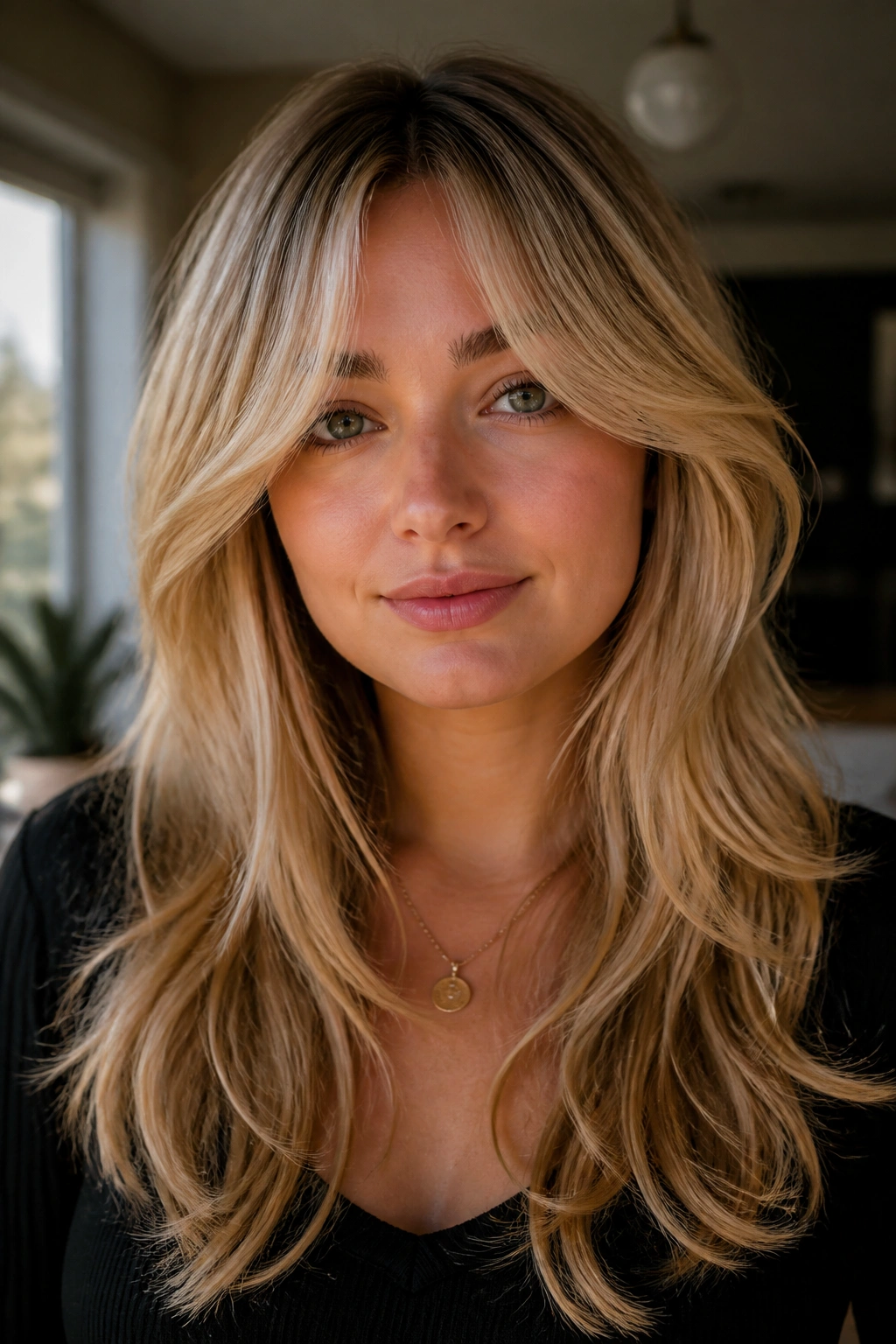
Curtain bangs can be the smartest fringe for a round face when they’re long enough to split and fall into the cheek area. Short, blunt bangs are a different story. They can chop the face in a way that works against the softness most people want here.
The sweet spot is a fringe that parts near the center and opens toward the temples. It should graze the cheekbones, then blend into long layers that keep moving past the jaw. That diagonal line is doing a lot of work. It breaks up the width of the face and adds shape without making the haircut feel severe.
Blonde hair makes curtain bangs even more useful because you can see the transition clearly. A pale front section, a slightly deeper root, and a soft bend at the ends create depth with very little effort. Blow-dry the bangs forward first, then curve them away from the face with a round brush. It takes a minute. Maybe two.
If your hair is fine, keep the fringe light and airy. If it’s thick, ask for more tapering at the sides so the bangs don’t sit like a curtain in the heavy sense of the word. That’s the whole game here.
3. Sleek Center-Part Blonde Hair for Round Faces
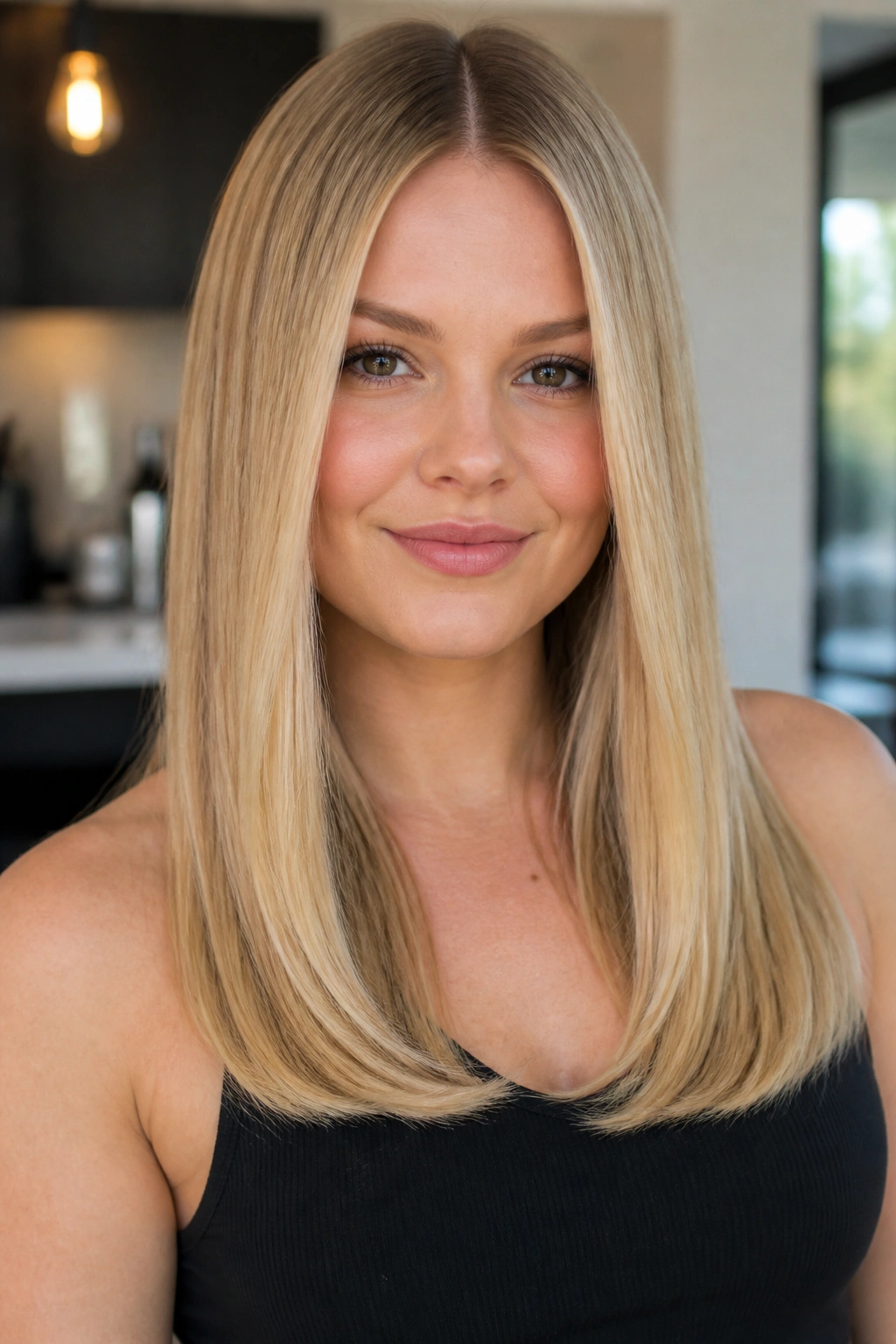
Can straight hair flatter a round face? Absolutely, if the line is clean and the length keeps going. A center part does one thing better than almost anything else: it creates two narrow vertical panels that make the face read longer.
The key is to keep the roots calm and the ends polished. You do not want a blunt wall of hair sitting at cheek level. You want long, straight pieces that fall past the shoulders with a slight bevel at the ends. A soft bend inward or outward is fine. Too much flick adds width. Too much volume at the temples does the same.
How to Wear It
- Use a smoothing cream before blow-drying.
- Flat iron in 1-inch sections for a clean finish.
- Keep the part centered or only slightly off-center.
- Finish with a shine spray on the mid-lengths and ends.
This style is especially good if your blonde has a bit of tonal contrast—think honey ribbons over a beige base, or cool highlights with a deeper root. Flat color can still work, but dimension makes the whole shape feel less one-note. And that matters when the cut is doing the shaping for you.
4. Side-Part Blowout With Big Ends
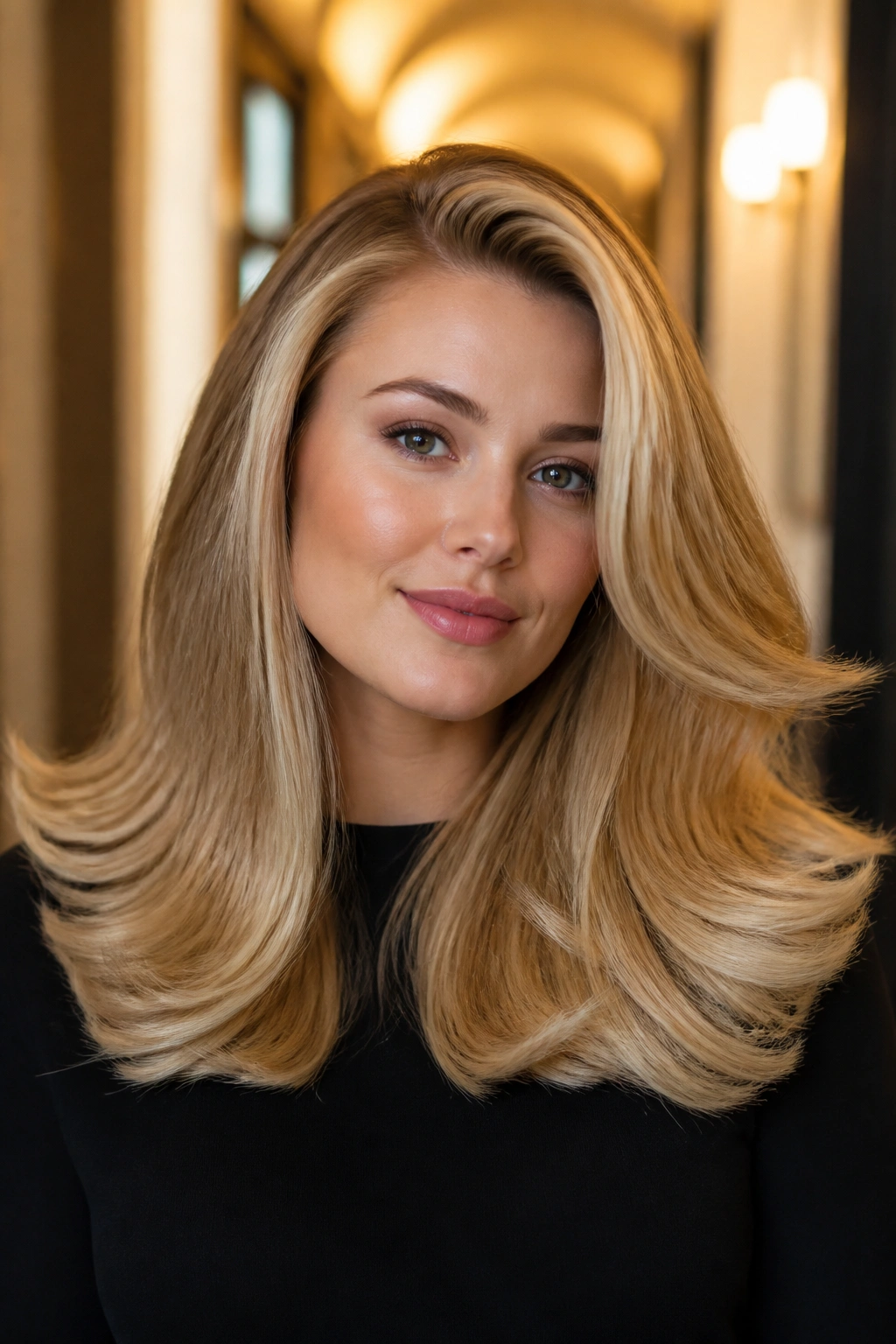
A side part changes the whole mood of long blonde hair in about five seconds. It shifts weight away from the middle of the face and gives the top section a little lift without making the style look stiff. On a round face, that tiny asymmetry can be a gift.
The trick is to keep the blowout smooth at the crown and fuller only through the lower half. Think soft movement, not a bubble of volume near the cheeks. If the ends turn slightly away from the face, even better. That outward curve makes the length feel airy instead of heavy.
A good blowout also works nicely with blonde color that has a little contrast. Root shadow keeps the top from looking flat, while brighter mid-lengths and ends show off the shape. If your hair is thick, a round brush and a few clips at the crown will help set the lift. If it’s fine, a root-lifting mousse before drying is worth the extra minute.
The part does not need to be dramatic. Even a one- or two-inch shift can change the balance. Small move. Bigger effect.
5. Soft Hollywood Waves
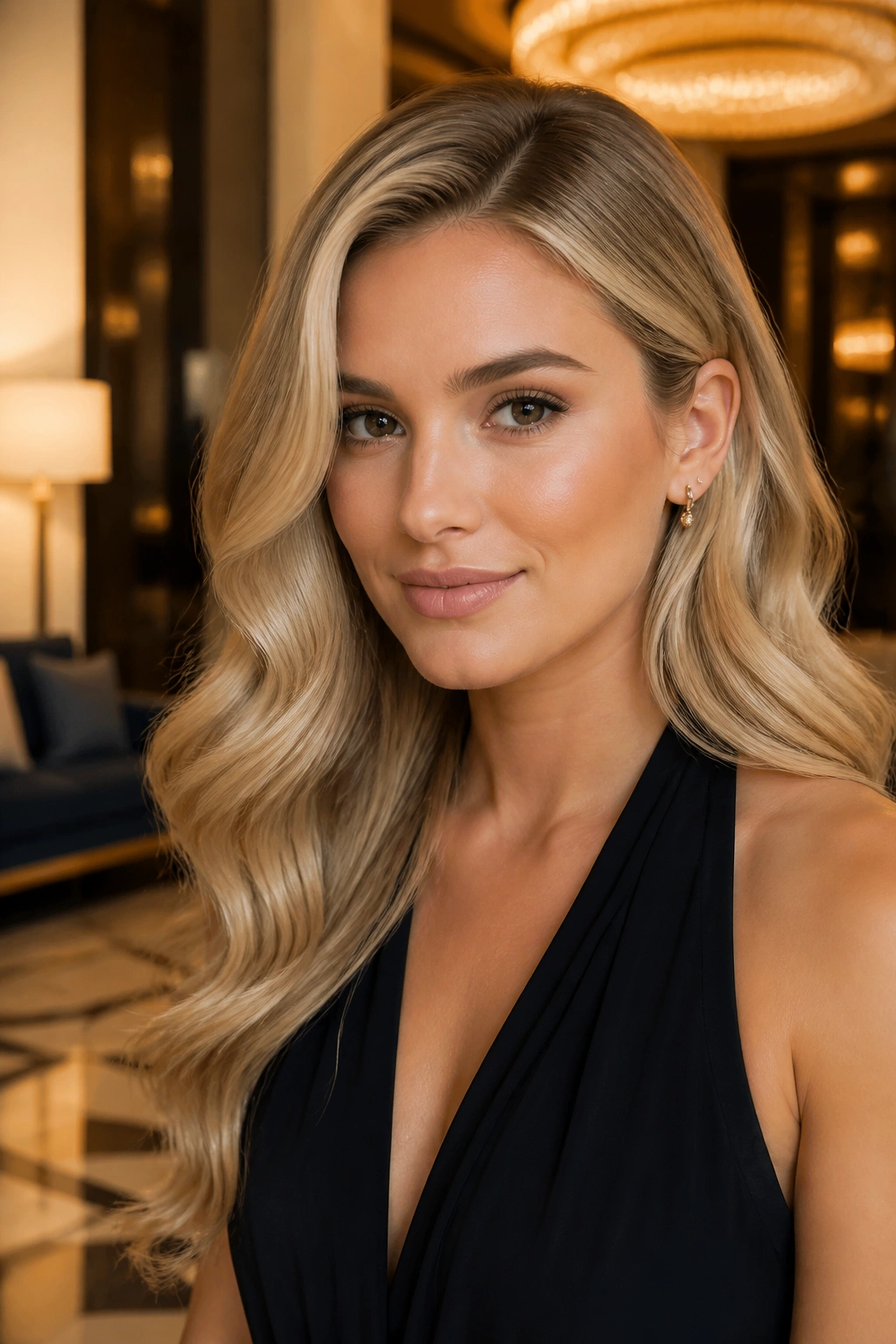
Hollywood waves get blamed for making round faces look broader, and that’s only true when the wave starts too high. Start the bend below the cheekbones, keep the crown smooth, and the style turns elegant instead of bulky.
What I like about this look is the control. The wave is polished, but it still moves. You can curl everything in one direction with a 1.5-inch iron, pin the curls while they cool, and then brush them into a softer wave with a paddle brush. The hair should look arranged, not shellacked. There’s a difference, and it’s a useful one.
Blonde hair loves this shape because the wave shows off dimension. Highlights catch on the ridges, lowlights sit in the shadowed parts, and the whole style gets depth from the motion itself. A gloss spray at the end helps, but don’t drown it. Too much product weighs the wave down and makes it look older than it is.
This is one of the better choices for formal events, photos, or any day when you want the hair to look intentional without losing softness. It has polish. It also has enough slack around the face to keep things flattering.
6. U-Cut Blonde Hair With Soft Ends
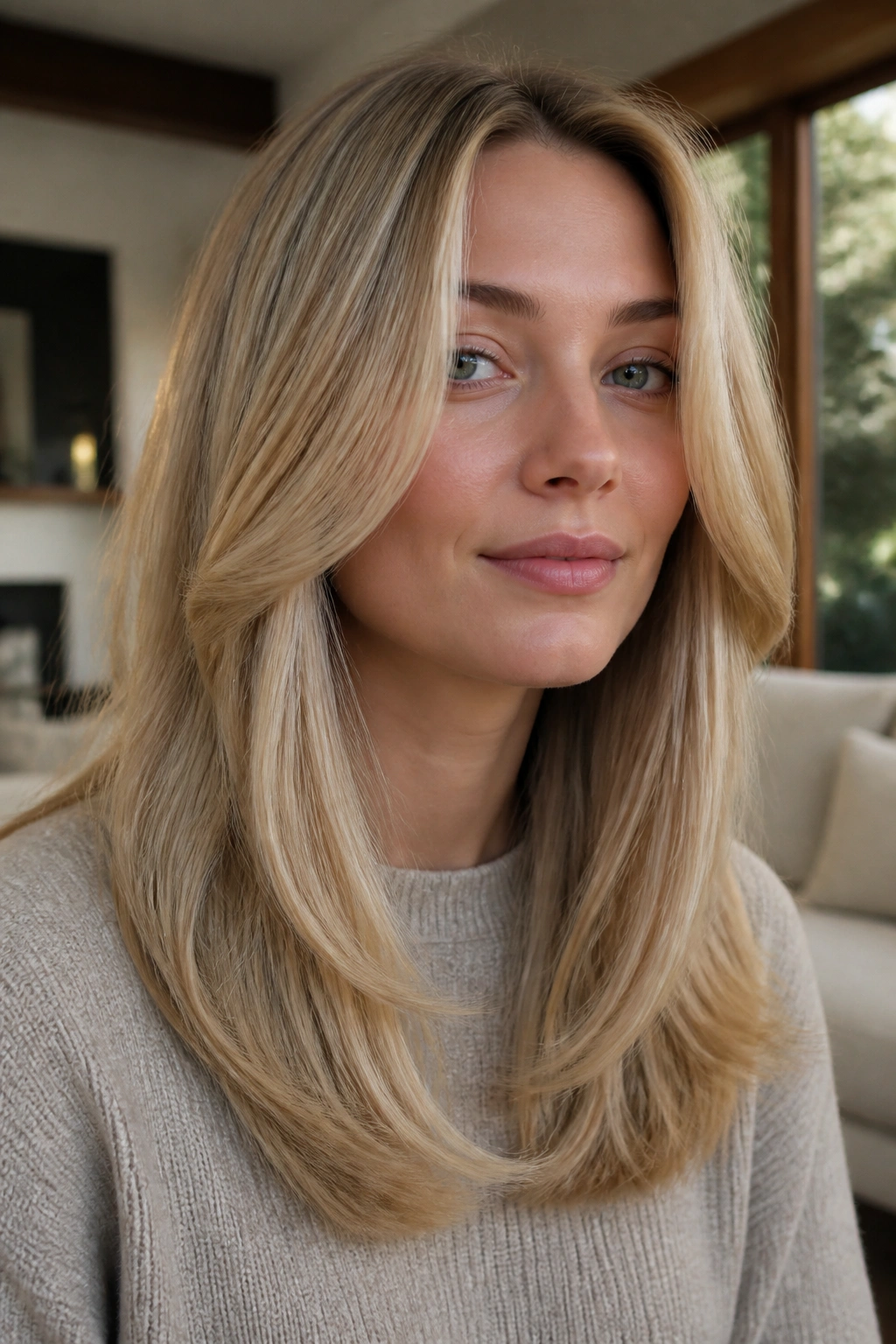
A blunt one-length cut can box in a round face. A U-cut softens the edge and keeps the silhouette moving downward, which is exactly what long hair should do here.
The shape is easy to picture: the center back is longest, and the sides curve up a little so the outline forms a gentle U instead of a hard line. That curve is subtle, but it helps a lot. It stops the hair from sitting like a curtain at the same level all the way around the head.
Who It Suits Best
- Medium to thick hair that needs shape without a big layer job.
- Blonde shades with dimension, such as honey, beige, or caramel ribbons.
- People who want movement but hate chopped, wispy ends.
The U-cut is one of those styles that looks expensive in motion, even when the styling is minimal. Air-dry it with a little smoothing cream, or blow it out with a big brush and let the ends tuck inward slightly. The shape does the heavy lifting. You just keep it clean.
7. V-Cut Layers for Extra Length
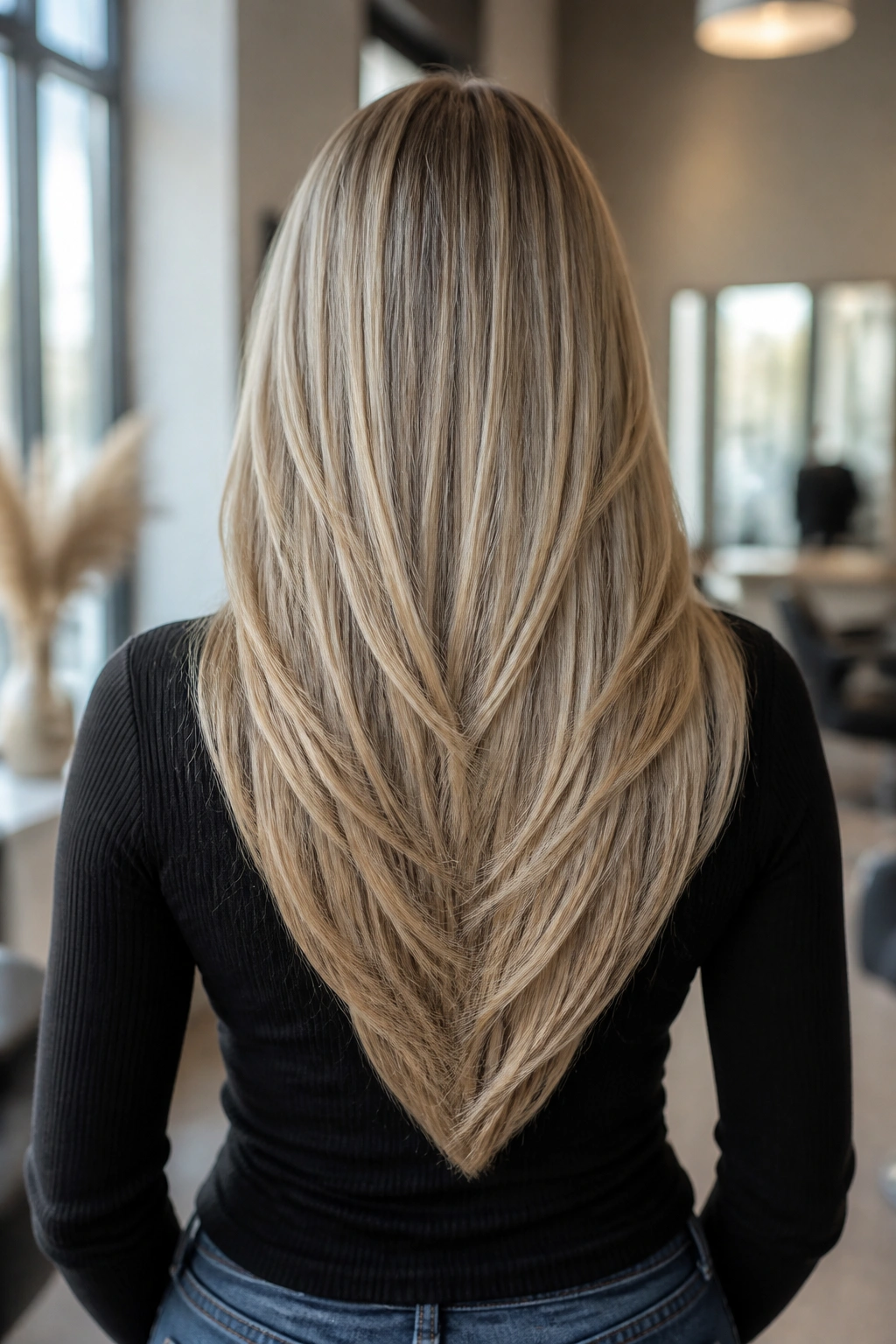
The V-cut is for anyone who wants the hair to look longer than it already is. The point at the back draws the eye straight down, which is useful if you want to stretch a round face visually without making the front pieces too heavy.
Unlike a U-cut, the V shape feels more directional. It has a sharper drop in the back and more movement through the length. That works especially well on thick hair, where the lower point keeps the bulk from spreading outward. On finer hair, the same cut can still work, but the layers need to stay soft. Too much slicing and the ends start to look thin.
A Few Things to Ask For
- Keep the shortest layers below the chin.
- Leave enough length around the face for soft framing.
- Ask for the point of the V to fall at the center back, not too high.
- Pair it with balayage or lowlights so the shape stays visible.
I’d choose this cut over a blunt trim every time if the goal is length with shape. It gives blonde hair a bit of drama, but not the kind that fights the face.
8. Half-Up Twist With Loose Blonde Length
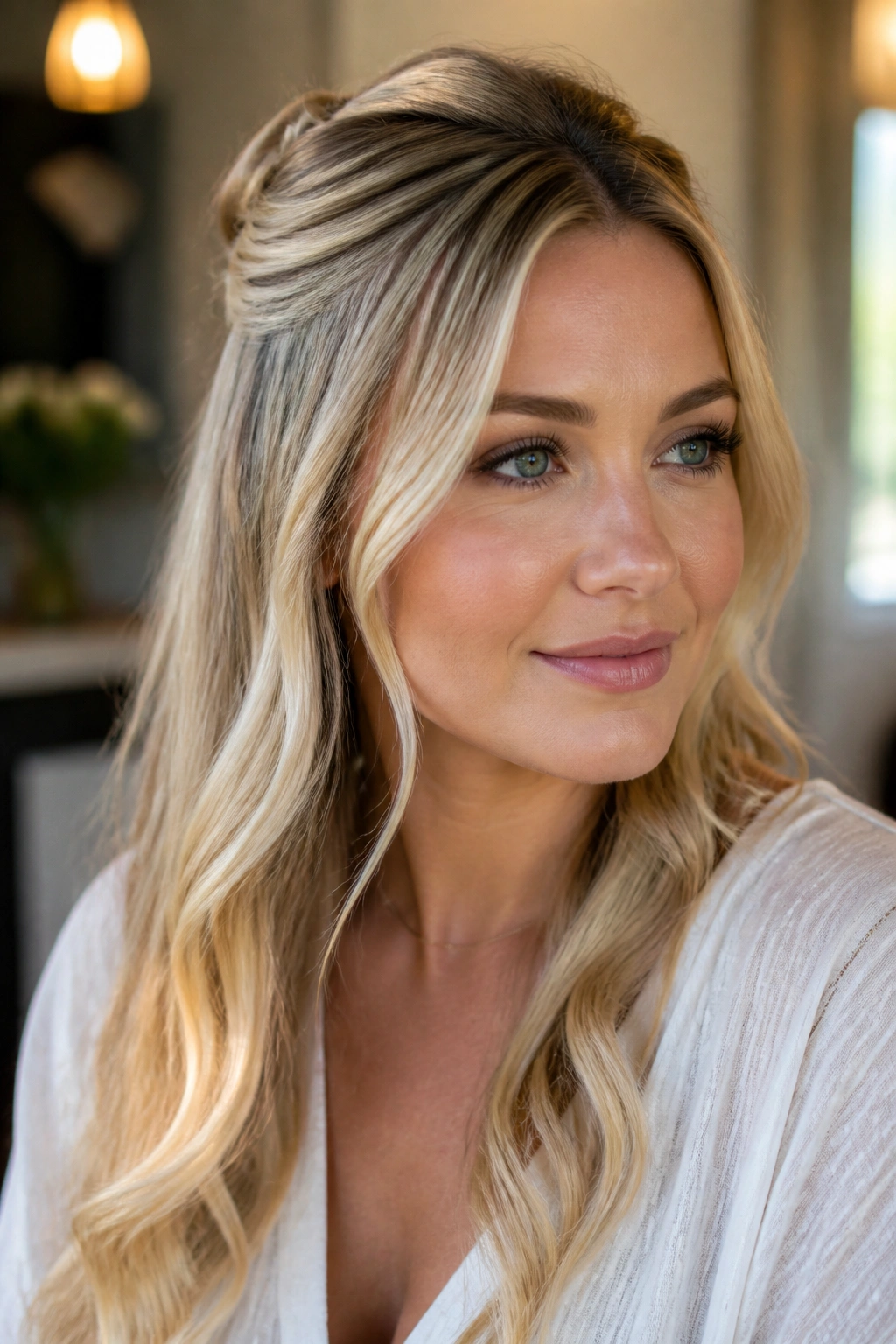
Half-up styles can flatter a round face, but only when the top section is small and the lower hair stays loose. Pulling too much hair away from the sides can make the face look wider, which is the opposite of what you want.
The cleanest version is a soft twist from each temple, pinned or tied at the back of the crown, with the rest of the hair falling straight or lightly waved. That lifts the eye line. It also keeps the front pieces open, which is important. You want the cheek area to breathe.
A little crown height helps, but don’t overdo it. A light tease at the roots or a touch of root spray is enough. If the hair is blonde with a few brighter face-framing pieces, the contrast makes the half-up shape read more clearly. You can even leave a thin strand out near each cheek for a gentler finish.
This style is one of my favorites for day-to-night wear because it looks done without asking much from you. No wrestling. No elaborate pins. Just a small lift in the right place.
9. Loose Spiral Curls With Lightweight Volume
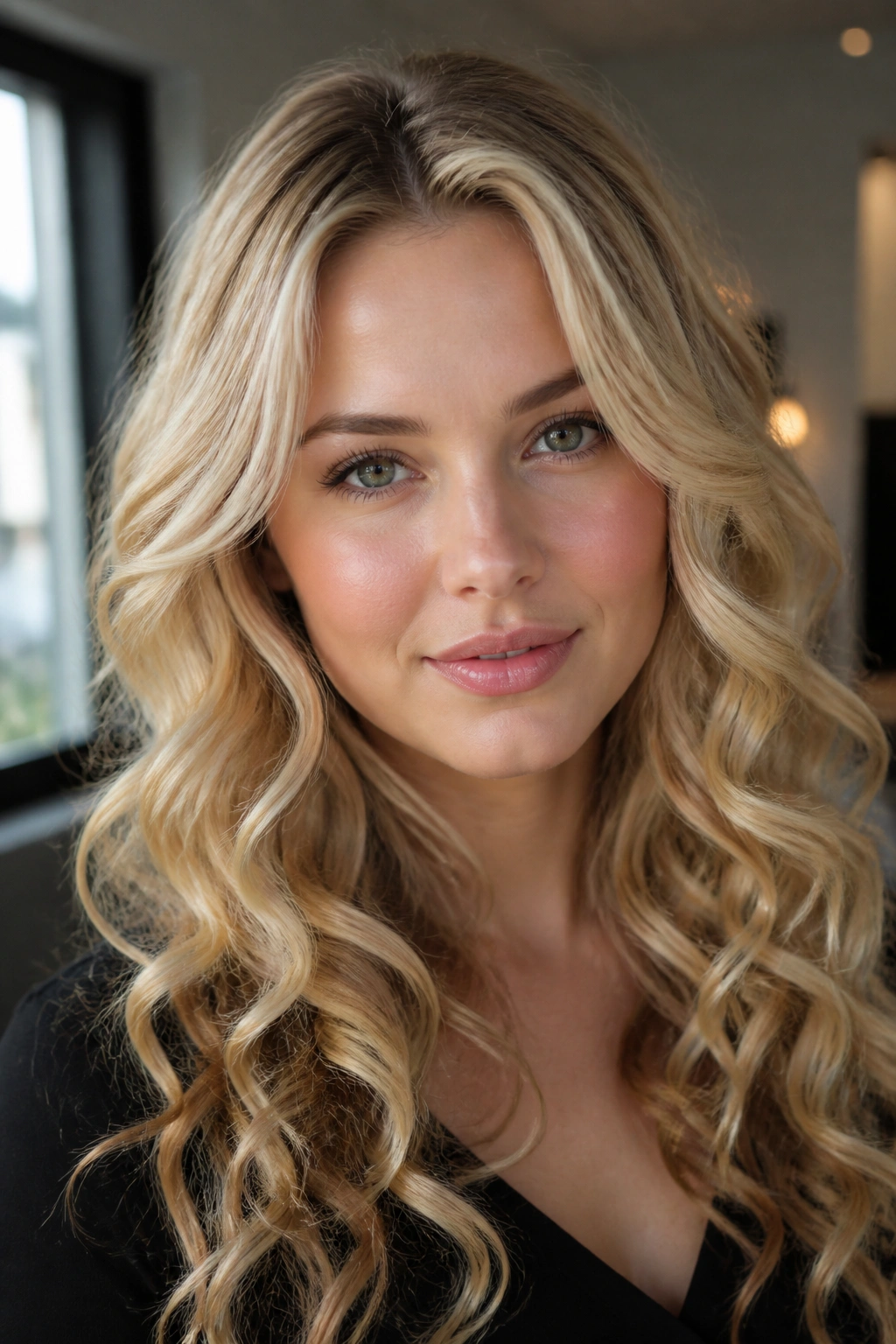
Why do some curls make a round face look softer while others make it look fuller? The answer is usually the size of the curl and where the volume lands. Loose spiral curls stretch the face. Tight curls often widen the sides.
The best version starts with medium sections wrapped around a curling iron or wand, then cooled completely before being separated with fingers. Use a heat protectant first, obviously, and don’t brush the curls out too early. That’s how they puff. Keep the root smooth, let the curl pattern loosen through the mid-lengths, and stop before the ends turn frizzy.
How to Keep Them From Spreading Too Much
- Curl away from the face on the front pieces.
- Use a heat setting that matches your hair type; fine hair needs less heat than coarse hair.
- Let curls cool for 10 to 15 minutes before touching them.
- Break them up with one or two drops of serum, not a palm full.
Blonde hair tends to show curl pattern beautifully because the light catches the bend. The trick is restraint. A little movement goes a long way when the face already has soft curves.
10. Braided Crown on Long Blonde Hair
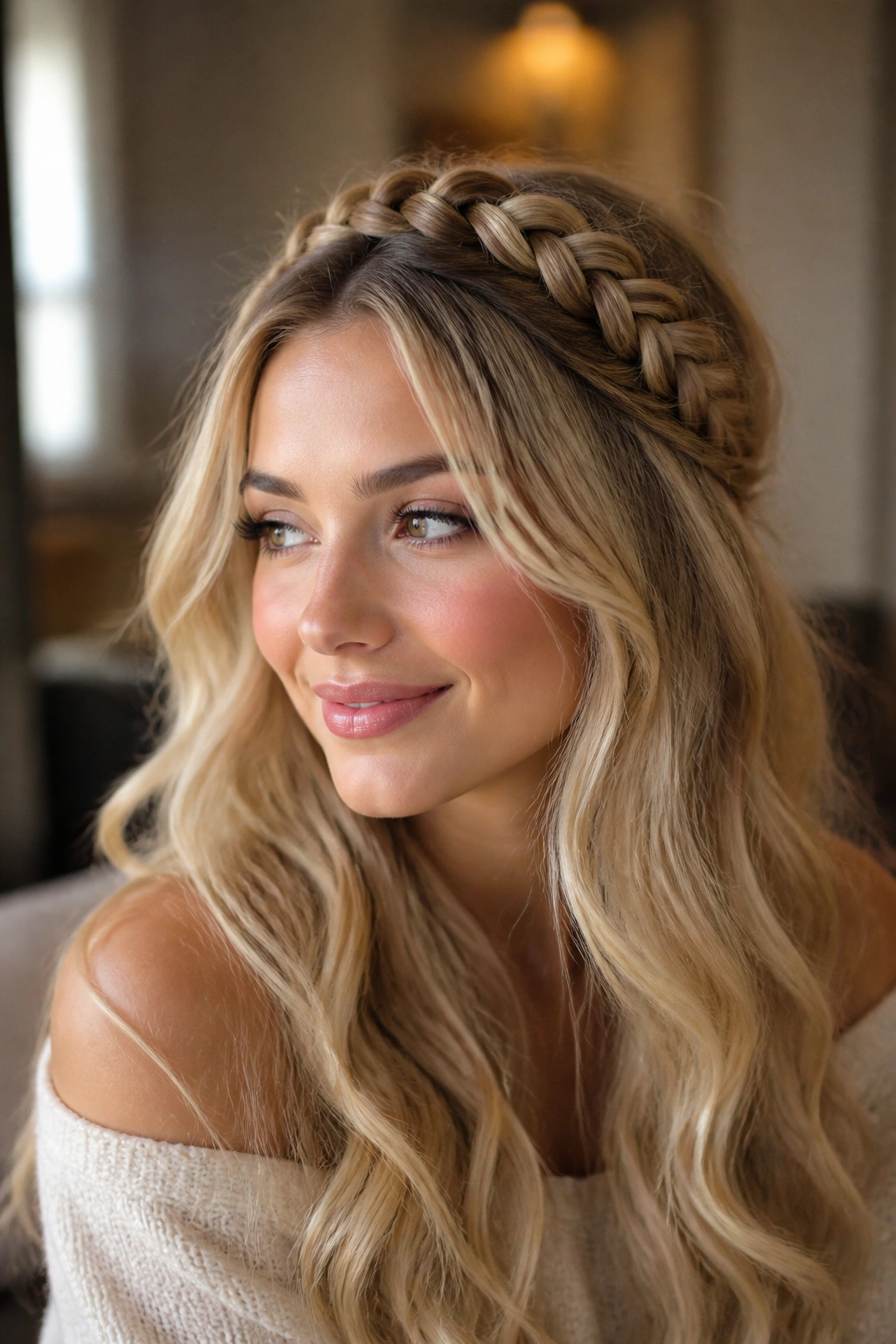
A braided crown can look heavy on a round face if the braid sits thick and low around the temples. Keep it narrow, keep it high, and it turns into a lovely way to lift the eye line.
The style works best when the braid starts near one side of the part, arcs across the top of the head, and ends behind the opposite ear. Leave the rest of the length loose. That contrast between the braided top and the open lower half helps the face read longer. It also stops the braid from acting like a ring of width around the widest part of the head.
Blonde hair is good at showing the braid texture, especially when there are a few lighter ribbons running through it. A slightly messy braid is better than a tight one here. Pull the braid apart gently after securing it so it looks a bit fuller, but not chunky. The goal is shape, not bulk.
This is a useful style for warm days, weddings, or those times when your hair needs to stay out of your face but you still want the length to matter. It’s practical. It also looks more thoughtful than it is.
11. Low Ponytail With Crown Lift
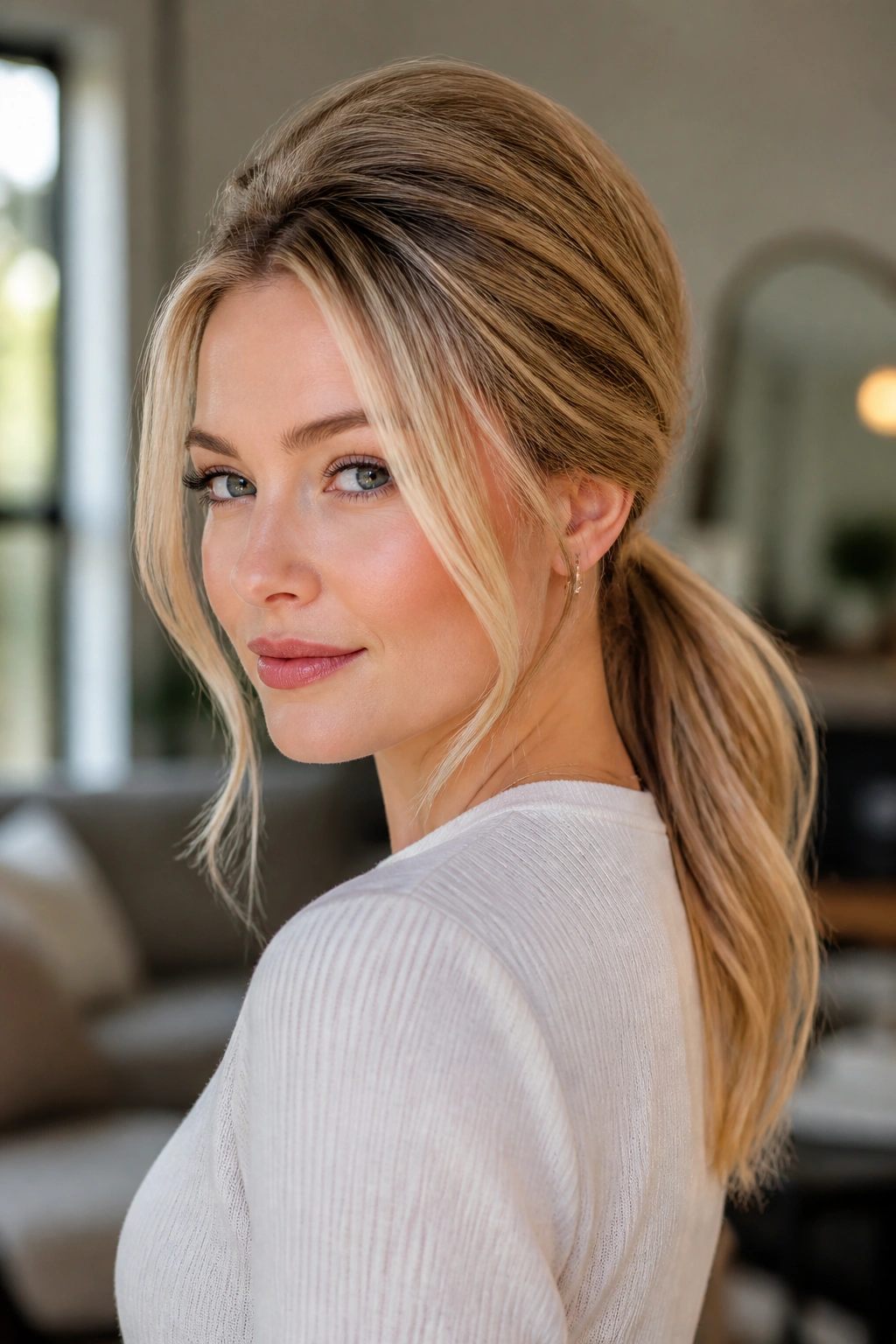
A low ponytail is one of the safest styles for a round face, and that’s because it keeps the width low and the crown neat. Put the ponytail at the nape, add a little lift at the top, and the face suddenly feels longer.
The crown lift matters. If everything is slicked straight back, the style can flatten the face in a way that feels severe. A small bit of volume at the roots changes that. It doesn’t need to be teased much—just enough to avoid a helmet look. The tail itself can be straight, waved, or lightly curled depending on the mood.
I also like a face-framing strand or two left out on the front. Keep them long. They should skim the jaw, not stop at it. A wrapped hair section around the elastic makes the whole thing look cleaner, and on blonde hair it gives you a nice little break in texture.
This is one of the few styles that works for errands, work, and dressier plans without much adjustment. The shape is simple. The payoff is not.
12. Textured Mermaid Waves
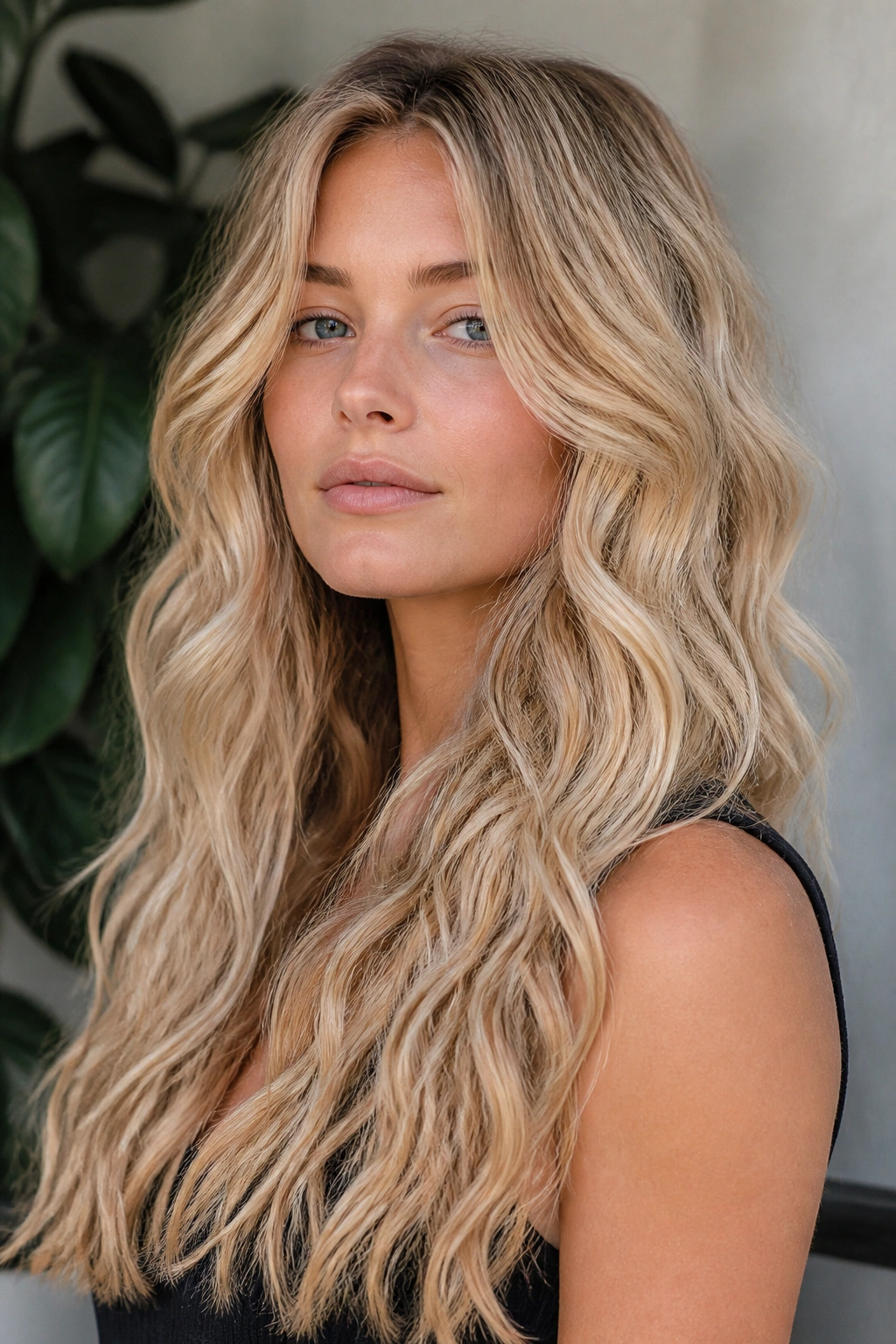
Unlike polished Hollywood waves, mermaid waves are softer, looser, and a little piecey through the mid-lengths. That difference matters for round faces because the style keeps movement vertical instead of pushing too much width into one smooth curve.
The best mermaid wave usually comes from a wave iron or a triple-barrel tool, but you can fake it with a flat iron if you work in alternating bends. The hair should stay flatter at the top and become more active lower down. Think of it as texture with a long line, not curls with a full silhouette.
This style is especially useful for thick blonde hair or hair with natural bend, because it doesn’t fight the texture. Fine hair can wear it too, but it needs a texturizing mist first so the wave holds. A little root lift helps, yet the real magic is in the looseness. If it starts looking too round, separate the waves a bit more with your fingers and leave the brush alone.
I’d skip this one if you hate heat styling and don’t want to touch your hair for 20 minutes. It asks for a little effort. The shape is worth it.
13. Wispy Side Bangs and Long Blonde Hair for Round Faces
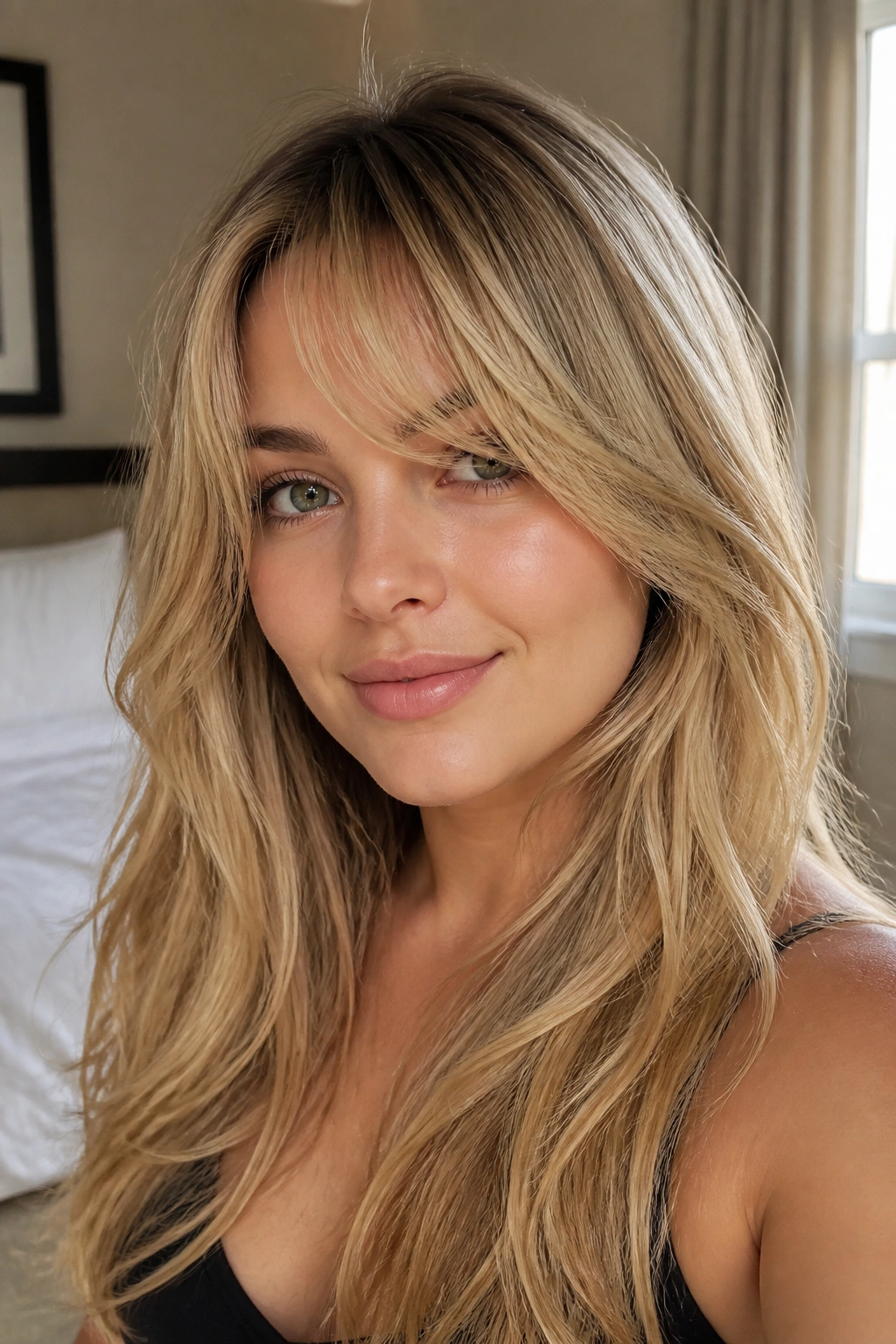
Wispy side bangs are a good answer when full curtain bangs feel like too much hair near the face. They give you the diagonal line without the commitment of a heavier fringe, and that’s often enough.
The important part is the weight. The bangs should be light, feathered, and easy to move. If they’re too dense, they sit across the cheek and shorten the face. If they’re soft enough to sweep aside, they help break up the roundness and create a slanted line from forehead to jaw.
What to Ask Your Stylist
- Keep the bang area thin and airy, not thick.
- Blend the fringe into long face-framing layers.
- Let the shortest pieces fall below the brow or at the outer eye.
- Avoid a sharp, chopped edge.
Blonde hair often makes side bangs look softer than darker shades because the lighter color shows the texture instead of the hard line. That’s useful. It means the fringe can be present without taking over the whole face. A round brush and a quick pass of heat are enough for most mornings.
14. Long Shag With Dimensional Blonde
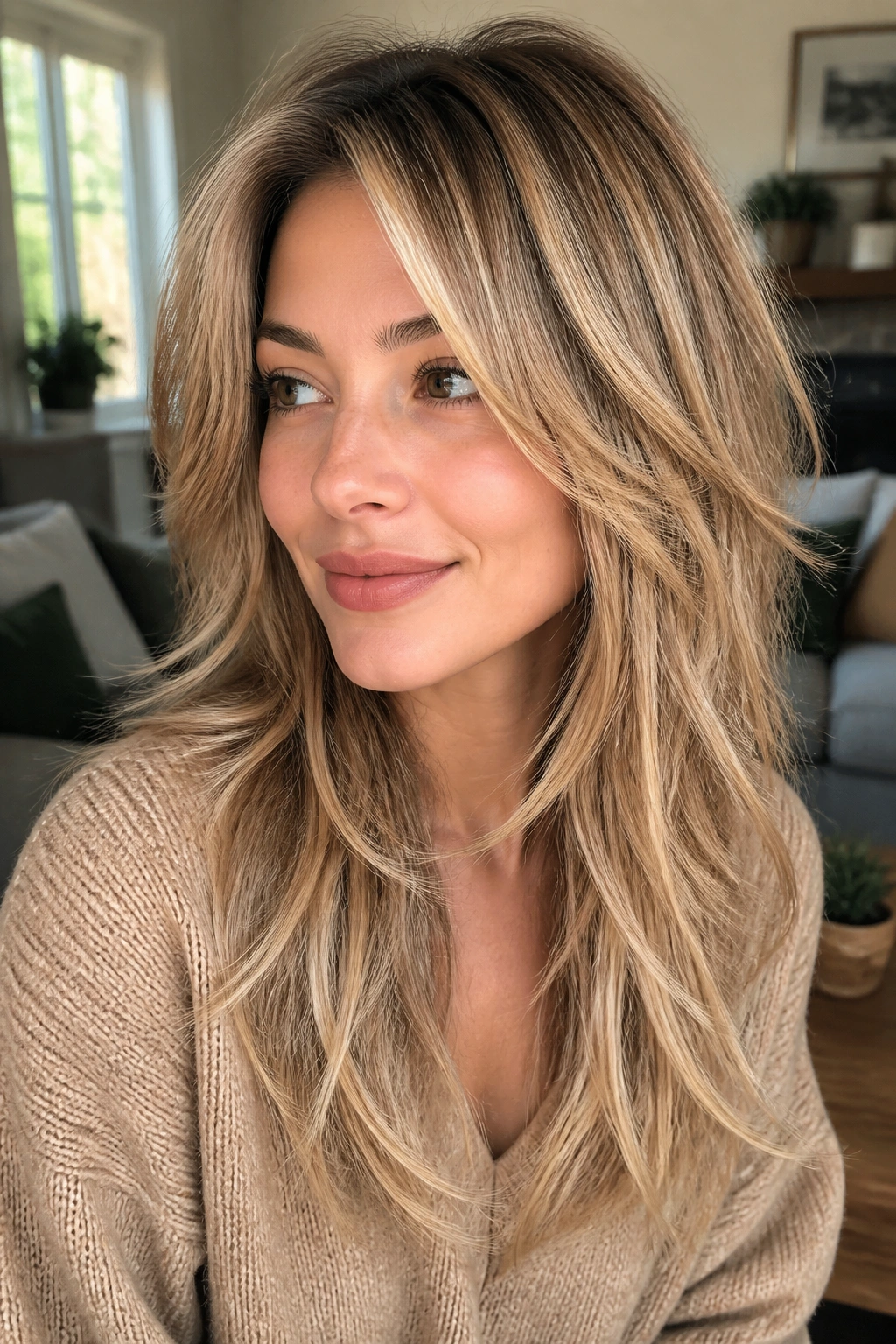
A long shag can be a very good haircut for a round face, but only if the layers stay long. Short crown pieces can widen the top half of the head. That’s not the goal. You want airy motion, not a mushroom shape.
The beauty of the long shag is its looseness. The layers break up the outline, the ends feel lighter, and the blonde dimension makes every bend visible. Balayage, face-framing highlights, and a few deeper ribbons underneath keep the cut from going flat. This is one of the few styles where a little roughness looks better than perfection.
If your hair is naturally wavy, the cut almost styles itself. Scrunch in a little mousse, diffuse until the roots are dry, and let the lengths do their thing. Straight hair can wear it too, but it needs more texture spray and a little bend from a flat iron or wand. The point is movement. A long shag without movement is just a layered haircut that lost its nerve.
I’d call this the edgier option on the list, but not in a way that scares people off. It feels relaxed, not messy.
15. Money Piece Blonde With Straight Lengths
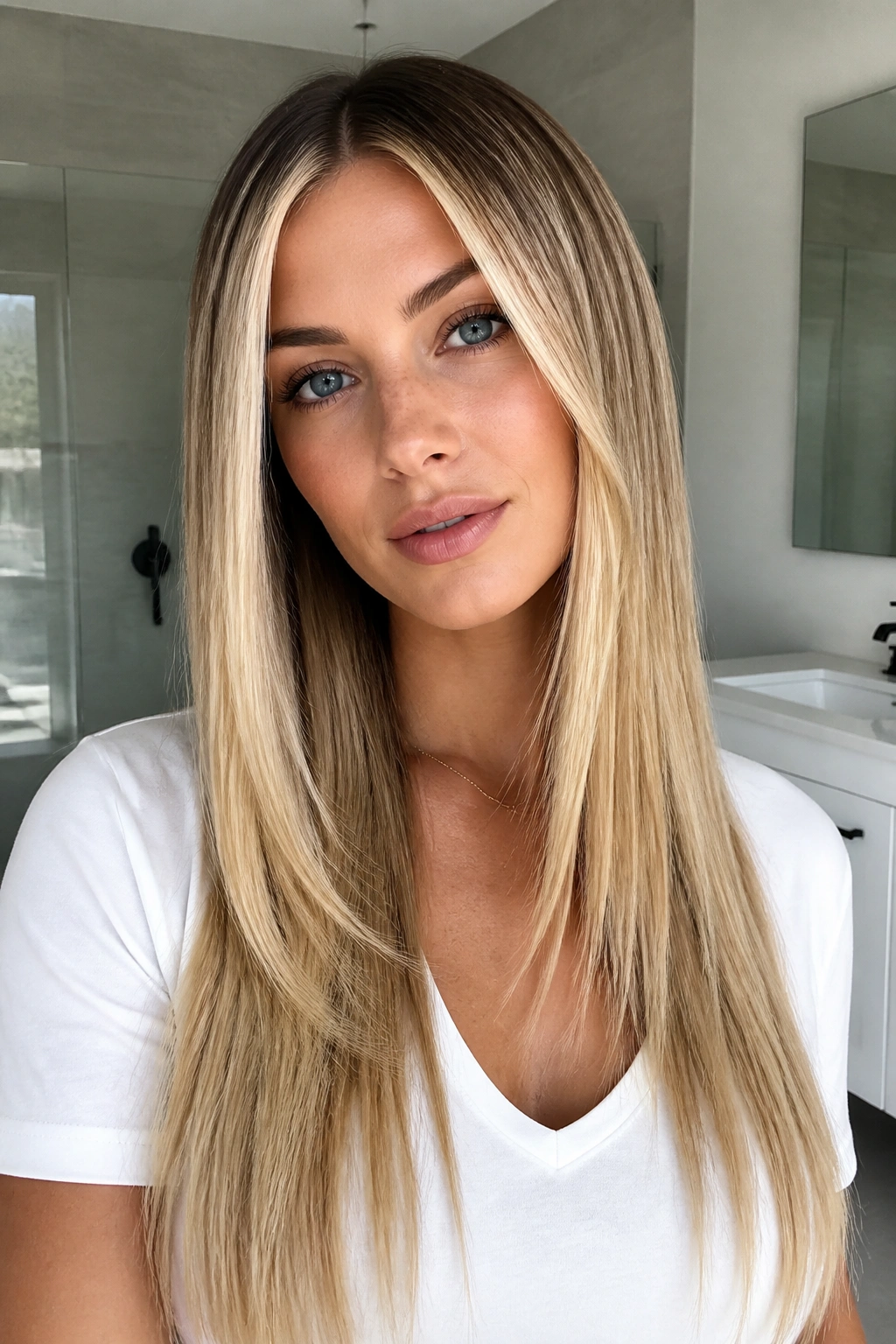
Can bold front pieces help a round face? Yes, if they’re placed well and the rest of the hair stays clean. The “money piece” works because it frames the face with brightness while the long lengths pull the eye downward.
The front sections should be lighter from about the brow or temple area down through the collarbone, but not thick enough to dominate the cut. Too much blonde at the sides can add width. A thin, bright panel does the opposite. It acts like a built-in frame. Pair that with straight or softly bent lengths and the face reads longer and more open.
A root shadow is useful here because it keeps the bright front from looking pasted on. The contrast between the shadowed root and the light face-framing streaks is what makes the shape pop. If your hair is very fine, keep the front pieces sleek. If it’s thick, a slight bevel at the ends keeps the line from feeling boxy.
Why the Placement Matters
- Brightness should start near the face, not through the whole head.
- Keep the front pieces long enough to hit below the cheekbone.
- Pair the color with a center part or slight offset part.
- Use a heat protectant with smoothing slip so the front panels stay clean.
16. Low Bubble Ponytail for Long Hair
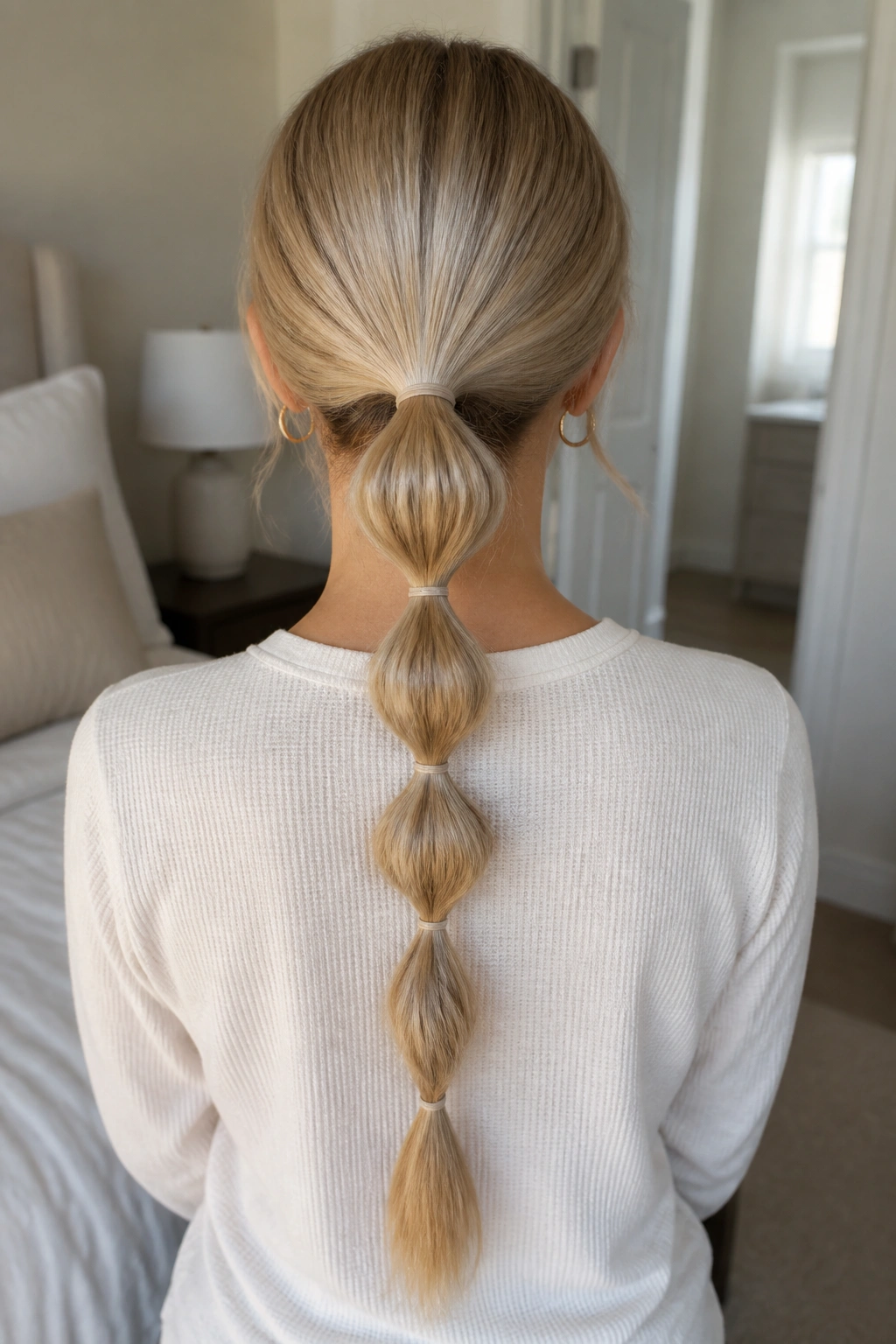
A low bubble ponytail gives long hair shape without adding bulk at the sides, which is why it works better on a round face than a high, wide pony. The bubbles create a vertical rhythm. That rhythm matters.
The style starts with a sleek or lightly lifted crown and a ponytail secured at the nape. Then you add elastics every 2 to 3 inches down the length, gently tugging each section outward to create the bubble shape. Keep the bubbles narrow rather than huge and round. Big bubbles can add width. Smaller ones read longer and cleaner.
Blonde hair is a nice match here because the elastic breaks and reflections show up more clearly along the tail. If you want the look softer, wrap a thin strand of hair around each elastic or leave the front pieces loose. If you want it sharper, smooth the top with a bit of gel and keep the tail straight.
It’s a playful style, but not childish. That’s the balance that makes it work. You get structure without losing the length.
17. Side Braid With Pull-Apart Texture
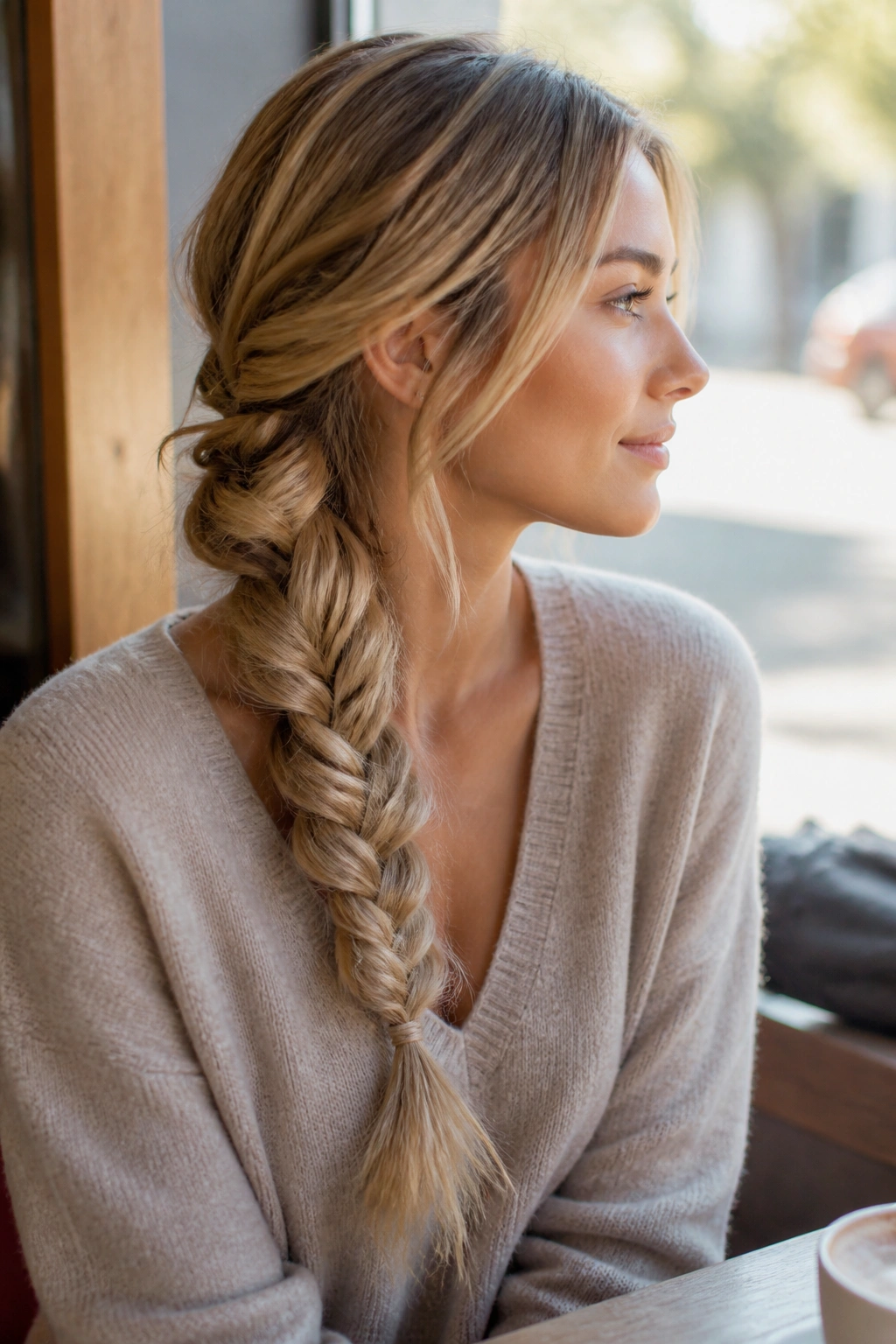
A loose side braid draws the eye diagonally across the body, and diagonals are your friend when the face is round. They interrupt the circle without making the hair look severe.
The braid should start low, near the back of one ear or just behind it, then fall over one shoulder. Keep the top smooth enough that the face stays open. Once the braid is secure, pull the outer edges apart a little at a time. Not enough to make it fall apart. Just enough to soften the thickness.
A three-strand braid works. A fishtail works too, especially if you want the texture to look a little finer. Blonde highlights make either one look more detailed because the strands catch light in different places. That’s one reason braided styles can look richer on blonde hair than people expect.
I’d leave a few thin pieces around the hairline if the braid is sitting high on the head. If it’s low and loose, you can skip them. The braid itself is already doing the shape work. No need to pile on.
18. Long Layers With a Swept-Over Front for Round Faces
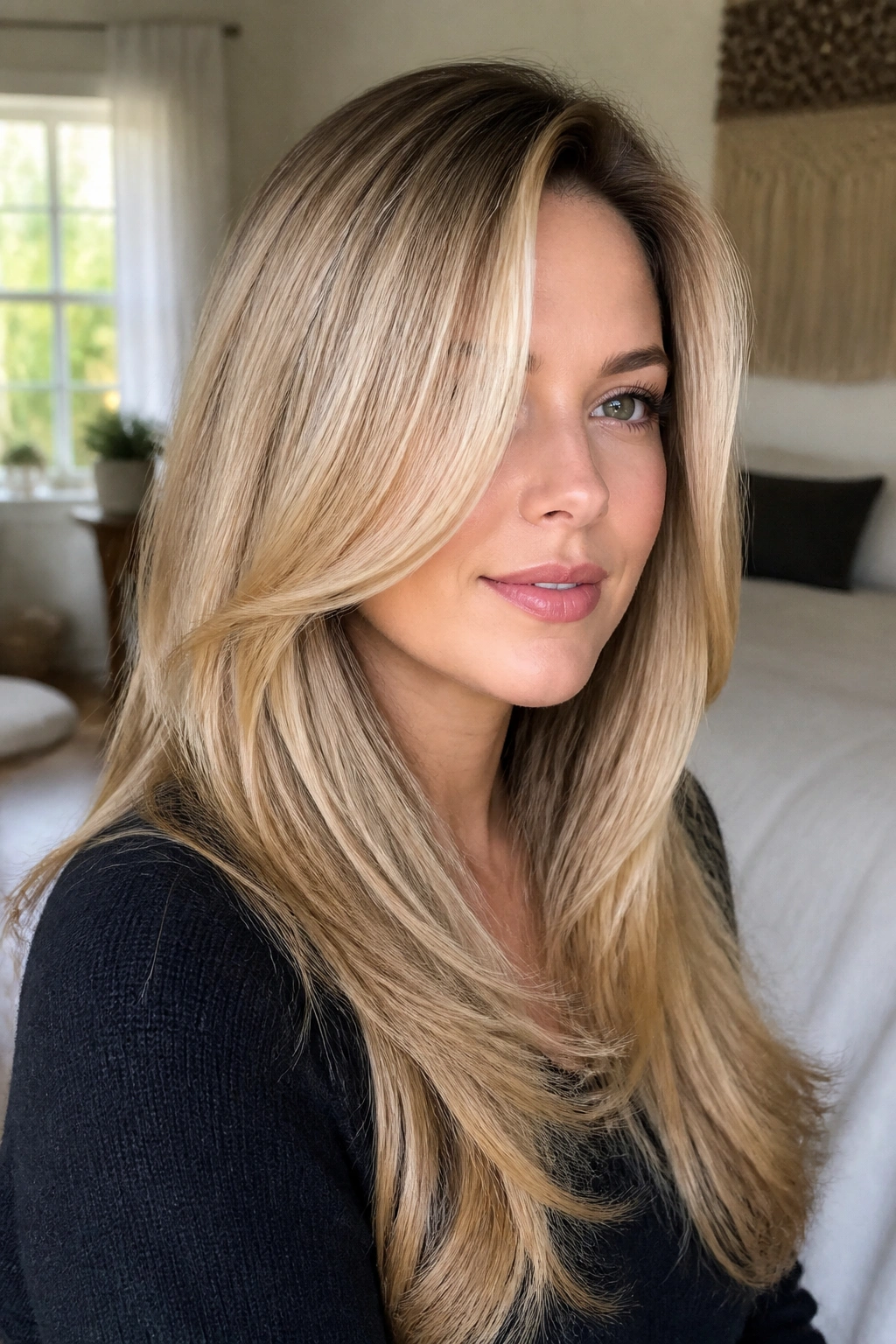
If I had to choose one haircut that quietly helps long blonde hair behave on a round face, this would be near the top. Long layers with a swept-over front keep the shape open, directional, and easy to wear.
The cut works because the front pieces are angled across the face rather than sitting straight beside it. That little sweep makes the face feel longer, especially when the shortest layer begins below the cheekbone. The back stays long enough to keep the overall line slim, while the layers remove weight without turning the whole style feather-light and shapeless.
This is the style I’d trust on thick hair, fine hair, straight hair, and wavy hair—though the styling changes a bit for each one. Thick hair usually needs more interior layering. Fine hair needs less. Straight hair looks best when the front is tucked behind one ear or given a slight bend. Wavy hair can carry the whole thing with almost no fuss.
A Few Things That Make It Work
- Keep the shortest layer below the widest part of the face.
- Ask for a swept front angle, not a blunt side fringe.
- Leave enough length around the face so the cut doesn’t puff outward.
- Add soft blonde dimension with highlights or babylights if the hair looks flat.
A good cut like this grows out gracefully, which matters more than people admit. Length is nice. Placement is nicer. And on a round face, placement wins almost every time.
