



Burgundy black hair color ideas for round faces work best when the color has a job, not just a mood. A heavy burgundy block can make the cheeks feel wider. A smart placement can pull the eye downward, sharpen the line around the jaw, and make the whole cut feel longer without looking forced.
Round faces usually look strongest with color that moves up and down, not side to side. That means side parts, face-framing pieces that start below the cheekbone, and darker sections sitting right at the widest part of the face are doing you a favor. It sounds tiny. It isn’t.
Black hair can swallow red if the placement is wrong. Burgundy can disappear into deep brown, read as plum in one light, then flash cherry in another — and that shift is exactly why these shades work so well when they’re handled with a little care. Some versions need only a gloss. Others need a few lighter ribbons so the red actually shows instead of hiding under the black.
The looks below lean into that idea. Some are quiet and glossy. Some are bolder. All of them are chosen with round faces in mind, because shape matters more than a cute color name.
1. Jet-Black Waves with a Deep Burgundy Gloss
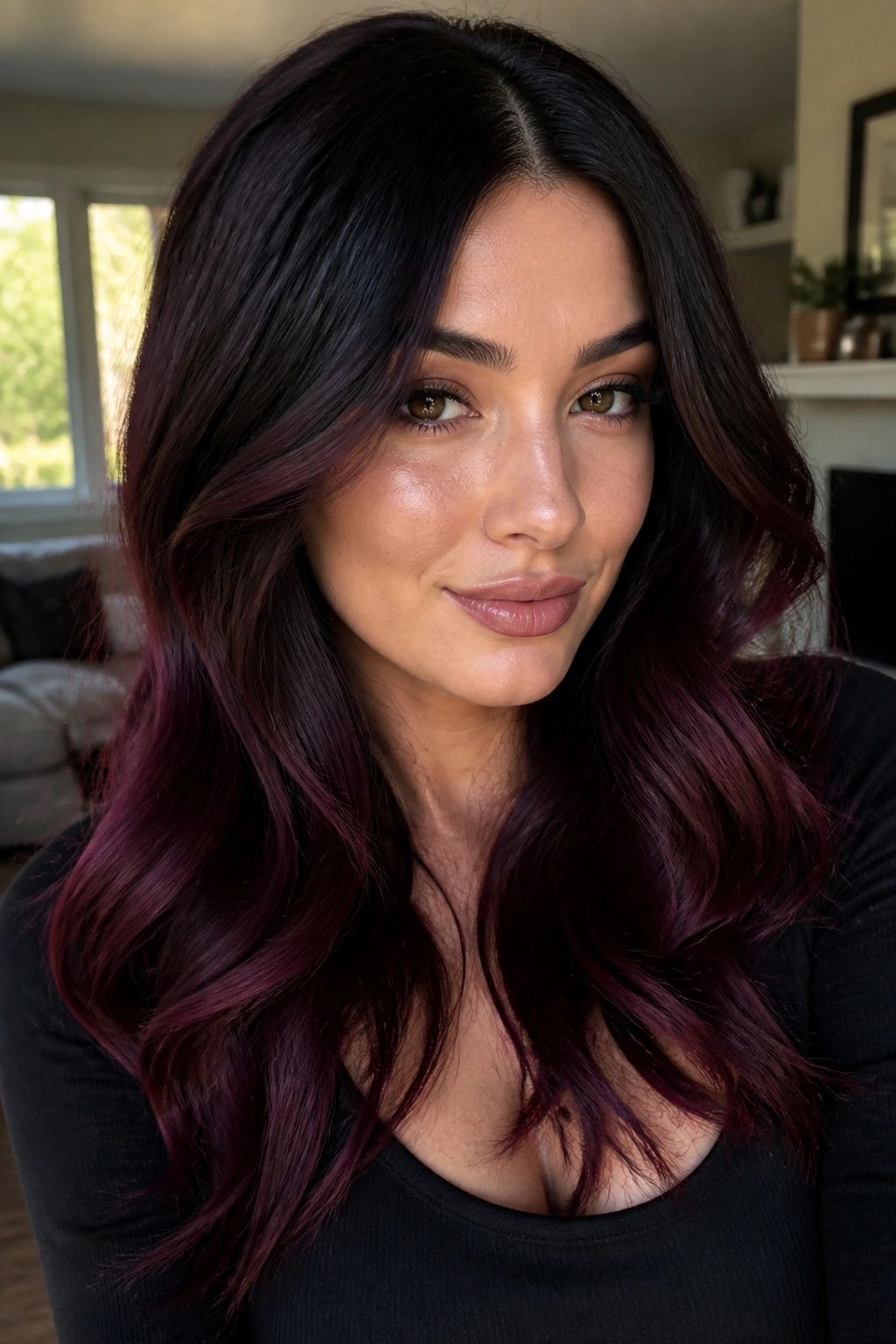
This is the calmest burgundy look on the list, and I mean that in a good way. The base stays jet black, while the burgundy lives as a deep gloss over the mid-lengths and ends, so the hair looks almost black indoors and turns wine-dark when it moves.
For a round face, that kind of softness helps. Loose waves add vertical motion, and the color shift sits lower on the head instead of widening the cheek area. The trick is keeping the burgundy rich, not loud. If the red is too bright, it can pull attention sideways. If it stays in the blackberry-to-merlot range, the whole look feels longer and sleeker.
I like this option for anyone who wants low drama but still wants people to notice something is different. It’s also one of the easier burgundy black hair color ideas for round faces to maintain, because a gloss fades more softly than a high-contrast dye job.
A 1.25-inch curling iron, brushed out after cooling, gives it that smooth swing that suits a round face best. No stiff curls. Those can puff out the sides, and nobody needs that.
2. Side-Swept Burgundy Money Piece for Round Faces
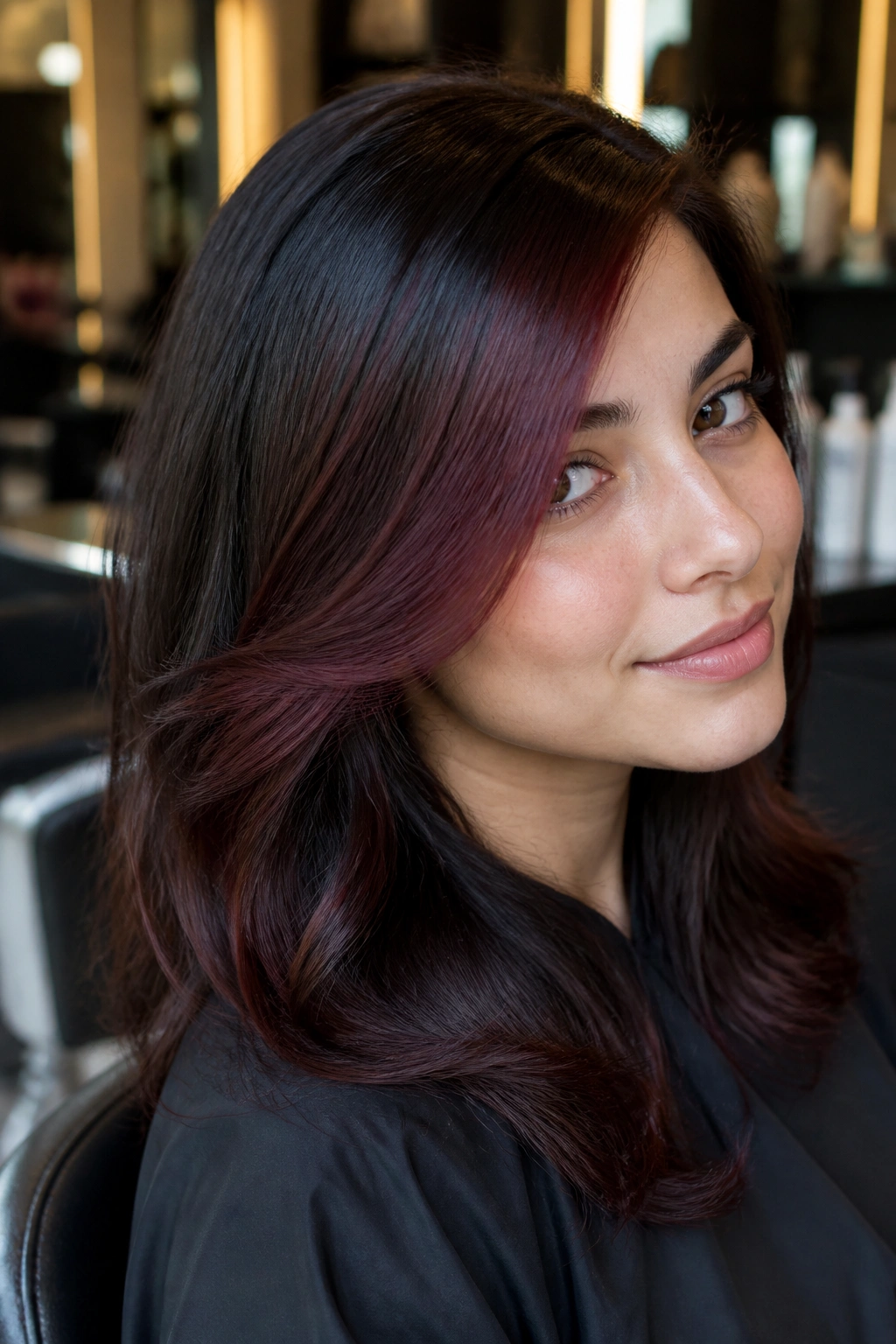
Can a money piece flatter a round face? Yes — if it starts with restraint. The bright burgundy should sit off-center and sweep across the forehead in a diagonal line, not drop straight down like a curtain on both sides.
Why it works
A side-swept front section breaks up the widest part of the face and pulls the eye toward the jawline and collarbone. The best version begins a little lower than you might expect, often around the cheekbone or just below it. That keeps the color from sitting where the face is broadest.
What to ask for
- Ask for a deep burgundy face frame, not chunky front streaks.
- Keep the brightest pieces on the heavier side of the part.
- Let the color taper toward the ends so the front doesn’t look square.
How to wear it
A blowout with movement away from the face keeps this look sharp. Tucking one side behind the ear helps, too. Tiny change. Big payoff.
This is one of those styles that works best when the hair is glossy and controlled. If the front pieces frizz out, you lose the clean line, and the whole point of the look disappears.
3. Black Cherry Balayage Starting Below the Cheekbones
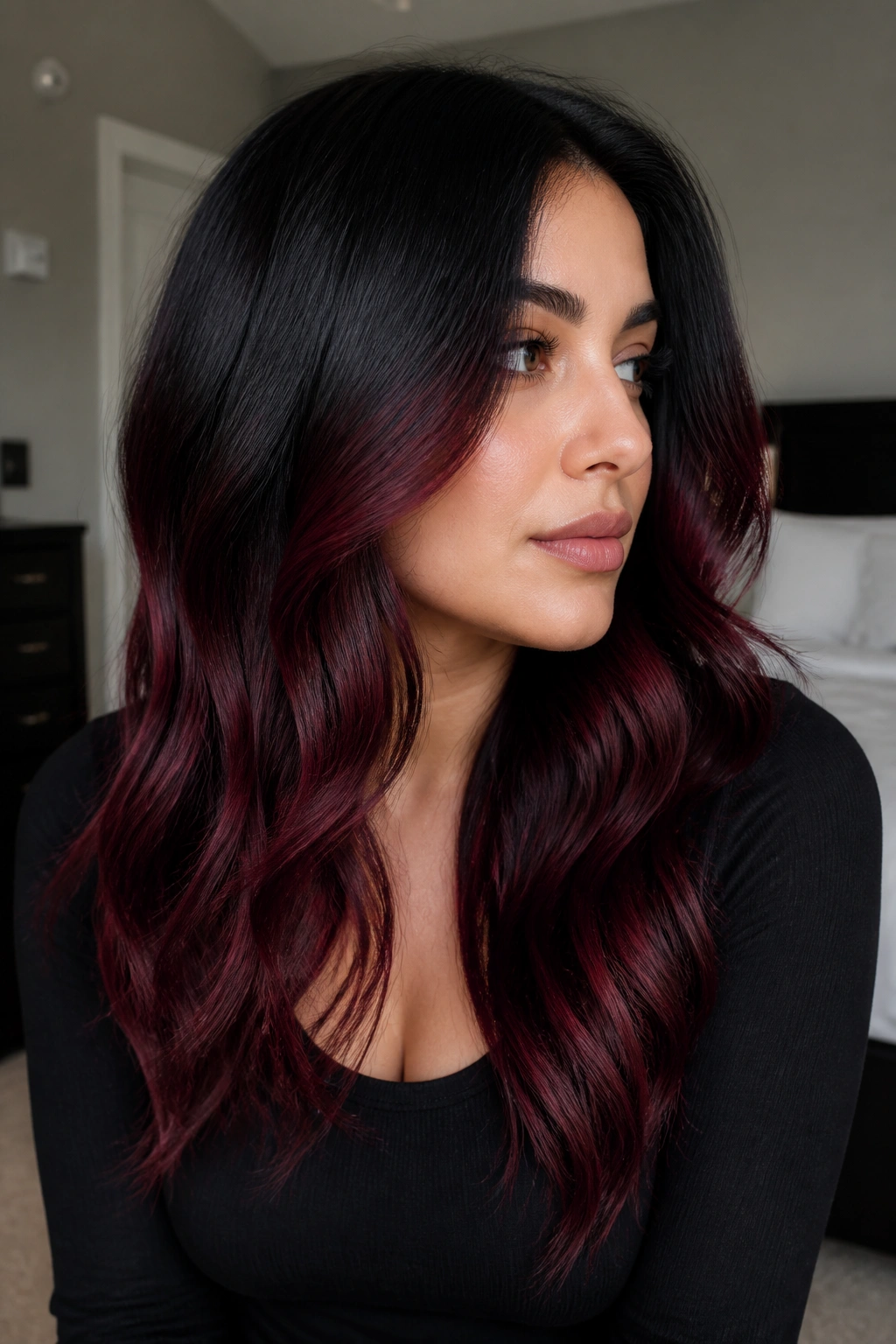
If you want burgundy without the hard edge of a full color block, black cherry balayage is the safer bet. The color is painted in softer ribbons, and those ribbons begin below the cheekbones so they don’t widen the face where it already carries the most fullness.
That placement matters more than people think. A round face usually looks longer when the eye is drawn down through the lengths. Balayage starting at mid-length or lower does exactly that. It gives you movement around the shoulders and ends, where the silhouette can use a little help.
This version works especially well on medium-to-long hair, because the darker root keeps the top calm while the burgundy wakes up the lower half. It’s also a nice choice if your hair is thick and tends to take color well. The painted pieces can be thin or medium-width, but they should never land in a blunt stripe across the cheeks.
I’d ask for soft ribbons, not chunky panels. That single note saves a lot of bad dye jobs.
4. Velvet Burgundy Peekaboo Panels Under Straight Hair
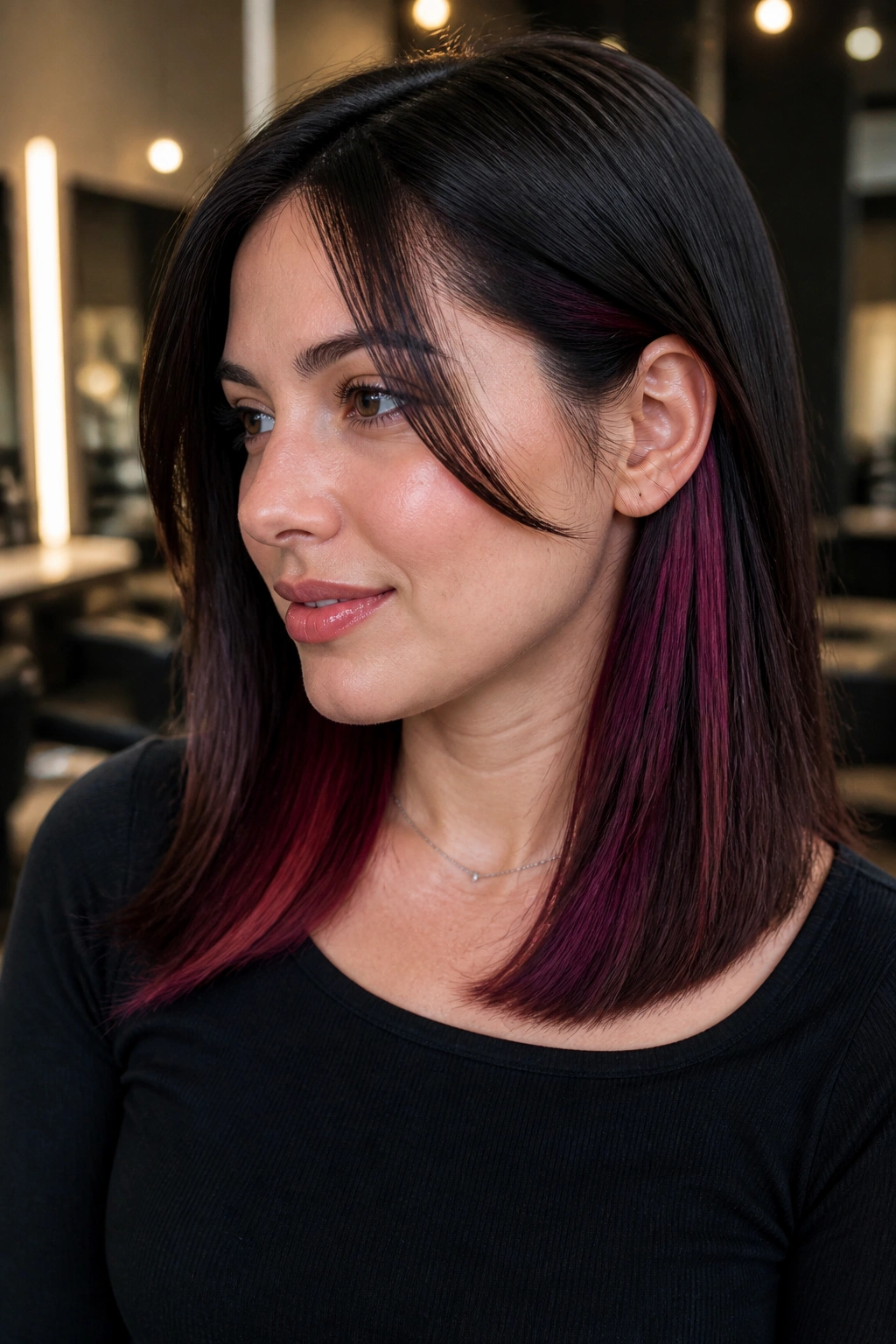
Not every flattering color has to announce itself from across the room. Peekaboo panels are hidden under the top layer, so the burgundy shows when the hair swings, tucks behind the ear, or gets tied half up.
For a round face, that hidden placement is smart because the eye doesn’t stop at the cheeks. It keeps traveling downward. The top layer stays dark and sleek, which helps the face look narrower. The burgundy becomes a surprise instead of a loud border around the face.
Straight hair shows this look best because the contrast between the black top layer and the wine-colored underneath stays crisp. If your hair is very layered, the peekaboo effect can get messy fast. That said, a blunt lob or a long, smooth cut makes the hidden color feel deliberate.
I like this one for people who need a work-friendly look during the day but still want some personality once the hair moves. It’s a little secret. That’s part of the charm.
5. Merlot Face-Framing Layers with a Center Part
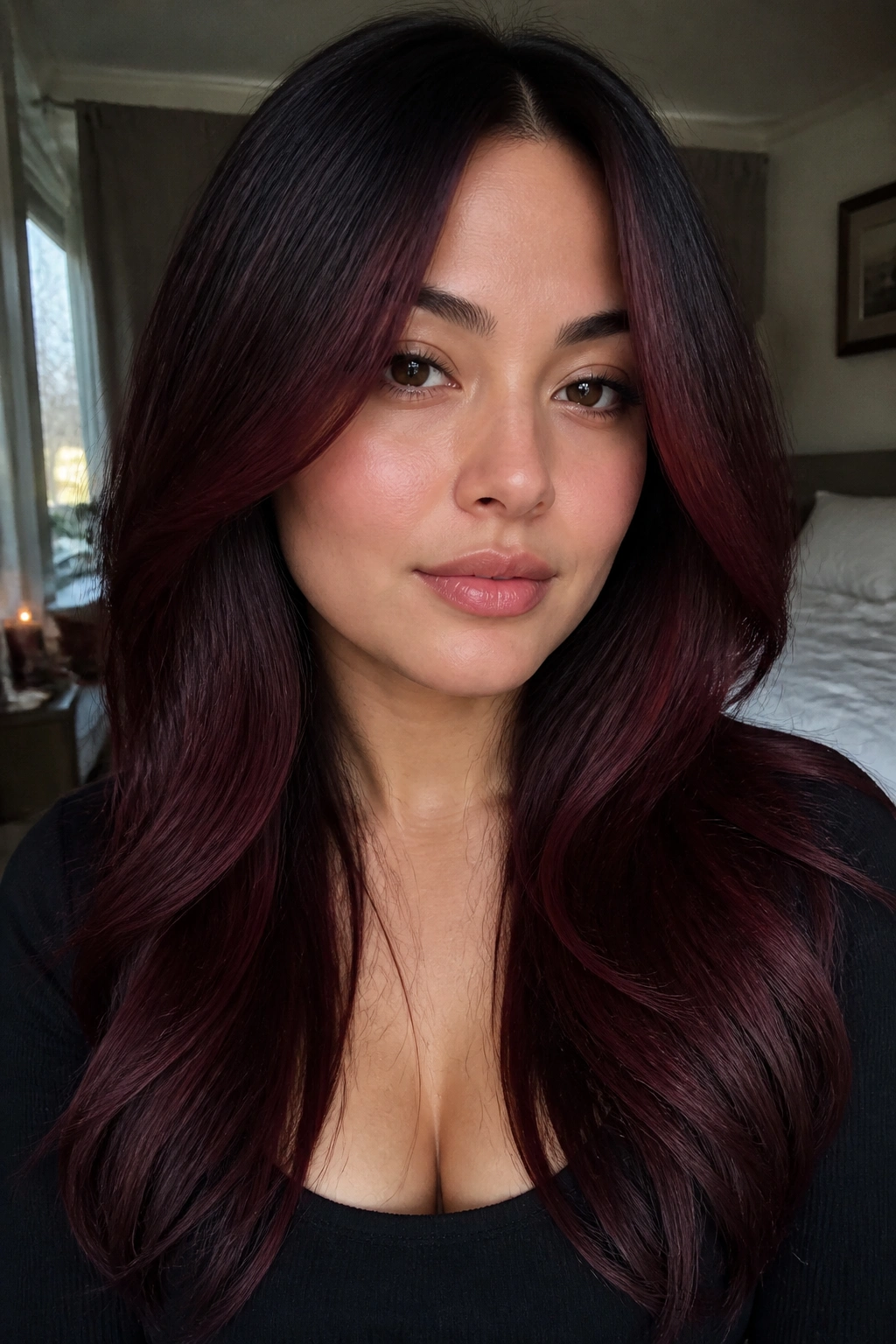
A center part is not off-limits for a round face. It just needs help, and merlot face-framing layers do the heavy lifting. The front pieces should start below the cheekbone and angle down past the jaw, which keeps the face from feeling wider than it is long.
The burgundy here should be deep and wine-rich, not bright red. Merlot reads richer against black hair than a flat cherry tone does. On darker skin tones especially, that deeper shade can look almost velvety, while still giving enough contrast to break up the black.
What makes it work
- The center part gives symmetry.
- The angled front pieces cut diagonally along the face.
- The darker root keeps the crown from puffing out.
This style looks best with long layers that move when you walk. If the hair hangs in one heavy sheet, the face-framing pieces lose their job. I’d also keep the ends blunt enough to feel full, but not so blunt that they make the lower face look boxed in.
There’s a nice balance here. Not fussy. Not flat either.
6. Smoky Plum Ends on Long Black Hair
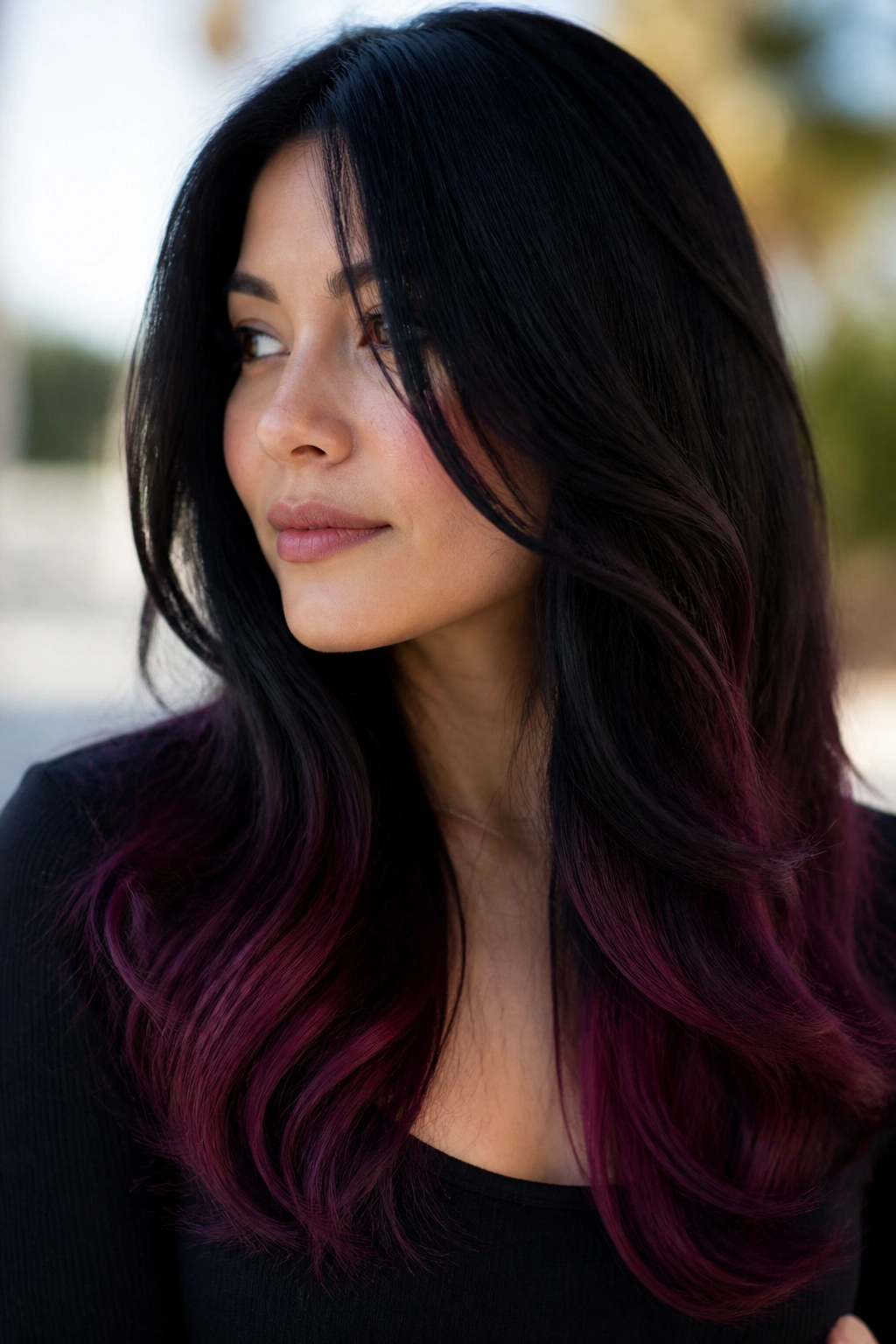
The first thing you notice is the ends. That’s the whole point. Smoky plum sits at the bottom of long black hair like a dark wine wash, and on a round face that lower placement does a lot of quiet work.
Long hair already helps stretch the face visually. Add a deeper plum at the ends and the eye follows the color downward instead of sitting around the cheeks. That downward pull makes the face look longer without shouting about it. It’s one of the easiest ways to wear burgundy if you don’t want the color near the hairline.
This look is especially strong on hair that has a little wave or bend in the last third. A straight finish can work too, but soft movement keeps the plum from feeling blocky. If you curl only the ends, the color shows in pieces instead of one flat band.
I’d keep the top almost untouched. The contrast between the black crown and plum ends is what gives this style its shape. Mess that up, and the whole thing turns muddy.
7. Burgundy Curly Shag with Height at the Crown
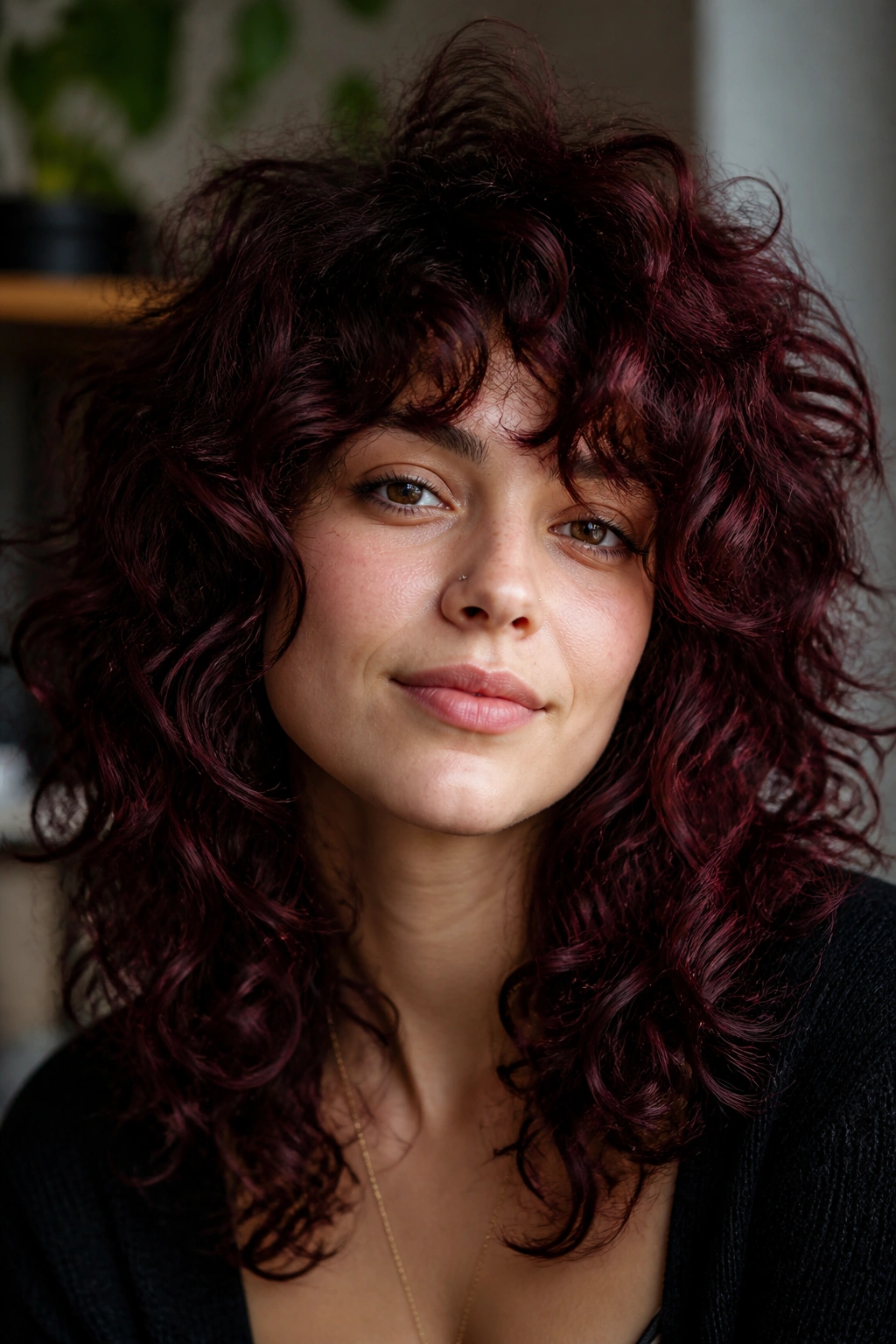
Why do curls and burgundy work so well on a round face? Because the shape needs lift at the top and control at the sides. A curly shag gives you both, especially when the crown is layered for height and the side pieces stay a little longer.
The burgundy should live in the curls that move around the shoulders and lower face, not in a wide band across the cheeks. That keeps the color from widening the face where it already has the most curve. A shag cut naturally adds some vertical energy anyway, so the shade can be a little richer without feeling heavy.
What to ask for
- Keep the top layers soft and springy.
- Leave the face-framing curls a touch longer.
- Place burgundy where the curl spirals are strongest, usually from mid-length to ends.
A diffused finish works better than a fluffy one here. Too much width at the sides defeats the whole point. And if your curls are tight, ask for a shape that follows the curl pattern instead of fighting it. The cut should look intentional when dry, not only after a perfect salon blowout.
This is one of my favorites. It has movement, shape, and a little attitude.
8. Wine-Red Underlights in a Sleek Ponytail
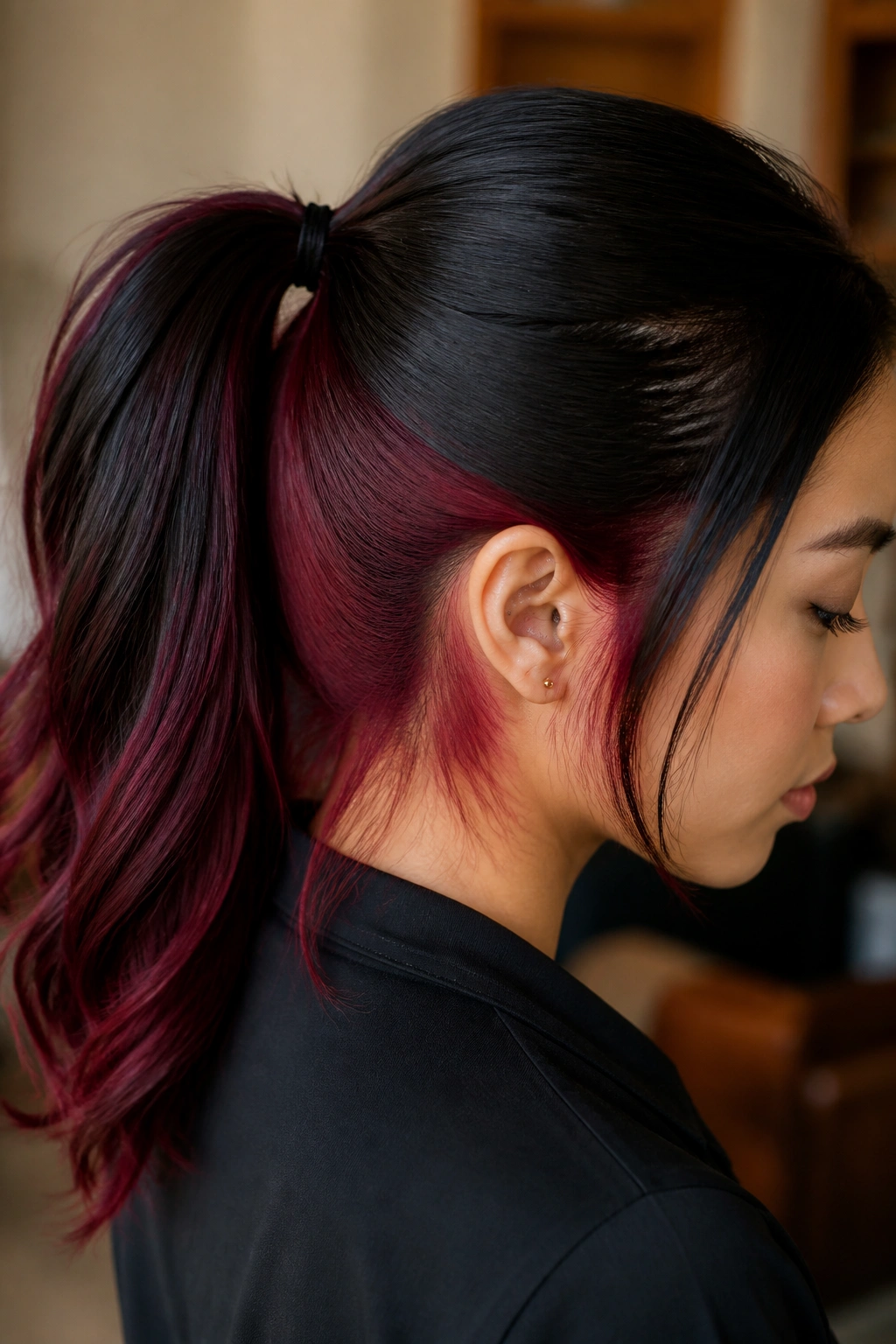
Underlights are for people who wear their hair up often and don’t want the color to disappear the second the ponytail goes on. The top layer stays black, smooth, and clean, while the wine-red lives underneath like a ribbon only some angles reveal.
That’s useful for round faces because the visible color sits lower, around the nape and lengths, instead of wrapping the face in brightness. A sleek ponytail with underlights pulls everything upward and back. The face opens up. The color still shows.
A few things make this work better:
- Keep the top layer dense enough to hide the underlights when the hair is down.
- Place the wine-red nearer the middle and lower sections, not right at the temples.
- Use a polished ponytail or low bun when you want the red to show in a controlled way.
I also like this option for thick hair. The hidden panels can give heavy hair some life without making the whole head look busy. If you’re the sort of person who wears a scarf, clip, or claw clip half the week, this one holds up well.
9. Dark Cabernet Ombre on Waist-Length Hair
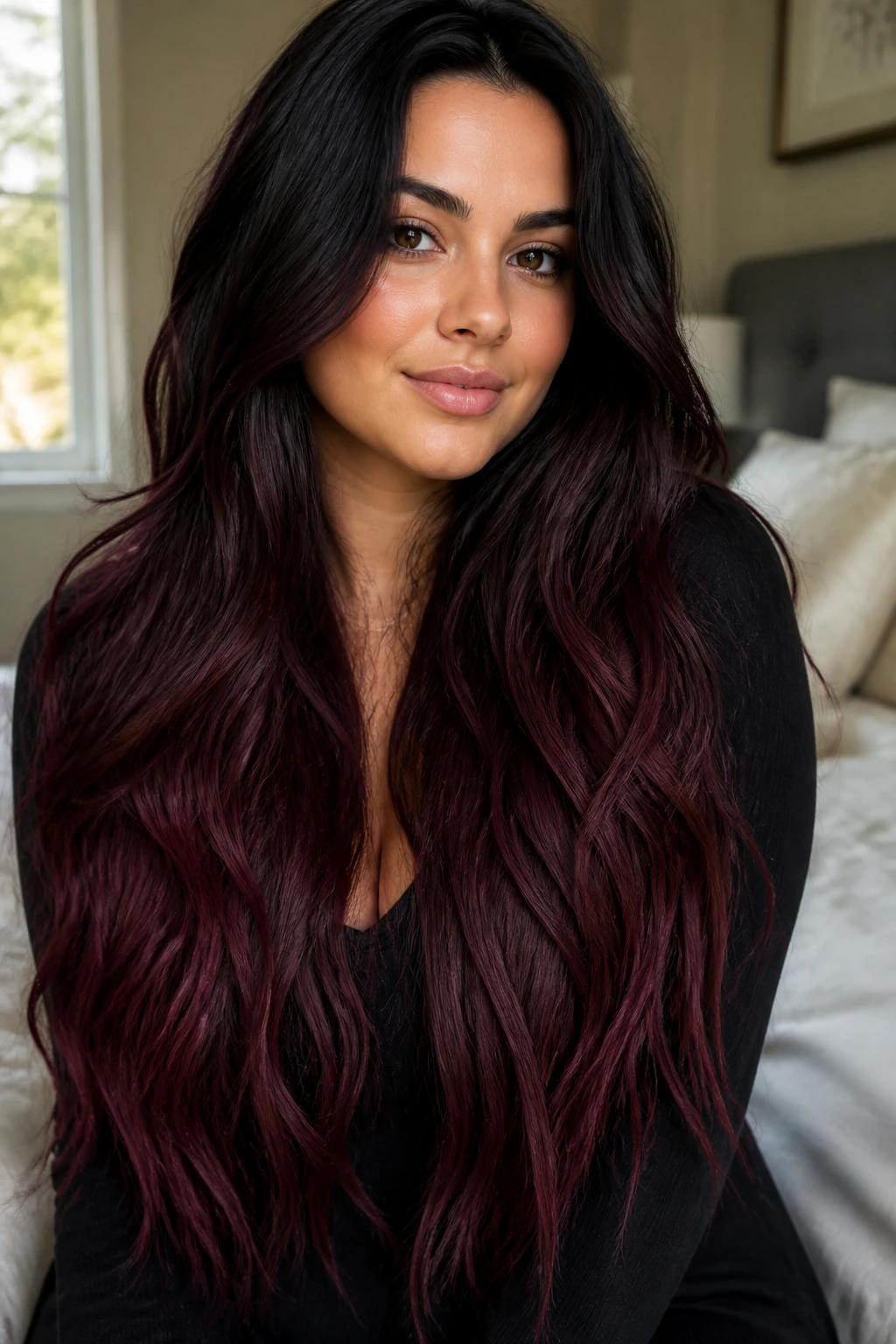
Waist-length hair gives ombre room to breathe, and burgundy-black ombre needs that space. The transition from black roots to dark cabernet ends should be gradual, almost soft enough that you only notice it once the hair moves.
For a round face, that long fade is useful because it draws the eye down the whole length of the hair. A low, slow ombre gives the face a longer outline. A sharp color break near the cheeks does the opposite, so the color should begin well below the face’s widest point.
The best version of this look is not bright. It leans dark cherry, black grape, and deep wine rather than a red that flares too hard in daylight. On very long hair, that deeper tone feels richer and less stripy.
This is a good choice if you love length and want your color to support the cut rather than fight it. It does need patience during maintenance, though, because long ends tend to fade first. A color-safe conditioner and a gentle sulfate-free wash routine make a difference here. Not glamorous. Necessary.
10. Black Raspberry Lob for Round Faces
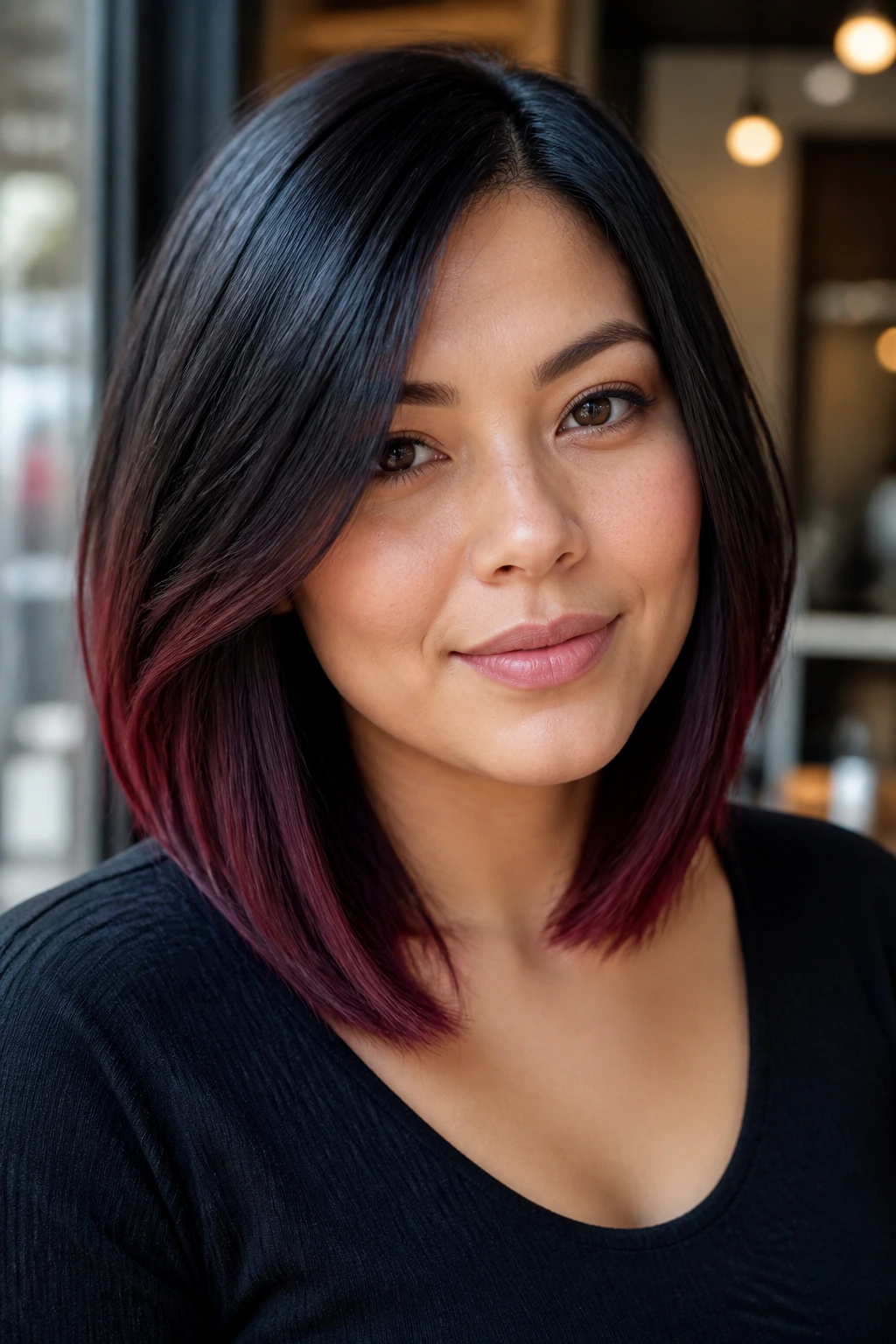
A blunt chin-length bob can be tricky on a round face. An angled lob is a different story. It gives you that cleaner shape around the jaw while keeping the front pieces longer, which helps stretch the face instead of framing it too tightly.
Black raspberry works well here because it’s dark enough to stay sophisticated but red enough to show against a black base. The color should live mostly through the lower half of the cut. If it sits too high, the bob can widen the face right where you want a little more length.
The front should graze the collarbone or just skim below it, especially if your cheeks are full. That little bit of extra length changes the whole read of the haircut. Straight styling gives the sharpest line, but a soft bend at the ends keeps it from looking severe.
I’d avoid stacking too much volume at the back. It sounds like a small thing, but on a round face a puffed-out bob can add width fast. Keep the back neat, let the front drop, and the shape does the rest.
11. Mulled-Wine Curtain Fringe with Long Layers
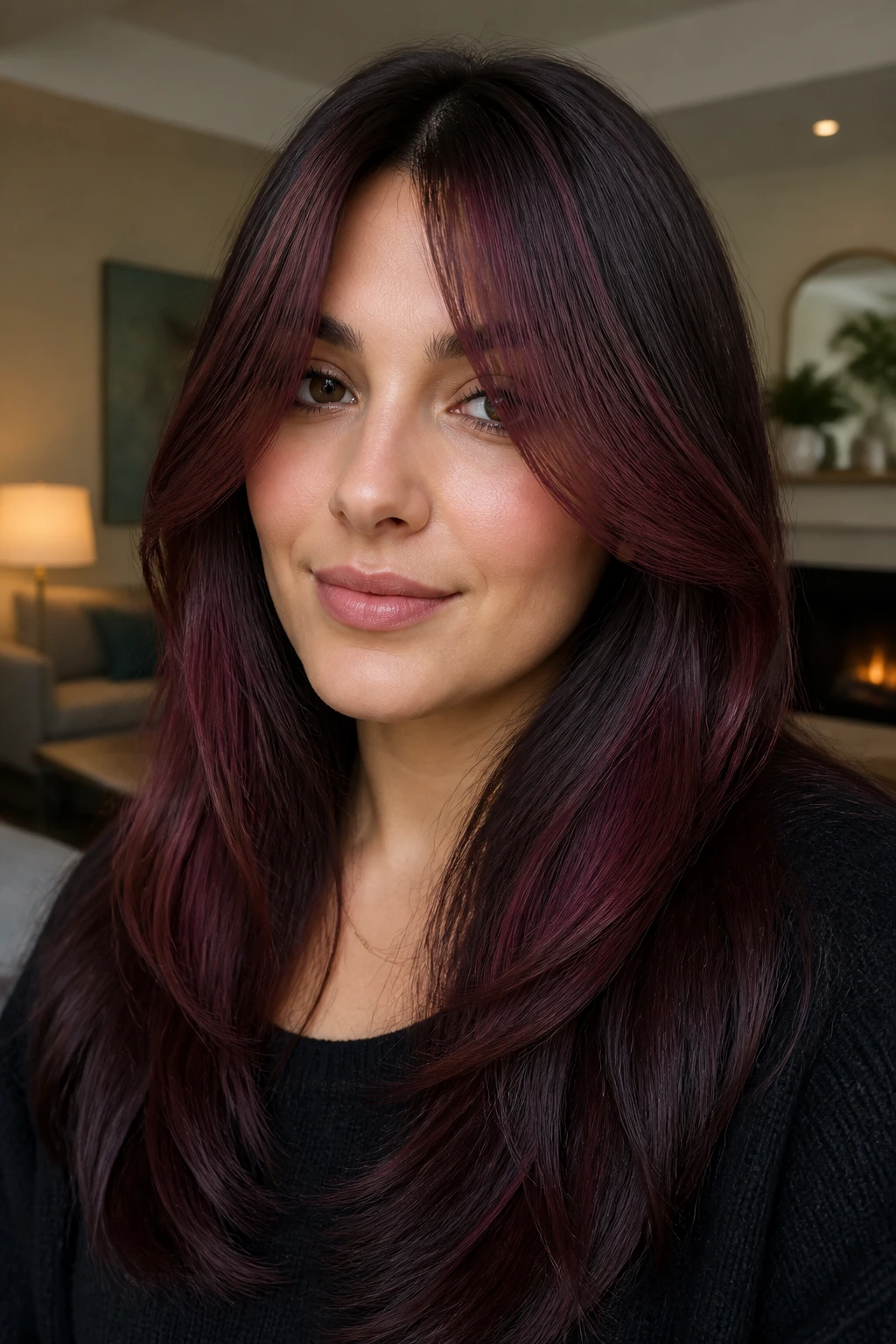
A fringe can work on a round face if it parts in the middle and falls softly to each side. Curtain fringe does exactly that, and when it’s tinted in mulled-wine burgundy, the front of the cut gets just enough interest without boxing in the face.
Why it flatters
The parted fringe creates two diagonal lines that move away from the center of the face. That angle matters. It breaks up width and gives the illusion of length. Long layers behind the fringe keep the rest of the hair from feeling heavy around the cheeks.
Styling notes
- Blow-dry the fringe away from the face, not straight down.
- Keep the shortest point around cheekbone level, not above it.
- Use a round brush only at the ends so the fringe stays soft.
This look is nicest on hair that already has some movement. Straight, flat hair can make curtain fringe hang like a curtain, and that’s the wrong kind of literal. A little bend gives it life.
The burgundy here should show mainly in the front pieces and upper layers. That keeps the color focused where it frames the eyes, instead of wrapping the widest part of the face in red. Good placement. Plain and simple.
12. Auburn-Burgundy Ribbon Highlights Through Black Curls
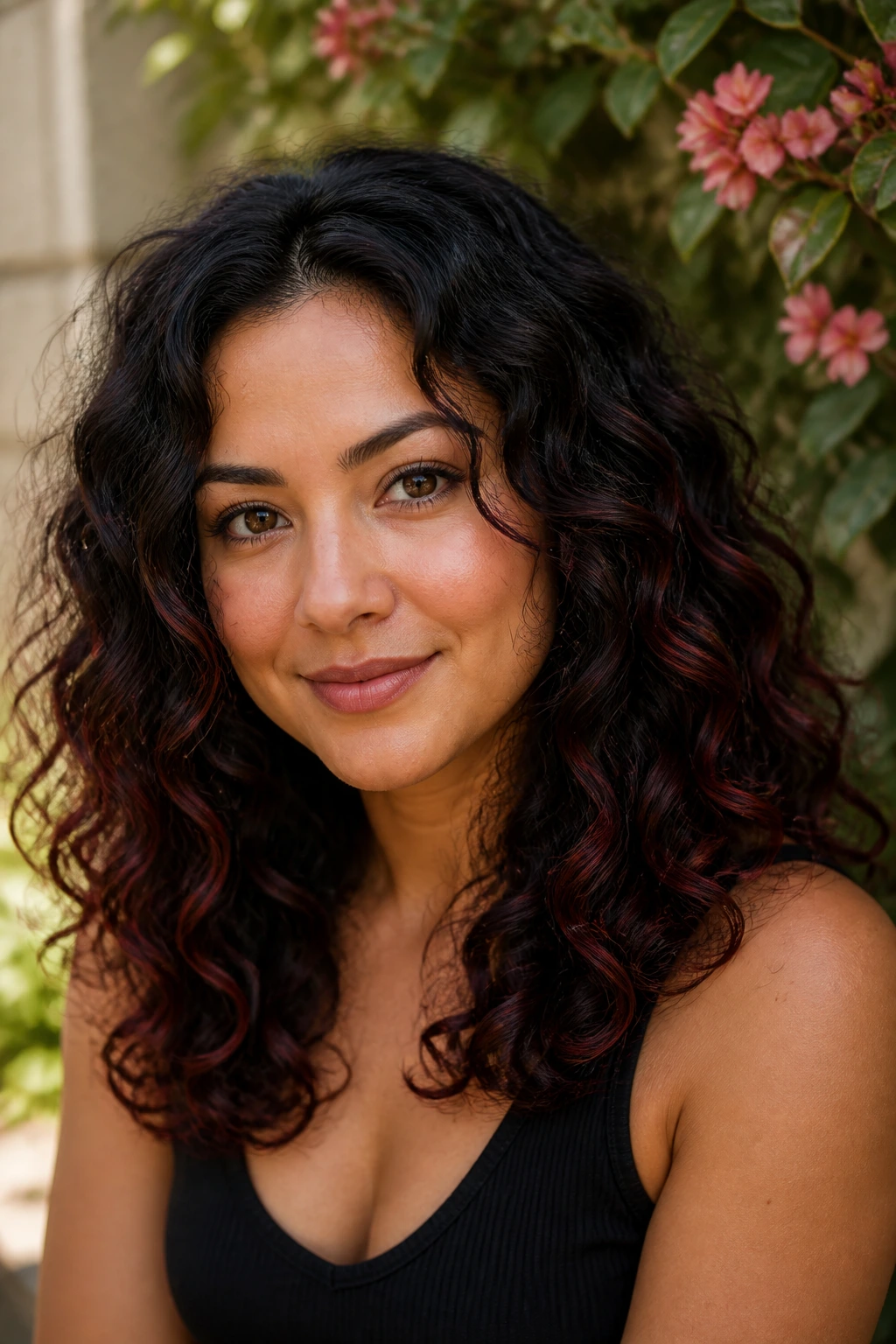
Can red and black curls look neat instead of busy? Yes, if the highlights are thin and placed like ribbons, not painted in thick slabs. Auburn-burgundy is a good middle shade for this because it sits between copper warmth and deep wine, so it plays well with black hair that needs a little lift.
Curly hair needs color that follows the curl pattern. Ribbons that track along the spiral look intentional; random chunky streaks do not. On a round face, keep the brighter pieces lower on the curl cluster and avoid loading them right at the cheekbone line.
A few placement rules help:
- Use narrow painted sections, especially near the front.
- Let the curls fall first, then decide where the color should sit.
- Keep the brightest ribbons under the top layer so the shape stays soft.
This is a strong option if your curls shrink up a lot. The color will still show in motion, and the layers can keep the roundness from feeling too wide. I like it with side parts, though a deep center part can work if the front curls are long enough to angle downward.
13. Soft Burgundy Shadow Root on a Rounded Bob
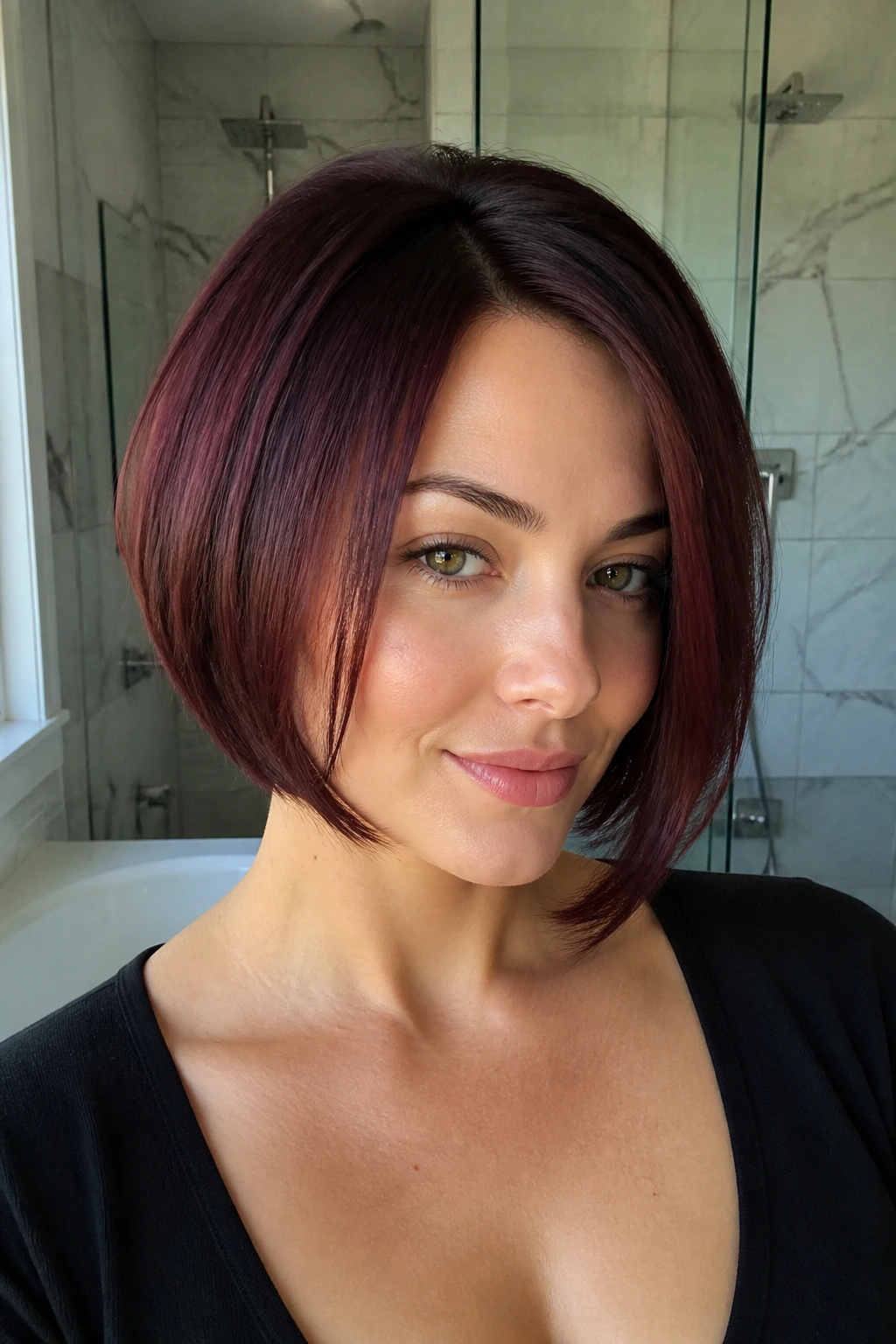
A rounded bob can be lovely on a round face if it’s cut with a little discipline. The shape should hug the jaw lightly, not puff out at the sides, and the burgundy should come in as a shadow-root blend rather than a hard stripe.
That shadow root gives the top depth and keeps the haircut from looking helmet-like. The burgundy can start around the temples and move darker toward the ends, which helps the face feel longer. You get dimension without a sharp line at the hairline.
This is one of the easier looks to maintain because the root is meant to be dark. Grow-out is softer, and that matters if you don’t want constant salon visits. On a bob, that practical side counts.
I’d keep the front just a touch longer than the back so the cut doesn’t stop right at the widest point of the cheeks. That small difference changes the whole silhouette. If the bob is too round, the face can look rounder. If it leans slightly forward, the shape gets cleaner.
14. Plum-Cherry Color Melt on a Mid-Length Cut
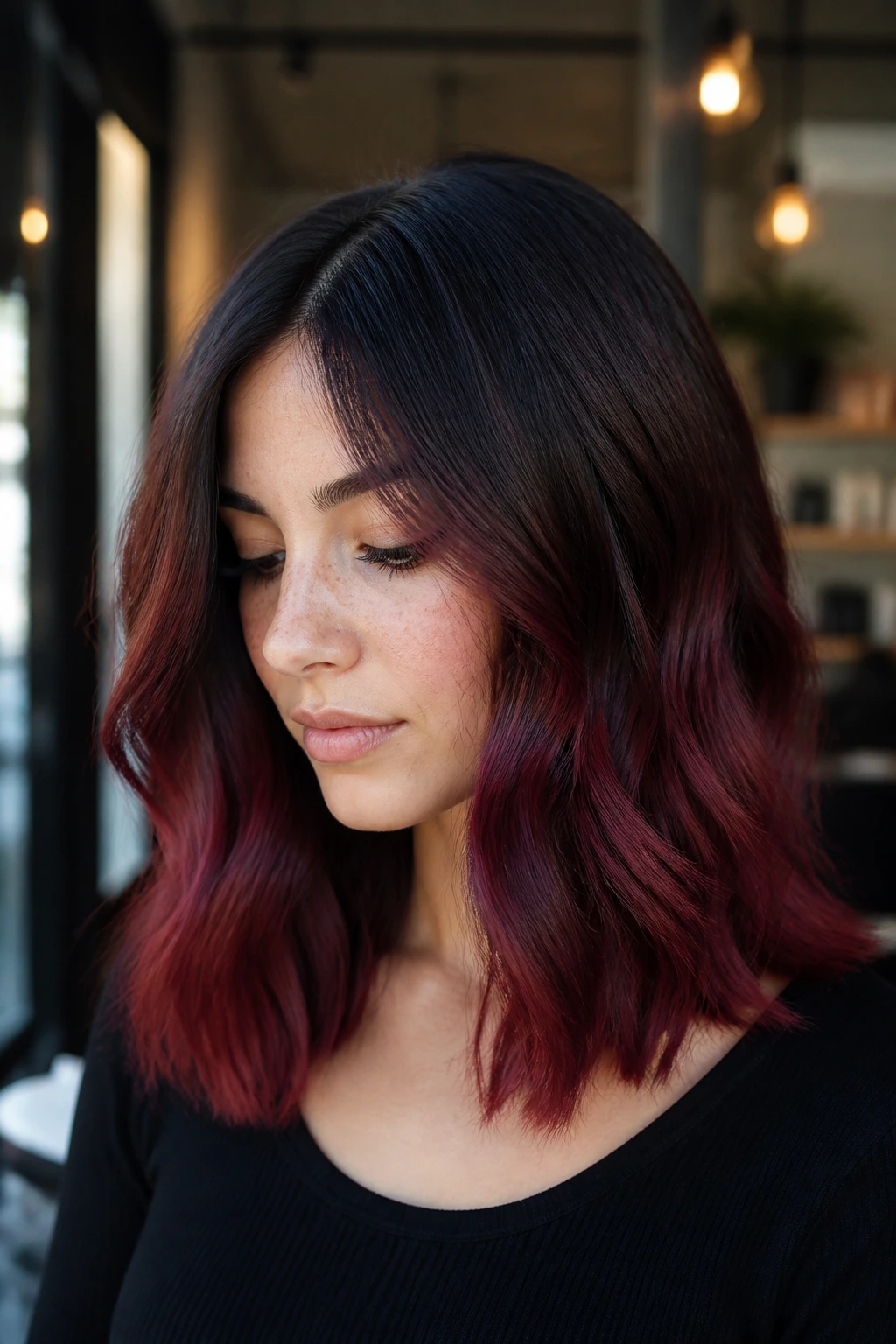
A color melt works because there’s no obvious stop between black, plum, and cherry. The shades slide into one another, which gives mid-length hair a smoother shape and keeps the eye moving down the cut instead of pausing at the cheeks.
For a round face, that smooth shift matters. Hard color lines can cut the face in half. A melt avoids that and makes the hair feel longer, softer, and more expensive-looking without trying too hard. Yes, I said expensive-looking. The reason is simple: clean blending looks polished even when the shade is deep and moody.
Mid-length cuts are especially good for this because they give the color room to transition below the jawline. The plum can live near the crown and upper mid-lengths, then drift into cherry and finally darker ends. The result is subtle but not flat.
This style does need a patient colorist. The blend should be seamless in person, not just from across the room. If the sections are too separated, the melt turns into stripes, and that ruins the whole point.
15. Burgundy Braided Accent Streaks in Thick Hair
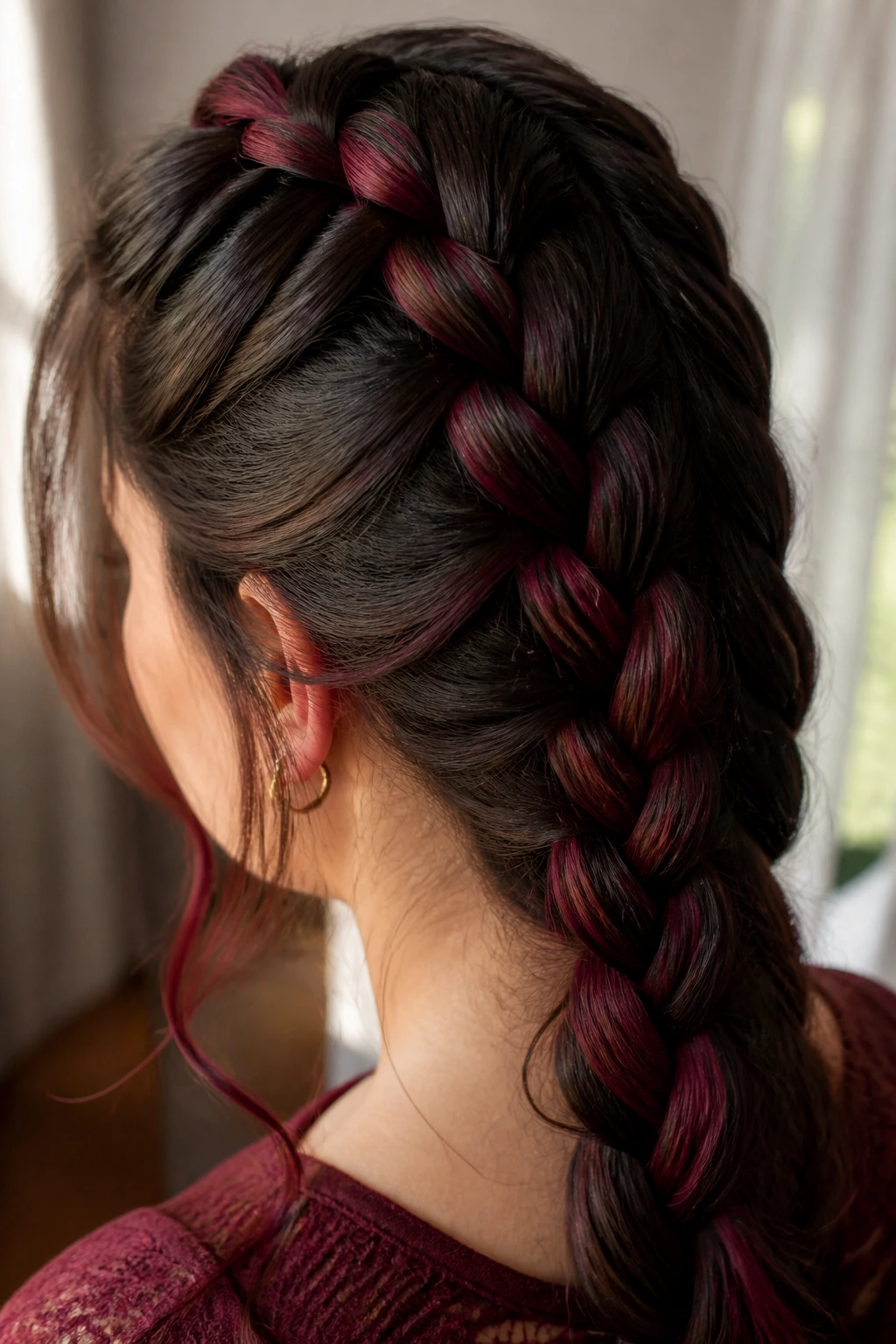
Thick hair can swallow burgundy if you paint it everywhere. Braids are different. They expose the color in neat slices, which is why accent streaks work so well when you wear plaits, twists, or rope braids.
What to ask for
- Place the burgundy in a few visible panels, not all over.
- Keep the streaks longer and thinner than a typical highlight.
- Make sure some color sits under the outer layer so the braid has depth.
Where it shines
A single Dutch braid down the back can show the red in alternating ridges. A crown braid can reveal it near the weave. Even two simple braids can look more structured when burgundy runs through the interior pieces.
For round faces, braid placement can help, too. A braid that starts a little higher on the head and drops down the back pulls the eye vertically. That’s the shape you want. I’d avoid very wide side braids that sit at cheek level, because they can add width where you don’t need it.
This one is practical if you like protective styling or just hate spending ages on daily heat tools. The color does half the styling work.
16. Deep Merlot Pixie with Swept-Over Top
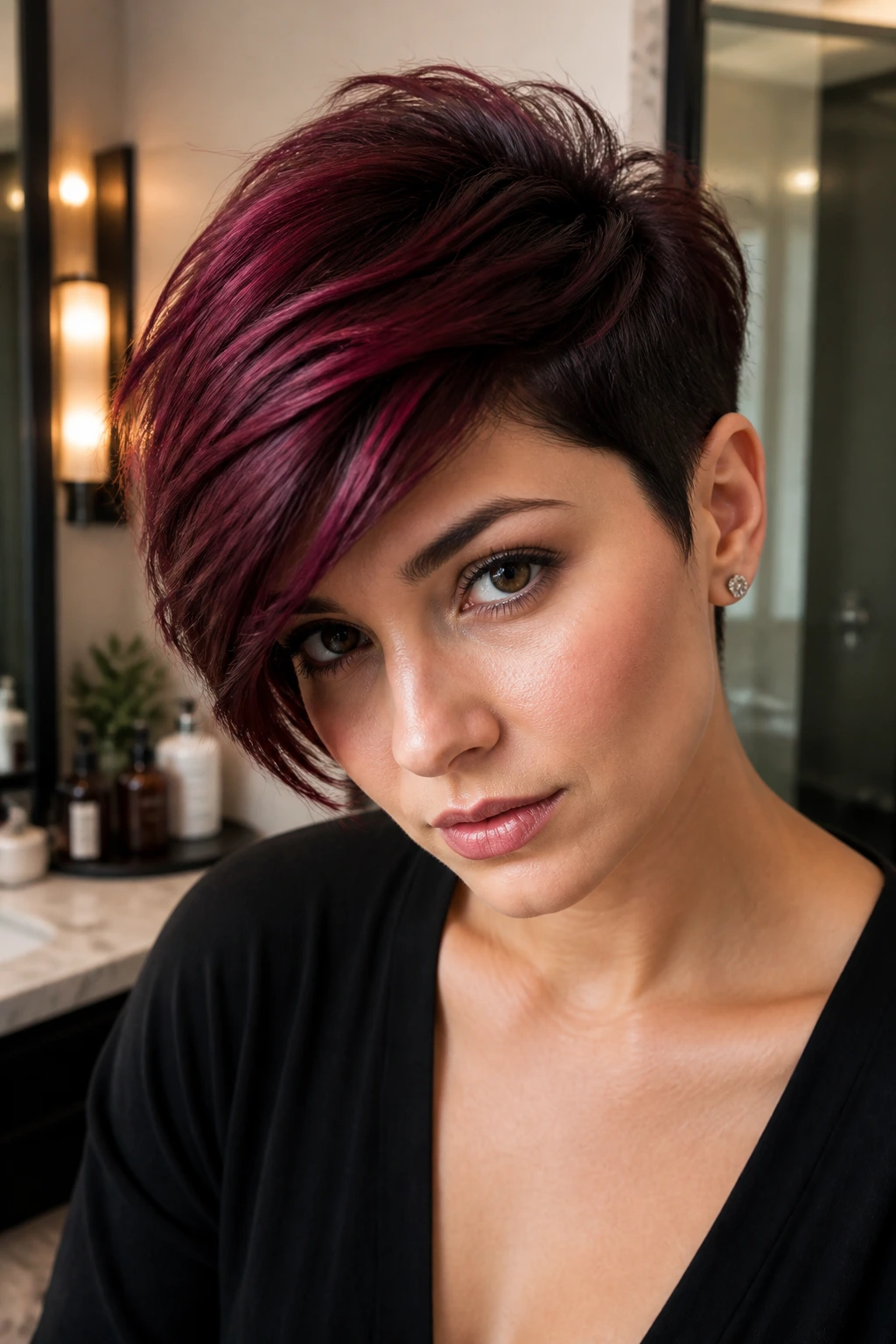
Short hair can work on a round face if the top has direction. A pixie with a swept-over top does that better than a neat, even crop, because the longer top section creates a diagonal line across the face.
Merlot gives the cut depth. On a black base, that deep red reads like a dark shadow with a little wine in it. That matters on short hair, where bright color can get loud fast. The safer move is a rich shade with a soft finish, not a neon one.
The sides should stay tapered and close to the head. The top needs enough length to sweep over and slightly forward, especially if you want the face to look a bit slimmer. A little texture paste at the ends keeps the shape from collapsing flat.
This is not the look for someone who wants softness around every edge. It’s sharper than that. But if you like short hair and want a burgundy-black color story that still suits a round face, this is a strong one.
17. Black Violet-Burgundy Blend on Straight Layers
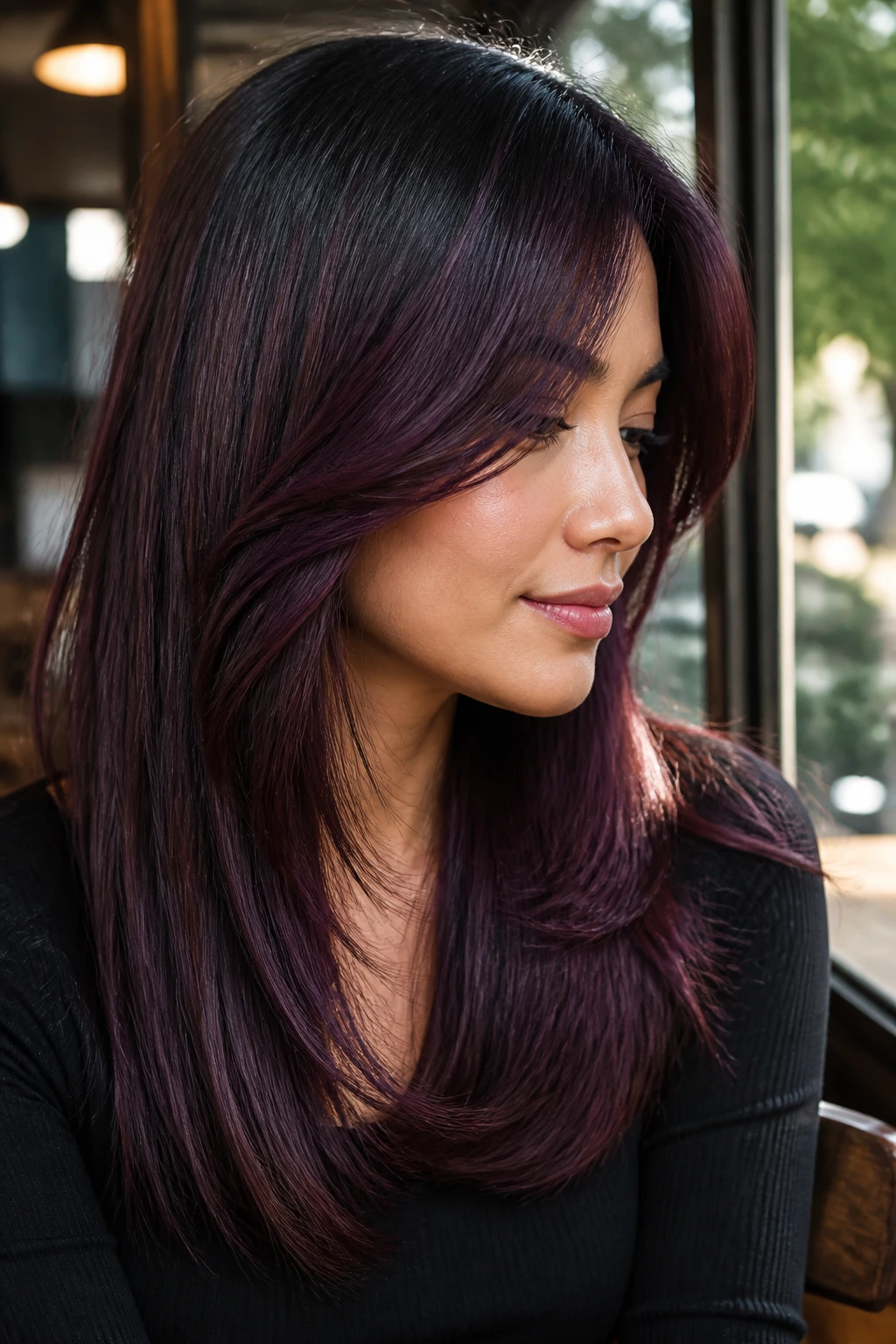
Straight hair can look plain if the color doesn’t do some work. A black violet-burgundy blend solves that by shifting tone from cool plum to warm wine as the layers move, which gives the hair more depth without needing huge highlights.
On a round face, straight layers are useful because they create long vertical lines. If the layers start below the cheekbone, the face gets that longer, cleaner outline. The color blend supports the cut instead of fighting it. That’s the goal.
I like this option for people who don’t want obvious red. Violet-burgundy stays darker and moodier than a cherry shade, so it feels less bright and more refined. When the hair swings, the violet notes show in one light and the burgundy in another. The change is subtle, but the effect is real.
Keep the finish smooth. A flat iron pass with a light heat protectant can make the different tones read more clearly. Frizz blurs the color, and on straight hair that kills the whole point.
18. Cherry Cola Face-Framing Streaks for Round Faces
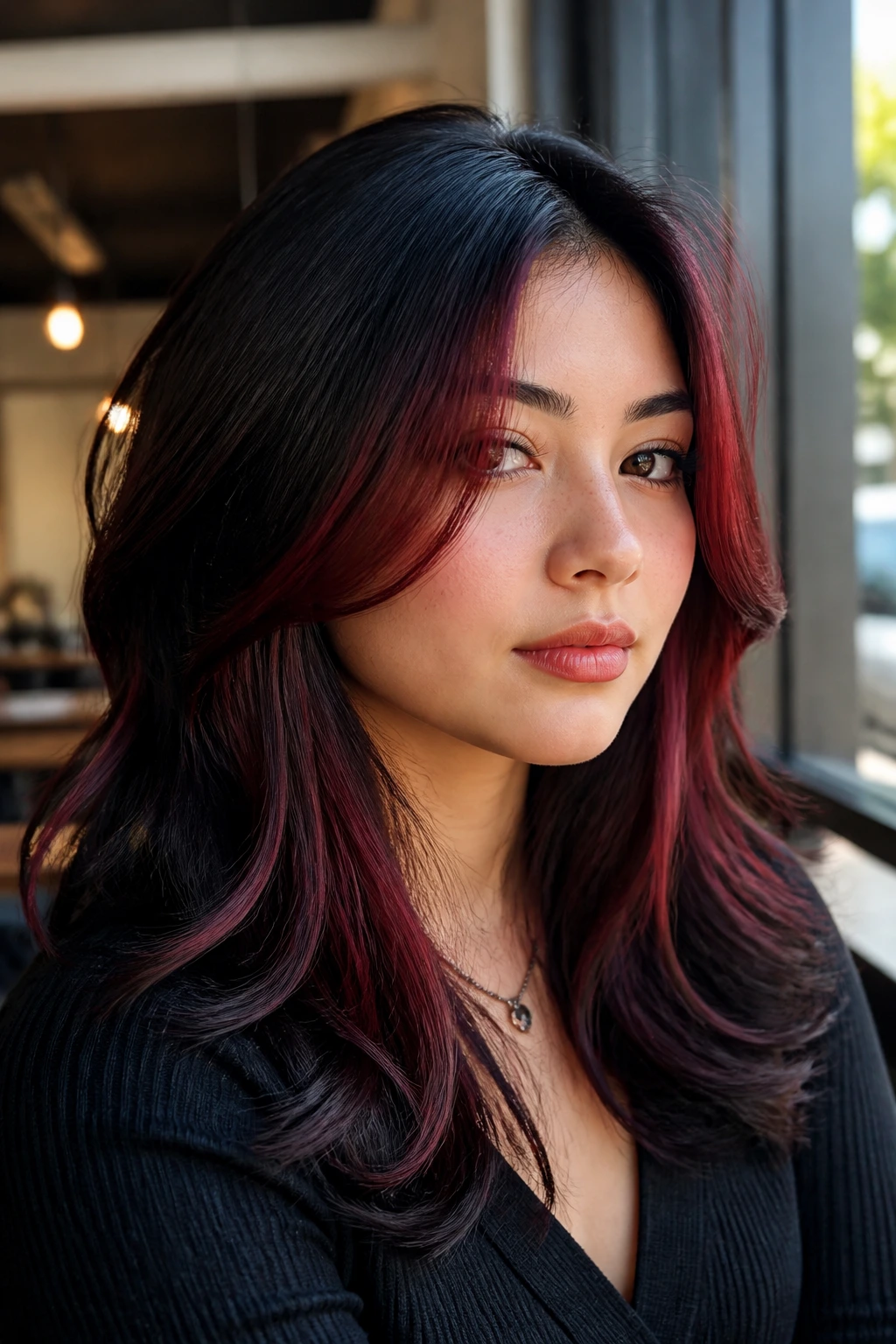
If you want one burgundy black hair color idea that sits between subtle and bold, this is it. Cherry cola face-framing streaks give you red near the front, but the color is deep enough to live comfortably against a black base.
The placement should stay below the widest part of the cheeks and angle down toward the collarbone. That downward line is what flatters a round face. You get brightness near the eyes without wrapping the whole face in color.
The rest of the hair can stay almost black, which keeps the look grounded. That contrast is what makes the front streaks pop. If you wear your hair in loose waves, the color shows in pieces instead of one block, and that feels softer. If you wear it straight, the streaks look sharper and a little more graphic.
I’d choose this one if you want flexibility. It can read polished at work, then stronger at night when you tuck the hair behind one ear. The shape stays honest either way. And honestly, that’s why it works so well on round faces: it gives you color where you want it, while leaving the widest part of the face alone.
