



Black and purple hair has a strange little talent: it can look polished, moody, and expensive without trying too hard. On a round face, though, placement matters as much as shade. Put the purple in the wrong spot and the hair widens the face; put it in the right spot and it pulls the eye downward, adds shape, and gives the whole cut a sharper outline.
That’s why black purple hair color ideas for round faces need more than a pretty color mix. They need strategy. A deep black base can slim the sides. Violet, plum, and eggplant can add movement where you want it. Face-framing brightness, shadow roots, curtain pieces, and low-placed balayage all change how the face reads from the front and from the side.
The best part is range. You can go soft and glossy, or loud and high-contrast, or somewhere in the middle where the purple only shows when your hair moves. Some versions need lightening. Some do not. And some of the smartest looks barely reveal the purple at all until you tuck your hair back or hit the sun. The first idea starts with the easiest place to control shape: the front.
1. Soft Black Base with Plum Money Piece
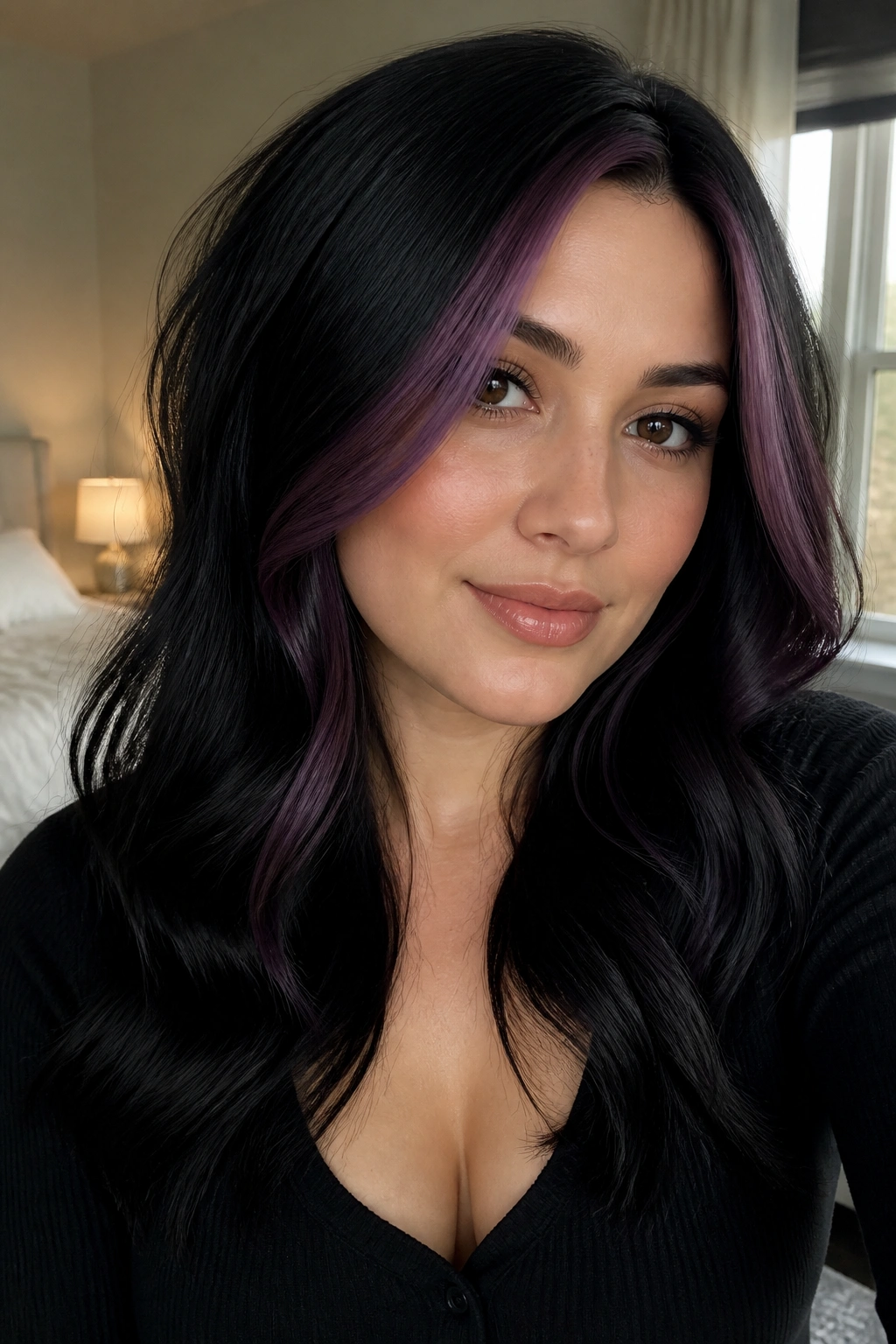
A narrow plum money piece is one of the easiest ways to make black-purple hair feel intentional on a round face. Keep the rest of the hair a deep black, then place the purple at the front so the eye moves vertically instead of spreading side to side.
Why It Works on Round Faces
A thick face-framing stripe can make the cheeks look wider, so the smarter move is a slimmer panel that starts a little below the hairline and falls past the cheekbone. That little drop matters. It creates a line the eye follows downward, which helps soften fullness around the middle of the face.
- Ask for a level 2 black base with a deep plum money piece about 1 to 1.5 inches wide.
- Keep the brightest part slightly off-center if your cheeks are full.
- Style it with a side part or soft bend, not a puffed curl right at cheek level.
- A gloss finish helps the plum read rich instead of flat.
Tip: Keep the roots sleek and the wave lower. That one choice does more for a round face than making the front pieces brighter ever will.
2. Smoky Black with Violet Balayage Ends
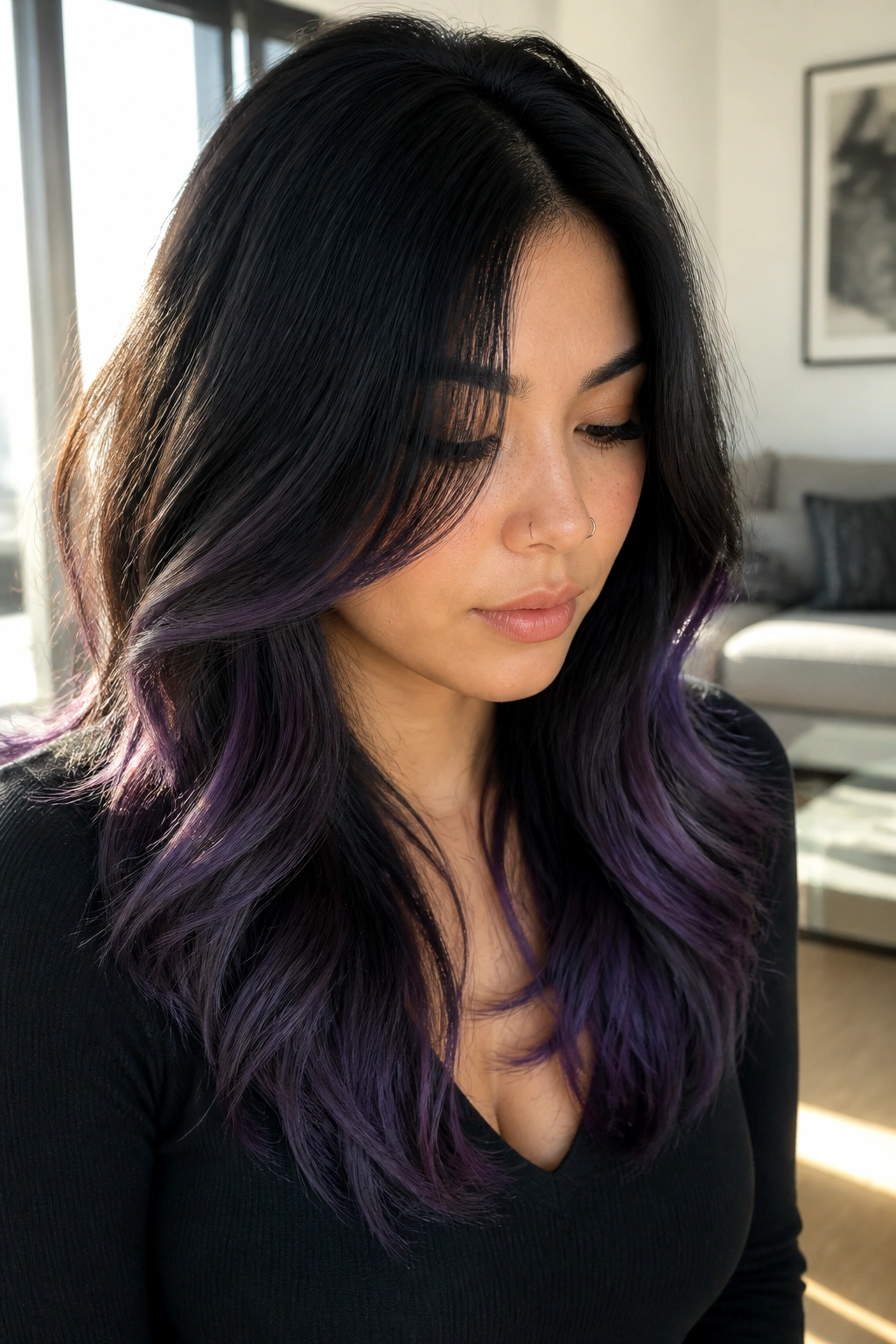
If you want movement, put the purple at the ends. Balayage ends let the top stay dark and neat while the lower half does the talking, and that’s a smart shape for a round face. The eye travels down the hair instead of getting stuck at the widest part of the cheeks.
This look works especially well on layers. Long layers let the violet catch on the tips and mid-lengths, which breaks up a heavy block of color. On straighter hair, the ends show in clean ribbons. On waves, the purple shifts in and out, which gives the style a little more life.
What I like most is the grow-out. The black root keeps the style grounded, and the violet can fade from vivid to smoky without looking messy. If you want a lower-maintenance version, ask your colorist to keep the balayage below the chin and concentrate the brighter purple on the last 4 to 6 inches.
A round face usually looks stronger when the brightest color sits lower than the cheeks. This one does that neatly.
3. Jet Black with Hidden Purple Underlayer
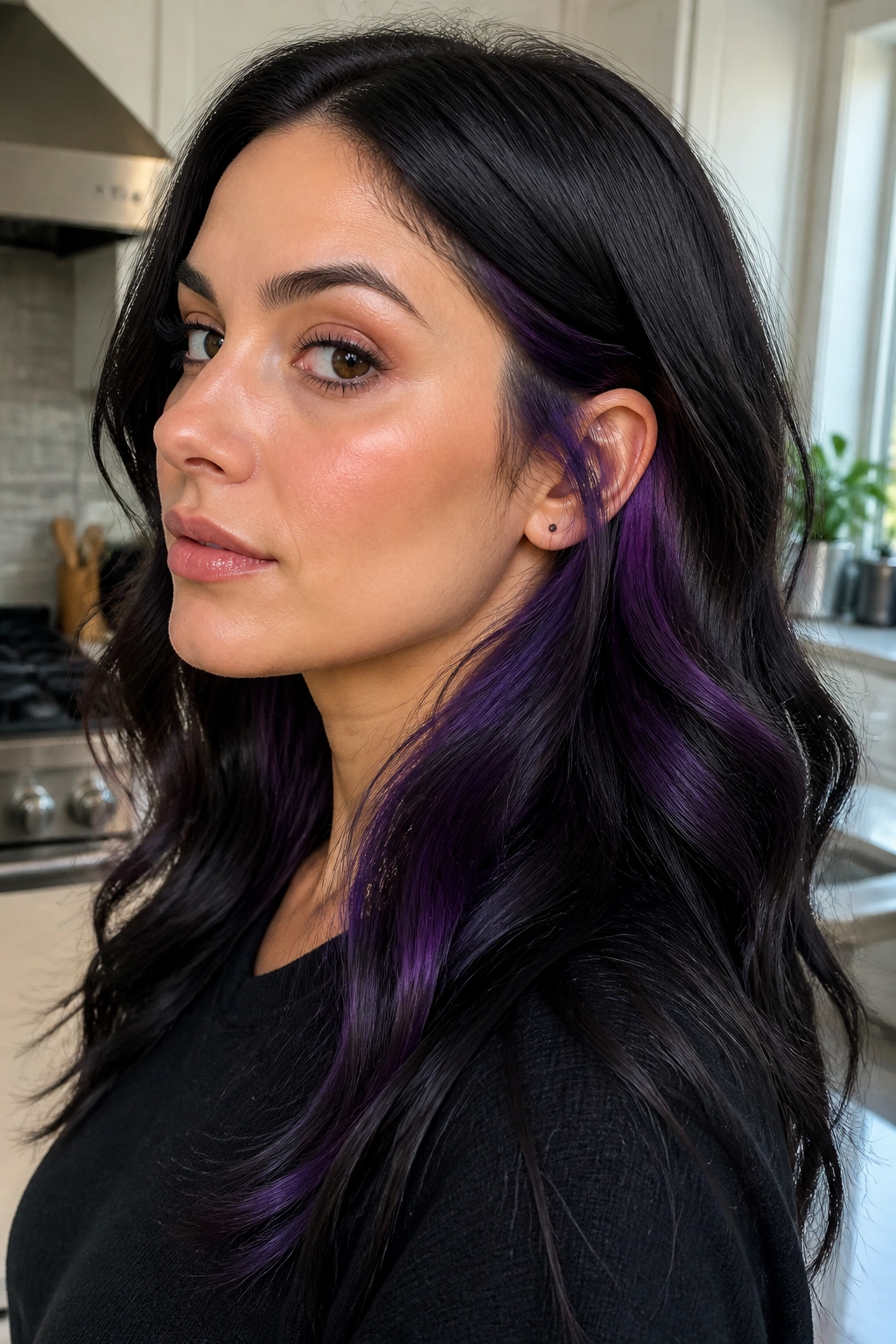
Why hide purple under black hair? Because the reveal is the whole point. On a round face, a hidden underlayer keeps the perimeter dark and tidy, while the purple flashes when the hair swings, tucks behind the ear, or gets pulled into a half-up style.
The effect is subtle until it isn’t. In still photos, the black dominates and gives the face a slimmer frame. In motion, the violet shows up in streaks and panels underneath, which keeps the look from feeling flat. That contrast is what gives the style its edge.
How to Wear It
- Wear it with a half-up clip so the lower layer shows through.
- Use loose waves to break up the purple panels.
- Keep the visible underlayer at least 2 to 3 levels brighter than the black base.
- Ask for placement under the crown and around the lower sides, not across the cheek line.
If you want color that feels a little secretive, this is a strong choice. It’s also a nice option if you work somewhere that prefers a quieter front view.
4. Black Cherry with Eggplant Ribbons
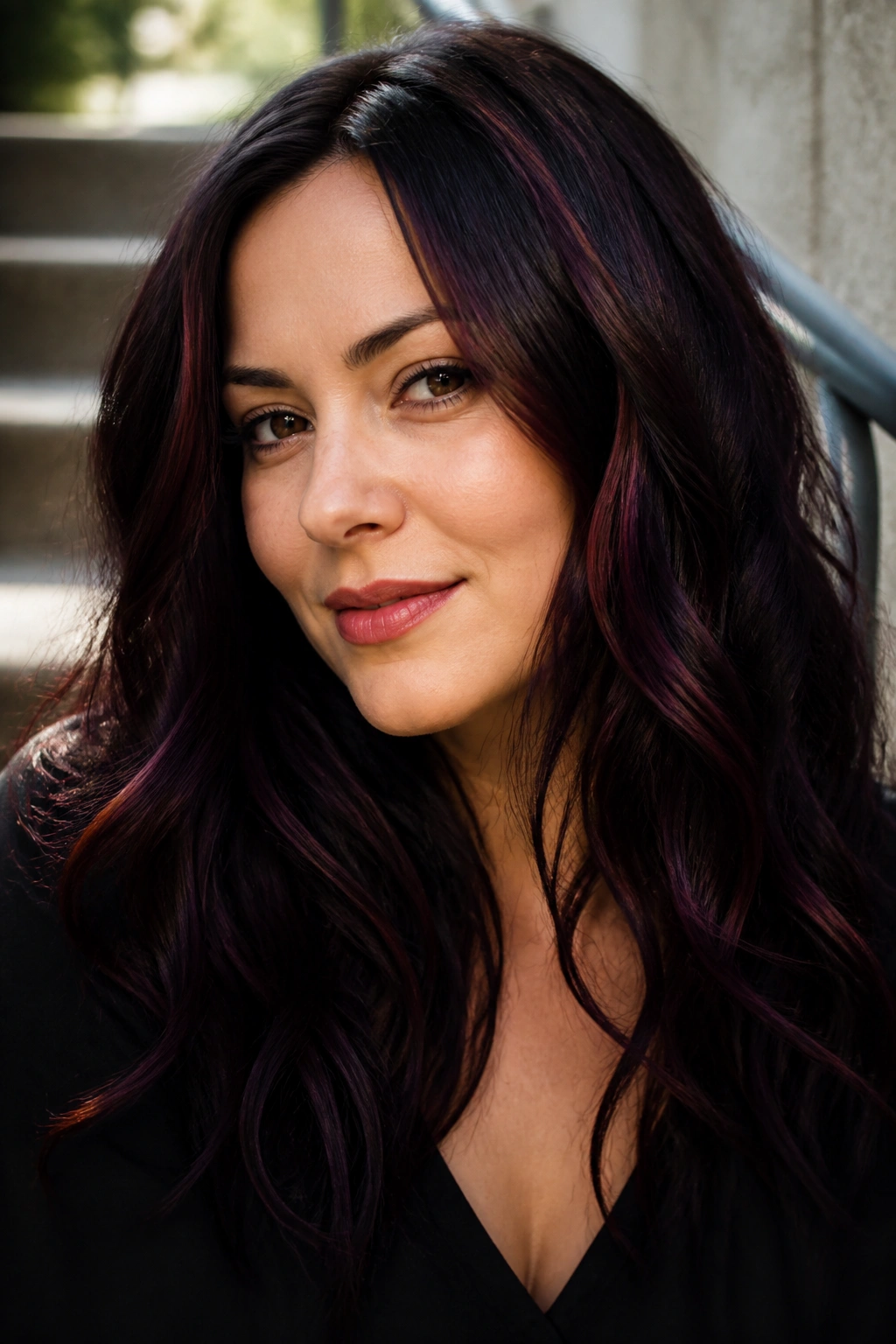
Picture black hair moving in the light and catching deep eggplant ribbons that only show when the strands separate. That’s the whole appeal here. It’s dark, glossy, and a little dramatic, but it still feels wearable because the purple is woven through the hair instead of sitting on top like a stripe.
A round face usually benefits from this kind of ribboning because it breaks up width without adding a hard line. The color shifts are vertical and fluid. Nothing sits right across the widest point of the face, which is where a lot of bad color placement goes wrong.
You’ll get the best result on layered cuts, especially if the front pieces are a touch longer than the back. Ask for the eggplant ribbons to start below the cheekbone and concentrate through the mid-lengths and ends. That keeps the fullness lower, which helps the face look longer.
- Best for wavy or curly textures that separate easily.
- Ask for ribbons 1/4 to 1/2 inch wide, not chunky panels.
- Keep the black base glossy with a blue-black or soft neutral-black toner.
- Use a shine spray, not a heavy oil.
Closing thought: This shade family looks expensive when the purple stays deep. If the eggplant turns too bright, the whole thing loses its quiet depth.
5. Ink Black with Amethyst Face Frame
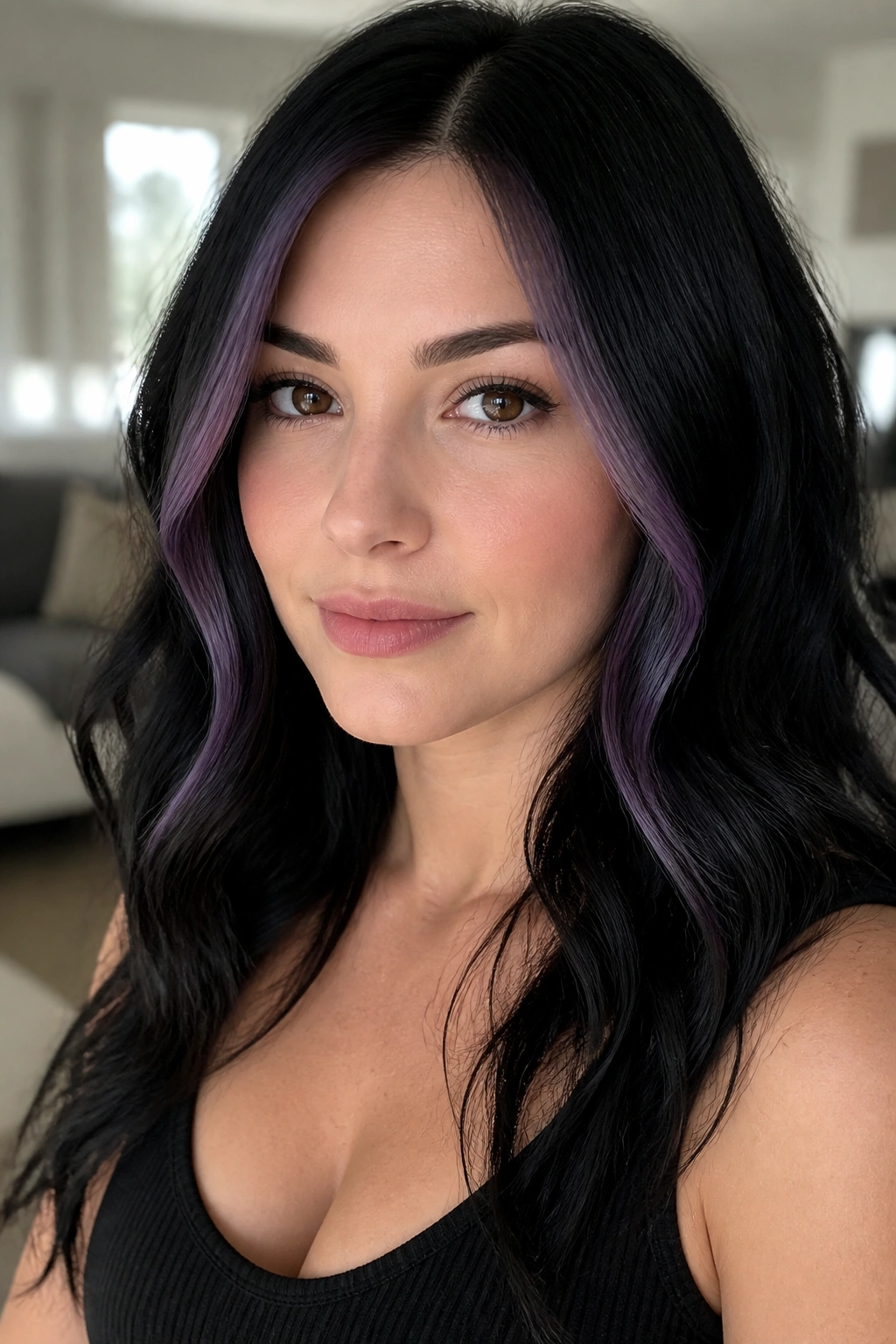
Amethyst around the face can be gorgeous on a round face, but the placement has to be narrow and deliberate. Two slim face-framing pieces can sharpen the outline of the cheeks and draw the eye downward, especially when the rest of the hair stays ink black and sleek.
I’d keep the amethyst close to the front, but not pasted right against the face from root to tip. Start the brighter part a little below the hairline, let it skim the temple, and taper it through the jaw. That keeps the effect soft instead of boxy. A thick, blunt purple panel at the cheek can make the face look wider. A narrow one feels cleaner.
The shape matters even more on straight hair. Straight hair shows every line, so the purple should be feathered, not chopped. If you wear waves, the color can be slightly bolder because the bend breaks up the edge. Either way, ask for the front pieces to be no wider than about an inch each.
This is one of those looks that can turn very sharp, very fast. Keep the cut soft and the amethyst deep, and the result lands in a good place.
6. Soft Black with Mulberry Shadow Roots
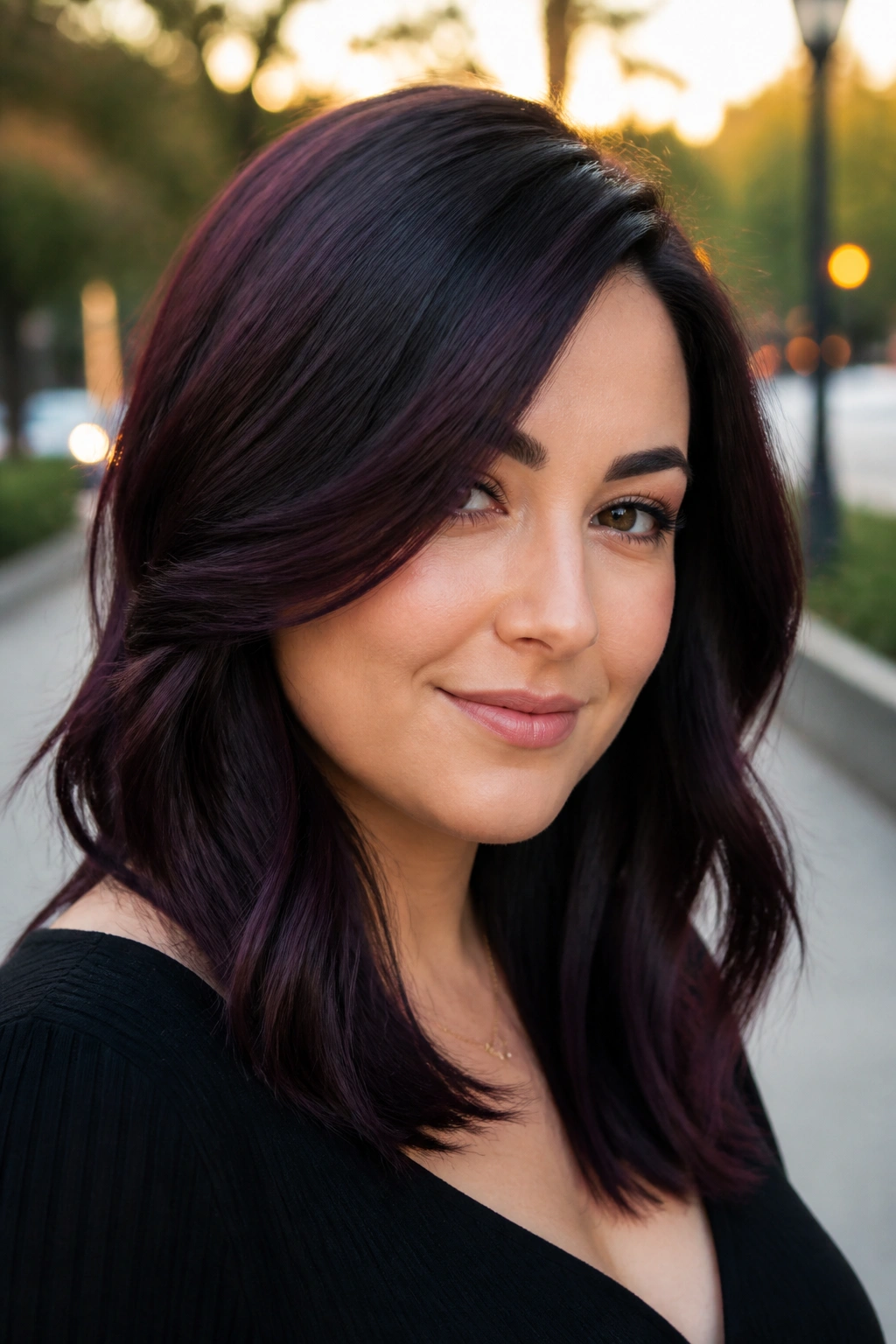
Mulberry shadow roots are for people who want color but don’t want to babysit it. The black stays dark through the crown, then a soft mulberry tone melts out through the mid-lengths. On a round face, that crown depth is doing a lot of quiet work, because it adds height where the eye naturally wants to go up.
Compared with a full purple block, this version feels more relaxed. The root area stays darker for longer, which means regrowth blends in better and the face shape reads taller. The mulberry also gives warmth without turning the whole look red. That matters if you want purple, not cherry.
This one sits nicely on bobs, lobs, and shoulder-length cuts. Ask for the color to start under the crown, not right at the hairline, and keep the transition soft through the temples. If the transition begins too low, near the cheeks, the style can widen the face instead of lengthening it.
Who it suits best: people who want dimension, easy grow-out, and a shade that looks polished on a workday but still has a little bite at night.
My pick: pair it with a side part and a light bend at the ends. That gives the shadow root somewhere to lead.
7. Glossy Black Curls with Purple Peekaboo Panels
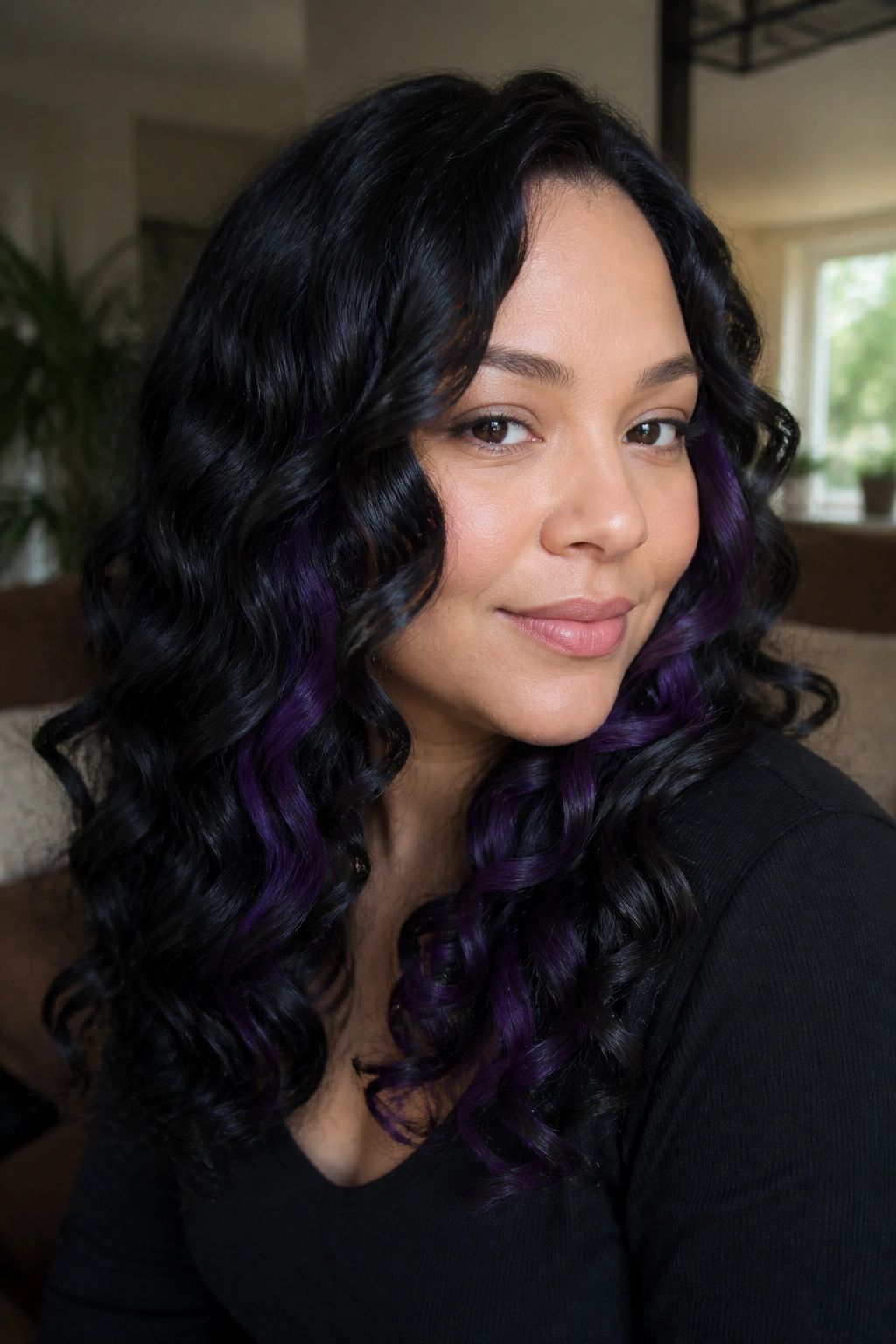
Curly hair and peekaboo panels get along better than a lot of people expect. The curls hide the color, then release it in flashes as the shape moves. On a round face, that’s useful because the color doesn’t sit flat across the sides all day; it shifts, curls, and changes as the hair bounces.
Where to Hide the Color
- Place the purple panels underneath the top layer, starting below the ear.
- Keep the front curl line dark so the face stays framed in black.
- Choose a violet that still reads in low light, not a pastel that disappears.
- Ask for the panels to be longer than you think, because curls shrink.
The nice part is that peekaboo color can feel playful without turning into a full loud look. If your curls are loose, the violet will peek out when the hair separates. If they’re tighter, it shows more when you stretch the curls with styling cream or wear the hair half-up.
This is one of the few black-purple ideas that can be bold without making the face look wider. The black outer layer keeps the shape clean. The purple stays tucked underneath, where it adds depth instead of width.
8. Black Velvet with Grape-Tinted Bangs
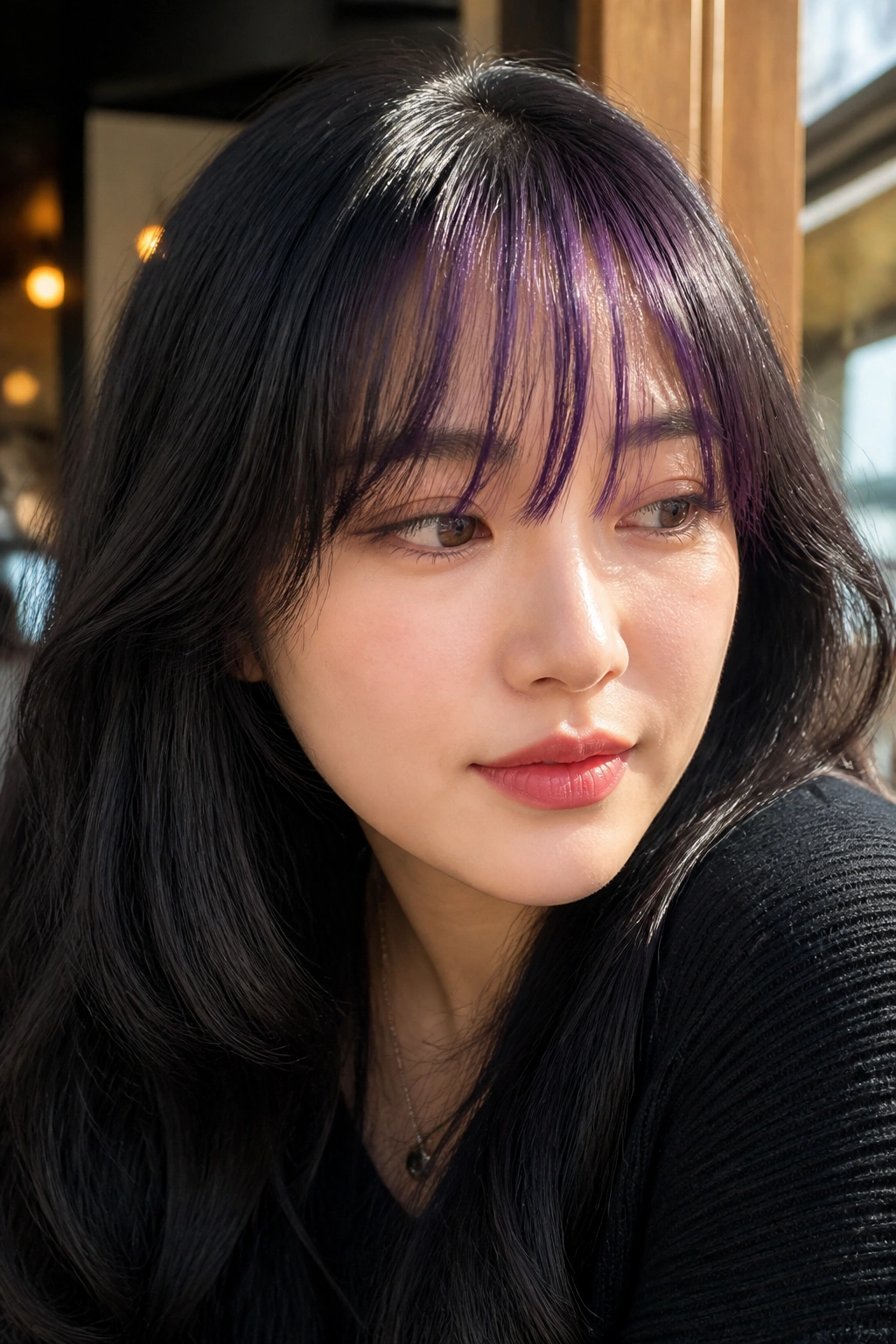
A heavy fringe is usually the wrong move for a round face. A softer one is much better. Grape-tinted bangs on black hair can work beautifully when the bangs are airy, piecey, and a little longer at the temples than in the center.
The trick is not to build a wall across the forehead. Keep the fringe thin enough that skin shows through in places, and let the grape tone sit in a soft glaze rather than a solid block. That creates focus above the eyes without cutting the face in half. A blunt, dense bang can shorten the face. A soft, colored fringe gives shape.
This look especially flatters shorter cuts, because the purple at the front creates a point of interest up high while the black stays sleek around the cheeks. If your hair is thick, ask for a bang that sits just below the brows and tapers at the sides. If it’s fine, a lighter hand with the color keeps the fringe from looking muddy.
It’s a little moody. A little artsy. And if you like a haircut with attitude, this one has plenty.
9. Deep Black with Lavender Melt on Layers
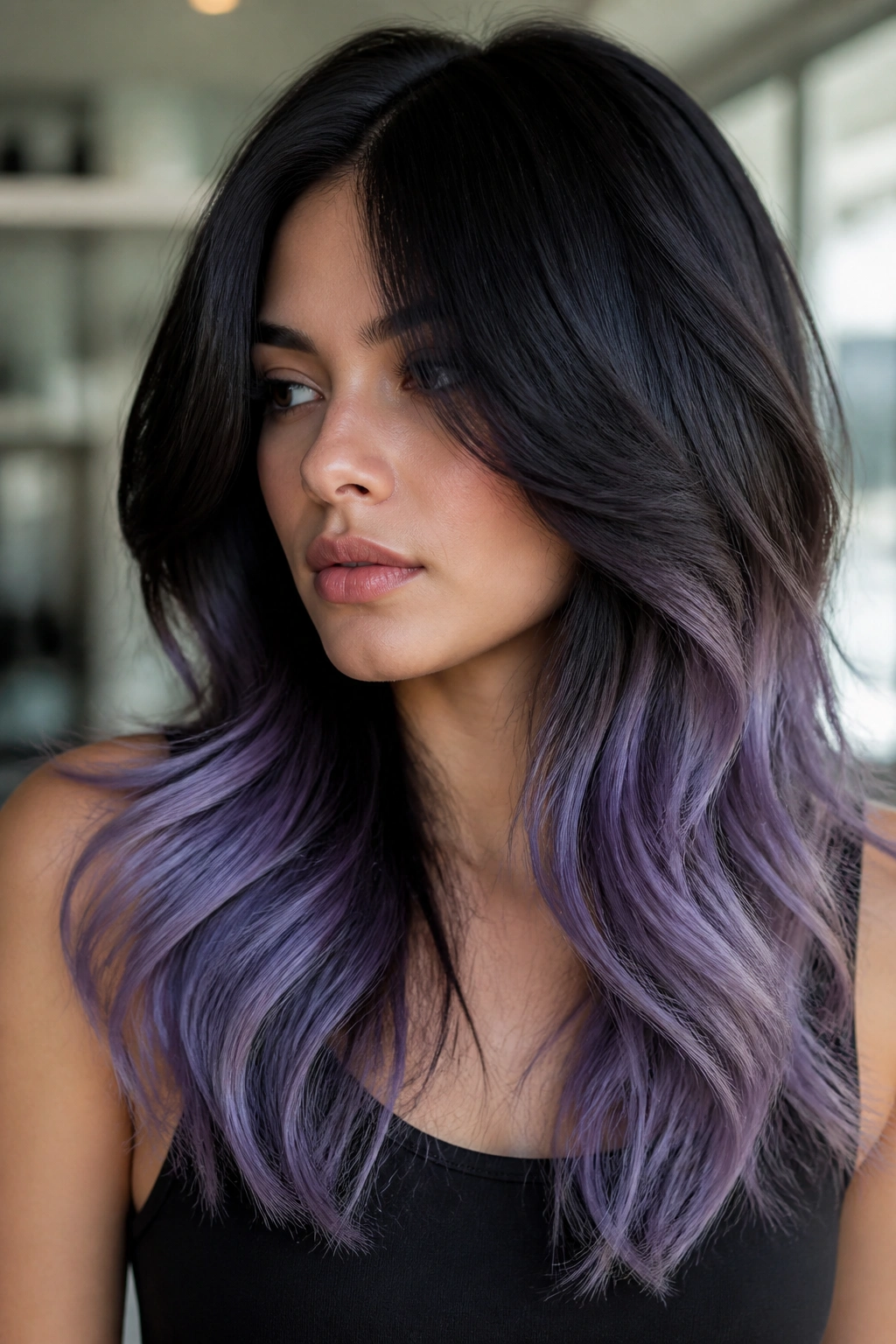
Why does a lavender melt look so good on a round face? Because the color can start where the face begins to narrow. A soft melt on long layers keeps the roots dark, then slides into lavender lower down, which gives the hair length and movement without crowding the cheeks.
The best version usually starts just below the chin. That gives the upper section a strong black frame, then the purple starts working once the eye has already moved past the widest part of the face. If the lavender starts too high, the look can spread out in the wrong way. Low placement keeps it cleaner.
How to Style the Melt
- Use a round brush or large curling iron to bend the ends away from the face.
- Keep the front layers slightly longer than the back.
- Choose a lavender with a gray undertone if you want a softer finish.
- Finish with a light gloss or serum so the black stays reflective.
This shade is one of my favorites for layered cuts because the color shift almost looks like movement built into the haircut itself. It doesn’t need a huge amount of styling to make sense.
10. Raven Black with Electric Purple Streaks
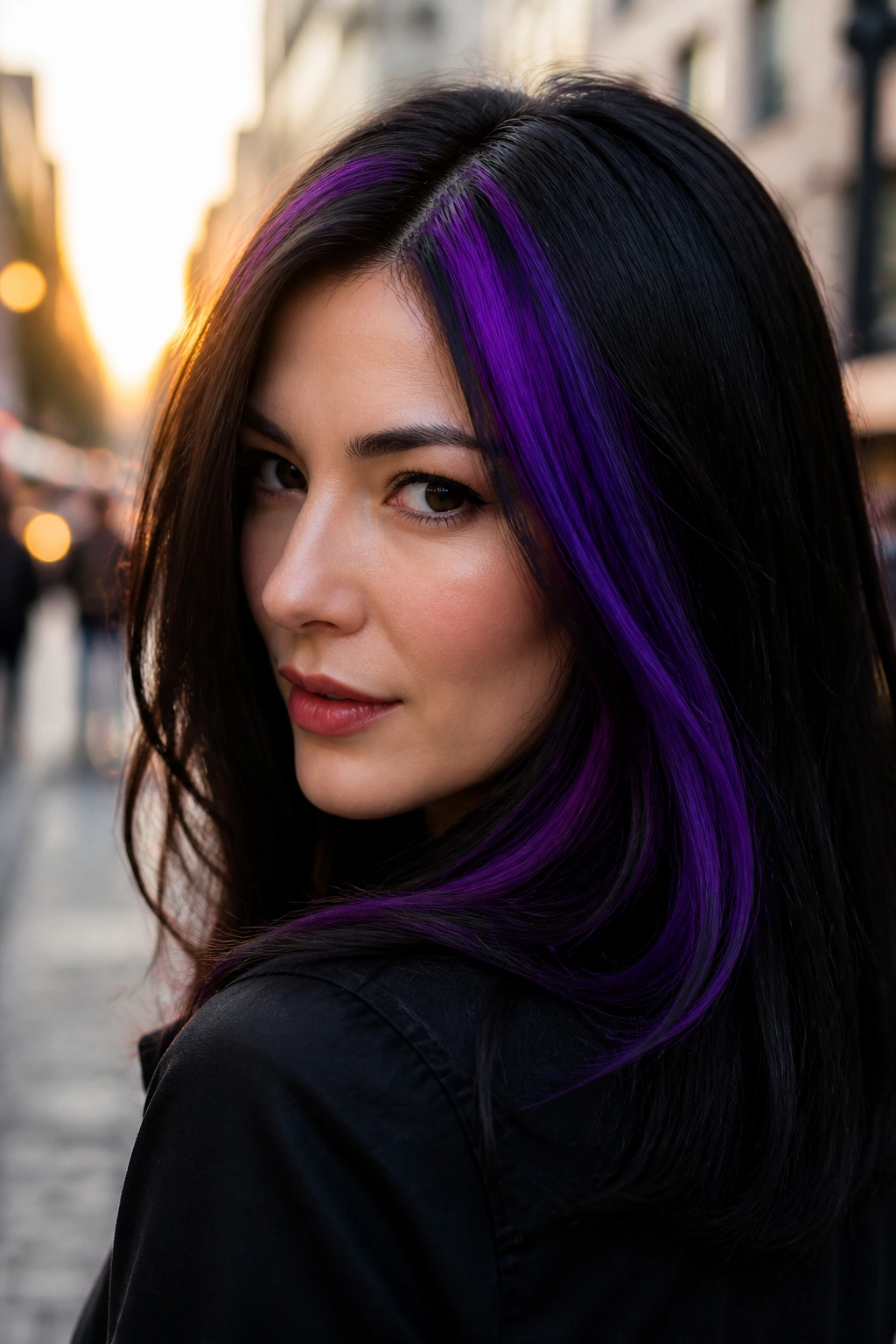
A single streak can say more than a whole head of color. On a round face, that can be a smart move, because one strong purple streak placed off-center can sharpen the shape without making the whole style feel wide or busy.
I usually like this look when the streak sits inside the front section or travels through one side of a layered cut. The black does the quiet work. The electric purple hits hard. That contrast is enough. If you spread the streaks all over, the face can lose definition. Keep them narrow, placed with intention, and let the rest of the hair stay dark.
This style is especially good if you like a slightly rebellious finish. It reads clean on straight hair and more hidden on textured hair, which means the effect changes depending on how you wear it. That flexibility is part of the appeal.
- Use one bold streak on the heavier side of your part.
- Keep the rest of the color almost blue-black.
- Place the streak below the brow line so it doesn’t widen the forehead.
- Ask for a gloss that keeps the purple shiny, not chalky.
Small warning: bright purple fades fast if the hair gets washed hard or heat-styled every day. A sulfate-free shampoo helps, but gentle water pressure matters too.
11. Soft Black Lob with Blackberry Ombre
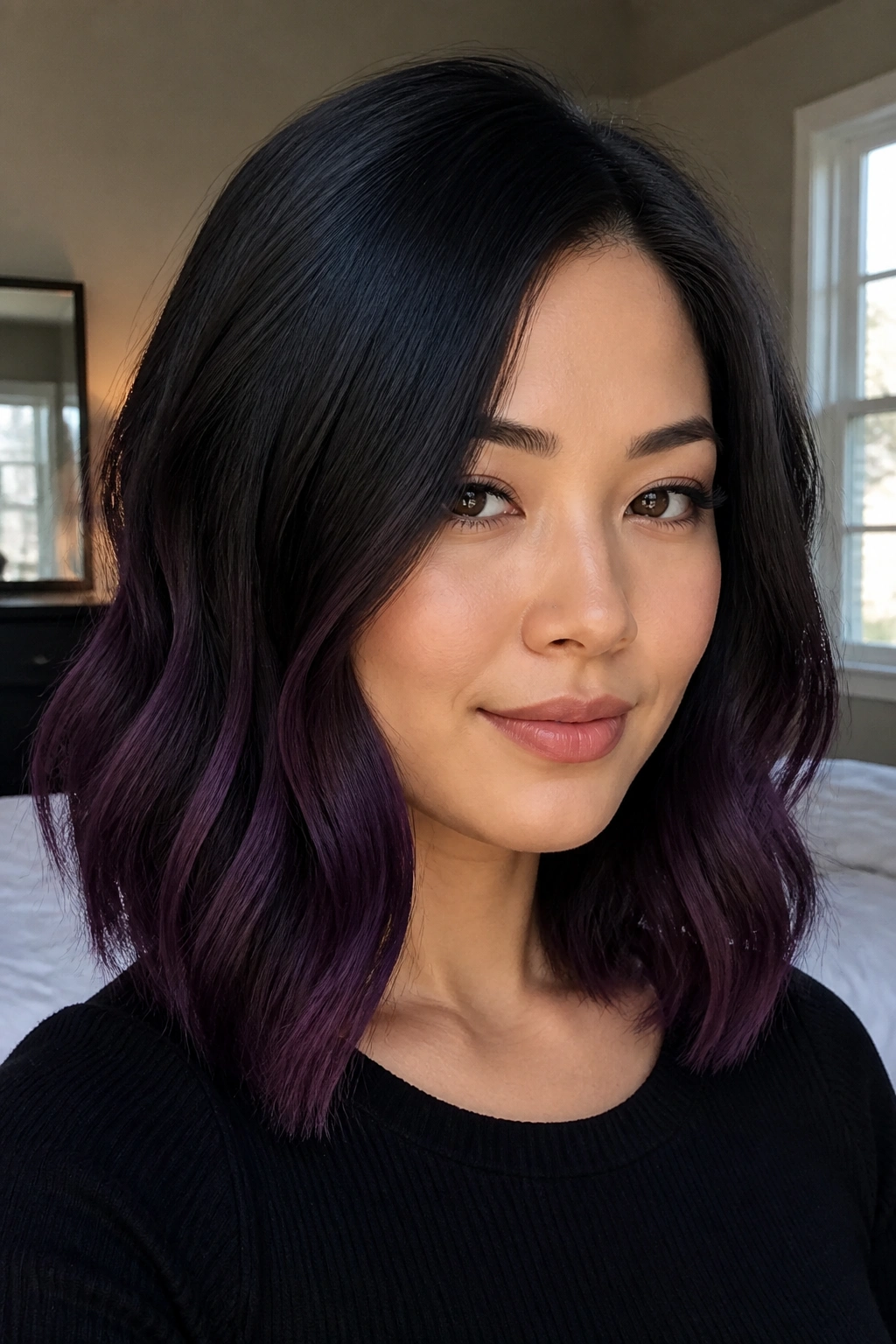
A collarbone lob is one of the easiest cuts to pair with black-purple color on a round face, and blackberry ombre makes the shape even better. The length sits below the chin, which helps stretch the face visually, and the purple can begin where the jaw has already done its job.
The dark-to-purple shift should be soft, not abrupt. A blackberry tone works well because it stays deep enough to keep the look grounded. If you start the lighter shade too high, the face gets framed in color at the wrong point. A low ombre lets the lob keep its clean outline.
This cut also behaves well with straight or slightly bent styling. The ends can turn in gently, but they should not puff out at cheek level. Keep the bend under the chin or closer to the collarbone. That tiny detail matters more than most people think.
What I like here is the balance: enough purple to make the hair feel special, enough black to keep it sleek. It’s a good middle ground if you want dimension without a huge maintenance routine.
12. Black Silk with Purple Crown Lights
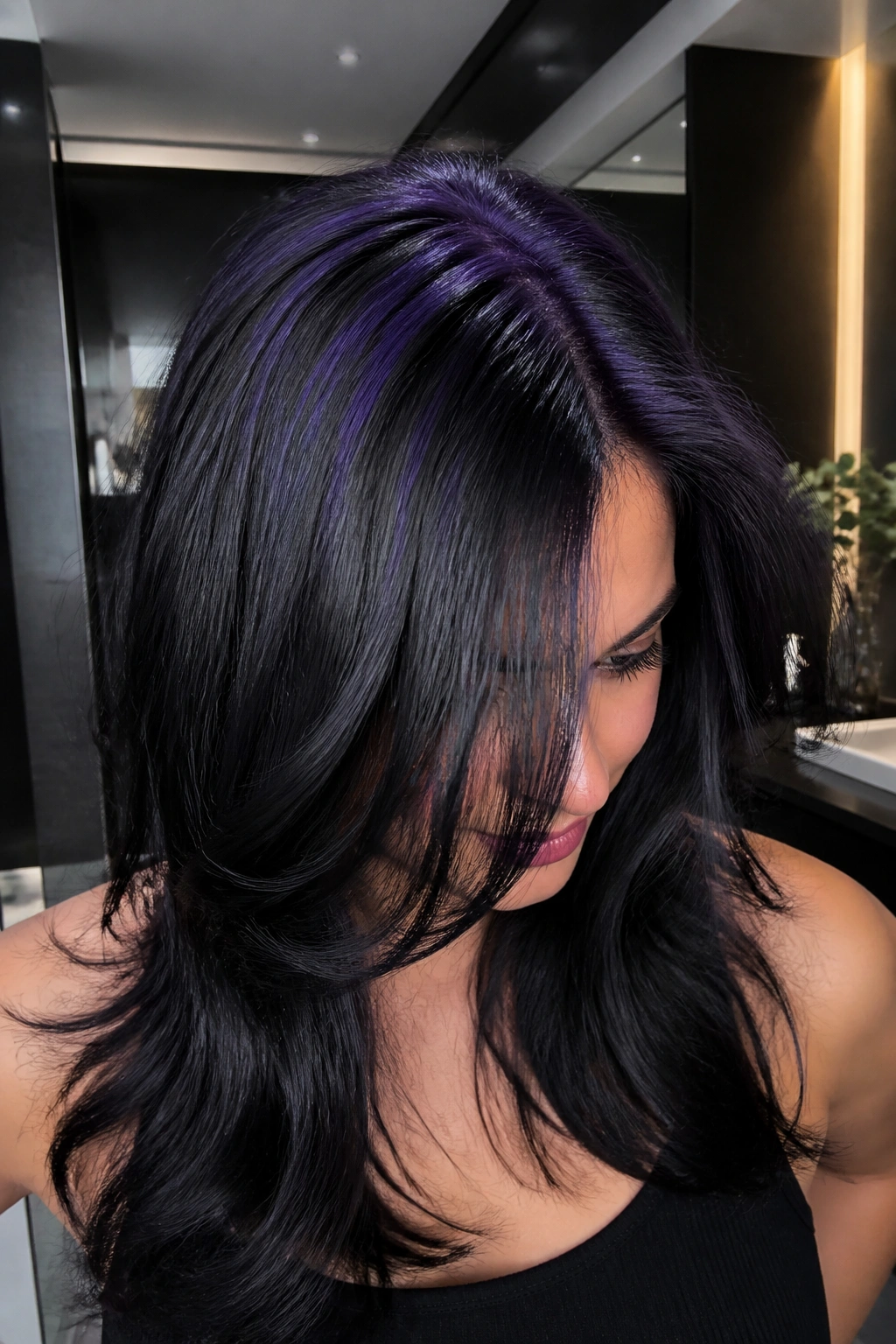
Crown lights are the quiet cousin of bold highlights, and they’re sneaky useful on a round face. Instead of putting the brightest purple at the sides, you place it near the top and crown, where it adds height and shifts the eye upward.
That’s the whole trick. Round faces benefit from lift. If the top section has a little more light, the face reads longer and the hair looks less flat at the roots. A silk-black base keeps the crown lights from turning harsh. The purple can be violet, orchid, or a muted mauve-purple, depending on how much contrast you want.
This is a smart option for anyone who wears a side part, because the crown lights show through the lifted root area and give the whole style a little movement. It also works well on medium-length hair that needs shape at the top but not too much drama through the cheeks.
Who should try it: people who want a softer take on black-purple hair, especially if their cut is layered or they like volume at the crown.
My recommendation: keep the highlights narrow and concentrated around the part, not scattered everywhere.
13. Dark Espresso Black with Orchid Tips
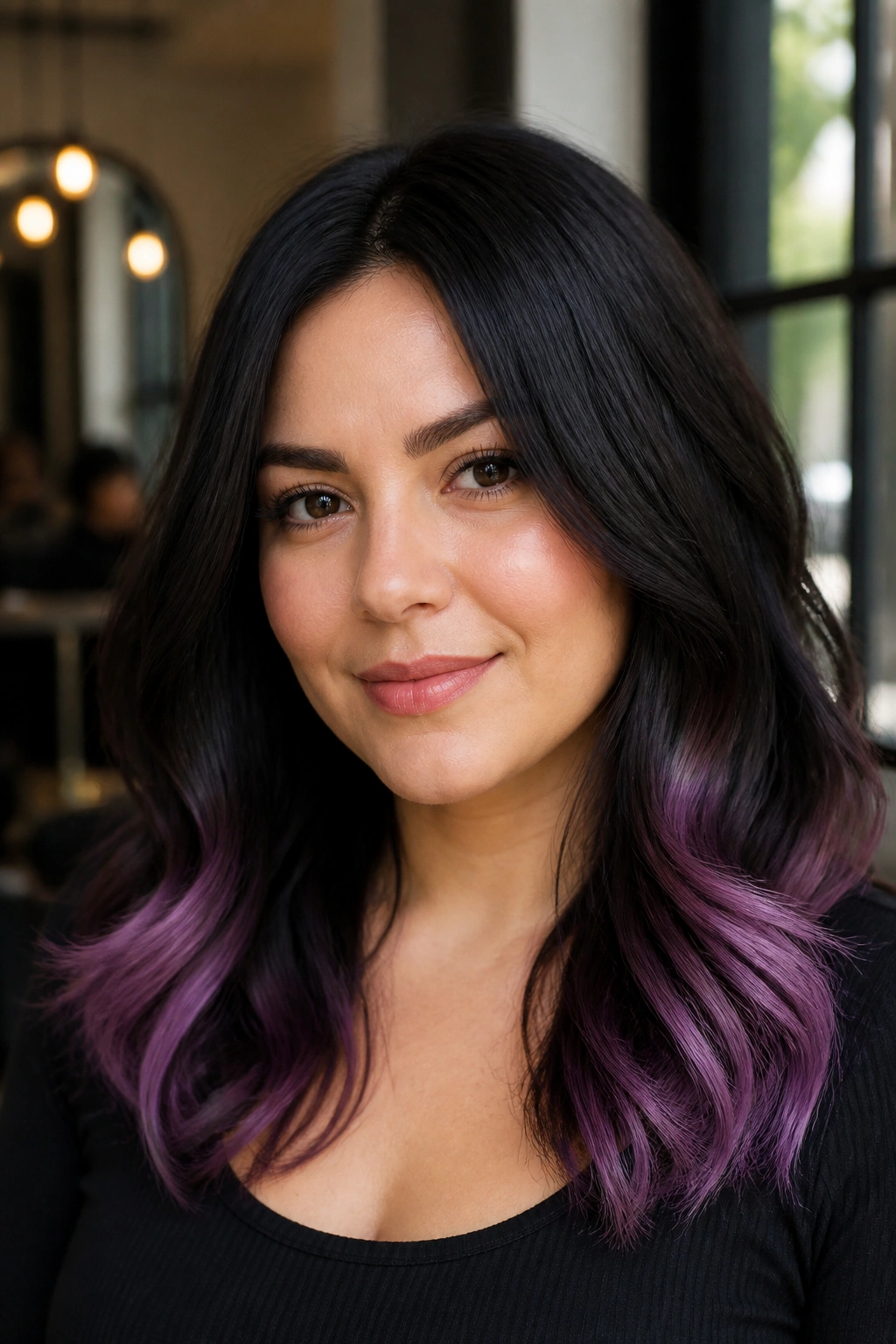
If you want purple that feels a little lighter, orchid tips are a neat way to do it. The dark espresso base keeps the top grounded, while the orchid ends bring in color where the face has already narrowed. On a round face, that placement helps the whole cut feel longer and less crowded.
Why the Tips Matter
The ends are where the eye lands last. If that last stop is a purple orchid tip below the jaw, the face looks extended instead of wide. The color has room to breathe there. Up near the cheeks, not so much.
- Ask for the orchid to cover only the last 2 to 4 inches.
- Keep the transition soft and vertical, not banded.
- Use a curling wand to bend the tips away from the face.
- Choose a cooler orchid if your skin leans cool, or a warmer violet-orchid if you want more glow.
This works nicely on layered cuts, but it also looks tidy on blunt shapes as long as the ends don’t flip outward at cheek level. If they do, the whole effect gets busier than it should.
Tip: A clear gloss over the ends can make the orchid look brighter without pushing the rest of the hair into high contrast.
14. Black Pixie with Purple Micro Highlights
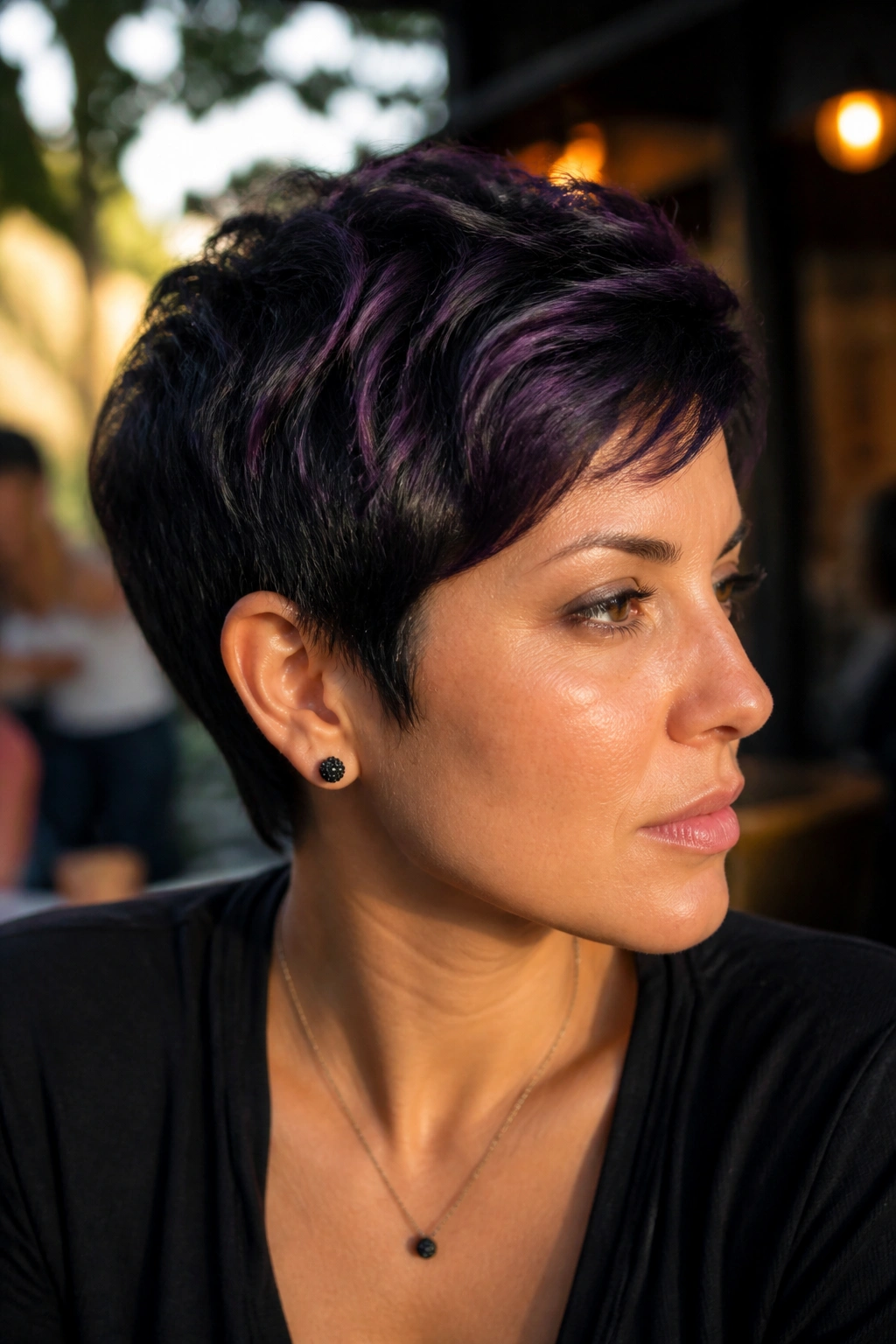
Short hair can handle color just fine. A black pixie with purple micro highlights is proof, and on a round face it can actually be more flattering than a bigger color block because the tiny highlights add texture without widening the shape.
The key is precision. Tiny violet slices through the top layer and temple area create lift, especially if the pixie has longer top pieces and shorter sides. If the purple is chunky, it can make the cut look busy. If it’s fine, narrow, and placed with care, it looks sharp. Very sharp.
This kind of color works best when the cut already has some height at the crown. That extra lift helps the face look a little longer. Ask for the purple to stay concentrated on the top third of the cut, with just a few whisper-thin pieces near the front. You do not want streaks all over the sides.
A pixie with micro highlights is also easier to refresh than a full-panel color job. The short length means less fade appears at once, and the black base keeps the silhouette clean.
15. Midnight Black with Plum Curtain Pieces for Round Faces
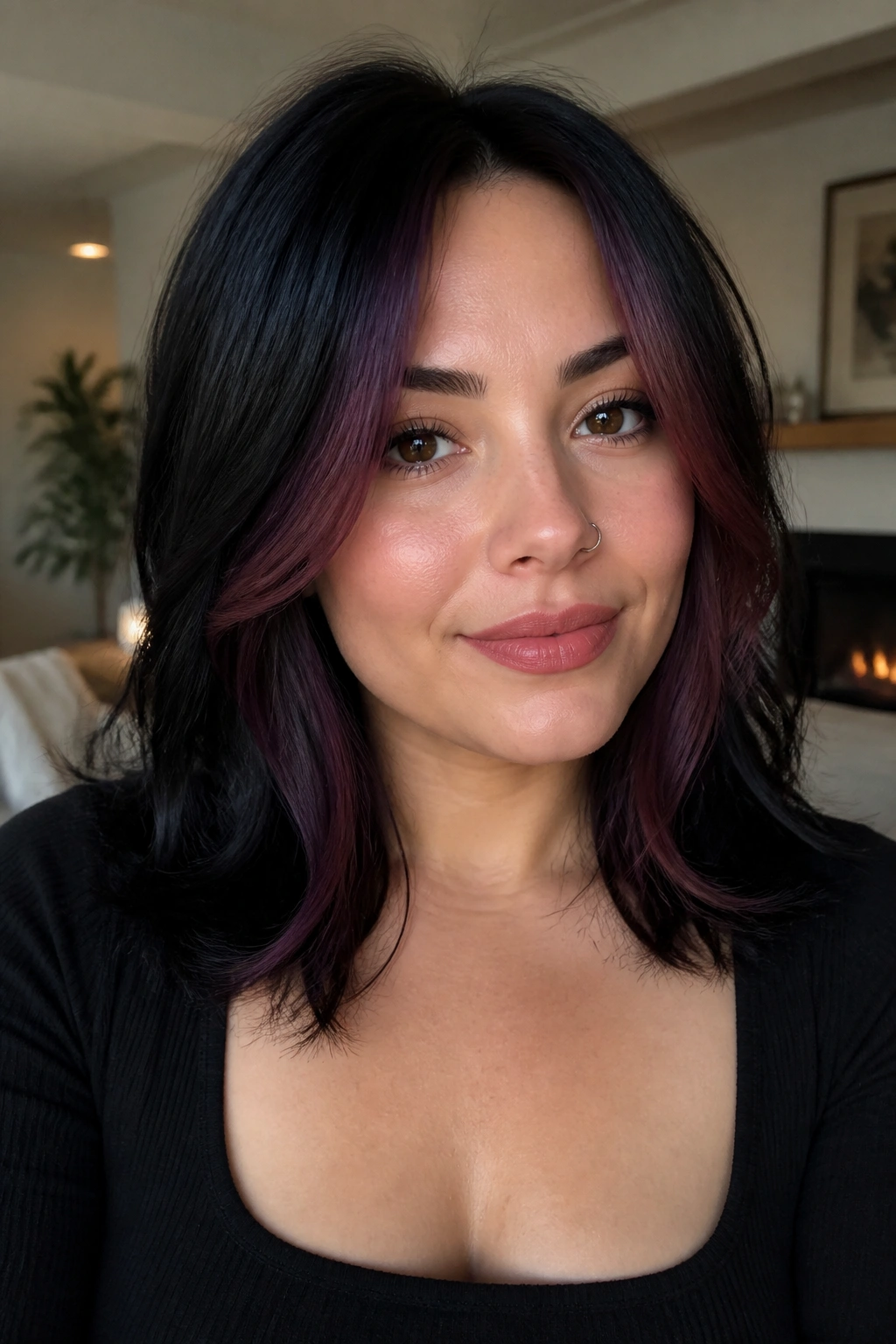
Curtain pieces are one of the smartest ways to bring purple into a round face shape because they open from the center and fall down the sides instead of cutting straight across the cheeks. The movement is soft, and the shape is forgiving.
The color should start just off the part and travel downward in long, tapered pieces. If the plum begins too high or gets too thick near the cheekbone, the face can look wider. A narrow panel that shifts lower does the opposite. It draws the eye from the top of the head down through the length of the hair.
How to Ask for It
- Request two plum pieces that begin near the part and taper below the jaw.
- Keep the rest of the hair midnight black for contrast.
- Ask for a soft blend, not a hard block of purple.
- Style the pieces away from the face with a round brush or flat iron bend.
This is a good middle-ground look if you like face-framing color but don’t want a full bright money piece. It gives shape, and it gives you something interesting when the hair moves.
16. Black Layers with Smoky Violet Slices
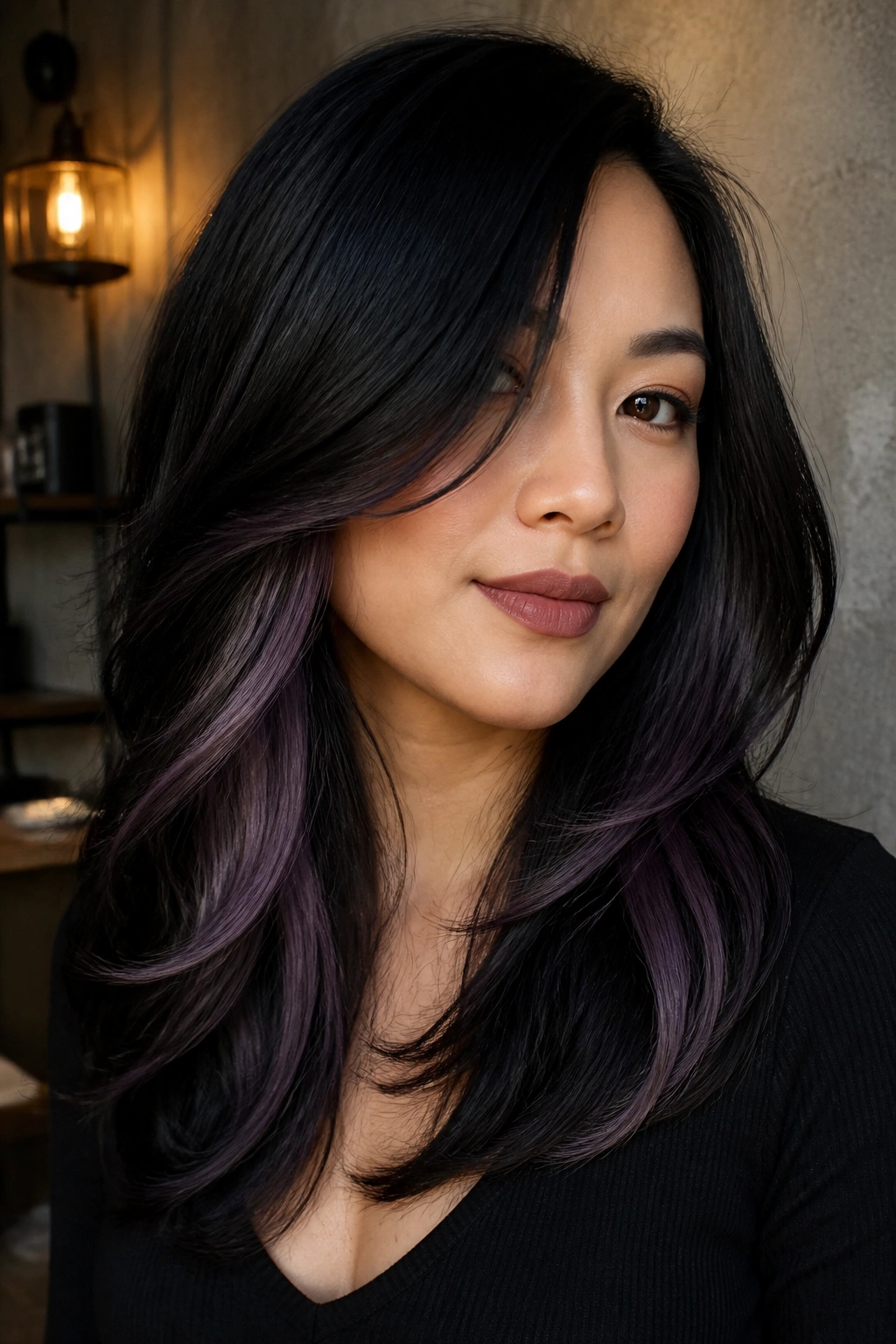
Smoky violet slices are one of those color choices that look a little different every time you turn your head. A slice is broader than a streak but narrower than a full panel, which makes it a nice match for layered hair on a round face. The black base stays dominant, and the violet slips in between the layers.
That matters because the eye reads the layers as length. If the slices sit below the cheekbone and move through the lower half of the cut, they help the face look longer and the hair look more textured. If they’re placed too high, they can fight the shape of the face and make the top half feel crowded.
I like this on medium to long hair, especially when the layers are visible on the sides. The violet doesn’t need to scream. A smoky tone with a little gray in it often looks richer than a bright candy purple, and it ages better as it fades.
- Use 3 to 5 thin slices instead of one broad streak.
- Keep the slices staggered rather than lined up.
- Concentrate the color below the cheek and through the ends.
- Add loose waves to make the slices separate.
The result is movement first, color second. That’s a good trade on a round face.
17. Black Bob with Iridescent Purple Glaze
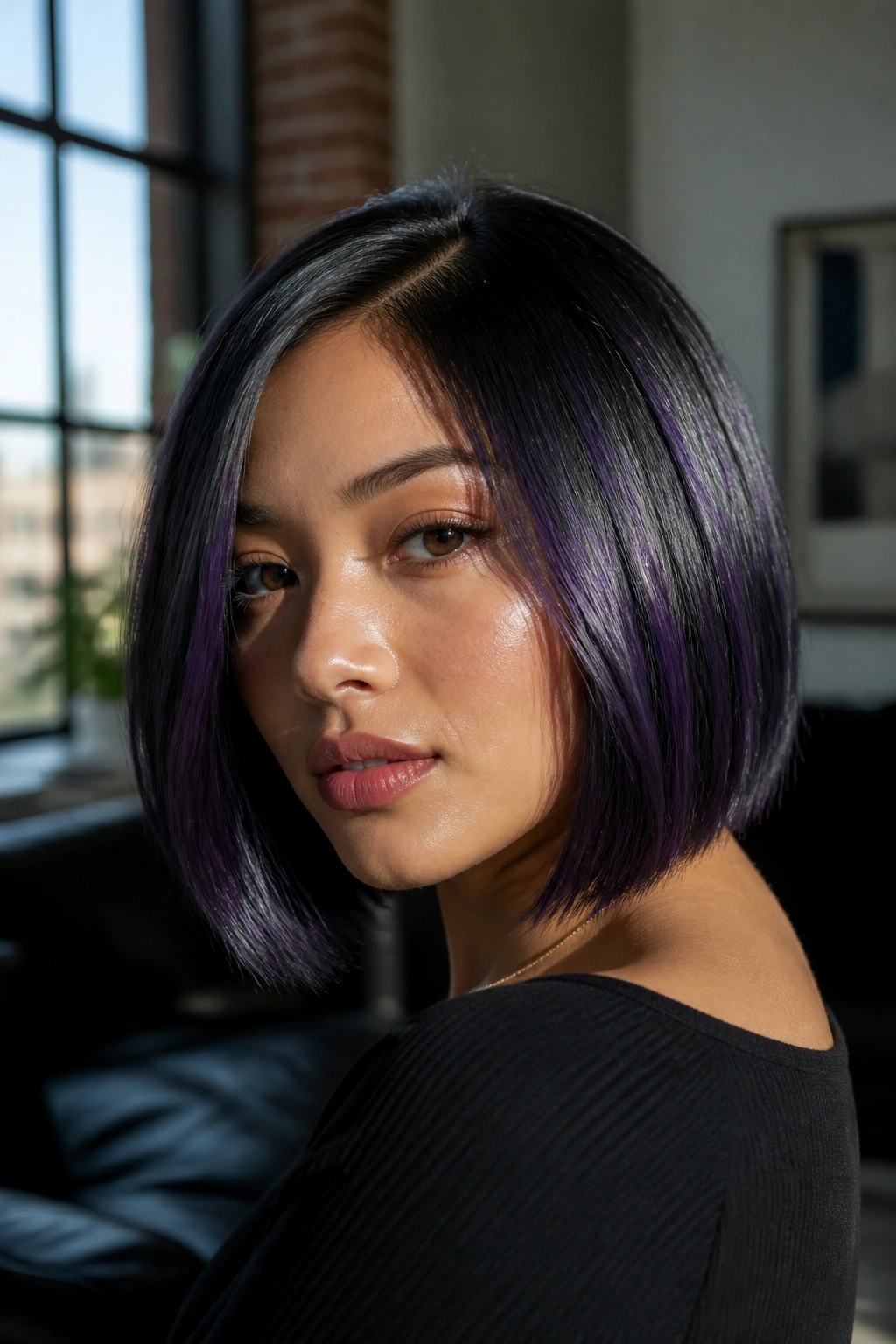
A sleek bob can go wrong on a round face if the length stops exactly at the cheekbone. The fix is simple: keep it slightly longer, either grazing the jaw or falling just below it, then layer on an iridescent purple glaze so the black catches different tones under light.
The glaze is doing less than a full dye job, which is the point. It gives the surface a violet sheen instead of a hard color block. That keeps the bob clean. A round face usually looks better with that kind of polish because the outline stays sharp while the shade itself adds depth.
This is a particularly good choice if you like straight styling. A center part can work, but a soft side part tends to narrow the face a bit more. Either way, keep the bob edges blunt enough to feel crisp, but not so wide that they fan out around the cheeks.
The iridescent finish also fades gracefully. As the glaze softens, the black still does the heavy lifting, and the purple just becomes quieter. That’s not a bad thing. Sometimes quiet is exactly what a good bob needs.
18. Matte Black with Deep Purple Dip-Dye
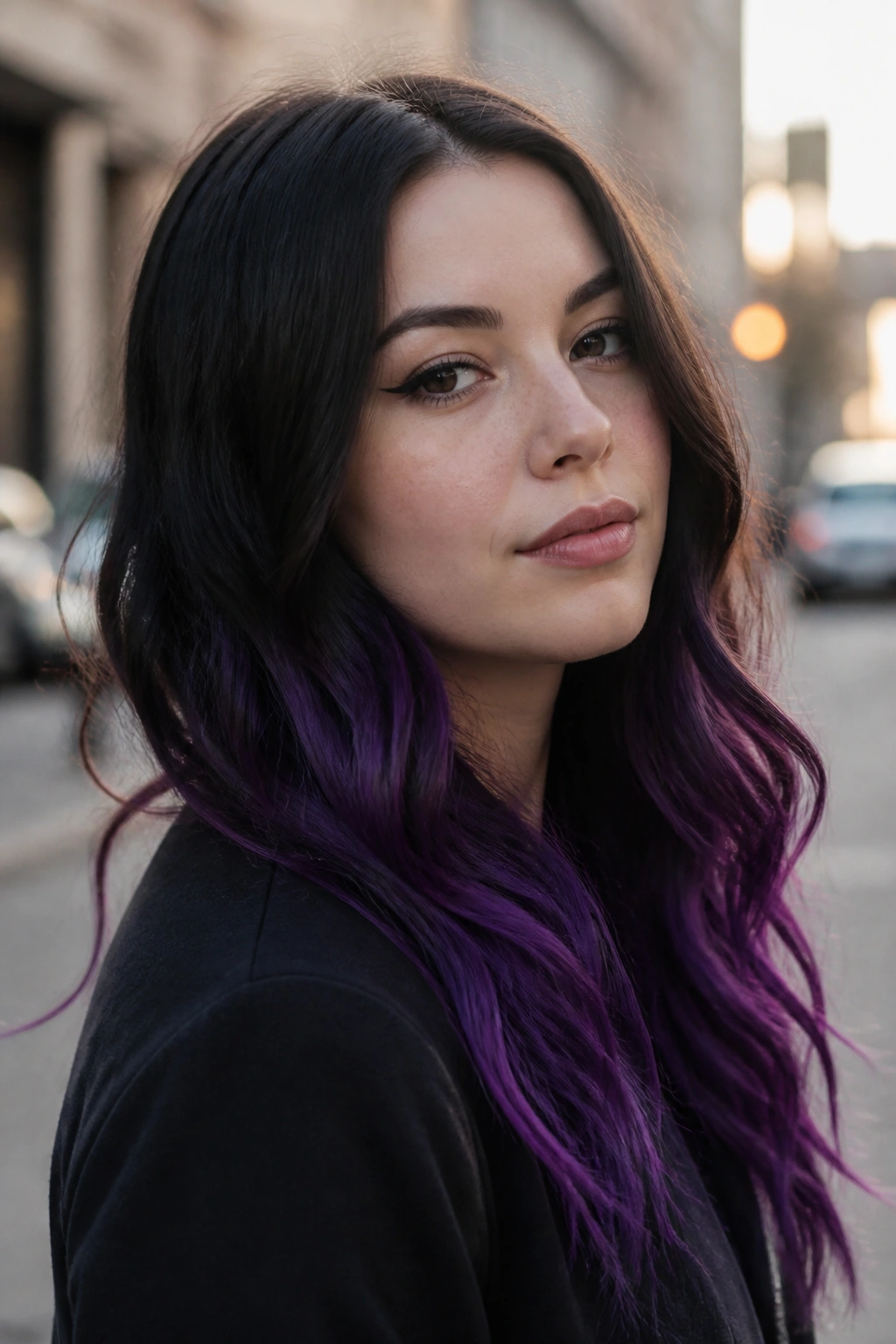
Dip-dye is the boldest of the bunch, and it can be the easiest to wear if you want a look that grows out without constant fixing. On a round face, the best version keeps the black on top and the purple below the jawline, where the color can hang lower and help stretch the shape.
The matte finish makes the contrast feel modern in a low-key way. No high shine, no glossy flash. Just a dark top and a deep purple bottom that looks deliberate from every angle. If you want something louder, you can push the purple into plum or violet. If you want it moodier, go for eggplant with a muted finish.
This works best on longer cuts, but a lob can pull it off too if the purple starts well below the chin. The lower placement matters more than the cut itself. Keep the transition soft and avoid a hard line across the cheeks. That line is the whole battle with round faces.
My honest take: if you want one of the black-purple hair color ideas for round faces that gives you drama without daily fuss, this is the one I’d point to first. It’s strong, it grows out cleanly, and it keeps the face looking longer instead of wider.
