



A sharp black-and-white color block can make a round face look leaner, taller, and more structured—if the white sits in the right place. Put that bright section across the widest part of the cheeks and you can widen the face instead of slimming it. These black and white hair color ideas for round faces work because placement, parting, and length do most of the heavy lifting.
That’s the part people miss. The shade itself matters, sure, but a white streak is not automatically flattering just because it’s dramatic. A deep side part, a diagonal front panel, or a bright piece that falls below the cheekbone tends to draw the eye down; a blunt horizontal band tends to spread it sideways. Small detail, big difference.
White also behaves differently from softer blondes and silvers. It needs a strong lift, usually down to a very pale yellow before toning, and it shows every bit of brass or uneven placement. Black, on the other hand, can look flat if it’s not given shine and movement. The best looks use both colors on purpose, not as a random split.
1. High-Contrast Money Piece with a Long Center Part
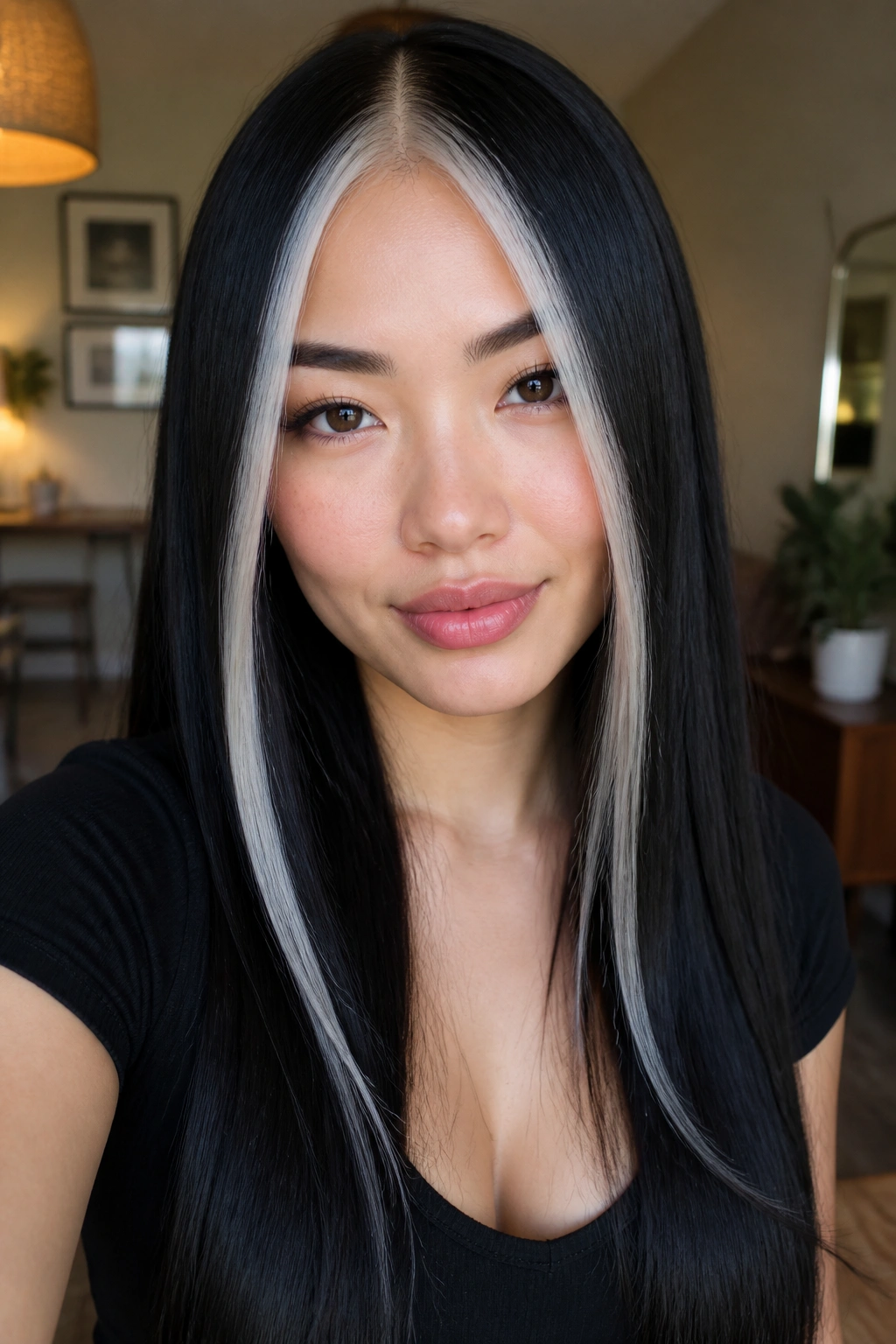
A money piece is one of the cleanest ways to wear black and white on a round face. The bright strands sit beside the part and fall past the cheek line, which pulls the eye downward instead of letting the face read wider.
Why It Flatters the Face Shape
Keep the white pieces narrow. Two face-framing slices, each about 1/2 to 3/4 inch wide, is usually enough to make an impact without turning the front of the head into a bright block.
The sweet spot is the area just below the brow and above the collarbone. If the lightest part of the color stops at the cheekbone, it can puff the face outward. That placement matters more than the exact tone.
What to Ask Your Colorist For
- A deep center part or a center part shifted a touch to one side
- White pieces that begin around the temple or brow bone
- A soft root shadow for the first 1/2 inch so the line does not look stamped on
- Ends that are slightly textured instead of blunt and square
Best on: medium to long straight hair, or loose waves that can show the vertical fall of the color.
One little trick helps a lot. Keep the black around the crown and underlayers richer than the front; that contrast makes the white feel slimmer and more deliberate.
2. Side-Swept White Fringe
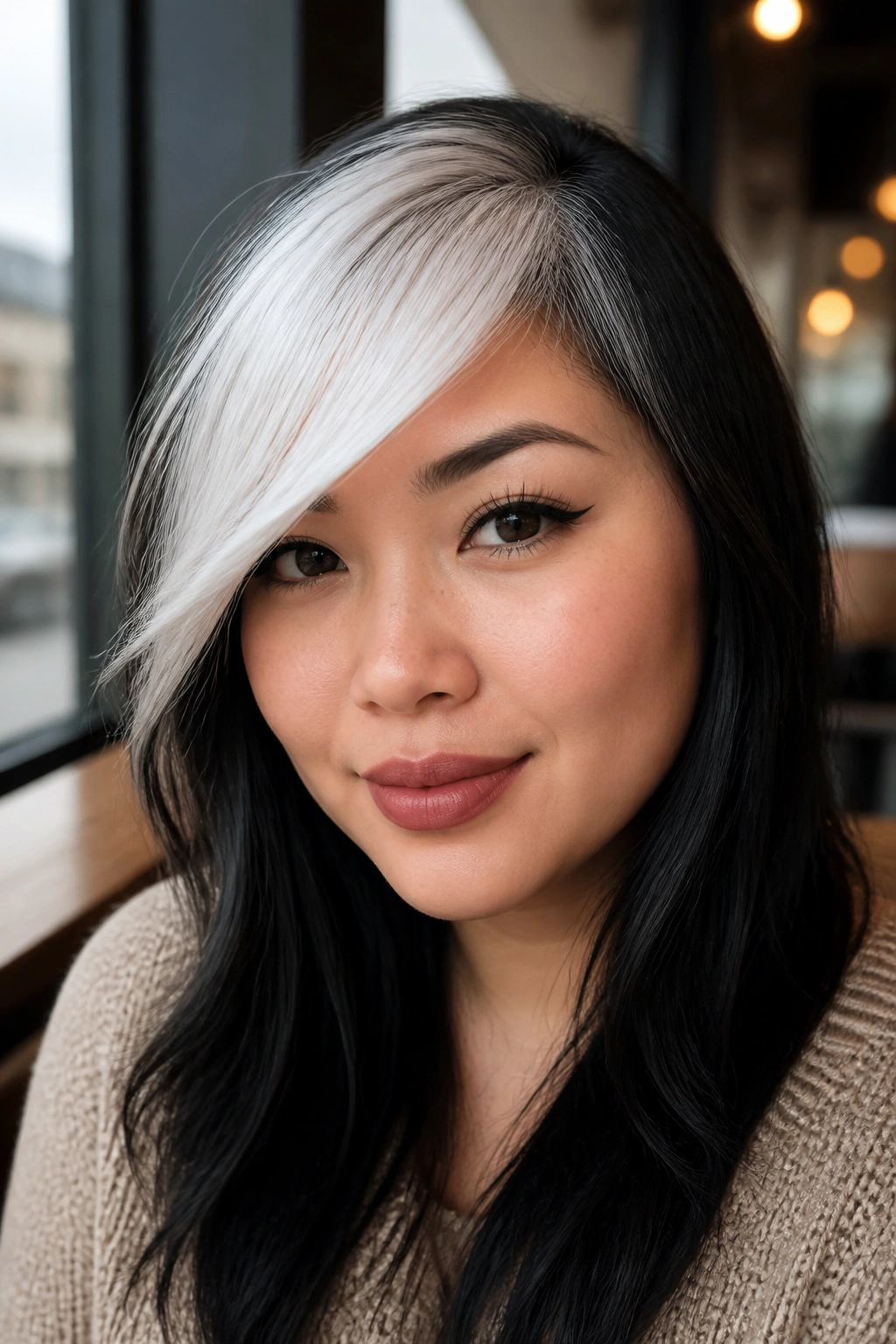
A side-swept fringe can do more for a round face than a lot of people expect. It breaks up the width of the forehead and cheek area with one diagonal line, which is exactly why it works so well in black-and-white color.
The white should not be a thick curtain. A cleaner result comes from a fringe that starts soft at the part, gets brighter through the middle, and tapers before it hits the cheek. That diagonal shape does the work. Diagonal beats horizontal here.
Keep the fringe long enough to brush the eyebrow and skim the top of the cheekbone. Shorter, dense bangs can make the face feel shorter and broader, which is the opposite of what you want. A side-swept piece gives you movement and a little mystery, and it’s easier to grow out if you get tired of the look.
Blow-dry the fringe with a small round brush, aiming the airflow from the roots down and across the forehead. Finish with a light cream or serum, not a heavy wax. Heavy product makes the white piece sit in one flat strip, and that ruins the softness.
3. Split-Dye Lob with an Off-Center Part

A straight half-and-half split is dramatic, but a round face usually looks better when the division is nudged off-center. A lob that lands at or below the collarbone gives the face length, while the split color adds the graphic hit people want from black and white hair.
What Makes It Different
Unlike a blunt split-dye bob, this version leaves one side slightly longer. That tiny asymmetry changes everything. The eye follows the longer side downward, and the face reads less circular.
The white side works best when it is not a flat, solid wall from root to tip. A soft root melt, even just 1/4 to 1/2 inch of shadow at the part, keeps the top from looking too heavy. The black side should stay glossy and deep so the contrast feels crisp, not muddy.
Who Should Wear It
- People who like bold color blocks
- Hair that is naturally straight or lightly wavy
- Anyone willing to keep up with toning every few washes
- Cuts that already hit at the collarbone or lower
If you love clean lines, this one delivers. If you want something softer, move down the list.
4. Thin White Ribbons Through Black Waves

Thin white ribbons are a smarter choice than chunky highlights when the goal is to flatter a round face. They create vertical movement through the hair, and vertical movement is your friend when the face shape already has width.
Question: why does this work so well? Because the eye reads lines before it reads color. A few narrow white pieces placed through dark waves act like visual rails, pulling attention down the length of the hair instead of sideways across the face.
The placement should stay on the outer third of the head. Keep the brightest ribbons away from the broadest part of the cheek, and start them a little lower than you think—roughly 1 to 2 inches below the temple is a safe starting point. That leaves the top darker and lets the shape feel longer.
How to Wear It
- Use fine foils or babylights, not chunky slices
- Place the lightest pieces around the face-framing edge and lower mid-lengths
- Leave the crown mostly black for lift and contrast
- Style with loose, broken waves instead of tight curls
A wavy finish helps the ribbons move. Still hair can make the color look boxy, and boxy is not the goal.
5. Peekaboo White Underlayer for Round Faces
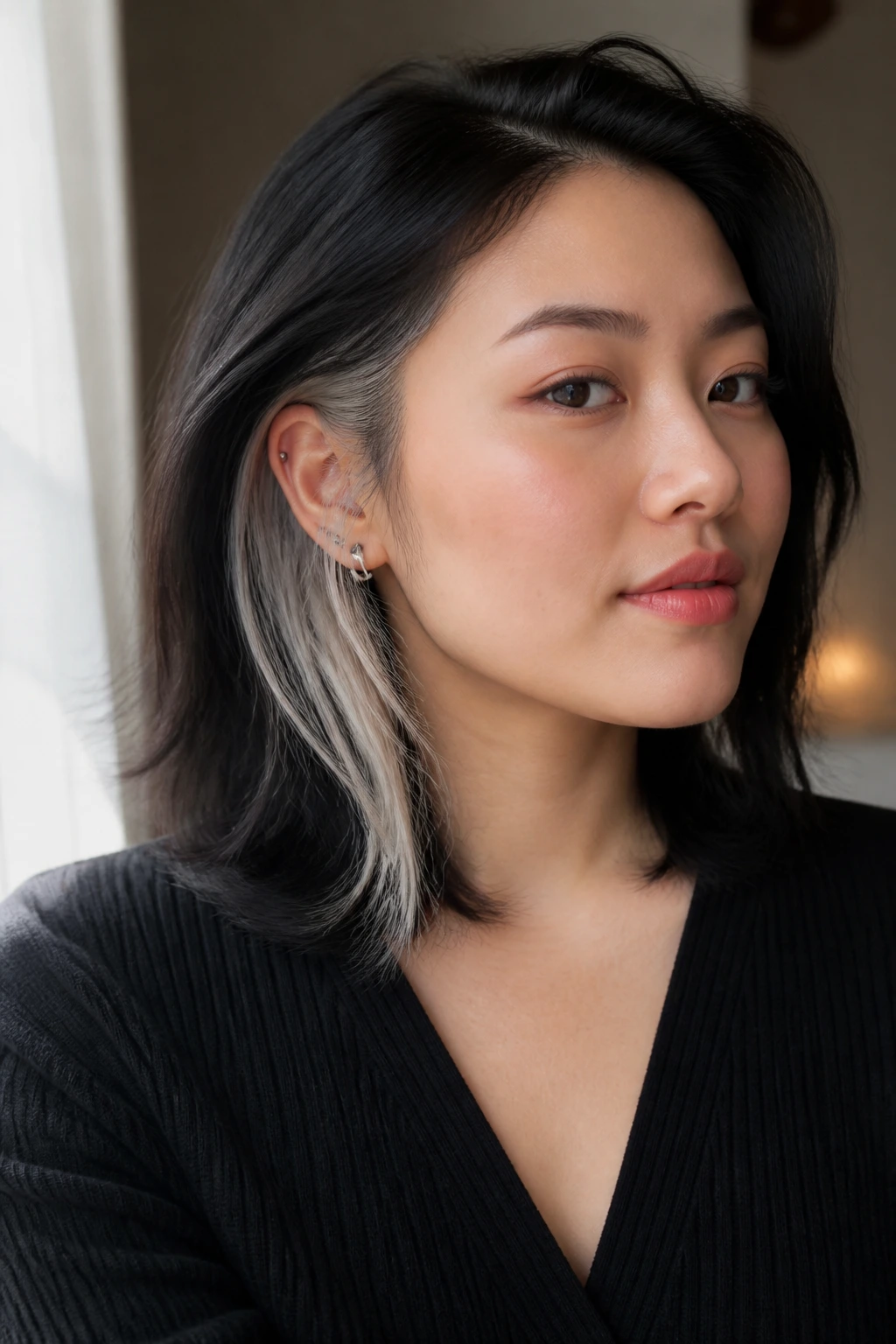
One of the easiest ways to wear black and white without making the face look wider is to hide the white under the top layer. A peekaboo underlayer flashes when you move, tie your hair back, or tuck one side behind the ear.
This placement is sneaky in the best way. The top layer stays dark and slimming, while the white lives underneath where it adds interest without sitting across the widest part of the face. That hidden contrast is flattering for round faces.
It also gives you flexibility. Wear the hair down when you want a softer look, or pull it into a half-up style when you want the white to show more. On layered cuts, the underlayer can peek out at the shoulders and neckline, which helps create a longer line.
This look is especially useful if you want a bold color story but not a high-maintenance front section. Root regrowth is less obvious under the top layer, and the white pieces stay cleaner for longer because they’re not the first thing everyone sees. A tiny win, but a real one.
6. Chunky White Panels Beside the Cheeks
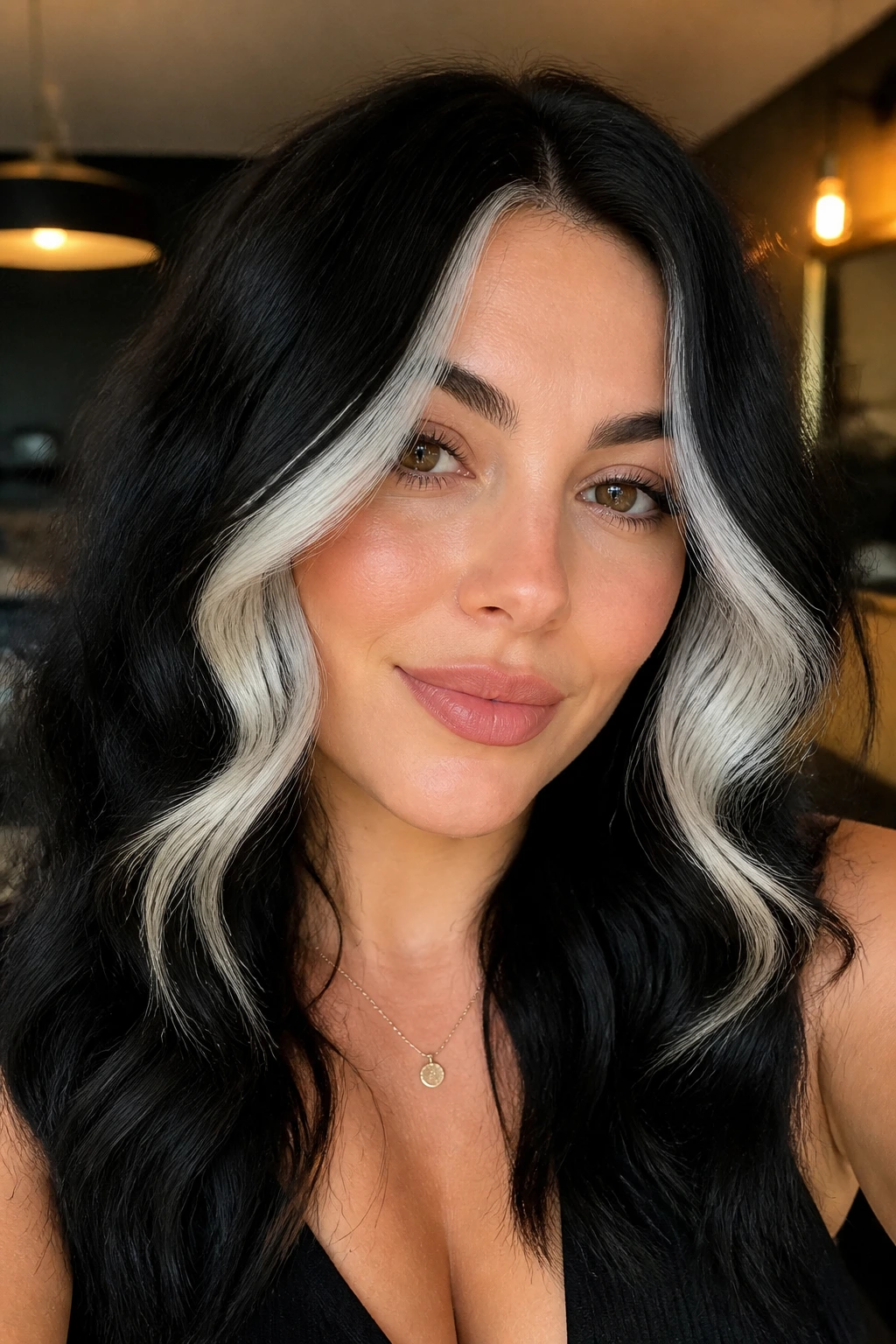
Some looks need a little more punch. Chunky white panels can work on a round face when they are placed with care and not just dropped in as wide, blunt stripes.
Start the lightest section just below the temple, then let it angle toward the collarbone. That diagonal path is what keeps the face from looking broader. If the panel ends right at cheek level, it can widen the face; if it falls longer, it starts to elongate the whole shape.
The rest of the hair should stay a true black or an inky dark brown-black so the white reads as deliberate. A soft wave helps the panel bend around the face instead of sitting as a hard stripe. Hard edges are the enemy here.
The look works well on mid-length cuts, especially if the front pieces are a touch longer than the back. That slight length difference keeps the white from sitting like a shelf near the cheeks. If you like a strong contrast and you’re not afraid of maintenance, this is a good one to bring to a color appointment.
7. Ash White Balayage on Long Layers
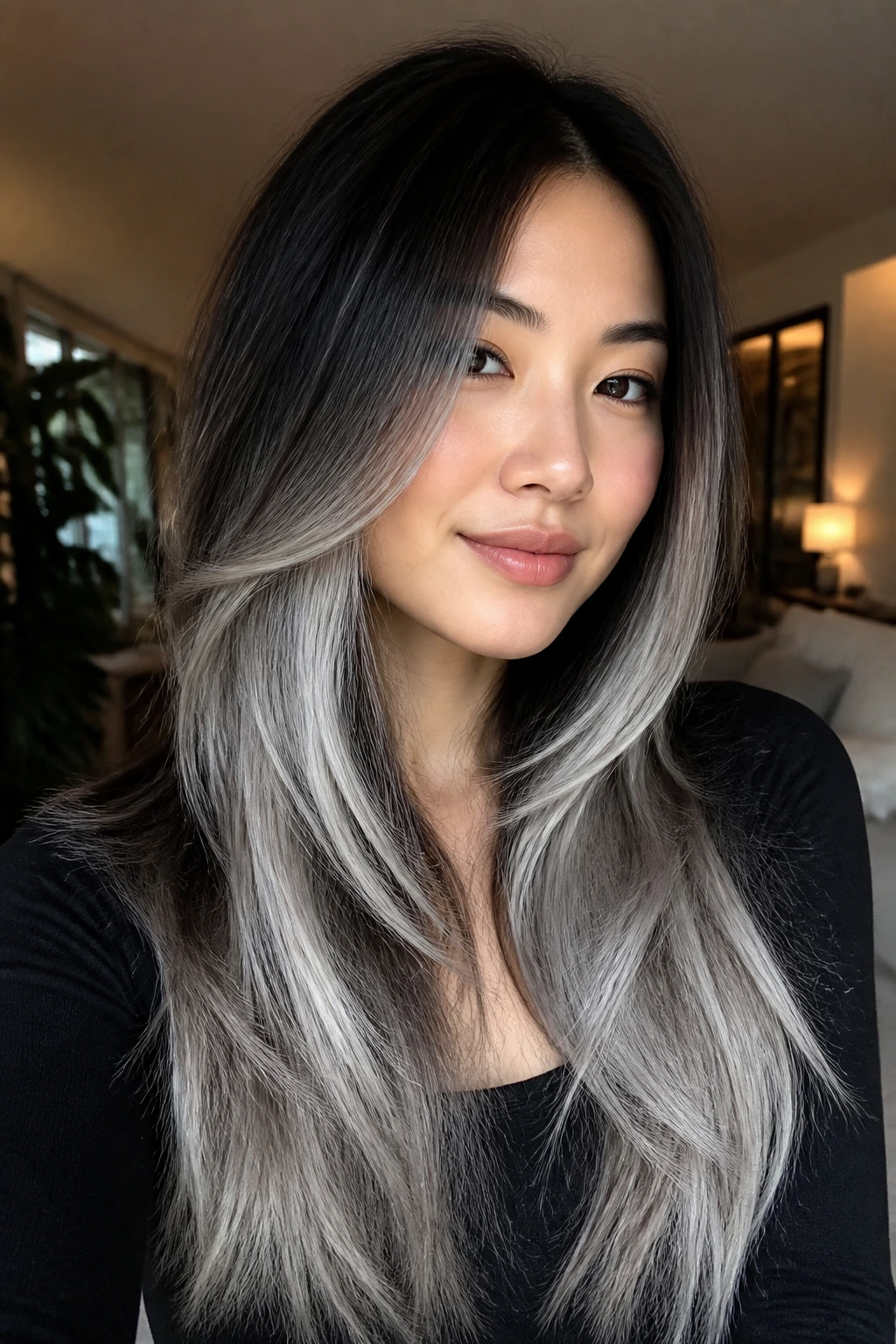
Ash white balayage softens black hair in a way that still feels graphic. The paint strokes are hand-placed, so the contrast is less harsh than a split dye, but the white still shows up clearly against a dark base.
Why It Works on a Round Face
Long layers are the secret. They let the white pieces fall in vertical lines, and that keeps the face from reading too wide. Start the balayage 2 to 3 inches below the chin, then brighten the ends a little more than the mid-lengths.
That lower placement matters. If the white starts too high, it can spread light across the cheeks and temples. If it starts lower, the hair carries the eye downward, which is the whole point.
Quick Placement Rules
- Keep the crown dark
- Brighten the outer lengths and ends
- Use a smoky or pearl toner, not a yellow blonde tone
- Ask for soft, blended edges at the front rather than a hard stripe
This is a good choice if you want something that grows out with less fuss than a stark white panel. It still needs toning, of course, but the blend buys you a little breathing room between salon visits.
8. Dip-Dyed White Ends on Black Hair
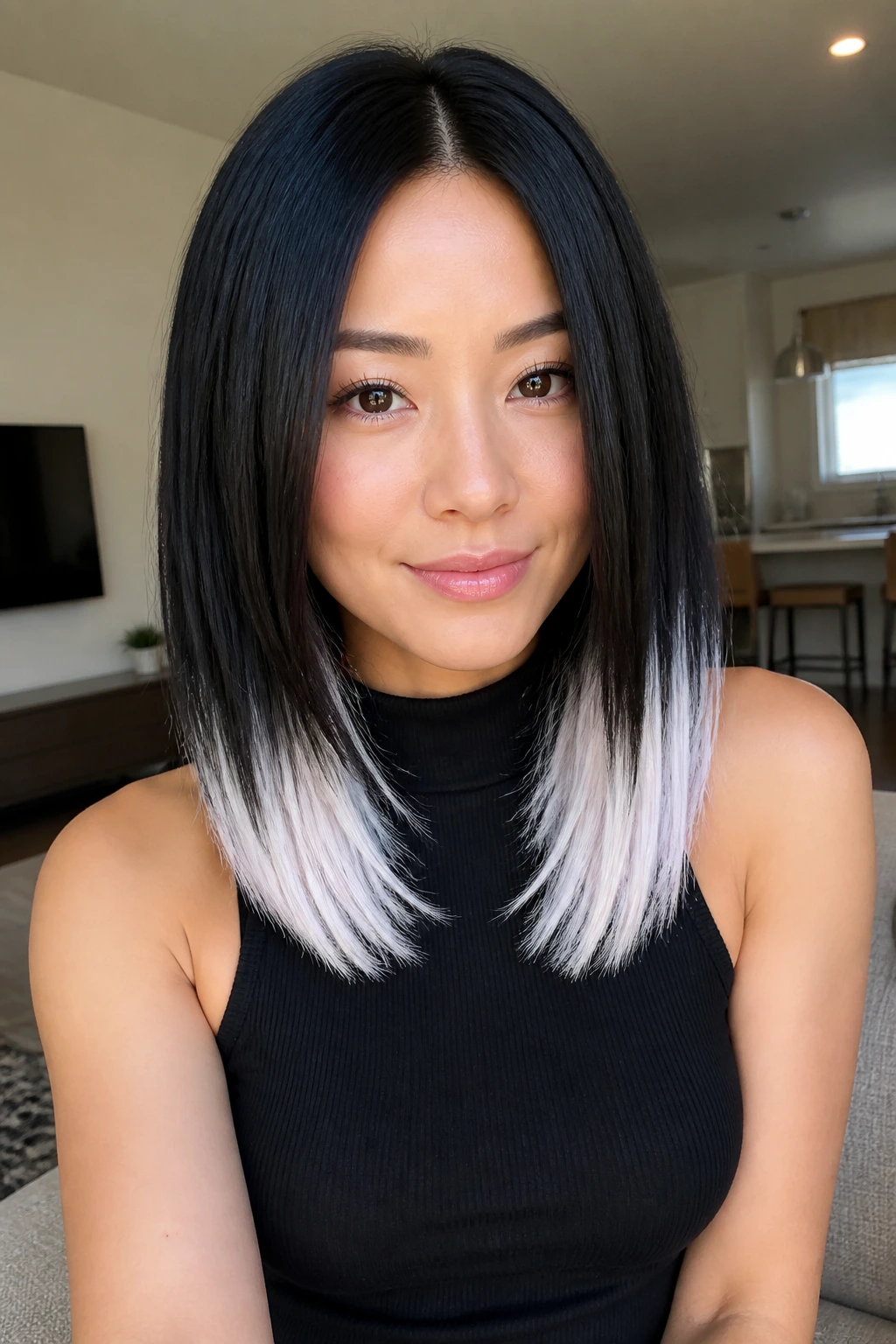
Dip-dyed ends are blunt in the best way. The black stays on top, the white comes in at the bottom, and the eye naturally moves downward toward the length of the hair rather than across the face.
That makes this look a strong pick for round faces, especially if the cut is shoulder length or longer. Long ends create a visual column. Short ends can feel too clustered around the jaw, which is a problem if you’re trying to stretch the face shape.
A little texture at the bottom helps a lot. Straight, blunt ends can read like a hard block of color. Feathered or slightly piecey ends feel lighter and more flattering. The color shift should feel intentional, not chopped in half.
This one suits people who like easy styling. You can wear it straight for a sharp edge, or wave it loosely so the white tips break up into smaller flashes. If you want contrast without living in the salon chair every few weeks, dip-dyed ends give you a practical middle ground.
9. Black Pixie with White Feathered Fringe
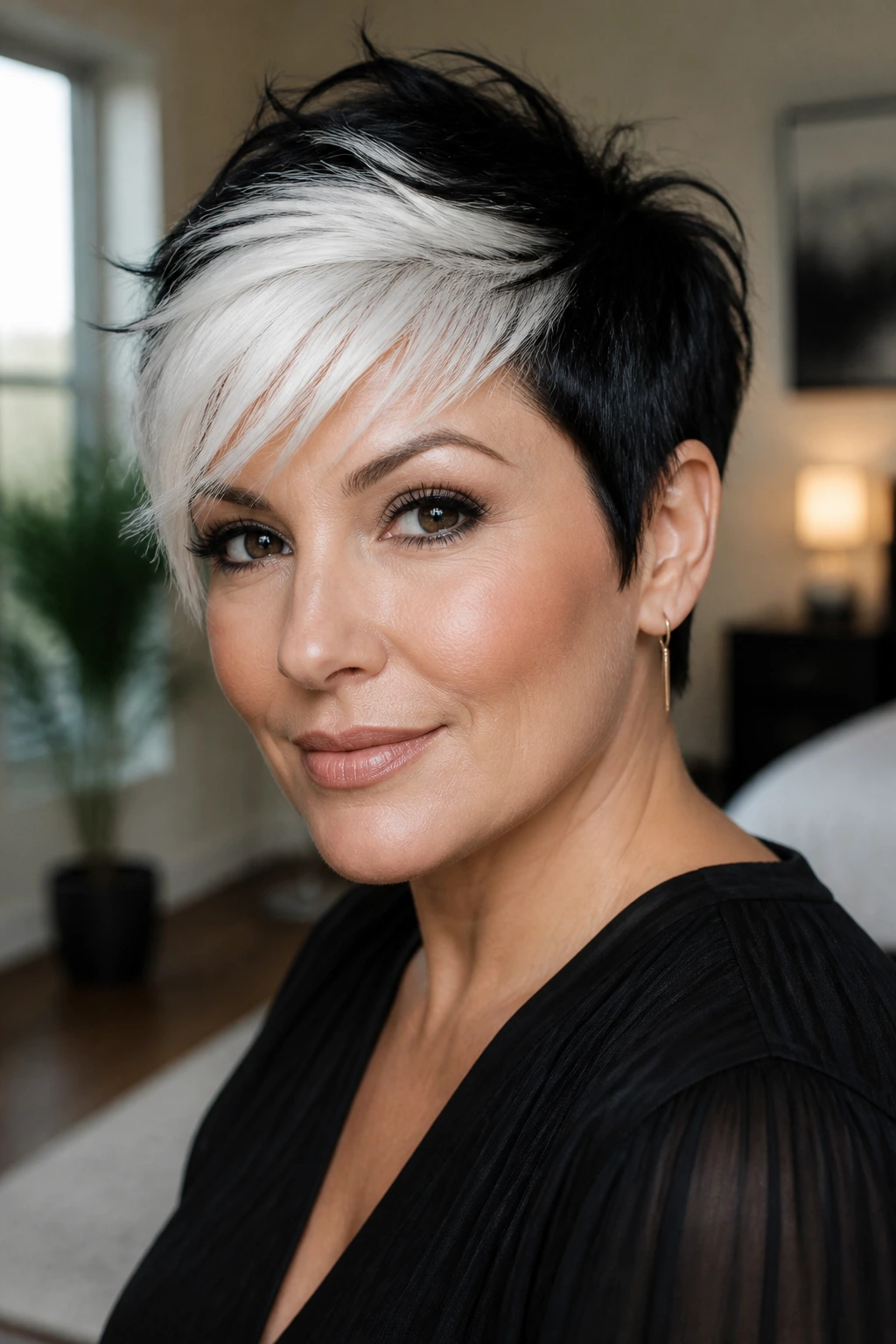
Short hair can flatter a round face too, and a pixie is proof. The trick is not the shortness itself; it’s the height at the crown and the direction of the fringe.
A white feathered fringe draws the eye upward and diagonally. That lift matters. If the fringe is blunt and dense, it can press the face down and make the shape feel fuller. A feathered version keeps air around the forehead and lets the face breathe a little.
The back and sides should stay deeper black, with the white concentrated in the front third of the cut. A little extra length on top—nothing wild, maybe 1 to 2 inches more than the sides—helps create the vertical line round faces need. Add texture paste to separate the white pieces so they don’t collapse into one flat strip.
This cut has a sharper personality than the longer styles. It feels confident. It also makes the color easier to show off, because every piece is visible. If you want black and white hair that looks crisp and expensive in a very plain, unfussy way, this is the one.
10. White Halo Underlights Around the Crown
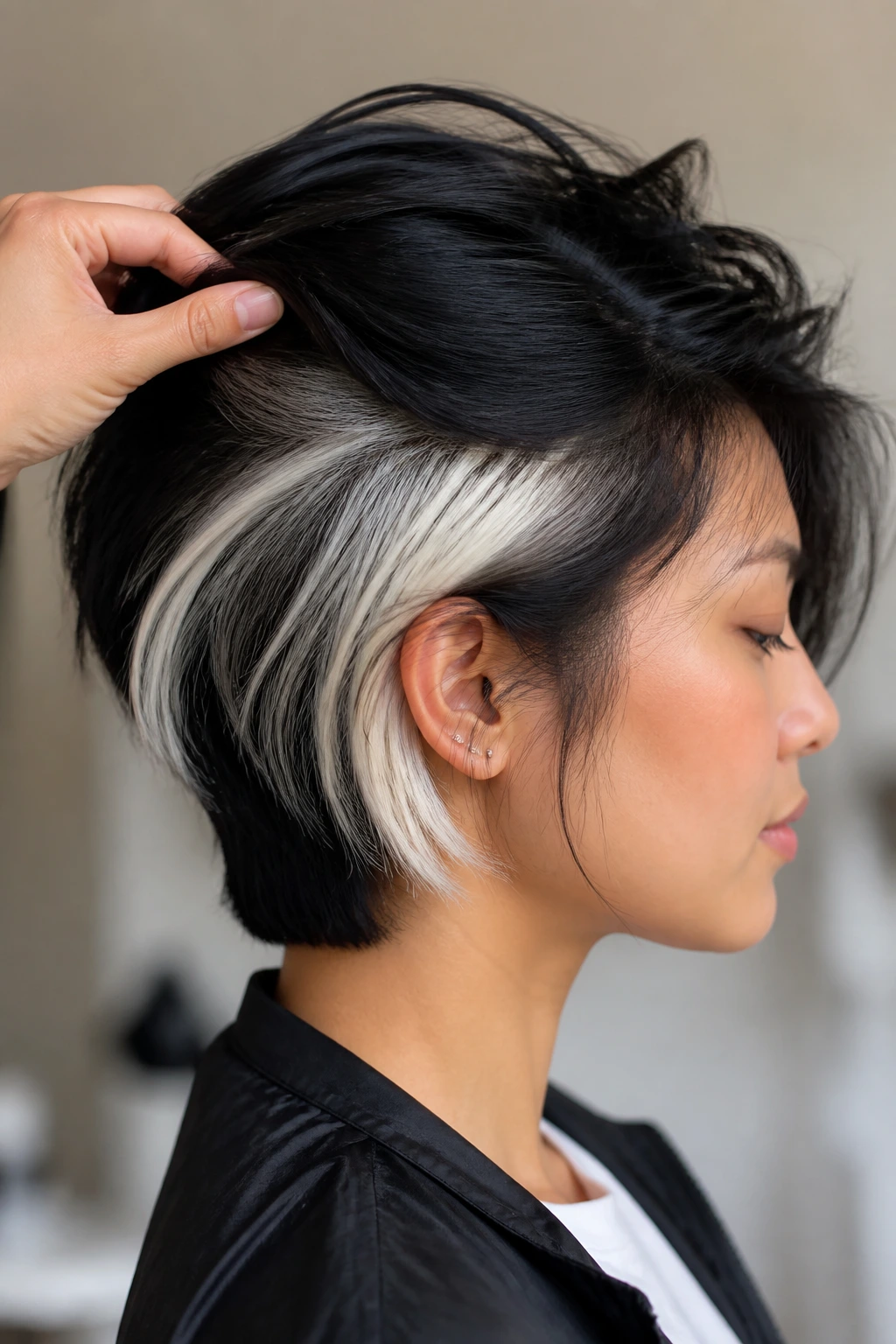
Why place white near the crown instead of the front? Because round faces benefit from height. A halo of white underlayers can lift the eye upward and make the top of the head feel a little taller.
The look is not a full ring around the hairline. That would be too much. Keep the white hidden just under the top layer, concentrated at the crown and upper sides, then let it peek out when the hair moves. The effect is softer and smarter than a bright strip sitting right on the temples.
How to Keep It from Puffing the Sides
- Leave the outermost face-framing layer dark
- Place the white under the top canopy of hair
- Use a round brush at the roots for lift, not volume at the cheeks
- Avoid over-lightening the panels that sit right beside the ears
The result is subtle but useful. You get a bright halo when the hair shifts, plus a little extra height without making the face look wide. On layered bobs and lobs, this can be especially good because the white catches movement in the upper half of the cut.
11. Soft Skunk Stripe
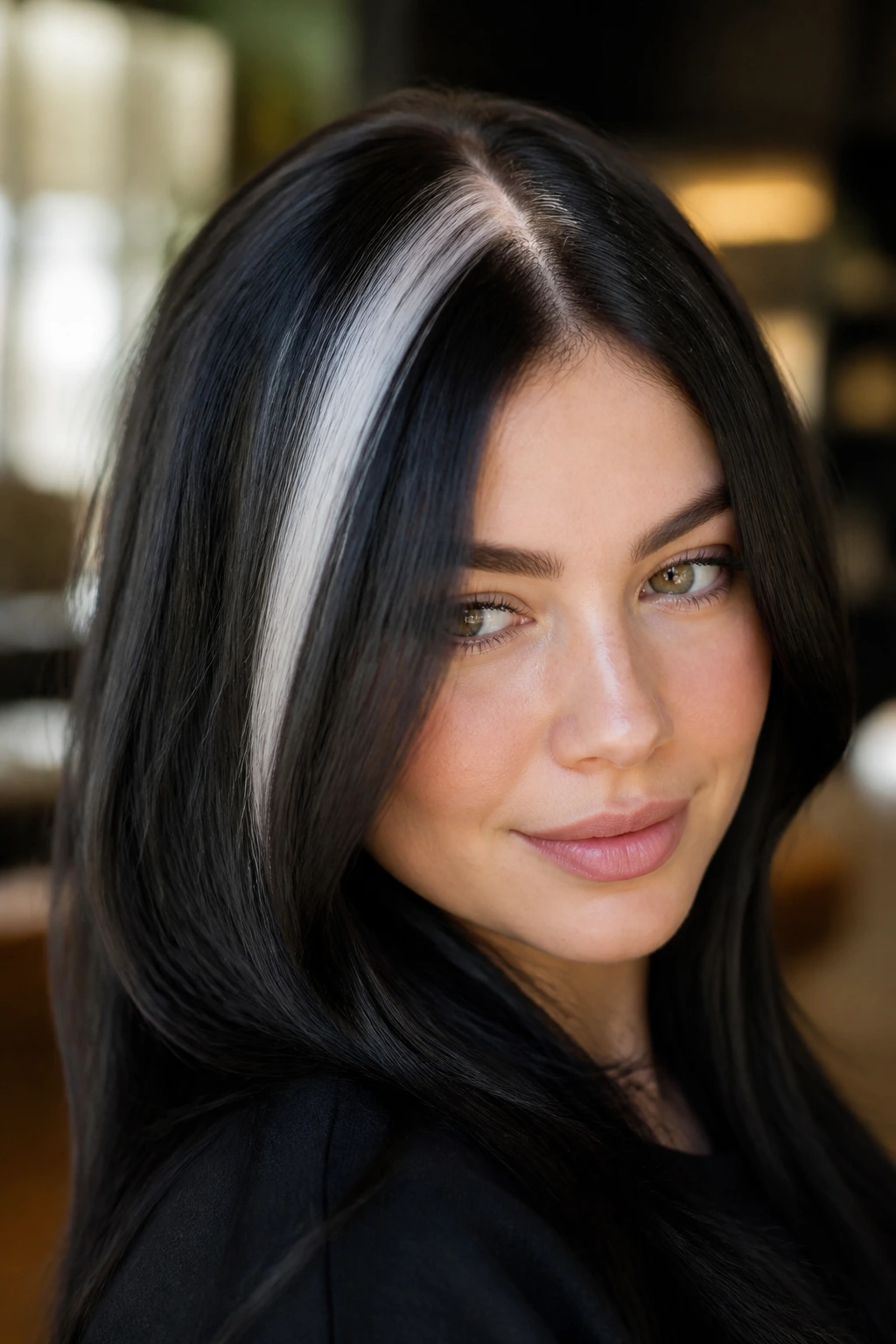
A skunk stripe can go wrong fast on a round face if it’s too wide or too centered. Done with restraint, though, it becomes one of the cleanest black-and-white contrasts you can wear.
The stripe should sit just off the center line, not squarely in the middle of the forehead. That tiny shift softens the shape. A stripe that lands a touch to one side and narrows as it moves down the length of the hair creates a cleaner vertical read, which is what you want.
Keep the rest of the hair dark and glossy. If the black turns dull, the stripe loses impact and the whole look starts to feel messy. Shine matters a lot here. A smoothing serum on the lengths and a shine spray on the top layer help the white pop without needing extra width.
This style suits straight hair, but it can work on loose curls too if the stripe follows the flow of the texture. The main thing is proportion. One stripe. Good placement. No extra fluff.
12. Salt-and-Pepper Melt
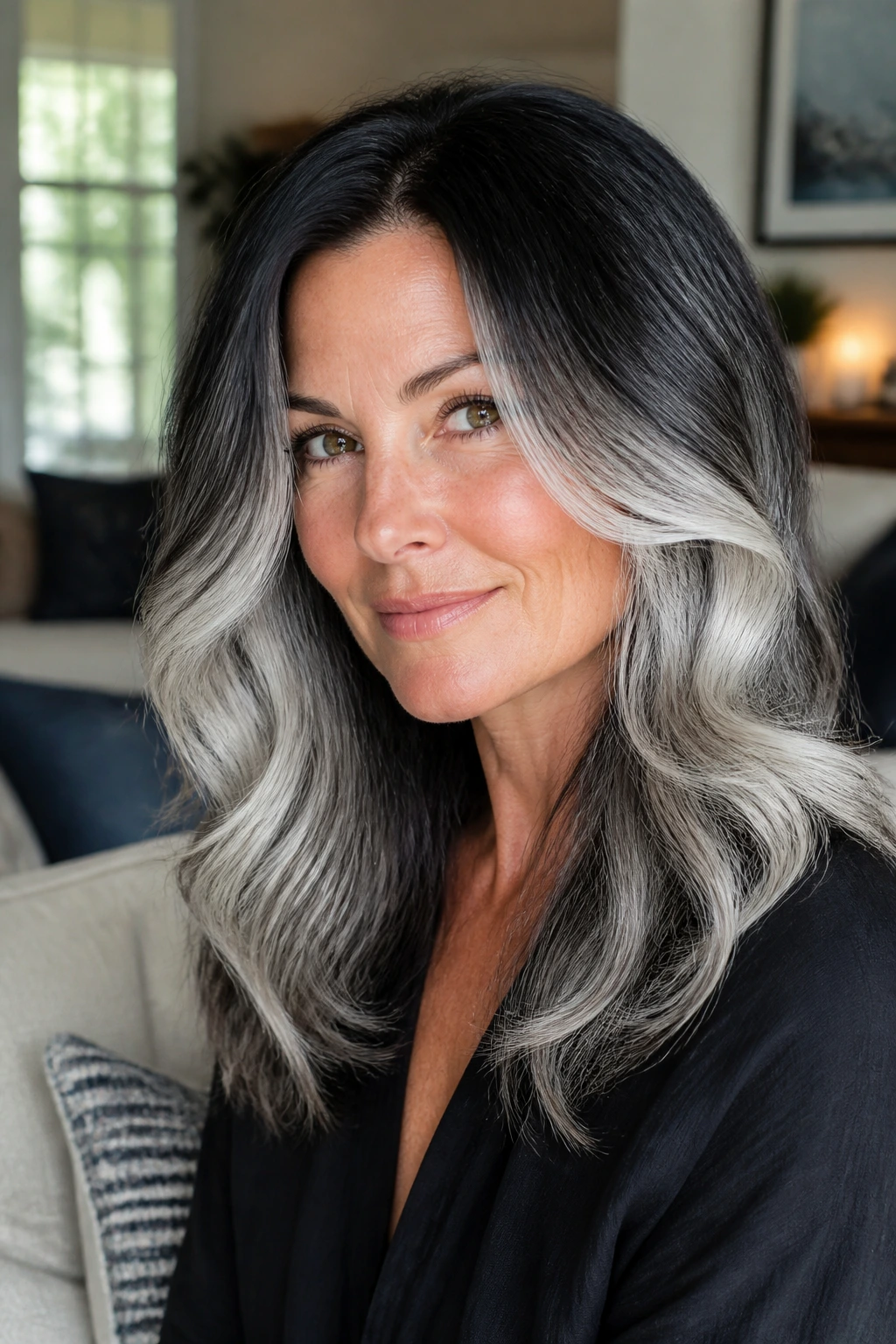
A salt-and-pepper melt is the quietest look on this list, and honestly, I like that about it. Instead of a hard black-to-white split, the color transitions through smoky gray, silver, and softened white.
That blend is kind to round faces because it avoids a sharp color bar across the cheeks. The shift happens gradually, which lets the hair fall in a longer visual line. It also means grow-out looks less abrupt, since the roots do not scream for attention the way a bright white panel does.
Why It’s Easier to Live With
- The gray bridge softens regrowth
- A gloss refresh every 4 to 6 weeks keeps the tone clean
- Loose waves show the blend better than pin-straight hair
- It works well if your natural hair already has some silver strands
This is a good move if you want black and white hair without the weekly drama of keeping pure white bright. It’s still high-contrast, just less severe. For a round face, that softness can be a real advantage.
13. Black Lob with a Bright White Frame for Round Faces
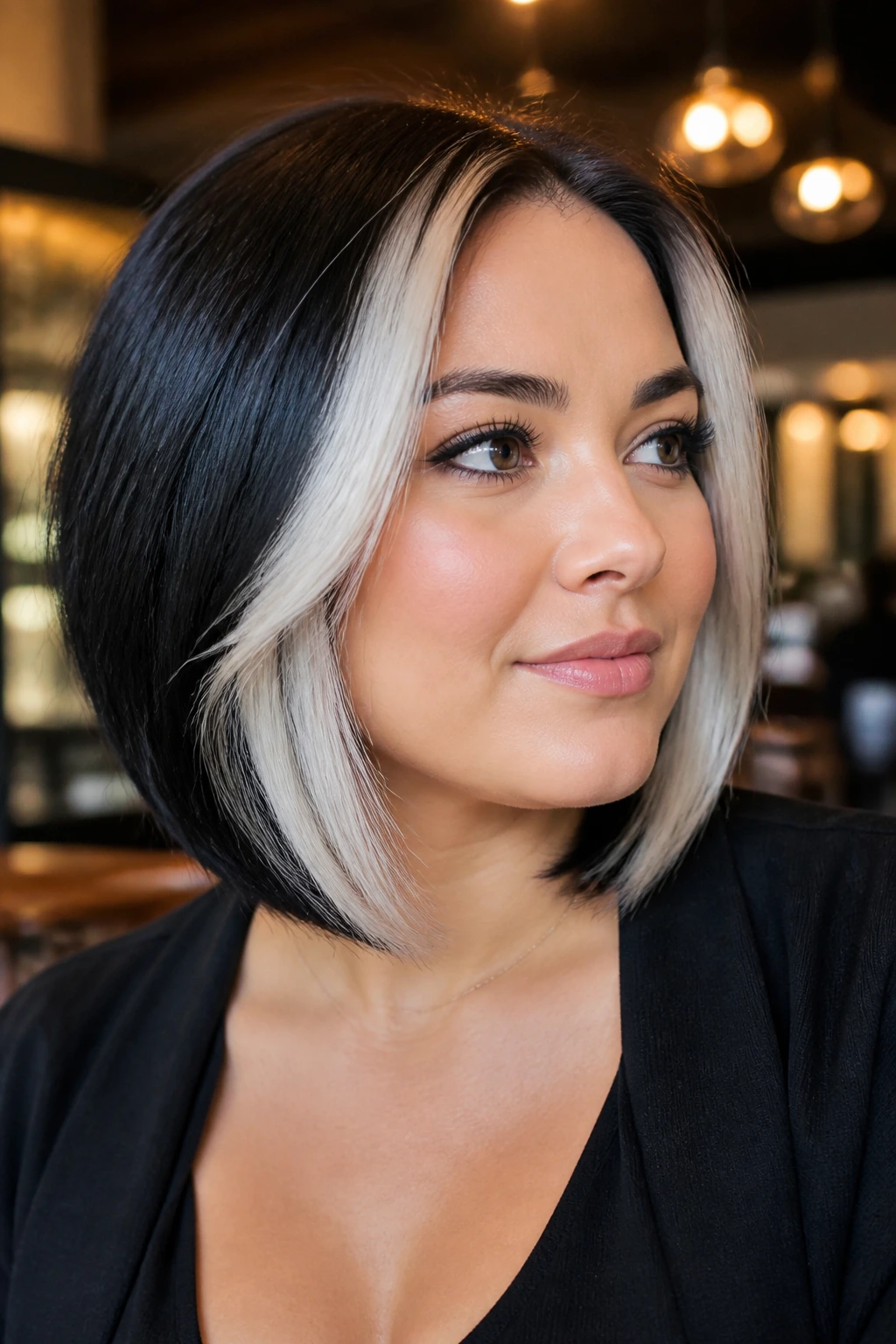
A lob is one of the safest lengths for a round face, and adding a bright white frame makes it feel sharper right away. The cut should hit somewhere between the chin and collarbone, with the front pieces a little longer than the back.
The white frame needs to start high enough to be seen, but not so high that it widens the cheeks. The best zone is around the temple and upper cheek, then tapering lower toward the jawline. That longer finish is what pulls the face down visually. Think lift, not spread.
What to Ask For
- A lob that lands at the collarbone or just above it
- White face-framing pieces with a soft edge
- A slightly deeper black through the back and nape
- Light texturizing at the ends so the shape stays airy
This style works because it combines three things round faces usually like: length, a clean front frame, and a dark base that keeps the bulk under control. It’s polished, but not stiff. And if you tuck one side behind the ear, the white frame becomes even more flattering.
14. Deep Side-Part White Streak
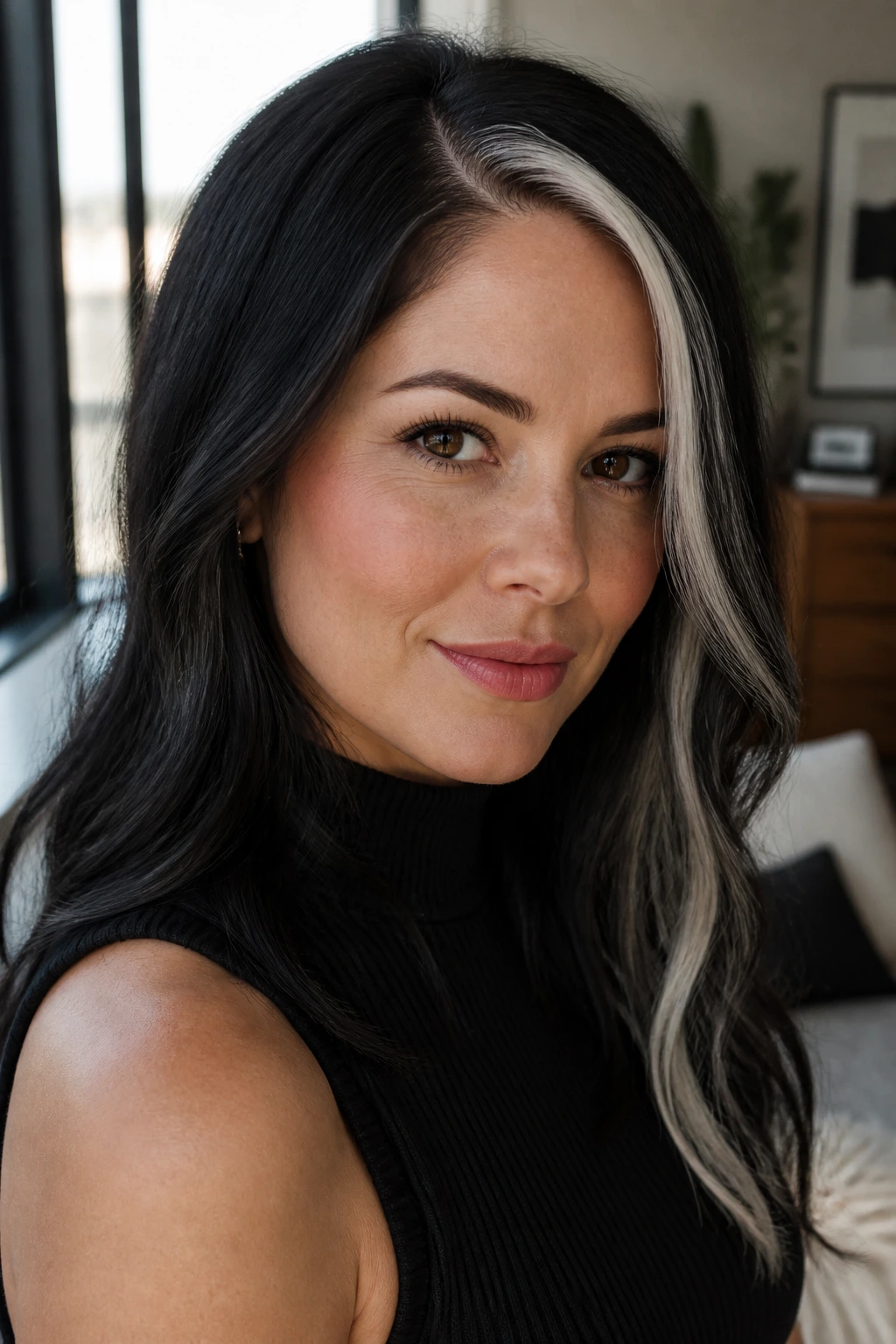
A single white streak can look expensive when it’s placed with a deep side part. The off-center part creates asymmetry, and asymmetry is one of the easiest ways to keep a round face from feeling too full.
The streak should begin near the hairline on the heavier side of the part, then move down through the front layers. If it disappears into the rest of the hair after a few inches, it can feel timid. Let it travel. That’s what gives the line its shape.
The best version is not a thick, banner-like stripe. It’s a clean ribbon that narrows near the top and widens a bit as it falls. Wear it straight if you want the line to look sharp, or wave it lightly if you want the color to break into softer flashes.
A deep side part also gives you an easy styling trick. Blow-dry the roots up and away from the face, then tuck the smaller side behind one ear. That opens up the face and makes the white streak feel even more deliberate.
15. Black Curls with White Tips
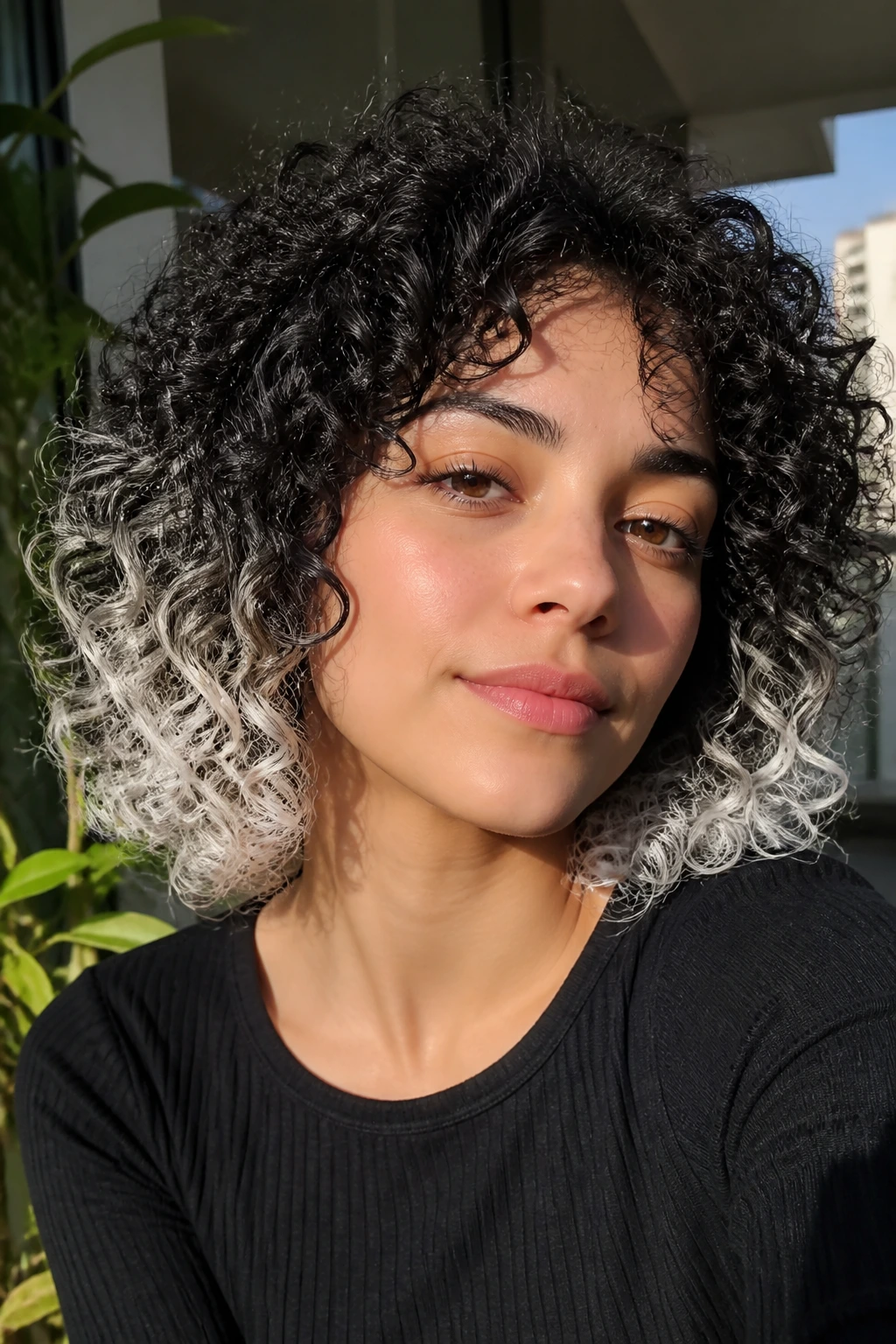
Curly hair changes the whole conversation. Instead of fighting the shape, a black base with white tips lets the curl pattern stay full at the root while still adding brightness where the coils move the most.
Unlike all-over highlights, white tips keep the top and sides darker, which matters on a round face because dark roots visually slim the widest part. The white shows up at the ends, where curl clumps separate and bounce. That gives the hair movement without turning the sides into a bright wall.
What to Watch For
- Keep the white away from the widest curl mass near the cheeks
- Place the lightest tone on the outermost ringlets and ends
- Use a gentle toner so the white doesn’t turn icy and flat
- Moisture matters; bleached curls dry out faster than dark curls
This look can be gorgeous on coils, curls, and loose spirals, but it does need care. Protein balance, deep conditioning, and low heat are not optional if you want the white tips to stay soft instead of frizzy. Still, the payoff is strong. The color feels playful, and the face stays framed in a way that’s actually flattering.
16. Graphic Black and White Panels
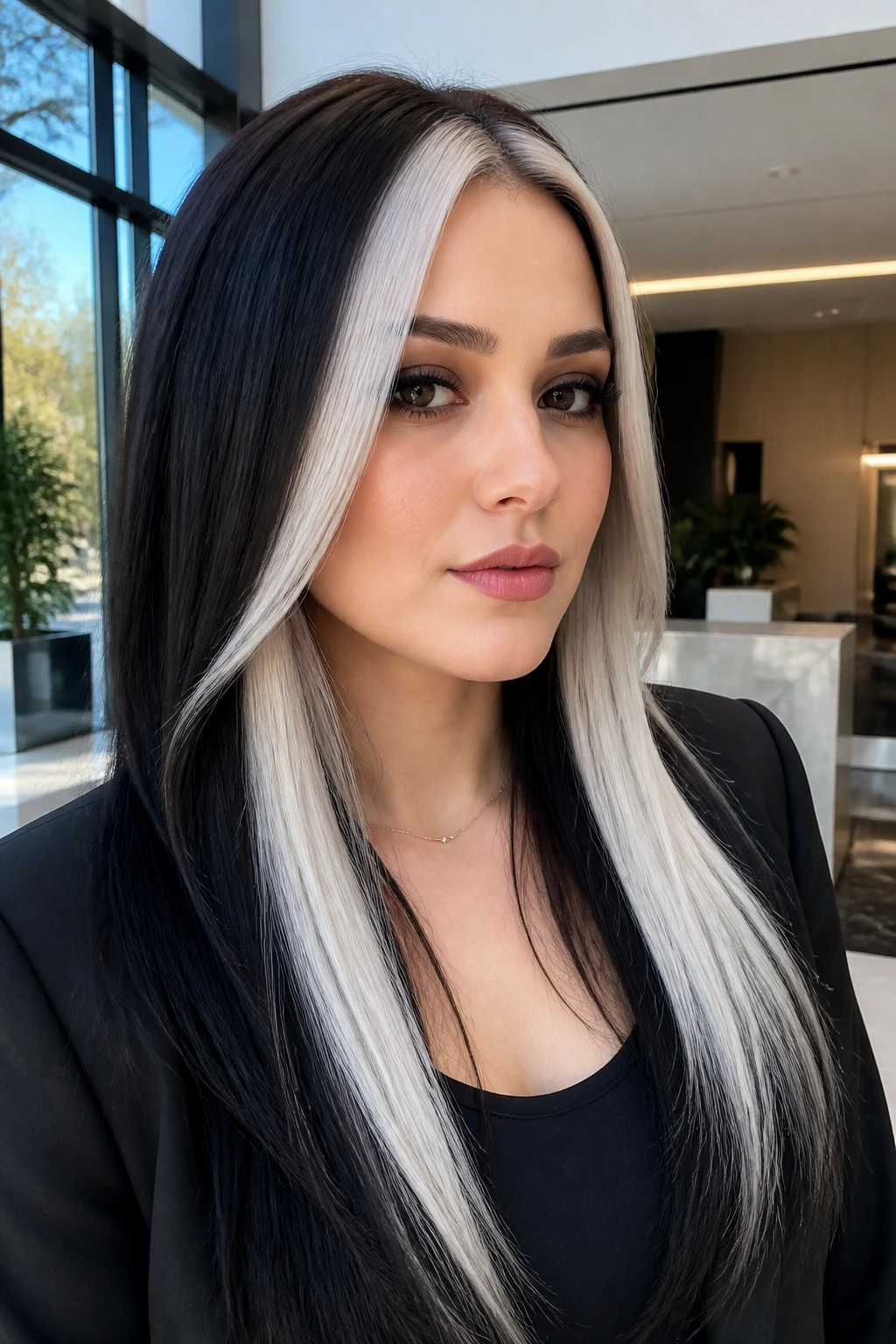
If you like hair that looks a little architectural, graphic panels are the boldest option here. Think blocks of black and white placed with intention, almost like pieces of a tailored jacket.
The key for a round face is keeping the panels vertical or diagonal. A wide horizontal panel across the cheeks can make the face feel broader than it is. A vertical panel from the temple down to the jawline or collarbone does the opposite. Long lines are your friend.
This works especially well on blunt bobs, angled lobs, and straight shags where the color blocks stay visible. A center panel of white with darker side sections can be too much on some faces, so I usually prefer an off-center layout that lets one side carry more darkness. That gives the eye a place to rest.
The look is not soft. It’s sharp, graphic, and a little editorial. If you want a style that reads strong in a room without needing curls or fancy styling, this is a solid pick. Keep the cut precise, though. Messy ends can turn a sharp concept into noise fast.
17. Black Shag with White Layers

A shag cut already does a lot of work for a round face because it breaks up the outline of the hair. Add white layers into the mix and you get movement, lift, and a little edge without piling weight around the cheeks.
What Makes It Different
The white should live in the interior layers and the longer fringe pieces, not as one solid front streak. That lets the shag’s texture do the flattering work. Every time the layers separate, the white shows in smaller flashes, and that keeps the face from reading wider than it is.
A good shag should have some crown height, some cheekbone-skimming pieces, and a slightly longer front. Those three pieces together make the face feel more oval. Add white to the disconnected layers and the whole thing gets brighter in motion, which is exactly where this cut looks best.
Ask Your Stylist For
- A shag with crown lift and soft, broken layers
- White placed through the mid-lengths and fringe
- Darker roots and nape to keep the shape slim
- A cut that still moves when air-dried
This one feels cool without trying too hard. That matters. If the layers are too perfect, the look loses its edge, and if they’re too heavy, the roundness comes right back.
18. Frosted Crop with Soft Edges
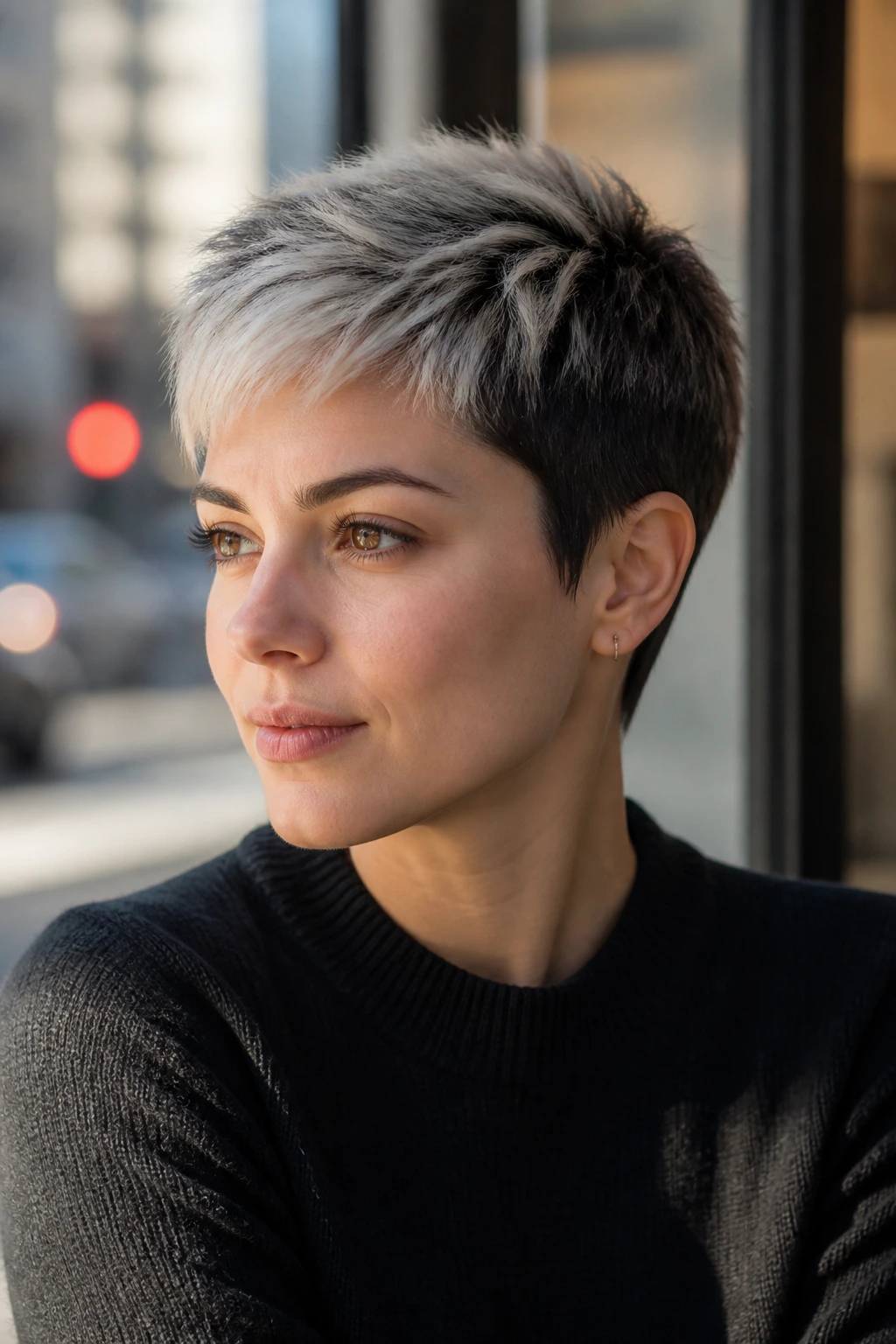
A frosted crop is a short option for someone who wants white to show up fast and black to do the slimming. The crop should stay softer around the temples and fuller at the crown, so the face gets a little lift instead of a hard helmet shape.
The white works best when it’s feathered through the top and lightly at the front hairline, not packed all the way around the sides. That keeps the brightest point above the cheek line. Round faces usually look better when the eye moves upward first, and this crop leans into that idea very neatly.
One practical detail matters here: the nape and lower sides should stay darker than the top. That contrast helps the cut feel taller. If the sides are too pale, the shape can spread outward, and that defeats the point.
This is a good ending note for the whole list because it proves short hair doesn’t have to be boring, and black-and-white color does not need long lengths to make sense. A sharp crop, a little crown height, and a soft white frost through the top can look clean, modern, and easy to wear. If you remember one rule from all of this, keep the brightest white above the jaw and the deepest black where the hair is widest. That single choice changes the whole read.
