



A blunt fringe can box in a round face in seconds. A shaggy one can do the opposite, but only if the layers are cut with some thought and the front pieces don’t land all at the same spot. That’s why shaggy fringe hairstyles for round faces are such a useful category: they soften the face without smothering it, and they add shape without turning the whole haircut into one big circle.
The trap is thinking the fringe does all the work. It doesn’t. The layers under it matter just as much, sometimes more. A shag with the wrong weight line can puff out at the cheeks and make the face look wider; the same haircut with the right length through the sides and a little lift at the crown can pull the eye upward and give the whole style more air.
Texture changes everything too. Fine hair needs lightness so the fringe doesn’t drop flat by lunch. Thick hair needs internal removal so the front doesn’t sit like a shelf. Curly hair needs room to spring. And if any of that sounds picky, well, yes — it is. Haircuts are picky. That’s the fun part.
Length placement is the whole game.
1. Chin-Length Textured Shag With Curtain Fringe
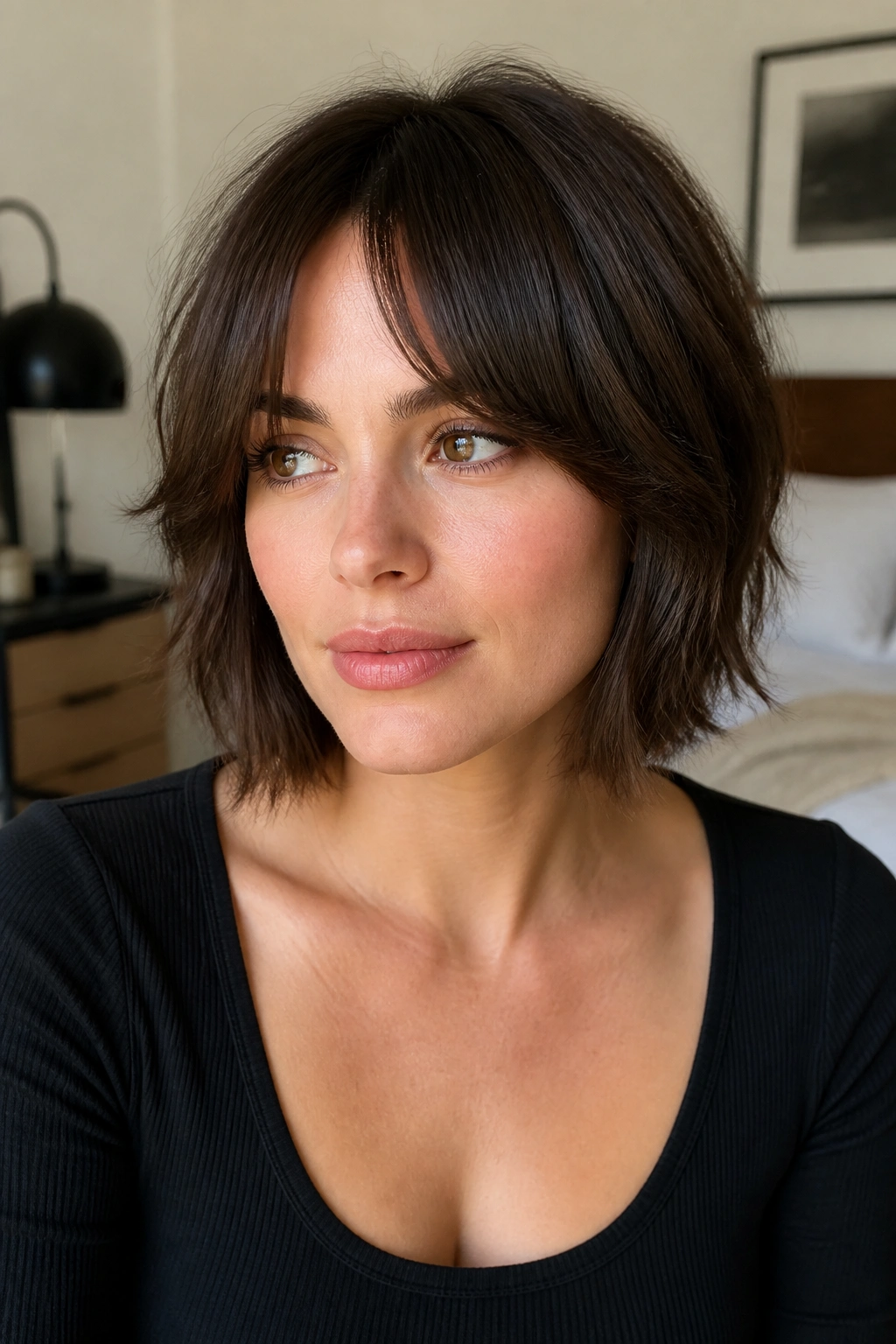
A chin-length textured shag is one of the safest places to start if your face reads round and you want the haircut to do some quiet narrowing. The chin line gives the eye a place to stop, and the curtain fringe opens the forehead instead of chopping it straight across. That little bit of openness matters more than people think.
Why It Works
The best version keeps the shortest layers below the widest point of the cheeks. That means the face doesn’t get “boxed” in by a stack of short pieces at cheek level. Instead, the movement drops downward, which creates a cleaner vertical line.
The fringe should split softly near the middle and graze the brows or just below them. If it sits too high, it can feel choppy in a way that makes the face look shorter. If it sits too low and heavy, it starts acting like a curtain in the bad sense.
- Ask for textured ends, not blunt edges.
- Keep the side pieces a little longer than the chin if your cheeks are full.
- Blow-dry the fringe away from the center with a small round brush.
- Finish with a tiny amount of light cream or paste, not a heavy wax.
Best for: straight to wavy hair that needs shape fast.
Watch for: a fringe that’s cut too short and flips upward like a shelf.
This cut works because it looks casual, but the geometry underneath is doing a lot of heavy lifting. That’s the sweet spot.
2. Shoulder-Length Wolf Cut With Broken Fringe
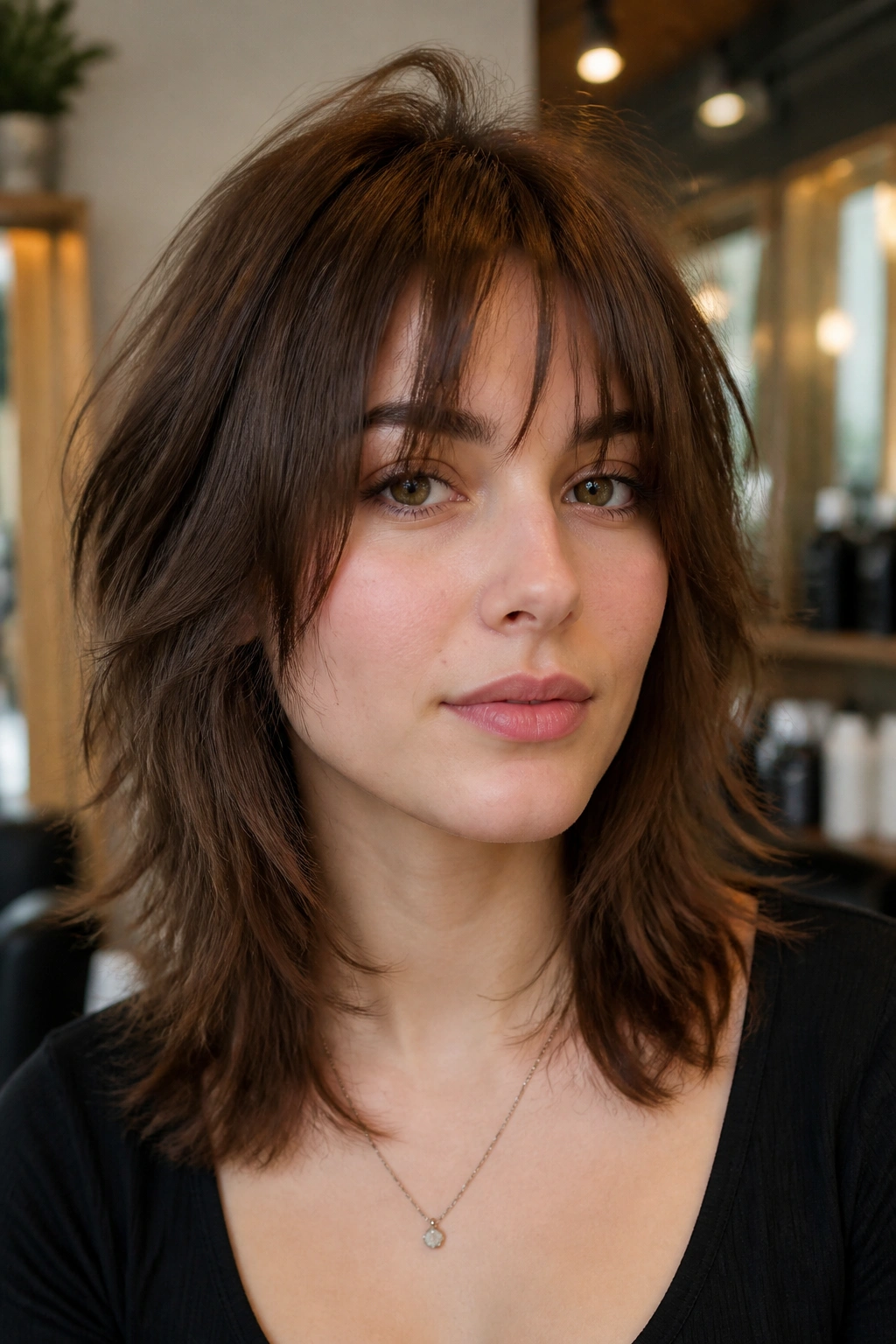
Why does the wolf cut keep showing up on round faces? Because it cheats in a good way. The crown gets height, the ends stay lean, and the fringe is broken enough to keep the front from turning into a flat line across the forehead.
The shoulder length is the part people underestimate. It gives the hair a little drop past the jaw, which helps pull attention down instead of out. A shorter wolf cut can get puffy around the ears if the hair is dense; shoulder length gives the layers more room to move before they fan out.
The fringe should look slightly unfinished. Not sloppy. Just not too neat. You want pieces that separate with fingers, not a solid rectangle that lands all at once. The best styling is usually a rough blow-dry with a diffuser or a quick round-brush lift at the roots, then a mist of texturizing spray through the mids.
How to Wear It
Ask for These Details
- Crown layers that start high enough to build lift.
- Fringe pieces that are longer at the temples.
- Internal thinning only if the hair is thick; skip heavy thinning on fine hair.
- Ends that are chipped or sliced so they don’t sit blunt.
The wolf cut is not shy. That’s the point. If your face shape can handle extra height on top, this cut gives you movement without making the cheeks feel crowded.
3. Long Shag With Wispy Eyebrow Fringe
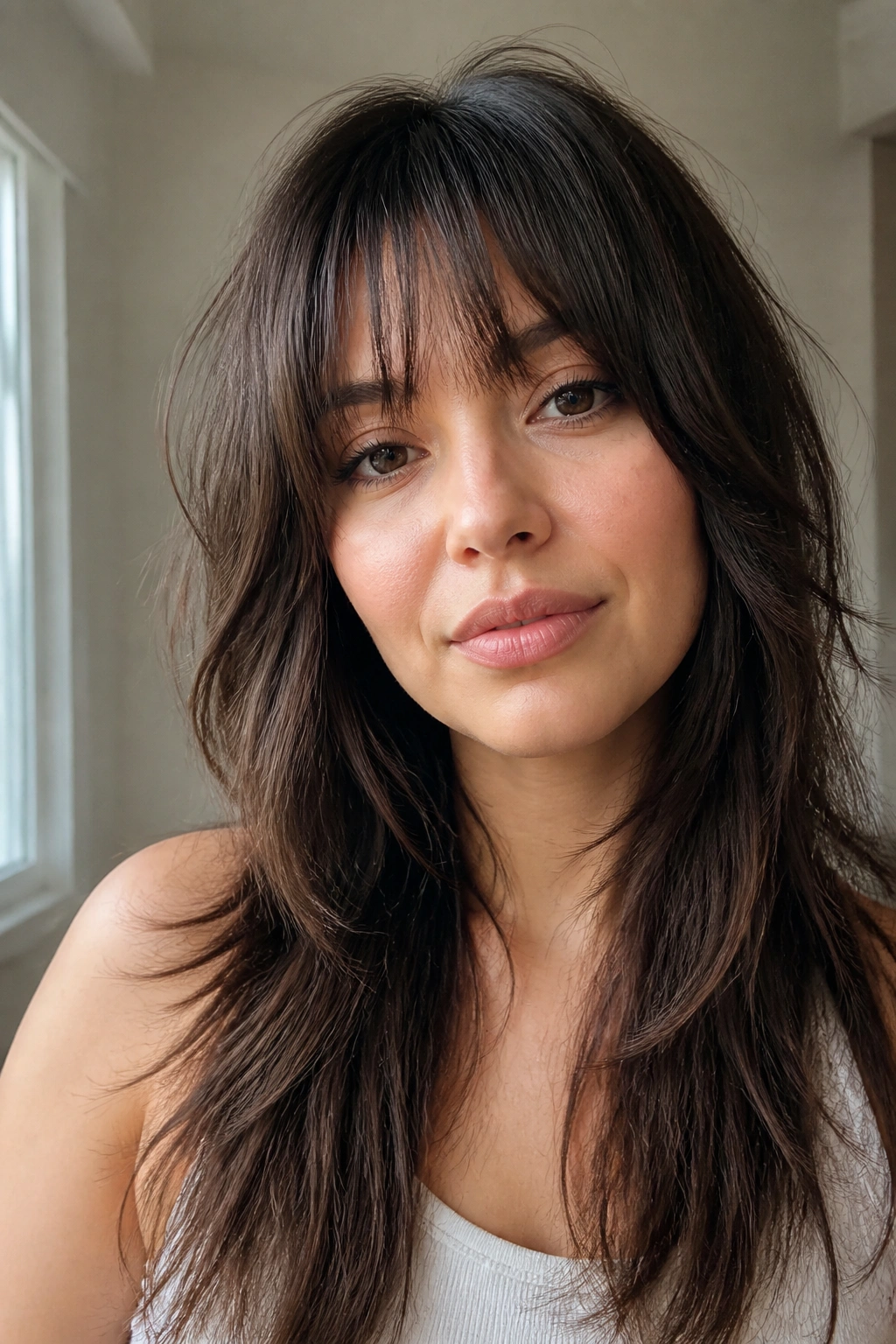
If you love length, do not let anyone talk you into a heavy fringe just because your face is round. A long shag with a wispy eyebrow fringe keeps the softness, but it leaves enough length through the body of the hair to stretch the overall shape.
This one is a good fit when you want the haircut to whisper instead of shout. The fringe should be airy enough that you can see bits of forehead through it. That transparency matters. It breaks up the horizontal line, which is exactly what a round face usually needs less of.
The long layers also help if your hair tends to swell at the sides. When the lowest layers fall below the jaw and the front pieces taper toward the collarbone, the silhouette feels slimmer and more intentional. That’s especially helpful with naturally thick hair, which can turn puffy fast if it’s cut too short in the front.
What to Tell Your Stylist
- Keep the fringe light and see-through, not dense.
- Start the shortest face-framing pieces around the cheekbone or just below.
- Leave enough length at the back so the whole haircut reads long, not bulky.
- Use a soft bend at the ends rather than a curl.
A wispy fringe like this is forgiving. It grows out well, and it doesn’t demand perfect styling every morning. Frankly, that’s half the appeal.
4. Airy Italian Shag With Side-Swept Fringe
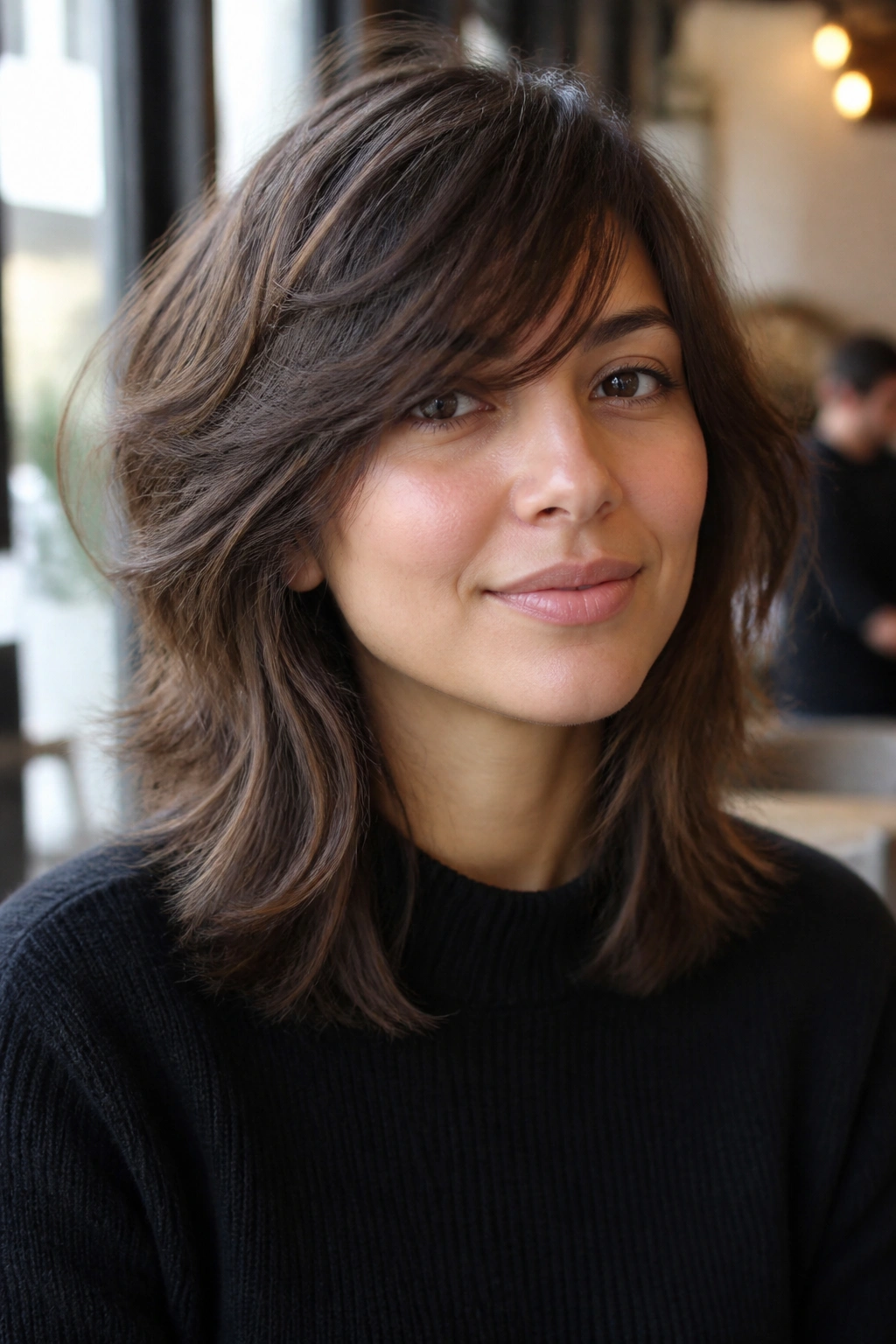
Side-swept fringe sounds old-fashioned until you see it cut with enough texture. Then it suddenly feels smart again. On a round face, that diagonal line does a lot of quiet work because it breaks symmetry and gives the forehead a longer look.
The Italian shag version keeps the layers soft, polished, and a little undone at the ends. It isn’t a hard-edged, rocker haircut. It’s softer than that. The hair moves in broad, loose sections, and the fringe sweeps across rather than sitting as a wall. That sweep is what keeps the face from feeling too open.
This style tends to flatter straight and lightly wavy hair especially well because the fringe can be brushed over and tucked into the rest of the cut without fighting the texture. If your hair is very curly, the same idea can work, but the sweep needs more length so shrinkage doesn’t pull it back too high.
The trick is the parting. A deep side part will exaggerate the diagonal and make the face look longer. A soft off-center part is gentler if you want movement without too much drama. And yes, there’s drama here if you want it. Just enough.
5. Curly Shag With Piecey Fringe

Curls need room. That sounds obvious until you see how often curly bangs get cut too short and too full, then spring up into a shape that fights the face instead of framing it. A curly shag with a piecey fringe works because it respects the curl pattern and avoids that heavy helmet effect.
The fringe should be cut dry, or at least mostly dry, so the stylist can see how much the curls bounce. If the hair has a tight spring, the longest piece in the fringe often needs to sit lower than expected. That’s not a mistake. It’s insurance.
Best Curl Patterns for This Look
- Loose waves and ringlets can usually handle a brow-skimming fringe.
- Tighter curls do better with a longer fringe that lands near the cheekbone.
- Dense curls need internal shaping so the front doesn’t balloon out.
- Fine curls need less thinning and more careful layering.
The rest of the shag should keep the weight moving down and away from the cheeks. That’s the real reason it flatters a round face. The shape is lifted at the top, tapered through the sides, and broken up at the front so nothing feels blocky.
A little curl cream, a little gel, and a diffuser do more here than a hot brush ever will. If the curls are shaped well, the fringe looks playful. If it isn’t, it looks like you fought a sheep and lost.
6. Collarbone Shag With Bottleneck Bangs
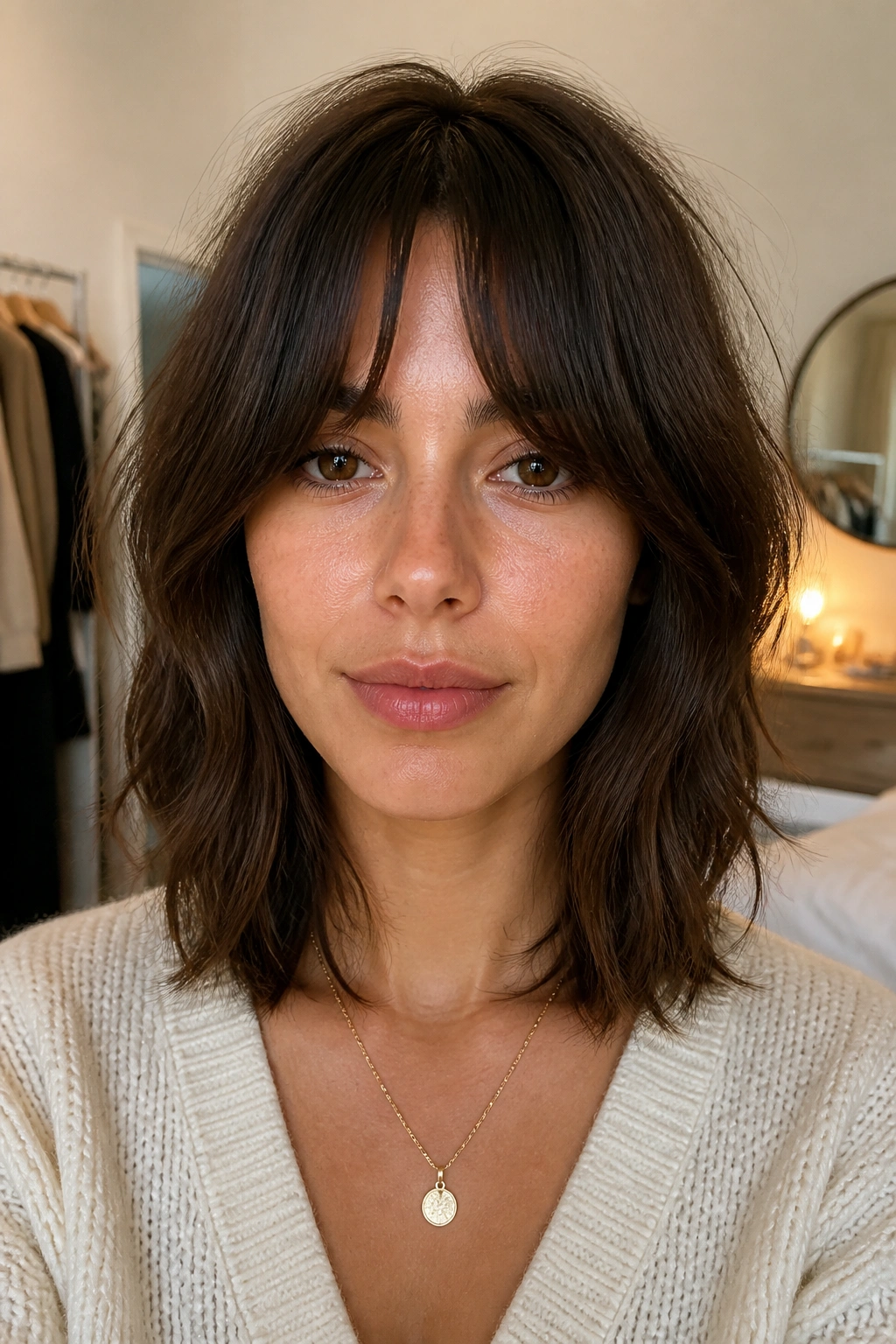
Two lengths do the work here. The collarbone length pulls the cut downward, while bottleneck bangs narrow at the center and open out toward the temples. That combination is gold for round faces because it adds shape without flooding the forehead or the cheeks with too much width.
Bottleneck bangs have a soft middle section that’s shorter, then longer sides that blend into the rest of the haircut. They’re less severe than a blunt fringe and more controlled than curtain bangs. On a round face, that middle dip creates a tiny vertical line right where you want one.
The collarbone length matters because it lands below the jaw and gives the face a clean frame. Shorter than that, and the cut can get too round. Longer than that, and you lose some of the structure that makes the bangs feel tied to the rest of the hair.
This style also plays nicely with medium-density hair. Thick hair can hold the shape, and finer hair can wear it as long as the layering stays gentle. If you want something that looks shaped even when it’s a little messy, this is a strong option.
7. Modern Shag Mullet With Long Fringe
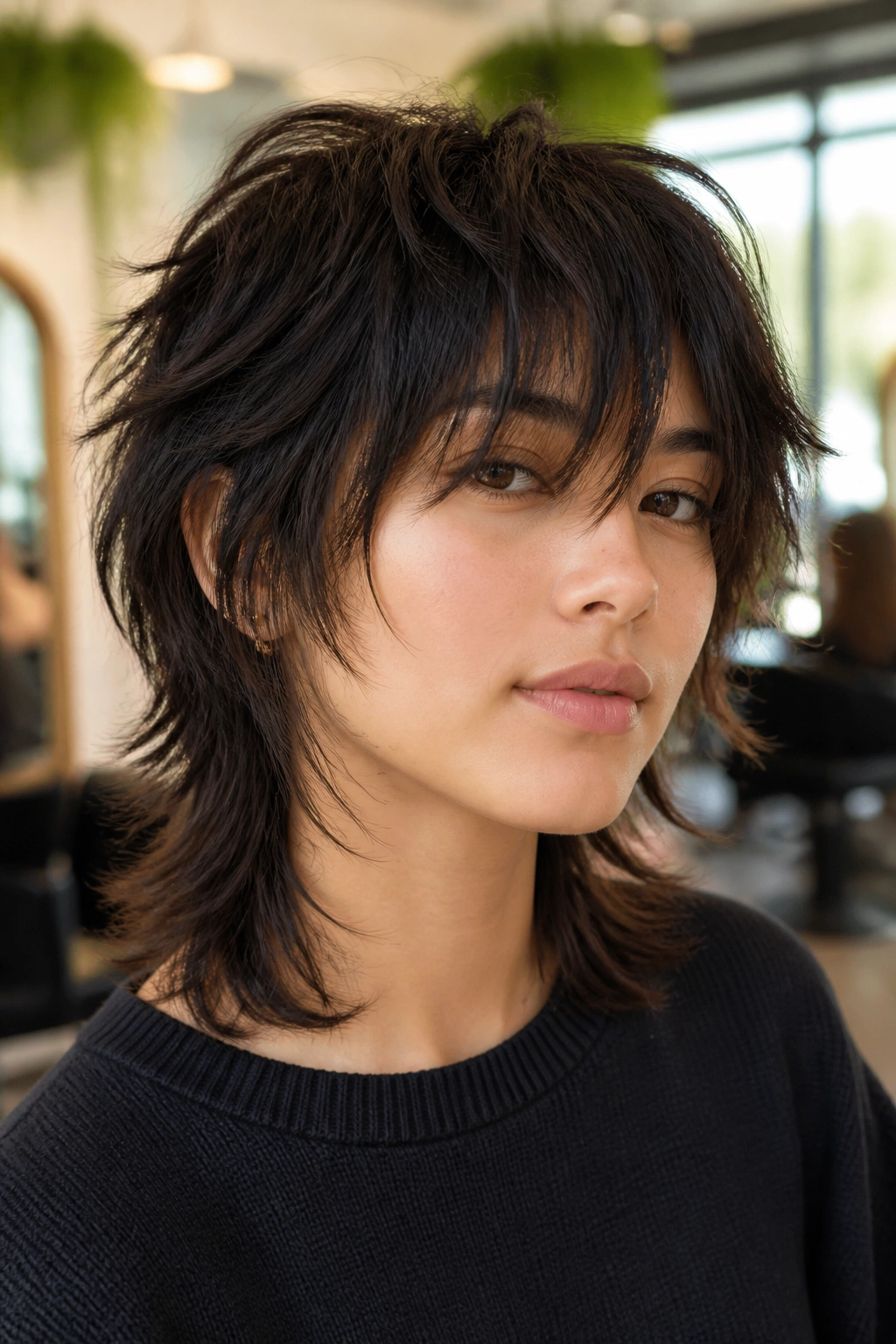
This is the boldest cut in the group, and I mean that in a good way. A modern shag mullet gives you height at the crown, movement around the sides, and length in the back, which is a sneaky-smart balance for a round face because it keeps the eye traveling vertically.
The long fringe is the part that keeps it from turning into a pure mullet. It should drape past the brows or split softly, depending on how much forehead you want to show. Too short, and the whole thing feels sharp in the wrong way. Too heavy, and you lose the lift that makes the cut interesting in the first place.
Ask for This at the Salon
- Shorter crown layers for lift.
- Tapered sides that don’t puff at cheek level.
- A long fringe that can be worn forward or parted.
- A softer back length, not a hard tail.
This cut shines on wavy or thick hair because texture helps it move. Straight hair can wear it too, but it usually needs more styling to avoid looking flat on top and wide on the sides.
The modern shag mullet is not the haircut for someone who wants to disappear into the background. It has edges. That said, on a round face, those edges can be the exact thing that makes the face look leaner and more alive.
8. Layered Lob With Soft Fringe
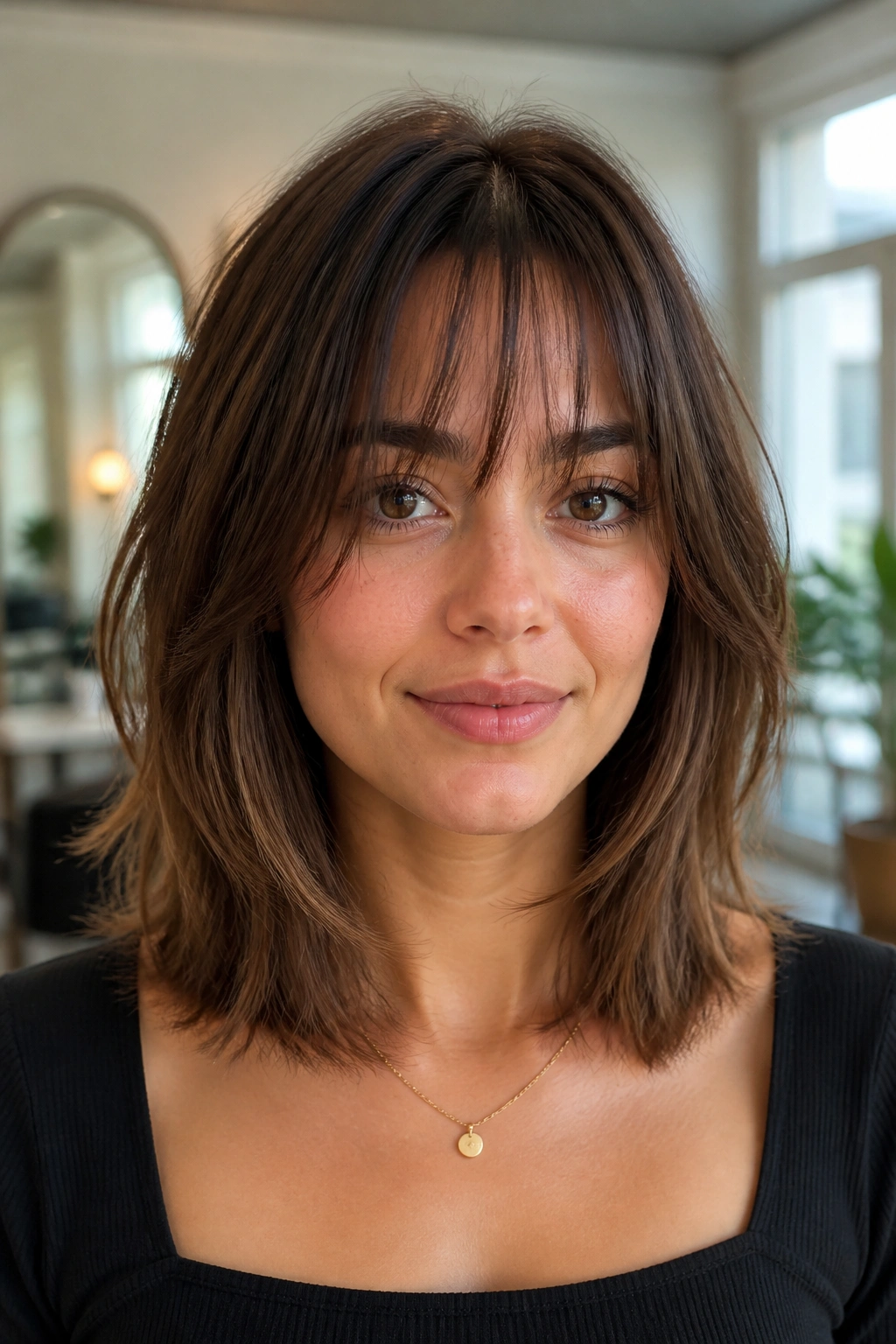
You know the client who wants something neat enough for work but not so polished that it feels stiff? This is their haircut. A layered lob with a soft fringe is calm, tidy, and a lot less boring than it sounds when it’s cut well.
The lob length sits around the collarbone or a touch above it, which is useful because it doesn’t stop at the widest point of the face. The soft fringe gives the front a little movement without drawing a hard line across the brow. Together, they make a round face look a little longer and less flat.
What separates this from a plain lob is the layering. The sides should move, not sit as one sheet. A few subtle layers around the jaw and neck help the haircut breathe. That’s especially useful if the hair is medium-thick, since a one-length lob can puff out and make the face look wider than it is.
Styling doesn’t need to be fussy. A bend through the ends with a flat iron or round brush, then a light mist of spray, is enough. If the fringe starts to separate during the day, a quick finger twist usually fixes it.
9. Razor-Cut Shag With Sweeping Fringe
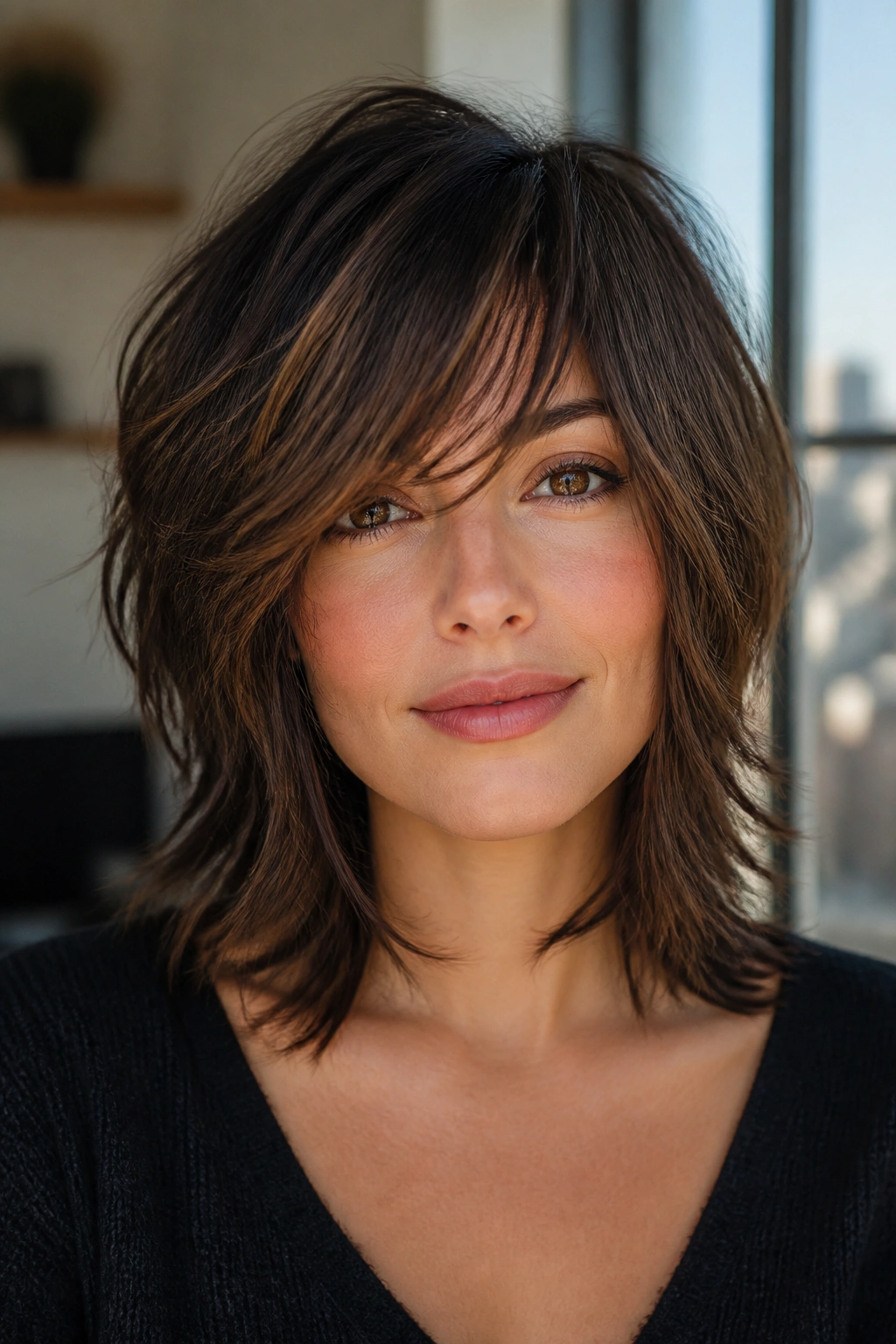
Does razor cutting make a round face look wider? Not when the haircut is built with shape. A razor-cut shag actually softens the outline, because the edges look feathered instead of solid. That broken line can be a gift on a face shape that already has a lot of curve.
The sweeping fringe is doing its own job here. It travels diagonally instead of straight across, which keeps the forehead from feeling boxed in. The combination of razor texture and sweep makes the front look light, almost airy, without becoming wispy in a weak way.
This haircut suits straight to wavy hair best. The razor can make fine hair look too thin if the stylist goes overboard, so the cut needs restraint. Thick hair, though, often loves this approach because the razor removes bulk from the ends and makes the shag move.
What Makes It Different
- Feathered edges instead of blunt lines.
- A fringe that blends into the side layers.
- Enough length to keep the jawline from feeling crowded.
- A finish that looks slightly broken up, not polished to death.
The thing I like here is that it doesn’t fight the natural shape of the face. It softens it. That’s a different goal, and a better one most of the time.
10. Mid-Length Shag With Face-Framing Curve

Face-framing matters more than the fringe itself sometimes. That’s the part people miss. A mid-length shag with a curved front can do more for a round face than a dramatic bang because the eye follows the line down from the temples to the collarbone.
The curve should start around the cheekbone and bend inward gently as it moves down. Not a hard swoop. Just enough shape to nudge the face into a longer outline. If the shortest pieces land too high, the face can look fuller. If they start too low, the haircut loses some of its lift.
This style sits in a good middle ground for people who do not want something edgy or too layered. It has movement, but it still looks approachable. The mid-length keeps the silhouette from ballooning, and the face-framing curve gives you a cleaner line than random short bits ever will.
A round face often looks better when the front pieces guide the eye down rather than out. That’s the whole trick here. Simple, really. But simple things need good placement.
11. Wavy Shag With Bardot Fringe
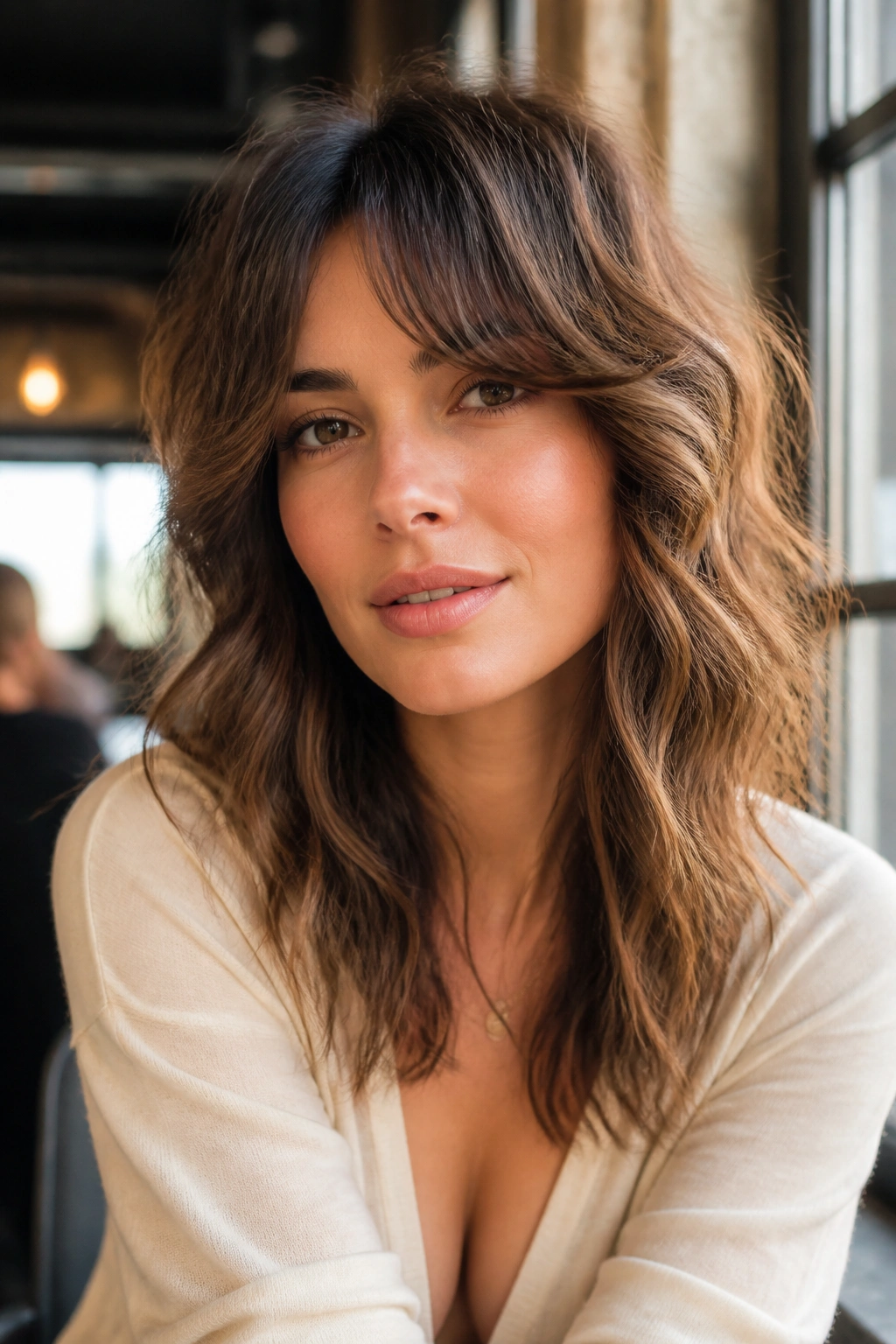
Why does a Bardot fringe flatter round faces so often? Because it splits the forehead in the middle, then falls away toward the temples like a soft V. That shape draws the eye upward and outward at the same time, which keeps the face from feeling boxed in.
A wavy shag is a natural partner for that fringe. The waves add texture, the fringe adds softness, and the layers keep the whole haircut from sitting in one heavy block. The result is relaxed, but not shapeless. There’s enough structure to keep the face from reading wider than it is.
The fringe needs enough length to part cleanly. If it’s cut too short, it loses the Bardot effect and starts acting like plain bangs. If it’s too thick, it can sit across the forehead like a flap. The sweet spot is usually somewhere near the brows or a touch lower, depending on curl and density.
This is a strong choice if your hair already bends a little on its own. A quick scrunch with mousse or a light diffuser pass can make it feel lived-in without much effort. The haircut does most of the work.
12. Tousled Pixie-Shag With Long Fringe
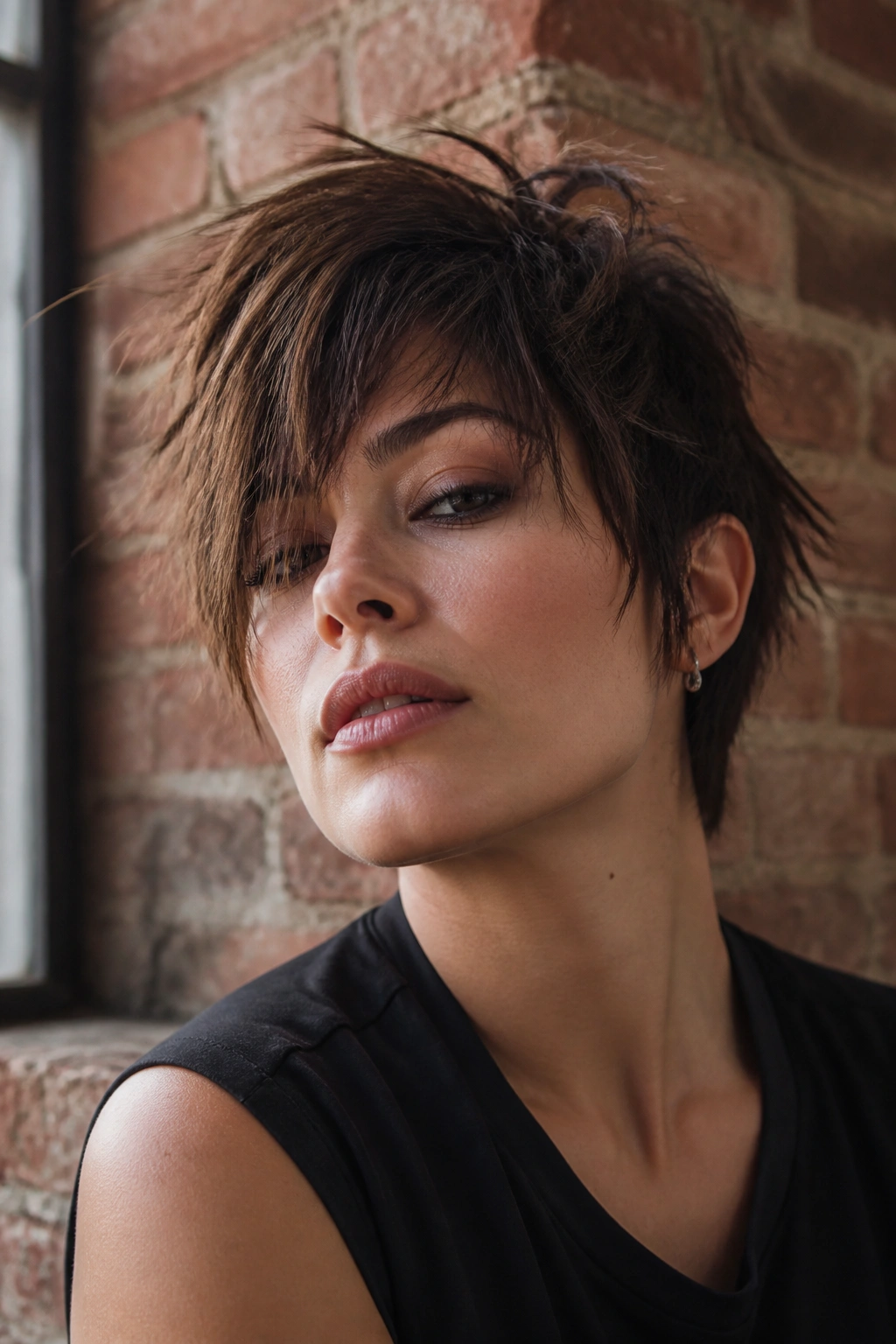
Short hair can flatter a round face. It just needs the right kind of short hair. A tousled pixie-shag with a longer fringe keeps the sides light and the top a little messy, which helps the face look taller instead of wider.
The fringe is the anchor. It should be long enough to brush across the forehead or fall diagonally, not chopped into a tiny straight line that stops the face dead. That length gives you options, too. You can push it forward, tuck it behind one ear, or let it fall across one eye for a softer line.
Best Fit Checklist
- Works well on fine to medium hair that needs lift.
- Good for people who like short styles but hate helmet shape.
- Needs a cut that keeps the sides close without shaving the head too tight.
- Benefits from paste or clay at the roots for separation.
A pixie-shag like this can be surprisingly flattering because it leaves space around the jaw and cheek area. That open space matters. A lot of short haircuts fail round faces by sitting too full at the sides, and this one avoids that mistake by staying lean where it counts.
It’s playful. It’s not precious. I like that.
13. Shaggy Lob With Choppy Fringe and Flipped Ends

A little flip changes everything. The shaggy lob with choppy fringe and flipped ends keeps the cut lively, but the length still sits below the jaw, which is the part that helps a round face look less wide.
The choppy fringe should be loose and broken, not blunt and even. It’s the kind of fringe that looks better when it’s not trying too hard. The flipped ends keep the lower half of the haircut from lying flat against the neck, so the style gets some lift and movement without turning into a triangle.
How to Style It
- Dry the fringe first so it doesn’t collapse while the rest of the hair is drying.
- Use a round brush or a flat brush to turn the ends slightly outward.
- Add a light mist of texture spray through the mids, not the roots.
- Separate the fringe with fingers instead of brushing it to death.
The reason this works on a round face is simple: the eye keeps moving. The choppy fringe breaks the forehead line, and the flipped ends keep the shape from settling into a heavy curve. It feels a little casual, which helps. Too much polish can make this kind of cut look stiff.
If you want a lob that has personality but still plays nicely with your face shape, this is one of the smarter routes.
14. Big-Volume 70s Shag With Feathered Fringe
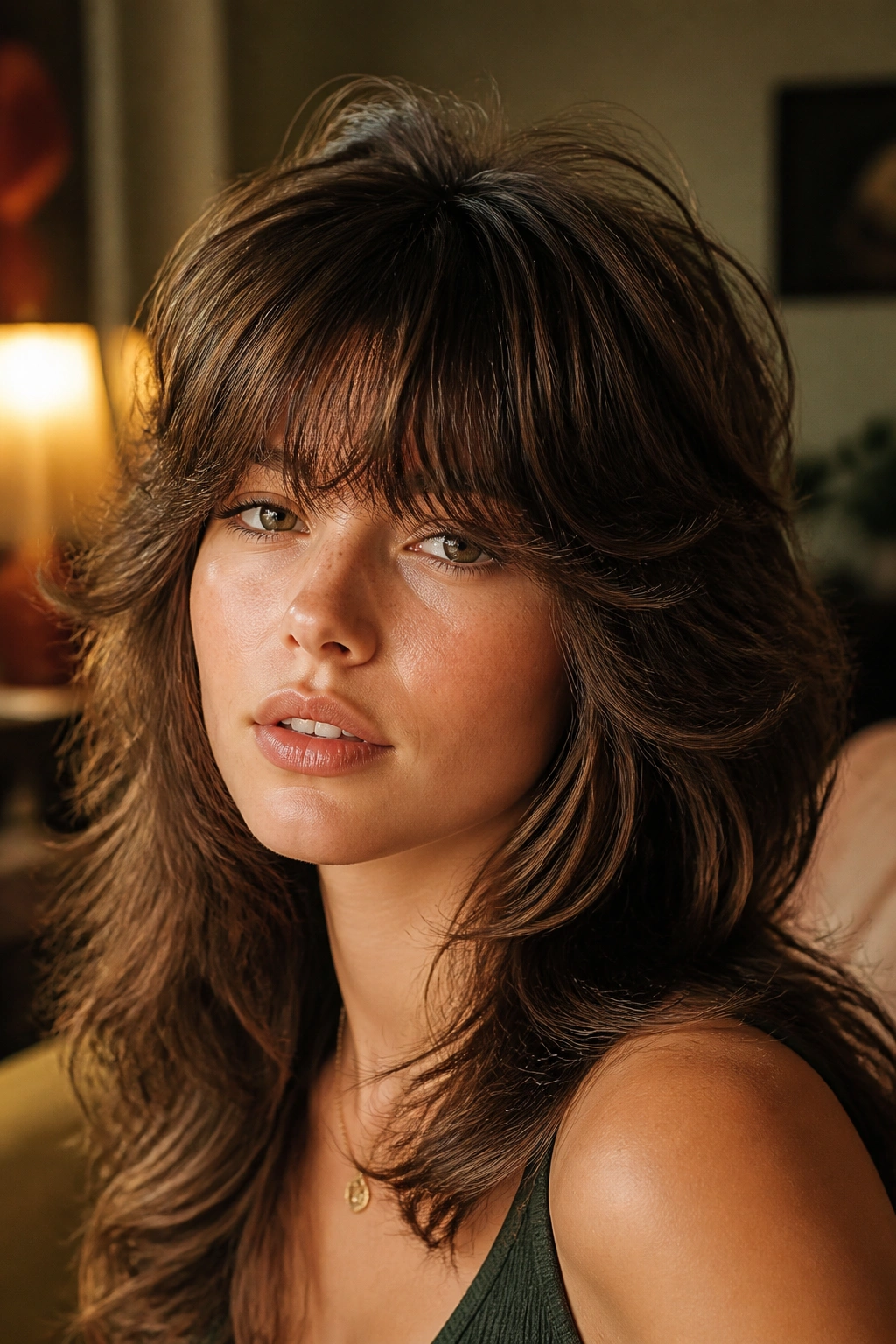
Big volume can flatter a round face when the lift sits on top, not at the cheeks. That’s the distinction people miss. A 70s-style shag gives you crown height, feathered fringe, and loose layers that move away from the face instead of hugging it.
The feathered fringe is softer than a blunt bang and usually looks best when it can skim the brows or split slightly off center. You want that airy, brushed-out feel. If the fringe is too dense, the style loses its swing and starts weighing the forehead down.
This cut loves hair that has some natural body. Thick hair can hold the volume without falling flat, and wavy hair can make the whole shape feel effortless. Straight hair can wear it too, but you’ll probably need a round brush and a bit more heat styling to get the lift in the crown.
The 70s shag is a little dramatic, and that’s part of its charm. It’s not a timid haircut. Still, on a round face, it works because the drama goes upward and outward, not straight across the cheeks. That’s a useful difference.
15. Long Layers With Invisible Fringe
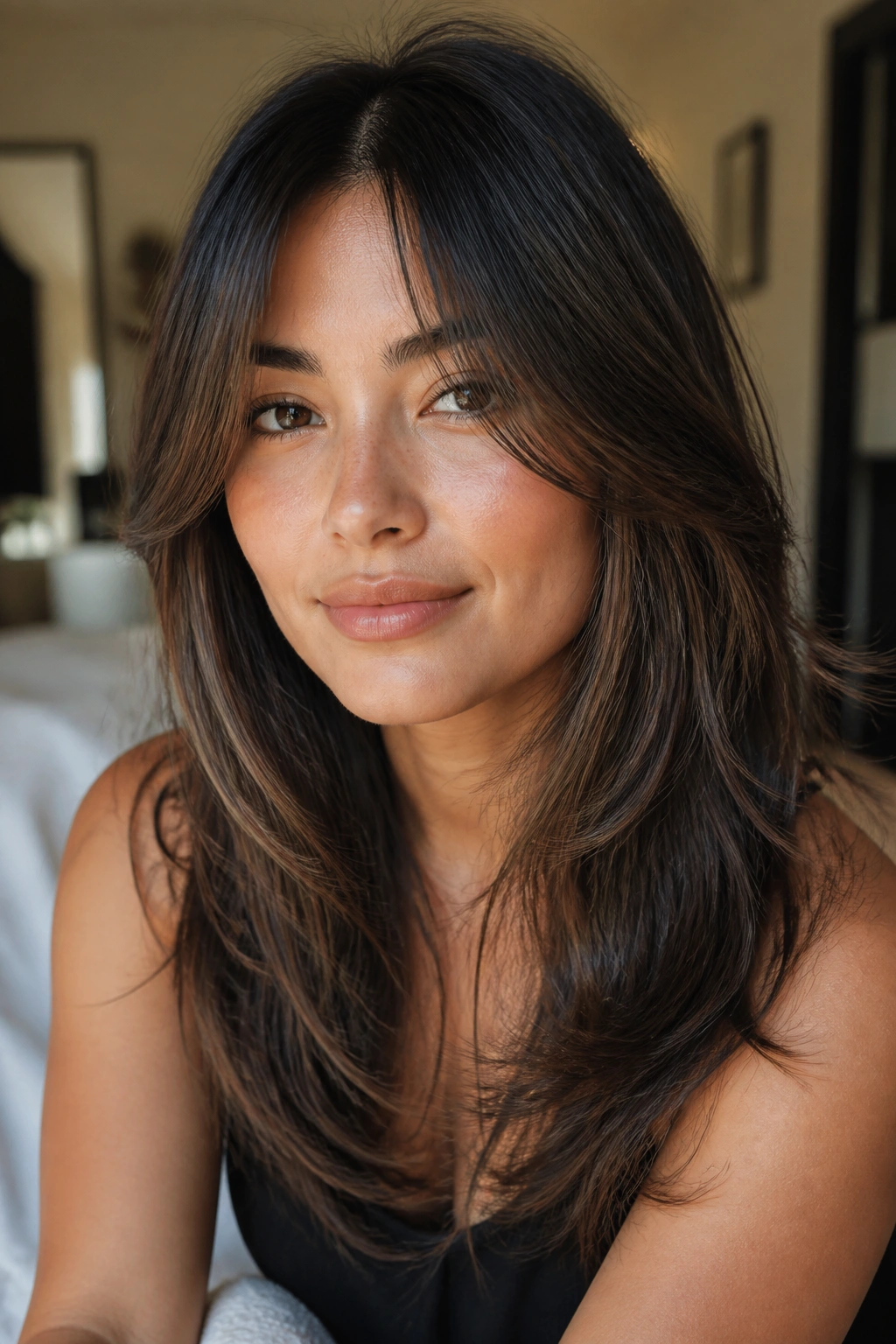
The most underrated option may be the one that barely looks like a fringe at all. Long layers with an invisible fringe give you the face-framing effect of bangs without the commitment of a heavy bang line, which is a relief if you’ve had one too many fringe regrets.
This cut uses very long front pieces that blend into the rest of the hair so gradually that the fringe almost disappears. When it’s styled forward, it softens the forehead. When it’s swept to the side, it acts like a long face frame. Either way, it avoids the hard horizontal line that can make a round face feel fuller.
That makes it useful for people who want something low-maintenance and flexible. You can let it grow out without the awkward bang stage looking too obvious. You can also wear it pinned back on days when you want the face fully open. There’s a lot of freedom in that.
If you like the idea of shaggy fringe hairstyles for round faces but don’t want to commit to a visible fringe every morning, this is the one I’d keep near the top of the list.
The Bottom Line
The best shaggy fringe for a round face is usually the one that adds height, diagonal lines, or length below the jaw. That can mean curtain fringe, bottleneck bangs, a wispy split fringe, or even a long invisible fringe. The common thread is never the same haircut shape over and over. It’s the placement.
A blunt, heavy fringe isn’t automatically off-limits, but it has to earn its place. Most of the time, the softer options win because they leave room for the face to breathe. And that’s really what a good shag does: it makes the face look framed, not fenced in.
Bring photos, yes. Better still, bring one clear note about where you want the shortest face-framing piece to land. That single detail can save you from a cut that looks fine on the model and weird on your own face.
