



Long brown bangs for round faces work best when they do one thing well: they pull the eye downward, then let it travel along a soft line instead of stopping it at the widest part of the cheeks. That sounds simple. It is. But haircuts are funny that way—small changes in length, parting, and texture can change the whole shape of a face.
Brown hair adds its own wrinkle. A chestnut fringe can look airy and expensive-looking even when the cut is low-key, while a deep mocha or espresso fringe can feel heavier if the shape is too solid. That’s why the cut matters as much as the color. A flat, one-length bang can sit there like a curtain. A bang with bend, feathering, or a little break at the center feels softer and smarter.
Ask for movement, not a shelf. The center of the fringe can start near the bridge of the nose or just under the brows, then sweep outward to cheekbone or jaw length. Point-cut ends help. So does a little internal weight removal if your hair is thick, because thick bangs on a round face can turn boxy fast. Fine hair needs a lighter touch, but not so much thinning that the fringe turns wispy in a sad, see-through way.
The 25 ideas below keep that balance in different ways. Some are polished, some are messy, some grow out beautifully, and a few are for people who want bangs without making a big dramatic statement. Different moods. Same goal.
1. Long Curtain Bangs for Round Faces
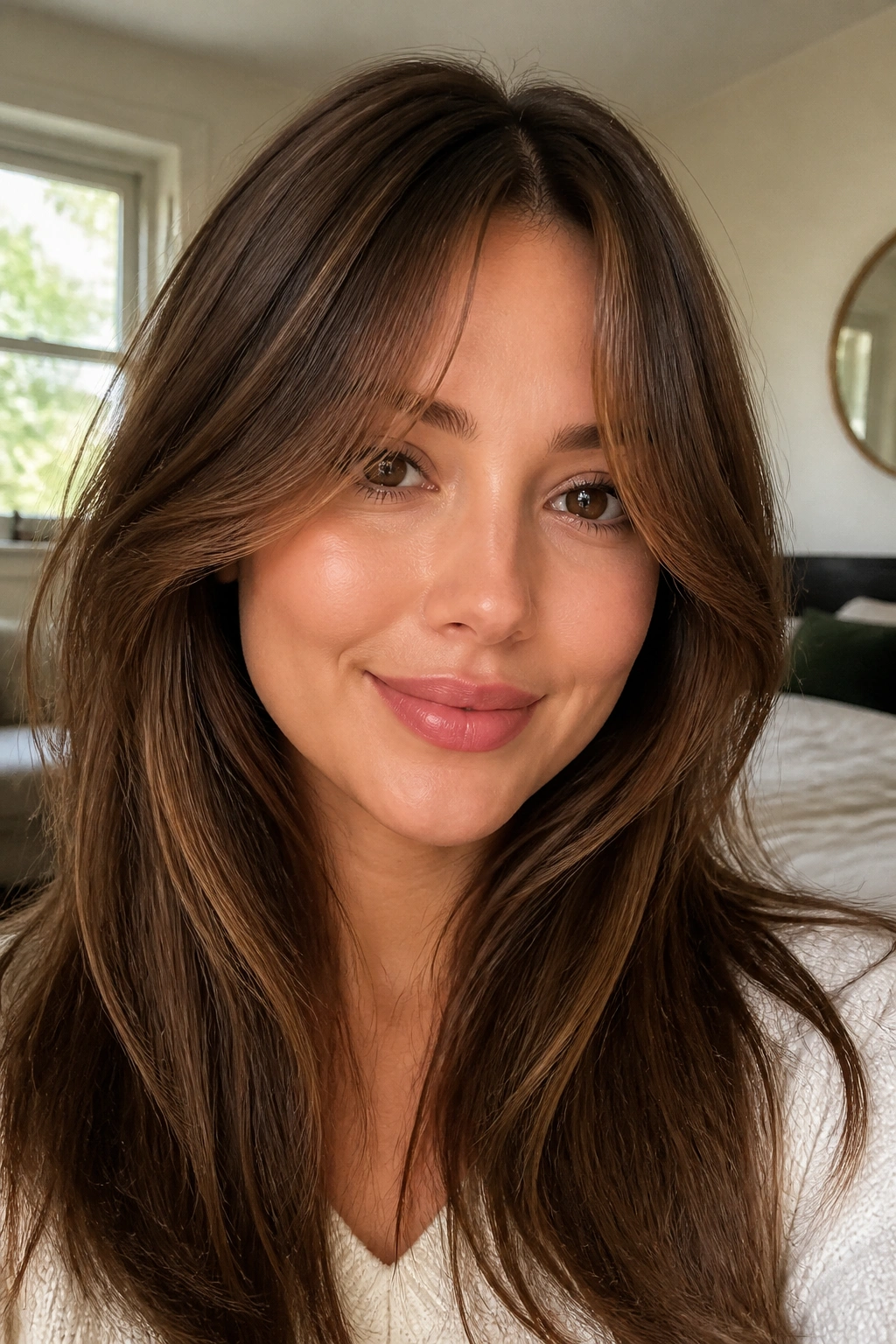
Curtain bangs are the easy answer for a reason. They split the forehead, then slide outward so the face reads longer and less wide.
Why They Work
The center can stay a little shorter—usually around the bridge of the nose or just under it—while the sides soften down toward the cheekbones. That diagonal line matters more than people think. It takes the eye off the widest part of the face and gives the whole cut a longer shape.
Brown tones make this even better because the fringe doesn’t need to be flat to look neat. A medium chestnut or cocoa brown shows the bend in the hair, which is half the charm. If your hair is thick, ask for the inner bulk to be removed lightly. If it’s fine, keep enough weight in the ends so the curtain doesn’t split into random pieces.
- Best with a center part or a slight off-center part.
- Works with straight, wavy, and softly curled textures.
- Easy to grow out into face-framing layers.
- Looks clean with a round brush and a cool shot at the end.
Tip: dry the front section forward first, then sweep it apart while it’s still warm. That little reset gives the fringe its shape.
2. Deep Side-Swept Brown Bangs
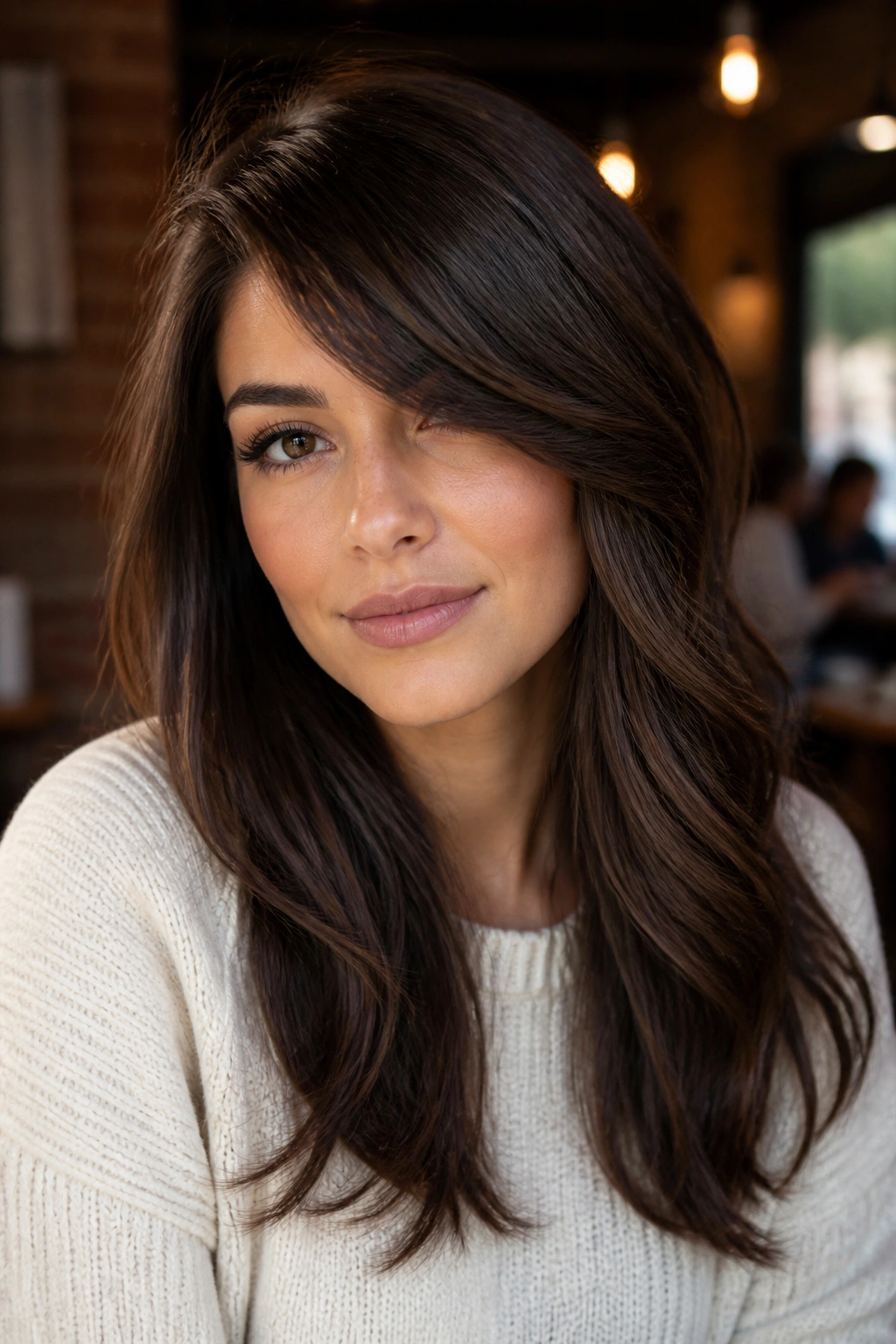
A deep side part changes the whole mood of a round face in one shot. The line cuts diagonally across the forehead, and that diagonal does more than a center part ever will.
The nice thing about this style is that it can be dramatic without being fussy. A side-swept bang in walnut, mocha, or dark chocolate brown sits close to the face, then opens up as it crosses toward the temple. That opens space around the eyes and makes the cheek area feel less dominant. It’s a clean trick, and it works fast.
I like this option for anyone who wears one side behind the ear a lot, because it builds the shape into your daily habit. The bang should be long enough to tuck, pin, or brush back on a windy day. Shorter side bangs can collapse into your cheek line. Longer ones behave better.
If your hair is fine, blow-dry the fringe in the opposite direction first. Then flip it over. That creates lift at the root and stops the bang from clinging to the forehead.
3. Bottleneck Bangs with a Narrow Center
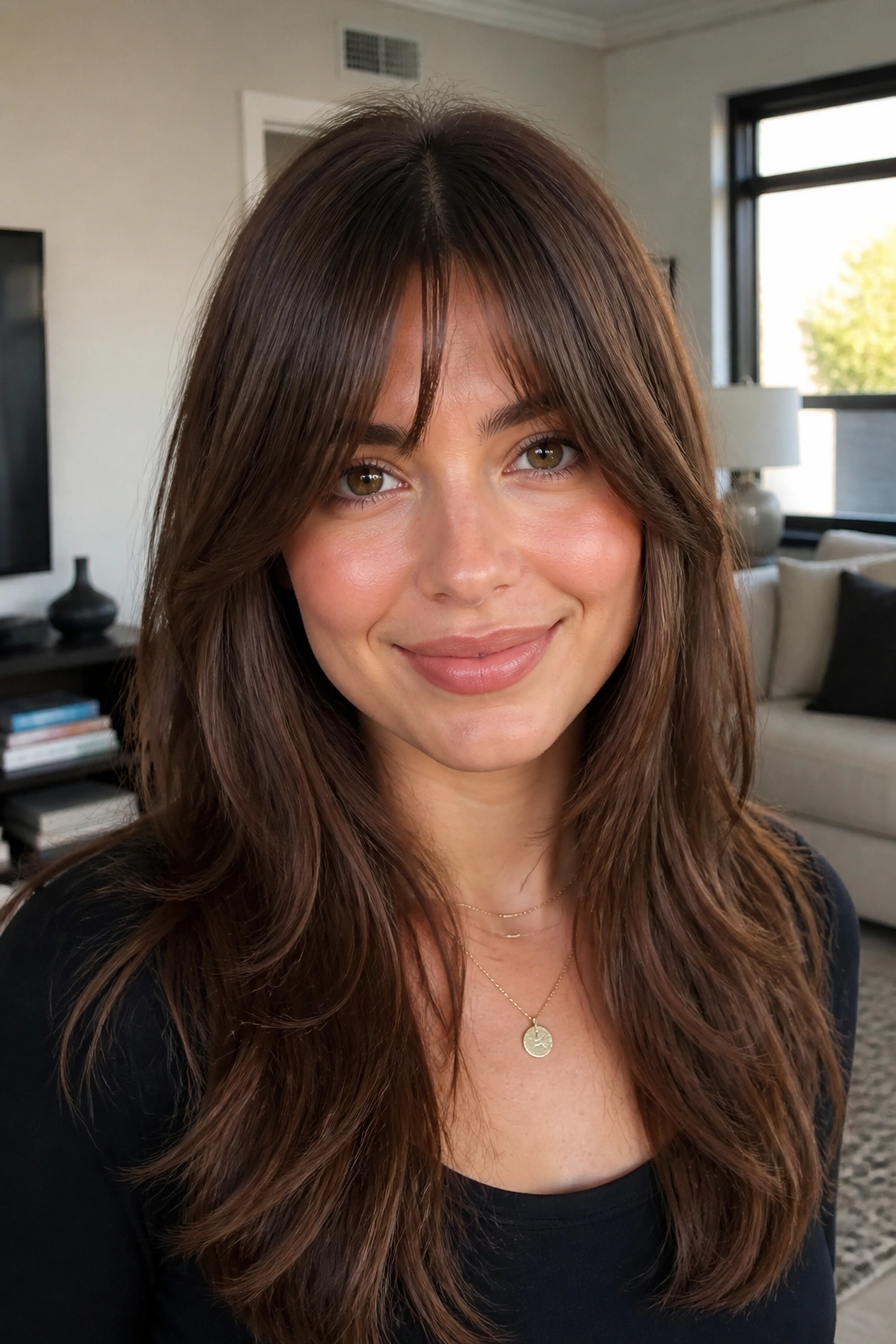
Why do bottleneck bangs look so good on round faces? Because they do the narrowing work in the middle and save the width for lower down, where it helps.
The center section is slimmer and shorter, then the hair widens as it moves outward. That shape mirrors a bottle neck, which sounds odd until you see it on. The fringe opens the forehead without eating up the face. It’s a tidy little compromise between curtain bangs and a more classic fringe.
What to Ask For
- A narrow center that starts around the brows.
- Longer side pieces that hit the cheekbones or upper jaw.
- Soft point-cut ends instead of a hard edge.
- Light texturizing only if your hair is dense.
This style is especially good if you want bangs that feel current without shouting for attention. They look polished when straightened, but they also work with a bend from a small iron or a brushed-out wave. The shape is the point. Not the styling gymnastics.
4. Wispy See-Through Bangs
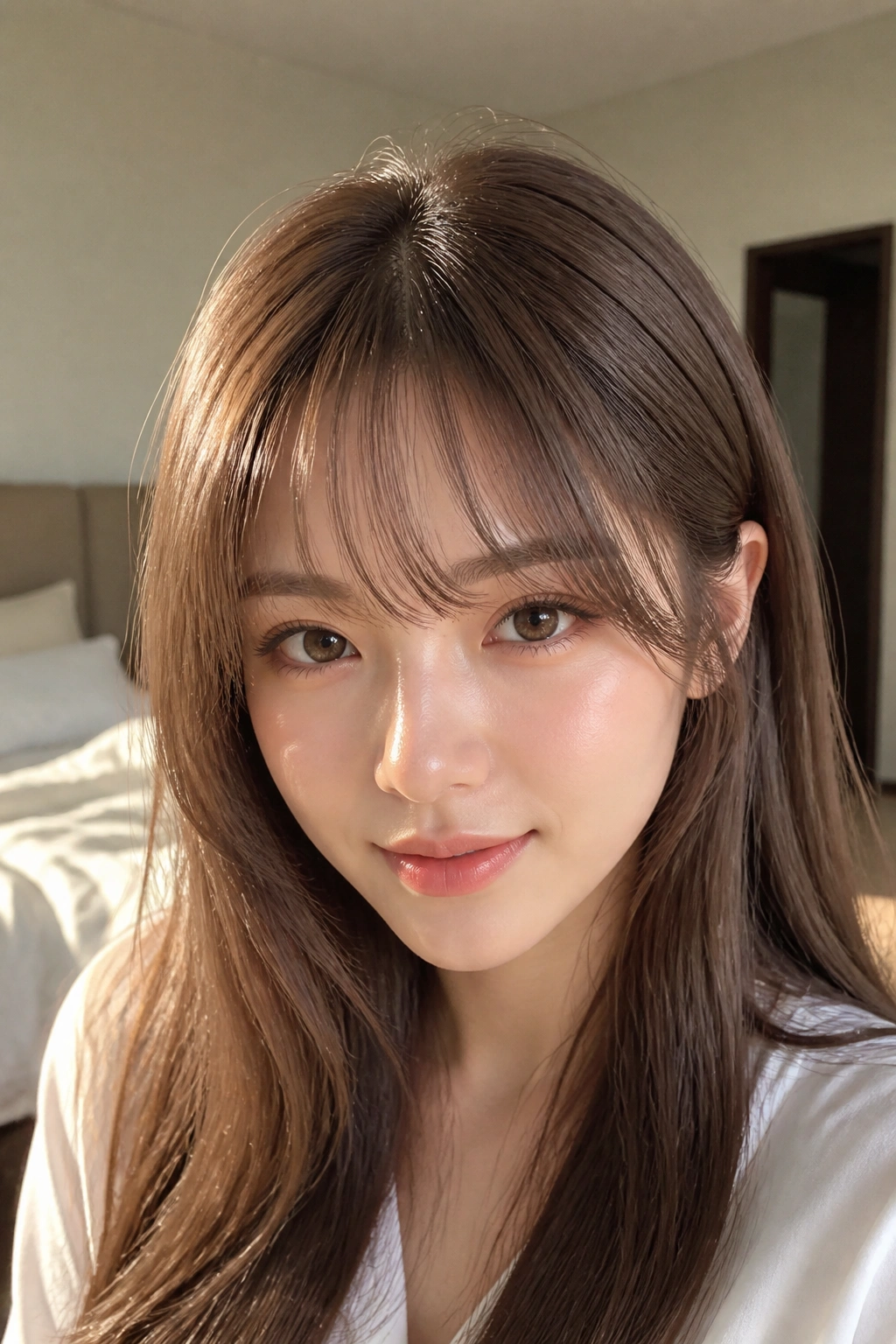
Picture a busy morning, a little humidity, and hair that refuses to behave. Wispy bangs still survive that kind of day better than a heavy fringe does.
The reason is simple: they don’t create one solid horizontal line. The gaps between the strands let the forehead show through, which keeps the face from looking boxed in. On a round face, that lightness matters. A soft brown shade—think warm cocoa or mushroom brown—can keep the bangs from disappearing into the skin while still looking delicate.
This works best when the ends are feathered, not chopped. A blunt mini-fringe with see-through density can look accidental. Wispy bangs need shape, even when they’re airy.
- Good for fine to medium hair.
- Easier to maintain than a full fringe.
- Works nicely with soft waves or a loose blowout.
- Needs only a tiny amount of styling cream or paste.
The catch: too much thinning makes them limp. You want light, not flimsy.
5. Choppy Shag Bangs with Brown Texture
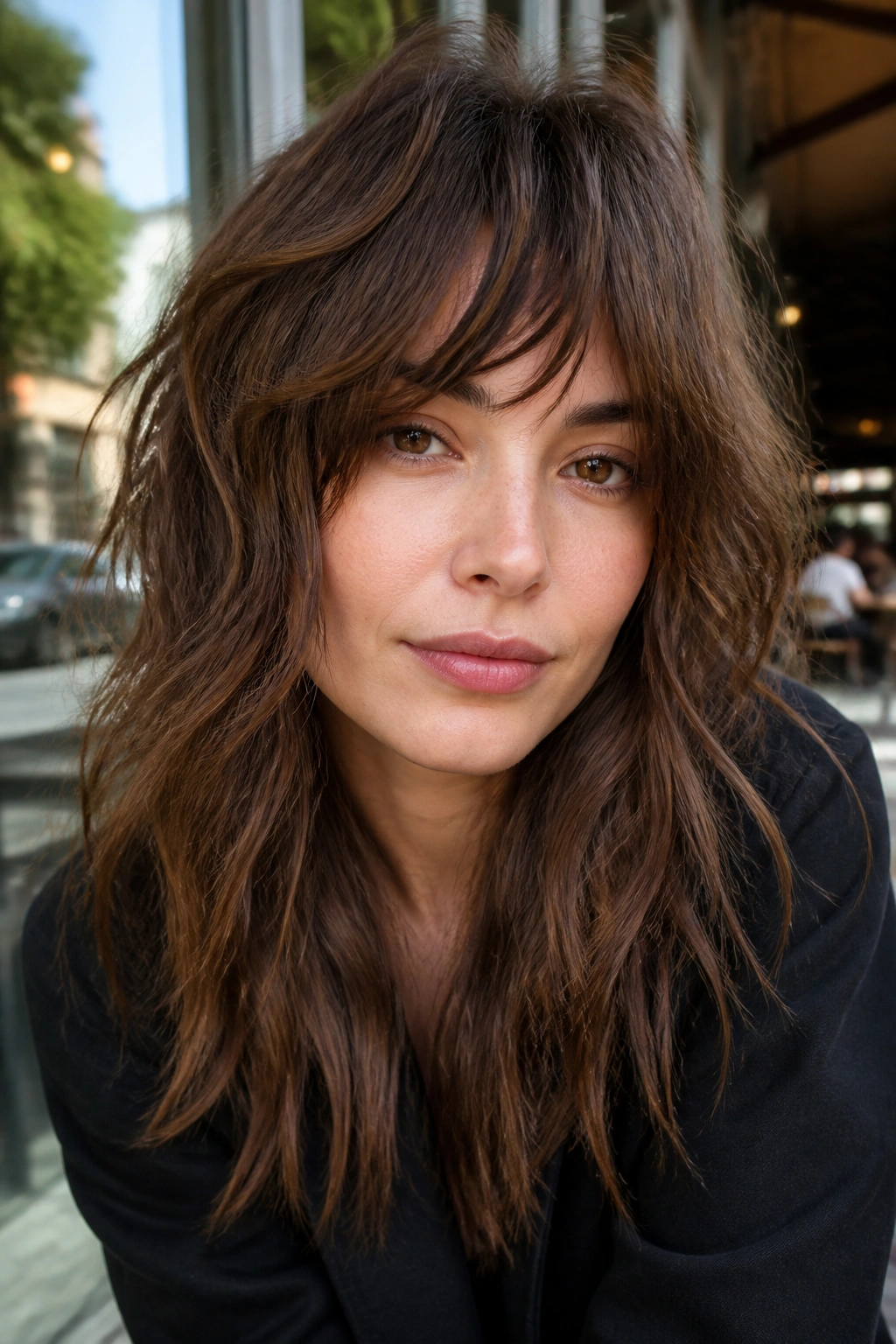
Choppy shag bangs have a little attitude, and round faces often wear that attitude well. The layers break up softness in the face so it doesn’t read as one smooth circle.
The best version is not a random mess. It’s controlled mess. The bang should sit long enough to move, then fall into the shag layers so the whole cut feels connected. In brown hair, especially medium brunette or chestnut, the texture shows up beautifully because the different lengths catch light at different points. You see the movement first, then the shape.
This style is especially useful if your hair naturally bends or frizzes a bit. Instead of fighting the texture, the cut uses it. That said, if your hair is pin-straight and slippery, you’ll need a little mousse or texture spray at the root to stop the fringe from collapsing.
A shag fringe is for someone who’d rather look cool than perfect. That’s the whole deal. It’s not the neatest option here, but it may be the one that looks the most alive.
6. Feathered Blowout Bangs
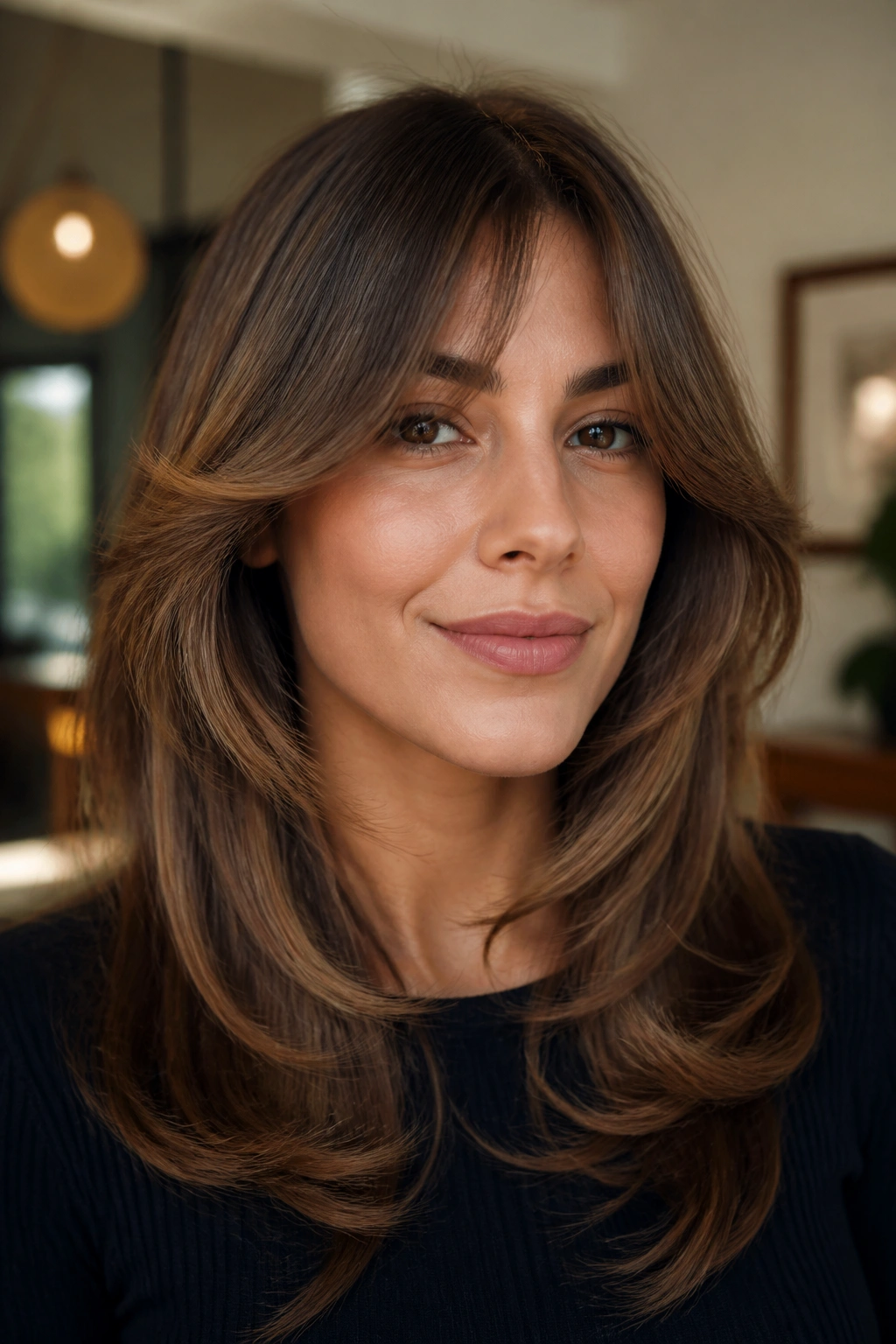
Unlike a blunt fringe, feathered blowout bangs leave air between the strands. That air is what keeps them from sitting heavy on a round face.
The shape usually starts with a soft center and longer outer corners that flip away from the cheeks. Think salon blowout, but less stiff. The ends are beveled, not sharp, so the fringe settles into the rest of the hair instead of drawing a hard line across the face. In brown shades with a little warmth, this looks polished without feeling rigid.
This style is best if you like a fuller front section but don’t want the fringe to dominate the haircut. It pairs well with shoulder-length cuts, layered mid-length hair, or long hair with a rounded blow-dry. A big brush helps. So does clipping the bangs out of the way while they cool.
If your hair swells in humidity, keep the feathering subtle. Too much lift can turn charming into puffy. And nobody wants that.
7. Face-Framing Bangs That Melt into Layers
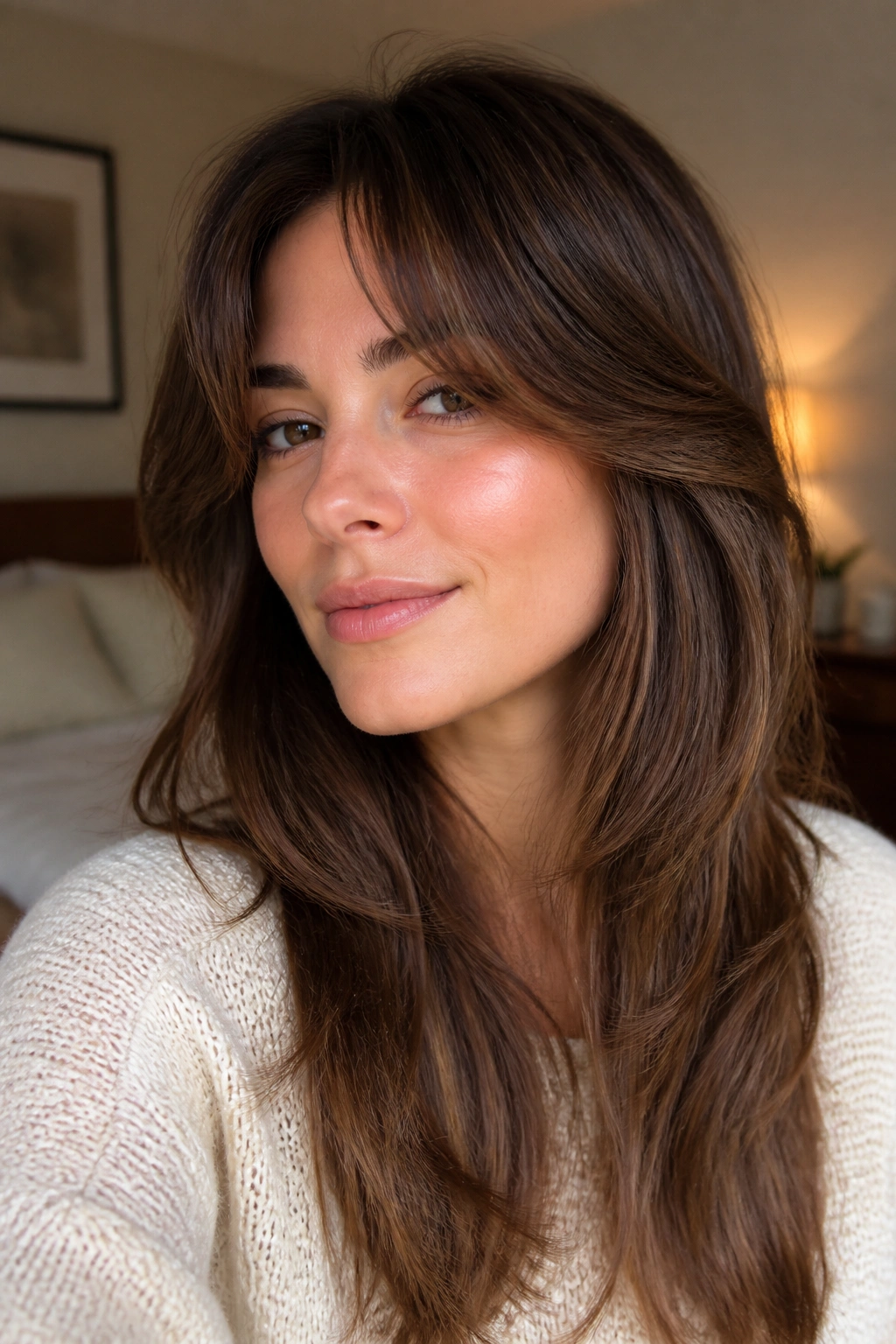
Face-framing bangs are the low-drama choice, which is exactly why they work. They don’t announce themselves with a hard line. They slide into the rest of the haircut.
Why They Work
The front pieces start near the brow or upper cheek, then continue down into the layers around the face. On a round face, that gives you vertical movement without a heavy fringe sitting across the forehead. The shape is soft, but it still edits the silhouette in a useful way.
Brown hair helps here because the layers show up as tonal depth. A soft mocha base with slightly lighter mid-lengths can make the whole frame feel more dimensional. If you’ve got a fuller face and hate anything that looks too done, this is the safer bet.
What to Ask Your Stylist
- Long front pieces that blend into the first face-framing layer.
- Soft graduation, not a dramatic disconnect.
- Ends that curve toward the jaw or collarbone.
- No blunt perimeter at the cheek.
Good news: this one grows out gracefully. That alone earns it a place in the list.
8. Arched Fringe with Soft Lift
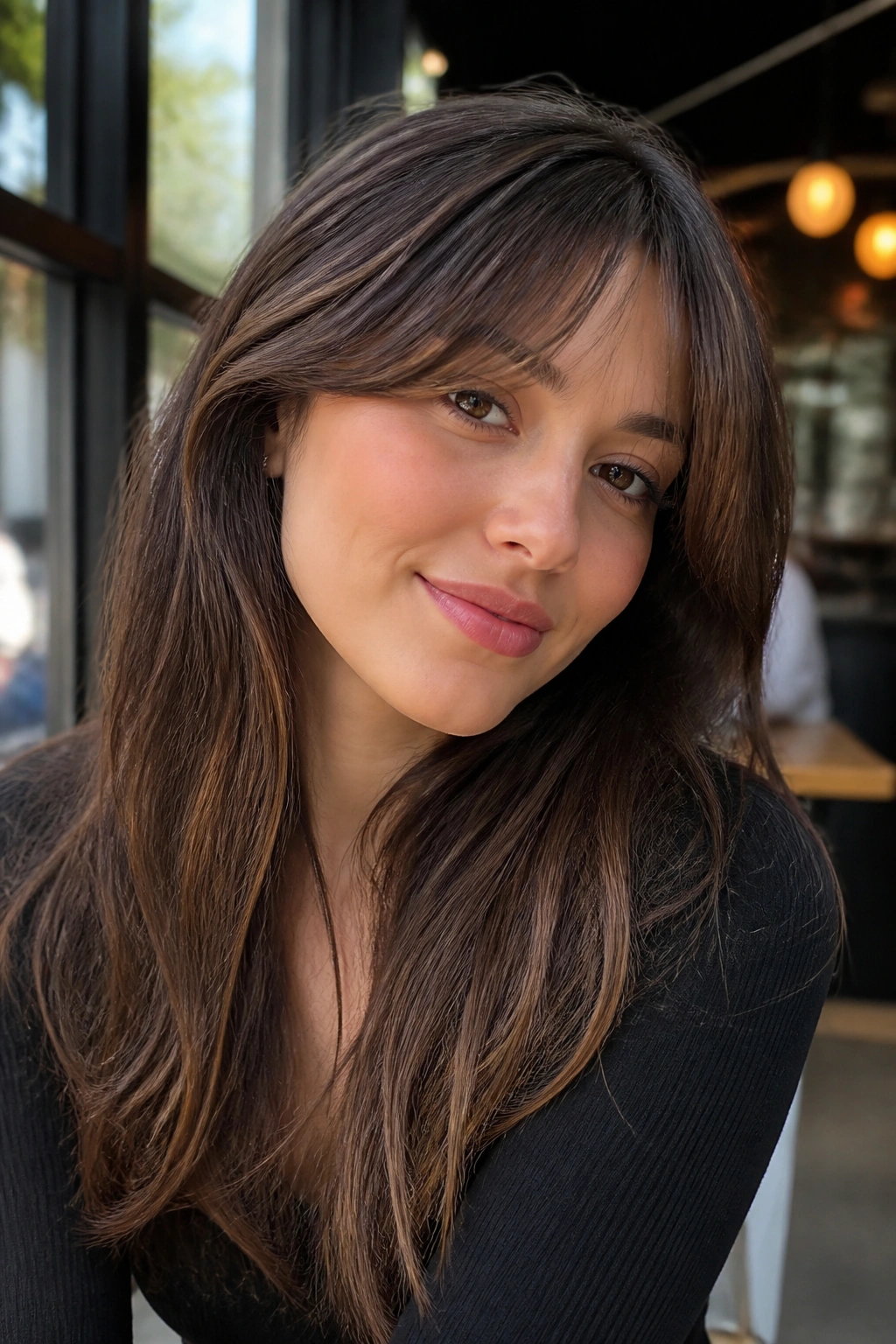
A round face can handle a fuller fringe if the center is lighter and the sides drop lower. That’s where the arch comes in.
The fringe rises slightly in the middle, then lowers toward the outer edges, which keeps the face from looking wide across the brow line. A warm brown color makes the arch read as shape instead of weight. It can feel a little old-school in the best way—clean, feminine, and deliberate.
I’d use this on medium-density hair more than on very thick hair. Thick hair can make the arch too heavy unless the ends are thinned with care. You want the front to curve, not sit like a thick band. A round brush can help, but a flat brush and a small bend at the ends work too.
This is one of those fringes that looks better after a few minutes of settling. Fresh off the brush, it can feel a touch formal. After it cools, it relaxes. That’s when it starts looking right.
9. Long Swoop Bangs for Round Faces
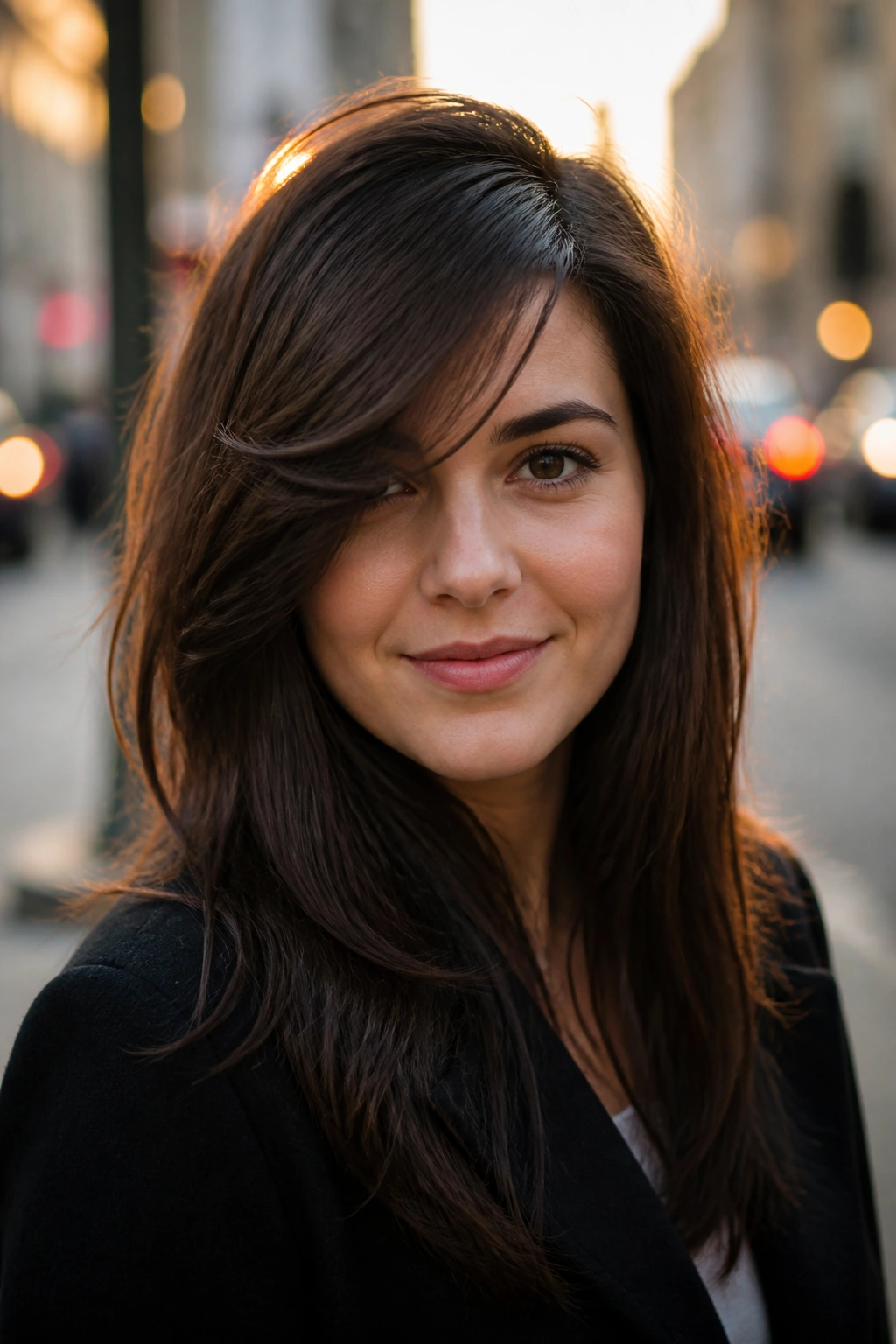
Can long swoop bangs make a round face look sharper without looking severe? Yes, and that’s exactly why people keep coming back to them.
The swoop gives you one long diagonal shape, which is flattering because it breaks up the width at the cheek level. A side part adds a bit of height at the root, and that extra lift helps the face feel longer. In brown hair, especially espresso or dark cocoa, the curve reads clean and smooth.
How to Wear It
Blow-dry the front section in the opposite direction first. Then guide it across the forehead with a medium brush or a flat brush if you want less roundness in the bend. Finish with a cool shot so the swoop doesn’t fall apart halfway through the day.
This style is good for people who want bangs but do not want to lose the ability to pin them back. It can go soft, dramatic, or casual depending on the part. The best version brushes the outer edge near the cheekbone and stops there. Anything shorter can widen the upper face again.
10. Grown-Out Bangs with a Soft Edge
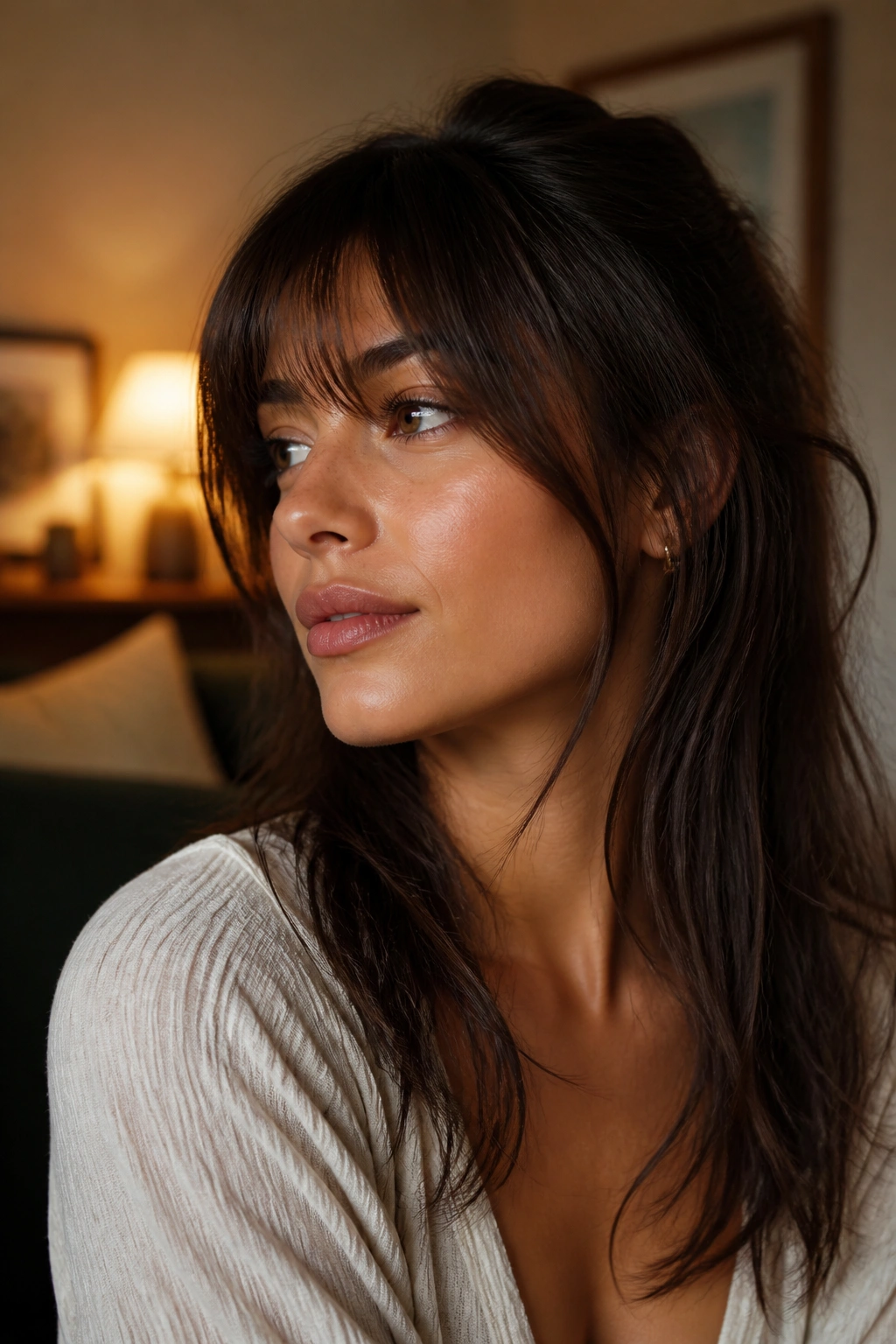
Grown-out bangs are underrated. They look like you’ve got your life together, even when the truth is you just missed a trim appointment.
The trick is to keep the line soft as they grow. On a round face, that soft edge matters because a hard, short bang can make the face feel fuller. Once the fringe reaches past the brows and starts grazing the cheekbone, it becomes more forgiving. Brown hair keeps the grow-out phase looking intentional, especially if the color has depth at the roots.
This is a good style for people who don’t want a strict maintenance schedule. It can be pushed to the side, split in the middle, or tucked behind one ear on bad hair days. You can also keep the ends point-cut so the shape doesn’t turn into a heavy shelf.
- Trim every 6 to 8 weeks if you want the shape intact.
- Use a light cream, not a sticky gel.
- Let the fringe air-dry when possible.
- Keep the edges uneven enough to move.
11. Caramel-Laced Brown Bangs
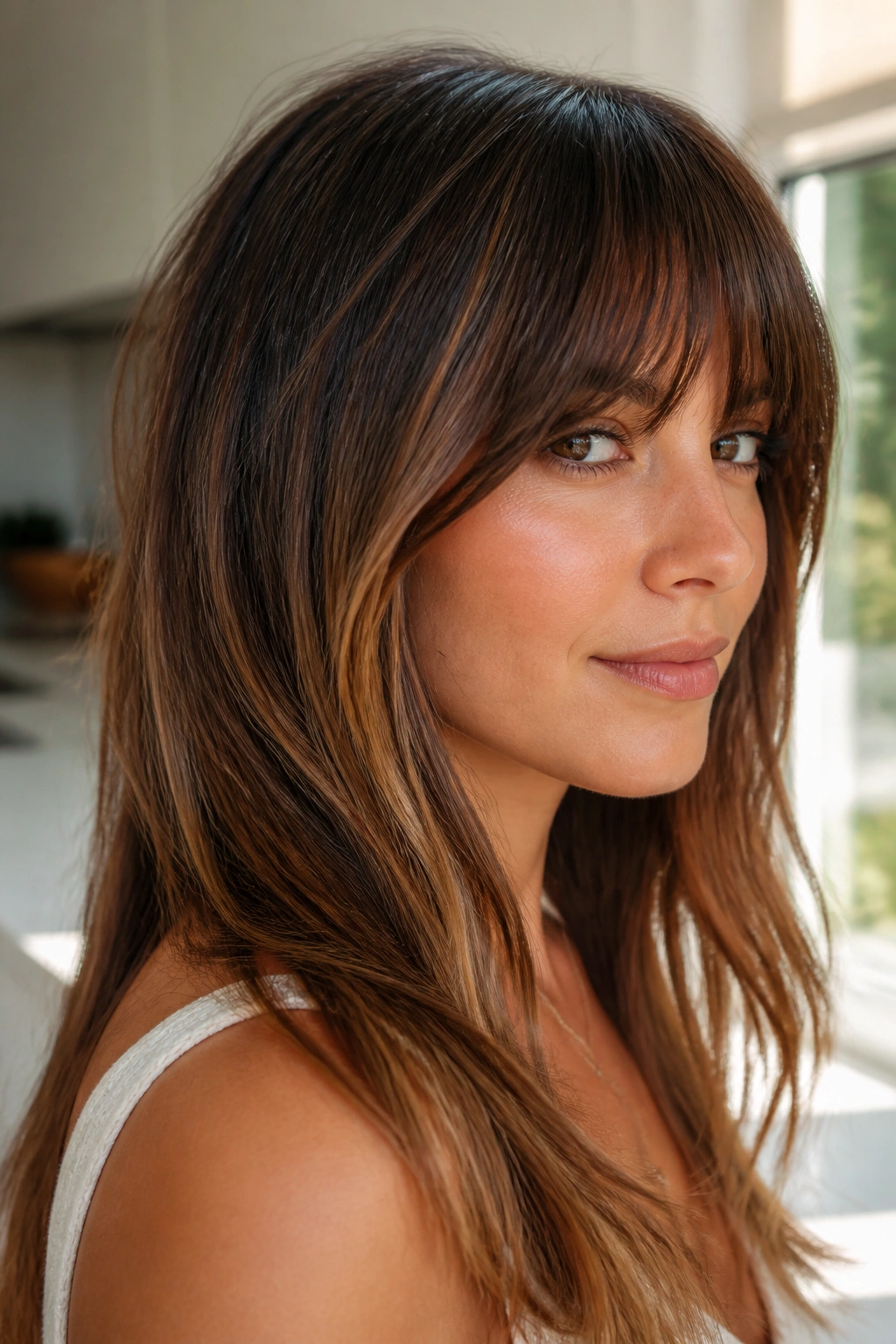
Brown bangs get a lot more interesting when the color is doing part of the work. A little caramel near the face can change the whole reading of the fringe.
The point isn’t to make the bangs loud. It’s to break up the mass so the fringe looks lighter around the cheeks and temples. That matters on a round face because a solid block of dark hair can sometimes feel too enclosing. A chestnut base with soft caramel ribbons near the front does the opposite. It gives the eye something to follow downward.
I’m not a fan of chunky front highlights here. They can look stripy and distract from the cut. Keep the light pieces fine, blended, and close to the face. Think of them as soft contouring, not a statement stripe.
This is a smart choice if your hair is already long and you want the bangs to feel a little more visible. The color helps the shape show up. The cut still does the real work.
12. Razored Brown Fringe
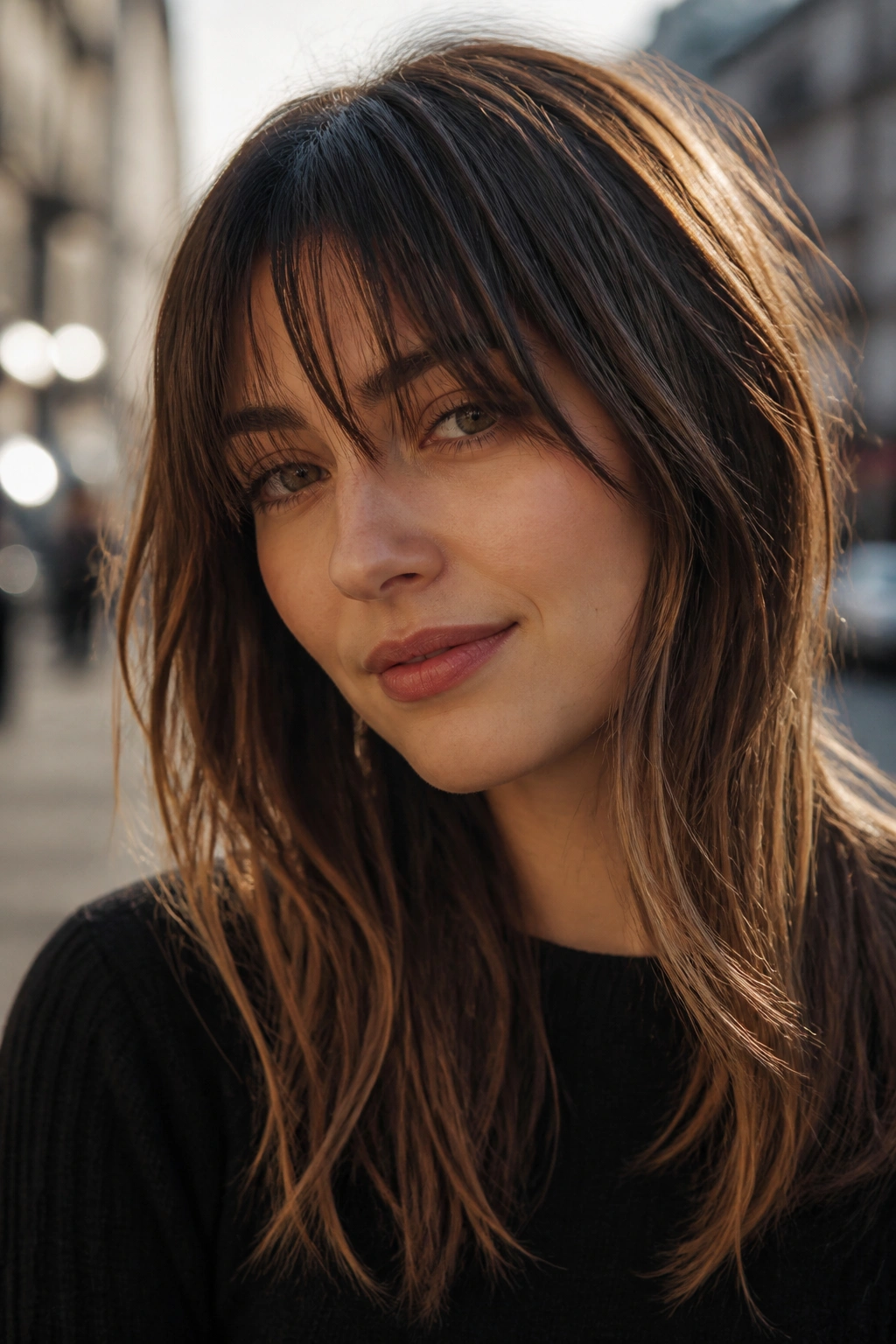
A razored fringe has a different feel from a scissor-cut fringe. The ends look lighter, and the whole front section moves more freely.
That lighter edge is useful on round faces because it keeps the bang from sitting as one thick block across the forehead. The shape feels broken in a good way. Not messy. Just less rigid. In a medium or dark brown shade, the texture becomes visible without needing a lot of styling product.
What Makes It Different
Unlike a blunt fringe, a razored one lets the hair fall in little pieces. That can be gorgeous on straight to slightly wavy hair. It’s less flattering if your hair is very coarse or frays easily, because the edge can look fuzzy instead of soft.
Best For
- Dense hair that needs internal removal.
- Straight or lightly wavy textures.
- People who like air-dried bangs.
- Anyone who wants a fringe that doesn’t look overbuilt.
Ask for the razor to be used mostly on the ends, not the whole bang. That keeps the shape controlled. Too much razor work and the fringe can frizz at the first sign of weather.
13. Collarbone Lob with Long Bangs for Round Faces
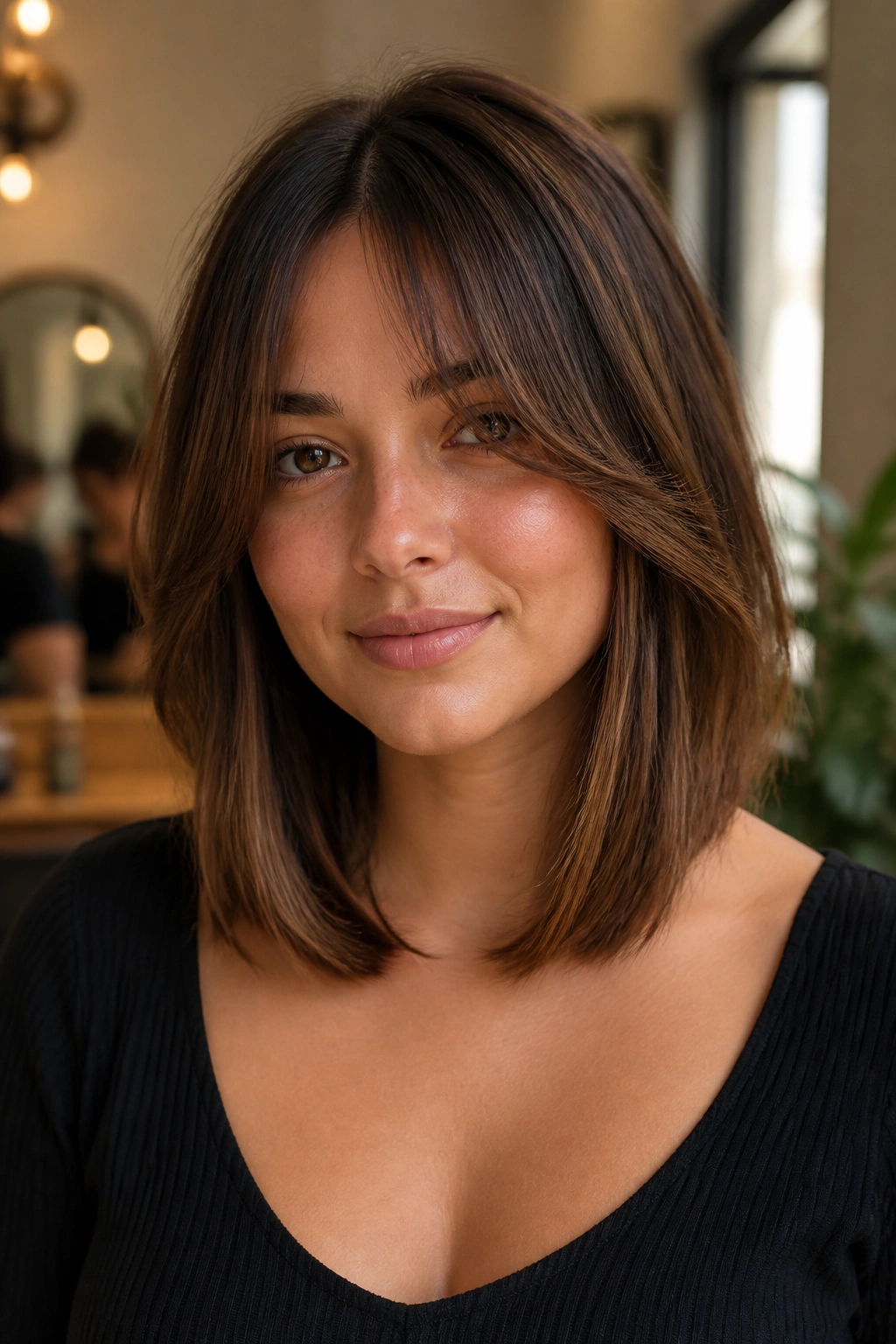
A collarbone lob changes how long the bangs feel. The length below the jaw gives the whole hairstyle a stronger vertical line, and round faces usually like that.
What to Ask For
Tell your stylist you want the fringe to start around the pupils or brows, then drift into the face frame by the time it reaches the cheekbones. That keeps the front soft while the cut underneath carries the length. If the lob ends right at the widest part of the jaw, the bangs have to work harder. A little extra length below the chin makes life easier.
Why It Works
- The collarbone hit draws the eye down.
- The long fringe softens the forehead.
- The face frame adds angle without sharp corners.
- Brown tones show off the cut’s movement, especially in warm light.
This is one of the better choices if you want a haircut that looks neat from the front and easy from the side. A tucked-back lob with long bangs has a nice balance to it. Not too precious. Not too severe.
14. Wavy Long Bangs
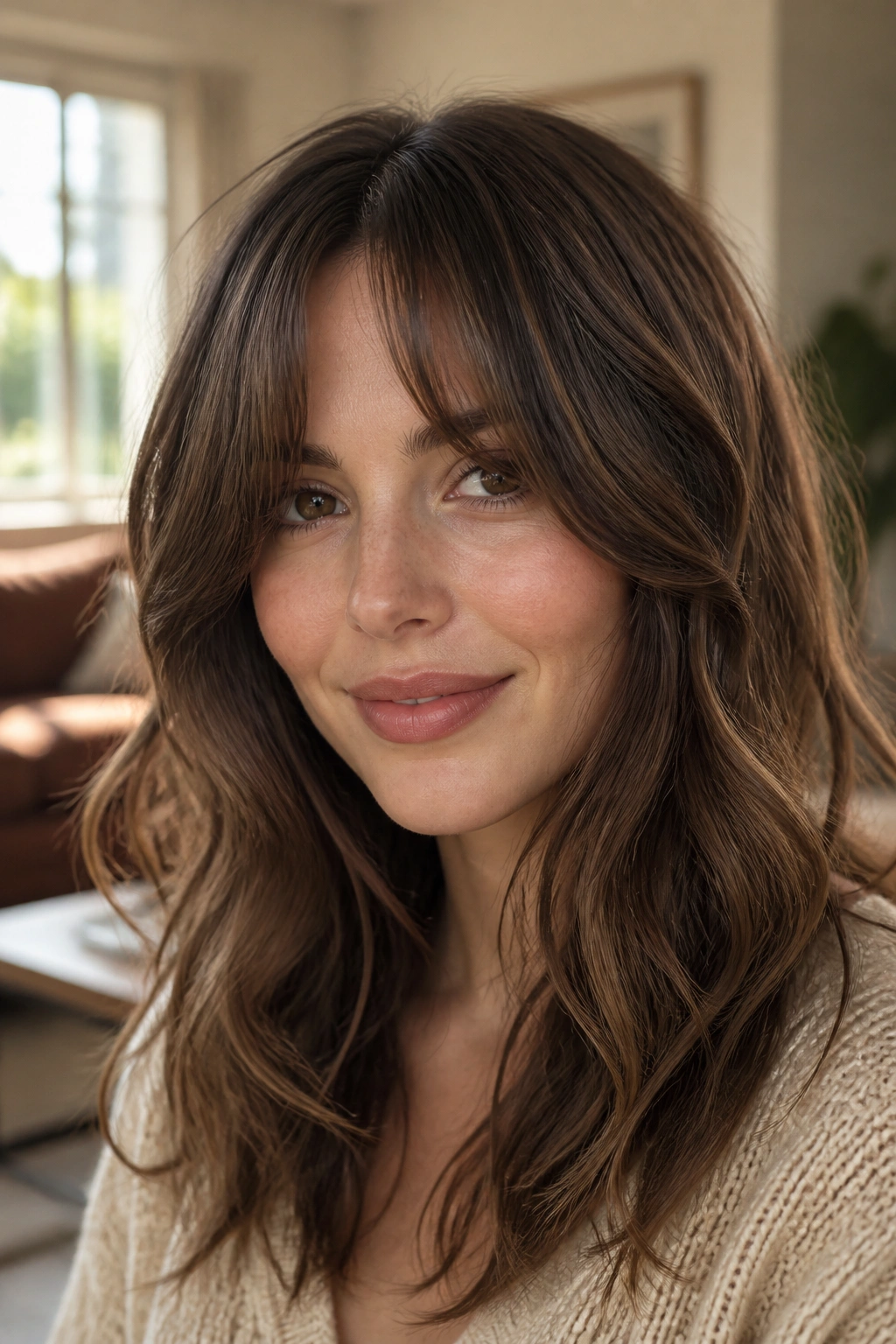
A natural wave can do half the job for you. The bend in the hair gives the face some length and keeps the bangs from sitting flat against the forehead.
If you have wavy brown hair, let the fringe keep its texture. Don’t iron every bit of movement out of it. A loose bend from a 1-inch iron or a quick scrunch with a diffuser is usually enough. You want the bangs to curve away from the cheeks, not curl tightly inward. That inward curl is the one to avoid.
The best wavy fringe feels a little undone. Brown shades make the wave visible in a softer way than very dark hair does, which helps if your hair tends to puff up. A mid-brown with subtle dimension reads especially well because the bends catch light in different places.
This style is good if you hate a high-maintenance morning routine. It doesn’t need perfect symmetry. It just needs a decent shape and a little product at the ends.
15. Center-Part Bangs That Open at the Nose
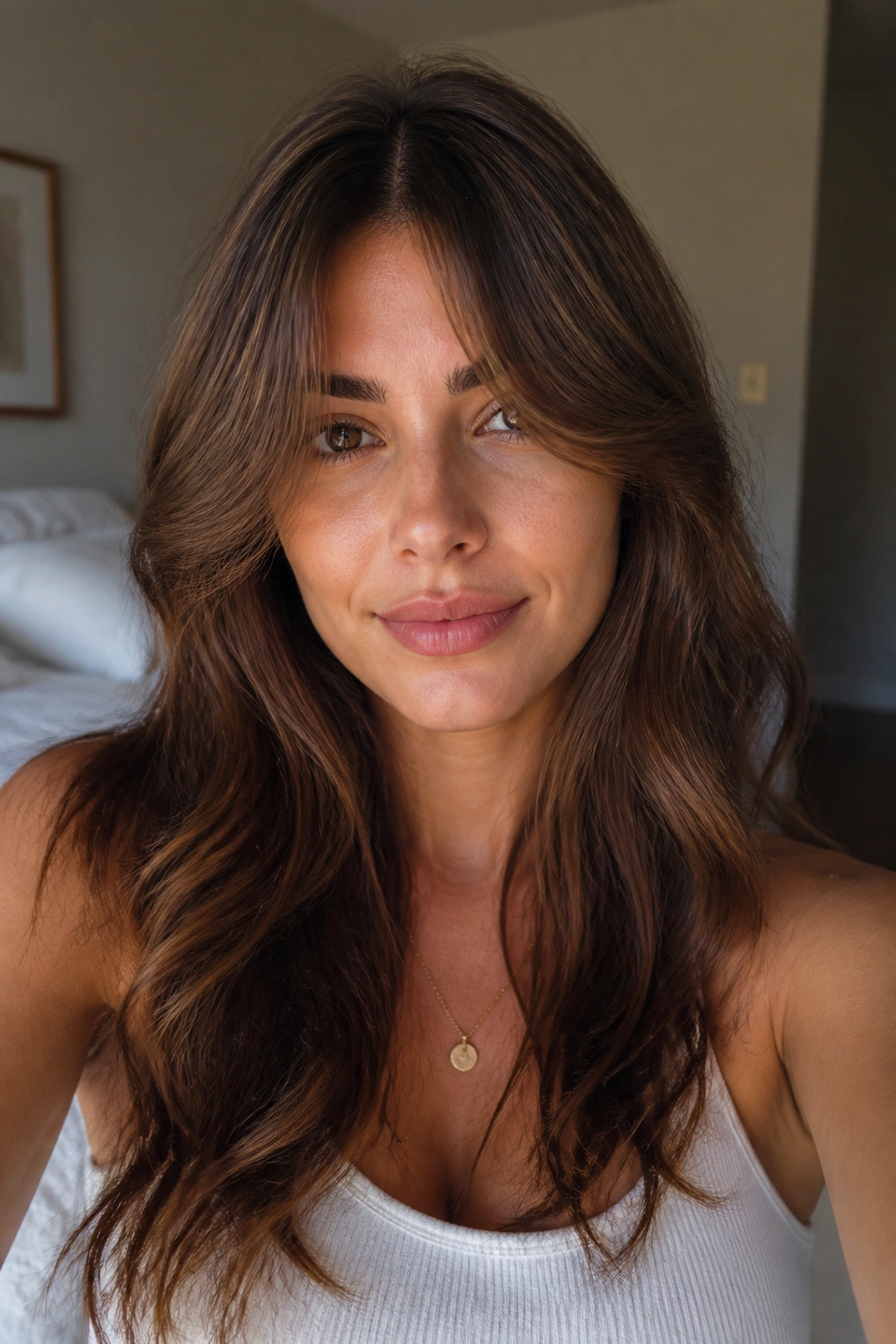
Can a center part work on a round face? Yes—if the front pieces are long enough to open from the nose outward instead of falling straight down.
This is not a strict middle-part fringe. It’s more like a soft split that starts narrow at the center, then expands below the eyes. The result is a long vertical frame with a gentle V shape near the forehead. That V matters. It keeps the face from looking too broad across the top.
I like this on hair that has a little natural movement, because the pieces sit better when they aren’t ironed into a stiff line. Brown hair gives the split more depth, especially if the root is a shade darker than the ends. That subtle difference makes the face frame look built-in rather than pasted on.
How to Wear It
Use a blow-dryer and a flat brush to guide the front away from the nose, then clip the sides for a few minutes while they cool. The opening should sit softly, not gape like curtains in a draft.
16. Thick Fringe with Broken Ends
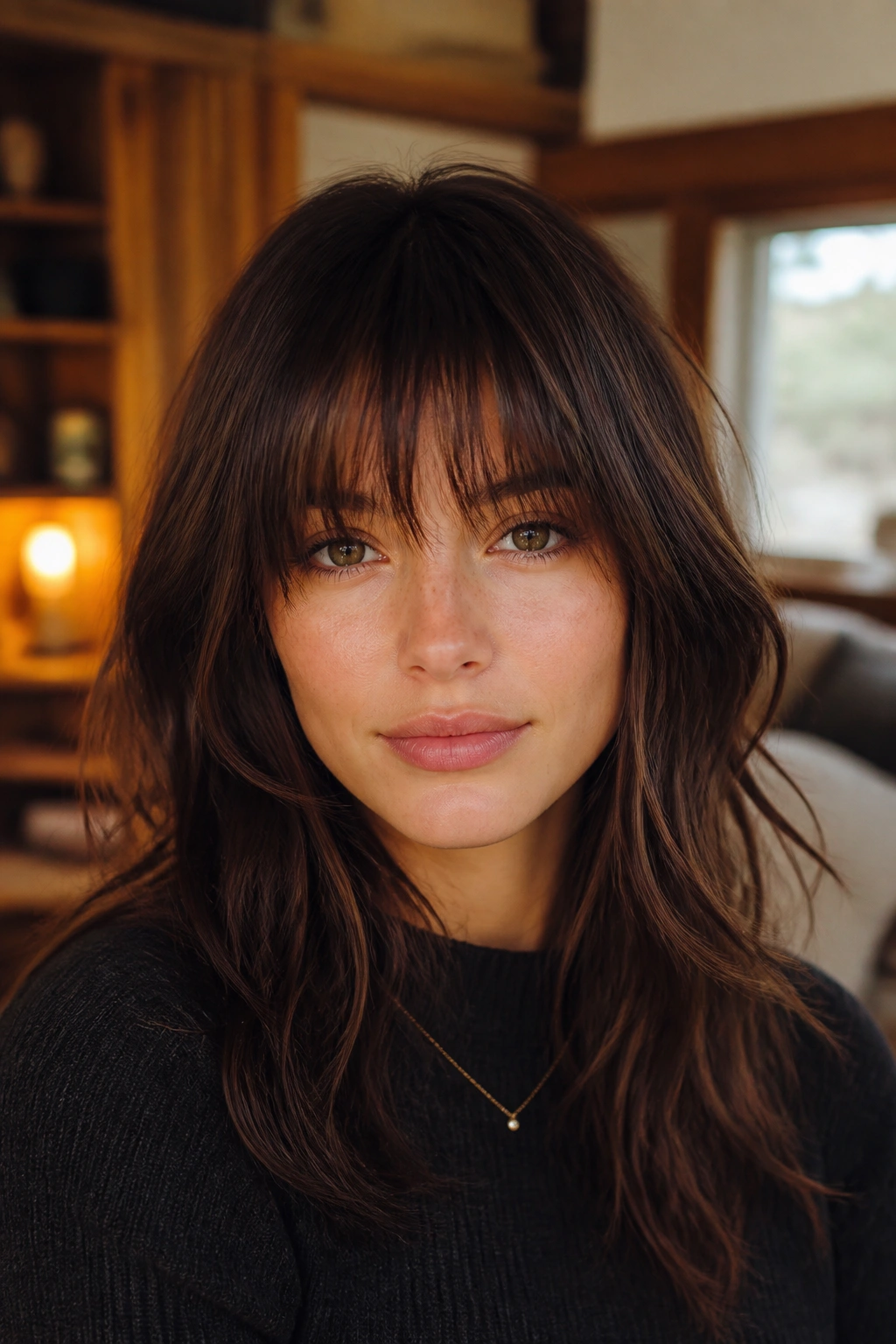
Thick bangs can work on a round face, but only when they’re broken up. A full, blunt sheet of hair across the brow can make the face feel wider than it is.
The fix is in the ends. Broken edges, point-cut texture, and a little unevenness keep the fringe from turning into a wall. Brown hair is useful here because the depth gives the bangs shape even when they’re dense. A deep walnut or cocoa shade can look rich, not heavy, if the cut has enough movement.
A Few Details Matter
- Keep the center slightly shorter than the outer corners.
- Remove weight from the inside, not just the perimeter.
- Style with a bend, not a stiff straight line.
- Avoid over-thinning the fringe; it can go stringy fast.
This version suits thick hair best. Fine hair can do it too, but only if the stylist leaves enough mass in the bang to hold shape. Too much thinning and the fringe loses the whole point.
17. Side-Tucked Long Bangs
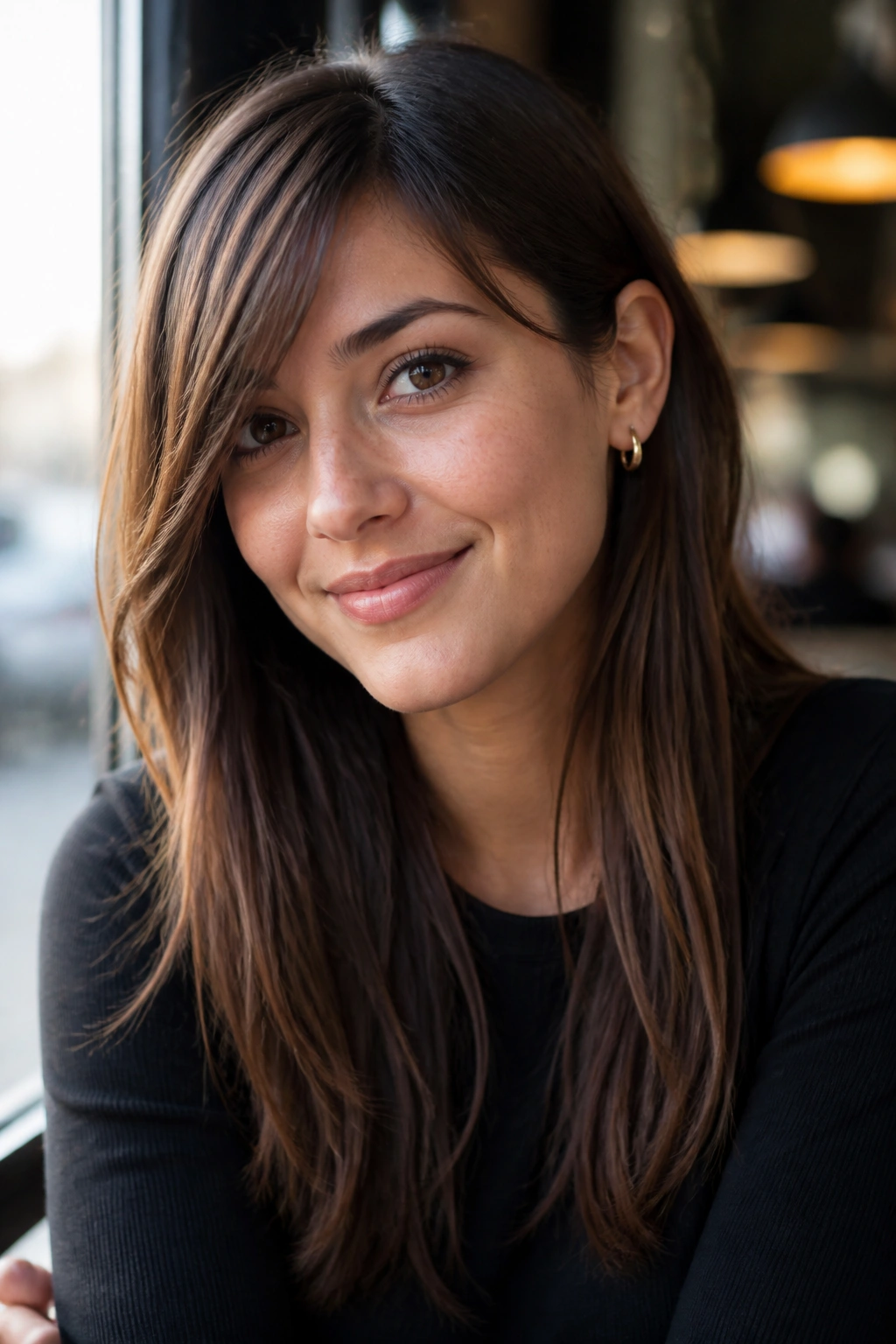
Side-tucked bangs are one of those styling moves that looks accidental and clever at the same time. The hair falls forward, then gets tucked behind one ear or pinned back on one side, leaving a diagonal sweep across the face.
For a round face, that asymmetry is useful. One cheekbone stays open, the other gets a soft veil. The result feels longer and less centered. It also works well if you like showing earrings, which is a nice bonus. Brown hair, especially mid-brown or chestnut, keeps the tuck looking intentional instead of messy.
This is a practical style for real life. Office day? Tuck it. Errands? Tuck it. Want the bang back for dinner? Pull it loose again. The cut should be long enough to move between both modes. If it’s too short, the tuck becomes a battle.
A light spritz of flexible hairspray helps, but don’t freeze it in place. The movement is the appeal.
18. Soft Wolf Cut with a Long Fringe
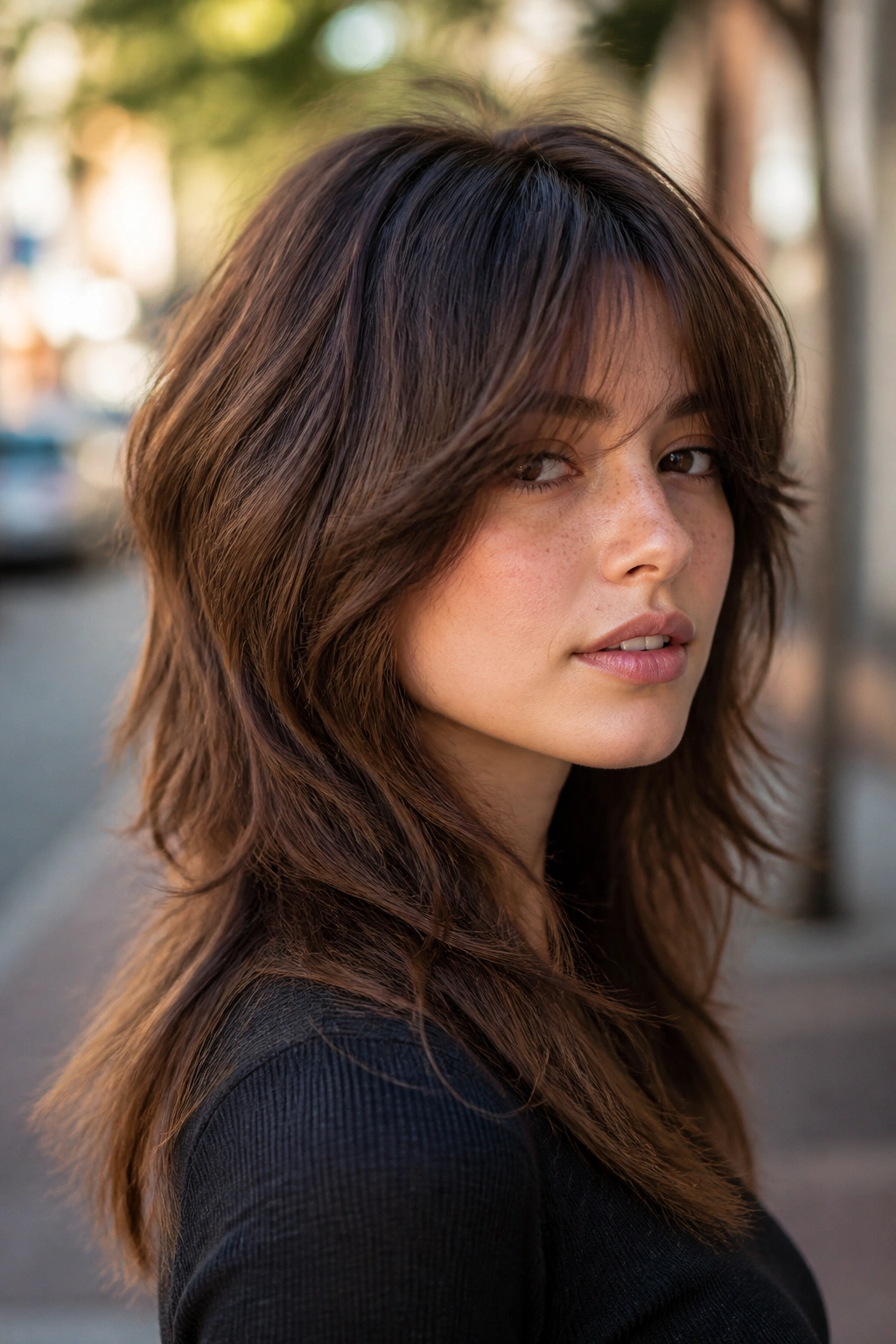
A wolf cut brings edge, but the soft version is much easier to wear than people assume. The crown has lift, the perimeter stays light, and the fringe connects to the layers instead of sitting on top of them.
That combination helps round faces because it creates height and breaks up softness in the outline. The long fringe can sweep across the forehead, then fall into uneven layers around the temples and jaw. In brown hair, the layered texture looks rich instead of chaotic. The color shows the shape clearly.
What Makes It Different
Unlike a classic shag, the wolf cut usually gives you a bit more drama at the crown and a narrower feel through the ends. That can be useful if your face reads wide and your hair has body. The caveat: it’s not the neatest haircut in this group. If you want sleek and polished every day, this may annoy you.
Still, if you like air-dried texture and a little edge, it has a lot going for it. Not precious. Not boring.
19. Airy Brown Layers with Long Bangs for Round Faces
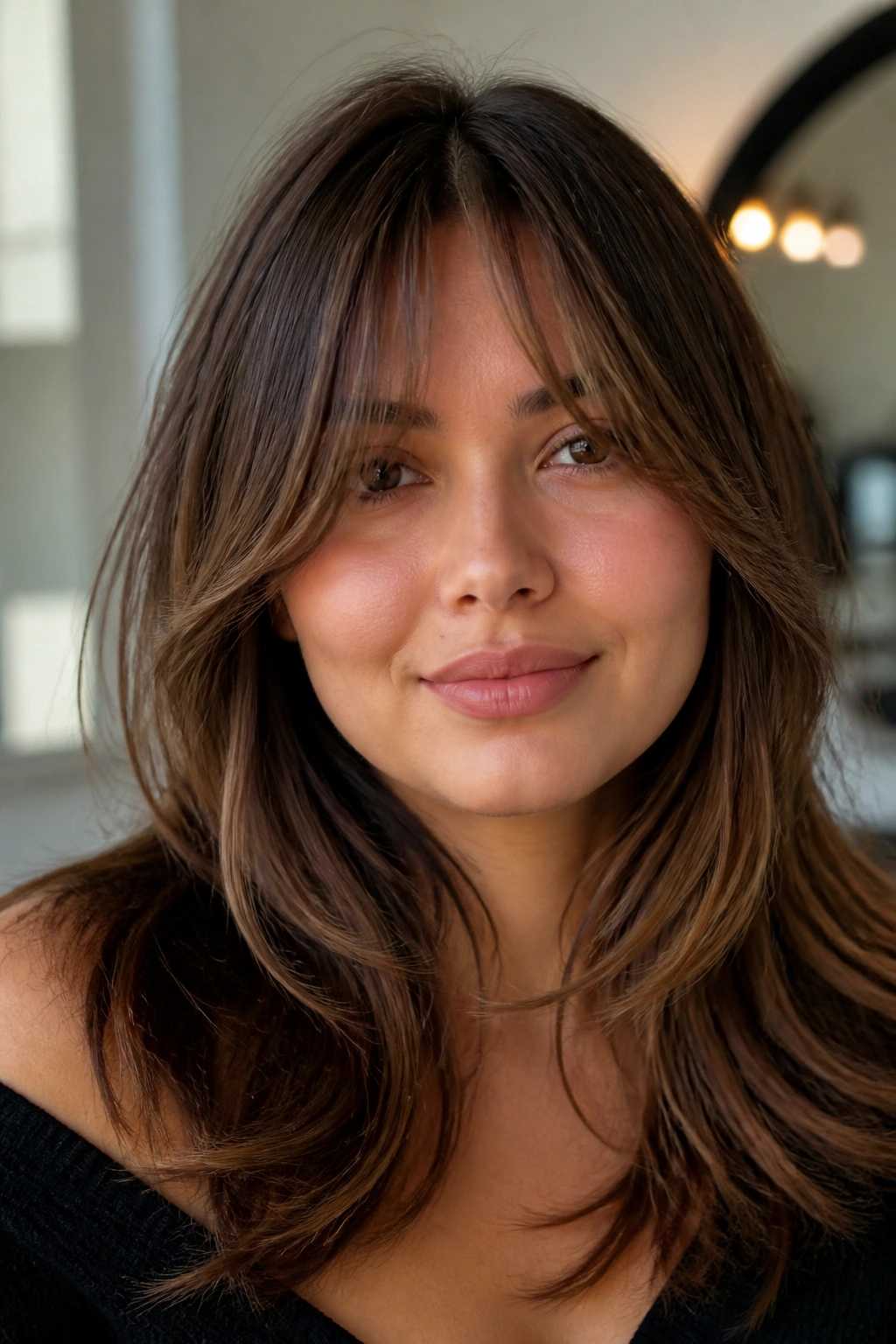
Some bangs work because they’re the main event. These work because they let the rest of the haircut breathe.
How They Change the Silhouette
Airy layers around the face create small gaps between the hair and the cheek. That gap matters. It keeps the face from looking enclosed, which can happen when the front section is too dense. On round faces, the long bangs should feel like a frame, not a cover.
The best version is soft brown with a little variation in tone—maybe a deeper root and lighter mid-lengths. That makes the layers show up without a harsh contrast. Ask for the front to be sliced lightly, not hacked away. You want movement at the cheek and jaw, where the eye needs a cue.
- Good for medium to thick hair.
- Works well with loose waves or a brushed-out bend.
- Needs regular shaping so the face frame stays visible.
- Looks especially good when the layers start below the brow line.
Small detail, big difference: keep the layer line curved away from the cheeks, not straight across them.
20. Long Bangs for Low-Bun Days
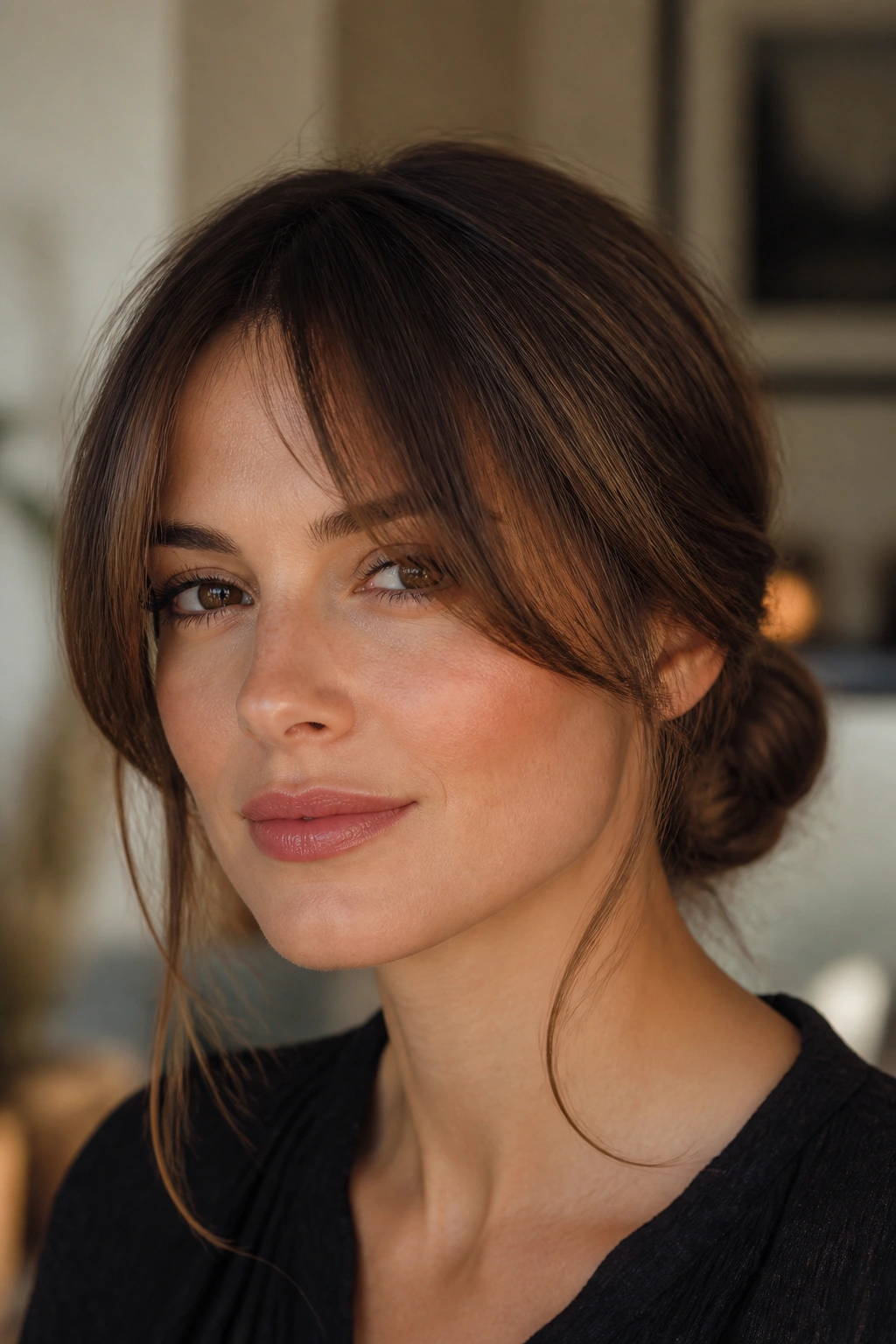
Long bangs can rescue a low bun from looking severe. That’s the honest truth.
A round face often benefits from a little softness near the forehead when the rest of the hair is pulled back. Without it, the face can feel exposed in a flat, unhelpful way. Long brown bangs fix that by giving the eye a place to land. A center opening or a side sweep both work. The fringe just needs enough length to move instead of sticking upright.
This style is useful for people who wear their hair up a lot. The bangs become the shape, while the bun keeps the rest simple. That can look polished for work, dinner, or a formal event. If you want extra softness, leave two thin pieces near the temples and keep them a touch longer than the center.
A little shine spray on the bangs helps here. Too much product near the roots does not. Greasy front pieces are a fast way to flatten the whole effect.
21. Invisible-Layer Bangs
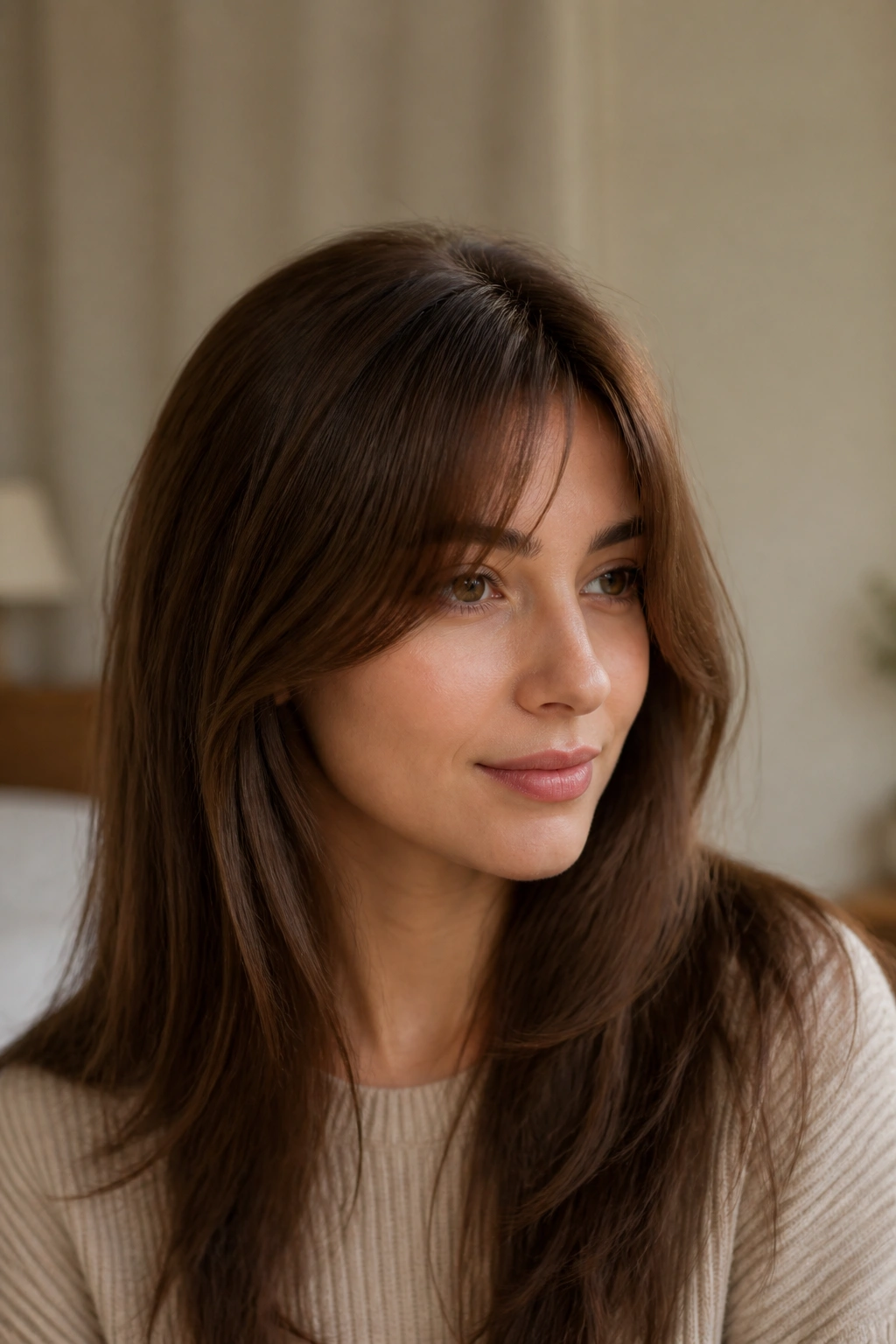
Are invisible layers worth asking for? If you want bangs that blend instead of announce themselves, yes.
The cut uses small, hidden shifts in length so the fringe doesn’t look chopped into obvious sections. On a round face, that can be a huge plus. You still get the lengthening effect, but the front never looks bulky. Brown hair, especially softer chestnut or warm cocoa, shows the separation gently. The result feels calm and expensive without trying to be flashy.
What Makes Them Different
The layering sits inside the fringe rather than on the surface. That means the ends move, but the outline stays smooth. It’s a good answer for people who hate a bang that falls in their eyes every hour. The shape stays controlled.
Best Way to Wear It
Use a round brush only on the very front. Then let the rest air-dry or rough-dry with your fingers. The goal is soft separation, not a curled-under helmet. That last part matters more than people think.
22. Long Bangs for Curly Brown Hair
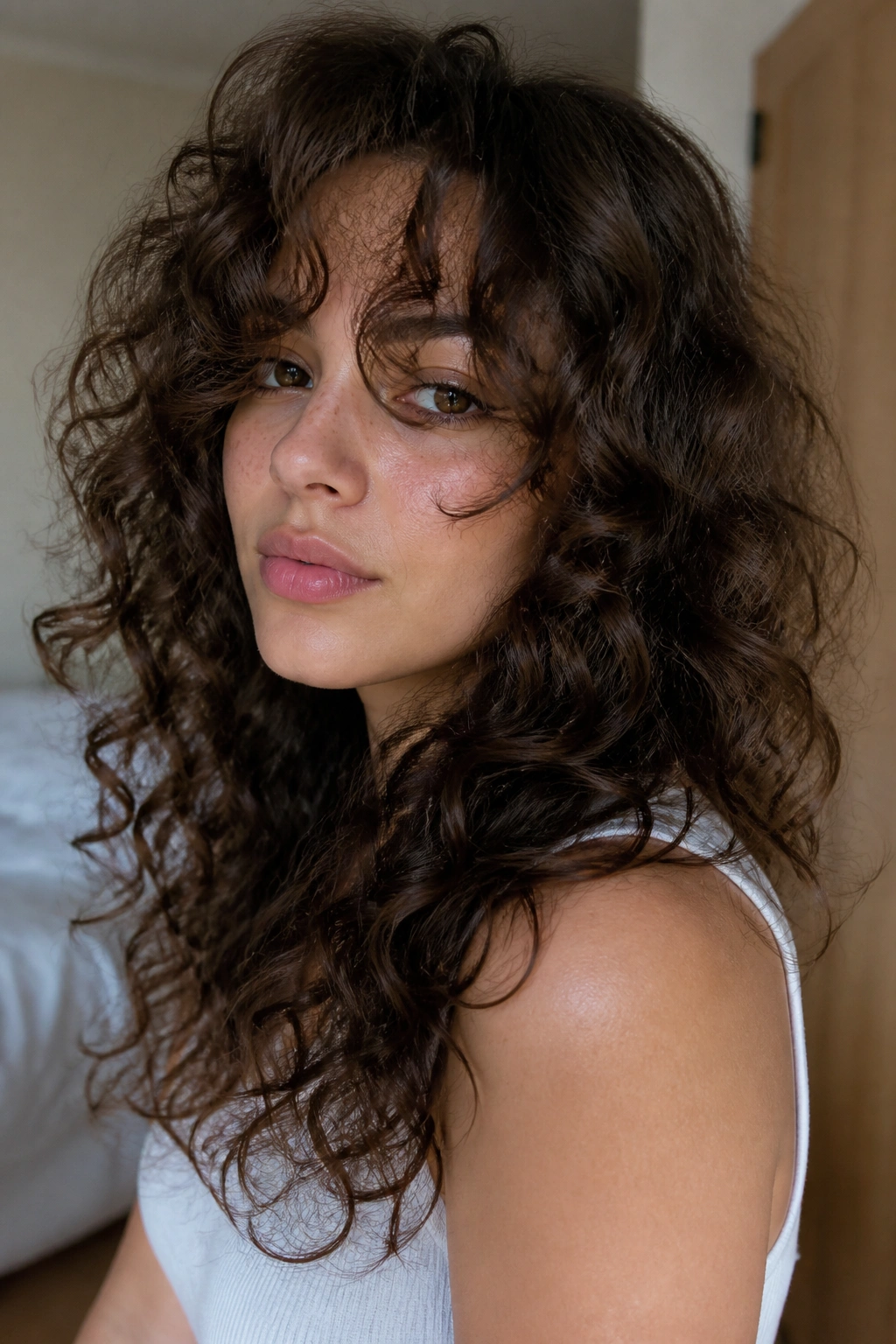
Curly hair and bangs can be a great match on round faces, but the fringe has to respect shrinkage. Too short, and it jumps up. Too heavy, and it blankets the forehead.
A long curly bang lets the curl pattern sit softly around the eyes and cheekbones. That creates shape without closing the face in. Brown hair helps because curls show their pattern more clearly when the color has depth. A rich brown with a little gloss can keep the front from looking fuzzy.
Quick Shape Notes
- Ask for the fringe to be cut dry, or nearly dry.
- Leave extra length for shrinkage.
- Keep the sides longer than the center.
- Use a diffuser or air-dry with curl cream, then separate gently.
This is one of the more personal cuts in the group. Curl size, density, and forehead length all matter. But when it’s right, it’s lovely. The bangs don’t fight your texture. They sit in it.
23. Glossy Brown Bangs with Soft Ends
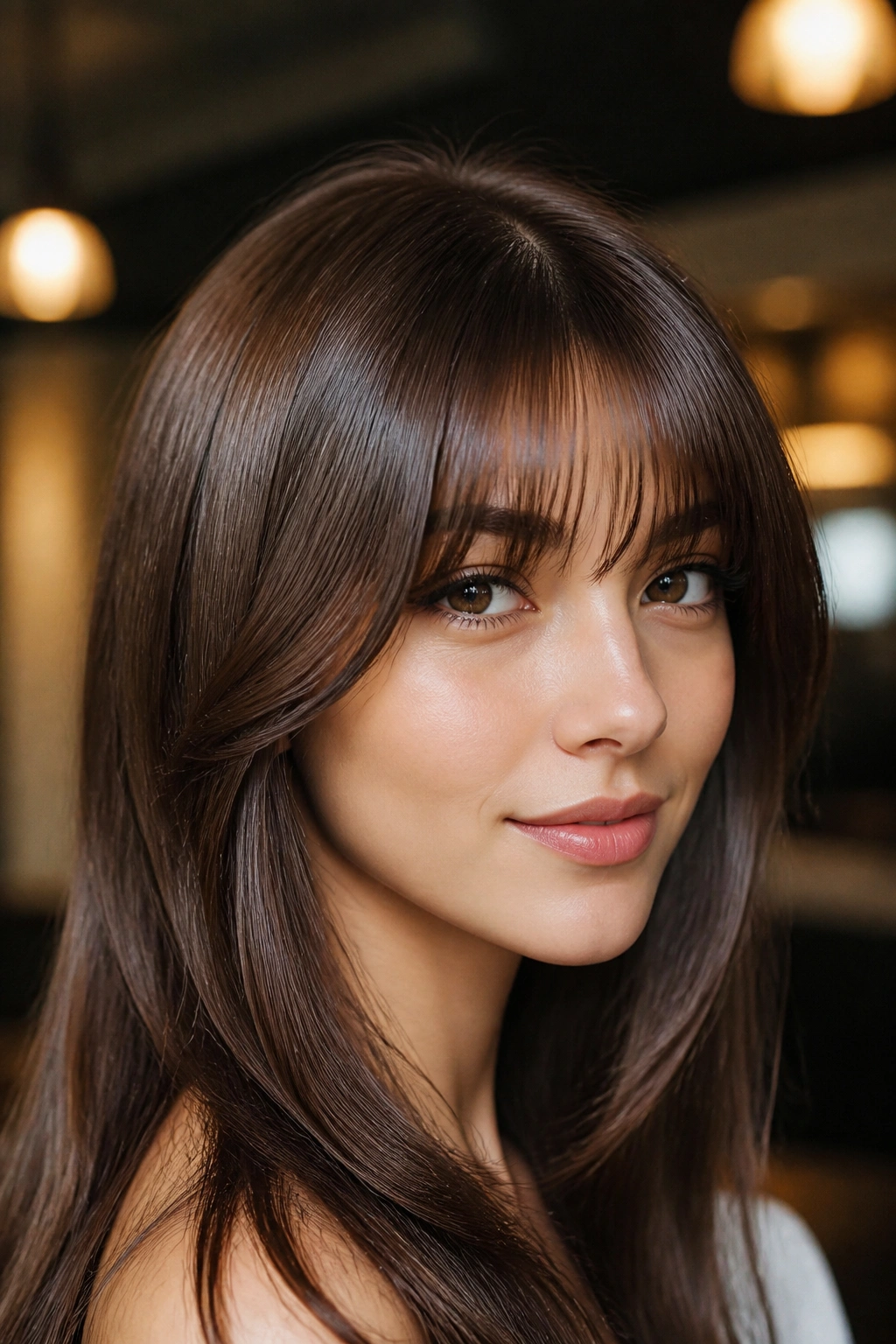
A glossy finish changes how bangs read on a round face. Shine makes the fringe look smoother, and soft ends keep it from feeling heavy.
That’s the real trick here. Not more hold. More polish. A chocolate or chestnut brown with a bit of gloss shows the shape of the cut without making it stiff. The edges should be slightly beveled, maybe even a little piecey, so the bangs fall rather than land all at once.
I’d reach for this if your hair is straight and you like a cleaner look. It pairs nicely with long layers or a mid-length cut. A light serum on the ends and a blow-dry that directs the front away from the cheeks is usually enough. Keep the roots lighter in product and the mid-lengths a touch smoother.
The result is subtle. That’s the point. It doesn’t scream for attention. It simply makes the face look more elongated and the haircut more finished.
24. Jaw-Skimming Bangs
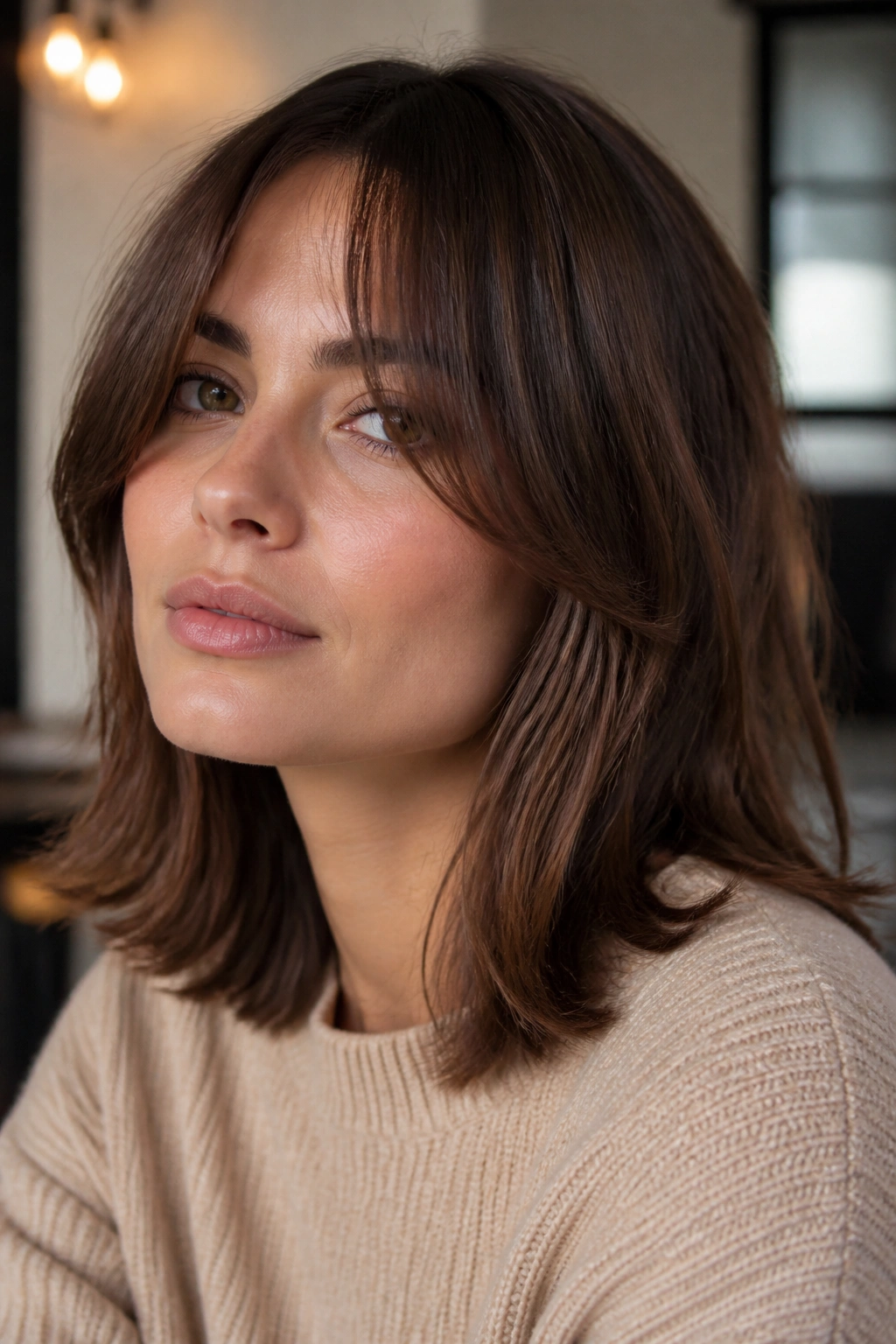
Jaw-skimming bangs change the frame by pushing the eye lower. That makes them one of the more useful choices for fuller cheeks.
The bangs start as a long front section, then angle down until they graze the jawline or just above it. That extra length creates a vertical path, which round faces usually wear well. The cut can be straight, waved, or lightly bent, but the landing point should be low enough to avoid sitting right on the cheek’s widest zone.
Unlike cheekbone-length fringe, this version gives more length than softness. It’s a better pick if you want the face to look longer first and softer second. Brown hair makes the line feel less stark, especially if the ends are feathered a touch.
This style works nicely with shoulder-length cuts and longer hair. It’s a bit more committed than curtain bangs, but it pays off if you want a face frame that does not quit halfway down the cheek.
25. Minimalist Curtain Bangs for Round Faces
The cleanest answer is often the one that looks the least worked-over. Minimalist curtain bangs do exactly that.
The shape stays simple: a quiet center split, a soft bend at the sides, and enough length to brush the cheekbones without crowding them. On round faces, that restraint helps. You get the lengthening effect without a lot of fluff around the temples. Brown tones keep the line grounded, especially if the hair is a deep mocha or neutral chestnut.
Why This Version Stays Easy
It does not need a heavy blowout to make sense. A quick dry with a brush, a little movement at the ends, and you’re done. The cut should be precise enough to hold shape, but not so polished that it feels stiff on a normal day. That balance is hard to fake.
- Best for people who want low-maintenance bangs.
- Good with straight, wavy, or loose-curly textures.
- Easy to pin back when needed.
- Grows out into face-framing layers without a weird line.
If you want one long brown bang idea that can move through different outfits, moods, and hair days without turning difficult, this is the one I’d start with.
