



Round faces can make color placement trickier than people admit. Put the brightest ribbon too high or too wide, and the cheeks seem to take over. Shift the light lower, keep a little depth at the root, and brown balayage starts doing the shaping for you.
That is why this family of color works so well. The brown tones keep the hair looking rich and believable, while the lighter pieces guide the eye down through the mid-lengths and ends instead of letting it bounce straight across the widest part of the face. A good result feels soft, not stripey. It also feels a little longer, which is exactly the point.
I’ve always liked brown balayage on round faces because it gives you room to play. Caramel, chestnut, mocha, hazelnut, mushroom brown, espresso — each one changes the mood, but the placement rules stay the same. Think below-cheekbone brightness, a root shadow that isn’t too harsh, and layers that don’t stop right at the jaw.
Some of the prettiest versions use curtain bangs, some lean on a deep side part, and some rely on thin face-framing pieces that start lower than people expect. The common thread is vertical movement. That’s the part to pay attention to.
1. Caramel Ribbon Balayage with Below-Cheekbone Layers
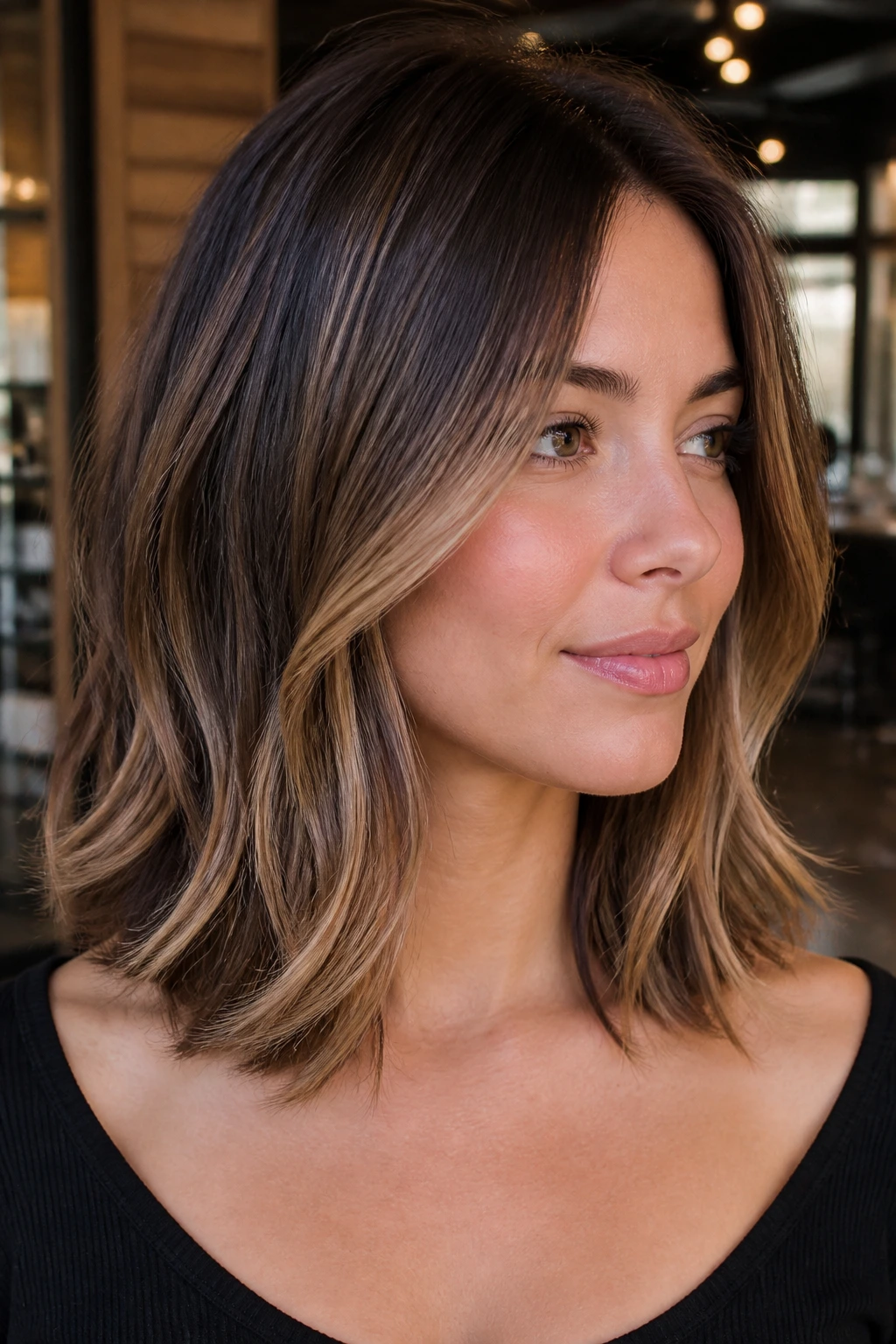
Caramel ribbons are a safe bet when you want warmth without losing dimension. The trick is to keep the brightest pieces a little lower than you think — around the cheekbone’s lower edge or even closer to the jaw — so the color lengthens the face instead of widening it.
Why It Flatters a Round Face
The hair around the cheeks stays softer and deeper, while the lighter pieces travel downward through the mid-lengths. That contrast gives the eye a path to follow.
Ask for thin caramel ribbons, not chunky blocks, and keep the root about one shade deeper than the mids. That gap matters. It stops the face-framing pieces from looking like a horizontal band.
- Start the lightest face-framing pieces 1 to 2 inches below the cheekbone.
- Keep the ends a touch brighter than the mids.
- Blow-dry with a round brush and bend the front sections away from the face.
Best move: Curl the front layers away from the cheeks so the color falls in a long, soft line.
2. Chestnut Melt with an Off-Center Part
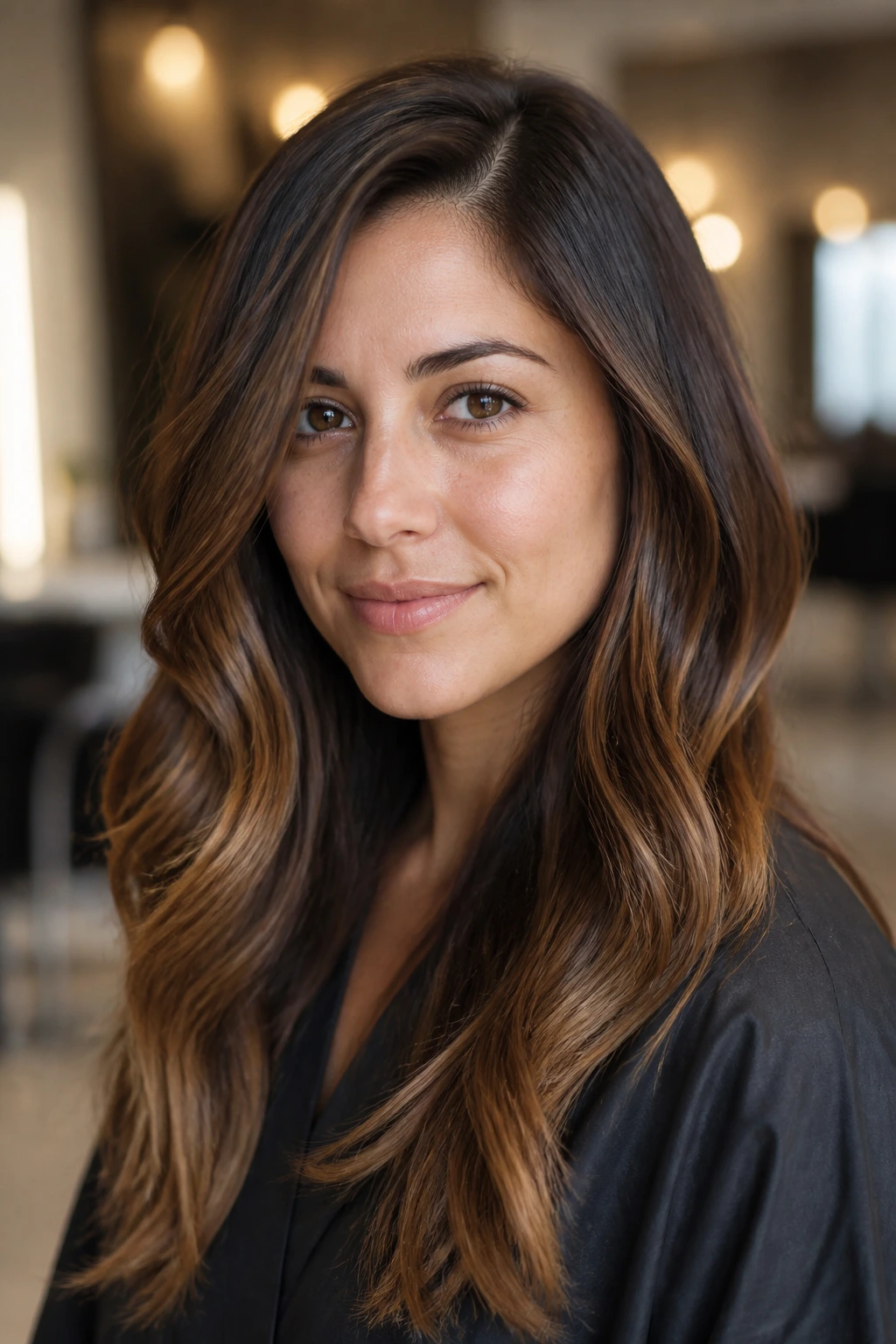
A chestnut melt can make a round face look longer without shouting about it. The color stays close to your natural brunette base, then slides into warmer chestnut through the mids and ends, so the eye moves vertically instead of getting stuck at the sides.
The off-center part does part of the work too. Not a deep side part. Just enough asymmetry to break the circle. I like this look on medium-density hair because the color does not have to carry all the shape by itself.
Put the lighter chestnut around the lower half of the hair, not all over the top. That keeps the crown from puffing out too much, which is one of those tiny details that changes everything. It sounds small. It isn’t.
3. Mocha Balayage Lob with Curtain Bangs
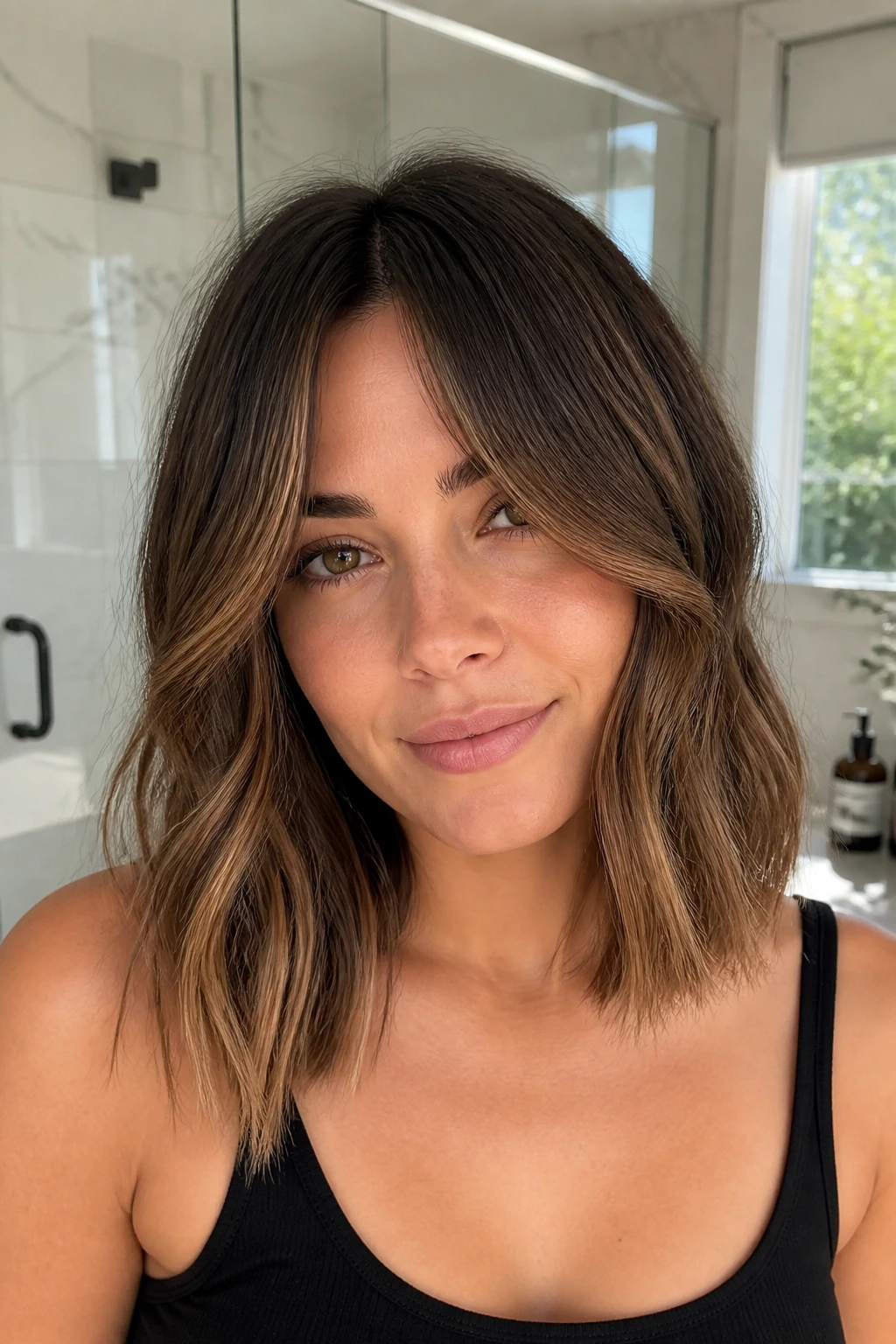
Can a lob work on a round face? Absolutely, if the ends hit right and the bangs open at the right place. A mocha balayage lob gives you structure without feeling severe, and the curtain fringe creates two clean vertical lines beside the face.
How to Get the Shape Right
The bangs should start around the brow or just below it, then sweep open near the cheekbones. If they end right at the apples of the cheeks, the whole cut can get boxy. Nobody wants that.
For the balayage, ask for mocha and soft toffee pieces that live mostly from the mid-lengths down. Keep the top darker. The contrast helps the cut look longer, especially when the lob sits around the collarbone.
Wear it with a slight bend from a 1-inch curling iron or a flat iron wave. Straight and flat can work too, but a little curve is what gives the color room to move.
4. Toffee Waves with Bright Ends
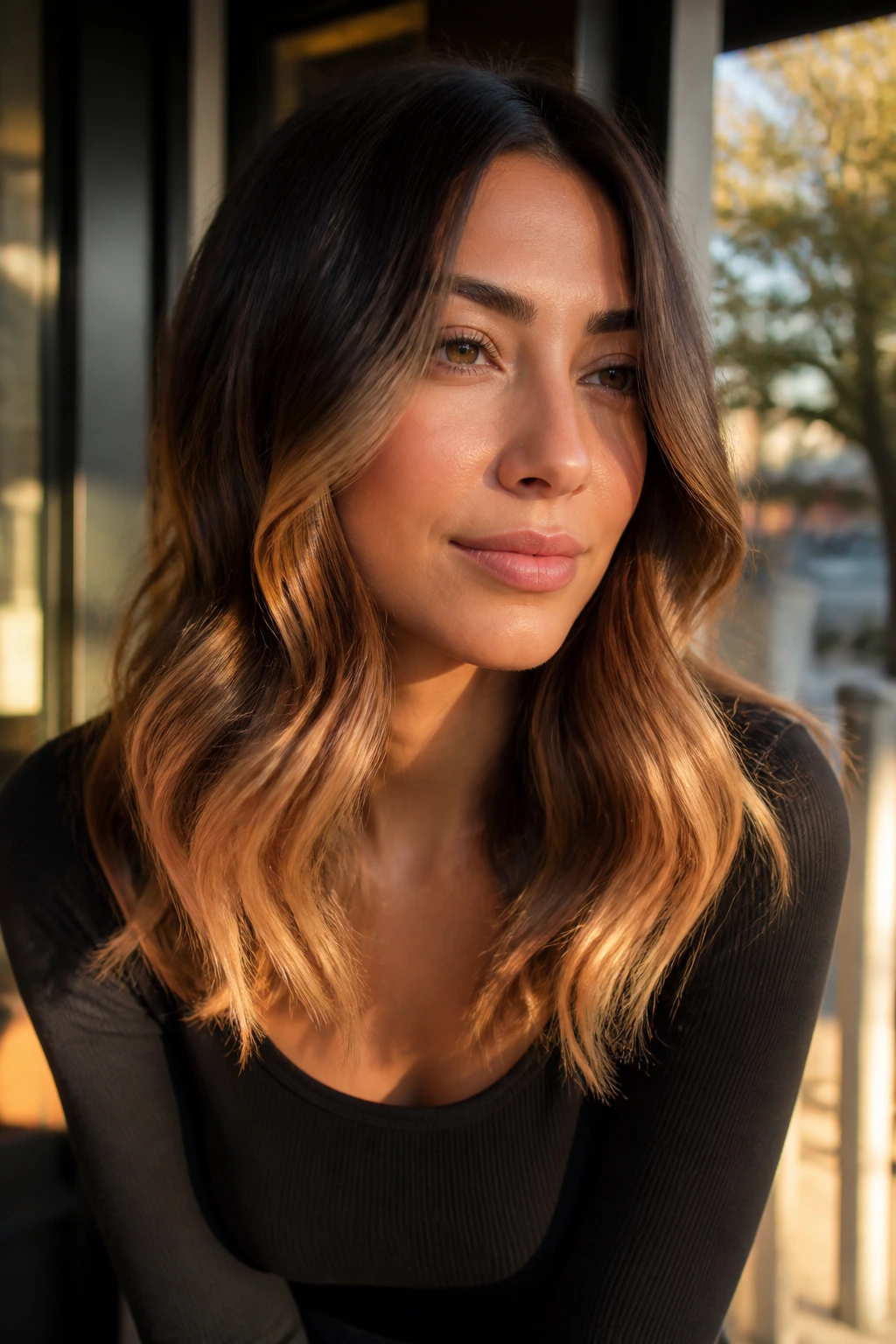
Picture loose waves that start below the ear, with toffee color building toward the ends. That’s the idea here. The face stays soft, the lower half of the hair gets all the brightness, and the roundness of the face stops feeling like the center of the look.
This is one of those styles that benefits from low-maintenance placement. You do not need the lightest pieces near the roots. In fact, I’d avoid that unless you want a wider shape up top. Keep the top darker, let the toffee show through the mid-lengths, then brighten the last 3 or 4 inches.
- Best on hair that holds a wave well.
- Great if you like a sunlit look that still reads brunette.
- Works especially well when the waves are brushed out a little, not left too tight.
The last bit matters. Soft separation beats perfect curls here.
5. Mushroom Brown Balayage with Airy Ends
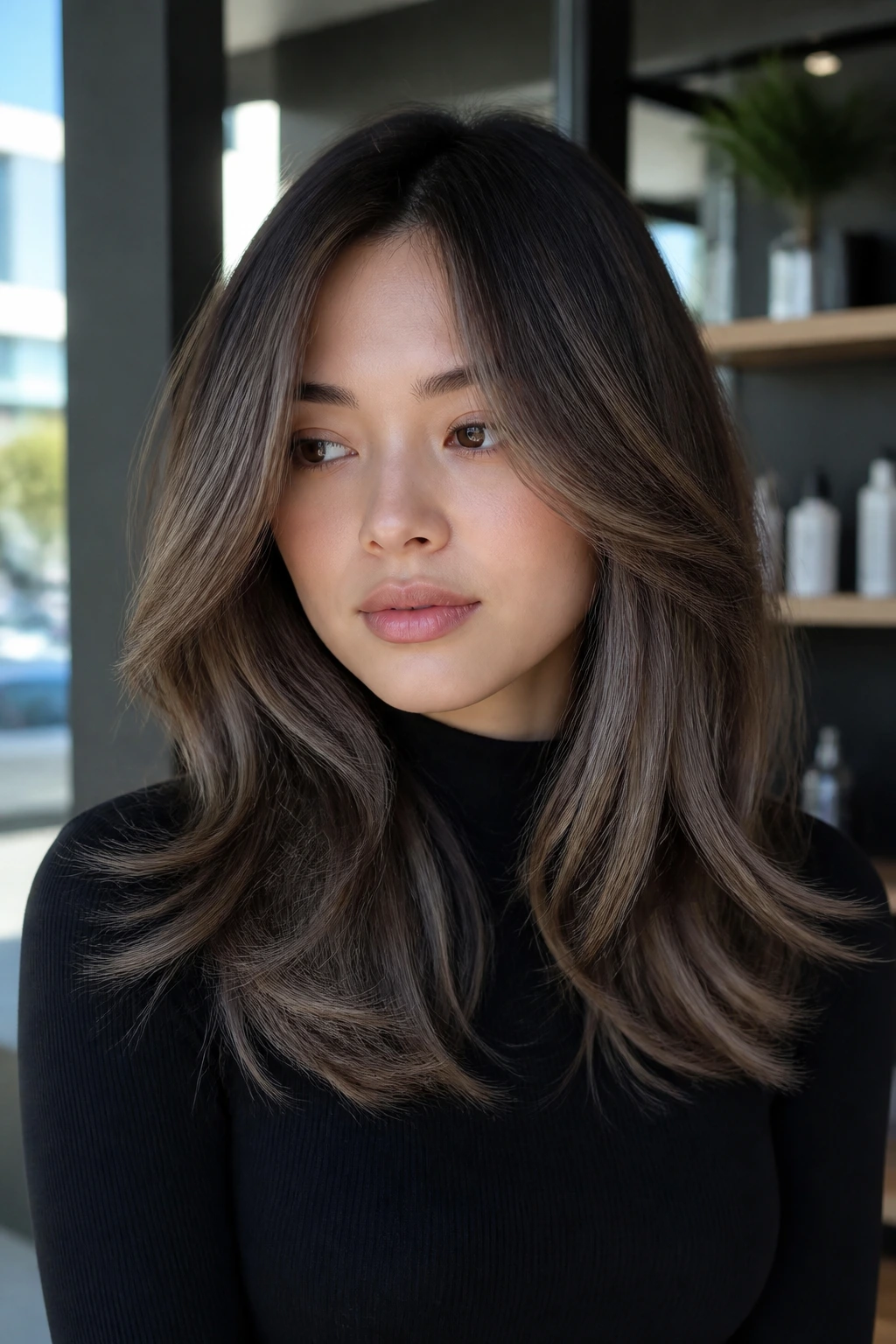
Mushroom brown has a quiet kind of polish. It’s cooler, more muted, and a little smoky, which makes it a strong choice if you do not want warmth fighting with the roundness of your face. The color itself feels restrained, and that restraint is useful.
What I like most is how it lets the haircut do the heavy lifting. On a round face, airy ends and long layers keep the silhouette open. The balayage should sit through the mid-lengths and tails of the hair, not form wide panels near the cheeks. If you wear it on straight or softly waved hair, the finish looks especially smooth.
There’s a small catch. Mushroom brown can look flat if the light pieces are too close in tone to the base. Ask for enough contrast to show movement, but not so much that it turns stripey. That middle ground is where this color gets good.
6. Cinnamon Brown Balayage on a Wavy Shag
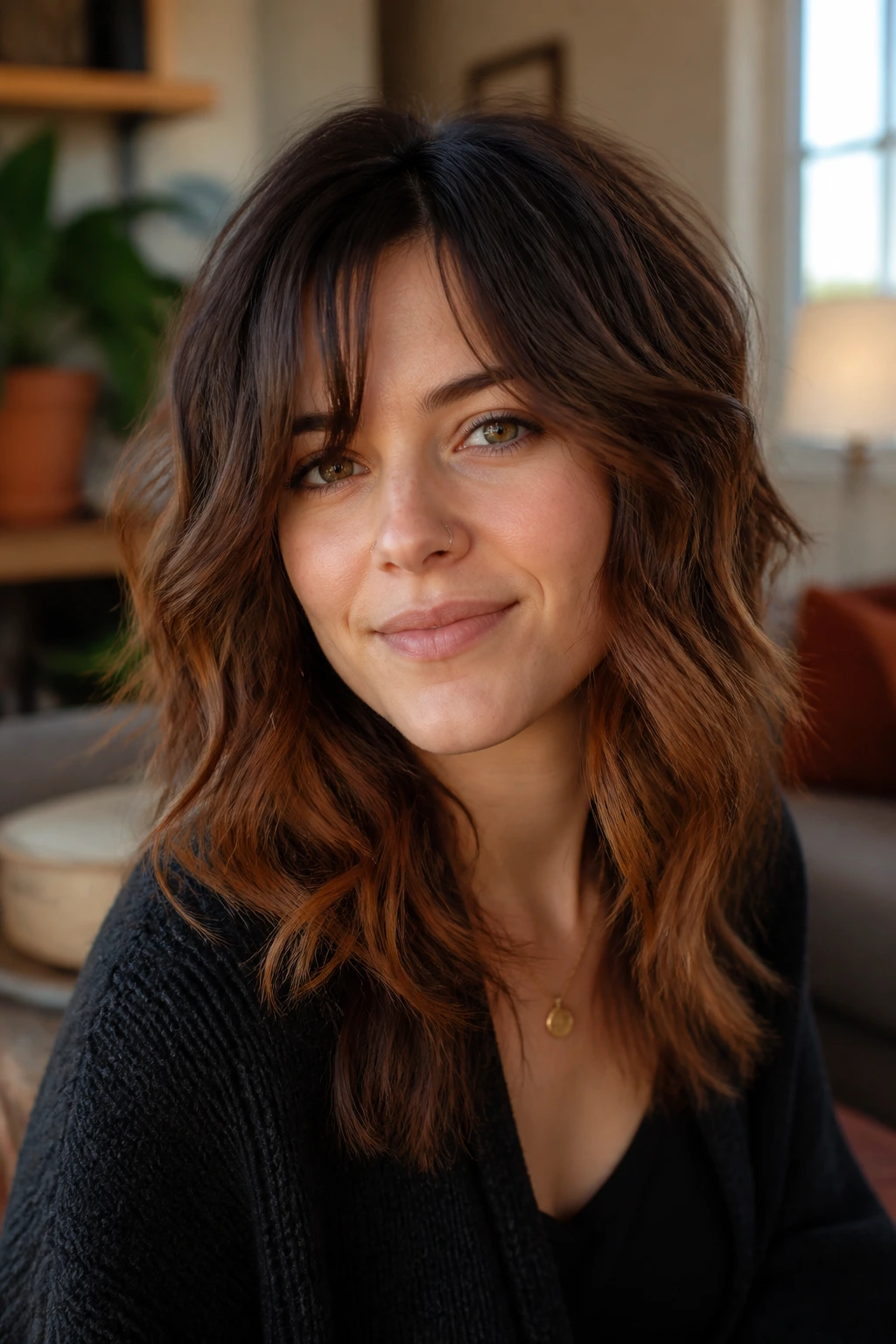
A shag can work on a round face, but only if the layers stay airy and the sides keep some length. Cinnamon brown balayage gives the cut warmth and texture, while the piecey layer pattern pulls the eye up and down instead of sideways.
Unlike a blunt shag, this version does not pile volume right at the cheeks. That’s the whole game. The shorter pieces around the crown create lift, and the longer exterior layers keep the face from feeling boxed in.
Best for Hair That Needs Movement
Thick hair, this one’s for you. The color breaks up density, and the shaggy layers stop the shape from turning heavy.
- Ask for cinnamon ribbons through the ends and lower mid-lengths.
- Keep the top section darker for contrast.
- Style with a diffuser or a salt-spray blow-dry to keep the texture loose.
If your hair is fine, the same idea still works, but you’ll want fewer layers and a softer wave pattern. Too much texturing can make the ends disappear.
7. Espresso Root Smudge with Honey Midlengths
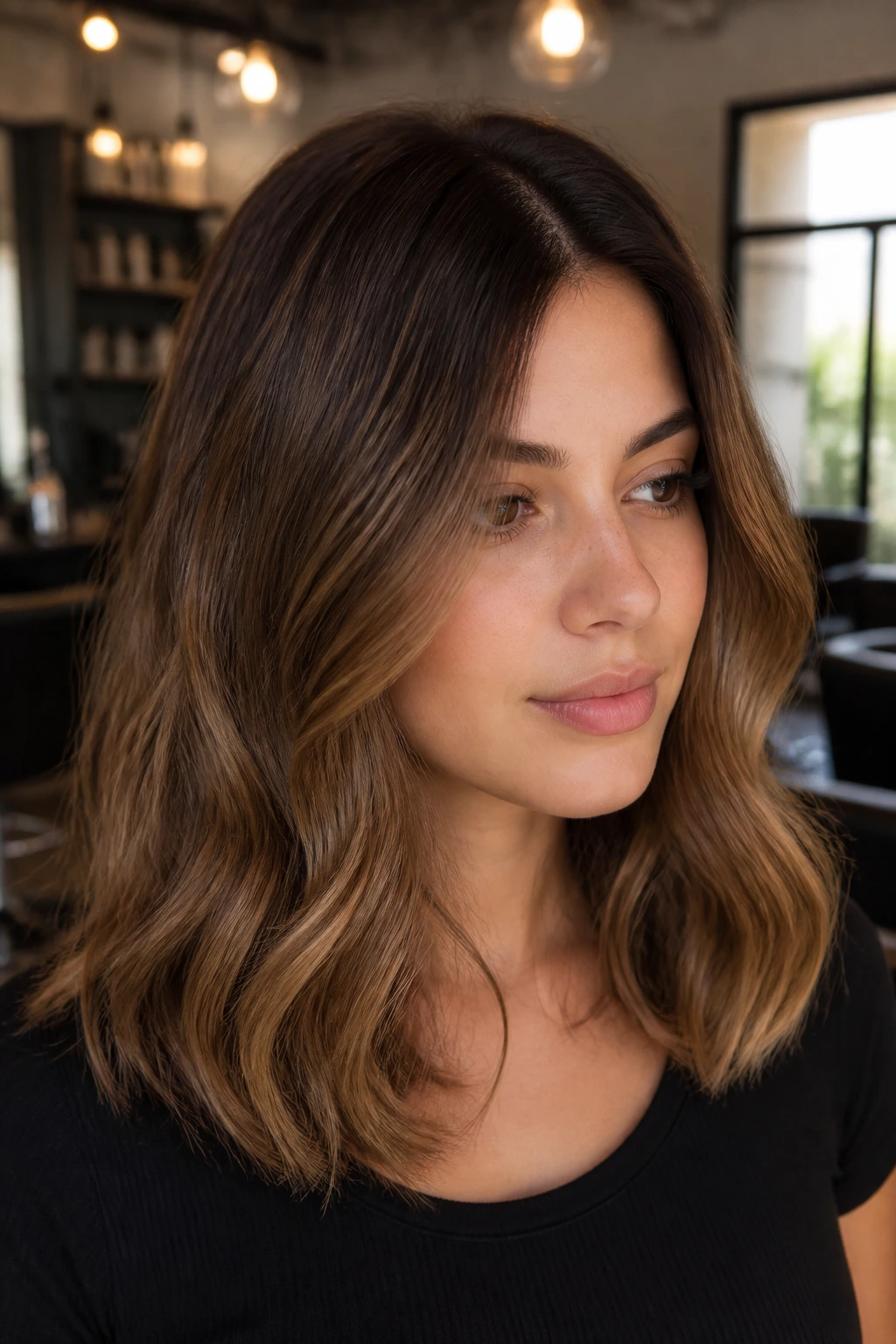
Espresso at the root, honey in the middle, and softness everywhere else. That’s the formula. On a round face, a root smudge like this creates a clean stretch of depth at the scalp, which keeps the face from looking wider up top.
What to Tell Your Colorist
Ask for a soft espresso root shadow that fades into honey-brown mids and slightly brighter ends. The fade should be seamless, not a hard line. If the root area is too light, the whole style loses its lengthening effect.
- Keep the espresso zone about 1 to 1½ inches from the scalp.
- Place the honey pieces lower than the chin, if your length allows it.
- Finish with waves that begin below the cheekbone.
That last point saves the look from feeling busy near the cheeks. And yes, the honey should still look brunette. If it starts reading blonde, the balance gets off fast.
8. Hazelnut Balayage on a Sleek Collarbone Cut
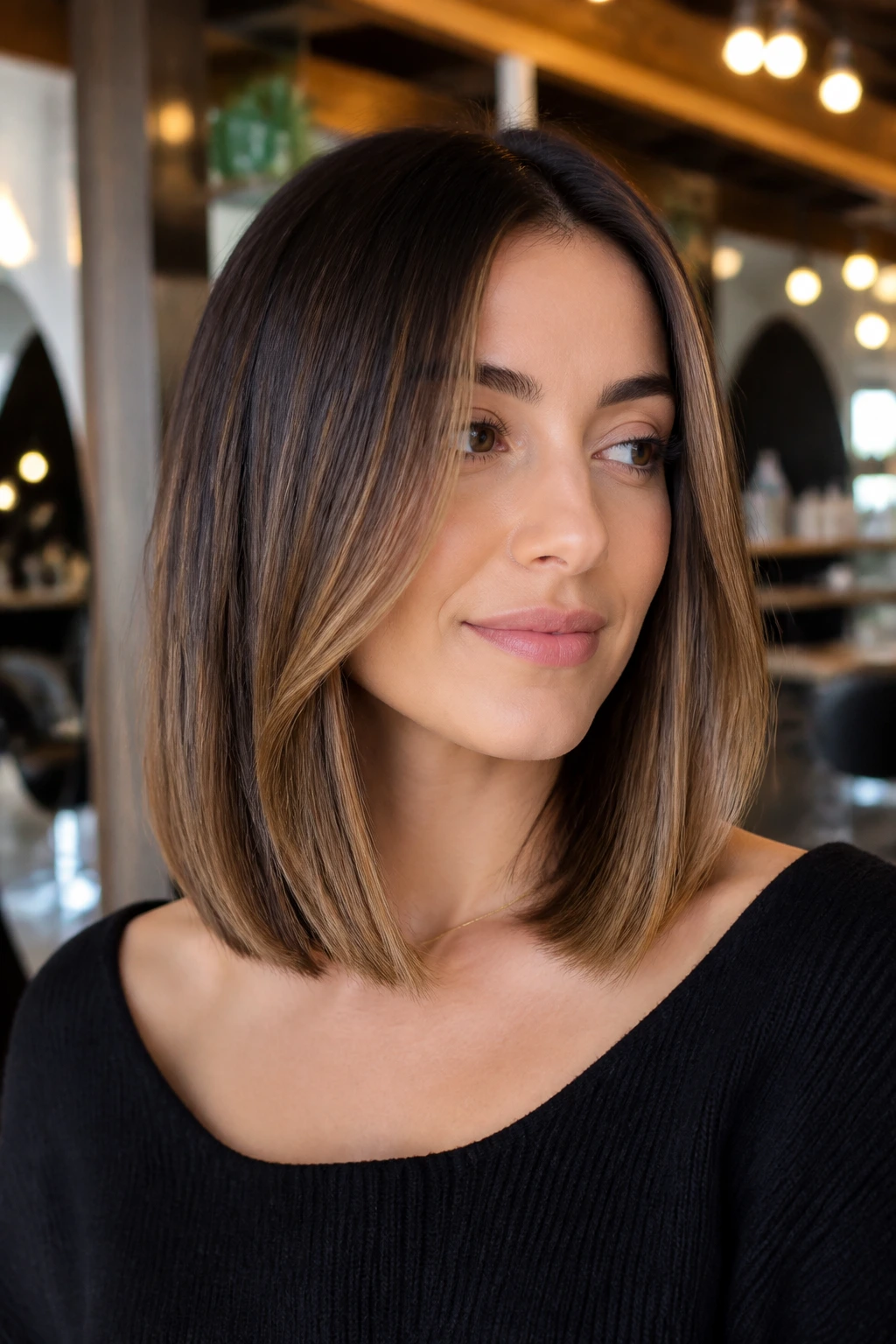
This is the one I reach for when somebody wants polish more than fuss. Hazelnut balayage on a collarbone cut gives you a long, narrow shape that suits round faces beautifully, especially when the ends sit just past the shoulders.
The sleek finish matters. It lets the hair hang in a cleaner line, which lengthens the profile. Hazelnut pieces through the mids and lower thirds add warmth without widening the cut, and a subtle face frame can start at the jaw instead of the cheek.
If your hair is thick, ask for the ends to be lightly beveled. If it’s fine, keep the perimeter blunt but not heavy. Either way, the point is the same: long lines, soft brightness, no blocky color at the sides.
9. Maple Brown Balayage with a Side-Swept Fringe
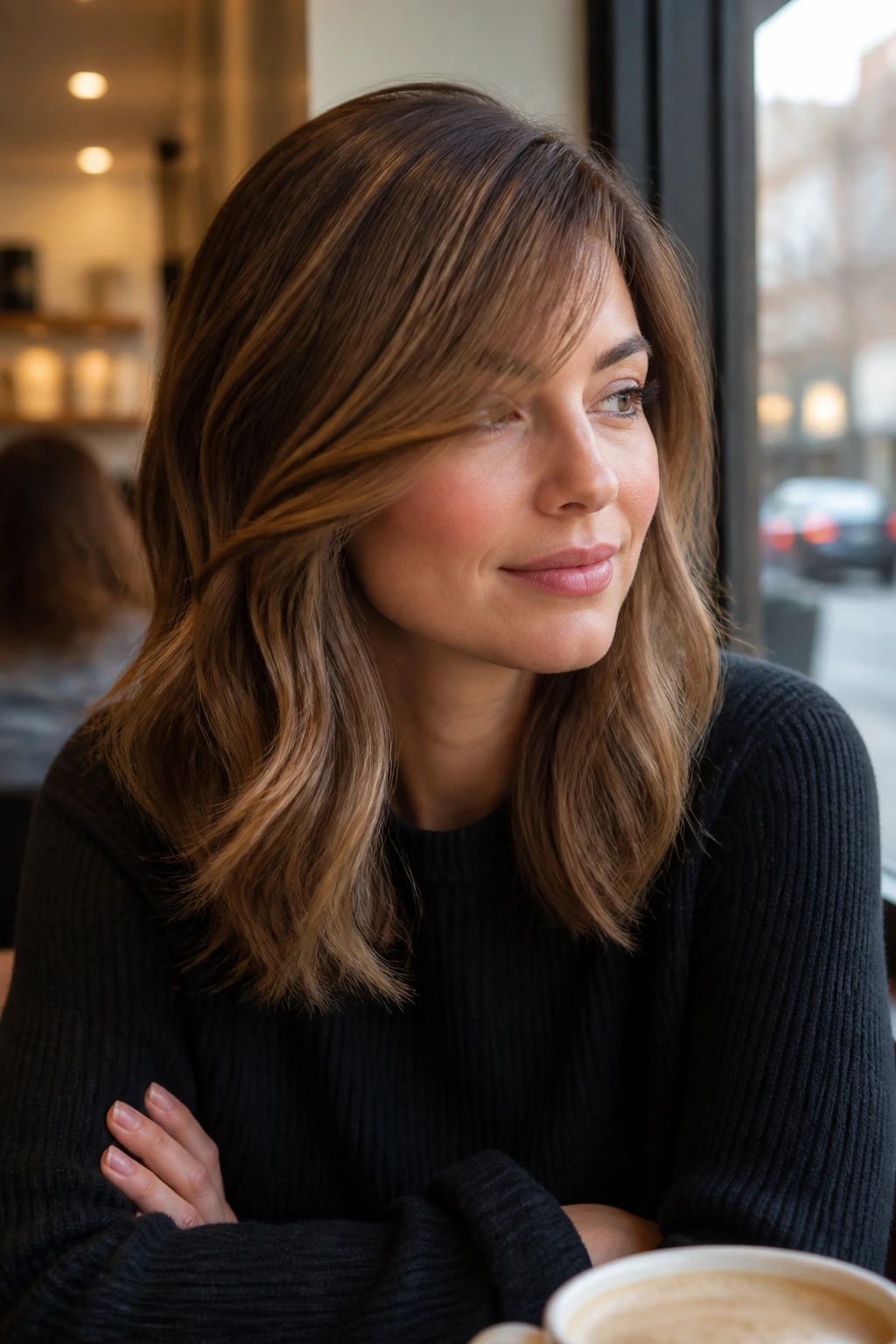
Can a side-swept fringe help a round face? Yes, if it’s angled and not too dense. A maple brown balayage with that kind of fringe creates a diagonal line across the forehead, which breaks up the symmetry that can make a round face feel broader.
The Parting Is Doing More Work Than You Think
Start with a side part that sits just off center, then let the fringe fall across one temple and taper into the rest of the cut. That diagonal line is the useful part. It draws the eye off to one side, then back down through the color.
Maple brown gives the whole look a warm, toasted feel. Keep the brightest pieces through the lower half of the hair, and let the fringe stay a shade deeper. If the bangs are too light, they take over the face.
For styling, a quick pass with a round brush is enough. You want the fringe to bend, not curl. Big difference.
10. Cocoa Balayage with Soft C-Curls
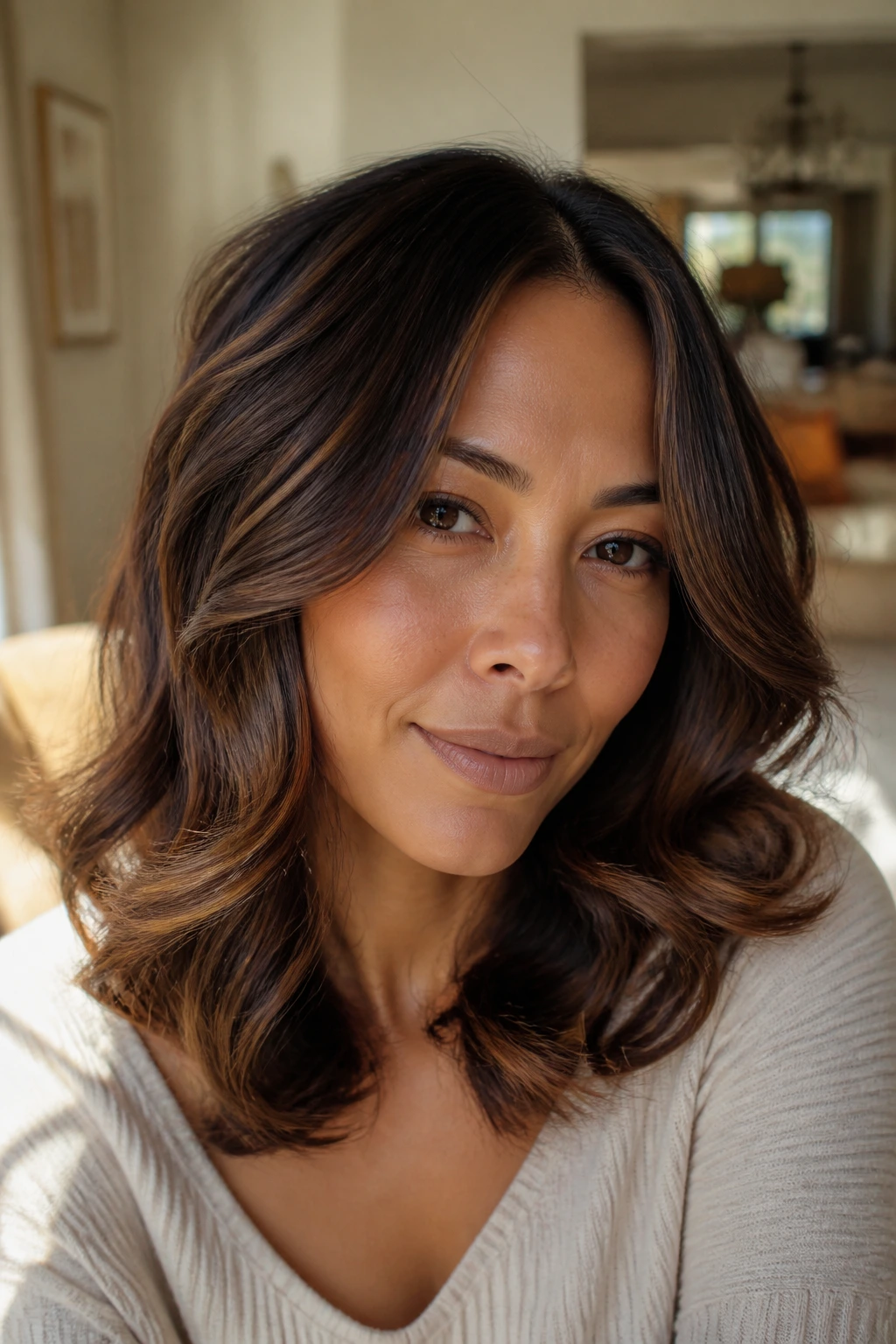
Soft C-curls are one of the easiest ways to keep a round face from looking wider than it is. They bend around the face without creating a puffy halo, and cocoa balayage gives the curl pattern some visual depth.
Imagine the curl turning in a gentle C shape from the mid-lengths down. That shape keeps the side sections smooth near the cheekbones and fuller lower on the hair, where the eye can move downward. That is the sweet spot.
- Use a 1¼-inch curling iron for loose C-curls.
- Curl away from the face on the front sections.
- Leave the ends out just a little so the look stays modern, not pageant-y.
A cocoa base with slightly lighter ribbons through the bends is enough. You do not need a dramatic contrast. In fact, too much contrast can make the curl pattern look busy.
11. Walnut Brown Balayage on a Long Layered Cut
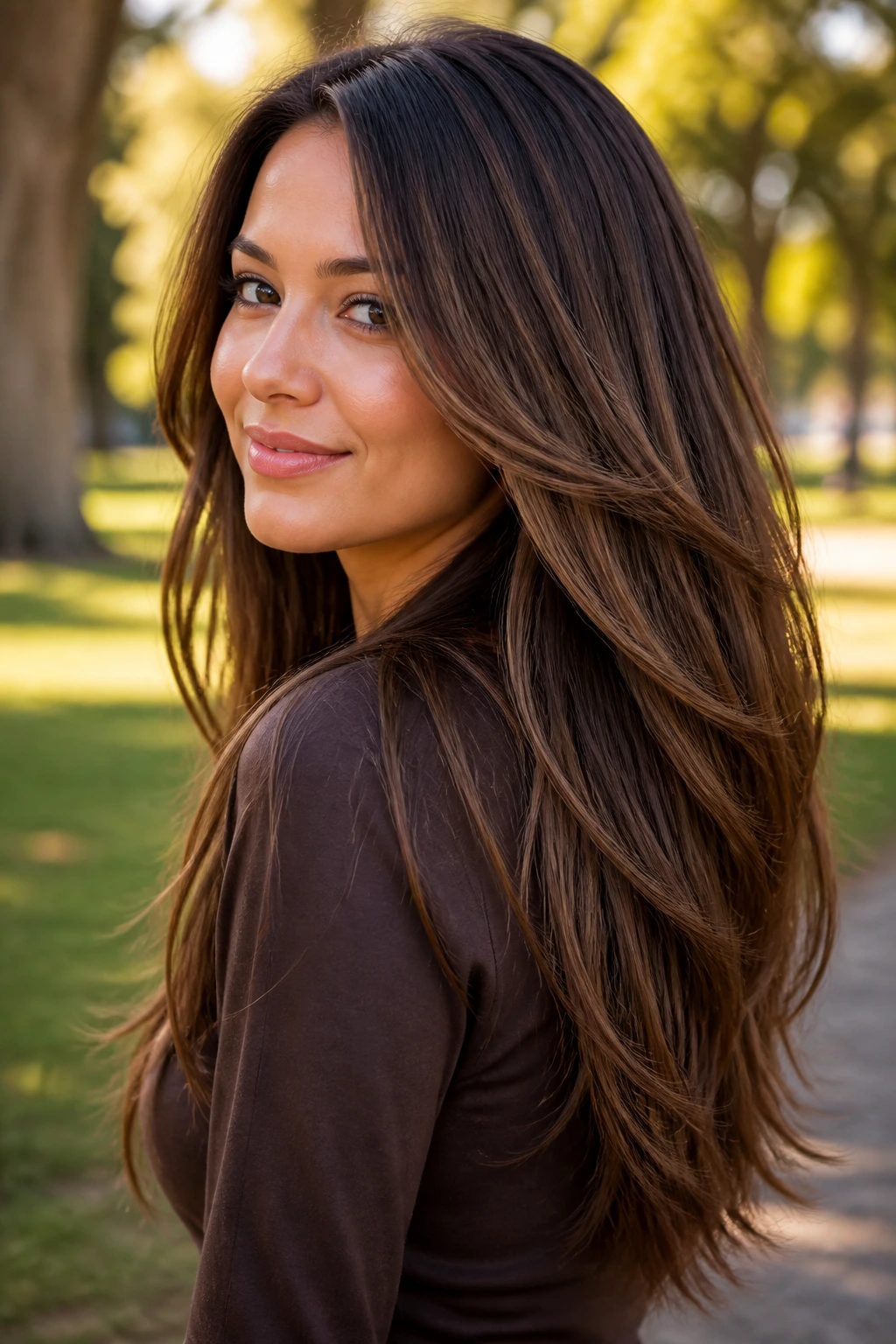
Long layers and walnut brown are a calm, reliable pair. The color is rich, a little earthy, and deep enough to keep the face from looking overly wide at the sides. The layers do the rest by creating a V-shaped fall through the back and keeping the front sections long.
I like this look for people who want movement but hate obvious color stripes. The balayage should feel tucked into the hair, not painted on top of it. Walnut pieces near the ends and through the lower mids keep the shape anchored.
It also grows out nicely, which is one of those practical things nobody mentions enough. Long hair with round faces can go flat fast if the placement is sloppy, but walnut tones fade into the base cleanly and keep the whole cut looking expensive without trying hard.
12. Smoky Brunette Balayage with Ashy Ends
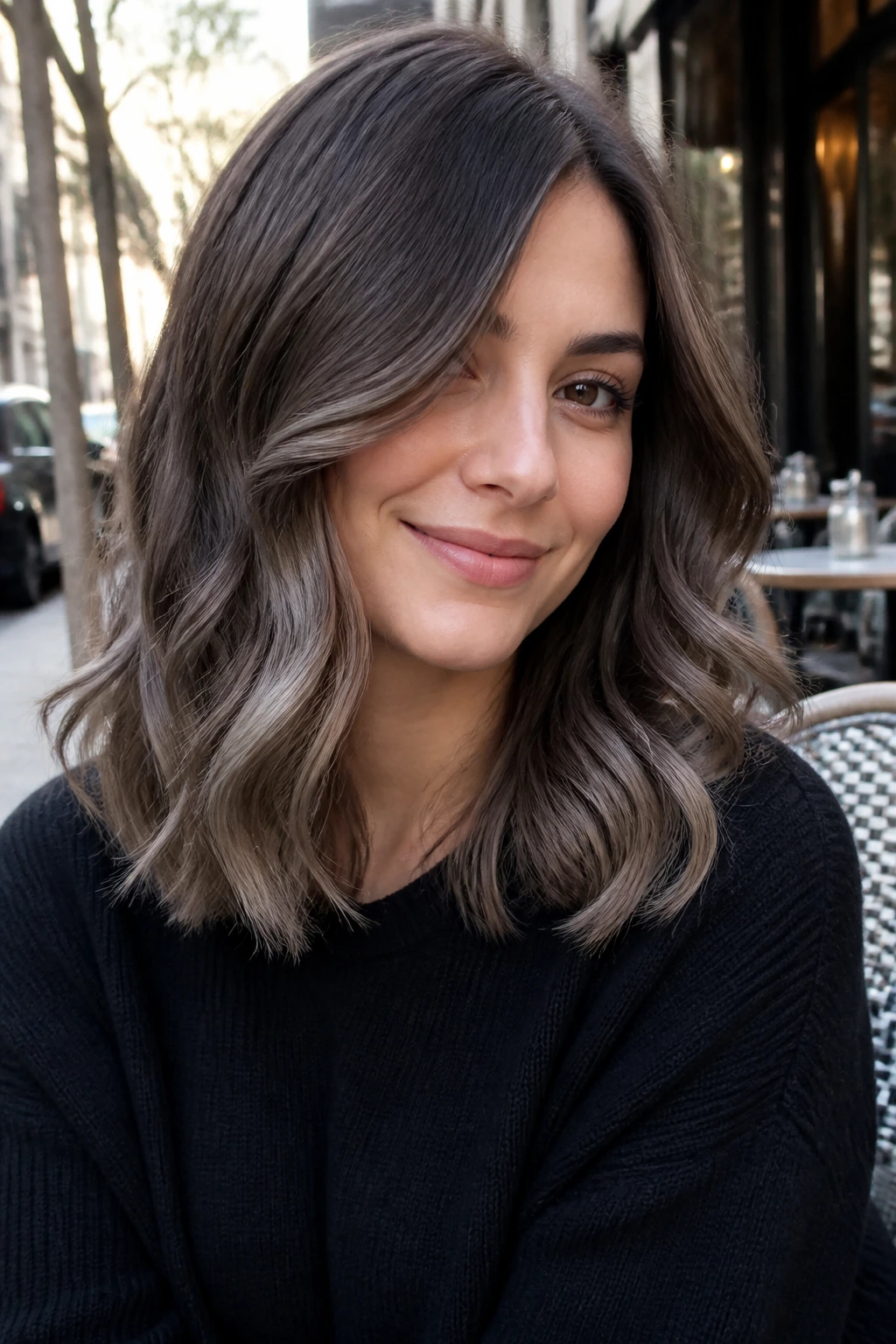
Smoky brunette is the cooler cousin in this group. It works best when you want softness but not warmth, and it can be a smart move if your face shape already reads full and you don’t want extra roundness from golden pieces.
Unlike caramel or honey, ashy ends keep the eye moving in a quieter way. The color doesn’t flare out at the sides. It just slips downward. That’s useful on a round face, especially with a shoulder-skimming cut or longer layers.
Who This Suits Best
- Cool or neutral undertones.
- Hair that lifts to a soft beige or ash tone without going orange.
- People who like a low-contrast brunette that still has dimension.
One caution: if your hair is very dark and resistant to lightening, this shade can turn muddy instead of smoky. A clean lift matters. If the lightening is weak, the tone loses its edge.
13. Bronze Brown Balayage with Broken Waves
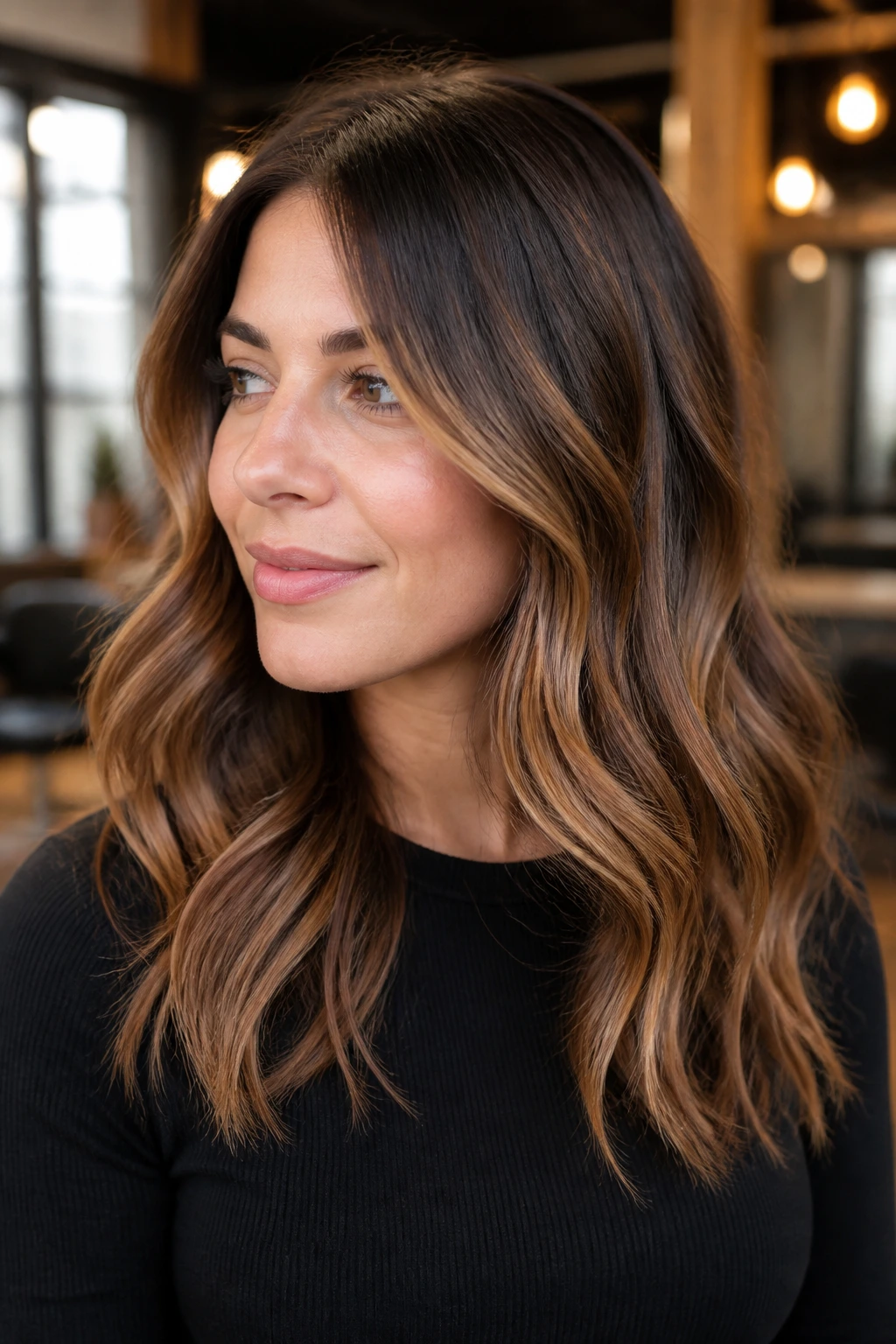
Bronze brown is for people who want a little shine in the mix. The warmth sits somewhere between brunette and soft copper, and broken waves make the color look scattered in a good way. Not messy. Scattered.
The placement should stay ribbon-like and low through the hair. Brightness around the temples can help, but keep it soft. If the widest part of the face gets the brightest pop, the balance slips. Broken waves fix that by bending the color into vertical pieces.
Why It Works
The rough, separated finish creates thin lines of light that travel through the hair. Those lines are flattering because they break up the width of a round face without sharp contrast.
If you like to air-dry, this one is forgiving. If you heat-style, keep the bends loose and avoid uniform curls. Uniform curls can make the sides balloon out. No thanks.
14. Latte Balayage with a Deep Side Part
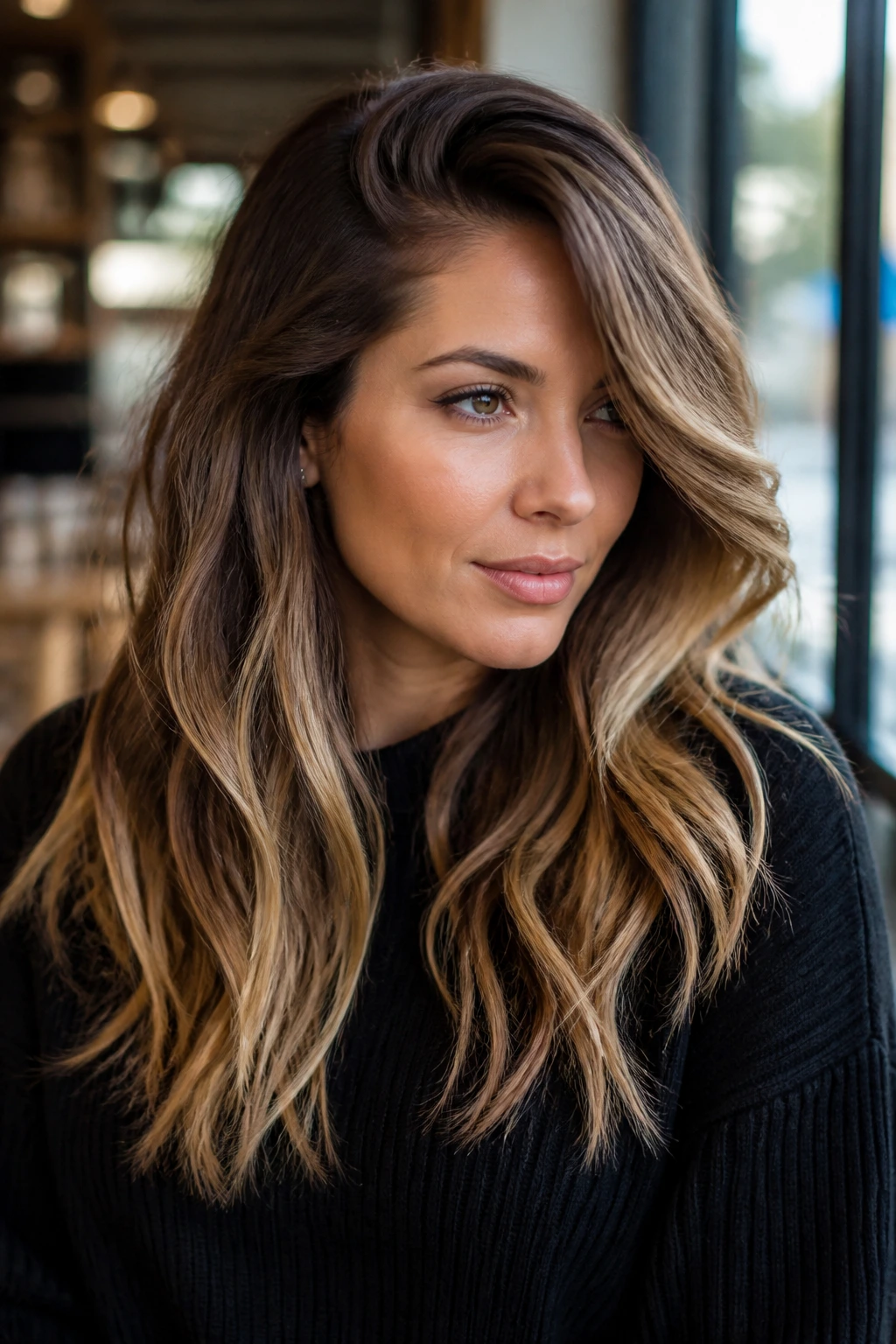
A deep side part can be a lifesaver on a round face. It creates instant asymmetry, and the latte balayage makes that asymmetry feel soft instead of severe. The result is elegant in a very everyday way.
The color is the point here: creamy brown at the base, lighter latte ribbons through the mids, and a bit more brightness through the lower lengths. That pattern pulls the eye down and away from the widest point of the cheeks.
A deep side part also gives you a little lift at the crown, which helps lengthen the face from top to bottom. If your hair tends to fall flat, use a root spray and blow-dry in the opposite direction first. Then flip it back. Simple trick. Works.
15. Chestnut Curly Balayage with Halo Dimension
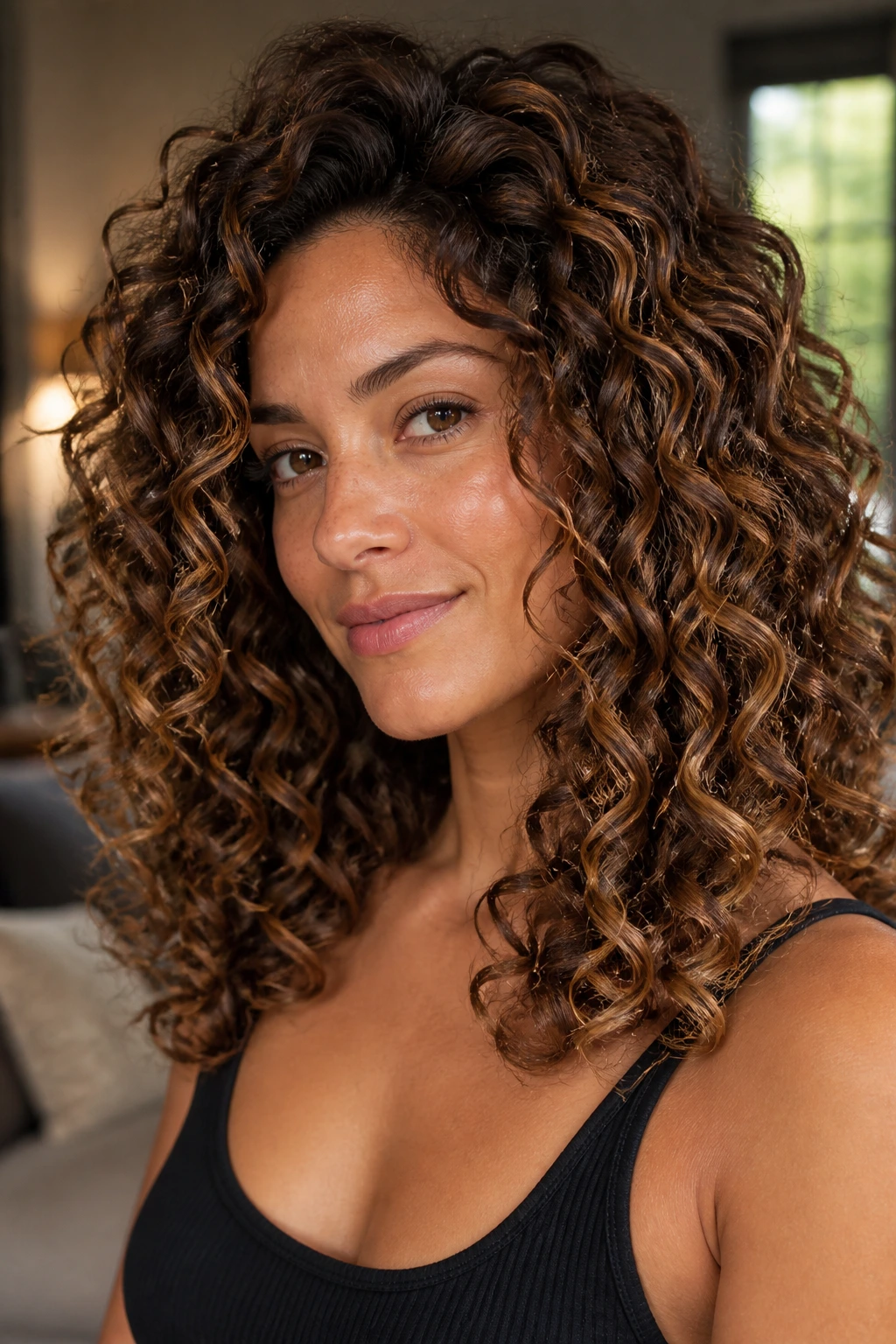
Curly hair changes the game, and chestnut balayage can be gorgeous on it when the light is placed with a bit of restraint. The best version keeps brightness around the outer halo of the curls, not in a wide band around the cheeks.
How to Place the Light
Think about the curl as a stack of rings. You want the chestnut to show through the middle and lower rings while the brightest pieces live on the surface and at the ends.
- Keep the face frame soft and narrow.
- Brighten the curls below the cheekbone first.
- Avoid heavy light pieces at the widest point of the curl cluster.
That approach keeps the shape round in a controlled way instead of adding width where you do not want it. Chestnut is warm enough to feel rich but deep enough to stay balanced.
16. Copper-Brown Balayage with Crown Lift
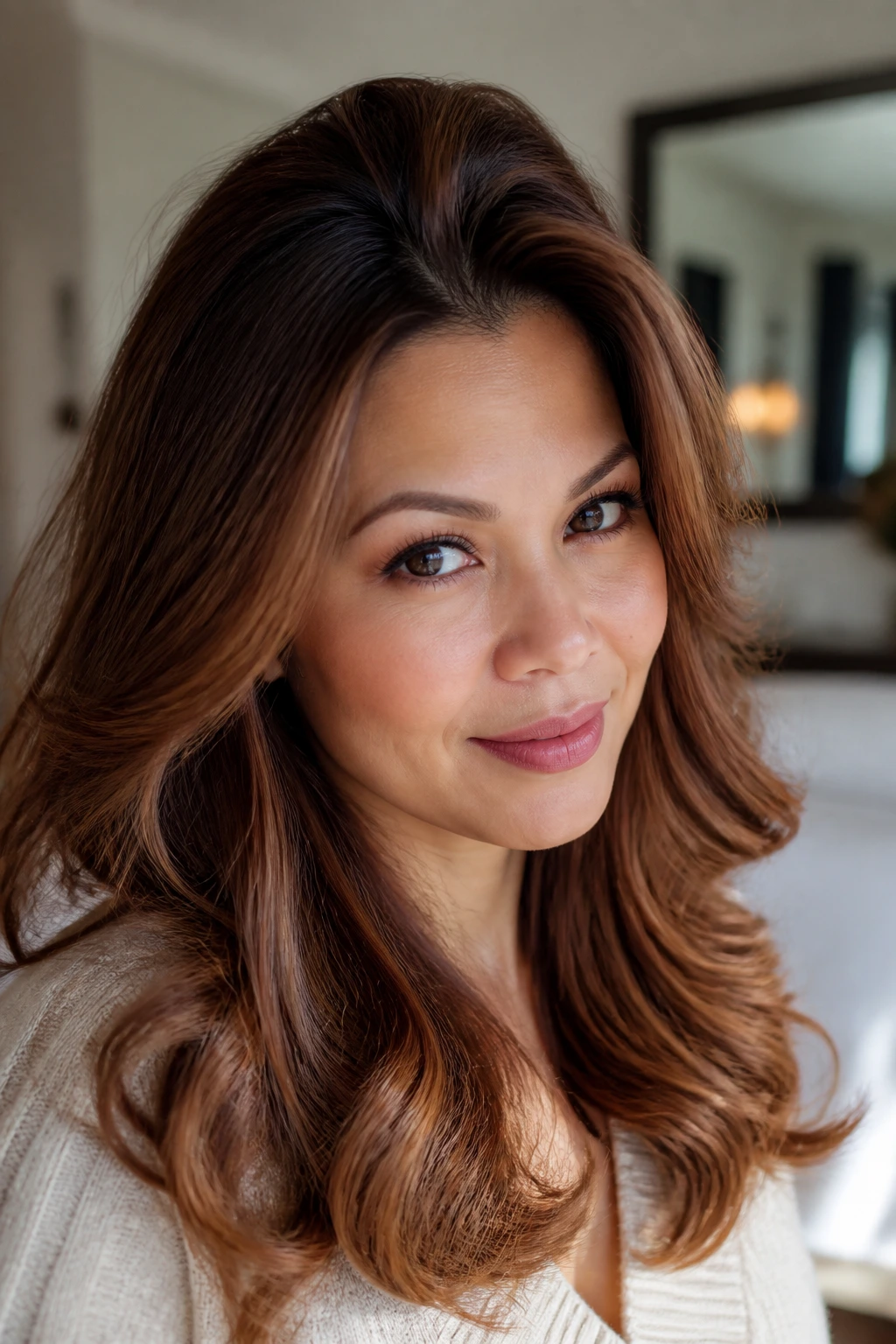
Copper-brown is a little bolder, and round faces can wear it well if the volume stays up top. That crown lift matters. It creates height where you want it and keeps the color from spreading horizontally across the cheeks.
A small amount of copper through the mid-lengths gives life to the brown base, while darker roots keep the top anchored. If the whole head turns copper, the shape loses definition. Keep the warmth in the lower half and let the crown stay deeper.
- Tease the crown lightly before styling.
- Use a round brush at the roots.
- Finish with a medium-hold spray, not a crunchy one.
The goal is softness with a little lift, not big pageant hair. That’s a different thing.
17. Dark Chocolate Balayage with Face-Framing Veils
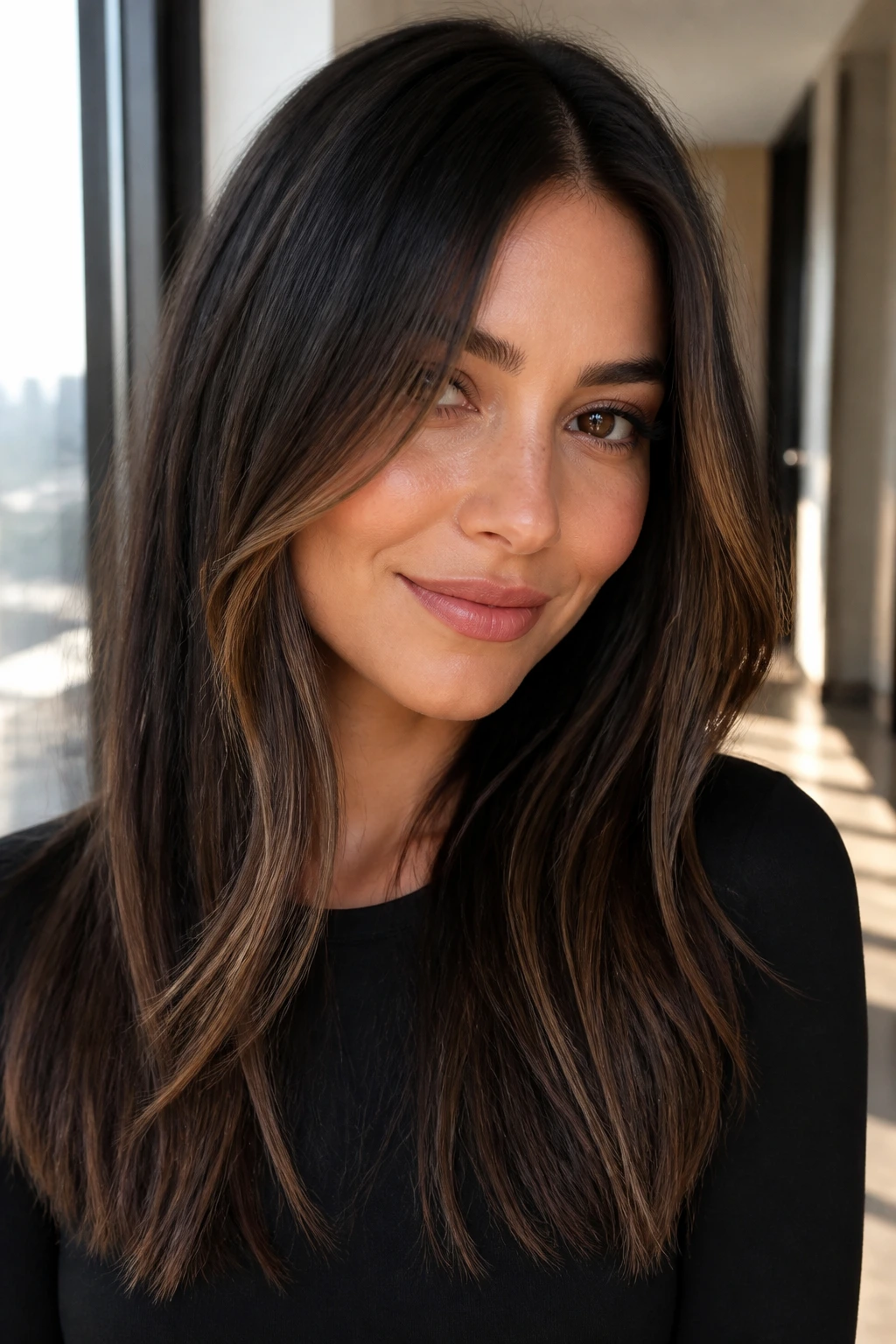
Dark chocolate balayage is one of the most underrated looks for a round face. It doesn’t depend on loud contrast. It depends on placement, and the placement is subtle: a few lighter veils around the face, then deeper chocolate through the rest.
The veils should begin lower than the cheekbones and melt toward the collarbone or longer. That creates a long visual line beside the face, which is exactly what round faces tend to like. If you go too wide with the face frame, the color starts pushing outward instead of downward.
This look is also easy to wear straight. That’s a plus. Straight brunette hair with a soft veil of light can look clean and expensive without looking stiff. The depth at the root keeps the whole thing from flattening out.
18. Beige Brown Balayage with a Butterfly Cut
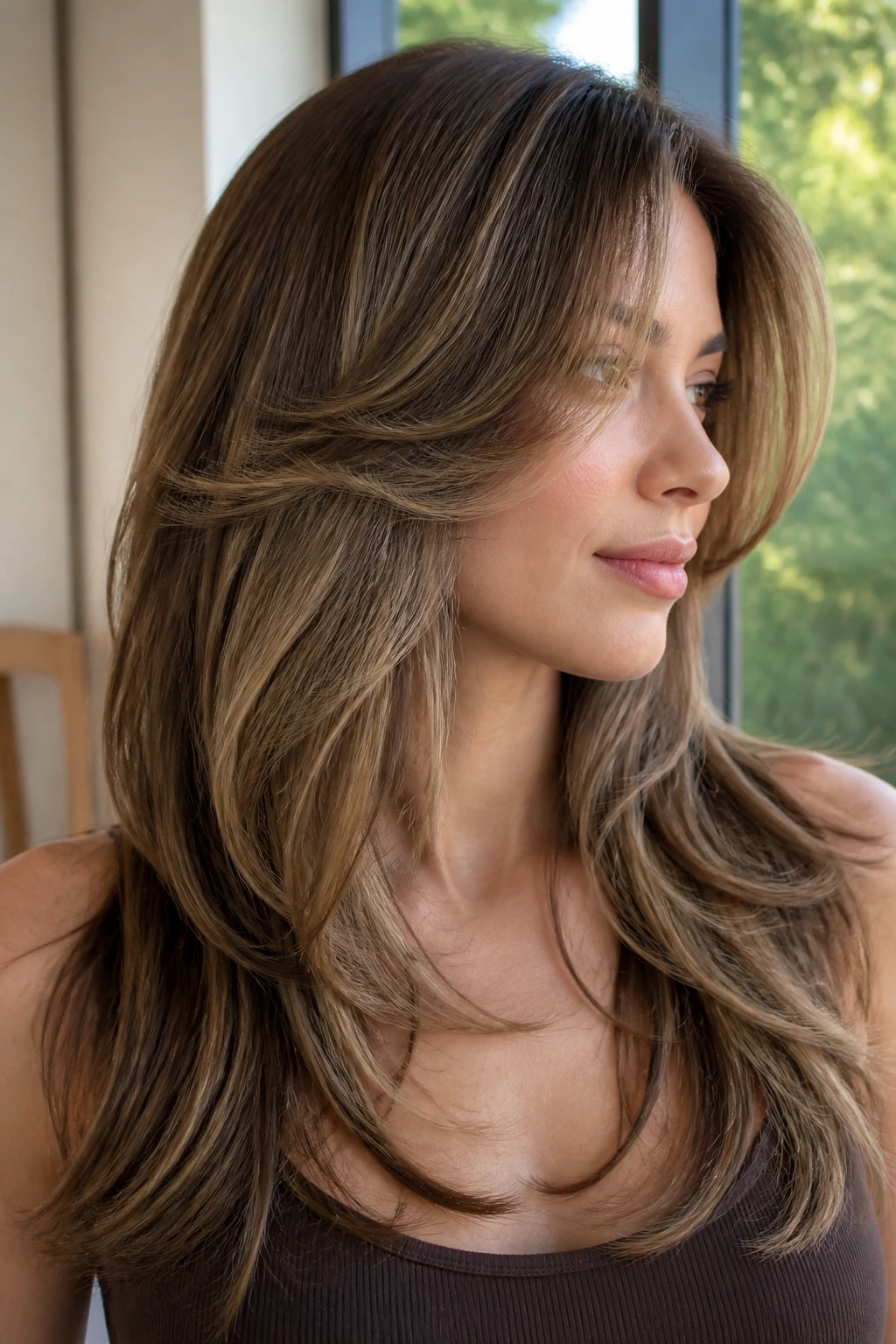
A butterfly cut gives you shorter face-framing layers and longer layers underneath, and beige brown balayage makes all that movement easier to read. On a round face, the trick is to keep the shortest pieces just below the cheekbone so they don’t widen the widest part of the face.
Compared with a heavy layered cut, this version feels lighter around the temples and jaw. That’s the useful difference. The beige brown tones brighten the floating layers without turning them brassy, and the longer back section keeps the profile lengthened.
If your hair is thick, the butterfly cut can take a lot of weight out without sacrificing shape. If it’s fine, go lighter on the layering and keep the balayage soft. Too many chopped layers can make the ends look thin. Nobody wants that.
19. Textured Bixie with Caramel Crown Lights
A bixie sounds risky until you see it on the right face shape. On a round face, it works when the sides stay close and the top stays lifted. Caramel crown lights help create that lift, and the shorter length keeps the silhouette neat instead of wide.
What Makes It Different
The caramel should sit mostly on the top and upper sides, not in a broad belt around the head. That gives the cut height and movement. The back can stay deeper, which keeps the eye moving upward and down through the fringe pieces.
This cut is for someone who likes short hair but does not want it to feel helmet-like.
- Keep the fringe piecey, not blunt.
- Ask for textured ends through the top only.
- Use paste or light cream to separate the layers.
A bixie with strong crown lights can be unexpectedly flattering. Tiny cut. Big payoff.
20. Almond Brown Balayage with Wispy Curtain Bangs
Almond brown has a softer, creamier feel than espresso or chestnut, and wispy curtain bangs stop the front of the hair from feeling heavy. On a round face, that feathered center opening is useful because it creates two gentle vertical lines and lets the forehead breathe.
The bangs should be thin enough to bend, not sit in one solid sheet. If they are too dense, they will add weight across the cheeks. Keep them light, keep them split, and let the almond brown live mostly through the lower mids and ends.
I like this look on medium-length cuts that skim the collarbone. It feels easy, but it is doing real work. The softness in the bang line balances the face, and the color keeps the shape from collapsing into a single block.
21. Toasted Pecan Balayage with Soft Ends
Can a warm brunette still feel fresh on a round face? Yes, if the ends stay soft and the placement isn’t too wide. Toasted pecan gives you that warm, nutty tone without tipping into brass, and the softness keeps the whole style from getting heavy.
Where the Brightness Should Sit
Focus the pecan ribbons through the lower mid-lengths and the last few inches. Leave the root area deeper so the color has somewhere to move from. If the light starts too high, the face can look broader.
For styling, a loose bend at the ends is enough. You want the hair to swing, not puff.
A small note: this shade looks especially nice in natural light because the warmth shows up in thin threads, not as one flat color.
22. Mulled Brown Balayage with Long Straight Lengths
Straight hair on a round face can be tricky if the cut lands at the cheeks and the color sits too evenly. Mulled brown balayage fixes part of that by building depth at the root and brightness lower down, so the eye keeps moving.
Imagine long straight lengths with tiny shifts of cinnamon, cocoa, and soft chestnut through the underside. That’s the feeling. The top stays darker. The lower half gets the warmth. The result is clean, not fussy.
- Ask for a subtle root stretch.
- Keep the brightest strands below the jawline.
- Add a tiny bevel at the ends so they do not hang like a ruler.
The bevel sounds minor, but on straight hair it changes the whole shape. A dead-straight perimeter can make the face feel wider than it is.
23. Iced Mocha Balayage with Feathered Layers
Iced mocha is a good answer if you like brunette hair with a cooler edge. The tone has that soft, caffeinated look — deeper brown at the base, lighter ash-mocha through the mids, and feathered layers that stop the cut from getting bulky.
The feathering is the important part. It keeps the layers from stacking at the cheeks, which is a common problem on round faces. If the cut is feathered correctly, the light lands in thin vertical pieces instead of broad side panels.
This style is especially nice when worn with a blowout that turns the ends slightly under and away from the face. That little movement keeps the eye traveling downward. It also makes the color look more expensive, though I hate that phrase because it sounds lazy. Still, it fits.
24. Chestnut-Black Balayage with a Deep Root Stretch
Chestnut-black is for someone who likes dark hair but still wants dimension. The deep root stretch keeps the top rich and grounded, while the chestnut pieces open up the lower half of the hair so the face doesn’t feel boxed in.
Unlike high-contrast blonde balayage, this one whispers. It does not flash from a distance. Up close, though, the warmth in the chestnut is what stops the style from looking flat. On a round face, that low-contrast depth can be a smarter choice than brighter color because it doesn’t widen the cheeks.
Best on thick hair, honestly. Fine hair can wear it too, but the cut needs movement. If the hair lies too close to the head, the darkness can feel heavy. Keep a few lighter streaks near the ends and you’ll avoid that problem.
25. Plum Brown Balayage with Long Glassy Layers
Plum brown is the boldest shade in this group, and it works on round faces when the layers stay long and the finish stays smooth. The slight berry tone brings life to deep brunette hair, while the glassy layers keep the silhouette vertical and sleek.
I like this look because it does not rely on obvious face-framing tricks. The long layers themselves do the shaping, and the plum-brown ribbons hide in the movement until the light hits them. That makes the color feel richer, not louder.
If you want one brown balayage look that can handle a round face without begging for attention, this is a strong candidate. Keep the shortest layers below the cheekbone, keep the gloss high, and let the color live in the length. That’s the whole thing, really.
