



Black hair looks rich on its own. Add blonde in the wrong spot, and a round face can look wider than it is. Put that same blonde in the right place, and the face seems a little longer, a little sharper, a little more planned.
The placement does most of the work. Pieces that start around the cheekbones can spread the face out visually, while lighter strands that run from the temples to the ends pull the eye down. A narrow money piece can do more than a whole head of broad highlights if the rest of the hair stays dark.
That is why this kind of color work has so much room to play. Ash blonde, honey, beige, pearl, platinum, and mushroom tones each tell a different story on black hair, and the face shape changes how loud or soft each one feels. On a round face, I usually like contrast that moves vertically, not a stripe that sits flat and wide.
You will see both bold and quiet options below. Some are easy to wear every day; others are for people who want the blonde to show even when the hair is tied back or tucked behind the ear. Either way, the goal is the same: black depth where you want slimming, blonde where you want lift.
1. Soft Money Piece Highlights
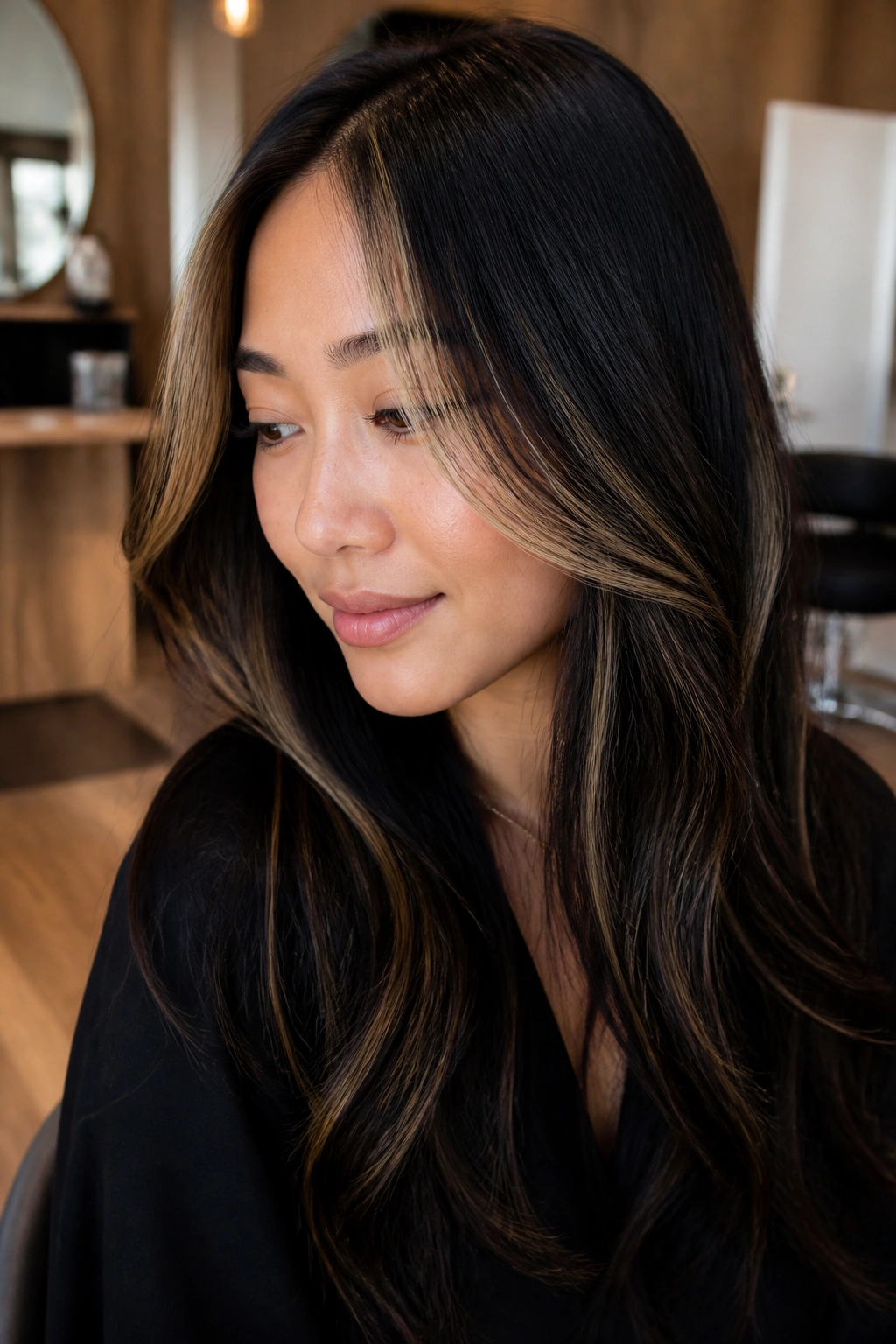
A soft money piece is one of the cleanest ways to bring blonde into black hair without flooding the whole head with light. The trick is keeping the front pieces narrow, feathered, and a little longer than the cheekbone so they don’t widen the face.
Why It Works on a Round Face
The front light catches first, so it pulls attention upward and downward instead of side to side. That matters. A round face usually benefits from movement that starts near the temples and falls past the jaw, because it makes the face read a little longer.
A money piece does not need to be chunky to do its job. In fact, too much width can make the cheeks look fuller than they are.
- Keep the brightest blonde just off-center if your face is very round.
- Ask for a soft root blur so the contrast doesn’t look harsh at the hairline.
- Let the pieces taper as they reach the collarbone.
Best tip: ask for a soft frame, not a solid stripe.
2. Ash-Blonde Curtain Pieces
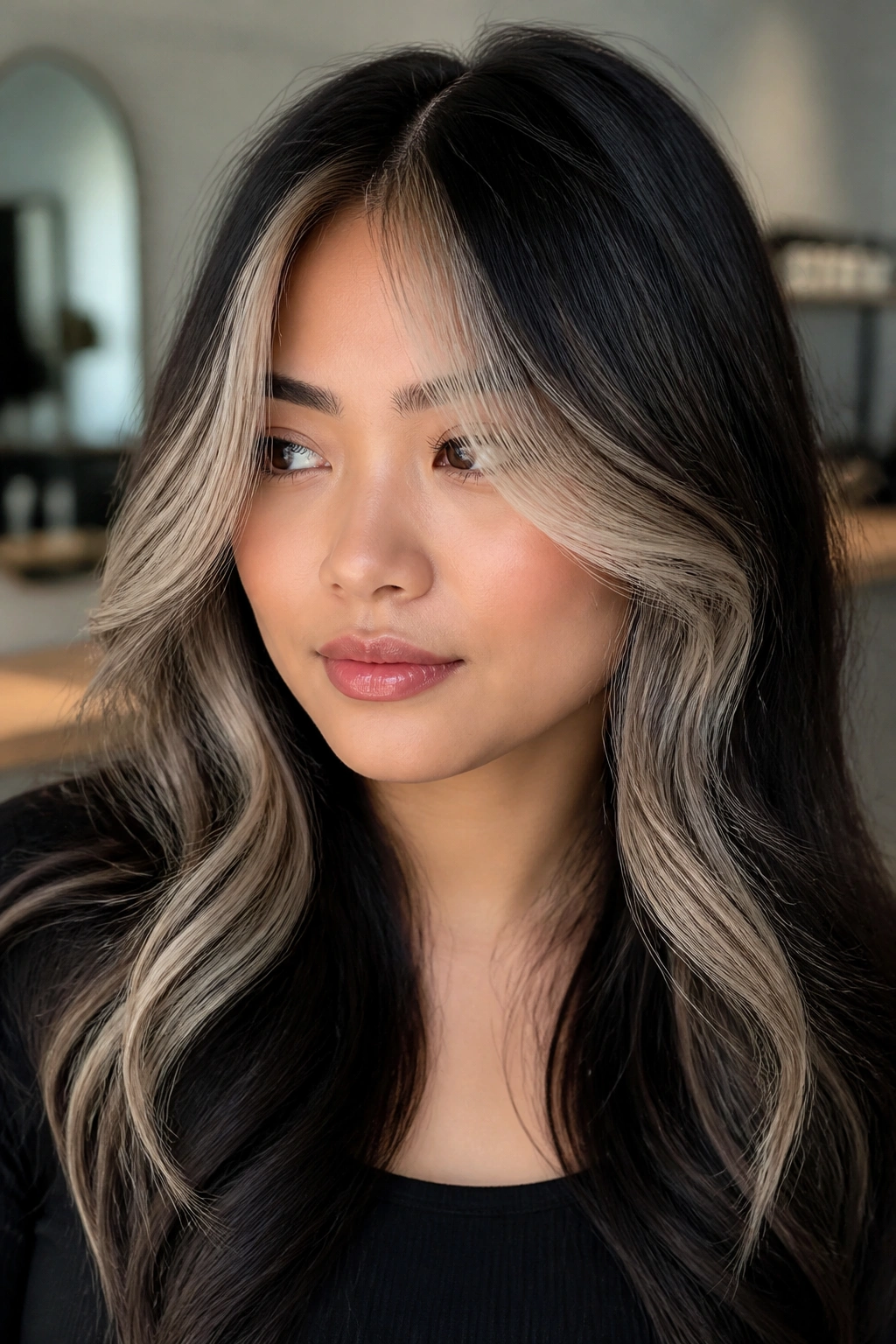
Why do ash-blonde curtain pieces work so well on black hair? Because the cooler tone keeps the contrast from feeling loud, and the shape of curtain bangs naturally narrows the middle of the face.
Ash blonde can look smoky, almost silvery in some light, which is useful if you want the blonde to feel sleek instead of sunny. On a round face, that cooler tone helps the front pieces read like vertical lines rather than a broad bright patch.
How to Ask for It
Tell your colorist you want blonde that starts around the brow or slightly below it, then slides down past the cheekbones. That line matters more than the exact shade.
If you wear a center part, keep the blonde narrow and soft near the nose. If you wear a side part, let one side be a little heavier so the face gets more asymmetry.
A subtle ash glaze helps keep the tone crisp, especially if your hair lifts warm underneath.
3. Caramel Balayage Ribbons
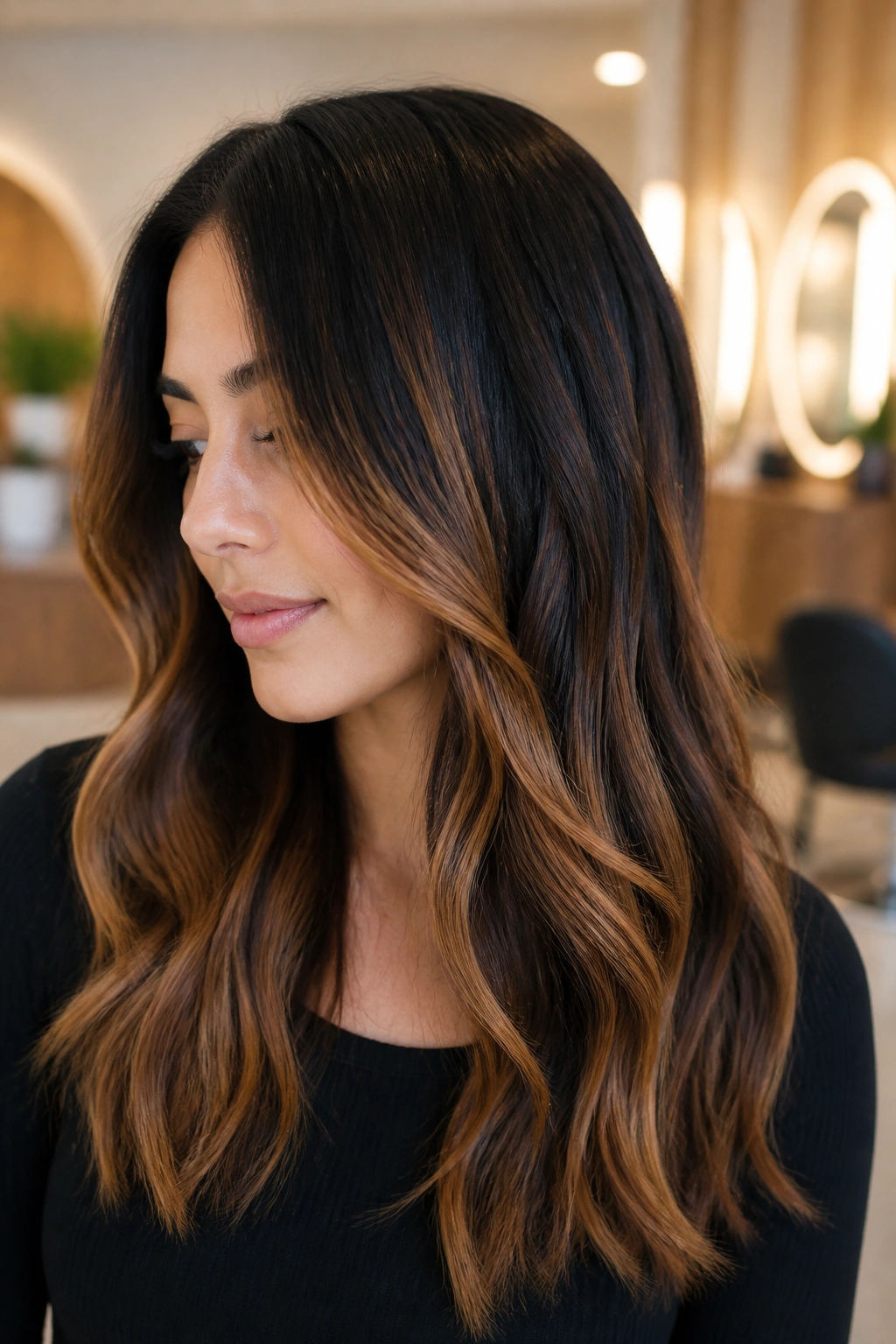
Caramel balayage on black hair gives you warmth without turning the whole look into a high-contrast block. The lighter ribbons sit through the mid-lengths and ends, which helps the eye travel down the hair instead of stopping at the widest part of the face.
This is one of the easier blonde-black hair color ideas for round faces if you like softness. Caramel sits between blonde and brown, so it melts into the black base instead of shouting over it.
If your hair is wavy or layered, the ribbons move around in a nice way. Straight, blunt hair can take it too, but the effect is flatter.
A small warning: don’t let the lightest pieces sit exactly at cheek level. Drop them lower, or the shape can puff out visually.
4. Platinum Ends With a Dark Root Melt
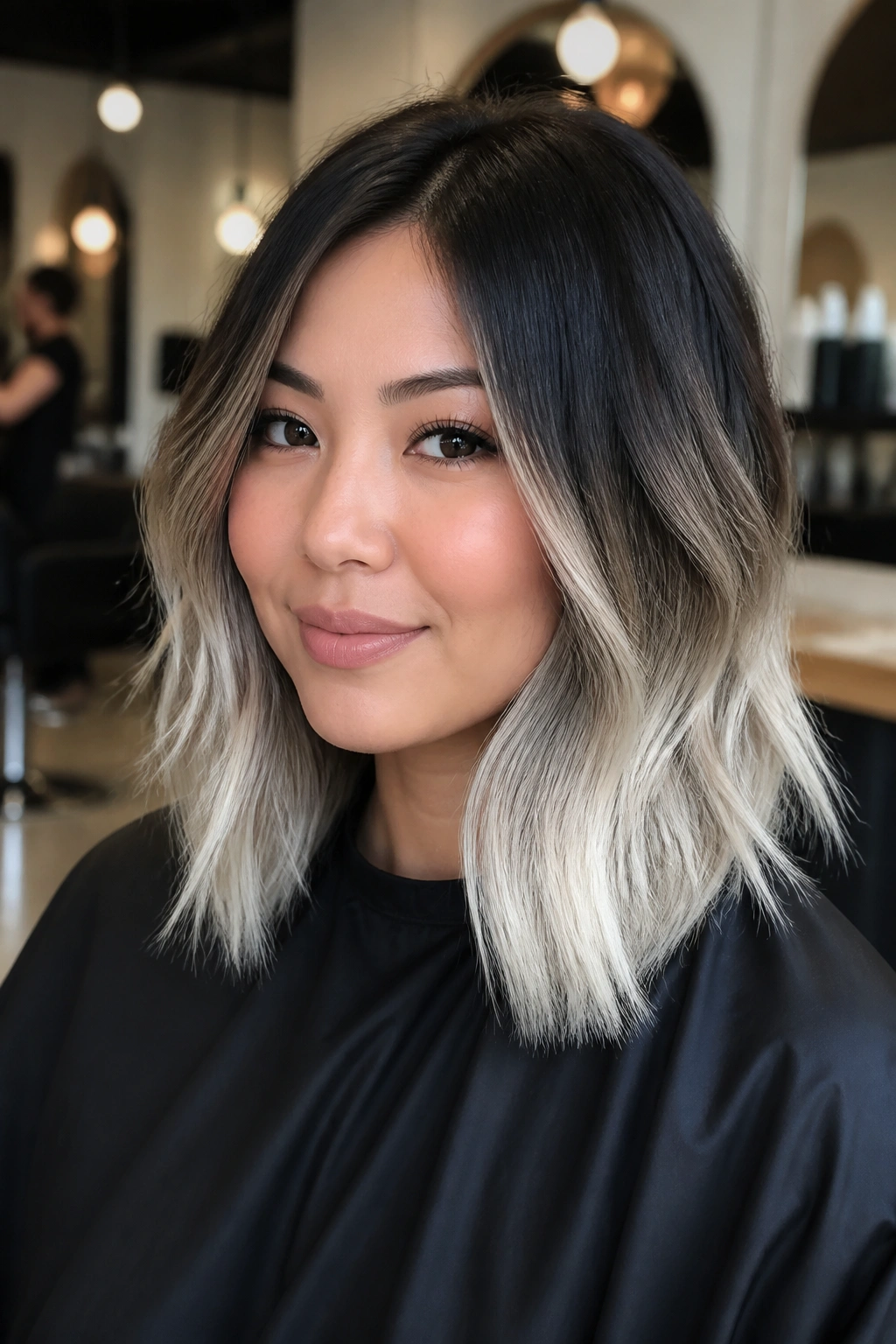
Platinum ends sound dramatic, and they are. But on a round face, the dark-root-to-light-end fade can be smarter than people expect because it keeps the eye moving downward.
The root melt is the important part. Without it, platinum can look blocky against black hair. With it, the blonde begins as a soft transition and ends in a bright finish that gives the length more presence.
What to Watch For
- Works best on shoulder-length hair or longer.
- Needs careful lightening, often more than one appointment on very dark hair.
- Looks sharper when the ends are textured, not blunt.
Keep the platinum at the bottom half of the hair, not across the upper side sections. That keeps the cheeks from looking wider and gives the face more stretch. A little wave helps, too. Flat ironed platinum ends can look a bit stiff if the cut is heavy.
5. Chunky 90s Front Streaks
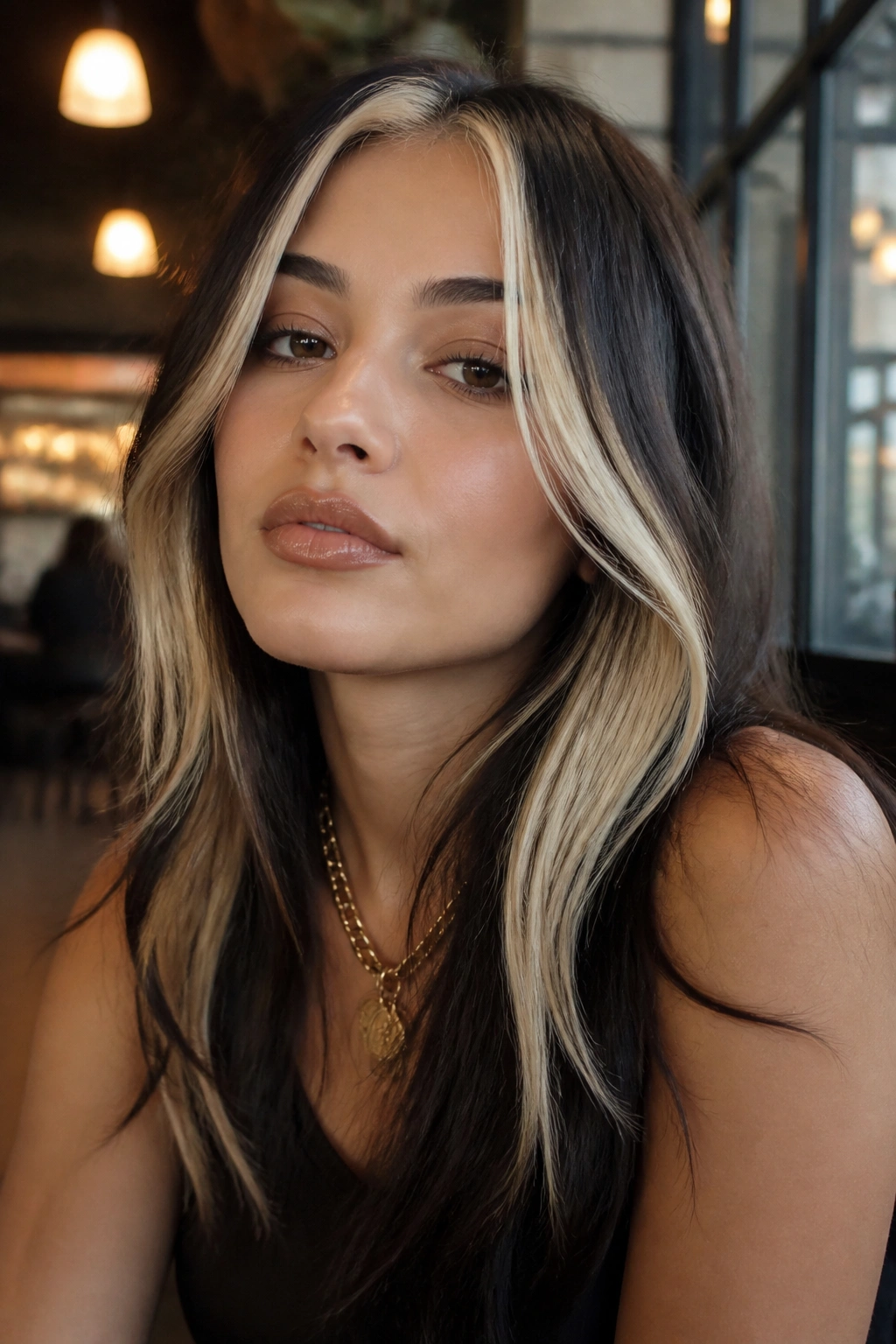
Chunky front streaks are back for a reason. They give black hair a bold frame, and when the streaks are placed with care, they can make a round face look longer rather than fuller.
The key is to keep the stripes narrow near the cheek and slightly longer as they fall. That keeps the blonde from forming a horizontal band across the widest part of the face. Go thick enough to notice. Not so thick that they swallow the shape of the haircut.
Compared with delicate babylights, chunky pieces are louder and a little more graphic. If you like strong lines and clear contrast, that is the appeal.
They work best with layered cuts, side parts, and a bit of bend through the front. Straight, one-length hair can make them feel too stiff.
6. Beige Blonde Underlayers
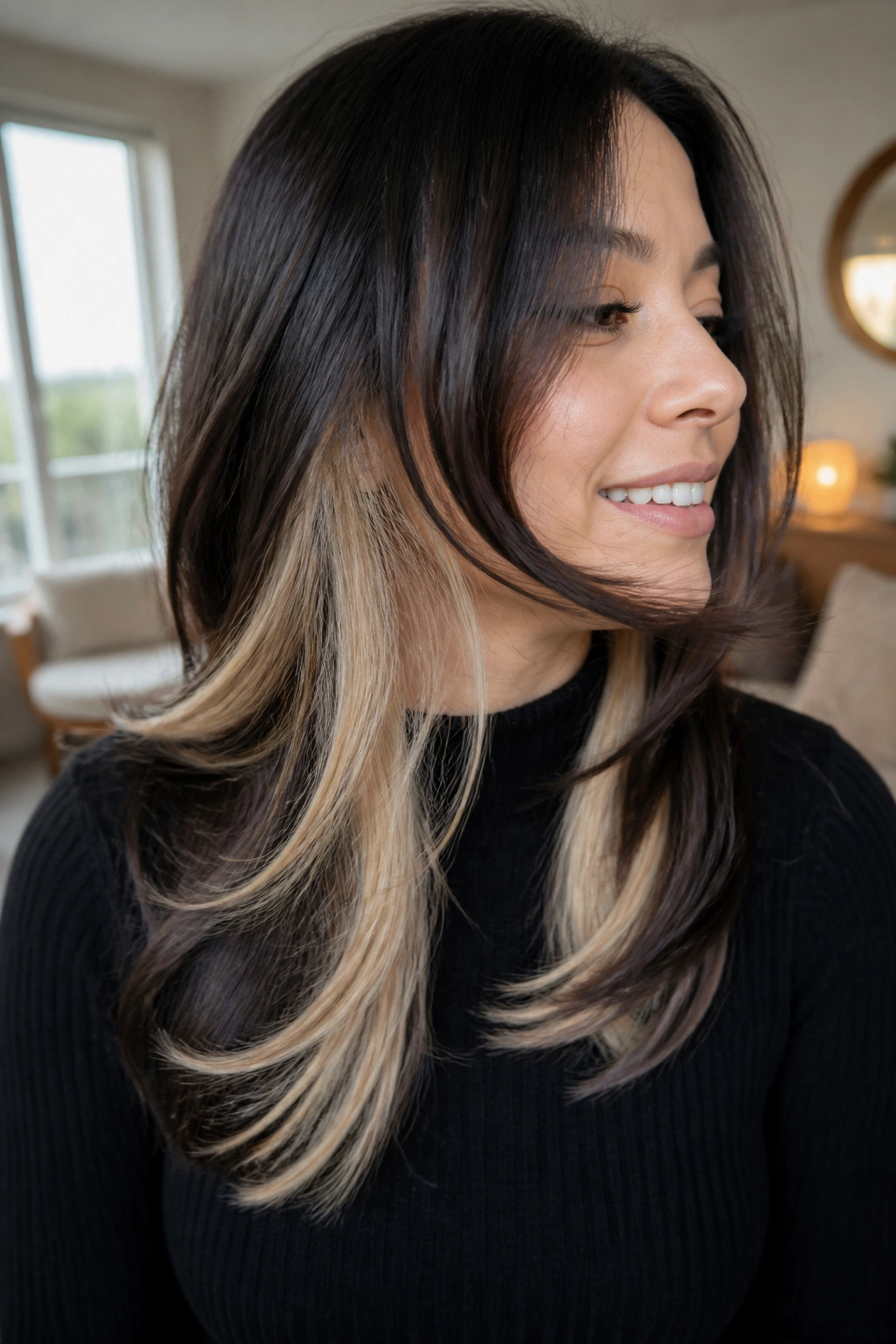
Beige blonde underlayers are one of my favorite quieter ideas because they hide a lot of the drama under the surface. The top stays mostly black, while the lighter beige shows when the hair swings, lifts, or gets tucked behind the ear.
That hidden placement helps a round face because the blonde does not sit directly around the cheeks all day. It appears in motion, which keeps the look lively without drawing a hard outline around the face.
Beige is also a smart shade if you want something softer than platinum but cooler than honey. It looks polished without going icy.
A plain truth: this idea looks better when the hair has movement. If your cut is dead-straight and heavy, the underlayer may stay hidden too often.
7. Honey Blonde Babylights
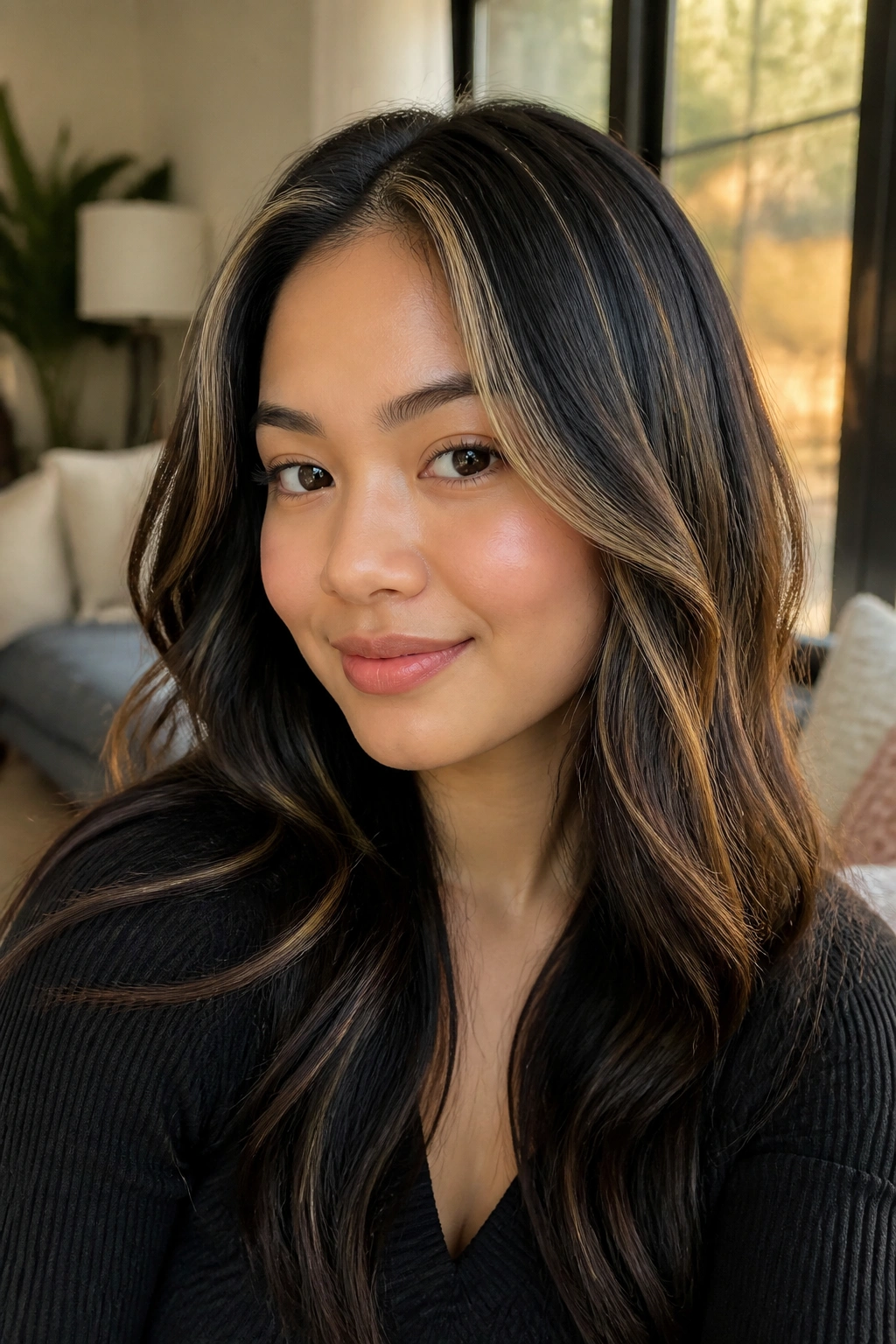
Honey blonde babylights are tiny, thin highlights that add warmth in small flashes. On black hair, they can make the surface look richer and less flat, which is useful if you want blonde without a big color commitment.
Why They Suit Round Faces
Because the lights are so fine, they do not build width. Instead, they create a soft shimmer around the crown and front layers. That slight lift near the top matters more than people think.
Babylights are also forgiving. If your hair is dark and you do not want a hard grow-out line, this is a calmer route.
How to Keep Them Soft
- Keep most of the light near the crown, temples, and longer front layers.
- Ask for a honey tone, not a bright yellow blonde.
- Pair the color with waves or soft bends so the lights break up across the hair.
The effect should feel airy, not striped.
8. Smoky Mushroom Blonde Melt
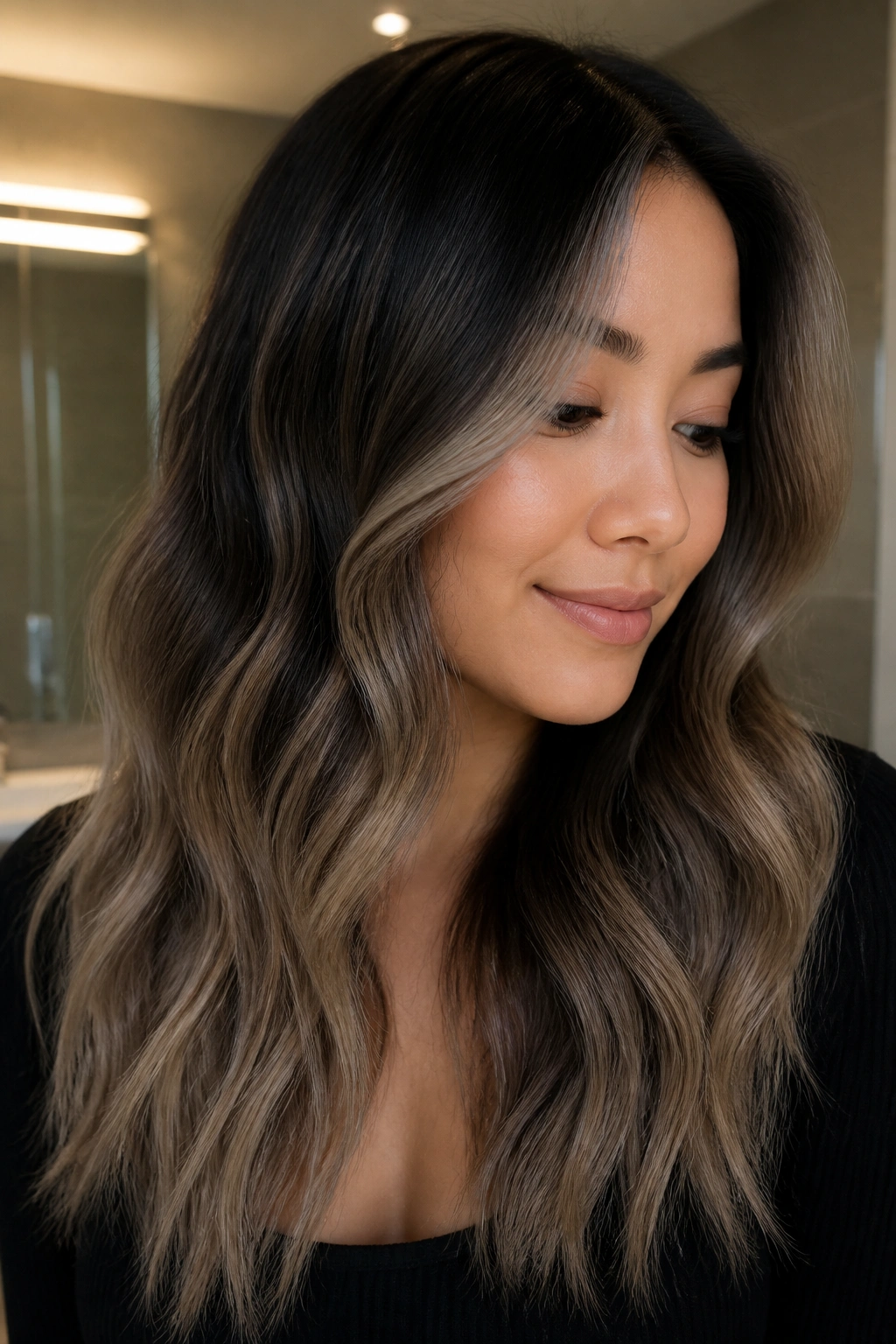
Smoky mushroom blonde sits in that cool beige-gray zone that looks expensive without trying too hard. On black hair, it softens the darkness and gives the color a muted, cloudy finish.
That is good news for round faces. The shade itself is not loud, so the shape of the placement does the work instead of the brightness of the blonde. A mushroom melt through the ends or front sections can trim visual width in a way heavy golden highlights sometimes cannot.
This tone also behaves well if you do not love brass. It can be glossed back toward beige or kept a little ashier, depending on how cool you want it to feel.
The one thing I would avoid is placing it in a thick band around the cheeks. Let it fade through the lower half of the hair, where it can stretch the face rather than sit beside it.
9. Peekaboo Blonde Panels
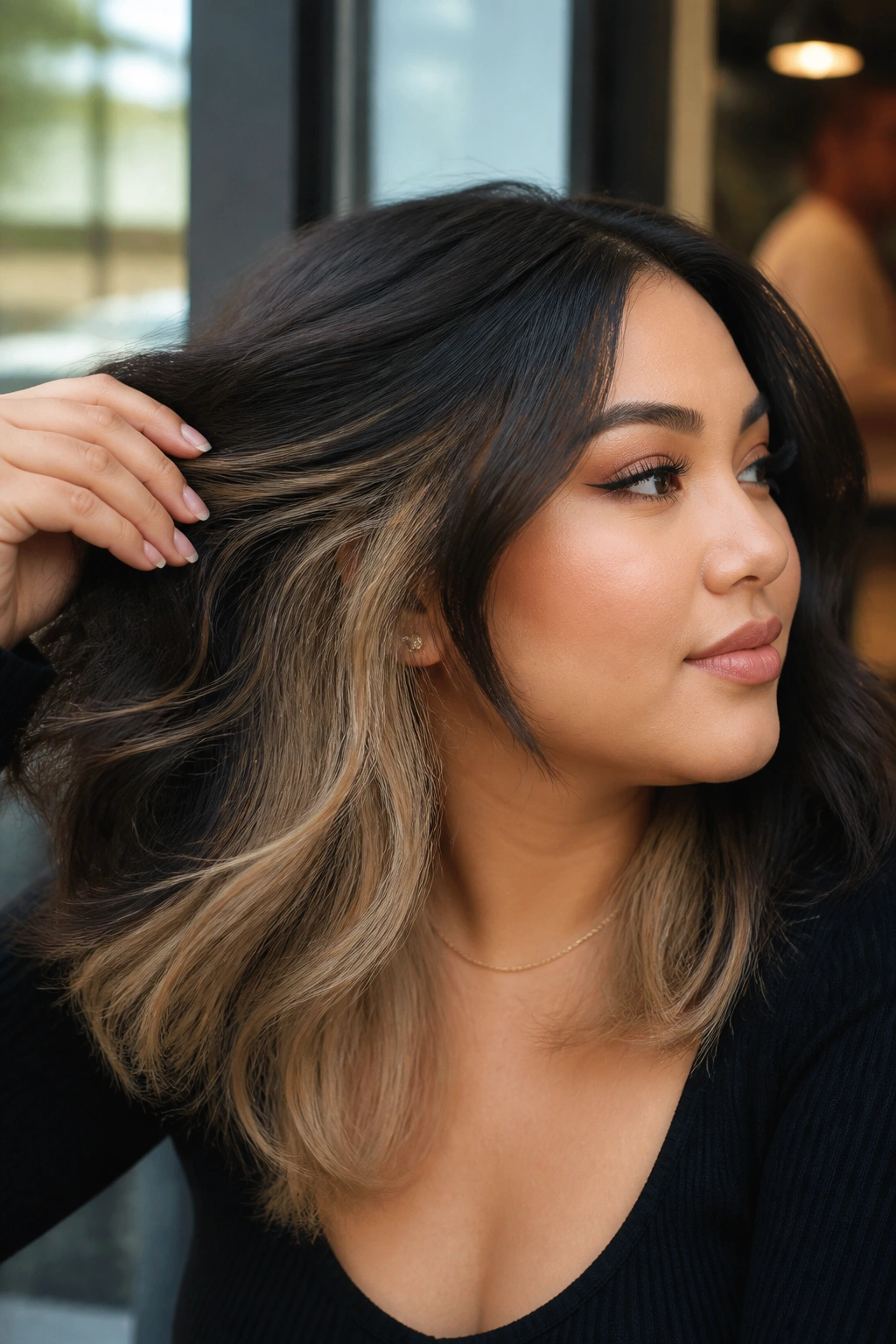
Peekaboo panels are for people who want surprise, not constant brightness. The blonde lives inside the hair, usually beneath the outer black layer, and shows up when the hair moves or is pinned back.
What Makes It Different
Unlike full surface highlights, peekaboo blonde keeps the sides visually dark most of the time. That’s useful on a round face because the visible width stays smaller.
The best version uses a few larger panels near the nape or under the temple layers, not a wide strip under the entire head. Keep the top veil dark and let the blonde flash underneath.
- Shows up in ponytails and half-up styles.
- Works well if you like a hidden pop of color.
- Needs less upkeep than all-over blonde.
The look feels playful, but it is also practical. A little strange in a good way.
10. Deep Side-Part Blonde Sweep
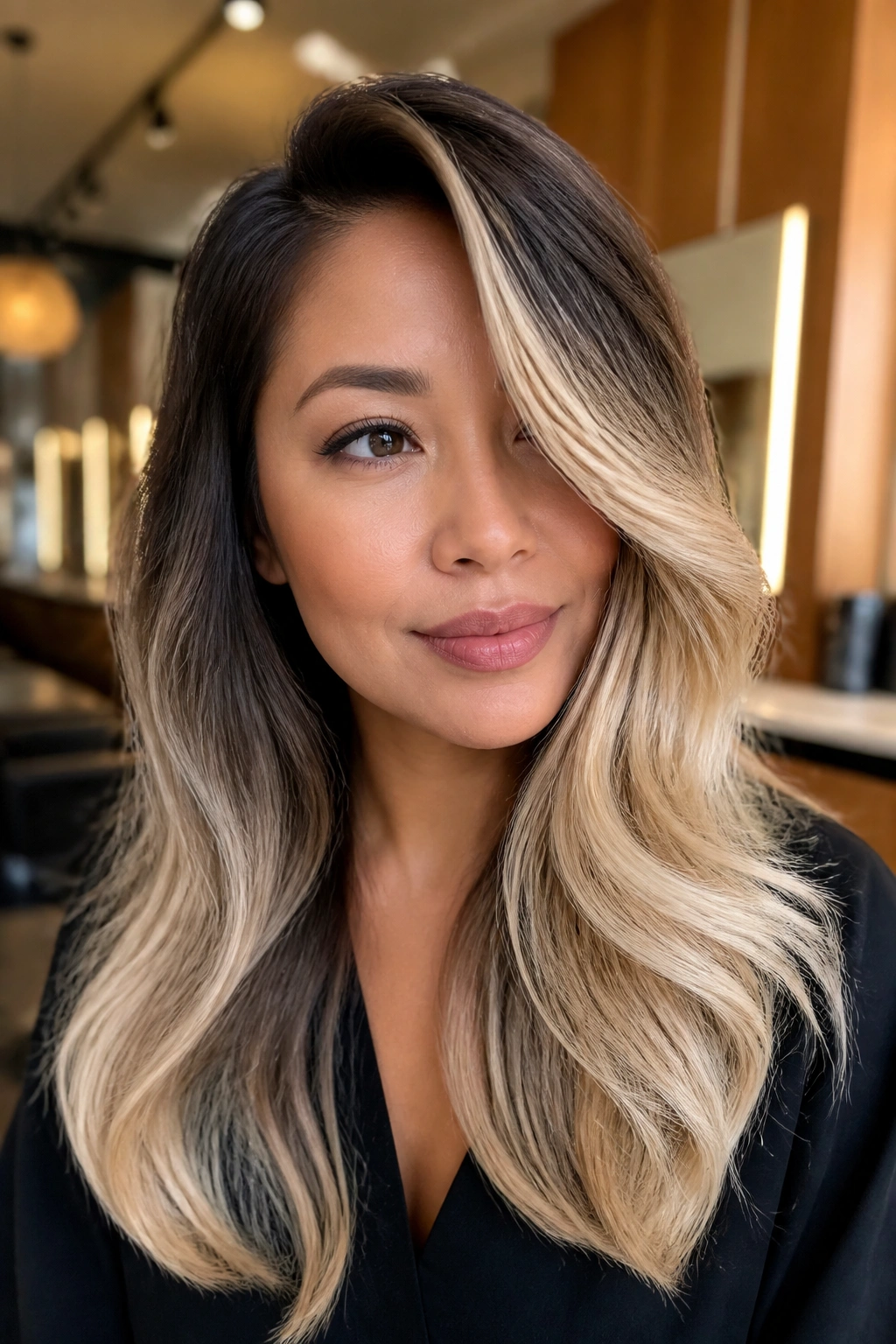
A deep side part can change a round face faster than most people expect. Add blonde to the heavier side, and the whole shape starts to lean longer and less symmetrical.
This is not about making one side loud and the other side invisible. It is about using contrast to pull the eye diagonally. Diagonal movement is your friend. It cuts across fullness better than a straight, even frame.
Compared with a center part, a deep side sweep feels a bit more sculpted. It also gives black-and-blonde hair a cleaner edge if you like glossy, polished styling.
If your hair is thick, keep the blonde on the top layers only. Too much underneath can make the side look bulky.
11. Blonde Halo Highlights
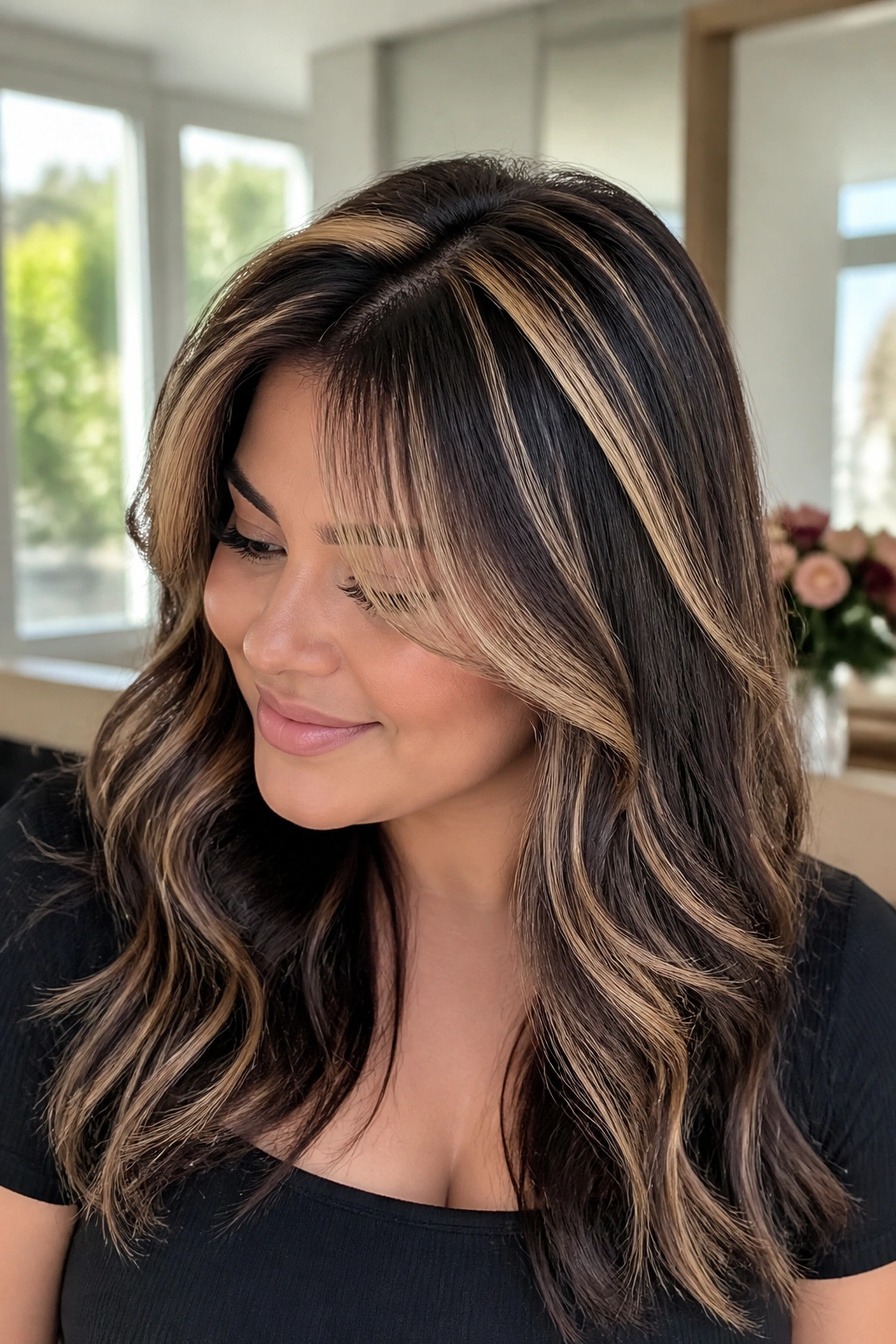
Halo highlights sit around the upper perimeter of the head, close to the crown and top layers, instead of hugging the jawline. That one choice changes the whole feel of the color.
A round face benefits when the light lives higher up. It directs the eye toward the top of the head, which gives the face more length. The lower half stays darker and quieter, which helps keep the cheeks from feeling boxed in.
This style can be as subtle or as bright as you want. A few pale ribbons around the crown can look soft and airy. A denser halo feels bolder, especially on black hair.
One small detail makes a big difference: keep the front edge broken up. A hard ring of blonde all the way around the top can look helmet-like. Soft gaps look much better.
12. Blonde on a Shag Cut
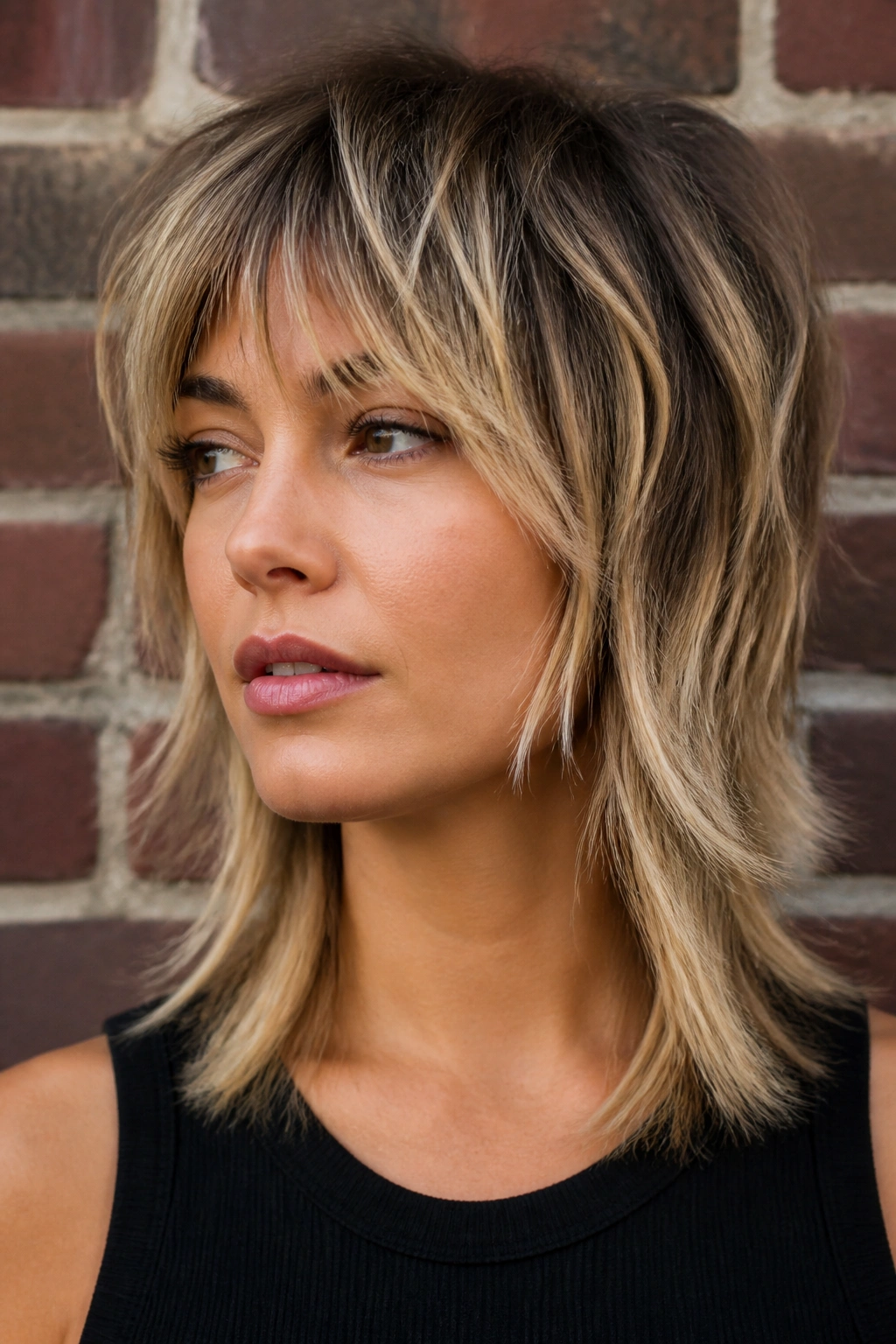
A shag cut and blonde highlights are a good pair because the layers do part of the shaping for you. On black hair, the blonde catches on the jagged ends and gives the whole cut a piecey, vertical feel.
Why does that help a round face? Because the layers fall at different lengths. Instead of one wide shape sitting at cheek level, the hair breaks into thinner sections that move around the face.
How to Make It Work
Ask for blonde on the ends of the front layers, the crown pieces, and the longer top sections. You do not need every layer lightened. Too much uniform blonde can flatten the texture.
A shag also likes a slightly smoky blonde more than a yellow one. The contrast feels cooler and more modern that way.
If you air-dry, even better. The rougher finish makes the pieces separate just enough.
13. Champagne Blonde Lob
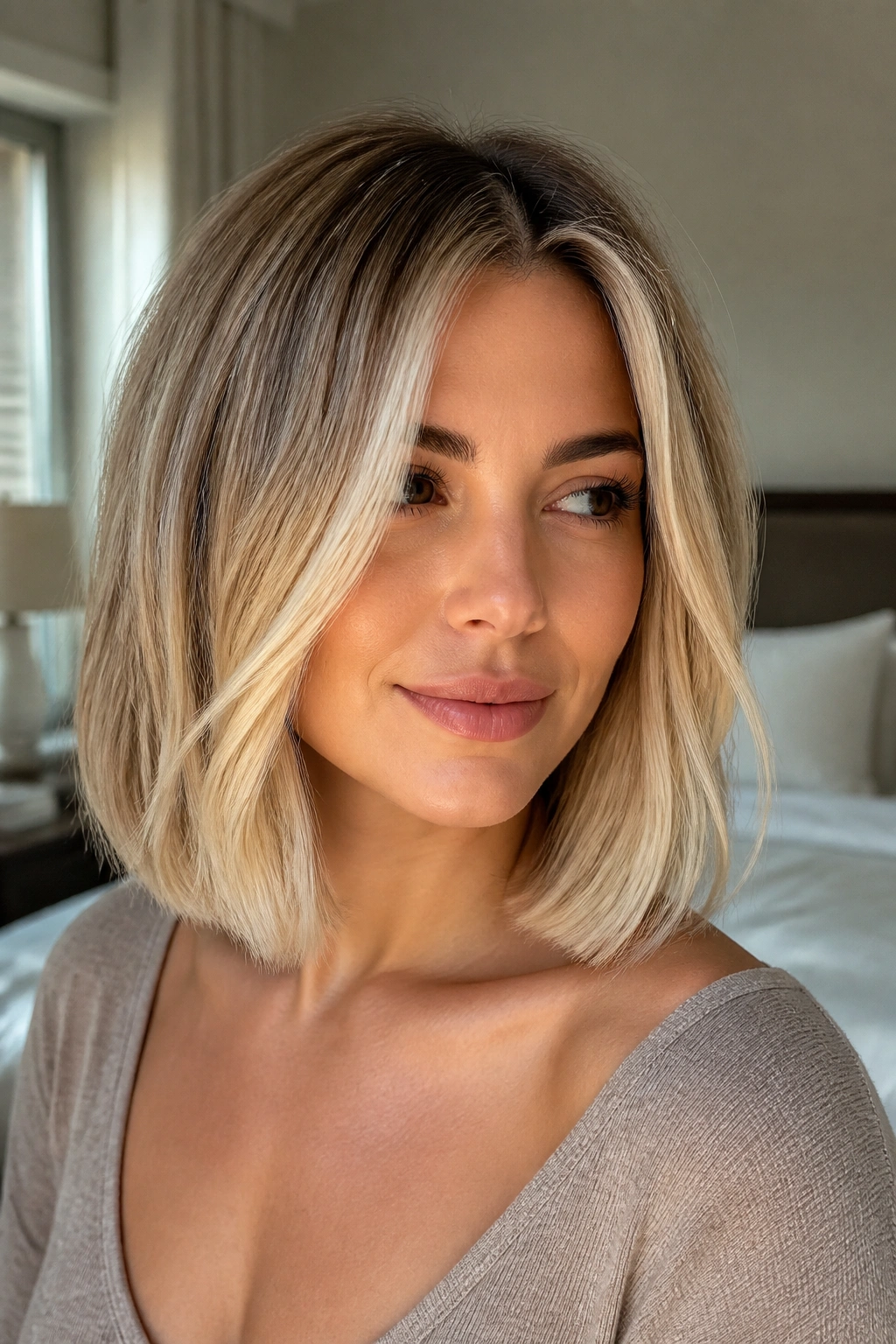
A lob gives the face more visual length on its own, and champagne blonde can make that shape feel even sleeker. The color is pale, warm enough to stay soft, but not so gold that it turns brassy against black hair.
On a round face, the best lob usually hits somewhere between the chin and collarbone. Put champagne blonde through the front corners and the lower half, and the eye follows the cut down instead of across.
This idea is cleaner than chunkier streaks. It feels controlled.
If you like straight styling, a lob with champagne blonde can look sharp. If you wave it, the light breaks up in a gentler way. Either version works, but the cut needs to stay a little longer in front than in back. That tiny slope matters more than most people realize.
14. Icy Blonde Micro-Ribbons
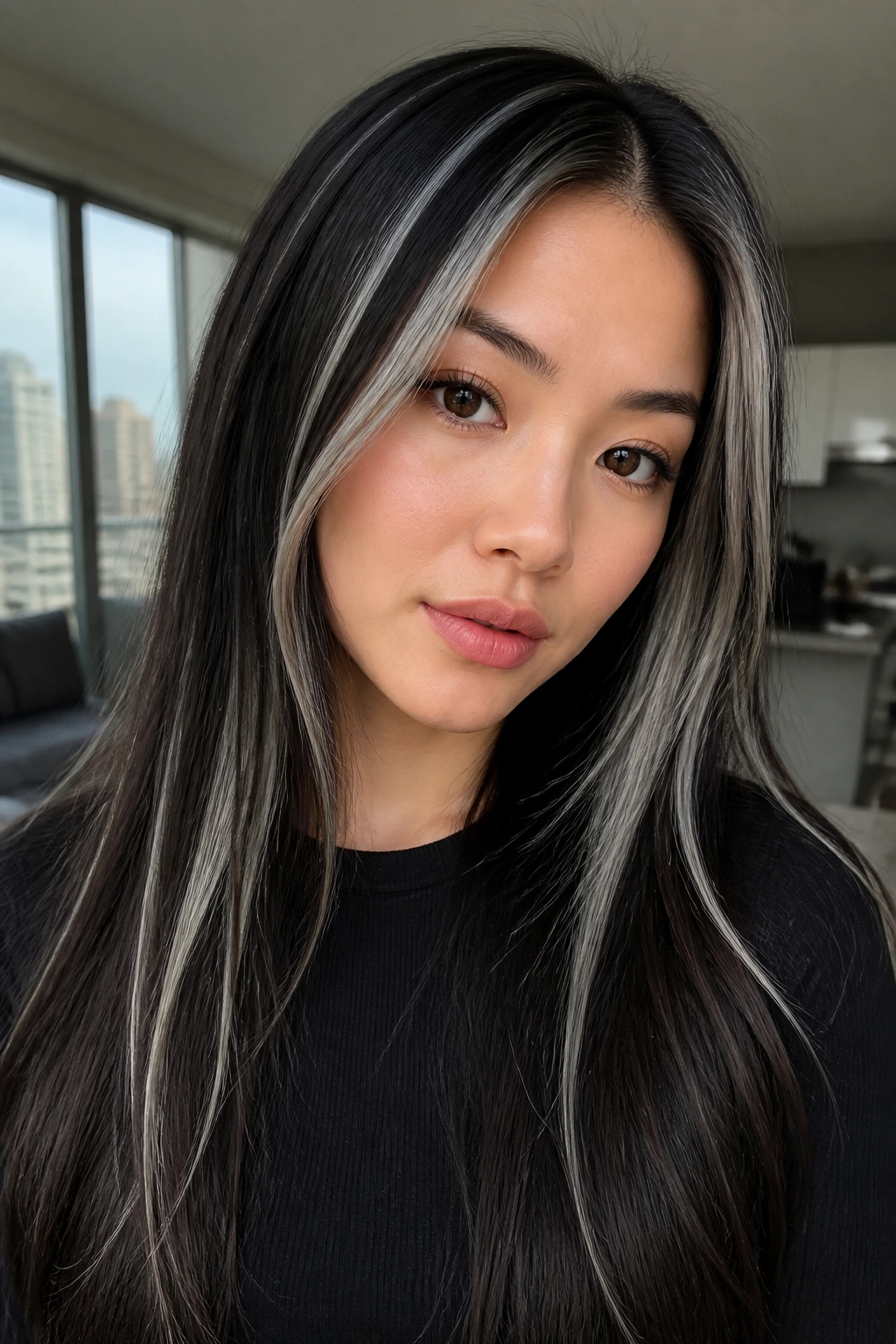
Icy blonde micro-ribbons are tiny, bright threads that sit inside black hair like thin slices of light. They are not thick enough to dominate, which is why they work when you want contrast without bulk.
Where to Place Them
- Around the crown to lift the eye upward.
- Just outside the temples for a narrow frame.
- Through the lower lengths so the shine keeps moving downward.
The cool tone keeps the blonde crisp. On black hair, icy pieces can look almost silver in some light, especially if the glaze is pale. That sharpness suits a round face because it creates cleaner lines.
Keep the ribbons thin. If they get too wide, the whole effect turns heavy fast.
A side note: this is a good option if you wear your hair straight a lot. The thin lines stay elegant instead of turning into broad streaks.
15. Golden Blonde on Curls
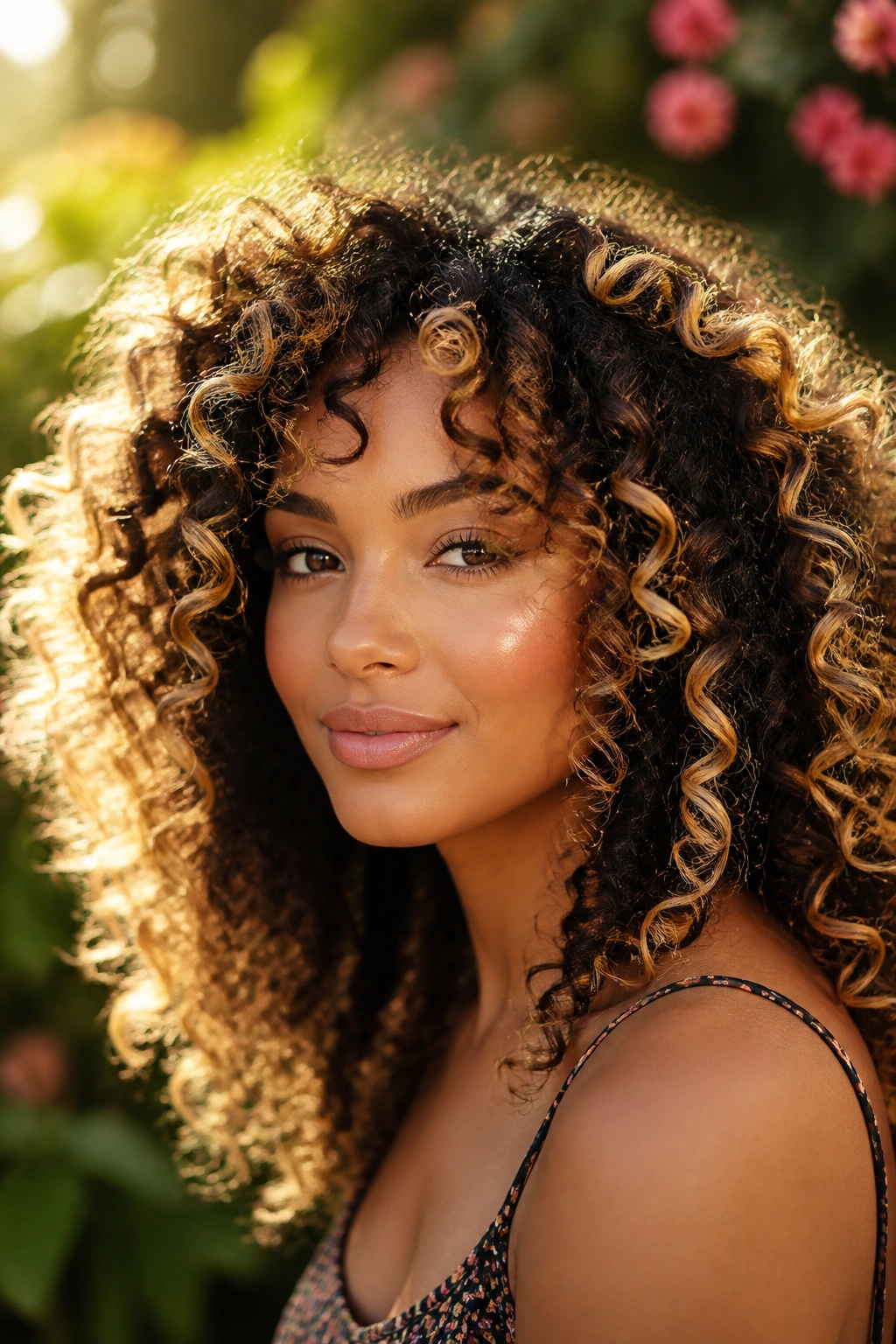
Curly hair changes the rules a little. The curl pattern already gives you vertical movement, so golden blonde can ride that shape and make the face seem longer without much effort.
The best part is how the light picks up on the bends. A few golden ribbons through black curls can look softer than the same color on straight hair, because the color spreads across the coil instead of sitting in one flat stripe.
Keep the blonde away from the widest cheek area if your curls are very full there. Focus on the outer spirals, the crown, and the lower lengths. That keeps the volume balanced.
Golden tones also bring warmth to deep black hair, which can be lovely if cool shades feel too stark on you. The result is richer than flashy. That matters.
16. Sand Blonde Ombré
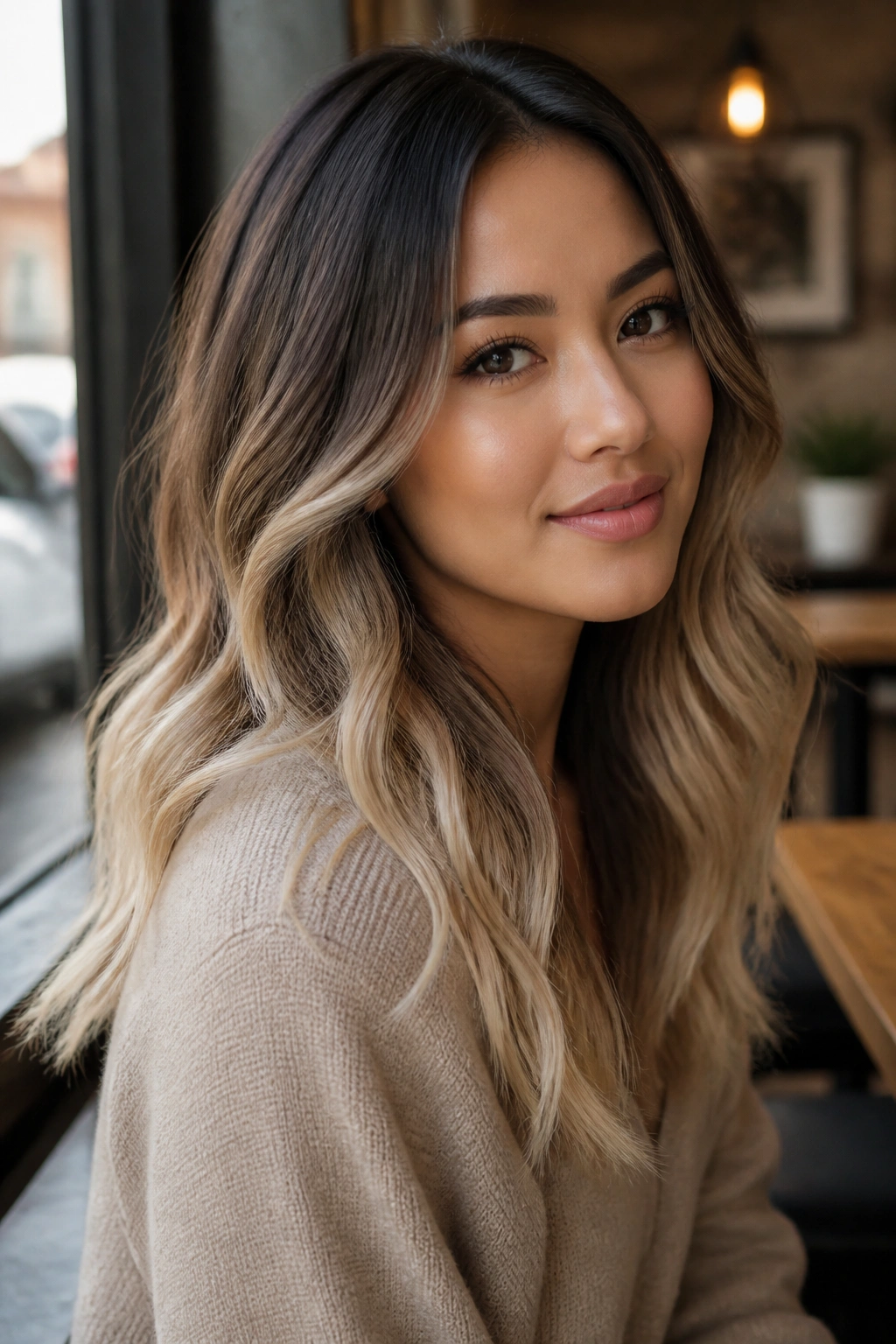
Sand blonde ombré is a calmer version of dip-dye. The transition starts darker and slowly shifts to a soft sandy blonde toward the ends, so the face stays anchored at the top and lighter at the bottom.
That bottom-heavy lightness is exactly why it can flatter a round face. It pulls the eye down, which adds length. If the fade begins too high, around the cheeks, the face can look wider. Keep the transition lower and the whole shape reads better.
Compared with platinum, sand blonde feels warmer and easier to wear. Compared with caramel, it feels a bit cleaner and less brown.
This one works especially well on wavy hair. The ombré gets broken up by movement, which keeps the ends from looking like a solid block of color.
17. Skunk Stripe Center Part
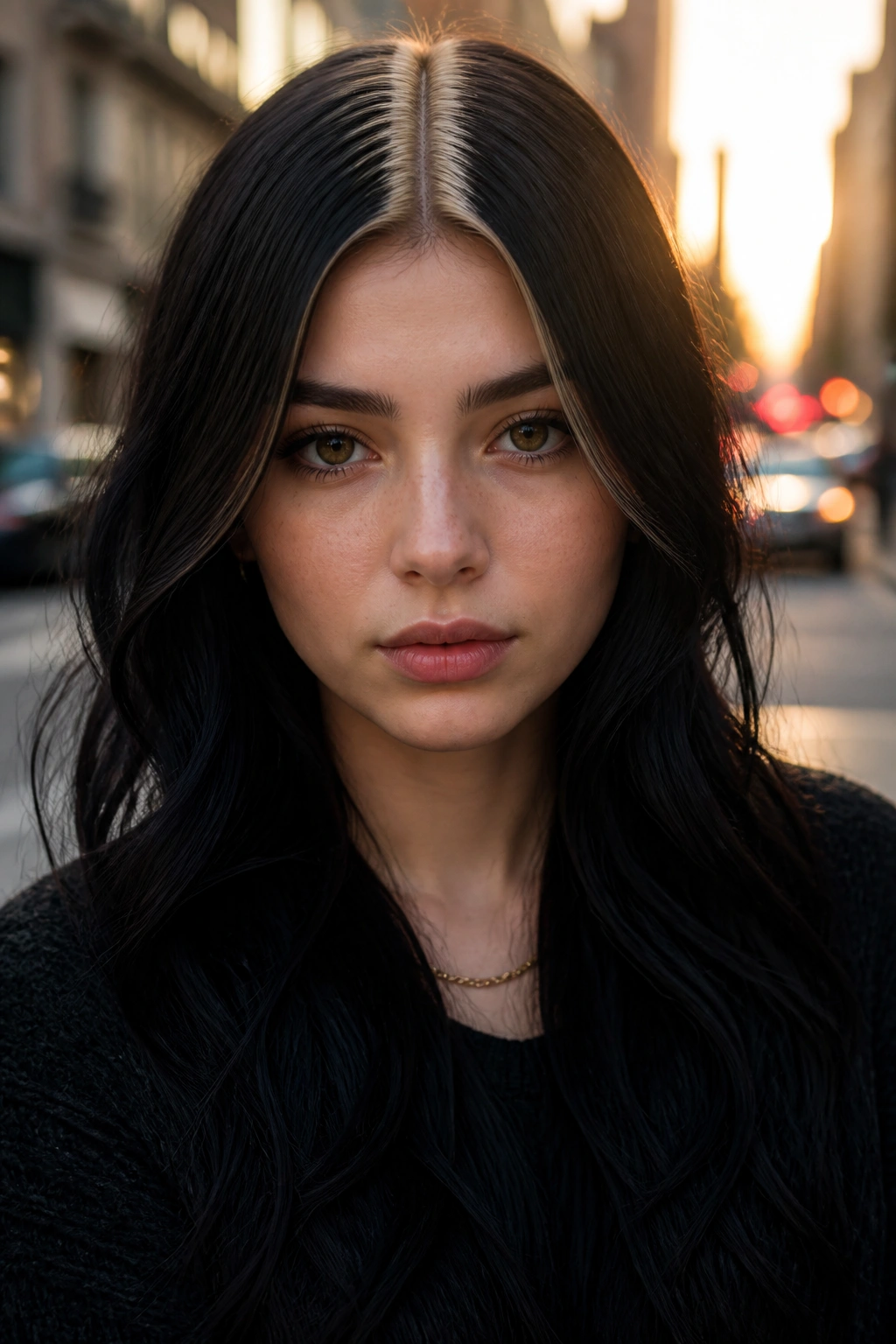
A skunk stripe sounds bold because it is bold. But on black hair, a narrow blonde stripe down the center can actually lengthen a round face by creating one strong vertical line from forehead to the nose and beyond.
The trick is width. Keep the stripe slender and the edges soft so it reads as a line, not a slab. If it gets too wide, the center can look heavy and the face can lose that lengthening effect.
This style works best when the rest of the hair stays deep and glossy. You want contrast, not chaos.
If you like streetwear energy, sharp makeup, or sleek straight styles, this is one of the most graphic options on the list. It is not shy. It should not be.
18. Money Piece With Long Layers
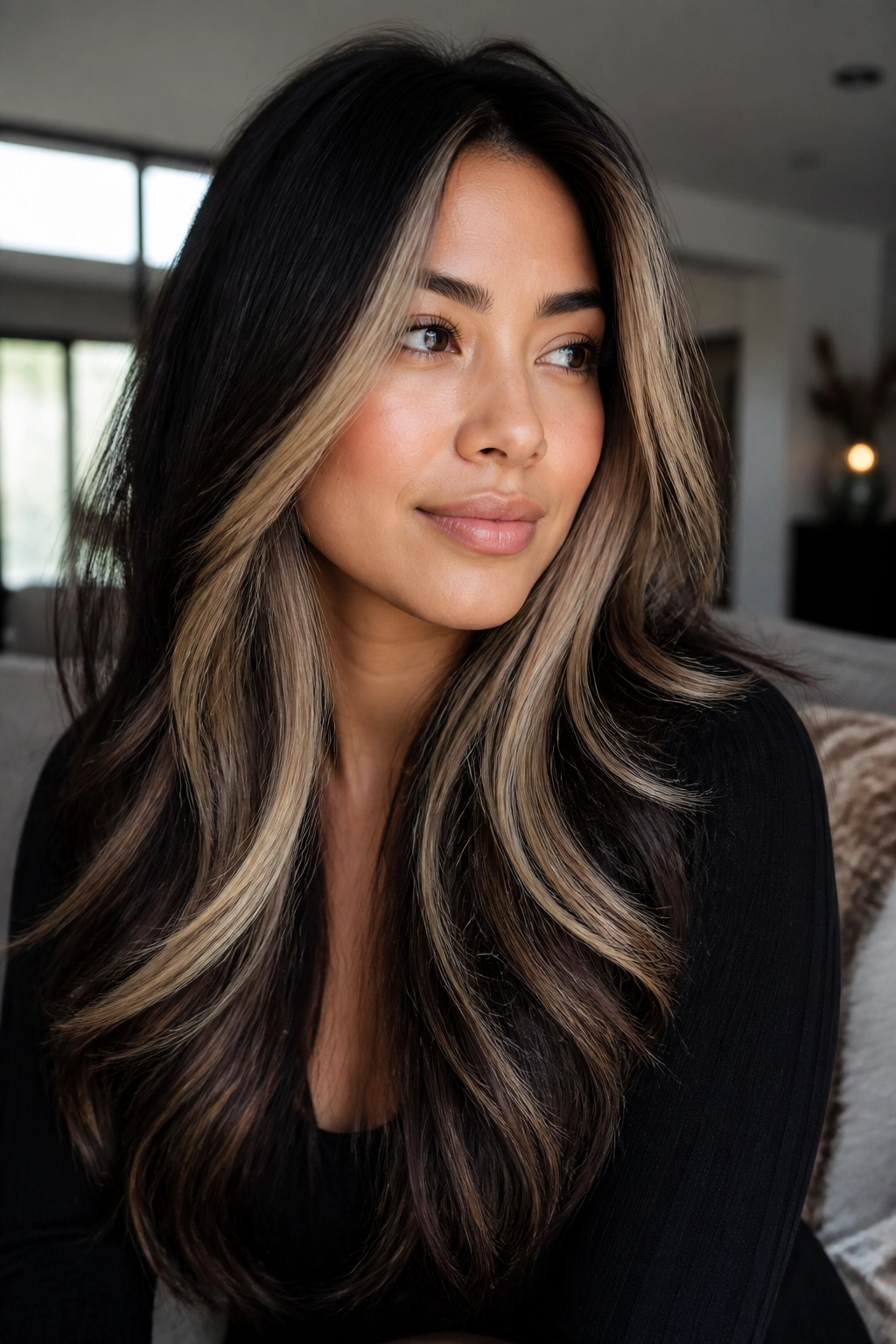
Long layers give a money piece room to breathe. Without them, the front blonde can hang in one flat curtain. With layers, the pieces move around the cheek and collarbone, which gives the face more lift.
Ask For This
Tell your stylist you want the brightest blonde concentrated at the front, then softened into lighter ribbons through the first few long layers. That keeps the front open without building width at the sides.
- Start the light around the temple, not straight across the cheek.
- Blend it through layers that fall below the chin.
- Keep the ends a touch lighter than the mid-shaft.
Long layers also help if you wear your hair curled. The blonde opens up in pieces instead of forming one wide sheet.
19. Dip-Dyed Blonde Ends
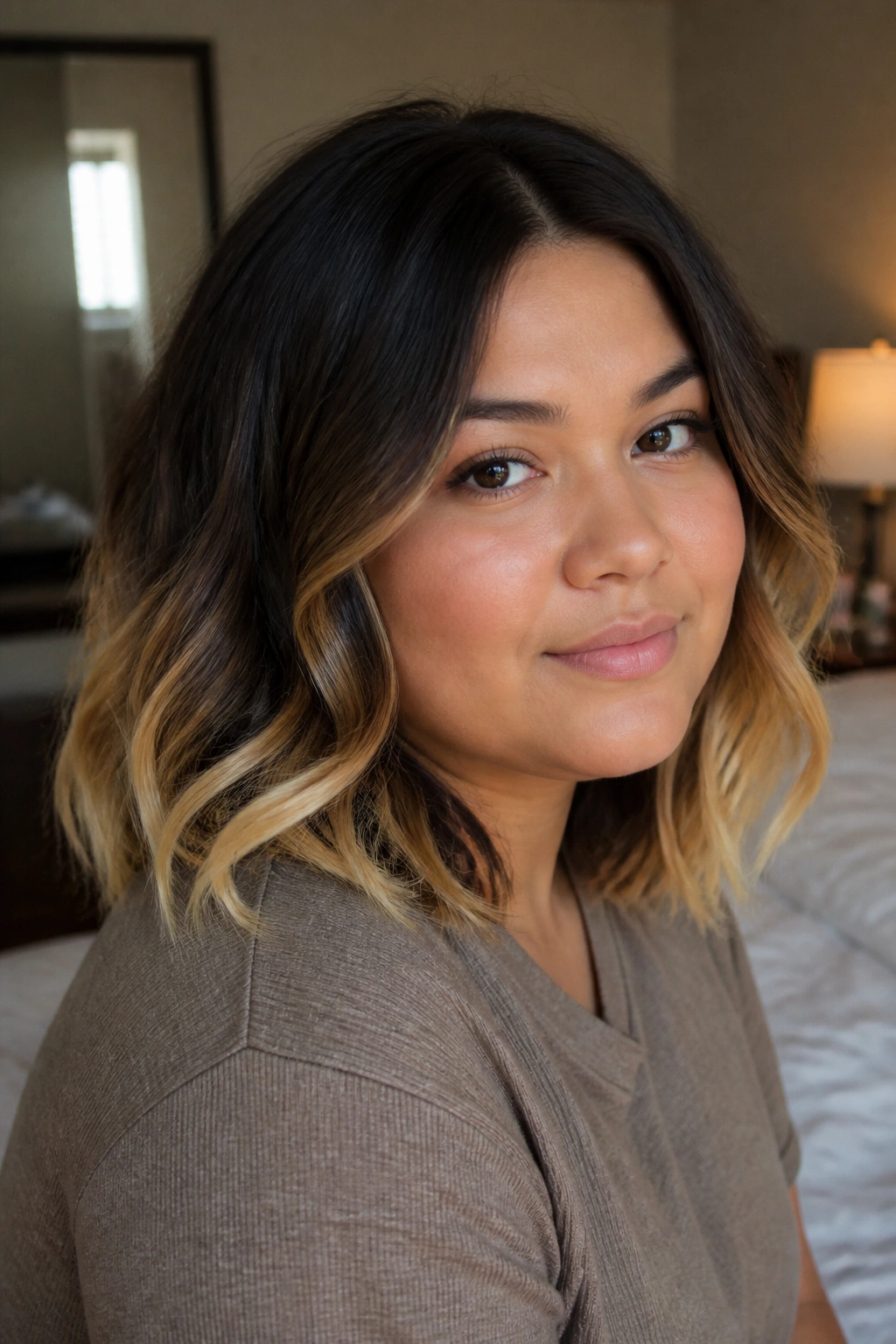
Dip-dyed blonde ends are simple, clear, and easy to understand at a glance. The black stays dominant on top, and the last few inches go blonde.
Why does this help a round face? Because the brightness lives far from the cheeks. The eye drops to the ends, which stretches the shape in a way heavy front color cannot.
The style works best when the transition is soft rather than a hard line. A blunt dip-dye can look chopped off. A blurred fade looks more natural and a little easier to wear.
Wavy or textured hair shows this idea best. Straight hair can make the color line feel more obvious, so ask for a bit of gradation if you want a softer finish.
It is also a useful choice if you like tied-back styles. The blonde ends still show in braids, buns, and ponytails.
20. Pearl Blonde Gloss Ribbons
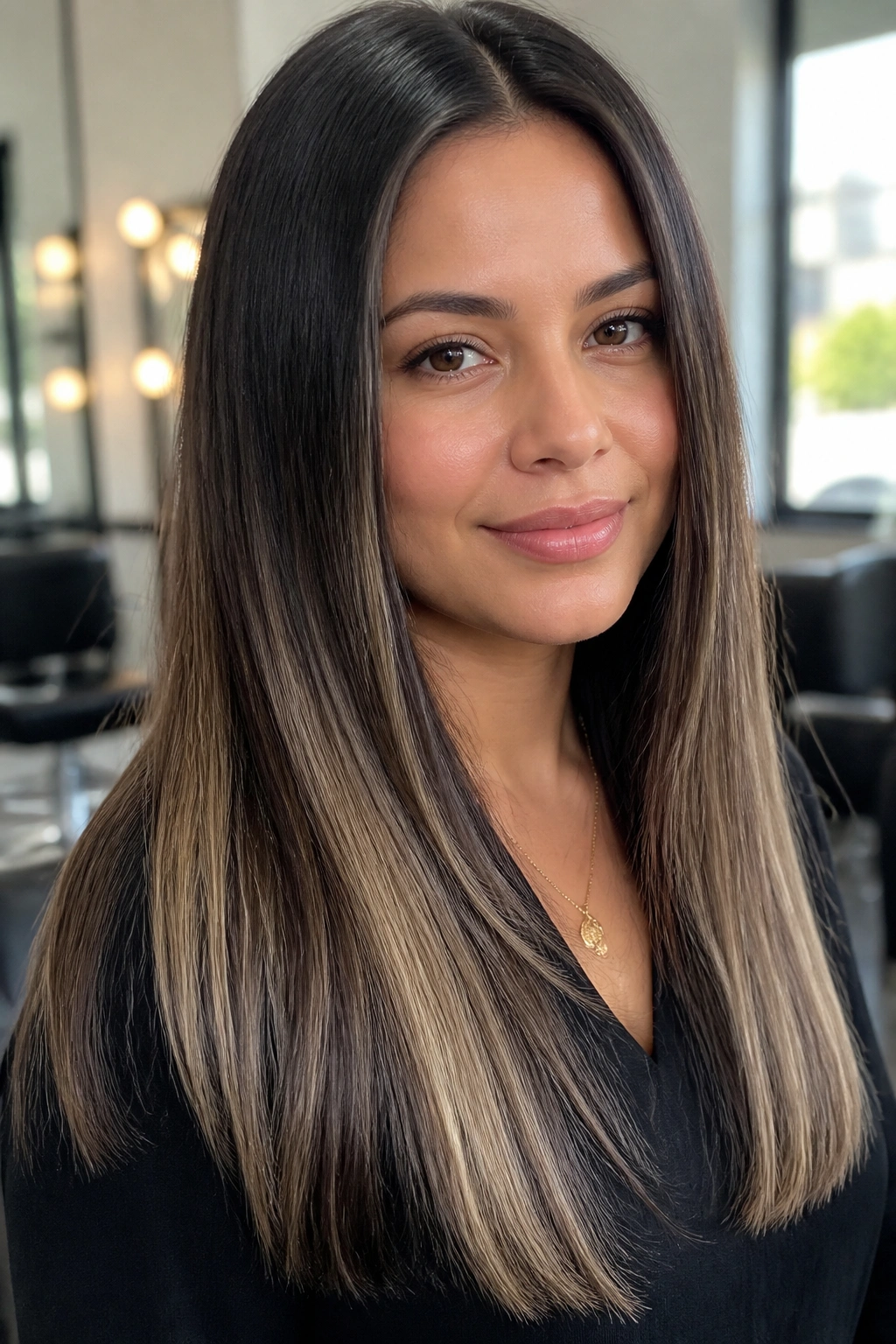
Pearl blonde has a creamy, reflective finish that sits somewhere between ash and ivory. On black hair, it looks polished without turning harsh, which is a nice middle path if you want light pieces with a smoother edge.
The color works well for round faces when the ribbons are thin and placed a little lower on the hair. You want a fine trail of brightness, not a blanket around the face. Pearl tones have enough sheen to hold attention even in narrow sections.
A gloss matters here. Pearl tones can go flat if the hair is dry or brassy, so a clear or beige toner helps keep the finish soft.
This is a good choice if you like sleek blowouts. The light catches along the bend of the hair and gives the whole style more shape.
21. Braid-Friendly Blonde Mapping
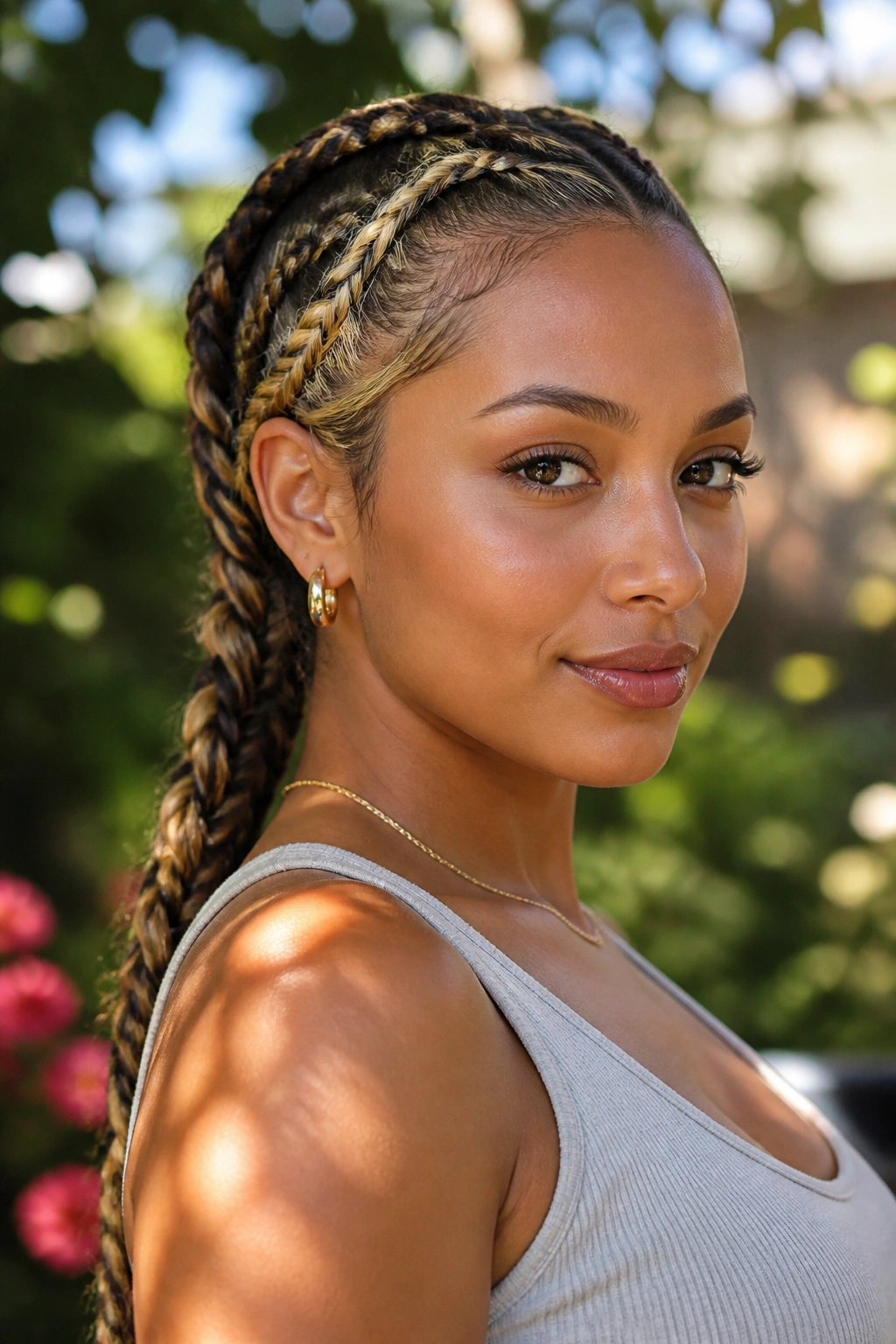
Some color ideas are made to be seen in motion, and braid-friendly blonde mapping is one of them. Instead of painting the same amount of light everywhere, the blonde is placed where braids, twists, and ponytails reveal it most.
That can mean lighter pieces at the temple, through the crown, or in narrow nape panels. The result is clever and a little unexpected. The black base still does the face-slimming work, while the blonde appears when the hair is gathered.
Good Spots for the Blonde
- Temple pieces for face framing.
- Mid-length strands that cross in a braid.
- Nape panels that show in updos.
This idea is smart if you wear your hair tied back often. A solid blonde highlight pattern can disappear in a ponytail. A mapped pattern keeps the dimension visible.
22. Buttery Blonde on a Wolf Cut
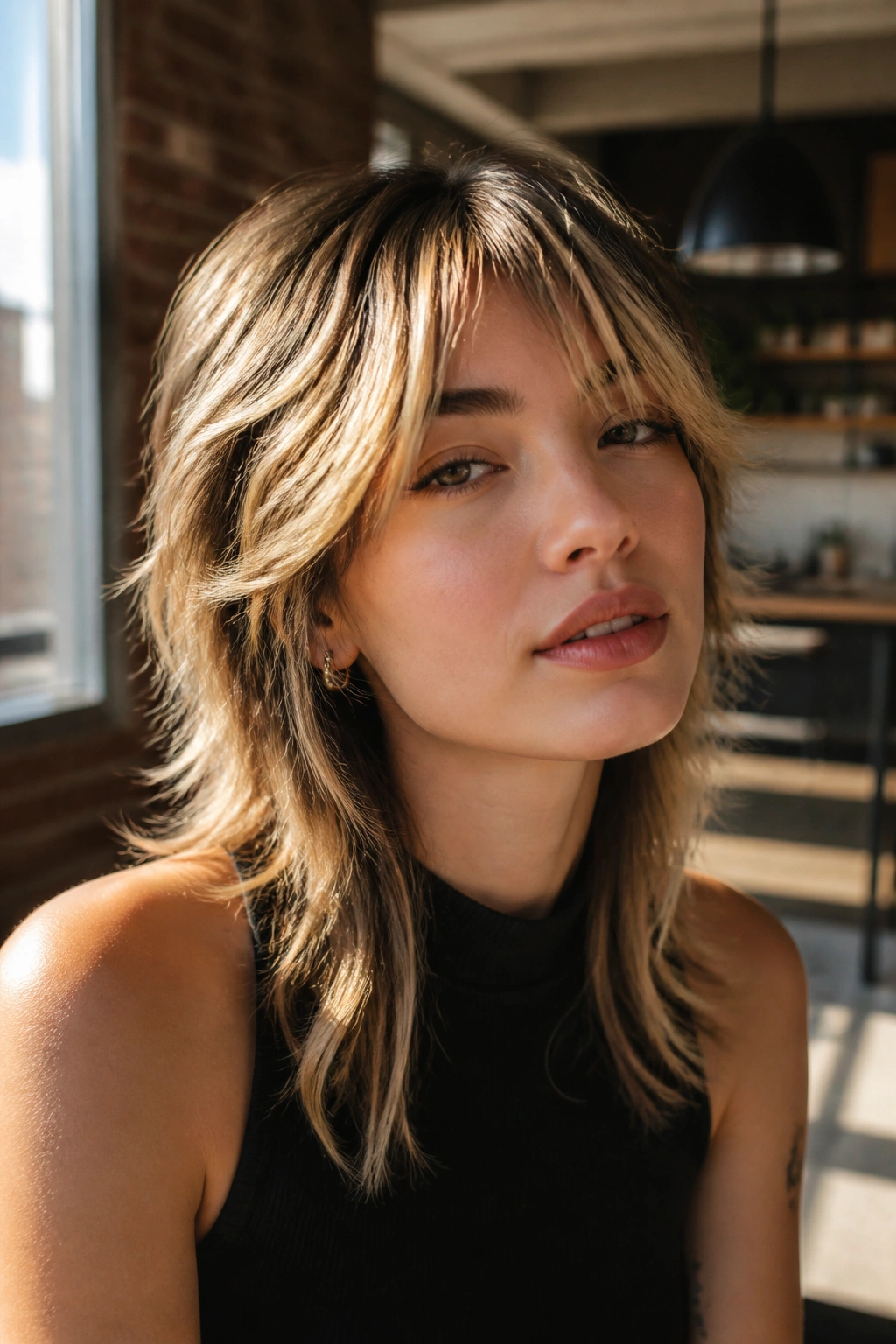
A wolf cut already has movement, roughness, and lift at the crown, so buttery blonde feels right at home there. The softness of the tone keeps the texture from looking too harsh.
On a round face, the wolf cut can help by adding height on top and choppiness through the lengths. Butter-yellow blonde on the temples and top layers makes that shape stand out even more.
Compared with a blunt lob, this look feels freer. Compared with icy blonde, it feels friendlier and warmer.
Keep the blonde feathered rather than blocky. Choppy layers need choppy light. If the blonde lands in one thick chunk, the cut loses its air.
This is one of the better options if you like a little edge and do not mind hair with personality.
23. Beveled Bob With Face-Frame Blonde
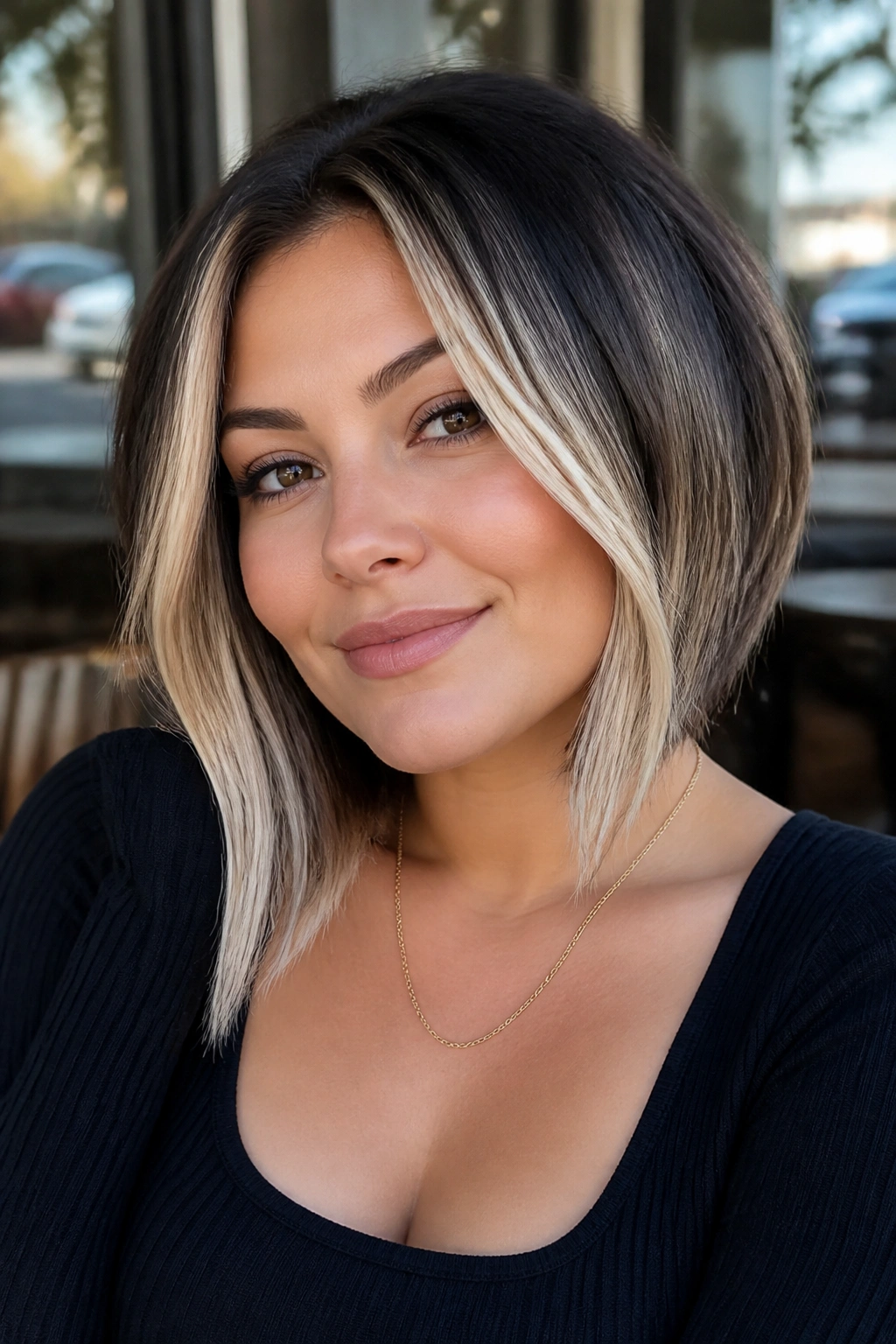
A beveled bob is cut so the shape angles inward toward the jaw, which already helps a round face look a little longer. Add blonde only to the front corners and top edge, and the silhouette gets even cleaner.
The reason this works is simple: the eye follows the diagonal line of the bob, then keeps moving downward through the lighter front strands. That diagonal shape is kinder to roundness than a blunt, boxy line.
A beveled bob looks best when the blonde is placed with restraint. Too much light at the sides can widen the face again. Keep the front bright, the back darker, and let the cut do the rest.
This one feels crisp, tidy, and modern without being cold. A good blowout makes it even sharper.
24. Half-Up Friendly Blonde Placement
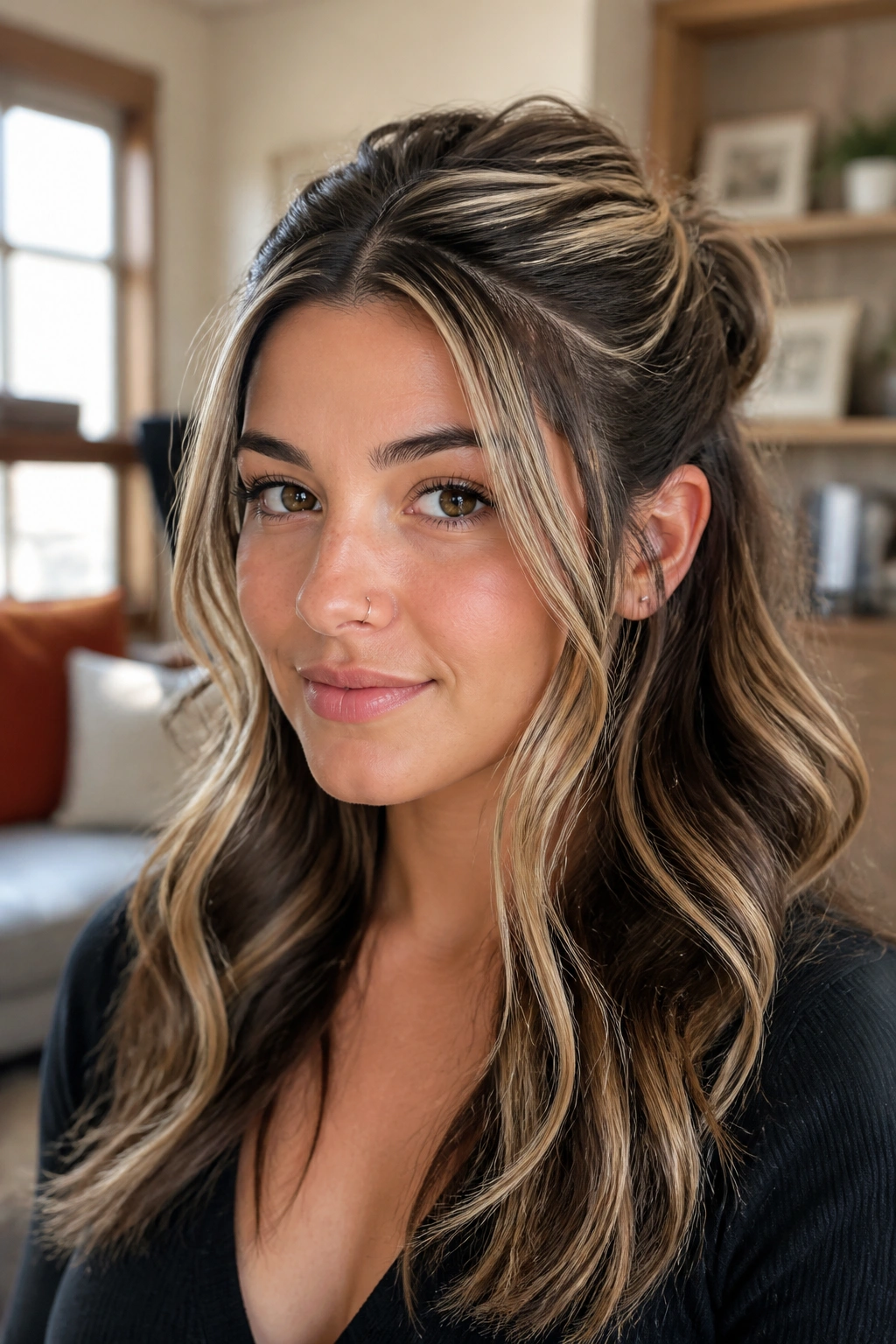
Does your hair spend a lot of time in half-up styles? Then place the blonde where the top section actually shows. That sounds obvious, but people miss it all the time.
The best placement is usually around the crown, the temple pieces, and the upper lengths that sit on top when the hair is pulled back. That way, the blonde stays visible in clips, knots, and half-up ponytails instead of hiding under the darker top layer.
How to Make It Read Well
- Keep the blonde slightly higher than the cheekbone line.
- Avoid one wide stripe across both sides.
- Let the lower lengths stay deeper for contrast.
This is a practical choice. You get face framing when the hair is down and shape in the back when it is up.
25. Full-Dimension Black-and-Blonde Blend
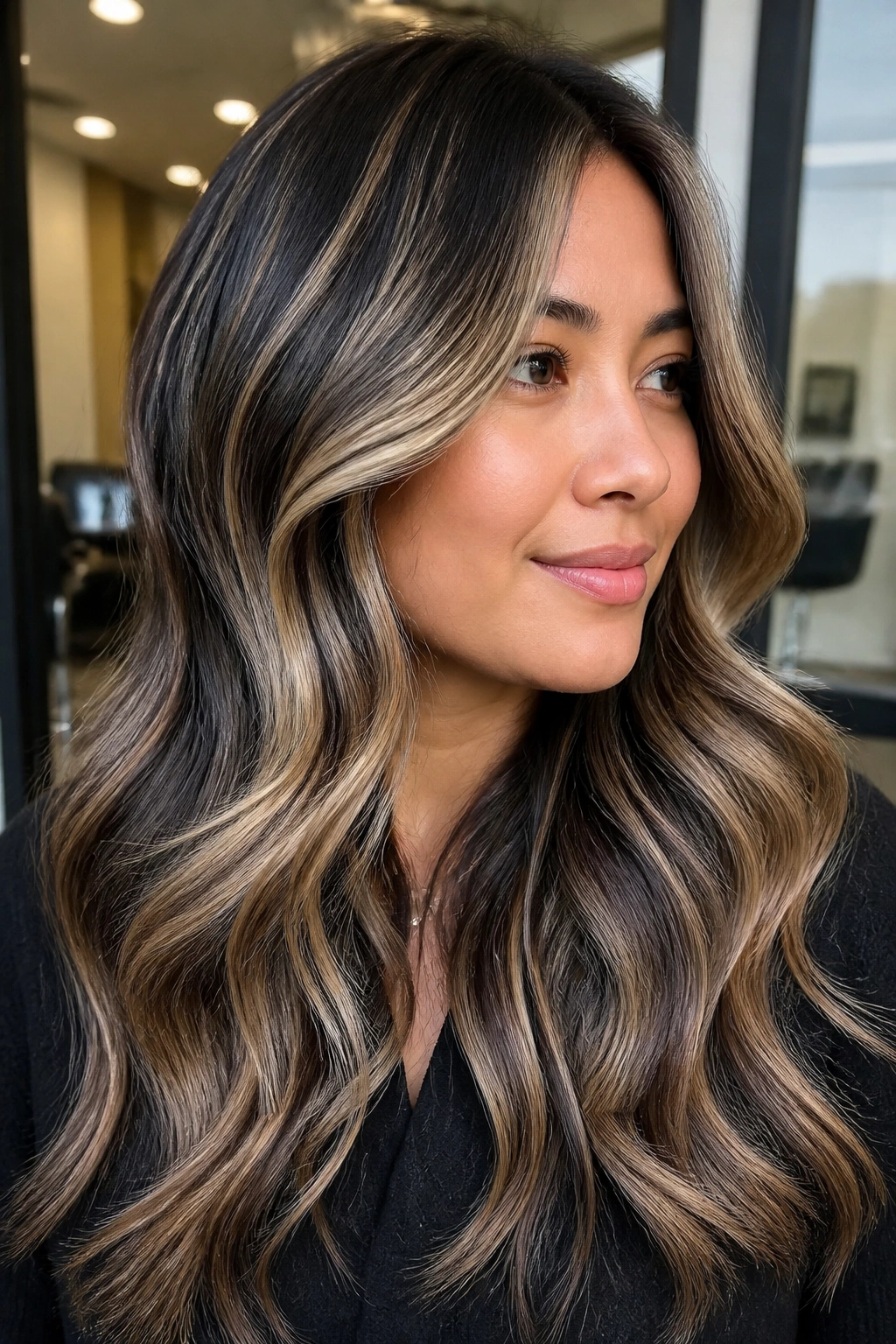
A full-dimension blend is for people who want the whole head to feel layered, not just the front or the ends. Think fine blonde ribbons, darker lowlights, and a black base that still stays strong enough to anchor the face.
On a round face, this kind of color works when the lighter pieces are scattered with purpose. Keep more light through the crown, upper layers, and lower lengths, and less through the widest part of the cheeks. That keeps the shape from spreading out.
The finished look should not read as stripey. It should feel woven. You notice the blonde when the hair moves, not because one section shouts louder than the rest.
That is probably the cleanest way to wear black and blonde together if you want depth, softness, and a little contrast all at once. It is also the easiest to live with when you are not chasing a dramatic grow-out line.
A final thought, if you want the shortest version of the advice: keep the brightest blonde above, below, or just inside the face shape—not spread straight across it. That one choice changes almost everything.
