



A fringe can sharpen a round face fast — or make it feel wider if the cut sits in the wrong place. The best fringe hairstyles for round faces do two things at once: they pull the eye down, and they break up that soft, circular outline without turning the haircut stiff.
The mistake most people make is chasing bangs that are too short or too blunt because they look cute in a photo. Photo and real life are not the same thing. A fringe that lands near the middle of the forehead can look sweet in stillness and then flatten the face the moment it meets humidity, curls, or a natural cowlick.
Length matters.
That is why the styles below lean on diagonal lines, soft gaps, cheekbone-skimming pieces, and crown height when it helps. Some are polished, some are messy, some are bold enough to feel like a statement, but each one gives a round face a little more shape without making the haircut feel fussy. Start with the one that fits your texture, then work outward from there.
1. Curtain Bangs With Long Layers
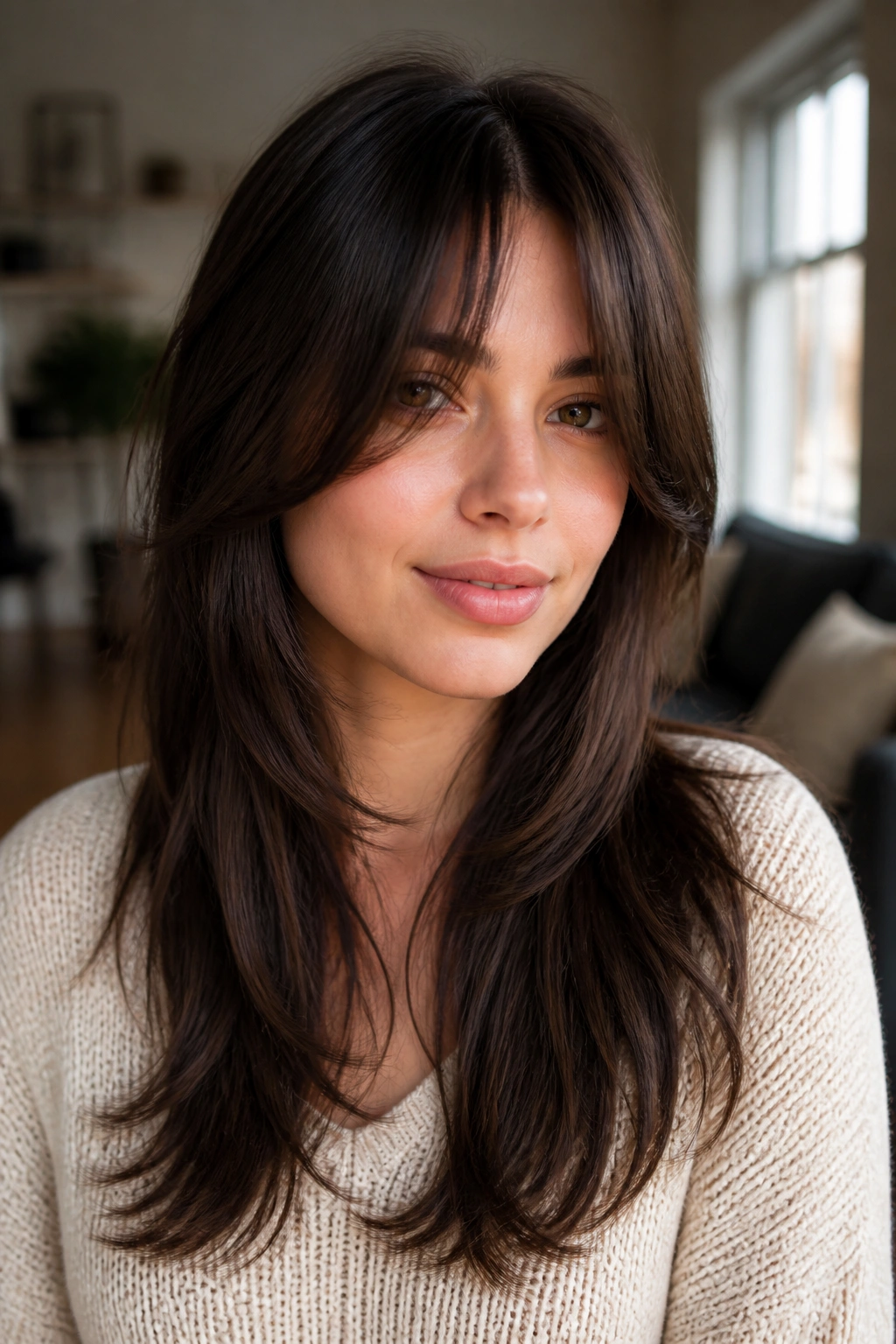
Curtain bangs are the first fringe I’d hand to someone with a round face who wants a safe, flattering starting point. They part in the middle, open up the center of the forehead, and let the longer sides fall along the cheekbones instead of cutting the face off at one hard line.
The sweet spot is usually a shortest point around the bridge of the nose or just below it, then longer pieces that graze the cheek or lip. That gives you movement without shrinking the face. If the bangs are cut too short, they can make the roundness feel louder; if they’re too thick, they turn into a curtain in the bad sense.
- Ask for soft graduation, not a heavy wall of hair.
- Blow-dry the fringe forward first, then bend the ends away from the face with a round brush.
- Let the outer pieces blend into layers that start at the cheekbone or collarbone.
- If your hair is wavy, keep the shortest pieces a touch longer so they don’t spring up too high.
Best detail: the fringe should look like it belongs to the haircut, not like it was dropped on top of it.
2. Side-Swept Fringe With a Shoulder-Length Lob

Why does a side-swept fringe keep showing up in flattering haircut conversations? Because the diagonal line does a lot of quiet work. A round face usually benefits from anything that breaks symmetry a little, and a long sweep across the forehead does that without feeling severe.
This version looks best with a lob that lands somewhere between the chin and collarbone. Too short, and the whole shape can bunch up around the cheeks. Too long, and the fringe loses its job. The sweep should start deep on one side and fall lightly toward the opposite brow, with the thickest part sitting above the temple rather than right over the center of the face.
How to style the sweep
A quick pass with a blow-dryer and a medium round brush is usually enough. Aim the airflow from the crown down and across, then flip the front section away from the face for a few seconds at the end.
The result should feel soft, not helmet-like. If you need a bit of hold, use a pea-sized amount of cream or light mousse, especially on fine hair that goes flat by noon.
3. Bottleneck Bangs With a Soft Shag
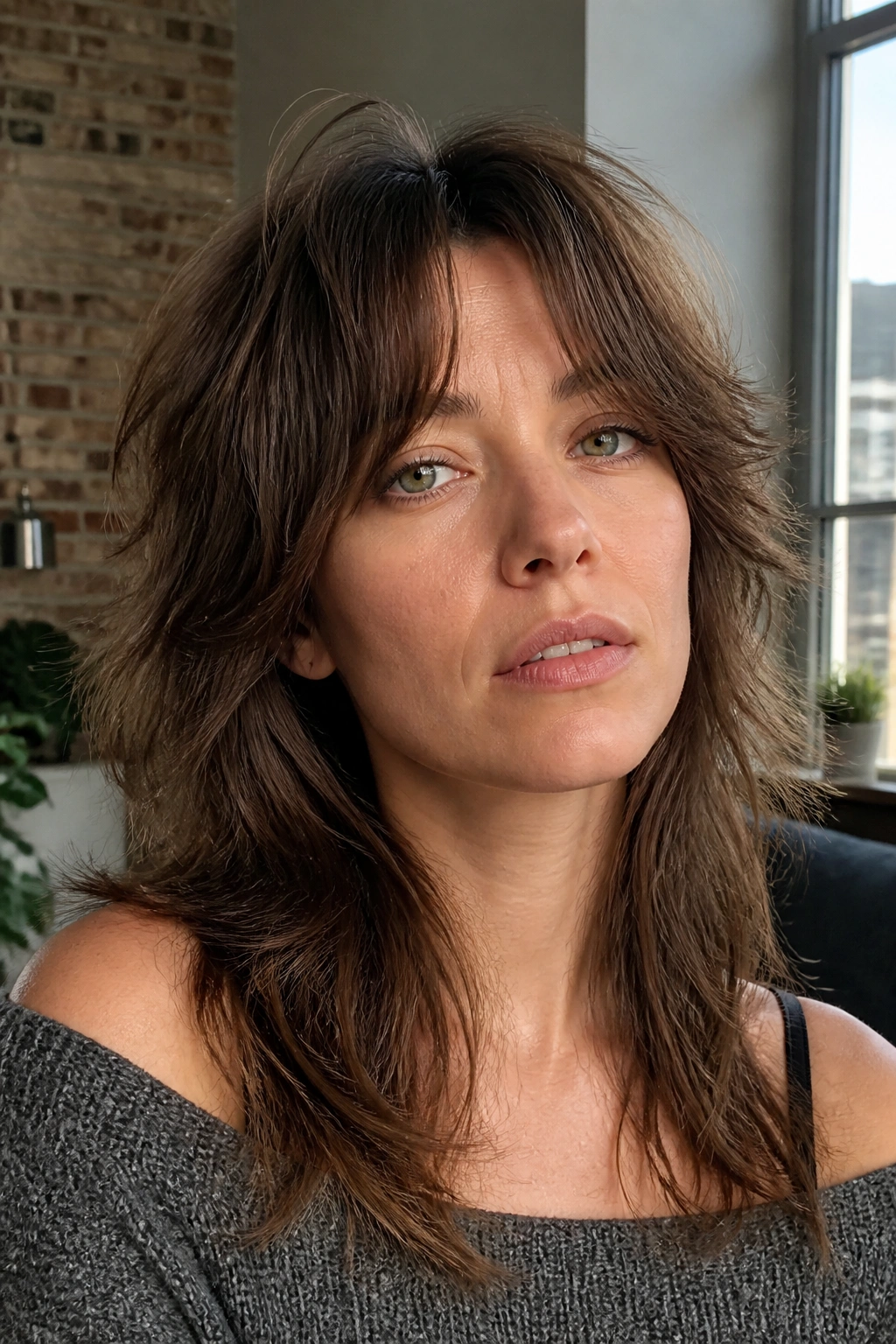
Bottleneck bangs are one of the smartest fringe shapes for a round face because they do two jobs at once: they open the center and widen out near the cheekbones. That shape acts a little like a frame, but a loose one, which keeps the face from looking boxed in.
The center is shorter, then the side pieces get longer and feathered. That makes the eye travel upward and outward instead of stopping at one blunt line. On a round face, that extra movement matters. It creates the feeling of length without asking you to wear a harsh, high-contrast fringe.
This cut is especially good with a soft shag or layered midi length. The texture in the rest of the haircut keeps the bangs from looking too neat, which is a good thing here. The fringe should feel piecey and light, almost as if it grew there that way.
If you like hair that looks a little lived-in, this is a strong pick. If you like every strand in place, it may annoy you. That’s the honest version.
4. Wispy Fringe With Straight Hair
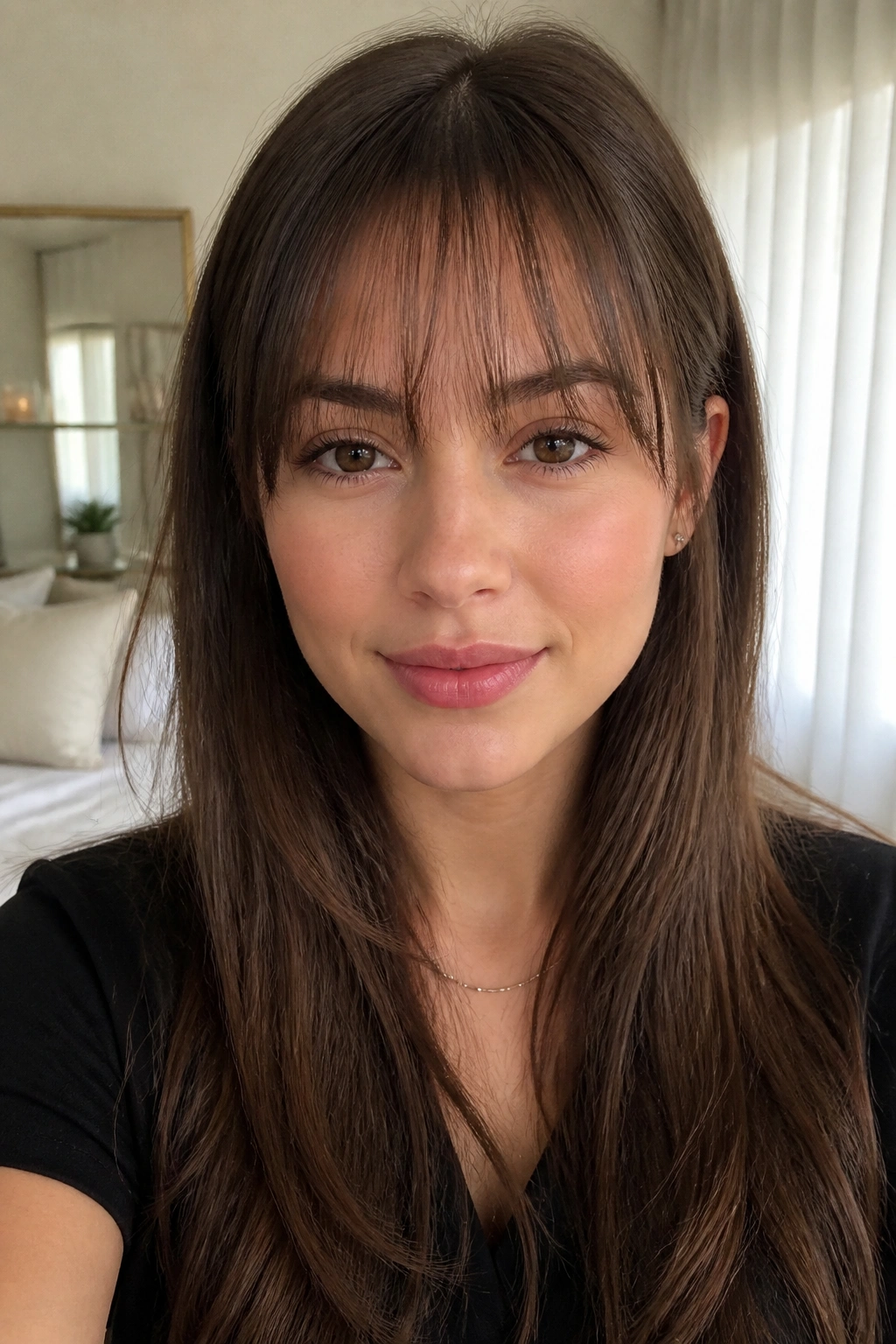
If your hair is fine, flat, or easily weighed down, a wispy fringe can save the whole cut. It gives you the softness of bangs without loading too much hair onto the forehead, which is exactly where round faces can get overwhelmed.
The trick is to keep the fringe airy enough that a bit of skin still shows through. That negative space matters. It stops the bangs from becoming a single block and keeps the face feeling open. A wispy fringe also sits well on straight hair because the line stays light instead of puffing outward.
What fine hair needs
- A light hand with texturizing shears, not aggressive thinning.
- A small round brush or flat brush for drying.
- A root lift spray at the crown if your face is very round and your hair tends to collapse.
- A tiny amount of matte paste on the ends if the fringe separates too much.
One important note: don’t ask for wispy bangs if you still want them to behave like a thick fringe. They’re not the same thing. Wispy bangs should feel soft enough that you can almost forget they’re there until they move.
5. Choppy Fringe With a Wolf Cut
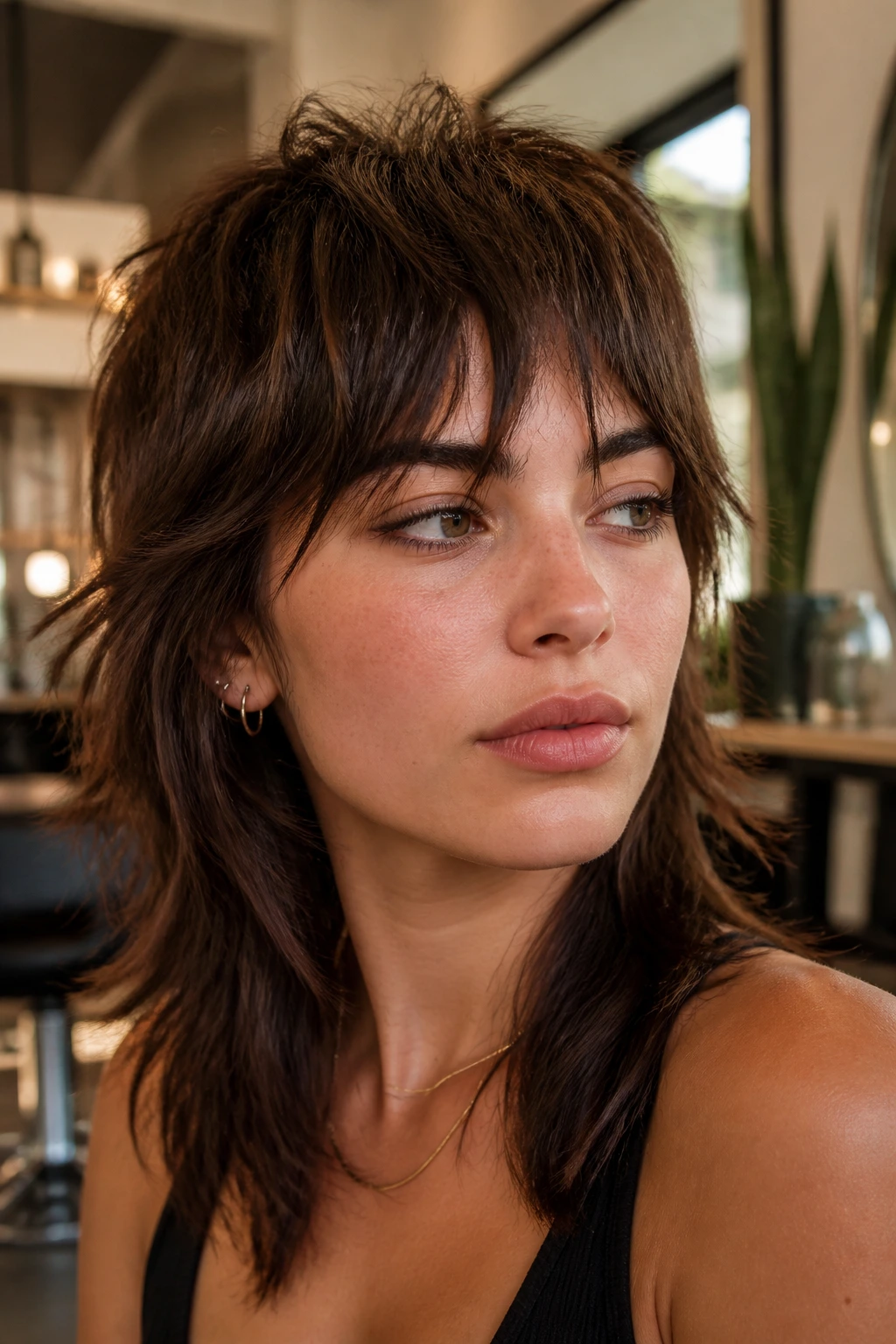
Choppy fringe and a wolf cut belong together. The haircut already has that rough, layered energy, so the bangs can be irregular without looking unfinished. For round faces, that kind of broken line is useful because it keeps the eye moving instead of circling the widest part of the cheeks.
The fringe should not be too dense. That’s the trap. A heavy choppy bang can still act like a wall if it’s packed with too much hair. What you want is separation — little gaps, soft point-cut ends, and enough length variation that the fringe shifts when you move.
The wolf cut also helps by adding height at the crown and keeping the perimeter airy. That vertical lift matters on a round face. It gives the whole style a longer shape, even when the actual hair length is medium. If you’ve got a little wave or bend, even better. The texture gives the bangs room to fall in an uneven but flattering way.
This one feels cool without trying too hard. That’s the point. If it looks overworked, it loses the charm.
6. Blunt Fringe With a Long Bob

A blunt fringe can work on a round face, but only if the rest of the haircut knows how to behave. A chin-length bob plus a heavy straight-across bang is where things go sideways. The face can end up looking wider because both the hair and the fringe stop at the same visual point.
A longer bob fixes that. Keep the length below the chin, often near the collarbone, so the hair stretches the face downward. Then let the fringe sit a touch below the brows rather than cutting too high. The line should feel clean, not thick and boxy. On straighter hair, the effect is crisp. On wavy hair, a little bend at the ends keeps it from feeling severe.
Unlike wispy or curtain styles, this one is about structure. The fringe is the strongest visual line in the cut, so the rest of the shape has to be softer and longer. That contrast is what makes it flattering.
If you love neat hair and low-frizz styling, this can be a satisfying choice. If you want softness above all else, keep moving down the list.
7. Arched Fringe With Soft Waves
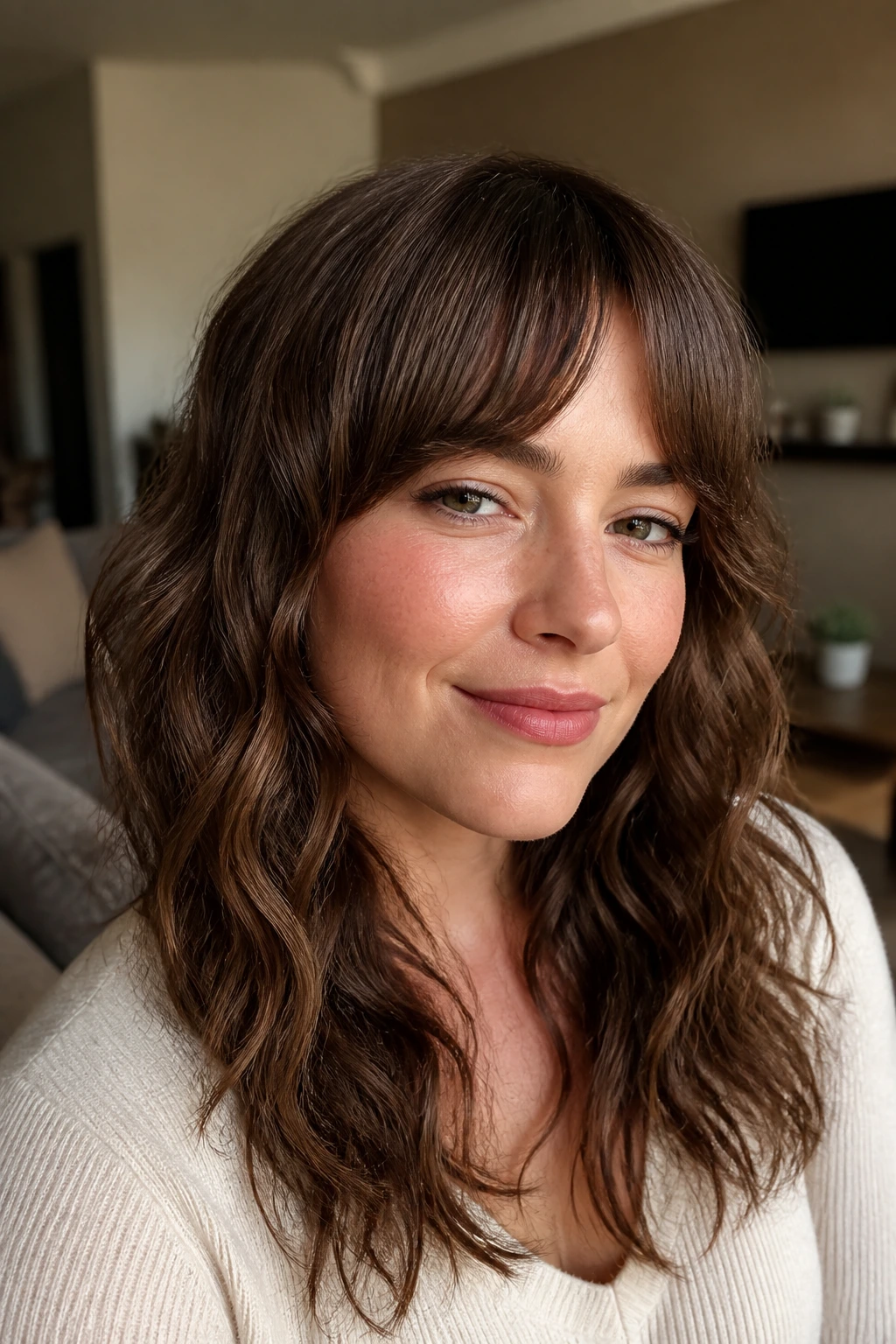
Can an arched fringe help a round face? Yes — if the arch is gentle. The idea is not to draw a cartoon eyebrow shape on the forehead. It’s to let the fringe rise a little in the center and fall at the sides so the face feels a touch longer and more open.
This style works well with waves because the texture breaks the straight line and keeps the fringe from looking too rigid. The highest part of the arch should sit near the center of the brow, then taper down toward the temples. That small curve changes how the eye reads the face. It doesn’t widen it; it eases it.
Where the arch should sit
Ask your stylist to keep the middle section a little shorter and the outer corners longer, but not so long that the fringe disappears into the rest of the hair. If your brow line is low or your forehead is short, the arch should stay subtle. Too much curve can make the face feel crowded.
Soft waves in the rest of the haircut help here because they stop the style from feeling too exact. Airy, imperfect movement is the whole point.
8. Micro Fringe With a Pixie Cut
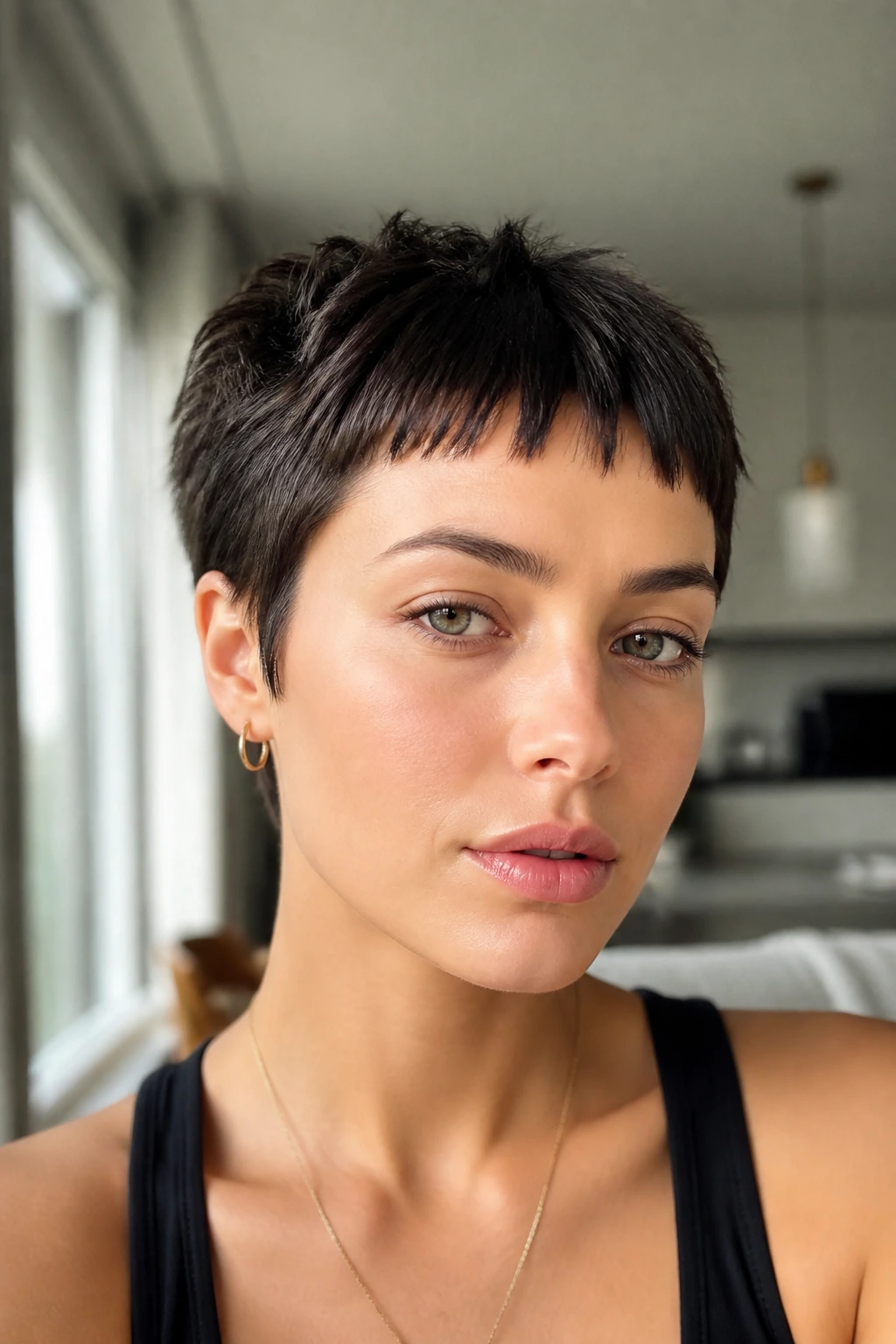
Micro fringe is not a timid choice, and that’s part of the appeal. On a round face, it can work when the pixie has enough height on top and enough taper around the sides to keep the shape from ballooning outward.
The best version is not one short chopped line across the forehead. It’s a tiny fringe that sits above the brows and leaves the temples and ears clean. That opens up the face in a way a heavier fringe can’t. The haircut reads sharper, leaner, and a bit more editorial, but only if the crown has lift.
- Keep the top a little longer so you can sweep it back or forward.
- Ask for soft tapering around the ears and nape.
- Use a matte paste or light wax to separate the bangs.
- Avoid a flat, helmet-like finish. It kills the shape.
This is one of those cuts that looks best when it’s not over-styled. A tiny bend, a little separation, and some texture at the crown are enough. If the fringe sits too straight and stiff, it can feel harsh fast.
9. Feathered Fringe With Layered Mid-Length Hair
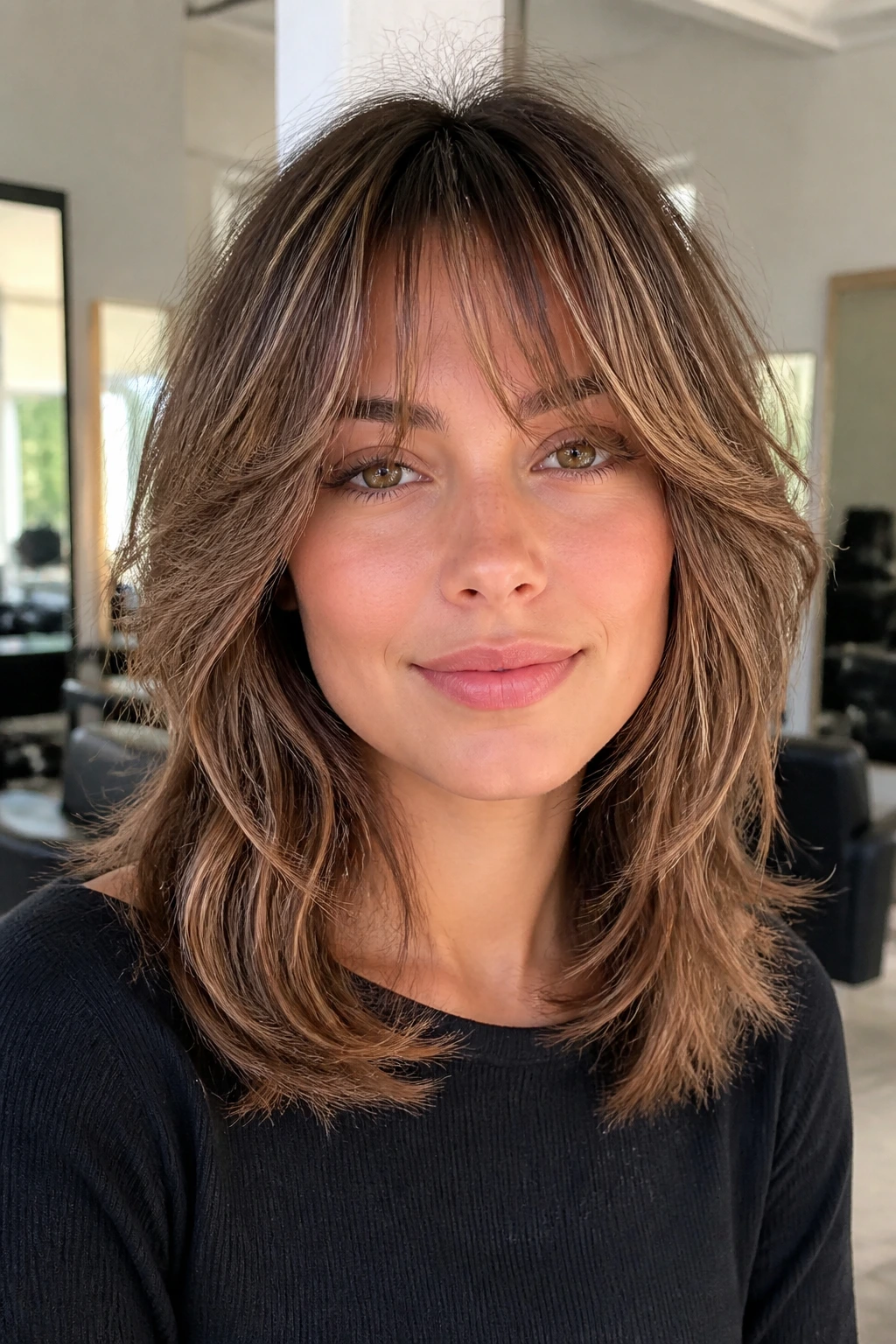
Feathered fringe is underrated. People think of it as old-school, but on a round face it can be one of the easiest ways to soften the forehead while keeping the haircut light around the sides.
The magic is in the ends. Feathering means the fringe is cut and styled so the tips split slightly and don’t fall as one flat curtain. That tiny separation helps the face look less full around the temples. It also blends nicely into layered shoulder-length or mid-length hair, which gives the cut a natural sweep.
The cut detail that matters
Ask for the fringe to start with enough density to show up, but not so much that it sits like a shelf. If the hair is thick, the stylist can remove weight from the inner sections and keep the outer pieces longer. That creates movement without thinning the bangs into nothing.
This style is especially kind to people who like quick styling. A blow-dry with a medium brush, a bit of root lift, and you’re done. It doesn’t need perfect symmetry, which is a relief on busy mornings.
10. Curly Fringe With a Rounded Bob
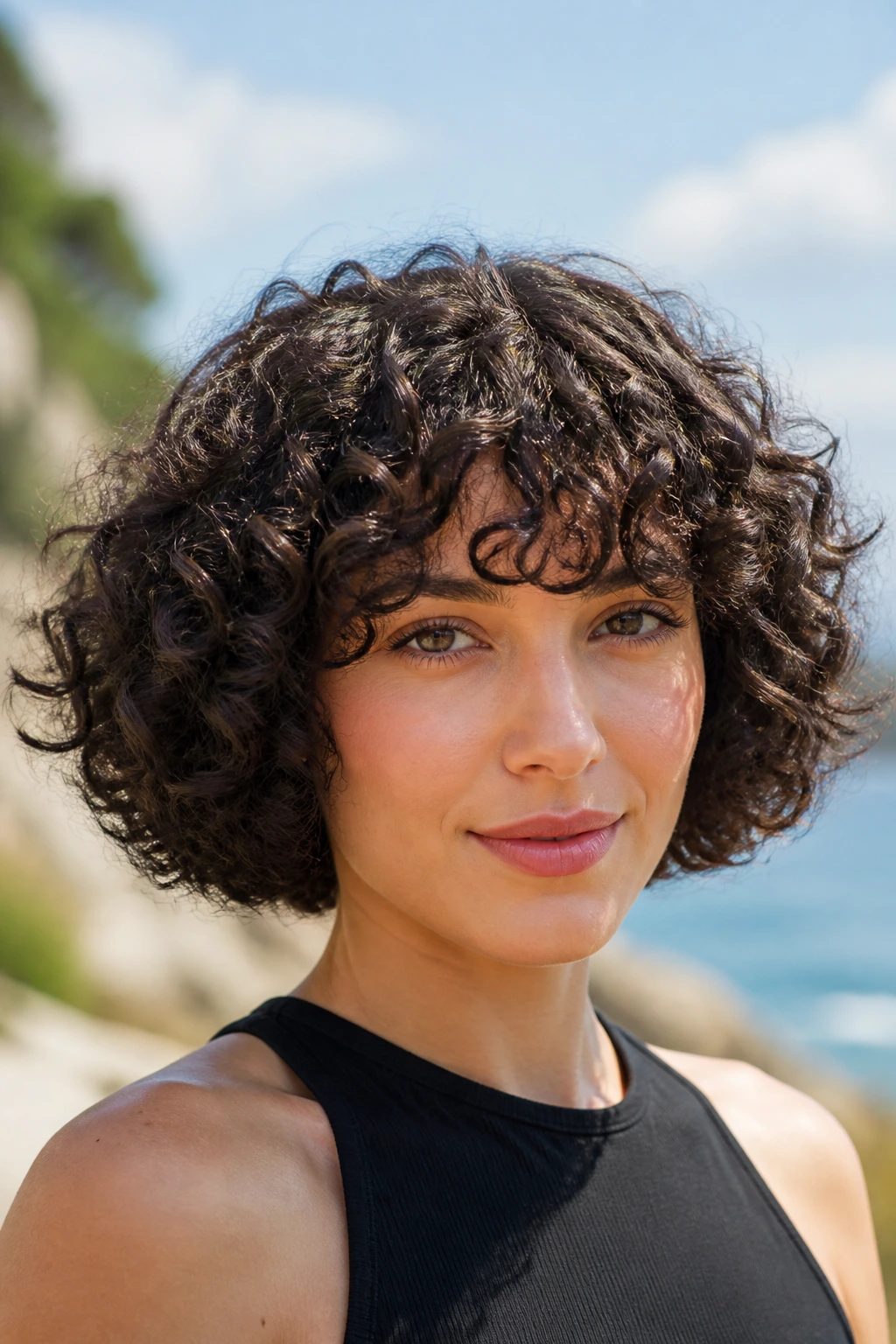
Curly hair and round faces can go together beautifully, but only when the fringe is cut with the curl pattern in mind. A curly fringe should not be treated like straight hair with a twist. It needs room to spring, and it needs to be cut where the curls naturally live.
A rounded bob keeps the shape soft while the fringe adds interest at the forehead. The trick is balance. If the bob is too puffed out at the cheeks, the face can feel wider. If the fringe is cut too short, shrinkage can push it above the brows and make the forehead look tight. So the better move is often a fringe that lands just at or slightly below the brow when dry.
Dry cutting helps here. So does letting curls fall where they want before deciding the final length. That approach gives you a shape that moves with the hair instead of fighting it.
A curly fringe also brings attention to the eyes and brows, which can be lovely. It feels relaxed, not stiff. That matters.
11. Deep Side Fringe With a High Ponytail
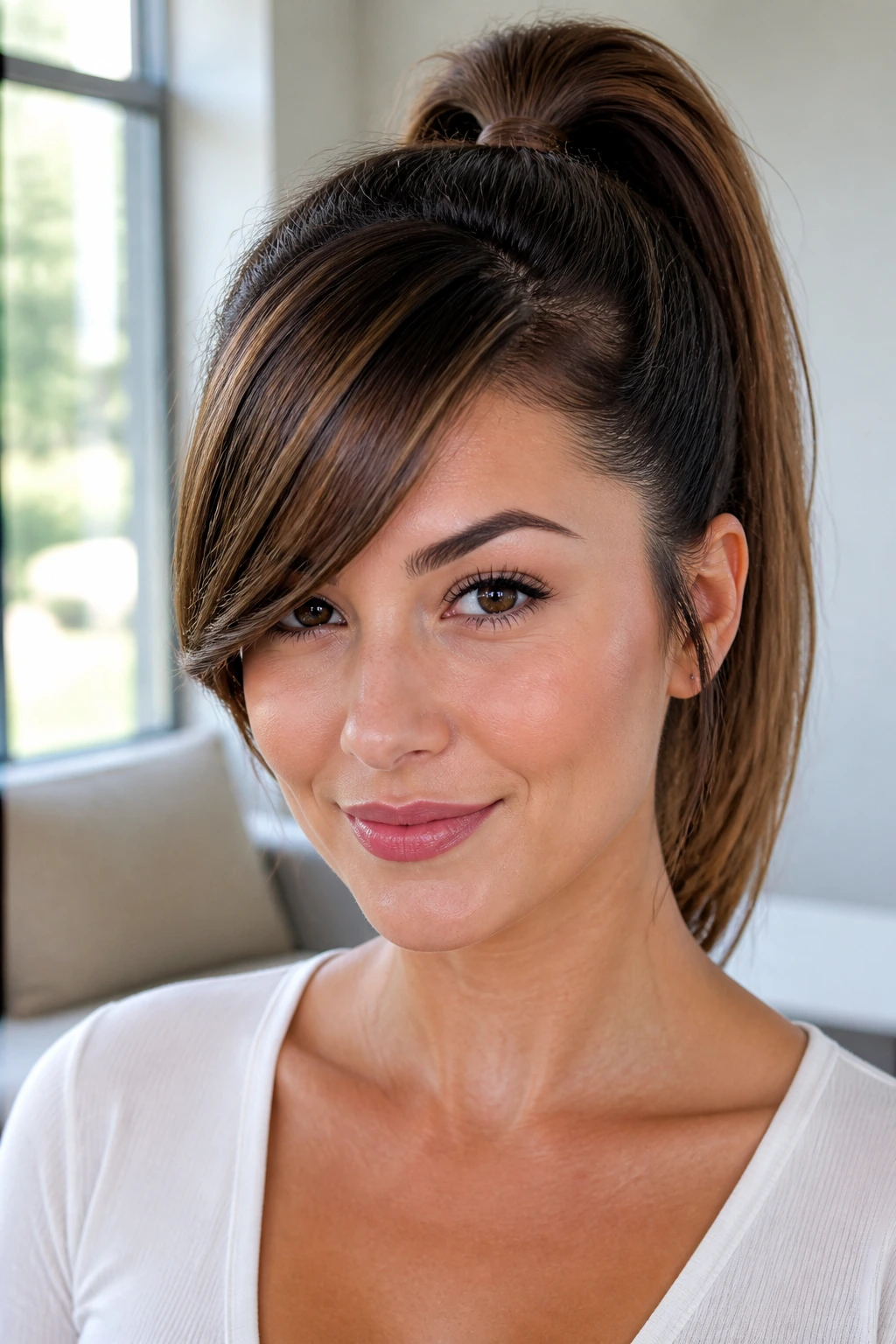
A deep side fringe is one of the easiest face-shaping tricks when you want your hair up. The diagonal front section gives a round face a longer line, while the high ponytail lifts the crown and keeps the shape from drooping around the cheeks.
This is not just a gym hairstyle. Done well, it looks polished enough for work, dinner, or a dressy top. The fringe should start from a deep side part and sweep across the forehead in one clean arc. The rest of the ponytail can be sleek or textured, but the lift at the crown is what makes the face read longer.
Why the diagonal line helps
A straight center line on a round face can feel a little too blunt when hair is tied back. The side fringe changes that. It cuts across the face rather than stopping at it, which creates motion. That motion matters more than people think.
A small amount of smoothing cream at the roots and a touch of hairspray at the front are enough. Keep the fringe soft. If it’s stiff, the whole look loses ease.
12. Grown-Out Fringe With a Collarbone Cut
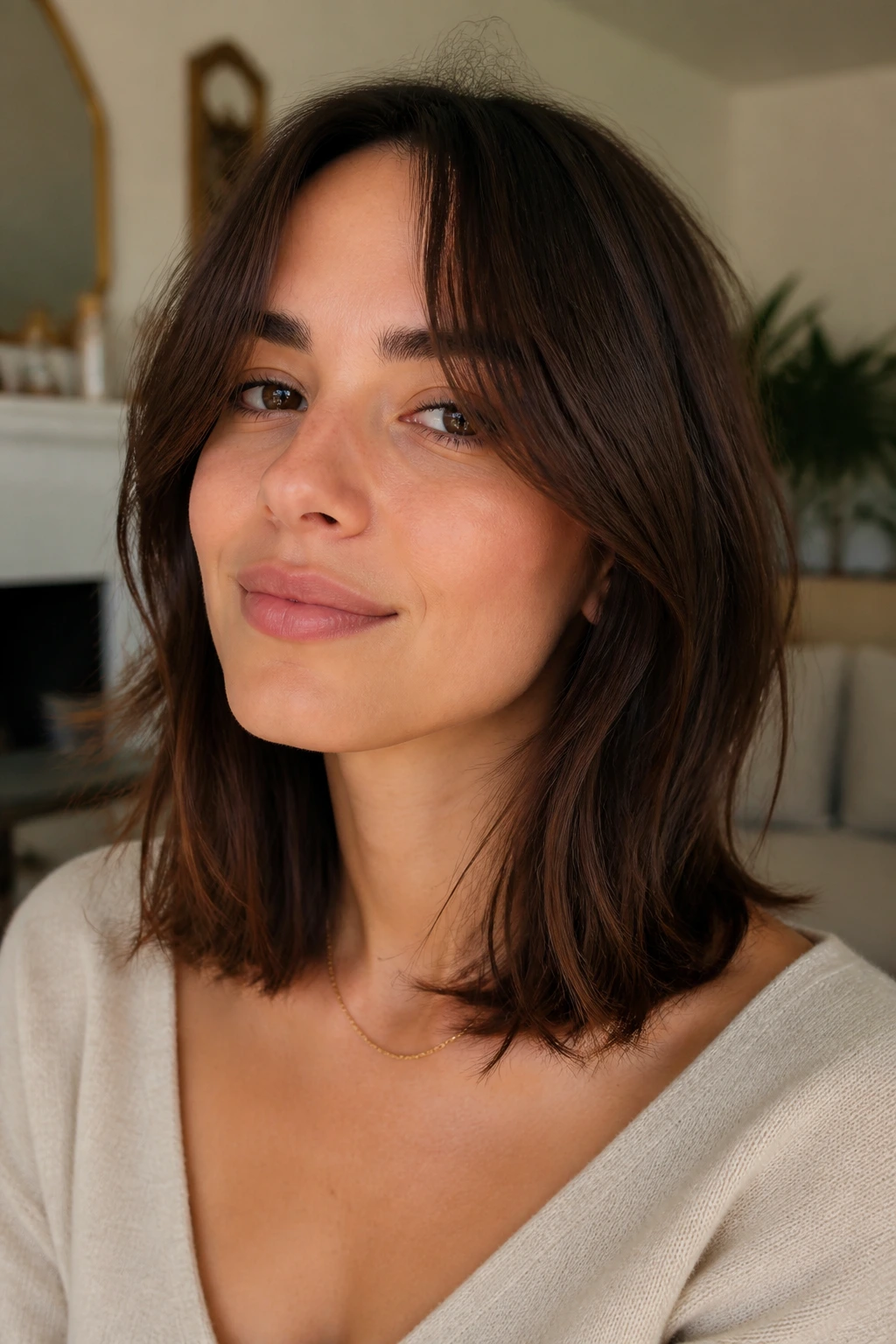
What do you do when your bangs are in that awkward grow-out stage and you do not want to keep trimming them every few weeks? You lean into the grow-out. A collarbone cut with grown-out fringe is one of the more forgiving looks for a round face because it gives you a long silhouette without demanding perfect bangs.
The fringe usually sits somewhere between a curtain bang and a face-framing layer. It parts enough to show the forehead, then falls into the rest of the hair around the cheek and jaw. That creates a soft vertical path down the face instead of a hard stop across the brows.
This is also one of the easiest ways to hide the fact that the fringe is growing. Tuck one side behind the ear, let the other side fall forward, and the whole thing looks intentional. That slight asymmetry helps round faces more than a strict, centered shape would.
If you want a style that can survive air-drying, re-drying, and the odd windy day, this one is practical. Not glamorous in a flashy way. Practical, and that counts.
13. Baby Curtain Fringe With a Long Shag
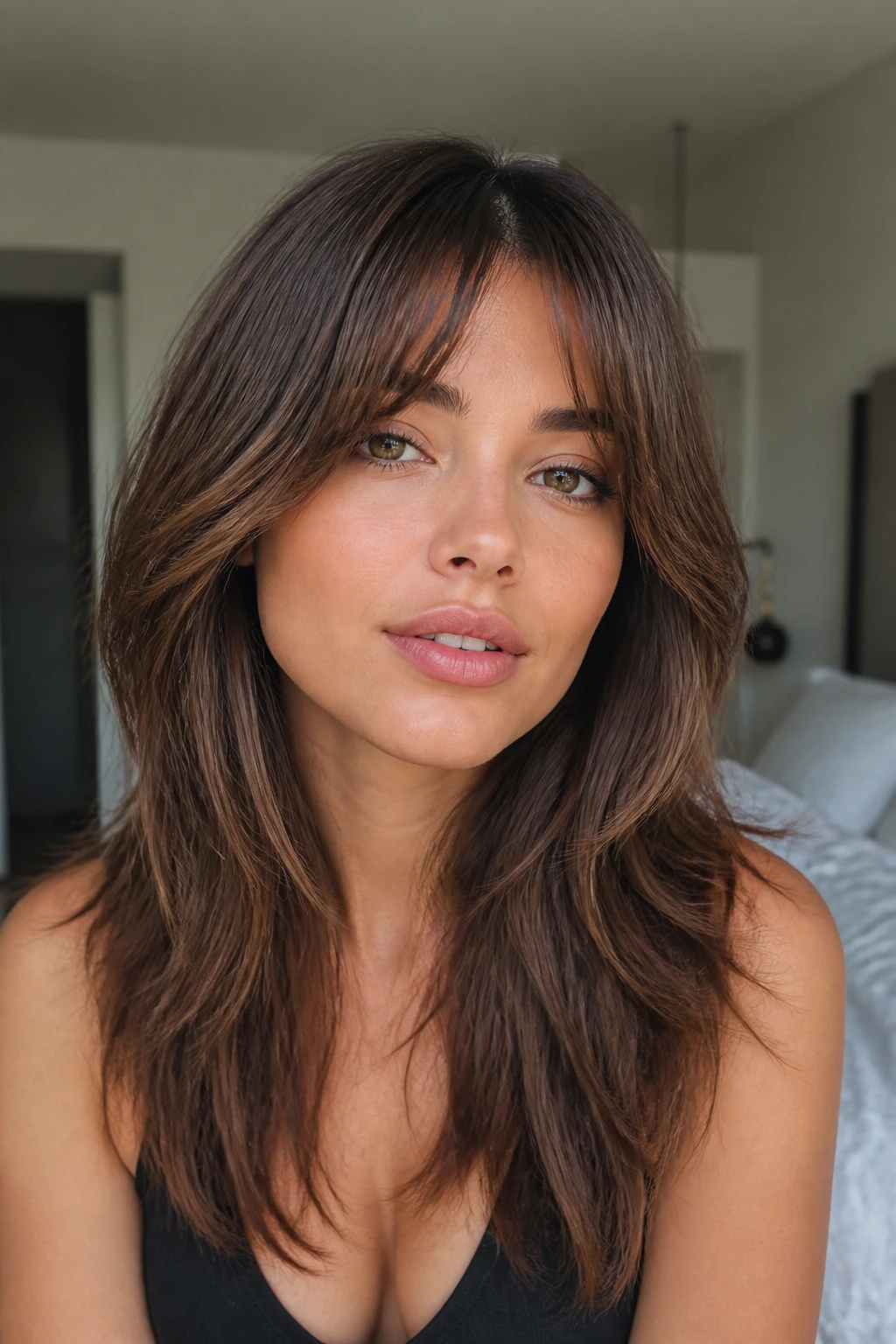
Baby curtain fringe sounds tiny, and it is. But when it sits at the right point and pairs with a long shag, it can make a round face look longer by opening the center of the forehead while keeping softness at the sides.
The fringe is shorter in the middle and sweeps out before it gets too heavy. That shape lets the eyes stay visible, which is useful if your face has a lot of softness already. A long shag beneath it gives the haircut room to move, so the fringe feels connected to the rest of the style instead of floating alone.
This cut is especially good if you like a bit of attitude. It has a slightly undone feel, but not in a messy-for-the-sake-of-messy way. The layers around the cheeks and shoulders do the real work. They frame the face and keep the fringe from becoming the only thing people notice.
You do need to style it a little. A quick round-brush bend or a soft blowout helps the shorter center pieces sit properly. Otherwise, the fringe can flip in odd directions and lose that airy split.
14. Asymmetrical Fringe With an Angled Bob
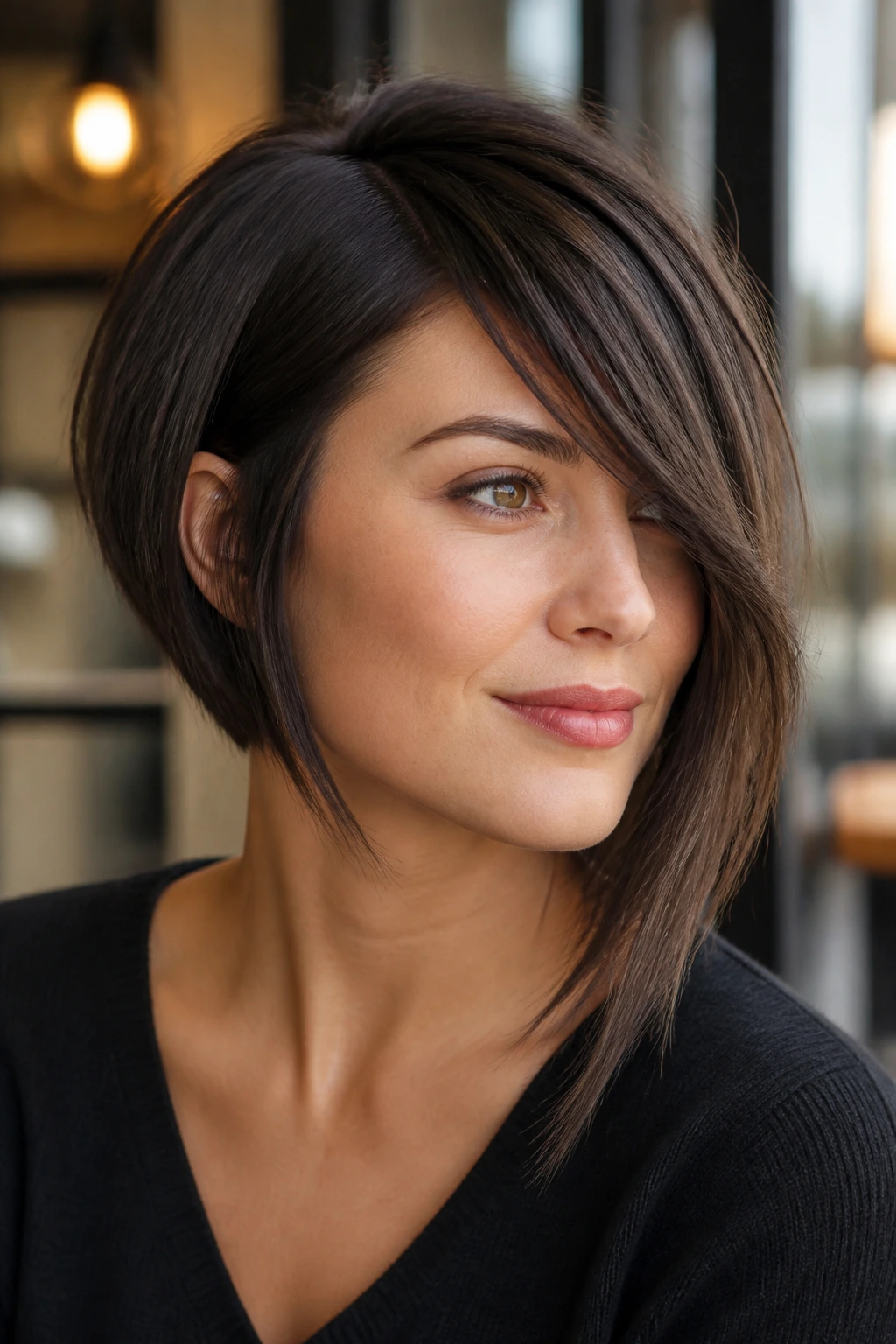
An asymmetrical fringe is a good answer when you want a face-framing detail that doesn’t feel predictable. On a round face, the one-sided fall of the fringe breaks up symmetry, which helps the face appear a little longer and a little sharper.
The bob should be angled too — shorter in the back, longer in the front. That forward length is doing a lot of work. It pulls the eye down and away from the cheeks. The fringe then leans to one side, usually blending into the longer front piece.
Ask for this in the chair
Tell your stylist you want the fringe to be noticeably longer on one side, but not so dramatic that it looks disconnected. The better version has a smooth transition. The shortest side can graze the brow, while the longer side slips toward the cheekbone.
This cut looks best with some shine and polish, but it doesn’t need ironed-flat perfection. A little texture at the ends keeps it from feeling severe. Round faces benefit from the shape, not from over-control.
15. Long Parted Fringe With Sleek Layers
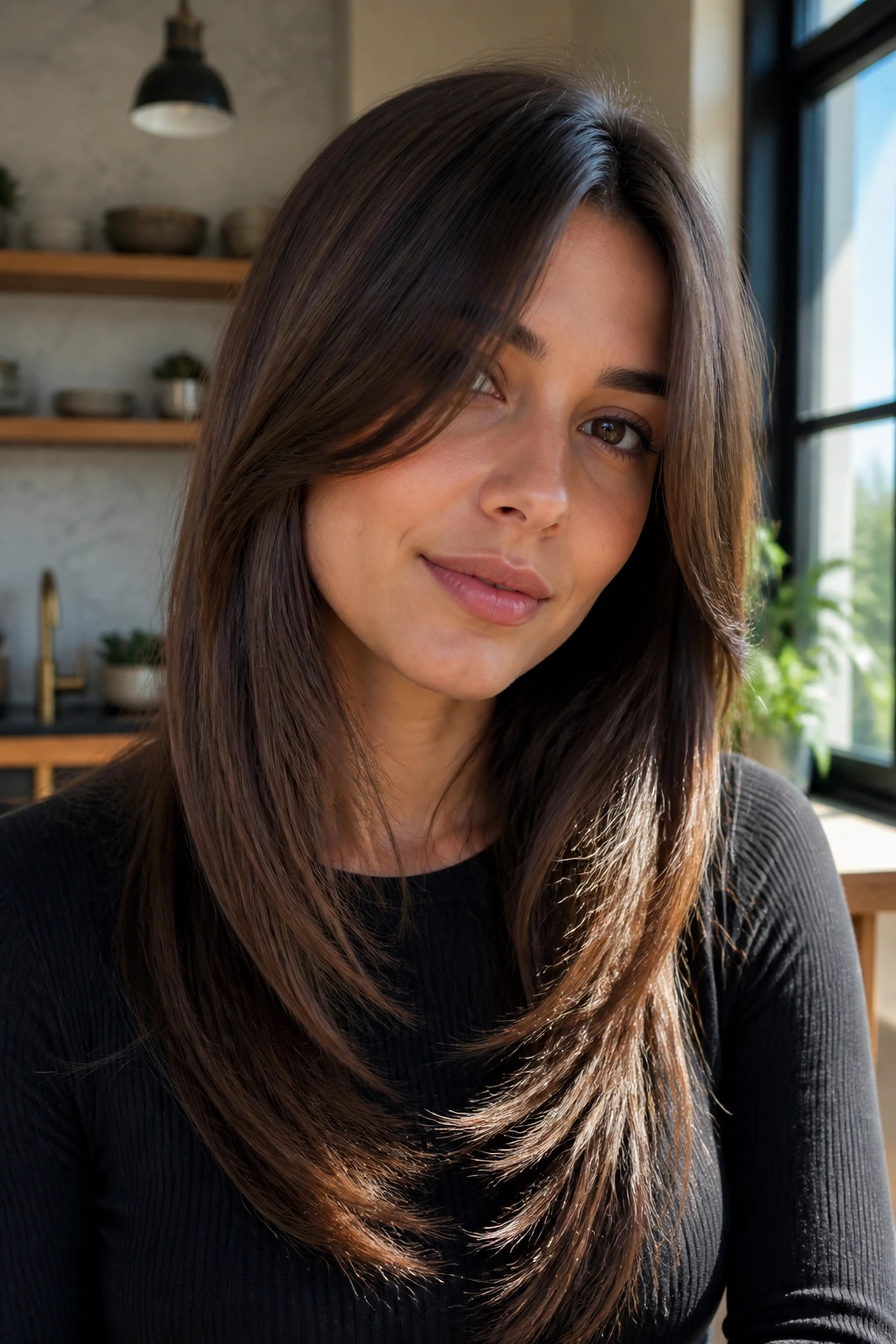
Long parted fringe is for people who want bangs without giving up the clean, sleek look of longer hair. The fringe is parted near the center or just off-center and left long enough to blend into the front layers, which keeps the face open and soft.
For a round face, that length is useful because it doesn’t stop at the forehead. It keeps traveling down toward the cheek and jaw. The eye follows the line, and the face feels less circular. Straight hair shows this shape best, but a smooth blowout on wavy hair can get close.
The haircut itself should be layered enough that the fringe doesn’t sit as a heavy block. The first layers can start around the chin or lip, then taper down through the collarbone. That gives the whole cut a quiet vertical effect.
This is one of those styles that can look understated in the best way. No drama, no sharp contrast, no fight with the face shape. Just clean lines and a little movement where it counts.
16. Face-Framing Fringe With Butterfly Layers
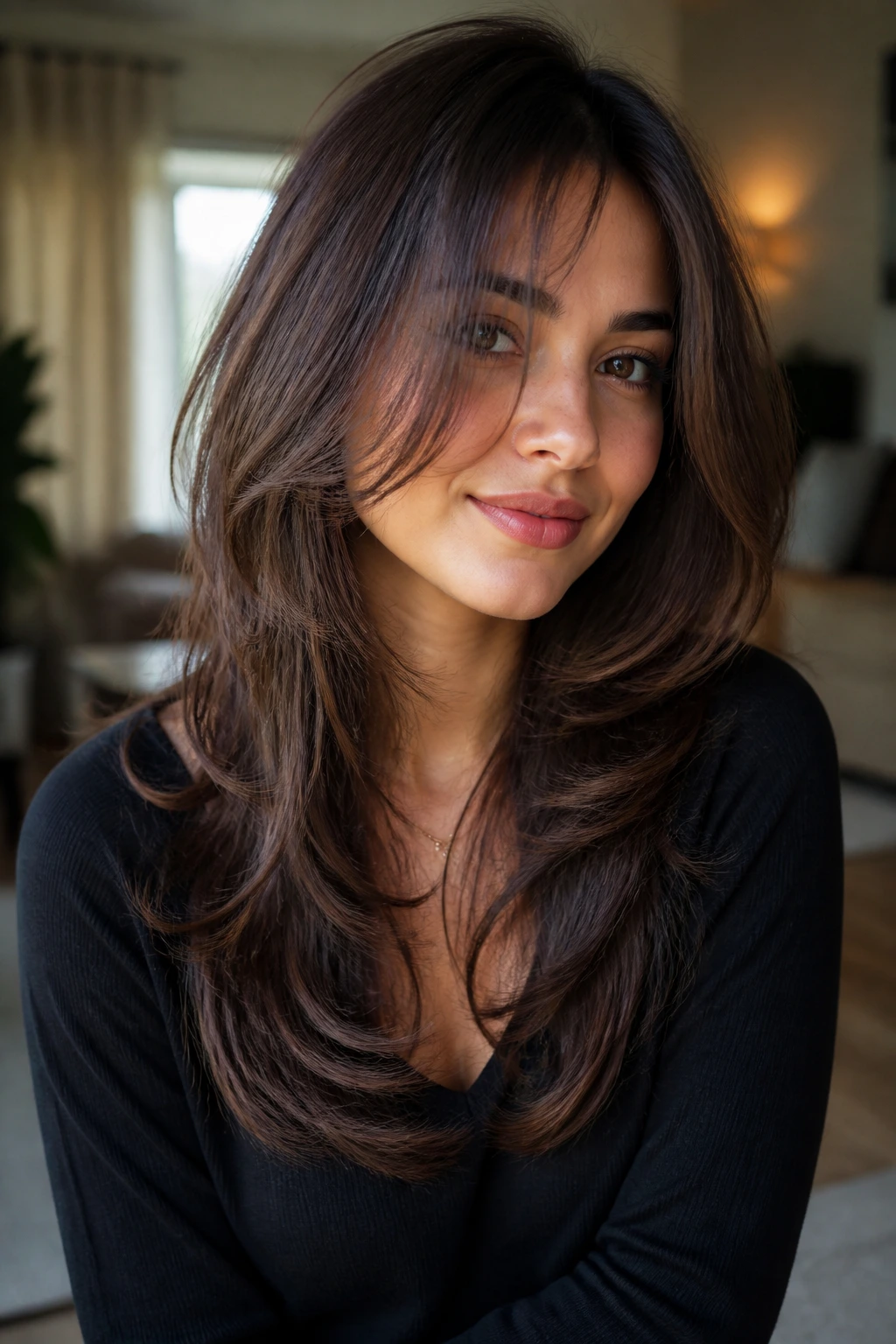
If curtain bangs feel too simple for you, face-framing fringe with butterfly layers gives you a bigger shape and more movement. The difference is mostly in scale. Butterfly layers start higher and fall more dramatically, so the front of the haircut has more presence around the cheekbones and shoulders.
That works well for round faces because the front pieces create a long, falling line that doesn’t stop at the widest part of the face. The fringe usually blends into those front layers instead of ending separately. The result feels airy but still noticeable.
Why this is not the same as curtain bangs
Curtain bangs are about an open split and a soft drape. Butterfly layers are about visible length changes — shorter around the front, longer through the back, and lots of movement in between. If you like hair that swishes when you walk, this one has that feeling.
It suits medium to long hair best. On shorter cuts, the shape can get lost. And if your hair is very fine, you may need a bit of blow-drying to keep the front pieces from collapsing into the rest of the haircut.
17. Piecey Fringe With a Bixie Cut
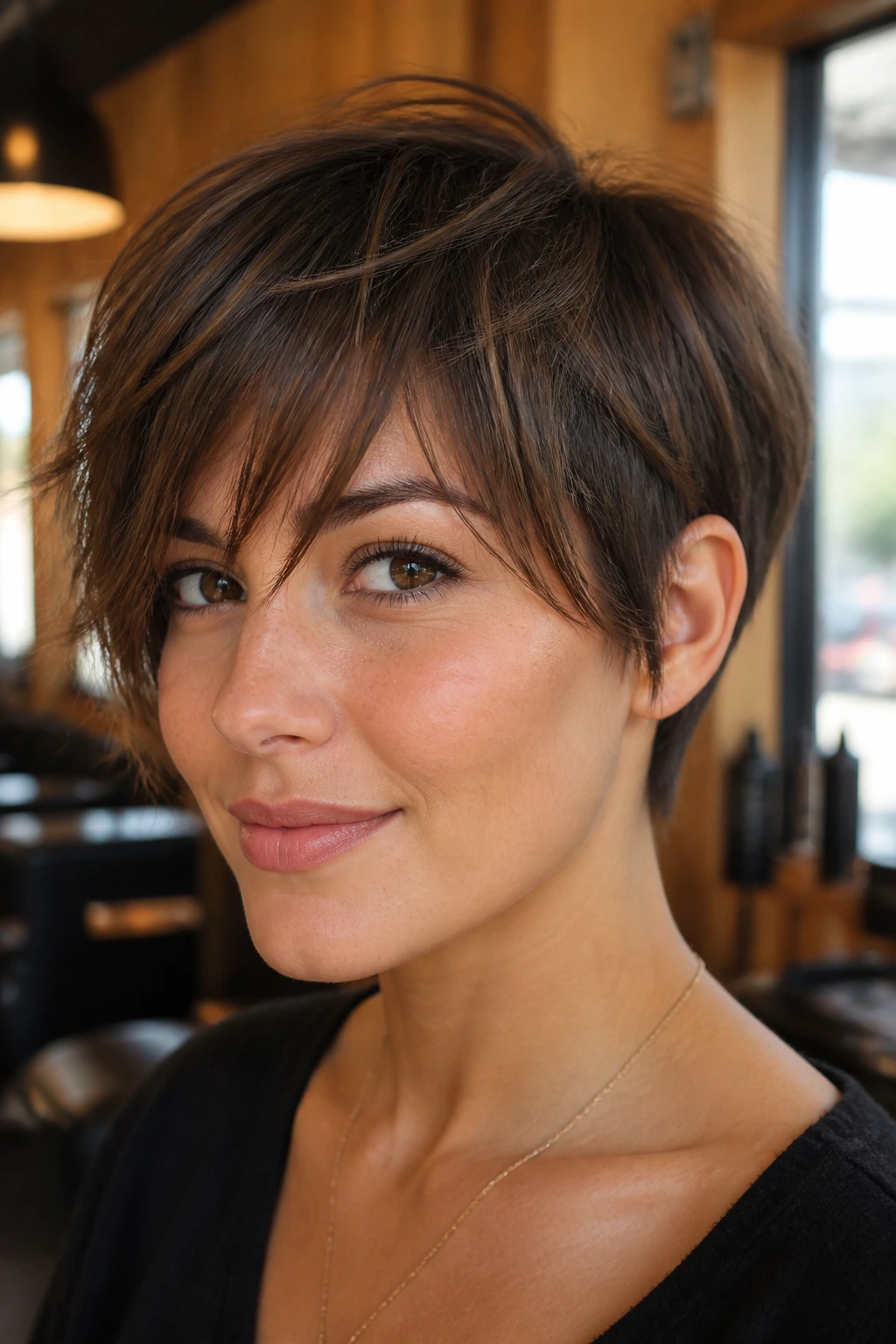
Is a short crop too much for a round face? Not if the shape is handled well. A bixie — that in-between pixie and bob cut — can look sharp and flattering with a piecey fringe because the cut keeps the sides soft and the top textured.
The fringe should not be solid. It should break into small pieces that separate easily, which stops the forehead from looking boxed in. That piecey detail helps the face keep some openness. The bixie itself adds height at the crown and motion around the temples, and that’s the combination that makes it work.
How to keep the crop soft
Ask for tapered sides, a little extra length on top, and fringe pieces that can be swept or shuffled rather than locked in place. A touch of wax at the ends is enough. Too much product makes the whole cut look stiff and smaller than it should.
This style is for someone who likes hair with attitude but doesn’t want a heavy fringe sitting across the whole forehead. It’s short, but not severe. That’s the difference.
18. Rounded Fringe With a Soft Mullet
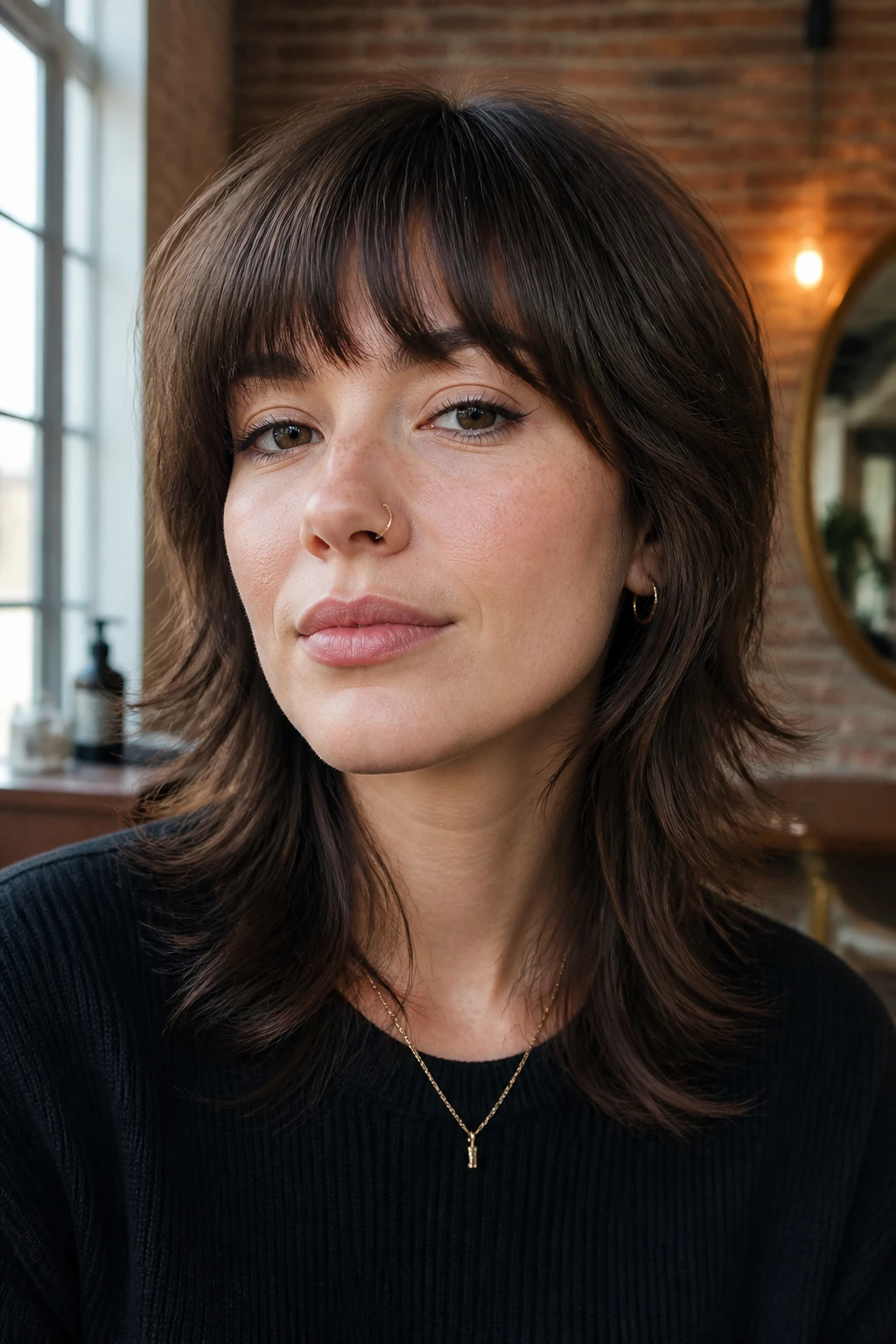
A soft mullet sounds like a bold move, and it can be. But the gentler version — with a rounded fringe and softer lengths through the nape — works better on round faces than most people expect. The haircut creates vertical stretch through the back while keeping the front light enough to avoid that all-over width.
The fringe should curve slightly, not form a straight bar. That curve follows the head shape and keeps the center from feeling too low. Around the cheeks, the layers should stay soft and broken so the face doesn’t get swallowed by volume.
- Keep the crown a little fuller than the sides.
- Leave the nape soft and wispy, not razor sharp.
- Use a diffuser or rough-dry with your hands if the hair has wave.
- Avoid heavy product at the front; it makes the fringe sink.
This is a good pick if you like hair that looks a little rebellious but still wearable. It’s not a costume cut. It’s a shape cut, and that distinction matters.
19. Heavy Side Fringe With Long Curls
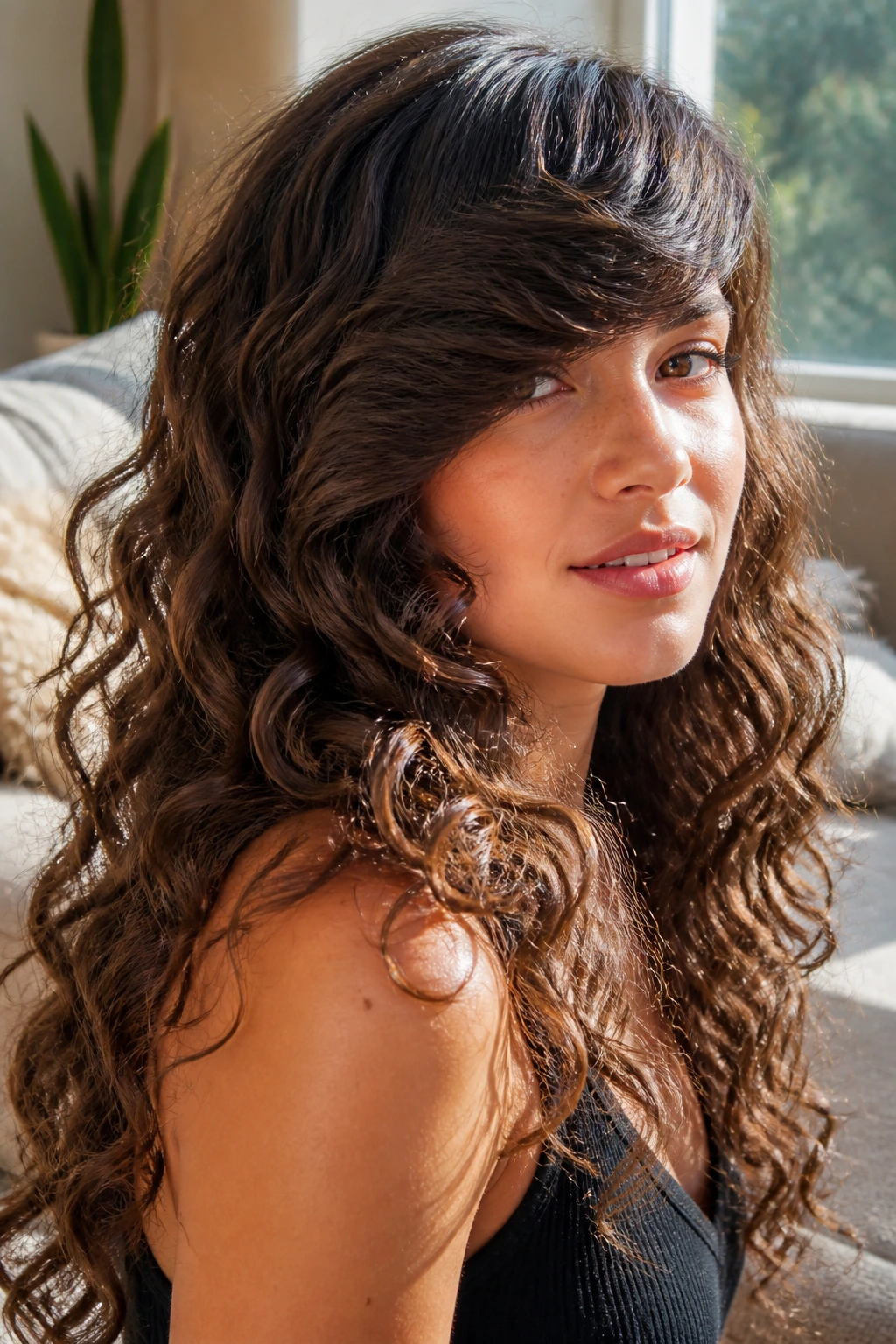
A heavy side fringe can be a smart match for long curls because curls add width on their own. The diagonal sweep gives the face a line to follow, while the length of the curls keeps everything from bunching up near the cheeks.
The important part is length. Curly hair springs up, so the fringe should be cut longer than you think you need when it’s wet. A side fringe that looks a little too long in the chair often lands in the right place once it dries. If it’s cut too short, it can pop up and make the forehead look smaller than you want.
This style works especially well when the curls are long enough to hang below the jaw. That extra length offsets the fullness around the middle of the face. If your curls are dense, the side fringe also helps prevent the front from becoming a solid, triangle-like block.
I like this look because it feels soft but controlled. The curls can do their own thing, and the fringe still keeps the face shaped. That balance is the whole appeal.
20. Short Fringe With a French Bob

A French bob with a short fringe can look chic on a round face, but the cut has to be precise. The bob should hit at or just below the jaw, never at the widest part of the cheeks. The fringe should stay short enough to show the brow line, but not so blunt that it closes the face.
What saves this style is contrast. The bob is neat and compact, but the fringe stays a little airy or slightly textured. That tiny bit of softness keeps the face from reading too square. On straight hair, the line is crisp. On wavy hair, the bob gets a looser, more lived-in feel that often suits a round face better.
The bob length that saves it
If the haircut stops too high, the face can feel crowded. Keep the perimeter around the jaw or just past it, and let the fringe sit with a little movement rather than a rigid edge.
This is a strong look if you like clear shape and low fuss. It is not the easiest fringe to grow out, though, so go in with your eyes open.
21. Split Fringe With a Half-Up Style
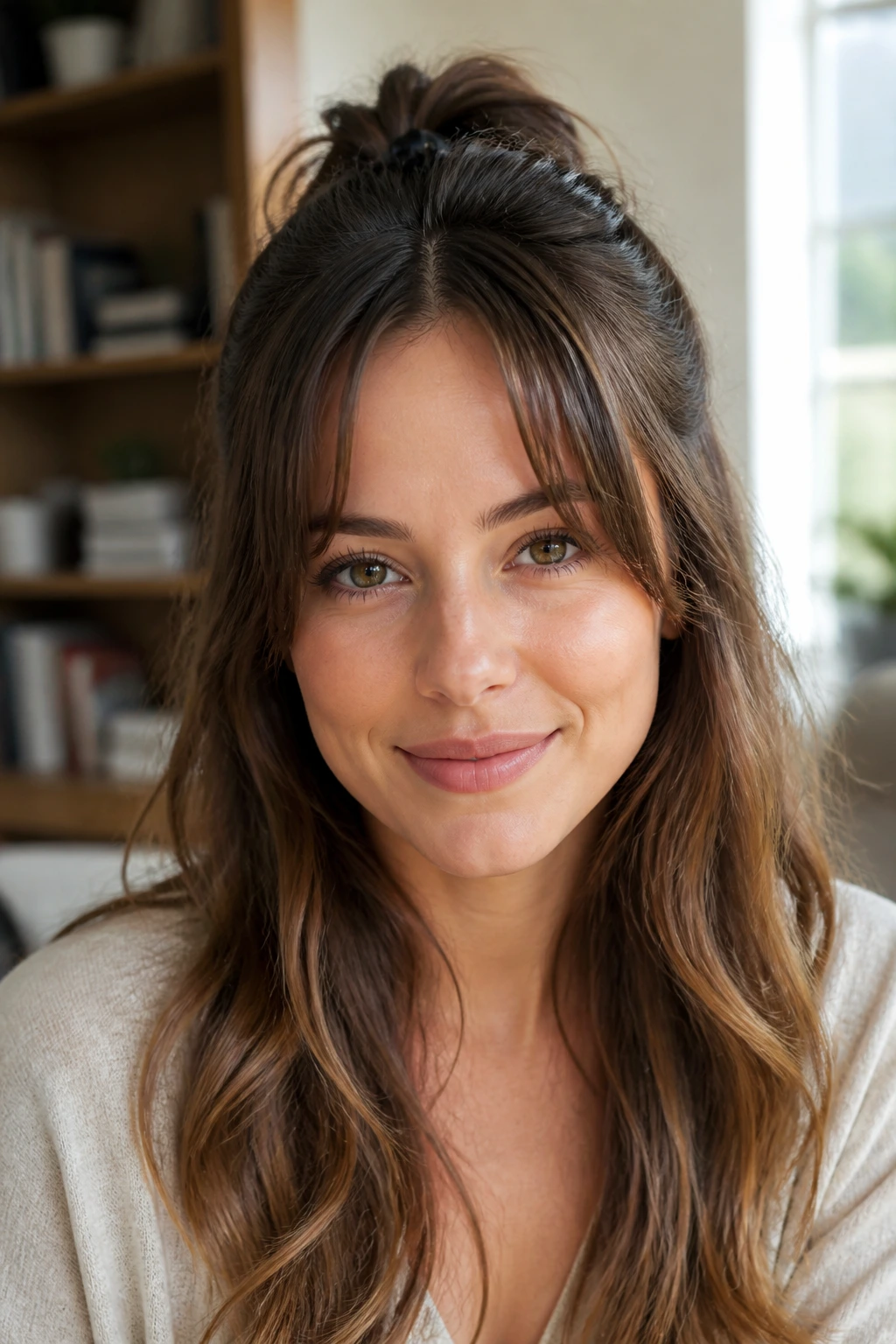
A split fringe with a half-up style is one of those looks that feels casual but still considered. The split opens the forehead, while the half-up section lifts the crown and keeps the sides from sitting flat against the face.
On a round face, that lift matters. Hair worn down can sometimes sit right at cheek level and add width where you don’t want it. Pulling the top section back changes the proportion fast. The fringe stays loose enough to keep the face soft, but the top half gives the whole style more height.
How to keep it from falling flat
Use a little dry texture spray at the roots before tying back the top section. A small claw clip or a soft elastic works fine. Then leave the fringe pieces slightly uneven on purpose. That roughness keeps the style from looking too formal.
This is an easy weekday style, but it also works for dinner or an event if the rest of the hair has a little wave. It’s practical, and it doesn’t try too hard. A rare combination.
22. Soft Fringe With a Low Bun
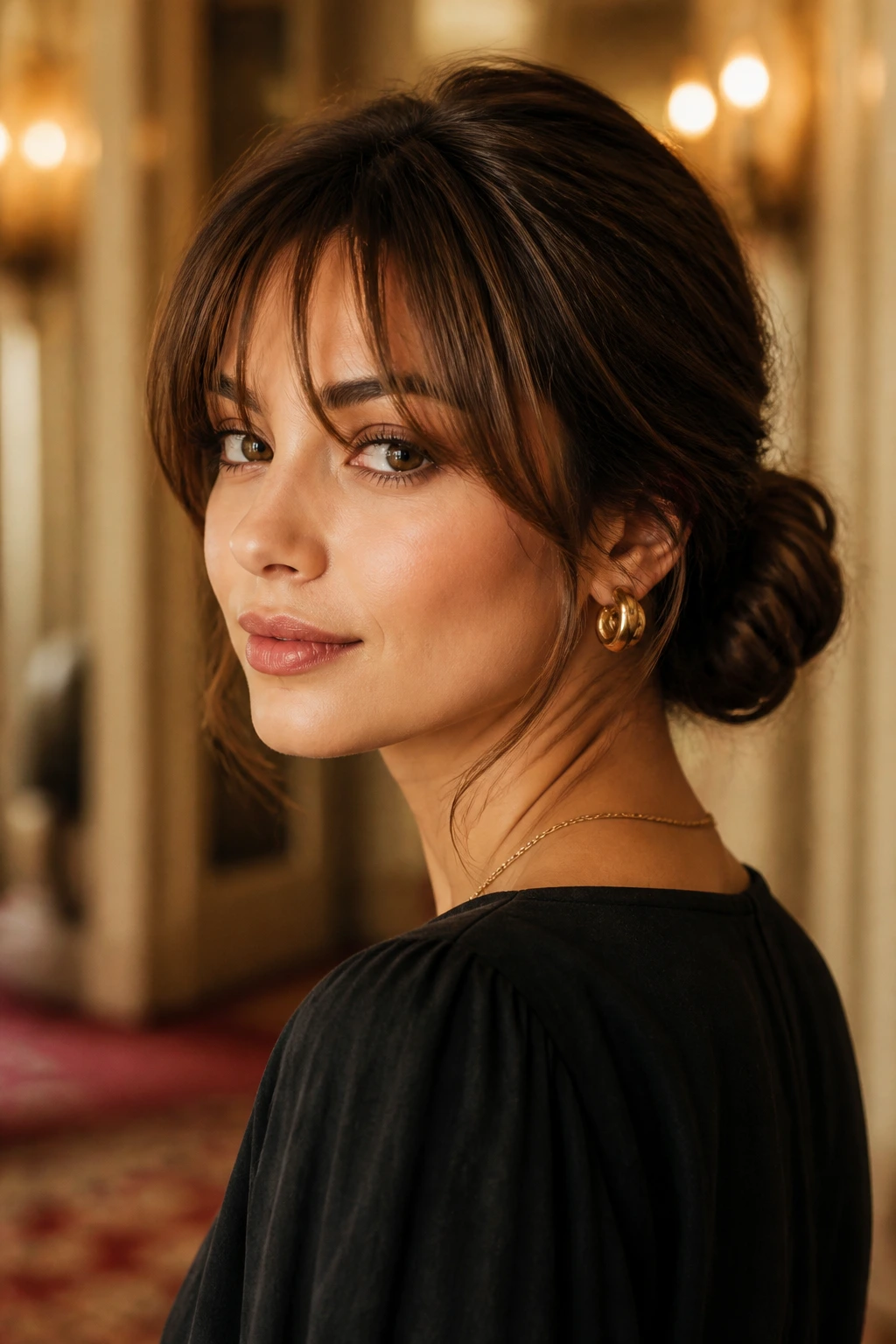
A low bun with a soft fringe is one of the easiest ways to wear fringe when you want the face open but not exposed. The bun sits low and neat, and the fringe does the softening work across the forehead so the face doesn’t feel bare.
This is a good option for round faces because the bun keeps volume away from the sides, while the fringe gives the face a vertical starting point. The bangs should be loose enough to move — not stiff, not glued down. A few longer pieces near the temples can help, especially if you like a slightly undone finish.
For formal wear, this pairing is hard to beat. For everyday use, it’s also practical because the fringe stops the style from looking severe. If your hair is thick, the bun can be tight. If it’s fine, leave a little fullness at the crown so the whole thing doesn’t collapse.
The best version feels soft around the face and neat everywhere else. That contrast is what makes it work.
Final Thoughts
The strongest fringe for a round face is rarely the one that looks the boldest on a hanger or in a salon mirror. It’s the one that understands where the face is widest, where the eye needs to travel, and how much hair you can realistically live with every morning.
A good rule: if the fringe ends right where your face is fullest, keep adjusting the shape. Push it longer, softer, more angled, or more split. Tiny changes matter here. A half-inch can make the difference between “nice” and “why does this feel off?”
Bring photos, yes, but bring the right kind — the ones that show where the fringe lands, not just the vibe. That detail saves a lot of awkward grow-out later.
