



Round faces and gray hair can make a surprisingly good pair. The right haircut gives silver strands shape, and shape matters when the face is widest through the cheeks.
The best gray haircuts for round faces do one simple thing well: they build length where the face needs it and keep width from spreading out at the cheeks. That can mean a clean angle, a lifted crown, a longer fringe, or a soft bend that starts lower than the jaw.
Gray hair changes the game a bit too. Once pigment drops, texture often shifts, so hair may feel drier at the ends, coarser around the crown, or flatter at the roots than it used to be. A cut that looked fine five years ago can start reading boxy or puffy under bright light.
That’s why the smartest styles here aren’t all long, and they aren’t all short. Some are crisp. Some are shaggy. Some lean polished and some are a little messy on purpose. The common thread is balance, and the details matter more than the label.
1. Angled Bob with a Longer Front
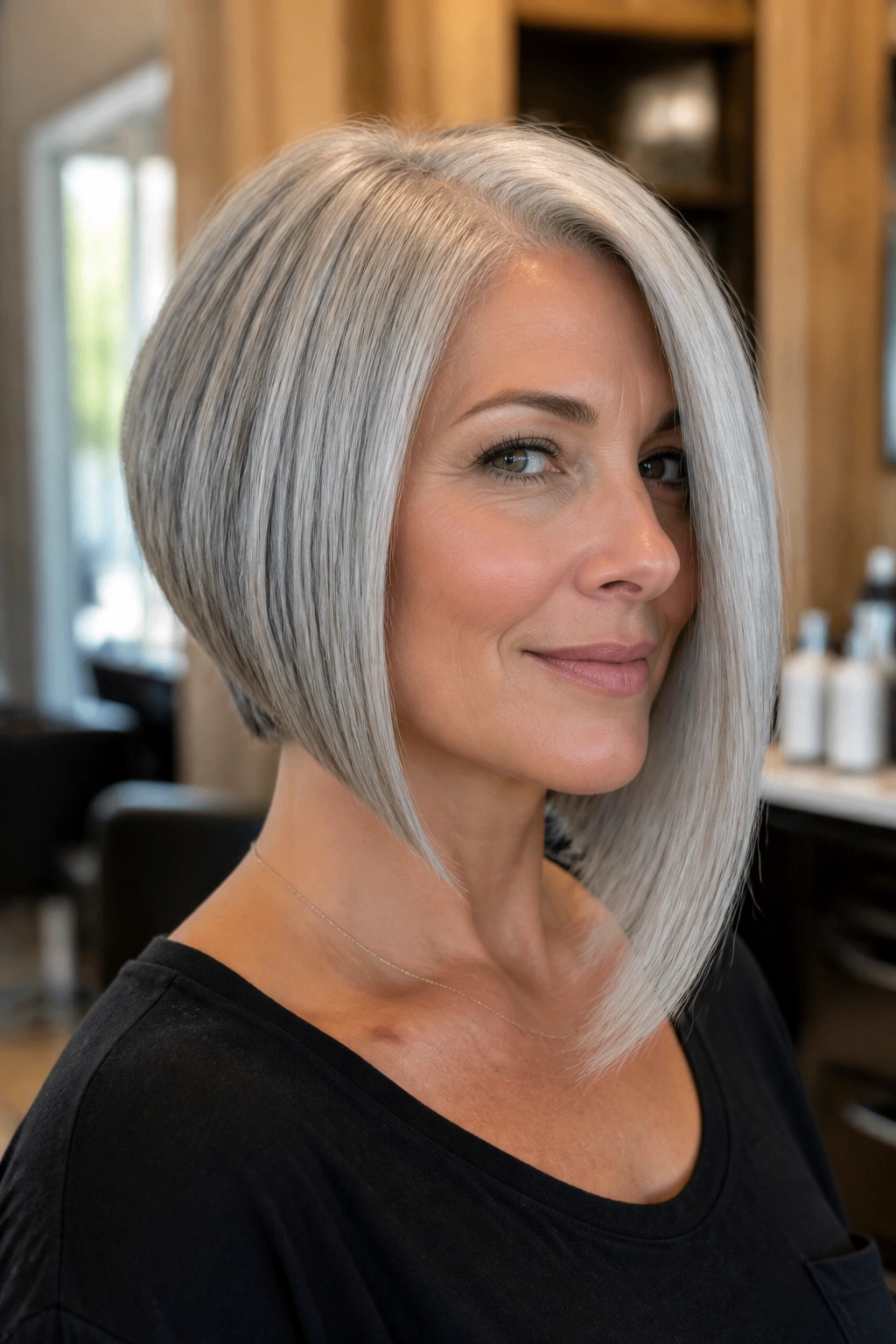
An angled bob is one of those cuts that looks calm from the front and slightly sharper from the side. That matters on a round face, because the front pieces can fall below the jaw while the back stays tucked in close.
Why It Flatters a Round Face
The angle creates a line the eye wants to follow. Instead of stopping at the fullest part of the cheek, the hair moves down and forward, which makes the face feel longer without looking severe.
Gray hair makes this shape read cleanly. Silver and white strands catch light fast, so a blunt edge at the wrong spot can look wide in a hurry. A slightly longer front keeps the style sleek and deliberate.
What to Ask For
- Keep the front 1 to 2 inches below the chin.
- Let the back sit close to the nape, not puffed out.
- Ask for light point-cutting at the ends if your hair flips hard.
- Use a side part or an off-center part to keep the shape from feeling too round.
Small tip: If your hair is fine, skip heavy thinning. It can make the bob lose its edge fast.
2. Long Pixie with a Lifted Crown
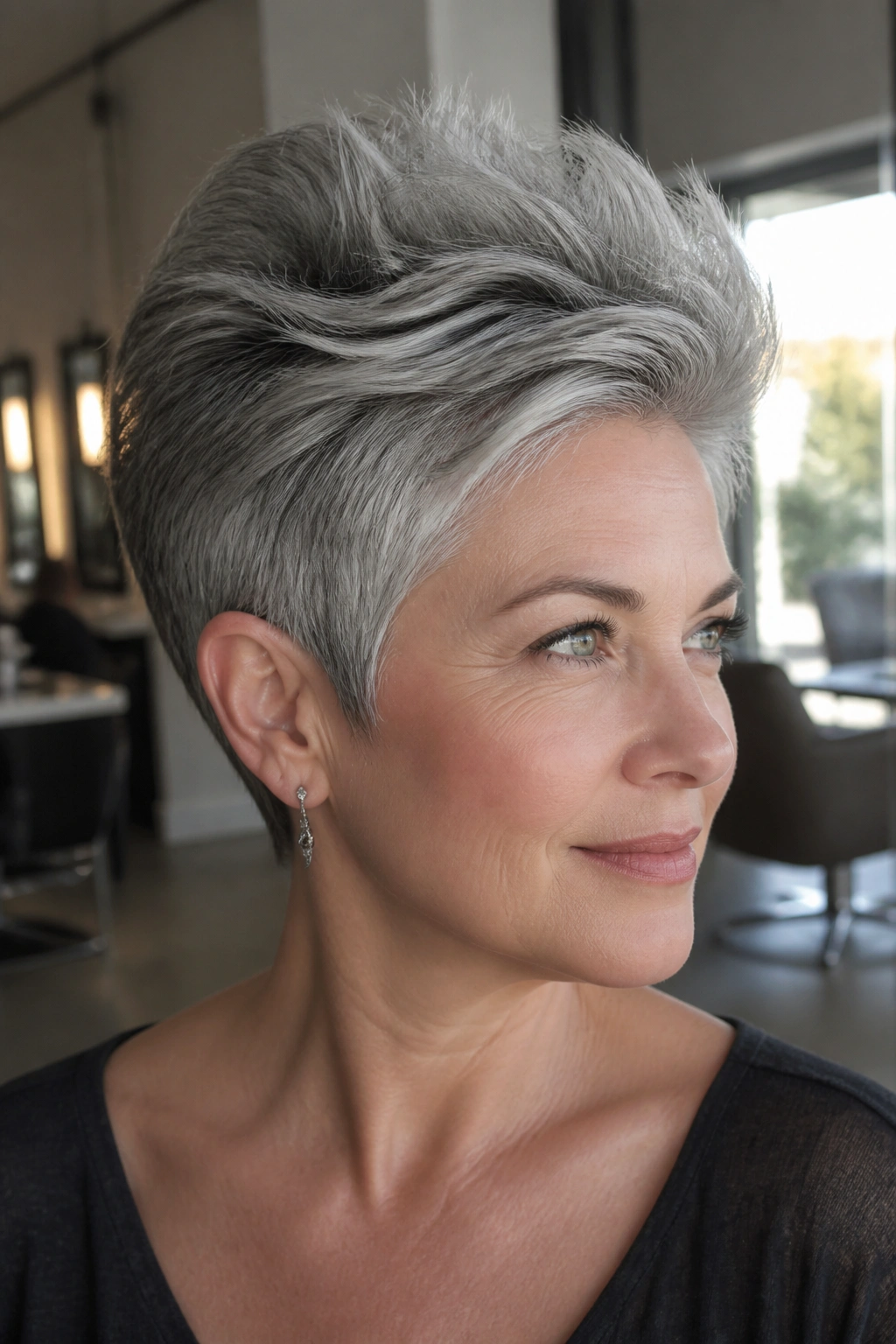
A long pixie can be more flattering than shoulder length if you want the face to look a little longer. That sounds backward until you see it in a mirror. Height at the crown does more for a round face than extra length that hangs flat.
The trick is in the proportions. Keep the sides neat and close, then leave enough length on top to sweep diagonally or push upward with a bit of root lift. That vertical movement pulls attention away from the widest part of the face.
Gray hair makes this cut look crisp. There’s no hiding behind fluff here. The shape shows, which is exactly why it works.
For styling, I’d start with a light mousse at the roots and a small round brush or your fingers if you prefer a messier finish. A pea-sized touch of matte paste on the top pieces is often enough. Too much product will flatten the crown, and then the whole point of the cut disappears.
3. Collarbone Lob with Soft Waves
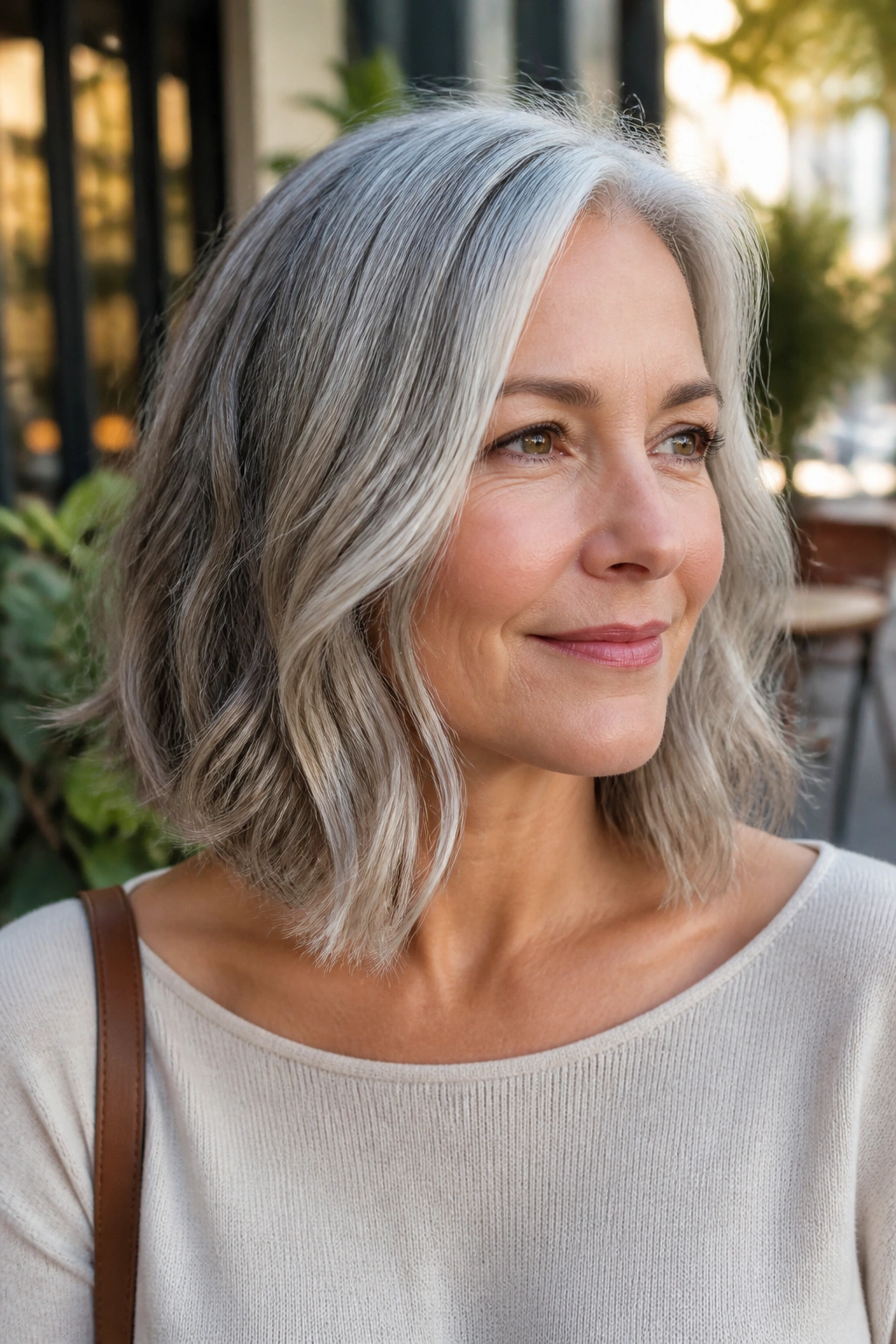
Can a longer cut still slim a round face? Yes, if the length lands at the collarbone and the wave starts low.
A lob that hits right around the collarbone gives the face room to breathe. It also keeps gray hair from hanging heavy at the cheeks, which can happen when the length stops too close to the jaw. The soft wave is the real helper here. It breaks up the outline so the silhouette feels vertical instead of circular.
The best version is not a tight curl or a polished beach wave from root to tip. Keep the bend relaxed and start it below the cheekbone. That way the upper half of the hair stays smoother and the movement happens lower, where it helps the most.
How to Wear It
- Create bends with a 1.25-inch iron or large hot rollers.
- Leave the ends a little straighter for a softer line.
- Use an off-center part if the face feels very full at the sides.
- Mist with flexible-hold spray, not hard shell spray.
That last part matters. Gray hair can go stiff fast if the styling product is too heavy.
4. Side-Swept Shag for Gray Haircuts for Round Faces

A shag can go wrong fast on a round face. Put the shortest layers too high around the cheeks, and the whole cut starts puffing outward. Keep the sweep to one side, though, and the shape turns useful in a hurry.
The side-swept shag works because it builds motion without making the face look wider. The fringe and top layers lean diagonally, the lower layers stay loose, and the overall effect is airy rather than puffy. On gray hair, that airy finish reads modern instead of fussy.
What I like about this shape is that it forgives a little mess. If your hair has a natural wave, even better. If it doesn’t, a rough dry with your head turned upside down can still give the cut enough lift to feel alive.
- Keep the shortest layers away from the exact cheekbone line.
- Ask for texture through the mid-lengths, not the ends only.
- Let the fringe sweep across the forehead instead of sitting straight on it.
- Finish with a dab of styling cream on the ends if they fray.
A shag should feel loose, not shredded. There’s a difference.
5. French Bob with a Loose Side Part
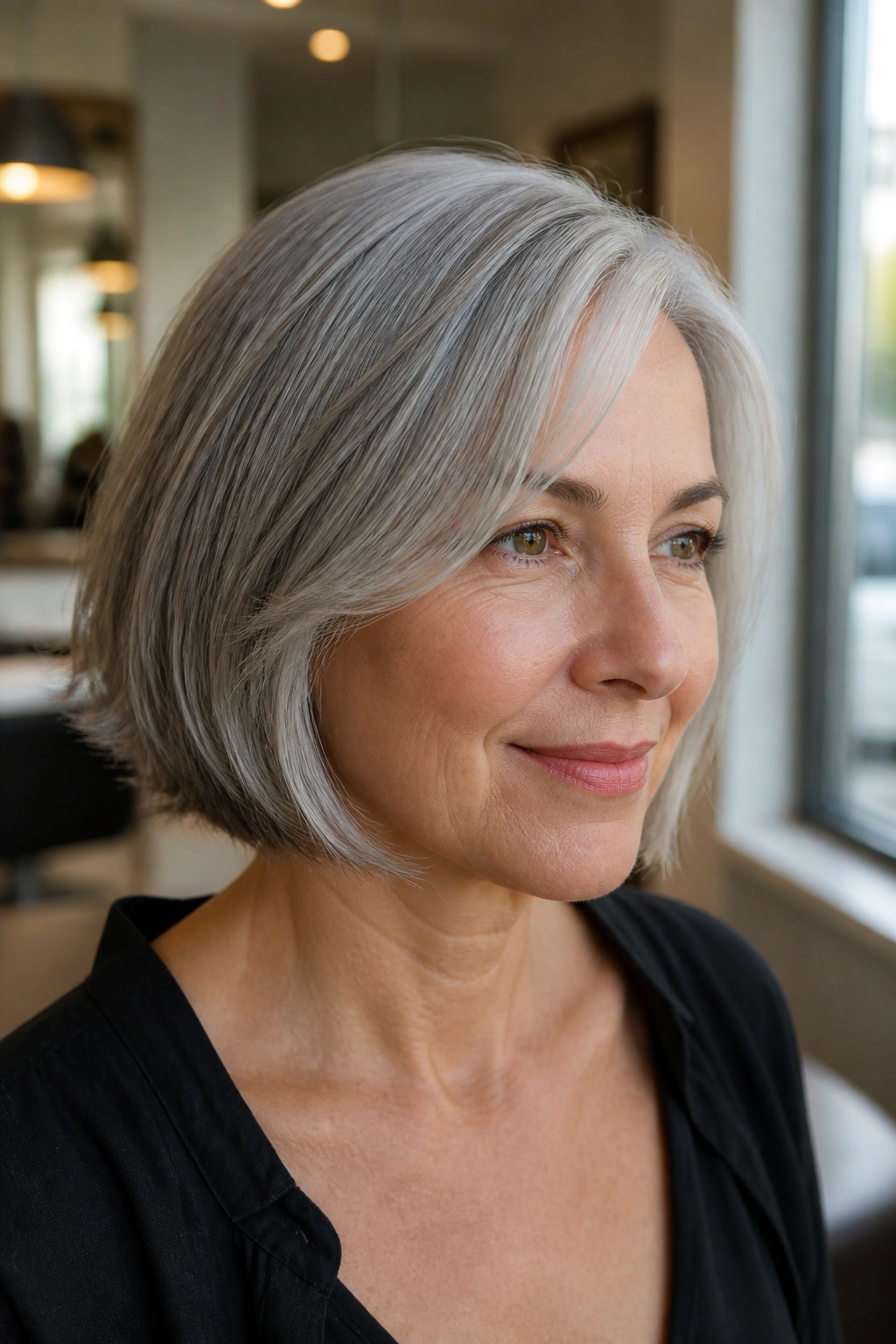
A chin-length French bob can be a trap. The cut sits close to the face, so any extra width shows fast. The fix is a loose side part and a little softness at the ends.
That soft side part breaks the circle without turning the haircut into something severe. The bob can still be short and chic, but it needs a slight lean. On gray hair, the line looks especially sharp, so a blunt chop at the jaw can feel boxy unless the front is nudged a touch longer.
I also like this cut on straight or gently wavy hair because the shape stays clean. If your hair is thick, ask for a little internal removal under the top layer so the bob does not balloon out. If your hair is fine, keep the perimeter crisp and let the part do the heavy lifting.
A wispy fringe can help too, but it should be light. Heavy bangs shorten the face in a way round faces usually do not need. A little softness at the brow line is enough.
6. Inverted Bob with a Clean Nape
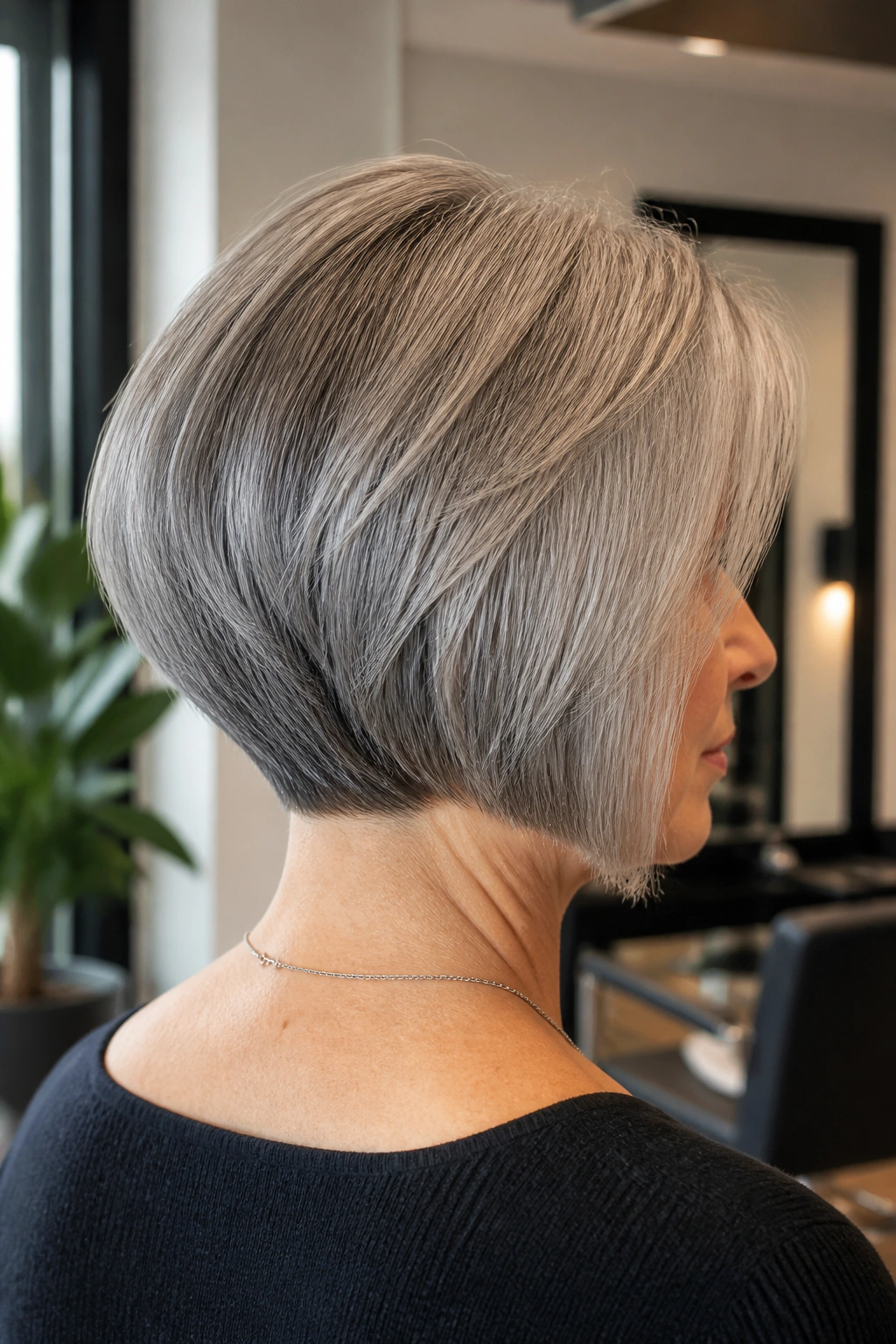
Unlike a classic one-length bob, an inverted bob gives you a built-in angle. That angle is the whole point. The back is shorter and tighter, while the front extends forward and down.
On a round face, that shape does two jobs at once. It shows the neck, which helps the face feel longer, and it moves the visual weight toward the front corners instead of the widest part of the cheeks. Gray hair loves this cut when the finish is smooth, because the graduation shows clearly.
This is a smart choice if your hair is straight and medium to thick. Fine hair can do it too, but the stack in the back needs to stay low or it may go flat and uneven. The best versions are not stiff. They tilt, they skim, they swing a little when you move.
If you want low maintenance, this one earns its keep. A quick blow-dry with a nozzle attachment and a paddle brush usually does enough. You do not need a big round-brush blowout every time unless you want one.
7. Shoulder-Length Layers That Start Below the Chin
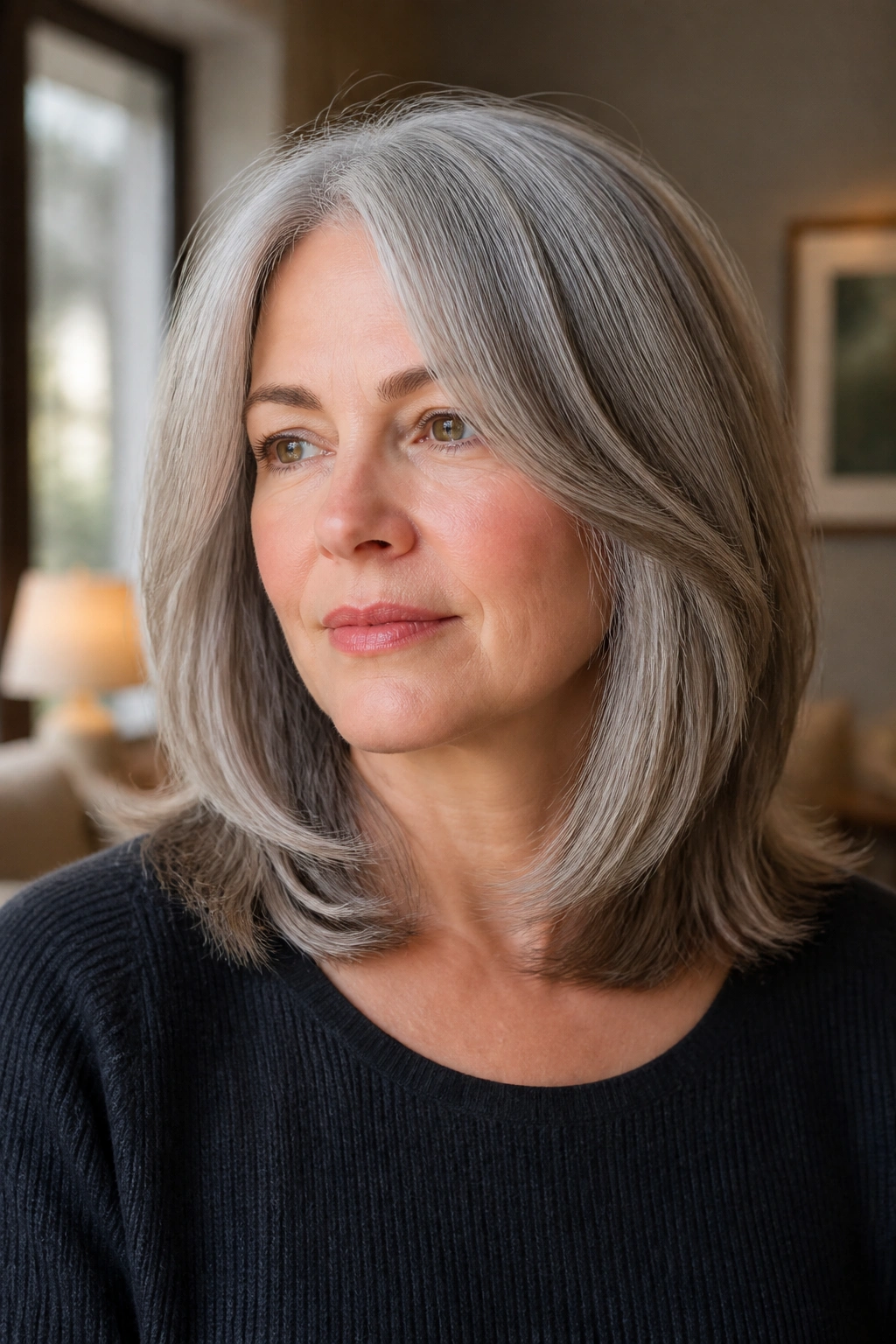
The first layer matters more than people think. If it starts right at the jaw on a round face, the cut can widen the middle of the face. Start it below the chin, and the whole shape gets calmer.
Where the First Layer Should Land
Ask your stylist to keep the shortest face-framing piece somewhere between the chin and collarbone, depending on your neck length. That little change keeps the eye moving downward. It also gives gray hair room to fall instead of kicking out at the sides.
How Much Movement Is Enough
Not much. Really. You want enough layering to stop the ends from hanging like a curtain, but not so much that the hair breaks into choppy pieces around the cheeks. A few longer layers through the front can soften the face without crowding it.
Who This Cut Helps Most
- People with medium-density gray hair that feels heavy at the ends.
- Anyone who wants to wear hair up half the week and down the rest.
- Wavy hair that loses shape when it is cut too short.
- Straight hair that needs a little motion near the face.
This is one of those cuts that looks plain in the chair and better after it settles. Let it move a bit before you judge it.
8. Curly Silver Crop with Crown Height
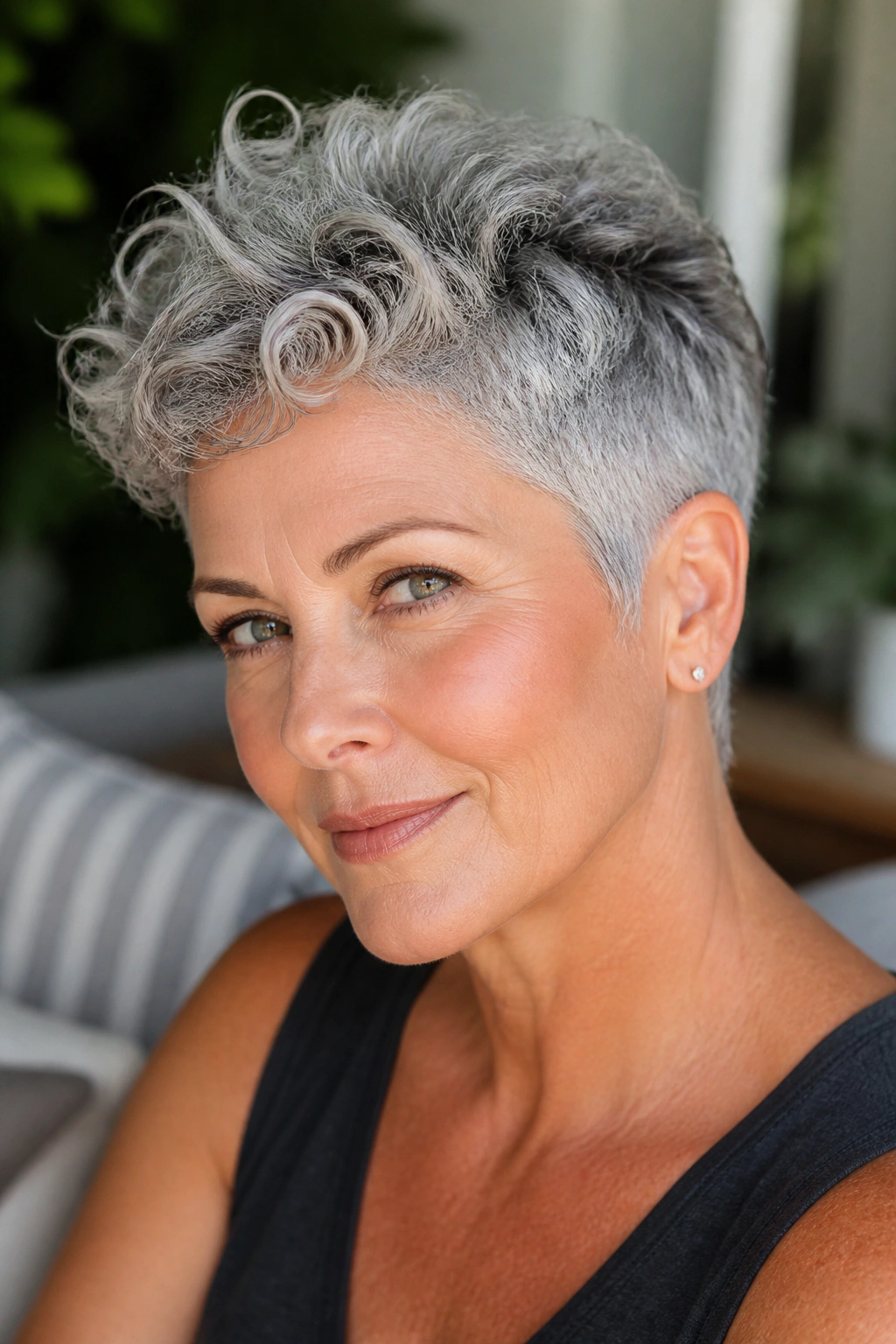
Curly gray hair does not need to be long to flatter a round face. In fact, a crop with crown height can work better than a longer shape that spreads out at the sides.
The key is to leave the sides controlled and let the top carry the shape. Curls already have their own width, so the cut should manage that width instead of fighting it. A dry cut often helps because curls spring up in ways wet hair hides. If your stylist cuts curly hair wet, make sure they leave enough room for shrinkage.
I like this shape because it respects the curl pattern and still gives the face some lift. A diffuser on low heat can set the top without blowing the sides outward. A curl cream with a light hold is usually enough. Heavy gels can make gray curls look dull or crunchy, and that is not the mood.
- Ask for shape at the top, not bulk at the cheeks.
- Keep the side pieces slightly longer than you think you need.
- Leave the neckline tapered so the cut does not box in the jaw.
- Scrunch gently and stop before the curls lose their spring.
This is a clean, smart crop when the curl pattern has a mind of its own.
9. Gray Haircuts for Round Faces with a Deep Side Part
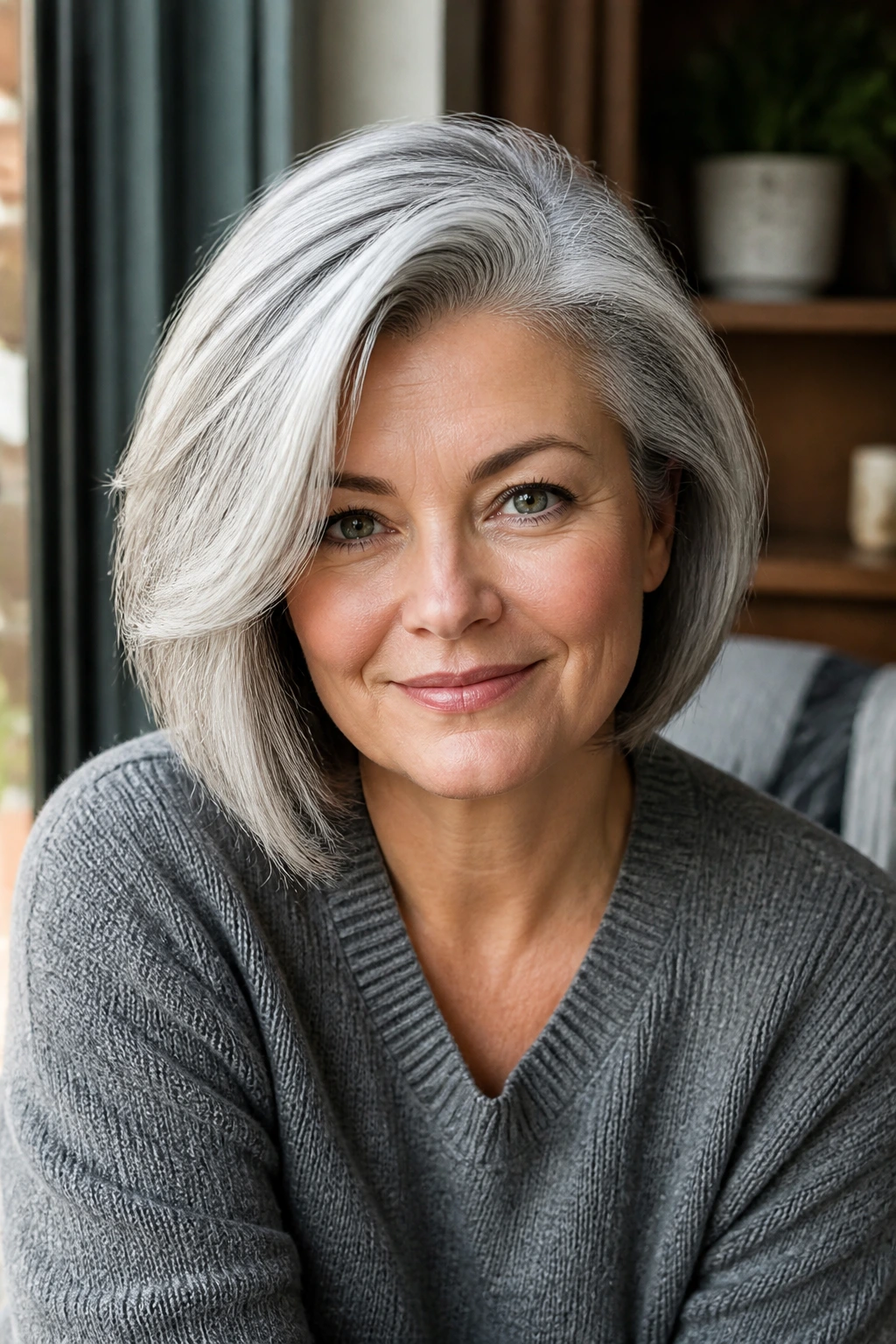
Does a deep side part really matter? On a round face, it can change the whole balance.
The reason is simple: a side part makes a diagonal line across the head, and diagonal lines tend to lengthen things. Center parts can work too, but a deep side part gives more movement near the forehead and a little asymmetry around the face. That asymmetry is useful when the cheeks are full.
Gray hair shows this shape fast, especially if the roots are lighter or the silver has different tones. The part creates a shadow line, and that line gives the haircut some depth. If your hair is fine, this can also build a little lift at the root without a lot of product.
How to Wear It
- Place the part about 1 inch off center rather than going extreme.
- Clip the heavier side up while the hair cools after blow-drying.
- Use a root-lift spray at the crown if the part falls flat.
- Keep the longest face-framing pieces below the cheekbone.
A deep side part is not dramatic for the sake of drama. It is a quiet trick that changes the shape.
10. Feathered Shoulder Cut with Airy Ends

A feathered shoulder cut is a good answer when you want movement without layers that scream for attention. The ends soften, the shoulders stop feeling boxed in, and the whole cut becomes easier on a round face.
What makes feathering different from plain layering is the finish. The edges are softened so the hair doesn’t stop in one hard line. On gray hair, that soft edge helps a lot because silver strands can make a blunt perimeter look harsher than expected.
This cut works especially well if your hair has medium density and a little natural bend. Blow-dry it with a medium round brush, rolling the front away from the face. That tiny turn keeps the hair from sitting flat against the cheeks.
- Keep the longest point at or just below the shoulders.
- Ask for feathering through the outer layer, not a lot of chopping inside.
- Use a light leave-in cream on the ends if they feel dry.
- Keep the top smooth so the movement stays at the lower half of the cut.
Airy ends. That’s the whole point.
11. Textured Pixie with a Long Fringe
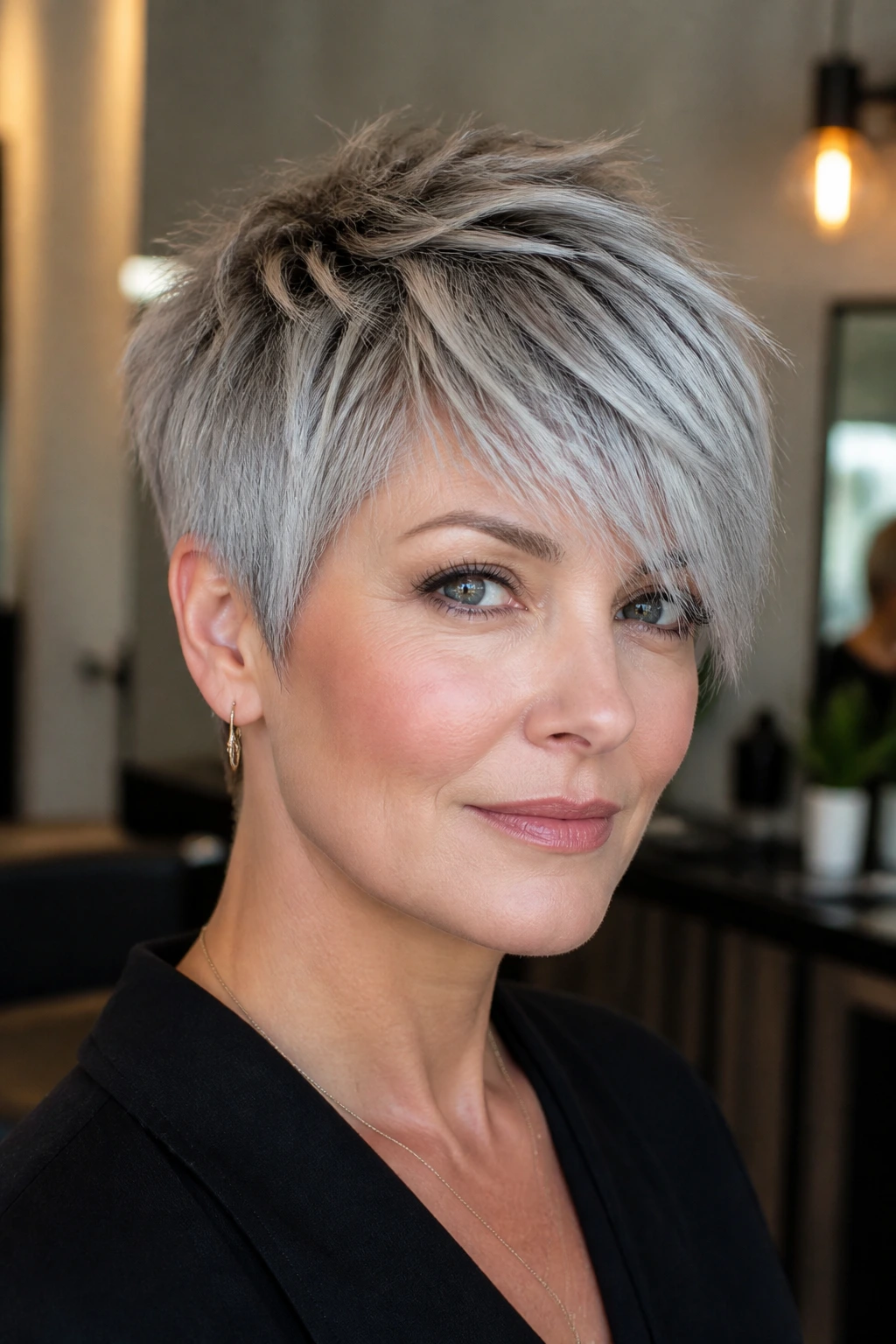
If the long pixie feels too neat, the textured pixie gives you more edge. It still opens the face, but it does it with piecey movement instead of a smooth sweep.
The long fringe is the part that matters most here. It should fall across the forehead at an angle, not sit in a straight line. That diagonal shape is useful on a round face because it breaks up the circle near the top, where the eye starts reading shape. The top can stay a little choppy, and the sides can be tighter than in a soft pixie.
Gray hair makes the texture pop. Every little cut line shows, which is why this style can look fresh instead of fuzzy when it is done well. The danger is over-thinning. Too much texturizing and the hair gets wispy in the wrong way.
I’d use a light matte cream and pinch the top pieces into place with fingers. A blow-dry is not even always necessary if your hair already has some bend. If your forehead is on the shorter side, keep the fringe longer so it can skim, not sit heavy.
12. Blunt Lob with a Slight Forward Angle
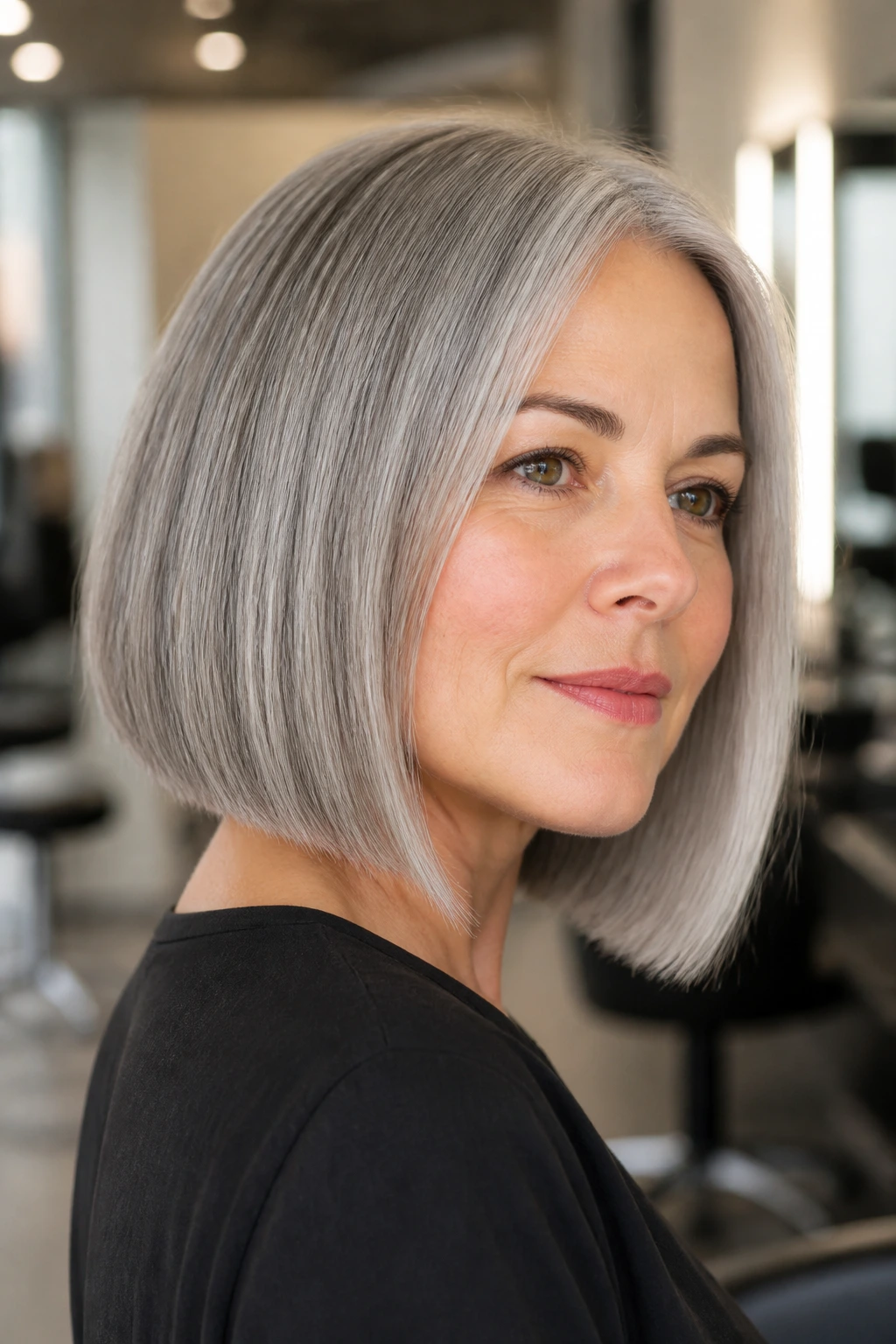
A blunt lob sounds boxy, but the trick is in the angle. Keep the edge blunt enough to feel strong, then let the front sit a little longer than the back.
That subtle forward slope stops the style from widening the face at the jaw. It also gives gray hair a clean line, which can look elegant when the texture is smooth. If the hair is very fine, a blunt finish can feel thin at the ends, so the cut needs enough density to hold the line.
This style is best for people who like low fuss. The outline does most of the work, so you do not need much styling beyond a quick bend at the ends. A flat brush and a blow-dryer nozzle can keep the surface sleek. If you want a little movement, bend only the front pieces inward or outward, not the whole head.
What I like here is the restraint. The cut doesn’t ask for much, but it still shapes the face. That’s a rare useful thing.
13. Soft Wolf Cut with Broken Layers
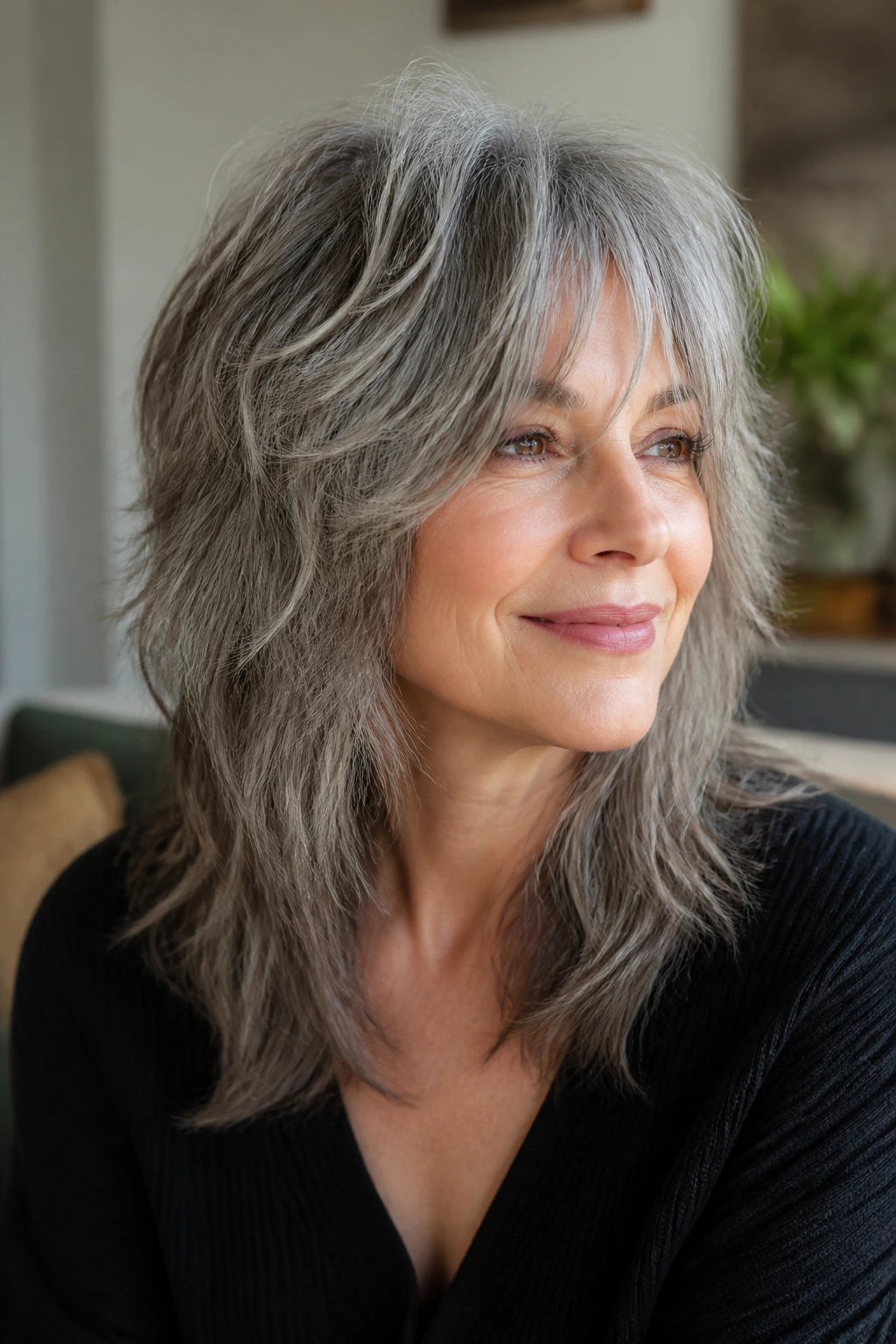
A wolf cut can turn loud fast. On a round face, the fix is to keep it soft, with broken layers that sit higher at the crown and stay looser at the sides.
Keep the Crown Loose
The top needs lift, not a hard spike. Ask for shorter layers near the crown that can be pushed forward or back, depending on how you wear it. That gives the face length without making the whole style look spiky.
Leave the Perimeter Longer
The lower line should stay below the chin or at the shoulders. If the shortest layers all land at the cheek, the cut starts to puff outward. Let the ends hang with some weight so the shape has a base.
Style It with a Bend, Not a Curl
A soft bend is enough. Use a medium iron or a quick twist with a blow-dry brush, then separate the pieces with your fingers. You want movement, not a perfect wave pattern.
Gray hair can make a wolf cut look crisp, almost smoky. When the layers are soft, that texture feels intentional rather than rough.
14. Curtain Bangs That Sit Past the Jaw

Curtain bangs can be one of the smartest tools for a round face, but only when they start long. Short curtain bangs can sit right on the widest part of the cheeks and make the face feel broader. Longer ones change the line.
The best version opens in the middle and sweeps outward past the cheekbones, then lands closer to the jaw or even the lips. That shape gives the face a vertical path to follow. It also works well with gray hair because the fringe breaks up a large block of light near the forehead.
I’d keep the base cut simple here. Shoulder length or longer gives the bangs room to do their job. If the rest of the cut is too short, the fringe starts carrying too much weight and can feel busy. A little bend away from the face is enough.
- Ask for bangs that start longer than you think you need.
- Keep the shortest point below the brow line if your face is very round.
- Blow-dry the fringe forward first, then sweep it outward.
- Use a small round brush or Velcro rollers for a soft curve.
Long curtain bangs age well on gray hair because they soften without hiding the face.
15. Stacked Bob with a Graduated Back
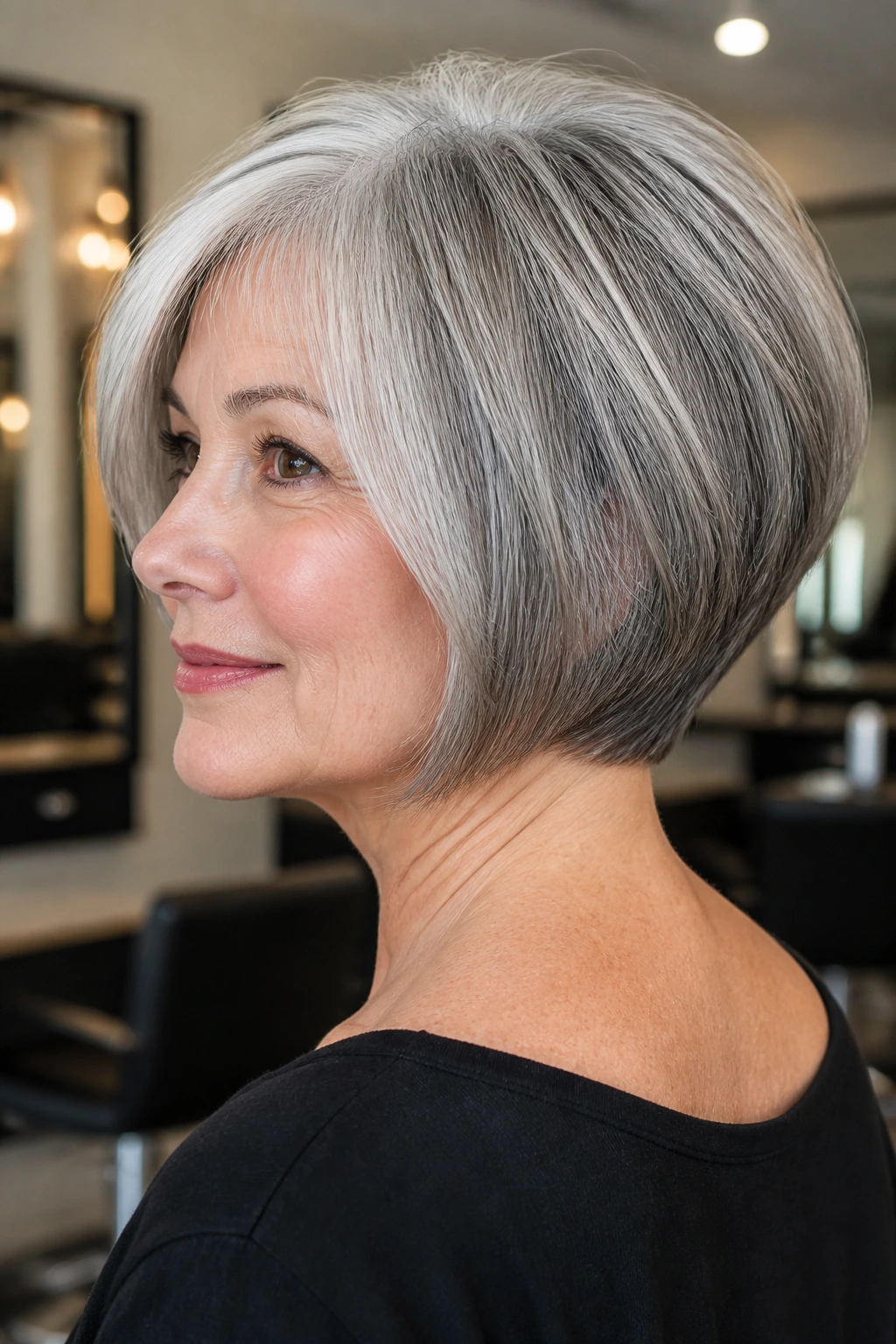
A stacked bob is all about the back. The graduation builds shape near the nape, and that shape can work well on a round face if it stays controlled.
The mistake people make is stacking it too high. Then the back balloons out and the sides compete with the cheeks. Keep the stack low and clean, and the bob looks neat instead of bulky. Gray hair shows this geometry clearly, which is why a good stacked bob feels almost architectural.
This cut suits medium to thick hair best. Fine hair can do it too, but the layers need enough support to avoid a see-through back. A round brush blowout helps a lot here, because the nape has to sit close while the top keeps some lift.
- Keep the shortest point tucked close to the neck.
- Leave the front longer than the jawline.
- Ask for soft texturizing on the crown if the top puffs out.
- Avoid a harsh shelf at the back.
A stacked bob can look sharp on gray hair without looking stern. That balance is the trick.
16. Long Gray Layers with Hidden Internal Shaping
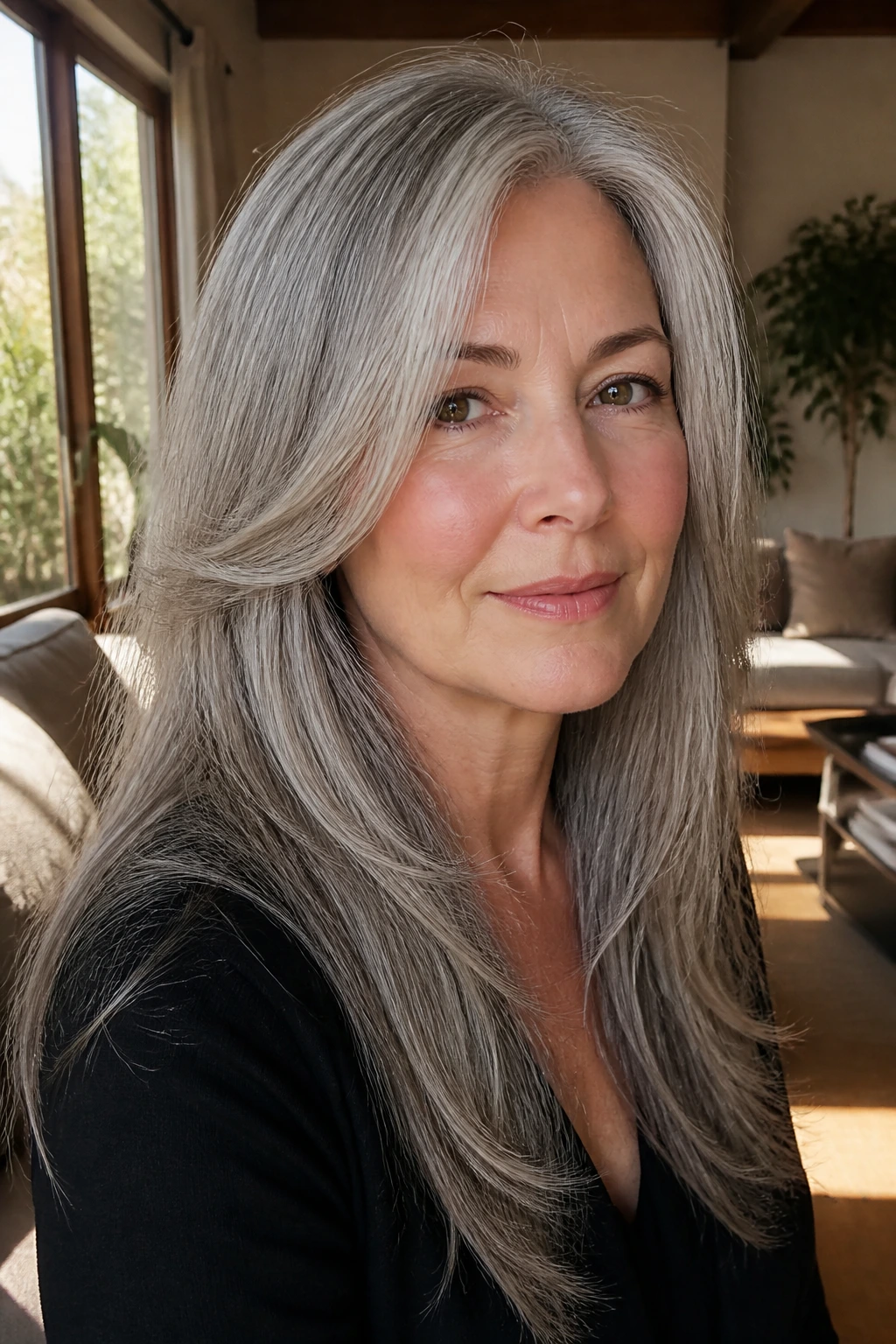
Long gray hair does not have to mean one heavy curtain. Hidden internal shaping lets you keep the length while taking weight out where round faces do not need more width.
This is one of my favorite options for people who are attached to long hair but tired of the triangle effect. The outside shape can stay smooth and long, while the inside gets carved just enough to let the hair move. You do not see the layers right away. You feel them when the hair falls a little better around the face.
Gray hair often gets drier through the ends, so long lengths can start looking stringy or wide if they are cut all one length. Internal shaping helps the hair swing instead of hang. It also makes styling easier because the ends are not fighting the crown.
If your hair is straight, this is especially useful. If it is wavy, the extra shape can keep the waves from bunching around the sides. The key is restraint. Too many visible layers and the haircut loses its quiet line.
17. Tapered Crop with Ear-Hugging Sides
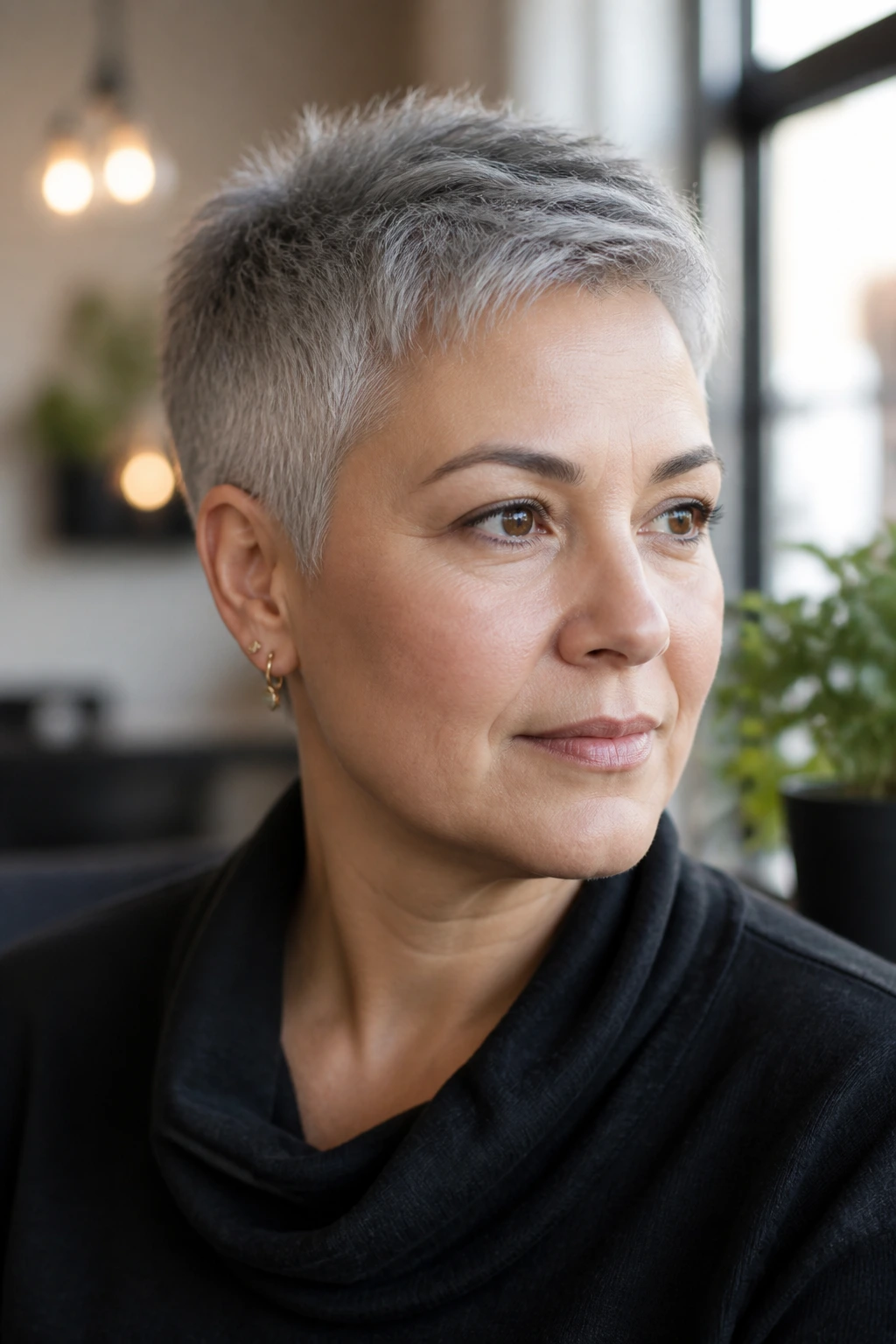
A tapered crop is the answer when you want short hair that still feels neat around a round face. The sides stay close, the top stays a little taller, and the whole shape opens the face without making it look wider.
This style is cleaner than a textured pixie and less airy than a shaggy crop. The taper at the sides helps because it pulls the outline inward near the cheeks. That’s a real advantage on gray hair, where a puffed-out side can show up fast in daylight.
It also wears well if your hair is coarse or has a wiry feel. The close sides tame the bulk, while the top can be lifted with a small amount of paste or cream. If the hairline at the temples is thinner, a tapered crop can still work, but the top should stay soft so the cut doesn’t feel too severe.
What to watch for: don’t let the taper climb too high around the ears, or the face can start looking overexposed. A good crop feels neat, not scraped tight.
18. Wavy Mid-Length Cut with an Off-Center Part
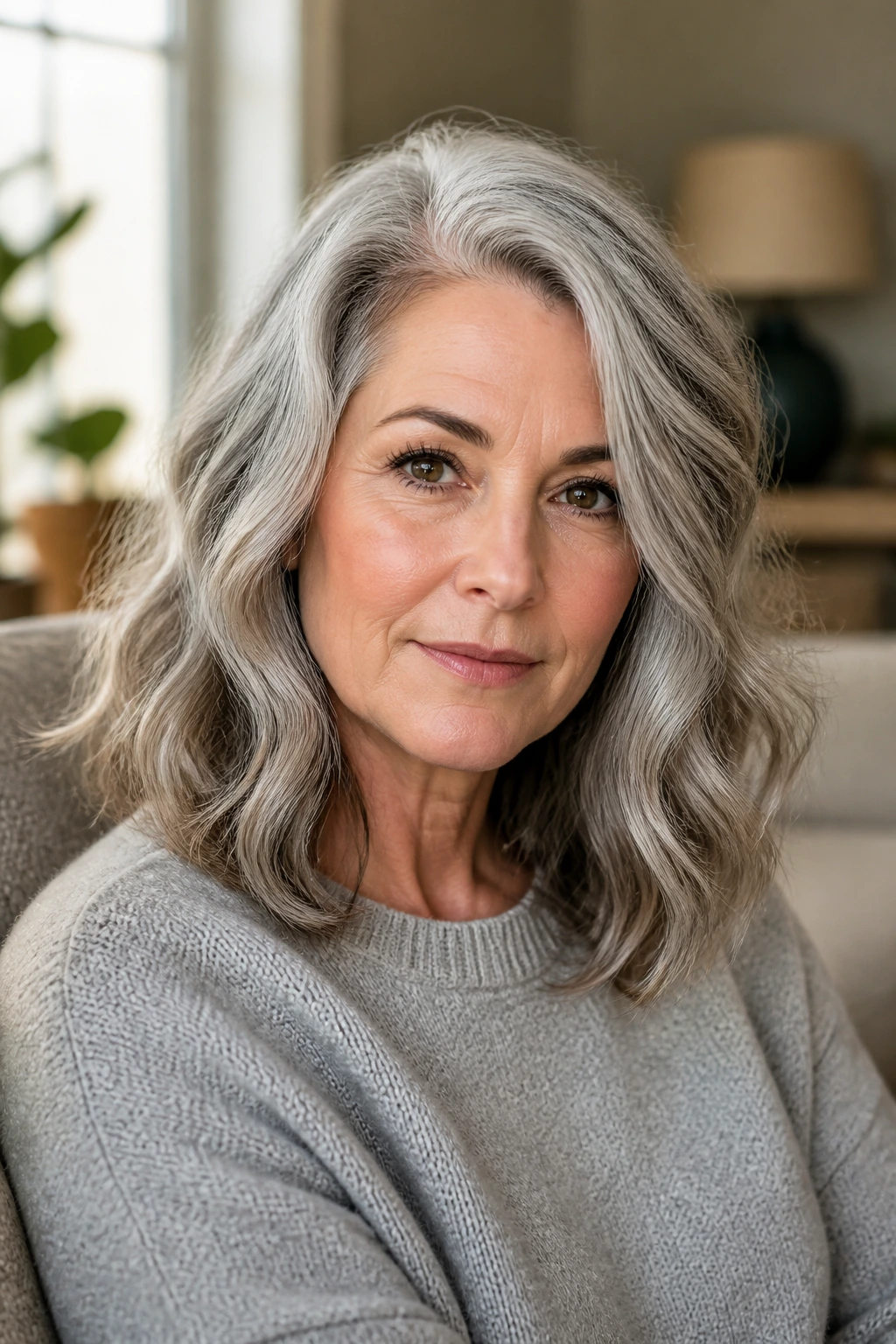
If you want one haircut that doesn’t ask much of you, this is the one I keep coming back to. A wavy mid-length cut with an off-center part gives a round face some length, some movement, and enough softness to feel easy.
The length should sit between the shoulders and the chest. That gives the wave room to fall past the cheeks instead of stopping on them. An off-center part keeps the top from feeling too symmetrical, and that small shift can change how the face reads in the mirror. Gray hair shows the bend beautifully when the wave starts low and stays loose.
This is also one of the most forgiving shapes for busy mornings. Air-dry it with a light cream, rough-dry it with a diffuser, or bend a few sections with a larger iron if you want more polish. The wave does not need to be perfect. It just needs to move.
What Makes It Work
- The part sits slightly off center, not dead center.
- The wave starts below the cheekbone.
- The ends stay soft, not stiff.
- The overall length stays long enough to fall past the widest part of the face.
If you want gray hair that looks calm, modern, and easy to live with, this is a strong place to land. The prettiest version is the one that moves when you turn your head and never stops right at the cheeks.
