



A round face can take a blunt haircut and lose the fight by noon. The line sits where your cheeks are fullest, the shape feels boxy, and suddenly the style looks heavier than your hair actually is. Feathered hairstyles for round faces dodge that problem by keeping the eye moving — up through the crown, down through long, soft ends, and across pieces that never stop in one hard line.
Too much width at the cheeks is the trap. Too much taper at the ends can be one too. A good feathered cut lives in the middle: enough lift to lengthen the face, enough softness to keep it from looking carved up, and enough balance that you can still air-dry it on a rushed morning without regretting the shape.
I’ve always liked feathering for round faces because it changes the silhouette without making the haircut feel fussy. You can do it with long hair, a shoulder-length lob, a short crop, even curls. The real trick is placement — where the shortest layer starts, where the side part lands, and whether the front pieces open the cheekbones or sit right on top of them. Those details matter more than the label in the salon book.
Some styles lean polished. Others are messy in the good way. The next 18 are the ones I’d actually point a friend toward, because they create shape instead of noise.
1. Long Feathered Hairstyles for Round Faces with a Deep Side Part
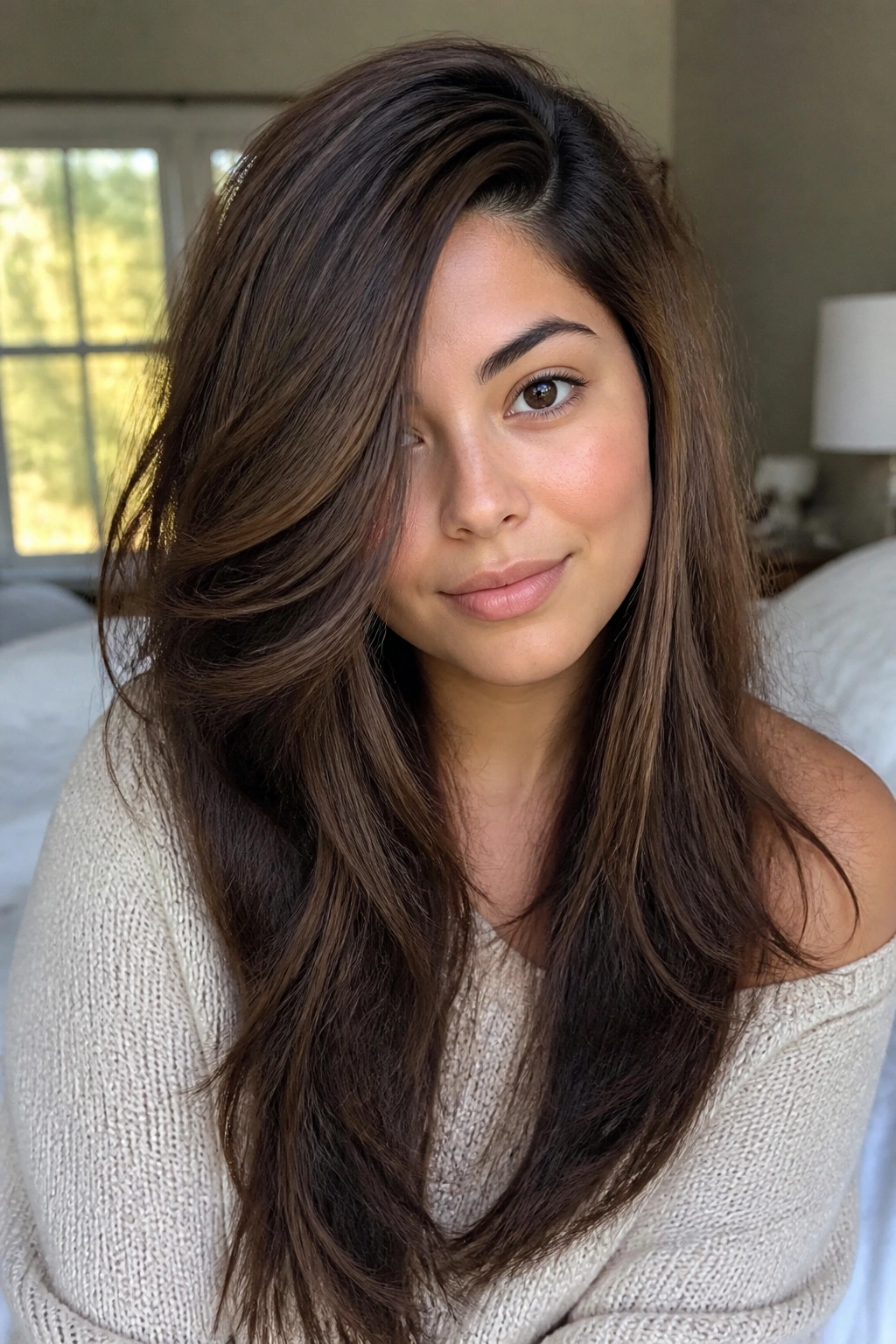
This is the safest long-length move. Keep the length past the collarbone, shift the part hard to one side, and let the layers fall in a soft diagonal instead of a straight curtain. That one shift changes how the eye reads the whole face.
Why It Flatters Round Faces
A deep side part gives you an asymmetrical line, and asymmetry is a gift on round faces. It breaks up the circular shape and pulls attention upward instead of letting everything land at cheek level.
The feathering should start lower than most people ask for. I like it when the first face-framing piece begins just below the cheekbone, then tapers into longer layers that skim the jaw and collarbone. Anything shorter can puff outward and add width.
- Keep the shortest front layer below the cheekbone.
- Ask for soft internal layers, not choppy stairs.
- Blow-dry the roots at the crown first for lift.
- Finish with a light shine spray on the mid-lengths only.
Best tip: tuck one side behind the ear. It sounds tiny. It makes a real difference.
2. Shoulder-Length Feathered Hairstyles for Round Faces with Flicked Ends
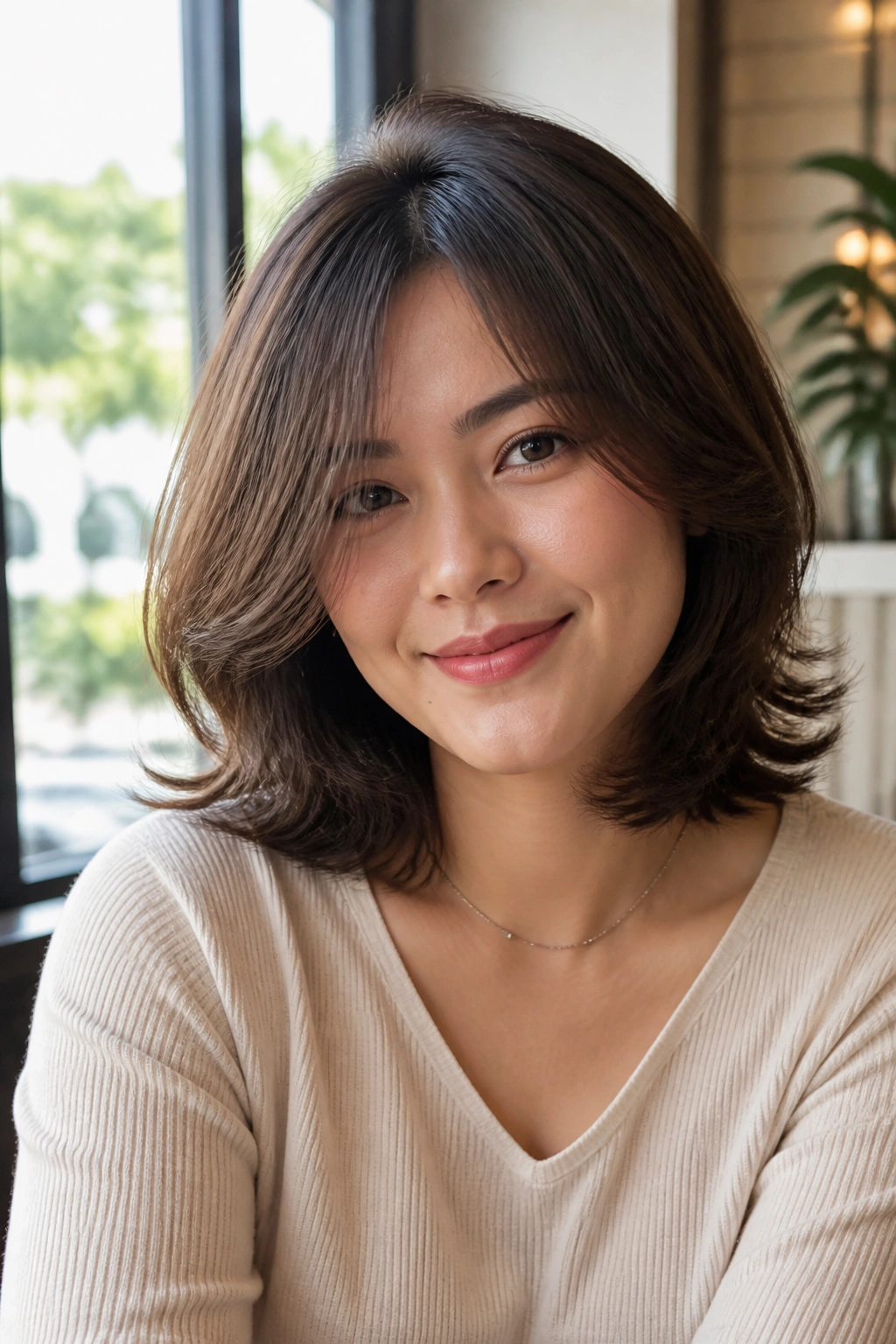
This is the cut I’d choose for someone who wants shape without looking overstyled. A shoulder-length feathered lob sits in the sweet spot: long enough to narrow the face, short enough to feel fresh, and flexible enough to wear straight, wavy, or with a little bend at the ends.
A blunt shoulder cut can feel heavy on a round face. Flicked feathered ends fix that by turning the perimeter slightly outward or inward, which keeps the line from stopping dead at the jaw. The movement matters more than the length itself.
I like this one with a soft off-center part and a round brush or 1.25-inch curling iron. Wrap the ends for five to eight seconds, release, then brush them out so the finish looks airy instead of curled into ringlets. A little texture spray at the very end helps the layers separate.
That little shift matters.
3. Short Feathered Hairstyles for Round Faces with a Tapered Crown
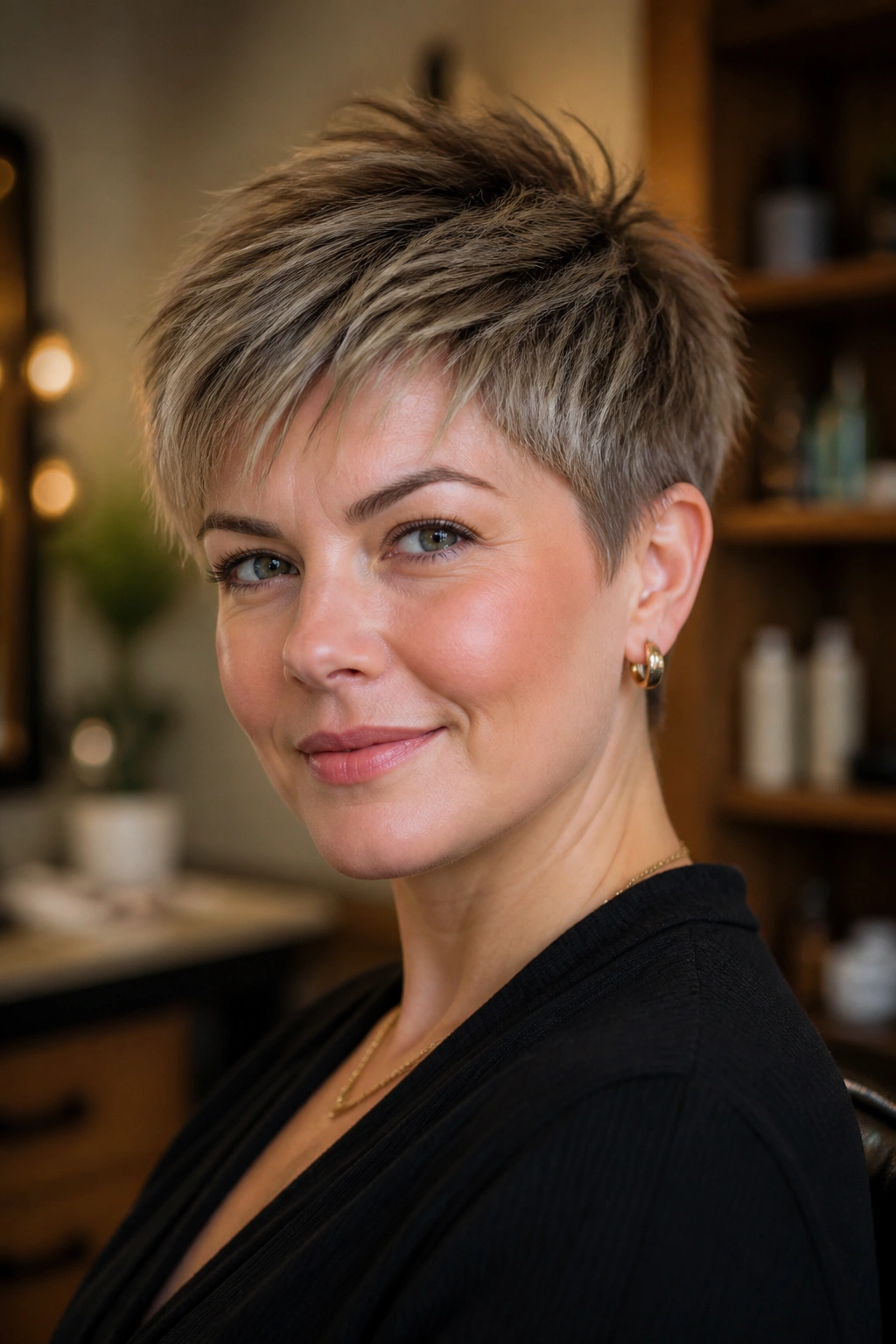
Can a short cut flatter a round face? Absolutely, if the volume lives on top and not on the sides. A feathered pixie with a tapered crown does that job well because it adds height where you want it and keeps the sides close.
The shape should rise from the crown, then narrow around the temples and ears. That creates a longer line through the face instead of a wide, bowl-like shape. If the front fringe is longer and brushed to one side, even better.
How to Style It
Use a pea-sized amount of matte paste or lightweight cream, rubbed warm between your palms. Push the hair upward at the roots first, then sweep the fringe diagonally across the forehead. Don’t flatten the crown.
- Keep the top pieces longer than the sides.
- Ask for soft tapering near the ears.
- Avoid a blunt fringe that cuts straight across the forehead.
- Use a fingertip amount of product, not a heavy wax.
Best for: fine to medium hair that needs lift without a lot of bulk.
4. Butterfly Cut with Curtain Bangs
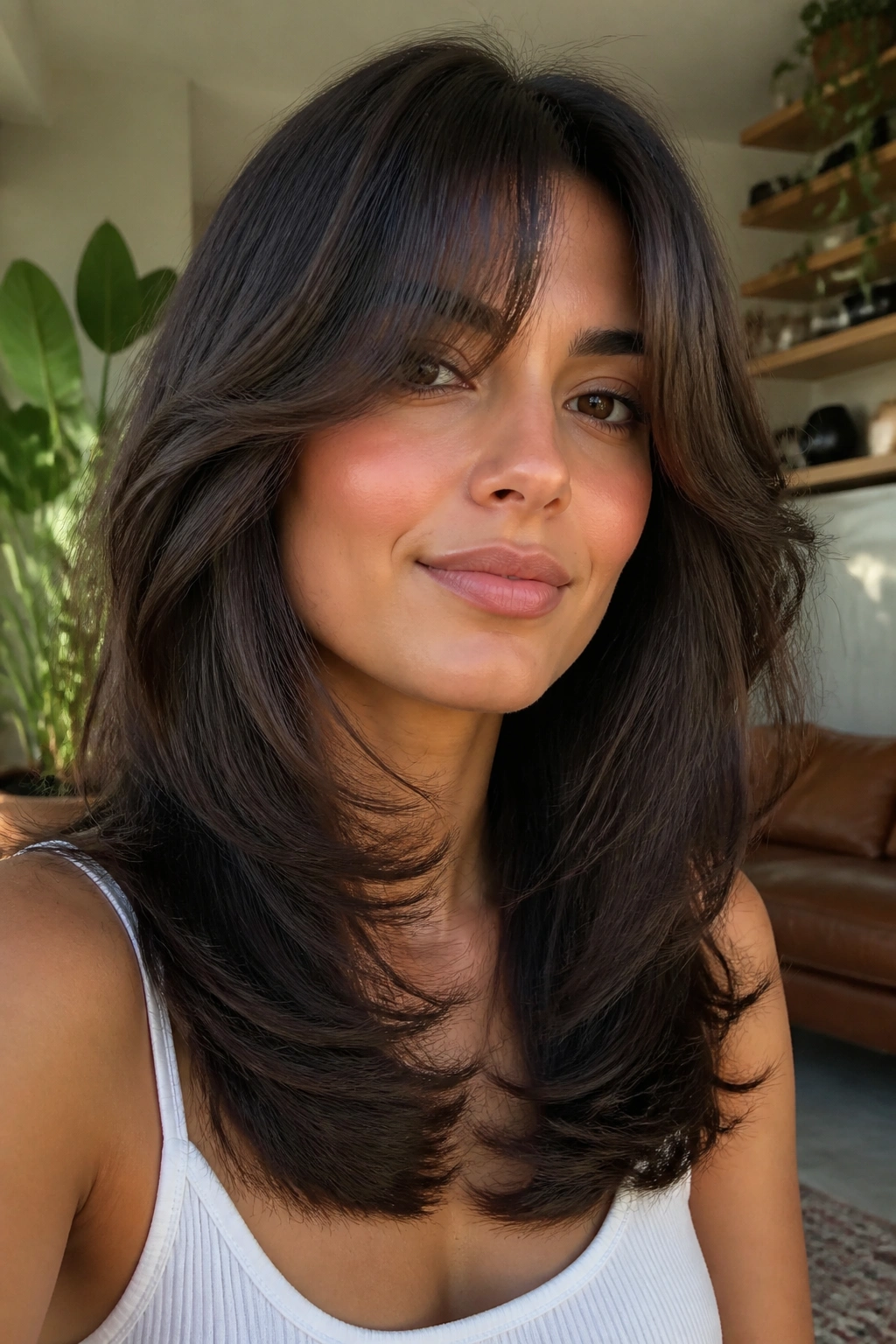
Picture hair that starts with a soft frame around the face, then drops into longer layers that move when you walk. That’s the butterfly cut, and it can be a smart choice for round faces when the shortest layers land below the cheekbone.
The curtain bangs are doing half the work here. They split at the center or just off-center, which opens the face without creating a wide horizontal line. I like them better when they’re longer at the outer edges and blend into the cheek-length layers instead of stopping sharply.
- Shortest layers should sit around the collarbone or just below the chin.
- Curtain bangs should part around the bridge of the nose.
- Blow-dry with a medium round brush for bend.
- Keep the ends soft, not razor-thin.
If you like a blowout look but hate the stiffness of a formal layered cut, this one gives you motion without the helmet effect. It’s a good middle ground.
5. Mid-Length Shag with Airy Fringe
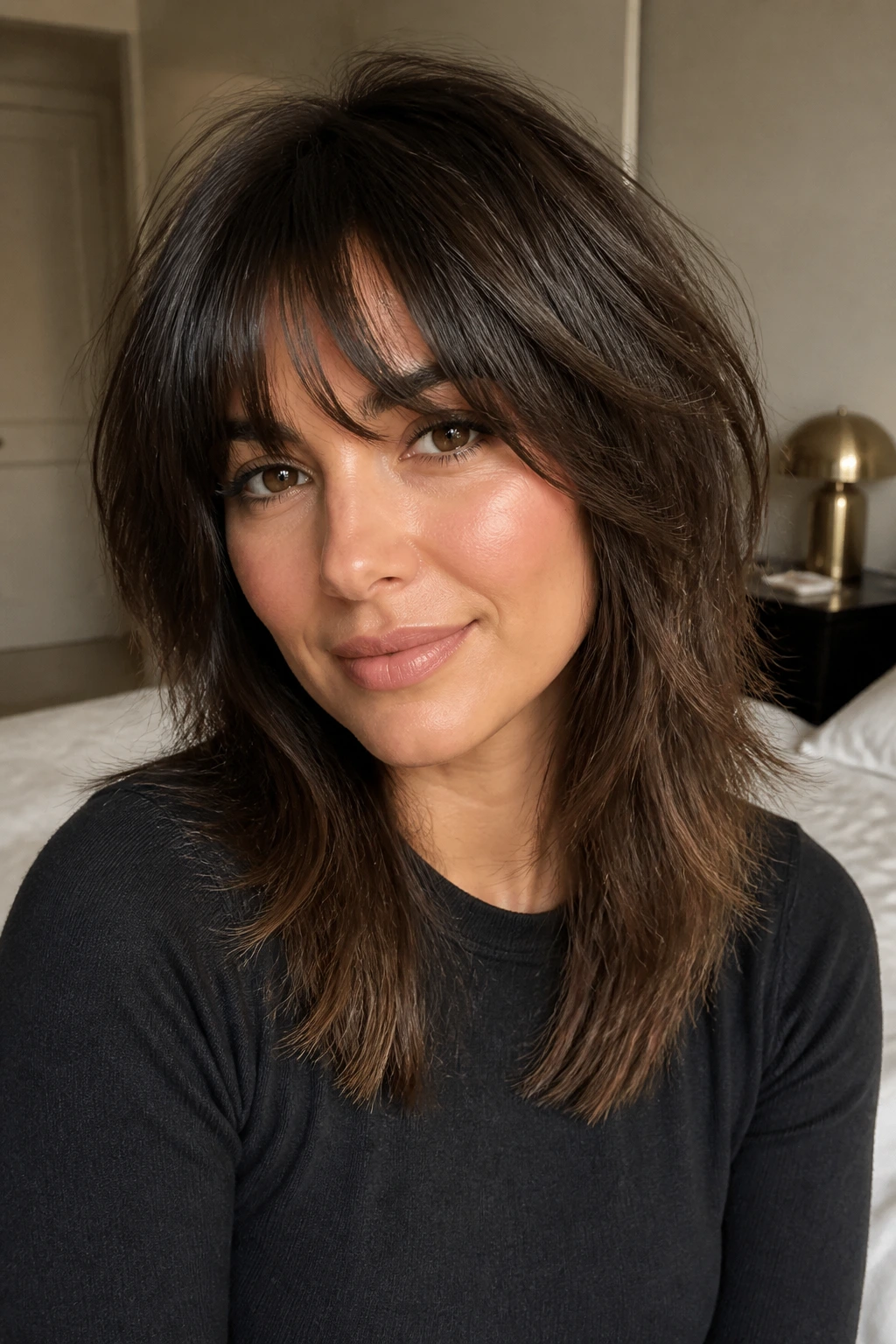
The shag can go wrong fast on a round face. Too much texture at the sides, and you get width. Too much choppiness near the cheeks, and the whole shape looks fuzzy. The version worth keeping is softer, lower, and more controlled.
Start the layers lower on the head. Leave the crown with enough height, but don’t carve away so much hair that the ends look see-through. A light fringe works well here, especially if it breaks into pieces instead of forming one solid line across the forehead.
The trick is restraint. A good shag should feel touched, not shredded. The ends can move, but they should still have enough weight to hang straight when you want them to.
I also like this cut on wavy hair because the natural bend makes the feathering look easy. Straight hair can wear it too, but the styling takes a little more effort. A quick bend with a flat iron, done in alternating directions, keeps the shape from turning flat at the bottom. That’s the part most people miss.
6. Side-Swept Bob with Beveled Ends
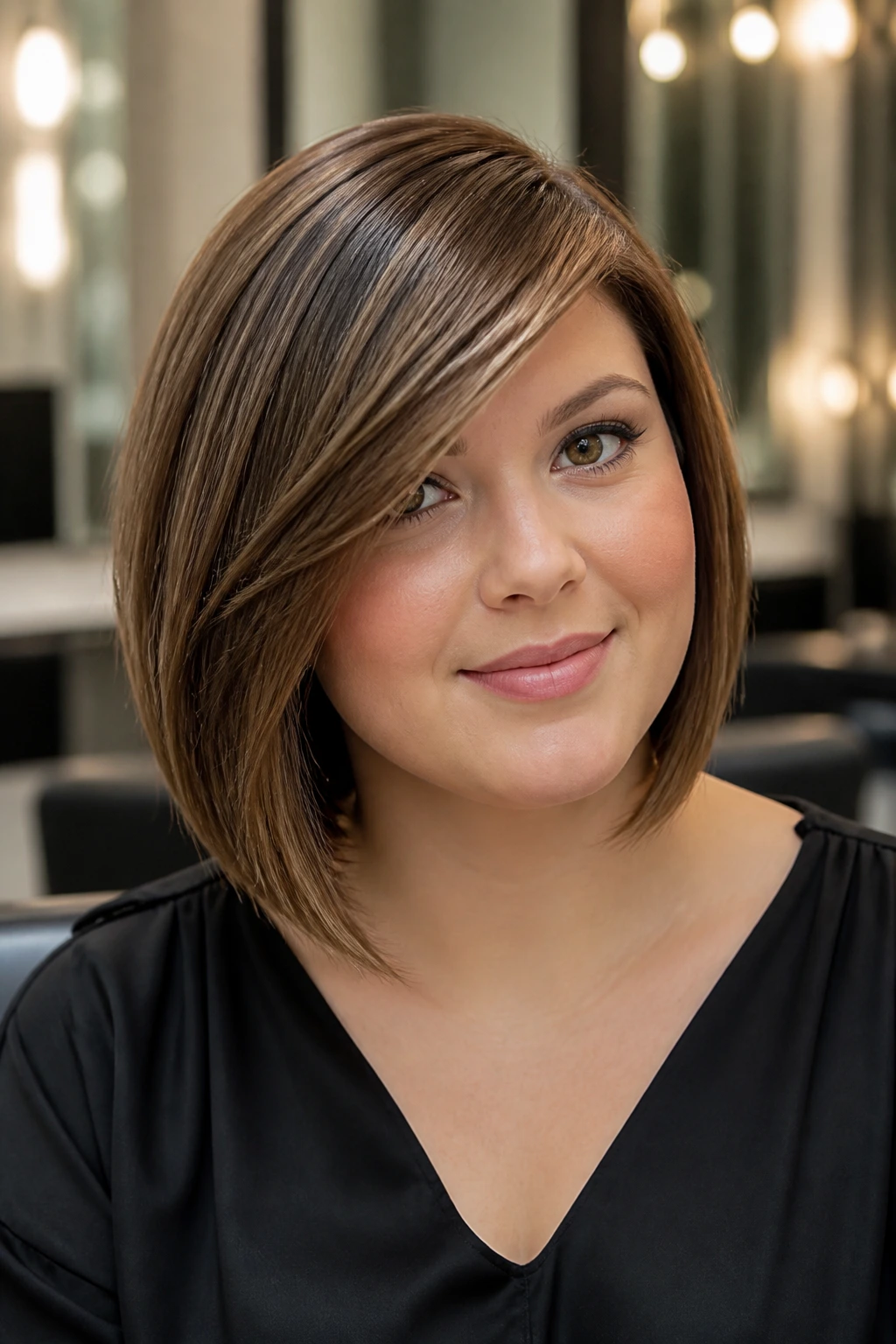
Unlike a blunt bob that can stop the eye right at the cheeks, this version leans diagonal. The side-swept bob keeps one side slightly longer, and the beveled ends angle inward or outward just enough to soften the line around the jaw.
I almost never love a bob that ends exactly at cheek level on a round face. It can feel too square. The beveled finish changes that by giving the ends motion, which makes the haircut look lighter even when the length stays the same.
This works best on straight to softly wavy hair because the shape needs a clean edge. Dry it with a flat brush or a blow-dryer nozzle, then give the ends a half-turn under with a round brush. If your hair bends easily, a tiny bit of serum at the ends will keep it smooth without killing the movement.
Who should pick it? Someone who wants a neat, polished cut that still dodges the blunt-line problem. It’s tidy. It’s not boring.
7. Curly Feathered Layers for Round Faces
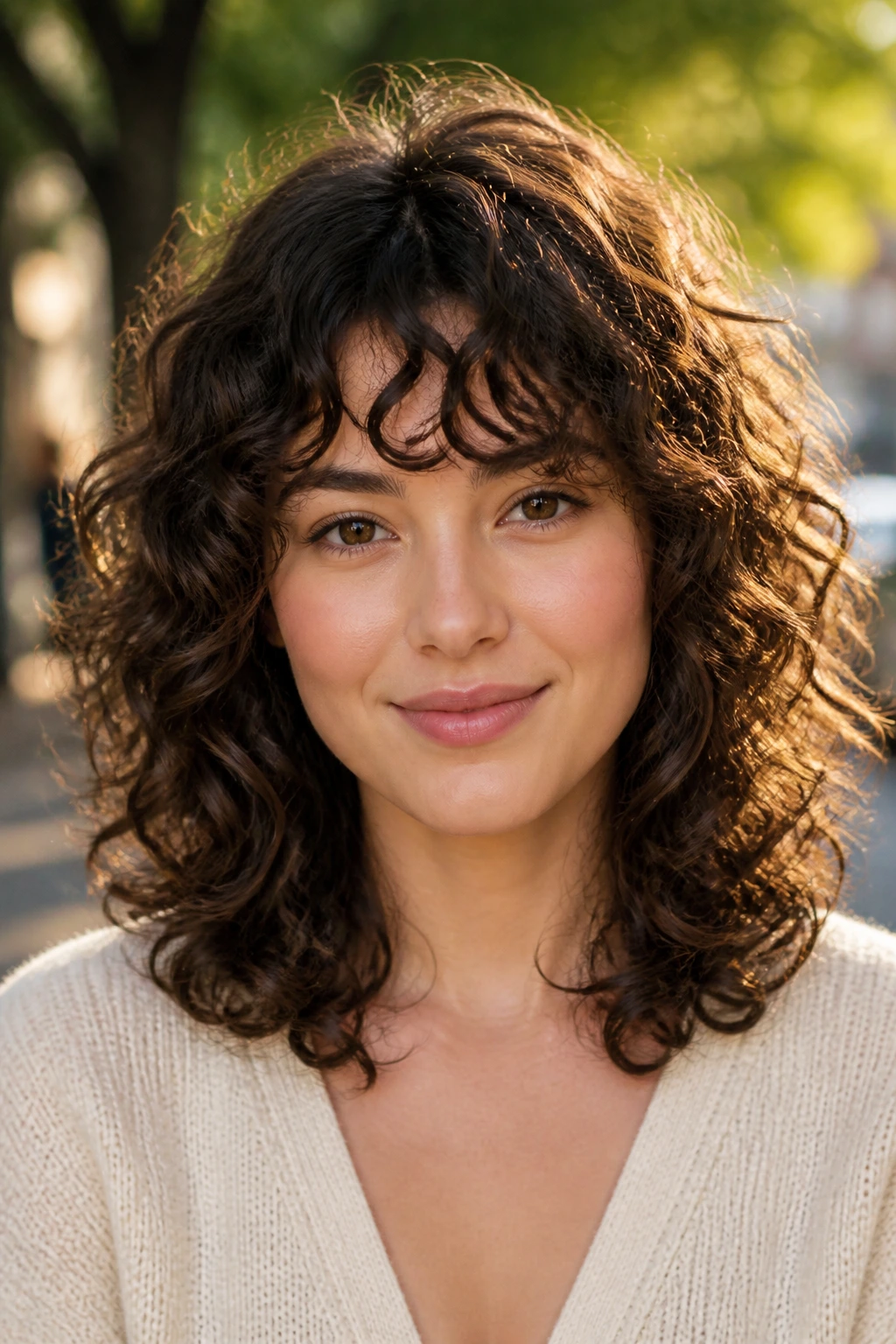
Curly hair and feathering get along better than most people think, but the cut has to respect the curl pattern. If the layers are placed badly, the hair balloons at the sides. If they’re placed well, the curls stack with shape instead of width.
What Makes It Different
A curl-by-curl trim, or at least a dry cut, is worth asking for if your hair is wavy or curly. The stylist can see where the curls sit naturally, which matters a lot when the face is round and the shrinkage is unpredictable.
The shortest curls should not sit right on the cheeks unless the cut is very open at the top. I prefer the first layer to begin lower, then let the curls spring around the jaw and collarbone. That keeps the silhouette long enough to flatter the face.
How to Wear It
- Diffuse on low heat to keep the curl clumps defined.
- Scrunch in gel while the hair is still wet.
- Avoid heavy cream at the roots.
- Let a few front pieces fall forward instead of pinning everything back.
Best for: curls that need shape but not bulk.
8. Razor-Cut Lob with an Off-Center Part
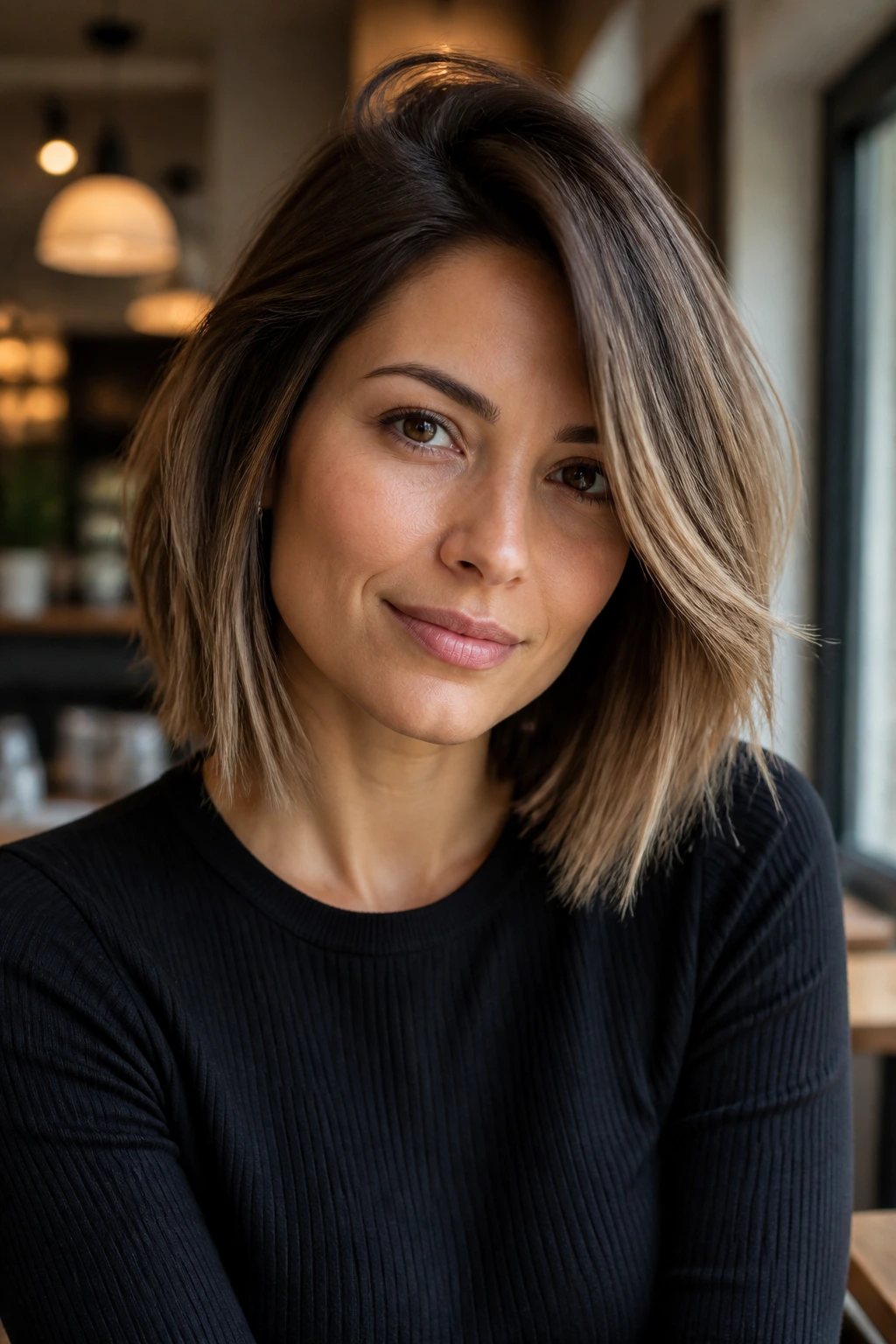
A razor cut can be a lifesaver for dense hair that wants to puff at the sides. The blade removes weight in a way that leaves the ends wispy and soft, which helps a round face by keeping the shape from turning broad.
The off-center part matters just as much as the cut. It shifts the center line and gives the face a little diagonal energy. That’s useful when your features are soft and even; you want some tension in the shape so the haircut doesn’t fade into the face.
I like this cut on medium-density hair. Fine hair can get a little too airy at the bottom if the razor work is heavy-handed. Ask for the longest pieces to sit around the collarbone and the shortest face frame to hover below the cheekbone, then style it with a bent blowout or loose waves.
If your hair falls flat by lunchtime, this cut can still work. Just keep the root lift at the crown and don’t overdo the product.
9. Soft Graduated Bob with Crown Lift
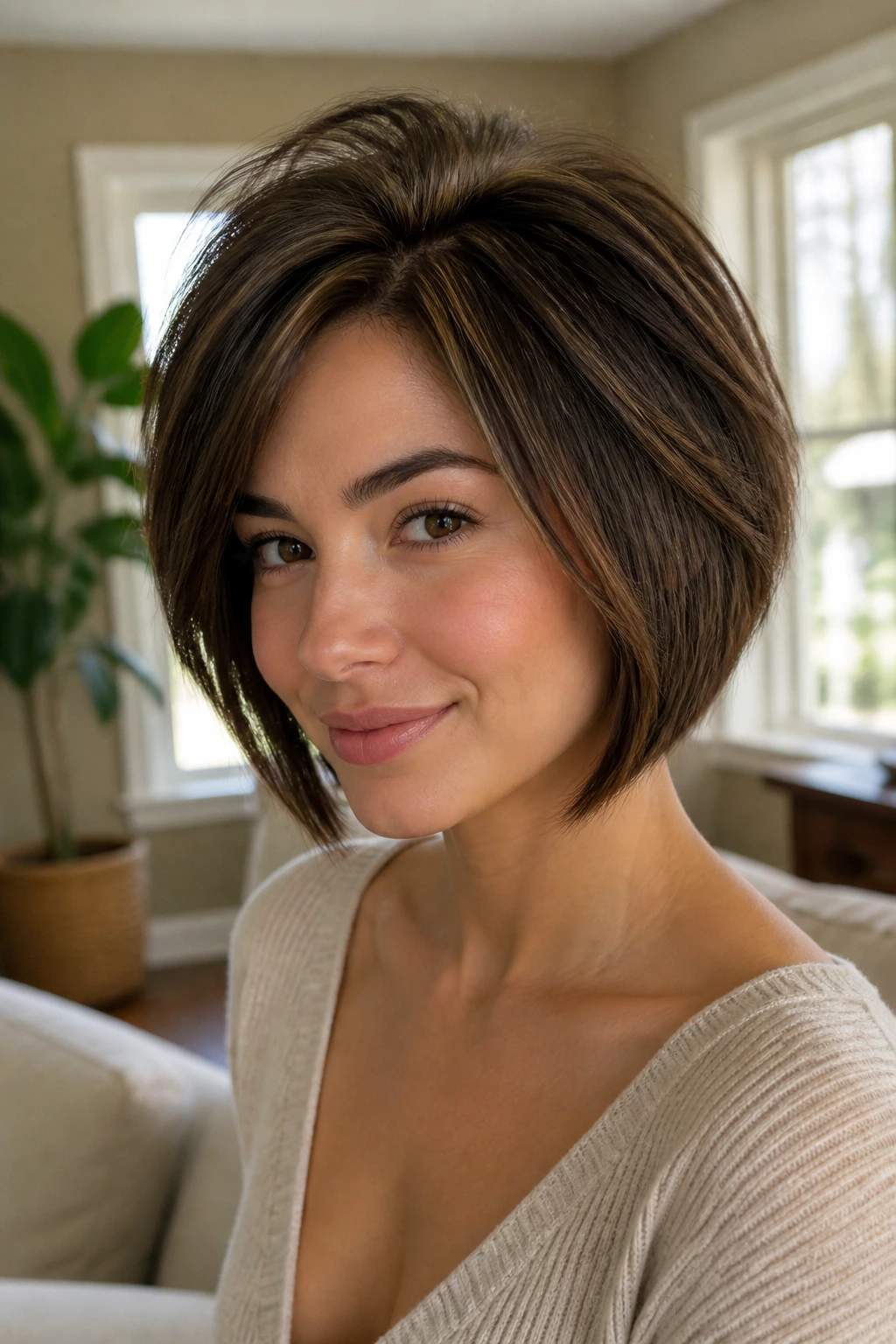
Can a graduated bob work on a round face without looking like a wedge? Yes, if the graduation stays soft and the crown gets the lift, not the sides. That’s the whole difference between flattering and awkward.
The back is a little shorter, the front a little longer, and the weight line stays controlled instead of harsh. That gives the haircut a bit of lift through the back of the head, which makes the face appear longer. If the front pieces graze the jaw or just below it, even better.
How to Ask for It
Tell the stylist you want a gentle graduation, not a stacked triangle. The back should rise enough to support the shape, but the transition should stay smooth.
- Keep the front pieces below the widest part of the cheek.
- Ask for soft internal layering at the crown.
- Blow-dry the roots upward with a round brush.
- Finish with a light spray wax only at the ends.
A sharp wedge bob can feel dated fast. This softer version does the same structural job with less edge.
10. Wolf Cut with Long Bangs
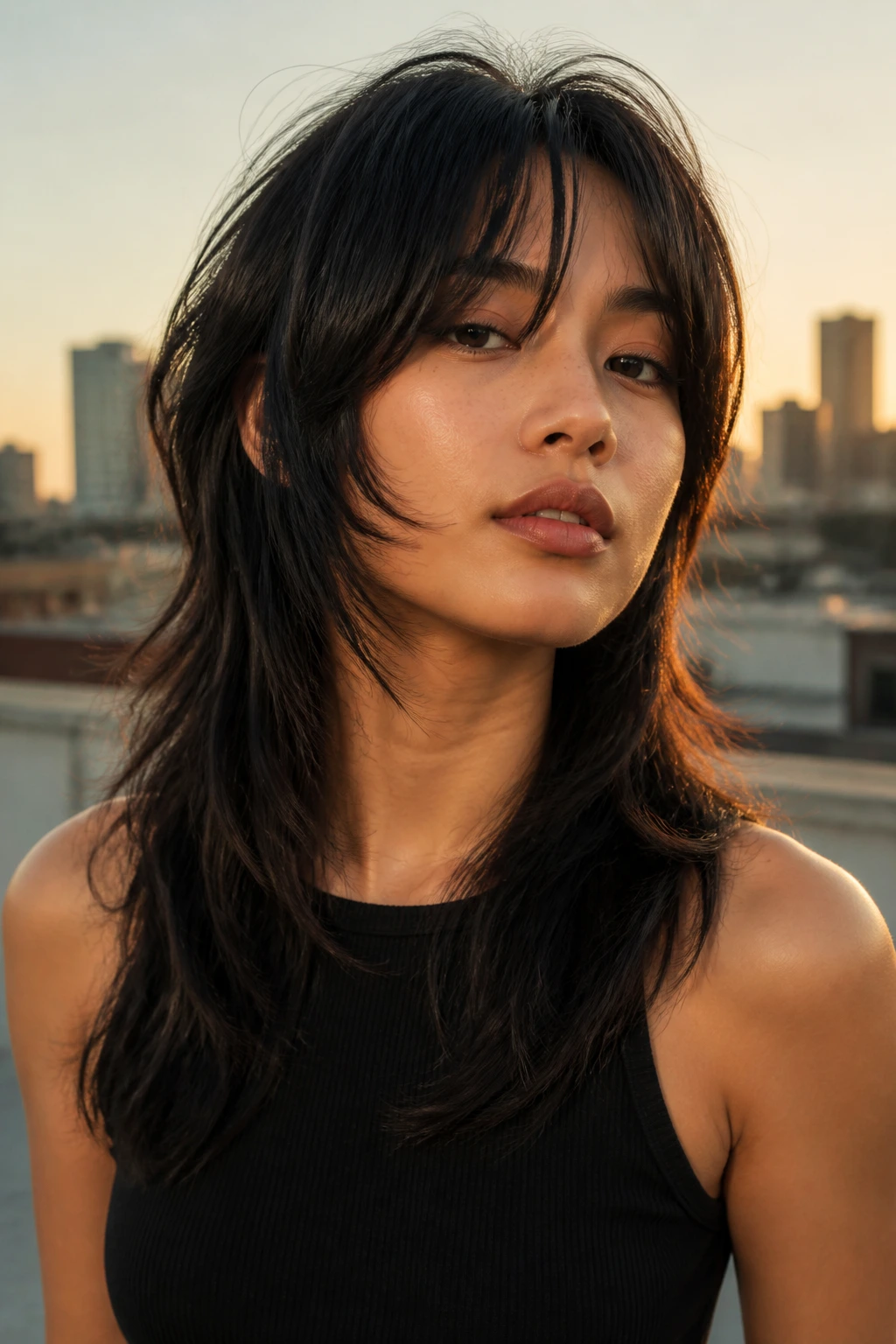
A wolf cut on a round face needs a careful hand, not a heavy one. If the top layers are too short, the sides puff. If the bangs are too blunt, the face gets shorter. Done right, though, this style adds movement where you need it and keeps the face from looking wide.
Think of it as a shag with more contrast. The crown gets texture, the lengths stay longer, and the bangs break up the forehead without cutting across the face in one hard line. Long bangs are the part that make it work.
- Keep the shortest layers above the cheekbone, not below it.
- Leave enough length in the fringe to sweep sideways.
- Use a texturizing spray, not a thick pomade.
- Keep the ends broken up, but not frayed.
If you like a slightly wild finish and you don’t mind styling with your fingers, this cut has personality. It’s not the neatest choice on the list. That’s the point.
11. U-Shaped Long Layers with Face Frame
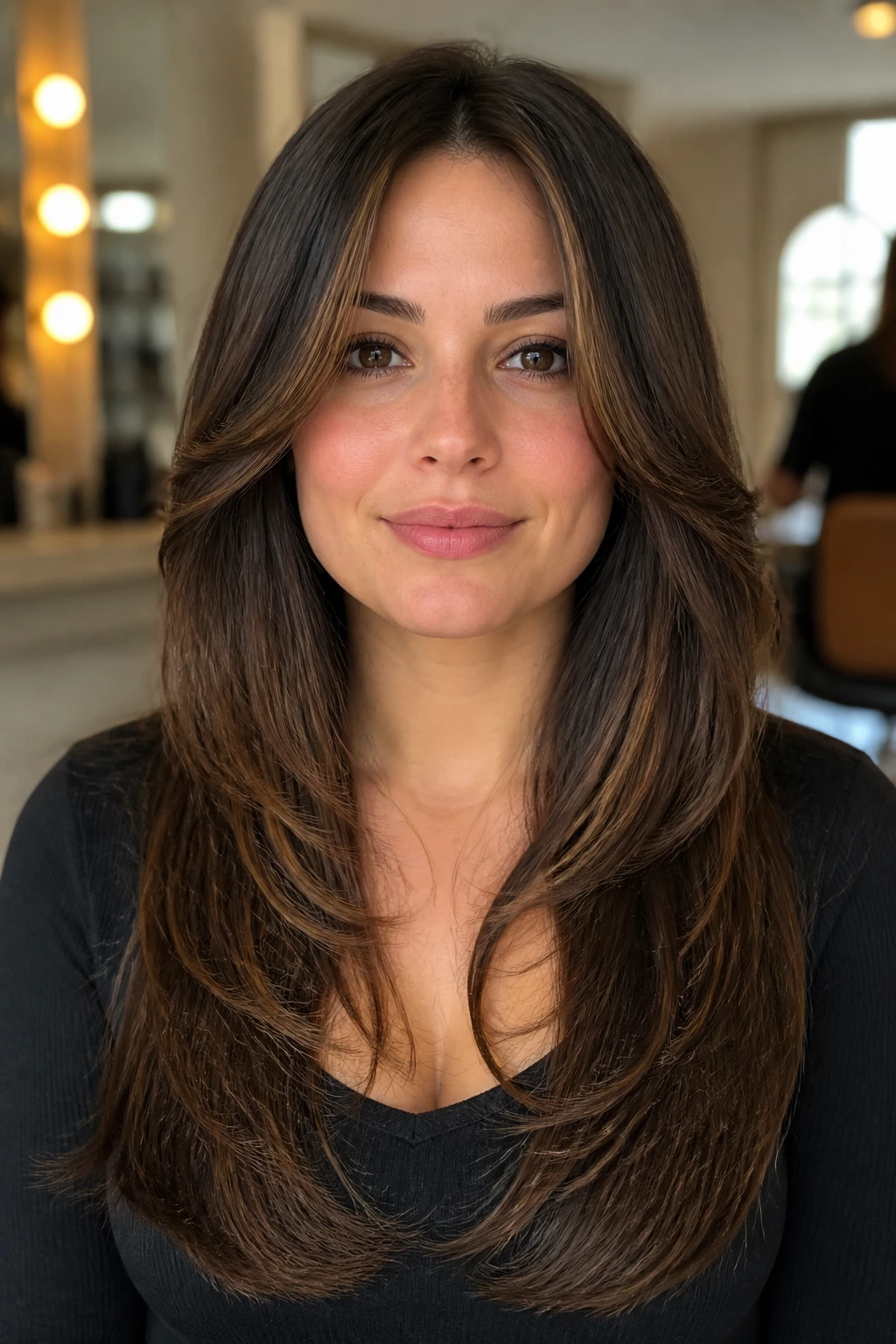
Long hair can still flatter a round face if the perimeter is shaped with care. A U-cut keeps the center back longest and lets the sides curve down gently, which gives the eye a vertical line to follow.
I like this shape because it avoids the dead-flat curtain effect you sometimes get with all-one-length hair. The face-framing pieces should start below the cheekbone and glide into the rest of the layers, not sit on top of the widest part of the face. That small difference changes everything.
There’s also a nice bonus here: the U-shape keeps the hair looking thick at the ends. A V-cut can sometimes look too sharp and pointy on round faces, while the U shape feels softer and more natural. If your hair is thick, ask for internal weight removal only. If it’s fine, keep the layers long so the ends don’t disappear.
This is one of those cuts that looks easy even when it’s carefully planned.
12. Bottleneck Bangs with Soft Layers
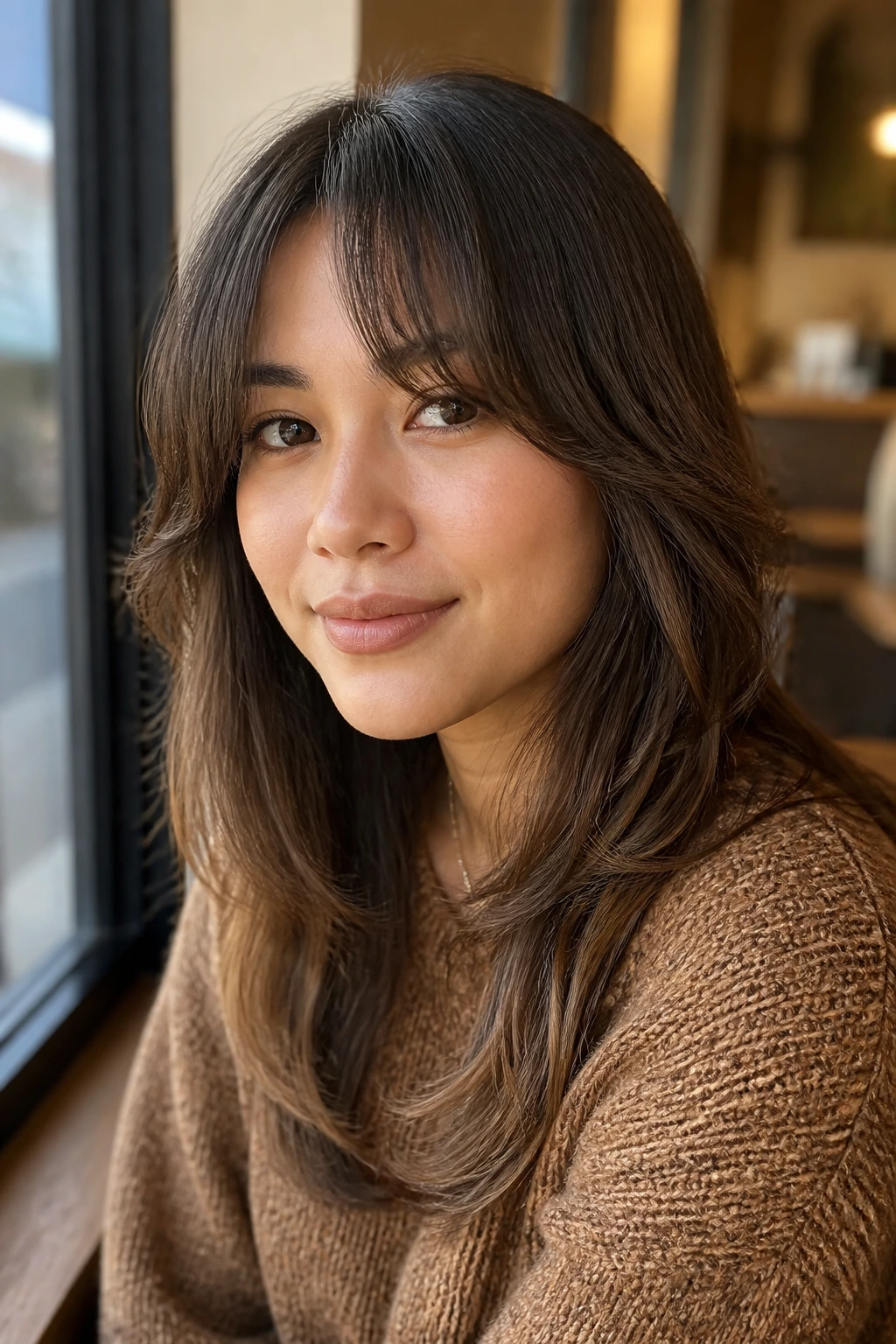
Bottleneck bangs are a smarter fringe than most people give them credit for. Unlike a straight bang that chops the face in half, they start narrow at the center and open wider toward the temples, which helps a round face feel a little longer.
The shape is the selling point. The center section sits shorter, then the outer pieces get longer and melt into the sides. That keeps the forehead from feeling boxed in while still giving you fringe. I prefer this over heavy curtain bangs when the goal is to trim width around the cheeks.
What Makes It Different
- The center of the bang is shortest.
- The outer pieces graze the cheekbones.
- The rest of the cut stays soft and layered.
- The fringe should move, not sit stiffly.
This style works especially well if you like your hair tucked behind one ear sometimes. The bang fills the front, while the side pieces keep the face open. It’s a neat fix for anyone who wants bangs without the usual widening effect.
13. Blowout Flip Layers
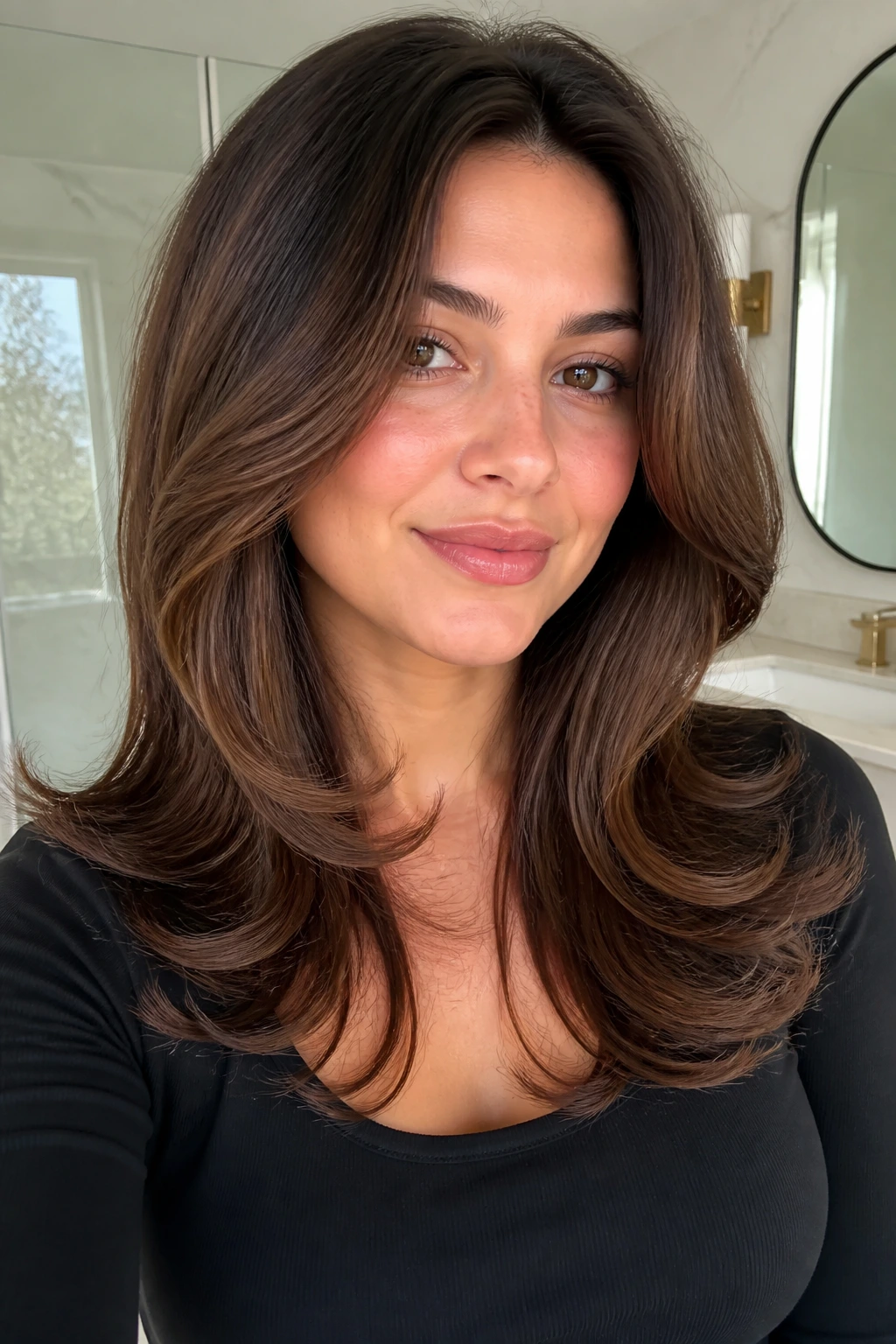
If you love a salon blowout, this cut gives you a shape worth styling. The layers are feathered to flip outward at the ends, which keeps the hair from hanging in one flat curtain around the face.
The real advantage on a round face is the movement at the bottom. Instead of the widest point sitting at the cheeks, the flipped ends pull the eye lower and stretch the silhouette. That works especially well on medium to long hair with a little density.
How to Style It
Use a heat protectant, then rough-dry the roots until they’re about 80 percent dry. After that, switch to a medium round brush and lift the crown first. Flip the ends away from the face with a half-turn of the wrist.
- Keep the brush size around 1.5 inches for shoulder-length hair.
- Direct the front pieces backward and slightly down.
- Mist flexible hairspray only after the shape cools.
- Avoid heavy oil near the roots.
This is a polished style, but it doesn’t need to feel stiff. If the ends move and the crown stays lifted, the whole cut reads lighter.
14. Deep Side Part with Diagonal Fringe
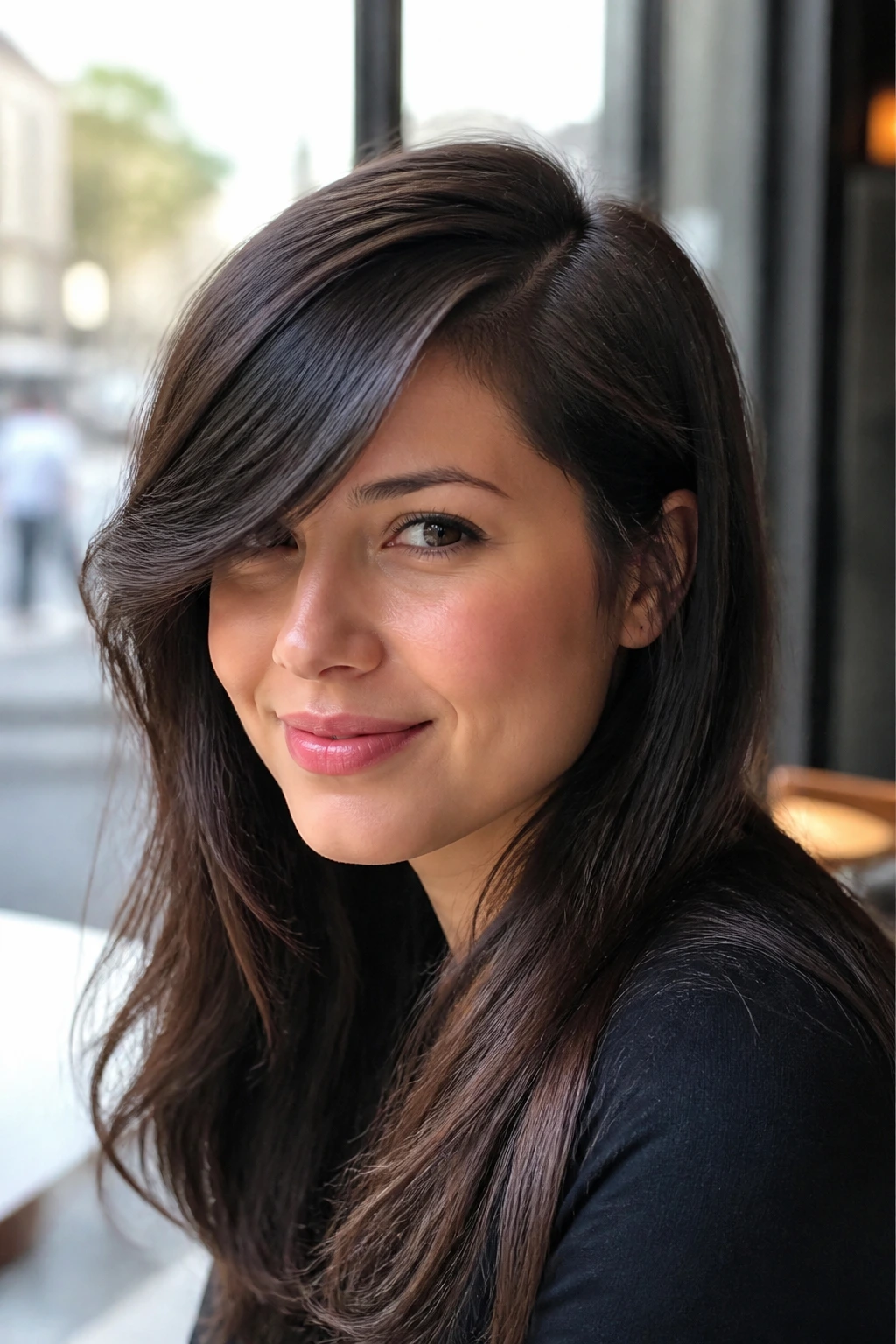
A deep side part does more for a round face than most people expect. It adds instant asymmetry, and asymmetry is one of the fastest ways to make a soft face shape look longer and sharper.
The fringe matters here. A diagonal fringe that sweeps from high on one side to lower on the other creates a strong line across the forehead, but not a blunt one. That line should land softly around the brow or cheekbone, depending on length. If it’s too short, it can feel choppy. If it’s too straight, it can make the face feel wider. There’s a narrow sweet spot, and it’s worth hitting.
I like this with medium-density hair and a cut that keeps the rest of the length below the jaw. Tuck the heavier side behind the ear for a few hours and the whole face opens up. Simple move. Big payoff.
This is also one of the easiest ways to refresh a cut you already have. Sometimes you don’t need a new haircut at all. You need a different part.
15. Piecey Cropped Cut with Textured Top
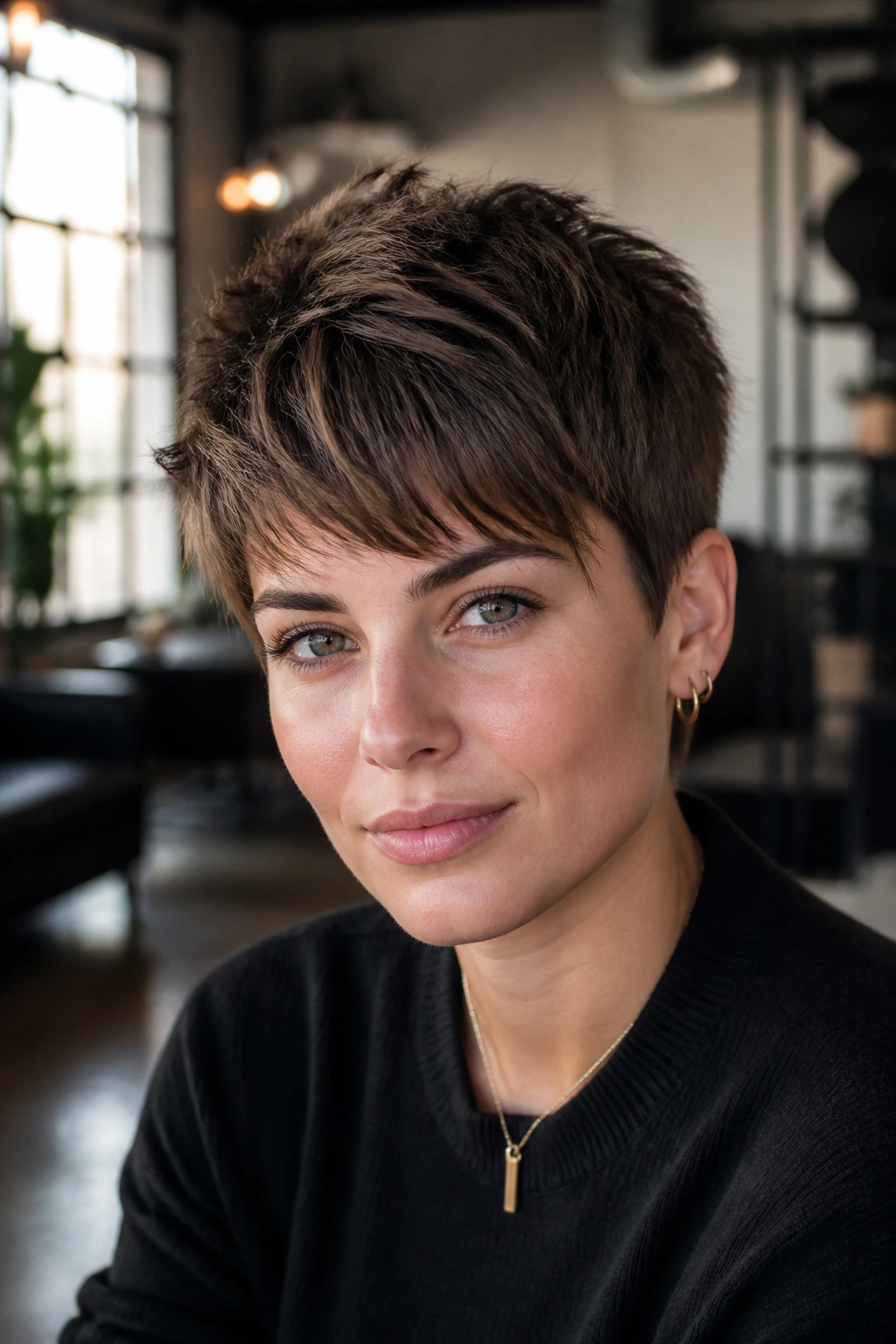
Can a crop look good on a round face? Yes, if the texture is built up top and the sides stay neat. A piecey cropped cut does exactly that, which keeps the face from widening out through the temples.
The top should be short enough to stand up a little when styled, but not so short that it sticks straight out like a helmet. I like a soft, broken finish around the fringe area, with the front pieces brushed diagonally rather than forward. That gives the cut a little length through the face.
How to Style It
Work a pea-sized amount of matte paste through dry hair. Push the roots upward with your fingertips, then separate the top pieces so they don’t clump into one solid shape.
- Keep the sides tapered close to the head.
- Leave the fringe longer than the crown.
- Use small amounts of product.
- Rework it with damp hands if it goes too stiff.
This is a bold short cut, but it can be surprisingly flattering when the texture is controlled. It’s edgy without becoming round on round.
16. Angled Lob with Chin-Skimming Front Pieces
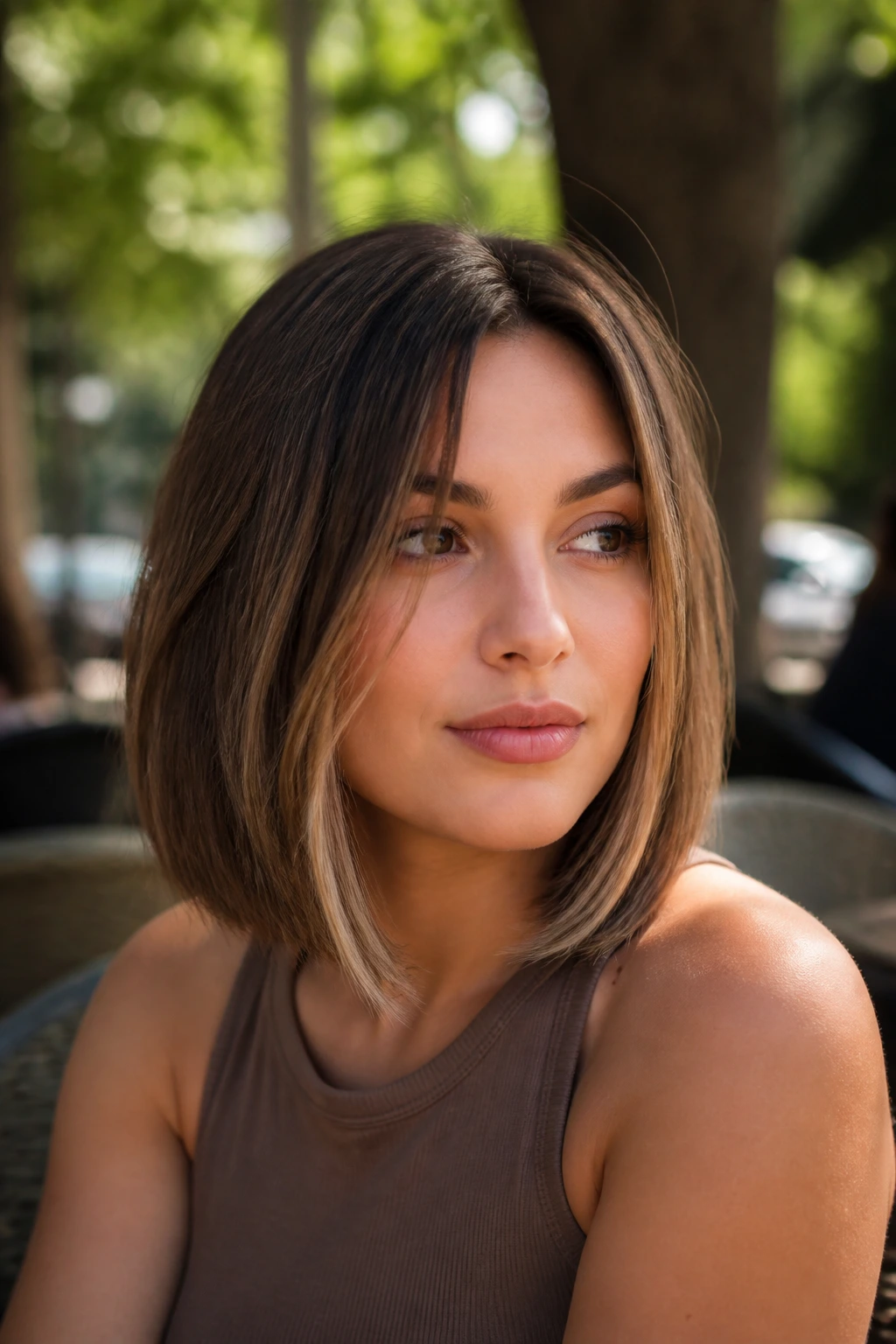
A clean angle can be a round face’s best friend. This lob is shorter in the back and longer in the front, with the front pieces landing right around the chin or just below it, which creates a diagonal line that visually lengthens the face.
I prefer this shape over a straight shoulder cut when the hair is sleek. The angle gives you structure without a hard edge. It also keeps the front pieces from stopping at the widest part of the cheeks, which is the mistake that ruins a lot of otherwise nice bobs.
What to Tell Your Stylist
- Ask for a gentle forward angle, not a steep one.
- Keep the front pieces grazing the chin, not the cheek.
- Leave enough weight in the ends so the cut doesn’t fray.
- Add soft internal layers if your hair is thick.
This is a smart choice if you want something tidy for work but still want movement when the hair is loose. It’s neat. It’s flattering. And it doesn’t ask you to style it like a project.
17. Long C-Cut Layers with Inward Bevel
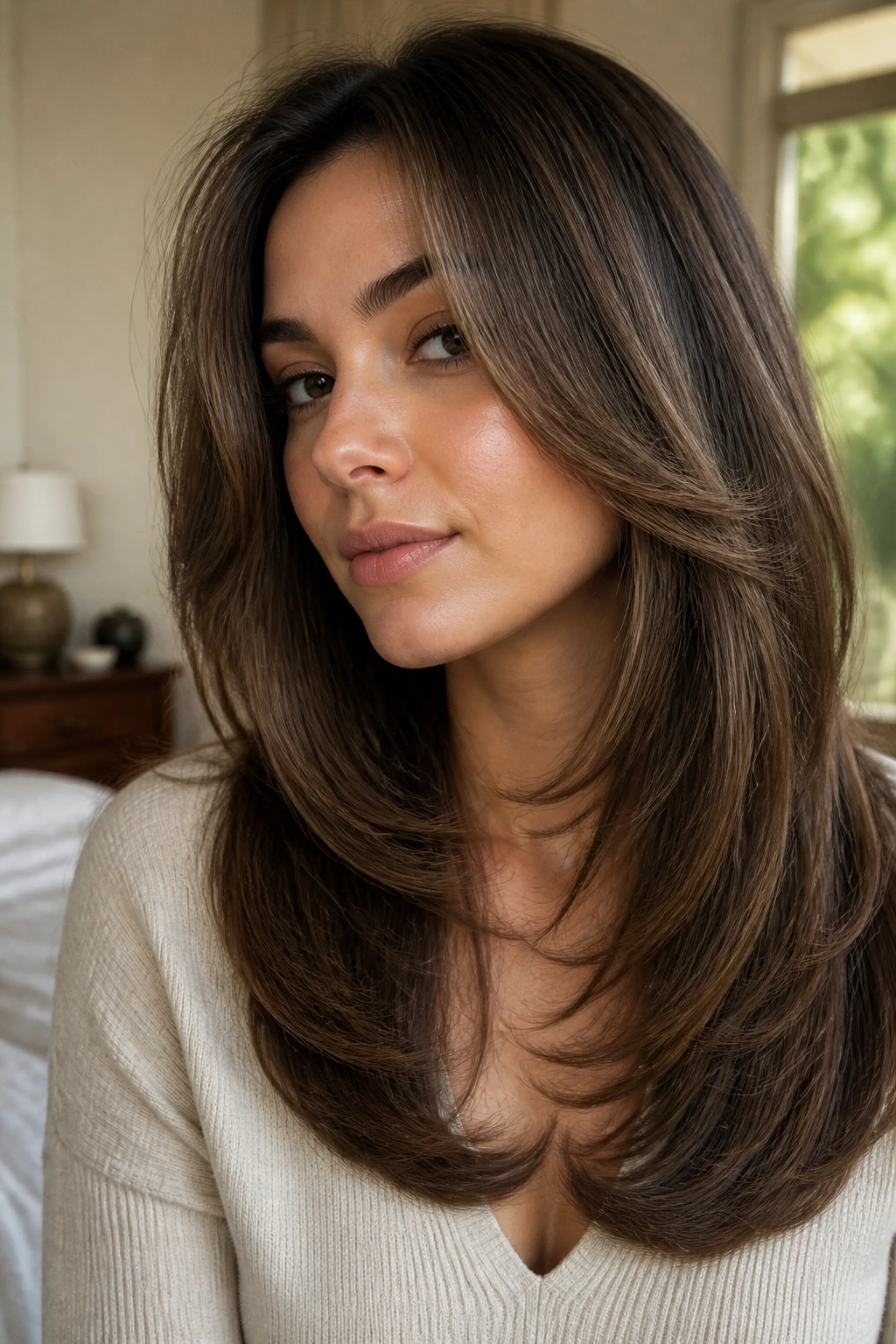
Long C-cut layers are one of my favorite sleeper options for round faces. The shape curves around the face in a soft “C,” which gives you movement without the overdone look that some face-framing cuts can pick up.
The bevel should start low enough to avoid the cheeks. That’s the part people miss. If the shortest layer is too high, it can widen the face instead of lengthening it. Start around the jaw or lower, then let the layer curve inward toward the collarbone. On long hair, that shape looks smooth and controlled, not fussy.
This cut is especially useful for thick hair that wants to live in a triangle. The C-shape keeps the weight in the right places and lets the front pieces move without puffing out. A blowout brush or a medium iron bend is enough; you don’t need tight curls.
If you like hair that swings when you walk, this one earns its keep fast.
18. Asymmetrical Pixie-Bob with Soft Side Fringe
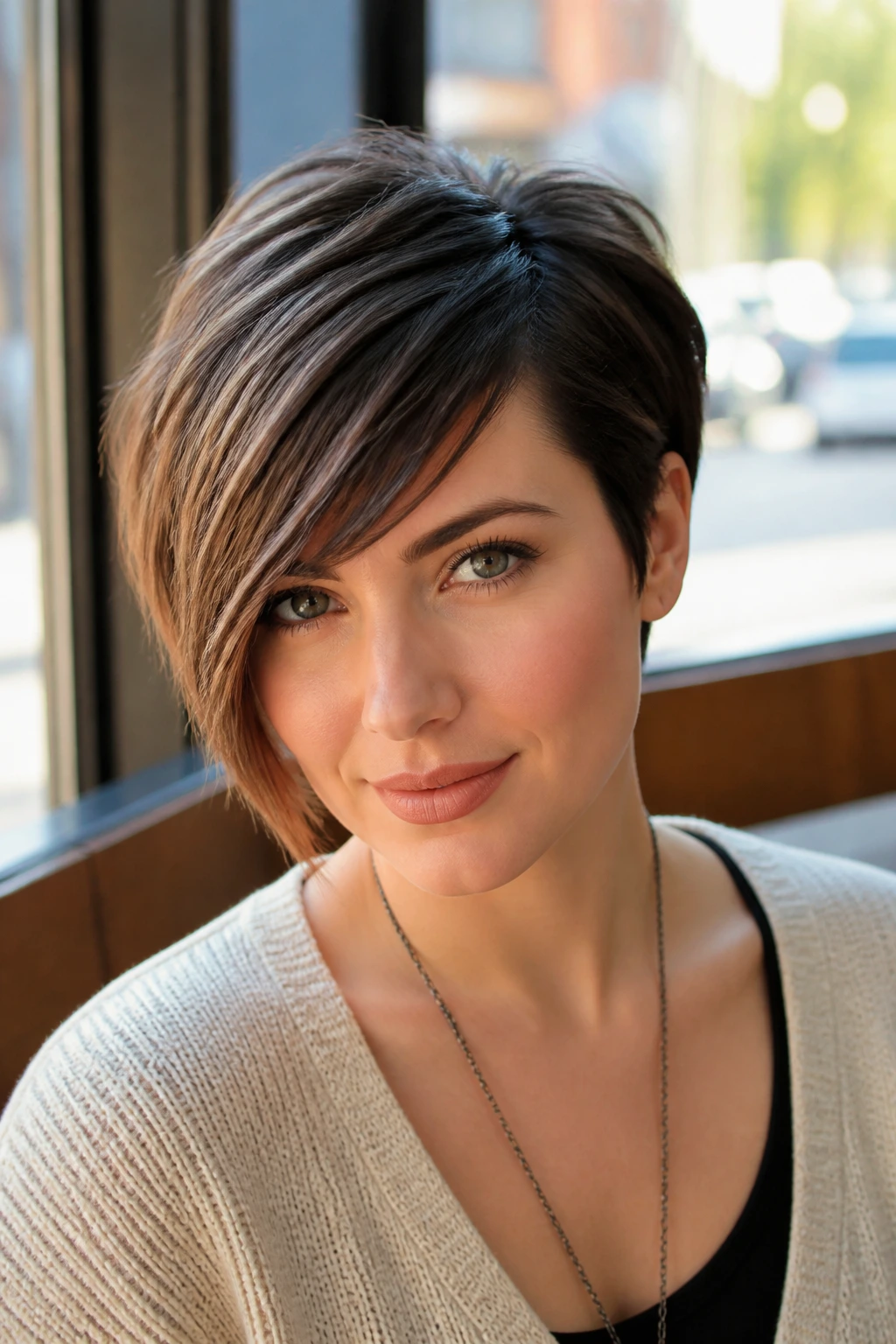
This is the short cut for someone who wants edge without harshness. An asymmetrical pixie-bob keeps one side a little longer than the other, which gives a round face a clean diagonal line and keeps the shape from turning too circular.
The side fringe is doing the heavy lifting. It should be soft, not blunt, and long enough to skim the brow or tuck near the temple. That little sweep opens the face and keeps the short length from making the cheeks look wider.
I like this style on straight or slightly wavy hair because the geometry stays visible. If your hair is curly, the asymmetry can blur a bit, which isn’t bad, but it changes the feel. Ask for close sides, a little height at the crown, and one longer panel near the front so the cut doesn’t become too uniform.
This is a strong look. Not every face-shape haircut needs to be discreet.
Final Thoughts
The best feathered cuts for round faces do one thing well: they move the widest part of the hair away from the widest part of the face. That sounds simple, and it is, but the execution takes a little care. Length, parting, and where the first layer starts matter more than almost anything else.
If you’re talking to a stylist, bring photos that show the side view as well as the front. Then point to the exact spot where you want the shortest layer to hit. Below the cheekbone is usually safer than above it, and a little crown lift goes a long way.
I’d also pay attention to how your hair behaves when it dries on its own. Fine hair usually needs less thinning. Thick hair usually needs more weight removed from the inside. That difference changes the whole haircut, and it’s the sort of detail that separates a decent feathered cut from one you keep wearing months later.
