



A good low hairstyle can do more for a round face than most people expect. Put the weight at the nape, keep the sides cleaner, and the whole face reads a little longer and less wide.
Height helps.
A style that sits too high on the cheeks, puffs out at the temples, or ends right at the jaw can make a round face look broader than it is. The smarter move is usually a low bun, low ponytail, or braid that pulls the eye downward without turning the style into a helmet. I pay close attention to three things: where the part starts, how much volume sits at the crown, and whether the front pieces skim the face instead of clinging to the widest part of the cheeks. Those tiny details matter more than the label on the hairstyle.
There is also a texture piece people miss. Very sleek hair can look sharp and elegant, but if every strand is flattened from temple to temple, the face can feel boxed in. A little lift at the top, a soft bend through the lengths, or a loose braid around the nape keeps things calmer and more flattering.
The 20 styles below all stay low, but they do not all feel the same. Some are polished, some are messy, some lean romantic, and a few are the kind of style you can throw together in five minutes and still look put together.
1. Sleek Low Bun with a Deep Side Part
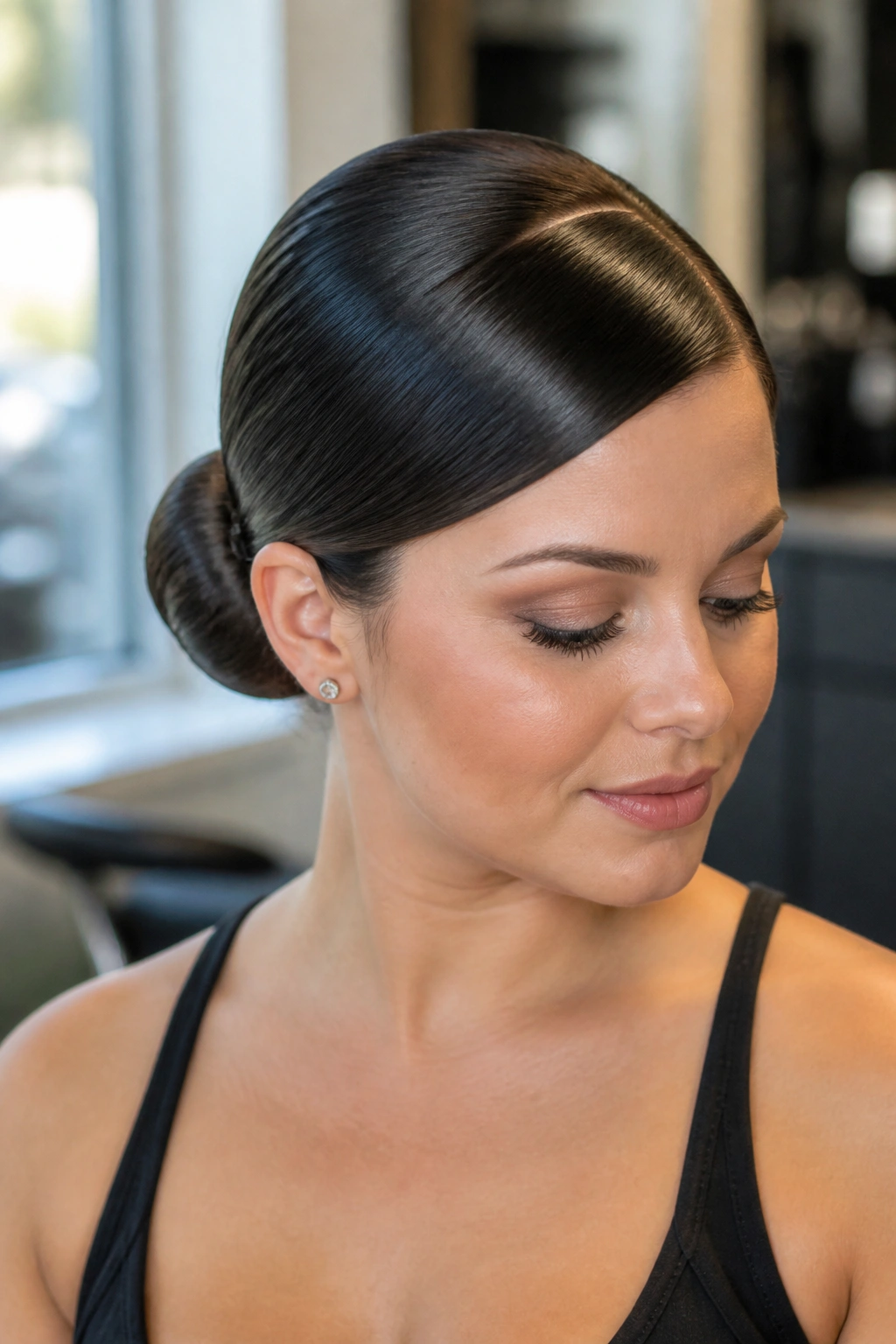
Nothing trims width faster than a sleek low bun with a deep side part. The part breaks the face into a diagonal line, and the bun stays low enough that it does not add bulk to the cheeks.
Why It Works
The side part does most of the visual work here. It pulls attention away from the center of the face and gives the crown a little lift, which is exactly what round faces tend to benefit from. Keep the surface smooth from the temples down, but do not flatten the top so hard that it looks painted on.
This style works especially well on medium to long hair with a little natural bend. Straight hair gives it a crisp finish, while wavy hair brings a softer feel after a quick pass with a brush and a touch of serum. If your hair is thick, a low bun can hold its shape all day without looking tiny or skimpy.
- Best part placement: about 1½ to 2 inches off center
- Best finish: smooth crown, tucked ends, no puff at the sides
- Best tools: fine-tooth comb, strong elastic, 4 to 6 bobby pins
- Best product: a pea-sized amount of smoothing cream or light gel
Keep the sides flat and the crown clean; that contrast is what does the work.
2. Low Ponytail with Crown Lift
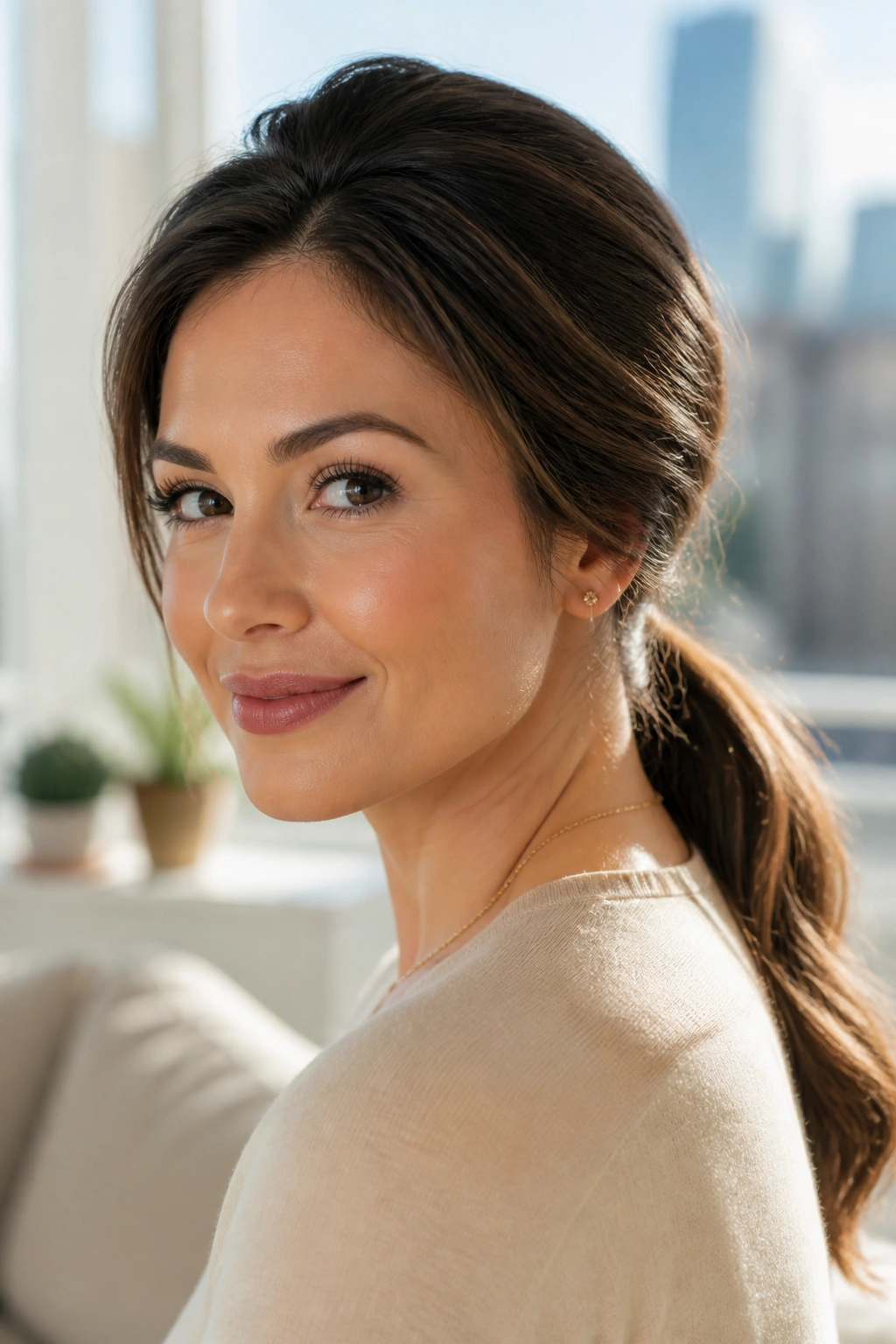
Why does a low ponytail with a little crown lift look so much better than one sitting flat against the head? Because that tiny bit of height gives the face a longer outline without adding width where you do not want it.
The trick is not teasing the hair into a huge bump. You only need a soft lift at the crown, about the size of your thumb, then a smooth sweep back into a low ponytail at the nape. If the lift gets too tall, the style starts to feel dated fast. If it stays gentle, it looks clean and easy.
How to Style It
Work a little mousse or spray through damp roots, then blow-dry the crown upward with a round brush. Once the hair is dry, smooth the top layer with your hands or a brush and secure the ponytail just below the occipital bone, where the skull starts to curve down.
Wrap one small strand around the elastic if you want it to look more finished. That one move always makes a plain ponytail feel more deliberate. If your hair slips, use two crossed bobby pins under the base so the ponytail stays low instead of sliding toward the neck.
3. Soft Low Chignon with Face-Framing Pieces
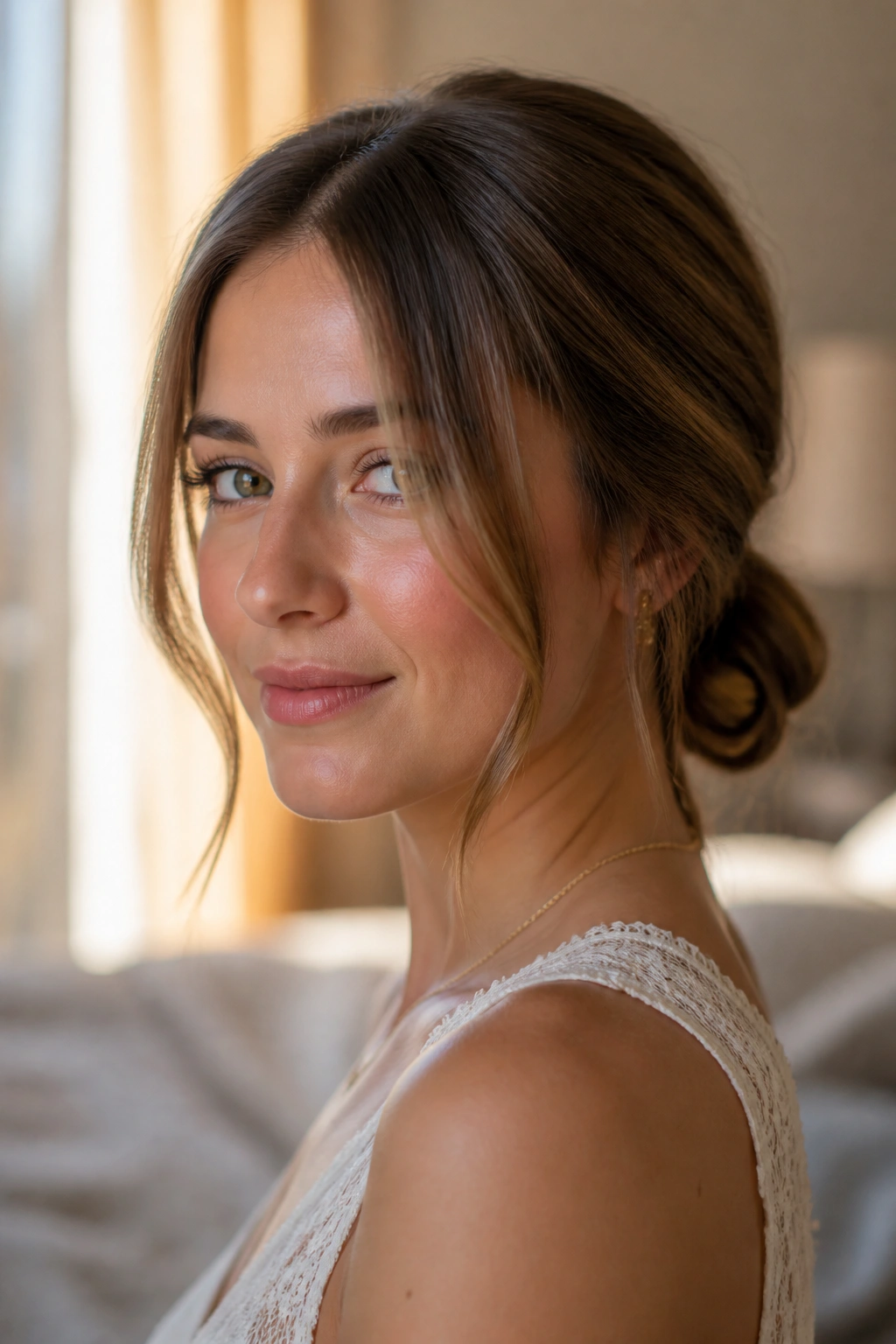
This is the style I reach for when a round face needs polish but not stiffness. A soft chignon sits low, usually just above the neckline, and the loose front pieces keep the whole look from feeling sealed shut.
A lot of people make the mistake of pulling every front strand back with the rest of the hair. That can work on some face shapes, but on a round face it often removes the gentle vertical line that makes the face look longer. Leave two slim pieces near the temples, then let them fall past the cheekbone or even toward the jaw.
What Makes It Work
- Keep the chignon small and tucked, not wide
- Leave the front pieces loose, but not stringy
- Use pins that match your hair color so the bun stays soft-looking
- Let the ends of the chignon disappear under itself instead of fanning out
A chignon like this is also kind to layered hair, because the shorter pieces can move a little without ruining the shape. It feels dressed up, but not precious.
4. Side-Swept Low Braid
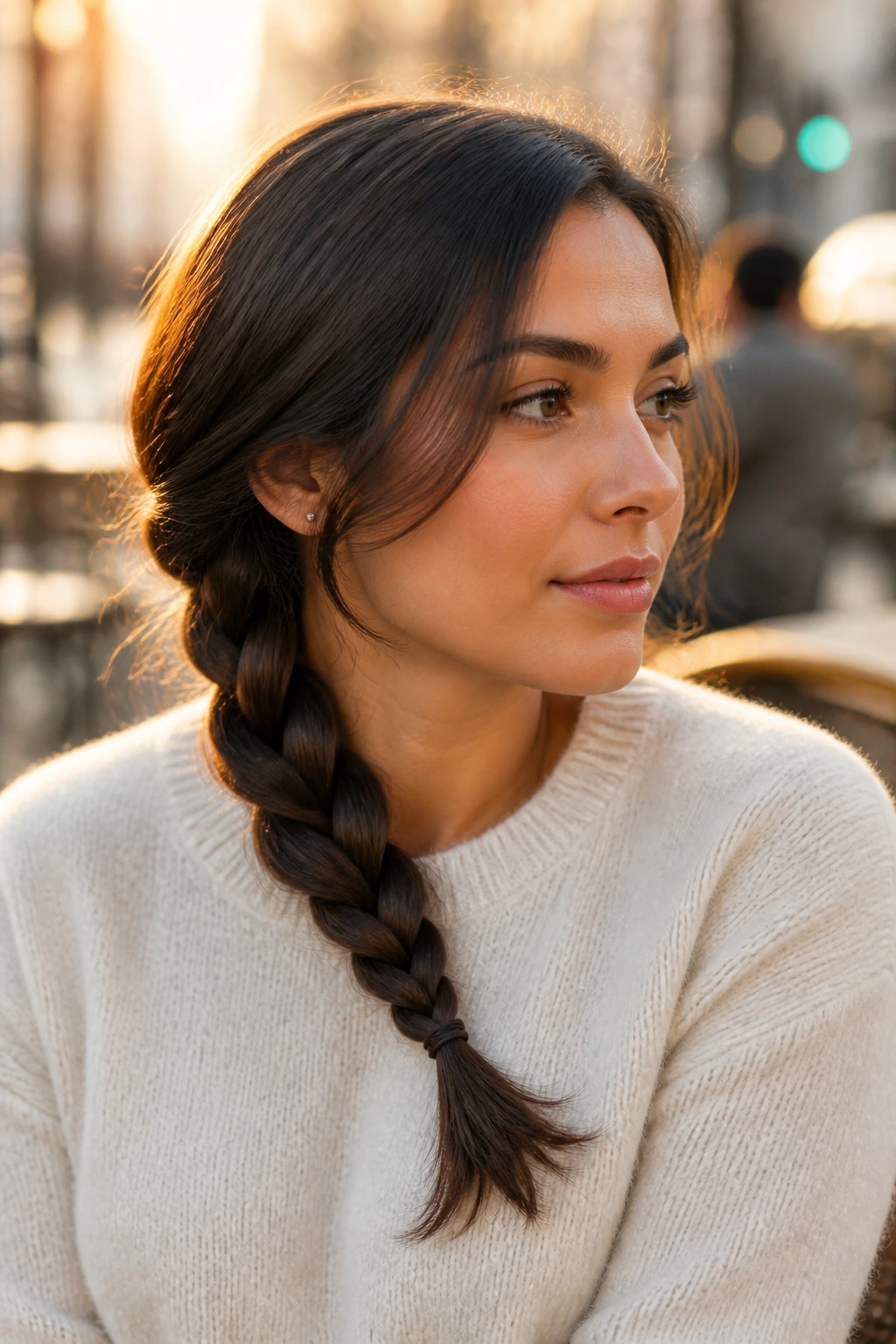
A braid pulled low over one shoulder does a lot of quiet work on a round face. The diagonal line cuts across the width of the cheeks, and that alone can make the face feel slimmer before you even notice the braid itself.
The key is to start the braid lower than people usually do. If it begins too high, near the temples, it can widen the upper half of the face. Start the braid near the back of the ear or just under it, then bring it across the neck and down one side. That angle matters more than braid type.
That diagonal line matters.
A plain three-strand braid is enough, but a slightly loosened braid often looks better because it has a softer edge. Pull the outer loops apart a little after you finish, then let a few fine pieces fall near the hairline. On straight hair, the braid reads neat and clean. On wavy hair, it gets this easy, almost undone texture that feels less severe around the face.
5. Wrapped Low Knot
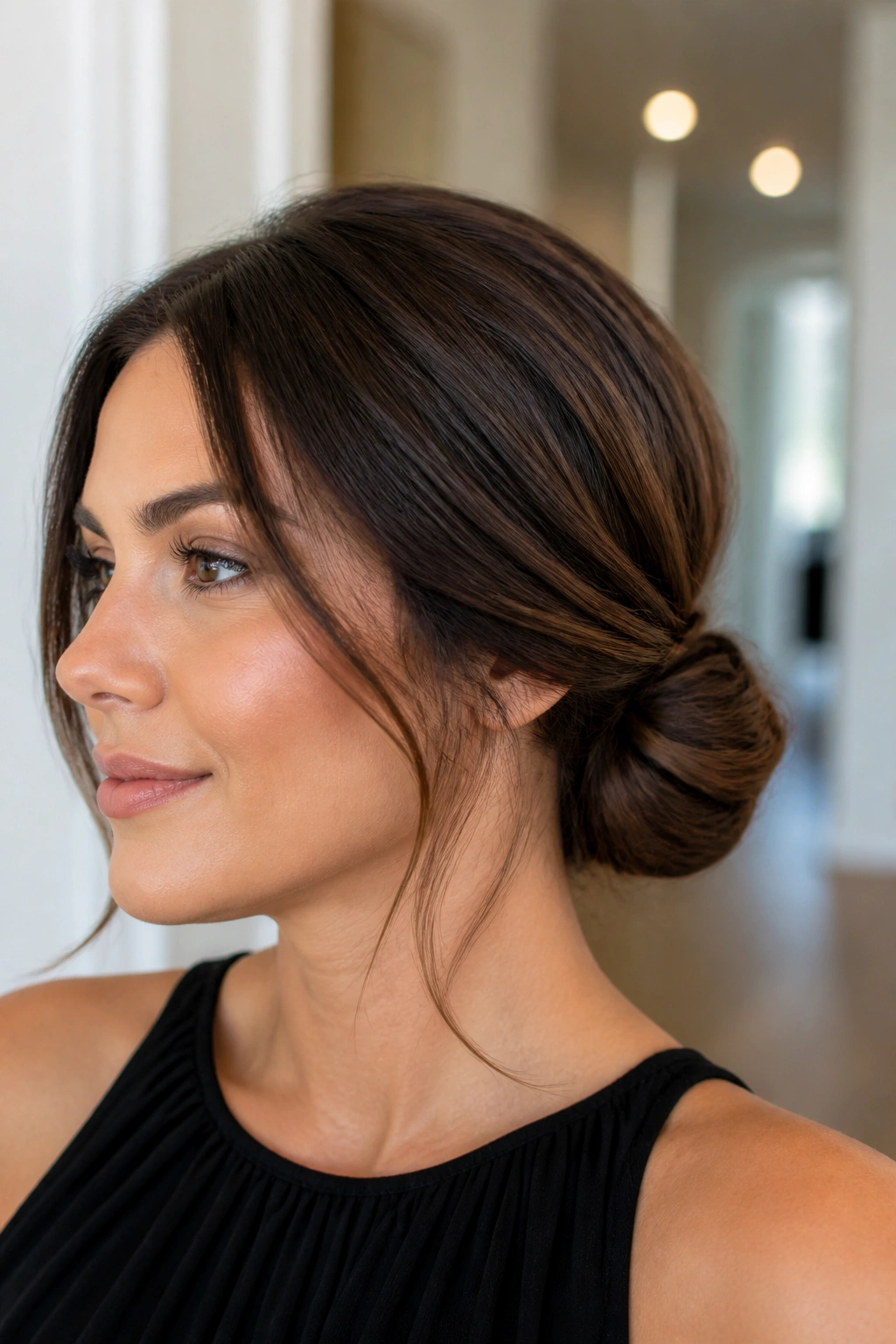
Unlike a tight ballet bun, a wrapped low knot feels softer at the edges and a little less severe on a round face. It still looks tidy, but it does not box the face in.
The shape matters here. You want the knot to sit low and slightly off the center line of the neck, not perched high at the back of the head. If the knot spreads too wide, it starts to compete with the cheeks. If it stays compact, the eye drops downward, which is where you want it.
This style is a good match for medium to thick hair because there is enough length and body to wrap the knot without it looking tiny. Use two strong pins crossed through the base, then tuck any loose ends under the knot so they do not poke out. A little shine spray at the end helps the whole thing look smooth, but keep it light. Too much gloss can make the style look slick in a bad way.
6. Low Twisted Ponytail
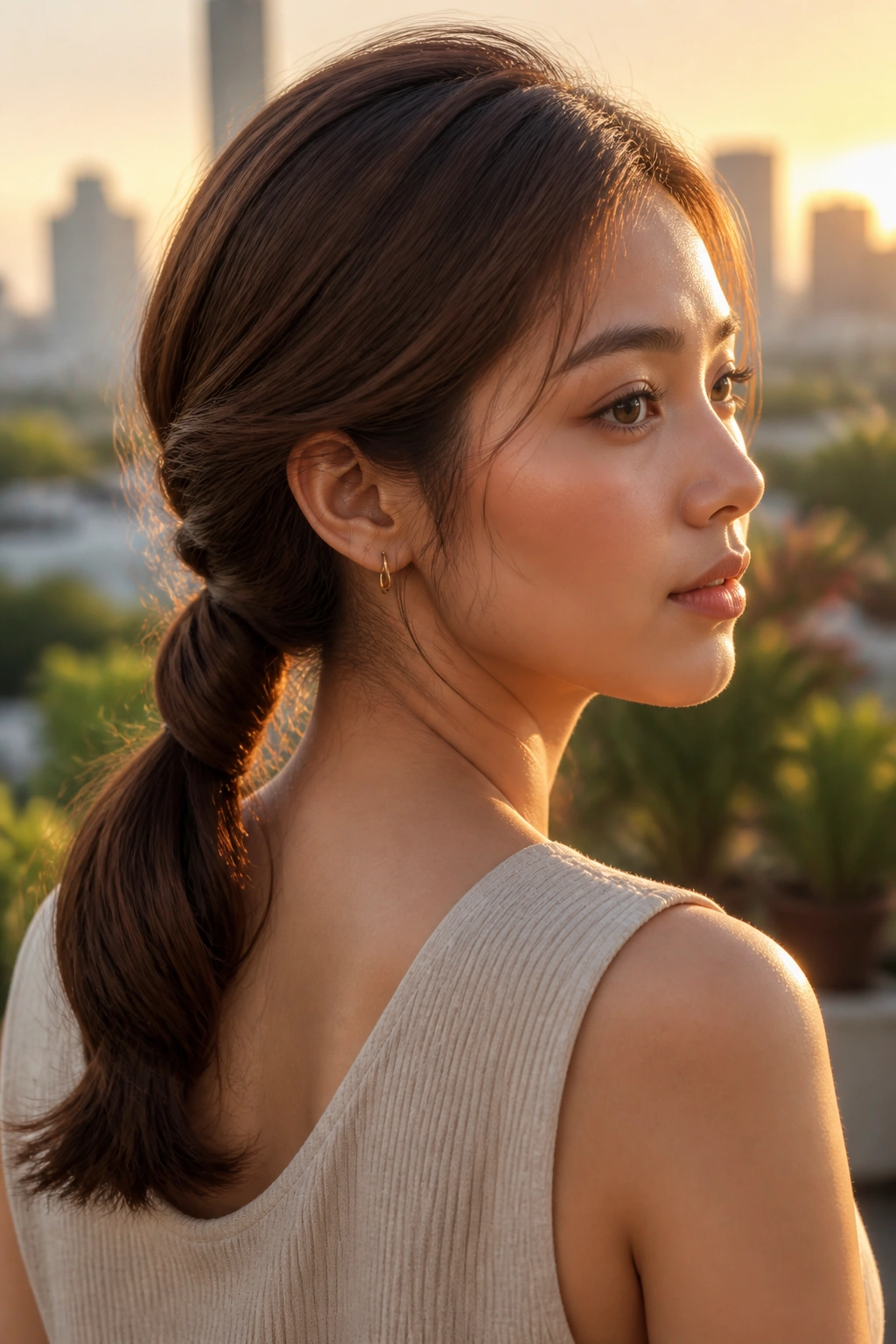
Twist beats puffiness every time. A low twisted ponytail keeps the silhouette narrow, and that narrow shape is flattering on round faces because it draws the eye straight down.
Here’s the part people skip: do not just twist the whole ponytail into one rope and hope for the best. Split the hair into two sections after you secure the base, twist each section on its own, then wrap them around each other so the texture looks intentional. That gives the ponytail a little movement without spreading it sideways.
If your hair is layered, this style is extra useful because the layers blend into the twist instead of sticking out. If your hair is fine, mist the lengths with texture spray before twisting so the ponytail does not collapse by lunchtime. A small elastic at the bottom keeps the shape neat, and a single pin near the nape stops the whole style from shifting.
7. Bubble Ponytail at the Nape
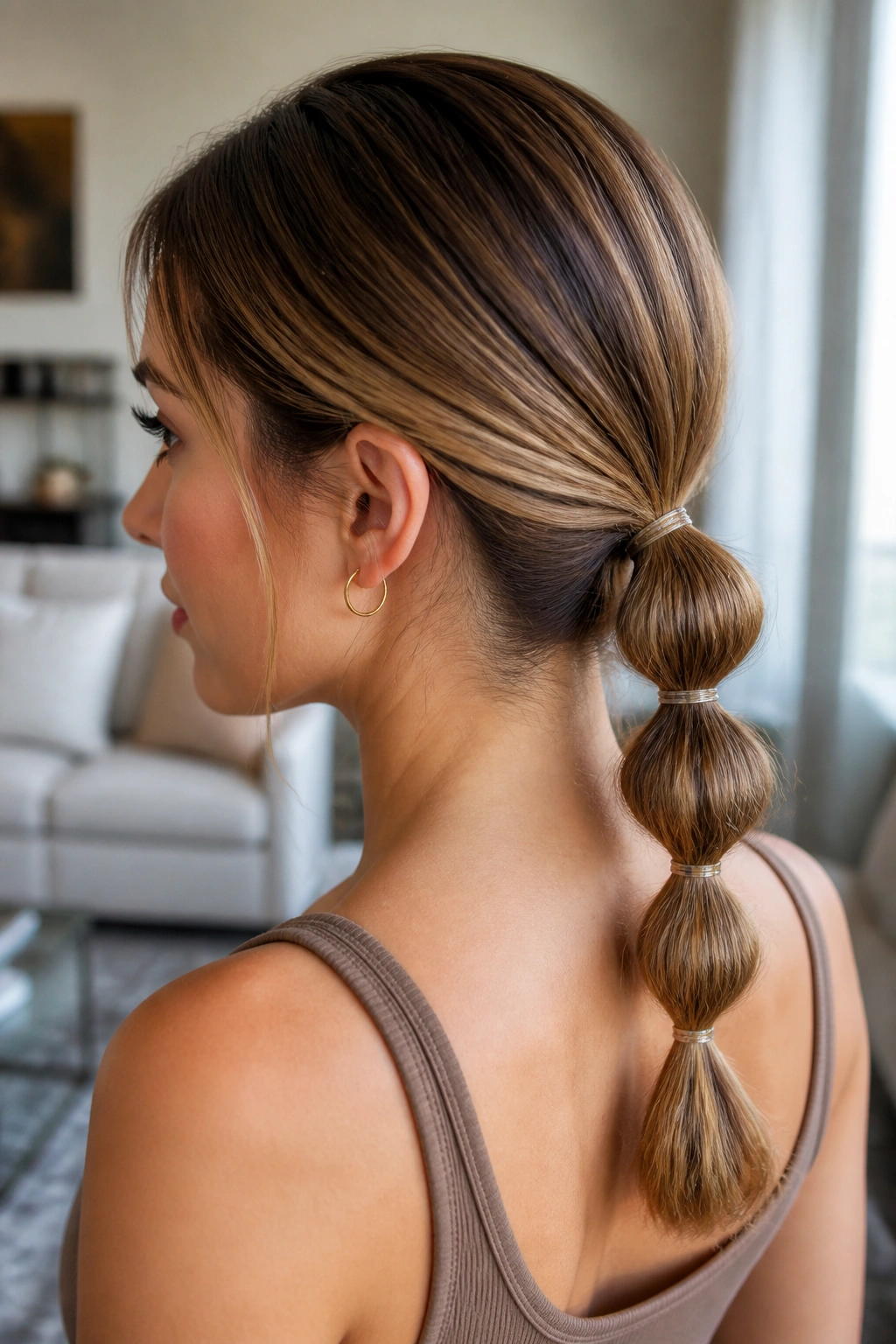
Why does a bubble ponytail work so well on a round face? Because each bubble creates a small vertical break, and those breaks keep the eye moving downward instead of outward.
The best version stays low, right at the nape, with the first elastic snug but not tight. Then you add another elastic 2 to 3 inches down, pull the section between them outward a little, and repeat. If the bubbles are too full at the sides, the style gets wide fast. Keep them rounded, not puffy.
How to Get the Shape Right
- Use clear elastics or slim covered bands
- Tug each bubble gently from the sides, not the center
- Keep the top smooth and close to the head
- Stop the first bubble before it gets too large
A bubble ponytail can look playful or polished depending on the finish. Smooth roots give it a cleaner feel. A few loose waves through the tail make it softer. Either way, it stays low enough to flatter a round face without trying too hard.
8. Low Bun with Curtain Bangs
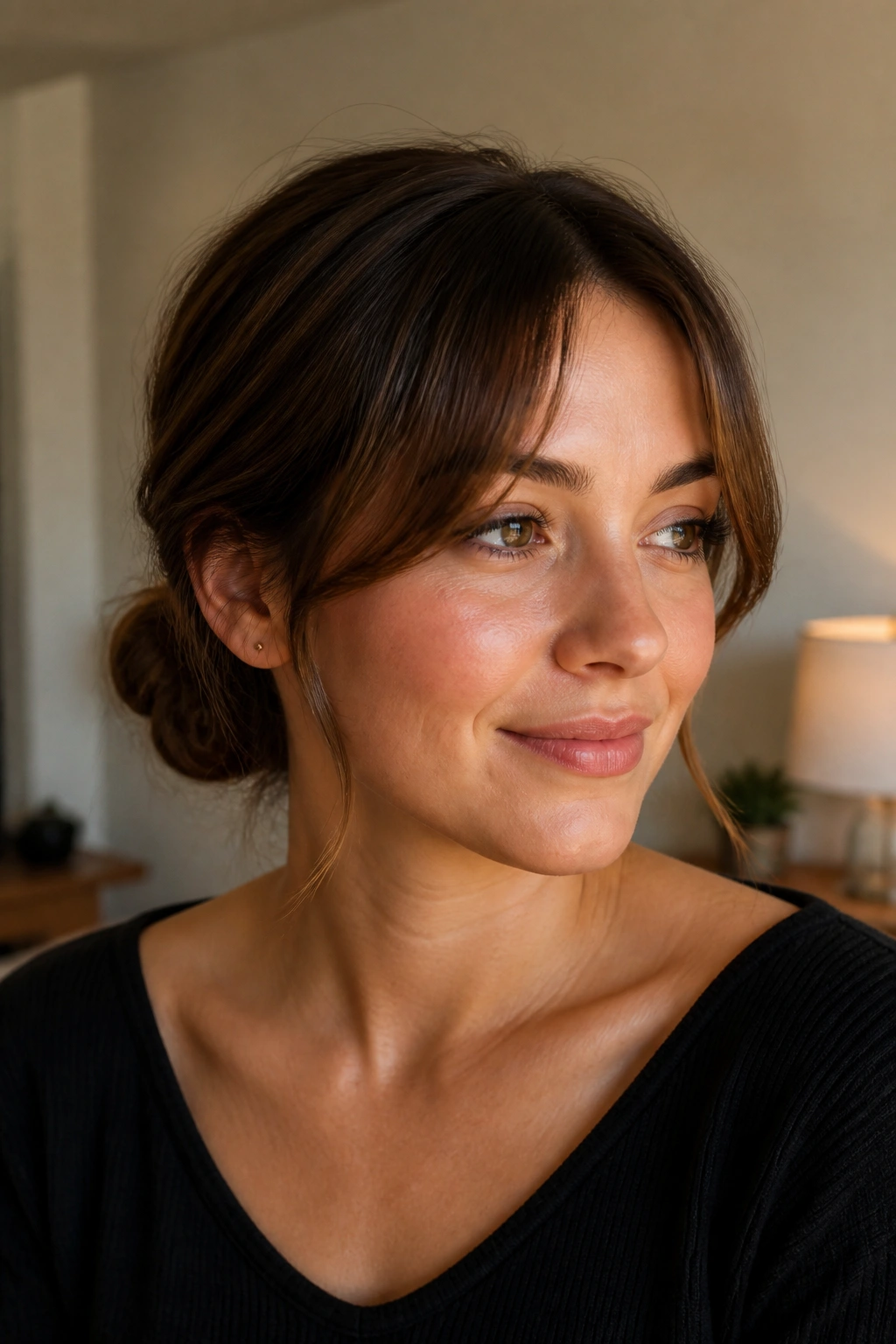
A low bun and curtain bangs is one of those pairings that looks easy even when it took a little planning. The bangs soften the front, and the bun keeps the back neat. That balance matters on a round face because you get shape without adding bulk.
Curtain bangs are useful here because they open at the center and sweep outward, which creates a subtle V-shape over the forehead. That line pulls the face downward in a way blunt bangs do not. If your bangs hit at cheek level, keep them loose and airy instead of heavy. Heavy bangs sitting right at the widest part of the face can work against you.
- Best if the bangs end around the cheekbone or upper jaw
- Best with a bun that sits below the back of the head
- Best for wavy or softly bent hair
- Best finished with a little dry texture spray, not stiff hairspray
The style feels lived-in, not fussy. That is the appeal.
9. Braided Low Bun
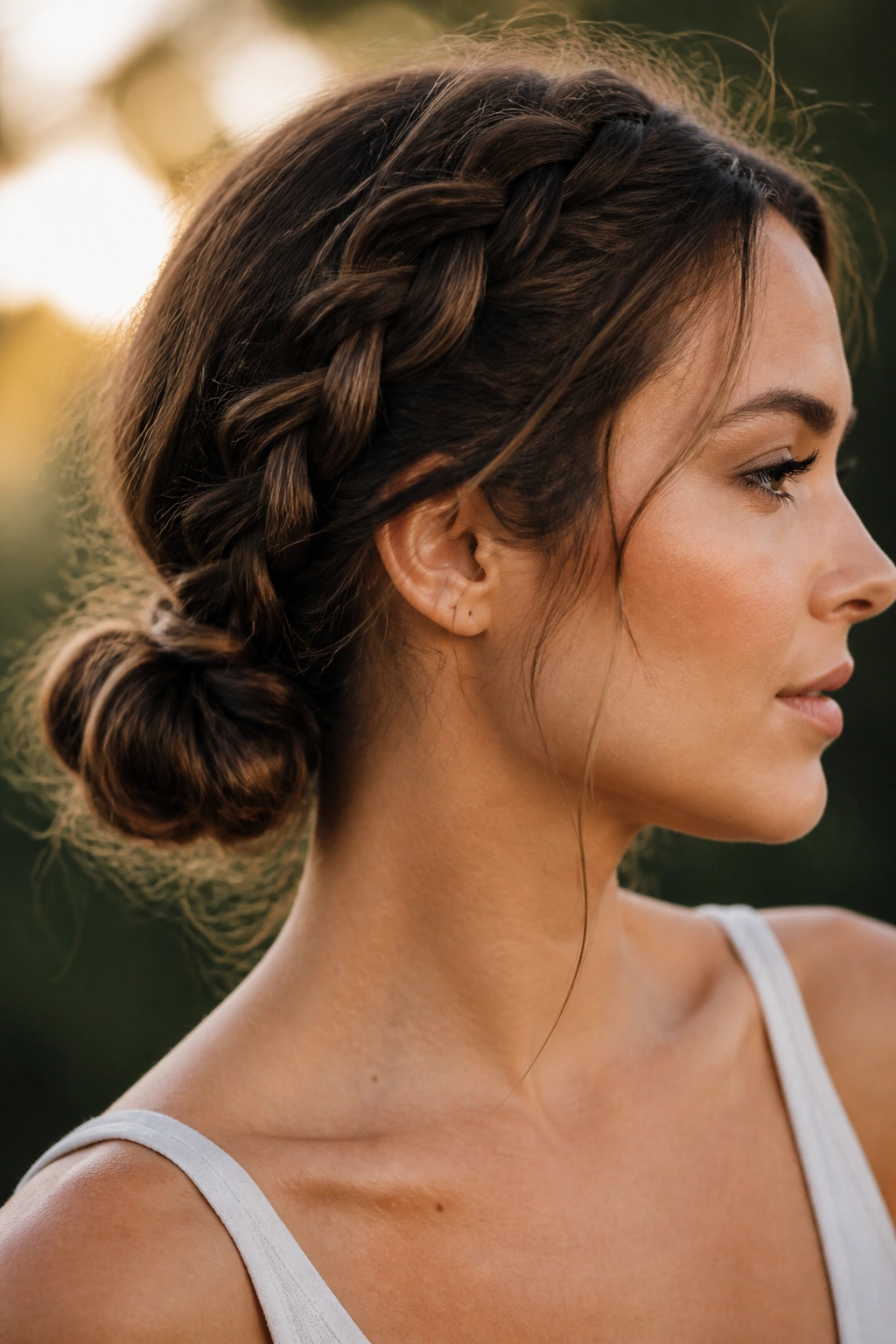
A braided low bun gives you structure without making the face look boxed in. The braid adds texture, the bun keeps the shape close to the neck, and the low placement keeps everything in the right place for a round face.
This one is especially good on second-day hair. Hair that is a little lived-in holds the braid better, and the bun gets extra grip instead of slipping apart. Start with a loose three-strand braid or Dutch braid, then coil it into a bun at the nape. If you braid too high, the fullness moves up toward the cheeks. Keep the braid low and let the bun stay compact.
A braided bun also works when you want your hair to feel deliberate but not slick. It hides frizz better than a plain knot, and it can make thick hair feel less heavy around the face. I like it for casual events, but it also looks sharp enough for a dressier setting if you pin the finish cleanly.
10. Low Side Bun
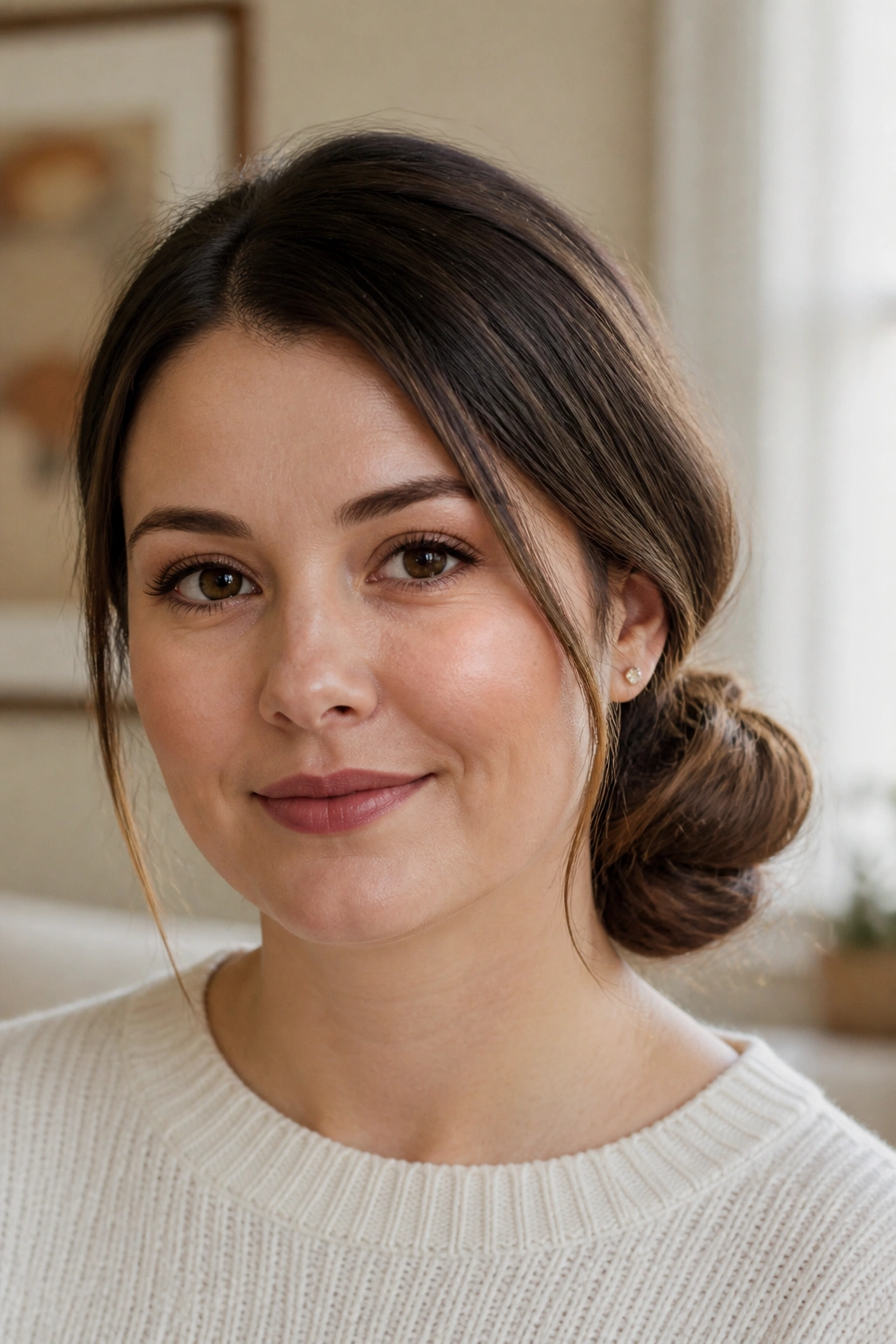
Compared with a bun in the center, a low side bun shifts the weight away from the widest part of the face. That alone gives it a softer, more angled look on round faces.
The important part is keeping the bun low and slightly behind the ear, not right beside the cheek. If it sits too far forward, it adds fullness exactly where you do not want it. If it sits too high, the shape starts to feel top-heavy. A side bun should look like it belongs near the neckline, almost tucked into the side of the head.
This style loves a side part, but a soft off-center part can work too. It looks especially nice with a few wisps at the temple and a clean sweep on the heavier side of the part. For a little extra security, use two pins to anchor the bun from different angles. The style stays put better that way, and you avoid the droopy look that can happen with one pin alone.
11. Rope-Braid Low Ponytail
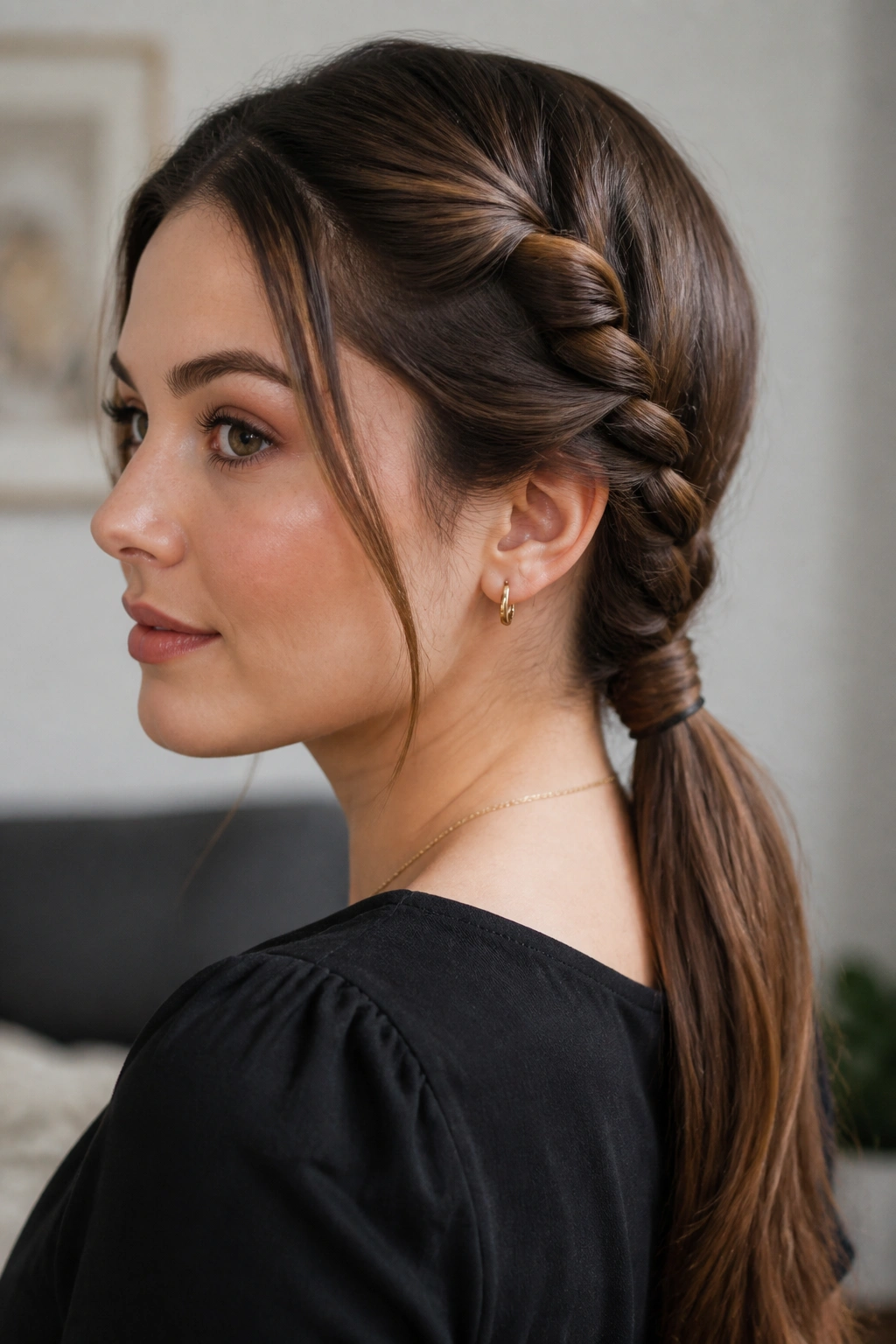
A rope-braid low ponytail is one of the neatest low styles for a round face, and it takes less effort than it looks like it should. The twist creates a slim line down the back, which keeps the shape long instead of wide.
This is also a good choice for fine hair. A rope braid gives the illusion of thickness without building a heavy shape around the face. You can keep the top smooth, secure a low ponytail, split it into two sections, twist each section tightly, and then wrap them around each other until the braid holds. The result is tidy, but not flat.
Use a small elastic at the end and tug the twist a little if you want it to feel softer. A tiny barrette or pin near the base can make it look more finished, though you do not need much decoration. The style already has enough texture on its own.
12. Loose French Twist at the Nape
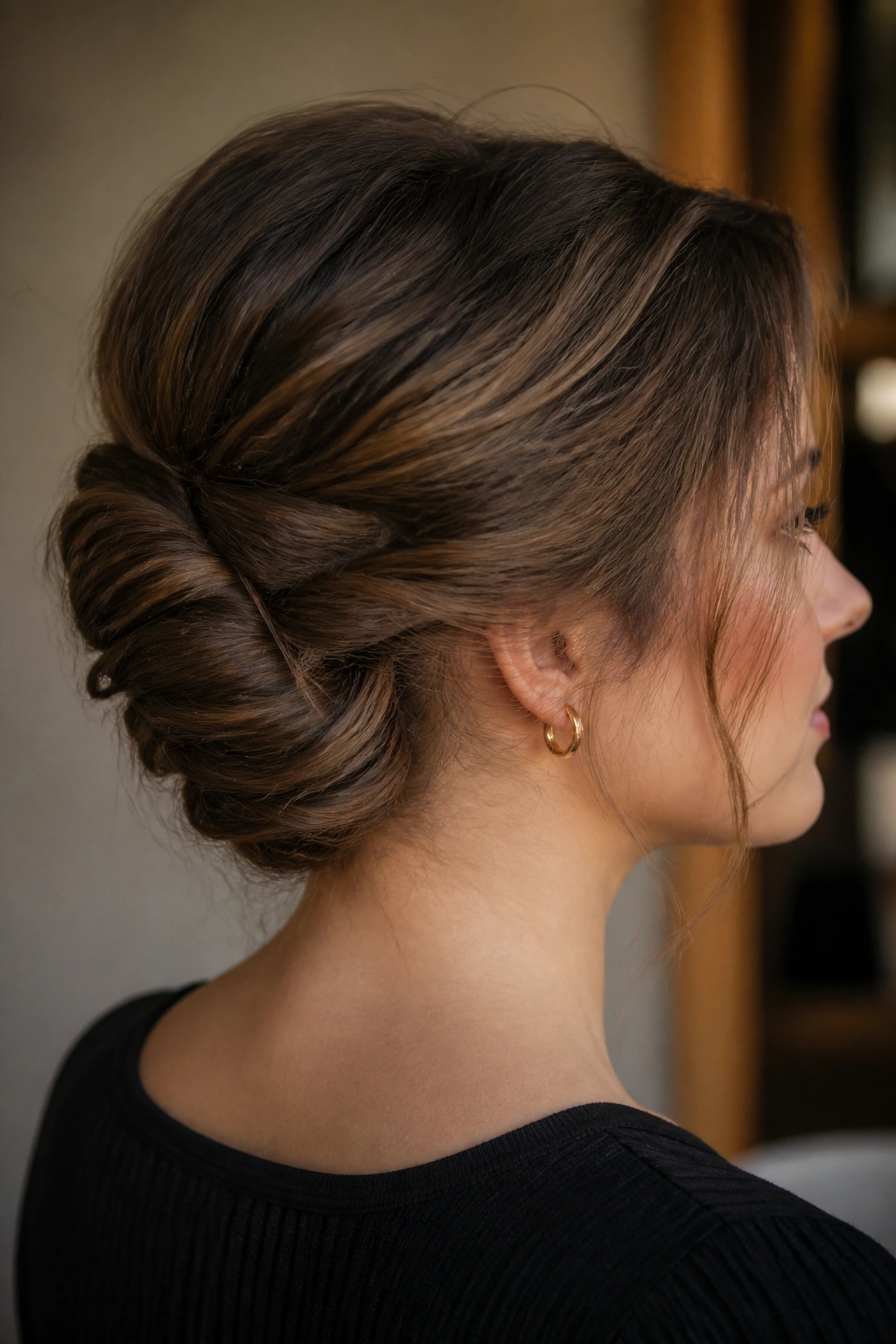
A classic French twist can be too tall for a round face. Lower it, loosen it a touch, and it suddenly makes much more sense.
The version that works best sits at the nape rather than climbing up the back of the head. That keeps the shape long and quiet. You still get the tidy roll and the tucked ends, but the style stops before it starts widening the upper half of the face. If your hair is very smooth, a little grip spray at the roots helps the twist stay in place.
How to Keep It from Looking Stiff
- Backcomb the crown lightly, only where you need grip
- Leave the sides smooth, not pasted down
- Pin the roll vertically so it stays close to the neck
- Keep the finish soft at the top edge
This is one of those styles that looks better when it is not overworked. A tiny bit of looseness makes it feel human, which is exactly what it should do.
13. Double Twist Bun
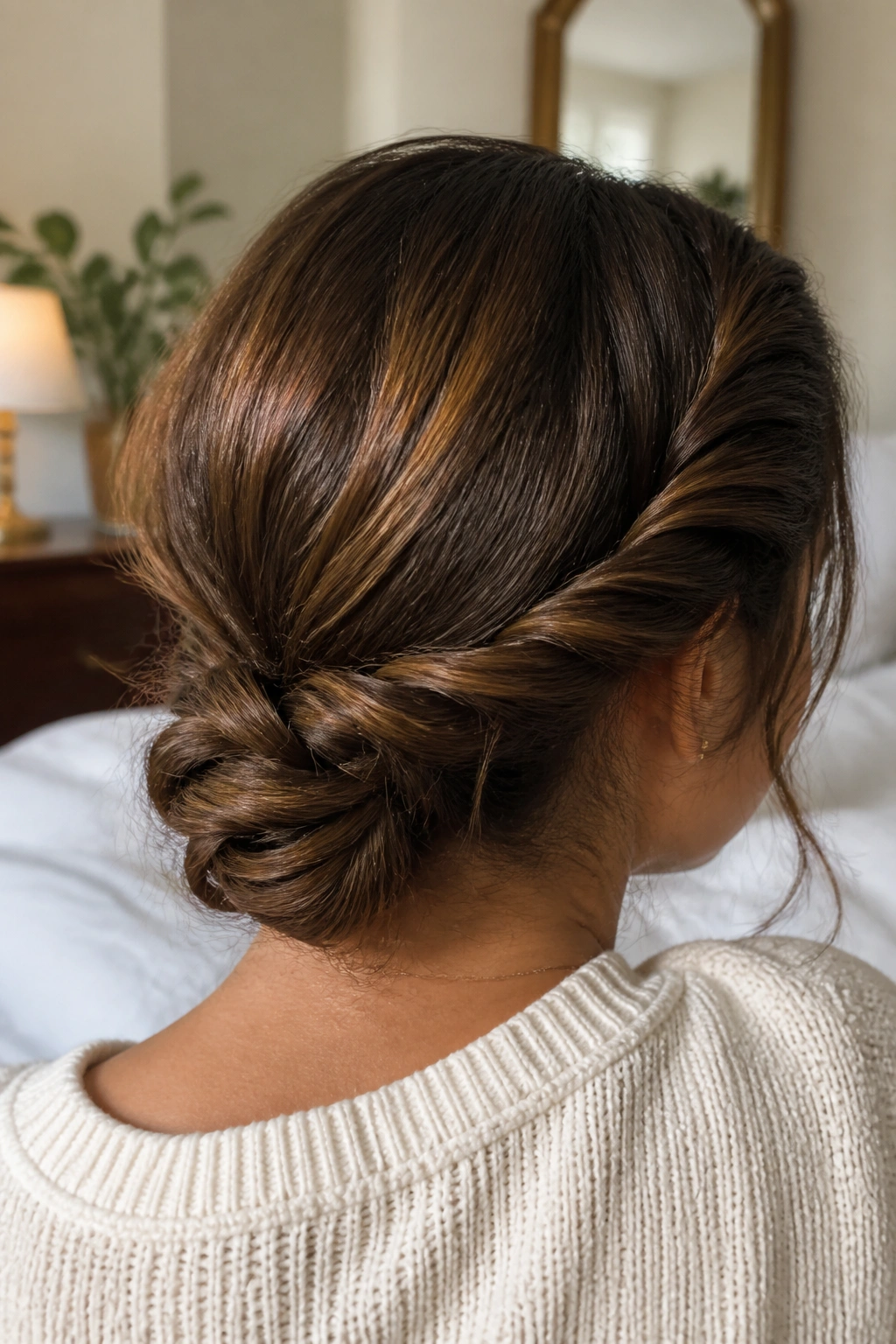
The double twist bun is a smart option when you want the hair lifted away from the cheeks without creating height at the crown. Two twisted sections from either side meet low at the back, and that low meeting point keeps the whole look balanced.
I like this one for hair that has a bit of texture or wave, because the twists hold better and look fuller. You divide the hair into two side sections, twist each one from behind the ear back toward the nape, then join them into a small bun. The shape is neat without being severe, and the side twists create a gentle diagonal line across the head.
- Works well on shoulder-length to long hair
- Needs 4 to 6 pins, depending on thickness
- Looks better when the front is smoothed, not teased
- Can be worn with a side part or a center part
A double twist bun feels polished enough for a dressy look, but it does not have the hard edge of a tightly wrapped bun. That softness matters.
14. Messy Low Ponytail with Waves
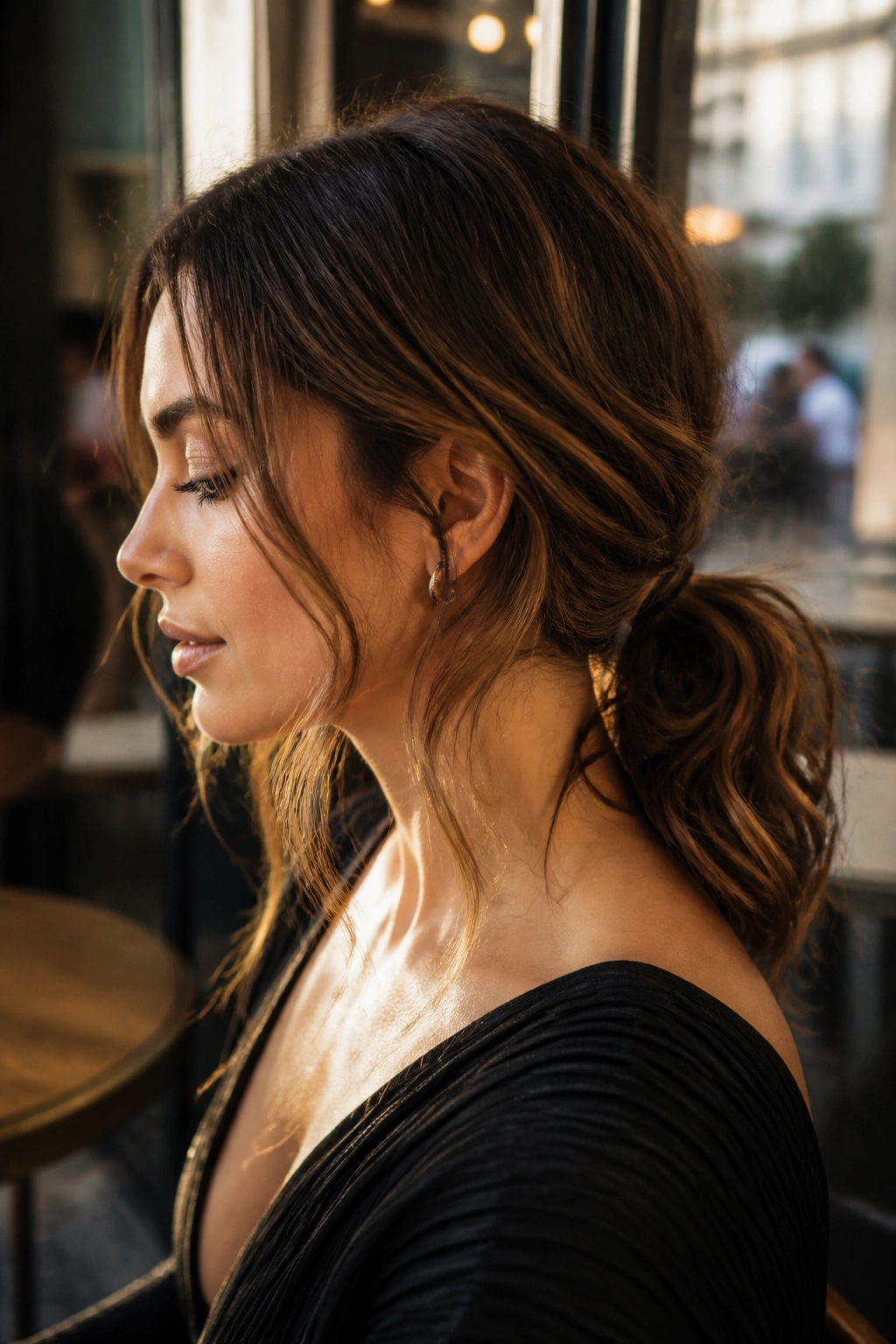
A messy low ponytail with waves can be one of the nicest low hairstyles for round faces, but only if the mess stays in the right place. You want movement through the lengths, not a cloud of volume around the cheeks.
Start by adding loose bends from mid-length to the ends. A 1¼-inch curling iron works well for shoulder-length or longer hair. Leave the roots mostly smooth, because root volume around the temples can make a round face look wider. Once the waves are set, gather the ponytail low and let a few face-framing pieces fall naturally.
The trick is to make the mess feel controlled. Pull the ponytail base snug, then pinch a few sections loose around the crown and temples. A small amount of texture spray gives the waves grip, but do not soak the hair. You want softness, not crunch.
This style works because it looks casual without losing shape. That is harder to do than people think.
15. Tucked Low Roll
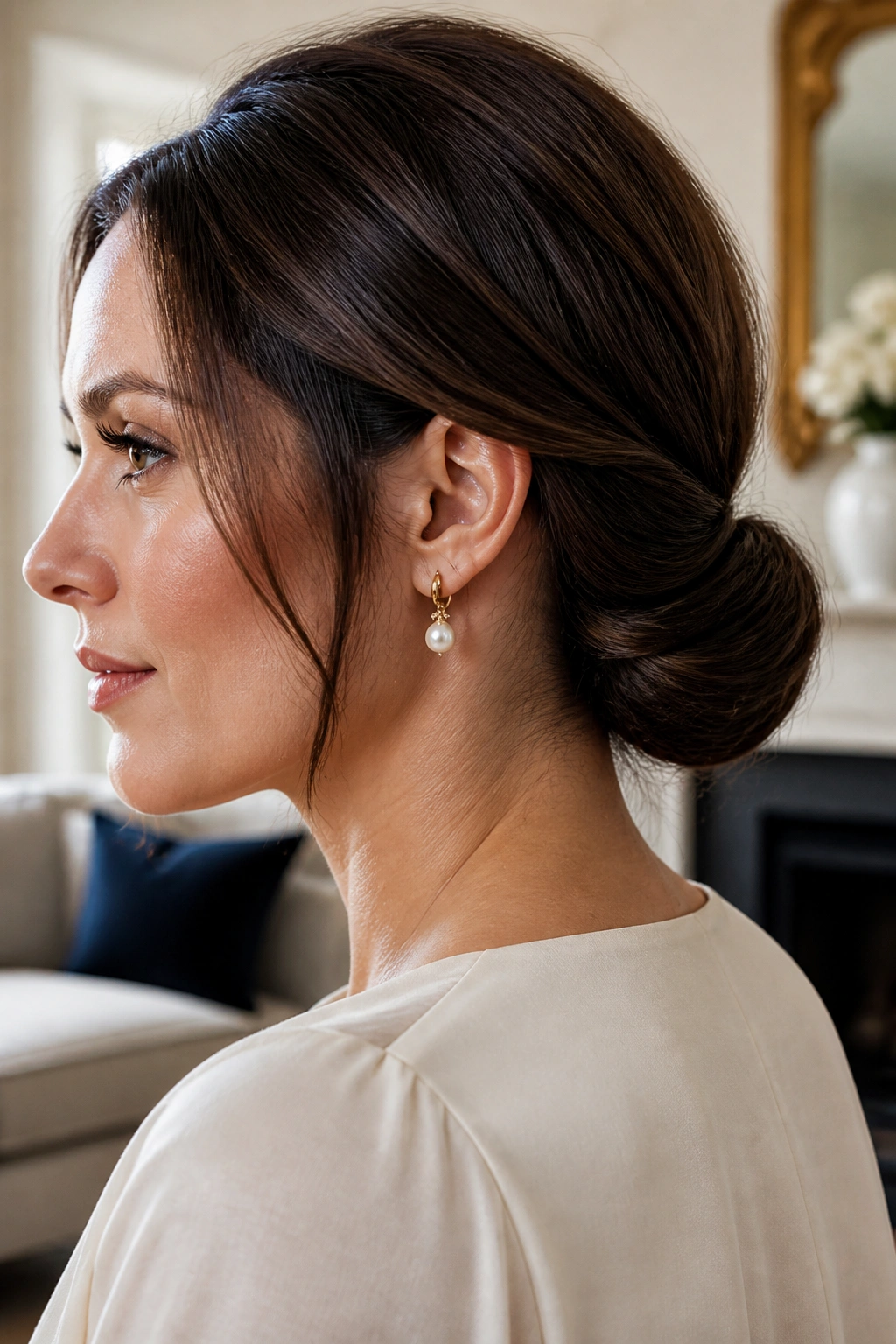
Compared with a French roll, a tucked low roll feels softer and more horizontal, which is a nice thing on a round face. The shape stays close to the nape, so it does not build extra width near the cheeks.
It is a particularly good option for shoulder-length hair. You do not need extreme length to make it work, because the ends are folded under instead of wrapped into a large structure. If your hair is layered, use a couple of extra pins along the seam so shorter pieces stay tucked in. The goal is a smooth roll that hugs the neck rather than floating off the head.
This is one of those styles that can look expensive without being flashy. That is not a word I use lightly. It has a clean line, a calm shape, and enough structure to hold up through a long day without turning stiff.
16. Low Fishtail Braid
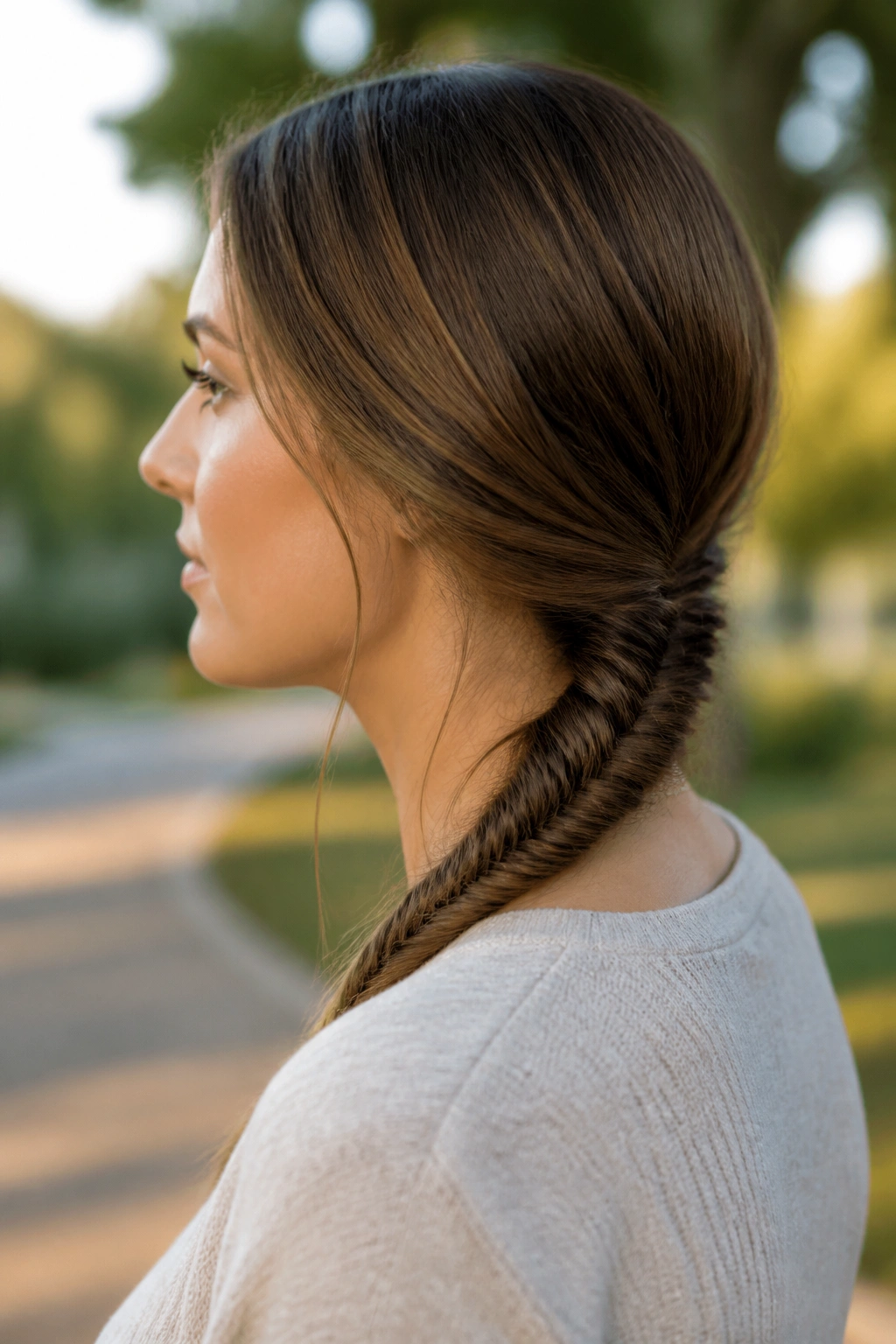
A low fishtail braid gives a round face a long, narrow line that regular braids do not always create. The pattern is finer, so the eye reads it as slimmer and more vertical.
Start the braid low, below the jaw line if you can. That placement is the whole point. If it starts too high, the braid detail moves into the area where a round face already has width. Keep the top smooth, braid the lengths with small sections, and loosen the braid just a little at the end if you want it to feel softer.
Small Details That Keep It Flattering
- Use small sections, about ¼ inch wide, for a cleaner fishtail
- Keep the first 2 inches near the scalp smooth
- Pancake the braid only after it is secured
- Finish with a thin elastic that matches your hair
It is a good braid for straight, wavy, or fine hair. On thick hair, it can look rich and dense, almost like woven fabric. Nice effect. Different result.
17. Sleek Center-Part Low Bun
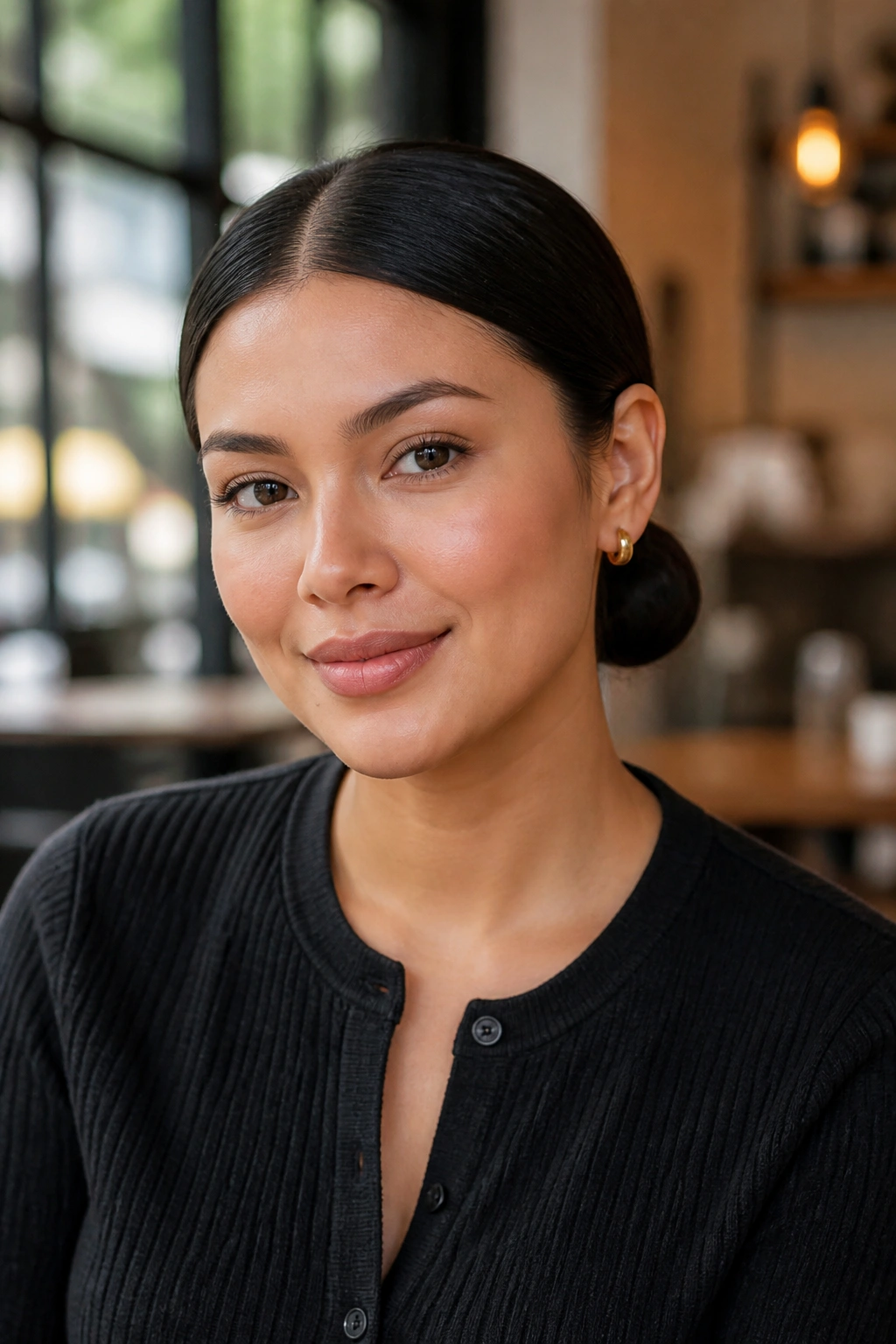
Can a center part work on a round face? Yes, if the rest of the style stays low and clean. A sleek center-part low bun can look balanced instead of severe when the bun sits at the nape and the sides are kept close to the head.
The middle part gives the face a neat vertical line. That line can help, but only if the bun does not balloon out at the sides. Keep the top smooth, brush the hair back evenly on both sides, and make sure the bun is small enough that it does not compete with the cheeks. If your hair has a lot of body, a smoothing cream or light gel can keep the part crisp.
How to Balance the Middle Part
- Keep the bun low and compact
- Leave no extra puff at the temples
- Tuck any short front layers behind the ear if they fall too wide
- Use a fine-tooth comb for a sharp part
This one has a sharper feel than a side-parted style, but that can be the whole point. Sometimes a clean line is exactly what a round face needs.
18. Low Braided Crown Knot
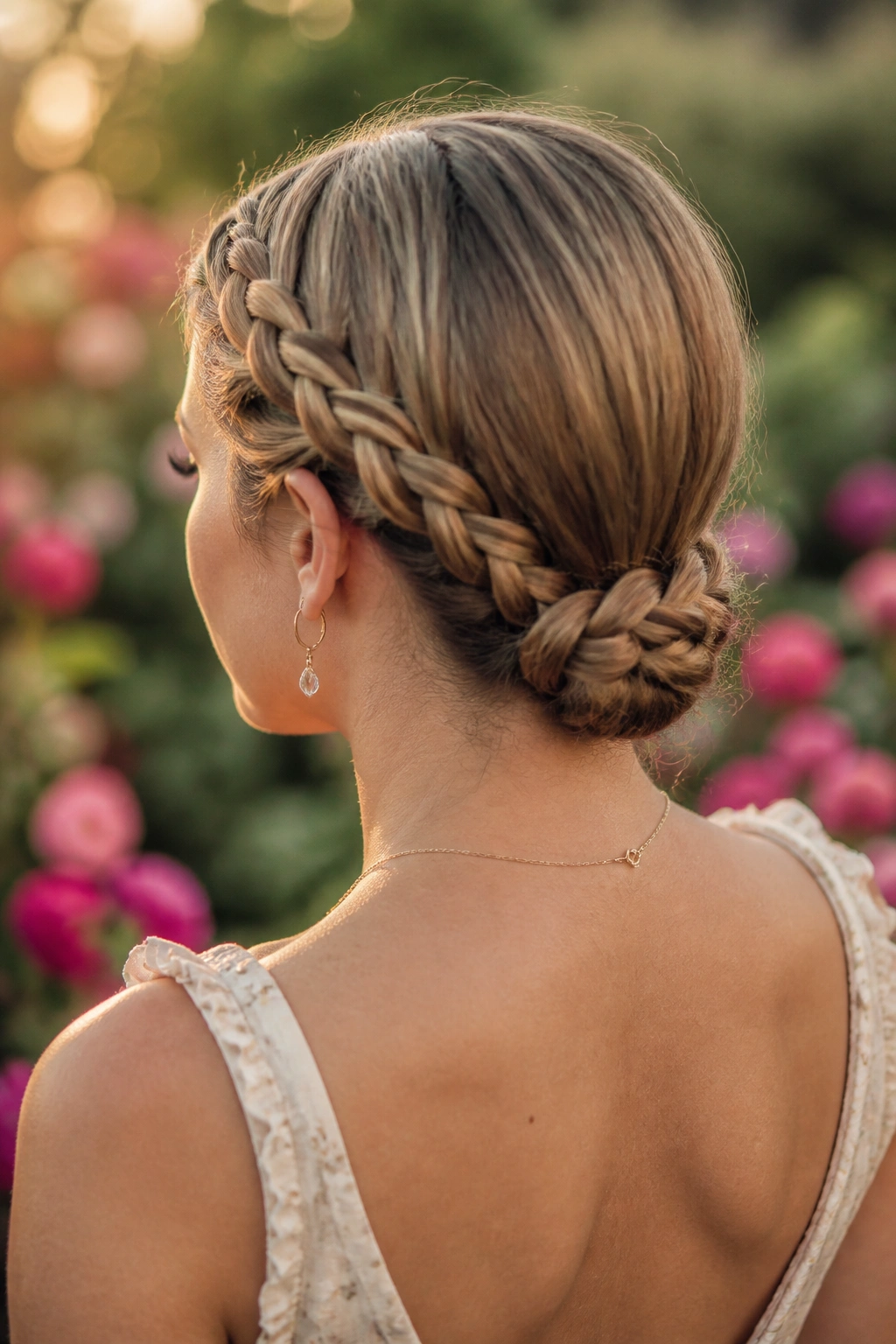
A low braided crown knot gives you braid detail without pushing the shape up into the top half of the head. That is the difference. The braid line stays low, the knot stays low, and the face keeps its long, clean outline.
The easiest version starts with two low sections just behind the ears. Braid or twist each side, bring them back to the nape, and join them into a small knot. If the braid line creeps too high, the style starts to widen the face. Keep everything below temple level and the shape stays flattering. A few loosened edges around the braid can soften the finish, but do not pull it apart so much that it loses the low, narrow shape.
- Keep the braid path low and close to the head
- Use pins that match your hair color
- Leave the knot compact, not spread out
- Loosen only the outer loops of the braid
It feels detailed, but not busy. That’s the sweet spot.
19. Low Ponytail with Flipped Ends
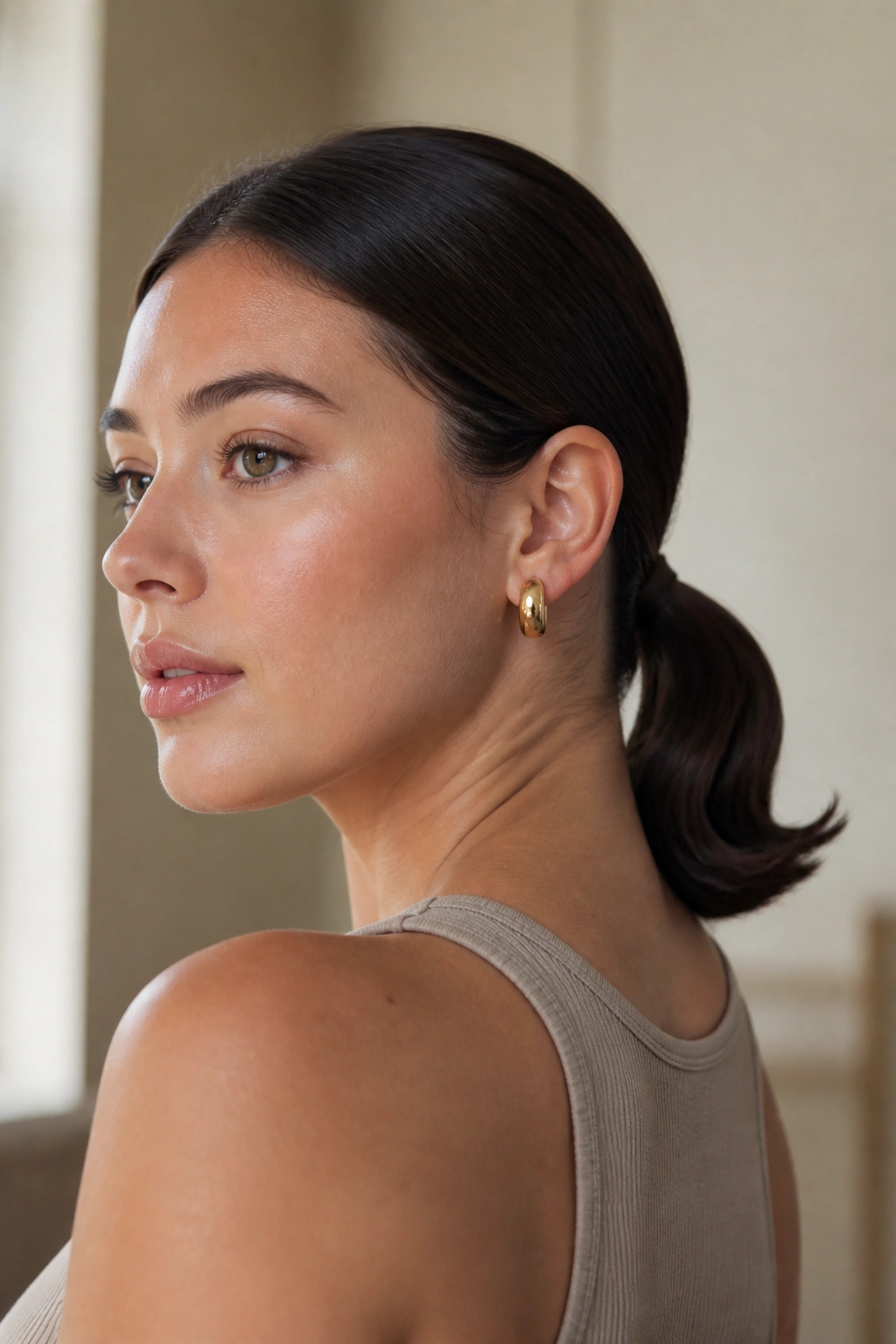
A low ponytail with flipped ends has a little retro energy, and the flip is doing more than people think. It gives the eye a reason to travel downward, which helps a round face feel a touch longer.
The style works best when the base stays sleek and the flip begins only at the last few inches. If you curl too high up the tail, the extra width lands near the shoulders and the style starts to look big. Keep the ponytail smooth at the crown, secure it low, then turn the ends outward with a flat iron or round brush. A 1½-inch iron can also do the job if you want a softer bend.
This is a nice option for collarbone-length hair that sometimes feels awkward in plain ponytails. The flipped finish gives it shape without making it fussy. Add a wrapped elastic or a slim ribbon if you want it to feel a little more finished, but it does not need much help.
20. Soft Side Chignon with Deep Fringe
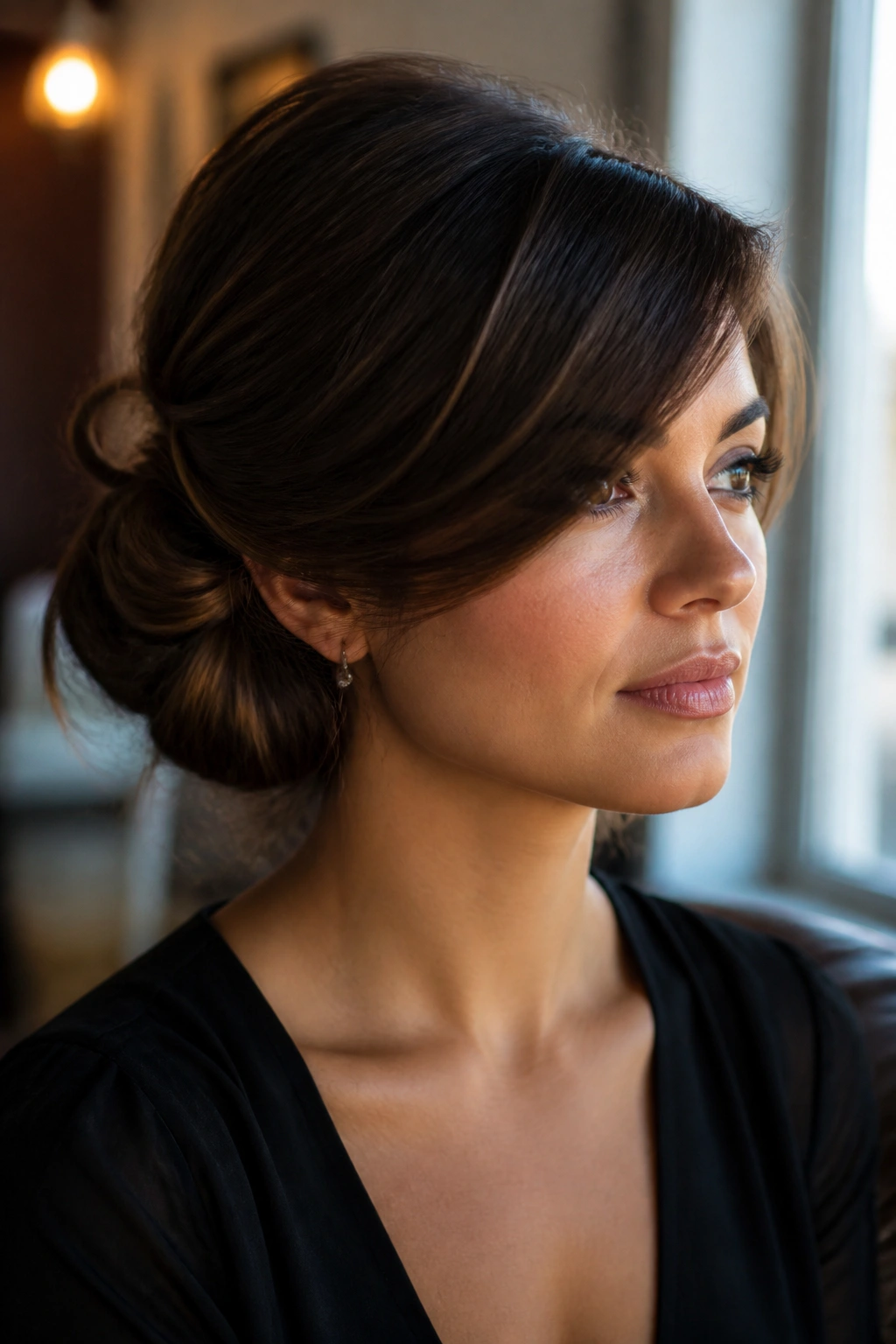
A soft side chignon with a deep fringe is one of the easiest ways to make a round face look a little longer without making the style feel stiff. The fringe pulls attention diagonally, and the chignon stays low enough to keep the shape calm.
Unlike a symmetrical bun, this one leans into the side of the head. That slight shift changes the whole mood. It is more forgiving than a center knot, especially if your hair has layers or if the front pieces like to fall out of place. Keep the chignon tucked near the nape and let the fringe sweep across the forehead, not straight down the cheeks. That sweep is the point.
It also has range. Wear it polished with smooth sides and pinned ends, or loosen it a little for a softer finish. Either way, it is one of the easiest low hairstyles for round faces to keep looking intentional. If you are trying only one style from this list first, start here.
